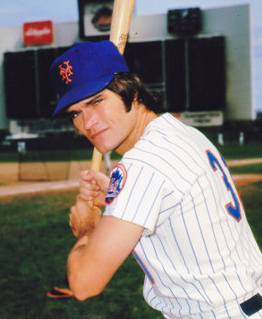
Every once in a while, I'll find a statistic or story about a Mets player that's so far out there, I have to share it. Similarly, on occasion I'll think of a title for a blog post that will go over everyone's head until they actually read the piece. And sometimes those two worlds collide. Today is one of those days.
About a month and a half ago, I wrote a piece on Anthony Young, the Mets pitcher who set a major league record by losing 27 consecutive decisions. However, the Mets didn't lose every game he appeared in during his losing streak. From the time his skein began on May 6, 1992 until he recorded his 27th straight loss on July 24, 1993, Young appeared in 77 games, making 17 starts and appearing in relief 60 times. The Mets actually won 25 of those 77 games, but Young did not receive credit for a victory in any of those contests.
This morning, I woke up with Young on my mind and decided to do some research on which Mets player appeared in the most games without ever celebrating a victory after any of those affairs. Well, thanks to the good folks who run the Baseball Musings Day-By-Day Database, I have my answer. Now excuse me while I "cram" this information into your brain.
The name is Cram. Jerry Cram.
Entering the 2015 season, a total of 62 players have appeared in at least one game for the Mets without ever going out for a winning hot dog and soda afterwards. Of those 62 players, more than half of them (37) appeared in no more than three games for the team - all losses, of course. But only four of those 62 players found their way into a game's boxscore at least 11 times. And of those four, the Met who appeared in the most losses without ever seeing a win did so 14 times. The unfortunate player's name was Jerry Cram.
Jerry Cram made his major league debut for the expansion Kansas City Royals in 1969, appearing in five games. The Royals actually won two of those games, probably spoiling Cram for life. He didn't appear in another major league game until 1974, a year after he had been traded to the Mets.
Cram pitched beautifully for the Mets in two seasons with the team, posting a 2.30 ERA in 14 relief appearances, tossing 27⅓ innings in those outings. His greatest effort came on September 11, 1974, when he pitched eight shutout innings against the St. Louis Cardinals. Cram entered the game in the 17th inning and pitched through the 24th frame, scattering seven hits and two walks. He also went 1-for-3 at the plate, collecting the only hit of his career in the 18th inning.
Once Cram was taken out of the game for pinch-hitter Rusty Staub in the bottom of the 24th, the Cardinals took advantage, as speedy center fielder Bake McBride led off the top of the 25th inning with a single, then came all the way around to score on an errant pickoff throw by reliever Hank Webb, who was making his first appearance of the season for the Mets. Webb's battery mate, Ron Hodges, was charged with the team's second error on the play, as he was unable to hold on to the throw by first baseman John Milner, allowing McBride to score the go-ahead run. The Mets lost the game in 25 innings, which to this day remains the longest game in National League history that did not end in a tie. (Brooklyn and Boston played a 26-inning affair in 1920 that ended in a 1-1 tie.) The game was also Cram's fifth appearance for the Mets in 1974, with all of them ending in losses. Cram appeared in five more games that month following his eight-inning relief effort and never celebrated a victory with his teammates. The Mets went 0-10 in Cram's ten appearances in 1974. Cram didn't appear in as many games during his second season with the Mets in 1975, making just four relief appearances for the team in April and May. Once again, the Mets failed to win any of those games. In fact, in all 14 of his games during his two-year tour of duty in Flushing, Cram never pitched with the lead. Three times he entered a game with the score tied - the Mets eventually lost each game - and 11 times he came into a game with the Mets trailing. They were trailing at the end of those games as well. Three pitchers in Mets history appeared in exactly 11 games with nary a happy recap to show for it. Jerry Hinsley made two starts and seven relief appearances for the Mets in 1964, then came out of the bullpen twice in 1967. The only constant in Hinsley's career was that he only pitched in games the Mets lost. Hinsley was a teammate of Joe Grzenda in 1967. Like Hinsley, Grzenda was also used exclusively in relief during the 1967 campaign, making 11 appearances. Each of those contests ended with the other team shaking hands after the game. Finally, we have Collin McHugh, who made five starts and appeared in relief six times for the Mets between 2012 and 2013.
Collin McHugh fell short of Cram's mark.
McHugh pitched seven shutout innings in his major league debut, becoming the second Met to strike out as many as nine batters in his first big league start (Matt Harvey set the record with 11 strikeouts a month before McHugh.) But unlike Harvey's effort in his debut, McHugh didn't earn a win in his, as no Mets hitter was able to cross the plate while McHugh - or any other Mets pitcher - was in the game. That was as close as McHugh came to appearing in a Mets victory, as his next ten appearances in a Mets uniform resulted in ten losses for the team. Now pitching for the Houston Astros, McHugh has left the losing behind, as he won 11 games in 2014 and posted a stellar 2.73 ERA in 25 starts. Although the Astros finished 22 games under .500 in 2014, they posted a winning record (13-12) in McHugh's starts. Hinsley, Grzenda and McHugh never appeared in a game won by the Mets, but at least they weren't as unlucky as Jerry Cram. He and his teammates all experienced the agony of defeat in each of Cram's 14 appearances in a Mets uniform. And for those of you curious about what happened to Cram after he pitched his final game for the Mets in 1975, well, he went back to Kansas City to pitch for a much-improved Royals team in 1976. Kansas City won its division in 1976, finishing the year with a 90-72 record. Cram appeared in four games for the A.L. West champions. What happened in those games? The Royals lost them all, meaning Cram never got to experience a victory in a game he pitched after the 1969 season. Anthony Young lost 27 straight decisions, but at least his teams won 25 times when he took the mound during his 14-month streak of individual futility. Jerry Cram probably wished he could have had Young's good fortune as a Met.
Every once in a while, a player is anointed as "the next big thing" by baseball pundits. Whereas some of these players do proceed to have spectacular careers, others end up being complete duds.
The Mets have had both types of "next big thing" players. They've had the success stories who played incredibly well in a Mets uniform, like Tom Seaver and Darryl Strawberry. But they've also had guys who didn't quite live up to the lofty expectations. Players like Gregg Jefferies and Paul Wilson come to mind.
It's bad enough when one of these supposed sure things flames out at the big league level. But it's far worse when that player is so highly touted that he ends up replacing an established veteran - only to have the veteran continue to play at a high level long after the so-called phenom's star has fizzled.
In 1975, the Mets fell into that trap, letting a one-month hot streak by a neophyte dictate whether or not they needed to keep an aging star. They made the wrong decision, and in doing so, changed the fortune of the team for the better part of a decade.
Mike Vail's one good month caused the Mets to have seven bad years.
Michael Lewis Vail was drafted by the St. Louis Cardinals in 1971 as an infielder who occasionally played in the outfield. Vail struggled as a hitter in his first two minor league seasons, batting .235 in just under 500 at-bats, causing him to be demoted from the Double-A level back to Single-A for the start of the 1973 season. But Vail started to turn things around in 1973, raising his average to .278, while banging out 31 doubles, nine triples and 15 homers. In 1974, Vail's power production remained consistent, but his batting average soared to .334. That caught the eye of the Mets' front office, who traded utility player Ted Martinez to the Cardinals for Vail and infielder Jack Heidemann in December.
Leaving the Cardinals organization did nothing to impede Vail's development, as he proceeded to bat .342 at Tidewater in 1975, posting an outstanding .888 OPS with the Mets' Triple-A affiliate. For his efforts, Vail was named the International League Player of the Year and earned his first promotion to the big leagues.
Prior to Vail's promotion in August, the Mets had used six different left fielders, with none of them having started more than 64 games at the position. Vail made his major league debut on August 18, collecting a pinch-hit single off Houston's hard-throwing right-hander J.R. Richard. Vail became the seventh Met to start a game in left field two days later, but went 0-for-5. Through his first four games at the big league level, Vail collected three hits in 11 at-bats. He more than doubled his career hit total in his fifth game - a game that began Vail's march into the record books.
Facing the San Diego Padres on August 25, Vail went 4-for-4 with a walk, becoming the first Met to collect four hits in a game during his first month in the big leagues. Vail collected three hits the following day and two more hits in the series finale against the Padres. But as August turned to September, the Mets faded from the NL East race. A victory over the Pirates on September 1 - a game in which Vail hit his first major league home run - moved the Mets to within four games of first place Pittsburgh. The joy was short-lived, however, as the Mets proceeded to lose eight of their next nine games to fall ten games out of first.
The Mets may have stopped winning in September, but Vail never stopped hitting. By September 9, Vail was hitting .358 and had recorded eight multi-hit games in his first 18 starts. Three days later, Vail extended his hitting streak to 20 games, making him just the third Met to collect a hit in 20 or more consecutive games, joining Tommie Agee and Cleon Jones, who both accomplished the feat in 1970. The hit streak by Jones eventually reached 23 games, and on September 15, Vail matched him.
Trailing 2-0 in the sixth inning against the Montreal Expos, Vail delivered a two-out, run-scoring single off Steve Rogers. Vail not only cut the Expos' lead in half, but he extended his hitting streak to 23 games, tying Cleon Jones's franchise record and the modern National League record for rookies. Vail joined Joe Rapp (1921), Alvin Dark (1948) and Richie Ashburn (1948) as the only Senior Circuit rookies to string together a hitting skein of 23 games. Two innings later, Vail delivered his second hit of the game, an RBI single that scored the decisive run in the Mets' 3-2 victory.
Unfortunately, Vail could not break the Mets' record for longest hitting streak, even though he got plenty of opportunities to do so. On September 16, during an 18-inning marathon against the Expos, Vail drew a first-inning walk, then failed to collect a hit in his next seven plate appearances. When Del Unser drew a bases-loaded walk to force in the winning run in the Mets' 4-3 victory, Vail was two batters away from getting a ninth chance to extend his streak.
With the streak now in the past, the Mets could contemplate their future - one that involved Mike Vail as an everyday player. But Vail's future in New York was not in left field. Rather, it was in right, a position that was occupied by Rusty Staub, who had just completed the first 100-RBI campaign in Mets history.
Staub had already played 13 seasons in the major leagues and was thought to be entering the downside of his career. Plus, with slugger Dave Kingman setting a franchise record by hitting 36 home runs in 1975, Staub was deemed expendable. The Mets were also searching for a fourth starter to use behind Tom Seaver, Jerry Koosman and Jon Matlack, and believed they had found him in Detroit in 207-game winner Mickey Lolich. General manager Joe McDonald was certain that Vail was ready to replace Staub in right, and thought of something the Brooklyn Dodgers had done in the early 1940s.
"When we won in 1973, George Stone won 13 games. But the last two years, we haven't had a consistent fourth starter. Stone had arm trouble and Randy Tate and Craig Swan couldn't quite do it. In getting Lolich, it reminds me of when the old Brooklyn Dodgers were winning with Larry French as their fourth starter."
If that was the reason McDonald acquired Lolich, then the Mets were in serious trouble. For one thing, French only started 15 games for the Dodgers in 1941 and 1942, appearing in relief 29 times. In his only full season with the Dodgers (1942), French did pitch beautifully, going 15-4 with a 1.83 ERA. But the Dodgers didn't win the pennant in 1942, finishing two games behind the eventual World Series champion Cardinals. They did advance to the World Series the previous year, but French only started one game for the Dodgers in 1941. (And not to nitpick, but McDonald's selective memory also pegged George Stone as a 13-game winner in 1973 when he only won a dozen games.)
While it was true that Mickey Lolich had had a solid career in the majors, winning 207 games prior to being traded to the Mets for Rusty Staub, McDonald failed to notice one important detail about Lolich's career. In his first eight years in the big leagues (1963-70), Lolich never pitched more than 280⅔ innings in any season. But from 1971 to 1974, Lolich never pitched fewer than 308 innings, peaking in 1971 when he tossed a mind-boggling 376 innings in 45 starts.
Staub had come off a 1975 season in which he received MVP consideration. Lolich was coming off a 1975 campaign in which he went 12-18 and pitched just 240⅔ innings, his lowest total since 1968. Lolich might have been able to give the Mets the innings they needed out of a fourth starter, but he certainly wasn't going to help them win. In other words, Lolich was not going to be the Mets' version of Larry French, something that was confirmed when Lolich went 8-13 and pitched just 192⅔ innings in his only season as a Met.
While Joe McDonald was busy trading away his MVP candidate for a washed-up pitcher, Mike Vail was busy getting hurt playing basketball. A dislocated right foot suffered in January caused Vail to miss half of the 1976 season. Upon his return, Vail spent most of June and July on the bench, starting just six games over the two months. Vail played in just 53 games in 1976, batting .217 in 143 at-bats. His total of 31 hits during the 1976 campaign was three fewer than the number of hits he collected during his 23-game hitting streak the previous summer.
Vail played one more season with the Mets in 1977, but never hit enough to play every day. He shared right field duties with Dave Kingman and Ed Kranepool during the season's first half, then ended the year in a right field platoon with Bruce Boisclair. Vail was then claimed off waivers by the Cleveland Indians prior to the start of the 1978 season.
In three years with the Mets, Vail produced a total of 25 doubles, 11 homers and 61 RBI. In his first three years with Detroit following the trade to make room for Vail, Rusty Staub averaged 31 doubles, 20 homers and 106 RBI per season. Needless to say, Vail didn't exactly make Mets fans forget about Rusty Staub.
Throughout the team's history, many young players have been viewed as the next great Mets prospect. For Mike Vail, an unexpected long hitting streak that began a week after he made his major league debut gave the team hope that it had found its newest young star - one that could shine at Shea Stadium for many years to come.
For one brief moment in time, Mike Vail was heralded as the future of the Mets. Instead, all he did was convince a general manager to make an ill-fated decision, one that brought the Mets back to its ugly past. It would take years for the team's future to be bright again.
Note: One Mo-MET In Time is a
thirteen-part weekly series spotlighting those Mets players who will
forever be known for a single moment, game or event, regardless of
whatever else they accomplished during their tenure with the Mets. For previous
installments, please click on the players' names below:
In the late 1990s, Nike had a famous ad in which future Hall of Fame pitchers Greg Maddux and Tom Glavine wondered why they didn't get the attention afforded to slugger Mark McGwire. Upon realizing that McGwire's adulation arose from his propensity to hit prodigious home runs, the two decided to hit the gym, "bulking up" so they could hit long batting practice blasts as well. Actress Heather Locklear appeared to take notice at their newfound power, calling out Glavine's name and causing Maddux to utter the now-famous catch phrase, "chicks dig the long ball". But in reality, all Locklear wanted to know was if the pitchers had seen McGwire around the batting cage.
The commercial, although funny and unrealistic (Maddux and Glavine combined to hit six home runs in nearly 3,500 career plate appearances), did get one thing right. Baseball fans - including "chicks" - really do get excited about home run hitters, especially ones who hit titanic blasts. Mark McGwire hit 583 home runs. But he only had 1,043 hits that didn't leave the park, and he also struck out nearly 1,600 times in his 15-plus years in the big leagues. But fans flocked to catch a glimpse of the red-headed slugger despite the fact that he was purely a one-dimensional hitter.
When McGwire was called up the majors for the first time in 1986, he became teammates with another great power hitter - one who could hit balls a mile whenever he didn't swing and miss at them, and one who also had no desire to keep his hits within the confines of the ballpark. This slugger finished his career as McGwire's teammate in Oakland, but hit the plurality of his home runs as a member of the New York Mets. And when he came to bat for the Mets in the mid-'70s and early '80s, "chicks" - and everyone else - stopped what they were doing to see what he was about to do.
More powerful than a locomotive. It's a bird. It's a plane. It's Dave Kingman!
David Arthur Kingman was a huge man. Standing six-and-a-half feet tall, the hulking first baseman and outfielder was selected by the San Francisco Giants as the first overall pick in the 1970 June secondary draft. Kingman made his debut a year later, and made his first trip to the postseason as a member of the National League West champion Giants. But after hitting .278 in 41 games as a rookie in 1971, Kingman could only muster a .218 batting average from 1972 to 1974. However, he did manage to hit 71 home runs over the three seasons, giving him some value as a major league talent.
But according to Giants owner Horace Stoneham, Kingman was unhappy in San Francisco and wanted to be traded from the Bay Area team. The Mets, who had coveted the young slugger for years, had offered pitcher Jerry Koosman for Kingman in 1973, but could not come to an agreement with San Francisco because the Giants asked for former Rookie of the Year pitcher Jon Matlack instead. Two years after almost becoming a Met, Kingman finally switched coasts after the Mets purchased him from the Giants for $150,000.
When Kingman arrived in New York prior to the 1975 season, he did not have a position on the field to play. Kingman preferred playing first base, but John Milner was the incumbent at that position. Left field - another position Kingman could play - was also taken, as long-time Met Cleon Jones had manned the position for the better part of a decade. But Jones had injured his knee and would not be coming north with the team for the start of the season, giving Kingman the opportunity to play every day until Jones came back from his rehab assignment.
Unfortunately, two problems arose for Jones during his time in extended spring training. First, he was arrested for indecent exposure when police found him and a female companion sleeping nude in the back of a van. And second, Kingman got off to a powerful start, hitting home runs in three of his first four games and reaching double digits in homers by his 46th game. Jones, who finished the 1974 season as the team's all-time leader in home runs with 93, had hit 13 long balls for the Mets in '74. Kingman had surpassed that number by the All-Star Break. In fact, Kingman hit 13 homers in the month of July alone, setting a new franchise record for round trippers in a single month. Less than two weeks after the Midsummer Classic, Jones' career with the Mets came to an abrupt end, as he was given his unconditional release by the team.
Jones' release came after an 11-game stretch by Kingman in which he batted .348 with seven homers and 14 RBI. One month after Kingman's torrid stretch, he was finally moved to his preferred first base position to make room for rookie left fielder Mike Vail, who had embarked on a blistering streak of his own - a club-record 23-game hitting skein from August 25 to September 15. Although Kingman continued to hit with tremendous power at his new position (12 HR in his last 39 games), he didn't do much else with the bat, batting .199 with 58 strikeouts in 161 at-bats. Still, fans continued to watch in awe every time the Sky King stepped up to the plate, especially on September 18, when Kingman penned a new entry in the Mets' record book.
With the season winding down and the Mets barely hanging on to their division title hopes, the team welcomed the Chicago Cubs to Shea Stadium. Starting pitcher Hank Webb made the Cubs feel very welcome, allowing four runs without retiring a batter. In doing so, Webb became the ninth pitcher in Mets history to fail to record an out in a start, and just the second to accomplish the feat at Shea Stadium (Nolan Ryan was the first, turning the terrible trick in 1971). The Mets trailed 4-0 before they came to bat, but slowly chipped away at the Cubs' lead, scoring a run in the third and two runs in the sixth. After the Cubs tacked on an insurance run in the top of the eighth, the Mets tied it in their half of the inning - an inning that started on a double by Dave Kingman.
The game remained tied as the Mets came to bat in the bottom of the ninth, and extra innings loomed after Cubs' closer Darold Knowles retired the first two batters in the frame. But Knowles - who just two years earlier had stymied the Mets as a member of the Oakland A's in the World Series, pitching in all seven games and recording the final out in Game Seven - couldn't retire Rusty Staub, who laced a single off the lefty reliever. That brought up Kingman, who exorcised the Knowles demon from 1973 by exercising his right to walk off the field as a winner. Kingman's two-run, game-winning blast gave the Mets a thrilling, come-from-behind 7-5 victory and also gave him 35 homers on the season, breaking Frank Thomas' single-season club record.
Kingman would go on to hit another round tripper before the end of the season, finishing the year with 36 homers and 88 RBI. Although Kingman hit just .231 for the year, that figure still represented his highest batting average over a full season at the time. Kingman also set a career high with 22 doubles and led the Mets with seven stolen bases, making him just the third Met to lead the team in homers and steals in the same season after Tommie Agee (1970, 1971) and John Milner (1974). But with great power comes great strikeout totals, as Kingman fanned a career-high 153 times in 1975. He also rarely scored when he wasn't driving himself in, as he crossed the plate just 65 times despite hitting 36 homers. The 1975 Mets posted a winning record, albeit barely, ending the year with an 82-80 mark.
Despite his high strikeout totals and inability to round the bases without the ball leaving the yard, Kingman became an instant fan-favorite at Shea. A Dave Kingman at-bat was a celebrated event in Flushing, giving fans a good reason to come rushing back from the concession stands at the risk of dropping their hot dogs or spilling their beer. The peak of his popularity with Mets fans came in 1976, when he began the year on a sizzling pace.
After going 0-for-7 in his first two games, Kingman unleashed a barrage of booming blasts, belting seven homers over his next seven games and driving in 15 runs. By late-May, Kingman was leading the league with 17 homers and was hitting around .250, which was quite admirable for a man who was a .226 lifetime hitter coming into the season. Kingman's best game as a Met came in early June, when he and the team visited Dodger Stadium in Los Angeles.
The game on June 4 started out without pomp and circumstance for Kingman, as the right fielder (Kingman had been moved to right by new manager Joe Frazier to allow Ed Kranepool and Joe Torre to platoon at first base) popped out to first base in his first at-bat. But Kingman homered in each of his next three at-bats, victimizing starting pitcher Burt Hooton for a two-run homer in the fourth inning and a three-run blast in the fifth. Kingman then took reliever Al Downing deep in the seventh inning, launching his second three-run homer of the game. In all, Kingman drove in eight runs in the Mets' 11-0 whitewashing of the Dodgers, setting a new club record for RBI in a game. Kingman also became the second Met to produce a home run trifecta, joining Jim Hickman, who accomplished the feat in 1965.
By this time, Kingman had already established himself as the premier home run hitter in the league. His 30 home runs before the All-Star Break set a team record and his name was being mentioned in the same breath as Hack Wilson and Roger Maris, the National League and major league single-season home run leaders, respectively.
For his outstanding performance during the season's first half, Kingman was selected by the fans to start the All-Star Game for the National League in 1976, making him the seventh Met to receive that honor after Ron Hunt (1964), Jerry Grote (1968), Cleon Jones (1969), Tom Seaver (1970), Bud Harrelson (1971) and Willie Mays (1972). But less than a week after going 0-for-2 in the Midsummer Classic, Kingman's assault on the single-season home run record came to a crashing end, quite literally.
Dave Kingman always kept his eye on the ball. He should have done the same with his thumb.
In a game against the Atlanta Braves at Shea Stadium on July 19, pitcher Phil Niekro knuckled a fly ball to left field, where Kingman was making just his fifth start of the season after playing much of the year in right field. But the man known as Kong took a dive that resembled his namesake's fall from the Empire State Building rather than that of an All-Star outfielder. As a result, the only thing Kingman caught on the awkward attempt was his thumb under his glove, causing him to spend nearly six weeks on the disabled list with torn ligaments in his left thumb. Upon his return in late August, Kingman was a shell of his former self. Other than a two-homer, five-RBI performance against the Pittsburgh Pirates on September 19, Kingman managed to produce just three homers and nine RBI in his other 31 games following his DL stint.
A year after finishing two homers behind Mike Schmidt for the National League home run crown, Kingman settled for second place again, as his time on the disabled list allowed Schmidt to pass him for the title during the season's final week. Kingman did manage to break his own club record by hitting 37 homers in 1976, but he could have produced an all-time great season had he not been felled by his outfield play. The Mets, on the other hand, were not hampered by Kingman's injury, as the team went on post an 86-76 record in 1976, which represented the second-highest win total in franchise history. The team appeared to be headed in the right direction going into the 1977 campaign. But then everything came crashing down, with Kingman being caught in the rubble.
Going into the 1977 season, Mets chairman M. Donald Grant had made it clear that he did not want to pay his players much money nor did he want to go shopping in the free agent market. The team's off-the field problems caused by Grant's thriftiness (some would call it cheapness) started to affect their play on the field. The Mets began the year with a 9-9 record, then proceeded to lose 21 of their next 27 games. Kingman had spent most of the season complaining about the direction of the team, as well as the fact that no one was listening to his demands for a multi-million dollar contract.
"My only demands are in line with the dollar figures given to other players on other clubs. The Mets adhere to a policy of trying to remain in their own league on salaries," said Kingman, prior to the start of the 1977 campaign. "I look around and see the dollar figures of other players and I ask, why? Why should I play for the old figures the Mets are imposing?"
Clearly, with statements such as that one, Kingman's days as a Met were numbered. It also didn't help that after the Mets' 9-9 start in 1977, in which Kingman batted .290 with six homers and 18 RBI, he proceeded to bat just .169 with three homers and ten runs batted in over his next 40 games. Adding more fuel to Kingman's fire was an admission by general manager Joe McDonald, who used statistical data in an attempt to prove that Kingman's offensive production wasn't as valuable as it seemed.
"Dave hits home runs, but he also strikes out a lot. And we found that he does not rank very high in production," said McDonald in a press conference that was held in response to one of Kingman's own press conferences. "For example, in pressure situations late in games where you're three runs behind with men on base, Mike Schmidt of Philadelphia knocks in a run 42 percent of the time, Steve Garvey of Los Angeles 36 percent of the time, and Kingman only 18 percent."
As impressive as McDonald's knowledge of pre-sabermetrics was, there was just one little problem with his argument. It was completely untrue. Kingman and Schmidt were both .282 hitters in late inning pressure situations during the 1976 season, with Schmidt hitting just one more homer than Kingman. Garvey was a better hitter in those spots, batting .339, but he hit three fewer homers than Kingman and drove in just five more runs despite having 33 more at-bats in late inning pressure situations than Kingman.
Nothing Kingman said was going to get him a contract similar to the one Reggie Jackson was given by the New York Yankees (five years, $2.96 million), no matter how similar their power numbers were. It had now become a war of words between Kingman and the front office - a war which Kingman had no chance of winning. On June 15, 1977, as the midnight hour approached, Kingman was traded to the San Diego Padres for pitcher Paul Siebert and infielder Bobby Valentine. Siebert would go on to win two games as a Met and Valentine would hit two homers during his Mets tenure. Kingman would do so much more over the next three-plus seasons.
After bouncing around from the Padres to the Angels to the Yankees in 1977, Kingman joined the Chicago Cubs in 1978, where he became more than just a home run hitter, batting .266 with 28 homers and 79 RBI in just 395 at-bats. A year later, Kingman had his signature season in the major leagues - the one Mets fans thought they were going to get in 1976 before Kingman's thumb got in the way. Kingman led the National League with 48 homers in 1979, becoming just the eighth NL player to hit that many home runs in a season. Kingman also recorded career highs in RBI (115), runs scored (97), batting average (.288) and slugging percentage (.613), leading the league in the latter category. And of course, he obliterated Mets pitching in 1979, batting .364 with nine homers and 20 RBI. Six of his nine home runs came at Shea Stadium in just eight games played in his former home park.
How much did the Mets miss Kingman's home run power after they traded him? From 1977 to 1980, no Met hit more than 17 home runs in a season. Kingman had already hit 18 homers in 1979 before the season was two months old. Without question, the Mets needed a powerful hitter in their lineup like Kingman, and as long as M. Donald Grant was calling the shots in the front office, that wasn't going to happen. But once Grant lost his power and the team had new, forward-thinking owners in Nelson Doubleday and Fred Wilpon, the Mets would get the slugger they coveted, and it would come in the form of - you guessed it - Dave Kingman.
It's snow joke! After nearly four years away from the team, Dave Kingman was a Met again.
In 1981, the Mets brought back Kingman, as well as fellow mid-'70s slugger Rusty Staub back into the fold. But familiar faces did little to erase what had become a familiar sight at Shea Stadium - losses. The Mets got off to a 17-34 start in 1981, and another season appeared lost despite the new acquisitions. Kingman was doing his part, producing 14 homers and 32 RBI by June 11, which included home runs in a club-record four straight games in late May.
But June 11 was also the last game the Mets played until August, as the players' strike wiped out the entire midsection of the 1981 season. It also gave the Mets unexpected hope, as baseball decided it would give split division titles to teams that finished in first place before the strike. That meant the slate was wiped clean for teams like the Mets who struggled during the season's first half, allowing them the opportunity to play well in the second half to earn the second half division crown.
The Mets took full advantage of their opportunity in the second half, competing for a split division title until late September. As late as September 21, the Mets were only 2½ games behind the first-place Cardinals and one game in back of the second-place Expos with 12 games to play. One of the reasons for the Mets' second-half surge was Kingman, who came back from the strike on fire. In his first dozen games after the season resumed play, Kingman batted .319 with five homers and 14 RBI. And during the team's mid-September push, Kingman was very much an integral part of the Mets' four-game winning streak from the 18th through the 21st, reaching base six times and driving in four runs.
New York fell short of a unique postseason berth in 1981, losing eight of its final 12 games to fall out of the race for the second-half division title, but Kingman came up big, leading the team with 22 homers and 59 RBI while splitting time between left field and first base. However, Kingman was the only player on the team who hit for any power, as no one else on the club could muster more than six homers.
The Mets tried to give Kingman a power buddy in 1982, acquiring George Foster from the Cincinnati Reds. On paper, it looked like a great deal for the Mets, as the team now had a dangerous one-two punch in the middle of the order in Kingman and Foster. It also allowed Kingman to become the team's full-time first baseman, as Foster was a left fielder by trade. It's too bad Foster forgot to pack his power when he made the trip from the Queen City to Queens. From 1976 to 1981, Foster averaged 33 homers and 112 RBI per year, including a 22 HR, 90 RBI performance in the strike-shortened 1981 season. But Foster came nowhere near the numbers he put up in the abbreviated '81 campaign despite playing in 151 games for the Mets in '82. With 13 homers and 70 RBI, Foster was a colossal bust in his first year with the Mets, leaving Kingman to put the team on his back when it needed a power boost. At least Kingman came through on his end of the deal. By the end of May, the Mets were one of the most surprising teams in the league. New York was in second place in the NL East as they headed into June - the proud owners of a 27-21 record - with Kingman providing his usual power (14 HR, 38 RBI). His first home run in June proved to be quite memorable, as it was his 119th homer as a Met, breaking Ed Kranepool's franchise record.
(YouTube video courtesy of CourtsideTweets)
But Kingman, despite being known as a power hitter, was not producing extra-base hits other than home runs, as he had only been able to hit three doubles and no triples during the season's first two months. That odd trend would continue throughout the rest of the season so that when Kingman went through any period of time in which he wasn't hitting home runs, the team would be left with a bunch of singles hitters. They would also be left with a bunch of losses.
For example, after clubbing 14 home runs in April and May, Kingman managed just three homers in June. Not coincidentally, the Mets were 9-18 for the month. Likewise, from August 8 to September 3, the Mets lost 21 of 24 games, which included a 15-game losing streak. During that 24-game stretch of futility, Kingman left the yard three times. He also produced just one other extra-base hit in the 24 games - a double on August 29 against the Braves. In 1982, Kingman drove in runs in 58 of the 149 games he played. The Mets went 29-29 in those games. They were 28-63 when Kingman failed to drive in a run. Clearly, the Mets fared well when Kingman was hitting homers and driving in runs. But becoming the first home run champion in club history in 1982 (Kingman's 37 homers tied his own franchise mark) and setting the team mark for RBI by a right-handed batter (99) wasn't going to do a thing for the team's success if he had no help around him. The Mets vowed to get better in 1983, and they did in various respects. The only problem was that Dave Kingman got worse.
In 1983, George Foster produced a bounceback campaign, leading the team with 28 homers and 90 RBI. He was followed closely by National League rookie of the year Darryl Strawberry, who produced 26 homers and 74 RBI. But Kingman got off to an awful start in '83, batting .168 with six homers and 13 RBI in the team's first 37 games. Even after swatting four homers in four games in late May, Kingman couldn't continue to produce at the level expected of him, as he failed to hit a home run or drive in a run in each of his next 11 games. By mid-June, general manager Frank Cashen felt a change was needed at first base, and when the Gold Glove-winning, former MVP Keith Hernandez was offered to him by the St. Louis Cardinals, Cashen jumped at the opportunity.
On June 15, 1983, the Mets completed a trade with the Cardinals that netted them the league's top defensive first baseman, as well as a consistent .300 hitter who could hit the ball to all fields and over the wall, if need be. From 1977 to 1982, Hernandez averaged 37 doubles, six triples and 11 homers per season. He also batted .303 with a .392 on-base percentage during the six years before his trade to the Mets. In Kingman's six seasons with the Mets, he averaged 12 doubles, one triple and 26 homers a year, while batting .219 and reaching base at a .287 clip. As powerful as Kingman was, his .453 slugging percentage in six seasons with the Mets was actually lower than the .456 mark posted by Hernandez in the half-dozen years prior to his trade to New York. Needless to say, Kingman's days as a Met were all but over, and his production - or lack of it - showed his disappointment at being replaced.
After Hernandez became a Met, Kingman started just six games the rest of the season, appearing mostly as a pinch-hitter over the season's final three months. Kingman batted just .175 after June 15, with one homer and six RBI - or two homers and two RBI fewer than what he produced in his record-setting three-homer, eight-RBI game against the Dodgers on June 4, 1976. The Mets chose not to bring back Kingman at the conclusion of the 1983 season, allowing him to sign with the Oakland A's as a free agent. In Oakland, Kingman experienced a power renaissance, belting 100 homers over the next three seasons. Kingman also averaged 101 RBI per season as the Athletics' designated hitter and part-time first baseman, including a career-high 118 RBI in his first year with the team in 1984. But Oakland chose not to re-sign Kingman after the 1986 season, choosing to give his spot on the team to rookie Mark McGwire. McGwire went on to become the subject of Greg Maddux and Tom Glavine's ire in a television commercial, while Kingman had trouble finding a job after finishing second in the 1986 American League home run race. It was later revealed that collusion by team owners kept free agent signings at a historically low level from 1985 to 1987, causing veteran players like Kingman to remain unsigned. Kingman eventually signed a minor league contract in 1987 with his original team, the San Francisco Giants, but batted just .203 with two homers in 73 plate appearances before ending his comeback attempt. After nearly two decades in professional baseball, Kingman decided to call it a career. And what a unique career it was.
Kingman was a unique personality whose prime focus was on one thing - hitting the ball out of the park.
In 16 big league seasons, six of which were spent with the Mets, Kingman blasted 442 home runs and produced 1,210 RBI. The only players in those 16 seasons with more home runs than Kingman were Hall of Famers Mike Schmidt (495 HR) and Reggie Jackson (448 HR). But as great as his home run and RBI numbers were, Kingman struggled to produce lofty numbers in other offensive categories. Going into the 2014 campaign, there have been 51 players in major league history who have reached the 400-homer mark. Fifty of those players scored 1,000 or more runs in their careers. The lone exception is Dave Kingman, who crossed the plate 901 times. The player with the next fewest runs scored is Mike Piazza, who scored 1,048 times but played most of his career as a catcher, which limited the number of games he played each year. Kingman also finished his career with 1,575 hits, a number that will become the fewest number of hits collected by a member of the 400-HR club once Adam Dunn picks up his 39th hit in 2014. Kingman is already low man on the totem pole when it comes to doubles, as his 240 two-base hits have been surpassed by each of the other 50 players in the 400-HR club. (Mark McGwire is one rung above him with 252.) As a Met, Kingman became just the second man in big league history to hit 30 or more homers in a season where he failed to collect 10 doubles, joining Gus Zernial, who had 30 homers and nine doubles in 1955. (Mark McGwire became the third player to join this group in 2000 when he collected 32 homers and eight doubles.) But Kingman's 37 homers in 1982 are still the most for any player who couldn't reach double digits in two-baggers. Kingman finished his Mets career with 154 homers, which still ranks fifth in club history 30 years after Kong played his last game with the team. But he only cracked 70 doubles as a Met. There have been 143 players in team history who have hit ten or more homers during their time in New York. Kingman is the only one of those 143 players to finish his career with more than twice as many homers as he had doubles. Similarly, there have been 215 players who scored 30 or more runs in their Mets careers. Of those 215 players, the only one who drove himself in more than his teammates did (meaning more than half of his runs scored came on his own homers) was Kingman, whose 154 homers as a Met contributed to more than 50 percent of his 302 runs scored. With Dave Kingman, you were going to get one of two things. You were either going to see him hit the ball out of the park (442 HR) or you were going to witness a whiff (1,816 Ks). But you were definitely going to see something. After all, no one left his or her seat whenever the slugger stepped up to the plate, especially at Shea Stadium, where Kingman hit more home runs than he did at any other park.
Kingman's monster clouts got him the nickname Kong, and his high fly balls earned him the Sky King monicker. But other words that stuck to him were "surly", as well as "grouchy" and "malcontent". Kingman never had a favorable relationship with the media, as evidenced by the bucket of ice water he dumped on a media member's head while with the Cubs in 1980 and the live rat he sent to a female sportswriter during the 1986 season in Oakland. Each incident occurred during his final season with his respective teams. He also was never fond of the front office, as he regularly quarreled with his bosses over money, playing time and anything else that came to his mind. But chicks dig the long ball. And Kingman did plenty of that.
"I enjoyed the six years on the Mets. I'm very happy and very content. I can't imagine making a living any other way than hitting a baseball. When you take a good cut and pitcher and hitter alike know where it's going, that's the joy of being a power hitter."
--Dave Kingman, as told to the NY Daily News (Photo by Ed Leyro/Studious Metsimus) Dave Kingman may never be considered an all-time great. He also may never be able to shake his status as a surly slugger. But as a Met, no one made fans stay in their seats more than Kingman did. In three of his six seasons with the Mets, Kingman had more than twice the number of home runs hit by any of his teammates. Kingman finished the 1976 season with 37 homers. John Milner was second on the team with 15. Similarly, Kingman's 22 homers in 1981 were almost four times the amount hit by second-place finisher Lee Mazzilli, who hit a mere six homers for the '81 squad. A year later, Kingman's 37 homers were two dozen more than runner-up George Foster, who was the only other Met besides Kingman to hit more than eight home runs in 1982. Kingman played his first season in New York on a team that needed to win its final game to finish the year with a winning record. His second year as a Met, the team finished ten games above .500. But that was as good as it got for a Kingman-led team in New York. The Mets never came close to .500 in any of his other four seasons with the team.
Dave Kingman had his share of flaws, both on and off the field, but he was also the best power hitter on some of the most powerless Mets clubs. Unfortunately for the team, he was perhaps the only reason fans got excited to come to Shea Stadium during his time in New York. As Kingman once said, that's the joy of being a power hitter. That's also the sadness of playing for the Mets in the late 1970s and early 1980s.
Note: The Best On The Worst
is a
thirteen-part weekly series spotlighting the greatest Mets players who
just happened to play on some not-so-great Mets teams. For previous
installments, please click on the players' names below: