Showing posts with label 20-Game Winners. Show all posts

Saturday, June 29, 2013

Matt Harvey Is The Bizarro Bobo Newsom

When Matt Harvey left Friday night's game after pitching seven outstanding innings, it appeared as if he had a great chance for a victory.  After all, the Mets were nursing a 4-1 lead and only needed six outs from the bullpen to wrap up their 33rd win of the season.  But how quickly things changed.  The Nationals scored five runs in the final two innings to complete a 6-4, come-from-behind victory, denying Harvey his eighth win of the year.

The not-so-shocking turn of events gave Harvey his ninth no-decision of the year.  Going back to his major league debut last July, Harvey now has more no-decisions (11) in his career than wins (10), despite posting a spectacular 2.25 ERA, 0.95 WHIP and 202 strikeouts in 176⅓ innings.

Eventually, Matt Harvey will get his share of wins.  But seeing spectacular performance after spectacular performance wasted by a lack of offense or a faulty bullpen has got to be weighing on him.

Harvey is not the first pitcher whose win total doesn't jibe with his other statistics.  In fact, there was one particular pitcher whose numbers were so awful, he should have lost 20 games.  But he won 20 instead.  Such was the 1938 season of Bobo Newsom.

Everything Matt Harvey has been, Bobo Newsom wasn't - except for one thing.

Bobo Newsom was a well-traveled pitcher nearly four decades before the advent of free agency allowed players to change teams at will.  Newsom played for nine teams during his 20-year career, a rather impressive feat considering there were only 16 teams in the majors at the time.

When Newsom was good, he was very good, as evidenced by his 211 career victories and four All-Star Game selections.  When Newsom was bad, he was downright awful (222 defeats, led the league in losses four times).  And at times, the Jekyll and Hyde-like Newsom was both.  Never was that more evident than in 1938, when Newsom was a member of the St. Louis Browns.

Seventy-five years ago, Newsom became a 20-game winner for the first time in his career.  He also led the league in starts (40), complete games (31) and innings pitched (329⅔), making his first All-Star team and finishing fifth in the MVP vote.   Most pitchers would love to have those numbers and accolades.  But not if they had to take some of Newsom's other numbers.

In addition to his many impressive statistics, Newsom's bizarre 1938 season also saw him lead the league in hits allowed (334), earned runs allowed (186) and home runs allowed (30), while posting an unsightly 5.08 ERA.  In doing so, Newsom became the first pitcher in American League history (and third pitcher overall) to cough up 30 dingers in a season in the modern era of baseball (post-1900).  And to this day, his 5.08 ERA remains the highest ever for a 20-game winner, while his 186 earned runs allowed are still the most given up by a pitcher since 1900.  You read that right.  The most runs yielded by a pitcher in a single season was accomplished by a pitcher who won 20 games in that season.

Newsom's season can be summarized by a start he made on June 19 against the Yankees.  In that start, Newsom allowed a whopping nine earned runs.  A total of 17 Yankees reached base against Newsom, with eight of them drawing a walk.  Of course, Newsom was the winning pitcher in that game, a 10-9 victory for the Browns.

That brings us back to Matt Harvey.  (Remember him?)  As mentioned before, Harvey has started 27 games in his career, receiving credit for a win in ten of them, while getting socked with a no-decision 11 times.  Harvey has allowed three earned runs or less in 24 of those 27 starts.  The Mets have lost 11 of them.

This year alone, Harvey has allowed one run or less in 11 of his 17 starts.  He has five no-decisions and one loss in those games, meaning that he has less than a 50-50 chance to earn a win when he allows no more than one run.  Meanwhile, Bobo Newsom allowed three runs or more in 31 of his 40 starts in 1938.  He earned a win in 11 of them.  That's one more win than Harvey has in his career.

Matt Harvey is not the first pitcher to have a low ERA and a smaller-than-expected win total.  He's not even the first Met to do this.  In 1978, Craig Swan led the National League with a 2.43 ERA, but only won nine games.  Swan was victimized by 13 no-decisions.  Nine years later, a former Met wished he had a few more no-decisions when he won an ERA title.  In 1987, Nolan Ryan finished atop the Senior Circuit with a 2.76 ERA.  But Ryan only had an 8-16 record to show for it.  He allowed two runs or less in 22 of his 34 starts for the Houston Astros, but was the losing pitcher in nine of those games and received a no-decision in six others.

In 1938, Bobo Newsom had a season in which he was easily hittable and allowed more runs than any pitcher in the modern era of baseball.  His reward for a lousy year was his first 20-win campaign.  Matt Harvey is doing everything better than Bobo Newsom did 75 years ago.  He's just not being rewarded for it in wins.  It's a bizarre story indeed.

Friday, September 28, 2012

It's Getting Easier To Say Goodbye To Shea Stadium


Four years ago today, the Mets played their final game at Shea Stadium, losing the season-ending contest to the Marlins, 4-2.  The festivities that followed were poignant and bittersweet, especially considering that the game did not have to be the last one played at Shea if the Mets had won it or any of the other 73 games they lost that season.

Saying hello again to players like Dave Kingman, George Foster and Craig Swan (all of whom played in the first Mets game I ever attended at Shea on June 15, 1983), along with seeing Doc Gooden in a Mets uniform for the first time in nearly a decade and a half made saying goodbye to Shea Stadium all the more difficult.

When Tom Seaver and Mike Piazza walked arm in arm through the center field gate and symbolically closed the Shea Stadium era, a part of my childhood was also closed for good.  Unsanitary as it may have been, I kissed the brick wall outside Gate C when I left, knowing I’d never set foot through that gate again.

Watching the Mets plod their way through the 2009, 2010 and 2011 seasons at Citi Field did not make it any easier for me to let Shea Stadium go.  Where was the black cat crossing behind Ron Santo past the visitors' dugout?  Where were Tommie Agee and Ron Swoboda making miracle catches for a miracle team?  Where was “Ya Gotta Believe”?  Where was the “K Korner”?  (For that matter, where was Kiner’s Korner?)  Where was Michael Sergio?  Where was the little roller up along first?  Where was Jesse Orosco’s glove (besides Buddy Harrelson’s hands, of course)?  Where was Todd Pratt, lifting Division Series-clinching homers into the air when he wasn’t lifting Grand Slam Singles hitters into that same air?  Where was Endy Chavez?  Where was memorable Mets baseball?  All of them had been left behind at Shea Stadium.

Shea Stadium has so many signature moments, many of which were detailed in question form above.  What did Citi Field have?  Gary Sheffield’s 500th home run,  Shake Shack and Ray Ramirez racking up the frequent jogger miles every time he ran onto the field to tend to the latest injury suffered by one of the Mets players.  In other words, Citi Field didn’t really have a signature moment.

Then 2012 came.  And Citi Field finally had its share of signature moments.

It all began on June 1, with the moment Mets fans thought they’d never see.  When Johan Santana struck out World Series MVP David Freese on his 134th pitch of the game, the Mets finally had their first no-hitter.  A sense of relief and elation enveloped Citi Field as it never had before as the no-hit monkey was finally lifted off the Mets’ backs after over 8,000 regular season games.

Santana didn’t make it through the season and neither did the Mets, but before the season ended, the team did give us two other moments to proud of at Citi Field.  First was David Wright, as he ended Ed Kranepool’s 36-year stay atop the franchise’s all-time hits list when he collected his 1,419th hit in the Mets’ penultimate home game.  That was followed less than 24 hours later by R.A. Dickey’s 13-strikeout performance in Thursday’s Citi Field finale, earning him his 20th victory and ending the Mets’ 22-year drought without a 20-game winner.

Johan Santana, David Wright and R.A. Dickey gave Mets fans a reason to get excited at Citi Field this season, even if the rest of the team couldn’t follow suit.  The Mets are about to lower the curtain on the 2012 season, but at least they gave us some defining moments at home, something that until this year was only reserved for games played at Shea Stadium (and perhaps a game or two at the Polo Grounds).

It’s always difficult to say goodbye to someone or something you love.  Whether it be a family member or an old teddy bear, those types of goodbyes are never easy.  But like everything else, we move on and accept what we’re given in life.  For the past three years, on September 28, I’d think of all the fun I used to have at Shea Stadium and the precious memories that came from those experiences, hoping that someday I’d be able to create new ones at Citi Field.  It took until the Mets’ fourth season at their new ballpark, but I now have some Citi Field memories I can be proud of.

I’ll always miss Shea Stadium, but for the first time in four years, I can now say that this year it’s been easier to let it go.  We still haven’t had a full season of success at Citi Field, but this year we were finally treated to several moments that reminded us why we became Mets fans in the first place.

We’ll always remember where we were when Johan Santana pitched his historic no-hitter.  And we’ll always be able to cherish the individual achievements of David Wright and R.A. Dickey, who both etched their names into the Mets’ record books with seasons that were decades in the making.  The best part of it all was that Santana, Wright and Dickey all accomplished their feats at home.  Not at Shea Stadium, but at Citi Field.

On September 28, 2008, I said goodbye to Shea Stadium for the final time.  Now on September 28, 2012, I can finally accept Citi Field as the place where my new Mets memories will be molded.  I’m not “calling it Shea” anymore.  I’m calling it Citi now.  It’s good to be home.


Thursday, September 27, 2012

Joey's Recap: Sponsored By "R", "A" and "20"

Hi, everyone!  This is Joey Beartran and here is my recap of today's Citi Field finale, a game that featured a number of key moments in Mets history, both inside and outside the ballpark.

Since today was a day game, we headed out to the ballpark early, especially since today was going to be The Apple's Final Mets Tailgate Ever.  So after a few hot dogs (I think I had more hot dogs than Jason Bay has doubles this year - he has two in case you didn't know or can't count past one), we took some photos of friends, tailgaters and bloggers alike before moving on to another historic event - the shaving of Keith Hernandez's iconic mustache.


The crowd that gathered around the Home Run Apple before the stroke of noon for the shaving of the 'stache was quite large.  In fact, I'd wager a hot dog that the number of people with cameras in tow was larger than the attendance at Wednesday night's game.  But then again, this was no ordinary 'stache we were talking about.

Some fans, like Matt Falkenbury of The Daily Stache, were particularly moved by the moment.  After seeing Matt's sign, I couldn't help but be moved as well.


Shortly before noon, the barber began to work his magic.  There was music playing over the speakers, with all the songs having a common "gone" theme.  I was glad they didn't play any songs from "Sweeney Todd: The Demon Barber of Fleet Street", or else Keith might not have stuck around in the barber's chair very long.

But why am I still talking?  I'll just let these exclusive photos tell the story for me.


That was the pre-game show.  Now let's move on to the game itself.  Today's game came on the heels of David Wright's historic hit against the Pirates.  Wright's 1,419th hit in Wednesday's game moved him past Ed Kranepool into the No. 1 spot on the club's all-time list.  R.A. Dickey was also trying to make history today.

With a win, Dickey would become the sixth Mets pitcher to win 20 games in a single season, joining Tom Seaver, Jerry Koosman, Dwight Gooden, David Cone and Frank Viola.  Things didn't start off so well with the Mets' resident knuckleballer, as Rod Barajas drove a long double off him in his first at-bat, followed by a home run his next time up.  Barajas' blast off Dickey gave the Bucs a 3-1 lead over the Mets, giving this bear and my 31,506 human friends in attendance a brief "oh no" moment.  But it was just brief.

An RBI single by Scott Hairston in the bottom of the fourth cut the deficit to one.  Then in the fifth, Daniel Murphy dropkicked a single to center to tie the game, which was followed by a titanic opposite field homer by David Wright.  The three-run blast could not be caught by Pirates' rightfielder Travis Snider, who made an Endy Chavez-like catch earlier in the game on a long drive by Mike Baxter.  And by Endy Chavez catch, I mean he made a highlight-reel catch in a losing effort.

Although Dickey admitted he "felt exasperated" and "was not himself today for the most part", he certainly didn't show it on the mound.  After Barajas' fourth-inning homer, Dickey did not allow another run, striking out a bazillion batters in the process.  Okay, so it was really 13 Ks, but it sure felt like a bazillion.

I guess "bazillion" didn't fit on CitiVision.

Dickey pitched into the eighth inning but with two outs, he walked Travis Snider on his 128th pitch of the game.  That was enough for Terry Collins, who removed Dickey and handed the ball to birthday boy Jon Rauch.  Rauch got the final out of the inning, but then had us all reaching for our Rolaids in the ninth.

A leadoff walk to Jordy Mercer (he of the .196 career batting average entering the game), followed by a two-run homer to Alex Presley (he of the 41 career RBIs in three seasons entering the game) cut the lead to 6-5.  But Rauch beared down (no pun intended) and got out of the inning without allowing another runner to reach base.  When Mike Baxter squeezed the final out into his glove, Dickey became the team's first 20-game winner since Frank Viola in 1990.  Interestingly, Viola also defeated the Pittsburgh Pirates for his 20th victory, as did Tom Seaver , who turned the trick twice.  Seaver picked up his 20th win against the Pirates in both 1972 and 1975.

Congratulations indeed!  What a season by the great R.A. Dickey!

Today was a day filled with many "lasts".  It was the last tailgate by The Apple (unless if the Mayans were wrong).  It was the last day Keith Hernandez got Tootsie Pop residue stuck in his 'stache.  It was the last home game at Citi Field.  But it was a "first" that became the most memorable part of the day, as R.A. Dickey became the first Mets pitcher to win 20 games in over two decades.

Although the season wasn't exactly great, Citi Field did get to witness three great moments.  In June, the home fans were treated to Johan Santana throwing the first no-hitter in team history.  Then in a span of 24 hours, David Wright became the franchise's all-time hits leader and R.A. Dickey put the cherry on top of his remarkable season (the whipped cream will be added on the day the Cy Young Award winner is announced).

Thanks to everyone who made this season special for me.  I'll miss seeing you all at Citi Field, but it'll just make me look forward to seeing you all again on April 1, 2013, when the Mets play their home opener next year.  I can't wait to see what the Mets have in store for us then.  Toodle-oo!


Friday, September 21, 2012

Why I Think R.A. Dickey Is Still A Lock For 20 Wins


Yes, you read the title right.  Despite the Mets' recent inability to score runs and despite R.A. Dickey suffering his first consecutive losses of the year, I still think the Mets' resident knuckleballer, author and documentary star is a lock to become the first pitcher since Frank Viola in 1990 to register a 20-win season for the Mets.

Call me crazy but I have three words that will explain why I'm making what appears to be a bold statement.  And those three words are:

The.  Miami.  Marlins.

For his career, R.A. Dickey is 9-2 versus the Marlins.  How great is he against the Marlins compared to other clubs?  Dickey doesn't have more than four wins against any other team in the majors.  But it's what Dickey has done against the Marlins since the start of the 2011 season that's really eye-opening.

Over the past two seasons, R.A. Dickey has made seven starts against Florida/Miami.  He's been the winning pitcher in all seven of them.  That's seven starts, 7-0 record.  Even with an 8-13 overall record in 2011, Dickey still managed to go 3-0 against the then-Florida Marlins.  And this year, he's won all four starts against Miami.

Of course, you might say that his seven victories over the Marlins over the past two seasons came at a time when the Mets were scoring more runs than they are now.  (Over their last 29 games, the Mets have scored 78 runs, an average of 2.7 runs per game.)  The lack of points on the board would make any pitcher struggle to get wins.  Just ask Matt Harvey.  But that shouldn't deter Dickey against Miami.

Since taking the mound for his first start against the Marlins in 2011, Dickey has allowed four earned runs in 51 innings versus Miami.  Four runs in seven starts.  That's an ERA of 0.71.  So basically all the Mets have had to do is scratch out a run and Dickey could put it in the books against the Fish.

R.A. Dickey will be starting against the Marlins at Citi Field on Saturday.  He will also be making a start against them in Miami during the final series of the season.  In between those starts, he will be facing the fading Pittsburgh Pirates, another team he has dominated since joining the Mets.  In four starts versus Pittsburgh as a Met, Dickey has a 1.71 ERA, 0.92 WHIP and two complete games.  Earlier this year, Dickey pitched seven innings of one-run ball against the Bucs, striking out 11 batters while picking up the win.

It's tough to say anything is a lock with the Mets these days.  But it's not tough to say this.  With three starts left, all against the Marlins and Pirates, R.A. Dickey will win 20 games this year.  You can put that prediction in the books.

Sunday, August 26, 2012

R.A. Dickey, 20-Game Winners And Losing Teams

Photo by Jim McIsaac/Getty Images North America

On Saturday, R.A. Dickey pitched seven strong innings to defeat the Houston Astros by the final score of 3-1.  In doing so, Dickey improved his record to 16-4.  Despite the win, the Mets are still 11 games under .500 with a 58-69 mark.

A few weeks ago, I wrote a piece on R.A. Dickey accomplishing two things that had never been done by a Mets pitcher in their 50-year history.  He could become the first starting pitcher for the Mets over a 162-game season to finish at least 10 games over .500 on a team with a losing record.  (Bret Saberhagen was 14-4 for the 1994 Mets, who finished three games under .500, but that was in a strike-shortened 113-game season.)  Dickey could also set a team record by winning the highest percentage of his team's games.  In 1975, Tom Seaver went 22-9 for a Mets team that finished 82-80.  Seaver was credited with a franchise-best 26.8% of his team's wins that year.  As of today, Dickey has 16 of the Mets' 58 victories, or 27.6% of the team's wins.

But now I'm looking at the bigger picture.  Barring a "ya gotta believe" 1973-style miracle, the Mets will finish the 2012 campaign with a losing record.  However, with approximately seven starts remaining on the season, Dickey still has a fair chance to win 20 games.  How rare has it been for a player to win 20 games on a team with a losing record?  It looks like it's time to put on my research shoes and tap out some stats for you.

Recently, there have been several pitchers who won 20 games for teams that were mediocre.  For example, last year Clayton Kershaw won 21 games for the 82-79 Dodgers.  In 2008, each league's leading winner played for so-so teams.  National League leader Brandon Webb won 22 games for the 82-80 Diamondbacks and American League leader Cliff Lee won 22 games for the 81-81 Indians.  But as mediocre as those teams were, none of them finished with a sub-.500 record.

You have to go back to 1997 to find the last pitcher who won 20 games or more for a team that finished with a losing record.  Two pitchers accomplished that rare feat a decade and a half ago.

Fifteen years ago, Roger Clemens went 21-7 for the Toronto Blue Jays.  Although the 1997 Blue Jays also had 15-game winner Pat Hentgen, who, like Clemens, was a former Cy Young Award winner (Hentgen won in 1996, Clemens won his fourth in 1997), Toronto didn't have other good horses to trot out to the mound on days when Clemens and Hentgen weren't pitching.  Despite Clemens' best efforts, the Blue Jays finished the 1997 season in last place in the AL East with a 76-86 record.

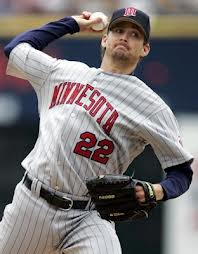
Even more outstanding than Clemens' mark was what Brad Radke did for the Minnesota Twins that same year.

In only his third season in the major leagues, Radke went 20-10 for the Twins in 1997.  But no other pitcher on the team won more than eight games that year.  As a result, the Twins finished the season with an abysmal 68-94 record, or 48-84 when Radke didn't get a decision.  Although it would mark the only time Radke won more than 15 games in a season, the lifelong Twin finished his career with 148 wins in 12 seasons with Minnesota, good for fourth place on the Washington Senators/Minnesota Twins' all-time list (the Senators moved to the Twin Cities in 1961), behind Hall of Famers Walter Johnson and Bert Blyleven, as well as 283-game winner Jim Kaat.  Radke is in great company on the Twins' all-time wins list, but when it came to his company on the 1997 Twins staff, there was none to be found.

Both Clemens and Radke won 20 or more games for American League teams with losing records in 1997, but to find the last National League pitcher to do it, you have to go back a little further, before each league split up into three divisions.

In 1992, Greg Maddux finished his final season in Chicago with a 20-11 record.  Like fellow 350-game winner Roger Clemens did five years later, Maddux also had a fine sidekick on the staff in Mike Morgan, who went 16-8 for the Cubs.  The rest of the team didn't fare so well, going 42-65 in games that the M & M boys didn't earn a decision.  The 1992 Cubs finished the season with a 78-84 record, then let Maddux walk away to sign a lucrative free agent contract with the Atlanta Braves, allowing Greg Hibbard to become the team's ace in 1993.  Of course, the Cubs somehow improved in 1993, finishing six games over .500, led by Hibbard's 15 wins (Hibbard only won one game in the major leagues after 1993, which is probably why you don't remember him).  Maddux also improved, winning the Cy Young Award in each of his first three seasons in Atlanta, en route to what will likely be a one-way ticket to Cooperstown when he becomes eligible for the Hall of Fame in 2014.

Out of curiosity, since two pitchers won 20 games for losing teams in the American League in 1997, I decided to go back and see who was the last National League pitcher before Greg Maddux to win 20 games for a sub-.500 team.  That honor went to a pitcher who was far more popular than Maddux ever was (the "Chicks Dig The Longball" ad notwithstanding"), although his lengthy career failed to produce half of Maddux's career win total.

In 1986, Fernando Valenzuela had arguably his most complete season in the major leagues.  Although he was thrust into the national spotlight in 1981, winning both the Rookie of the Year and Cy Young awards (not to mention the Silver Slugger Award) for a team that won the World Series, he only won 20 games once in his nearly two-decade major league career.  Valenzuela went 21-11 for the Dodgers in 1986, leading the league in complete games (20).  He also flashed the leather at his position, winning the Gold Glove Award for the only time in his career.  Despite a Mets pitching staff that featured four pitchers with a .700 winning percentage (Bob Ojeda, Dwight Gooden, Sid Fernandez and Ron Darling finished 1-2-3-4, respectively, in winning percentage in 1986), it was Fernando Valenzuela who led the National League in victories, doing so for a Dodgers team that finished with a 73-89 record.

Valenzuela's 1986 season was also special in one other regard.  It was the last time a pitcher in either league completed 20 of his starts.  Since Valenzuela's 20-win, 20-complete-game season in 1986, no National League pitcher has finished a season with more than 15 complete games (Orel Hershiser and Danny Jackson each had 15 complete games in 1988, as did Curt Schilling in 1998).  The most complete games by an American League pitcher since 1986 is 18, which was accomplished by Roger Clemens one year after Valenzuela's 20-complete-game season.  Only one pitcher (Jack McDowell in 1991) has reached the 15-complete-game plateau in the American League since Clemens did it in 1987.  By comparison, R.A. Dickey is currently the National League leader in complete games with four.

I am Dickey, hear me roar!
(AP Photo/Paul J. Bereswill)


With that mention of R.A Dickey, we have now come full circle.  Dickey already has a good chance of becoming the first Mets pitcher over a full 162-game season to finish at least 10 games over .500 while his team finishes with a losing record, as well as recording the highest percentage of his team's victories over a single season.  But it's not just Mets history he might make this year.

Dickey is also in line to become the first 20-game winner to pitch for a sub-.500 team since Roger Clemens and Brad Radke did so for their teams in 1997, and the first National League pitcher to accomplish the feat in two decades.  Dickey would join Greg Maddux as the only pitchers in the last quarter century to win 20 games for a losing team in the National League.

R.A. Dickey has already become one of the best pitchers in the National League.  Now he has a chance to do something that hasn't been accomplished in the major leagues since the 20th century by pitchers who are among baseball's all-time greats (Maddux, Clemens) as well as pitchers who were all-time greats on their respective teams (Valenzuela, Radke).

The Mets team might not be winning as much as its players and their fans would like, but R.A. Dickey has shown that it's possible for a losing team to have a winner on it.

Thursday, June 7, 2012

R.A. Dickey And The Quest For A 20-Win Season


Not since Frank Viola in 1990 have the Mets produced a 20-game winner.  In fact, the only Met to win as many as 17 games in a season since then was Al Leiter, who went 17-6 in 1998.  But that might change in 2012, and the man who might make it happen is R.A. Dickey.

R.A. Dickey, who just extended his personal scoreless streak to 24⅔ innings (just seven innings shy of Jerry Koosman's franchise record), is the proud owner of a 9-1 record with a 2.44 ERA through his first 12 starts.  With a full month left to the season's midpoint, Dickey is only one win shy of seeing himself halfway to win No. 20.

Will he finally end the Mets' 22-year drought of not producing a 20-game winner?  Let's look at all of the past 20-game winners in Mets history to see where they were after the first 12 starts of their 20-win campaigns.

  • Tom Seaver (1969): 8-3, 2.51 ERA through 12 starts (13 gm); finished 25-7, 2.21 ERA
  • Tom Seaver (1971): 7-2, 2.01 ERA through 12 starts (13 gm); finished 20-10, 1.76 ERA
  • Tom Seaver (1972): 8-3, 3.09 ERA through 12 starts; finished 21-12, 2.92 ERA
  • Tom Seaver (1975): 8-4, 2.16 ERA through 12 starts; finished 22-9, 2.38 ERA
  • Jerry Koosman (1976): 6-5, 4.03 ERA through 12 starts (13 gm); finished 21-10, 2.69 ERA
  • Dwight Gooden (1985): 8-3, 1.72 ERA through 12 starts; finished 24-4, 1.53 ERA
  • David Cone (1988): 9-2, 2.35 ERA through 12 starts (19 gm); finished 20-3, 2.22 ERA
  • Frank Viola (1990): 9-2, 2.04 ERA through 12 starts; finished 20-12, 2.67 ERA


Of the five pitchers who have produced 20-win seasons for the Mets, none had more than nine wins after his first 12 starts.  With today's win, Dickey has matched David Cone and Frank Viola with nine victories over their first 12 starts, although two of Cone's nine wins came in relief.

It appears that Dickey is on track to become the sixth member of the 20-win club, but there have been other pitchers in the past who got off to a quick start for the Mets, then failed to win 20 games.

In 1997, Bobby Jones had a spectacular first two months, going 10-2 with a 2.22 ERA through his first 12 starts to earn his first and only trip to the All-Star Game.  But after his quick start, he struggled the rest of the way, going 5-7 with a 4.85 ERA over his final 18 starts of the season.

Just two years ago, Mike Pelfrey got off to the best start of his career, going 8-1 with a 2.23 ERA over his first 12 starts.  But in addition to being snubbed for the All-Star team, he also failed to continue his hot start after June.  Over his final 21 starts in 2010, Pelfrey went 7-8 with a 4.60 ERA.  Both Jones and Pelfrey had to settle for 15-win campaigns in 1997 and 2010, respectively.

Johan Santana recently ended the Mets' long no-hitter drought.  Now it's up to R.A. Dickey to end another drought that no Mets pitcher has come close to ending over the past two-plus decades.  Can he become the first 20-game winner since the end of the Davey Johnson era?  Nothing is certain, but if Dickey can maintain his torrid pace, there's no reason why he can't join Seaver, Koosman, Gooden, Cone and Viola as Mets' 20-game winners.