Showing posts with label Al Schmelz. Show all posts

Saturday, January 10, 2015

A Mets Team Is Worth A Thousand Players

According to baseball-reference.com, the Mets have had 984 players appear in a game for them during their first 53 seasons.  From Aardsma to Zimmer, these players have played the field, appeared as a pitcher or had a turn at the plate at least one time in a Mets uniform.  Sixteen of these players made their Mets debuts in 2014.  Another sixteen in 2015 would give the Mets an even thousand.

To mark this soon-to-be occasion that will be probably be old news once the thousand-and-first player sets foot on the field or in the batter's box, I have come up with a few factoids, oddities and other fun bits of minutiae in this, my 1,000th Studious Metsimus post.  (So THAT'S the reasoning behind publishing this now!)  Hopefully, this blog post won't be forgotten once my 1,001st piece is published.  Enjoy!


The three most common surnames by Mets players are Hernandez, Johnson and Jones.  Each last name has been represented seven times.  I'm sure you'll remember most of these players very well and some of these players not at all:

This one's Luis.
  • Keith Hernandez (1983-89)
  • Manny Hernandez (1989)
  • Roberto Hernandez (2005, 2006)
  • Anderson Hernandez (2005-07, 2009)
  • Orlando Hernandez (2006-07)
  • Livan Hernandez (2009)
  • Luis Hernandez (2010)

One of the Bobs.
  • Bob Johnson (1967 - infielder)
  • Bob Johnson (1969 - pitcher)
  • Howard Johnson (1985-93)
  • Lance Johnson (1996-97)
  • Mark Johnson (2000-02)
  • Ben Johnson (2007)
  • Rob Johnson (2012)

NOT the Mets' Randy Jones.
  • Sherman Jones (1962)
  • Cleon Jones (1963, 1965-75)
  • Randy Jones (1981-82)
  • Ross Jones (1984)
  • Bobby J. Jones (1993-2000)
  • Chris Jones (1995-96)
  • Bobby M. Jones (2000, 2002)

Of course, one of the most popular Johnsons to ever wear a Mets uniform never played a game for New York, and hence, would not appear on the list of Johnsons above.  That would be manager Davey Johnson, who is the team's all-time winningest skipper and led the club to its second World Series championship in 1986.  He is also the only manager to win two division titles (1986, 1988) during his tenure with the Mets.

Excluding the inaugural 1962 campaign - a year in which every Met player (all 45 of them) suited up for the very first time in a Mets uniform - the year that saw the most new players appearing in at least one game for the Mets was 1967.  Thirty-eight years before Carlos Beltran coined the phrase, there were 35 "new Mets" in 1967, none more famous than The Franchise himself, Tom Seaver.  Unlike Seaver, who set and still holds most of the club's pitching records, a total of 14 players from that squad never played for the Mets after 1967, including Al Schmelz, who is the owner of one team record that's still standing.  His seven-letter surname is the longest last name in franchise history with only one vowel in it.  Of course, if that's the one thing Al Schmelz is going to be known for, then his career must have really stunk.

Conversely, the year that saw the fewest new Mets was 1988, when just four players made their debuts with the team (Bob McClure, Ed Nuñez, Mackey Sasser, David West).  That was the same year New York retired Tom Seaver's number.  And lest we forget, it was also the year Al Schmelz turned 45.

Editor's note:  For those who are curious, Al Schmelz has had a wonderful post-baseball career.  He has been a successful real estate broker in Arizona, where he currently resides, so maybe he's going to be known for more than just having the longest one-vowel surname in Mets history and for turning 45 in 1988.  And I'm sure he doesn't mind that at all.

Of the 984 players who appeared in at least one game for the Mets, only eight of them never played a defensive position while on the team.  Those eight players are Lou Klimchock (1966), Greg Harts (1973), Rick Sweet (1982), Randy Milligan (1987), Brook Fordyce (1995), Terrence Long (1999), Gary Bennett (2001) and Abraham Nuñez (2008).

All eight players appeared in games solely as pinch-hitters or pinch-runners.  Of the eight, Klimchock had the most plate appearances, going 0-for-5 with three strikeouts in five pinch-hitting appearances.  Just four of the eight players (Harts, Sweet, Fordyce, Bennett) collected hits in their brief, non-defensive-playing Mets careers, with Fordyce collecting the only extra-base hit when he doubled in his final at-bat as a Met.

Brook Fordyce never had a chance with the Mets.  Not with that smile.

Greg Harts is unique among all 984 players, as he is the only player in Mets history whose entire major league career consisted of pinch-hitting and pinch-running.  Harts appeared in three late-season games for the 1973 Mets, just as the team was making its unexpected run to the NL East title.  Harts collected a pinch-hit single in his major league debut on September 15.  Two days later, he grounded out as a pinch-hitter for Ray Sadecki.  Three days after that, he pinch-ran for Duffy Dyer.  Harts never appeared in a major league game again for the Mets or any other team.  The other seven players who never played a defensive position for the Mets at least got the opportunity to play the field with other teams, a privilege that wasn't afforded to Harts.

Finally, there have been many players in Mets history who never walked up to the plate with bats in their hands.  Naturally, most of those players were relief pitchers who were usually taken out of games for pinch-hitters when their spots in the batting order came up.  But just two non-pitchers in franchise history got to play defense without getting an opportunity to step into the batter's box while wearing a Mets uniform.

In 2004, catcher Joe Hietpas appeared in his only major league game as a late-inning defensive replacement for Todd Zeile, who was playing in his 2,158th and final major league game.  The contest, which took place on October 3, was also the final game ever played by the Montreal Expos.  Hietpas never batted for the Mets - or any other team - but at least he made two putouts, both on strikeouts by Bartolome Fortunato, and can say he was on the field when future Met Endy Chavez made the final out in Expos history.

Unlike Hietpas, Shane Halter can say he played in several games for the Mets, even if he never took a bat in his hands for the team.  Five years before Hietpas became the final new player to play for the Mets in 2004 (and the 747th overall), Halter appeared in seven games for the 1999 Mets.  Halter was a pinch-runner in five of those games and played the field in the other two.  On September 18, Halter played center field in the eighth inning, then moved to shortstop in the ninth, never collecting a plate appearance.  Two weeks later, in the game against the Pirates that forced a one-game playoff with the Cincinnati Reds, Halter played the final out of the nail-biting ninth inning in right field.  He never got a chance to bat, as the Mets won the game in the bottom of the ninth.  Halter played in seven games with the Mets, but failed to pick up a plate appearance.  He also never made a putout on the field.  At least Hietpas got to do that with the Mets five years later.

"Here's to you, Mr. Hietpas.  Mets fans love you more than you will know, wo, wo, wo."

A total of 984 players have played in at least one game for the Mets.  Some of them had long and distinguished careers in the majors, while others had careers that were over before you could say Schmelz, Harts and Hietpas.

At least four new players have joined the team every year they've been in existence.  Sixteen of those players became Mets in 2014.  If that number repeats itself in 2015, the number of players to have appeared in at least one game with the team will reach one thousand.

A picture is worth a thousand words.  Pretty soon, the Mets will have reached a thousand players.  And that's a picture that's over half a century in the making.
 

Sunday, May 4, 2014

A Different Kind of Banner Day

With the Mets on the road for over a week, I took advantage of Citi Field being devoid of fans walking around the outside plaza (which isn't all that different from game days) and decided to take some photos of the banners hanging on the light poles near the various entrances to the ballpark.  In doing so, I noticed some interesting pairings on those poles.

Six particular pairings caught my eye.  As shown in the photos below, these conscious couplings had to have been as intentional as Roger Clemens' broken bat-flinging incident in Game 2 of the 2000 World Series.  Take a look.


The above photo depicts Nolan Ryan and Robin Ventura, two former Mets who are connected by more than just a light pole.  In 1993, Ventura famously charged the mound when Ryan hit him with a pitch, only to be confronted by Ryan's Noogie Express.

Ventura's White Sox teammates and Ryan's cronies in Texas separated the two back then, but now the Mets are keeping them together, separated by just a metal light pole.


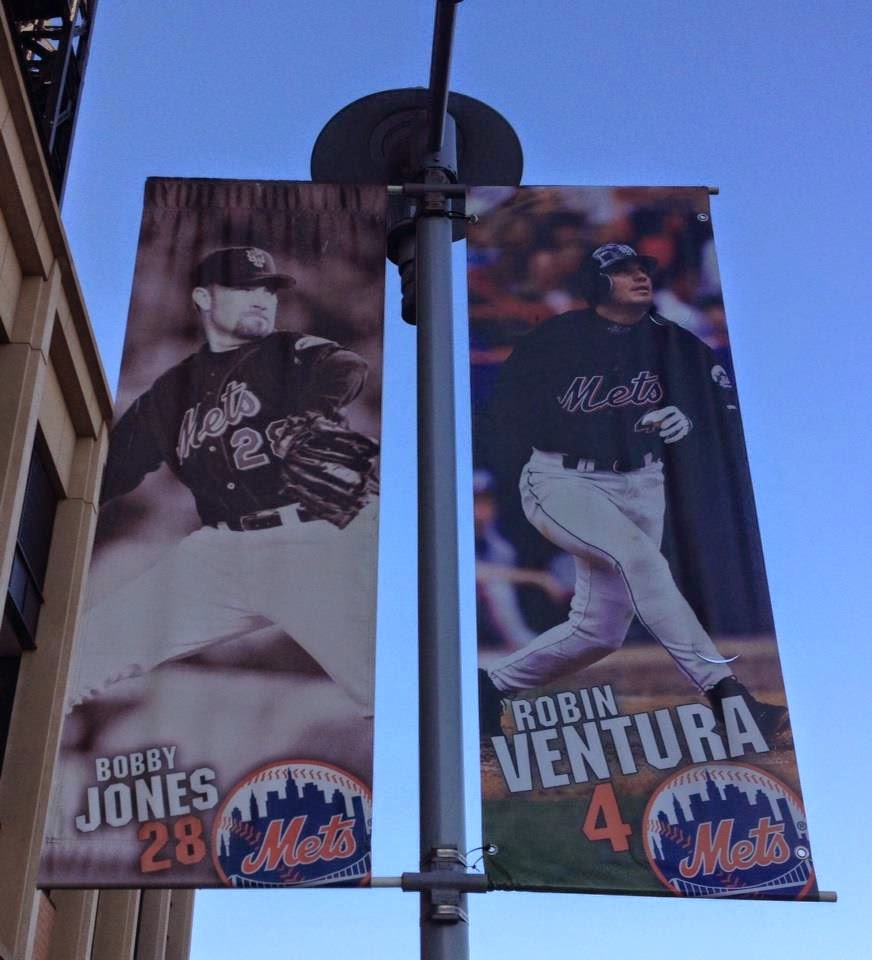
Ventura appears on another banner outside Citi Field.  This time, he's paired with Bobby Jones, a former Met who won 74 games in his pitching career as a Met, good for the ninth-highest total in club history.

Despite his lofty win total and status as an underrated Met, Jones is known primarily for his complete-game one-hit shutout over the San Francisco Giants in Game 4 of the 2000 NLDS.  Jones would get all the runs he needed in the first inning, when Robin Ventura crushed a two-run homer to give the Mets a 2-0 lead.  Eight innings later, Ventura and Jones celebrated their series clinching victory along with the rest of their teammates.  


This pairing should be obvious to even the most casual of Mets fans.  John Franco pitched for the Mets in 14 seasons (1990-2001, 2003-04) while Ed Kranepool appeared in a Mets uniform for 18 campaigns (1962-79).

Their longevity puts both players atop the team's all-time leaderboard in several offensive and pitching categories.  It also ranks them No. 1 (Kranepool) and No. 2 (Franco) in seasons played in New York.


Unlike the players represented in the first three photographs, Pedro Martinez and Carlos Delgado were teammates for three seasons (2006-08) in New York.  But they could have been teammates longer had it not been for the way general manager Omar Minaya pursued Delgado.

In Minaya's first off-season as the Mets GM, he signed two of the top available free agents in Pedro Martinez and Carlos Beltran.  But when Minaya sought the services of Delgado, he was turned away because the first baseman was uncomfortable with the way Minaya was appealing to his Latin-American heritage.  Delgado was eventually traded to the Mets in 2006, becoming a teammate of Pedro Martinez - the first player signed by Minaya in what some people have since referred to as the "Los Mets" era of the team.


Gil Hodges made his mark as a member of the Brooklyn Dodgers, then became an original Met in 1962.  Seven years later, as the team's manager, he led the Mets to their first World Series championship.  Meanwhile, Lee Mazzilli was born in Brooklyn in 1955 - the same year Hodges helped the Dodgers win their only World Series in the borough.  Mazzilli was one of the team's brightest stars in the late 1970s before being traded away in 1982.  But just like Hodges, Mazzilli was brought back to help the Mets win a championship.

For Hodges and Mazzilli, their seeds were planted in Brooklyn.  But both men blossomed for the Mets in Queens, winning championships and making the entire city proud.


The oddest pairing might be this David Wright-Keith Miller pole.  Wright is the Mets' all-time leader in various offensive categories and is one of the most beloved figures in recent club history.  Keith Miller was a utility player for the Mets from 1987 to 1991, never collecting more than 275 at-bats in any season and finishing his Mets career with just seven homers and 48 RBI - numbers Wright can easily put up in half a season.

As random as this pairing might seem, these two players have quite a personal connection to each other.  Prior to the 2013 season, Wright signed the most lucrative contract in team history, a deal that pays him $138 million over eight seasons.  Every time Wright thanks his agent for that contract, all he has to say is, "Thank you, Keith Miller."  Miller gave the Mets little run production as a player, but he gave the team eight extra years of run production as David Wright's agent.


Plenty of room for more banners, don't you think?

The Mets have set up various banner displays on poles outside Citi Field.  The banners feature several random pairings of the team's best players.  But not all of them are random.  Some of them, as seen in the six photos above, appear to be quite intentional.  And who knows, maybe the Mets aren't done with intentional banner pairings.

For example, there are still no banners pairing up Mike Piazza and Guillermo Mota.  They got into a famous spring training bench-clearing brawl in 2003 when Mota was a Dodger and Piazza was an ex-Dodger.  Similarly, there are no Gregg Jefferies-Roger McDowell pairings in the plaza.  Maybe the reason for that is because Gary Carter had to spend his final home game as a Met separating the two after they got into a brawl following the game's final out.  And don't get me started on an Armando Benitez-Graeme Lloyd pole.  The two had to be separated in a fight between the Orioles and Yankees in 1998, then briefly became teammates with the Mets five years later.

In addition, there are no banners teaming up Jesse Orosco and Jerry Koosman, two pitchers who were traded for each other following the 1978 season and remain the only pitchers who can say they recorded the final out in a World Series-clinching game for the Mets.  (Seriously, Mets, this pairing has to get done.)

If the Mets wanted some comic pairings, they could have a Follicle Follies-themed pole featuring Nino Espinosa and Jenrry Mejia.  Or perhaps Don Aase (a Met reliever in 1989) and Al Schmelz (a Met reliever in 1967) could have shared an Aase-Schmelz pole.  Aase could also appear on a pole with 1969 World Series hero Al Weis, but that pairing would probably be shot down, because no one likes a Weis-Aase.

The opportunity is there for the Mets to have a different kind of Banner Day at Citi Field.  They just need to show a little extra creativity.  They tried (and failed) to be creative by getting "True New Yorkers" to respond to a letter they sent out.  The team was chased up a pole on that one.  At least there were no banners on that pole.  I'd say it's because those are the poles being reserved for the Terrence Long and R.A. Dickey banners, but knowing the Mets, fans would probably get stiffed on that pairing as well.