Showing posts with label Los Angeles Angels of Anaheim. Show all posts

Thursday, October 2, 2014

Joey's Soapbox: My 2014 Not-So-Biased Division Series Picks


Hey, everyone!  This is Joey Beartran and I'm already exhausted after watching the two wild card games.  First, the Royals won a four-hour, 45 minute marathon on Tuesday that was a thrill a minute.  Then the Giants and Bucs played a snoozefest in Pittsburgh on Wednesday.  But don't worry.  I'm not ready to hibernate just yet.  I still have some prognosticating to do.

Today, it's time for my division series picks.  And we've got four intriguing matchups to dissect.  And speaking of dissecting, has anyone seen my plastic knife?  I need it to cut two slices of cake for myself.  One slice is to celebrate the Royals' victory (which I correctly predicted) and the other is to console myself after making a boo boo with my pick of the Pirates over the Giants.  Oops!  Now, it's on to the division series picks!


American League Division Series


Detroit Tigers vs. Baltimore Orioles

The Tigers have been regulars in the postseason, winning their fourth consecutive AL Central title in 2014.  Meanwhile, the Orioles won their first division crown since 1997 and are making just their second postseason appearance since that last AL East championship.

Detroit's Achilles heel over the past three playoff runs has been its bullpen, and this year it's been no different.  The Tigers' relief corps posted a 4.29 ERA and 1.48 WHIP during the 2014 season.  Both numbers ranked near the bottom of the league.

As bad as their bullpen has been since 2011, their starting pitchers have been the exact opposite.   Going into the postseason, the Tigers boast the last three American League Cy Young Award winners in Justin Verlander, David Price and Max Scherzer.  Scherzer was outstanding once again in 2014 (18-5, 3.15 ERA, 252 Ks), but Verlander was unimpressive (15-12, 4.54 ERA, 1.40 WHIP), striking out just 159 batters after five consecutive seasons with 200+ strikeouts.  And Price was a .500 pitcher for Detroit with an ERA nearly half a run higher than his career mark with Tampa Bay.  Why is this so important?

Because Baltimore has bats.  Lots and lots of bats.

The Orioles led the major leagues with 211 home runs, which was 25 more than their nearest competitor in that category.  Seven players reached double digits in homers, and four of them made it to 20 dingers.  One of those players (Nelson Cruz) was the only player in baseball to reach 40 long balls.  Simply stated, Baltimore can rake.  A lot.  And when they're facing a team with a subpar bullpen and underachieving starting pitchers, things could get ugly faster than you can say Willie McGee.

All that playoff experience for the Tigers and still no championships since 1984.  The drought will continue into next year.

Prediction:  Orioles in 4.


Kansas City Royals vs. Los Angeles Angels of Anaheim

Picking this series is a toss-up.  The Royals and Angels split their six games against each other, with each team winning two of three in its home park.

The Angels have announced their rotation for the series, using Jered Weaver (who did not face the Royals in 2014) in Games 1 and 4.  Although Weaver led the league with 18 victories, he posted a 3.59 ERA - his highest since 2009.  Assuming the series doesn't end in a sweep, Weaver's start in Game 4 will come on three days rest.  Short rest does not agree with Weaver, who has a 6.75 lifetime ERA when he pitches on fewer than his normal four days rest.

Matt Shoemaker would also get two starts in the series (Games 2 and 5), which on paper looks divine for the Angels, as Shoemaker went 16-4 this season, including a 14-3 mark as a starting pitcher.  There's just one problem.  One of his three losses as a starter came to the Royals.  His other start against Kansas City did not result in a decision, but ended in another loss for the Angels.  In fact, in his two starts versus the Royals, Shoemaker combined to pitch nine innings, allowing 11 runs (10 earned) and 21 base runners (19 hits, two walks).  For all you kids out there, that's a 10.00 ERA and 2.33 WHIP.  How bad is that?  It's worse than what former Royal Jose Lima put up for the 2006 Mets (9.87 ERA, 2.02 WHIP).  And Shoemaker would face the Royals twice, including a do-or-die fifth game.

Kansas City will be going with Jason Vargas in Game 1, followed by Yordano Ventura and James Shields.  Manager Ned Yost will decide who his starters for Games 4 and 5 will be if the Royals make it that far.  The threesome combined to go 39-28 and pitched a total of 597 innings between them.  That bodes well for the Royals, who could use long outings from their three starters to take them to their three-headed relief monster of Wade Davis (9-2, 1.00 ERA), Kelvin Herrera (4-3, 1.41 ERA) and Greg Holland (46 saves, 1.44 ERA).

The Angels will have to score early and often against the Royals to prove that their 98-win season wasn't a fluke.  But even if they do, their starting pitchers are going to have to pitch well, and with Weaver allowing more runs in 2014 than he had in five years and Shoemaker sucking more than a starving vampire against the Royals, it could be hell for the Angels in this series.

Prediction:  Royals in 5.


National League Division Series


St. Louis Cardinals vs. Los Angeles Dodgers (not of Anaheim)

Last year, these two teams faced each other in the NLCS, with the Cardinals prevailing.  It was the 25th consecutive season without a pennant for the Dodgers - the longest such streak in franchise history.  The victory over Los Angeles allowed St. Louis to advance to its fourth World Series in ten seasons.

But this year's playoff rematch boils down to one man.  And that man is Clayton Edward Kershaw.
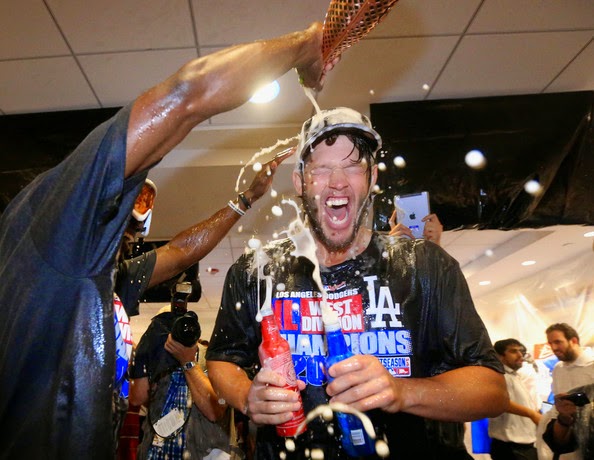
Kershaw made just 27 starts this season, but still managed to go 21-3 with a 1.77 ERA and 239 strikeouts.  In doing so, Kershaw became the first pitcher in major league history to win as many as 21 games in as few as 27 appearances.  The only thing Kershaw failed to do in 2014 was get Major League Baseball to change the name of the award for the league's best pitcher to the Clayton Kershaw Award.  To summarize Kershaw's performance this year, he was i-ight.

But the soon-to-be three-time Cy Young Award winner will only get a chance to win two games in the best-of-five series.  If the Dodgers are to advance to the NLCS, they'll need someone to win that third game.  Will it be Zack Greinke, whose 17 wins, 2.71 ERA and 207 strikeouts would have led most teams, but not the Los Angeles Kershaws?  What about Hyun-jin Ryu, who made just 26 starts, but still managed to win 14 of them?

The answer is none of the above.  The third game will be won by Dee Gordon's legs (MLB-leading 64 steals), Adrian Gonzalez's bat (41 doubles, 27 HR, MLB-leading 116 RBI) and Yasiel Puig's pieces of flair.  And if you've ever watched Office Space, you know how important those extra pieces of flair can be.

Prediction:  Dodgers in 3.


San Francisco Giants vs. Washington Nationals

The Giants came up huge against the Pittsburgh Pirates behind the arm of Madison Bumgarner and one big swing by shortstop Brandon Crawford.  Although Bumgarner won't be available to pitch against Washington until Game 3, his fellow moundsmen are more than capable of pulling out at least one win in Washington before his turn in the rotation comes up.

Jake Peavy will be key for the Giants.  After an awful first half with the Red Sox (1-9, 4.72 ERA, 1.43 WHIP), Peavy was dominant as a Giant, going 6-4 with a 2.17 ERA and 1.05 WHIP.  In his last ten starts of the season, Peavy was Kershaw-esque, posting a 1.64 ERA and allowing a .288 on-base percentage.  Because Bumgarner will only get one start in the division series, that means Peavy will get two.  And the second of those two starts could be the one that sends the Giants into the league championship series.

Also key for the Giants will be Hunter Pence (.333 batting average in seven games vs. Washington), rookie Joe Panik (.417 average, 1.128 OPS in a late-season series against the Nats) and Pablo Sandoval, who kung fu'd Washington pitchers to the tune of a .455 average in seven games.  Those three players - along with the always dependable Buster Posey - will need to continue to feast on the likes of Jordan Zimmermann, Doug Fister and Stephen Strasburg to give the Giants a fighting chance.

Speaking of Strasburg, this will be his first time in the postseason spotlight, as he had been shut down by the organization prior to the Nats' brief visit to the playoffs in 2012.  Prior to 2014, Strasburg had never pitched more than 183 innings in a single season.  This year, he has logged 215 innings, with more to come against the Giants in the division series.  How will his arm hold up against the playoff-tested Giants?

Washington may have finished with the best record in the league for the second time in three seasons, but that may not be enough to get them to the National League Championship Series for the first time since moving to our nation's capital.  As the saying goes, Washington is first in war, first in peace, and really crappy when it comes to winning the division series.  Or at least that's how I think it goes.

Prediction:  Giants in 4.

Saturday, April 12, 2014

Plunks For The Memories

Jeurys Familia knows that he pitched a plunker of a game.  (Photo by Stephen Dunn/Getty Images)

If you were one of the many insomniacs who stayed up until 2:03am to watch the conclusion of the Mets' colossally important April interleague game against the Los Angeles Angels of Anaheim in Orange County near Disneyland where Gwen Stefani grew up, then you were witness to just the fourth walk-off loss on a hit batsman in franchise history.

When Jeurys Familia plunked Hank Conger in the bottom of the 11th inning with the bases loaded, he joined a small, but infamous fraternity that included Jack Aker, Greg McMichael and Scott Schoeneweis - pitchers who ended games on the road by throwing a pitch that made contact with the opposing batter.

But it's not who they hit that made Mets fans go to bed unhappy, it's when they hit them.  Of course, when you look at the short list of players who sacrificed their bodies for a bruise-off victory, maybe it's also who the pitchers hit that make Mets fans cringe.

On July 25, 1974, Jerry DaVanon of the Cardinals was hit by a poorly placed Jack Aker pitch, giving the Mets a 4-3, ten-inning loss in St. Louis.  DaVanon played eight years in the big leagues for five teams, collecting just 117 hits.  He had three homers in 574 career plate appearances.  In other words, grooving a pitch right down the middle probably wouldn't have hurt the Mets as much in that situation as throwing one into the body of DaVanon.

The Mets didn't suffer another embarrassing walk-off defeat for another 23 years.  It wasn't until Greg McMichael plunked Houston's Luis Gonzalez on August 3, 1997 that the Mets walked off the field a loser because of a hit batsman.  Granted, Gonzalez was not Jerry DaVanon at the plate, as he produced over 2,500 major league hits and 1,018 extra-base hits over his 19-year major league career.  But most of his success came after the 1997 season.  From 1998 to 2003, an average Gonzo season saw him produce a .306 batting average, 38 doubles, 32 homers, 108 RBI and 102 runs scored.  Prior to 1998, Gonzalez's average annual numbers were not quite the same (.268, 25 doubles, 10 HR, 60 RBI, 56 runs scored).  Perhaps McMichael was afraid Gonzalez would hit a walk-off double against him, explaining why he felt hitting the not-yet slugger was a safer bet.

The third time a Mets pitcher ended a game with a walk-off plunk was not a charm for New York, as Scott Schoeneweis hit San Diego's Paul McAnulty with a bases-loaded pitch in the bottom of the ninth on June 5, 2008.  McAnulty had himself a career that only his mother and Jerry DaVanon were proud of.  The former Padre played parts of five seasons in the majors, producing a fearsome .201 batting average and .325 slugging percentage.  At the time of his beaning by Schoeneweis, McAnulty had produced just 39 hits in his big league career in 214 plate appearances, numbers that clearly scared the Mets reliever in such a way that he couldn't get himself to throw a ball somewhere around home plate.  Fortunately for Schoeneweis, that wasn't the low point of his career with the Mets.  That would happen almost four months later, as he allowed Wes Helms' go-ahead homer in the bottom of the eighth inning in the last game ever played at Shea Stadium.  But hey, at least he didn't hit Helms with the bases loaded, right?  Because that would have been embarrassing.

In the wee hours of the morning on Saturday, Jeurys Familia joined Jack Aker, Greg McMichael and Scott Schoeneweis, becoming the fourth pitcher in Mets history to walk off the field as a result of a game-ending hit batsman.  Familia's victim was an unfamilar face in Hank Conger.  The artist formerly known as Hyun Choi Conger obviously changed his name to Hank to evoke fear in the hearts of pitchers and it clearly worked against Familia.  After watching all the tributes to Hank Aaron in Atlanta earlier in the week, Familia must have been spooked into grooving a pitch to another Hank, not knowing that the Angels' Hank had only produced 106 hits in parts of five seasons with Los Angeles/Anaheim/Orange County/Disneyland/Gwen Stefani.

If Familia never does anything else of importance in the major leagues, he can always say he's a member of an exclusive Mets fraternity - one that includes the unforgettable trio of Jack Aker, Greg McMichael and Scott Schoeneweis.  The bruises will heal on the bodies of Jerry DaVanon, Luis Gonzalez, Paul McAnulty and Hank Conger, but at least they will always be able to say "plunks for the memories".

Hank Conger has a boo-boo because of Jeurys Familia's boo-boo.  (Photo by Stephen Dunn/Getty Images)

Thursday, February 21, 2013

Travis d'Arnaud Has A Large P

So tell me, Mets fans.  Have you seen the jersey being worn by new Mets catcher Travis d'Arnaud in Port St. Lucie?

Take a look at this photo taken by MetsBlog's Matt Cerrone and see if you notice something odd.

Photo by Matt Cerrone/MetsBlog

Now I don't claim to be an expert on fonts, but it sure looks to me as if the first "d" in d'Arnaud is actually an upper case "P" turned upside down.  So do the Mets have a shortage of lower case letters as they do with experienced outfielders?  Or did they just use up their entire budget on left-handed relievers, low-risk, high-reward reclamation projects and Bobby Bonilla?

Travis d'Arnaud is not the first Mets catcher to have a lower case letter in his surname.  In fact, they've had several in recent years.

In 2005, Mike DiFelice played in 11 games for the Mets.  He also spent time as a Met in 2006 and 2007, when he was a teammate of Paul Lo Duca.

If you look at the photos below, the lower case letters on the jerseys of DiFelice and Lo Duca were actually smaller versions of upper case letters.  However, they were definitely Is and Os and not one of the other 24 letters in the alphabet.


Lower case letters in players' surnames were like opinions in the mid-2000s, as it seemed every Met had one.  Even pitcher Mike DeJean, a teammate of DiFelice in 2005, had a mini-"E" on the back of his jersey.

But all Travis d'Arnaud gets is an upside-down upper-case "P" on his first Mets jersey.  I guess he shouldn't complain.  After all, it could have been worse.  He could have been traded to Washington or Los Angeles (of Anaheim) instead of New York, where he might have been a "Natinal" or an "Angee".


Thursday, October 22, 2009

Did John Lackey Just Pitch His Way Onto The Mets?

John Lackey has been with the Angels since 2002, when he helped them win the World Series. He has been the heart and soul of their pitching staff for eight seasons. Now he may have thrown his last pitch for Los Angeles/Anaheim/California. Is it possible that his performance for the Angels in Game 5 of the ALCS just earned him a contract for the 2010 Mets?

The Mets need a proven #2 starter to follow Johan Santana in the rotation. Mike Pelfrey and his 5.00-plus ERA just isn't cutting it. Lackey's consistency and bulldog mentality would form a great lefty-righty tandem with Santana.

Let's see just how consistent Lackey has been over his career. He started out slowly for the Angels from 2002-2004. Over his first three seasons, Lackey was just a .500 pitcher, going 33-33 with a 4.44 ERA. However, as he gained experience, he also became one of the best pitchers in baseball. Witness his seasons from 2005-2009:
  • 2005: 14-5, 3.44 ERA
  • 2006: 13-11, 3.56 ERA
  • 2007: 19-9, 3.01 ERA
  • 2008: 12-5, 3.75 ERA
  • 2009: 11-8, 3.83 ERA
That's five consecutive seasons facing a DH in every game (other than interleague games in National League parks) with ERAs under 4.00. His 3.01 ERA in 2007 led the American League. He is also one of only six pitchers in baseball to win at least 11 games in each of the last six seasons, with the other five being potential teammate Johan Santana, CC Sabathia, Derek Lowe, Javier Vazquez and Jason Marquis.

For the five-year stretch mentioned above, Lackey is a combined 69-38 with a 3.49 ERA. He has also walked only 282 batters in 150 starts made over those five years, an average of less than two walks per start.

The Mets struggled with their control all year in 2009. Lackey's impeccable control would surely help the pitching staff. He walked 52 batters or less in each of the past three seasons. Compare that to the 58 walks surrendered by Oliver Perez in only 14 starts this season.

In addition to his excellent work in the regular season, Lackey has plenty of playoff experience, making 12 starts over five different postseasons. His ERA in those 12 starts is 3.12, which is even better than his regular season ERA. Also, opposing hitters have only hit 4 HR off Lackey in 78 career postseason innings.

Lackey has proven that he can step up his game when his team needs it the most, unlike certain members of the current Mets staff. When the Angels needed him in Game 7 of the 2002 World Series, he was the winning pitcher as a rookie. With their backs against the wall in Game 5 of this year's ALCS, Lackey pitched beautifully, giving up three runs in 6.2 innings, although those runs did not score while he was in the game (no thanks to former Met Darren Oliver). He wants the ball at all times and is not afraid to speak his mind when he feels that he's still the best option to get a hitter out (as seen by his "this game is mine" comment that lip readers could recognize when Mike Scioscia removed him from Game 5 against the Yankees).


Who wouldn't want him on the Mets? Probably the people whose names would appear on the bottom of his paycheck. Lackey will not come cheap. More than likely, it will take at least five years and an average annual value of $16-$18 million to sign him. He has definitely earned those dollars with his consistency over the past five years. However, if Lackey agrees to a five-year deal, he would be almost 36 when the contract expires in 2014. $18 million might be a lot to give to a pitcher on the statistical downside of his career.

As with all pitchers, the Mets must be careful not to overpay for a pitcher who might give them great performances over the first part of the contract, followed by a dropoff afterwards (see Pedro Martinez). However, Lackey might give them a good reason to make an exception. After all, he began both the 2008 and 2009 seasons on the disabled list but came back both times to pitch as well as he did before each injury occurred.

If Lackey doesn't re-sign with Los Angeles/Anaheim/California/Disneyland/Wallyworld, then the Wilpons should open up their wallets to bring him to Citi Field. The Mets haven't had a potential dominant 1-2 punch since...heck, I have no idea! That's how long it's been.

If the power outage suffered by the Mets in 2009 continues in 2010, then they will have to outpitch their opponents. Having Santana and Lackey on the mound for 40% of their games will surely help them improve from their dismal 2009 season. Let's get it done and make John Lackey a Met in 2010!