Showing posts with label Hisanori Takahashi. Show all posts

Monday, January 25, 2016

The Most With The Least: Hisanori Takahashi (2010)

Ever since Hideo Nomo burst onto the major league scene with the Los Angeles Dodgers in 1995, creating a craze at Chavez Ravine not seen since the days of Fernando-mania, the pipeline for Japanese players has remained quite active in the United States, particularly for the Mets.  Two years after Nomo became the first player from Japan to win the Rookie of the Year award - edging out future Mets killer Chipper Jones for the honor - the Mets signed their first Japanese player in reliever Takashi Kashiwada.

Kashiwada became the first of 15 players born in Japan to play for the Mets from 1997 to 2010, making Flushing the top destination in the major leagues for Japanese players.  However, none of the 15 athletes achieved the success and adulation that Nomo (who was one of the 15, becoming a Met in 1998) earned in Los Angeles.

Masato Yoshii won 12 games for the Mets in 1999 - albeit with a high ERA (4.40) and WHIP (1.30) - then fizzled in the postseason, pitching just 13 innings in three starts.  Tsuyoshi Shinjo became the first position player from Japan to don a Mets uniform in 2001.  But after a decade of being a rock star in Japan, he became soft rock in New York and was gone after just one somewhat productive season (returning for a shorter, less productive stint with the Mets in 2003).  And who could forget Kaz Matsui?  If the Mets signed him specifically to hit home runs in his first at-bat each season, then they were wildly successful, as Matsui did just that in each of this three years in New York.  But high expectations, in addition to temporarily displacing the more popular Jose Reyes to second base in 2004, caused the Matsui era in Flushing to be mostly forgettable.

It wasn't until 2010, when a lesser-known veteran pitcher joined the Mets, that the team found a Japanese player who actually exceeded expectations in New York.  He also developed an unexpected following and redefined himself during his one season with the Mets to became a lights-out reliever, helping the team improve by nine wins after a disappointing season the year before.

Hisanori Takahashi found success in New York in multiple roles.  (Doug Pensinger/Getty Images)

Hisanori Takahashi played ten years in his native Japan from 2000 to 2009.  Unlike some of his more celebrated peers, Takahashi didn't begin his Japan Central League career until he was 25 years old.  And although he was a popular player in his home country, his career as a starting pitcher and sometimes reliever had its share of ups and downs.  He was an All-Star who helped the Yomiuri Giants win three championships, but he also had a number of poor seasons, which made several major league teams hesitant to sign him when he declared his interest to pitch in the United States as a 35-year-old in 2010.  But the Mets were a team in disarray and needed all the help they could get, especially in the pitching department.

After winning the N.L. East division crown in 2006 and falling one game short of the playoffs in 2007 and 2008, the Mets crumbled completely in 2009, finishing the year with a 70-92 record as several key players spent a significant amount of time on the disabled list.  One of the glaring weaknesses on the 2009 team was its pitching, as the staff finished the year with a 4.45 ERA - the third-worst mark in franchise history, surpassed by only the 2003 club (4.48 ERA) and the inaugural 1962 squad (5.04 ERA).

John Maine and Oliver Perez combined to make just 29 starts in 2009 and Johan Santana also had his season cut short due to injuries.  The only pitcher who remained healthy in 2009 and was guaranteed a spot in the starting rotation in 2010 was Mike Pelfrey, who became the first and only pitcher in team history to make 30 or more starts and finish the year with an ERA above 5.00, as he posted a 5.03 ERA in 31 starts during the nightmarish 2009 campaign.  Needless to say, the Mets went into the 2009-2010 off-season needing to bolster its pitching in the worst way.

A week before the start of spring training, the Mets signed Takahashi to a one-year, $1 million deal, with the potential to earn $2 million more in performance bonuses.  At the time, Anthony Nakanishi - who worked for Takahashi's team of agents - was quite optimistic for his agency's client.

"This could work out very well for the Mets," said Nakanishi.  "Hisanori is a bit of a late bloomer and like some other left-handed pitchers from Japan, like Hideki Okajima, his pitching style may translate even better in major league baseball.  Who knows, he could win 15 games.  It's a possibility."

Of course, Nakanishi had to say positive things about Takahashi to give Mets fans a reason to be optimistic and not boo his client from day one.  Those same fans had seen several Japanese players try to succeed in New York, with most of them failing miserably.  But predicting 15 wins for a pitcher competing for the role of fifth starter on a 70-win team?  That seemed like quite a stretch.  But before long, Nakanishi's words almost seemed prophetic, even after his client failed to earn a spot in the starting rotation coming out of spring training.

"What has my agent gotten me into?  15 wins?  Really?"  (Kyodo News, via AP)

Takahashi pitched very well for the Mets in his first spring training outside of Japan, holding opposing hitters to a .170 batting average and collecting 14 strikeouts in 13 innings of work.  But even with Jonathon Niese struggling in his Grapefruit League appearances, opening the potential for Takahashi to sneak into the rotation, manager Jerry Manuel preferred to see Takahashi in the bullpen.  When Opening Day arrived, the Mets' rotation consisted of Santana, Maine, Perez, Pelfrey and Niese, with Takahashi joining Pedro Feliciano as the team's second lefty option in the bullpen.

Takahashi's major league debut did not go well.  On April 7, 2010, the Mets erased a five-run, seventh-inning deficit against the Florida Marlins, scoring two runs in the seventh and three more in the eighth to tie the game, 6-6.  Closer Francisco Rodriguez had been used to preserve the tie in the top of the ninth inning, but was due to lead off in the bottom of the frame, causing Manuel to insert Ruben Tejada (who was also making his debut in the big leagues) into the game as a pinch hitter.  When Tejada and the rest of the team failed to push across a run, Manuel gave the ball to Takahashi to start the tenth, who allowed the Marlins to score the go-ahead run on two singles and a walk.  Takahashi was saddled with the loss in the debut, as the Mets fell to Florida, 7-6.

Although Takahashi did not have the debut he wanted, he quickly learned from his mistakes.  Manuel started to use Takahashi as a long man in the bullpen and was rewarded instantly.  From April 13 to May 16, Takahashi made 12 relief appearances, pitching three innings or more in four of those outings and striking out 32 batters in 23⅔ innings.  His best performance during the five-week stretch came on April 23, when he struck out seven Atlanta Braves hitters in three innings, earning his first big league victory in the process.

As the calendar flipped from April to May, the Mets found themselves in a surprising position - first place in the N.L. East.  But the seeds planted in April did not lead to a full bloom in May, as the Mets lost 13 of their first 18 games in the season's second month.  Games weren't the only things being dropped by the Mets, as three-fifths of the starting rotation went down, either to injury (Jonathon Niese strained his right hamstring) or ineffectiveness (Oliver Perez allowed too many long balls and John Maine allowed too many balls).  With all the tumult going on with the starting rotation, manager Jerry Manuel needed to make some decisions.  One of them was made when R.A. Dickey was inserted into the rotation, launching what became a magical three-year tenure in New York for the rejuvenated knuckleball pitcher.  Manuel's next decision involved Takahashi's move from the bullpen to make a start against the New York Yankees on May 21.  It was then that Takahashi's season really took off.

Takahashi pitched six scoreless innings against the Yankees in his first big league start, scattering five hits and striking out five batters.  But one year after Mets second baseman Luis Castillo made a costly error to give the Yankees a come-from-behind victory, it was another second sacker - Alex Cora - who tossed the game away.  Cora's throwing error on a potential double play ball was followed by a two-run double by seldom-used outfielder Kevin Russo.  (Russo had just four RBI in his entire major league career, with half of them coming in that one game-changing swing.)  Those were the only tallies needed by the Yankees in their 2-1 victory over the Mets.

The Mets lost the game, but found a new starting pitcher in Takahashi.  The southpaw continued his scoreless streak by putting six more zeroes on the scoreboard in his next start - a 5-0 victory over the Philadelphia Phillies.  Although he had some hiccups along the way, Takahashi allowed one run or fewer in five of his 12 starts, which included a second brilliant performance against the Yankees on June 18, a game in which he threw another six scoreless innings.  This time, the bullpen and the defense came through for the Mets, as four relievers combined with Takahashi on the shutout.  Most importantly, the victory was the Mets' eighth straight and improved the team's record to 39-28.

Unfortunately, the Mets regressed from late June to early August, dropping 23 of 34 games to fall below .500 for the first time since late May.  The wheels came completely off the Mets' bus on August 11 when K-Rod attempted to KO his children's grandfather in the Citi Field family lounge after the team's 6-2 loss to the Colorado Rockies.  Rodriguez was arrested and missed the rest of the season with torn ligaments in his right thumb, which he suffered during the altercation.

A portrait of Citi Field's Least Wanted.  (Debbie Egan-Chin/NY Daily News)

Although the Mets were under .500 and their playoff hopes were all but gone, the team still needed to play the games on its schedule.  They also needed a closer for the rest of the season, with Rodriguez out for the year.  Once again, Manuel turned to Takahashi to fill a specific role and the 35-year-old responded with aplomb.

Takahashi got his first save opportunity on August 16, retiring the Houston Astros in order in the ninth inning of a 3-1 Mets victory.  From that point to the end of the season, Takahashi was brilliant in his new role, earning three wins and going 8-for-8 in save opportunities.  In 19 appearances, Takahashi had a 0.84 ERA and 0.94 WHIP, holding opposing hitters to a .197/.247/.289 slash line, which was slightly better than the .213/.289/.308 slash line allowed by Rodriguez prior to his season-ending scuffle.

The Mets ended the 2010 season with a 79-83 record, which represented a nine-game improvement over their 2009 performance.  Takahashi's first season in the majors was an unexpected success.  Although he didn't quite reach the 15 wins predicted by his agent at the beginning of the year, he did notch ten wins and eight saves, becoming the fifth Met - and the first since 1986 - to reach double digits in wins while saving eight or more games, joining Tug McGraw (11 wins, 8 saves in 1971), Skip Lockwood (10 wins, 19 saves in 1976), Jesse Orosco (13 wins, 17 saves in 1983; 10 wins, 31 saves in 1984) and Roger McDowell (14 wins, 22 saves in 1986) in this exclusive club.  But those four pitchers combined to make one start in their spectacular seasons (McGraw got a no-decision in that start), meaning they earned all their wins in relief.  Takahashi was the only true starter/reliever hybrid of the group, earning four of his wins as a starting pitcher.  Takahashi was also the Mets' first "rookie" pitcher to earn 10 or more wins in his inaugural major league season since 1985, when Rick Aguilera posted a 10-7 record as a first-year player for the team.

Unfortunately, once the 2010 season ended, the Mets cleaned house, ridding themselves of manager Jerry Manuel and general manager Omar Minaya.  The new regime (featuring Terry Collins and Sandy Alderson) did not see the soon-to-be 36-year-old Takahashi as part of the team's future and allowed him to become a free agent, ending the respected pitcher's one-year stay in New York.  Takahashi spent the next three seasons with the Los Angeles Angels, Pittsburgh Pirates and Chicago Cubs, before returning to Japan to pitch for the Yokohama Bay Stars in 2014.

There have been many pitchers in team history who were never expected to amount to much when they joined the big league roster.  Except for his agent, no one expected Hisanori Takahashi to contribute much to the team.  But the left-hander silenced all his critics, and in doing so, became one of the most appreciated Japanese players to ever play for the Mets.

Photo by Lucy Nicholson/Reuters


"Eight months here in the United States, I'll spend most of the time in New York.  I kind of like New York."

--Hisanori Takahashi (September 2010)


And New York kind of liked Takahashi back.  After years of high expectations for Japanese players such as Tsuyoshi Shinjo and Kaz Matsui, it was a player originally brought in to compete for the fifth starter job that finally succeeded in every role he was called upon to fill.

Hisanori Takahashi had a short career in New York, but accomplished things that very few pitchers in team history had been able to do.  In a year that provided very few highlights for the Mets, Takahashi was a bright spot, making the most of his varied opportunities and giving Mets fans a reason to cheer whenever he set foot on the mound.


Note:  The Most With The Least is a thirteen-part weekly series spotlighting those Mets players who performed at a high level without receiving the accolades or playing time their more established teammates got, due to injuries, executive decisions or other factors.  For previous installments, please click on the players' names below:

January 4, 2016: Benny Agbayani
January 11, 2016: Donn Clendenon
January 18, 2016: Tim Teufel

Tuesday, November 19, 2013

Fill In At Closer, Fill Out Your Pink Slip

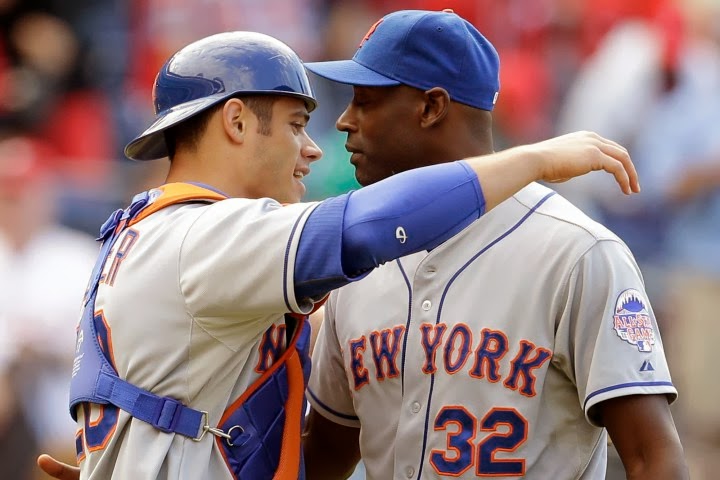
A hug before leaving.  (Getty Images Photo)

After having an excellent season with the Mets in 2013, LaTroy Hawkins will be pitching elsewhere in 2014.  Hawkins, who finished the year as the Mets' closer after Bobby Parnell was sidelined with a season-ending injury, signed a one-year, $2.5 million deal with the Colorado Rockies on Monday.

Never mind that Sandy Alderson said he wouldn't pay a 41-year-old reliever that kind of money, even though Hawkins gave the Mets his best statistical season since 2004, posting a 2.93 ERA, 1.15 WHIP and 13 saves at the age of 40.  But if Hawkins was aware of recent Mets history, he should've known that he was about to become a goner.

In 2011, Francisco Rodriguez was dealt to the Milwaukee Brewers during the All-Star Break.  After the trade, Jason Isringhausen became the Mets' closer, saving seven games - including his 300th career save.  The following season, he traded apples for oranges, leaving the Big Apple for Orange County.  Isringhausen pitched in 50 games for the Los Angeles Angels in 2012, but did not pitch in the majors in 2013.

One year before Isringhausen finished the year for K-Rod, another pitcher was forced into closer duties for the Mets when Francisco Rodriguez couldn't finish the year with the team.  After injuring himself when he became Frankie Knuckles in front of his son's grandfather, Hisanori Takahashi filled in as the team's closer, notching three wins and eight saves over the season's final two months.  The 35-year-old Takahashi was not re-signed by the Mets following his versatile "rookie" season in 2010.  Instead, he chose to sign with the Angels, spending a year and a half in Los Angeles, followed by short tenures in Pittsburgh and Chicago.

Billy Wagner began the final season at Shea Stadium as the Mets' closer.  But a season-ending injury forced Omar Minaya to acquire Luis Ayala in August 2008.  Ayala saved nine games as Wagner's temporary replacement.  And by temporary, I mean his two blown saves, two losses and 14.40 ERA over the season's final two weeks guaranteed he wouldn't be a Met in 2009.  Since then, Ayala has bounced around more than his pitches did in the left and right field corners of Shea Stadium in his six weeks with the team.  The right-hander has collected paychecks from the Twins, Marlins, Yankees, Orioles and Braves since he allowed the final run to cross the plate at Shea Stadium on a back-breaking blast by Dan Uggla on September 28, 2008.

When Braden Looper was in the final days of the two-year contract he signed with the Mets prior to the 2004 season, he required season-ending surgery to repair a blown AC joint in his right shoulder.  In stepped Roberto Hernandez, who picked up two wins and three saves over the final two weeks of the 2005 campaign.  But the Mets allowed Hernandez to leave as a free agent, and the 40-year-old reliever inked a one-year deal to pitch for the Pittsburgh Pirates in 2006.  Hernandez was traded back to the Mets (along with Oliver Perez) when Duaner Sanchez had a case of the munchies and got into the wrong taxi cab in Miami, but Hernandez did not record another save as a Met.

Roberto Hernandez should've pitched in this game instead of Braden Looper.

LaTroy Hawkins had a wonderful season for the Mets in 2013.  After becoming the team's closer on August 6, Hawkins pitched in 23 games and was 13-for-14 in save attempts.  Hawkins had pinpoint control as the team's closer, striking out 18 batters and walking only one in 22⅓ innings.  Opposing hitters had a .229 on-base percentage and a miniscule .272 slugging percentage against Hawkins, collecting just two extra-base hits in 81 at-bats.

Usually, those numbers are what you'd expect from a young, stud closer.  Someone like Craig Kimbrel.  In fact, going back to August 6 - the day Hawkins became the Mets' fill-in closer for the injured Bobby Parnell, Kimbrel went 16-for-17 in save opportunities with 31 strikeouts and five walks in 23⅔ innings, allowing a .211 on-base percentage and .224 slugging percentage (three extra-base hits in 85 at-bats).  Those numbers weren't that much better than what Hawkins did as the Mets' closer.  But because Hawkins is going to be 41 next month, he's not worth $2.5 million for one year, according to Sandy Alderson.

Perhaps Alderson should have given Hawkins another chance to be one of the team's top relievers in 2014, just like he was in 2013.  But Alderson must know about the team's recent history.  He surely has to know how relievers who fill in as temporary closers for the Mets never stick around with the team.  And who is Sandy Alderson to mess with tradition, right?  

Goodbye and thanks for playing, LaTroy Hawkins.  You should have been given another chance next year.  Instead, you're just in the same class as Roberto Hernandez, Luis Ayala, Hisanori Takahashi and Jason Isringhausen.  That's some consolation prize.


Monday, May 30, 2011

My Memories of Memorial Day

For many people, Memorial Day represents the unofficial beginning of summer. From spending the day at the beach (unless if you grew up with Mike Pelfrey and spent hours looking for the perfect beach until you realized there were no beaches in Kansas) to firing up the barbecue, Memorial Day is a day for relaxation and for some people, baseball.

I have many fond memories of Memorial Day. The game that turned me into a Mookie Wilson fan for life occurred on Memorial Day (May 25, 1981) when I watched Mookie reach base four times on two walks, a single and a two-run triple against former Met Tug McGraw. He also stole second base in the first inning, leading to the first of his three runs scored on the day. The Mets blew out the defending World Champion Phillies by the final score of 13-3 and from that day forward, I would be forever hooked on Mookie Wilson and the Mets.

I also remember Memorial Day in 1986, but not because of a memorable Mets game. Rather, I remember that day because there was no Mets game scheduled for that day. I thought it was odd that on a national holiday, the day that unofficially kicked off the summer season, there was no Mets game to watch. Then again, perhaps it was better for the Mets to have that day off. After all, they had gone 6-6 over their past 12 games after their red-hot 21-5 start and only had a four-game lead in the division. After their Memorial Day respite, the Mets won 27 of their next 37 games, culminating in their extra-inning victory against the Astros on the Fourth of July. By then, the Mets had a 12½-game lead in the division and were well on their way to turning Davey Johnson into a prophet by dominating the NL East.

I actually didn't attend a Memorial Day game in person until 1994, when the Mets were taking on the Colorado Rockies, who were in their sophomore season. Unfortunately, that game didn't produce the type of memories I wanted to have, as Mets' starter Mauro Gozzo (yes, the same Mauro Gozzo that was traded away by the Mets to acquire David Cone seven years earlier) left the game in the sixth inning after loading up the bases with no outs and the Mets trailing by a run. Mike Maddux then promptly gave up a grand slam to the first batter he faced, Andres Galarraga, and the Rockie offensive avalanche was on. The Rockies added five runs in the seventh (three of which came on the strength of a long home run by John Vander Wal, who had only hit 11 HR in almost four big league seasons up to that point) and another run in the eighth on their way to a 12-2 victory over the Mets. It was my first Memorial Day game at Shea Stadium and it would be my last, as memories of a lineup consisting of Jose Vizcaino leading off, Shawn Hare batting second and pitchers Gozzo, Maddux, Eric Hillman and Frank Seminara sharing duties in this horrendous effort made me want to listen to the dulcet tones of Bob Murphy on the radio instead of the three-hour serenade of boos at Shea Stadium on every Memorial Day after that day.

So now let's fast-forward to 2011. Today will be the first time I attend a Mets home game on Memorial Day since that 12-2 debacle in 1994. It can't get any worse that, can it? (Actually, it did, because last year the Mets lost to the Padres in San Diego on Memorial Day by the score of 18-6, a game started by Hisanori Takahashi and finished by your friend and mine, Oliver Perez, who arguably had his best outing of the year, giving up two runs, four hits [including a home run], one walk and one hit batsman in 2.2 innings.) Will the Mets give me a positive Memorial Day memory today like they did thirty years ago during my first season of fandom, or will they give me memories I'd rather forget, like they did in 1994, when the only players worth cheering were Jeff Kent (ugh) and Bobby Bonilla (double ugh)?

Regardless of what type of memories the Mets give me today, please don't forget the true meaning of Memorial Day. While you're catching rays at the beach or munching on burgers and hot dogs in your backyard (hopefully listening to Mets coverage), please remember to honor all of the men and women who have fought for your right to live your life freely in America. These brave people gave their lives so that you can have a day like today when you can relax and do whatever you choose to do. Some countries don't allow the freedoms that Americans sometimes take for granted. Don't ever take for granted the men and women who have fought to keep those freedoms alive.

May all of you have a happy and safe Memorial Day, doing all the things you're free to do.


Wednesday, October 27, 2010

Broken News: Alderson To Become Mets GM

Welcome to the latest edition of Broken News, where other people break the news and we break it some more to the point where forensics experts can't even identify it. In today's edition, we discuss the hiring of Sandy Alderson as the new Mets general manager.

According to numerous tweets, including one by Jon Heyman and one by Joel Sherman, the Mets have notified both Sandy Alderson and Josh Byrnes that a decision has been made and that Alderson is their choice to be their next GM.

Since Major League Baseball generally frowns upon major announcements on days when World Series games are being played, the Mets will more than likely not make this signing official until Friday. The Giants and Rangers have an off day between Games 2 and 3 as the Fall Classic moves to Texas over the weekend.

Alderson brings a decade and a half of GM experience to the Mets, as he was in charge of the Oakland Athletics from 1983-1997. Under his reign, the A's won four division titles and three American League pennants. Oakland won the World Series in 1989, when they swept the San Francisco Giants in the series known more for the devastating earthquake that struck the Bay Area before Game 3.

It was Alderson who introduced sabermetrics into the world of general managing, a system that he passed along to his successor, Billy Beane. By using sabermetrics, both Alderson and Beane were able to put together competitive teams while spending as little money as possible by focusing on statistics that help teams win ballgames, but don't necessarily lead to exorbitant contracts. (One such stat is on-base percentage, as detailed in Michael Lewis' book, "Moneyball: The Art of Winning an Unfair Game".) It was this cost-effective system that helped Beane become one of the best and most coveted general managers in baseball.

So now Alderson will be on hand to help turn the Mets around from a fourth-place team to a contender. His plate will definitely be full at the start.

From Hisanori Takahashi's soon-to-expire contract to the search for a new manager to the acquisition of a starting pitcher (especially when you consider the uncertain status of incumbent ace Johan Santana), Alderson will have to make many key decisions early on in his tenure as general manager. It will be these decisions that will serve as the seeds for what Mets fans hope are a return to respectability and contention.

A change is in the air, Mets fans. Let's hope Sandy Alderson is the man who will bring it to us.

Thursday, May 27, 2010

Takahashi Might Be Pitching Well, But...

Hisanori Takahashi stepped into the Mets rotation and has been spectacular in his two starts, shutting down two explosive offenses in the Yankees and Phillies. With six scoreless innings against the Yankees last Friday and six more against the Phillies on Wednesday, Takahashi lowered his ERA to 2.13, while upping his record to 4-1.

The Japanese southpaw has been a Lefty Luthor to the Supermen wearing the jerseys of last year's pennant winners. More importantly, he has made Jerry Manuel a believer in his ability to give the Mets quality starts, something that could not be said for the man he replaced in the rotation, Oliver Perez.

I have been quite impressed with Takahashi's recent performances and would like to think that his stretch of outstanding starts will continue past his last outing against the Phillies. However, before giving him the keys to the castle, let's remember that just last year, we were also singing the praises of a starter that was tearing it up in his first few starts. Just like Takahashi, this pitcher was moved from the bullpen to the starting rotation and was asked to shut down the powerful Yankee lineup. Then, he continued to face teams with potent offenses and pitched beyond expectations. Unfortunately, his streak of good fortune ended almost as quickly as started and now he's back in the Mets bullpen. Who am I talking about? Fernando Nieve.

After pitching two scoreless innings of relief against the Washington Nationals last year on June 6, Fernando Nieve was called upon to make an emergency start against the Yankees on June 13. The game was played less than 24 hours after Luis Castillo gift-wrapped a Yankee victory with his infamous dropped pop-up. With all the momentum shifting over to the Yankees, Nieve was given the ball and was asked to stop the bleeding He ended up pitching 6.2 innings, holding the Yankees to two runs on four hits. That was the only win picked up by the Mets against the Yankees all year.

Given another start against a high-quality team, this time the Tampa Bay Rays, Nieve followed up his victory against the Yankees with an even better performance against the Rays, giving up one run and three hits in a 5-3 Mets victory.

In his third start, he faced the National League Central division-leading St. Louis Cardinals and pitched six shutout innings, again allowing only three hits in an 11-0 blowout of the Cards. That gave Nieve three wins in three starts against upper-echelon teams. In those three games, his ERA was a microscopic 1.45 and he held opposing hitters to a .154 batting average.

For all intents and purposes, it appeared as if the Mets had found themselves a starting pitcher from out of nowhere that they could depend upon to pitch effectively and deep into ballgames. Even I was sold on Fernando Nieve, as I wrote a number of blogs for Mets Merized Online on The Three Fernandos (Nieve, Tatis and Martinez). Alas, Nieve could not continue his success past those three starts.

Over his next three starts, Nieve came crashing back down to Earth, losing to the Brewers, Phillies and Reds. In those games, Fernando's ERA was 5.40 and opposing batters hit an alarming .403 against him. Despite the fact that he was clearly not the same pitcher he was over his first three starts, Jerry Manuel gave him another start against the Atlanta Braves. That was the last time Nieve would pitch for the Mets in 2009, as he injured himself while running to first base in the second inning.

Do I expect Hisanori Takahashi to fade as quickly as Fernando Nieve did last year? I don't think he will. For one thing, Takahashi has an impeccable ability to throw strikes. In his starts against the Yankees and Phillies, Takahashi has pitched 12 innings and has only walked one batter. In those two games, he has thrown a total of 195 pitches, of which 138 were strikes. That's better than 70% of his pitches going for strikes.

In Nieve's first three starts last year, as great as they were, he still walked nine batters in 18.2 innings. Over those three starts, he threw 318 pitches, of which 188 were strikes. That's only 59% of his pitches going for strikes. Nieve was effective over those starts because he gave up few hits. Once he started giving up hits, combined with the walks, that led to his three-game losing streak.

Hisanori Takahashi has the potential to be an effective #3 starter in the Mets rotation. Since he's constantly throwing strikes, he stands less of a chance to suffer a meltdown such as the one Fernando Nieve went through last year after his third start. However, just because Takahashi has been shutting down potent offenses now doesn't guarantee long-term success. Be happy that he's giving us great pitching at a time when the Mets need it the most, but be wary because as wonderful as Takahashi has been, it can all come crashing down. Just ask Fernando Nieve.


Tuesday, May 25, 2010

Mets Might Have The Solution To Stopping The Phillies' Supermen

After taking the first round of the Subway Series this past weekend at Citi Field, the Mets will look to continue their winning ways tonight when the division-leading Phillies come to town, fresh off an interleague series loss to the Boston Red Sox. The Mets were able to stifle the powerful Yankee bats over the weekend. How will they be able to stop the potent Phillies' offense? A trip to the local comic book shop might provide them with the answer.

Superman's powers come from the yellow sun of Earth's solar system, as opposed to the red sun that the planet Krypton revolved around; a red sun whose radiation inhibits the development of these powers and takes them away once a Kryptonian has them.

Red Sox starting pitcher Daisuke Matsuzaka hails from Japan, the land of the rising sun. Have you ever seen the Japanese flag? There's a RED SUN smack-dab in the middle of it!

Matsuzaka must have used the radiation of Japan's red sun to zap the Phillies of their power on Saturday. How else would you explain the Phillies only managing one bloop hit against the Red Sox in their hitters' haven of a ballpark?

Another item that causes Superman and his powers to go berserk is red kryptonite. From changes in his personality to losing his invulnerability, red K's effects, although unpredictable, can neutralize Superman and reduce him to a jelly-legged fool.

Tim Wakefield's knuckleball was red kryptonite to the Phillies on Sunday. They flailed away at it, hitting the ball weakly if they hit it at all. No batter knew what the effect of Wakefield's knuckleball would do to their hitting ability, similar to our fav'rit Kryptonian not having a clue what red K will do to his superhuman abilities.

So how will this information help the Mets as they begin their three-game series against the Phillies tonight at Citi Field? A quick check of the Mets' starting pitchers for the series should provide the answer.

In tonight's series opener, R.A. Dickey will take the hill for the Mets. What's his pitching specialty? The knuckleball! That's the same pitch that served as red kryptonite to the Phillies on Sunday. The kind of Kryptonite that caused Superman to turn into a giant ant has already started to affect Phillies' starter Cole Hamels, as seen by these before and after pictures of the southpaw.


In tomorrow's middle game of the series, the Mets will trot out Hisanori Takahashi, who is a fellow countryman of Daisuke Matsuzaka. That's right, SMFs. Takahashi hails from the Land of The Rising Sun. That means he'll be firing the power of the red sun at the Phillies. As we witnessed last Friday, Lefty Luthor was able to use his ability to take the power away from the Yankees' bats. Now he'll try to use his gift to rob the Phillies of their superhuman abilities at the plate.

The series finale on Thursday will feature Mike Pelfrey and his 6-1 record. What state is Big Pelf from? Kansas! Where did Kal-El's rocket crash land when his parents, Jor-El and Lara, sent him away to Earth before Krypton exploded? You guessed it. The baby who became Clark Kent, who later became Superman, began his time on Earth in the town of Smallville in the state of Kansas! Clark Kent spent his formative years in Kansas, developing his superheroic craft there before moving to the big city of Metropolis, just like Pelfrey learned to pitch in Kansas before taking his talent to the big city of New York to pitch for the Metropolitans.


Now that the Mets know the Phillies' weakness, they'll need to exploit it if they want to move up, up and away in the NL East standings. They'll get their first crack against them tonight at Citi Field when R.A. Dickey opposes octogenarian Jamie Moyer.

The Mets were able to thwart the bats of the Evil Empire. Now they must face their arch-enemies for three games. Do the Mets have enough red kryptonite left in the tank for their division rivals? Tune in throughout the three-game series to see the Mets continue their never-ending battle for truth, justice and the Metsian way.

Sunday, May 16, 2010

From Worst To First To Worst Again

The Mets were defeated by the Florida Marlins today by the final score of 10-8. The loss gave the Marlins their first ever four-game sweep of the Mets in Florida. Since believing in comebacks Tuesday night against the Nationals, the Mets have dropped five straight contests and find themselves occupying the cellar in the National League East. What a difference a month makes!

On April 16, after playing ten games, the Mets were 3-7 and were buried in last place, five games behind the division-leading Phillies and two games behind the fourth-place Nationals. Of course, two weeks later, the Mets surprised everyone (including themselves) by running off an eight-game winning streak. In a fortnight, the Mets had crashed the penthouse suite in the NL East and had knocked the Phillies off their perch.

One month after the Mets were in last place, they find themselves back in the cellar, proving that they can go back home again, as long as home means shoddy pitching, poor defense and bringing up the rear in the NL East.

The Mets are now 18-20. However, with the way they've been playing recently, coupled with events that took place during the third inning of today's game, the Mets might be playing games this summer hoping to get back to being only two games below .500. Let's take a look at a few things.

Had the Mets not scored six runs in the eighth inning of Tuesday night's game against the Nationals, they would be in the midst of an eight-game losing streak, having lost last Sunday's series finale against the Giants and the first game of the series against the Nationals on Monday. Jerry Manuel's head would be on the chopping block and the fans would be lining up to release the guillotine.

Oliver Perez should stop making Mets fans grimace by robble-robbing the Wilpon's millions. It's plain and simple. He has no business being on a major league roster. When he's not sponsoring the latest walk-a-thon as part of Jerry's Kids, he's giving himself whiplash (not necessarily a bad thing) as well as the outfielders (a bad thing) by making everyone on the field turn their heads to watch the latest home run sail over the wall.

Jerry Manuel has already decided that he's not down with O.P.P. (Oliver Perez's Problems) and has relegated Ollie to the bullpen. However, what seemed to be the obvious choice with Hisanori "Don't Call Me Ken" Takahashi replacing Perez in the rotation is no longer a sure thing. In fact, it's not happening. Why's that? Because of today's starter, Jonathon "Don't Call Me Solly" Niese.

Jonathon Niese had to be removed from today's game after re-injuring his right hamstring in the third inning. This is the same hamstring that required season-ending surgery last year. As a result of Niese's injury, Takahashi was brought into the game and threw 59 pitches, making him unavailable to make Oliver Perez's next scheduled start on Wednesday.

The New York Times is reporting that Raul Valdes is being considered for the start on Wednesday. Long-suffering Mets fans (and by long-suffering, I mean since April) might recall that Valdes has stepped in for Oliver Perez before. It was Valdes who gave up a grand slam to the Cardinals' Felipe Lopez on April 16 to deny Oliver Perez of what would have been his only victory of the season. Perez had entered the seventh inning of that game with a 1-0 lead, only to be removed with one out and one on for Fernando Nieve-ryday. Nieve-ryday then hit Skip Schumaker and walked Matt Holliday before giving way to Raul Valdes and his magic gopher ball.

Therefore, to summarize:

Oliver Perez - Outie
Jonathon Niese - Ouchie
Don't Call Me Ken - Still in the 'pen
Raul Valdes and his Magic Gopher Ball - Coming soon to a mound near you
Fernando Nieve-ryday - Has a cool Studious Metsimus nickname
John Maine - Not mentioned here, but is about to throw ball sixteen.

The Mets' minor league team in Brooklyn is called the Cyclones, but it's the fans who have been taken on a roller coaster ride. We've had to watch the team go down, up and down again. The ride is not over yet, but with the way the team has been playing, some fans are looking forward to getting off the ride. Can you blame them? Why get on a rickety ride if the owners aren't willing to give it the proper repairs?

It might be a long season at Citi Field this year. Let's hope the ride gets better as the summer progresses.

Thursday, April 15, 2010

We Believe In Comebacks, But Not Winning

The Mets are off to their worst start in 18 years. Not since 1992 have they begun the season with a 2-6 record. The team is in last place, five games behind the Phillies. The team's slogan for 2010, "We Believe In Comebacks", was supposed to be for the team coming back into contention after a miserable 2009 season.

Apparently, the team didn't read the fine print when they were informed of the new slogan. So far, the Mets have been able to come back from late-inning deficits, but have not finished the job.

Last Wednesday against the Marlins, the Mets erased a five-run seventh-inning deficit, turning a 6-1 deficit into a 6-6 game that went into extra innings. Unfortunately, Hisanori Takahashi gave up the go-ahead run in the tenth inning and the Mets fell to the Marlins by the final score of 7-6.

On Saturday, the Mets entered the ninth inning against Nationals' closer Matt Capps trailing by one run. Capps was not particularly effective, giving up a line drive single to Jose Reyes, followed by two walks. The Mets appeared poised to complete the comeback when Rod Barajas lined a frozen rope to left field. Of course, that's Willie Harris territory, meaning that the catch was made and the comeback was thwarted.

Now we get to last night's game. The Mets were already in last place and needed a victory to get back on track. They were trailing 5-3 going to the eighth inning, but scored a run in each of the last two frames to send the game into extra innings. Could the Mets finally complete a comeback, pulling out a much-needed victory at Coors Field?

I'll let the following set of pictures paint the picture of what happened on the fourth pitch from Jenrry Mejia to Rockies' catcher Chris Iannetta.


For the third time this year, the Mets appeared poised to come back from a deficit, snaring a victory from the jaws of defeat. Instead, all they snared was another heartbreaking loss. Had they completed each comeback, their record would be a much more attractive 5-3 instead of the dreadful 2-6 that's staring back at us from the newspaper.

The Mets do believe in coming back. They've shown the ability to fight back from an early deficit on three occasions this year. However, if they want to remain relevant in the NL East race and not continue to be the laughing stock of baseball, they must add "We Believe In Winning" to the equation.

If the Mets don't learn how to pull out these tight ballgames soon, not only will their 2010 slogan seem silly, but the fans will stop believing in coming back...to Citi Field, that is.