Showing posts with label Polo Grounds. Show all posts

Saturday, October 17, 2020

A Walking Tour of New York Baseball History

When a hitter takes a free pass, he walks - or runs, in the case of Brandon Nimmo - 90 feet to first base.  When I decided to pass through the city freely, traveling on foot to various sites of former and current ballparks to raise money for the American Cancer Society, I walked 64 miles, or 337,920 feet.

This two-day journey through all five boroughs took me to major league stadiums (Citi Field and Yankee Stadium), minor league parks (MCU Park and Richmond County Bank Ballpark at St. George) and several sites where professional baseball used to be played.  If you followed along on Facebook and Twitter while I was shuffling my feet, you saw me post short videos at each location.  If you didn't, that's where this blog post comes in.  Think of it as the Cliff's Notes to my walking tour of New York baseball history.


This place is a part of my past, present and future.  (Photo by Ed Leyro/Studious Metsimus)
 

The walk began on Friday, October 9, at Heritage Field in the Bronx.  This is where old Yankee Stadium used to stand from 1923 to 2008.  The field, which has not been well maintained during the current global pandemic, is where Babe Ruth, Lou Gehrig, Joe DiMaggio, Mickey Mantle and the recently departed Whitey Ford established themselves as baseball legends.

There is not much left from the original Yankee Stadium in this area other than the large bat that used to stand outside the House That Ruth Built and a piece of the iconic frieze, which was originally above the upper deck of the old ballpark.  That frieze is now located by a running track located in the approximate area where the center field wall at the old Yankee Stadium once stood.


Batman vs. Mr. Freeze?  No, it's just a bat and a frieze.  (EL/SM)
 

From Heritage Field, I crossed E. 161 St. to the new Yankee Stadium, which opened for business in 2009.  Despite it being the closest major league stadium to where I live, I have never set foot inside the new stadium, and I'm okay with that.  Besides, I'd probably look just like this in all my photos if I ever entered the ballpark.


Doing my best Siskel & Ebert reviewing "Ishtar" pose. (EL/SM)


The Yankees weren't always known by that moniker.  In fact, they weren't always a New York team.  In 1901 and 1902, the franchise played in Baltimore as the original Orioles, then they moved to Manhattan and became the New York Highlanders.  The Highlanders took that name because they played their home games in American League Park, which was better known as Hilltop Park because it sat atop a hill in Washington Heights.  That was the future Yankees' home for ten seasons (1903-12) before their lease expired.  They then left the park and the Highlanders name to move to the Polo Grounds and play as the New York Yankees.

Hilltop Park was demolished in 1913, but over a century later, there is still one reminder that a ballpark once rose atop the hill.

After I crossed Macombs Dam Bridge into Manhattan, I made my way to Fort Washington Avenue between W. 165 St. and W. 168 St.  This is the current location of the New York Presbyterian / Columbia University Irving Medical Center.  On the east side of Fort Washington Avenue, just north of W. 165 St. is a set of two gates that lead to a garden and chapel.  These gates are usually locked from the outside, but as one person left the gate furthest away from W. 165 St., I took advantage and went in before the gate locked shut.  Walking to the back of the garden across from the chapel, I found a plate-shaped plaque that was dedicated on the exact spot where Hilltop Park's home plate was once located.  It's a shame that it's not easily accessible to the public, but as long as you don't mind sneaking in - the garden is technically a public space even though it's behind a locked gate - the Hilltop Park artifact is there for the viewing.


Behind a locked gate, this home plate is definitely safe.  (EL/SM)


When the Highlanders moved to the Polo Grounds in 1913 and became the Yankees, they shared their new home with their National League counterparts, the New York Giants.  The Giants had only been in existence for a little over a quarter century, but they already had quite a history with their home ballparks.  In fact, their home in 1913 was the fourth such edifice known as the Polo Grounds.

The original Polo Grounds was built in 1876 and was located between Fifth and Sixth Avenues from 110th to 112th Streets, just north of Central Park.  Polo was originally played there before the original New York Metropolitans called it home from 1880 to 1885.  The Metropolitans, who played in the American Association, shared Polo Grounds I with the National League's New York Gothams, who began play in 1883.  Two years later, the Gothams became the Giants.

In 1886, the Giants no longer had to share a stadium with the original "Mets", as the Metropolitans baseball club left polo for cricket, vacating the Polo Grounds to move into their new home in Staten Island at the St. George Cricket Grounds, where they played for two seasons until the team ceased operations.  The Giants' residence at Polo Grounds I ended after the 1888 season, when the city of New York decided they wanted to extend the Manhattan street grid north of 110th St.  Needing a new home, the Giants played two games at Oakland Park in Jersey City, NJ before temporarily moving to the St. George Cricket Grounds.  While they played in Staten Island for two months, a new Polo Grounds was being erected under Coogan's Bluff in upper Manhattan.  That ballpark opened in the summer of 1889.

Polo Grounds II was not the only park in the area.  Just two blocks south was a ballpark that housed another baseball team known as the New York Giants.  Those Giants were part of the Players' League and they played in Brotherhood Park in 1890.  When the rival Players' League folded after just one season, the National League's New York Giants moved into Brotherhood Park in 1891 and renamed it - you guessed it - the Polo Grounds, the third such park with that name.

The third Polo Grounds was built out of wood, which as we all know is quite flammable.  Sure enough, in April 1911, Polo Grounds III was destroyed by a fire, forcing the Giants to relocate to Hilltop Park for two months while a new Polo Grounds was being built on the same location as the burned down building.  Learning from the past, Polo Grounds IV was built out of steel and concrete, allowing it to survive everything except a demolition ball, which was used after the second iteration of the Mets left for Shea Stadium in 1964.

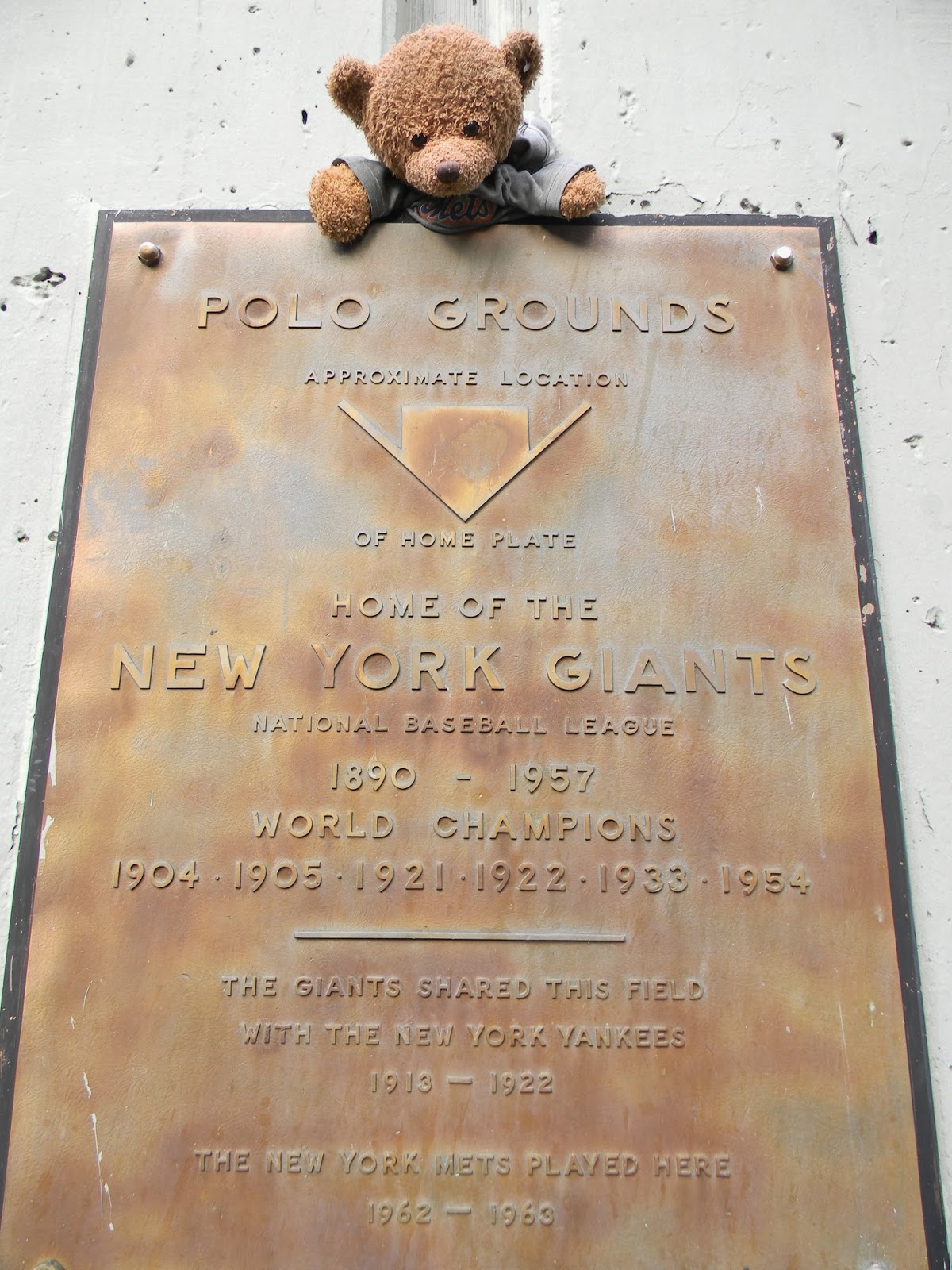
In over half a century, Polo Grounds IV housed the Giants (1911-57), Yankees (1913-22) and Mets (1962-63).  The site now houses the Polo Grounds Towers, an apartment complex that overlooks the Harlem River.  There are still several reminders that baseball was once played there, including a new Polo Grounds Towers sign that's painted in the old New York Giants' colors and the John T. Brush Stairway, which used to lead fans down Coogan's Bluff into the Polo Grounds.


Also the first home of the New York Mets.  (EL/SM)


The Yankees and Giants were just two of the three major league teams that called New York home prior to the formation of the Mets in 1962.  Brooklyn once had a team as well, but they weren't always called the Dodgers.

From 1883 to 1891, the Brooklyn Atlantics, Brooklyn Grays, Brooklyn Bridegrooms and Brooklyn Grooms played at the first Washington Park in the neighborhood of Park Slope.  This ballpark was located between Fourth and Fifth Avenues from 3rd to 5th Streets.  Currently, a public park with that name can be found where Brooklyn's first National League team once played.  After leaving Washington Park in 1892, the team moved to Eastern Park in Brownsville.  But when fans failed to follow the team to their new digs in Brownsville, the club moved back to a new Washington Park after the 1897 season, located just a block away from the original ballpark.

This park, in the Gowanus neighborhood of Brooklyn, was home to the team with many names, as they were known as the Bridegrooms in 1898 and the Superbas from 1899 to 1910 before finally setting on the Dodgers in 1911 after the people who dodged the trolleys in the vicinity of Washington Park.  Brooklyn played at this Washington Park for fifteen seasons (1898-1912) before moving to Ebbets Field in 1913.

Washington Park might not be standing anymore, but the building's wall still is.  A short 12-mile walk from the Polo Grounds Towers, on the corner of Third Avenue and 1st St. in Gowanus, is a wall that looks exactly like what you'd expect a late 19th century/early 20th century ballpark wall to look like.  The brick wall that was behind center field runs for part of 1st St., while the wall that stood behind the left field area of the park takes up all of Third Ave. from 1st St. to 3rd St.  The photos below show what that exterior wall of Washington Park looked like.


Washington Park wall.  (EL/SM)


Once the Dodgers left Washington Park for the new Ebbets Field in 1913, they became the Superbas once again before taking the new name of the Brooklyn Robins in 1914.  That name stuck for nearly two decades until they finally settled on the Dodgers for good in 1932.  The Dodgers played at Ebbets Field for another quarter century before failed attempts at a new ballpark in Brooklyn or Queens caused the team to move to Los Angeles, taking the Giants with them to the Golden State.

The location of Ebbets Field in Crown Heights (the area was part of Flatbush when the Dodgers called it home) is now covered with apartment buildings.  Similar to the Polo Grounds Towers in Manhattan, the Ebbets Field Apartments (also known as the Jackie Robinson Apartments) rest on the location of a former major league ballpark.  This apartment complex also remembers its history, with a cornerstone on Bedford Ave. that notes what used to stand there and a home plate marker just outside a laundromat within the complex, which can be seen by walking into a nondescript entrance on Sullivan Place.  (The former address of Ebbets Field was 55 Sullivan Place.)


The site of the House That Jackie Built.  (EL/SM)


Before the Dodgers settled on moving to the west coast, one of the areas they were looking at for a new stadium was in Queens.  And seven years after Brooklyn got out of Dodge, Queens had its own team when Shea Stadium opened to Mets fans in 1964.

The Mets became New York's one and only National League team in 1962, setting up shop at Polo Grounds IV for two seasons while they waited for Shea Stadium to be completed.  Once they moved to Flushing, the Mets stayed at Shea for 45 seasons - the same number of years Ebbets Field hosted the Dodgers/Superbas/Robins - before moving across the parking lot to Citi Field in 2009.

By the time I walked the ten miles from the site of Ebbets Field to the former home of Shea Stadium, the sun had set on my first day of walking, so I ran the Shea Stadium bases, which are conveniently marked in the current Citi Field parking lot, before taking one last photo with my Studious Metsimus colleagues outside the Jackie Robinson Rotunda entrance at Citi Field.


Time for bed.  There's still another day of walking to go!  (EL/SM)


Day two of my baseball walk (Saturday, October 10) began where the first day ended - at Citi Field.  Although the sun had not officially risen when I got there, there was enough daylight to take photos of the area where Shea Stadium used to be and the special purple and back bunting above the Seaver Entrance, which was named after the late Tom Seaver.


May "The Franchise" rest in peace.  (EL/SM)


With the major league parks out of the way, it was now time to go back to the minors.  From Queens, I walked over the Kosciuszko Bridge to Brooklyn, made my way through Greenpoint and Wiliamsburg, then scampered over the Williamsburg Bridge to Manhattan.  Once in Manhattan, I made my way south through Chinatown and the Financial District before arriving at the Staten Island Ferry terminal.  Since it's not possible to walk to Staten Island from another borough, I got on the ferry and walked around the boat as I made the 25-minute trip through New York Harbor.  Once the ferry docked at the St. George terminal, I walked a short distance to the next stop: Richmond County Bank Ballpark at St. George, a.k.a. the home of the Staten Island Yankees.

The Staten Island Yankees have played in the New York-Penn League since 1999.  In their first two seasons, they played their home games at the College of Staten Island Baseball Complex before moving into their current home in St. George.  The parking lot of RCB Ballpark is also home to a bit of baseball history, as that was the former location of the St. George Cricket Grounds, where the original New York Metropolitans and New York Giants played in the 1880s.

The ballpark in Staten Island has several unique features, such as the likeness of the Verrazzano Bridge above the video board in left field, a panoramic view of the Lower Manhattan skyline, and a Wall of Fame dedicated not to former players, but to the baseball scouts who discovered some of the best players.  If only that Wall of Fame wasn't located behind the first base stands, invisible to mostly everyone in the stadium.


Seriously, couldn't this have been located where it could be, you know, seen?  (EL/SM)


From Staten Island, it was back on the ferry to Manhattan, followed by a walk north to the Manhattan Bridge, which I crossed to get back into Brooklyn.  On my way to the final destination of this two-day baseball trip, I made a stop at Barclays Center.  Why did I stop at a place that was built for basketball, hockey and non-sports events?  Because it is also the home of a piece of Brooklyn Dodgers history.

Outside the arena, on the corner of Atlantic Ave. and Flatbush Ave., is a lone flagpole.  But this is not just any flagpole.  No, my friends, this pole once flew at Ebbets Field and was brought to Barclays Center in 2012 to commemorate the return of professional, major league sports to Brooklyn.  (The NBA's Nets have called Barclays Center home since 2012, while the NHL's Islanders played there from 2015-19.)


O say, does that Ebbets Field banner yet wave?  Yes.  Yes, it does.  (EL/SM)


I had already walked over 50 miles between the two days.  I had visited two current MLB stadiums, the sites of several former major league parks and had even seen some artifacts from those current and former parks that are still standing.  I had just one stop to go.  And to do so, I had to walk as far south as I could go on foot in Brooklyn.  I had to go to Coney Island.

By this time, I was walking at a Bartolo Colón home run trot pace.  But I was determined to make it to my final destination.  I walked eight miles through the neighborhoods of Park Slope, Windsor Terrace, Kensington, Borough Park, Midwood and Gravesend, with no other baseball sites to slow me down.  And right before sunset, I finally made it to Coney Island.  Once there, I passed by Luna Park.  I also passed by Nathan's.  I did not pass by MCU Park, which was the end of my journey.

Once the Brooklyn Dodgers left for California after the 1957 season, the borough of Kings was left without professional baseball for 44 years.  It wasn't until the Cyclones came to town in 2001 that Brooklyn had a team again.

The Cyclones started in St. Catharines, Ontatrio, as a minor league affiliate of the Toronto Blue Jays.  They played in Canada from 1986 to 1999, before moving to Queens in 2000 as the Queens Kings.  Although they played in Mets country, they were still the New York-Penn League affiliate of the Blue Jays.  Finally, in 2001, and nearly half a century after the Brooklyn Dodgers considered building a new home in Queens, the Kings moved from Queens to Brooklyn, setting up shop at KeySpan Park in Coney Island, which was renamed MCU Park in 2010.

Brooklyn had a professional baseball team again and this bum was done with his walk.


Forgive the blurriness.  It was late and I was tired.  (EL/SM)


In just two days, I covered 64 miles walking through all five boroughs and saw more New York baseball history than I ever thought I could.  But most importantly, I helped raise $2,100.00 for the American Cancer Society.

This was a 36-hour period I will never forget and one my feet will probably never forgive me for.  But I certainly hope they'll get over it.  After all, it was a baseball trip.  And taking a walk is always good for the team.


A walk is as good as a hit.  In this case, my walk was a hit.  (EL/SM)


Sunday, July 3, 2016

Sweepin' Ain't Easy ... Said No One at Citi Field This Weekend

After looking deflated and defeated in losing three games to their division rivals in Washington, the Mets came home for a four-game series this weekend against the Chicago Cubs, who have been the best team in baseball all season.  The series would mark the 58th time since 1962 that New York and Chicago had squared off for four consecutive games.  And in their first 57 four-game series, the Mets had taken all four games just one time.

But thanks to some timely hitting, effective pitching and a monster 6-for-6 game by Wilmer Flores, that is no longer a true statement.


New York completed a four-game sweep of the Cubs today, defeating the North Siders, 14-3.  They scored seven runs in the second inning to give Cubs starting pitcher Jon Lester his shortest outing in over 300 career starts just one day after he won the National League Pitcher of the Month award for the just-completed month of June.

The Mets won the four games by blowing out the Cubs twice (they also defeated the Cubs, 10-2, on Friday) and taking two nailbiters on Thursday and Saturday, both by a 4-3 score.  Basically, they continued their dominance over the Cubs that began last year during the four-game NLCS sweep.

But as great as the Mets have performed against the Cubs over the last eight months, they had only won every game of a four-game series from Chicago just once in 57 tries.  In 1985, during the first series between the two teams after their battle for division supremacy the previous year, the Mets brought out the brooms against the Cubs in a four-game set at Shea Stadium, allowing a total of just four runs in the series.

Screen shots or it didn't happen.  (Courtesy of Ultimate Mets Database)

The Mets went on to win all nine games they played versus Chicago at Shea Stadium in 1985, taking a three-game series in August and a two-game set in September.  But the four-game sweep marked the first and only time New York had won every game of a four-game series against the Cubs in the team's first 54 seasons.  Until now.

And if you want to say that it's very difficult for any team to win four consecutive games in the same series against the same team, perhaps you should know what the usually lowly Cubs have done against the Mets in four-game sets since their first one in 1962.

That first four-game series in June 1962 at the Polo Grounds resulted in four Cubs victories.  It should be noted that the Cubs finished that campaign with a 59-103 record, which was - and still is - the worst regular season record in Chicago's long history.  (The 1966 Cubs also went 59-103.)

A year later, the Cubs swept another four-game series from the Mets, this time at Wrigley Field.  Then in 1965, the Cubs added a third venue to the four-game sweep-a-thon, taking four straight from New York at Shea Stadium.

It then took nearly two decades for Chicago to win all four games of a four-game series against the Mets, but they finally repeated the feat in 1984, scoring 32 runs in the four August games at Wrigley Field.  The Cubs had previously pulled off four-game sweeps against three awful Mets teams in 1962, 1963 and 1965.  However, the 1984 Mets squad won 90 games.  It wasn't just pushover Mets clubs that were experiencing the wrath of the Cubs in four-game sets.

Let's now fast forward seven years later to 1991.  On August 9, the Mets went into Wrigley Field with a 57-50 record.  They were still very much alive in the race for the N.L. East title, entering the game just 5½ games behind the first place Pittsburgh Pirates.  But the Cubs, who were struggling and under .500 entering the series, took out their frustrations on the Mets, winning all four games.  The sweep was the beginning of a season-changing 11-game losing streak for the Mets.

It was déjà vu all over again for the Mets in 1992, as once again in August, the Mets were still in the race for the division crown - they were 7½ games out of first - but were swept four straight in Chicago.  That sweep was the beginning of a 21-35 stretch for the Mets to close out the season.

With the Cubs moving to the N.L. Central in 1994, the Mets and Cubs only played five four-game series from 1994 to 2014, with none of them resulting in sweeps for either team.  But in 2015, the Cubs pulled off a four-game sweep of the Mets at Wrigley Field in May.  Of course, we all know how that season turned out for the Mets.

So that means the Mets suffered four-game sweeps to the Cubs seven times from 1962 to 2015, returning the favor just once in 1985.  Once.  In fifty-four seasons.

But now that number has gone up to two, as the Mets have just completed a four-game sweep of the Cubs at Citi Field - the only venue in which the Cubs have yet to turn the trick against the Mets.

Sweeping a series of any length - particularly a four-game series - may not be easy, but don't tell that to the Mets.  They treated the series the way Cubs used to treat four-game series against the Mets.  And in doing so, fans got to witness something they hadn't seen the Mets do as a team since 1985.

The Cubs are the cleanest team in baseball after they just got swept by the Mets.


Monday, February 9, 2015

One Mo-MET In Time: Tim Harkness

In the early days of the New York Mets, fans attended the team's home games to see many things.  They went to see manager Casey Stengel, who was as entertaining as any comic actor they could watch on television.  They also went to catch a glimpse of former members of the Brooklyn Dodgers and New York Giants, who were closing out their careers in the city they called home prior to going out west.  Some fans even went to see stars from other teams - players they hadn't been able to see in a National League park since the defection of the Dodgers and Giants following the 1957 campaign.

What fans didn't get to see too much during the team's early days were wins.  In the two years the Mets called the Polo Grounds home, the team won a total of 56 games there.  That's fewer wins at home in a two-year period than the Cincinnati Reds won in their home park in 1962 alone, and the Reds were a third-place team that year.

Needless to say, most of the excitement generated on the field during the team's short stay at the Polo Grounds had nothing to do with the players wearing "Mets" on their chests.  If the team had a lead, they had a good chance of blowing it.  And if they trailed in the late innings, there seemed to be little chance of a happy recap.  But during the team's second season, an unlikely hero stepped up to the plate on an early summer afternoon, trying to erase a two-run deficit in extra innings.  What happened next was something that would not be seen again during a Mets home game for nearly three decades.

Tim Harkness had a left-handed power swing made for the short distance to right field at the Polo Grounds.

Thomas William Harkness, better known as Tim, was a power threat from a very young age.  The Canadian slugger signed with the Phillies in 1956, then played in the Dodgers minor league system over the next five years.  A year after putting up a 28 HR, 111 RBI season at the Double-A level, Harkness made his major league debut with the Dodgers.  But Harkness never caught on as a first baseman in Los Angeles.  He started just six games at the position in two seasons, appearing primarily as a pinch-hitter before being traded to the Mets at the conclusion of the 1962 campaign.

With the Mets, Harkness became the team's primary first baseman in 1963, although he did share the position at times with Duke Carmel (17 starts), Frank Thomas (15 starts) and an 18-year-old Ed Kranepool (15 starts).  Harkness was a streaky hitter, hitting home runs and driving in runs in bunches - he had four homers and 14 RBI during a 17-game stretch in May - but experienced many more cold periods than hot ones.  In fact, from May 30 to June 25, Harkness batted .125, collecting nine hits in 72 at-bats.

Harkness, who once had a .276 batting average in late May, was now in danger of dropping below the .200 mark, entering the June 26 tilt against the Chicago Cubs with a .208 batting average.  Coming into the game, Harkness had collected just 53 hits in his brief three-year career in the majors, never having more than three hits in any single game.  Through nine innings against the Cubs, Harkness had picked up one hit in four at-bats.  But the game was tied through nine, as the Mets had chipped away at an early four-run deficit to send the game into extra innings.  The team's day wasn't quite done, and neither was Tim Harkness.

Harkness doubled to lead off the 11th inning, but was stranded in scoring position when pinch-hitter Norm Sherry grounded into an inning-ending double play.  Two innings later, a single by Harkness put runners on the corners with one out.  But the Mets couldn't capitalize on Harkness's third hit of the game, as two groundouts ended the scoring threat.

It was on to the 14th inning at the Polo Grounds, where the Cubs looked to score for the first time since taking a 4-0 lead in the fifth inning.  Mets reliever Galen Cisco was one out away from getting out of the inning, but surrendered a two-run, inside-the-park home run to future Hall of Famer Billy Williams, giving Chicago a 6-4 lead.  The Mets, who had squandered numerous scoring opportunities in the previous innings, had one more chance to come up with a game-winning rally.  What they got was a seminal moment in team history.

Jim Hickman led off the Mets' half of the 14th inning with a single.  Ron Hunt followed with a single of his own, but Hickman was thrown out after he accidentally ran past second base.  Cubs pitcher Jack Warner then walked Jimmy Piersall to put the tying runs on base for Frank Thomas.  Thomas, who led the Mets with 34 home runs during the team's inaugural season in 1962, entered the game with just four home runs in 1963.  But Thomas had hit a two-run homer earlier in the game, and was another clout away from winning it.  With the crowd of just over 8,000 hoping for Thomas to blast his second homer of the game, all they got was a fly ball to left off Cubs reliever Paul Toth.

The Mets were now an out away from losing a heartbreaker to Chicago.  Seldom used catcher Sammy Taylor stepped up to the plate.  Left-handed pitcher Jim Brewer was summoned from the bullpen to face the lefty-swinging Taylor.  Taylor was already 0-for-6 in the game and had collected just eight hits all season up to that point.  But Brewer had not pitched in a major league game in 17 days and had been awful since May 19 (7.59 ERA in his last six appearances).  Taylor was able to coax a walk from Brewer to load the bases, bringing up Tim Harkness.

Harkness had already tied his career high in the game by notching three hits, including two in extra innings.  A fourth hit would almost surely tie the game.  A long hit would win it.  Harkness worked the count full.  Then with one mighty swing, Harkness delivered something no Met had accomplished before and no Met would accomplish again for almost 30 years.

With the right field wall looming just 257 feet away from home plate, Harkness pulled a grand slam over that wall, giving the Mets a thrilling 8-6 victory.  The game-winning blast was Harkness's fourth hit of the game - a new career high - but most importantly, was the first walk-off grand slam in the brief history of the team.

Tim Harkness emerges from the Mets clubhouse to greet fans following his extra-inning heroics. (UPI Photo)

Although the Mets hit a handful of walk-off grand slams over the next few decades, including one by Jim Hickman just six weeks after Harkness's game-winner, most of them occurred with the score tied.  But the grand slam by Harkness turned a potential two-run loss into a two-run win.  No Mets player would hit another walk-off grand slam with the team trailing at the time until Kevin McReynolds turned the trick against the Montreal Expos on June 25, 1991, nearly 28 years to the day after Harkness's heroics.  It would be another 23 years before a third Mets player - Ike Davis in 2014 - slammed the Mets from an apparent loss to a last-licks victory.

Harkness would go on to hit another walk-off homer for the Mets in 1963 - although this one was only a two-run shot in September - but for the most part, his grand slam against the Cubs was his last highlight of the season.  After victimizing Jim Brewer on June 26, Harkness went into a deep slump, going 9-for-87 with no homers and two RBI over his next 35 games.  A six-game hitting streak to end the season kept his average above .200, but also showed the Mets that the team needed to go in a different direction at first base.

The Mets moved into Shea Stadium in 1964, a park whose right field fence was nearly 100 feet deeper down the line than the one at the now-defunct Polo Grounds, and Harkness's power suffered.  Harkness played 39 games for the Mets in 1964, hitting just two homers.  Only one of those homers came at Shea Stadium.  Harkness was traded to Cincinnati in July, then bounced around in the minors for the next three seasons, never making it back to the majors.

In four big league seasons, Harkness never matched his power production in the minors.  His 28 HR, 111 RBI campaign in the minors in 1960 didn't translate to the majors, as Harkness managed just 14 homers and 61 RBI as a member of the Dodgers and Mets.  But for one amazing day in June 1963, Harkness became a hero in New York, powering the Mets to a dramatic, come-from-behind victory.

Manager Casey Stengel probably said it best (as he usually did) when discussing how important Harkness's homer was to the team at that moment.


"It was one of those good ones.  We just about had to end it there because I'd run out of men."


As the saying goes, if you watch baseball long enough, you're bound to see something you've never seen before.  On June 26, 1963, Mets fans saw something they had never seen before when Tim Harkness sent the small, but lively, Polo Grounds crowd home happy, turning a loss into a win with a game-ending grand slam home run.  It was the only time a Mets player ever snatched a victory from the jaws of defeat on a grand slam at the Polo Grounds.  Twenty-eight years later, Kevin McReynolds became the only Met to repeat Harkness's feat at Shea Stadium.  And twenty-three years after that, Ike Davis became the first Met to do it at Citi Field.  It has become a once-in-a-stadium's-lifetime event.

Tim Harkness may not have had a long career in New York, nor was it particularly a successful one.  But for one memorable moment, he provided Mets fans with a thrill that would not soon be forgotten.  It would also be a moment that would rarely be duplicated.


Note:  One Mo-MET In Time is a thirteen-part weekly series spotlighting those Mets players who will forever be known for a single moment, game or event, regardless of whatever else they accomplished during their tenure with the Mets.  For previous installments, please click on the players' names below:

January 5, 2015: Mookie Wilson 
January 12, 2015: Dave Mlicki
January 19, 2015: Steve Henderson 
January 26, 2015: Ron Swoboda
February 2, 2015: Anthony Young
 

Thursday, August 14, 2014

Citi Field Is Becoming Nationals Park North

Bryce Harper doesn't wear clown shoes as he rounds the bases at Citi Field.  (Photo by Jim McIsaac/Getty Images)

On Thursday, the Mets dropped a 4-1 decision to the first place Washington Nationals.  It was New York’s 11th straight loss to Washington at Citi Field, a venue which has in essence served as a second home for the Nats.

It’s not just that the Mets are dropping decisions to the Nationals, it’s how they’re racking up the losses.  Let’s take a look at some of the horrifying numbers.  You might want to keep a barf bag nearby.

  • Washington has celebrated a victory in each of its last 11 games at Citi Field.  That 11-game streak of success is the longest winning streak by any team at the park, including the Mets.  The Mets' longest skein in the ballpark built for them is just nine games, accomplished from April 22 to May 8, 2010.  The Nationals' streak is also the longest of all-time by any road team in the Mets' home venue.  That includes teams that visited all the awful Mets squads that played in the Polo Grounds and Shea Stadium.
  • During the Mets’ eleven-game streak of ineptitude, they have been outscored by the Nationals, 74-21, with seven of the Mets’ 21 runs coming in one game - a 9-7 loss on March 31, 2014.  (Simple math lets us know that the Mets have scored just 14 runs in the other ten games.)  That March 31 game and last night’s 3-2 setback were the only times during the skein that the Mets lost by fewer than three runs.  I guess last night’s game would have to be considered a moral victory for the Mets, even if it was still yet another demoralizing defeat.
  • The Mets haven’t just been stinking up the joint against the Nationals in their last eleven head-to-head matchups at Citi Field.  They’ve actually lost 25 of 29 games versus Washington since September 2011.  In that time period, the Mets have played nine series against the Nats.  They’ve won just one of those series and they’ve been swept six times.  Two of those six sweeps came in four-game series.  In the 29-game stretch, New York has been outscored, 150-66.  That means the Mets have scored eight fewer runs in their last 29 home games against the Nationals than Washington has scored in their last ten versus the Mets. 
  • When Citi Field opened in 2009, the Pepsi Porch overhang was meant to evoke memories of a similar right field overhang at Tiger Stadium.  But the Nats’ bats are bringing back a different kind of Tiger Stadium memory.  Washington has outhomered the Mets, 29-5 during their 11-game rampage at Citi Field, numbers that are reminiscent of the Mets’ lone trip to Tiger Stadium in 1997, when the team hit no home runs and Detroit blasted 14 moon shots off Mets pitchers.  Are we 100% sure that Bobby Higginson isn’t the Nationals’ guest hitting coach when Washington plays in New York?
  • Speaking of long balls, Washington has homered 47 times in their last 29 games at Citi Field.  These home runs have accounted for a total of 72 runs.  Meanwhile, during those same 29 games, the Mets have managed to cross the plate via any means just 66 times (as painfully detailed two paragraphs above).  That means Washington has had a better chance of scoring at Citi Field via the home run than the Mets have had of scoring … period.  The Nationals have also scored 78 runs without the benefit of the ball leaving the park, which is just them throwing salt on the Mets’ open wound. 
  • Finally, in five of their last 15 games at Citi Field, the Nationals have smacked four homers or more.  The Mets, on the other hand, have played a total of 463 games in their home park.  How many times in those 463 contests do you think they’ve produced a four-homer game?  You guessed it.  Five times.  The Nats have done in 15 games what the Mets have struggled to do in nearly 500 affairs.

Before moving to Washington at the conclusion of the 2004 season, the Nationals/Expos franchise played its home games in Montreal.  The Expos played their inaugural game on the road at Shea Stadium in 1969.  Thirty-five years later, Shea Stadium bid adieu to Les Expos, hosting Montreal in the team’s final game before sending them off to our nation’s capital.  But apparently, the Expos/Nationals franchise still thinks of New York as its second home.  How else can one explain the Nationals’ dominance over the Mets at Citi Field in recent years?

Citigroup has the naming rights for the Mets’ home ballpark through the 2028 season.  But if you ask anyone associated with the Washington Nationals, Citi Field has already been re-christened as Nationals Park North.  After all, with 11 straight wins over the Mets in New York - the longest win streak by a road team at the Mets' home ballpark in the history of the franchise - the Nats have proven that they have a distinct road team advantage at Citi Field.

Saturday, April 5, 2014

Hark(ness), The Herald Davis Swings

If you were at Citi Field today as I was, you witnessed a thrilling conclusion to the Mets-Reds affair.  With the Mets trailing, 3-2, going into the bottom of the ninth, Juan Lagares, Anthony Recker and Ruben Tejada all reached base to start the inning.

Up stepped Ike Davis, needing a long fly ball to tie the game and a base hit to perhaps win it.  What he did was even more exciting.

Slam!  Let the boys be boys!  (Photo by Howard Simmons/NY Daily News)

Davis' long blast off the Subway sign in right-center turned a potential heartbreaking one-run loss into a scream-until-you-lose-your-voice three-run victory.  The walk-off grand slam gave the Mets a 6-3 win over the Reds and put them in position to sweep Cincinnati on Sunday.

But Ike Davis' game-ending homer was more than just a fantastic moment in this young season.  It also was one of the rarest moments in the 53-year history of the team.  Please allow me to elaborate.

Davis' walk-off grand slam was only the seventh such home run hit by a Mets player in franchise history.  Tim Harkness was the first Met to smoke a game-ending salami, accomplishing the feat against the Chicago Cubs at the Polo Grounds on June 26, 1963.  Just forty-four days later, Jim Hickman also victimized the Cubs for a walk-off grand slam at the Polo Grounds.  The killer H's were the only two players in team history to end games with four-run homers until 1980, when Mike Jorgensen took the Dodgers' Rick Sutcliffe deep at Shea Stadium.  Six years later, Tim Teufel hit a grand slam against Tom Hume of the Phillies at Shea, a feat that wasn't seen again at the Mets' former home until 1991, when Kevin McReynolds blasted a bases-clearing shot over the wall versus the Montreal Expos.  It took another 22 years before Jordany Valdespin became the sixth Met to end a game with a grand slam, taking the Dodgers' Josh Wall over the wall at Citi Field on April 24, 2013.  Less than 365 days after Jordany took a spin around the bases, Ike Davis became the seventh slammer.

Obviously, becoming the seventh player to hit a walk-off grand slam in Mets history puts Davis in select company, but four of the other six players who ended games by putting a four-spot up on the scoreboard did so when their respective games were tied.

Hickman, Jorgensen, Teufel and Valdespin each turned tie games into four-run victories with their powerful swings.  That means Harkness, McReynolds and now Ike Davis are the only players who can claim snatching a victory from the jaws of defeat by walking off with a grand slam home run.  And each player did so at a different home park, with Harkness turning a 6-4 deficit into an 8-6 win at the Polo Grounds, McReynolds blasting away at a potential 5-4 loss by slamming the Mets to an 8-5 victory at Shea Stadium and Ike Davis erasing a 3-2 Reds lead with one swing of the bat, giving the Mets a 6-3 win at Citi Field.

Harkness.  McReynolds.  Davis.  Three very different players playing in three very different eras.  But all produced one very similar result with three well-timed swings of the bat.  And it was a result that made Mets fans across the generations leave the ballpark feeling slam-tastic.


Monday, January 13, 2014

The Best On The Worst: Al Jackson

In 1962, the New York Mets and Houston Colt .45s entered the National League as expansion franchises.  The previous October, a special draft was held so that the two teams could stock their rosters with major league talent.  Houston decided to draft younger players who had bright futures.  The Mets, on the other hand, felt like the best way to go was with veteran players, including several who had ties to New York.  That's just a nice way of saying the Mets drafted older players who had bright pasts.

Roger Craig, Gil Hodges and Don Zimmer - all former members of the Brooklyn Dodgers - were drafted by the Mets in the expansion draft.  By the end of the 1963 season, they were all former Mets.  The Mets also drafted just three pitchers with their first ten selections, so when it came time for the team to announce its 11th pick, the Mets set their sights on a 26-year-old southpaw who had pitched beautifully in the Pittsburgh Pirates' minor league system for half a decade, but had never been afforded much more than a cup of coffee at the major league level.

From 1958 to 1961, he posted a 55-34 record in the minors with a brilliant 2.58 ERA.  But despite his success, he only took the mound for the Pirates 11 times over those four years, making just five starts and six relief appearances.  Needing a left-handed starting pitcher after drafting three right-handers in their first ten picks, the Mets took a chance on the talented, but inexperienced pitcher.  A few years later, he became the team's first ace, or what passed for an ace on a last-place team.

Al Jackson was the best he could be for a team that was the worst anyone did see.

Alvin Neill Jackson wasn't a very tall pitcher.  Listed at 5'10", Jackson was never going to be an intimidating presence on the mound.  But he knew how to pitch, and he gave the fledgling Mets their best chance to pick up a rare victory during their seminal seasons.

Jackson's career as a Met didn't start out very well.  But then again, neither did the Met careers of most of his teammates.  Jackson started the third game for the Mets in 1962, allowing six runs in his first outing for New York, a loss against the team that gave up on him just six months earlier.  He followed that up by allowing another half-dozen tallies in a 9-4 loss to the St. Louis Cardinals.  But after two scoreless relief appearances, Jackson was tapped by manager Casey Stengel to start the first game of a doubleheader against the Philadelphia Phillies on April 29.  Jackson responded by tossing the first shutout in Mets history, scattering eight hits in the team's 8-0 victory.

Despite ending April on a high note, the month of May was not very kind to Jackson.  By the end of the month, Jackson had a 2-6 record and an ERA approaching 6.00.  But his fortunes turned once the calendar turned to June.  From June 6 through August 28, Jackson made 18 starts, allowing two runs or less in ten of them.  Jackson actually won five of those ten games, which was quite an accomplishment on a team that went 28-101 after starting the season with a 12-19 record.  Three of the five victories were shutouts, including the first one-hitter in franchise history on June 22, but one of his better performances came in a game he actually lost.

On August 14, 1962, the Mets hosted the Phillies at the Polo Grounds.  Jackson was dominant in the game, allowing one run on two hits through nine innings.  But Phillies starter (and future Mets manager) Dallas Green was just as stingy, holding the Mets to just one run through the first nine frames.  Green was lifted from the game in the 11th, but Jackson soldiered on, scattering two hits in five scoreless innings from the 10th through the 14th.  Incredibly, Jackson had gotten the Phillies to ground out a whopping 25 times in the first 14 innings.  He appeared to have his 26th ground ball out when Tony Gonzalez led off the 15th inning by hitting a roller to Mets third baseman Sammy Drake, who had entered the game as a pinch-runner for regular third sacker Felix Mantilla six innings earlier.  But Drake's throw was mishandled by first baseman Marv Throneberry, allowing Gonzalez to reach second base.  Jackson then allowed two singles wrapped around an intentional walk, giving the Phillies a 3-1 lead.  Jackson stayed in the game to complete the 15th inning, but the Mets failed to rally for him in the bottom of the inning.  Jackson's final line: 15 innings, three runs (two earned), six hits, five walks, six strikeouts, another loss.  It was as typical as the 1962 Mets got.

For the season, Jackson went 8-20 with a 4.40 ERA.  But those numbers don't accurately represent how good Jackson was for a team that wasn't good at all.  From June 1 through September 10, Jackson posted a 3.38 ERA and was credited with six victories.  The Mets won seven of Jackson's 20 starts during that three-month time period.  They were a woeful 16-66 in the 82 games not started by Jackson from the beginning of June through the middle of September.  Jackson led the 1962 Mets in ERA and tied for the team lead with 118 strikeouts.  He also pitched the only four complete-game shutouts the Mets recorded in their inaugural season.  Considering the team of misfits he played for, Jackson pitched very well in 1962.  The Mets took a small step forward in 1963, but it was Jackson who made the greatest strides in the team's sophomore season.

In Jackson's second season with the Mets, he posted a 13-17 record with a 3.96 ERA and a team-leading 142 strikeouts.  His 13 wins represented 25.5% of the team's 51 victories in 1963.  To this day, Jackson remains one of only five Mets pitchers who were credited with victories in more than one-quarter of the team's wins in a single season.  The other four are Tom Seaver (1967, 1972, 1975), Jerry Koosman (1968), Bret Saberhagen (1994) and R.A. Dickey (2012).  Jackson was particularly strong over the final two months of the season, going 7-3 with a 2.49 ERA over his last 11 appearances (10 starts).  Unfortunately, the team went 9-29 in games Jackson did not appear in over that same stretch.

The Mets combined to win just 91 games in 1962 and 1963, but Jackson won 21 of them, more than any other pitcher on the team.  When the team moved from the Polo Grounds to Shea Stadium in 1964, Jackson found the new digs much to his liking.  Although Jackson's final record (11-16, 4.26 ERA) wasn't overwhelming, he pitched his best games that year at Shea.  Included among them was the first shutout (as the well as the first victory) in Shea Stadium's short history, a 6-0 victory over the Pittsburgh Pirates on April 19.  Overall, Jackson went 7-5 with a 3.68 ERA at the new park in 1964.  But he didn't save all his best games for the home fans.

On October 2, Jackson won a 1-0 pitcher's duel over future Hall of Famer Bob Gibson in St. Louis.  It was the second time Jackson had defeated Gibson by that score in three seasons, having previously accomplished the feat on July 27, 1962, also in St. Louis.  Those twin shutout victories by Jackson over Gibson were the only two times the Mets defeated the Cardinal legend from 1962 to 1966, as Gibson went 15-2 against New York in the years prior to the debut of their own Hall of Famer, Tom Seaver.  But by the time Seaver came aboard, Al Jackson was already gone.

After two seasons in which he led the team in wins, Jackson lost 20 games for the second time in 1965.  Jackson's ERA also went up to 4.34, while his innings decreased to 205⅓ - his lowest total in four seasons as a Met.  Although his 8-20 record said otherwise, Jackson wasn't horrible in 1965.  He still tossed three complete-game shutouts and posted a career-best 1.354 WHIP.  It was the team around him that got worse, especially when Jackson was on the mound.  Jackson made 31 starts in 1965.  The Mets scored two runs or less in 15 of those starts, putting extra pressure on Jackson to be as flawless as possible.  Even in his three complete-game shutouts, the Mets only managed to score a total of five runs for him.  And all but one of Jackson's eight wins in 1965 came in complete-game efforts.

By the end of the 1965 season, the Mets realized they needed two things.  They needed to abandon their "let's go with the proven veterans" philosophy.  They also needed a third baseman, a need that continued to haunt them into the 1970s when they inexcusably traded away future All-Stars like Nolan Ryan and Amos Otis in order to get help at the hot corner.  Apparently, their need for a third baseman was greater than their need to get younger.

Just weeks after the 1965 campaign ended, the Mets traded Jackson and Charley Smith to the St. Louis Cardinals for Ken Boyer, an 11-year veteran who was the league's MVP just a year earlier.  But after winning the award following a 1964 season in which he hit .295 with 24 homers and a league-leading 119 RBI for the World Series-winning Cardinals, Boyer regressed in 1965, batting .260 with 13 homers and 75 RBI.  Still, that didn't stop the Mets from trading Smith and their 29-year-old left-handed starting pitcher, who was also the team's all-time leader in wins at the time.

Boyer performed miserably as a Met, batting .258 with 17 homers and 74 RBI in one-and-a-half seasons in New York.  Meanwhile, Jackson went on to post his best season in the majors with the Cardinals in 1966, going 13-15 with a career-best 2.51 ERA and 1.148 WHIP.  Jackson finished 6th in the league in ERA in 1966 and 10th in WHIP.  He followed up his 1966 campaign by going 9-4 in 1967, although the 31-year-old Jackson was used mostly in relief by the team.  The Cardinals returned to the World Series that season, but by then, Jackson had already fallen out of favor with the team.  One day after St. Louis won their second championship in four seasons, Al Jackson was traded back to the Mets.

By 1968, the Mets had a young and talented starting rotation, led by Tom Seaver and Jerry Koosman.  New manager Gil Hodges liked the youth in his starting rotation, which eventually also included 21-year-old Nolan Ryan and two 24-year-olds in Dick Selma and Jim McAndrew.  As a result, Al Jackson was only allowed to start nine games for the Mets in 1968.  He did not fare well as a starter in his second go-round with the Mets, going 2-6 with a 4.42 ERA.  But he did have great success coming out of the bullpen.  In 16 games as a reliever, Jackson posted a 2.52 ERA and 0.981 WHIP, holding opposing batters to a .257 on-base percentage.  Jackson had found a new home with a Mets team that was clearly better that they were when he left them after the 1965 season.  But his homecoming didn't last very long.

Jackson was brutal to start the 1969 season, recording a 10.64 ERA in nine relief appearances.  In five of those nine games, Jackson allowed two or more runs.  The final straw came on May 22, the day after the Mets had reached the .500 mark for the first time in team history in the month of May.  In that game, a 15-3 loss to the Braves, Jackson came into the game in the seventh inning with the Mets already trailing by ten runs.  By the time the inning was over, the Mets were down by two touchdowns, as Jackson allowed an inherited runner to score, plus three of his own runners.

Soon after his meltdown in Atlanta, the Mets rolled off a team-record 11-game winning streak, but Jackson did not pitch in any of those games.  With the team feeding off its young pitchers, Jackson was no longer needed, so he was sold to the Cincinnati Reds on June 13.  The Mets went on to win the World Series without him, and Jackson went on to finish his career as a Red, as Cincinnati released him on April 13, 1970.  A career that began in Pittsburgh in 1959 was now over, but Jackson's life in baseball, especially with the Mets, was not.

Since throwing his final pitch in the big leagues, Jackson has coached at many levels.  He managed the Kingsport Mets for a spell in 1981, then served as Davey Johnson's pitching coach before Johnson's eventual promotion to manage the Mets in 1984.  Jackson molded the young arms that became All-Stars for the Mets in the mid-to-late '80s, and eventually made it back to the big club himself, serving as the team's bullpen coach for the only Mets squads to earn back-to-back postseason berths in 1999 and 2000.  Jackson had just missed appearing in the World Series on two separate occasions, first with the Cardinals in 1967 and then with the Mets in 1969, but he finally got to experience one in 2000, nearly four decades after pitching in his first game for the Mets.  His career had come full circle, and as noted in David Ferry's book, "Total Mets: The Definitive Encyclopedia of the New York Mets' First Half-Century", Jackson still hasn't reached the end of his baseball journey.


"The years that I spent [with the Mets], as a player, coach, whatever, it was a great ride.  An outstanding ride.  And I really haven't finished yet."


Al Jackson was diminutive in stature, but he was quite large for the Mets when it came to giving the team its best chance to win during its formative years.  From 1962 to 1965, Jackson went 40-73 with a 4.24 ERA for a team that was a combined 194-452 over its first four seasons.  During those four years, Mets pitchers hurled 25 complete-game shutouts.  Jackson was responsible for ten of them.  (Jackson is one of only six pitchers to toss ten shutouts as a Met.  The others are Tom Seaver, Jerry Koosman, Dwight Gooden, David Cone and Ron Darling.)  Jackson also led or tied for the team lead in wins three times, strikeouts three times, and ERA once.  His highs of 13 wins and 142 strikeouts in 1963 remained single-season team records until they were broken by Seaver and Koosman - two pitchers who went on to set a lot of club records in their time with the Mets.

Just 38 days after Jackson played his last game with the Mets in 1969, Seaver broke the lefty's franchise record of 43 career wins.  But Jackson's 80 losses were not surpassed until May 27, 1974, when Seaver lost his 81st game as a Met.  By then, Seaver had amassed 137 wins, nearly 100 more than Jackson's total.  To this day, only four Mets pitchers have lost more than 80 games - Seaver, Koosman, Gooden and Jon Matlack.  All four of those pitchers are considered to be among the best in franchise history.  However, all four of them also pitched for more successful Mets teams.  Jackson had the unfortunate luck of being the best pitcher on the worst Mets teams.

Al Jackson could have played for a number of World Championship teams.  He played for the Pittsburgh Pirates in 1959 and 1961.  The Bucs won the World Series in 1960.  He was a member of the St. Louis Cardinals in 1967, but he didn't participate in their run to the World Series crown.  He also pitched for the 1969 Mets, though he was a member of the Cincinnati Reds when his former teammates celebrated their title on the Shea Stadium mound.

When Jackson was afforded the opportunity to pitch, it was usually for teams that did very little to help him earn a victory.  Jackson was the Mets' de facto ace from 1962 to 1965, although all that title got him was hard-luck loss after hard-luck loss, with a pinch of a one-hitter here and a couple of dashes over Bob Gibson there.  Jackson deserved better from his teammates, but that was like asking Marv Throneberry to play more alertly on the field.  You knew he would try his best, but in the end, he would just miss a base or two or drop a throw to cost his teammate a chance at a complete-game, 15-inning victory.

If anyone can define being the best on the worst, it's most definitely Al Jackson.  His final numbers as a Met certainly don't look pretty when compared to those posted by the likes of Seaver, Koosman and Gooden.  But his numbers were far better than the ones his teammates were putting up on the board.  Little Al Jackson may have been small in stature, but he was as big as they came in the early days of the New York Mets.

Photo by Herb Scharfman/Getty Images

Note:  The Best On The Worst is a thirteen-part weekly series spotlighting the greatest Mets players who just happened to play on some not-so-great Mets teams.  For previous installments, please click on the players' names below:

January 6, 2014: Todd Hundley


Monday, November 11, 2013

Joey's World Tour: These Used To Be Our Playgrounds

Hi, everyone!  This is your fav'rit Studious Metsimus roving reporter, Joey Beartran.  The Mets haven't played a baseball game in six weeks, but since when has a small detail like that kept me from visiting a baseball stadium or two?

In recent years, we've used the offseason to visit various ballparks.  The end of the 2011 season saw my colleagues and I taking a tour of Oriole Park at Camden Yards in Baltimore.  A few weeks later, we went out west, visiting Petco Park in San Diego and Dodger Stadium in Los Angeles.

Our trip to Dodger Stadium made me think of when New York had two National League teams instead of the current one.  Prior to 1958, the Dodgers and Giants called the Big Apple home, playing at Ebbets Field in Brooklyn and the Polo Grounds in Manhattan, respectively.  Both parks are long gone, but there are still a few reminders to young whippersnappers such as myself of the golden era of baseball in New York.

First, we hopped the trolley to Flatbush.  (Okay, so it was more like the 2 train, but just humor me here.)  We got off at President Street, walked two long blocks to the west, and made a left turn onto Bedford Avenue.  As we walked past Medgar Evers College, we approached Montgomery Street, which is now the northern border of the Ebbets Field Apartments.  But prior to 1958, Montgomery Street was just a few feet behind left field at Ebbets Field.

Just before reaching Sullivan Street, we saw the only mentions of what used to be the home of Gil Hodges, Duke Snider, Pee Wee Reese and of course, Jackie Robinson.  My photographer stopped to snap these photos of the only reminders of Ebbets Field.  (All photos can be viewed at a higher resolution by clicking on them.  In layman's terms, that means I get bigger if you click on the photos.)


Across the street from the Ebbets Field Apartments is a Rite-Aid pharmacy, which would normally not attract my attention.  However, there was a mural on the side of the building which paid homage to the great Jackie Robinson and the ballpark that used to be across the street.

We didn't need to get any prescriptions filled, but we did need to take a few photos by these lovely works of art, which you can see below.


Prior to the team winning its first World Series championship in 1955, fans of the Brooklyn Dodgers used to say "wait till next year" after each season ended without a title.  Well, we didn't have to wait that long to continue my quest to visit the two former sites of National League baseball in New York.  It only took a day before we traveled to Coogan's Bluff, in the northeast part of Manhattan, to visit the area that now is home to the Polo Grounds Towers.  But before there were apartment towers there, it was just the Polo Grounds - a place the Giants, Mets and Yankees called home.

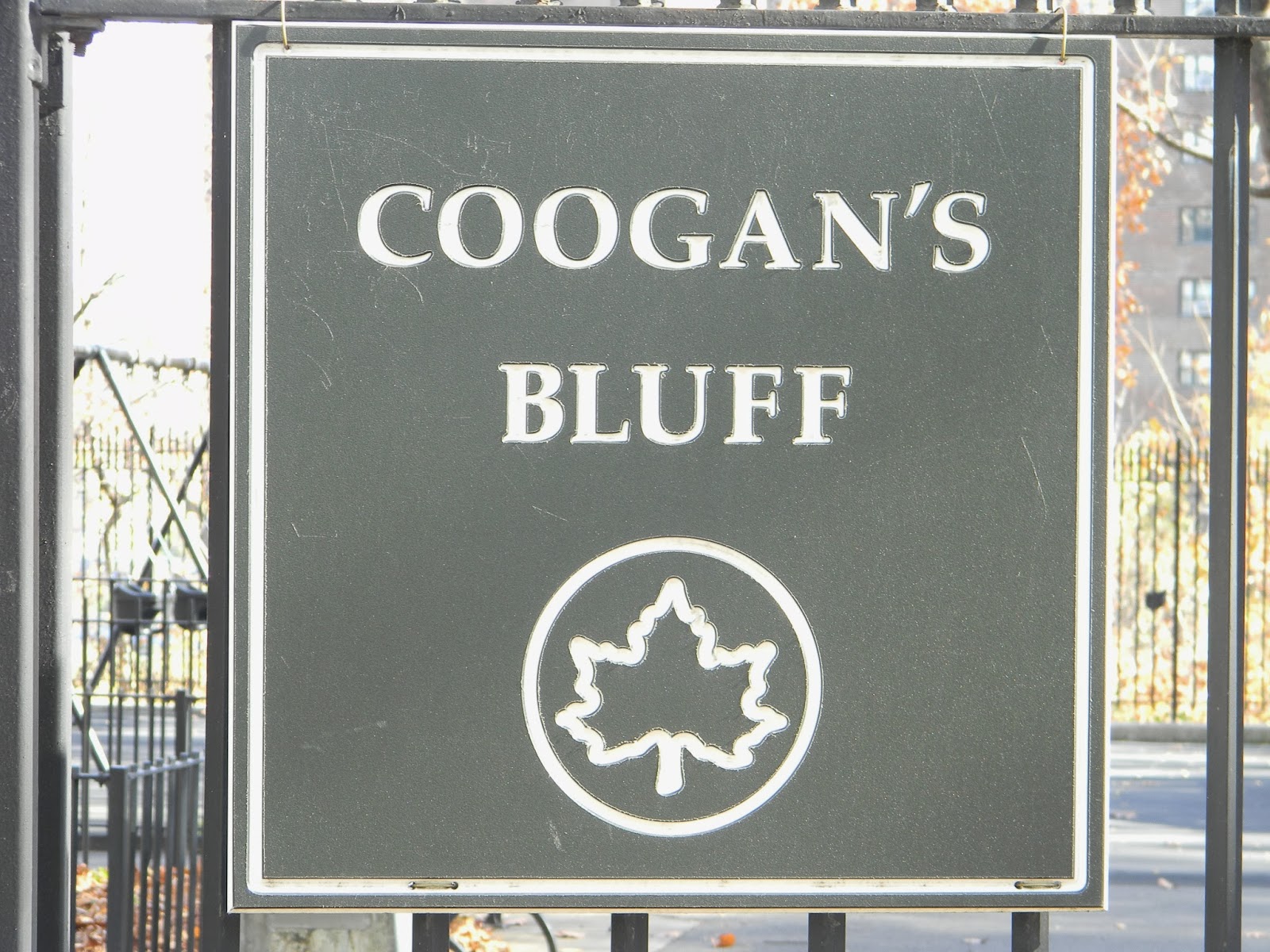
As we walked between the buildings, we came across a playground in front of the hill known as Coogan's Bluff.  Opposite that playground is an apartment building with a sign that reminds all who enter of the Hall of Fame center fielder who used to make brilliant catches with ease (see photo below, center).  Walking past that sign, we came across the final building in the complex, which was constructed on top of what used to be home plate at the old Polo Grounds.  A sign reminds us of this, and also informs us of the championships won by the Giants during the time they played there, plus the years in which the Yankees and Mets called the park home (see photo below, right).


In Brooklyn, there's really nothing left standing from Ebbets Field from the time it was still in use.  But unlike the Ebbets Field Apartments, there is still one thing left standing from the area around the Polo Grounds.

The John T. Brush Stairway, which would lead Giants fans down from Coogan's Bluff to the Polo Grounds, was never torn down when the Polo Grounds ceased to be.  However, the stairs (which were dedicated by the Giants to their owner, John T. Brush, in 1913, just months after his passing) were left in a state of disrepair for many years and were all but forgotten.  But the city of New York is now repairing the stairway, although they're taking their sweet time.

The stairway should have been re-opened in time for the 100th anniversary of its original dedication, but as you can see from the photos below, that clearly wasn't the case.  According to the New York City Parks Department sign (seen in the photo below, right) the expected completion date of the project was supposed to be in the summer of 2012.  Oops.

Despite the area being fenced in to keep the public out, that didn't stop me and my photographer from entering the wooded area around the site to take some exclusive photos of the stairway.  It was a little risky, but seriously, who was going to keep a bear away from his natural habitat in the woods?


Oh, and in the event you couldn't read it clearly, the platform on the stairway at the point where it makes a 90-degree turn says "The John T. Brush Stairway presented by the New York Giants".  To see what the stairway used to look like before its restoration, please click here.


That's all for this special edition of Joey's World's Tour.  I'd like to thank my photographer for accompanying me on my trip to Brooklyn and Upper Manhattan, and for not chickening out when I asked him to join me in the steep wooded area around the John T. Brush Stairway.  He gets two paws up for that.

I'd also like to thank you, the readers, for making these trips worth it.  I may just be a blogging bear, but it's because of people like you that I take great pleasure in touring current and long-gone ballparks.  Until next time, this is Joey Beartran.  Enjoy your offseason!