Showing posts with label Kevin McReynolds. Show all posts

Monday, November 7, 2016

The Mets Who Came Close to Winning a Major Award

In the classic film, "A Christmas Story", Ralph Parker's Old Man became quite excited when he realized he had won a major award.  And why shouldn't he?  It's not every day that someone is recognized with a prize, even if it's just a leg lamp wrapped in vintage Old West tumbleweed.

Just like Mr. Parker was rightfully pleased with what he won, major league ballplayers are tickled pink when they are bestowed with their sport's most prestigious single-season honors.  After all, a player's performance can vary dramatically from one campaign to another, especially for a player who might be considered, shall we say, fra-jee-lay.  (Those players must be Italian.)

What I'm trying to say is that nothing is guaranteed in baseball, so winning a major award might be what separates a so-so career from one that causes a player to be remembered long after his career is over.  For example, Jon Matlack had a mediocre 82-81 won-loss record in seven seasons as a Met and never approached the lofty statuses afforded his fellow moundsmen, Tom Seaver and Jerry Koosman.  But he won the National League Rookie of the Year Award in 1972 - one of five Mets players to take home the prize for top neophyte - and even the most casual Mets fan today knows about Matlack, even though the southpaw pitched his final game for the team nearly 40 years ago. 

Some all-time Mets greats came close to taking home the hardware, such as Koosman, who finished second in the 1968 N.L. Rookie of the Year vote to future Hall of Famer Johnny Bench and second to future Met Randy Jones for the 1976 N.L. Cy Young Award.  Similarly, Seaver and Keith Hernandez were runners-up in the 1969 and 1984 National League Most Valuable Player Award race.  Koosman, Seaver and Hernandez are now all in the Mets Hall of Fame and are beloved by Mets fans to this day.

But several former Mets who were near-misses come awards time aren't Mets Hall of Famers such as Kooz, the Franchise and Mex.  Perhaps with a little more support from awards voters, they would have earned a plaque of their own at Citi Field.  Here are ten players who came oh-so close to winning the baseball version of a leg lamp.


Ron Hunt

After making their National League debut in 1962 with a slew of veteran players, the Mets decided they needed to add some fresh faces to their roster in 1963.  One of those faces belonged to 22-year-old rookie Ron Hunt.  Hunt was purchased from the Milwaukee Braves at the conclusion of the 1962 season, but did not get into a game with the Mets until the team's seventh contest in 1963.  But once he got into the lineup at second base, Hunt made it impossible for manager Casey Stengel to take him out.

In the first of his 12 big league seasons, Hunt posted career highs in several offensive categories that he would never surpass.  Among these categories were at-bats (533), hits (145), doubles (28), home runs (10) and RBI (42).  Hunt finished second in the 1963 Rookie of the Year vote to Cincinnati's Pete Rose, even though Hunt had more doubles, homers and RBI than Rose and finished the year with an identical .334 on-base percentage.  It should be noted that Hunt accomplished his numbers while compiling nearly 100 fewer at-bats than Rose and playing in a much weaker lineup that gave him far less protection than Rose enjoyed.


John Milner

The first ten years of the Mets' existence saw the team produce several good, young players.  Among these players were one Rookie of the Year Award winner (Seaver) and two runners-up (Hunt, Koosman).  But in 1972, New York had its first third-place finisher for top rookie in the league.  And as impressive as a top-three finish is for any rookie, this particular Mets neophyte wasn't even the best rookie on his own team.

Playing in just 117 games in 1972, John Milner showed Mets fans why he would become known as "The Hammer", pounding 17 home runs in his inaugural campaign.  Milner also showed a keen eye at the plate, walking 51 times in just 423 plate appearances.  As Milner showed his prowess at the plate, his teammate, Jon Matlack, topped his performance on the mound.  Matlack's first full season in the majors produced a 15-10 record, 2.32 ERA, 1.17 WHIP and 169 strikeouts, which earned him the 1972 Rookie of the Year Award.  But instead of settling for second place, Milner also finished behind Giants' catcher Dave Rader, whose .640 OPS was dwarfed by Milner's .762 mark.


Steve Henderson

In 1976, Steve Henderson was one of the Reds' top prospects, hitting for average (.312), flashing good power (17 HR) and displaying great speed (44 SB).  Henderson continued to tear it up at the Triple-A level in 1977, batting .326 with seven homers and 19 steals in just 60 games.  But Henderson was an outfielder, and with top slugger George Foster in left, perennial Gold Glove winner Cesar Geronimo in center, and batting title contender Ken Griffey in right, Henderson's chances of making the Reds was slim to none.  With no room on the roster for him, Cincinnati traded Henderson to the Mets for the team's first Rookie of the Year winner, Tom Seaver.

In his first season in New York, Henderson blossomed, posting a .297/.372/.480 slash line.  Despite not playing his first game for the Mets until June 16, Henderson led the team in RBI (65) and tied for the team lead in homers (12).  He also finished second to Lenny Randle in both runs scored (67) and triples (6).  Henderson lost the Rookie of the Year Award to Montreal's Andre Dawson, finishing just one vote behind the future Hall of Famer, despite having a higher batting average, OBP and slugging percentage than Dawson.  Henderson also scored more runs, drew more walks and tied Dawson in runs batted in despite playing in 40 fewer games than the Hawk.


Hubie Brooks

In 1980, the Mets marketing campaign tried to convince fans that the magic was back at Shea Stadium.  Sure enough, in September, three promising rookies made their debuts with the team, as Mookie Wilson, Wally Backman and Hubie Brooks all made their first appearances at the major league level during the final month of the 1980 campaign.  Although Backman spent most of the next few seasons in the minors, Wilson and Brooks were with the Mets to stay, and both took advantage of their new everyday player status.

Wilson impressed the Mets with his speed, but Brooks had a better all-around game.  Two weeks before the player's strike began in 1981, Brooks was contending for a batting title.  Once the players came back from their two-month hiatus, Brooks began to drive the ball, collecting ten extra-base hits and driving in 13 runs in his first 19 games after the strike.  For the season, Brooks batted .307 with 21 doubles, four homers and 38 RBI.  That was good enough for third place in the National League Rookie of the Year vote, behind Fernando Valenzuela and Tim Raines.  How impressive was Brooks' rookie season?  To this day, Brooks remains the only Met rookie with at least 350 at-bats to finish his first year with a batting average above .300.


Jesse Orosco

When the Mets traded Minnesota native Jerry Koosman to the Twins following the 1978 campaign, they received two minor league pitchers in return.  One of the young hurlers was Greg Field, who never played in the Mets organization, as he was dealt to the Pittsburgh Pirates the following April.  The other was a 21-year-old southpaw who spent his first professional season getting himself in and out of jams, as evidenced by his stellar 1.12 ERA and mediocre 1.23 WHIP pitching for the Elizabethton Twins.  It's no wonder he was eventually known by the moniker Messy Jesse.

Jesse Orosco will always be known for recording the final out of the 1986 World Series and for appearing in more games than any pitcher in major league history.  But as a part-time closer who spent most of his career coming into games long before the ninth inning, Orosco had little hope of ever being considered for an individual award.  At least until he put up one of the best seasons ever recorded by a reliever in 1983, posting a 13-7 won-loss record with 17 saves.  In 110 innings, Orosco posted a 1.47 ERA, becoming the only Met (starter or reliever) to post a sub-1.50 ERA in 100 or more innings.  In fact, Orosco is one of only seven pitchers since 1920 to accomplish the feat, joining players such as Hall of Famers Bob Gibson (1968) and Bruce Sutter (1977).  For his efforts, Orosco finished third in the N.L. Cy Young Award ballot, finishing behind John Denny and Mario Soto.


Kevin Mitchell

In 1986, the Mets had several players locked into their defensive positions such as Keith Hernandez, Gary Carter and Darryl Strawberry.  Manager Davey Johnson also employed several platoons, making it difficult for a rookie to find his way into the starting lineup.  But one rookie learned how to play many positions in order to make the team.  Contending for a batting title during the first half of the season and lashing extra-base hit after extra-base hit throughout the entire season forced Johnson to put him in the lineup as many times as he could, even if he couldn't promise him a regular position on the field.

After having a cup of coffee with the big club in 1984, Kevin Mitchell made it back to New York in 1986.  By July 6, Mitchell was batting .370 with 16 doubles and five homers, despite starting just 33 games.  But Mitchell had also played six defensive positions by then, playing everywhere but second base, pitcher and catcher.  By season's end, Mitchell's batting average had sunk to .277, but he still managed 22 doubles, 12 homers and 43 RBI in just 328 at-bats, which placed him third in the Rookie of the Year ballot behind Todd Worrell of the St. Louis Cardinals and Robby Thompson of the San Francisco Giants.  Mitchell became the second Met rookie (after Ron Hunt) to record 20 doubles and 10 HR and will always be remembered for his hit that continued the Mets' miraculous tenth-inning rally in Game 6 of the 1986 World Series.  Unfortunately, that hit was his last in a Mets uniform, as the versatile slugger was traded to the San Diego Padres during the off-season, which brings us to the next player on this list.


Kevin McReynolds

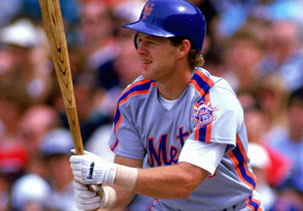
Following the 1986 World Series victory, general manager Frank Cashen traded Kevin Mitchell to his hometown San Diego Padres, mainly because he thought Mitchell was a problem in the clubhouse.  In return, he received an outfielder who also had World Series experience but wouldn't hurt a fly (as long as he wasn't hunting it).  Kevin McReynolds gave the Mets several solid, All-Star caliber seasons and almost led the Mets to a second pennant in three years in 1988.

McReynolds had the most complete season of his career in 1988, batting .288 with 30 doubles, 27 homers, 99 RBI and a perfect 21-for-21 in stolen bases, which at the time was a major league record for most steals in a season without being caught.  He finished in the top five in the league in home runs and RBI, while placing in the league's top ten in extra-base hits and slugging percentage.  And on the defensive side, he led all National League outfielders with 18 assists and five double plays turned.  But because his fellow outfielder and teammate Darryl Strawberry also had a spectacular season (39 HR, 101 RBI, 29 SB), McReynolds and Strawberry split the MVP vote, allowing Dodgers outfielder Kirk Gibson to limp home with the award.  McReynolds, who never made an All-Star team in a dozen seasons in the big leagues, finished third in the 1988 N.L. MVP vote.


Gregg Jefferies

Not since Darryl Strawberry in 1983 had a Met rookie been promoted to the big leagues with such potential.  But that was a different team in 1983 - a team that was on the rise and destined for greatness.  The 1988 squad had recently won a championship and appeared poised to become a dynasty.  But the team was getting older and needed an infusion of young talent.  Gregg Jefferies had destroyed minor league pitching from 1985 to 1987, recording two 100-RBI campaigns and batting .354 over the three years.  By 1988, the 21-year-old was ready to become a full-time player at the major league level.  Unfortunately, his maturity level hadn't caught up with his talent level.

Jefferies batted .321 after his late-season call-up to the Mets, and despite not playing enough to remove his rookie status for the following season, Jefferies still got enough support from the voters to finish sixth in the 1988 Rookie of the Year vote.  A year later, his production at the plate suffered, as his batting average slumped to .258, although he did record 28 doubles, 12 homers, 21 stolen bases and a clubhouse full of dissenting veteran players.  His attitude notwithstanding, he still finished third in the 1989 Rookie of the Year ballot, trailing Cubs teammates Jerome Walton and Dwight Smith.  At least Jefferies got the last laugh, making multiple All-Star teams (albeit with the St. Louis Cardinals) while Walton and Smith never played in the Midsummer Classic.


Frank Viola

After losing the pennant to the Dodgers in 1988, Frank Cashen started to part ways with several players who were instrumental in the team's rise to title contention.  By late July 1989, fan-favorite players such as Wally Backman, Roger McDowell, Lenny Dykstra and Mookie Wilson were all former Mets.  Although Cashen was trying to rebuild the team, he wasn't giving up on the 1989 campaign.  That was made clear when the general manager traded five pitchers to the Twins for 1987 World Series MVP and 1988 A.L. Cy Young winner Frank Viola.

Viola was a local kid from Long Island who became one of the most durable pitchers in the game, averaging over 250 innings pitched per season from 1984 to 1988.  And as a left-handed starter, that durability made him all the more valuable.  Although Viola couldn't help the Mets defend their 1988 N.L. East division crown, he did go on to win 20 games for the team in 1990, joining Jerry Koosman as the team's only left-handed starters to win that many games in a season.  The Mets won 91 games in 1990 but fell short of their postseason goals, finishing behind the Pittsburgh Pirates in the East.  No Mets pitcher was able to duplicate Viola's 20-win campaign for over two decades, when R.A. Dickey accomplished the rare feat.  Viola's 20-win season earned him a third-place finish in the 1990 N.L. Cy Young Award vote behind fellow 20-game winners Doug Drabek and Ramon Martinez.


Jay Payton

The Mets did not produce many five-tool players in their minor league system in the 1990s, but one player stood out among all the others.  In the mid-'90s, Jay Payton was recognized by Baseball America as one of the top prospects in the game.  He was never better than he was in 1995, when he batted .307 with 31 doubles, 18 homers and 27 stolen bases, all while playing an above-average center field.  But injuries held Payton to 71 games in 1996 and wiped out his entire 1997 campaign.  Payton split time between the majors and minors in 1998 and 1999, before finally getting his first chance to stick with the Mets in 2000.  He took full advantage of the opportunity.

Payton led all Mets outfielders in games played during their pennant-winning season, batting .291 with 23 doubles, 17 homers, 62 RBI and 63 runs scored.  He also made great contact and had a keen eye at the plate, as evidenced by his low strikeout total (Payton whiffed just 60 times in 523 plate appearances in 2000).  But the voters were more impressed by Rafael Furcal's speed (40 SB) and Rick Ankiel's arm (194 Ks in 175 IP) than Payton's complete game, dropping Payton to third in the Rookie of the Year vote behind the Braves' speedster and the Cardinals' promising young pitcher.  The Mets wouldn't have another top-three finisher in the Rookie of the Year vote for another 14 years, when Jacob deGrom took home the award.


Wednesday, August 31, 2016

Yoenis Céspedes vs. Other Mets in Their First 162 Games

Yoenis Cespedes's 162-game start gets a big thumbs up!  (Ed Leyro/Studious Metsimus)

Yoenis Céspedes has meant everything to the Mets since he was acquired at the trade deadline last July.  But because of nagging injuries and a trip to the disabled list earlier this season, Céspedes didn't get to play in his 162nd career game with the team until Wednesday, as he has missed 28 games during the 2016 campaign after resting for only two games with the Mets in 2015, both of which came after the team had clinched the division title.

Céspedes's numbers with the team in those 162 games are astounding, as he has produced 34 doubles, 44 homers, 112 RBI and has compiled a .583 slugging percentage and .941 OPS in a full season's worth of games.  Those five categories are traditionally recognized as categories in which sluggers generally excel, and Céspedes ranks favorably with the team's all-time greats in all five.

In doing research for hot starts by Mets players to see where Céspedes ranked, I found some interesting names that I did not expect to find among those franchise legends.  For every time Mike Piazza was in the top ten - he's the only player to be ranked in the top five in all five categories within his first 162 games with the team - there were a handful of "did they really have that type of start?" players.

Here are five lists, one each for doubles, home runs, runs batted in, slugging percentage and on-base plus slugging percentage, that show just how good Céspedes has been in his first 162 games with the Mets and how fortunate some other players were in their first full season's worth of contests with the club.


Doubles:

Bernard Gilkey
Mike Piazza - 46
Bernard Gilkey - 45
Paul Lo Duca - 44
David Wright - 41
Mike Cameron - 40
Rusty Staub - 39
Eddie Murray - 38
Robin Ventura - 38
Todd Zeile - 38
Ike Davis - 37


Home Runs:

Kevin McReynolds
Dave Kingman - 48
Yoenis Céspedes - 44
Carlos Delgado - 39
Mike Piazza - 38
Mike Cameron - 35
Gary Carter - 34
Frank Thomas - 34
Robin Ventura - 32
Cliff Floyd - 31
Bernard Gilkey - 31
Kevin McReynolds - 31
Darryl Strawberry - 31


Runs Batted In:

John Olerud
Carlos Delgado - 126
Bernard Gilkey - 124
Robin Ventura - 120
Mike Piazza - 119
Dave Kingman - 118
Gary Carter - 116
Yoenis Céspedes - 112
Donn Clendenon - 108
John Olerud - 107
Kevin McReynolds - 102


Slugging Percentage:

Mike Cameron
Mike Piazza - .604
Yoenis Céspedes - .583
Bernard Gilkey - .544
Rico Brogna - .529
Robin Ventura - .525
Cliff Floyd - .523
Carlos Delgado - .518
Donn Clendenon - .512
Dave Kingman - .511
Mike Cameron - .510


On-Base Plus Slugging Percentage:

Rico Brogna
Mike Piazza - 1.005
Yoenis Céspedes - .941
Bernard Gilkey - .930
Robin Ventura - .902
Cliff Floyd - .890
John Olerud - .889
Rico Brogna - .880
Carlos Delgado - .870
Benny Agbayani - .867
David Wright - .865


As you can see, there are several players whose names you would expect to see in multiple categories.  Power hitters such as Céspedes, Piazza, Carlos Delgado, Dave Kingman and others can be found in at least three of the five top-ten lists.  But did you really expect to see a guy like Rico Brogna appear on as many lists as David Wright?  What about Cliff Floyd and Mike Cameron showing up three times?  Or most surprisingly, what do you think of Bernard Gilkey and Robin Ventura joining Piazza as the only three players to rank in the top ten in all five categories?

Those unexpected players (Brogna, Floyd, Cameron, Gilkey, Ventura) all had sensational starts to their careers in Flushing, but they also suffered injuries (Brogna, Floyd and Cameron come to mind) or faded quickly (Gilkey and Ventura were both one-season wonders).

Meanwhile, a number of all-time team greats were absent from a number of these top-tens.  The late, great Gary Carter made it to the Hall of Fame and began a miraculous World Series rally that fueled the Mets to a championship.  But his excellent .490 slugging percentage and .861 OPS in his first 162 games with the team were both not high enough to appear on either category's respective top-ten list.  Darryl Strawberry may have won the National League Rookie of the Year award in 1983, but his only appearance on any of the above lists is a ninth-place tie in the homer department.  And Carlos Beltran may be the greatest free agent signing in Mets history, but a poor start to his career in New York kept him off every list.

It remains to be seen whether Céspedes will go down the road traveled by the great sluggers in Mets history or if the nagging injuries continue to increase and he will just be remembered for the incredible 162-game start to his Mets career, which included helping the team reach the 2015 World Series.

For now, Céspedes is one of only three Mets to have at least 30 doubles, 35 homers and 100 RBI in his first 162 games with the team, joining Carlos Delgado and Hall of Famer Mike Piazza.  Whether or not Céspedes joins Piazza in Cooperstown or even in the Mets Hall of Fame won't be known for years, but one thing's for certain.

Yoenis Céspedes has been gotten off to one of the best starts of any hitter in franchise history.  And there's nothing fluky about that.


Saturday, January 23, 2016

Joey's Small Bites: Cespedes and His Fellow Outfielders Could Make Mets Homer History

Hello, all you snowbound Mets fans.  I'm Joey Beartran and despite all the white stuff piling up outside my window, I'm thinking Mets baseball.  And why am I thinking Mets baseball?  Because of the news that the Mets did what no one thought they would do.  No, the Wilpons didn't sell the team.  But they did max out their credit cards.

Just as the first flakes flew last night, the news came out that the Mets had signed Yoenis Cespedes to a three-year, $75 million contract with an opt-out after the first year.  The stunning news that Washington couldn't buy Cespedes for five years and give him a front row seat for Daniel Murphy's next costly error shocked Mets Twitter - myself included.


It became very difficult for me to hibernate for the evening upon hearing that bit of information.  After all, throughout the off-season, Mets fans had been clamoring for the return of Cespedes, but they fully expected him to be out of the Wilpons' price range.  Then the news became official and the numbers starting running through my head.

With Michael Conforto and Curtis Granderson manning the corner outfield positions and Cespedes taking over as the team's center fielder, it occurred to me that the Mets outfield will produce a lot of home runs.  After all, Cespedes hit 35 homers last year between the Tigers and Mets, while Granderson rocketed 26 blasts.  Conforto is still developing his power, but still managed to hit 12 home runs in 91 games in the minors, nine more in 56 games after his promotion to the Mets and added another three in 12 postseason games.  (For all you kids out there, that's 24 HR in 159 games for the 22-year-old Conforto.)

So of course, being the inquisitive bear that I am, I looked back through my archives (you might call it baseball-reference.com) to see how often the Mets have had three power-hitting outfielders at the same time.  My research surprised me almost as much as the Cespedes re-signing did.

The Mets have been in business for 54 seasons.  In that time, only 17 outfielders have ever produced a 20-HR campaign.  (To qualify as a Mets outfielder, the player had to have played at least half of his games in any of the three outfield positions.)  Having a pair of Mets outfielders produce 20 or more homers is even rarer in club annals, especially a pair that didn't have Darryl Strawberry as one of its members.

Prior to 1983, the Mets had never had two outfielders with 20+ homers in the same season.  But from 1983 to 1985, Strawberry and George Foster each reached the 20-homer mark.  Then, from 1987 to 1990, Strawberry and Kevin McReynolds produced 20 or more home runs in each of the four campaigns.  The only time in Mets history that two outfielders not named Darryl Strawberry joined forces to hit 20-plus homers in the same season was in 2004, when center fielder Mike Cameron (30 HR) and right fielder Richard Hidalgo (21 HR) turned the trick.  In fact, that 2004 campaign was the closest the Mets have ever come to having all three outfielders reach the 20-homer mark, as left fielder Cliff Floyd added 18 homers of his own.

Now let's just consider years in which the Mets had three outfielders hitting 15+ homers.  That total might not seem impressive, but it's a feat that's rarely been done by a trio of Mets outfielders.  Here's the tiny group of outfielders, listing the left fielder first, center fielder second and right fielder third.

  • 1965: Ron Swoboda (19 HR), Jim Hickman (15 HR), Johnny Lewis (15 HR)
  • 2000: Benny Agbayani (15 HR), Jay Payton (17 HR), Derek Bell (18 HR)
  • 2004: Cliff Floyd (18 HR), Mike Cameron (30 HR), Richard Hidalgo (21 HR)

That's it.  Only three Mets teams have produced an outfield in which all three players reached the not-so-lofty 15-homer plateau.  Over the years, the Mets have relied more on infielders (Howard Johnson, Carlos Delgado, David Wright, Lucas Duda) and even catchers (Todd Hundley, Mike Piazza) to supply power than they have in their outfielders.

It wouldn't be out of the realm of possibility to see the Conforto-Cespedes-Granderson trio becoming the fourth outfield threesome to bang out 15 homers apiece.  It also wouldn't be a shocker to see them become the first outfield combo in Mets history to each have 20 or more homers.  Conforto, Cespedes and Granderson could also combine to hit the most homers in one season by the team's primary three outfielders.

In 1987, the outfield trio of Strawberry (39 HR), McReynolds (29 HR) and Lenny Dykstra (10 HR) combined to produce 78 home runs, which is a team record for outfielders.  (Dykstra started 24 more games than fellow outfielder Mookie Wilson did in '87.)  The team's three main outfielders have produced 70 or more homers in only two other seasons, with both years involving the Straw Man and Big Mac.

The 1988 squad featured Strawberry once again clubbing 39 homers, while McReynolds hit 27 bombs and Dykstra jacked eight balls out of the park for a combined total of 74 homers.  Two years later, the Strawbery-McReynolds combo was joined by newcomer Daryl Boston, as the 1990 outfield saw left fielder McReynolds (24 HR), center fielder Boston (12 HR) and right fielder Strawberry (37 HR) combine for 73 home runs.

Other than the 1987, 1988 and 1990 clubs, no other Mets team has had its three primary starting outfielders surpass the 70-homer mark between them.  That could change in 2016 now that Yoenis Cespedes and Michael Conforto will each be playing their first full years in New York.

Cespedes hit 35 homers during the entire 2015 regular season.  Conforto combined to hit 21 regular season homers between the minors and majors.  Granderson - the only one of the three outfielders to play the entire season in New York - had 26 homers of his own.

In 2016, the Mets could have a power-hitting outfield that has never been seen before in club annals.  Combine that with the best starting rotation in baseball and a much-improved bullpen and the outfield's home run total might not be the only thing making history for the Mets this upcoming season.

It's enough to make man or beast look forward to warm nights at Citi Field on the snowiest of winter days.

Who wouldn't wake to make snow angels the morning after Cespedes re-signs with the Mets?

Monday, February 9, 2015

One Mo-MET In Time: Tim Harkness

In the early days of the New York Mets, fans attended the team's home games to see many things.  They went to see manager Casey Stengel, who was as entertaining as any comic actor they could watch on television.  They also went to catch a glimpse of former members of the Brooklyn Dodgers and New York Giants, who were closing out their careers in the city they called home prior to going out west.  Some fans even went to see stars from other teams - players they hadn't been able to see in a National League park since the defection of the Dodgers and Giants following the 1957 campaign.

What fans didn't get to see too much during the team's early days were wins.  In the two years the Mets called the Polo Grounds home, the team won a total of 56 games there.  That's fewer wins at home in a two-year period than the Cincinnati Reds won in their home park in 1962 alone, and the Reds were a third-place team that year.

Needless to say, most of the excitement generated on the field during the team's short stay at the Polo Grounds had nothing to do with the players wearing "Mets" on their chests.  If the team had a lead, they had a good chance of blowing it.  And if they trailed in the late innings, there seemed to be little chance of a happy recap.  But during the team's second season, an unlikely hero stepped up to the plate on an early summer afternoon, trying to erase a two-run deficit in extra innings.  What happened next was something that would not be seen again during a Mets home game for nearly three decades.

Tim Harkness had a left-handed power swing made for the short distance to right field at the Polo Grounds.

Thomas William Harkness, better known as Tim, was a power threat from a very young age.  The Canadian slugger signed with the Phillies in 1956, then played in the Dodgers minor league system over the next five years.  A year after putting up a 28 HR, 111 RBI season at the Double-A level, Harkness made his major league debut with the Dodgers.  But Harkness never caught on as a first baseman in Los Angeles.  He started just six games at the position in two seasons, appearing primarily as a pinch-hitter before being traded to the Mets at the conclusion of the 1962 campaign.

With the Mets, Harkness became the team's primary first baseman in 1963, although he did share the position at times with Duke Carmel (17 starts), Frank Thomas (15 starts) and an 18-year-old Ed Kranepool (15 starts).  Harkness was a streaky hitter, hitting home runs and driving in runs in bunches - he had four homers and 14 RBI during a 17-game stretch in May - but experienced many more cold periods than hot ones.  In fact, from May 30 to June 25, Harkness batted .125, collecting nine hits in 72 at-bats.

Harkness, who once had a .276 batting average in late May, was now in danger of dropping below the .200 mark, entering the June 26 tilt against the Chicago Cubs with a .208 batting average.  Coming into the game, Harkness had collected just 53 hits in his brief three-year career in the majors, never having more than three hits in any single game.  Through nine innings against the Cubs, Harkness had picked up one hit in four at-bats.  But the game was tied through nine, as the Mets had chipped away at an early four-run deficit to send the game into extra innings.  The team's day wasn't quite done, and neither was Tim Harkness.

Harkness doubled to lead off the 11th inning, but was stranded in scoring position when pinch-hitter Norm Sherry grounded into an inning-ending double play.  Two innings later, a single by Harkness put runners on the corners with one out.  But the Mets couldn't capitalize on Harkness's third hit of the game, as two groundouts ended the scoring threat.

It was on to the 14th inning at the Polo Grounds, where the Cubs looked to score for the first time since taking a 4-0 lead in the fifth inning.  Mets reliever Galen Cisco was one out away from getting out of the inning, but surrendered a two-run, inside-the-park home run to future Hall of Famer Billy Williams, giving Chicago a 6-4 lead.  The Mets, who had squandered numerous scoring opportunities in the previous innings, had one more chance to come up with a game-winning rally.  What they got was a seminal moment in team history.

Jim Hickman led off the Mets' half of the 14th inning with a single.  Ron Hunt followed with a single of his own, but Hickman was thrown out after he accidentally ran past second base.  Cubs pitcher Jack Warner then walked Jimmy Piersall to put the tying runs on base for Frank Thomas.  Thomas, who led the Mets with 34 home runs during the team's inaugural season in 1962, entered the game with just four home runs in 1963.  But Thomas had hit a two-run homer earlier in the game, and was another clout away from winning it.  With the crowd of just over 8,000 hoping for Thomas to blast his second homer of the game, all they got was a fly ball to left off Cubs reliever Paul Toth.

The Mets were now an out away from losing a heartbreaker to Chicago.  Seldom used catcher Sammy Taylor stepped up to the plate.  Left-handed pitcher Jim Brewer was summoned from the bullpen to face the lefty-swinging Taylor.  Taylor was already 0-for-6 in the game and had collected just eight hits all season up to that point.  But Brewer had not pitched in a major league game in 17 days and had been awful since May 19 (7.59 ERA in his last six appearances).  Taylor was able to coax a walk from Brewer to load the bases, bringing up Tim Harkness.

Harkness had already tied his career high in the game by notching three hits, including two in extra innings.  A fourth hit would almost surely tie the game.  A long hit would win it.  Harkness worked the count full.  Then with one mighty swing, Harkness delivered something no Met had accomplished before and no Met would accomplish again for almost 30 years.

With the right field wall looming just 257 feet away from home plate, Harkness pulled a grand slam over that wall, giving the Mets a thrilling 8-6 victory.  The game-winning blast was Harkness's fourth hit of the game - a new career high - but most importantly, was the first walk-off grand slam in the brief history of the team.

Tim Harkness emerges from the Mets clubhouse to greet fans following his extra-inning heroics. (UPI Photo)

Although the Mets hit a handful of walk-off grand slams over the next few decades, including one by Jim Hickman just six weeks after Harkness's game-winner, most of them occurred with the score tied.  But the grand slam by Harkness turned a potential two-run loss into a two-run win.  No Mets player would hit another walk-off grand slam with the team trailing at the time until Kevin McReynolds turned the trick against the Montreal Expos on June 25, 1991, nearly 28 years to the day after Harkness's heroics.  It would be another 23 years before a third Mets player - Ike Davis in 2014 - slammed the Mets from an apparent loss to a last-licks victory.

Harkness would go on to hit another walk-off homer for the Mets in 1963 - although this one was only a two-run shot in September - but for the most part, his grand slam against the Cubs was his last highlight of the season.  After victimizing Jim Brewer on June 26, Harkness went into a deep slump, going 9-for-87 with no homers and two RBI over his next 35 games.  A six-game hitting streak to end the season kept his average above .200, but also showed the Mets that the team needed to go in a different direction at first base.

The Mets moved into Shea Stadium in 1964, a park whose right field fence was nearly 100 feet deeper down the line than the one at the now-defunct Polo Grounds, and Harkness's power suffered.  Harkness played 39 games for the Mets in 1964, hitting just two homers.  Only one of those homers came at Shea Stadium.  Harkness was traded to Cincinnati in July, then bounced around in the minors for the next three seasons, never making it back to the majors.

In four big league seasons, Harkness never matched his power production in the minors.  His 28 HR, 111 RBI campaign in the minors in 1960 didn't translate to the majors, as Harkness managed just 14 homers and 61 RBI as a member of the Dodgers and Mets.  But for one amazing day in June 1963, Harkness became a hero in New York, powering the Mets to a dramatic, come-from-behind victory.

Manager Casey Stengel probably said it best (as he usually did) when discussing how important Harkness's homer was to the team at that moment.


"It was one of those good ones.  We just about had to end it there because I'd run out of men."


As the saying goes, if you watch baseball long enough, you're bound to see something you've never seen before.  On June 26, 1963, Mets fans saw something they had never seen before when Tim Harkness sent the small, but lively, Polo Grounds crowd home happy, turning a loss into a win with a game-ending grand slam home run.  It was the only time a Mets player ever snatched a victory from the jaws of defeat on a grand slam at the Polo Grounds.  Twenty-eight years later, Kevin McReynolds became the only Met to repeat Harkness's feat at Shea Stadium.  And twenty-three years after that, Ike Davis became the first Met to do it at Citi Field.  It has become a once-in-a-stadium's-lifetime event.

Tim Harkness may not have had a long career in New York, nor was it particularly a successful one.  But for one memorable moment, he provided Mets fans with a thrill that would not soon be forgotten.  It would also be a moment that would rarely be duplicated.


Note:  One Mo-MET In Time is a thirteen-part weekly series spotlighting those Mets players who will forever be known for a single moment, game or event, regardless of whatever else they accomplished during their tenure with the Mets.  For previous installments, please click on the players' names below:

January 5, 2015: Mookie Wilson 
January 12, 2015: Dave Mlicki
January 19, 2015: Steve Henderson 
January 26, 2015: Ron Swoboda
February 2, 2015: Anthony Young
 

Tuesday, January 6, 2015

Mets Almost Traded For Randy Johnson In 1991

(Photo by Elaine Thompson/AP)

In 1991, the Mets posted their first losing season in eight years.  After winning 87 or more games from 1984 to 1990, New York finished the 1991 campaign with a disappointing 77-84 record.  As a result, general manager Al Harazin decided to shed salaries without going through a rebuilding phase.

Kevin McReynolds, one of the team's best offensive players during his five-year tenure in New York, was dealt to Kansas City.  Hubie Brooks, who returned to the Mets for one season as Darryl Strawberry's replacement in right field, was jettisoned to the Angels.

The McReynolds trade (which also sent Gregg Jefferies and Keith Miller to the Royals) brought two-time Cy Young Award winner Bret Saberhagen to Flushing.  Saberhagen was part of Harazin's plan to create a top-notch starting rotation, as long-time Met Ron Darling had been traded to Montreal during the 1991 season and Frank Viola was about to leave via free agency.

But Saberhagen was not Harazin's first choice to lead a starting rotation that already featured David Cone, Dwight Gooden and Sid Fernandez.  His original plan was to send McReynolds to Seattle for one of the Mariners' top two young starting pitchers.

Coming to New York in exchange for McReynolds would have been either Erik Hanson, a 26-year-old right-hander who posted an 18-win, 211-strikeout campaign in 1990, or a lanky 28-year-old southpaw with a 37-34 career record, 4.01 ERA and a 1991 season in which he walked 152 batters - the first time since 1977 that a pitcher had issued over 150 bases on balls.

That skinny lefty was future Hall of Fame pitcher Randy Johnson.

Harazin knew Seattle was in need of a left fielder, and was willing to part ways with the veteran McReynolds, who had signed a three-year, $10 million contract extension the previous off-season.

But Seattle did not want to trade Hanson or Johnson for McReynolds, whose salary was supposedly too high for the penny-pinching Mariners.  (Seattle's $17.5 million team payroll was the fifth-lowest in the majors in 1991.)  At least that's what Harazin was led to believe.


"The conversation we had with them was such that I didn't think they were interested in anyone's $3 million player."


That's when Harazin opted for Plan B, trading McReynolds and two others to Kansas City for Saberhagen and infielder Bill Pecota.  There was only one problem.  Seattle ended up trading for a left fielder who was due more money than McReynolds, and parted ways with three pitchers to get him.

Former Met Kevin Mitchell, who was traded for McReynolds just five years prior, was acquired by the Mariners from San Francisco for pitchers Bill Swift, Mike Jackson and Dave Burba.  Mitchell was due $10.5 million through the 1994 season, an average of $3.5 million per year.

Mitchell flopped in Seattle, hitting just nine home runs in 99 games after averaging 36 homers per season during his final three years in San Francisco.  McReynolds wasn't much better in Kansas City and was out of baseball after the 1994 season.

Randy Johnson, on the other hand, learned how to control his wildness.  After one more subpar season in 1992 (12-14, 3.77 ERA, league-leading 144 walks), Johnson became one of the game's most dominant pitchers.  Over his next dozen campaigns, the Big Unit posted three 20-win seasons (and four other years with 18+ victories) and won nine strikeout titles.  He also led the league in winning percentage four times, ERA four times, complete games four times, shutouts three times and WHIP on three occasions - all in a span of 12 years.  And most importantly, he never walked 100 batters in a season again.

Almost a quarter century ago, Seattle was willing to trade three pitchers to San Francisco for a left fielder making $10.5 million for three seasons.  Had they listened to Al Harazin, they could have saved half a million dollars over those three campaigns and would have lost just one pitcher to acquire the Mets' left fielder.

But Seattle would have potentially lost a future Hall of Famer in Randy Johnson.

Imagine how different the histories of two franchises would have been had the McReynolds-for-Johnson trade been consummated.


Saturday, April 5, 2014

Hark(ness), The Herald Davis Swings

If you were at Citi Field today as I was, you witnessed a thrilling conclusion to the Mets-Reds affair.  With the Mets trailing, 3-2, going into the bottom of the ninth, Juan Lagares, Anthony Recker and Ruben Tejada all reached base to start the inning.

Up stepped Ike Davis, needing a long fly ball to tie the game and a base hit to perhaps win it.  What he did was even more exciting.

Slam!  Let the boys be boys!  (Photo by Howard Simmons/NY Daily News)

Davis' long blast off the Subway sign in right-center turned a potential heartbreaking one-run loss into a scream-until-you-lose-your-voice three-run victory.  The walk-off grand slam gave the Mets a 6-3 win over the Reds and put them in position to sweep Cincinnati on Sunday.

But Ike Davis' game-ending homer was more than just a fantastic moment in this young season.  It also was one of the rarest moments in the 53-year history of the team.  Please allow me to elaborate.

Davis' walk-off grand slam was only the seventh such home run hit by a Mets player in franchise history.  Tim Harkness was the first Met to smoke a game-ending salami, accomplishing the feat against the Chicago Cubs at the Polo Grounds on June 26, 1963.  Just forty-four days later, Jim Hickman also victimized the Cubs for a walk-off grand slam at the Polo Grounds.  The killer H's were the only two players in team history to end games with four-run homers until 1980, when Mike Jorgensen took the Dodgers' Rick Sutcliffe deep at Shea Stadium.  Six years later, Tim Teufel hit a grand slam against Tom Hume of the Phillies at Shea, a feat that wasn't seen again at the Mets' former home until 1991, when Kevin McReynolds blasted a bases-clearing shot over the wall versus the Montreal Expos.  It took another 22 years before Jordany Valdespin became the sixth Met to end a game with a grand slam, taking the Dodgers' Josh Wall over the wall at Citi Field on April 24, 2013.  Less than 365 days after Jordany took a spin around the bases, Ike Davis became the seventh slammer.

Obviously, becoming the seventh player to hit a walk-off grand slam in Mets history puts Davis in select company, but four of the other six players who ended games by putting a four-spot up on the scoreboard did so when their respective games were tied.

Hickman, Jorgensen, Teufel and Valdespin each turned tie games into four-run victories with their powerful swings.  That means Harkness, McReynolds and now Ike Davis are the only players who can claim snatching a victory from the jaws of defeat by walking off with a grand slam home run.  And each player did so at a different home park, with Harkness turning a 6-4 deficit into an 8-6 win at the Polo Grounds, McReynolds blasting away at a potential 5-4 loss by slamming the Mets to an 8-5 victory at Shea Stadium and Ike Davis erasing a 3-2 Reds lead with one swing of the bat, giving the Mets a 6-3 win at Citi Field.

Harkness.  McReynolds.  Davis.  Three very different players playing in three very different eras.  But all produced one very similar result with three well-timed swings of the bat.  And it was a result that made Mets fans across the generations leave the ballpark feeling slam-tastic.


Monday, February 11, 2013

The Mets That Got Away: Lenny Dykstra

There are some players who are so good in high school, they're considered can't-miss prospects.  These are the players who are scooped up in the first round of the draft and given hefty signing bonuses, all before they've set foot on a professional baseball field.  Because of their reputations, these players don't always have to put up eye-popping numbers in the minor leagues to advance from one level to the next.

But there are also players who are bypassed multiple times by every team, eventually taken in the middle-to-late rounds.  More often than not, these players have flaws that prevent them from joining the can't-miss prospects in the earlier rounds.  These players also have to prove themselves repeatedly in the lower minor league levels before even getting a sniff of a promotion.  One such player was drafted by the Mets in the 13th round of the 1981 June amateur draft.

In the early rounds of the '81 draft, the Mets selected Terry Blocker and John Christensen, neither of whom made a significant impact in the major leagues.  Their fifth round pick was used on Steve Phillips, who had a far greater impact on the team as its general manager than he did as a middle infielder.  And of course, a fairly decent starting pitcher named Roger Clemens was selected in the 12th round (he decided to go to college instead of signing with the Mets, presumably to hone his bat-throwing skills).  But it was the Mets' next pick after Clemens that eventually opened everyone's eyes.  It's too bad that he opened more eyes as a division rival than he did as a Met.

Small in stature, but tough as nails.  That was Lenny Dykstra.

Leonard Kyle Dykstra was the 315th overall pick in the 1981 draft.  A skinny kid from California whose first word out the womb was probably "dude",  Dykstra was an outfielder who played the game with reckless abandon and extreme confidence.  If an outfield fence wasn't dinged up, it was because Dykstra hadn't played on that field.  If a future Hall of Fame pitcher faced him, Dykstra would nonchalantly claim that he would "stick him".  These were the intangibles that caught the eye of scout Myron Pines and led Frank Cashen to select Dykstra on draft day.

Although Dykstra's slight body wasn't built for hitting home runs, he possessed a wonderful eye at the plate and an exceptional ability to steal bases.  After hitting .261 with 15 stolen bases in 48 games as an 18-year-old, Dykstra stole his way onto the team's radar in 1982.  Playing for Shelby in the South Atlantic League, Dykstra batted .291 in 120 games for the Mets' Single-A affiliate.  However, he had a .425 on-base percentage and stole 77 bases in 88 attempts.  Both figures were second in the league.  One year later, Dykstra was second to no one.

In 1983, while playing for Lynchburg in the Carolina League, Dykstra led the league in batting average (.358), on-base percentage (.472), hits (188), walks (107), triples (14), runs scored (132) and stolen bases (105).  Despite hitting only eight home runs, Dykstra managed to finish fifth in the league with 81 RBIs and sixth in slugging percentage with a .503 mark.

Dykstra's production dropped off in 1984 playing for AA-Jackson.  But his "down year" still resulted in a .275 batting average, .372 on-base percentage, 53 stolen bases and a league-leading 100 runs scored.  Dykstra advanced to AAA-Tidewater to begin the 1985 campaign, but less than a month into the season, he received his first call-up to the Mets, replacing the injured Ron Gardenhire on the 25-man roster.  It didn't take long for Dykstra to make an impact in the major leagues.

With Mookie Wilson getting a few days off to recover from a nagging shoulder injury, Dykstra was inserted into the starting lineup for the first time on May 3, 1985, batting leadoff against the Cincinnati Reds.  Facing three-time All-Star Mario Soto, Dykstra struck out in his first at-bat before hitting a two-run homer off Soto the next time he faced him.  Dykstra's debut was a success, as the centerfielder went 2-for-5 with two runs scored and a stolen base in the Mets' 9-4 victory.  Dykstra would go 5-for-12 in the three-game series at Riverfront Stadium, but was sent back down to Tidewater after appearing as a pinch-runner later in the week against Atlanta.

Over the first three months of the season, Dykstra rode the Tidewater-to-Shea shuttle several times.  As a member of the Tides, Dykstra performed splendidly, batting .310 with 44 runs scored and 26 stolen bases in 58 games.  As a Met, Dykstra struggled, batting .242 with only four runs scored and three steals in 12 games.  But after the Mets defeated the Braves in a memorable 19-inning affair on the Fourth (and Fifth) of July, the post-game fireworks weren't the only thing set to explode.

In the Mets' 16-13 victory over Atlanta, Dykstra played all 19 innings, going 3-for-9 with a run scored and two RBIs.  With the scored tied in the 18th inning, Dykstra hit a sacrifice fly that gave the Mets an 11-10 lead.  Dykstra's run-scoring fly ball would have represented the winning run, but Braves relief pitcher Rick Camp decided to give Chief Noc-A-Homa and the dozens of fans still in attendance an unexpected thrill with a game-tying home run in the bottom of the 18th.  Dykstra may have lost a game-winning RBI, but gained a starting job.  And once he became an everyday player, the runs started piling up.

Over his next 19 starts, Dykstra served as the team's catalyst.  He scored 21 runs, collected 11 RBIs, stole five bases and made outstanding contact, striking out only seven times in 102 plate appearances.  More importantly, the Mets went 15-4 in Dykstra's starts and averaged 7.1 runs in those games after averaging only 3.4 runs in their first 75 games.  For the season, Dysktra batted .254 and reached base at a .338 clip.  Although he only had 236 at-bats with the Mets in 1985, he scored 40 runs and stole 15 bases.

In 1986, Dykstra went into spring training trying to win an everyday job with the Mets.  Once again, he got his chance because of a teammate's misfortune.  A gruesome eye injury suffered by Mookie Wilson during a rundown drill put the six-year veteran on the disabled list.  Center field was now Dykstra's position to lose, and he made sure to take advantage of the opportunity.

Dykstra played in 78 of the team's first 85 games, batting .347 with a .420 on-base percentage.  He also started driving the ball more, collecting 25 extra-base hits in his first 216 at-bats.  His eye at the plate continued to be impeccable, as he drew more walks (28) than strikeouts (26).  And as he did in 1985, Dykstra continued to contribute to a plethora of Mets victories.

The Mets won 58 of the 78 games in which Dykstra played through July 17.  For the season, they were 100-47 when Dykstra played and 8-7 when he didn't.  Dykstra finished his first full season in the majors with a .295 batting average, 77 runs scored and a team-leading 31 stolen bases.  He was also one of six Mets to garner MVP consideration, finishing 19th in the vote.  Dykstra only hit eight homers during the regular season, but during the postseason, he ratcheted up the power in several key situations.

Touch 'em all, Lenny.  You'll never hit a bigger home run.  (But you sure tried.)

In Game 3 of the NLCS against Houston, Dykstra's two-run homer in the bottom of the ninth gave the Mets their first postseason victory at Shea Stadium since Game 5 of the 1973 World Series.  Dykstra also hurt the Astros in Game 6, starting a three-run rally in the ninth inning with a long triple.  In the 16th inning, Dykstra gave the Mets a 7-4 lead with an RBI single off Jeff Calhoun.  The run-scoring hit proved to be the difference in the Mets' 7-6 pennant-clinching victory.

After the Mets dropped the first two games of the World Series to the Boston Red Sox at Shea Stadium, Dykstra led off Game 3 with a home run at Fenway Park.  Dykstra followed in the footsteps of Tommie Agee and Wayne Garrett, who both homered to lead off Game 3 of the World Series, with Agee accomplishing the feat in the 1969 Fall Classic and Garrett doing it in 1973.  Dykstra also broke open Game 4 by hitting a two-run homer in the seventh inning the following night.

The Mets went on to defeat the Red Sox in seven games to win the franchise's second World Series championship.  In 13 postseason games, Dykstra batted .300 (15-for-50) with three homers, six RBIs and seven runs scored.  The man known as "Nails" hammered the Astros and Red Sox to the tune of a .540 slugging percentage.

The 1987 season began with the newly-acquired Kevin McReynolds in left field, leaving center field to both Dykstra and Mookie Wilson.  Neither player was particularly pleased with the situation, but they accepted manager Davey Johnson's decision (well, Mookie did) and played hard whenever they found themselves in the starting lineup.  Dykstra, in particular, got off to a hot start.  Lenny played in 45 of the team's first 53 games, starting 32 of them.  In those games, Dykstra batted .326 with a .391 on-base percentage.  His 19 extra-base hits in 141 at-bats contributed to an uncharacteristically high .560 slugging percentage.  Unfortunately, that was higher than the team's winning percentage at the time, as the Mets struggled to keep their team - particularly their starting pitchers - healthy and on the field.

The Mets eventually got hot as the summer continued, pulling to within striking distance of the first place St. Louis Cardinals.  The team suffered a heartbreaking loss to the Cards on September 11 when Roger McDowell allowed a game-tying two-run homer in the ninth inning to Terry Pendleton, followed by a tenth inning meltdown by Jesse Orosco.  But even after the deflating defeat, Lenny Dykstra did whatever he could to keep the team in contention until the season's final week.

From September 13 to the day the Mets were officially eliminated from the playoff race, Dykstra carried the team on his back.  He started all 16 games the Mets played during that stretch, batting .349 with ten doubles, a homer, 11 RBIs, 17 runs scored and four stolen bases.  But not even a player as tough as nails could prevent the Mets from giving up their division crown to the Cardinals, as New York finished the year three games behind the eventual National League champions.

Despite his platoon role, Dykstra had a tremendous season in 1987.  He played in 132 games, batting .285 with 37 doubles, 10 home runs, 43 RBIs and 86 runs scored.  His 37 two-base hits set a new club record for left-handed hitters, a mark that would not be surpassed until 1999, when John Olerud (39 doubles) and Robin Ventura (38 two-baggers) passed him.

It was more of the same for Dykstra in 1988.  Kevin McReynolds and Darryl Strawberry were the everyday corner outfielders, leaving Dysktra and Wilson to split the duties in center field.  Dykstra performed well under those circumstances in 1987, but suffered from it in 1988.

Although the Mets won their second division title in three years, Dykstra struggled for most of the season.  His .285/.352/.455 slash line from 1987 fell to .270/.321/.385 in 1988, causing a 100-point drop in OPS (on-base plus slugging percentage).  Also, his 19 doubles were barely half of his 1987 total and his 57 runs scored in 126 games were far less than the Mets had come to expect from their leadoff hitter.

Despite his subpar season, Dykstra turned his game up a notch in the postseason, batting .429 (6-for-14) with three doubles, a homer and no strikeouts in the seven-game NLCS against the Dodgers, but the Mets fell short of their ultimate goal, losing the series when Orel Hershiser pitched a complete-game shutout in Game 7.  After the unexpected loss, the team was ready to make changes.  One of those changes ended up becoming the death knell for the mid-to-late '80s Mets.

On June 18, 1989, the Mets traded Lenny Dykstra and Roger McDowell to the Phillies for Juan Samuel.  Samuel was a two-time All-Star and a Silver Slugger-winning second baseman for the Phillies before becoming a Met.  But the Mets didn't start him at second because Mets wünderkind Gregg Jefferies was already there.  Rather, Samuel became the team's new centerfielder, effectively (or ineffectively) replacing Dykstra and causing Mookie Wilson to spend more time on the bench.  Samuel, to put it bluntly, couldn't carry Dykstra's dirt-covered jock strap.

The Mets let their soul go, replacing him with Juan Samuel and his Soul Glo.

In 86 games with the Mets following the trade, Samuel hit .228 with three home runs and 28 RBIs.  His .300 slugging percentage was the lowest of any Mets everyday player.  That means it was lower than Barry Lyons' percentage (.340) and lower than Kevin Elster's figure (.360).  Heck, it was even lower than the slugging percentage posted by notorious singles hitter Dave Magadan (.393), who beat Samuel by nearly 100 points!  And let's not even get started with Samuel's play in the outfield.  Fortunately, the Mets realized the error of their ways, trading Samuel to the Dodgers six months after they acquired him.

The trade of the popular Dykstra to Philadelphia meant that Lenny was now going to be an everyday player for the first time in his career.  Like Samuel with the Mets, Dykstra also went through a period of adjustment in 1989, hitting .222 with 27 extra-base hits for the last-place Phillies.  But the Phillies remained patient with Dykstra, and by the following season, they had an All-Star on their hands.

In 1990, the 27-year-old Dykstra had his best season to date.  His .325 batting average was fourth in the National League and he led the league in both hits (192) and on-base percentage (.418).  Dykstra also finished in the top ten in doubles (35; 7th place), walks (89; 4th) and runs scored (106; 5th).  Dykstra became an All-Star for the first time in 1990 and finished 9th in the NL MVP vote despite playing for a sub-.500 team.

Injuries kept Dykstra from repeating his success in 1991 and 1992.  He played in only 63 games in 1991 and 85 games in 1992.  But despite playing in fewer than a full season's worth of games over those two years, Dykstra combined to hit .299 with 31 doubles, nine homers, 54 stolen bases and 101 runs scored.  One year later, Dykstra was fully healthy for the first time since 1990 and he embarked on a season for the ages.

In 1993, the Phillies won their first NL East title in ten years.  Philadelphia had many key contributors to their success, but none of them posted a season like Lenny Dykstra.  Dykstra set a major league record with 773 plate appearances (a record since surpassed by Jimmy Rollins).  He also led the league in at-bats (637), hits (194), walks (129) and runs scored (143), becoming the first National League player since Chuck Klein in 1932 to score over 140 runs in a single season.  But being the first National Leaguer in over 60 years to score that many runs wasn't the most impressive achievement for Dykstra in 1993.

As mentioned before, Dykstra led the league in 1993 with 194 hits and 129 walks.  In doing so, he became only the fifth player in major league history to pace his league in both categories.  Dykstra joined Billy Hamilton (179 hits, 102 walks in 1891), Rogers Hornsby (227 hits, 89 walks in 1924), Richie Ashburn (215 hits, 97 walks in 1958) and Carl Yastrzemski (183 hits, 95 walks in 1963) in this exclusive fraternity.  It should be noted that all four players are in the Hall of Fame.

Dykstra's historic year with the Phillies (he also set career highs with 44 doubles, 19 home runs, 66 RBIs and 37 stolen bases in 1993) continued in the the National League Championship Series and the World Series.

In 12 games against the Braves and Blue Jays, Dykstra batted .313 and reached base 27 times for a gaudy .450 on-base percentage.  Dykstra also socked six homers, collected 10 RBIs and scored 14 runs for the National League champions.  In the World Series alone, Dykstra smacked four homers, stole four bases and slugged .913.  He would easily have been the World Series MVP had Joe Carter not sent the Skydome into a frenzy with his title-winning home run in Game 6.  (Dykstra also had to settle for second place in the NL MVP vote, as he was the runner-up to Barry Bonds.)

Dykstra did not make the All-Star team in 1993 because of a slow start (he was hitting .265 as late as June 5), but he was selected to play in the Midsummer Classic in each of the following two seasons, including his only All-Star start in 1995.  However, just like the 1991 and 1992 campaigns, injuries curtailed both seasons.  Dykstra was held to 84 games in 1994 and 62 games in 1995.  He did not perform nearly as well as he did in 1993 when he was healthy enough to play, batting .269 with seven homers and 42 RBIs in 569 at-bats over the two seasons.  However, he did manage to hit 41 doubles, score 105 runs, steal 25 bases and walk 101 times over the same time period.

In 1996, Dykstra was limited to only 40 games and he missed the entire 1997 season due to injuries.  Although Dykstra was only 33 years old when he played his final game in the majors, he still put up a number of fantastic seasons for both the Mets and the Phillies.

Dykstra ranks 36th on the all-time Mets leaderboard in games played.  However, he's in the top thirty in batting average (.278; 17th place), on-base percentage (.350; 18th), doubles (104; 26th), triples (17; T-18th), runs scored (287; 27th) and stolen bases (116; 7th).  He ranks so highly on the team's all-time lists despite never holding a firm grip on an everyday job in 4½ seasons in New York.  His numbers are even better as a Phillie.

A total of 58 players have played more games in a Phillies uniform than Dykstra did (Lenny took the field 734 times as a Phillie), but Dykstra still ranks highly on the team's leaderboard in batting average (.289; T-40th), on-base percentage (.388; 7th), OPS (.810; 31st), hits (829; 46th), total bases (1,211; 44th), doubles (177; 36th), walks (459; 24th), runs scored (515; 36th) and stolen bases (169; T-16th).  Keep in mind that the Phillies have been in business since 1883 and have employed almost 2,000 players, while the Mets have yet to employ 1,000 players through the 2012 season.

In 12 years in the big leagues, Dykstra was a three-time All-Star and won a Silver Slugger Award in 1993.  He also received MVP votes in three seasons, including two top ten finishes (1990, 1993).  But as good as he was in the regular season, he was even better in the postseason.

Dykstra only reached the playoffs three times in his career but is still considered to be one of the best postseason hitters of all time.  In 32 games, Dykstra hit .321 with a .433 on-base percentage.  He also had a .661 slugging percentage and a whopping 1.094 OPS.  (For the record, Reggie Jackson - who was known as Mr. October for his postseason prowess - had a .527 slugging percentage and .885 OPS in 77 career postseason games.)  Almost half of Dykstra's 36 postseason hits went for extra bases, and 10 of them left the park.  Not bad for a player who surpassed ten home runs in a single season only once in his 12-year career.

Lenny Dykstra was always in the spotlight playing for two large-market teams in New York and Philadelphia.  Unfortunately, he has remained in the spotlight during his post-playing days, and not for reasons he would like. 

After running a successful car wash business for nearly a decade, Dykstra was sued by a former business partner in 2005, who accused him of steroid use and betting on baseball games.  It would not be the last time Dykstra was named in a lawsuit.  Dykstra also spent much of his money on extravagant cars, the stock market and other business pursuits.  All of his post-baseball success was only temporary.  By 2009, Dykstra was bankrupt, divorced and living on the street.

He may not have money, a wife or a permanent address.  But at least Lenny Dykstra has his Twizzlers.

Two years later, Dykstra's problems with the law continued.  In no particular order, he was:

  • Arrested on suspicion of grand theft for trying to buy a stolen car.
  • Accused of embezzling funds from a bankruptcy estate, trying to hide or sell almost half a million dollars worth of items without permission from the trustee.
  • Accused of sexual assault by his former housekeeper. 
  • Charged with indecent exposure after luring women to his house via an ad on Craigslist. 

Everything came crashing down on Dykstra in 2012, as he was sentenced to six months in prison for bankruptcy fraud.  Dysktra had already been serving three years for auto theft and nine months for lewd conduct.  He expects to be released from prison in June 2013, twenty years after his landmark season with the Phillies and more than a quarter century after he endeared himself to Mets fans.

Like Tug McGraw before him, Lenny Dykstra was beloved by both Mets fans and Phillies fans and helped both teams to a World Series appearance.  But unlike McGraw, Dykstra didn't remain a hero to his fans after his playing days were done.  Sadly, McGraw succumbed to his demon when cancer took his life in 2004.  Lenny Dykstra is still paying for the demons that took away his livelihood.

In 1985, Dykstra was a skinny kid who thought he was the best player on the field.  His "you can't stop me" attitude helped him win a World Series with the Mets and a National League pennant with the Phillies.  But Dykstra was eventually stopped by the law and his vices.

The Mets let Dykstra get away in 1989.  Then Dysktra let his life get away 20 years later.  Sometimes it's best to hold on to what you have.  It's a heck of a lot better than not having a hold on anything.


Note:  The Mets That Got Away is a thirteen-part weekly series that spotlights those Mets players who established themselves as major leaguers in New York, only to become stars after leaving town.  For previous installments, please click on the players' names below:

January 7, 2013: Nolan Ryan
January 14, 2013: Melvin Mora  
January 21, 2013: Kevin Mitchell 
January 28, 2013: Amos Otis
February 4, 2013: Jeff Reardon