Showing posts with label Amos Otis. Show all posts

Thursday, May 3, 2018

Joey's World Tour: Missouri Madness (Part II - Royal Rumbin' in Kansas City)

Kauffman Stadium is middle-aged, but it still looks young to me.  (Photo by Ed Leyro/Studious Metsimus)

Hello again!  This is Studious Metsimus' one and only roving reporter and culinary expert, Joey Beartran, and this is the second part of my two-part Missouri Madness tour.  After slogging my way through St. Louis (and two Mets losses), I hopped on a bus going west to the BBQ capital of the world, Kansas City.

I thought the best part of this trip would be that the Mets weren't joining me in KC, meaning that I couldn't see them lose any games in person.  Then I thought the best part would be the sampling some Kansas City style barbecue.  I was wrong on both counts.  The best part of Kansas City was Kansas City as a whole.  Let's go on a virtual tour of a city that's the true crown jewel of Missouri.

Of course, the main reason the Studious Metsimus staff went to Kansas City was to attend a ballgame at Kauffman Stadium, home of the Royals.  Originally, we were going to go in 2016 when the Mets were scheduled to open the season there.  Then the 2015 World Series happened.  And we decided to go to cities that didn't open up fresh wounds instead.

Three years after that Fall Not-So-Classic, the Mets opened the season with one of the best records in the league and the Royals were at the bottom of their division.  So if you ask me, now seemed like a pretty good time to check out "The K".  And boy, did we ever check it out.  I mean, look at this view!


Sunset in KC is truly the place to be!  (EL/SM)

The Royals continued to disappoint as a team, losing to the equally inept White Sox, 7-4 in 11 innings, but nothing about my time at the game was disappointing to me.  For one thing, the food choices at Kauffman Stadium blew the door off anything served at Busch Stadium.

There was several food stands devoted to BBQ such as "The Pit", which served items such as brisket or pulled pork BBQ sandwiches, BBQ extreme fries (in a souvenir helmet, to boot!) and the cheesy corn brisket-achos that made their way to the recent MLB Food Fest.  But my favorite stand was "Sweet Baby Ray's" barbecue in center field.  I could have ordered a cheesesteak with burnt edges, but instead, I went with the mac and cheese with baked beans.  The woman behind the register accused me of being a vegetarian because I didn't order steak or brisket, but I was really just looking forward to chowing down on their famous BBQ Baked Beans.  And they did not disappoint.


Ooey gooey mac n' cheese and two bowls of BBQ baked beans.  And they were inexpensive, too!  (EL/SM)

This is most definitely a food stand I'm racing to the next time I attend a game at "The K".  The baked beans were even better than advertised and the mac and cheese was chewy, gooey and gone faster than you can say, "Why couldn't Lucas Duda have made a better throw to home plate to nail Eric Hosmer in Game Five?"

Oh, and speaking of Lucas Duda, he's a member of the Royals now.  And he even has own banner outside the ballpark.  I mean, Royals fans loved him since Game Five so they might as well shower him with gifts at Kauffman Stadium just like he gave them a gift as a member of the Mets in the World Series.

But I digress.


Eric Hosmer may be gone, but Lucas Duda still lives on.  (EL/SM)

Back to the topic of hand, namely, the tasty things I can put in my mouth at Kauffman Stadium.  In addition to all the barbecue stands in the ballpark, you can also have gourmet hot dogs with unique toppings at "Dogfather".  There are also berrie-kabobs for dessert.  This succulent snack has berries covered in chocolate and icing, which are then pierced by a long stick.  And for all you non-kids out there, you can have alcohol in a way you don't normally see at ballparks back east.

Kauffman Stadium has a pour-your-own-beer stand, where you choose your beer from either a tap wall or behind a bodega-style refrigerated display.  And if you like your alcohol just a little bit colder, you can order a vodka-infused sno cone (in cherry or blue raspberry flavors) or vodka lemonade.  It almost makes me wish I was already 21 so I could try one!


Imagine if they had these at Citi Field on hot days.  The lines would be longer than Shake Shack.  (EL/SM)

Another aspect of the park that put Citi Field to shame was the Royals Hall of Fame and Museum.  The Mets have seven more years of history than the Royals do, yet the studio apartment-sized Hall of Fame and Museum at Citi Field pales in comparison to the multi-room exhibit at Kauffman Stadium.

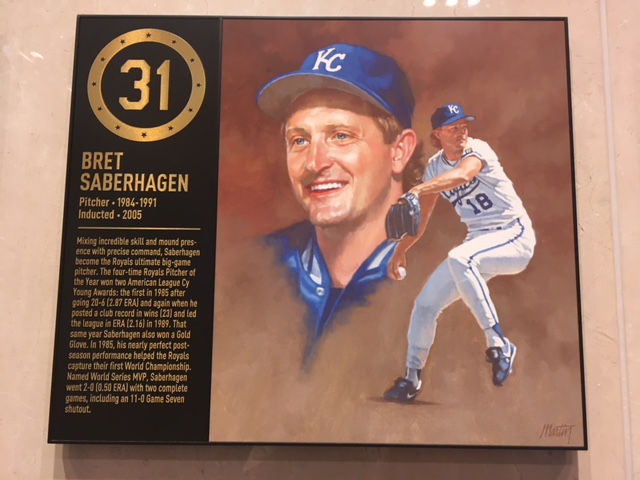
Located in the left field corner on the field level, the Royals Hall of Fame and Museum celebrates the team's best players, with a section for retired numbers and a wing devoted to the Royals' one Cooperstown honoree, George Brett.  It also has Dan Quisenberry's Rolaids Relief Man Award, team trophies, a history of the World Series (and not just the Royals' appearances in the Fall Classic), player lockers and bobbleheads.  In the area where the Royals Hall of Fame members are honored, a beautifully done painting of each honoree is displayed, along with a short history of the player depicted on the canvas.  It sure beats the traditional Hall of Fame plaque.  (And I was surprised to see so many former Mets who were honored for their playing and/or coaching careers in Kansas City.)

But my favorite display in the museum had to be the huge No. 5 made with 3,154 baseballs, or one for each hit collected by George Brett during his 21-year career in Kansas City.  In the middle of the display is Brett's 3,000th hit ball and the bat used to reach that milestone.  Incredibly, the bat is still loaded with pine tar as a reminder of just how much Brett applied to his lumber during his career.  And in case you were wondering, the Pine Tar Game is also discussed in the museum.

Of course, as a Mets fan, I was upset that the jersey worn by Eric Hosmer in Game Five of the 2015 World Series (complete with Citi Field dirt still on it) was prominently displayed, as well as the third base bag he was standing on before he made his mad dash to the plate,  But that was offset somewhat by the unexpected Gil Hodges Mets jersey from 1969 that was there to commemorate the team that won the championship during the Royals' inaugural season.


This trophy would have been ours if World Series games ended after seven innings.  (EL/SM)

Kauffman Stadium is a great place to watch a game, but if you have young kids who can't stay still in a seat for three hours, there are many activities to keep them occupied.  Whereas Citi Field only has a dunk tank, pitch speed machine and a mini field, Kauffman Stadium has so much more.

There's a baseball-themed carousel.  There's a much larger "mini" field where you can play actual baseball games.  There are pitching cages.  There are batting cages.  There's even a miniature golf course with baseball obstacles.  And of course, there are the beautiful fountains in center field that shoot water high up in the air between innings and when the Royals score.

All those things were great for a Mets fan like me.  Why is that, you ask?  Because they distracted me from the 2015 World Series flag flying in the wind and the large 2015 World Champions sign in center field.


I think I liked this sign better when it just said 1985 World Champions.  (EL/SM)

So that covers the ballpark in Kansas City.  But watching a game is far from the only thing you can do in this beautiful burgh and the nearby surrounding areas.

There are numerous great restaurants and venues to watch live music in the Power and Light District.  There's also the Harry S. Truman Presidential Library and Museum in nearby Independence, MO.  For music lovers, nothing beats the American Jazz Museum in the 18th and Vine District.  And housed in the same building is the Negro Leagues Baseball Museum, which I made sure to visit during my stay in the city.

Ordinarily, photos are not allowed in the NLBM.  This is done to protect the artifacts within the 10,000 square-foot space.  But my colleagues and I were given a green light to take all the photos we wanted to document our visit on the Studious Metsimus site.  My photographer took hundreds of photos, of which I will share a few here.


This was my field of dreams, which I shared with some of the greatest players of all-time.  (EL/SM)


So there you have it, my fellow Mets fans.  The baseball teams from Kansas City and St. Louis may have given the Mets lots of heartache in recent years, but the cities those teams call home made up for all the grief.  Well, at least Kansas City did.  And for all the things St. Louis didn't have, Kansas City picked up the slack and then some.

Busch Stadium and Kauffman Stadium are both beautiful ballparks.  Although the immediate area around Busch has more baseball-related activities to entertain fans when there are no games being played, Kauffman is the superior stadium.  The food is tastier and there is more variety.  And there's far more to do inside "The K" when the game isn't the only thing you're interested in.

I can't wait to rumble in the Royals' home town again.  Maybe next time I'll just fly over St. Louis and wave at Busch Stadium from the air while I count down the minutes until I touch down in Kansas City.  And by then, maybe losing the World Series to the Royals in 2015 won't sting as much as it still does and I'll just want BBQ because it's delicious rather than to wash away the memories of that Fall Classic.

Thanks for joining me on the latest legs of my baseball world tour.  Now excuse me while I try on my Negro Leagues apparel.  They may have allowed me to take photos in the museum but they still have to work on making clothes in my size.


Hope my colleagues kept the receipt for this.  (EL/SM)


For previous installments of Joey's World Tour, please click on the links below, where you will be entertained by Joey's wit, photos and love of ballpark cuisine:

World Tour Stop #1: Baltimore
World Tour Stop #2: Washington, DC
World Tour Stop #3: Pittsburgh
World Tour Stop #4: Texas
World Tour Stop #5: Los Angeles
World Tour Stop #6: San Diego
World Tour Stop #7: Toronto
World Tour Stop #8: Chicago (NL)
World Tour Stop #9: Milwaukee
World Tour Stop #10: Seattle
World Tour Stop #11: Cleveland
World Tour Stop #12: Brooklyn (Ebbets Field site) and Manhattan (Polo Grounds site)
World Tour Stop #13: Baltimore (again) and Pittsburgh (part deux)
World Tour Stop #14: Cincinnati
World Tour Stop #15: Colorado
World Tour Stop #16: Cooperstown (Baseball Hall of Fame)
World Tour Stop #17: Detroit
World Tour Stop #18: Atlanta
World Tour Stop #19: Miami
World Tour Stop #20: St. Louis


Monday, March 28, 2016

The Most With The Least: Wayne Garrett (1969-76)

In the early 1980s, James Ingram sang, "I did my best, but I guess my best wasn't good enough."  The opening line from his hit song, "Just Once", referred to a relationship that continued to fail despite the repeated attempts to make it work.  The lyric could also apply to an infielder on the Mets who gave his best effort to the team for nearly eight full seasons, yet could never do enough to satisfy the club.

Although this player was equally adept at three infield positions (second base, shortstop and third base), the Mets already had two middle infielders starting most of their games in Ken Boswell and Bud Harrelson.  The team then acquired three-time All-Star and two-time Gold Glove winner Felix Millan to play second, leaving third base as the only position with a vacancy sign on it.

Despite having good pop and a tremendous eye at the plate, the Mets were still reluctant to give this young and talented player a longer look at third base.  As a result, the club made two ill-advised trades to acquire veteran players who were deemed better suited to handle the hot corner.  Neither third baseman panned out in New York, while the players they were traded for went on to become legends for their respective teams.  And while all this was happening, the player who was never trusted to play third base on a regular basis ended up having a solid career of his own - one that could have produced fantastic numbers had the team just had a little more faith in his abilities.

Wayne Garrett could have solved the third base conundrum, if only the Mets had noticed.  (Focus On Sport/Getty Images)

In 1965, Ronald Wayne Garrett, a 17-year-old infielder from Sarasota, Florida, was selected by the Milwaukee Braves in the sixth round of the inaugural June amateur draft.  A year later, the Braves moved from Milwaukee to Atlanta, just as Garrett was moving from one minor league affiliate to another.  Following the 1968 campaign - his fourth in the Braves' system - Garrett was scooped up by the New York Mets in the Rule 5 draft, which required him to stay on the Mets' 25-man roster for the entire 1969 season.

Even before Garrett took the field for the first time as a Met, the team had already set its sights on acquiring a regular third baseman in five-time All-Star Joe Torre.  But Mets general manager Johnny Murphy decided not to complete the deal with the Braves, as Atlanta GM Paul Richards was asking for outfielder Amos Otis and pitcher Nolan Ryan in return - a price Murphy considered too steep.  When their plans to acquire Torre fell through, the Mets decided to go with an assortment of players at third base, hoping to find one player who could stand out above the others.

Although Garrett was in the starting lineup as the Mets' third baseman more than any other player on the roster in 1969, he still only started 63 games at the position, as manager Gil Hodges used Ed Charles at the hot corner 45 times and Bobby Pfeil on 40 occasions.  The three players combined to produce a .222 batting average and .281 slugging percentage.  At a position known for power hitting, Garrett, Charles and Pfeil hit just four home runs between them in 780 at-bats.  But as the sole left-handed hitter among the three third basemen, Garrett got the nod to start at the hot corner in the National League Championship Series against the Braves, who used right-handed starting pitchers in all three games.  The move paid off for the Mets, as Garrett reached base seven times in the series, tying him for the team lead.  Garrett didn't just reach base often; he also reached base during key moments of the series.

In Game One, the Mets trailed the Braves, 5-4, as the teams moved to the eighth inning.  Garrett began the frame with a double off starting pitcher and future Hall of Famer Phil Niekro.  He then scored the tying run on a single by Cleon Jones.  Garrett's hit kicked off a five-run rally by the Mets, giving them a 9-5 lead, which became the final score an inning later.

Garrett contributed in several ways in Game Two, coaxing a walk from pitcher Ron Reed in the first inning, then participating in a double steal with Jones, which eventually led to the game's first run.  Two innings later, Garrett delivered an RBI single off reliever Paul Doyle to give the Mets a 6-0 lead.  In his next at-bat, Garrett doubled and scored to increase the lead to 9-1.  The extra runs were crucial, as the Braves rallied for five runs in the fifth inning to cut the lead to 9-6.  But the bullpen combo of Ron Taylor and Tug McGraw kept Atlanta off the scoreboard the rest of the way to seal the victory for the Mets.

The third game saw the series go back to New York, and Garrett saved his most clutch at-bat for the Shea faithful.  Trailing 4-3 in the fifth inning after Orlando Cepeda took Nolan Ryan deep for a two-run homer, Garrett returned the favor, blasting a go-ahead two-run shot of his own off Braves starter Pat Jarvis.  The Mets then tacked on two more runs to win the game and the series, with Garrett fielding a Tony Gonzalez grounder and throwing to first baseman Ed Kranepool for the pennant-clinching out.

Garrett's star turn in the NLCS didn't lead to many at-bats in the World Series, as the American League champion Orioles used left-handed starting pitchers in four of the five games.  But Garrett still reached base twice in four plate appearances in the Fall Classic to give him an impressive .357/.500/.714 slash line in the 1969 postseason.

This was one of Wayne Garrett's few at-bats in the 1969 World Series.  (Focus On Sport/Getty Images)

Despite Garrett's heroics in October, the Mets did not trust him to be the team's starting third baseman in 1970.  A year after not wanting to trade Amos Otis to the Braves for Joe Torre, general manager Johnny Murphy parted ways with the outfield prospect, sending Otis to the Kansas City Royals for third baseman Joe Foy.  Within six weeks of the deal, Murphy suffered two massive heart attacks and died.  The Mets' dreams of repeating as world champions, along with Foy's career, died as well in 1970.

Foy, who was never comfortable defensively at third base, committed 18 errors in 94 starts at the position for the Mets in 1970.  He also underachieved as a hitter, batting .236 with 12 doubles, six homers and 37 RBI in his one season in New York, after averaging 20 doubles, 13 homers, 61 RBI and a .250 batting average in his first four major league seasons.

While Foy was flushing away his career in Flushing, Garrett was continuing his development as a fine major league player.  Garrett started 67 games at third base and 34 games at second.  Despite collecting only 366 at-bats (just 44 more than Foy had in 1970), Garrett was third on the team in homers (12), second in runs scored (74), second in walks (81), fourth in slugging percentage (.421), third in OPS (.811) and he led the Mets with a .390 on-base percentage.  With the Mets losing Foy to the Washington Senators in the 1970 Rule 5 draft, Garrett's road to the starting third base position appeared to be free of obstacles.  That is, until the United States military came a-callin'.

Because of the ongoing conflict in Vietnam, Garrett was required to spend the first half of 1971 on active duty.  Once he completed his service, the Mets sent him to AAA-Tidewater, where he hit three home runs in 11 games.  With Garrett away, the Mets handed over the third base job to veteran Bob Aspromonte, who was the last member of the Brooklyn Dodgers to play in the majors (he had one at-bat for Brooklyn in 1956).  The 33-year-old Aspromonte - who was nearly ten years Garrett's senior - hadn't started more than 74 games at the hot corner in any season since 1967, but Hodges inserted him in the starting lineup at third base in 73 of the Mets' first 95 games.  Aspromonte was a disappointment as Garrett's fill-in, batting .244 with a .298 on-base percentage and grounding into as many double plays (12) as he had doubles (7) and homers (5) combined.  Just as disappointing was Wayne Garrett, who returned from Tidewater in late July to bat just .213 with one homer and 11 RBI in 235 plate appearances.

General manager Bob Scheffing, who took over for Johnny Murphy after his untimely passing, had grown impatient with the lack of production at third base.  Garrett's poor production despite having been away from baseball for several months while serving his country led Scheffing to make what many still consider to be the worst trade in franchise history, as he sent Nolan Ryan and three other players to the California Angels for shortstop Jim Fregosi, who had never played a single inning at third base in his 11 seasons with the Angels.  Scheffing assumed Fregosi could make a smooth transition from one infield position to another, yet failed to consider that Fregosi's offensive production in 1971 (.233, 5 HR, 33 RBI in 107 games) was eerily similar to what the Mets got from Aspromonte in the same campaign (.225, 5 HR, 33 RBI in 104 games).  Needless to say, Fregosi was a bust as a Met, while Ryan embarked on a Hall of Fame career as an Angel.

(Focus On Sport/Getty Images)
Garrett did not perform particularly well as the understudy to Fregosi in 1972, batting .232 with two homers and 29 RBI in 298 at-bats, but despite the low batting average, he still managed to lead the team with a .374 on-base percentage (Fregosi reached base at a relatively unimpressive .311 clip).  In doing so, Garrett accomplished something no other Met - past or present - has been able to match.  During the 1972 campaign, Garrett collected 69 hits and walked 70 times in 114 games, making him the only Mets player who played in at least 100 games to have more walks than hits.  The only players to come close to matching Garrett were Bud Harrelson in 1974 (75 hits, 71 walks in 106 games) and Ike Davis in 2013 (65 hits, 57 walks in 103 games).

When the 1973 season started, the Mets were four years removed from their world championship season and had yet to win more than 83 games or finish higher than third place in the division in any subsequent season.  Once again, the Mets turned to Fregosi at third base, with the veteran starting seven of the team's first eight games.  But by early May, Fregosi's batting average had dipped below .200, he had yet to produce a home run and he had driven in just three runs, all while striking out once every four at-bats.  Meanwhile, Wayne Garrett was off to a fantastic start, posting a .268/.388/.439 slash line in his first 99 plate appearances through the middle of May.  In early June, shortstop Bud Harrelson was placed on the disabled list with a fractured wrist, moving Fregosi to his natural position and allowing Garrett to become the team's everyday third baseman for the first time in his five-year career.  By late June, Fregosi was still not producing at the plate, causing the Mets to cut ties with the six-time All-Star by selling his contract to the Texas Rangers.

With Garrett finally entrenched as the team's starting third baseman, the 25-year-old produced his best season in the majors.  In July, Garrett reached base 50 times (31 hits, 19 walks) in 128 plate appearances and he also scored 19 runs while driving in a dozen.  Even though Garrett was finally enjoying personal success, the team was not, as the Mets found themselves in last place with a 58-70 record on August 26.  But on August 27, in the Mets' 6-5 victory over the San Diego Padres, Garrett reached base four times as the team's leadoff hitter and scored the run that gave the Mets a lead they never relinquished.  That win began a season-ending stretch in which the Mets went 24-9, overtaking every team in the N.L. East to win their second division title in five years.  A key reason for New York's surge from worst to first was the play of Wayne Garrett.

Beginning with his effort on August 27, Garrett started 30 of the Mets' final 33 games, producing an impressive .328/.415/.603 slash line.  Garrett collected 16 extra-base hits (seven doubles, two triples, seven homers) and scored 26 times during the five-week stretch.  He also drove in 18 runs - a phenomenal total for a leadoff hitter in such a short period of time.  On the defensive side, Garrett played a key role in the memorable "Ball On The Wall" play, which took place on September 20 against the first place Pittsburgh Pirates.  In the top of the 13rd inning, Bucs outfielder Dave Augustine hit a long fly ball that bounced off the top of the left field fence, staying in the park before it settled into the glove of left fielder Cleon Jones.  Jones then fired the ball to cutoff man Garrett, who had replaced Bud Harrelson at shortstop three innings earlier, and Garrett threw a perfect strike to catcher Ron Hodges to nail Richie Zisk at the plate.  The Mets won the game in the bottom of the 13th on an RBI single by Hodges and moved into first place the following night.  Less than two weeks later, they were crowned champions of the National League East.

Looking back at the pivotal play that helped propel the Mets into first place, Jones admitted that he knew the ball was not going to clear the left field fence, and credited Garrett's positioning as the cutoff man as the main reason why the Mets were able to retire Zisk at the plate.

"Luckily, Garrett was at short," said Jones.  "If Harrelson had been there, he would have taken the relay much further in the outfield and we would never have gotten Zisk."


YouTube video courtesy of Warren Zvon

In 1973, Garrett started 118 games at third base - the first time he started more than 70 games at the position.  Garrett produced career highs across the board, finishing the regular season with 20 doubles, 16 homers, 58 RBI and 74 runs scored.  He was either first, second or third on the team in almost every offensive category and finished fourth in the National League in assists by a third baseman (280) and second in double plays turned (36) despite not starting at the hot corner in 43 of the team's 161 games played.

Garrett's second trip to the postseason wasn't as productive as his first, as he reached base just twice in 24 plate appearances against the Cincinnati Reds.  But he made up for it in the World Series, reaching base ten times in the seven-game loss to the Oakland A's.  Garrett homered off Vida Blue in Game Two and led off Game Three with a home run against future Hall of Famer Catfish Hunter.  But he also made the final out of the Fall Classic, popping out to shortstop Bert Campaneris with two runners on base when a third home run of the series would have tied the game.

After a disappointing end to the 1973 season, Garrett went into the 1974 campaign knowing he was the everyday third baseman for the first time in his career.  Garrett started a career-high 136 games at third in 1974, but the team suffered through its first losing season since 1968 - when Garrett was still bouncing around in the Braves' organization.  Garrett continued to be one of the Mets' more productive players at the plate (13 HR, 53 RBI, 89 walks), but his teammates were not as successful with a bat in their hands, as the Mets finished the season at or near the bottom of the league in many offensive categories.

Although Garrett had proven himself to be a capable third baseman and one of the better offensive players on the team in 1973 and 1974, the front office felt the Mets needed to upgrade their offense, acquiring power-hitting Dave Kingman to play left field and 15-year veteran Joe Torre to play third base - the same Joe Torre who could have been a Met six years earlier had the Mets wanted to part ways with Amos Otis and Nolan Ryan.

Once again, Garrett stood to lose playing time to a more experienced player and once again, Garrett's replacement did not perform well.  Just four years removed from his MVP season in which he led the league in batting average (.363) and RBI (137), Torre had the worst full season of his career, batting a career-low .247.  Torre's six home runs ended a streak of 12 consecutive seasons in which he reached double digits in homers.  He also managed just 35 RBI in 400 plate appearances, or more than 100 fewer than he had during his MVP campaign.

What made Torre's acquisition seem like more of a bust was that Garrett - who was never a high-average hitter - produced a higher batting average (.266) than Torre.  Garrett also matched Torre in homers and finished just one RBI short of Torre's total, even though Garrett had nearly 100 fewer at-bats than Torre did in 1975.  And for the third time in his seven seasons with the team, Garrett led the Mets in on-base percentage, this time with a robust .379 mark.

Wayne Garrett poses with The Coop and Joey Beartran in 2011.  (Photo by Ed Leyro/Studious Metsimus)

In 1976, the Mets posted the second-highest win total in franchise history, going 86-76 under new manager Joe Frazier.  But Garrett was long gone before the team got to celebrate its successful season.  After starting 58 of the team's first 90 games at third base, Garrett was traded to the Montreal Expos, ending his long career with the Mets.  At the time of the trade, Garrett was among the team leaders in runs scored and walks, but he was only hitting .223 and had produced just four homers - his lowest total in four years.  Although Garrett did not believe the Mets would trade him, he knew his lack of production wasn't doing him any favors.

"I am surprised, certainly, but it hasn't been a good year for me," said Garrett.  "I guess that was the reason (for the trade)."

Garrett played nearly eight seasons with the Mets, reaching the postseason twice.  His three postseason homers have been surpassed by just seven Mets players (through 2015) and only eight Mets have walked more times in the playoffs than Garrett, who drew nine bases on balls in 17 career postseason games.  When he played his final game for the Mets in 1976, Garrett ranked among the team's all-time leaders in several offensive categories, despite starting more than 70 games at his familiar third base position in just two of his eight seasons with the team.  Garrett was fifth in hits (667), eighth in doubles (93), tied for fourth in triples (20), ninth in homers (55), sixth in RBI (295), fourth in runs scored (389), fourth in stolen bases (33) and second in walks (482).  Through the 2015 season, Garrett still ranks in the team's all-time top thirty in hits, triples, RBI and runs scored.  He's also in the top twenty in games played (883; 16th), on-base percentage (.348; 19th) and WAR (13.9; 19th).  And only David Wright, Darryl Strawberry, Bud Harrelson and Howard Johnson drew more walks in their Mets careers than Garrett.

Despite the Mets' best efforts to replace him at third base with players such as Joe Foy, Jim Fregosi and Joe Torre, Garrett ended up playing 711 games at the position for the Mets, while Foy, Fregosi and Torre combined to play just 287 games at the hot corner.  To this day, only David Wright and Howard Johnson have played more games at third than Garrett.

Wayne Garrett probably would have liked to play more for the Mets, but the team always felt there was someone better suited to play third base.  After not wanting to part ways with Amos Otis and Nolan Ryan for third baseman Joe Torre in 1969, the Mets eventually did trade away both players in separate deals for two third basemen who both flopped in Flushing.  Otis went on to become a five-time All-Star, three-time Gold Glove winner and had four top-ten finishes in the MVP vote, while Ryan became the greatest strikeout pitcher and no-hit artist of all-time, eventually being inducted in the Hall of Fame and having his number retired by every team he played for after he left the Mets.

In Matthew Silverman's book, "Swinging '73: Baseball's Wildest Season", Garrett explained how he never changed his approach to playing the game even as the Mets were constantly trying to change the identity of their starting third baseman.

Image courtesy of Topps


"I would just go out and play.  I'd play every game the same, as hard as I could. ... I can't go out and make demands.  They're the ones that make the choices as to who plays and who doesn't play.  I'd just do the best that I could and if they wanted to play me at third base, then I'd play third base."


For nearly eight full seasons, Wayne Garrett did his best for a team that always seemed ready to replace him.  But the Mets constantly wanted the next best thing at third base instead of using a player they already had.  And through it all, Garrett just kept on chugging, making his way up the Mets' all-time leader board even as the team kept sitting him on the bench more often than he probably deserved.

The team lost so much when it traded away Amos Otis and Nolan Ryan.  Imagine what the Mets could have gained had they just noticed that the solution to their third base conundrum was wearing No. 11 the whole time.


Note:  The Most With The Least was a thirteen-part weekly series (that's "was" - as in the past tense of "is" - because you just read the final installment) spotlighting those Mets players who performed at a high level without receiving the accolades or playing time their more established teammates got, due to injuries, executive decisions or other factors.  For previous installments, please click on the players' names below:

January 4, 2016: Benny Agbayani
January 11, 2016: Donn Clendenon
January 18, 2016: Tim Teufel
January 25, 2016: Hisanori Takahashi
February 1, 2016: Chris Jones
February 8, 2016: Claudell Washington
February 15, 2016: Moises Alou
February 22, 2016: Pat Zachry
February 29, 2016: Art Shamsky
March 7, 2016: Mark Carreon
March 14, 2016: Jose Valentin
March 21, 2016: Pat Mahomes

Monday, March 4, 2013

The Mets That Got Away: Ken Singleton

In the late '60s and early '70s, the Mets went as far as their pitching would take them.  The 1968 team was the first to lose fewer than 90 games, with sophomore sensation Tom Seaver and Rookie of the Year runner-up Jerry Koosman combining for 35 of the team's 73 wins.  One year later, that dynamic duo was joined by rookie Gary Gentry in the rotation and went on to win the World Series.  The Miracle Mets were also helped by a stellar bullpen, which included Ron Taylor, Tug McGraw and part-time starter Nolan Ryan.

The Mets failed to defend their title in 1970 and fell short once again in 1971.  Both of those teams led the National League in ERA and strikeouts.  They also shared identical 83-79 records.  How could teams so rich in pitching fail to win more than one division or league title from 1968 to 1971?  The answer is simple.  They couldn't hit.

The 1968 team was the only Mets squad that failed to score three runs per game.  In 1970, the Mets' .249 team batting average was well below the league average of .258.  And in 1971, the team could only muster 98 home runs (the NL average was 115).  Even the 1969 World Championship team had difficulty at the plate, finishing near the bottom of the league in batting average, on-base percentage and slugging percentage.

By 1972, the Mets were desperate to acquire a premier slugger to give their offense a jump start.  They had already failed twice when they kept their focus on acquiring an offensive-minded third baseman, losing Amos Otis and Nolan Ryan in the process.  This time, they set their sights elsewhere, trading for soon-to-be fan-favorite Rusty Staub.  Unlike Joe Foy and Jim Fregosi - the players received for Otis and Ryan, respectively - Staub actually produced as a Met.  But by the end of 1975, Staub had become an ex-Met, while one of the players he was traded for was just entering his prime and becoming one of the top players in the majors.

The Mets developed Ken Singleton and other talented hitters in the 1960s.  Keeping them, however, was another story.

Kenneth Wayne Singleton was the Mets' first round selection in the 1967 January draft, taken one spot before future Hall of Famer Carlton Fisk.  At the time, the New York-born Singleton was a student at Hofstra University who had played just one year of college ball.  But that single season was enough to attract the attention of Mets scouts, as the team took the 19-year-old outfielder with the third overall pick in the draft.

Singleton displayed the poise and patience of an experienced veteran as he was advancing through the Mets' minor league system, batting over .300 and reaching base more than 40% of the time.  When he finally reached AAA-Tidewater in 1970, it had become clear that Singleton was ready for the bright lights of the New York stage.

Singleton tore apart the International League as a member of the Tides, batting .388 with 17 homers and 46 RBIs in only 64 games.  The switch-hitting Singleton also had an eye-popping .513 on-base percentage and .703 slugging percentage.  But the Mets had a crowded outfield, with Cleon Jones in left, Tommie Agee in center and a platoon of Ron Swoboda and Art Shamsky in right.  A change would be needed for Singleton to get his first promotion to the big leagues.  That change would come at the expense of another native New Yorker.

As spring turned to summer in 1970, the Mets were playing as mediocre as a team could play.  Through their first 65 games, the team had not yet been more than three games above or below the .500 mark.  The team was in desperate need of a spark to awaken from its doldrums, especially with first place still within shouting distance.  In a move that was considered shocking, but not unexpected, the Mets sent veteran first baseman Ed Kranepool to Tidewater and promoted Ken Singleton to take his spot on the roster.


Going into the 1970 season, Kranepool was the longest tenured Met, having played in each of the team's first eight seasons.  But after a slow April in which he batted .222 with no extra-base hits and one RBI, everything began to unravel for the 25-year-old veteran.

Ed Kranepool
The former All-Star failed to collect a single hit in the month of May and was no longer being used as part of a lefty-righty platoon with World Series MVP Donn Clendenon at first base.  With part-time rightfielder Art Shamsky now sharing first base duties with Clendenon and leftfielder Cleon Jones suffering from hamstring and groin injuries, the time was right for Singleton to get his long-awaited promotion to the big leagues, which finally happened on June 23.  Singleton's promotion made Kranepool a minor leaguer for the first time since 1964.

Singleton began his big league career as the Mets' leftfielder, keeping the position warm for Jones while he recovered from his injuries.  Upon Jones' return in July, Singleton moved over to right field, where he played until an injury forced him to leave a game early on August 3.  When Singleton returned to the Mets ten days later, he was placed in a four-man right field rotation that also featured Swoboda, Shamsky and Dave Marshall.  The lack of regular playing time hurt Singleton, as he batted .220 in his last 30 games (10 starts) to finish his rookie campaign with a .263 average.

In 1971, Singleton found himself on the Mets' Opening Day roster for the first time, but struggled mightily in his first full season in the major leagues.  Singleton was batting .175 and had collected one extra-base hit in the team's first 49 games, being used mostly as a pinch-hitter and late-inning defensive replacement.  But once manager Gil Hodges inserted him in the starting lineup for good on June 11, Singleton became one of the team's top threats at the plate.

Singleton played in 84 of the team's final 109 games.  Although his batting average over that span was only .255, he reached base at a .381 clip.  Singleton also collected 12 home runs and 39 RBIs over the final 3½ months of the season.  The 24-year-old outfielder was at his best during the final three weeks of the season, batting .313 with five home runs and 14 RBIs in his last 15 starts.  Included in Singleton's season-ending hot streak was his first and only multi-homer game as a Met, which he accomplished in the regular season finale to help Tom Seaver win his 20th game of the year.  (Editor's note: For more on this game, please listen to the audio at the end of this piece.)

In his first two seasons with the Mets, Singleton never became the full-time player he expected to be, collecting fewer than 500 at-bats in 184 games.  But he did show good power (18 HR), an ability to drive in runs (72 RBIs) and a keen eye at the plate (91 walks).  Going into his third year in the big leagues, Singleton had every intention to be the Mets' Opening Day rightfielder.  He did start in the outfield as the curtains rose on the 1972 campaign, but it wasn't as a member of the New York Mets.

The Mets had coveted superstars to bolster their offense going into the 1972 season, especially after posting back-to-back 83-79 records in 1970 and 1971.  In December, they added their first piece, sending Nolan Ryan and three others to the California Angels for Jim Fregosi.  Four months later (and just three days after the death of manager Gil Hodges), they pulled off another deal, acquiring Rusty Staub from the Montreal Expos for Mike Jorgensen, former No. 1 overall pick Tim Foli and one Kenneth Wayne Singleton.

Tim Foli, Ken Singleton, Rusty Staub and Mike Jorgensen exchange pleasantries at Shea Stadium.

Ken Singleton's first year in Montreal was similar to his last year with the Mets.  Although Singleton was finally given the opportunity to be an everyday player with the Expos, he managed only 14 homers and 50 RBIs in 142 games.  One year later, he posted the kind of season he never got a chance to achieve as a Met.

In their first four seasons in the National League, the Montreal Expos had never competed for a division title.  But that all changed in 1973, when a late surge pushed them above the .500 mark and only half a game out of first place on September 16.  The Expos eventually watched the Mets pass them and every other team in the NL East, but they still managed to win a franchise-record 79 games.  None of it would have been possible if not for the MVP-caliber season produced by Ken Singleton.

Over the Expos' final 50 games, no pitcher could get Singleton out.  He batted .357 and posted a .486 on-base percentage, reaching base a whopping 105 times (61 hits, 44 walks).  Montreal finished 3½ games behind the eventual National League champion Mets, but had a new star in Ken Singleton.  Singleton played in all 162 games and finished the year with a .302 batting average, 23 homers, 103 RBIs and 100 runs scored, becoming the first Expo to reach triple digits in runs batted in and runs scored.  He also paced the National League with a .425 on-base percentage.  To this day, Singleton's 123 walks in 1973 remain the Expos/Nationals' franchise record.

A year after helping the Expos contend for the first time in their short history, Singleton had a disappointing follow-up campaign.  In 148 games, Singleton batted .276 with only nine home runs.  His walks dipped from 123 to 93 and his triple-digit totals in runs and RBIs dropped to 68 and 74, respectively.  Although Singleton was only 27 and just entering his prime, Montreal decided to give up on their promising outfielder.  In what became a lopsided deal, the Expos sent Singleton and pitcher Mike Torrez to Baltimore for four-time 20-game winner Dave McNally, outfielder Rich Coggins and a minor leaguer.

McNally and Coggins managed three wins and ten hits, respectively, as members of the Expos.  Torrez won 124 games after leaving Montreal, including a 20-win season in his first year in Baltimore, while Singleton became one of the best hitters in the American League and a perennial MVP candidate following the trade.

In 1975, Singleton enjoyed a fine first season in Baltimore, batting .300 with 15 homers and 55 RBIs as the Orioles' leadoff hitter.  Singleton also laced a career-high 37 doubles and set a still-standing Baltimore Orioles record with 118 walks (the franchise record of 126 was set while the team was still in St. Louis as the Browns). 

Singleton's second season in Baltimore produced a .278 average, 13 homers and 70 RBIs.  His third year there made him a superstar.

The 1977 American League leaderboard had Ken Singleton's name all over it.  Singleton finished third in the league in batting average (.328), second in on-base percentage (.438) and second in OPS (.945).  He also surpassed a .500 slugging percentage for the first time in his career on the strength of his 24 doubles and 24 homers.  In addition, Singleton drove in 99 runs and crossed the plate 90 times, while drawing 100 or more walks for the third time in five seasons.  For his efforts, Singleton was selected to his first All-Star team and finished third behind Al Cowens and future Hall of Famer Rod Carew in the AL MVP race.

After another fine season in 1978 (.293, 20 HR, 81 RBI, .409 OBP), Singleton had a career year in 1979.  The 32-year-old continued to hit well (.295) and posted a high on-base percentage (.405), but he also became one of the top power hitters in the league, shattering his previous career highs with 35 homers and 111 RBIs.  On a team that featured future Hall of Famer (and future Met) Eddie Murray, it was Singleton who helped the Orioles end the Yankees' three-year reign as American League champions.

Singleton's torrid regular season carried into the postseason.  In his first trip to the playoffs after ten years in the big leagues, Singleton batted .375 against the Angels in the ALCS and .357 versus the Pirates in the World Series.  Singleton appeared to have a strong chance to be named World Series MVP, batting .412 in the first four games as the Orioles took a commanding 3-1 series lead.  But Baltimore dropped the final three games of the series, losing to the Pirates in seven games.  A month after his team was the runner-up to Pittsburgh in the Fall Classic, Singleton became the runner-up to Don Baylor for the AL Most Valuable Player Award.

Although the Orioles won 100 games in 1980, they failed to defend their American League crown, finishing three games behind the Yankees in the AL East.  But Singleton did everything he could to keep Baltimore in contention until the final weekend of the regular season.  In the season's final 33 games, Singleton batted .373 with 15 extra-base hits and 28 RBIs.  Baltimore fell short in their quest to repeat as AL champs, but Singleton succeeded in his quest to continue to be one of the league's top hitters, finishing the year with a .304 batting average, 24 homers and 104 RBIs.

As Singleton entered his mid-thirties, his numbers began to drop off.  The strike-shortened 1981 season saw Singleton make the All-Star team for the final time.  But it also saw him fail to score 50 runs or drive in 50 runs despite playing in over 100 games.  In 1982, Singleton posted his lowest batting average (.251) since his last year as a Met.  That season was also his first year as the Orioles' primary designated hitter.  But after two subpar seasons, Singleton had one final productive season, and it came at the best possible time.

In 1983, Singleton batted .276 with 18 homers and 84 RBIs.  He also finished second in the league in walks (99) and fifth in on-base percentage (.393).  For the second time in his career, Singleton was going to the playoffs, as Baltimore held off the Detroit Tigers for the division title.  Baltimore had won the AL East for the seventh time since division play began in 1969, but only had one title to show for it.  (The Orioles also won the 1966 World Series, but that was three years before the advent of divisional play.)  That would change in 1983.

In a career that began in 1970 as a member of the defending World Series champion Mets, Singleton finally got to win a championship of his own in 1983.  Baltimore took out the Chicago White Sox in the ALCS before defeating the Philadelphia Phillies in the World Series in five games.  Singleton didn't pick up a hit in the Fall Classic, but he did draw a game-tying bases-loaded walk as a pinch-hitter in the decisive fifth game.  He also got to pick up something far more valuable - a World Series ring that had eluded him for 13 years.

Singleton played one more year in Baltimore before retiring at the end of the 1984 season.  He finished his career with a .282 batting average and .388 on-base percentage, collecting 2,029 hits, 317 doubles, 246 homers and 1,065 RBIs - numbers that he could have achieved as a Met had he not been traded prior to the 1972 season because the Mets were in need of offense.

The Orioles have been in Baltimore for 60 years, moving to Charm City from St. Louis following the 1953 campaign.  In that time, many great hitters have donned Orioles uniforms.  Ken Singleton is one of them.  In ten years with the Orioles, Singleton ranks among the team leaders in games played (1,446; 8th in Orioles history), at-bats (5,115; 8th), hits (1,455; 6th), doubles (235; 10th), home runs (182; 7th), RBIs (766; 5th), runs scored (684; 10th), walks (886; 4th) and on-base percentage (.388; T-2nd).

Rusty Staub, the man Singleton was traded for in 1972, was only a Met for four seasons before he was traded to Detroit prior to the 1976 campaign (Staub did return in 1981, but was used mostly as a pinch-hitter for the next five seasons).  His numbers as a Met from 1972 to 1975 were comparable to what Singleton produced over the same time period in Montreal and Baltimore:

  • Rusty Staub:      .276/.361/.428, 99 doubles, 62 HR, 297 RBI, 267 runs scored
  • Ken Singleton:  .289/.399/.432, 106 doubles, 61 HR, 282 RBI, 333 runs scored

But Staub obviously did nothing for the Mets from 1976 to 1980 and played sparingly for the team from 1981 until his retirement in 1985.  At the same time, Singleton made multiple All-Star teams as a member of the Orioles, nearly won two AL MVP Awards, played in two World Series and won a championship.

Perhaps former Mets director of player development Whitey Herzog (who knows a thing or two about winning pennants and championships after leaving New York) said it best in his book, "White Rat: A Life In Baseball", when he shared his thoughts on the trade that jettisoned Ken Singleton, Tim Foli and Mike Jorgensen out of New York.


"We made a terrible deal with Montreal, giving up three fine players for Rusty Staub.  Here I was busting my tail to develop young players, and Don Grant says he doesn't trust minor leaguers, that we need big names.  We had guys in our system who could have helped the Mets dominate baseball in the 1970s ... and we gave them up."


Both Tim Foli and Mike Jorgensen eventually returned to New York after being shipped out in the Rusty Staub deal.  Foli was purchased by the Mets in December 1977, which led to the trade of long-time shortstop Buddy Harrelson to the Phillies the following March.  Mike Jorgensen won a Gold Glove two years after being traded by the Mets to Montreal, but didn't begin his second engagement in New York until 1980.

By then, the Mets were no longer contenders in the NL East.  They also were no longer hoping that Ken Singleton would follow suit and return to New York, as he had carved out an exceptional career in Baltimore - one that led him to be enshrined in the Orioles Hall of Fame in 1986.  Ironically, it was the same year Rusty Staub was inducted into the Mets Hall of Fame.

Rusty Staub was a beloved player in New York.  But his best years happened before and after his first stint with the team.  In the three seasons prior to becoming a Met (1969-1971), Staub averaged 26 HR and 90 RBIs.  In the three seasons after leaving New York (1976-1978), Staub averaged 20 HR and 106 RBIs.  But he never hit 20 homers in a season for the Mets and only once surpassed 80 RBIs.  Meanwhile, Singleton produced five seasons of 20+ homers and three years of 100+ RBIs in Montreal and Baltimore.  And those walks.  Oh, those walks.

From 1972 to 1983, Singleton finished in his respective league's top ten in walks every year.  Over the same time period, he ranked among the league leaders in on-base percentage ten times, including five seasons above .400 and another year in which he just missed with a .397 OBP.  From 1973 to 1980, Singleton's combined on-base percentage was .406, as he reached base via a hit, walk or hit-by-pitch over 2,100 times in the eight-year period.

How impressive was that eight-year stretch for Singleton?  Let's put it this way.  Going into the 2013 season, David Wright is the Mets' all-time leader in times on base.  The long-time third baseman has reached base safely 2,078 times in nine seasons with the team.  In second place is Ed Kranepool, who reached base 1,886 times in 18 years in New York.  Singleton reached base more times in eight years than any Met has ... EVER!  That's more than David Wright and more than the man whose poor start in 1970 gave Singleton his first chance to compete at the major league level.

Ken Singleton did it all in the major leagues.  He hit for average.  He hit for power.  He reached base with a consistency that most players can only dream of having.  He was a three-time All-Star (1977, 1979, 1981).  He had four top ten MVP finishes (1973, 1975, 1977, 1979).  He played in two World Series (1979, 1983).  And at the tail end of his long and successful career, he achieved his life-long dream of winning a championship.  Yup, Ken Singleton did it all.  But he didn't do any of it as a Met.

The Mets gave up on Singleton long before he had a chance to prove just how valuable a player he was about to become.  Their impatience and need to acquire a big-name, veteran slugger led to the departure of three players who all had long, successful careers.  (Both Foli and Jorgensen played in the big leagues until 1985).  But of the three players traded for Rusty Staub in 1972, none had as big an impact to his new team as Ken Singleton.  Sure, it's possible the Orioles could have won without Singleton.  But it's certain the Mets would have been a better team had they never let him get away.


This audio of Ken Singleton's final game as a Met was brought to you by samspinchat on YouTube.  It's also sponsored by Rheingold.


Note:  The Mets That Got Away is a thirteen-part weekly series that spotlights those Mets players who established themselves as major leaguers in New York, only to become stars after leaving town.  For previous installments, please click on the players' names below:

January 7, 2013: Nolan Ryan
January 14, 2013: Melvin Mora  
January 21, 2013: Kevin Mitchell 
January 28, 2013: Amos Otis
February 4, 2013: Jeff Reardon
February 11, 2013: Lenny Dykstra
February 18, 2013: Jeff Kent
February 25, 2013: Randy Myers