Showing posts with label 1985 Mets. Show all posts

Thursday, June 11, 2020

The Von Hayes Game Haunts Me to This Day

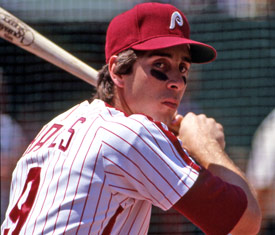
Forget Freddy Krueger.  This is the true man of my nightmares.  (MLB.com)

On June 11, 1985, the Mets took on the Philadelphia Phillies at Veterans Stadium.  New York entered the game with a 31-22 record, leaving them just three games behind the first place Chicago Cubs.  The Phillies, on the other hand, were already falling out of contention in the N.L. East with a 20-34 mark.  Only the Pittsburgh Pirates and Cleveland Indians had a worse record in the majors than the phloundering Phils at the time.

Starting for the Mets that night was Tom Gorman, who was making just his seventh start in the big leagues but was entering the game with a solid 2.52 ERA.  Philadelphia countered with Charles Hudson, who had lost each of his previous four starts, with the Phillies having scored a total of seven runs in those four contests.

Clearly, the Mets appeared to have an advantage coming in to the game.  Then Von Hayes happened.  And I haven’t recovered since.

Without going into too much detail for fear that I’ll suffer a post-traumatic Mets disorder breakdown, Gorman faced seven batters and retired one of them.  He couldn’t retire Von Hayes, who led off the game with a home run.  Gorman had already been replaced by Calvin Schiraldi by the time Hayes batted for a second time in the first frame, not like Hayes could tell the difference, as he launched a grand slam off Schiraldi.  An inning later, with Schiraldi still in the game, Hayes singled and scored a run.

After two innings, the Mets were losing, 16-0.  And then it got worse.

Schiraldi allowed ten runs before manager Davey Johnson ended his suffering.  The Mets then scored seven unanswered runs to make it 16-7, at which time Johnson summoned Joe Sambito from the bullpen to relieve Doug Sisk, who had pitched 2⅓ scoreless innings.  Clearly, Sambito decided he was going to pay homage to Schiraldi’s performance, as he gave up ten runs of his own.  Included in the carnage was a bases loaded walk to Von Hayes, who later came around to score his fourth run of the game on a groundout.

The final straw in what became a 26-7 loss came during the WHN radio post-game show when the turning point of the game was announced.  Was it Von Hayes’ leadoff homer or his grand slam?  How about Sambito giving up a ten-spot after the Mets had cut the deficit to a “manageable” nine runs?  Nope, it happened well before either of those events took place, as fellow Von Hayes Game sufferer Vince Vincenzo can attest.


Oh say, can you see how much this game affected me.

Things eventually got better for the Mets following their historic loss to the Phillies, a game that forever put Von Hayes’ name in the minds of Mets fans who obsess over every little thing about their team.  (And by “Mets fans who obsess over every little thing about their team”, I mean me.)

New York passed the first place Cubs in the standings and went on to win 98 games in 1985, just two victories shy of a franchise record.  Yes, they lost the division to the St. Louis Cardinals instead of the Cubs, but they proved that the 1984 campaign - a year in which they won 90 games and finished above .500 for the first time in eight years - was not a fluke.  They continued their climb in 1986, a season that culminated in the franchise’s second World Series championship.

Since winning it all just sixteen months and sixteen days after the Von Hayes Game took place, the Mets have reached the playoffs six times, including three division titles and two National League pennants.  One would think that success would erase the events of June 11, 1985 from my mind.  One would be wrong.

The truly Hayesian effort continues to haunt me to this day.  Every time the Mets fall behind by a significant number of runs early in a game, I find myself saying aloud, “Who’s going to be Von Hayes in this game?”  Whenever a Mets reliever comes into the game in a mop-up role, proceeds to get shelled and then is left on the mound to take one for the team, the Schiraldi and Sambito Wrecking Crew come to mind.

Even while watching a Mets game that ends up well for the good guys, the Von Hayes Game is inevitably brought up.

During the current pandemic, SNY has taken to showing classic Mets games from years past.  One contest that has been aired ad nauseam is Game Seven of the 1986 World Series.  As we all know, while Von Hayes and his Phillies’ teammates were watching this game at home, the Mets were putting together their second straight comeback win against the Red Sox.  With the score tied in the seventh inning, Boston manager John McNamara brought in Calvin Schiraldi to face Ray Knight, who had delivered a key single against Schiraldi in the miraculous tenth inning comeback just two nights before.  Knight followed up his bloop in Game Six with a blast in Game Seven, taking Schiraldi out of the park to give the Mets the lead.  But they weren’t done yet.

After Knight circled the bases, Schiraldi allowed a hit to Lenny Dykstra, uncorked a wild pitch on a pitchout to Rafael Santana, then gave up another hit to Santana.  After Roger McDowell moved Santana into scoring position with a sacrifice bunt, McNamara replaced Schiraldi with Joe Sambito, who continued to add gas to the fire.  Sambito issued two walks and allowed a sacrifice fly to Keith Hernandez, which scored the sixth run of the game, otherwise known as the run that was the difference in the 8-5 championship-clinching win by the Mets.

A normal fan would have just celebrated the rally by the Mets, praising their clutch hitters coming up big in key late-inning situations.  I guess I’m not a normal fan.  Because this is what I was doing while watching that seventh inning (even though I mistakenly referred to it as happening in the sixth; I blame Von Hayes for my error).


We all have games that give us a kind of post-traumatic Mets disorder; games that are forever associated with the opposing player responsible for our pain.  Whenever someone mentions the Terry Pendleton Game, we know what they’re referring to.  The Mike Scioscia Game?  Don’t get me started.  Some people even can’t let go of the Jason Jennings Game (although I think those people remember it more for Donne Wall than for what Jennings did to the Mets).  Personally, I’m surprised that after his devastating performance against the Marlins to close out the 2007 season, Tom Glavine didn’t say, “I’m disappointed, but at least it wasn’t the Von Hayes Game.”

See what I mean about PTMD and not being able to let things go?

For me, I can’t seem to rid myself of the Von Hayes Game, which took place 35 years ago today.  It comes back to me during blowouts.  It comes back to me during World Series viewings.  It comes back to me when I flip the channel past VH-1 and think it stands for “Von Hayes Won”.  Heck, I can’t even see the Van Halen logo and not think of Von Hayes.


You can't unsee it, can you?


A third of a century after “The Von Hayes Game” became part of my vocabulary, the Mets defeated the Phillies at Citizens Bank Park, 24-4.  In that game, played on August 16, 2018, the Mets broke a 31-year franchise record for runs scored in a game.  They pounded out 25 hits, of which 11 went for extra bases.  It got so bad for the home team that they used two position players to pitch the final three innings.  The Mets knocked them around as well, crossing the plate nine times in those three frames.

I should have been ecstatic at the offensive outburst.  I should have been thrilled the Mets beat up on a division rival.  I should have celebrated a long standing franchise record being toppled.  Instead, I just said four words as the game came to its conclusion.

“TAKE THAT, VON HAYES!!”

I guess it just goes to say that in good times and in bad, the man and the game that put his name in my brain will always find a way to haunt me.  Anyone know the number of a good exorcist?


Call the Ghostbusters.  I'm being haunted by Von Hayes. (Scott Halleran/Getty Images)


Monday, February 13, 2017

The Thrill of Victory, The Agony of the Mets: Doug Sisk

Mets fans love their team.  It doesn't matter if the club is mired in last place or fighting for a title; the fans will always be supportive.  Occasionally, however, the team's fans have been known to show their disdain for a player or two, even though those individuals are wearing the team's colors and are playing on the same side as the athletes who get the loudest cheers.

Richie Hebner didn't like playing in New York.  The fans noticed.  Hebner, who was a gravedigger when he wasn't playing baseball, dug his own grave during his one season with the Mets.

Bobby Bonilla was actually from New York.  But after the Mets acquired him, he rubbed everyone the wrong way with his exploits, both on and off the field.  Bonilla called the press box during a game to dispute an error.  He then wore earplugs on the field to silence the boo birds at Shea.  The coup de grâce was when he offered to be a Bronx tour guide to a Daily News reporter.  And let's just say it probably would have been more violent than the seas during Gilligan's three-hour tour.

Besides hearing constant boos from the fans, Hebner and Bonilla shared something else.  They both played for awful Mets teams.

It's easy to dislike a player when the entire team is playing poorly.  But what about the player who receives negative reactions from fans when the team is playing reasonably well, perhaps even well enough to win a championship?  Or even worse, what if the player being booed was actually having a decent career with the Mets but no one remembers because they were too busy booing him?  Such was the plight of one championship reliever who was made to feel like less of a champion during the latter part of his career.

Doug Sisk didn't throw heat.  But fans often threw heat at him.  (Jacqueline Duvoisin/Getty Images)

Douglas Randall Sisk was drafted by the Mets in 1980 as an amateur free agent.  The Washington state native, who was born and raised approximately 2,400 miles away from where the 1969 and 1973 Mets played their home games, grew up rooting for those pennant winners despite the geographical distance between himself and the team.

"I can recall the '69 World Series and I could always name every player on that team," Sisk said to author Erik Sherman.  "And then I could always recall the '73 National League playoffs when Willie Mays was on the club.  I mean, how many kids from the Seattle area back then could name the rosters from those two teams?  I might have been the only one."

Sisk may have been the only Mets fan he knew in the Pacific Northwest, but he wasn't the only Mets farmhand making a rapid ascent to the big club.  After years of ineptitude brought about by a flawed front office and the dismantling of the team's minor league system, the Mets were committed to restructuring their farm with an influx of young talent.  By 1982, several of those players had become regulars at the major league level, with Wally Backman, Mookie Wilson and Hubie Brooks in the starting lineup just about every day, and Ed Lynch, Jesse Orosco and Neil Allen finding themselves on the mound more often than not.  Just weeks before the curtain closed on the 1982 campaign, Sisk was on the big stage as well.

Making eight relief appearances for the Mets following his September call-up, Sisk was quite effective, allowing just one run (a home run by future Hall of Famer Andre Dawson) in 8⅔ innings.  Sisk, who prior to his late-season promotion had never pitched above the Double-A level, broke camp with the Mets in 1983 and continued to shine.  Used in various relief situations, Sisk notched 11 saves and posted a 2.24 ERA in 104⅓ innings.  In doing so, he became just the fifth pitcher in team history to throw 100 or more innings while pitching exclusively in relief, joining Tug McGraw (1972), Skip Lockwood (1977), Jeff Reardon (1980) and Jesse Orosco (also in 1983; Orosco reached the 100-inning mark two weeks before Sisk did).

Amazingly, Sisk allowed just one home run in those 104⅓ innings in 1983, and once again, it was a future Hall of Famer who took him deep (Mike Schmidt).  To this day, Sisk is the only pitcher in club annals to pitch more than 100 innings in a season and allow fewer than three home runs in that campaign.

As great as Sisk was in 1983, he was even better in 1984, especially during the first half of the season.  Through July 1, Sisk had recorded 11 saves and was the owner of an otherworldly 0.50 ERA, allowing three earned runs in 53⅔ innings.  Opposing hitters were batting just .165 against the right-hander and slugging (if you want to call it that) at a .188 clip.

Sisk had always pitched to contact, nibbling at corners hoping to get batters to swing at his best pitch - the sinkerball.  As a result, hitters didn't collect many hits (just 29 of them through July 1), but they did draw their share of walks (31 bases on balls).  Still, the object of the game for a pitcher is to keep the opponent off the scoreboard and few pitchers were as effective at doing that during the first half of the 1984 season as Sisk was.

As the weather got hotter in July, so did the race for the N.L. East crown between the Mets and Chicago Cubs.  But one player who melted in the heat was Sisk, who allowed runs in six of his 12 outings during the month.  From July 28 to August 6, Sisk made three appearances on the mound.  All three times he pitched against the Cubs.  All three times he allowed runs.  And all three times the Mets lost.  His appearance on July 28, one in which he allowed four runs (three earned) without retiring a batter, caused the fans at Shea Stadium to serenade him with a chorus of boos once he left the mound.  It was a sound Sisk was not yet accustomed to.


It's scary how quickly fans turned on Sisk.
"You know, that's the first time I've ever been booed," Sisk said after the game.  "Oh well, I guess you've got to get booed once in a while."

Once in a while turned into every time he set foot on the mound, as the Shea faithful continued to show a lack of faith in their reliever.  Finally, after his third straight disappointing appearance against the Cubs on August 6, the Mets found a way to keep their once-dependable pitcher away from the hostile home crowd, placing Sisk on the disabled list with what the team called shoulder stiffness.  But the reliever begged to differ, claiming the transaction should not have happened.

''I don't think they should have disabled me,'' Sisk said.  ''I've had soreness in the shoulder in the past, and have pitched with it.  It's demeaning to me to be put on the disabled list.  It wasn't necessary.  It makes me feel they intend to trade me before next season.''

Upon his return from the disabled list, Sisk appeared in five more games in 1984.  He held the opposition scoreless in four of them.  The one time he was scored upon was - you guessed it - against the division-leading Cubs on September 8.

Sisk came into the game with the Mets trailing the Cubs by two runs.  He faced 14 batters in two innings, allowing eight of them to reach base.  But just two of them scored.  Wes Gardner then relieved Sisk and allowed two more Cubs to score.  Cubs pitcher Rick Sutcliffe, who went on to win the Cy Young Award that season, pitched a complete-game shutout as Chicago knocked off New York, 6-0.

It's obvious that Sisk didn't have his best stuff in that game, just as it's obvious that any loss by the second-place Mets to the first-place Cubs was going to sting.  But did Sisk deserve to get viciously booed by the fans on that late summer evening at Shea?  The Mets failed to cross the plate in nine innings.  Sisk came into the game with the Mets already trailing by two runs.  After he was taken out for a pinch-hitter, Gardner pitched an inning and two more Cubs circled the bases.  That means the Mets would have lost the contest anyway even if Sisk had pitched two perfect innings.  Going back to the three consecutive appearances against the Cubs prior to his stint on the disabled list, the first loss (July 28) was definitely on Sisk.  But the other two?  Not so much.

On July 29, Sisk took the mound in the ninth inning with the Mets trailing the Cubs, 2-0.  He then allowed the Cubs to tack on an insurance run.  The Mets failed to score in the bottom of the ninth and lost, 3-0.  That final result was certainly not Sisk's fault, as once again the team could not generate any offense.  Eight days later, Sisk entered the game against the Cubs with the Mets already trailing, 7-3.  He pitched a scoreless sixth, then put up another zero in the seventh.  Sisk then allowed two runs in his third inning of work and the Mets lost to Chicago, 9-3.  Again, New York would have lost even if Sisk had not allowed two runners to cross the plate after he had already pitched two scoreless innings.

When Sisk pitched his final game before being disabled, the Mets' record was 62-45.  When he returned on August 31, the Mets were 73-58.  That means the team posted a losing record (11-13) while Sisk was recovering from his injury.  They also lost four games to the Cubs in the N.L. East standings during Sisk's recovery, going from a slim 1½-game deficit to nearly being out of the race at 5½ games back.  The boo birds probably found a way to blame Sisk for that as well.

Overall, Sisk finished the 1984 campaign with 15 saves and a 2.09 ERA - numbers that were still quite impressive, but not enough to make fans stop booing.  Sisk then began the 1985 season with an 8.53 ERA in his first 11 appearances, which earned him a demotion to AAA-Tidewater.  His manager, Davey Johnson, was as tired of Sisk's poor outings as he was of the fans' reactions to them.

"It was a tough decision to make, but I couldn't think of anything else to do," Johnson said.  "I just felt that his failure, plus the way New York fans were getting on him that I thought this was my only option.  In Tidewater he'll get playing time and a chance to iron out his problems."

Sisk may have ironed out his problems at Tidewater, but the fans at Shea still had a few creases.  (Duvoisin/Getty Images)

When Sisk returned to the team after three weeks with the Tides, he did not pitch well at first.  On June 7, he was brought into an extra-inning affair against the St. Louis Cardinals, allowing six runs (five earned) in his one frame.  Of course, the game took place at Shea Stadium, where the home team's fans got to witness the carnage and voice their displeasure.

A week after his trouncing at the hands of the eventual division champion Cardinals, Sisk was still the owner of an ungodly 7.68 ERA.  But after June 14, Sisk turned his season around, going 3-0 with a 2.95 ERA the rest of the way.  Included in his revival was a yeoman-like effort against the Braves on July 4, when he pitched 4⅓ shutout innings in the Mets' epic 16-13 victory.  Sisk also hurled two scoreless frames against his previous year's nemesis, the Cubs, on August 2, then followed it up with two shutout innings versus the Giants and two more zeroes against the Dodgers, earning the victory in each game.  Unfortunately for Sisk, all of those brilliant efforts took place on the road.  When he returned with his teammates to Flushing, those games in Atlanta, Chicago, San Francisco and Los Angeles were distant memories for throaty Mets fans.

For the second straight year, the Mets fell short in their quest for a division title, making them more determined to advance to the postseason in 1986.  Also determined to recover from his worst season in the majors was Doug Sisk.  In late September 1985, Sisk was found to have bone chips in his right elbow and was thought to be lost for a significant part of the '86 campaign, if not all of it.  The bone chips, as well as a spur that was found in his pitching elbow, were the reason why Sisk did not pitch well in 1985.

"I kept mentioning all year that I wasn't right," Sisk said.  "I wasn't getting any leverage.  They thought I was a mental case.  They had me throwing sidearm in the bullpen.  Sidearm.  And I sat for 18 days, twice.  I was scared."

Despite a prognosis that cautioned against any pitching-related activities, Sisk spent the off-season swimming and chopping wood back home in Tacoma.  He then did some soft tossing, with his wife serving as his catcher.  Defying the odds, Sisk was back with the team in 1986 before Memorial Day.

Although Sisk got off to a bumpy start, posting a 4.02 ERA over his first 18 appearances, this time the heat of the summer brought back his effectiveness.  From July 29 to September 21, Sisk was one of the best relievers in baseball, posting a stellar 1.02 ERA in 35⅓ innings, while holding opposing hitters to a .238 batting average and .628 OPS.  However, fans still found the need to mercilessly boo Sisk despite his solid recovery from an awful 1985 campaign, causing Johnson to use him primarily when the team was trailing.  Johnson also tried not to use Sisk in games played at Shea Stadium, especially after the All-Star Break.  Once players returned from the mid-season hiatus, Sisk pitched just seven times in his home park until the Mets clinched the division title on September 17.  In the postseason, Sisk did not allow a run in two appearances.  But of course, both of those outings came in mop-up duty, as he pitched the final innings of games the Mets lost.

For the season, Sisk lowered his ERA by more than two runs, finishing the year with a 3.06 mark.  He also didn't allow a single home run in 70⅔ innings - not even to a future Hall of Fame slugger.  How unusual has it been over the years to pitch that many innings for the Mets and not give up a single long ball?

Without baseball-reference.com generating this chart for me, you'd still be booing Doug Sisk.

Since coming into the league in 1962, only five Mets pitchers have thrown at least 30 innings in a season without allowing a home run.  The only one to surpass 36⅓ innings in a tater-free campaign was Sisk in 1986, and he pitched almost twice as many innings as the next closest gopherless pitcher.

It's been more than half a century since the Mets played their inaugural season.  Since then, only ten pitchers have thrown more innings in a season than Sisk without allowing a single ball to leave the yard, as detailed in the chart below.

I wonder if the other pitchers on this list had to put up with constant boos from their home crowd.

The Mets failed to repeat as world champions in 1987, but Sisk had another solid season.  He pitched 78 innings - his highest regular season total since his fabulous 1983 campaign - and posted a 3.46 ERA.  He also walked just 22 batters, averaging 2.5 walks per nine innings, which was the lowest ratio of his career.

When the Mets were battling it out with the St. Louis Cardinals for the division title in September, it wasn't Sisk who gave up the crushing, season-changing homer to Terry Pendleton.  That was Roger McDowell.  And when New York was still mathematically alive during the last week of the season, Sisk wasn't on the mound giving up a walk-off blast to light-hitting pinch-hitter Luis Aguayo.  That was Jesse Orosco.  In fact, from August 31 until the end of the season, Sisk pitched ten times and recorded a 2.08 ERA.  Even more impressive was the slash line against him, as opposing hitters could only manage a .208/.240/.229 mark in those ten appearances spanning 13 innings.


The Mets used three relievers in high-leverage situations in 1987 (McDowell, Orosco and rookie Randy Myers).  McDowell finished the year with a 4.16 ERA, while Orosco's ERA ballooned to 4.44.  Myers, who finished sixth in the N.L. Rookie of the Year vote, had the lowest ERA of the three, but it was still a relatively high 3.96 mark.  And that was still half a run higher than the ERA posted by Sisk, who was traded to Baltimore at the end of the season.

Doug Sisk was a Met for six seasons.  He had a rough patch against the division-winning Cubs in 1984, but was mostly stellar against the rest of the league.  He admittedly had a difficult year in 1985, but an elbow injury was later revealed to be the reason for his ineffectiveness.  Still, fans viewed him as a scapegoat, booing him just about every time he stepped on the mound at Shea Stadium during the final three-and-a-half seasons of his tenure in New York.

They booed the owner of 3.10 lifetime ERA as a Met, which is tied for the seventh-lowest mark for all pitchers who threw at least 400 innings in franchise history.  Other pitchers in the top ten include Tom Seaver (2.57), Jesse Orosco (2.73), R.A. Dickey (2.95), Jon Matlack (3.03), Jerry Koosman (3.09) and Dwight Gooden (3.10).  Those pitchers were either Cy Young Award winners, Rookie of the Year Award recipients or pitchers who recorded final outs in the World Series for the Mets.  In other words, Sisk is in good company.

In addition, the man who was on the receiving end of the fans' vitriol during the latter part of his career allowed just 11 home runs in 412⅓ innings during his time with the Mets.  That's an average of 0.24 homers per nine innings - the lowest of any pitcher with at least 400 innings in club annals.  The only other hurler with a ratio under 0.50 is Roger McDowell.  The ten players directly behind Sisk on this list include the usual suspects - Seaver, Koosman, Matlack, Gooden, Orosco - as well as other notable pitchers like Nolan Ryan, Bob Ojeda and David Cone.

Three world champion relievers.  Only one was booed regularly.  (NY Daily News Archive/Getty Images)

The 1985 season happened for Sisk.  It can't be erased.  But the other five years he was in New York, he pitched to a 2.63 ERA and held his opponents to a .248 batting average and .656 OPS.  He did this despite the fact that he wasn't a strikeout pitcher and had his share of walks when hitters were able to lay off his sinker.  But once a player is disliked in New York, he's always disliked in New York, even if his full résumé suggests that the hatred is unwarranted.

Doug Sisk experienced everything after being signed by the Mets in 1980.  He made his way through the minor league ranks quickly.  He joined Jesse Orosco to become a force in the bullpen just as the Mets were shedding their losing ways.  He was part of a world championship team.  But he couldn't get the fans on his side, no matter how hard he tried.  When his then-fiancee asked him why he didn't do anything about the constant derision, he only had one response.

"I can't beat up 60,000 fans."

Richie Hebner heard it from Mets fans.  Bobby Bonilla did, too.  The slow, rising crescendo of fans voicing their displeasure is enough to run the toughest players out of New York.  But not every player deserves that kind of treatment.  And certainly, a player who is a significant part of a team's rise to contention, culminating in an eventual championship, shouldn't have to be subjected to that kind of vocal negativity.

But that's what Sisk had to put up with for several years as a Met.  And unjust as it may be, that's also what he has had to deal with ever since he played his final game in New York.  Such is the agony of Doug Sisk, a player who wanted nothing more than to cherish being part of a victorious team accomplishment.


Note: The Thrill of Victory, The Agony of the Mets is a thirteen-part weekly series spotlighting those Mets players and personnel who experienced the best of times and the worst of times with the team.  For previous installments, please click on the names below:

January 2, 2017: Tom Seaver
January 9, 2017: Mike Piazza
January 16, 2017: Wally Backman
January 23, 2017: Daniel Murphy
January 30, 2017: Frank Cashen
February 6, 2017: Ed Kranepool


Saturday, June 11, 2016

A Wild Finish in Milwaukee Allows the Mets to Accomplish Something They Hadn't Done Since 1985

Jeurys Saves!  And what a wild game he ended up saving...  (SNY screen shot)

The Mets defeated the Brewers at Miller Park on Friday night by the final score of 2-1, needing a bizarre play in the 11th inning to push across the go-ahead run.

Clearly, Milwaukee's infielders had not watched Tom Emanski's Defensive Drills video, as they attempted to retire Kelly Johnson after they had already retired him.  By losing track of which runner they needed to tag in the bases-loaded, one-out situation, Asdrubal Cabrera was able to hustle home with the Mets' second run of the game.  And once Jeurys Familia recorded his 70th career save (passing Neil Allen into 8th place on the team's all-time saves leader board in the process), the Mets were able to celebrate a highly unorthodox victory.

Six pitchers combined to allow just three hits in the 11-inning affair, as Matt Harvey, Hansel Robles, Antonio Bastardo, Jim Henderson, Jerry Blevins and Familia all contributed to the win by striking out 15 batters, with each hurler fanning at least one Brewer.

The low-hit, extra-inning effort was a rarity in Mets history, as it was just the fourth time the team had ever allowed no more than three hits in a game that lasted at least 11 innings.  And it was the first time they accomplished the feat since June 12, 1985 - almost 31 years ago to the day.

That date in 1985 looks awfully familiar.  Maybe it's because of what happened the day before...

After accomplishing the feat for the first time in 1967 (an 11-inning complete game win by Bob Shaw) and then repeating it in 1976 (Craig Swan and Skip Lockwood combined on the 14-inning three-hitter), the Mets waited until 1985 to record their third such game, when Ron Darling, Jesse Orosco and Rick Aguilera combined to allow three hits in the team's 11-inning victory over the Philadelphia Phillies on June 12.  What made that effort even more spectacular was that it came just one day after five Mets pitchers combined to give up 26 runs to the Phils - the most runs ever scored against the Mets in a single game.  The Von Hayes Game, as it's now known because of the Phillies' leadoff hitter's two homers and five RBI in the first inning alone, is still brought up by Mets fans whenever the team gets completely embarrassed by its opponent on the diamond.

The Mets have yet to allow as many as 26 runs in another affair since the Von Hayes Game.  (No team has crossed the plate more than 19 times in any contest against the Mets since June 11, 1985.)  And since the day after that forgettable game that no one can seem to forget, the Mets had also not played a game of at least 11 innings in which they gave up three hits or fewer.  Until Friday night, that is.

An unusual play in extra innings helped the Mets earn a win in Milwaukee on Friday night.  It also helped the Mets accomplish something they hadn't done in over three decades.  As the old saying goes, if you watch the game long enough, you're bound to see something you've never seen before.  If you watched the Mets game on Friday, you saw something you couldn't have seen more than three times before.


Thursday, April 25, 2013

R.I.P. Rick Camp (15 Minutes of Fame For A 19-Inning Game)

If you're a long-time Mets fan, you know who Rick Camp is, and you know him for one thing.  Camp was the relief pitcher who hit a home run off Mets' reliever Tom Gorman in the bottom of the 18th inning to extend an already epic Fourth of July battle between the Braves and Mets into a 19th inning in 1985.

Camp's home run over the head of a disbelieving Danny Heep tied the seemingly never-ending game at 11-11.  The unexpected jog around the bases must have sapped Camp of all his strength, as the Mets scored five runs off the slugger in the 19th inning and held on for a 16-13 victory in a game that ended five minutes before a 4 A.M. fireworks show.

Rick Camp never hit another home run in the major leagues.  In fact, the blast was one of only 13 hits collected by Camp in his nine-year major league career.  But to this day, it is still talked about by Mets fans as being one of the most unlikely home runs ever hit against their favorite team.

After receiving his 15 minutes of fame in 1985, Camp remained out of the spotlight, retiring from baseball a few short months after hitting his highlight-reel home run.  But today, Rick Camp's name is back in the news, and for sad reasons.

Rick Camp has passed away at the age of 60.

Earlier today, the Bartow County (Georgia) coroner's office confirmed that Camp passed away in his home, indicating that although the autopsy has not yet been performed, Camp more than likely died of natural causes.

Rick Camp had himself a nice career as a starter and reliever for Atlanta, going 56-49 with a 3.37 ERA in nine seasons with the Braves.  He even received national recognition in the strike-shortened 1981 season, going 9-3 with a 1.78 ERA to receive MVP consideration.  (Interestingly enough, Camp finished tied for 20th place in the 1981 NL MVP race with Keith Hernandez, who hit for the cycle in the same game Camp hit his only home run.)  But nothing gave Camp more recognition than one long fly ball he hit at 3:30 in the morning in a game that began on the Fourth of July.

On a night that ended with rockets red glare, it was Rick Camp's bomb that burst in the air.  His shot gave proof through many nights that his legacy would remain there.  Camp earned his 15 minutes of fame by extending a memorable game into the 19th inning.  It is a moment that is etched in the memories of many Mets fans.  And that moment will keep Rick Camp alive, even now after his death.

R.I.P. Rick Camp (June 10, 1952 - April 25, 2013).  You may have moved on, but your memory (and your homer) lingers on.

Chief Noc-A-Homa and a Camp who knocked a homer.
 

Thursday, September 20, 2012

Just Call The Mets "Tea Totallers"

If you were watching the first inning of tonight's Mets-Phillies tilt, you were reminded of many things.  Fans from my generation will recall the game between the Mets and Phillies on June 11, 1985, otherwise known as The Von Hayes Game.

In that debacle, the Mets set the franchise record for runs allowed in a game, losing to the Phillies 26-7.  Aided by two first-inning home runs by Von Hayes including a grand slam, the Phillies took a 16-0 lead after two innings en route to their lopsided win.  Three Mets pitchers (Tom Gorman, Calvin Schiraldi and Joe Sambito) combined to give up all 26 runs.  Amazingly, almost incomprehensibly, Doug Sisk pitched 2⅓ innings of scoreless relief, despite entering the game with a 7.68 ERA.

That's what I was reminded of.  But more mature fans (and by more mature, I mean fans who remember seeing Dave Schneck and Al Schmelz stinking it up in Mets uniforms) might think of tonight's first inning and be reminded of this:


The Mets weren't nearly as bad against the Phillies as the Tea Totallers were against the Gas-House Gorillas in that classic Bugs Bunny sketch.  But they were pretty close, allowing eight first inning runs to their division rivals.

Instead of batters doing a conga line to home plate, it was Mets fans making a beeline toward the exits.  That's just what happens when the team you root is playing like a cartoon.

Sunday, July 22, 2012

To Continue This Rare Season, The Mets Must Win Now

On Saturday, the Mets lost for the seventh time in eight games since the All-Star Break.  Their 8-5 loss to the Dodgers dropped their record to 47-47.  It was the third time this year the Mets fell to .500, as they were 8-8 in April and 13-13 in May.  They have yet to fall under .500 at any point this year.

Should the Mets win today to go back above .500, they would continue to hold out hope that they can play an entire 162-game schedule without ever spending a day below the break-even point.  How rare is it for the Mets to play an entire season without ever falling below .500?  Let's put it this way.  They've had an easier time winning division titles than they've had playing an entire campaign at or above the .500 mark.

Since their inaugural season in 1962, the Mets have won five division titles (making a total of seven playoff appearances overall).  But they've only had four seasons in which they never spent a day below .500.

The 1969 Miracle Mets might have won 100 games en route to a World Series championship, but even they didn't spend every day of the season at or above .500.


From 1962-1969, the Mets lost on Opening Day every year, ending their chances of playing at or above .500 for an entire season before they had earned their first victory.  From 1970-1976, the Mets had six winning seasons, with 1974 being the sole exception to this era of winning baseball.  But in each of those seasons, the Mets couldn't get through the year without spending a day below .500.

The 1970 Mets were under .500 by the seventh game of the season en route to an 83-79 record.  In 1971, the team got off to a fantastic start.  Going into July, they were 45-29 and had yet to spend a single day below .500.  But over the next six weeks, the team played as bad as their 1962 counterparts, going 13-31.  They fell under .500 for the first time on August 14.  It was the first time a Mets team had gone past the All-Star Break without spending a day below .500.

Although the 1972 Mets became the second team in franchise history to finish a season at least ten games above .500, they spent exactly one day below the break-even point.  After three games, the Mets were 1-2, ending any chances of going an entire season with ever having a losing record.

The 1973 Mets had to believe they were going to win the pennant, but they didn't for most of the season.  In fact, from May 30 to September 20, the Mets were below .500 every single day.  They did recover to win a very mediocre National League East and shocked the Big Red Machine in the NLCS, but their late season success did not carry over into 1974, as the Mets finished 20 games under .500 that season.

1975 and 1976 brought the team back to the winning baseball they had known in the early '70s, but both teams spent time under the .500 mark before the calendar turned to May.

Should we even talk about the 1977 to 1983 Mets?  Let's just say those seasons were darker than Grant's tomb.  Needless to say, those teams spent plenty of time below .500 during that bleak era of Mets baseball.

But in 1984, things started to turn around for the franchise.  The Mets spent one day under .500 all season, and that was after their Opening Day loss to the Reds.  The team recovered from that 8-1 defeat to win their next six games, never dropping below .500 again all year, although they did fall to exactly .500 twice, at 22-22 and 23-23.

Darryl Strawberry, Keith Hernandez and Dwight Gooden played together for the first time in 1984.  By 1985, they were part of a Mets team that did something no other Mets team had accomplished before.


Then it finally happened.  In their 24th season of existence, the 1985 Mets did not spend a single day below .500, becoming the first team in franchise history to play an entire season of winning baseball.  Of course, the St. Louis Cardinals, who spent most of April and May below .500, went 77-38 after June 2 and went on to take the division title from the Mets during the last week of the season.

Although the Mets had an extended era of greatness in the mid-to-late 1980s, the team didn't play another full season at or above .500 for another 13 years.  (The 1991 team came close, not going under .500 for the first time until August 16.)  Just like the 1985 team, the 1998 Mets were in the second season of a renaissance after an extended slumber.  The 1998 squad spent three days at exactly .500 (1-1, 13-13, 14-14), but never succumbed to the dark side, although a five-game losing streak at season's end once again kept the Mets from making the postseason.

In 1999 and 2000, the Mets made the playoffs in back-to-back seasons for the first time in franchise history.  But both teams spent time below .500 at some point of their magical seasons, with the 1999 squad dropping under .500 two times (0-1, 27-28) and the 2000 team losing six of their first nine games.

The 2001 Mets finished the season with a winning record (82-80) but needed a strong finish to get there after spending most of the season below .500, just one year after their fourth World Series appearance.  That would be the last time the Mets would finish an entire season above the break-even point until 2005, when the team finished 83-79 (although they didn't go over .500 for good until September 25).

The 2006 Mets were good enough to win the World Series.  But they weren't good enough to win the pennant.  However, they were good enough to become the third team in franchise history to spend every day at or above .500.  After dropping to .500 with a loss in their second game of the season, the Mets didn't see .500 again until the 2008 season.  That's right.  In 2007, the Mets also never spent a day below .500.  In fact, they became the first team since 1985 to never even finish a day at exactly .500, as they won their first four games of the season and never dropped back to the break-even point.

The 2006 Mets began a two-year run in which the team never spent a single day below .500 during the regular season.  Unfortunately, the same could not be said about the postseason.


That brings us to the Citi Field era, an era in which the Mets have finished under .500 for three consecutive seasons (2009-2011).  The 2012 Mets have yet to spend a day under .500.  But after losing to the Dodgers on Saturday, the Mets fell back to the mark of mediocrity for only the third time this season.  The first two times they fell to .500, they recovered to win their next game.  They'll have to do the same again today.

Only four times in franchise history have the Mets played an entire season without ever falling below .500.  The 1985, 1998, 2006 and 2007 Mets are the only teams in the franchise's 50-year existence to accomplish that feat, making it a rarer accomplishment than winning a division title, which the Mets have done five times.

The 2012 squad is looking to become the fifth team to join that exclusive Mets fraternity.  But if they lose today, their dream will end.  Instead of becoming one of the lucky five, they will join the 1971 and 1991 Mets as the only teams in franchise history to spend their first day below .500 after the All-Star Break.  It's not such a bad thing to be compared to a Gil Hodges-led Mets team, but it would be much more of an accomplishment to be associated with the four teams that never spent a day below .500, as those teams were all part of an extended era of success for the franchise.

Will this year's team be the start of another extended era of success?  Spending every day at or above .500 for an entire season usually leads to that.  But the Mets have to win today to make sure 2012 can continue to be an unexpected magical season.