 |
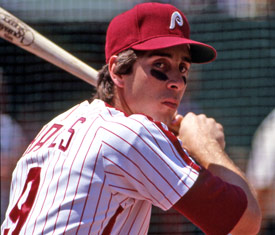
| Forget Freddy Krueger. This is the true man of my nightmares. (MLB.com) |
On June 11, 1985, the Mets took on the Philadelphia Phillies at Veterans
Stadium. New York entered the game with a 31-22 record, leaving them
just three games behind the first place Chicago Cubs. The Phillies, on
the other hand, were
already falling out of contention in the N.L. East with a 20-34 mark.
Only the Pittsburgh Pirates and Cleveland Indians had a worse record in the majors
than the phloundering Phils at the time.
Starting for the Mets that night was Tom Gorman, who was making just his seventh start in the big leagues but was entering the game with a solid 2.52 ERA. Philadelphia countered with Charles Hudson, who had lost each of his previous four starts, with the Phillies having scored a total of seven runs in those four contests.
Clearly, the Mets appeared to have an advantage coming in to the game. Then Von Hayes happened. And I haven’t recovered since.
Without going into too much detail for fear that I’ll suffer a post-traumatic Mets disorder breakdown, Gorman faced seven batters and retired one of them. He couldn’t retire Von Hayes, who led off the game with a home run. Gorman had already been replaced by Calvin Schiraldi by the time Hayes batted for a second time in the first frame, not like Hayes could tell the difference, as he launched a grand slam off Schiraldi. An inning later, with Schiraldi still in the game, Hayes singled and scored a run.
After two innings, the Mets were losing, 16-0. And then it got worse.
Schiraldi allowed ten runs before manager Davey Johnson ended his suffering. The Mets then scored seven unanswered runs to make it 16-7, at which time Johnson summoned Joe Sambito from the bullpen to relieve Doug Sisk, who had pitched 2⅓ scoreless innings. Clearly, Sambito decided he was going to pay homage to Schiraldi’s performance, as he gave up ten runs of his own. Included in the carnage was a bases loaded walk to Von Hayes, who later came around to score his fourth run of the game on a groundout.
The final straw in what became a 26-7 loss came during the WHN radio post-game show when the turning point of the game was announced. Was it Von Hayes’ leadoff homer or his grand slam? How about Sambito giving up a ten-spot after the Mets had cut the deficit to a “manageable” nine runs? Nope, it happened well before either of those events took place, as fellow Von Hayes Game sufferer Vince Vincenzo can attest.
I can tell you exactly what I was doing during this game - Jr year of HS studying for a Regents exam the next morning I’m listening on the radio. In the post game they announced the answer for the turning point of the game contest for the next morning - the national anthem!— Vincent Vincenzo (@vvincenzo) June 11, 2020
Oh say, can you see how much this game affected me.
Things eventually got better for the Mets following their historic loss to the Phillies, a game that forever put Von Hayes’ name in the minds of Mets fans who obsess over every little thing about their team. (And by “Mets fans who obsess over every little thing about their team”, I mean me.)
New York passed the first place Cubs in the standings and went on to win 98 games in 1985, just two victories shy of a franchise record. Yes, they lost the division to the St. Louis Cardinals instead of the Cubs, but they proved that the 1984 campaign - a year in which they won 90 games and finished above .500 for the first time in eight years - was not a fluke. They continued their climb in 1986, a season that culminated in the franchise’s second World Series championship.
Since winning it all just sixteen months and sixteen days after the Von Hayes Game took place, the Mets have reached the playoffs six times, including three division titles and two National League pennants. One would think that success would erase the events of June 11, 1985 from my mind. One would be wrong.
The truly Hayesian effort continues to haunt me to this day. Every time the Mets fall behind by a significant number of runs early in a game, I find myself saying aloud, “Who’s going to be Von Hayes in this game?” Whenever a Mets reliever comes into the game in a mop-up role, proceeds to get shelled and then is left on the mound to take one for the team, the Schiraldi and Sambito Wrecking Crew come to mind.
Even while watching a Mets game that ends up well for the good guys, the Von Hayes Game is inevitably brought up.
During the current pandemic, SNY has taken to showing classic Mets games from years past. One contest that has been aired ad nauseam is Game Seven of the 1986 World Series. As we all know, while Von Hayes and his Phillies’ teammates were watching this game at home, the Mets were putting together their second straight comeback win against the Red Sox. With the score tied in the seventh inning, Boston manager John McNamara brought in Calvin Schiraldi to face Ray Knight, who had delivered a key single against Schiraldi in the miraculous tenth inning comeback just two nights before. Knight followed up his bloop in Game Six with a blast in Game Seven, taking Schiraldi out of the park to give the Mets the lead. But they weren’t done yet.
After Knight circled the bases, Schiraldi allowed a hit to Lenny Dykstra, uncorked a wild pitch on a pitchout to Rafael Santana, then gave up another hit to Santana. After Roger McDowell moved Santana into scoring position with a sacrifice bunt, McNamara replaced Schiraldi with Joe Sambito, who continued to add gas to the fire. Sambito issued two walks and allowed a sacrifice fly to Keith Hernandez, which scored the sixth run of the game, otherwise known as the run that was the difference in the 8-5 championship-clinching win by the Mets.
A normal fan would have just celebrated the rally by the Mets, praising their clutch hitters coming up big in key late-inning situations. I guess I’m not a normal fan. Because this is what I was doing while watching that seventh inning (even though I mistakenly referred to it as happening in the sixth; I blame Von Hayes for my error).
Friendly reminder that Calvin Schiraldi and Joe Sambito, who pitched in this pivotal sixth inning, combined to give up 20 runs in the Von Hayes Game just a year earlier as members of the Mets.#Mets #SNY #1986WorldSeries pic.twitter.com/fR69g6DW1D— Ed Leyro (@Studi_Metsimus) May 25, 2020
We all have games that give us a kind of post-traumatic Mets disorder; games that are forever associated with the opposing player responsible for our pain. Whenever someone mentions the Terry Pendleton Game, we know what they’re referring to. The Mike Scioscia Game? Don’t get me started. Some people even can’t let go of the Jason Jennings Game (although I think those people remember it more for Donne Wall than for what Jennings did to the Mets). Personally, I’m surprised that after his devastating performance against the Marlins to close out the 2007 season, Tom Glavine didn’t say, “I’m disappointed, but at least it wasn’t the Von Hayes Game.”
See what I mean about PTMD and not being able to let things go?
For me, I can’t seem to rid myself of the Von Hayes Game, which took place 35 years ago today. It comes back to me during blowouts. It comes back to me during World Series viewings. It comes back to me when I flip the channel past VH-1 and think it stands for “Von Hayes Won”. Heck, I can’t even see the Van Halen logo and not think of Von Hayes.
 |
| You can't unsee it, can you? |
A third of a century after “The Von Hayes Game” became part of my vocabulary, the Mets defeated the Phillies at Citizens Bank Park, 24-4. In that game, played on August 16, 2018, the Mets broke a 31-year franchise record for runs scored in a game. They pounded out 25 hits, of which 11 went for extra bases. It got so bad for the home team that they used two position players to pitch the final three innings. The Mets knocked them around as well, crossing the plate nine times in those three frames.
I should have been ecstatic at the offensive outburst. I should have been thrilled the Mets beat up on a division rival. I should have celebrated a long standing franchise record being toppled. Instead, I just said four words as the game came to its conclusion.
“TAKE THAT, VON HAYES!!”
I guess it just goes to say that in good times and in bad, the man and the game that put his name in my brain will always find a way to haunt me. Anyone know the number of a good exorcist?
 |
| Call the Ghostbusters. I'm being haunted by Von Hayes. (Scott Halleran/Getty Images) |