My grandparents moved to Puerto Rico when I was three years old. After they moved to San Juan, I only saw them for a few weeks at a time when my parents and I visited them during my summer vacation from school. Because those trips coincided with the middle of baseball season, my grandfather always wanted to talk to me about the game.
When I was eight years old, I discovered that Abuelo (that's Spanish for "grandfather") was a Brooklyn Dodgers fan. He, my grandmother and their four children (one of which is my father) moved from the Island of Enchantment to New York in 1947, the same year Jackie Robinson broke the color barrier in baseball. Robinson wasn't the only reason Abuelo became a Dodger fan, as 1947 was also the year Gil Hodges and Duke Snider came up to the major leagues to stay. The Dodgers won the pennant in 1947, making only their second trip to the World Series since 1920. They would make many more over the next few decades. Abuelo was hooked for life.
The summer of 1981 was special for both Abuelo and I. It was the year I became a Mets fan, but it was also the year of Fernandomania. That summer, when my parents and I went to visit my grandparents in Puerto Rico, the players' strike was nearing its conclusion. But just because there was no baseball to watch didn't mean there were no baseball stories to share.
Any time I wanted to talk about Mookie Wilson, my grandfather would remind me that he wasn't as fast as Maury Wills. (Wills was the first major league player in the modern era to steal 100 bases in a season, swiping 104 bags for the Dodgers in 1962, which was 45 more than the entire Mets team stole in their inaugural season.) I knew better than to argue with him.
After a few minutes, the conversation would always turn to Fernando Valenzuela, who had taken the country by storm during his rookie season. Abuelo would normally be in bed by 10 PM every night, but if Valenzuela was pitching and the game just happened to be broadcast on the local television channel, he'd always stay up to watch the game on a 13-inch black and white TV. He'd keep the volume low so as not to wake my grandmother, telling me that he didn't need to hear the game because Fernando's pitching would tell the story. In the summer of 1981, he was absolutely right.
I'll always remember talking to him on the phone after the Mets won the World Series in 1986. He was thrilled that I was finally able to celebrate a championship, but he was also quick to remind me that despite the Mets boasting a pitching staff that included Dwight Gooden, Ron Darling, Bob Ojeda and Sid Fernandez, it was Fernando Valenzuela who led the National League in wins. (Valenzuela won 21 games for the Dodgers in 1986; his only 20-win campaign in 17 years in the big leagues.)
Oh, Abuelo. He really loved his Dodgers.
Two years after the Mets won the World Series, they played for the right to appear in another. But this time it was different. This time, the Mets were playing the Dodgers for the pennant. A member of the Leyro family was going to see his favorite team play in the World Series in 1988. But for that to happen, another member of the Leyro family was going to be disappointed that his team failed to reach the Fall Classic. It was about as awkward as it was ever going to get between me and Abuelo when it came to our shared love of the national pastime. In the end, it became one of the most important times in our relationship.
The Dodgers defeated the Mets in the 1988 NLCS, upsetting them in seven games. The Mets weren't the only ones upset by that result. The day after Game Seven, the phone rang in our house. My mother picked it up, spoke for a few seconds, then called me over to the phone. It was for me, she said. It was Abuelo.
I thought it was strange that Abuelo would call me. After all, any time I'd speak to him on the phone, it would be my grandmother who called us and then she'd pass the phone over to Abuelo. (The men in the Leyro family have never been known as "phone people".) But this time, my grandfather let his fingers do the walking and he called me directly. Over three decades have passed since this call was made, but I'll never forget that conversation.
Not once did he mention the Dodgers while talking to me. Nor did he mention the Mets. Instead, he reminded me that there would be times in life when we'd question why things happened the way they did. He told me that he once went on a date with a girl when he was eighteen. She was his definition of "the perfect girl". She was smart, beautiful and came from a great family. He was sure after one date that he was going to marry her. Two dates later, she decided she didn't want to see him anymore. He was crushed.
After two years of wondering where he went wrong, he made the acquaintance of another local girl. Abuelo admitted to me that he wasn't attracted to her at first, but she listened to his story of lost love and gave him words of encouragement. They continued to talk as friends for nearly a year until he realized something.
He was falling in love. And this time, the girl he loved felt the same way about him.
The year was 1933. In 1934, they were married.
When Abuelo finished telling me the story of how he and Abuela met and fell in love, I thanked him for making me smile. I thought that was the reason he was sharing his story with me, because I was upset that my Mets had lost to his Dodgers and I would need some cheering up. But that wasn't why he told me the story. He then went back to the beginning of our conversation, the part where he said there would be times in life when we'd question why things happened the way they did.
For two years, he wondered to himself why the love of his life didn't love him back. But without that unexpected breakup, he never would have met my grandmother, a woman he would be married to until she passed away in 2001. He then told me to think about his words and to "never stop believing" before hanging up.
It took me until that evening, but as I was getting ready for bed, it finally hit me. Abuelo was using his story as an analogy. I was questioning how the Mets could lose to the Dodgers in the playoffs after defeating them 10 of 11 times during the regular season, just like he had questioned why the girl he loved couldn't reciprocate those feelings for him. He had to wait two years after suffering through a devastating heartbreak, but in the end, it netted him the love of his life. Therefore, what Abuelo was telling me was that he knew I was heartbroken because of the Mets' loss to the Dodgers, but before long, they'd be back and I'd love them more than ever.
You know what? He was right.
Sure, it took 11 years for the Mets to make it back to the postseason, but when they did, they went to the playoffs in back-to-back seasons and made their first trip to the World Series since 1986. And when they did win the pennant, Abuelo was the first person who called me to offer a congratulatory message.
Abuelo didn't make it to see the next two Mets/Dodgers postseason matchups in 2006 and 2015, as he passed away five days after his 90th birthday in 2002. But when the Mets defeated the Dodgers to advance to the NLCS in both campaigns, the first person I thought of was him. What did I think of? That he didn't have to feel sad because the team he loved would be back. And they did, as the Dodgers have won eight consecutive division titles and three National League pennants in the last four years. Somewhere in Heaven, I knew Abuelo was smiling. And now he's probably smiling even more, as the Dodgers just won their first World Series championship since the year he called me to tell me a story about love and patience.
There is a point to this personal story. You see, Abuelo was born on October 29, 1912. That means today would have been his 108th birthday. He and I never went to a Mets/Dodgers game together, but we didn't have to. The stories took us there.
When I was eight years old, Abuelo shared his love of the Dodgers with me at the same time I was trying to share my love of the Mets with him. He never became a Mets fan, just as I never became a Dodgers fan. But we shared that love of baseball that no rivalry can break. That love brought us together and provided me with some of my most wonderful childhood memories - memories that I continue to cherish as an adult.
Sometimes we question why things happen the way they do. I never have to question why I loved my grandfather. He was the most important man I've ever known.
Happy 108th birthday, Abuelo. And thank you for always taking me out to the ballgame.
Dedicated to Horacio Leyro (October 29, 1912 - November 3, 2002)
My grandparents moved to Puerto Rico when I was three years old. After they moved to San Juan, I would only see them for a few weeks at a time when my parents and I would visit them during my summer vacation from school. Because those trips would coincide with the middle of baseball season, my grandfather would always want to talk to me about the game.
When I was eight years old, I discovered that Abuelo (that's Spanish for "grandfather") was a Brooklyn Dodgers fan. He, my grandmother and their four children (one of which is my father) moved from the Island of Enchantment to New York in 1947, the same year Jackie Robinson broke the color barrier in baseball. Robinson wasn't the only reason he became a Dodger fan, as 1947 was also the year Gil Hodges and Duke Snider came up to the major leagues to stay. The Dodgers won the pennant in 1947, making only their second trip to the World Series since 1920. They would make many more over the next few decades. Abuelo was hooked for life.
The summer of 1981 was special for both Abuelo and I. It was the year I became a Mets fan, but it was also the year of Fernandomania. That summer, when my parents and I went to visit my grandparents in Puerto Rico, the players' strike was nearing its conclusion. But just because there was no baseball to watch didn't mean there were no baseball stories to share.
Any time I wanted to talk about Mookie Wilson, my grandfather would remind me that he wasn't as fast as Maury Wills. (Wills was the first major league player in the modern era to steal 100 bases in a season, swiping 104 bags for the Dodgers in 1962, which was 45 more than the entire Mets team stole in their inaugural season.) I knew better than to argue with him.
After a few minutes, the conversation would always turn to Fernando Valenzuela, who had taken the country by storm during his rookie season. Abuelo would normally be in bed by 10 PM every night, but if Valenzuela was pitching and the game just happened to be broadcast on the local television channel, he'd always stay up to watch the game on a 13-inch black and white TV. He'd keep the volume low so as not to wake my grandmother, telling me that he didn't need to hear the game because Fernando's pitching would tell the story. In the summer of 1981, he was absolutely right.
I'll always remember talking to him on the phone after the Mets won the World Series in 1986. He was thrilled that I was finally able to celebrate a championship, but he was also quick to remind me that despite the Mets boasting a pitching staff that included Dwight Gooden, Ron Darling, Bob Ojeda and Sid Fernandez, it was Fernando Valenzuela who led the National League in wins. (Valenzuela won 21 games for the Dodgers in 1986; his only 20-win campaign in 17 years in the big leagues.)
Oh, Abuelo. He really loved his Dodgers.
Two years after the Mets won the World Series, they played for the right to appear in another. But this time it was different. This time, the Mets were playing the Dodgers for the pennant. A member of the Leyro family was going to see his favorite team play in the World Series in 1988. But for that to happen, another member of the Leyro family was going to be disappointed that his team failed to reach the Fall Classic. It was about as awkward as it was ever going to get between me and Abuelo when it came to our shared love of the national pastime. In the end, it became one of the most important times in our relationship.
The Dodgers defeated the Mets in the 1988 NLCS, upsetting them in seven games. The Mets weren't the only ones upset by that result. The day after Game Seven, the phone rang in our house. My mother picked it up, spoke for a few seconds, then called me over to the phone. It was for me, she said. It was Abuelo.
I thought it was strange that Abuelo would call me. After all, any time I'd speak to him on the phone, it would be my grandmother who called us and then she'd pass the phone over to Abuelo. (The men in the Leyro family have never been known as "phone people".) But this time, my grandfather let his fingers do the walking and he called me directly. Nearly three decades have passed since this call was made, but I'll never forget that conversation.
Not once did he mention the Dodgers while talking to me. Nor did he mention the Mets. Instead, he reminded me that there would be times in life when we'd question why things happened the way they did. He told me that he once went on a date with a girl when he was 18. She was his definition of "the perfect girl". She was smart, beautiful and came from a great family. He was sure after one date that he was going to marry her. Two dates later, she decided she didn't want to see him anymore. He was crushed.
After two years of wondering where he went wrong, he made the acquaintance of another local girl. Abuelo admitted to me that he wasn't attracted to her at first, but she listened to his story of lost love and gave him words of encouragement. They continued to talk as friends for nearly a year until he realized something.
He was falling in love. And this time, the girl he loved felt the same way about him.
The year was 1933. In 1934, they were married.
When Abuelo finished telling me the story of how he and Abuela met and fell in love, I thanked him for making me smile. I thought that was the reason he was sharing his story with me, because I was upset that my Mets had lost to his Dodgers and I would need some cheering up. But that wasn't why he told me the story. He then went back to the beginning of our conversation, the part where he said there would be times in life when we'd question why things happened the way they did.
For two years, he wondered to himself why the love of his life didn't love him back. But without that unexpected breakup, he never would have met my grandmother, a woman he would be married to until she passed away in 2001. He then told me to think about his words and to "never stop believing" before hanging up.
It took me until that evening, but as I was getting ready for bed, it finally hit me. Abuelo was using his story as an analogy. I was questioning how the Mets could lose to the Dodgers in the playoffs after defeating them 10 of 11 times during the regular season, just like he had questioned why the girl he loved couldn't reciprocate those feelings for him. He had to wait two years after suffering through a devastating heartbreak, but in the end, it netted him the love of his life. Therefore, what Abuelo was telling me was that he knew I was heartbroken because of the Mets' loss to the Dodgers, but before long, they'd be back and I'd love them more than ever.
You know what? He was right.
Sure, it took 11 years for the Mets to make it back to the postseason, but when they did, they went to the playoffs in back-to-back seasons and made their first trip to the World Series since 1986. And when they did, Abuelo was the first person who called me to offer a congratulatory message.
Abuelo didn't make it to see the next two Mets/Dodgers postseason matchups in 2006 and 2015, as he passed away five days after his 90th birthday in 2002. But when the Mets defeated the Dodgers to advance to the NLCS in both campaigns, the first person I thought of was him. What did I think of? That he didn't have to feel sad because the team he loved would be back. And they did, as the Dodgers have won seven division titles in the last ten seasons. Somewhere in Heaven, I knew Abuelo was smiling. And now he's probably smiling even more, as the Dodgers are playing for their first World Series title since the year he called me to tell me a story about love and patience.
There is a point to this personal story. You see, Abuelo was born on October 29, 1912. That means today would have been his 105th birthday. He and I never went to a Mets/Dodgers game together, but we didn't have to. The stories took us there.
When I was eight years old, Abuelo shared his love of the Dodgers with me at the same time I was trying to share my love of the Mets with him. He never became a Mets fan, just as I never became a Dodgers fan. But we shared that love of baseball that no rivalry can break. That love brought us together and provided me with some of my most wonderful childhood memories - memories that I continue to cherish as an adult.
Sometimes we question why things happen the way they do. I never have to question why I loved my grandfather. He was the most important man I've ever known.
Happy 105th birthday, Abuelo. And thank you for always taking me out to the ballgame.
Dedicated to Horacio Leyro (October 29, 1912 - November 3, 2002)
There have been many highly touted prospects who never lived up to the lofty expectations after they were called up to the majors. Former No. 1 overall pick David Clyde went from being a Texas high school superstar (18-0, 0.18 ERA, 328 Ks in 148 IP) to the Texas Rangers almost overnight in 1973. He pitched his final game in the majors before his 25th birthday. Similarly, Joe Charboneau's first season with the Cleveland Indians in 1980 saw him win the American League Rookie of the Year Award and be the subject of a novelty song ("Go Joe Charboneau"). He played just 70 more games in the big leagues after his inaugural campaign, setting the record for fewest career games by a former Rookie of the Year.
Charboneau played his final game in the majors in June 1982, the same month that the Mets drafted a 17-year-old high school pitching phenom from Tampa, Florida with the fifth overall pick. Before he was out of his teens, the prospect would win his own Rookie of the Year Award. Then at age 20, he was the unanimous winner of the Cy Young Award. A year later, he helped the Mets win a World Series trophy. Three years, three individual and team awards. But what should have been the beginning of a Hall of Fame career ended up leading to his downfall as a major league pitcher. A small taste of success on the field led to a much larger taste in illegal activities off it. And before long, his performance on the field for the Mets became the least of his worries.
Oh, what might have been for the good doctor. (Ronald C. Modra/Sports Imagery/Getty Images)
Dwight Eugene Gooden was the third pitcher selected in the 1982 June Amateur Draft after Jimmy Jones (Padres) and Bryan Oelkers (Twins). But whereas Jones and Oelkers failed to have much of an impact on the teams that drafted them, Gooden made the Mets better as soon as he put on a major league uniform for the first time in 1984.
"I kept asking for him that year," Johnson said. "I knew his command. The Mets had taken Walt Terrell and Tom Gorman away from me that year, they took Ron Darling, and I kept yelling, 'Give me Gooden.' After he pitched a 1-0 shutout that won the championship for Lynchburg, they finally let me have him in the playoffs."
Facing hitters who were one step away from the majors didn't faze the 18-year-old Gooden, as he struck out 19 more batters and recorded a complete-game victory over the Denver Bears. Tidewater ended up winning the Little World Series, earning Johnson a promotion to the Mets to manage the big league club. Although Gooden was still in his teens, Johnson wanted him on the Opening Day roster in 1984, which made general manager Frank Cashen uneasy because of what had happened to another top prospect just three years earlier.
"Davey told us he'd protect the kid, but Frank Cashen was leery," Mets vice president of operations Lou Gorman said. "Frank remembered how Tim Leary had hurt his arm and he didn't want to take a chance on an 18-year-old hurting his arm after a long season."
In 1981, Leary - another former first round pick - was promoted from Double-A to the big leagues, making his debut with the Mets on April 12 at cold Wrigley Field in Chicago. His first appearance lasted two innings, as an elbow injury forced him out of the game. By the time Gooden was pitching for Tidewater in September 1983, Leary had not yet returned to the majors and would only start nine more games for the Mets before he was traded to the Milwaukee Brewers in 1985.
With a feeling of trepidation, Cashen agreed to have Gooden on the Mets' Opening Day roster as a 19-year-old in 1984. There were no weather concerns for Doc in his first start, as the game was played indoors at the Houston Astrodome. Gooden was sharp in his debut, holding the Astros to one run and three hits in five innings to earn his first major league victory. He was not as fortunate in his second appearance, which, in an interesting bit of irony, was also played at a chilly Wrigley Field.
Rick Sutcliffe beat Doc for the 1984 Cy Young, but Doc beat Chicago the rest of his career. (Ronald C. Modra/Getty Images)
Through his first eight starts, Gooden was just 3-3 with a 4.15 ERA. But in late May, after a 14-strikeout performance against the Los Angeles Dodgers at Shea Stadium, Gooden became the pitcher Johnson saw in the minors. In his final 23 starts, Doc went 14-6 with a 2.22 ERA, holding opposing hitters to a .197 batting average and .539 OPS. Gooden struck out 217 batters in those 23 starts en route to setting a new single-season strikeout record for rookies. Included in his stellar second half were back-to-back 16-strikeout games against the Pittsburgh Pirates and Philadelphia Phillies in mid-September when the Mets were trying to stay in their first pennant race in nearly a decade.
Unfortunately, the Mets lost Gooden's second 16-K game, and with it, lost any hope of catching the first-place Cubs in the division. Despite having to settle for a second-place finish, the Mets had ended a seven-year stretch of losing baseball at Shea, one that began when the last pitching virtuoso, Tom Seaver, was traded away from the team. New York finished the 1984 campaign with a 90-72 record, just the second time in franchise history that the team reached the 90-win plateau. It would not be the last time the Mets won that many games during Gooden's tenure in New York.
The 1985 campaign began with the National League's Rookie of the Year trying to avoid the dreaded sophomore slump. It ended with Gooden completing what is arguably the greatest season by a Mets starting pitcher in franchise history. With off-season acquisition Gary Carter behind the plate, Gooden flourished in his second year with the team, winning the Triple Crown of pitching, as he led the league in wins (24), ERA (1.53) and strikeouts (268). Doc also paced all National League pitchers in innings pitched (276⅔) and complete games (16), often pitching like a seasoned veteran despite being only 20 years old. After failing to be the unanimous winner in the Rookie of the Year vote the previous season (future teammate Juan Samuel got one first place vote), Gooden received every first place vote for the Cy Young Award in 1985, becoming the first Met since Tom Seaver in 1975 to take home the coveted pitching prize. For the second straight year, the Mets were runners-up in the division, this time finishing second to the St. Louis Cardinals. The Mets were determined to not let it happen three years in a row, with Johnson going so far as saying that the team wouldn't just win; they would dominate. Gooden also looked to improve upon his 1985 campaign. But how does one improve a product that's already nearly perfect?
One thing that got better in 1986 was Gooden's bank account, as he received a hefty raise before his third season from $450,000 to $1,320,000. That money did not include what he was earning from all the endorsement deals that were coming his way. A 21-year-old whose face was plastered everywhere - including a larger-than-life mural on 42nd Street - became instantly recognizable to everyone; even non-baseball fans knew who Gooden was. That recognition and success in turn led to all kinds of temptations. And as strong as Gooden was on the mound, he was weak off it, especially when the high of doing lines became greater than the rush of pitching between them.
In 1986, Gooden picked up where he left off the previous year, winning his first five decisions and posting a stellar 1.04 ERA through his first six starts. But Doc was merely human after his strong first month of the season, as he pitched to a 3.32 ERA and 1.207 WHIP in his final 27 starts. Gooden also needed to strike out the last batter he faced in his final regular season start just to reach 200 strikeouts, a number he had reached by the end of August in each of his first two seasons. But with the Mets fulfilling their manager's prophecy by dominating the division, Gooden's so-so season never became an issue. That is, until the postseason started.
In the National League Championship Series, Gooden pitched well against the Astros, allowing just two runs in 17 innings. But he only struck out nine batters in his two starts and failed to earn a win in either game. When Gooden took the mound against the Boston Red Sox in the World Series, he was hit quite hard. Boston's hitters operated on Doc twice in the series, scoring ten runs (eight earned) and collecting 17 hits in his nine innings of work against the American League champions. Although the Red Sox defeated Gooden twice in the series, the Mets would go on to win the Fall Classic in seven games.
The Mets lost five postseason games in 1986. Three of the losses were charged to Gooden. It was alarming to see the Mets' ace not come through for the team in the postseason. It was even more alarming not to see him at the Mets' victory parade up the Canyon of Heroes.
As the team celebrated with its fans, Gooden was watching the parade from his bed after spending the previous night drinking heavily and doing drugs. In his autobiography, "Doc: A Memoir", Gooden recounted his post-Game Seven activities. "I was drinking shots of vodka," Gooden wrote. "I was snorting lines of cocaine. And more lines of cocaine - and more lines of cocaine. I didn't leave the drug party until after the sun came up. As my teammates toasted our triumph, I was nursing a head-splitting coke-and-booze hangover, too spent, too paranoid, and too mad at myself to drag my sorry butt to my own victory parade." Drugs had taken over Gooden's life in 1986. When he wasn't pitching or preparing to pitch, he was nose deep in cocaine. And when there was no baseball to play, there was more time to do drugs. For the better part of a year, Gooden had been able to keep his off-the-field exploits a secret from the fans and the press. By the end of spring training, however, his addiction had become public knowledge. In March 1987, a urine sample submitted by Gooden tested positive for cocaine. Faced with the option of a one-year suspension without pay or going to a drug rehabilitation center while continuing to be paid, Gooden chose the latter, checking himself into the Smithers Alcoholism and Treatment Center in Manhattan, where he would remain for a month. Once Gooden completed his rehab, he made five starts in the minors before returning to the Mets on June 5. Gooden had no idea what to expect from the Shea Stadium crowd that night. In his absence, the defending champion Mets had become a mediocre team, entering the Friday night matchup against the Pittsburgh Pirates in fourth place with a 25-25 record. Sportswriter Dick Young, whose articles had contributed to the departure of Tom Seaver a decade earlier, encouraged Mets fans to "stand up and boo" Gooden when he took the mound. "If I could choreograph things tonight," Young wrote, "I would do it this way: Enter
Dwight Gooden ... 50,000 people boo loudly. That's to let him know how
society feels about the wrong he has done, about the damage he has
committed to the millions of kids who worshipped him."
Throw a Lord Charles like this and you'll never get booed. (Focus On Sport/Getty Images)
Instead of booing, Gooden received a rousing ovation from the sellout crowd. The extra support from the fans helped Doc pitch into the seventh inning, and when he was removed from the game with two outs, he exited to more thunderous applause. The Mets won the game, 5-1, and more importantly, they had their ace back. Although the Mets failed to return to the playoffs in 1987, they did improve from a .500 team without Gooden to a team that went 67-45 with Doc on the active roster. And despite missing nearly a third of the season, Gooden still won 15 games for the Mets, which helped him place fifth in the Cy Young Award vote - his third top five finish in his first four seasons.
Unlike the 1987 season, Gooden was with the team from the start of the '88 campaign. His drug demons supposedly behind him, Gooden finished the year with an 18-9 record and ten complete games. It was the last time Gooden - or any other Mets pitcher - reached double digits in complete games. For the first time in his career, Gooden pitched to contact instead of going for the strikeout, as he struck out just 175 batters in 248⅓ innings and averaged a career-low 2.1 walks per nine innings. But as well as Gooden's pitch-to-contact mantra worked during the regular season in 1988, it came back to haunt him and the Mets in the postseason. The Mets won 100 games in 1988 and cruised to their second division title in three years. Their opponent in the NLCS was the Los Angeles Dodgers, a team New York had defeated ten times in 11 regular season matchups. The Mets' fortunes against the Dodgers continued in the first three games of the series, as they took two of those three contests and had Gooden on the mound for Game Four. Gooden struggled early, allowing two runs in the first inning before striking out Mike Scioscia to limit the damage. Gooden's strikeout of Scioscia got him back on track, as Doc allowed just one hit over the next seven innings. Meanwhile, Dodgers' starter John Tudor - who was the runner-up to Gooden for the Cy Young Award just three years earlier - was knocked around for four runs in five innings.
Through eight innings, the Mets held a 4-2 lead with Gooden throwing 118 pitches. Still, Johnson kept Gooden in the game to face John Shelby, who had driven in the only two runs scored by the Dodgers. Shelby fouled off Gooden's first pitch, then took a curveball for strike two. Needing one pitch to retire the leadoff batter in the ninth, Gooden threw six more pitches before walking Shelby. Doc was now up to 126 pitches, but there was still no one warming up in the Mets' bullpen.
And then, with one swing of the bat, Scioscia happened.
Mike Scioscia had gone deep just three times in 452 regular season at-bats in 1988. He made it four on Gooden's first pitch to him, taking Doc over the right field wall for a game-tying, stadium-quieting home run. It was like déjà vu all over again for Gooden and Scioscia, as the light-hitting Scioscia's first-ever homer at Shea Stadium back in 1984 had also been hit off Gooden, although that blast didn't come in a critical postseason game. With the wind taken out of the Mets' sails, the Dodgers eked out an extra-inning win on a home run by Kirk Gibson. Three games later, New York abandoned ship on their season, dropping the seventh and deciding game at Dodger Stadium.
Make that 2 wins, 60 losses after what transpired in Game Four. (Screen shot courtesy of MLBClassics YouTube channel)
The heartbreaking loss in the 1988 NLCS was the beginning of the end for the Mets, as general manager Frank Cashen began to slowly dismantle the team that won him a championship. By the end of the 1989 campaign, fan-favorites Wally Backman, Lenny Dykstra, Roger McDowell, Mookie Wilson and Lee Mazzilli were all gone. Gooden's perfect health was also gone, as the 24-year-old veteran was placed on the disabled list because of an actual injury for the first time in his career in July. Originally thought to be out three to four weeks with a slight tear of a muscle in his right shoulder, Gooden didn't return to the team until mid-September, making two relief appearances before being shut down for the final two weeks of the season. Gooden finished the year with a 9-4 record; it was the first time he failed to win at least 15 games in a season.
New York bid adieu to the the 1980s with just one championship despite having one of the best pitching staffs in the league. And less than two months into the first season of the 1990s, the team also said goodbye to its long-time manager, as Davey Johnson was removed from the position following a less-than-mediocre 20-22 start. Gooden's early season performance matched the team's, as Doc started the year with a 3-5 record and 4.44 ERA in his first 12 starts. But with the arrival of new manager Buddy Harrelson, the team started hitting. And hitting. And hitting some more. Dave Magadan competed for the batting title. Darryl Strawberry set the single-season franchise record for RBI. Even Mackey Sasser hit over .300, becoming the first catcher in team history to reach that lofty level while playing in at least 100 games. One of the main beneficiaries of the increased run production was Doc Gooden, who went 16-1 from mid-June to late September. But just because he was winning almost every start didn't mean he was pitching like vintage Gooden. Case in point, in back-to-back starts against the Dodgers and Giants in August, Gooden allowed a total of 13 runs (all earned), 15 hits and eight walks in just 11 innings. Incredibly, he was the winning pitcher in both games. For the season, the Mets averaged over six runs per game in Gooden's 34 starts. As a result, Gooden won 19 games in 1990, losing his final start as he attempted to become a 20-game winner for the second time in his career. Gooden also struck out 223 batters, his highest total since his Cy Young season in 1985. But Doc's 3.83 ERA was the highest of his career and was more than a run higher than his 2.64 lifetime ERA coming into the season. The years of sub-3.00 ERAs would become a thing of the past for Gooden, as would winning seasons for the Mets. In 1991, the Mets finished the year with a 77-84 record; their first losing season since Gooden was pitching for Single-A Lynchburg. Although Gooden won 13 of 20 decisions, his campaign was curtailed by another injury to his pitching arm, which required season-ending surgery in early September. Prior to Opening Day of the '91 campaign, a healthier Gooden had signed the richest contract in National League history, which guaranteed him $15.45 million through 1994 (the contract wouldn't kick in until the 1992 season). Unfortunately, Gooden had difficulty living up to his end of the deal.
From 1984 to 1991, Gooden finished at least five games over .500 in each season. But from 1992 to 1994 - which covered the length of his new contract - Gooden had a losing record in each campaign. His 1994 season was especially harsh, beginning with his Opening Day outing, when he allowed three home runs to Tuffy Rhodes at Wrigley Field. Gooden also injured his toe during the season opener and exacerbated the injury over his next two starts, which caused him to spend nearly two months on the disabled list. During his time away from the team, Gooden was randomly tested for drugs as part of his after-care program. He returned to the team in early June, just three weeks before the results of his drug test were made public. The news was not what the Mets and their fans wanted to hear. Gooden was caught with cocaine in his system. Again. And this time, he was suspended by Major League Baseball for 60 days.
"I have been suspended for breaking the rules of my aftercare program," Gooden said in a prepared statement.
"I'm truly sorry it happened. I will be back
stronger and better."
Gooden never did come back to the Mets, as the 1994 players' strike canceled the remainder of the season before his suspension had come to an end. Then, just days after the World Series would have ended had it been played, it was revealed that Gooden had tested positive for cocaine multiple times after completing his rehabilitation in August. He was suspended for the entire 1995 season, which disappointed Joe McIlvaine, the team's executive vice president of baseball operations.
"Right now our only concern is for Dwight Gooden the
person," McIlvaine said. "Any speculation about
his baseball future is secondary and unimportant. It's a shame at the age of 29 his future is so much in doubt."
Gooden's declaration of coming back stronger and better would have to come in another team's uniform, as the Mets did not offer their former ace a contract after he completed his suspensions. Gooden signed with the crosstown Yankees in 1996 and almost immediately pitched a no-hitter for his new team. He went on to win two World Series rings with the Yankees and made a triumphant return to Shea Stadium in 2000, defeating the Mets in the first game of a two-stadium doubleheader.
Gooden retired just days before the start of the 2001 season, ending his 16-year major league career six wins shy of 200 for his career. All but 37 of his 194 victories came as a member of the New York Mets.
"It's a sad and enjoyable day for myself," Gooden said upon announcing his retirement. "I've enjoyed a great career. It's been a joyous ride."
Dwight Gooden played 11 seasons with the Mets. His once-promising career should have yielded so many memorable moments, but instead ended up seeing Gooden with more drug suspensions as a Met than championship trophies. Despite the personal demons that he could never quite conquer, even well after his retirement as a player, Gooden has remained quite popular with Mets fans. Gooden received the loudest ovation when he returned to Shea Stadium for the park's closing ceremonies in 2008 and was inducted into the Mets Hall of Fame in 2010.
Doc's memorabilia is in Cooperstown, but not Doc himself. (Ed Leyro/Studious Metsimus)
In 1984, a 19-year-old rookie gave fans a reason to come to the ballpark after the Mets had spent seven seasons as the dregs of the league. Dr. K had his own "Korner" at Shea Stadium. He also had his own six-story mural on one of New York's busiest streets. But for all the hold Gooden had on the city of New York, he couldn't control his own vices. And a road that should have led to Cooperstown ended up leading to one rehab trip after another.
There's an old saying that reminds us "it's not where you start, it's where you finish." Players like David Clyde and Joe Charboneau are quite familiar with that quote. So is Dwight Gooden. His first few years in the majors had many pundits mentioning his name in the same sentence as the game's all-time greats. By the time his career ended, those same people were including Gooden on their lists of the game's greatest disappointments.
The Mets won one World Series during Gooden's tenure in Flushing. Gooden then missed the parade that celebrated that lone title. Just like Mets fans missed out on what should have been a legendary career in orange and blue.
Note:
The Thrill of Victory, The Agony of the Mets is a thirteen-part weekly
series spotlighting those Mets players and personnel who experienced the
best of times and the worst of times with the team. For previous installments, please click on the names below:
In 1988, the Mets suffered an unexpected and heartbreaking loss to the Los Angeles Dodgers in the National League Championship Series. Following the season, the team began what was to become a major 12-month overhaul.
By the end of the 1989 campaign, a year in which the Mets failed to win 90 games for the first time in the Davey Johnson era, the Mets had said their final goodbyes to Wally Backman, Terry Leach, Roger McDowell, Lenny Dykstra, Rick Aguilera, Lee Mazzilli, Mookie Wilson, Keith Hernandez and Gary Carter. Replacing them were players such as Juan Samuel, Frank Viola, Jeff Musselman and a number of minor leaguers. Samuel, Viola and Musselman were all ex-Mets by the end of the 1991 season, while the minor leaguers became never-Mets.
Only one trade produced a player who remained a Met past the 1991 season. It gave the Mets a player who participated in their two postseason runs in 1999 and 2000, which would seem to suggest that the deal was a steal for New York. Although John Franco became the team's all-time saves leader and was eventually enshrined into the Mets Hall of Fame, he did come at a price, and that price was a young relief pitcher who became one of the most dominant closers in baseball in the 1990s, helping three teams reach the postseason and setting all-time National League records for a fourth.
Randall K. Myers, before major league hitters discovered what the "K" was for.
Randall Kirk Myers was drafted by the Mets in the first round of the 1982 June secondary draft. Myers was a starting pitcher at the time who had a blazing fastball, but no control over it. In his first four years in the minors, Myers walked 343 batters and threw 56 wild pitches. But when hitters took a hack at Myers' pitches, they usually came up empty.
From 1982 to 1985, Myers averaged nearly a strikeout per inning (597 Ks in 604 IP), allowed a mere 505 hits (7.5 H/9 IP) and gave up only 30 HR (less than one homer every 20 innings). As a result, Myers posted an excellent 40-28 won-loss record and was able to maintain a fine 3.01 ERA.
But despite his fantastic minor league numbers as a starter, Myers was unable to crack the Mets' rotation, as the youth movement of Dwight Gooden, Ron Darling, Sid Fernandez and Rick Aguilera limited Myers' opportunities at the big league level. Myers made one appearance for the Mets in 1985, pitching the final two innings of the season in relief. Then in 1986, Myers was back in the minors, but this time he was there as a reliever. It would turn out to be a career-changing decision.
Myers began the 1986 season at AAA-Tidewater, where he spent the first half of the season in the bullpen. In 45 games with the Tides, Myers posted a 2.35 ERA and recorded 12 saves, striking out 79 batters and allowing only two homers in 65 innings. Myers was called up to the Mets in July and got into ten games with the parent club, striking out 13 batters in 10⅔ innings. By 1987, Myers became a bigger cog in the Mets bullpen. In the year following the Mets' World Series championship, the two-headed closer combo of Roger McDowell and Jesse Orosco suffered from a post-title hangover. Both pitchers had ERAs north of 4.00 and Orosco actually led the team in losses with nine. The Mets bullpen as a whole did not fare well in 1987, but one of the bright spots was the emergence of Randy Myers. Myers had a rough start in his first full season as a Met. Manager Davey Johnson used the rookie reliever sparingly through the first four months of the season, with Myers appearing in only 29 of the team's first 102 games. As a result, Myers was maddeningly inconsistent, sporting an ungodly 5.44 ERA for the third-place Mets. But in the season's final two months, Myers was unhittable as he helped the team rise back into NL East contention.
Over the first three weeks of August, Myers struck out 17 batters in ten scoreless innings. He also held opposing hitters to a .162 batting average, .184 on-base percentage and notched two saves. Although the Mets finished short in their quest to repeat as division champions, Myers' performance over the final two months of the season (1.97 ERA, five saves, five holds, 43 Ks, eight walks, no homers allowed) gave the Mets hope that 1988 would be a more successful campaign. Rookie of the Year voters also took notice of his final two months, as Myers finished tied for 6th in the 1987 vote.
The 1988 campaign started out with Myers in a new role as the team's left-handed closer, as long-time Met Jesse Orosco was traded to the Los Angeles Dodgers during the offseason. Myers' start was as blazing as his fastball, as the lefty went 4-0 with nine saves and a microscopic 0.87 ERA through early June. After allowing three runs without retiring a batter in a game against the Expos on June 12, Myers settled down, saving 17 games in 18 chances and posting a 1.52 ERA the rest of the way. Myers finished his first season as a closer with a brilliant 1.72 ERA and 0.91 WHIP. He also recorded 26 saves and struck out 92 batters in 75 innings. More importantly, he finally started to control the fastball that constantly got away from him in the minors, as he walked just 30 batters and uncorked three wild pitches. In 1987, Myers' strong finish didn't help the Mets reach the postseason. That was not the case in 1988, as the Mets ran away with the NL East title. Although the Mets lost a heartbreaking NLCS to the Dodgers in seven games, Myers was outstanding in his first playoff experience. Myers got into three games, allowing no runs and one hit in 4⅔ innings. But the series turned when Myers wasn't brought into a game.
With the left-handed hitting Mike Scioscia representing the tying run at the plate in the ninth inning of Game 4, manager Davey Johnson chose not to replace Dwight Gooden with Randy Myers to set up a lefty-lefty matchup. The move went on to become one of the costliest decisions in Mets history, as Scioscia took Gooden deep to tie the game. Myers eventually replaced Gooden in the ninth, pitching 2⅓ shutout innings before he was replaced by co-closer Roger McDowell. One inning later, McDowell allowed a solo homer to NL MVP Kirk Gibson, a lefty just like the recently-removed Randy Myers. Myers never threw another pitch in the series. Following the disappointing end to the 1988 season, the Mets continued to underachieve in 1989. The team won fewer than 90 games for the first time since 1983, spending most of the season alternating between third and fourth place before finally moving into second place to stay on the next-to-last day of the season after they had been eliminated from playoff contention. Randy Myers, however, did not underachieve, going 7-4 with 24 saves and a 2.35 ERA.
With the Mets having traded Roger McDowell during the 1989 season, the team went into the Winter Meetings searching for a right-handed reliever to replace McDowell and serve as a complement to Randy Myers. They succeeded in getting a reliever in Nashville, but he wasn't a righty. And he also came at a price. On December 6, 1989, Myers was traded to the Cincinnati Reds for fellow southpaw and Brooklyn native John Franco. The move brought an ecstatic Franco back home, while Randy Myers was left stunned, especially since he had become one of the most dominant closers in the league. Franco eventually became the longest tenured pitcher in Mets history, saving a team-record 276 games. But Myers had more success on an individual level and a team level after the Mets let him get away.
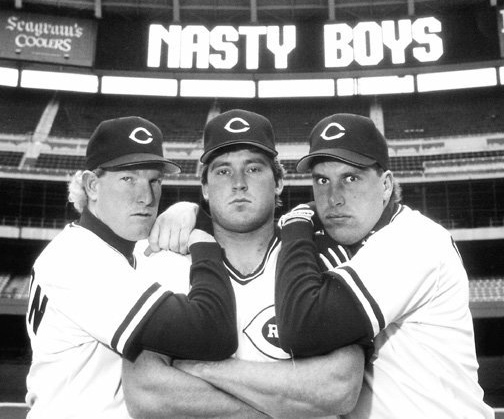
Who needs sleeves when you can have a Nasty Boy or two keeping you warm?
While Franco was saving games for a second-place Mets team in 1990, Randy Myers was becoming one of the "Nasty Boys" in the Reds bullpen. The three-headed monster made up of Myers, fellow southpaw Norm Charlton and wide-eyed righty Rob Dibble became one of the most formidable relief trios of their generation. The Nasty Boys combined to record 44 of the Reds' league-high 50 saves, in addition to their 2.14 ERA and 291 strikeouts in 235⅓ innings.
With a steady offense, quality starting pitching and dominant relief corps, Cincinnati was never out of first place, keeping a firm grip on the division lead from Opening Day to the end of the season. Randy Myers was one of the many contributors to the Reds' wire-to-wire success. Myers led the team with 31 saves and posted a 2.08 ERA, striking out 98 batters in 86⅔ innings. He was also one of the toughest pitchers to hit in the National League, holding opposing hitters to a .193 batting average and .281 slugging percentage.
For his efforts, Myers earned his first trip to the All-Star Game, finished fifth in the NL Cy Young Award vote and even received MVP consideration. But he got a lot more consideration for MVP in the National League Championship Series.
Myers took home the top prize in the NLCS, saving three games for the Reds, including the Game 6 clincher that sent Cincinnati to the World Series for the first time since 1976. Myers was also on the mound in the ninth inning of Game 4 of the World Series against the defending champion Oakland A's, retiring Carney Lansford on a foul pop-up to complete an unlikely four-game sweep that gave the Reds the title. Myers did it all for Cincinnati in 1990, even taking time out to record a rap video as a member of "B-Lark and The Homeboys". But Myers was just getting started in 1990, even if his fledgling music career was not.
In 1991, the Reds couldn't capitalize on their unexpected World Series-winning campaign. Instead, they decided to convert Randy Myers into a starting pitcher, which he hadn't done since his days as a Mets farmhand. Needless to say, it failed miserably.
Myers started 12 games for the Reds in 1991. Although he had a respectable 3.45 ERA in those dozen starts, he pitched in and out of trouble regularly, allowing 106 base runners (62 hits, 43 walks, one hit batsman) in 70⅓ innings. Myers' teammates didn't fare much better, as Cincinnati followed up its memorable 1990 campaign by finishing fifth in the six-team NL West with a disappointing 74-88 record in 1991.
Two months and two days after he became a Red, Myers was sent packing again, this time to San Diego in a trade for infielder Bip Roberts. After a so-so season with the Padres (3-6, 38 saves, 4.29 ERA, 1.48 WHIP), Myers became a free agent and signed a three-year deal with the Chicago Cubs. The National League record book was not prepared for what Myers was about to accomplish. In 1993, while the Mets were plodding through their first 100-loss campaign since 1967, their former closer was thriving as a North Sider. Myers set a National League record by saving 53 games in his first season as a Cub, helping Chicago finish the year above .500 for only the third time in 21 seasons. Myers' save total dropped to 21 in 1994, as the Cubs failed to give Myers many late-inning leads to protect. Chicago finished the 1994 season in last place in the NL Central, winning only 49 games before the players' strike put the kibosh on the season.
The Cubs went back above .500 in 1995, finishing the year with a 73-71 record (the strike cut 18 games from the schedule) and contending for the first-ever National League wild card berth. Chicago eventually fell short, finishing four games behind the Colorado Rockies for the additional playoff spot. For the second time in three seasons, Myers led the National League in saves with 38. He also became a three-time All-Star, earning his second consecutive nod as a Cub. But his time with the Cubs ended with an unexpected bang, as Myers had to fend off a would-be attacker on the Wrigley Field mound after allowing a crushing home run to Houston's James Mouton.
Even a Getty Images watermark can't cover up the fact that Randy Myers is one tough badass.
The attack on the mound helped steer Myers to Baltimore when he became a free agent after the conclusion of the 1995 season. As an Oriole, Myers was reunited with former Mets manager Davey Johnson, who gave him his first shot in the big leagues a decade earlier. Myers did not disappoint, helping the Orioles make the playoffs in each of his two seasons in Baltimore.
Myers saved 31 games for Baltimore in 1996, as the Orioles ended a 13-year playoff drought by claiming the American League wild card. Myers was especially productive during the season's final month. On August 29, the Orioles found themselves in a virtual three-way tie with the White Sox and Mariners for the AL wild card lead. From that point on, Baltimore was one of the hottest teams in the league, winning 12 of their next 16 games to take control of the wild card race. Myers was particularly dominant during the season's final month, posting a barely-there 0.84 ERA in 13 games and allowing only nine hits - all singles - in 10⅔ innings.
Myers' regular season success in his first year as an Oriole continued in his second year with the team, as he led the American League with 45 saves in 1997. In doing so, Myers set a new single-season team record, shattering the old mark of 37 set by Gregg Olson in 1990. (Myers' record was eventually surpassed by Jim Johnson, who saved 51 games for the Orioles in 2012.)
Unfortunately, his success in the regular season didn't carry over into the playoffs, as Myers struggled in the postseason for the first time in his career. After not having allowed an earned run in any of his first 12 postseason appearances with the Mets and Reds, Myers gave up an extra-inning walk-off home run to Bernie Williams, giving the Yankees the win in Baltimore's first ALCS game since 1983.
In 1997, Myers lost another ALCS game in walk-off fashion, although this one was far from being a conventional walk-off loss. In what was perhaps the turning point of the series, Marquis Grissom of the Indians stole home off Myers in the bottom of the 12th inning on a failed suicide squeeze attempt by Omar Vizquel. The Game 3 victory gave Cleveland a 2-1 lead in a series they went on to win in six games.
Randy Myers was one of the most dependable playoff relievers of all time. But even he wasn't perfect all the time.
Once again, Myers was facing free agency and once again, he switched teams. This time, Myers packed his bags for Toronto, who gave him a three-year, $18 million contract. While in Toronto, Myers fared well in the saves department (28) but did not fare well with his ERA (4.46), leading the Blue Jays to bid farewell to Myers in August. Toronto placed Myers on waivers, where he was unexpectedly claimed by the San Diego Padres.
The Blue Jays gladly traded their expensive reliever back to San Diego (Myers was a Friar in 1992), where he served as a lefty specialist and set-up man to closer Trevor Hoffman. Myers didn't pitch well in his new role, posting a 6.28 ERA and 1.53 WHIP in 21 games with the Padres. But the trade to San Diego did allow Myers to pitch in the World Series for a second time, eight years after winning a ring with Cincinnati. Myers did not perform well in the playoffs, allowing four runs in three innings to the Braves and Yankees.
Since San Diego had claimed Myers off waivers, they were now on the hook for the remaining two years and $13 million left on his contract. But Myers did not pitch at all in 1999 and 2000 because of a damaged shoulder and offseason rotator cuff surgery. Myers' injuries caused the Padres to become involved in an ugly legal dispute with their insurance carrier, which was eventually settled in 2003. By that time, Myers had already been out of baseball for two years. Myers retired in 2001 after appearing in one game with the Seattle Mariners' Triple-A affiliate in Tacoma, allowing four runs without retiring a batter.
Randy Myers pitched 14 seasons in the major leagues with six different teams. He finished in the league's top ten in saves at least once with each team. In doing so, Myers became the only player in history to finish in his respective league's top ten in saves with at least six teams. Myers also led the league in saves three times (1993, 1995, 1997) and finished second twice (1991, 1992). Against the Mets, Myers was a perfect 21-for-21 in save opportunities. And of course, Myers' 347 career saves are ninth all-time and third among left-handed pitchers.
The man affectionately referred to as Randall K. Myers by former Mets broadcaster Tim McCarver was a four-time All-Star who received Cy Young consideration in 1990, 1993 and 1997 and MVP votes in 1988, 1990, 1993 and 1997. Myers also made the playoffs five times with three teams and posted a 2.35 ERA in 29 career postseason appearances.
In his short time with the Mets, Myers saved 56 games, which has him on the outside of the team's top ten list looking in (Braden Looper is 10th all-time with 57 saves as a Met). His time as a starter in Cincinnati kept him from cracking the Reds' top ten as well. But Myers is one of only four relievers to save as many as 100 games for the Cubs. He is also eighth on the Padres' all-time saves list and ranks fifth on the Orioles' leaderboard.
Randy Myers last threw a pitch in a Mets uniform on September 30, 1989. Since then, six pitchers have earned the right to be the Opening Day closers for the Mets. Those six pitchers are:
Braden Looper
John Franco (1990-1999)
Armando Benitez (2000-2003)
Braden Looper (2004-2005)
Billy Wagner (2006-2008)
Francisco Rodriguez (2009-2011)
Frank Francisco (2012)
Besides being the team's Opening Day closers, the six pitchers listed above have another thing in common. None of them were developed in the Mets' minor league system. Franco and Benitez were acquired via trades, while Looper, Wagner, Rodriguez and Francisco all signed with the Mets as free agents.
The Mets have not developed a closer in their system since Randy Myers. Sure, Aaron Heilman and Bobby Parnell have been used to close out games for limited stretches, with Heilman recording nine saves as a Met and Parnell notching 14, but the homegrown Met with the most saves since Randy Myers left New York is ... (drum roll please) ... Anthony Young!
Young is most known for his record-setting 27-game losing streak, but he also filled in for incumbent closer John Franco while the Mets' all-time saves leader was recovering from various injuries in 1992 and 1993. Young saved 15 games for the Mets in 1992 and three more in 1993, ending his Mets career with 18 saves - a number that has only been surpassed by 16 players in Mets history, including the last homegrown Met to save that many games, Randy Myers.
The Mets haven't developed many closers over the last quarter century. The last time they did, they traded him away for a hometown kid, but not a homegrown player. The hometown kid (John Franco) became the team's all-time leader in saves, but was never an imposing figure on the mound and only led the league in saves twice as a Met. The homegrown player (Randy Myers) went on to become one of the most dominant closers the game has ever known, becoming an All-Star with three different teams and setting the National League single season saves record.
Having veteran leadership is always beneficial to a contending team, but sometimes that leadership comes with a price. The Mets paid that price when they traded Randy Myers to the Cincinnati Reds in 1989. And they've been paying for other teams' closers ever since. Sometimes it's best to give a kid a chance. Otherwise, he might turn into a Met that got away.
Not even a black and white photo can mask how colorful Randy Myers was.
Note: The Mets That Got Away
is a
thirteen-part weekly series that spotlights those Mets players who
established themselves as major leaguers in New York, only to become
stars after leaving town. For previous
installments, please click on the players' names below:
My grandparents moved to Puerto Rico when I was three years old. After they moved to San Juan, I would only see them for a few weeks at a time when my parents and I would visit them during my summer vacation from school. Because those trips would coincide with the middle of baseball season, my grandfather would always want to talk to me about baseball.
When I was eight years old, I discovered that Abuelo (that's Spanish for "grandfather") was a Brooklyn Dodgers fan. He, my grandmother and their four children (one of which is my father) moved from the Island of Enchantment to New York in 1947, the same year Jackie Robinson broke the color barrier in baseball. Robinson wasn't the only reason he became a Dodger fan, as 1947 was also the year Gil Hodges and Duke Snider came up to the major leagues to stay. The Dodgers won the pennant in 1947, making only their second trip to the World Series since 1920. They would make many more over the next few decades. Abuelo was hooked for life.
The summer of 1981 was special for both Abuelo and I. It was the year I became a Mets fan, but it was also the year of Fernandomania. That summer, when my parents and I went to visit my grandparents in Puerto Rico, the players' strike was nearing its conclusion. But just because there was no baseball to watch didn't mean there were no baseball stories to share.
Any time I wanted to talk about Mookie Wilson, my grandfather would remind me that he wasn't as fast as Maury Wills. (Wills was the first major league player to steal 100 bases in a season, swiping 104 bags for the Dodgers in 1962, which was 45 more than the entire Mets team stole in their inaugural season.) I knew better than to argue with him.
After a few minutes, the conversation would always turn to Fernando Valenzuela, who had taken the country by storm during his rookie season. Abuelo would normally be in bed by 10 PM every night, but if Valenzuela was pitching and the game just happened to be broadcast on the local television channel, he'd always stay up to watch the game on the 13-inch black and white TV. He'd keep the volume low so as not to wake my grandmother, telling me that he didn't need to hear the game because Fernando's pitching would tell the story. In the summer of 1981, he was absolutely right.
I'll always remember talking to him on the phone after the Mets won the World Series in 1986. He was thrilled that I was finally able to celebrate a championship, but he was also quick to remind me that despite the Mets boasting a pitching staff that included Dwight Gooden, Ron Darling, Bob Ojeda and Sid Fernandez, it was Fernando Valenzuela who led the National League in wins. (Valenzuela won 21 games for the Dodgers in 1986, his only 20-win campaign in 17 years in the big leagues.)
Oh, Abuelo. He really loved his Dodgers.
Two years after the Mets won the World Series, they played for the right to appear in another. But this time it was different. This time, the Mets were playing the Dodgers for the pennant. A member of the Leyro family was going to see his favorite team play in the World Series in 1988. But for that to happen, another member of the Leyro family was going to be disappointed that his team failed to reach the Fall Classic. It was about as awkward as it was ever going to get between me and Abuelo when it came to our shared love of the national pastime. In the end, it became one of the most important times in our relationship.
The Dodgers defeated the Mets in the 1988 NLCS, upsetting them in seven games. The Mets weren't the only ones upset by that result. The day after Game 7, the phone rang in our house. My mother picked it up, spoke for a few seconds, then called me over to the phone. It was for me, she said. It was Abuelo.
I thought it was strange that Abuelo would call me. After all, any time I'd speak to him on the phone, it would be my grandmother who called us and then she'd pass the phone over to Abuelo. (The men in the Leyro family have never been known as "phone people".) But this time, my grandfather let his fingers do the walking and he called me directly. Although almost a quarter century has passed, I'll never forget that conversation.
Not once did he mention the Dodgers in the conversation. Nor did he mention the Mets. Instead, he reminded me that there would be times in life when we'd question why things happened the way they did. He told me that he once went on a date with a girl when he was 18. She was his definition of "the perfect girl". She was smart, beautiful and came from a great family. He was sure after one date that he was going to marry her. Two dates later, she decided she didn't want to see him anymore. He was crushed.
After two years of wondering where he went wrong, he made the acquaintance of another girl. He wasn't attracted to her at first, but she listened to his story of lost love and gave him words of encouragement. They continued to talk as friends for nearly a year until he realized something.
He was falling in love. And this time, the girl he loved felt the same way about him.
The year was 1933. In 1934, they were married.
When Abuelo finished telling me the story of how he and Abuela met and fell in love, I thanked him for making me smile. I thought that was the reason he was sharing his story with me, because I was upset that my Mets had lost to his Dodgers and I would need some cheering up. But that wasn't why he told me the story. He then went back to the beginning of our conversation, the part where he said there would be times in life when we'd question why things happened the way they did.
For two years, he wondered to himself why the love of his life didn't love him back. But without that unexpected breakup, he never would have met my grandmother, a woman he would be married to until her death in 2001. He then told me to think about his words and to "never stop believing" before hanging up.
It took me until that evening, but as I was getting ready for bed, it finally hit me. Abuelo was using his story as an analogy. I was questioning how the Mets could lose to the Dodgers in the playoffs after defeating them 10 of 11 times during the regular season, just like he had questioned why the girl he loved couldn't reciprocate those feelings for him. He had to wait two years after suffering through a devastating heartbreak, but in the end, it netted him the love of his life. Therefore, what Abuelo was telling me was that he knew I was heartbroken because of the Mets' loss to the Dodgers, but before long, they'd be back and I'd love them more than ever.
You know what? He was right.
Sure, it took 11 years for the Mets to make it back to the postseason, but when they did, they went to the playoffs in back-to-back seasons and made their first trip to the World Series since 1986. And when they did, Abuelo was the first person who called me to offer a congratulatory message.
Abuelo didn't make it to see the next Mets/Dodgers postseason matchup in 2006, as he passed away five days after his 90th birthday in 2002. But when the Mets swept the Dodgers to advance to the NLCS in that magical season, the first person I thought of was him. What did I think of? That he didn't have to feel sad because the team he loved would be back. And they did, winning back-to-back division titles in 2008 and 2009. Somewhere in Heaven, I knew Abuelo was smiling.
There is a point to this personal story. You see, Abuelo was born on October 29, 1912. That means today would have been his 100th birthday. He and I never went to a Mets/Dodgers game together, but we didn't have to. The stories took us there.
When I was eight years old, Abuelo shared his love of the Dodgers with me at the same time I was trying to share my love of the Mets with him. He never became a Mets fan, just as I never became a Dodgers fan. But we shared that love of baseball that no rivalry can break. That love brought us together and provided me with some of my most wonderful childhood memories - memories that I continue to cherish as an adult.
Sometimes we question why things happen the way they do. I never have to question why I loved my grandfather. He was the most important man I've ever known.
Happy 100th birthday, Abuelo. And thank you for always taking me out to the ballgame.
Dedicated to Horacio Leyro (October 29, 1912 - November 3, 2002)