The Mets have not had too many "lights out" closers since the dawn of the 21st century. Armando Benitez is the only Mets closer with multiple 40-save seasons. But he walked too many hitters and was a Mr. April type pitcher, meaning he was wonderful when games weren't critical but always seemed to allow a crushing hit or home run in September and October. Similarly, Braden Looper was booed off the Shea Stadium mound several times in his two-year stretch as the team's closer, yet somehow ranks in the team's all-time top ten in saves despite allowing more hits than innings pitched in both of his seasons here. And since Francisco Rodriguez punched his ticket (quite literally) out of Citi Field in 2011, a total of ten pitchers have filled in as closer for the Mets, including Jason Isringhausen, Manny Acosta, Jon Rauch, LaTroy Hawkins, Kyle Farnsworth and Jose Valverde.
Stability has never been a word associated with the closer position in Flushing in the past 15 seasons. But after injuries and/or suspensions curtailed the ninth inning duties for both Bobby Parnell and Jenrry Mejia, a third homegrown pitcher was called upon to put on his closer shoes. And this time, the Mets may have finally found the dependable closer they've been looking for all these years.
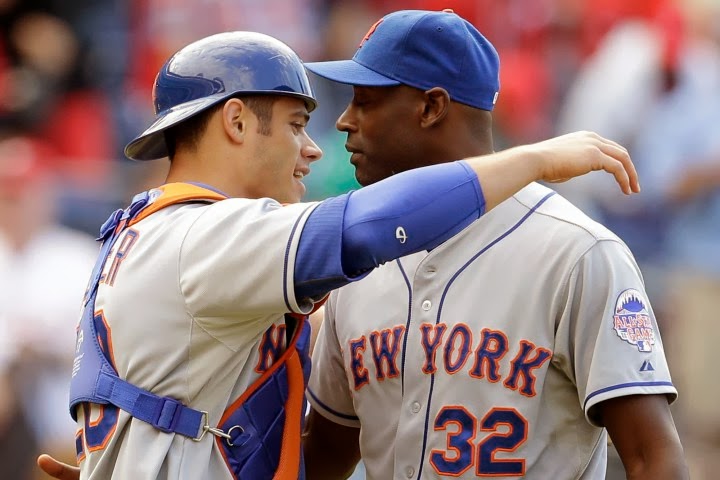
Jeurys Familia has been pumping his fist quite often during the season's first month. (Getty Images)
After starting 111 games in parts of six minor league seasons, Jeurys Familia was thrust into the bullpen once he made it to the big show. Familia only pitched 23 innings for the Mets in 2012 and 2013, but finally stayed with the team for good in 2014. Since earning a full-time gig in the bullpen, Familia has been nothing short of spectacular, posting a 2.11 ERA and 1.09 WHIP in 88 appearances. He has also struck out nearly a batter per inning and allowed just 63 hits to the 365 batters he has faced.
Familia got some save opportunities here and there in 2014, racking up five saves in his first full season in the majors - a year that saw him finish seventh in the National League Rookie of the Year vote. But once Mejia was suspended 80 games for a banned substance violation earlier this season, Familia became the team's full-time closer, and he has been as close to perfect as we've seen in Flushing in quite some time.
Through Saturday's game, Familia is a perfect 10-for-10 in save opportunities, leading all of baseball in that department. He also became the first Met to rack up eight saves in an 11-game stretch and the first to record more than eight saves before the end of April. But what's more impressive than the total number of saves is how he's getting those saves. He's basically doing it without even working up a sweat.
Since coming into the game for his first save opportunity on April 12, Familia has appeared in ten games. He retired every batter he faced in five of those ten appearances and allowed exactly one base runner in each of the other five. Familia has faced a total of 35 batters in those ten relief outings, allowing just five of them to reach base - and one of them was later erased on a double play.
This isn't a new thing for Familia, who has been on top of his game since last June. Familia appeared in 50 games after the calendar turned from May to June in 2014. He faced the minimum number of hitters in almost half of those outings (23 in all) and allowed no more than one base runner in 34 of the 50 contests. Compare those numbers to what Jenrry Mejia produced as the team's closer in 2014 (56 relief appearances; allowed multiple base runners in 28 of them and faced the minimum just 20 times) and it's clear that Familia's appearances have given Mets fans less stress than Mejia's outings ever did.
After years of suffering through less-than-dependable closers and going with the closer du jour, it looks as if the Mets have finally found what they were looking for in their ninth-inning pitcher. Jeurys Familia throws strikes that aren't hit 400 feet. He's also efficient (13.2 pitches per inning in 2015) and limits stress-inducing innings.
Through injuries (Parnell) and poor choices (Mejia), Familia has been given a chance to be the team's closer. He's done nothing to make manager Terry Collins regret his decision. And he's done everything to become one of the top closers in the game. Not bad for a pitcher who was once being groomed to be a starter instead of one who has done quite a bit of finishing.
On Monday, the Mets will begin their 53rd season of play, looking to begin the season with a 1-0 record for the 35th time. New York's .654 winning percentage in season-opening games is tops in the majors, ahead of the Baltimore Orioles, who are second with a .580 success rate on Opening Day. (For the record, the Mets are 27-25 on Opening Day II, a dropoff from their won-loss record in Game 1s, but still not bad for a team that's nearly 400 games under .500 in all other games played.)
The Mets would like to continue their team success on Opening Day in 2014, and obviously would like that magic to spread to all other games throughout the season, unless if the Wilpons have been secretly replaced by Rachel Phelps, the "owner" of the Cleveland Indians in Major League.
While the team attempts to put big numbers up on the scoreboard and the win column, several of its players are also close to reaching significant individual milestones. Some of the milestones will get honorable mentions on the Citi Field scoreboard and will cause the players who reached them to receive standing ovations. Unfortunately, some other milestones will be embarrassing to the players and will cause them to send me direct messages asking me not to share those moments with their friends or loved ones. To which I say, "Stop striking out so much, Ike, and I wouldn't have to write about you approaching the 500-strikeout plateau in well under 2,000 at-bats!"
But I digress.
Anyhoo, here are the milestones that your favorite Mets players should have no problem reaching at some point during the 2014 season. And once those players reach those numbers, please feel free to share them on Twitter before anyone else gets a chance to do so. That way your friends can either marvel at your Mets knowledge or call you the biggest geek they know. Enjoy!
Ike Davis better not set any new club records for striking poses with his eyes closed after striking out.
David Wright:
Needs 31 home runs to surpass Darryl Strawberry as the Mets' all-time leader.
Needs 53 plate appearances and 263 at-bats to knock Ed Kranepool down to No. 2 in both categories.
Needs 17 stolen bases for 200 and 19 steals to be ahead of every Met not named Jose Reyes or Mookie Wilson.
Needs 1 hit-by-pitch to end Ron Hunt's four-decade reign as the team's top punching bag.
Daniel Murphy:
Needs 11 home runs and 8 steals to become the 11th Met to attain 50 HR and 50 SB.
Needs 18 doubles to enter the Mets' all-time top ten in that category.
Needs to reach double digits in homers and steals to prove 2013 wasn't a fluke season.
Ike Davis:
Needs 33 homers to reach 100 and to set a single-season career-high.
Needs 19 doubles to reach 100 and to still be well behind Daniel Murphy and David Wright in two-baggers.
Needs 89 strikeouts for 500 and just as many boos.
Needs 1 good season to avoid being traded or demoted.
Curtis Granderson:
Needs 20 runs scored for 800.
Needs 1 double for 200.
Needs 1 double to become the 11th MLB player in the last 50 years to reach 200 doubles, 80 triples and 200 homers.
Needs 1 decent season to have a better Mets career than Jason Bay.
Ruben Tejada:
Needs a whole lotta luck.
Attainable Individual Milestones (Pitchers)
Bartolo Colon almost fit within the borders of this photo. Almost.
Jonathon Niese:
Needs 7 wins for 50.
Needs 97 strikeouts to enter the Mets' all-time top ten.
Needs to stay off the disabled list, please.
Dillon Gee:
Needs 19 starts for 100.
Needs 130 strikeouts for 500.
Needs to repeat his second half of 2013 and stretch it out for both halves of 2014.
Bartolo Colon:
Needs 11 wins for 200.
Needs 50 strikeouts for 2,000.
Needs to turn Harvey Day into Día de Colon.
Needs to stay as far away from Shake Shack during his bullpen sessions.
Zack Wheeler:
Needs 6 wins to have more career victories than Matt Harvey. (For that matter, Noah Syndergaard needs 13 victories to join Wheeler in that respect.)
Bobby Parnell:
Needs 2 games for 300.
Needs 14 saves for 50.
Needs 22 saves to finally knock Braden Looper out of the Mets' all-time top ten saves leaders.
Needs to not turn his neck whenever he gives up a long fly ball. (It's probably not leaving the park anyway and he's still recovering from neck surgery.)
With just 22 saves in 2014, Bobby Parnell will cause Braden Looper to walk right out of the Mets' top ten. Let's go Bobby!!
After having an excellent season with the Mets in 2013, LaTroy Hawkins will be pitching elsewhere in 2014. Hawkins, who finished the year as the Mets' closer after Bobby Parnell was sidelined with a season-ending injury, signed a one-year, $2.5 million deal with the Colorado Rockies on Monday.
Never mind that Sandy Alderson said he wouldn't pay a 41-year-old reliever that kind of money, even though Hawkins gave the Mets his best statistical season since 2004, posting a 2.93 ERA, 1.15 WHIP and 13 saves at the age of 40. But if Hawkins was aware of recent Mets history, he should've known that he was about to become a goner.
In 2011, Francisco Rodriguez was dealt to the Milwaukee Brewers during the All-Star Break. After the trade, Jason Isringhausen became the Mets' closer, saving seven games - including his 300th career save. The following season, he traded apples for oranges, leaving the Big Apple for Orange County. Isringhausen pitched in 50 games for the Los Angeles Angels in 2012, but did not pitch in the majors in 2013.
One year before Isringhausen finished the year for K-Rod, another pitcher was forced into closer duties for the Mets when Francisco Rodriguez couldn't finish the year with the team. After injuring himself when he became Frankie Knuckles in front of his son's grandfather, Hisanori Takahashi filled in as the team's closer, notching three wins and eight saves over the season's final two months. The 35-year-old Takahashi was not re-signed by the Mets following his versatile "rookie" season in 2010. Instead, he chose to sign with the Angels, spending a year and a half in Los Angeles, followed by short tenures in Pittsburgh and Chicago.
Billy Wagner began the final season at Shea Stadium as the Mets' closer. But a season-ending injury forced Omar Minaya to acquire Luis Ayala in August 2008. Ayala saved nine games as Wagner's temporary replacement. And by temporary, I mean his two blown saves, two losses and 14.40 ERA over the season's final two weeks guaranteed he wouldn't be a Met in 2009. Since then, Ayala has bounced around more than his pitches did in the left and right field corners of Shea Stadium in his six weeks with the team. The right-hander has collected paychecks from the Twins, Marlins, Yankees, Orioles and Braves since he allowed the final run to cross the plate at Shea Stadium on a back-breaking blast by Dan Uggla on September 28, 2008.
When Braden Looper was in the final days of the two-year contract he signed with the Mets prior to the 2004 season, he required season-ending surgery to repair a blown AC joint in his right shoulder. In stepped Roberto Hernandez, who picked up two wins and three saves over the final two weeks of the 2005 campaign. But the Mets allowed Hernandez to leave as a free agent, and the 40-year-old reliever inked a one-year deal to pitch for the Pittsburgh Pirates in 2006. Hernandez was traded back to the Mets (along with Oliver Perez) when Duaner Sanchez had a case of the munchies and got into the wrong taxi cab in Miami, but Hernandez did not record another save as a Met.
Roberto Hernandez should've pitched in this game instead of Braden Looper.
LaTroy Hawkins had a wonderful season for the Mets in 2013. After becoming the team's closer on August 6, Hawkins pitched in 23 games and was 13-for-14 in save attempts. Hawkins had pinpoint control as the team's closer, striking out 18 batters and walking only one in 22⅓ innings. Opposing hitters had a .229 on-base percentage and a miniscule .272 slugging percentage against Hawkins, collecting just two extra-base hits in 81 at-bats. Usually, those numbers are what you'd expect from a young, stud closer. Someone like Craig Kimbrel. In fact, going back to August 6 - the day Hawkins became the Mets' fill-in closer for the injured Bobby Parnell, Kimbrel went 16-for-17 in save opportunities with 31 strikeouts and five walks in 23⅔ innings, allowing a .211 on-base percentage and .224 slugging percentage (three extra-base hits in 85 at-bats). Those numbers weren't that much better than what Hawkins did as the Mets' closer. But because Hawkins is going to be 41 next month, he's not worth $2.5 million for one year, according to Sandy Alderson. Perhaps Alderson should have given Hawkins another chance to be one of the team's top relievers in 2014, just like he was in 2013. But Alderson must know about the team's recent history. He surely has to know how relievers who fill in as temporary closers for the Mets never stick around with the team. And who is Sandy Alderson to mess with tradition, right? Goodbye and thanks for playing, LaTroy Hawkins. You should have been given another chance next year. Instead, you're just in the same class as Roberto Hernandez, Luis Ayala, Hisanori Takahashi and Jason Isringhausen. That's some consolation prize.
On Sunday, Bobby Parnell notched his sixth save of the season, recording the final three outs of the Mets' 4-3 victory over the Cubs. With the save, Parnell now has 20 in his six-year career with the Mets. Now that may not seem like much, but it does give Parnell a special title.
Tell me, my fellow Mets fans. Do you know which homegrown Met has the most saves in team history? That would be Tug McGraw, who had 86 saves in a Mets uniform. (Jesse Orosco, who had 107 saves in Flushing, made his major league debut with the Mets, but was originally drafted by the Minnesota Twins and made his professional debut in their minor league system.)
McGraw is followed by Roger McDowell (84 saves), Neil Allen (69 saves), Randy Myers (56 saves), Doug Sisk (33 saves), Bob Apodaca (26 saves), Danny Frisella (24 saves) and Parnell.
Did you notice that all of the homegrown relievers ahead of Parnell pitched for the Mets exclusively in the '60s, '70s and '80s? When Randy Myers was traded for John Franco after the 1989 season, that began a nearly quarter century stretch in which the Mets went with closers whom they traded for or signed as free agents.
First it was John Franco (acquired from Cincinnati). Then it was Armando Benitez (acquired from Baltimore). Benitez was followed by Braden Looper (free agent signing), Billy Wagner (free agent signing), Francisco Rodriguez (free agent signing) and Frank Francisco (yup, another free agent signing). During that 20-plus year stretch, homegrown pitchers were used to close games primarily when the incumbent closer needed a day of rest or was on the disabled list.
So since the departure of Randy Myers following the 1989 campaign, which homegrown pitchers have registered the most saves for the Mets? Here is the top three list:
Bobby Parnell (20 saves)
Anthony Young (18 saves)
Aaron Heilman (9 saves)
The only homegrown pitchers to record at least ten career saves for the Mets since Randy Myers' last season in New York are Anthony Young and Bobby Parnell. Young is also the only homegrown closer since 1990 to record an individual season of more than seven saves when he saved 15 games in 1992 - the same year he began his major league-record 27-game losing streak.
Bobby Parnell has been given the closer duties by manager Terry Collins. He is the first homegrown pitcher since 1989 to earn that responsibility out of spring training. And he is now the team's all-time saves leader for homegrown pitchers since that year.
The Mets have not developed many closers over the past quarter century, choosing to bring in closers from other teams. Bobby Parnell is finally getting a chance to become the next Tug McGraw, Roger McDowell or Randy Myers. If he succeeds, he stands to join those pitchers as the best homegrown closers in franchise history.
Our ninth inning savior has finally arrived! And his name is Bobby Parnell. It sure is nice to see a familiar face on the mound in the ninth inning instead of a recruit from another team.
This is a scene that very few homegrown closers have been able to repeat.
In 1988, the Mets suffered an unexpected and heartbreaking loss to the Los Angeles Dodgers in the National League Championship Series. Following the season, the team began what was to become a major 12-month overhaul.
By the end of the 1989 campaign, a year in which the Mets failed to win 90 games for the first time in the Davey Johnson era, the Mets had said their final goodbyes to Wally Backman, Terry Leach, Roger McDowell, Lenny Dykstra, Rick Aguilera, Lee Mazzilli, Mookie Wilson, Keith Hernandez and Gary Carter. Replacing them were players such as Juan Samuel, Frank Viola, Jeff Musselman and a number of minor leaguers. Samuel, Viola and Musselman were all ex-Mets by the end of the 1991 season, while the minor leaguers became never-Mets.
Only one trade produced a player who remained a Met past the 1991 season. It gave the Mets a player who participated in their two postseason runs in 1999 and 2000, which would seem to suggest that the deal was a steal for New York. Although John Franco became the team's all-time saves leader and was eventually enshrined into the Mets Hall of Fame, he did come at a price, and that price was a young relief pitcher who became one of the most dominant closers in baseball in the 1990s, helping three teams reach the postseason and setting all-time National League records for a fourth.
Randall K. Myers, before major league hitters discovered what the "K" was for.
Randall Kirk Myers was drafted by the Mets in the first round of the 1982 June secondary draft. Myers was a starting pitcher at the time who had a blazing fastball, but no control over it. In his first four years in the minors, Myers walked 343 batters and threw 56 wild pitches. But when hitters took a hack at Myers' pitches, they usually came up empty.
From 1982 to 1985, Myers averaged nearly a strikeout per inning (597 Ks in 604 IP), allowed a mere 505 hits (7.5 H/9 IP) and gave up only 30 HR (less than one homer every 20 innings). As a result, Myers posted an excellent 40-28 won-loss record and was able to maintain a fine 3.01 ERA.
But despite his fantastic minor league numbers as a starter, Myers was unable to crack the Mets' rotation, as the youth movement of Dwight Gooden, Ron Darling, Sid Fernandez and Rick Aguilera limited Myers' opportunities at the big league level. Myers made one appearance for the Mets in 1985, pitching the final two innings of the season in relief. Then in 1986, Myers was back in the minors, but this time he was there as a reliever. It would turn out to be a career-changing decision.
Myers began the 1986 season at AAA-Tidewater, where he spent the first half of the season in the bullpen. In 45 games with the Tides, Myers posted a 2.35 ERA and recorded 12 saves, striking out 79 batters and allowing only two homers in 65 innings. Myers was called up to the Mets in July and got into ten games with the parent club, striking out 13 batters in 10⅔ innings. By 1987, Myers became a bigger cog in the Mets bullpen. In the year following the Mets' World Series championship, the two-headed closer combo of Roger McDowell and Jesse Orosco suffered from a post-title hangover. Both pitchers had ERAs north of 4.00 and Orosco actually led the team in losses with nine. The Mets bullpen as a whole did not fare well in 1987, but one of the bright spots was the emergence of Randy Myers. Myers had a rough start in his first full season as a Met. Manager Davey Johnson used the rookie reliever sparingly through the first four months of the season, with Myers appearing in only 29 of the team's first 102 games. As a result, Myers was maddeningly inconsistent, sporting an ungodly 5.44 ERA for the third-place Mets. But in the season's final two months, Myers was unhittable as he helped the team rise back into NL East contention.
Over the first three weeks of August, Myers struck out 17 batters in ten scoreless innings. He also held opposing hitters to a .162 batting average, .184 on-base percentage and notched two saves. Although the Mets finished short in their quest to repeat as division champions, Myers' performance over the final two months of the season (1.97 ERA, five saves, five holds, 43 Ks, eight walks, no homers allowed) gave the Mets hope that 1988 would be a more successful campaign. Rookie of the Year voters also took notice of his final two months, as Myers finished tied for 6th in the 1987 vote.
The 1988 campaign started out with Myers in a new role as the team's left-handed closer, as long-time Met Jesse Orosco was traded to the Los Angeles Dodgers during the offseason. Myers' start was as blazing as his fastball, as the lefty went 4-0 with nine saves and a microscopic 0.87 ERA through early June. After allowing three runs without retiring a batter in a game against the Expos on June 12, Myers settled down, saving 17 games in 18 chances and posting a 1.52 ERA the rest of the way. Myers finished his first season as a closer with a brilliant 1.72 ERA and 0.91 WHIP. He also recorded 26 saves and struck out 92 batters in 75 innings. More importantly, he finally started to control the fastball that constantly got away from him in the minors, as he walked just 30 batters and uncorked three wild pitches. In 1987, Myers' strong finish didn't help the Mets reach the postseason. That was not the case in 1988, as the Mets ran away with the NL East title. Although the Mets lost a heartbreaking NLCS to the Dodgers in seven games, Myers was outstanding in his first playoff experience. Myers got into three games, allowing no runs and one hit in 4⅔ innings. But the series turned when Myers wasn't brought into a game.
With the left-handed hitting Mike Scioscia representing the tying run at the plate in the ninth inning of Game 4, manager Davey Johnson chose not to replace Dwight Gooden with Randy Myers to set up a lefty-lefty matchup. The move went on to become one of the costliest decisions in Mets history, as Scioscia took Gooden deep to tie the game. Myers eventually replaced Gooden in the ninth, pitching 2⅓ shutout innings before he was replaced by co-closer Roger McDowell. One inning later, McDowell allowed a solo homer to NL MVP Kirk Gibson, a lefty just like the recently-removed Randy Myers. Myers never threw another pitch in the series. Following the disappointing end to the 1988 season, the Mets continued to underachieve in 1989. The team won fewer than 90 games for the first time since 1983, spending most of the season alternating between third and fourth place before finally moving into second place to stay on the next-to-last day of the season after they had been eliminated from playoff contention. Randy Myers, however, did not underachieve, going 7-4 with 24 saves and a 2.35 ERA.
With the Mets having traded Roger McDowell during the 1989 season, the team went into the Winter Meetings searching for a right-handed reliever to replace McDowell and serve as a complement to Randy Myers. They succeeded in getting a reliever in Nashville, but he wasn't a righty. And he also came at a price. On December 6, 1989, Myers was traded to the Cincinnati Reds for fellow southpaw and Brooklyn native John Franco. The move brought an ecstatic Franco back home, while Randy Myers was left stunned, especially since he had become one of the most dominant closers in the league. Franco eventually became the longest tenured pitcher in Mets history, saving a team-record 276 games. But Myers had more success on an individual level and a team level after the Mets let him get away.
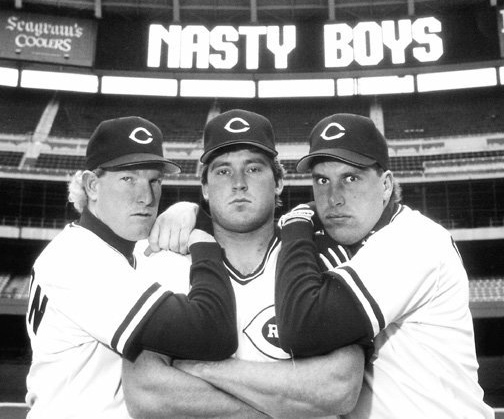
Who needs sleeves when you can have a Nasty Boy or two keeping you warm?
While Franco was saving games for a second-place Mets team in 1990, Randy Myers was becoming one of the "Nasty Boys" in the Reds bullpen. The three-headed monster made up of Myers, fellow southpaw Norm Charlton and wide-eyed righty Rob Dibble became one of the most formidable relief trios of their generation. The Nasty Boys combined to record 44 of the Reds' league-high 50 saves, in addition to their 2.14 ERA and 291 strikeouts in 235⅓ innings.
With a steady offense, quality starting pitching and dominant relief corps, Cincinnati was never out of first place, keeping a firm grip on the division lead from Opening Day to the end of the season. Randy Myers was one of the many contributors to the Reds' wire-to-wire success. Myers led the team with 31 saves and posted a 2.08 ERA, striking out 98 batters in 86⅔ innings. He was also one of the toughest pitchers to hit in the National League, holding opposing hitters to a .193 batting average and .281 slugging percentage.
For his efforts, Myers earned his first trip to the All-Star Game, finished fifth in the NL Cy Young Award vote and even received MVP consideration. But he got a lot more consideration for MVP in the National League Championship Series.
Myers took home the top prize in the NLCS, saving three games for the Reds, including the Game 6 clincher that sent Cincinnati to the World Series for the first time since 1976. Myers was also on the mound in the ninth inning of Game 4 of the World Series against the defending champion Oakland A's, retiring Carney Lansford on a foul pop-up to complete an unlikely four-game sweep that gave the Reds the title. Myers did it all for Cincinnati in 1990, even taking time out to record a rap video as a member of "B-Lark and The Homeboys". But Myers was just getting started in 1990, even if his fledgling music career was not.
In 1991, the Reds couldn't capitalize on their unexpected World Series-winning campaign. Instead, they decided to convert Randy Myers into a starting pitcher, which he hadn't done since his days as a Mets farmhand. Needless to say, it failed miserably.
Myers started 12 games for the Reds in 1991. Although he had a respectable 3.45 ERA in those dozen starts, he pitched in and out of trouble regularly, allowing 106 base runners (62 hits, 43 walks, one hit batsman) in 70⅓ innings. Myers' teammates didn't fare much better, as Cincinnati followed up its memorable 1990 campaign by finishing fifth in the six-team NL West with a disappointing 74-88 record in 1991.
Two months and two days after he became a Red, Myers was sent packing again, this time to San Diego in a trade for infielder Bip Roberts. After a so-so season with the Padres (3-6, 38 saves, 4.29 ERA, 1.48 WHIP), Myers became a free agent and signed a three-year deal with the Chicago Cubs. The National League record book was not prepared for what Myers was about to accomplish. In 1993, while the Mets were plodding through their first 100-loss campaign since 1967, their former closer was thriving as a North Sider. Myers set a National League record by saving 53 games in his first season as a Cub, helping Chicago finish the year above .500 for only the third time in 21 seasons. Myers' save total dropped to 21 in 1994, as the Cubs failed to give Myers many late-inning leads to protect. Chicago finished the 1994 season in last place in the NL Central, winning only 49 games before the players' strike put the kibosh on the season.
The Cubs went back above .500 in 1995, finishing the year with a 73-71 record (the strike cut 18 games from the schedule) and contending for the first-ever National League wild card berth. Chicago eventually fell short, finishing four games behind the Colorado Rockies for the additional playoff spot. For the second time in three seasons, Myers led the National League in saves with 38. He also became a three-time All-Star, earning his second consecutive nod as a Cub. But his time with the Cubs ended with an unexpected bang, as Myers had to fend off a would-be attacker on the Wrigley Field mound after allowing a crushing home run to Houston's James Mouton.
Even a Getty Images watermark can't cover up the fact that Randy Myers is one tough badass.
The attack on the mound helped steer Myers to Baltimore when he became a free agent after the conclusion of the 1995 season. As an Oriole, Myers was reunited with former Mets manager Davey Johnson, who gave him his first shot in the big leagues a decade earlier. Myers did not disappoint, helping the Orioles make the playoffs in each of his two seasons in Baltimore.
Myers saved 31 games for Baltimore in 1996, as the Orioles ended a 13-year playoff drought by claiming the American League wild card. Myers was especially productive during the season's final month. On August 29, the Orioles found themselves in a virtual three-way tie with the White Sox and Mariners for the AL wild card lead. From that point on, Baltimore was one of the hottest teams in the league, winning 12 of their next 16 games to take control of the wild card race. Myers was particularly dominant during the season's final month, posting a barely-there 0.84 ERA in 13 games and allowing only nine hits - all singles - in 10⅔ innings.
Myers' regular season success in his first year as an Oriole continued in his second year with the team, as he led the American League with 45 saves in 1997. In doing so, Myers set a new single-season team record, shattering the old mark of 37 set by Gregg Olson in 1990. (Myers' record was eventually surpassed by Jim Johnson, who saved 51 games for the Orioles in 2012.)
Unfortunately, his success in the regular season didn't carry over into the playoffs, as Myers struggled in the postseason for the first time in his career. After not having allowed an earned run in any of his first 12 postseason appearances with the Mets and Reds, Myers gave up an extra-inning walk-off home run to Bernie Williams, giving the Yankees the win in Baltimore's first ALCS game since 1983.
In 1997, Myers lost another ALCS game in walk-off fashion, although this one was far from being a conventional walk-off loss. In what was perhaps the turning point of the series, Marquis Grissom of the Indians stole home off Myers in the bottom of the 12th inning on a failed suicide squeeze attempt by Omar Vizquel. The Game 3 victory gave Cleveland a 2-1 lead in a series they went on to win in six games.
Randy Myers was one of the most dependable playoff relievers of all time. But even he wasn't perfect all the time.
Once again, Myers was facing free agency and once again, he switched teams. This time, Myers packed his bags for Toronto, who gave him a three-year, $18 million contract. While in Toronto, Myers fared well in the saves department (28) but did not fare well with his ERA (4.46), leading the Blue Jays to bid farewell to Myers in August. Toronto placed Myers on waivers, where he was unexpectedly claimed by the San Diego Padres.
The Blue Jays gladly traded their expensive reliever back to San Diego (Myers was a Friar in 1992), where he served as a lefty specialist and set-up man to closer Trevor Hoffman. Myers didn't pitch well in his new role, posting a 6.28 ERA and 1.53 WHIP in 21 games with the Padres. But the trade to San Diego did allow Myers to pitch in the World Series for a second time, eight years after winning a ring with Cincinnati. Myers did not perform well in the playoffs, allowing four runs in three innings to the Braves and Yankees.
Since San Diego had claimed Myers off waivers, they were now on the hook for the remaining two years and $13 million left on his contract. But Myers did not pitch at all in 1999 and 2000 because of a damaged shoulder and offseason rotator cuff surgery. Myers' injuries caused the Padres to become involved in an ugly legal dispute with their insurance carrier, which was eventually settled in 2003. By that time, Myers had already been out of baseball for two years. Myers retired in 2001 after appearing in one game with the Seattle Mariners' Triple-A affiliate in Tacoma, allowing four runs without retiring a batter.
Randy Myers pitched 14 seasons in the major leagues with six different teams. He finished in the league's top ten in saves at least once with each team. In doing so, Myers became the only player in history to finish in his respective league's top ten in saves with at least six teams. Myers also led the league in saves three times (1993, 1995, 1997) and finished second twice (1991, 1992). Against the Mets, Myers was a perfect 21-for-21 in save opportunities. And of course, Myers' 347 career saves are ninth all-time and third among left-handed pitchers.
The man affectionately referred to as Randall K. Myers by former Mets broadcaster Tim McCarver was a four-time All-Star who received Cy Young consideration in 1990, 1993 and 1997 and MVP votes in 1988, 1990, 1993 and 1997. Myers also made the playoffs five times with three teams and posted a 2.35 ERA in 29 career postseason appearances.
In his short time with the Mets, Myers saved 56 games, which has him on the outside of the team's top ten list looking in (Braden Looper is 10th all-time with 57 saves as a Met). His time as a starter in Cincinnati kept him from cracking the Reds' top ten as well. But Myers is one of only four relievers to save as many as 100 games for the Cubs. He is also eighth on the Padres' all-time saves list and ranks fifth on the Orioles' leaderboard.
Randy Myers last threw a pitch in a Mets uniform on September 30, 1989. Since then, six pitchers have earned the right to be the Opening Day closers for the Mets. Those six pitchers are:
Braden Looper
John Franco (1990-1999)
Armando Benitez (2000-2003)
Braden Looper (2004-2005)
Billy Wagner (2006-2008)
Francisco Rodriguez (2009-2011)
Frank Francisco (2012)
Besides being the team's Opening Day closers, the six pitchers listed above have another thing in common. None of them were developed in the Mets' minor league system. Franco and Benitez were acquired via trades, while Looper, Wagner, Rodriguez and Francisco all signed with the Mets as free agents.
The Mets have not developed a closer in their system since Randy Myers. Sure, Aaron Heilman and Bobby Parnell have been used to close out games for limited stretches, with Heilman recording nine saves as a Met and Parnell notching 14, but the homegrown Met with the most saves since Randy Myers left New York is ... (drum roll please) ... Anthony Young!
Young is most known for his record-setting 27-game losing streak, but he also filled in for incumbent closer John Franco while the Mets' all-time saves leader was recovering from various injuries in 1992 and 1993. Young saved 15 games for the Mets in 1992 and three more in 1993, ending his Mets career with 18 saves - a number that has only been surpassed by 16 players in Mets history, including the last homegrown Met to save that many games, Randy Myers.
The Mets haven't developed many closers over the last quarter century. The last time they did, they traded him away for a hometown kid, but not a homegrown player. The hometown kid (John Franco) became the team's all-time leader in saves, but was never an imposing figure on the mound and only led the league in saves twice as a Met. The homegrown player (Randy Myers) went on to become one of the most dominant closers the game has ever known, becoming an All-Star with three different teams and setting the National League single season saves record.
Having veteran leadership is always beneficial to a contending team, but sometimes that leadership comes with a price. The Mets paid that price when they traded Randy Myers to the Cincinnati Reds in 1989. And they've been paying for other teams' closers ever since. Sometimes it's best to give a kid a chance. Otherwise, he might turn into a Met that got away.
Not even a black and white photo can mask how colorful Randy Myers was.
Note: The Mets That Got Away
is a
thirteen-part weekly series that spotlights those Mets players who
established themselves as major leaguers in New York, only to become
stars after leaving town. For previous
installments, please click on the players' names below:
Marco Scutaro (left) and Angel Pagan (right) traded in their orange and blue for some orange and champagne.
Last night, the San Francisco Giants swept their way to their second World Series title in three years. Meanwhile, it's been 26 years (and counting) since the Mets won their last championship.
Mets fans have proudly been wearing their team colors year after year hoping to see the team claim what has eluded them for over a quarter century. But some players who have worn those same colors during their time at Shea Stadium and Citi Field have traded them in for another team's colors, winning World Series rings for their new teams while their former fans in New York continue to wait ... and wait ... and wait some more.
Here is a list of players who played for the Mets after the team won its last World Series in 1986 (meaning those players never won a title wearing orange and blue), then left New York to became part of a world championship team elsewhere. You'll see the player's name, followed by the year or years he played for the Mets, and capped off by when he won a World Series ring for another team. The list, unfortunately, is longer than we'd like.
Player Name
Years With Mets
World Series Championships Won With Other Teams
Tom Edens
1987
1991 Twins
David West
1988-89
1991 Twins
Kevin Tapani
1989
1991 Twins
David Cone
1987-92, 2003
1992 Jays, '96-'98, '00 Yankees
Pat Tabler
1990
1992 Jays
Tony Castillo
1991
1993 Jays
Dick Schofield
1992
1993 Jays
Tony Fernandez
1993
1993 Jays
Alejandro Peña
1990-91
1995 Braves
Charlie O’Brien
1990-93
1995 Braves
Bobby Bonilla
1992-95, 1999
1997 Marlins
John Cangelosi
1994
1997 Marlins
Allen Watson
1999
1999, 2000 Yankees
Ryan Thompson
1992-95
2000 Yankees
Jose Vizcaino
1994-96
2000 Yankees, 2006 Cardinals
Lance Johnson
1996-97
2000 Yankees
Armando Reynoso
1997-98
2001 Diamondbacks
Alex Ochoa
1995-97
2002 Angels
Jorge Fabregas
1998
2002 Angels
Dennis Cook
1998-2001
2002 Angels
Kevin Appier
2001
2002 Angels
Carl Everett
1995-97
2005 White Sox
Timo Perez
2000-03
2005 White Sox, 2006 Cardinals
Jason Isringhausen
1995-99, 2011
2006 Cardinals
Preston Wilson
1998
2006 Cardinals
Braden Looper
2004-05
2006 Cardinals
Xavier Nady
2006
2009 Yankees, 2012 Giants
Guillermo Mota
2006-07
2010, 2012 Giants
Octavio Dotel
1999
2011 Cardinals
Marco Scutaro
2002-03
2012 Giants
Angel Pagan
2008-11
2012 Giants
Joaquin Arias
2010
2012 Giants
But wait, there's more! Here are four additional notes on former Mets and the World Series rings they won (or in some cases, didn't win) after they left New York.
Note #1: Darrin Jackson began the 1993 season in Toronto, but was traded to the Mets during the season. He still received a World Series ring from the Blue Jays even though he finished the 1993 campaign in New York. Similarly, Miguel Batista started the 2011 season in St. Louis, but was released by the Cardinals and finished the season with the Mets. Batista was still given a World Series ring by St. Louis for his contributions to the team.
Note #2: Wally Whitehurst (a Met from 1989 to 1992), and Paul Gibson (a Met in 1992 and 1993) played for the 1996 Yankees, but were never given World Series rings. Stay classy, Yankee brass.
Note #3: Bobby M. Jones (a Met in 2000 and 2002; no relation to Bobby J. Jones, who pitched a one-hitter to clinch the 2000 NLDS for the Mets) pitched three games for Boston in April 2004, but was not given a World Series ring when the Red Sox won the championship. Despite the oversight, they're still classier than the Yankee brass.
Note #4: Dennis Cook and Braden Looper share the unique distinction of being the only two players since 1986 to win a World Series ring the year before joining the Mets and the year after they moved on to another team. Cook was part of the Florida Marlins world championship team in 1997, then played for the Mets from 1998 to 2001, before winning his second title as a member of the Anaheim Angels in 2002. Similarly, Looper also won a title with the Marlins, although his came in 2003. He then closed (or tried to close) for the Mets in 2004 and 2005, before signing with the St. Louis Cardinals in 2006 and becoming a part of their championship team. This is yet another reason to always hate Braden Looper.