Showing posts with label Randy Myers. Show all posts

Saturday, August 10, 2013

Some Trivia About Mets Walk-off Losses

On Friday night, the Mets dropped the opener of their four-city, 11-game road trip, losing to the Arizona Diamondbacks, 5-4.  They were defeated when MVP candidate Paul Goldschmidt hit the schmidt out of a Scott Atchison offering, leading the Diamondbacks to the walk-off win.

Walk-offs are nothing new against the Mets.  Friday night's defeat was the Mets' tenth walk-off loss of the season and the 421st against the team in franchise history, which includes three postseason walk-off losses.  (For the record, the Mets have won 387 regular season and postseason games via the walk-off, including eight such wins in 2013.)

Game-ending hits, walks, errors, wild pitchers, balks, etc. are common against the Mets, but I'm willing to wager a Scott Atchison autographed sundial (he still uses them to tell time) that you don't know everything there is to know about walk-off losses against the Mets.  So sit back, pop open a Rheingold, and enjoy a little bit of Mets trivia - Studious Metsimus-style - on those dang blasted walk-off losses.

Another day, another walk-off loss.  (Photo by Matt York/AP)

The Mets' first walk-off loss occurred on May 26, 1962, when Willie Mays took Jay Hook deep at Candlestick Park in San Francisco, turning a 6-5 Mets lead into a 7-6, ten-inning defeat.  However, by that time, the Mets had already experienced four walk-off victories, all of which came in a span of five days between May 12 and May 16.  Of course, by the next time the Mets won a game via the walk-off on July 7, 1962, the team had dropped five more games in this fashion.

The most walk-off losses registered by the Mets in a single season is 14, first accomplished by the 1974 Mets and then matched by the 1978 squad.  The fewest regular season walk-off losses in a single year is one, accomplished by the 1999 Mets (Armando Benitez allowed a game-ending homer to the Marlins' Mark Kotsay on June 30, 1999).  Unfortunately, the Mets' season ended that year on a walk-off walk by Kenny Rogers to Andruw Jones in Game 6 of the National League Championship Series.

Many players have delivered game-ending hits (or other type plays) against the Mets over the years.  Several players have been a triple threat, beating the Mets three times via the walk-off.  Those players include Hall of Famers (Andre Dawson, Tony Gwynn, Tony Perez), former All-Stars (Dusty Baker, Cesar Cedeño, Ron Cey, Jim Davenport, Jim Edmonds, Dale Murphy), several active players (Dan Uggla, Ryan Zimmerman), a journeyman slugger (Bob Bailey), a former Rookie of the Year (Jerome Walton) and two guys named Manny (Manny Mota, Manny Trillo).  But only one player has delivered four walk-off hits against the Mets in team history.  That would be one Michael Jack Schmidt, who hit walk-off homers to defeat the Mets in 1974, 1975 and 1978, then kept it in the park for a game-ending RBI single against Roger McDowell in 1987.

Of their 418 regular season and three postseason walk-off losses, the most common way the Mets have lost via the walk-off has been on a single (194 losses).  That's followed by home runs (123, including ten grand slams), doubles (23), errors (21), walks (17) and sacrifice flies (17).  The Mets have also been victims of the walk-off loss through uncommon plays.  They've lost three games on walk-off balks and have been witnesses to two game-ending triples.  But the Mets have suffered only one walk-off loss because of a passed ball.  That occurred on July 27, 1967, when Tommie Reynolds could not handle a pitch by Jack Fisher, allowing Nate Oliver to score the winning run for the Dodgers in the bottom of the 11th.  Although Reynolds played for four teams from 1963 to 1972 (including 101 games for the Mets in 1967), it was his first and last appearance behind the plate in a big league game.

What don't you see in this photo of Tommie Reynolds?  Catching equipment.  That's because he wasn't a catcher.

Including last night's affair, the Mets have now lost 123 times on a game-ending home run.  Two pitchers share the team record for most walk-off homers surrendered, as both Jesse Orosco and Randy Myers allowed six game-ending home runs during their time with the Mets.  But Myers is alone when it comes to walk-off homers allowed in a single season.  In 1989, Myers gave up four such blasts, as he watched Rey Quiñones, Von Hayes, Mark Grace and Chris James circle the bases into the arms of smiling teammates.  Although he only pitched three full seasons in New York (he had cups of coffee with the Mets in 1985 and 1986), Myers was on the mound for ten walk-off losses, making it more palatable for the Mets to trade him to the Cincinnati Reds for John Franco (more on him later).  But those ten walk-off losses are not the most in Mets history.  In fact, they were eight short of the record at the time.

Neil Allen pitched for the Mets from 1979 until he was traded to the St. Louis Cardinals for Keith Hernandez on June 15, 1983.  In his four-plus seasons with the Mets, Allen was victimized by the walk-off an incredible 18 times.  In 1980 alone, Allen walked off the mound six times while the opposing team celebrated their late victory.  Changing uniforms in 1983 did nothing to change Allen's penchant for the late-inning loss.  In the two seasons following the trade from the Mets to the Cardinals, Allen watched the Mets celebrate four walk-off victories against him, with the most memorable coming on Opening Day 1985, when Gary Carter took him deep in his first game as a Met.

Allen is no longer the team record-holder when it comes to being on the mound while the opponent is walking off with a win.  That distinction belongs to John Franco, who witnessed 25 walk-off celebrations from a distance of 60 feet, six inches.  Two players walked off against Franco twice.

Glenallen Hill hit a two-run homer off Franco on September 5, 1993 to give the Cubs a 2-1 victory over the Mets.  Hill then hit another game-ending homer off the longtime Met nearly two years later, giving the Giants a 6-5 win on September 1, 1995.

Steve Finley is the only other player to be at the plate against John Franco when Franco delivered the pitch that gave the opponent a victory.  However, one of those two walk-offs was made possible by an untimely error.  On September 7, 1993, just two days after he watched Glenallen Hill hit a game-ending two-run homer against him, Franco was on the mound for another walk-off celebration, although this one was created by poor defense.  A gaffe by Jeff Kent on a ball hit by Finley allowed the winning run to score in a 4-3, 10-inning loss to the Astros.  Nearly ten years later, Finley victimized Franco again, but this time the blame was all on Franco's shoulders.  On August 9, 2003, Finley became the first Diamondback to hit a walk-off home run against the Mets, connecting on a solo blast in the bottom of the ninth inning to give Arizona a 2-1 victory.

Steve Finley might have walked off against the Mets twice, but he couldn't prevent this walk-off from happening.

And that brings us back to last night and Paul Goldschmidt's game-ending homer.  Goldschmidt's bomb came on the ten-year anniversary of Finley's homer.  Those two homers are also the only times the Diamondbacks have defeated the Mets with a walk-off homer.  The only other time Arizona walked off with a victory against New York was on July 21, 2010, when Chris Snyder delivered an RBI single off Fernando Nieve to end a 14-inning marathon in the desert.

The Mets have lost thousands of games over their 50-plus years of existence.  But there is nothing more heartbreaking than a walk-off loss.  And the Mets have had their share of those.  Whether it be on a game-ending homer or a passed ball by a catcher who had never played the position before, it never gets easier to watch a team you don't root for celebrating a late victory against the team you do.  That's just baseball for you.

I hope you enjoyed this piece on game-ending trivia and related minutia.  By reading it, you will no longer be at a loss when you walk off to tell your friends about it.
 

Sunday, May 19, 2013

Our Savior Has Arrived!


On Sunday, Bobby Parnell notched his sixth save of the season, recording the final three outs of the Mets' 4-3 victory over the Cubs.  With the save, Parnell now has 20 in his six-year career with the Mets.  Now that may not seem like much, but it does give Parnell a special title.

Tell me, my fellow Mets fans.  Do you know which homegrown Met has the most saves in team history?  That would be Tug McGraw, who had 86 saves in a Mets uniform.  (Jesse Orosco, who had 107 saves in Flushing, made his major league debut with the Mets, but was originally drafted by the Minnesota Twins and made his professional debut in their minor league system.)

McGraw is followed by Roger McDowell (84 saves), Neil Allen (69 saves), Randy Myers (56 saves), Doug Sisk (33 saves), Bob Apodaca (26 saves), Danny Frisella (24 saves) and Parnell.

Did you notice that all of the homegrown relievers ahead of Parnell pitched for the Mets exclusively in the '60s, '70s and '80s?  When Randy Myers was traded for John Franco after the 1989 season, that began a nearly quarter century stretch in which the Mets went with closers whom they traded for or signed as free agents.

First it was John Franco (acquired from Cincinnati).  Then it was Armando Benitez (acquired from Baltimore).  Benitez was followed by Braden Looper (free agent signing), Billy Wagner (free agent signing), Francisco Rodriguez (free agent signing) and Frank Francisco (yup, another free agent signing).  During that 20-plus year stretch, homegrown pitchers were used to close games primarily when the incumbent closer needed a day of rest or was on the disabled list.

So since the departure of Randy Myers following the 1989 campaign, which homegrown pitchers have registered the most saves for the Mets?  Here is the top three list:

  • Bobby Parnell (20 saves)
  • Anthony Young (18 saves)
  • Aaron Heilman (9 saves)

The only homegrown pitchers to record at least ten career saves for the Mets since Randy Myers' last season in New York are Anthony Young and Bobby Parnell.  Young is also the only homegrown closer since 1990 to record an individual season of more than seven saves when he saved 15 games in 1992 - the same year he began his major league-record 27-game losing streak.

Bobby Parnell has been given the closer duties by manager Terry Collins.  He is the first homegrown pitcher since 1989 to earn that responsibility out of spring training.  And he is now the team's all-time saves leader for homegrown pitchers since that year.

The Mets have not developed many closers over the past quarter century, choosing to bring in closers from other teams.  Bobby Parnell is finally getting a chance to become the next Tug McGraw, Roger McDowell or Randy Myers.  If he succeeds, he stands to join those pitchers as the best homegrown closers in franchise history.

Our ninth inning savior has finally arrived!  And his name is Bobby Parnell.  It sure is nice to see a familiar face on the mound in the ninth inning instead of a recruit from another team.

This is a scene that very few homegrown closers have been able to repeat.

Monday, February 25, 2013

The Mets That Got Away: Randy Myers

In 1988, the Mets suffered an unexpected and heartbreaking loss to the Los Angeles Dodgers in the National League Championship Series.  Following the season, the team began what was to become a major 12-month overhaul.

By the end of the 1989 campaign, a year in which the Mets failed to win 90 games for the first time in the Davey Johnson era, the Mets had said their final goodbyes to Wally Backman, Terry Leach, Roger McDowell, Lenny Dykstra, Rick Aguilera, Lee Mazzilli, Mookie Wilson, Keith Hernandez and Gary Carter.  Replacing them were players such as Juan Samuel, Frank Viola, Jeff Musselman and a number of minor leaguers.  Samuel, Viola and Musselman were all ex-Mets by the end of the 1991 season, while the minor leaguers became never-Mets.

Only one trade produced a player who remained a Met past the 1991 season.  It gave the Mets a player who participated in their two postseason runs in 1999 and 2000, which would seem to suggest that the deal was a steal for New York.  Although John Franco became the team's all-time saves leader and was eventually enshrined into the Mets Hall of Fame, he did come at a price, and that price was a young relief pitcher who became one of the most dominant closers in baseball in the 1990s, helping three teams reach the postseason and setting all-time National League records for a fourth.

Randall K. Myers, before major league hitters discovered what the "K" was for.

Randall Kirk Myers was drafted by the Mets in the first round of the 1982 June secondary draft.  Myers was a starting pitcher at the time who had a blazing fastball, but no control over it.  In his first four years in the minors, Myers walked 343 batters and threw 56 wild pitches.  But when hitters took a hack at Myers' pitches, they usually came up empty.

From 1982 to 1985, Myers averaged nearly a strikeout per inning (597 Ks in 604 IP), allowed a mere 505 hits (7.5 H/9 IP) and gave up only 30 HR (less than one homer every 20 innings).  As a result, Myers posted an excellent 40-28 won-loss record and was able to maintain a fine 3.01 ERA.

But despite his fantastic minor league numbers as a starter, Myers was unable to crack the Mets' rotation, as the youth movement of Dwight Gooden, Ron Darling, Sid Fernandez and Rick Aguilera limited Myers' opportunities at the big league level.  Myers made one appearance for the Mets in 1985, pitching the final two innings of the season in relief.  Then in 1986, Myers was back in the minors, but this time he was there as a reliever.  It would turn out to be a career-changing decision.

Myers began the 1986 season at AAA-Tidewater, where he spent the first half of the season in the bullpen.  In 45 games with the Tides, Myers posted a 2.35 ERA and recorded 12 saves, striking out 79 batters and allowing only two homers in 65 innings.  Myers was called up to the Mets in July and got into ten games with the parent club, striking out 13 batters in 10⅔ innings.  By 1987, Myers became a bigger cog in the Mets bullpen.

In the year following the Mets' World Series championship, the two-headed closer combo of Roger McDowell and Jesse Orosco suffered from a post-title hangover.  Both pitchers had ERAs north of 4.00 and Orosco actually led the team in losses with nine.  The Mets bullpen as a whole did not fare well in 1987, but one of the bright spots was the emergence of Randy Myers.

Myers had a rough start in his first full season as a Met.  Manager Davey Johnson used the rookie reliever sparingly through the first four months of the season, with Myers appearing in only 29 of the team's first 102 games.  As a result, Myers was maddeningly inconsistent, sporting an ungodly 5.44 ERA for the third-place Mets.  But in the season's final two months, Myers was unhittable as he helped the team rise back into NL East contention.

Over the first three weeks of August, Myers struck out 17 batters in ten scoreless innings.  He also held opposing hitters to a .162 batting average, .184 on-base percentage and notched two saves.  Although the Mets finished short in their quest to repeat as division champions, Myers' performance over the final two months of the season (1.97 ERA, five saves, five holds, 43 Ks, eight walks, no homers allowed) gave the Mets hope that 1988 would be a more successful campaign.  Rookie of the Year voters also took notice of his final two months, as Myers finished tied for 6th in the 1987 vote.

The 1988 campaign started out with Myers in a new role as the team's left-handed closer, as long-time Met Jesse Orosco was traded to the Los Angeles Dodgers during the offseason.  Myers' start was as blazing as his fastball, as the lefty went 4-0 with nine saves and a microscopic 0.87 ERA through early June.  After allowing three runs without retiring a batter in a game against the Expos on June 12, Myers settled down, saving 17 games in 18 chances and posting a 1.52 ERA the rest of the way.  Myers finished his first season as a closer with a brilliant 1.72 ERA and 0.91 WHIP.  He also recorded 26 saves and struck out 92 batters in 75 innings.  More importantly, he finally started to control the fastball that constantly got away from him in the minors, as he walked just 30 batters and uncorked three wild pitches.

In 1987, Myers' strong finish didn't help the Mets reach the postseason.  That was not the case in 1988, as the Mets ran away with the NL East title.  Although the Mets lost a heartbreaking NLCS to the Dodgers in seven games, Myers was outstanding in his first playoff experience.  Myers got into three games, allowing no runs and one hit in 4⅔ innings.  But the series turned when Myers wasn't brought into a game.

With the left-handed hitting Mike Scioscia representing the tying run at the plate in the ninth inning of Game 4, manager Davey Johnson chose not to replace Dwight Gooden with Randy Myers to set up a lefty-lefty matchup.  The move went on to become one of the costliest decisions in Mets history, as Scioscia took Gooden deep to tie the game.  Myers eventually replaced Gooden in the ninth, pitching 2⅓ shutout innings before he was replaced by co-closer Roger McDowell.  One inning later, McDowell allowed a solo homer to NL MVP Kirk Gibson, a lefty just like the recently-removed Randy Myers.  Myers never threw another pitch in the series.

Following the disappointing end to the 1988 season, the Mets continued to underachieve in 1989.  The team won fewer than 90 games for the first time since 1983, spending most of the season alternating between third and fourth place before finally moving into second place to stay on the next-to-last day of the season after they had been eliminated from playoff contention.  Randy Myers, however, did not underachieve, going 7-4 with 24 saves and a 2.35 ERA.

With the Mets having traded Roger McDowell during the 1989 season, the team went into the Winter Meetings searching for a right-handed reliever to replace McDowell and serve as a complement to Randy Myers.  They succeeded in getting a reliever in Nashville, but he wasn't a righty.  And he also came at a price.

On December 6, 1989, Myers was traded to the Cincinnati Reds for fellow southpaw and Brooklyn native John Franco.  The move brought an ecstatic Franco back home, while Randy Myers was left stunned, especially since he had become one of the most dominant closers in the league.  Franco eventually became the longest tenured pitcher in Mets history, saving a team-record 276 games.  But Myers had more success on an individual level and a team level after the Mets let him get away.

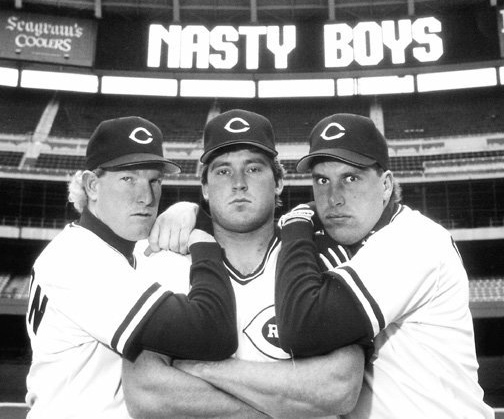
Who needs sleeves when you can have a Nasty Boy or two keeping you warm?

While Franco was saving games for a second-place Mets team in 1990, Randy Myers was becoming one of the "Nasty Boys" in the Reds bullpen.  The three-headed monster made up of Myers, fellow southpaw Norm Charlton and wide-eyed righty Rob Dibble became one of the most formidable relief trios of their generation.  The Nasty Boys combined to record 44 of the Reds' league-high 50 saves, in addition to their 2.14 ERA and 291 strikeouts in 235⅓ innings.

With a steady offense, quality starting pitching and dominant relief corps, Cincinnati was never out of first place, keeping a firm grip on the division lead from Opening Day to the end of the season.  Randy Myers was one of the many contributors to the Reds' wire-to-wire success.  Myers led the team with 31 saves and posted a 2.08 ERA, striking out 98 batters in 86⅔ innings.  He was also one of the toughest pitchers to hit in the National League, holding opposing hitters to a .193 batting average and .281 slugging percentage.

For his efforts, Myers earned his first trip to the All-Star Game, finished fifth in the NL Cy Young Award vote and even received MVP consideration.  But he got a lot more consideration for MVP in the National League Championship Series.

Myers took home the top prize in the NLCS, saving three games for the Reds, including the Game 6 clincher that sent Cincinnati to the World Series for the first time since 1976.  Myers was also on the mound in the ninth inning of Game 4 of the World Series against the defending champion Oakland A's, retiring Carney Lansford on a foul pop-up to complete an unlikely four-game sweep that gave the Reds the title.

Myers did it all for Cincinnati in 1990, even taking time out to record a rap video as a member of "B-Lark and The Homeboys".  But Myers was just getting started in 1990, even if his fledgling music career was not.


In 1991, the Reds couldn't capitalize on their unexpected World Series-winning campaign.  Instead, they decided to convert Randy Myers into a starting pitcher, which he hadn't done since his days as a Mets farmhand.  Needless to say, it failed miserably.

Myers started 12 games for the Reds in 1991.  Although he had a respectable 3.45 ERA in those dozen starts, he pitched in and out of trouble regularly, allowing 106 base runners (62 hits, 43 walks, one hit batsman) in 70⅓ innings.  Myers' teammates didn't fare much better, as Cincinnati followed up its memorable 1990 campaign by finishing fifth in the six-team NL West with a disappointing 74-88 record in 1991. 

Two months and two days after he became a Red, Myers was sent packing again, this time to San Diego in a trade for infielder Bip Roberts.  After a so-so season with the Padres (3-6, 38 saves, 4.29 ERA, 1.48 WHIP), Myers became a free agent and signed a three-year deal with the Chicago Cubs.  The National League record book was not prepared for what Myers was about to accomplish.

In 1993, while the Mets were plodding through their first 100-loss campaign since 1967, their former closer was thriving as a North Sider.  Myers set a National League record by saving 53 games in his first season as a Cub, helping Chicago finish the year above .500 for only the third time in 21 seasons.  Myers' save total dropped to 21 in 1994, as the Cubs failed to give Myers many late-inning leads to protect.  Chicago finished the 1994 season in last place in the NL Central, winning only 49 games before the players' strike put the kibosh on the season.

The Cubs went back above .500 in 1995, finishing the year with a 73-71 record (the strike cut 18 games from the schedule) and contending for the first-ever National League wild card berth.  Chicago eventually fell short, finishing four games behind the Colorado Rockies for the additional playoff spot.  For the second time in three seasons, Myers led the National League in saves with 38.  He also became a three-time All-Star, earning his second consecutive nod as a Cub.  But his time with the Cubs ended with an unexpected bang, as Myers had to fend off a would-be attacker on the Wrigley Field mound after allowing a crushing home run to Houston's James Mouton.

Even a Getty Images watermark can't cover up the fact that Randy Myers is one tough badass.

The attack on the mound helped steer Myers to Baltimore when he became a free agent after the conclusion of the 1995 season.  As an Oriole, Myers was reunited with former Mets manager Davey Johnson, who gave him his first shot in the big leagues a decade earlier.  Myers did not disappoint, helping the Orioles make the playoffs in each of his two seasons in Baltimore.

Myers saved 31 games for Baltimore in 1996, as the Orioles ended a 13-year playoff drought by claiming the American League wild card.  Myers was especially productive during the season's final month.  On August 29, the Orioles found themselves in a virtual three-way tie with the White Sox and Mariners for the AL wild card lead.  From that point on, Baltimore was one of the hottest teams in the league, winning 12 of their next 16 games to take control of the wild card race.  Myers was particularly dominant during the season's final month, posting a barely-there 0.84 ERA in 13 games and allowing only nine hits - all singles - in 10⅔ innings.

Myers' regular season success in his first year as an Oriole continued in his second year with the team, as he led the American League with 45 saves in 1997.  In doing so, Myers set a new single-season team record, shattering the old mark of 37 set by Gregg Olson in 1990.  (Myers' record was eventually surpassed by Jim Johnson, who saved 51 games for the Orioles in 2012.)

Unfortunately, his success in the regular season didn't carry over into the playoffs, as Myers struggled in the postseason for the first time in his career.  After not having allowed an earned run in any of his first 12 postseason appearances with the Mets and Reds, Myers gave up an extra-inning walk-off home run to Bernie Williams, giving the Yankees the win in Baltimore's first ALCS game since 1983.

In 1997, Myers lost another ALCS game in walk-off fashion, although this one was far from being a conventional walk-off loss.  In what was perhaps the turning point of the series, Marquis Grissom of the Indians stole home off Myers in the bottom of the 12th inning on a failed suicide squeeze attempt by Omar Vizquel.  The Game 3 victory gave Cleveland a 2-1 lead in a series they went on to win in six games.

Randy Myers was one of the most dependable playoff relievers of all time.  But even he wasn't perfect all the time.

Once again, Myers was facing free agency and once again, he switched teams.  This time, Myers packed his bags for Toronto, who gave him a three-year, $18 million contract.  While in Toronto, Myers fared well in the saves department (28) but did not fare well with his ERA (4.46), leading the Blue Jays to bid farewell to Myers in August.  Toronto placed Myers on waivers, where he was unexpectedly claimed by the San Diego Padres.

The Blue Jays gladly traded their expensive reliever back to San Diego (Myers was a Friar in 1992), where he served as a lefty specialist and set-up man to closer Trevor Hoffman.  Myers didn't pitch well in his new role, posting a 6.28 ERA and 1.53 WHIP in 21 games with the Padres.  But the trade to San Diego did allow Myers to pitch in the World Series for a second time, eight years after winning a ring with Cincinnati.  Myers did not perform well in the playoffs, allowing four runs in three innings to the Braves and Yankees.

Since San Diego had claimed Myers off waivers, they were now on the hook for the remaining two years and $13 million left on his contract.  But Myers did not pitch at all in 1999 and 2000 because of a damaged shoulder and offseason rotator cuff surgery.  Myers' injuries caused the Padres to become involved in an ugly legal dispute with their insurance carrier, which was eventually settled in 2003.  By that time, Myers had already been out of baseball for two years.  Myers retired in 2001 after appearing in one game with the Seattle Mariners' Triple-A affiliate in Tacoma, allowing four runs without retiring a batter.

Randy Myers pitched 14 seasons in the major leagues with six different teams.  He finished in the league's top ten in saves at least once with each team.  In doing so, Myers became the only player in history to finish in his respective league's top ten in saves with at least six teams.  Myers also led the league in saves three times (1993, 1995, 1997) and finished second twice (1991, 1992).  Against the Mets, Myers was a perfect 21-for-21 in save opportunities.  And of course, Myers' 347 career saves are ninth all-time and third among left-handed pitchers.

The man affectionately referred to as Randall K. Myers by former Mets broadcaster Tim McCarver was a four-time All-Star who received Cy Young consideration in 1990, 1993 and 1997 and MVP votes in 1988, 1990, 1993 and 1997.  Myers also made the playoffs five times with three teams and posted a 2.35 ERA in 29 career postseason appearances.

In his short time with the Mets, Myers saved 56 games, which has him on the outside of the team's top ten list looking in (Braden Looper is 10th all-time with 57 saves as a Met).  His time as a starter in Cincinnati kept him from cracking the Reds' top ten as well.  But Myers is one of only four relievers to save as many as 100 games for the Cubs.  He is also eighth on the Padres' all-time saves list and ranks fifth on the Orioles' leaderboard.

Randy Myers last threw a pitch in a Mets uniform on September 30, 1989.  Since then, six pitchers have earned the right to be the Opening Day closers for the Mets.  Those six pitchers are:

Braden Looper
  • John Franco (1990-1999)
  • Armando Benitez (2000-2003)
  • Braden Looper (2004-2005)
  • Billy Wagner (2006-2008)
  • Francisco Rodriguez (2009-2011)
  • Frank Francisco (2012)

Besides being the team's Opening Day closers, the six pitchers listed above have another thing in common.  None of them were developed in the Mets' minor league system.  Franco and Benitez were acquired via trades, while Looper, Wagner, Rodriguez and Francisco all signed with the Mets as free agents.

The Mets have not developed a closer in their system since Randy Myers.  Sure, Aaron Heilman and Bobby Parnell have been used to close out games for limited stretches, with Heilman recording nine saves as a Met and Parnell notching 14, but the homegrown Met with the most saves since Randy Myers left New York is ... (drum roll please) ... Anthony Young!

Young is most known for his record-setting 27-game losing streak, but he also filled in for incumbent closer John Franco while the Mets' all-time saves leader was recovering from various injuries in 1992 and 1993.  Young saved 15 games for the Mets in 1992 and three more in 1993, ending his Mets career with 18 saves - a number that has only been surpassed by 16 players in Mets history, including the last homegrown Met to save that many games, Randy Myers.

The Mets haven't developed many closers over the last quarter century.  The last time they did, they traded him away for a hometown kid, but not a homegrown player.  The hometown kid (John Franco) became the team's all-time leader in saves, but was never an imposing figure on the mound and only led the league in saves twice as a Met.  The homegrown player (Randy Myers) went on to become one of the most dominant closers the game has ever known, becoming an All-Star with three different teams and setting the National League single season saves record.

Having veteran leadership is always beneficial to a contending team, but sometimes that leadership comes with a price.  The Mets paid that price when they traded Randy Myers to the Cincinnati Reds in 1989.  And they've been paying for other teams' closers ever since.  Sometimes it's best to give a kid a chance.  Otherwise, he might turn into a Met that got away.

Not even a black and white photo can mask how colorful Randy Myers was.

Note:  The Mets That Got Away is a thirteen-part weekly series that spotlights those Mets players who established themselves as major leaguers in New York, only to become stars after leaving town.  For previous installments, please click on the players' names below:

January 7, 2013: Nolan Ryan
January 14, 2013: Melvin Mora  
January 21, 2013: Kevin Mitchell 
January 28, 2013: Amos Otis
February 4, 2013: Jeff Reardon
February 11, 2013: Lenny Dykstra
February 18, 2013: Jeff Kent

Monday, February 14, 2011

M.U.M.'s The Word (Most Underrated Mets): David Cone

In 1987, the Mets entered the season as defending World Series champions. They won the title in 1986 with a strong pitching staff that combined youth and veteran leadership. Despite their success on the mound, the Mets were still looking for more pitching prior to the 1987 season.

Kansas City had a hometown kid in their minor league system who had once been a top pitching prospect (16-3, 2.08 ERA in 1982), but fell out of favor when he developed control problems. The former "can't miss" prospect was a "can miss", as far as the strike zone was concerned, walking a combined 207 minor league batters in 1984 and 1985. As a result, the Royals had no problems trading him to the Mets (along with Chris Jelic) in 1987 for backup catcher Ed Hearn, minor league pitcher Mauro Gozzo and spot-starter Rick Anderson. The trade ended up being one of the best in Mets history, for it brought David Cone to New York.

The kid from Kansas City took a bite out of the Big Apple and never looked back.

Two weeks after being traded from Kansas City to New York, David Cone was on the Shea Stadium mound for the first time, coming out of the bullpen to face the Atlanta Braves. Unfortunately, his Shea Stadium debut was not a pleasant one, as Cone gave up the go-ahead run in the ninth inning and took the loss. Cone would go on to pitch in nine more games (six starts) in April and May before breaking his pinky on May 27 in San Francisco. The injury occurred when Cone (a right-handed pitcher, but a left-handed batter) was hit by a wayward Atlee Hammaker pitch as he was squaring around to bunt. As a result, Cone was placed on the disabled list and did not return until mid-August.

Upon returning to the big leagues on August 15, Cone looked like a new pitcher. Prior to his stint on the disabled list, Cone was 2-2 with a 4.60 ERA. But once he returned, he gave the injury-depleted pitching staff a big boost. In 11 games (seven starts), Cone held opposing batters to a .215 batting average and had a sparkling 2.92 ERA. Unfortunately, Cone's record during this stretch was only 3-4 because the Mets failed to provide him with any run support, scoring two runs or less in five of the seven starts.

Cone's rookie year was good, but not great. He went 5-6, with a 3.71 ERA in 21 games (13 starts). Still, he picked up valuable experience pitching in the heat of a pennant race in September, and did not wilt under the pressure. That experience would come in handy in 1988, when Cone blossomed into an unlikely star.

David Cone began the 1988 season in the Mets bullpen, making seven appearances in April. In his first six relief appearances, it was all or nothing for David, as he pitched 13 innings, striking out 12 batters and walking 11 more. But in his final April appearance, manager Davey Johnson stretched Cone out a little, allowing him to pitch 4 1/3 innings against the Cincinnati Reds. It was his best appearance of the young season, as Cone only allowed two baserunners (one hit, one walk) and struck out five. It also prepared Cone for his return to the starting rotation, which he did four days later when he faced the Atlanta Braves at Shea Stadium.

On May 3, 1988, David Cone faced the same team that he made his Mets debut against just one year earlier. In that start, he took the loss against Atlanta. This time, the end result would be much different, as Cone notched the first shutout of his career, blanking the Braves on eight hits. Cone's first start of the 1988 campaign would set the tone for what was to come for the rest of the season.

After shutting out the Braves, Cone won every game he started in the month of May, going 5-0 with a microscopic 0.72 ERA. For his efforts, Cone was named the National League Pitcher of the Month for May. Two months later, he earned his first All-Star selection, retiring future Hall of Famers Rickey Henderson, Paul Molitor and Wade Boggs in order in his one inning of work.

As the Mets were pulling away from the rest of the competition in the NL East, Cone was establishing himself as the ace of the staff. Whereas some pitchers coast to the finish line, Cone was accelerating towards it. From August 23 to the end of the season, Cone won all eight of his starts. More importantly, the wildness that had plagued him since his days in the Royals' farm system was no longer an issue, as Cone walked a total of 14 batters over his final eight appearances.

For the season, Cone finished 20-3, with a 2.22 ERA and 213 strikeouts. His .870 winning percentage led the National League and was the highest in Mets history for pitchers with 20 or more decisions, surpassing Dwight Gooden's .857 mark from 1985. Although his performance was certainly worthy of the Cy Young Award, that honor went to Orel Hershiser, who bulldogged his way to the award by pitching 59 consecutive scoreless innings to end the season. Cone finished third in the voting, behind Hershiser and Danny Jackson of the Cincinnati Reds.

After finishing ahead of David Cone in the 1988 NL Cy Young Award vote, Danny Jackson went 52-74 with a 4.52 ERA over the rest of his career. Insert "you may have won the battle, but I will win the war" here.

In the 1988 NLCS, the Mets faced the Los Angeles Dodgers, a team they had defeated in 10 of 11 regular season matchups. On paper, the Mets were the clear favorite, although the Dodgers had Orel S. Hershiser (the "S" stands for "shutout") as their Game 1 starter. Speaking of paper, David Cone decided to use one, the New York Daily News, to share his thoughts on the series in a daily column. His venture into being a sports columnist turned out to be misguided.

After the Mets rallied for three runs in the ninth inning to defeat the Dodgers in Game 1, Cone shared his opinion on the state of the Dodgers in his column, when he said:


''I'll tell you a secret: As soon as we got Orel out of the game, we knew we'd beat the Dodgers. Knew it even after Jay Howell had struck out HoJo. We saw Howell throwing curveball after curveball and we were thinking: This is the Dodgers' idea of a stopper? Our idea is Randy, a guy who can blow you away with his heat. Seeing Howell and his curveball reminded us of a high school pitcher.''


Naturally, the Dodgers took umbrage to Cone's remarks, calling them "classless" and "stupid". Of course, this gave them all the motivation they needed when they faced Cone in Game 2.

In 28 starts during the regular season, Cone gave up as many as five earned runs in a game only once (June 29 vs. Pittsburgh in a game eventually won by the Mets 8-7). Game 2 would be his second such start, as he allowed five runs in only two innings of work. Cone faced 14 batters and allowed eight of them to reach base (five hits, two walks, one hit batsman). The Mets would go on to the lose the game 6-3, and returned to Shea Stadium with the series deadlocked at one game apiece.

In the aftermath of the game, Cone decided that it would be best to make his statements on the mound rather than in a newspaper column. The day before the series resumed in New York, Cone "retired" from his sports writing gig, saying:


''This is my first - and I'm announcing today - my last attempt at tabloid journalism. I apologize to my family for embarrassing them. And I apologize to my teammates.''


The Mets were able to recover from the loss in Game 2 by defeating the Dodgers, 8-4, in Game 3. After his short outing at Dodger Stadium, Cone came out of the bullpen to pitch the ninth inning, retiring the Dodgers in order.

The quick recovery in Game 3 was short-lived, as the Mets lost Game 4 (no thanks to Mike Scioscia and Kirk Gibson) and Game 5, facing elimination as they returned to Dodger Stadium for Game 6. It was time for David Cone to prove that he was the dominant pitcher who won 20 games during the regular season and not the helpless mortal who showed up in Game 2.

The Mets pounced on Dodgers' starter Tim Leary early, scoring a run in the first and adding another in the third. After Kevin McReynolds hit a two-run homer in the fifth inning, the Mets led 4-0 and Cone was on cruise control, retiring 12 consecutive batters, before giving up back-to-back singles with two outs in the ninth. At 116 pitches, manager Davey Johnson could have elected to bring in Randy Myers from the bullpen. After all, it was Cone who said in his newspaper column that Myers could blow anyone away with his fastball. But Johnson decided to let Cone finish what he started and he did just that, retiring pinch-hitter Mike Davis on a fly ball to left field.

David Cone had exorcised his Game 2 demons, helping the Mets reach Game 7 against Orel Hershiser. Unfortunately, Cone's victory in Game 6 would not lead to the team's fourth World Series berth, as Ron Darling struggled, retiring only three batters while giving up six runs. The offense also failed to produce, as Hershiser stymied the Mets, shutting them out for the National League pennant.

Despite the unexpected ending to the 1988 season, the year can still be remembered for the breakthrough of David Cone from reliever/spot starter to the ace of a formidable staff.

David Cone will huff and he'll puff and he'll blow your hitters away.

The 1989 and 1990 Mets failed to return to the postseason, finishing second in the NL East to the Chicago Cubs and Pittsburgh Pirates, respectively. Although David Cone did not return to the lofty perch he reached in 1988, he remained one of the best pitchers in the National League, combining to go 28-18, with a 3.38 ERA over the two seasons. In 1990, he led the National League with 233 strikeouts. His 9.9 strikeouts per nine innings and his 3.58 K/BB ratio also paced the NL. On a team filled with underachievers, Cone raised the bar and helped keep the Mets in contention until the season's final days.

By the time 1991 rolled around, most of the players from the 1986 and 1988 division winners had left the team. Gary Carter, Keith Hernandez, Wally Backman, Mookie Wilson, Lenny Dykstra and Darryl Strawberry were no longer taking the field for the Mets, being replaced by the likes of Mackey Sasser, Dave Magadan, Gregg Jefferies, Keith Miller, Daryl Boston and Hubie Brooks. The pitching staff was bolstered by the acquisition of former Cy Young Award winner Frank Viola, but the heart and soul those '80s teams had disappeared.

The 1991 Mets came into the season with a fearsome threesome at the top of their rotation. With 53 victories and 638 strikeouts between them in 1990, Frank Viola (20-12, 2.67 ERA, 182 Ks), Dwight Gooden (19-7, 3.83 ERA, 223 Ks) and David Cone (14-10, 3.23 ERA, 233 Ks) were counted on to lead the Mets back to the postseason. However, other than Howard Johnson, who had a career year with 38 HR, 117 RBI and 108 runs scored, the offense sputtered, with no Met hitting more than 16 homers, driving in more than 74 runs or scoring more than 65. The team's .244 batting average was the lowest since 1983, which was the last time the Mets finished with a losing record, that is, until 1991.

The inept offense took its toll on the pitching staff, especially during a particularly horrid stretch in July and August when the Mets lost 23 out of 27 contests. During that 4-23 stretch, the Mets scored two runs or less 16 times, losing all 16. Dwight Gooden's season was cut short in late August by a shoulder injury while Frank Viola was a shadow of his former self, leading the major leagues in hits allowed (259). David Cone could have packed it in just like the Mets did in the final two months of the 1991 season, but he only became stronger as the season went on.

From August 21 to the end of the season, Cone made ten starts. In 72 innings, he recorded 86 strikeouts and opposing batters hit .196 against him. During that period, Cone also had an exceptional 2.63 ERA. Of course, since the offense had gone south for the summer, the Mets lost six of those ten starts. One of the starts they did win was the final game of the season, which was perhaps Cone's most memorable effort in a Mets uniform.

Cone took the mound at Veterans Stadium on the final day of the 1991 season, needing a win to avoid finishing the year with a losing record. If the Mets weren't going to hit for Cone, he wasn't going to let the Phillies hit him. Over the first six innings, Cone struck out 15 batters. Almost miraculously, the Mets put on their hitting shoes that afternoon, scoring three runs in the first inning and adding single runs in each odd-numbered inning after that.

By the time the Phillies came to bat in the bottom of the ninth inning, the Mets had a commanding 7-0 lead and Cone had struck out 17 batters. although he had thrown 126 pitches to do so. But interim manager Mike Cubbage wasn't about to take Cone out when his next start wasn't scheduled for another six months. Cone struck out Kim Batiste and Mickey Morandini to tie the National League record for strikeouts in a nine-inning game. Now only one K away from setting a new NL record and tying Roger Clemens' major league record, Cone faced Wes Chamberlain, whom he had fanned in each of his three previous plate appearances, but the Phillies' leftfielder smoked a ground rule double to extend the inning, bringing up aging veteran Dale Murphy. The former All-Star was prone to striking out, leading the National League in whiffs three times (1978, 1980, 1985). However, on a 2-1 pitch, Murphy grounded out to shortstop Jeff Gardner, preserving the shutout, but keeping Cone from baseball immortality.

With his Closing Day victory, Cone finished the 1991 season with a 14-14 record and a 3.29 ERA. For the second consecutive season, Cone led the league in strikeouts, finishing with 241. But all this took a backseat to the news that Cone had allegedly raped a woman the night before his season-ending victory. Soon after, the police dropped the case, as the alleged victim's claims were deemed baseless.

In 1992, the Mets put together a team that (yet again) on paper, looked like a contender. They added manager Jeff Torborg, who had won the AL Manager of the Year Award for the White Sox in 1990. They also brought in sluggers Eddie Murray and Bobby Bonilla, along with two-time Cy Young Award winner Bret Saberhagen. None of these acquisitions fared well for the Mets, nicknamed "The Worst Team Money Could Buy". But the one Met who continued to perform exceptionally well was David Cone.

The 1992 Mets were around the .500 mark for much of the first half of the season. At the All-Star Break, they were 42-46 and in fourth place in the NL East. For all the former All-Stars brought in to help the team, it was David Cone who was the Mets' sole All-Star Game representative. His stats at the halfway mark (9-4, 2.56 ERA, 154 Ks) were far and away the best on the staff and they continued to get better after the break, as Cone won his first four second-half starts to improve to 13-4. However, the Mets were still below .500 at 51-53 and were going nowhere fast despite having the highest payroll in baseball.

Prior to the 1992 season, David Cone was awarded the highest arbitration amount in history, when he won a $4.25 million salary for the '92 campaign. That left the Mets in a bind because Cone was due to become a free agent at year's end and his stellar season was sure to command a hefty pay increase. Therefore, to avoid having to pay Cone during the off-season, the Mets chose to trade him to the Toronto Blue Jays on August 27 for Jeff Kent and Ryan Thompson. Although he played the final five weeks of the 1992 season in the American League, Cone still led the National League with five shutouts (tied with Tom Glavine) and finished one strikeout behind John Smoltz for the National League lead.

Jeff Kent burst everyone's bubble as a Met, but apparently, not his own. (Photo by Brad Mangin)

Kent and Thompson never became stars for the Mets, although Kent did have quite a career after leaving New York, building a Hall of Fame-caliber career with the San Francisco Giants. Cone, on the other hand, blossomed after he Shea'd goodbye. He won a World Series ring in 1992 as a Blue Jay, then took home the Cy Young Award as a Kansas City Royal in the strike-shortened 1994 season. He won four more World Series rings as a member of that other New York team in 1996, 1997, 1998 and 2000, becoming a 20-game winner for the second time in 1998 and throwing a perfect game in 1999.

After playing the 2001 season in Boston, Cone was not signed by a major league team in 2002. Not believing his career to be done, Cone signed an incentive-laden deal with the Mets in February 2003. At the time, Cone needed seven wins to reach 200 for his career and the Mets, fresh off a 2002 season in which they went 75-86, were the only team willing to give him the opportunity to reach that plateau. Nothing was guaranteed for Cone as he entered Spring Training, as he was fighting for a job with players who were almost half his age. But as time went by, Cone was performing as well, if not better, than pitchers already guaranteed spots in the rotation. By the end of Spring Training, Cone had not only made the team, but he was penciled in as the Mets' fourth starter, making his return to Shea Stadium on April 4, 2003.

It had been over a decade since Cone last started for the Mets, but as he faced off against the Montreal Expos, it appeared as if nothing had changed. On a cold and windy night at Shea, Cone froze the Expos' hitters, pitching five scoreless innings, allowing only two hits, walking three and striking out five. It was vintage David Cone at Shea Stadium that night, and career win No. 194 was reminiscent of his previous 80 wins in a Mets uniform.

However, Cone's first start of the 2003 season would also produce the final win of his highly successful career. In his next start, also against the Expos, but this time at Montreal's home away from home in Puerto Rico, Cone struggled mightily. After keeping the Expos scoreless over the first two innings, Cone was rocked for seven runs in the third, with the crushing blow coming on a grand slam by Brad Wilkerson. Cone would lose that game as well as his next start in Pittsburgh, although he pitched better against the Pirates, allowing three runs in five innings of work.

On April 22, Cone would make his final start for the Mets, pitching two innings against the Houston Astros, before leaving the game with an injured left hip, for which he was placed on the disabled list the following day. Cone returned to the Mets on May 28, pitching two innings of relief against the Phillies, but his arthritic hip would not allow him to pitch again, as Cone announced his retirement two days later.

Cone only pitched five full seasons (1987-1991) and parts of two others (1992, 2003) in a Mets uniform. Despite having a relatively short career as a Met, Cone is all over the franchise's all-time pitching leaderboard, finishing in the top ten in all of the following categories:

  • Wins: 81 (8th)
  • ERA: 3.13 (9th)
  • Win-Loss Percentage: .614 (5th)
  • WHIP: 1.192 (9th)
  • Hits/9 IP: 7.524 (5th)
  • Strikeouts/9 IP: 8.722 (1st)
  • Innings Pitched: 1,209.1 (10th)
  • Starts: 169 (10th)
  • Strikeouts: 1,172 (5th)
  • Complete Games: 34 (7th)
  • Shutouts: 15 (5th)
  • Strikeouts/BB: 2.719 (7th)

Cone struck out 10 or more batters in a game 33 times in 169 starts as a Met, which explains why he is the club's all-time leader in strikeouts per nine innings, despite the fact that the Mets have employed some of the best strikeout pitchers of all-time, such as Tom Seaver, Dwight Gooden and some guy whose last name was Ryan.

Speaking of Seaver and Gooden, upon further inspection of the Mets' all-time leaderboard, Cone ranks in the top three for right-handed pitchers in ERA, hits per nine innings pitched, strikeouts per nine innings pitched, total strikeouts and shutouts. The other two pitchers in the top three in almost all of those categories are Tom Seaver and Dwight Gooden.

Had David Cone been a Met for more than six years, perhaps he'd be on this stage alongside legendary right-handers Dwight Gooden and Tom Seaver. (Photo by Michael G. Baron)

It would not be a stretch to say that David Cone is the third-best right-handed starting pitcher in franchise history. Nolan Ryan didn't have his best years until after he left New York, Ron Darling had too many ups and downs in the latter part of his Mets career and Rick Reed didn't pitch long enough to be taken into consideration. Bobby Jones, although very underrated, only had one exceptional year and one memorable post-season appearance for the Mets, although he's among the franchise's all-time winningest pitchers.

When David Cone was traded to New York before the 1987 season, the trade didn't make much noise in the tabloids. Almost a quarter century later, it remains one of the best trades in franchise history. The Mets gave up three players who had very little, if any, major league experience and got back a pitcher who went on to become one of the best and most beloved players in franchise history.

It's odd to call such a great pitcher underrated, but just ask any Mets fan on the street who the best right-handed starting pitchers are in team history. You'll hear some Tom Seavers and some Dwight Goodens in their responses, but see how many people say David Cone. Even they would be surprised at just how great Cone was once he left his hometown to come to the bright lights of the big city.


Note: M.U.M.'s The Word is a thirteen-part weekly series spotlighting some of the best Mets players of all-time who never got the recognition they deserved because they weren't the biggest names on the teams they played for. For previous installments, please click on the players' names below:

January 3, 2011: John Olerud
January 10, 2011: Sid Fernandez
January 17, 2011: Jon Matlack
January 24, 2011: Kevin McReynolds
January 31, 2011: Bobby Jones
February 7, 2011: John Stearns