Showing posts with label Cooperstown. Show all posts

Sunday, July 31, 2016

Joey's World Tour: Won't You Take Me To ... Cooperstown?

My sister, Bee, joined me as Mike Piazza and Ken Griffey Jr. entered the Hall of Fame.  (Ed Leyro/Studious Metsimus)

Hi, everyone!  This is your fav'rit roving reporter, Joey Beartran.  And this edition of my baseball world tour took me to a place where there is no major league baseball team, but there's certainly no shortage of baseball.

With Mike Piazza and Ken Griffey Jr. being elected into the Hall of Fame this year, it seemed like a perfect time for me (a Mets fan) and my sister, Bee (a Mariners fan), to venture 200 miles northwest of Citi Field to Cooperstown.  The Hall is located on Main Street, in an area full of baseball themed stores.  And during Hall of Fame weekend, those stores hosted many former athletes, including several Mets players of days gone by.

My photographer took several photos of these former players, but he failed to inform me that two members of the 1969 World Champion Mets found it amusing that among the many websites covering Hall of Fame weekend, one of them sent a bear instead of a human.  Needless to say, they smiled a little too much for the camera.

It's almost as if Art Shamsky and Ed Kranepool had never seen a roving reporter that's also a bear.  (EL/SM)

In addition to members of the Mets' first championship squad, there were also players from their second title team, such as Mookie Wilson, Howard Johnson and Lenny Dykstra.  I heard Jesse Orosco was also signing autographs and posing for photos with fans, but I was eating a hot dog at the time and didn't want mustard to accidentally appear on the side of my mouth in the photo.  If Shamsky and Kranepool were laughing when my face was mustard-free, how would Messy Jesse have reacted at the sight of Messy Joey?

At least Mookie, Lenny and HoJo didn't make fun of me.  (EL/SM)

Soon after meeting the Mets, meeting the Mets (again), stepping right up and greeting the Mets (for a small fee), the Hall of Fame parade began.

Thousands of people lined up on Main Street to see their favorite former players go by in the back of a Ford pickup truck.  Because who doesn't want to see Tom Glavine being taken hostage hanging out in the back of a moving pickup truck?  Missing among the living Hall of Famers were three former Mets (Nolan Ryan, Tom Seaver, Roberto Alomar), but hey, at least we got Glavine to make up for them.

No comment.  (EL/SM)

Other Hall of Famers who took part in the parade included Jim Bunning, Johnny Bench, Reggie Jackson, Rollie Fingers, Eddie Murray, Pedro Martinez and Randy Johnson, to name a few.  They were all smiles throughout the route.  (Even Eddie Murray!)  But of course, my photographer captured players like Mike Schmidt, George Brett and Dennis Eckersley at their surliest.  Because his sense of timing is awful.

Smile!  You're on Candid Studious Metsimus Camera!  (EL/SM)

The parade ended at the Hall of Fame building, which is the crown jewel of Cooperstown.  We entered the Hall three and a half hours before closing time.  By the time we got around to the gift shop, the employees were getting ready to kick us out.  (Not literally.  They were actually very polite.)  There was so much to see and do in the Hall, we could have easily spent more than three and a half hours there.

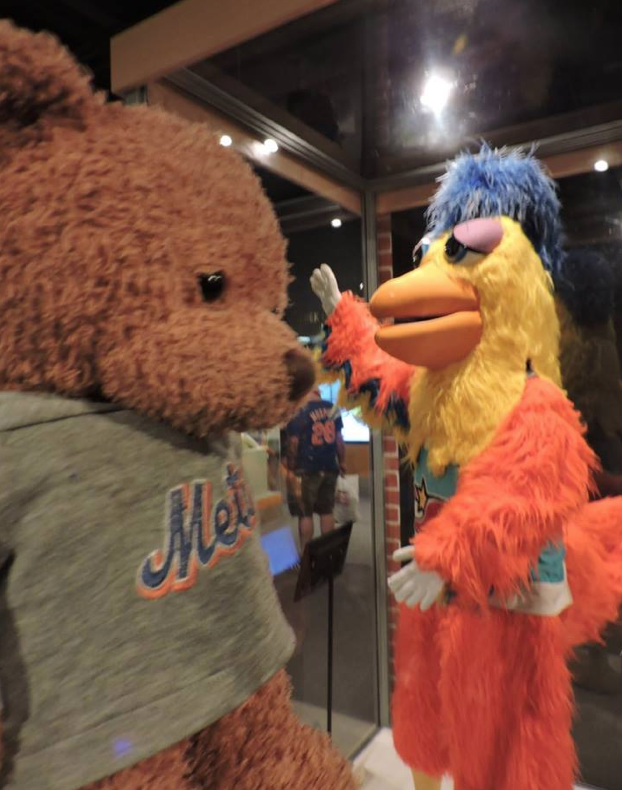
Exhibits included Women In Baseball, The African-American Baseball Experience and Viva Baseball (Latin-American baseball).  There were also wings devoted to baseball by the decades and baseball records, as well as a locker room featuring memorabilia from every team.  The area devoted to the 1970s was particularly interesting to me, even though that era was way before my time.  Two objects that stood out for me were the Andy Warhol painting of Tom Seaver (circa 1977 - not the happiest time to be Tom Seaver or a Mets fan) and the full costume of the San Diego Chicken, who entertained Padres fans at a time when the team wore brown and mustard colored uniforms and still didn't have a no-hitter.  (Well, at least they no longer wear those uniforms.)

The Chicken was lucky he didn't end up inside a Campbell's Soup can that was eventually painted by Warhol.  (EL/SM)

Once I left the '70s behind, I wish I hadn't.  You see, there was also a wing in the Hall of Fame devoted to the 2015 World Series, which I was not too keen on seeing.  (Yes, I took a photo there, but I'm not very happy about it.  If you absolutely must see it, just click here.  If the link doesn't take you to the photo, consider it a good thing.)

But enough about last year.  You want to see the Hall of Fame plaques, right?  Of course you do.  Well, you can always Google those.  There's an abundance of those photos on the interwebs.  At the time I went to see the plaques, the spots were still open for Mike Piazza and Ken Griffey Jr.  But at least both players were well-represented in the gift shop.

By the time you read this, the plaques will be there.  Please buy a jersey while you wait.  (EL/SM)

Another place they were well-represented was in their special wings.  Both Piazza and Griffey had their own section in the Hall featuring memorabilia and photos taken at various points of their distinguished careers.

Bee and I enjoyed this section very much, although I was disappointed that Piazza's area had too much focus on the other teams he played for compared to Griffey.  Griffey was a member of the Cincinnati Reds longer than Piazza was a Met, but Mariners fans like Bee will be happy to know that his wing almost exclusively features him as a Seattle Mariner.   With Piazza, it was as if the Mets were just a stop on his baseball journey.  Take a look at the photos to see what I mean.

At least Bee got what our petty cash tin paid for in the Griffey wing.  (EL/SM)

Finally, on Sunday we attended the Hall of Fame induction ceremony at the Clark Sports Center, which is about a one mile trudge from the Hall of Fame building.  We had left our blankets and lawn chairs there overnight just to reserve a spot.  By the time we got there Sunday morning, there were nearly 50,000 other people who had claimed spots around us.  That's more people than the capacity at Citi Field, even when they're selling standing room only tickets!

We were sitting too far away for my photographer to get any clear shots of the dozens of Hall of Famers sitting on the stage and the two new ones standing at the podium, but all you need to know about the ceremony can be summed up in this one photo taken off the big screen after both Piazza and Griffey had given their spectacular tear-filled speeches.

During the ceremony, Mets fans gave Piazza lots of TLC, while Griffey wore his hat 2 da back.  (EL/SM)

So that's all for this special edition of Joey's World Tour.  The next installment will come sooner than you expect, as we are planning on following the Mets to Detroit's Comerica Park next weekend.  I wonder what food options they have there...

Oh, before I forget, I have one more anecdote to share with you.  You see, a week after Mike Piazza entered the Hall of Fame in Cooperstown, the Mets had a special ceremony of their own at Citi Field to retire Piazza's No. 31.  And about that plaque I mentioned before that wasn't at Cooperstown when I was there - well, it made the trip to Citi Field, and I was fortunate enough to get a photo with it before it made its return trip to the National Baseball Hall of Fame and Museum.  (You don't have to Google it like I said before.  I'll be kind enough to share it with you here.)  My photographer also took lovely photos (for a change) of Piazza's former Mets teammates - Cliff Floyd, Edgardo Alfonzo and Al Leiter - who attended the Citi Field ceremony, as well as the new retired No. 31 that now sits atop the ballpark.

The Piazza celebration is complete now that the No. 31 has been retired at Citi Field.  (EL/SM)

Mike Piazza was very special to me.  You see, on the day I was "born" at Shea Stadium in 2004, Piazza was being celebrated in an on-field celebration (which seems to be a common theme in this blog post).  A dozen years ago, the Mets were celebrating the fact that he had just become the game's top home run hitting catcher.  They invited Carlton Fisk and Johnny Bench to attend the ceremony, and Ivan Rodriguez was also there in uniform as a member of the Detroit Tigers, the Mets' opponent that day.  That was my first baseball experience - seeing a celebration of Mike Piazza.  So it's fitting that I got to see him receive the ultimate honors of being inducted into the Baseball Hall of Fame and having his number retired by the Mets.

So on that note, now that I'm done with Cooperstown and the two-weekend celebration of Mike Piazza, I think I'm going to rest up to make sure I'm fully awake for next weekend's getaway to Michigan to see the Mets play the Tigers, which is a rematch of that first Mets game I saw in person back in 2004.  Got any suggestions where I can hibernate for the week?  Maybe a large place where a bear can feel like home?


This place on the way back from Cooperstown seems like a good place for a bear to crash.  (EL/SM)

Take care, Mets fans.  I hope to talk to you again once I've completed the next leg of my baseball world tour!


For previous installments of Joey's World Tour, please click on the links below, where you will be entertained by Joey's wit, photos and love of ballpark cuisine:

World Tour Stop #1: Baltimore
World Tour Stop #2: Washington, DC
World Tour Stop #3: Pittsburgh
World Tour Stop #4: Texas
World Tour Stop #5: Los Angeles
World Tour Stop #6: San Diego
World Tour Stop #7: Toronto
World Tour Stop #8: Chicago (NL)
World Tour Stop #9: Milwaukee
World Tour Stop #10: Seattle
World Tour Stop #11: Cleveland
World Tour Stop #12: Brooklyn (Ebbets Field site) and Manhattan (Polo Grounds site)
World Tour Stop #13: Baltimore (again) and Pittsburgh (part deux)
World Tour Stop #14: Cincinnati
World Tour Stop #15: Colorado


Sunday, July 27, 2014

Tom Glavine and the Hall of Overrated

Tom Glavine went as high as his teammates would take him.  (Photo by Rob Kim/Getty Images)

Today, Tom Glavine joins his long-time teammate Greg Maddux, as well as Frank Thomas, Bobby Cox, Joe Torre and Tony La Russa into the Hall of Fame.  Glavine's 305 wins and .600 winning percentage are certainly nothing to scoff at, but those numbers may have been more due to the teams he was on rather than his own talent.

As my Gal For All Seasons so eloquently detailed in her recent post called "The Pity Vote", the former Brave (and I guess you have to call him a former Met as well) wasn't as good as his numbers say he was.

Let's take a look at some of the points she brought up in "The Pity Vote" and add a few of my own.

  • Almost half of Glavine's wins (149 out of 305) came when his teams scored six or more runs.  On 226 occasions, Glavine received that type of run support, or slightly over ten times per season.
  • In 22 seasons in the big leagues, Glavine was pinned with a no-decision or loss a whopping 77 times when his teams scored at least half a dozen runs.  That's three-and-a-half times a season in which he couldn't get a win with excellent run support.
  • Glavine's teams scored two runs or less in 176 of his 682 starts.  The southpaw won just 26 of those games.  By comparison, Curt Schilling won 24 games when he received two runs of support or fewer.  That's just two wins shy of Glavine's total.  However, Schilling did this despite making 246 fewer starts than Glavine.  For the record, Schilling has been eligible for the Hall of Fame for the past two seasons and has yet to receive more than 38.8% of the votes.
  • Speaking of Schilling, the 20-year veteran was one of the best postseason pitchers of all time, going 11-2 with a 2.23 ERA and 0.968 WHIP in 19 career starts.  Glavine, on the other hand, went 14-16 with a 3.30 ERA and 1.273 WHIP.  It should also be noted that Glavine's 16 postseason losses are the most by any pitcher in the history of the game.
  • Glavine had five 20-win seasons, going 103-40 in those campaigns.  That means he went 202-163 in his other 17 seasons, which averages to a 12-10 record over those 17 years in which he didn't win 20 games.  That's not exactly what I would call Hall of Fame-caliber for the majority of his career.
  • In the year he set a career high in victories (1993), Glavine posted a 1.365 WHIP.  Glavine and fellow lefty Andy Pettitte are the only pitchers since 1980 to post a WHIP higher than 1.35 in a year they won 20+ games.  In addition, Glavine is the only pitcher since 1950 to win 22 or more games in a single season and have a 1.35 WHIP in the same year.  That's over six decades of baseball, kids.
  • Finally, while we're on the topic of base runners, there are only 14 pitchers in history (since 1900) to allow 6,000 base runners over their careers.  Tom Glavine is one of them, but he pitched the fewest innings of those 14 hurlers, tossing 4413.1 frames.  In fact, the only pitcher on this list within 150 innings of Glavine is Jim Kaat, who, by the way, IS NOT IN THE HALL OF FAME!

"It's okay, Greg.  We were the best pitchers on the Braves.  Tommy just rode our coattails."  (Photo by John Bazemore/AP)

Tom Glavine's high win total was a product of the teams he was on.  They scored lots of runs when he was on the mound, making it so easy to win that even his brother, Mike, could have earned victories in those games.  In the five seasons Glavine won 20 or more games, the Braves' offense ranked in the top four in runs scored every year.  Meanwhile, when he was a Met from 2003 to 2007, the Mets' offense ranked in the top four in runs scored just twice (2006, 2007).  Not surprisingly, Glavine went 28-15 in those two seasons.  Without a good offense behind him in his first three seasons as a Met, his record was just 33-41.

Pitchers who earn enshrinement in the Hall of Fame should be the dominant pitchers of their era.  No one who allows as many base runners as Glavine did in as few innings as he pitched should get his ticket punched to Cooperstown.  Jim Kaat and his 1.259 career WHIP is still waiting for his plaque.  So is Tommy John, who allowed 6,479 base runners in 4710.1 innings for a 1.283 WHIP.  But Tom Glavine, with his 1.314 lifetime WHIP, has his Hall of Fame plaque ready to be put on display.

Likewise, Hall of Fame pitchers should have been clutch performers in the postseason.  It's true that Glavine was the winning pitcher in Atlanta's only World Series-clinching victory in 1995.  However, it's also true that no pitcher in postseason history has been saddled with an "L" more than Glavine has.  But don't tell that to the people ogling at Glavine's newly installed plaque, one of whom might be Curt Schilling, who was a far better pitcher when the games mattered the most but still needs to buy his own ticket to get into Cooperstown.

Tom Glavine was never the best pitcher on the Braves (Maddux and Smoltz outperformed him in the '90s) and quite possibly wasn't the best pitcher on the Mets when he toiled in Flushing (Steve Trachsel was 44-35 as Glavine's teammate from 2003 to 2006, while Glavine was just 48-48 during those seasons).  But none of that mattered to the baseball writers who voted him into the hallowed halls of Cooperstown.

For 22 seasons, Tom Glavine was a very good pitcher.  Now, he will forever be known as a Hall of Fame pitcher.  It's just too bad there isn't a Hall of Overrated in baseball.  Glavine would have been a first-ballot inductee there as well.
 

Tuesday, November 26, 2013

Plaque Is Wack: Armando Benitez & The Hall of Fame

The Baseball Writers' Association of America announced its Hall of Fame ballot for 2014 earlier today, with 36 players named.  Among the most prominent returnees are Mike Piazza, Roger Clemens, Barry Bonds, Jeff Bagwell, Craig Biggio and Jack Morris.  There are also 19 first-timers on the ballot, including Greg Maddux, Frank Thomas and former Mets Jeff Kent and Tom Glavine.

Both Kent and Glavine have excellent chances of making it into the Hall, as Kent is the all-time leader in home runs for second basemen and Glavine surpassed the magic 300-win plateau.  But as divisive as Kent and Glavine were to Mets fans, there is another former Met on the Hall of Fame ballot for the first time whose picture can probably be found next to the word "divisive" in the dictionary.  That player is Armando Benitez.

Please do not throw darts at your computer screen.

Armando Benitez pitched for seven major league teams during his 15-year career, including five years with the Mets from 1999 to 2003.  Benitez had 289 lifetime saves, which is currently the 26th highest total in baseball history.  The right-hander also recorded three 40-save campaigns, including a league-leading 47 saves in 2004 as a member of the Florida Marlins.  In addition, Benitez struck out 946 batters in 779 innings, averaging 10.929 strikeouts per nine innings.  That's the third-highest K/9 IP ratio for all pitchers with at least 700 innings pitched, behind only Billy Wagner (11.920 K/9 IP) and Francisco Rodriguez (10.931 K/9 IP).

As a Met, Benitez saved 160 games (second on the team to John Franco's 276 saves).  He also posted a 2.70 ERA and 1.133 WHIP in 347 innings.  Of all Mets with at least 300 innings pitched, only Tom Seaver posted a lower ERA (2.57) and only Seaver (1.076 WHIP), Bret Saberhagen (1.079), Sid Fernandez (1.113) and Skip Lockwood (1.114) had a lower WHIP than Benitez.

Perhaps the most amazing number posted by Benitez was his batting average against.  As a Met, opposing hitters hit only .182 against him (225-for-1236), and for his entire 15-year career, that number was still just .195, a figure that would cause Mario Mendoza to shake his head.

Those look like the Hall of Fame numbers of a dominant reliever.  But Benitez has as much chance of making it to Cooperstown as Ike Davis has of winning a batting title.  In fact, Benitez will probably fall well short of the 5% needed to remain on the ballot for a second year.  Why is that?  It's all about the timing of this rare hits against him.

  • Who gave up the game-tying home run to Derek Jeter in Game 1 of the 1996 ALCS (the Jeffrey Maier homer)?  That was Armando Benitez.
  • Who failed to protect a two-run lead by serving up a three-run homer to Marquis Grissom in Game 2 of the 1997 ALCS?  Señor Armando Benitez.
  • Who allowed the Diamondbacks to tie Game 4 of the 1999 NLDS, only to be spared by Todd Pratt's walk-off home run in extra innings?  Armando the Destroyer.
  • Who made Mets fans rain expletives when he allowed a game-tying three-run homer to J.T. Snow in the ninth inning of Game 2 of the 2000 NLDS?  It was Armando F. Benitez.
  • Who prevented the Mets from taking Game 1 of the 2000 World Series by allowing the Yankees to tie the game in the bottom of the ninth?  That damn dirty Armando.

You want me to serve up another gopher ball in a big spot?  Sure, why not?

And that was just the postseason.  We don't really need to mention the regular season, like the blown save to the Phillies during the near-fatal seven-game losing streak at the end of September 1999.  Or the eight runs he allowed in two September appearances against the Braves during the final two weeks of the 2001 season that thwarted the Mets' unexpected late-season run.  Or even the game-tying home run he allowed to light-hitting Craig Counsell that set up the Mets' season-changing 12-game losing streak in August 2002. 

Armando Benitez allowed 39 home runs as a Met.  That means 17.3% of the 225 hits he gave up in a Mets uniform left the park - a number that overshadows the sub-.200 batting average against him.  And Mets fans got a good look at those home runs, as 31 of the 39 homers were hit at Shea Stadium.

On January 8, 2014, the Hall of Fame will get a new member or two.  Whether it be Mike Piazza, Jeff Kent or Tom Glavine, there is a good chance a former Met will be given that ultimate baseball honor.  Another former Met will be considered for enshrinement, but the only way he'll get in is if Brian Jordan hijacks the voting system or if the baseball writers decide to show their sick sense of humor.

Armando Benitez had a great Mets career.  When he wasn't pitching in a big spot, that is.  That being said, he should probably start saving his money for Cooperstown.  After all, the admission fee for visitors is getting higher year after year.

Wednesday, November 28, 2012

Some Mike Piazza Video Love

Earlier today, former Mets legend Mike Piazza was among the dozens of players named as first-time candidates for enshrinement to the National Baseball Hall of Fame.  Piazza is one of a number of players who might be making a trip to Cooperstown next July.  Other notable first-timers on the ballot include Craig Biggio, Curt Schilling and a number of players who have the steroid cloud hanging above them, such as Barry Bonds, Sammy Sosa and a certain pitcher who was originally drafted by the Mets in 1981 but chose not to sign with the team.

I can go on and on about Piazza's unprecedented offensive numbers for a catcher, which should make him an easy first-ballot Hall of Famer.  (Of course, that's assuming the voters don't lump him in with the steroid class.)  But instead, I'd rather show you what made Piazza so great.  Perhaps a video or five might stir up those memories.

In order, we have Mike Piazza's debut with the Mets in 1998, followed by his game-tying home run against the Braves in Game 6 of the 1999 NLCS.  The third video is his healing home run against the same Braves in the first game at Shea Stadium after 9/11.  Video No. 4 is Piazza's home run in 2004 that broke the all-time record for homers by a catcher, while the final video is of Piazza hitting his first two home runs as a visiting player in 2006, earning him a standing ovation from the Shea faithful.

I hope you enjoy all five videos.  Although the Hall of Fame vote won't be announced until January 9, you know I'll be seeing you in Cooperstown on July 28.  Just make sure to pack your No. 31 jerseys.  You know you'll be wearing them...


Sunday, January 8, 2012

If Studious Metsimus Had A 2012 Hall of Fame Vote...

On Monday, the National Baseball Hall of Fame will announce their 2012 inductees.  First-time candidates include former Met Jeromy Burnitz, Vinny Castilla, one-time Met nemesis Brian Jordan (okay, many-time Met nemesis), Javy Lopez, Bill Mueller, Terry Mulholland, Phil Nevin, Brad Radke, Tim Salmon, Ruben Sierra, Bernie Williams, Tony Womack and Eric Young.

Holdovers from previous years include Jeff Bagwell, Juan Gonzalez, Barry Larkin, Edgar Martinez, Don Mattingly, Fred McGriff, Mark McGwire, Jack Morris, Dale Murphy, Rafael Palmeiro, Tim Raines, Lee Smith, Alan Trammell and Larry Walker.

For the second straight year, Studious Metsimus was not allowed to cast an official Hall of Fame vote.  (Note to self:  Hire Bobby Bonilla to show the Bronx to the BBWAA if they don't accept our votes next year.)  However, if we did have a say in who should be checking priceline.com for the best rates on airfare and hotels in Cooperstown, these are the players who would make the cut.


Barry Larkin

Had Ozzie Smith not been a contemporary of Barry Larkin over the early part of Larkin's career, we wouldn't be having this discussion right now.  Larkin would have been inducted into the Hall of Fame in his first year of eligibility in 2010.  But because Larkin's defensive wizardry was never validated with numerous Gold Gloves due to Smith's presence in St. Louis, he didn't receive the necessary 75% of the vote during his first two years of eligibility.  (Larkin's three Gold Glove Awards were earned after Smith had played 16 seasons and earned 13 Gold Gloves.)  Larkin received 51.6% of the votes in 2010 and jumped to 62.1% last year.  That bodes well for the former Reds' shortstop in 2012.

Over his 19-year career, all with Cincinnati, Larkin hit .295 with 2,340 hits, 441 doubles, 198 HR, 379 SB and 1,329 runs scored.  Larkin hit .300 or better nine times, won nine Silver Slugger Awards and was a 12-time All-Star.  He also won the Gold Glove Award three times (1994-1996), was the National League MVP in 1995 and became the first shortstop to record a 30-30 season when he collected 33 HR and 36 SB in 1996.  Furthermore, Larkin was an outstanding post-season hitter, batting .338 with five doubles, two triples and eight stolen bases in 17 career post-season games, which included a 1990 World Series championship.

If Ozzie Smith made the Hall of Fame primarily because of his defense, then Barry Larkin should make it as well.  Not only was he a standout player on the field, but at the plate, there was no comparison between Larkin and Smith.  After two strikes in 2010 and 2011, Larkin will not strike out in his third attempt at making the Hall of Fame.  He's as good as in.


Jeff Bagwell

How did Bagwell only garner 41.7% of the votes last year?  He was one of the most feared hitters in the National League during his 15-year career, all with the Houston Astros.

Bagwell averaged over 100 runs scored and 100 RBIs per season over his entire career, crossing the plate 1,517 times and driving in 1,529 runs in his decade and a half of service.  Every player in the 1,500/1,500 club who is eligible for the Hall of Fame and hasn't been suspended for steroids (I'm wagging my finger at you, Rafael Palmeiro) has been enshrined in Cooperstown.  Bagwell should be the next on this list.

The Astros' first baseman had an amazing career in the majors.  During his best six-year stretch (1996-2001), Bagwell hit .301, had a .429 on-base percentage and slugged .583, giving him an eye-popping 1.022 OPS.  He tallied 236 doubles, 236 home runs and stole 121 bases.  Bagwell also scored 765 runs and drove in 754 more during those six campaigns.

For his career, Bagwell hit .297, had an on-base percentage of .408 and finished with a .540 slugging percentage.  He lashed 2,314 hits, including 488 doubles and 449 HR.  He was also an intelligent baserunner, stealing 202 bases.  Bagwell scored 100 or more runs in a season nine times, drove in 100 or more runs eight times (and narrowly missed twice, picking up 96 RBI in 1992 and 98 RBI in 2002) and registered triple-digit walks on seven occasions.

Bagwell also won the Rookie of the Year Award in 1991 and the National League MVP Award in 1994, a year in which he hit .368, led the league in runs scored, RBIs, total bases, slugging percentage, OPS and won both the Silver Slugger and Gold Glove Awards?  Furthermore, Bagwell led the Astros to six postseason appearances in nine years from 1997-2005.  Prior to Bagwell's arrival in Houston, the Astros had only made the playoffs three times in three decades of existence.  'Nuff said!


Larry Walker

It's always tough to consider a man who played the majority of his career at Coors Field.  After all, Andres Galarraga was a .267 career hitter who had never hit 30 HR or driven in 100 runs in a season in his first eight years in the majors.  Then he goes to Colorado, wins a batting title in his first season there (hitting a whopping .370) and averages .316, 34 HR and 116 RBI in his five seasons in Denver.  The same thing happened to other mediocre players who flourished during their years as a Rockie, like Dante Bichette, Ellis Burks and Vinny Castilla.  So how did Galarraga do in his first year of Hall of Fame eligibility (2010)?  He received only 4.1% of the votes and was taken off subsequent ballots.  That being said, Larry Walker should still be a Hall of Famer.

Prior to becoming a Colorado Rockie, Larry Walker was already a good hitter and complete player.  In his final three years in Montreal, Walker had a .294 batting average, .371 on-base percentage and .516 slugging percentage, averaging 33 doubles, 21 HR, 88 RBI and 21 SB.  He also was an All-Star, won a Silver Slugger Award and two Gold Gloves while in Montreal.  Although those numbers are not quite Hall of Fame-worthy, they were still very good.  Then he signed with Colorado and became one of the best players in the major leagues.

In his first season as a Rockie (1995), Walker hit .306 with 36 HR and 101 RBI.  His .607 slugging percentage was second in the league and he helped lead the third-year Rockies to their first-ever playoff appearance.  Year two in Colorado was fraught with injuries, as Walker only played in 83 games but still managed 18 HR, 58 RBI and 18 SB in half a season's worth of games.  Fully healthy in 1997, Walker's career took off into the stratosphere.  Walker's 1997 numbers (.366 batting average, 46 doubles, 49 HR, 130 RBI, 143 runs scored, 33 SB, .452 OBP, .720 SLG, 1.172 OPS) almost looked like they came straight from a video game.  But Walker wasn't done after his phenomenal '97 campaign.  Over the next five seasons, Walker won three batting titles (1998, 1999, 2001), finished second another year (2002) and had a combined .350 batting average over those five seasons.  Basically, he was Tony Gwynn with power and Gwynn was a first-ballot Hall of Famer.

In ten years as a Rockie, Walker posted a .334 batting average, .426 on-base percentage, .618 slugging percentage and 1.044 OPS.  Only 24 players in major league history finished with a higher career batting average than what Larry Walker put up in that ten-year span.  Of those 24, the only three who finished with a higher on-base percentage, slugging percentage and OPS were Ted Williams, Babe Ruth and Lou Gehrig, all first ballot Hall of Famers and all legends of the sport.

Larry Walker played 17 years in the major leagues.  However, because of injuries, he only had four seasons in which he played at least 140 games.  From 1994-2005, Walker missed an average of 44 games per season, failing to play more than 103 games in five of those 12 campaigns.  Despite his multiple trips to the disabled list, Walker finished his career with 2,160 hits, including 471 doubles and 383 HR.  He also stole 230 bases, scored 1,355 runs and drove in 1,311 more.  His combined averages (.313 BA, .400 OBP, .565 SLG) are among the highest career marks of anyone not already in the Hall of Fame.  Walker was a five-time All-Star, won seven Gold Gloves and three Silver Slugger Awards.  He also finished in the top 20 in the MVP vote seven times, winning the 1997 MVP Award.  Not all of his awards and accolades came as a member of the Colorado Rockies, proving that Walker was an exceptional player before and after his time in Colorado.  Simply stated, Larry Walker has earned the right to become the first player with a Rockies hat on his Hall of Fame plaque.


As is the case every season, there are always quality players left out of the Hall of Fame, but will garner enough votes for future consideration.  This year such players include Jack Morris (53.5% of the votes in 2011, but his 3.90 ERA and 1.30 WHIP over 18 seasons might offset his 254 career victories), Edgar Martinez (.312 career batting average, .418 on-base percentage, 514 doubles, 309 HR, seven-time All-Star, five-time Silver Slugger, but might be hurt because of his DH status) and Lee Smith (478 career saves, retired as the all-time saves leader, but was never the dominant closer of his era a la Goose Gossage, Bruce Sutter and Dennis Eckersley).

Also of note, none of the first-time candidates should become Hall of Famers either this year or ever.  When Bernie Williams, who averaged 85 runs, 28 doubles, 18 HR, 79 RBI and nine stolen bases per season over his 16-year career is the most attractive new candidate, players who fell short in previous years will be camping out in front of their phones come Hall of Fame selection day.

The time might eventually come for Jack Morris, Edgar Martinez and Lee Smith, but if Studious Metsimus had a vote for the Hall of Fame Class of 2012, Barry Larkin, Jeff Bagwell and Larry Walker would be graduating to the team of baseball immortals.

Sunday, July 10, 2011

If Johnny Damon Were Derek Jeter

We interrupt your regularly scheduled blog on the Mets to bring you this PSA (pretty solid argument). In case you're that guy in the Geico commercial who lives under a rock, let me announce to you that Derek Jeter collected his 3,000th hit yesterday. He became the second player to reach that milestone by hitting a home run (Wade Boggs was the other) and the second player to collect five hits in the same game (after Craig Biggio accomplished the feat in 2007).

We're not trying to diminish the fact that Jeter got to 3,000 hits. It's a fantastic lifetime achievement and he deserves to be congratulated for it. But there's another player who's approaching the milestone that doesn't get nearly the love and the accolades reserved for a player of Jeter's stature. He's a contemporary of Jeter and has career numbers that are very similar to the Yankee shortstop. So tell me something. Why doesn't Johnny Damon get the respect bestowed upon Derek Jeter?

Whether on the Royals, A's, Red Sox, Yankees, Tigers or Rays, Johnny Damon has been as consistent as they come.

Both Derek Jeter and Johnny Damon made their major league debuts during the 1995 season, with Jeter playing his first game for the Yankees on May 29 and Damon collecting his first at-bat for the Kansas City Royals on August 12. The following season (1996), both became everyday players on their respective teams.

Let's go through their career numbers to compare the two players.

As of July 9, Derek Jeter has 3,003 hits, which include 481 doubles, 62 triples and 237 HR. Johnny Damon has 2,663 hits, racking up 502 doubles, 104 triples and 224 HR.

Derek Jeter has scored 1,727 runs and has driven in 1,159 runs. Johnny Damon has crossed the plate 1,606 times and has 1,088 RBI.

Jeter has also reached base via the walk 972 times, while Damon has drawn 955 bases on balls. However, Jeter has struck out 1,605 times during his career, while Damon has fanned on 1,182 occasions.

In addition, Jeter has stolen 331 bases in 419 attempts (79.0% success rate), while Damon has stolen 392 bases in 493 attempts (79.5% success rate).

Derek Jeter's career batting average, on-base percentage and slugging percentage are .313/.383/.450, respectively, while Johnny Damon holds a career .287/.354/.436 mark in those categories.

Jeter has grounded into 241 double plays in his career, while Damon has been victimized by a twin killing only 91 times.

If you look at the individual regular season numbers, their careers are very similar, with Jeter leading Damon in some categories, Damon leading Jeter in other categories, and the two of them having almost identical numbers in several others. Now let's dissect those same numbers a little differently over their entire careers.

Derek Jeter has scored 100+ runs in 13 different seasons. Johnny Damon has accomplished that feat 10 times, with two other seasons in which he scored 93 and 95 runs. In those two seasons (2007 and 2008), Damon missed 21 games (93 runs in 141 games) and 19 games (95 runs in 143 games).

Jeter has had eight seasons with at least 30 doubles. Damon has 11 such seasons, including nine consecutive years in which he compiled 30 or more doubles (1998-2006).

Derek Jeter has never reached double digits in triples in any season (he hit a career-high nine triples in 1999). Damon has hit at least 10 triples in a season three times, including a league-leading 11 three-base hits in 2002.

Both Derek Jeter and Johnny Damon have hit at least 20 HR in a season three times, and both have career highs of 24 HR in a single season, with Jeter accomplishing his high mark in home runs in 1999 and Damon hitting his career-high in 2006 and again in 2009.

Although Derek Jeter's career-high in RBI is 102, while Damon has never driven in more than 94 runs in a single season, Jeter has surpassed the 80 RBI mark in a season only three times, while Damon has done it four times.

In the patience category, Jeter has walked as many as 60 times in a season eight times. Damon has 11 such seasons. On the opposite extreme, Jeter has struck out at least 99 times in a dozen different campaigns. Why is 99 such an important number? Because Johnny Damon has never struck out that many times in a single season. His career high in strikeouts in 98, accomplished in 2009 as Jeter's teammate with the Yankees.

Johnny Damon beat 'em, then he joined 'em.

Speaking of teammates, let's look at those four years (2006-2009) when Derek Jeter and Johnny Damon shared the same clubhouse in the Bronx. During that time, these were Derek Jeter's numbers, followed by Johnny Damon's stats:

  • Derek Jeter: .325 batting average, .394 on-base percentage, .453 slugging percentage, 415 runs scored, 130 doubles, 11 triples, 55 HR, 305 RBI, 90 SB, 249 BB, 377 K.
  • Johnny Damon: .285 batting average, .363 on-base percentage, .458 slugging percentage, 410 runs scored, 125 doubles, 15 triples, 77 HR, 296 RBI, 93 SB, 268 BB, 344 K.

Jeter had a favorable edge in batting average and on-base percentage while they were in the same batting order and had a few more runs scored (five), doubles (five) and RBI (nine) than Damon. However, Damon had more triples, home runs, stolen bases and walks than Jeter, while striking out 33 fewer times.

Before you say "so what?", let it be known that during the four years used in the above comparison, Jeter played in 47 more games than Damon (613 for Derek, 576 for Johnny) and had nearly 300 more plate appearances (2,813 for Jeter, 2,525 for Damon), meaning that Damon would more than likely have had far batter cumulative numbers than Jeter during the time they were teammates, and would also have surpassed him in doubles, runs scored and RBI, the three categories Jeter had a slight edge in.

In the two years since they stopped being teammates, Damon has surpassed Jeter in almost every offensive category, including batting average, on-base percentage and doubles, as shown below:

  • Derek Jeter: .270 batting average, .337 on-base percentage, .365 slugging percentage, 153 runs scored, 43 doubles, four triples, 13 HR, 91 RBI, 26 SB, 87 BB, 139 K.
  • Johnny Damon: .274 batting average, .344 on-base percentage, .412 slugging percentage, 123 runs scored, 51 doubles, nine triples, 17 HR, 92 RBI, 18 SB, 89 BB, 134 K.

Once again, Jeter had more plate appearances in those two seasons (1,056) than Damon (968), so the categories in which Damon trailed Jeter might be much closer if Damon had had the opportunities that Jeter was afforded, and of course, the categories in which Damon already had the edge over Jeter would have a much greater difference.

Derek Jeter has five World Series rings to Johnny Damon's two. Jeter has also been selected to 12 All-Star teams to Damon's two and has finished in the top 20 in the MVP voting nine times to Damon's four. Jeter has accomplished these awards and accolades despite having very similar career numbers to Johnny Damon.

So why doesn't Johnny Damon get the respect he apparently deserves? Derek Jeter has played his entire career in a powerful Yankee lineup. Johnny Damon played from 1995-2000 in Kansas City and played one season in Oakland. Those teams were not exactly known for being offensive juggernauts. Johnny Damon was one of the few bright spots on those teams. (Carlos Beltran was another on those late '90s Royals teams. See, I was able to mention a Mets player after all.)

Yet, despite his success in Kansas City and Oakland, he did not receive any attention at all from a baseball standpoint until he became a self-proclaimed "idiot" in Boston. It was in Boston that he became an All-Star for the first time and it was with Boston that he won his first championship, hitting .467 in the 2004 ALCS and smacking the game-changing grand slam against Derek Jeter's Yankees in the seventh and deciding game.

Johnny Damon will always be a legend in Boston, even if they think he's an idiot for becoming a Yankee.

Derek Jeter is a future Hall-of-Famer, of that there is no doubt. But when the topic of Johnny Damon's Hall of Fame candidacy comes up, all you hear is crickets or an occasional snicker. I'm not saying Johnny Damon is a better player than Derek Jeter. Both players are special in their own way.

But if you consider their entire careers, it would be difficult to say that Johnny Damon pales in comparison to the Yankee captain. Derek Jeter has had fantastic career numbers, both in the regular season and the post-season. But Johnny Damon is not that far behind. By the time both players call it a career, their numbers will be almost identical across the board.

At his current pace, Johnny Damon has a chance to reach the 3,000 hit plateau by the time he's 39 (in two seasons). Ordinarily, that warrants an automatic call to Cooperstown, yet hardly anyone would mention Johnny Damon and Hall of Fame in the same sentence.

Perhaps it's time for the people who have showered their love and respect upon Derek Jeter to take a look at one of his contemporaries. Johnny Damon might not have played his entire career in New York as Jeter has, but he's been as big a star as the Yankees' brightest player since 1995. Whether you agree or disagree with me, it's time to recognize the achievements of Johnny Damon. He's certainly earned it.

Thursday, February 11, 2010

Tom Glavine Officially Retires; Mets Fans Aren't Devastated

According to Mark Bowman at mlb.com, Tom Glavine has retired from baseball after 22 years in the major leagues. He will reportedly return to the Braves as a special assistant to team president John Schuerholz and will participate in Braves' radio and television broadcasts.

To baseball fans, Glavine was one of the best pitchers of his generation. He won 305 games over his career, including five 20-win seasons. He finished in the top three in Cy Young Award balloting six times, winning the award twice (1991, 1998).

Mets fans might remember him for something different. Some will remember Glavine for picking up his 300th career victory in 2007 as a member of the Mets. Others will remember his outstanding 2006 campaign; a year in which he finished with a 15-7 record in the regular season and followed that up with two more victories in the postseason, which included a sparkling 1.59 ERA.

Some of us (myself included) will only remember Glavine for his final appearance in a Mets uniform. On September 30, 2007, just one day after John Maine pitched his near no-hitter against the Marlins to help the Mets tie the Phillies in the standings going into the regular season finale, Glavine was only able to record one out against Florida. Sandwiched around that out were seven runs by the Marlins. Coupled with the Phillies' victory over the Washington Nationals, the Mets failed to repeat as division champions in 2007.

If his poor performance against the Marlins wasn't enough to enrage Mets fans, his post-game comments surely managed to do the trick. After the season-ending loss, Glavine offered this tidbit to reporters.


“I’m not devastated. I’m disappointed, but devastation is for much greater things in life. I’m disappointed, obviously, in the way I wanted to pitch. I can’t say there is much more I would have done differently.”

As a baseball fan, I appreciate what Tom Glavine did on the baseball field. He will be a first ballot Hall of Famer (and since he threw his last pitch in the majors in 2008, he is eligible to be enshrined with former Braves teammate Greg Maddux in 2014). He was a quality postseason pitcher. He was not a cancer in the clubhouse. He also taught us (with the help of the aforementioned Maddux) that "chicks dig the longball".

Chicks might dig the long ball, but Mets fans dig season-ending victories.

However, as a Mets fan, every time I think of the final 17 games of the 2007 season, instead of the frequent losses to the Nationals and Marlins, I think of Tom Glavine. Mets fans suffered a great deal as they watched their team lose the division title to the Phillies. We could not fathom that the Mets were part of an historic collapse. So when Tom Glavine did not echo the sentiments of Mets fans by saying he wasn't devastated by his performance and the outcome of the game, it came as no surprise that Mets fans had had enough of Glavine.

Congratulations on your retirement, Mr. Glavine. I'm happy that you had a successful and lengthy career in the major leagues. Based on your career achievements, you deserve to be a first ballot Hall of Famer. I'm just not devastated to see you go.


Tuesday, December 1, 2009

Vote For Gary Cohen! Let's Get Him Into The Hall Of Fame!

Hey, SMFs! Let's get our fav'rit Mets broadcaster into the National Baseball Hall of Fame! If you have a Facebook account (and you know you do), you can vote for Gary Cohen to receive the 2010 Ford C. Frick Award for excellence in broadcasting.

Fine print: Technically speaking, recipients of the award aren't considered Hall of Famers, as they are not inducted into the Hall of Fame. But they do give speeches during the weekend of the Hall of Fame Induction and their names are included on a plaque in the Hall of Fame's library.

It's so simple to vote, even a Phillies fan can do it. Here are the instructions:

1) Log into your Facebook account and go to http://www.facebook.com/baseballhall.

B) At the top of the page, just under the status message, you will see a line that says "wall, info, events, boxes, photos, poll". Click on "poll", where you will be taken to the page that lists all potential award recipients.

III) Scroll down to Gary Cohen's name and let your finger do the clicking.

There you go, SMFs. It's as easy as that. The best thing about it is that kids DON'T have to ask for their parents' permission to vote, unless if you're grounded and you're not allowed to log on to Facebook. Don't exacerbate things with your parents. If you have been grounded, please leave me a comment here and I will vote for you. After all, multiple votes for the same broadcaster are allowed (and encouraged)!

Thanks for voting! Tell all your friends! Let's get Gary Cohen to Cooperstown without having to buy a ticket for him! He's given us many nights to remember over the radio and now on SNY. Let's give him a weekend to remember in Cooperstown!