Showing posts with label Howard Johnson. Show all posts

Sunday, July 31, 2016

Joey's World Tour: Won't You Take Me To ... Cooperstown?

My sister, Bee, joined me as Mike Piazza and Ken Griffey Jr. entered the Hall of Fame.  (Ed Leyro/Studious Metsimus)

Hi, everyone!  This is your fav'rit roving reporter, Joey Beartran.  And this edition of my baseball world tour took me to a place where there is no major league baseball team, but there's certainly no shortage of baseball.

With Mike Piazza and Ken Griffey Jr. being elected into the Hall of Fame this year, it seemed like a perfect time for me (a Mets fan) and my sister, Bee (a Mariners fan), to venture 200 miles northwest of Citi Field to Cooperstown.  The Hall is located on Main Street, in an area full of baseball themed stores.  And during Hall of Fame weekend, those stores hosted many former athletes, including several Mets players of days gone by.

My photographer took several photos of these former players, but he failed to inform me that two members of the 1969 World Champion Mets found it amusing that among the many websites covering Hall of Fame weekend, one of them sent a bear instead of a human.  Needless to say, they smiled a little too much for the camera.

It's almost as if Art Shamsky and Ed Kranepool had never seen a roving reporter that's also a bear.  (EL/SM)

In addition to members of the Mets' first championship squad, there were also players from their second title team, such as Mookie Wilson, Howard Johnson and Lenny Dykstra.  I heard Jesse Orosco was also signing autographs and posing for photos with fans, but I was eating a hot dog at the time and didn't want mustard to accidentally appear on the side of my mouth in the photo.  If Shamsky and Kranepool were laughing when my face was mustard-free, how would Messy Jesse have reacted at the sight of Messy Joey?

At least Mookie, Lenny and HoJo didn't make fun of me.  (EL/SM)

Soon after meeting the Mets, meeting the Mets (again), stepping right up and greeting the Mets (for a small fee), the Hall of Fame parade began.

Thousands of people lined up on Main Street to see their favorite former players go by in the back of a Ford pickup truck.  Because who doesn't want to see Tom Glavine being taken hostage hanging out in the back of a moving pickup truck?  Missing among the living Hall of Famers were three former Mets (Nolan Ryan, Tom Seaver, Roberto Alomar), but hey, at least we got Glavine to make up for them.

No comment.  (EL/SM)

Other Hall of Famers who took part in the parade included Jim Bunning, Johnny Bench, Reggie Jackson, Rollie Fingers, Eddie Murray, Pedro Martinez and Randy Johnson, to name a few.  They were all smiles throughout the route.  (Even Eddie Murray!)  But of course, my photographer captured players like Mike Schmidt, George Brett and Dennis Eckersley at their surliest.  Because his sense of timing is awful.

Smile!  You're on Candid Studious Metsimus Camera!  (EL/SM)

The parade ended at the Hall of Fame building, which is the crown jewel of Cooperstown.  We entered the Hall three and a half hours before closing time.  By the time we got around to the gift shop, the employees were getting ready to kick us out.  (Not literally.  They were actually very polite.)  There was so much to see and do in the Hall, we could have easily spent more than three and a half hours there.

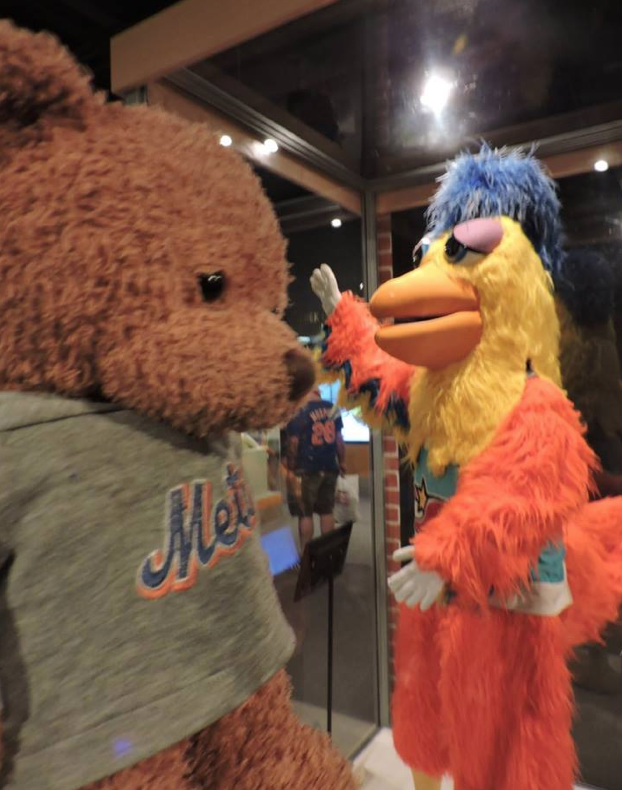
Exhibits included Women In Baseball, The African-American Baseball Experience and Viva Baseball (Latin-American baseball).  There were also wings devoted to baseball by the decades and baseball records, as well as a locker room featuring memorabilia from every team.  The area devoted to the 1970s was particularly interesting to me, even though that era was way before my time.  Two objects that stood out for me were the Andy Warhol painting of Tom Seaver (circa 1977 - not the happiest time to be Tom Seaver or a Mets fan) and the full costume of the San Diego Chicken, who entertained Padres fans at a time when the team wore brown and mustard colored uniforms and still didn't have a no-hitter.  (Well, at least they no longer wear those uniforms.)

The Chicken was lucky he didn't end up inside a Campbell's Soup can that was eventually painted by Warhol.  (EL/SM)

Once I left the '70s behind, I wish I hadn't.  You see, there was also a wing in the Hall of Fame devoted to the 2015 World Series, which I was not too keen on seeing.  (Yes, I took a photo there, but I'm not very happy about it.  If you absolutely must see it, just click here.  If the link doesn't take you to the photo, consider it a good thing.)

But enough about last year.  You want to see the Hall of Fame plaques, right?  Of course you do.  Well, you can always Google those.  There's an abundance of those photos on the interwebs.  At the time I went to see the plaques, the spots were still open for Mike Piazza and Ken Griffey Jr.  But at least both players were well-represented in the gift shop.

By the time you read this, the plaques will be there.  Please buy a jersey while you wait.  (EL/SM)

Another place they were well-represented was in their special wings.  Both Piazza and Griffey had their own section in the Hall featuring memorabilia and photos taken at various points of their distinguished careers.

Bee and I enjoyed this section very much, although I was disappointed that Piazza's area had too much focus on the other teams he played for compared to Griffey.  Griffey was a member of the Cincinnati Reds longer than Piazza was a Met, but Mariners fans like Bee will be happy to know that his wing almost exclusively features him as a Seattle Mariner.   With Piazza, it was as if the Mets were just a stop on his baseball journey.  Take a look at the photos to see what I mean.

At least Bee got what our petty cash tin paid for in the Griffey wing.  (EL/SM)

Finally, on Sunday we attended the Hall of Fame induction ceremony at the Clark Sports Center, which is about a one mile trudge from the Hall of Fame building.  We had left our blankets and lawn chairs there overnight just to reserve a spot.  By the time we got there Sunday morning, there were nearly 50,000 other people who had claimed spots around us.  That's more people than the capacity at Citi Field, even when they're selling standing room only tickets!

We were sitting too far away for my photographer to get any clear shots of the dozens of Hall of Famers sitting on the stage and the two new ones standing at the podium, but all you need to know about the ceremony can be summed up in this one photo taken off the big screen after both Piazza and Griffey had given their spectacular tear-filled speeches.

During the ceremony, Mets fans gave Piazza lots of TLC, while Griffey wore his hat 2 da back.  (EL/SM)

So that's all for this special edition of Joey's World Tour.  The next installment will come sooner than you expect, as we are planning on following the Mets to Detroit's Comerica Park next weekend.  I wonder what food options they have there...

Oh, before I forget, I have one more anecdote to share with you.  You see, a week after Mike Piazza entered the Hall of Fame in Cooperstown, the Mets had a special ceremony of their own at Citi Field to retire Piazza's No. 31.  And about that plaque I mentioned before that wasn't at Cooperstown when I was there - well, it made the trip to Citi Field, and I was fortunate enough to get a photo with it before it made its return trip to the National Baseball Hall of Fame and Museum.  (You don't have to Google it like I said before.  I'll be kind enough to share it with you here.)  My photographer also took lovely photos (for a change) of Piazza's former Mets teammates - Cliff Floyd, Edgardo Alfonzo and Al Leiter - who attended the Citi Field ceremony, as well as the new retired No. 31 that now sits atop the ballpark.

The Piazza celebration is complete now that the No. 31 has been retired at Citi Field.  (EL/SM)

Mike Piazza was very special to me.  You see, on the day I was "born" at Shea Stadium in 2004, Piazza was being celebrated in an on-field celebration (which seems to be a common theme in this blog post).  A dozen years ago, the Mets were celebrating the fact that he had just become the game's top home run hitting catcher.  They invited Carlton Fisk and Johnny Bench to attend the ceremony, and Ivan Rodriguez was also there in uniform as a member of the Detroit Tigers, the Mets' opponent that day.  That was my first baseball experience - seeing a celebration of Mike Piazza.  So it's fitting that I got to see him receive the ultimate honors of being inducted into the Baseball Hall of Fame and having his number retired by the Mets.

So on that note, now that I'm done with Cooperstown and the two-weekend celebration of Mike Piazza, I think I'm going to rest up to make sure I'm fully awake for next weekend's getaway to Michigan to see the Mets play the Tigers, which is a rematch of that first Mets game I saw in person back in 2004.  Got any suggestions where I can hibernate for the week?  Maybe a large place where a bear can feel like home?


This place on the way back from Cooperstown seems like a good place for a bear to crash.  (EL/SM)

Take care, Mets fans.  I hope to talk to you again once I've completed the next leg of my baseball world tour!


For previous installments of Joey's World Tour, please click on the links below, where you will be entertained by Joey's wit, photos and love of ballpark cuisine:

World Tour Stop #1: Baltimore
World Tour Stop #2: Washington, DC
World Tour Stop #3: Pittsburgh
World Tour Stop #4: Texas
World Tour Stop #5: Los Angeles
World Tour Stop #6: San Diego
World Tour Stop #7: Toronto
World Tour Stop #8: Chicago (NL)
World Tour Stop #9: Milwaukee
World Tour Stop #10: Seattle
World Tour Stop #11: Cleveland
World Tour Stop #12: Brooklyn (Ebbets Field site) and Manhattan (Polo Grounds site)
World Tour Stop #13: Baltimore (again) and Pittsburgh (part deux)
World Tour Stop #14: Cincinnati
World Tour Stop #15: Colorado


Friday, July 22, 2016

30 Years Ago: The Game That Epitomized the 1986 Mets

Ray Knight tried to take Eric Davis's face clean off his face.  (MLB screen shot)

The 1986 Mets were a fighting team, both literally and figuratively.  They always fought back when faced with adversity and they never backed down from a fight (or four).  This never-say-die attitude carried the Mets to a team-record 108 victories and a world championship in October.

The team's 62nd win of the year probably epitomized the Mets more than any other game they played in 1986.  Their game at Riverfront Stadium in Cincinnati had it all.

It had Darryl Strawberry being ejected by home plate umpire Gerry Davis for arguing a questionable strikeout call.

It had a brawl that cleared both benches (except for George Foster, who was thinking about what kids' impressions of him would be had he joined the fracas - he should have thought what they would think of his awful "Get Metsmerized" album instead).

It had Gary Carter participating in a double play as the 80th third baseman in team history.  (Since then, there have been 81 additional players to man the hot corner for the Mets, giving the team 161 third sackers, or 96 fewer players than have played left field.  Funny how everyone talks about all the third basemen in club history, but no one ever talks about the 257 left fielders.)

It had one of those 257 left fielders - Roger McDowell - playing musical chairs with his lefthanded pitching counterpart, Jesse Orosco, as manager Davey Johnson rotated McDowell and Orosco between the pitching mound and the outfield when the team ran out of players due to ejections and other substitutions.

It had a tie-breaking three-run homer by Howard Johnson - playing shortstop at the time - to give the Mets a hard-fought (pun very much intended) victory in the 14th inning.  It was the team's second five-hour game in three days after they dropped the finale in Houston in 15 innings two days earlier on a controversial call at the plate by umpire Greg Bonin.  (And that 15-inning affair came two days after four Mets players were famously arrested for - what else - fighting some crooked cops at Cooter's.)

The game in Cincinnati on July 22, 1986 - thirty years ago today - most definitely had it all.  And almost all of it would never have happened had three-time Gold Glove winner Dave Parker not enraged then-Reds closer John Franco by dropping what should have been the final out of the game in the ninth inning...

I hope you enjoy the video, courtesy of ClassicMLB11 on YouTube, which shows the entire game (including commercials!!).  For those not interested in sitting through five hours of sometimes grainy video, the Strawberry at-bat and subsequent ejection happen around the 1 hour, 36 minute mark.  The Parker gaffe occurred at 2 hour and 56 minutes.  The fight began around 3 hours and 29 minutes, then continues for many minutes after that.  Gary Carter playing third base and turning two happens at 4 hours, 20 minutes.  HoJo's homer occurs at 4 hours, 53 minutes.  And Orosco and McDowell rotate throughout extra innings.  Enjoy!

Shoutout to ClassicMLB11 for posting this video of the Reds' TV broadcast from 7/22/86.


Thursday, September 3, 2015

Curtis Granderson's Resurgence Keeps the Naysayers at Bay

Curtis Granderson is rarely without a smile.  His 2015 production is making everybody smile.  (Ed Leyro/Studious Metsimus) 

Curtis Granderson did not have a good year offensively in 2014 - the first of four campaigns he was under contract with the Mets.  In his first season in Flushing, Granderson posted a .227/.326/.388 slash line.  The right fielder failed to record 50 extra-base hits and did not reach double-digit stolen bases after having seven straight seasons with 50+ XBH and six consecutive campaigns with 10+ SB through 2012, averaging 66 XBH and 18 SB per season.  (Granderson played just 61 games in 2013, notching 22 extra-base hits and eight steals.)  Granderson did lead the team in one offensive category in his first year, striking out 141 times in 564 at-bats.

But unlike the other free agent outfielder signed to a long-term deal by the Mets in the post-Shea Stadium era (Jason Bay), Granderson has turned things around quite nicely in his second season at Citi Field.  Through the team's first 133 games in 2015, Granderson has produced a .258/.351/.457 slash line, racking up 52 extra-base hits (28 doubles, one triple, 23 homers) and stealing 11 bases.  He has also scored 77 runs, has 59 RBI - a high number for a leadoff hitter - and has drawn 69 walks.

A year after he had fans wishing the team had never signed him to a four-year deal, Granderson is now leading the team in hits, walks, runs scored, home runs, RBI and stolen bases.  And that's not something that has happened much in team history.  Here are the players who have led the Mets in all six categories over a full season, with Granderson's numbers included in the mix.


Player
Year
Hits
Walks
Runs
HR
RBI
SB
Lee Mazzilli
1980
162
82
82
16
76
41
Howard Johnson
1989
164
77
104
36
101
41
Curtis Granderson
2015
128
69
77
23
59
11


In addition to Mazzilli, HoJo and Granderson, only two other players have led the team in five of the six categories in one season.  Darryl Strawberry's 1987 campaign saw him lead the Mets in walks (97), runs (108), home runs (39), RBI (104) and stolen bases (36).  However, the Straw Man finished third on team in hits behind Keith Hernandez and Kevin McReynolds.  David Wright has twice led the team in five of the six categories in a season.  The team's all-time leader in several offensive categories led the club in everything but home runs in 2009, finishing two taters behind unlikely team leader Daniel Murphy.  Three years later, Wright once again led the Mets in hits, walks, runs scored, RBI and stolen bases, but finished second to Ike Davis in home runs.

Should Granderson remain the team leader in the six offensive categories over the final month of the 2015 campaign, he would become just the third Met in franchise history to finish first in all six over a full season.  And he'd accomplish something never accomplished by Strawberry, Wright, Tommie Agee, Cleon Jones and other five-tool players that have worn a Mets uniform over the years.

Last year was widely considered to be a subpar season for Granderson, even though he hit 20 HR and drew 77 walks - the two categories coveted by Mets general manager Sandy Alderson.  The next time Granderson takes ball four in 2015, he will have his second consecutive 20 HR/70 BB campaign, which would make him just the tenth Met to have multiple seasons reaching both totals, joining Strawberry (1984-88, 1990), Johnson (1987-89, 1991), Todd Hundley (1996-97), John Olerud (1997-98), Edgardo Alfonzo (1999-2000), Robin Ventura (1999-2001), Wright (2005, 2007-08, 2012), Carlos Beltran (2006, 2008) and Carlos Delgado (2006, 2008).  You may know some of those players as among the best offensive stars in team history.

Granderson has two years left on the four-year, $60 million contract he signed prior to the 2014 season.  His first year left a lot to be desired.  But his second season has seen him lead the team's offensive charge in ways that have rarely been seen in club annals.  It remains to be seen how the rest of his tenure in Flushing will unfold.  But one thing is for sure.  Curtis Granderson is earning every penny of his contract this season.  He's regularly reaching base with hits and walks.  He's driving the ball out of the park.  He's running the bases with aplomb.  And he's hitting in the clutch, driving in his teammates from a spot in the batting order not usually known for its run-production.

The Mets owe their resurgence to a player whose renaissance couldn't have come at a better time.
 

Sunday, November 16, 2014

Doc Gooden's Greatness On The Mound Extended Past The 1986 Season

Photo by Ray Stubblebine/AP

Dwight Gooden, the Mets' hurler who helped exhume the team from Grant's Tomb and brought Shea Stadium back to life in the mid-'80s, is celebrating his 50th birthday today.  When Gooden was at his peak three decades ago, the baseball cognoscenti agreed that his first three seasons in the major leagues were among the best by a young pitcher in the game's history.  Gooden took the mound 99 times from 1984 to 1986, going 58-19 with a 2.28 ERA, 1.04 WHIP, 35 complete games, 13 shutouts and 744 strikeouts - reaching 200 or more strikeouts in each season.

But after off-the-field problems came to light prior to the 1987 campaign, Gooden went from being Dr. K to being Dr. Just OK.  Or did he?

From 1987 to 1991, Doc's numbers were clearly not the same as they were during his first three seasons.  But they were still pretty darn good.  In his fourth through eighth seasons with the Mets, Gooden went 74-34 with a 3.39 ERA and 1.23 WHIP, striking out 797 batters, completing 22 games and tossing eight shutouts.  He also finished in the top five in the Cy Young Award voting twice.  (Gooden was fifth in the Cy Young balloting in 1987 and fourth in 1990.)  He accomplished all of this from 1987 to 1991 despite making fewer than 28 starts in three of the five seasons.

Perhaps his greatest and most underappreciated accomplishment occurred in 1991.  After seven consecutive seasons of winning 87 or more games, the Mets finished under .500 in '91.  But Gooden still managed to finish with a 13-7 record, 3.60 ERA and 150 strikeouts in only 27 starts.  In 15 of those 27 starts, Gooden allowed two earned runs or fewer, but received losses or no-decisions in six of the games, mainly because he was surrounded by a putrid offense.

Keith Miller (.280) and Gregg Jefferies (.272) were the only players with 300 or more plate appearances to finish the year with a batting average north of .260.  Howard Johnson (38 HR, 117 RBI, 108 runs) was the sole Met with more than 16 homers, 74 RBI or 65 runs scored.  Gooden basically had to help himself when he was in the game, as he batted .238 with three doubles, a homer, six RBI and seven runs scored in only 63 at-bats.  His .333 slugging percentage was higher than the marks posted by Mark Carreon (.331 in 254 AB), Vince Coleman (.327 in 278 AB) and Garry Templeton (.306 in 219 AB).

In the five seasons immediately following the 1986 championship campaign, when Gooden supposedly went from being a great pitcher to just being a very good pitcher, the right-hander's winning percentage was .685 in 137 starts.  That was the highest winning percentage for all pitchers who made 100 or more starts from 1987 to 1991.  The rest of the top five included Dave Stieb, Roger Clemens, Bob Welch and Dave Stewart - pitchers who combined to win 909 games over their long and successful major league careers.


Player W-L% GS W L ERA FIP BA OBP SLG OPS
Dwight Gooden .685 137 74 34 3.39 2.78 .249 .304 .342 .647
Dave Stieb .667 137 68 34 3.32 3.78 .226 .306 .332 .638
Roger Clemens .662 172 94 48 2.74 2.61 .227 .284 .329 .613
Bob Welch .662 174 88 45 3.47 3.93 .245 .313 .375 .689
Dave Stewart .629 181 95 56 3.54 3.66 .246 .314 .366 .680
Provided by Baseball-Reference.com: View Play Index Tool Used
Generated 11/15/2014.


The Mets averaged nearly 99 wins a season from 1984 to 1986, with Gooden accounting for 58 of the team's 296 wins in those three campaigns.  Although several stints on the disabled list caused Gooden to miss significant time in 1987, 1989 and 1991, Doc still won 74 games in the five years immediately following the team's championship in 1986.

Averaging 27 starts per season from 1987 to 1991 should have allowed other National League pitchers to finish well ahead of Gooden in wins, but that never happened.  In fact, only Doug Drabek won more games in the Senior Circuit than Dwight Gooden did during that five-year stretch, as seen in the chart below.


Player W G GS CG SHO W-L% IP H BB SO
Doug Drabek 77 165 162 26 12 .602 1106.0 1009 283 643
Dwight Gooden 74 139 137 22 8 .685 969.0 911 283 797
Greg Maddux 73 171 168 32 9 .549 1143.0 1107 374 718
Tom Browning 72 176 175 19 5 .576 1141.1 1123 297 573
David Cone 67 155 138 27 10 .620 994.2 829 336 945
Provided by Baseball-Reference.com: View Play Index Tool Used
Generated 11/15/2014.


When Gooden was at his best from 1984 to 1986, he was the league's premier strikeout pitcher, fanning 200 or more batters in each of his first three seasons and averaging nearly 250 Ks per year.  Gooden's propensity for throwing strike three earned him the nickname Dr. K, but just because he wasn't leading the league in strikeouts from 1987 to 1991 as he did in his first two seasons didn't mean he was no longer frustrating batters at the plate.

In his fourth through eighth seasons in the big leagues, the good Doctor struck out 797 batters.  Only one pitcher in the National League had more strikeouts than Gooden did during those five "post-dominant Doc" seasons - his teammate, David Cone, who won two strikeout titles of his own in 1990 and 1991.


Player SO SO/9 SO/BB K% GS W L W-L% IP BF
David Cone 945 8.55 2.81 23.1% 138 67 41 .620 994.2 4092
Dwight Gooden 797 7.40 2.82 19.8% 137 74 34 .685 969.0 4023
Sid Fernandez 733 8.40 2.55 22.8% 128 48 40 .545 785.2 3211
Mike Scott 719 7.13 2.72 19.4% 134 59 46 .562 908.0 3715
Greg Maddux 718 5.65 1.92 14.9% 168 73 60 .549 1143.0 4831
Provided by Baseball-Reference.com: View Play Index Tool Used
Generated 11/15/2014.


There's one last thing that won't show up in a boxscore or a Baseball Reference chart that helps assess Dwight Gooden's value to the Mets after his first three historic seasons with the team.  During the five-year period from 1987 to 1991, Gooden was outstanding at helping the Mets win games that immediately followed a loss, thereby preventing the Mets from suffering through extended losing streaks.  In Gooden's 137 starts during those five years, 65 of them came after a loss by the team.  The Mets' record in those 65 contests was 41-24, giving the team a .631 winning percentage in post-loss games started by Doc.  When any other starting pitcher took the mound immediately following a Mets loss during that five-year stretch, the team's record in those games was 147-148, for a .498 winning percentage.  That's how valuable Gooden was to the team after he had supposedly lost his ability to dominate hitters.

Dwight Gooden never had a winning percentage under .650 in any season from 1987 to 1991, while the Mets never posted a winning percentage above .625 in any of those five campaigns.  The entire team stopped being as great as they were in 1986, but not Doc.  He just continued to find ways to win.  If anything, he was one of the main reasons why the team continued to be competitive for as long as they did, until the bottom fell out in the early '90s.

Today is Doc's 50th birthday, making it a perfect day to look back at how golden he was not just during his first three seasons with the Mets, but in the years immediately following the team's World Series championship.  The baseball pundits might say Gooden wasn't the same pitcher after 1986, but that didn't make him any less valuable to the Mets.  The numbers don't lie.  Doc Gooden never lost his ability to be among the best pitchers in the league even when his club stopped being one of the best teams in the league.