Showing posts with label Lenny Dykstra. Show all posts

Wednesday, August 16, 2017

30 Years Ago Today: Mets Score Club Record 23 Runs in a Game

The late Harry Caray probably wishes he hadn't been taken out to the ballgame on August 16, 1987.

The New York Mets are currently playing the crosstown rival Yankees in a four-game home-and-home series.  Thirty years ago today, the Mets were playing another of baseball's storied franchises, taking on the Chicago Cubs on a lazy Sunday afternoon at Wrigley Field.  One year after winning the 1986 World Series, the Mets were battling the St. Louis Cardinals for the division title and needed to win the finale of their four-game set against the Cubs after dropping the first three games.  They were in the throes of a poor stretch that saw them lose six out of eight games after they had cut the Cardinals’ lead in the division from 10½ to 3½ games.  In that eight-game stretch, they had scored only 20 runs.  They needed to bust out of their slump quickly if they were going to continue to stay in the race with St. Louis.  Fortunately, the wind was blowing out at Wrigley Field on August 16, 1987 and the Mets’ bats were ready to take advantage.

The starting pitchers were Ron Darling for the Mets and a kid for the Cubs who had just been recalled from the minors after being sent down two weeks earlier due to a poor 6-10 start for the big club.  You may have heard of him.  He was a scrawny 21-year-old kid named Greg Maddux.

The Mets jumped out of the box quickly, scoring three runs in the first inning to take an early lead.  The lead had extended to 7-0 by the time the Cubs came up to bat in the bottom of the fourth inning.  However, Darling struggled in the fourth, giving up a grand slam to catcher Jody Davis.  That was followed up by a home run from the next batter, a rookie who was pinch-hitting for Cubs reliever (and former Met) Ed Lynch.  That neophyte was Rafael Palmeiro, who hit the tenth of his 569 career home runs to cut the Mets lead to 7-5.

Fortunately for Darling, manager Davey Johnson did not remove him from the game despite the poor inning.  He was allowed to put out the fire he started and pitch the minimum five innings required to qualify for the victory.  Because of that, Darling was able to stick around to reap the benefits of the additional fireworks displayed by his teammates as they continued to ride the jet stream out of Wrigley Field.

The Mets immediately responded to the Cubs’ five-run fourth by scoring three runs in the fifth inning and seven additional runs in the sixth.  They now had a commanding 17-5 lead, but the Cubbie carnage continued.  Not satisfied with a lead of a dozen runs, they scored three additional runs in both the seventh and eighth innings.  Jesse Orosco relieved Darling in the seventh and gave up four runs in his inning of work, but by then, the Mets had already put the game away.  A run by Chicago in the ninth inning off Jeff Innis produced the final tally in the Mets’ 23-10 shellacking of the Cubs.

The offense was powered by Lenny Dykstra and Darryl Strawberry.  Eights were wild for the two Met outfielders, as they combined for eight hits, eight runs scored and eight runs batted in.  Strawberry in particular smoked the Cubs’ pitchers, as all four of his hits went for extra bases (two doubles, a triple and a home run).

Dykstra and Strawberry - two smiling California kids who put lots of frowns on Cubs fans' faces on August 16, 1987.

In doing so, Strawberry became just the third Met to produce four extra-base hits in one game, joining Joe Christopher, who accomplished the feat in 1964, and Tim Teufel, who turned the trick just six weeks prior to Strawberry.  Strawberry added a stolen base in the second inning, making him the first Met to collect four extra-base hits and a stolen base in the same game.  The Straw Man was the only Met to accomplish this feat until Yoenis Céspedes matched him with four extra-base hits (three homers, one double) and a steal against the Colorado Rockies on August 21, 2015.

Strawberry also became just the third Met to score five runs in a game, after Lenny Randle in 1978 and Lee Mazzilli in 1979.  In addition, the Straw Man drove in five runs, making him the first Mets player to have a five-run, five-RBI game in franchise history.  The only other Mets to accomplish that rare feat since August 16, 1987 are Edgardo Alfonzo, who produced six runs and five RBI against the Houston Astros on August 30, 1999, and Céspedes in the aforementioned 2015 affair.  He had seven RBI to go with his five runs scored.

Dykstra also made Mets history in the game, becoming the first Met to collect seven at-bats in a nine-inning game.  The only Met to match Dykstra since then is Luis Hernandez, who went 3-for-7 in an 18-5 thrashing of the Cubs in 2010, which, just like Dykstra's record-setting effort 23 years earlier, took place on a lazy Sunday afternoon at Wrigley Field.

Strawberry and Dykstra victimized several Cubs pitchers that day, including starting pitcher Greg Maddux.  Maddux collected almost 10% of his 355 career wins against the Mets.  His 35 victories (against 19 losses) are the most by any pitcher against New York.  However, one of his worst pitching performances against the Mets (or any other club) took place on that Sunday afternoon in the North Side of Chicago.

Throughout his major league career, which resulted in a much-deserved call to the Baseball Hall of Fame this year, Maddux was always known as a control pitcher, as he walked fewer than 1,000 batters in over 5,000 innings.  But on August 16, 1987 against the Mets, Maddux pitched 3⅔ innings and was charged with seven earned runs allowed.  He gave up six hits and a very un-Maddux-like five bases on balls.  Let's dissect Maddux's effort to see just how much of an anomaly this game was for him.

Greg Maddux would have preferred starting at Shea Stadium on August 16, 1987.

Greg Maddux made 740 starts in his big league career.  He issued five bases on balls or more in just 20 of those starts.  But in 14 of those 20 starts, he lasted at least six innings, giving him more time to issue those free passes.  Maddux wouldn't have another game in which he lasted fewer than four innings and allowed five or more walks until 2004, a year in which he produced his first ERA above 4.00 since - you guessed it - 1987.

Maddux also allowed seven earned runs in the game, which was the first time he had ever allowed that many runs in one of his starts.  Maddux would go on to allow seven or more earned runs in a start a total of 27 times in his career, including three more times against the Mets, but he never walked more than three batters in any of his other seven-run efforts.  The game on August 16, 1987 was the only time in his 23-year career that Maddux allowed seven or more runs and walked more than three batters.  And that was from a future Hall of Famer who beat the Mets more than any other pitcher in the 56-year history of the club.

Going into their series finale against the Cubs on August 16, 1987, the Mets were in a hitting slump and got out of it in a major way at Wrigley Field.  They scored more runs in that one game than they did in their previous eight contests combined.  By doing so, the Mets established a new franchise record with their 23-run outburst in Chicago and were able to use that game as a stepping stone that carried them all the way until the last week of the season, when they were eliminated from playoff contention by the Cardinals.  And it all happened exactly 30 years ago today.


Sunday, July 31, 2016

Joey's World Tour: Won't You Take Me To ... Cooperstown?

My sister, Bee, joined me as Mike Piazza and Ken Griffey Jr. entered the Hall of Fame.  (Ed Leyro/Studious Metsimus)

Hi, everyone!  This is your fav'rit roving reporter, Joey Beartran.  And this edition of my baseball world tour took me to a place where there is no major league baseball team, but there's certainly no shortage of baseball.

With Mike Piazza and Ken Griffey Jr. being elected into the Hall of Fame this year, it seemed like a perfect time for me (a Mets fan) and my sister, Bee (a Mariners fan), to venture 200 miles northwest of Citi Field to Cooperstown.  The Hall is located on Main Street, in an area full of baseball themed stores.  And during Hall of Fame weekend, those stores hosted many former athletes, including several Mets players of days gone by.

My photographer took several photos of these former players, but he failed to inform me that two members of the 1969 World Champion Mets found it amusing that among the many websites covering Hall of Fame weekend, one of them sent a bear instead of a human.  Needless to say, they smiled a little too much for the camera.

It's almost as if Art Shamsky and Ed Kranepool had never seen a roving reporter that's also a bear.  (EL/SM)

In addition to members of the Mets' first championship squad, there were also players from their second title team, such as Mookie Wilson, Howard Johnson and Lenny Dykstra.  I heard Jesse Orosco was also signing autographs and posing for photos with fans, but I was eating a hot dog at the time and didn't want mustard to accidentally appear on the side of my mouth in the photo.  If Shamsky and Kranepool were laughing when my face was mustard-free, how would Messy Jesse have reacted at the sight of Messy Joey?

At least Mookie, Lenny and HoJo didn't make fun of me.  (EL/SM)

Soon after meeting the Mets, meeting the Mets (again), stepping right up and greeting the Mets (for a small fee), the Hall of Fame parade began.

Thousands of people lined up on Main Street to see their favorite former players go by in the back of a Ford pickup truck.  Because who doesn't want to see Tom Glavine being taken hostage hanging out in the back of a moving pickup truck?  Missing among the living Hall of Famers were three former Mets (Nolan Ryan, Tom Seaver, Roberto Alomar), but hey, at least we got Glavine to make up for them.

No comment.  (EL/SM)

Other Hall of Famers who took part in the parade included Jim Bunning, Johnny Bench, Reggie Jackson, Rollie Fingers, Eddie Murray, Pedro Martinez and Randy Johnson, to name a few.  They were all smiles throughout the route.  (Even Eddie Murray!)  But of course, my photographer captured players like Mike Schmidt, George Brett and Dennis Eckersley at their surliest.  Because his sense of timing is awful.

Smile!  You're on Candid Studious Metsimus Camera!  (EL/SM)

The parade ended at the Hall of Fame building, which is the crown jewel of Cooperstown.  We entered the Hall three and a half hours before closing time.  By the time we got around to the gift shop, the employees were getting ready to kick us out.  (Not literally.  They were actually very polite.)  There was so much to see and do in the Hall, we could have easily spent more than three and a half hours there.

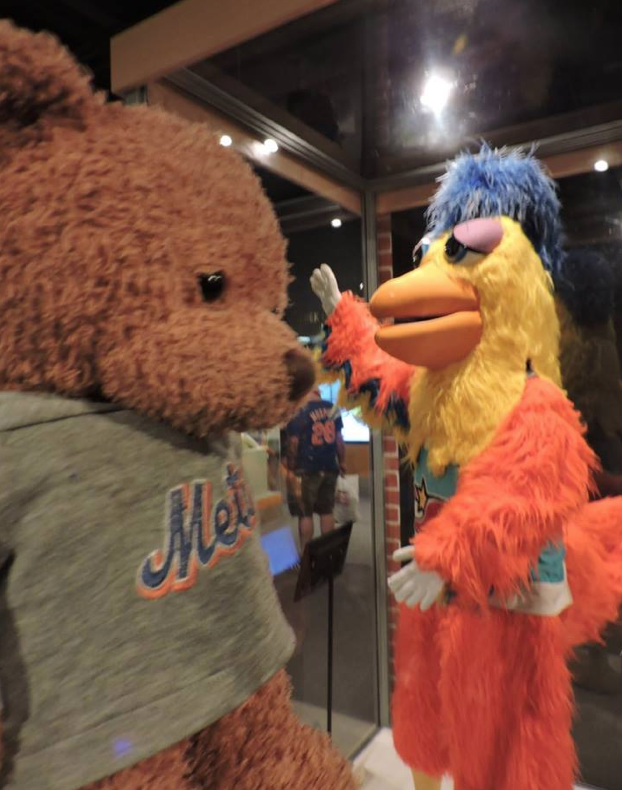
Exhibits included Women In Baseball, The African-American Baseball Experience and Viva Baseball (Latin-American baseball).  There were also wings devoted to baseball by the decades and baseball records, as well as a locker room featuring memorabilia from every team.  The area devoted to the 1970s was particularly interesting to me, even though that era was way before my time.  Two objects that stood out for me were the Andy Warhol painting of Tom Seaver (circa 1977 - not the happiest time to be Tom Seaver or a Mets fan) and the full costume of the San Diego Chicken, who entertained Padres fans at a time when the team wore brown and mustard colored uniforms and still didn't have a no-hitter.  (Well, at least they no longer wear those uniforms.)

The Chicken was lucky he didn't end up inside a Campbell's Soup can that was eventually painted by Warhol.  (EL/SM)

Once I left the '70s behind, I wish I hadn't.  You see, there was also a wing in the Hall of Fame devoted to the 2015 World Series, which I was not too keen on seeing.  (Yes, I took a photo there, but I'm not very happy about it.  If you absolutely must see it, just click here.  If the link doesn't take you to the photo, consider it a good thing.)

But enough about last year.  You want to see the Hall of Fame plaques, right?  Of course you do.  Well, you can always Google those.  There's an abundance of those photos on the interwebs.  At the time I went to see the plaques, the spots were still open for Mike Piazza and Ken Griffey Jr.  But at least both players were well-represented in the gift shop.

By the time you read this, the plaques will be there.  Please buy a jersey while you wait.  (EL/SM)

Another place they were well-represented was in their special wings.  Both Piazza and Griffey had their own section in the Hall featuring memorabilia and photos taken at various points of their distinguished careers.

Bee and I enjoyed this section very much, although I was disappointed that Piazza's area had too much focus on the other teams he played for compared to Griffey.  Griffey was a member of the Cincinnati Reds longer than Piazza was a Met, but Mariners fans like Bee will be happy to know that his wing almost exclusively features him as a Seattle Mariner.   With Piazza, it was as if the Mets were just a stop on his baseball journey.  Take a look at the photos to see what I mean.

At least Bee got what our petty cash tin paid for in the Griffey wing.  (EL/SM)

Finally, on Sunday we attended the Hall of Fame induction ceremony at the Clark Sports Center, which is about a one mile trudge from the Hall of Fame building.  We had left our blankets and lawn chairs there overnight just to reserve a spot.  By the time we got there Sunday morning, there were nearly 50,000 other people who had claimed spots around us.  That's more people than the capacity at Citi Field, even when they're selling standing room only tickets!

We were sitting too far away for my photographer to get any clear shots of the dozens of Hall of Famers sitting on the stage and the two new ones standing at the podium, but all you need to know about the ceremony can be summed up in this one photo taken off the big screen after both Piazza and Griffey had given their spectacular tear-filled speeches.

During the ceremony, Mets fans gave Piazza lots of TLC, while Griffey wore his hat 2 da back.  (EL/SM)

So that's all for this special edition of Joey's World Tour.  The next installment will come sooner than you expect, as we are planning on following the Mets to Detroit's Comerica Park next weekend.  I wonder what food options they have there...

Oh, before I forget, I have one more anecdote to share with you.  You see, a week after Mike Piazza entered the Hall of Fame in Cooperstown, the Mets had a special ceremony of their own at Citi Field to retire Piazza's No. 31.  And about that plaque I mentioned before that wasn't at Cooperstown when I was there - well, it made the trip to Citi Field, and I was fortunate enough to get a photo with it before it made its return trip to the National Baseball Hall of Fame and Museum.  (You don't have to Google it like I said before.  I'll be kind enough to share it with you here.)  My photographer also took lovely photos (for a change) of Piazza's former Mets teammates - Cliff Floyd, Edgardo Alfonzo and Al Leiter - who attended the Citi Field ceremony, as well as the new retired No. 31 that now sits atop the ballpark.

The Piazza celebration is complete now that the No. 31 has been retired at Citi Field.  (EL/SM)

Mike Piazza was very special to me.  You see, on the day I was "born" at Shea Stadium in 2004, Piazza was being celebrated in an on-field celebration (which seems to be a common theme in this blog post).  A dozen years ago, the Mets were celebrating the fact that he had just become the game's top home run hitting catcher.  They invited Carlton Fisk and Johnny Bench to attend the ceremony, and Ivan Rodriguez was also there in uniform as a member of the Detroit Tigers, the Mets' opponent that day.  That was my first baseball experience - seeing a celebration of Mike Piazza.  So it's fitting that I got to see him receive the ultimate honors of being inducted into the Baseball Hall of Fame and having his number retired by the Mets.

So on that note, now that I'm done with Cooperstown and the two-weekend celebration of Mike Piazza, I think I'm going to rest up to make sure I'm fully awake for next weekend's getaway to Michigan to see the Mets play the Tigers, which is a rematch of that first Mets game I saw in person back in 2004.  Got any suggestions where I can hibernate for the week?  Maybe a large place where a bear can feel like home?


This place on the way back from Cooperstown seems like a good place for a bear to crash.  (EL/SM)

Take care, Mets fans.  I hope to talk to you again once I've completed the next leg of my baseball world tour!


For previous installments of Joey's World Tour, please click on the links below, where you will be entertained by Joey's wit, photos and love of ballpark cuisine:

World Tour Stop #1: Baltimore
World Tour Stop #2: Washington, DC
World Tour Stop #3: Pittsburgh
World Tour Stop #4: Texas
World Tour Stop #5: Los Angeles
World Tour Stop #6: San Diego
World Tour Stop #7: Toronto
World Tour Stop #8: Chicago (NL)
World Tour Stop #9: Milwaukee
World Tour Stop #10: Seattle
World Tour Stop #11: Cleveland
World Tour Stop #12: Brooklyn (Ebbets Field site) and Manhattan (Polo Grounds site)
World Tour Stop #13: Baltimore (again) and Pittsburgh (part deux)
World Tour Stop #14: Cincinnati
World Tour Stop #15: Colorado


Sunday, June 19, 2016

Memories of Baseball on Father's Day

As we reach another Father's Day, let's take a break from discussing the Mets' recent ups and downs (mostly downs).  Today is not a day to discuss why the Mets seem to have fewer timely hits than Kajagoogoo, nor is a day to talk about how the Mets lead the league in mental errors.  (Sending Flores to the plate with no outs in the ninth?  Really?)  Rather, today is a day to reflect on a special man in our lives.

He is the man who more than likely showed us how to throw our first curveball, took us to our first ballgame and showed us the proper way to order a ballpark hot dog (which I seem to have forgotten once prices passed the $4.00 mark).  I'm talking about fathers.

Just as we have surely had many Father's Day memories, both pleasant and not so pleasant, the Mets and Major League Baseball have also had a number of noteworthy moments on Father's Day.  Here's a small sample:


       HAPPY FATHER'S DAY!       HAPPY FATHER'S DAY!       HAPPY FATHER'S DAY!


On Father's Day 2004 (June 20), Cincinnati Reds outfielder (and new Hall of Famer) Ken Griffey Jr. hit the 500th home run of his career at St. Louis' Busch Stadium.  At the time, he was the youngest player to reach that milestone.  Making it more fitting, Ken Griffey Sr. was in attendance to help celebrate his son's momentous occasion.

Nothing like a little Griffey love to get this post started.

On Father's Day 1997 (June 15), Major League Baseball instituted its first Home Run Challenge to benefit prostate cancer research.  Now in its 20th season, the Home Run Challenge has raised nearly $45 million in the hopes that a cure can be found for this devastating disease that affects millions of men worldwide.

(Note to all men reading this.  Please go to your doctors and get checked. Early detection can save your life, enabling you to share many Father's Day moments with your loved ones.)

Early prostate cancer detection is serious business.  Even if it is a pain in the ass.

In one of the most ill-fated trades in Mets history, beloved members of the 1986 World Championship team Lenny Dykstra and Roger McDowell were traded to the Philadelphia Phillies for Juan Samuel on Father's Day 1989 (June 18).  Samuel would have a tumultuous time playing center field for the Mets during his short stay at Shea and was later traded for another dud, Mike Marshall.  Dykstra would become an All-Star in Philadelphia and helped lead the Phillies to the 1993 World Series.  McDowell pitched seven more seasons after the trade and would become famous to Seinfeld fans for his role as the man who spit the magic loogie on Kramer and Newman when they confronted Keith Hernandez after a Mets loss. 

Just as Tom Seaver's trade is known as the Midnight Massacre, this day should be known as The Day The Hotfoot Died.  On a lighter note, sales of Jheri Curl products increased in the New York metropolitan area ... by one.

"Let your Soul Glo..."

Jim Bunning of the Philadelphia Phillies pitched a perfect game at Shea Stadium on Father's Day in 1964 (June 21) when he defeated the Mets by the final score of 6-0.  Bunning struck out ten batters en route to becoming the first National League pitcher to toss a perfect game in the 20th century and the first pitcher in the modern era to throw a no-hitter in both leagues.  He pitched his first no-hitter in 1958 as a member of the Detroit Tigers.

Hall of Famer Jim Bunning made Shea Stadium's first Father's Day game a memorable one.

Please forgive the abundance of Phillies pictures in this post.  It is unintentional and is not meant to dampen your Father's Day festivities in any way.  If so, the photo beneath the next paragraph should bring a smile to your face, especially if you are a long-time Mets fan.

Ralph Kiner was always the king of malapropisms.  From classic lines such as "if Casey Stengel were alive today, he'd be spinning in his grave" and "all of his saves have come in relief appearances", Ralph mangled words and phrases with grace and dignity.  One of his most famous quotes came on Father's Day as well, when during a Mets broadcast, he said "on Father's Day, we again wish you all a happy birthday!"

R.I.P. Ralph Kiner and Bob Murphy.  You will always be missed.

One final note before you go have a catch with your son or daughter.  Mets fans are well aware of the fact that no pitcher in franchise history had pitched a no-hitter before Johan Santana turned the trick on June 1, 2012.  But prior to Santana's gem, the Mets had had several no-hitters pitched against them, including the perfect game tossed by the aforementioned Bunning in 1964.  (Let's not talk about last year's no-nos by San Francisco's Chris Heston and Washington's Max Scherzer.)  Before Santana accomplished his historic feat four years ago, the Mets weren't the only team that had never pitched a no-hitter.

The only team currently without a no-hitter to its credit has also been around since the 1960s.  The San Diego Padres have played 47 years since their inaugural season in 1969 and have never had a no-hitter pitched for them.  Hmm, Padres.  That's Spanish for Fathers.  On that note, I can't think of a more fitting way to end this than by wishing all you fathers out there a Happy Birthday!  (I mean, Father's Day!)


       HAPPY FATHER'S DAY!      HAPPY FATHER'S DAY!      HAPPY FATHER'S DAY! 
 

Saturday, January 23, 2016

Joey's Small Bites: Cespedes and His Fellow Outfielders Could Make Mets Homer History

Hello, all you snowbound Mets fans.  I'm Joey Beartran and despite all the white stuff piling up outside my window, I'm thinking Mets baseball.  And why am I thinking Mets baseball?  Because of the news that the Mets did what no one thought they would do.  No, the Wilpons didn't sell the team.  But they did max out their credit cards.

Just as the first flakes flew last night, the news came out that the Mets had signed Yoenis Cespedes to a three-year, $75 million contract with an opt-out after the first year.  The stunning news that Washington couldn't buy Cespedes for five years and give him a front row seat for Daniel Murphy's next costly error shocked Mets Twitter - myself included.


It became very difficult for me to hibernate for the evening upon hearing that bit of information.  After all, throughout the off-season, Mets fans had been clamoring for the return of Cespedes, but they fully expected him to be out of the Wilpons' price range.  Then the news became official and the numbers starting running through my head.

With Michael Conforto and Curtis Granderson manning the corner outfield positions and Cespedes taking over as the team's center fielder, it occurred to me that the Mets outfield will produce a lot of home runs.  After all, Cespedes hit 35 homers last year between the Tigers and Mets, while Granderson rocketed 26 blasts.  Conforto is still developing his power, but still managed to hit 12 home runs in 91 games in the minors, nine more in 56 games after his promotion to the Mets and added another three in 12 postseason games.  (For all you kids out there, that's 24 HR in 159 games for the 22-year-old Conforto.)

So of course, being the inquisitive bear that I am, I looked back through my archives (you might call it baseball-reference.com) to see how often the Mets have had three power-hitting outfielders at the same time.  My research surprised me almost as much as the Cespedes re-signing did.

The Mets have been in business for 54 seasons.  In that time, only 17 outfielders have ever produced a 20-HR campaign.  (To qualify as a Mets outfielder, the player had to have played at least half of his games in any of the three outfield positions.)  Having a pair of Mets outfielders produce 20 or more homers is even rarer in club annals, especially a pair that didn't have Darryl Strawberry as one of its members.

Prior to 1983, the Mets had never had two outfielders with 20+ homers in the same season.  But from 1983 to 1985, Strawberry and George Foster each reached the 20-homer mark.  Then, from 1987 to 1990, Strawberry and Kevin McReynolds produced 20 or more home runs in each of the four campaigns.  The only time in Mets history that two outfielders not named Darryl Strawberry joined forces to hit 20-plus homers in the same season was in 2004, when center fielder Mike Cameron (30 HR) and right fielder Richard Hidalgo (21 HR) turned the trick.  In fact, that 2004 campaign was the closest the Mets have ever come to having all three outfielders reach the 20-homer mark, as left fielder Cliff Floyd added 18 homers of his own.

Now let's just consider years in which the Mets had three outfielders hitting 15+ homers.  That total might not seem impressive, but it's a feat that's rarely been done by a trio of Mets outfielders.  Here's the tiny group of outfielders, listing the left fielder first, center fielder second and right fielder third.

  • 1965: Ron Swoboda (19 HR), Jim Hickman (15 HR), Johnny Lewis (15 HR)
  • 2000: Benny Agbayani (15 HR), Jay Payton (17 HR), Derek Bell (18 HR)
  • 2004: Cliff Floyd (18 HR), Mike Cameron (30 HR), Richard Hidalgo (21 HR)

That's it.  Only three Mets teams have produced an outfield in which all three players reached the not-so-lofty 15-homer plateau.  Over the years, the Mets have relied more on infielders (Howard Johnson, Carlos Delgado, David Wright, Lucas Duda) and even catchers (Todd Hundley, Mike Piazza) to supply power than they have in their outfielders.

It wouldn't be out of the realm of possibility to see the Conforto-Cespedes-Granderson trio becoming the fourth outfield threesome to bang out 15 homers apiece.  It also wouldn't be a shocker to see them become the first outfield combo in Mets history to each have 20 or more homers.  Conforto, Cespedes and Granderson could also combine to hit the most homers in one season by the team's primary three outfielders.

In 1987, the outfield trio of Strawberry (39 HR), McReynolds (29 HR) and Lenny Dykstra (10 HR) combined to produce 78 home runs, which is a team record for outfielders.  (Dykstra started 24 more games than fellow outfielder Mookie Wilson did in '87.)  The team's three main outfielders have produced 70 or more homers in only two other seasons, with both years involving the Straw Man and Big Mac.

The 1988 squad featured Strawberry once again clubbing 39 homers, while McReynolds hit 27 bombs and Dykstra jacked eight balls out of the park for a combined total of 74 homers.  Two years later, the Strawbery-McReynolds combo was joined by newcomer Daryl Boston, as the 1990 outfield saw left fielder McReynolds (24 HR), center fielder Boston (12 HR) and right fielder Strawberry (37 HR) combine for 73 home runs.

Other than the 1987, 1988 and 1990 clubs, no other Mets team has had its three primary starting outfielders surpass the 70-homer mark between them.  That could change in 2016 now that Yoenis Cespedes and Michael Conforto will each be playing their first full years in New York.

Cespedes hit 35 homers during the entire 2015 regular season.  Conforto combined to hit 21 regular season homers between the minors and majors.  Granderson - the only one of the three outfielders to play the entire season in New York - had 26 homers of his own.

In 2016, the Mets could have a power-hitting outfield that has never been seen before in club annals.  Combine that with the best starting rotation in baseball and a much-improved bullpen and the outfield's home run total might not be the only thing making history for the Mets this upcoming season.

It's enough to make man or beast look forward to warm nights at Citi Field on the snowiest of winter days.

Who wouldn't wake to make snow angels the morning after Cespedes re-signs with the Mets?

Sunday, June 21, 2015

Memories of Baseball and Father's Day

As we reach another Father's Day, let's take a break from discussing the Mets' recent ups and downs (mostly downs).  Today is not a day to discuss why Sandy Alderson continues to do nothing about the team's lack of offense, nor is a day to talk about how the Mets lead the league in mental errors this year.  Today is a day to reflect on a special man in our lives.

He is the man who more than likely showed us how to throw our first curveball, took us to our first ballgame and showed us the proper way to order a ballpark hot dog (which I seem to have forgotten once prices passed the $4.00 mark).  I'm talking about fathers.

As we have had many Father's Day memories, both pleasant and not so pleasant, the Mets and Major League Baseball have also had a number of noteworthy moments on Father's Day.  Here's a small sample:


       HAPPY FATHER'S DAY!       HAPPY FATHER'S DAY!       HAPPY FATHER'S DAY!


On Father's Day 2004 (June 20), Cincinnati Reds outfielder Ken Griffey Jr. hit the 500th home run of his career at St. Louis' Busch Stadium.  At the time, he was the youngest player to reach that milestone.  Making it more fitting, Ken Griffey Sr. was in attendance to help celebrate his son's momentous occasion.

Nothing like a little Griffey love to get this post started.

On Father's Day 1997 (June 15), Major League Baseball instituted its first Home Run Challenge to benefit prostate cancer research.  Now in its 19th season, the Home Run Challenge has raised nearly $45 million in the hopes that a cure can be found for this devastating disease that affects millions of men worldwide.

(Note to all men reading this.  Please go to your doctors and get checked. Early detection can save your life, enabling you to share many Father's Day moments with your loved ones.)

Early prostate cancer detection is serious business.  Even if it is a pain in the ass.

In one of the most ill-fated trades in Mets history, beloved members of the 1986 World Championship team Lenny Dykstra and Roger McDowell were traded to the Philadelphia Phillies for Juan Samuel on Father's Day 1989 (June 18).  Samuel would have a tumultuous time playing center field for the Mets during his short stay at Shea and was later traded for another dud, Mike Marshall.  Dykstra would become an All-Star in Philadelphia and helped lead the Phillies to the 1993 World Series.  McDowell pitched seven more seasons after the trade and would become famous to Seinfeld fans for his role as the man who spit the magic loogie on Kramer and Newman when they confronted Keith Hernandez after a Mets loss. 

Just as Tom Seaver's trade is known as the Midnight Massacre, this day should be known as The Day The Hotfoot Died.  On a lighter note, sales of Jheri Curl products increased in the New York metropolitan area ... by one.

"Let your Soul Glo..."

Jim Bunning of the Philadelphia Phillies pitched a perfect game at Shea Stadium on Father's Day in 1964 (June 21) when he defeated the Mets by the final score of 6-0.  Bunning struck out ten batters en route to becoming the first National League pitcher to toss a perfect game in the 20th century and the first pitcher in the modern era to throw a no-hitter in both leagues.  He pitched his first no-hitter in 1958 as a member of the Detroit Tigers.

Hall of Famer Jim Bunning made Shea Stadium's first Father's Day game a memorable one.

Please forgive the abundance of Phillies pictures in this post.  It is unintentional and is not meant to dampen your Father's Day festivities in any way.  If so, the photo beneath the next paragraph should bring a smile to your face, especially if you are a long-time Mets fan.

Ralph Kiner was always the king of malapropisms.  From classic lines such as "if Casey Stengel were alive today, he'd be spinning in his grave" and "all of his saves have come in relief appearances", Ralph mangled words and phrases with grace and dignity.  One of his most famous quotes came on Father's Day as well, when during a Mets broadcast, he said "on Father's Day, we again wish you all a happy birthday!"

R.I.P. Ralph Kiner and Bob Murphy.  You will always be missed.

One final note before you go have a catch with your son or daughter.  Mets fans are well aware of the fact that no pitcher in franchise history had pitched a no-hitter before Johan Santana turned the trick on June 1, 2012.  But prior to Santana's gem, the Mets had had several no-hitters pitched against them, including the perfect game tossed by the aforementioned Bunning in 1964.  (Let's not talk about this month's no-no by San Francisco's Chris Heston.)  Before Santana accomplished his historic feat three years ago, the Mets weren't the only team that had never pitched a no-hitter.

The only team currently without a no-hitter to its credit has also been around since the 1960s.  The San Diego Padres have played 46 years since their inaugural season in 1969 and have never had a no-hitter pitched for them.  Hmm, Padres.  That's Spanish for Fathers.  On that note, I can't think of a more fitting way to end this than by wishing all you fathers out there a Happy Birthday!  (I mean, Father's Day!)


       HAPPY FATHER'S DAY!      HAPPY FATHER'S DAY!      HAPPY FATHER'S DAY! 
 

Monday, January 5, 2015

One Mo-MET In Time: Mookie Wilson

A legendary player is known for many things.  Mention Willie Mays to a casual baseball fan and that person might bring up the Say Hey Kid's catch in the 1954 World Series or his 660 career home runs.  Fans questioned about Tom Seaver could discuss his near-perfect game in 1969, his three Cy Young Awards or the Midnight Massacre trade to Cincinnati.

But what about players who weren't first ballot Hall of Famers?  Or those who didn't even make an appearance in an All-Star Game?  Naturally, those players are going to be known for far less.  However, every once in a while, a player will do something that he will forever be remembered for.  Whether it be a memorable season, a special game or just a bizarre play, that athlete will have to live with that moment and be linked to it long after his baseball career is over.  And those moments are not always positive - even if the rest of the player's career was - much to the chagrin of that player.

There have been numerous Mets players who will always be known for one thing above anything else they accomplished on a baseball field.  This series will focus on some of those players and discuss not only the primary things for which they are remembered, but also the events and occurrences that may not immediately come to mind or have simply been forgotten that each player was responsible for.

One such player spent an entire decade in a Mets uniform and when he played his final game as a Met, he was the team's all-time leader in multiple offensive categories.  He was also one of the most exciting and beloved players in team history.  But ask anyone about his career and it will always come down to just one moment.

Mookie Wilson should be known for far more than just one memorable moment.

William Hayward Wilson was a second round draft pick in 1977 and quickly advanced through the Mets' minor league system.  His blazing speed helped him leg out 25 triples and steal 87 bases between the Double-A and Triple-A level in 1978 and 1979.  But with All-Star and fan-favorite Lee Mazzilli playing center field at Shea Stadium, Wilson had no position to play at the big league level, so he began the 1980 campaign at AAA-Tidewater.  Also hurting Wilson was the fact that he was solely a right-handed hitter, while Mazzilli batted from both sides of the plate.  So upon returning to Tidewater for a second season, Wilson took it upon himself to learn how to hit left-handed.

The decision paid off beautifully, as the new switch-hitter batted .295 for the Tides with 14 triples, 92 runs scored and 50 stolen bases.  His year at Tidewater caught the eye of the front office, and despite having Mazzilli entrenched in center field, the Mets called up Wilson in September for his first taste of the big leagues.  Wilson batted .248 with three triples, seven steals and 16 runs scored in 27 games.  He wouldn't return to the minors again for six years.

As the 1981 season opened, Wilson still did not have a regular position because of the presence of Lee Mazzilli, so manager Joe Torre platooned Wilson with Joel Youngblood in right field.  But an injury to newly-reacquired first baseman Rusty Staub forced Torre to move left fielder Dave Kingman to first, causing Mazzilli to move to left field, which opened up a spot for Wilson.  Wilson took advantage of the opportunity, leading the team in runs scored (49), triples (8) and stolen bases (24) in the strike-shortened season.

With Wilson claiming center field as his own, the Mets used the opportunity to trade Mazzilli - their main box office attraction since Tom Seaver was dealt away in 1977 - to Texas for two young pitchers, Ron Darling and Walt Terrell.  Darling would go on to become a vital cog in the Mets' resurgence during the mid-'80s, while Terrell was sent to Detroit in a deal that brought Howard Johnson to New York.  Wilson, on the other hand, became a mainstay in the Mets lineup for the next three seasons.

From 1982 to 1984, Wilson was one of the premier leadoff hitters in the National League.  Although he didn't walk much (76 free passes during the three seasons) and struck out a little too much (295 Ks), Wilson ranked in the top ten among all National League hitters in several categories during those three campaigns, including hits (516; 7th in the NL), triples (25; T-3rd), runs scored (269; 7th) and stolen bases (158; 4th).  The lofty stolen base totals allowed Wilson to become the Mets' all-time leader in that category, as he supplanted Lee Mazzilli - Mookie always seemed to be taking something away from Maz whenever he could - when he stole his 140th career base in a game against the Pittsburgh Pirates on September 27, 1983.  And who got a great view of the record-setting theft from the Pirates dugout?  That would be none other than Mazzilli, who by then had been traded to Pittsburgh and had been relegated to pinch-hitting duties.

Wilson was the starting center fielder for the Mets entering the 1985 season, but a sore shoulder limited him to pinch-running duties in late April and early May.  Darryl Strawberry had filled in for Wilson for five games, but the Straw Man was not a center fielder.  Once the Mets realized that Darryl belonged in right, they called up Lenny Dykstra to fill the void left by Wilson.  Dykstra caught the Mets' eye in 1983 when he stole 105 bases at Class A-Lynchburg.  He was a scrappy player who was tough as nails and would go all out to help his team win.  In other words, he was just the type of player manager Davey Johnson loved.

Eventually, Wilson's shoulder required surgery, and the center fielder was out of action for two months during the latter part of the season.  In his absence, Dykstra gave the Mets everything Mookie did.  He ran down fly balls in the gap.  He stretched singles into doubles and doubles into triples.  He stole bases.  But there was one thing Dykstra did far better than Wilson.  He was patient at the plate and had a good eye.  Whereas Mookie struck out four times for every time he walked, Dykstra was more likely to walk than strike out.  In fact, when Dykstra's major league career ended following the 1996 season, he had drawn more walks than strikeouts in ten of his 12 seasons.

Although Wilson wasn't thrilled with losing playing time to the younger Dykstra, he took his new platoon role as a challenge.  Gone were the days when he racked up 600-plus plate appearances.  But in his diminished role, Wilson learned how to become a better hitter.  From 1980 to 1984, Wilson batted .275 with a .309 on-base percentage and a .688 OPS.  Over his next four seasons - all of which involved sharing time with Dykstra - Wilson posted a .290 batting average, reached base at a .345 clip and upped his OPS nearly 100 points to .781.

By the time Wilson played his final game as a Met in 1989, he was the team's all-time leader in runs scored (592), triples (62) and stolen bases (281), and was third in hits (1,112) and doubles (170).  In ten seasons with the Mets, Wilson had become one of the team's best players and had accomplished many positive things with the club.  But one moment stood above all others, and it occurred in what is perhaps the most memorable game ever played by the franchise.

After six-plus seasons in New York, Mookie Wilson finally made it to the postseason in 1986.  A year that began with a dangerous eye injury in spring training (one that required a rehab assignment that saw him play minor league games for the first time since 1980) ended with the Mets' first division title in 13 years.  Mookie's first playoff experience did not start out well on an individual level, as the veteran collected just four hits in his first 36 postseason at-bats.  But one of those hits was a single that plated the first run in the Mets' three-run ninth-inning rally in Game 6 of the National League Championship Series against the Houston Astros.

As hard as it was for Wilson to reach base in his first nine postseason games, it seemed like he was always on base during the final four games of the World Series.  In those four games, Wilson collected six hits, one walk and was hit by a pitch.  He also reached base another way, and did it when the Mets needed it the most.

With the Red Sox one win away from securing their first championship in 68 years, the Mets had to win Game 6 at Shea Stadium to force a deciding seventh game.  The game was tied, 2-2, as the Red Sox came to bat in the seventh inning.  But a walk, a throwing error by third baseman Ray Knight and a groundout produced the go-ahead run for Boston.  The Red Sox had a chance to score a second run in the inning when catcher Rich Gedman lashed a single to left, but Wilson ended the Red Sox rally by throwing out Jim Rice at the plate.

Two Hall of Famers exchange pleasantries at the plate, courtesy of Mookie Wilson's throwing arm.  (Peter Southwick/AP)

New York eventually tied the game to send it to extra innings, but there may not have been a tenth frame had it not been for Mookie Wilson's accurate throw to nail Rice.  Had the Mets won the game in nine innings, Wilson's legacy might have been based on that throw, but the game did not reach its conclusion after each team had recorded 27 outs.

In the top of the tenth inning, Dave Henderson homered to left as Mookie could only watch the ball sail over the wall.  Boston added an insurance run on a Marty Barrett single, which was followed by Bill Buckner getting hit by a pitch.  But Jim Rice, who ended a Red Sox rally in the seventh inning, did so again in the tenth, as he flied out to right.

The Mets were now facing the reality of losing the World Series in front of their home crowd to a team that had not won a title since 1918.  And after Wally Backman and Keith Hernandez flied out to start the bottom of the tenth, that heartbreaking conclusion was becoming more and more likely.  But singles by Gary Carter, Kevin Mitchell and Ray Knight - the latter coming on an 0-2 pitch - brought the Mets to within one run and put the spotlight on the shoulders of Mookie Wilson.

Wilson was never a good breaking ball hitter, and Red Sox closer Bob Stanley - who had been brought into the game to face Wilson - specialized in palm balls, sinkers and sliders.  Four pitches into the at-bat, Wilson had two strikes on him.  It was then that he decided to go to with his mantra, a phrase he had heard in church.

"Thou shalt not pass without offering."

Mookie Wilson was not going to go down without a fight.  He was determined to swing at every pitch, not allowing the game to end on a called third strike.  Simply stated, he was not going to let a pitch pass by without offering at it.  And that's exactly what he did.

Pitch No. 5 was foul tipped.  Barely.  Pitch No. 6 was then fouled off to his left.

Wilson was sticking to his guns, taking aim at every ball fired his way by Stanley.  That is, until pitch No. 7 took aim at him.

With Rich Gedman setting up on the outside part of the plate, Stanley's pitch went inside.  An acrobatic Wilson threw his body out of the way as Gedman's lunged in vain for the errant pitch.  Scoring from third base with the tying run was Mitchell, as Knight moved into scoring position.  The Mets were now a well-placed hit away from tying the game, but Wilson kept placing balls in the left and right field stands.

Pitch No. 8 was fouled off near the first base dugout.  Pitch No. 9 was lined down the left field line and into the crowd.  Then came the tenth pitch of the at-bat, a pitch that Mookie made sure to keep in fair territory.

Wilson chopped the ball into the dirt along the first base line.  The ball took three hops in the direction of a running (some might say hobbling) Bill Buckner.  Buckner, who was already playing with a bad Achilles tendon and had been struck in the ribs by a Rick Aguilera pitch in the top of the tenth, was only on the field because manager John McNamara wanted him to celebrate the final out with his teammates.  Late-inning defensive replacement Dave Stapleton, who had replaced Buckner in the final inning of each of Boston's three victories over the Mets, remained on the bench as the ball took a fourth hop and rolled by Buckner's glove into right field, giving the fragile first baseman a bruised ego to go with his bruised ribs.

Mookie Wilson did not let any strike pass without offering at it, and in doing so, hit the most famous ground ball in Mets history.  It gave the Mets an unlikely victory in Game 6 of the 1986 World Series and helped set up their championship win two nights later.

In the late 1970s, Mookie Wilson's path to the majors was blocked by Lee Mazzilli.  But through perseverance and the will to get better at his craft, Wilson finally achieved his dream of playing in the major leagues.  Similarly, in 1986, Mookie refused to make the final out of the World Series.  And that refusal to give up allowed him to run down the first base line and into the hearts and memories of Mets fans everywhere.

Mookie Wilson was a dynamic player who brought excitement to the game.  He could make an acrobatic catch as easily as he could leg out a triple, steal a base or score from second base on a groundout.  He could do so many things so well that he became the team's all-time leader in several categories.  But all that was overshadowed by a little roller up along first in the biggest game of his life.

Perhaps Mookie said it best in his memoir, "Mookie: Life, Baseball, and the '86 Mets", when he discussed the play that forever changed the course of his life and the Mets franchise.

Photo by Christian Oth/NY Times

  
 "I think everyone has to have a moment that defines them. ... But if you take that moment away and just look at my career numbers, there's nothing that jumps out at you.  So while there may be some regrets over how the play has become the focal point of my career, I wouldn't trade it for anything in the world."


Mets fans wouldn't trade his defining play either.  The tenth inning of Game 6 was one of many reasons why Mookie Wilson will forever be a beloved figure in the Mets community.  But it should come as no surprise that one little dribbler will always overshadow all the other wonderful moments in his career.  It would be almost impossible for it not to.


Note:  One Mo-MET In Time is a thirteen-part weekly series spotlighting those Mets players who will forever be known for a single moment, game or event, regardless of whatever else they accomplished during their tenure with the Mets.  Please come back next week for the next installment.


Saturday, August 16, 2014

August 16, 1987: Mets Score Club-Record 23 Runs

The late Harry Caray probably wishes he hadn't been taken out to the ballgame on August 16, 1987.

Note:  I originally published this piece five years ago on Mets Merized Online, but this Mets game from 1987 has always fascinated me, and I have since uncovered some more oddities about this game.  Therefore, I felt compelled to make some quick edits and share this piece once again with you.  Enjoy!


The New York Mets are currently playing a three-game set against the Chicago Cubs at Citi Field.  Twenty-seven years ago today, the Mets were also playing the Cubs, although the venue on that lazy Sunday afternoon was Wrigley Field in Chicago.  One year after winning the 1986 World Series, the Mets were battling the St. Louis Cardinals for the division title and needed to win the finale of their four-game series against the Cubs after dropping the first three games.  They were in the throes of a poor stretch that saw them lose six out of eight games after they had cut the Cardinals’ lead in the division from 10½ to 3½ games.  In that eight-game stretch, they had scored only 20 runs.  They needed to bust out of their slump quickly if they were going to continue to stay in the race with St. Louis.  Fortunately, the wind was blowing out at Wrigley Field on August 16 and the Mets’ bats were ready to take advantage.

The starting pitchers were Ron Darling for the Mets and a kid for the Cubs who had just been recalled from the minors after being sent down two weeks earlier due to a poor 6-10 start for the big club.  You may have heard of him.  He was a scrawny 21-year-old kid named Greg Maddux.

The Mets jumped out of the box quickly, scoring three runs in the first inning to take an early lead.  The lead had extended to 7-0 by the time the Cubs came up to bat in the bottom of the fourth inning.  However, Ron Darling struggled in the fourth, giving up a grand slam to catcher Jody Davis.  That was followed up by a home run from the next batter, a rookie who was pinch-hitting for Cubs reliever (and former Met) Ed Lynch.  That rookie was Rafael Palmeiro, who hit the tenth of his 569 career home runs to cut the Mets lead to 7-5.

Fortunately for Darling, manager Davey Johnson did not remove him from the game despite the poor inning.  He was allowed to put out the fire he started and pitch the minimum five innings required to qualify for the victory.  Because of that, Darling was able to stick around to reap the benefits of the additional fireworks displayed by his teammates as they continued to ride the jet stream out of Wrigley Field.

The Mets immediately responded to the Cubs’ five-run fourth by scoring three runs in the fifth inning and seven additional runs in the sixth.  They now had a commanding 17-5 lead, but the Cubbie carnage continued.  Not satisfied with a lead of a dozen runs, they scored three additional runs in both the seventh and eighth innings.  Jesse Orosco relieved Darling in the seventh and gave up four runs in his inning of work, but by then, the Mets had already put the game away.  A run by Chicago in the ninth inning off Jeff Innis produced the final tally in the Mets’ 23-10 shellacking of the Cubs.

The offense was powered by Lenny Dykstra and Darryl Strawberry.  Eights were wild for the two Met outfielders, as they combined for eight hits, eight runs scored and eight runs batted in.  Strawberry in particular smoked the Cubs’ pitchers, as all four of his hits went for extra bases (two doubles, a triple and a home run).

Dykstra and Strawberry - two smiling California kids who put lots of frowns on Cubs fans' faces on August 16, 1987.

In doing so, Strawberry became just the third Met to produce four extra-base hits in one game, joining Joe Christopher, who accomplished the feat in 1964, and Tim Teufel, who turned the trick just six weeks prior to Strawberry.  Strawberry added a stolen base in the second inning, making him the first and only Met to collect four extra-base hits and a stolen base in the same game.

Strawberry also became just the third Met to score five runs in a game, after Lenny Randle in 1978 and Lee Mazzilli in 1979.  In addition, the Straw Man drove in five runs, making him the first Mets player to have a five-run, five-RBI game in franchise history.  The only other Met to accomplish that rare feat since August 16, 1987 is Edgardo Alfonzo, who produced six runs and five RBI against the Houston Astros on August 30, 1999.

Dykstra also made Mets history in the game, becoming the first Met to collect seven at-bats in a nine-inning game.  The only Met to match Dykstra since then is Luis Hernandez, who went 3-for-7 in an 18-5 thrashing of the Cubs in 2010, which, just like Dykstra's record-setting effort 23 years earlier, took place on a lazy Sunday afternoon at Wrigley Field.

Strawberry and Dykstra victimized several Cubs pitchers that day, including starting pitcher Greg Maddux.  Maddux collected almost 10% of his 355 career wins against the Mets.  His 35 victories (against 19 losses) are the most by any pitcher against New York.  However, one of his worst pitching performances against the Mets (or any other club) took place on that Sunday afternoon in the North Side of Chicago.

Throughout his major league career, which resulted in a much-deserved call to the Baseball Hall of Fame this year, Maddux was always known as a control pitcher, as he walked fewer than 1,000 batters in over 5,000 innings.  But on August 16, 1987 against the Mets, Maddux pitched 3⅔ innings and was charged with seven earned runs allowed.  He gave up six hits and a very un-Maddux-like five bases on balls.  Let's dissect Maddux's effort to see just how much of an anomaly this game was for him.

Greg Maddux would have preferred starting at Shea Stadium on August 16, 1987.

Greg Maddux made 740 starts in his big league career.  He issued five bases on balls or more in just 20 of those starts.  But in 14 of those 20 starts, he lasted at least six innings, giving him more time to issue those free passes.  Maddux wouldn't have another game in which he lasted fewer than four innings and allowed five or more walks until 2004, a year in which he produced his first ERA above 4.00 since - you guessed it - 1987.

Maddux also allowed seven earned runs in the game, which was the first time he had ever allowed that many runs in one of his starts.  Maddux would go on to allow seven or more earned runs in a start a total of 27 times in his career, including three more times against the Mets, but he never walked more than three batters in any of his other seven-run efforts.  The game on August 16, 1987 was the only time in his 23-year career that Maddux allowed seven or more runs and walked more than three batters.  And that was from a future Hall of Famer who beat the Mets more than any other pitcher in the 53-year history of the club.

Going into their series finale against the Cubs on August 16, 1987, the Mets were in a hitting slump and got out of it in a major way at Wrigley Field.  They scored more runs in that one game than they did in their previous eight contests.  By doing so, the Mets established a new franchise record with their 23-run outburst in Chicago and were able to use that game as a stepping stone that carried them all the way until the last week of the season, when they were eliminated from playoff contention by the Cardinals.  And it all happened 27 years ago today.
 

Sunday, June 15, 2014

Baseball Memories On Father's Day

As we reach another Father's Day, let's take a break from discussing the Mets' recent ups and downs (mostly downs).  Today is not a day to discuss why Sandy Alderson continues to play musical chairs with the Mets' bullpen, nor is a day to talk about how the Mets' loss total is only surpassed by the Cubs, Padres, Diamondbacks and Rays.  Today is a day to reflect on a special man in our lives.

He is the man who more than likely showed us how to throw our first curveball, took us to our first ballgame and showed us the proper way to order a ballpark hot dog (which I seem to have forgotten once prices passed the $4.00 mark).  I'm talking about fathers.

As we have had many Father's Day memories, both pleasant and not so pleasant, the Mets and Major League Baseball have also had a number of noteworthy moments on Father's Day.  Here's a small sample:


       HAPPY FATHER'S DAY!       HAPPY FATHER'S DAY!       HAPPY FATHER'S DAY!


On Father's Day 2004 (June 20), Cincinnati Reds outfielder Ken Griffey Jr. hit the 500th home run of his career at St. Louis' Busch Stadium.  At the time, he was the youngest player to reach that milestone.  Making it more fitting, Ken Griffey Sr. was in attendance to help celebrate his son's momentous occasion.

Nothing like a little Griffey love to get this post started.

On Father's Day 1997 (June 15), Major League Baseball instituted its first Home Run Challenge to benefit prostate cancer research.  Now in its 18th season, the Home Run Challenge has raised over $40 million in the hopes that a cure can be found for this devastating disease that affects millions of men worldwide.

(Note to all men reading this.  Please go to your doctors and get checked. Early detection can save your life, enabling you to share many Father's Day moments with your loved ones.)

Early prostate cancer detection is serious business.  Even if it is a pain in the ass.

In one of the most ill-fated trades in Mets history, beloved members of the 1986 World Championship team Lenny Dykstra and Roger McDowell were traded to the Philadelphia Phillies for Juan Samuel on Father's Day 1989 (June 18).  Samuel would have a tumultuous time playing center field for the Mets during his short stay at Shea and was later traded for another dud, Mike Marshall.  Dykstra would become an All-Star in Philadelphia and helped lead the Phillies to the 1993 World Series.  McDowell pitched seven more seasons after the trade and would become famous to Seinfeld fans for his role as the man who spit the magic loogie on Kramer and Newman when they confronted Keith Hernandez after a Mets loss. 

Just as Tom Seaver's trade is known as the Midnight Massacre, this day should be known as The Day The Hotfoot Died.  On a lighter note, sales of Jheri Curl products increased in the New York metropolitan area ... by one.

"Let your Soul Glo..."

Jim Bunning of the Philadelphia Phillies pitched a perfect game at Shea Stadium on Father's Day in 1964 (June 21) when he defeated the Mets by the final score of 6-0.  Bunning struck out ten batters en route to becoming the first National League pitcher to pitch a perfect game in the 20th century and the first pitcher in the modern era to throw a no-hitter in both leagues.  He pitched his first no-hitter in 1958 as a member of the Detroit Tigers.

Hall of Famer Jim Bunning made Shea Stadium's first Father's Day game a memorable one.

Please forgive the abundance of Phillies pictures in this post.  It is unintentional and is not meant to dampen your Father's Day festivities in any way.  If so, the photo beneath the next paragraph should bring a smile to your face, especially if you are a long-time Mets fan.

Ralph Kiner was always the king of malapropisms.  From classic lines such as "if Casey Stengel were alive today, he'd be spinning in his grave" and "all of his saves have come in relief appearances", Ralph mangled words and phrases with grace and dignity.  One of his most famous quotes came on Father's Day as well, when during a Mets broadcast, he said "on Father's Day, we again wish you all a happy birthday!"

R.I.P. Ralph Kiner and Bob Murphy.  You will always be missed.

One final note before you go have a catch with your son or daughter.  Mets fans are well aware of the fact that no pitcher in franchise history had pitched a no-hitter before Johan Santana turned the trick on June 1, 2012.  But prior to Santana's gem, the Mets had had numerous no-hitters pitched against them, including the perfect game tossed by the aforementioned Bunning in 1964.  Before Santana accomplished his historic feat, the Mets weren't the only team who had never pitched a no-hitter.

The only team currently without a no-hitter to its credit has also been around since the 1960s.  The San Diego Padres have gone 44 years since their inaugural season in 1969 and have never had a no-hitter pitched for them.  Hmm, Padres.  That's Spanish for Fathers.  (And it's also the team the Mets are playing today.)  On that note, I can't think of a more fitting way to end this than by wishing all you fathers out there a Happy Birthday!  (I mean, Father's Day!)


       HAPPY FATHER'S DAY!      HAPPY FATHER'S DAY!      HAPPY FATHER'S DAY!