Showing posts with label Jose Lima. Show all posts

Saturday, May 23, 2020

Jose Lima and the Final Destination of the 2006 Mets' Starting Pitchers

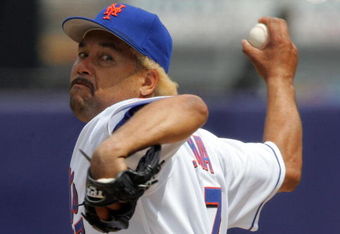
Here's to you, Mr. Lima.  Hope you're able to pitch past the fifth inning in Heaven.  (Victor Baldizon/Getty Images)

Ten years ago today, the baseball world lost one of its true characters in Jose Lima.  The former Met, who had heart issues before his untimely death on May 23, 2010, finished his career with an 89-102 record and 5.26 ERA in 235 starts, which is the highest lifetime earned run average in major league history for a pitcher who made that many starts. 

Lima was the second pitcher who started at least one game for the 2006 Mets to pass away, following the death of Geremi Gonzalez (who was then known by his hip-hop nom de plume, Jeremi Gonzalez) in 2008.  Gonzalez was tragically killed at the age of 33 after being struck by lightning in Venezuela.

Back in 2009, Studious Metsimus jokingly reported that after the Mets released Jose Lima in 2006, he put a hex on the franchise, lovingly referred to as "The Curse of Lima Time".  The whammy was supposedly the reason for the Mets' failure to reach the World Series in 2006, as well as their late-season collapses in 2007 and 2008.

But is the curse real?  Has it expanded beyond a Studious Metsimus story?  A look at the thirteen starting pitchers who took the mound for the Mets in 2006 seems to suggest that it might have escaped the confines of this blog and gone searching for the Unlucky Thirteen.


************* 


Tom Glavine (32 starts) - Failed to get more than one out for the Mets in the 2007 season finale.  Later went back to Atlanta where he picked up two wins and was released by the team in 2009.  By co-inky-dink, he ended his career the way he began it, by going 2-4 with a 5.54 ERA for the Braves in 2008.  He also went 2-4 with a 5.54 ERA for the Braves in his first season with the team back in 1987.

Steve Trachsel (30 starts) - After leading the 2006 Mets with 16 wins, the Human Rain Delay II (with apologies to the original Human Rain Delay, Mike Hargrove) signed a free agent contract with the Baltimore Orioles in 2007.  He was traded in August 2007 to the Chicago Cubs, then re-signed by the Orioles the following off-season, before being released by Baltimore in June 2008.  His post-Mets stats for the 2007 and 2008 seasons featured an abysmal 9-16 won-loss record and a 5.60 ERA.

(David Zalubowski/AP)
Pedro Martinez (23 starts) - Started off brilliantly in 2006, earning wins in each of his first five starts.  Then he was placed on the disabled list after pitching horribly in his return to Fenway Park on June 28.  After coming back from his injury exactly one month later, Martinez pitched poorly in the potential division clincher at PNC Park and was caught weeping in the dugout.  In July 2009, Pedro signed a one-year deal with the Philadelphia Phillies, but his affiliation with the Bloods (see photo, right) helped bring about his downfall.  Facing the Yankees in the that year's Fall Classic also helped, as Pedro lost the two starts he made, including the game that gave the Yankees their sole championship of the last 19 seasons.  Following his defeat in Game Six, the 37-year-old Martinez never pitched again in the major leagues.

Orlando Hernandez (20 starts) - It looked as if the Curse of Lima Time was going to escape Orlando "The Dookie" Hernandez.  After all, he was surprisingly effective for the Mets after being acquired in a trade from the Arizona Diamondbacks.  The Dookie went 9-7 for the Mets and struck out nearly a batter per inning (112 Ks in 116.2 innings).  However, The Dookie met The Curse right after he was named the starting pitcher for Game One of the 2006 NLDS.  While running sprints in the outfield, the then-57 year old (give or take a few decades) tore a calf muscle and had to be removed from the postseason roster.  Despite his AARP membership and injury history, the Mets signed Mr. Dookie to a two-year, $12 million contract that off-season.  They were rewarded by getting 24 starts from His Dookness in 2007 and no starts in 2008.  He then signed a minor league deal with the Texas Rangers in 2009, only to be released a month later.  No longer in baseball, The Dookerino has apparently been offered three lucrative deals to be the spokesperson for Geritol, Metamucil and Depends undergarments.

John Maine (15 starts) - Maine was originally the throw-in when the Mets unloaded Kris and Anna Benson to the Baltimore Orioles for Jorge Julio (who was then traded to Arizona for The Dookie).  Maine impressed so much as a rookie for the Mets in 2006 that he earned a spot on the postseason roster.  His victory in Game Six of the NLCS helped the Mets reach the do-or-die Game Seven against the Cardinals.  Although Maine won 15 games in 2007, his ERA increased annually through 2010, when he won one game and posted a 6.13 ERA in nine starts.  Maine never won a game in the majors after his 29th birthday and appeared in just four games as a thirty-something, all of them coming for the lowly Marlins in 2013.  The scowl that once helped Maine get hitters out is now solely seen whenever someone utters Jerry Manuel's name.


The look of a man who just heard Jerry Manuel say "gangsta" for the umpteenth time. (AP Photo)

Alay Soler (8 starts) - Pitched a complete-game shutout against the Arizona Diamondbacks in his fourth major league start.  Three starts later, he gave up eight runs to the Boston Red Sox.  After that game, he was told to watch tapes of his outing against the Diamondbacks to prepare for his next start against the Yankees.  The Curse of Lima Time struck again, as the tapes were misplaced and instead Soler watched the tapes from his Boston Massacre.  He learned well, as he gave up another eight runs to the Yankees.  So long, Soler.  That marked the end of his short-lived major league career.

Oliver Perez (7 starts) - When the Mets needed a reliever to replace Dominican food aficionado Duaner Sanchez, they traded Xavier Nady to the Pittsburgh Pirates for 41-year-old Roberto Hernandez and Oliver Perez.  Perez did not pitch well for the Mets after his trade, going 1-3 with a 6.38 ERA.  He did pitch in Game Seven of the NLCS and then went 25-17 over the next two seasons, fooling the Mets into giving him a three-year, $36 million contract after the 2008 campaign.  Perez "rewarded" the Mets with three victories over the length of the contract.  However, sales of antacids did increase exponentially in Flushing during his time with the team, which was good news if your name was Duane or Reade.

Brian Bannister (6 starts) - The son of former major league pitcher Floyd Bannister was a respectable 2-0 with a 2.89 ERA for the 2006 Mets before the Curse of Lima Time found him on the bases at the ballpark formerly known as Pac Bell, SBC and AT&T Park.  While trying to score a run, Bannister left his hamstring in San Francisco and missed the next four months of the season.  Bannister was not himself after his return, going 0-1 with an 8.10 ERA.  He was traded that off-season to the Kansas City Royals for future felon Ambiorix Burgos, proving that the Curse of Lima Time was contagious.

Victor Zambrano (5 starts) - I won't waste your time.  You already know his story.  He was cursed before Lima could get to him.

Dave Williams (5 starts) - Williams was never meant to make that many starts for the Mets, but the team's membership with the Injury of The Week Club forced him into action five times.  Williams went 3-1 for the Mets in 2006, but the good record was due to excellent run support, as his ERA was a high 5.59.  Williams was not as lucky in 2007, appearing in only two games for the Mets.  Perhaps his 22.85 ERA had something to do with the lack of appearances.  Although he was only 28 at the time, Williams never pitched in the major leagues again.

Mike Pelfrey (4 starts) - Appeared to have been born with the antidote to the Curse of Lima Time in his blood.  After his breakout 2008 season, Big Pelf struggled a bit in 2009, but was been the Mets' most dependable starting pitcher in 2010, going 15-9 with a 3.66 ERA while surpassing the 200-inning mark for the first time in his career.  Pelfrey's success was short-lived, as he followed up his 2010 campaign by becoming one of the game's worst pitchers from 2011 until his final game in 2017.  Over those seven seasons, Pelfrey went 25-62 with a 4.99 ERA and 1.56 WHIP pitching for the Mets, Twins, Tigers and White Sox.  By age 33, the former ninth overall pick was out of the game.

The reason my wife drinks.  (Reuters)
Jose Lima (4 starts) - Just like Lou Gehrig wasn't immune to the disease named after him, Jose Lima fell to the Curse that took his name. Lima never pitched again in the majors after his brief tour of duty with the Mets, a tour that included an 0-4 record, a 9.87 ERA and a grand slam allowed to opposing pitcher Dontrelle Willis (which my future wife didn't remember even though she was at the game because Lima's appearance on the mound caused her to become best friends with her section's beer vendor).  Lima did, however, reach one milestone while in New York.  On May 12, 2006, Lima was credited with his 100th career loss, earning the landmark defeat by allowing five runs in 4⅔ innings against the Milwaukee Brewers.

Geremi Gonzalez (3 starts) - Gonzalez started against Randy Johnson in the first game of the 2006 Subway Series at Shea Stadium and gave up four runs in the first inning.  The Mets eventually won that game on David Wright's walk-off hit off Mariano Rivera in the bottom of the ninth inning, making Gonzalez the answer to the trivia question, "Who sucked so badly in Game One of the 2006 Subway Series that the Mets needed a walk-off hit by David Wright to win the game?"  Unfortunately for Gonzalez, he made a better lightning rod than starting pitcher, as he was killed during a thunderstorm in his native Venezuela.


*************


The starting pitchers for the 2006 Mets, otherwise known as the Unlucky Thirteen, have suffered professionally and personally since that 2006 campaign. The so-called Curse of Lima Time has claimed careers and lives, including the man for whom it was named.

Although this blog was written as a humor piece, we do not mean to poke fun at the expense of Jose Lima, who passed away ten years ago today at the age of 37.  Lima was a fun-loving man who had a respectable major league career, if you don't look at his ERA or X-Rays of my wife's liver.  Lima was also a positive presence in the clubhouse and was loved by his teammates.

Jose Lima will always be missed in the major league community and of course, in the blogging community.  May he continue to rest in peace.


This is how most Mets fans remember Jose Lima.  (Howard Earl Simmons/NY Daily News)

Sunday, May 23, 2010

Jose Lima And The Final Destination Of The 2006 Mets Starting Pitchers

We regret to inform you that former Mets pitcher and Studious Metsimus whipping boy Jose Lima passed away earlier today at the age of 37. The cause of death was reported to be a heart attack.

Lima is now the second pitcher who started at least one game for the 2006 Mets to pass away, following the death of Geremi Gonzalez (who was then known by his hip-hop nom de plume, Jeremi Gonzalez) in 2008. Gonzalez was killed at the age of 33 after being struck by lightning in Venezuela.

Back in October, Studious Metsimus jokingly reported that after the Mets released Jose Lima in 2006, he put a hex on the franchise, lovingly referred to as "The Curse of Lima Time". The hex was supposedly the reason for the Mets' failure to reach the World Series in 2006, as well as their late-season collapses in 2007 and 2008.

But is the curse real? Has it expanded beyond a Studious Metsimus story? A look at the 13 starting pitchers who took the mound for the Mets in 2006 seems to suggest that it might have escaped the confines of this blog and gone searching for the Unlucky 13.

Tom Glavine (32 starts) - Failed to get more than one out for the Mets in the 2007 season finale. Later went back to Atlanta where he picked up two wins and was released by the team in 2009. By co-inky-dink, he ended his career the way he began it, by going 2-4 with a 5.54 ERA for the Braves in 2008. He also went 2-4 with a 5.54 ERA for the Braves in 1987.

Steve Trachsel (30 starts) - After leading the 2006 Mets with 16 wins, the Human Rain Delay II (with apologies to the original Human Rain Delay, Mike Hargrove) signed a free agent contract with the Baltimore Orioles in 2007. He was traded in August 2007 to the Chicago Cubs, then re-signed by the Orioles the following off-season, before being released by Baltimore in June 2008. His post-Mets stats for the 2007 and 2008 seasons? How about a 9-16 record and a 5.60 ERA.

Pedro Martinez (23 starts) - Started off brilliantly in 2006, winning his first five decisions. Then he was placed on the disabled list after pitching horribly in his return to Fenway Park. After coming back from the DL, he pitched poorly in the potential division clincher at PNC Park and was caught weeping in the dugout. He signed with the Phillies in 2009, but his affiliation with the Bloods (see photo, below) helped bring about his downfall. As of now, Pedro is still unemployed.

Orlando Hernandez (20 starts) - It looked as if the Curse of Lima Time was going to escape Orlando "The Dookie" Hernandez. After all, he was surprisingly effective for the Mets after being acquired in a trade from the Arizona Diamondbacks. The Dookie went 9-7 for the Mets and struck out nearly a batter per inning (112 Ks in 116.2 innings). However, The Dookie met The Curse right after he was named the starting pitcher for Game 1 of the 2006 NLDS. While running sprints in the outfield, the then-57 year old Dookie tore a calf muscle and had to be removed from the postseason roster. Despite his AARP membership and injury history, the Mets signed Mr. Dookie to a two-year, $12 million contract that off-season. They were rewarded by getting 24 starts from The Dookie in 2007 and no starts in 2008. He then signed a minor league deal with the Texas Rangers in 2009, only to be released a month later. No longer in baseball, The Dookie has apparently been offered three lucrative deals to be the spokesperson for Geritol, Metamucil and Depends undergarments.

John Maine (15 starts) - Maine was originally the throw-in when the Mets unloaded Kris and Anna Benson to the Baltimore Orioles for Jorge Julio (who was then traded to Arizona for The Dookie). Maine impressed so much as a rookie for the Mets in 2006 that he earned a spot on the postseason roster. His victory in Game 6 of the NLCS helped the Mets reach the do-or-die Game 7 against the Cardinals. Nowadays, Maine can be seen moping around the clubhouse, weak shoulder dragging along beside him. The scowl that once helped get hitters out is now solely used whenever Jerry Manuel is in the room with him.

Alay Soler (8 starts) - Pitched a complete-game shutout against the Arizona Diamondbacks in his fourth major league start. Three starts later, he gave up eight runs to the Boston Red Sox. After that game, he was told to watch tapes of his outing against the Diamondbacks to prepare for his next start against the Yankees. The Curse of Lima Time struck again, as the tapes were misplaced and instead Soler watched the tapes from his Boston Massacre. He learned well, as he gave up another eight runs to the Yankees. So long, Soler. That marked the end of his short-lived major league career.

Oliver Perez (7 starts) - When the Mets needed a reliever to replace Duaner Sanchez, they traded Xavier Nady to the Pittsburgh Pirates for Dominican food intolerant Roberto Hernandez and Oliver Perez. Perez did not pitch well for the Mets after his trade, going 1-3 with a 6.38 ERA. He did pitch in Game 7 of the NLCS and then went 25-17 over the next two seasons, fooling the Mets into giving him a 3-year, $36 million contract after the 2008 season. Since signing the mega-deal, Perez has "rewarded" the Mets with three victories. However, sales of antacids have increased exponentially in Flushing.

Brian Bannister (6 starts) - The son of former major league pitcher Floyd Bannister was a respectable 2-0 with a 2.89 ERA for the 2006 Mets before the Curse of Lima Time found him on the bases at the park formerly known as Pac Bell. While trying to score a run, Bannister left his hamstring in San Francisco and missed the next four months of the season. Bannister was not himself after his return, going 0-1 with an 8.10 ERA. He was traded that off-season to the Kansas City Royals for future felon Ambiorix Burgos, proving that the Curse of Lima Time was contagious.

Victor Zambrano (5 starts) - I won't waste your time. You already know his story. He was cursed before Lima could get to him.

Dave Williams (5 starts) - Williams was never meant to make that many starts for the Mets, but the Mets membership in the Injury of The Week Club forced him into action five times. Williams went 3-1 for the Mets in 2006, but the good record was due to excellent run support, as his ERA was a high 5.59. Williams was not as lucky in 2007, appearing in only two games for the Mets. Perhaps his 22.85 ERA had something to do with the lack of appearances. Williams has not pitched in the major leagues since.

Mike Pelfrey (4 starts) - Apparently was born with the antidote to the Curse of Lima Time in his blood. After his breakout 2008 season, Big Pelf struggled in 2009, but has been the Mets' best starting pitcher in 2010, going 6-1 with a 2.86 ERA over the first quarter of the season. He may be the key to curing all those afflicted by the Curse.

Jose Lima (4 starts) - Just like Lou Gehrig wasn't immune to the disease named after him, Jose Lima fell to the Curse that took his name. Lima never pitched again in the major league after his brief tour of duty with the Mets, a tour that included an 0-4 record and a 9.87 ERA.

Geremi Gonzalez (3 starts) - Gonzalez started against Randy Johnson in the first game of the 2006 Subway Series at Shea Stadium and gave up four runs in the first inning. The Mets eventually won that game on David Wright's walk-off hit off Mariano Rivera in the bottom of the ninth inning, making Gonzalez the answer to the trivia question, "Who sucked so badly in Game 1 of the 2006 Subway Series that the Mets needed a walk-off hit by David Wright to win the game?" Unfortunately for Gonzalez, he made a better lightning rod than starting pitcher, as he was killed during a thunderstorm in his native Venezuela.

The Unlucky 13 (other than Mike Pelfrey) have suffered professionally and personally since the 2006 season. The so-called Curse of Lima Time has claimed careers and lives, including the man for whom it was named.

Although this blog was written as a humor piece, we do not mean to poke fun at the death of Jose Lima. Lima was a fun-loving man who had a respectable major league career. He was also a positive presence in the clubhouse.

Studious Metsimus would like to offer our condolences to the family and friends of Jose Lima. He will be missed in the major league community and of course, in the blogging community. May he rest in peace.

Tuesday, January 26, 2010

Hey, Wilpons! Where's The Beef?

Watching the Mets go after free agent pitchers is like watching a game of musical chairs, except the Mets are the ones who are left without a chair when the music stops.

First came the announcement that free agent pitcher Ben Sheets had signed a one-year, $10 million (plus performance bonuses) contract with the Oakland Athletics. Now comes word from Corey Brock of mlb.com that Jon Garland has signed a one-year, $5.3 million deal to pitch for the San Diego Padres. The deal also pays Garland $6.75 million in 2011 if the Padres choose not to buy him out for $600,000.

After the John Lackey signing with the Red Sox, many of the remaining free agent pitchers on the Mets' radar have signed reasonable contracts FOR OTHER TEAMS! None of these contracts has been for the amount of money the team wasted on Oliver Perez to retain his impeccable ability to throw ball four.

Here are some of the deals given to players who were supposedly on the Mets' radar, but chose to sign somewhere else. The players are listed in alphabetical order to appease the fans who like organization amongst all the disorganization:

Doug Davis

Surprisingly leaves Arizona to sign a one-year deal with Milwaukee for $5.25 million.


Jon Garland

Takes his laundry from LA down the coast to SD for the next year and $5.3 million.


Rich Harden

Yawns his way out of the north side of Chicago to sign a one-year, $7.5 million deal with the Texas Rangers.


Jason Marquis

Gets off his Rocky Mountain High to sign a two-year deal with the Washington Nationals worth $15 million (with an option for a prosthetic right leg).


Joel Piñeiro

After a career year in St. Louis, he looks to the heavens and finds the Angels and their two-year, $16 million deal to his liking.


Ben Sheets

Celebrates his year off from baseball by signing a one-year, $10 million contract with the Oakland Athletics.


Randy Wolf

Takes the force with him from Los Angeles to Milwaukee for three years and $29.75 million.


Usually players sign with other teams for big money, for the security of a long-term deal or to play for a contender. Every player listed above signed for less money than Oliver Perez did in 2009. Other than Wolf, none of the players signed for more than two years. And other than Harden and Piñeiro, the rest of the players decided to sign with teams who finished the 2009 season with a losing record (Brewers, Padres, Nationals, Athletics).

So are you telling me the Mets couldn't afford these pitchers? Did they find the length of their contracts to be too much? To the Wilpons, I have one thing to say. Come close to the screen so you can see it clearly.

WHERE'S THE BEEF??

Are you aware that the fans are not going to accept a repeat fourth-place performance by the Mets in 2010? Do you think you can place a small patty inside a bun and hope that it satisfies your paying customers to come back for seconds? Surely you can't believe we're idiots!

But hey. Who am I? I'm just one of those paying customers who keeps coming back for that small patty inside that oversized (and overpriced) bun. The free agent pitchers who have chosen to sign with other teams are probably on to something that I've failed to notice.

As Mets fans continue to sit around hopelessly watching the latest free agent pitcher sign with another non-blue and orange team, I'd rather look on the bright side. At least Omar Minaya hasn't decided to re-sign Jose Lima (yet).

Thursday, January 14, 2010

Reason #17 To Retire Keith Hernandez's Number

Keith Hernandez was the heart and soul of the 1980s Mets teams that went from languishing at the bottom of the National League East to winning two division titles and a World Series championship. The former first baseman was a leader both on and off the field, and was given the captain's "C" to honor his leadership on the team. However, despite numerous pleas by Mets fans to retire his number 17, the Mets have not yet honored their former captain by doing so.

Let's compare Keith's career with the Mets to that of another first baseman who played on the West Coast for another expansion team from the 1960s. Perhaps if the people from the Coalition To Decide New Reasons To Put Off Retiring Keith's Number read the following, they might have to rethink things.

Keith Hernandez was a member of the Mets from 1983-1989. Over his 6½ years with the team, he batted over .300 four times, scored over 80 runs four times and drove in over 80 runs four times (including two 90-RBI seasons). He won six Gold Gloves while with the Mets, made the All-Star team three times, finished in the top ten in the MVP voting three times (including two top five finishes) and won a Silver Slugger Award in 1984.

During his first four full seasons with the Mets (1984-1987), an average season for Keith Hernandez looked like this: .305 batting average, .396 OBP, .836 OPS, 32 doubles, 14 HR, 89 RBI and 88 runs scored. More importantly, he was an instrumental player in the Mets' march to the 1986 World Series championship.

So which of his contemporaries am I comparing him to? Let's peruse over the numbers of a certain Steve Garvey, especially after he joined the San Diego Padres.

Steve Garvey joined the Padres as a free agent before the 1983 season (the same year Hernandez was traded to the Mets). He played four full seasons as San Diego's first baseman and part of a fifth in 1987, playing in only 27 games during his final season in the big leagues. During his tenure in San Diego, Garvey did not win any Gold Gloves (Mr. Hernandez was winning all of those), made the All-Star team twice and never finished higher than 20th in the MVP voting. He also did not win any Silver Slugger Awards. Furthermore, he never batted over .300 in any of those four seasons, never scored more than 80 runs and drove in over 80 runs three times (but no 90-RBI seasons).

During those four full seasons in San Diego (1983-1986), these were the numbers for an average Steve Garvey season: .278 batting average, .311 OBP, .725 OPS, 26 doubles, 15 HR, 77 RBI and 72 runs scored. He helped lead the Padres to one National League pennant in 1984, but did not win the World Series that year.

Clearly, Hernandez's numbers and awards with the Mets were superior to Garvey's numbers and lack of awards with the Padres. However, Garvey can claim one thing that Keith Hernandez can't.

STEVE GARVEY'S NUMBER HAS BEEN RETIRED BY THE SAN DIEGO PADRES!

Apparently, the Padres cared enough to acknowledge the fact that Garvey was instrumental in bringing the team back from being also-rans prior to 1983 to pennant winners in 1984. The Mets were cellar dwellers prior to 1983 as well. Then Keith Hernandez came aboard and things started to change, eventually leading to the World Championship that Garvey wasn't able to bring to San Diego.

How can the Mets not retire Keith Hernandez's number when the Padres have bestowed that honor to Steve Garvey? Instead, they continue to hand out the number to Fernando Tatis and various pitchers like Jose Lima, Graeme Lloyd and Dae-Sung Koo. At least Gary Carter's number hasn't been worn by a Met since Matt Galante wore it as a coach in 2002.

It's time for the Mets to retire the #17 in honor of their former captain and team leader, Keith Hernandez. The left field wall at Citi Field is high enough for more retired numbers. Let's end this oversight once and for all by raising the #17 for all Mets fans to see. Say it loud. Say it proud. Retire #17!


Friday, October 30, 2009

Frightening Moments In Mets History

We’ve made it to another Halloween, Mets fans! That means it’s time for my first annual “Frightening Moments In Mets History” blog. It’s so scary that even Jose Reyes was not prepared for the shocking stories he was about to read.

I’ve gone through the archives (and by archives, I mean Google and my warped little mind) and picked out some moments that’ll make you cringe, some moments that’ll make you squirm and some moments that’ll make you want to look away. Of course, if you’re a Mets-ochist like I am, you’ll want to keep your eyes glued to the screen throughout the whole piece. After all, we wouldn’t want you to miss any of the bloody goodness.

So grab some popcorn or maybe some deviled eggs and enjoy some of the most macabre Mets moments I could find. Don’t worry. It won’t hurt you…unless if you let it.

There have been numerous trades in Mets history that might be considered frightening. For example, there was the trade that involved Nolan Ryan for Jim Fregosi. More recently, there was the trade of Scott Kazmir for the wrong Zambrano. Heck, I know a few 14-year old boys who were petrified when Anna Benson was traded away with her husband, Kris.

But perhaps the trade that scared off many Mets fans from coming back to Shea Stadium was the trade of Tom Seaver to the Cincinnati Reds in 1977. Seaver and Mets chairman of the board M. Donald Grant never had the best relationship, with the war of words often spilling onto the back pages of the tabloids. Seaver’s relationship with Grant reached its nadir when he blamed him for giving negative information about his wife to legendary sportswriter Dick Young. Young wrote a column claiming that Seaver and his wife were jealous of the money Nolan Ryan was earning with the California Angels.

On June 15, 1977, the Mets conducted what is now known as “The Midnight Massacre”, where they parted ways with Tom Seaver and slugger Dave Kingman in two separate trades. Following the trades, attendance at Shea Stadium dropped as quickly as the Mets did in the standings. Is it no wonder that fans started referring to Shea as Grant’s Tomb after the bloody massacre was complete?

There have been numerous on-field injuries that were gruesome to behold. Just recently, the Mets were forced to watch David Wright be the recipient of a head-seeking missile by Giants’ starter Matt Cain. The concussion suffered by Wright forced him to go on the disabled list for the first time in his career. Fortunately, the injury wasn’t as frightening as it looked as Wright was able to return to the Mets when his 15 day stay at the DL Hotel expired. Although he was forced to return his stylish hospital attire (see photo, right), he was more than happy to leave the hospital and return to the Mets lineup. Unfortunately, not every Mets player who went down with an injury was as fortunate as David was. Some players just vanished into thin air, never to be heard from again.

Remember Bernard Gilkey? He had a spectacular season for an otherwise unspectacular Mets club in 1996. He finished the season with a .317 average, along with 30 HR and 117 RBI. He also collected a franchise-record 44 doubles. Then he decided to appear in the movie “Men In Black”. In his one scene, he was playing left field at Shea Stadium when an alien spacecraft appeared over Flushing. Left in a state of shock, Gilkey never saw a fly ball headed in the direction of his coconut, where (you guessed it), he suffered a close encounter of the third kind with the baseball. Unlike David Wright’s injury, Gilkey’s head injury clearly affected his career. He followed up his stellar 1996 season with a subpar 1997 campaign, hitting only .249 with 18 HR and 78 RBI. It got worse from there. He was traded to Arizona during the 1998 season and only hit a total of 18 HR for the rest of his career until his final season in the majors in 2001.

One more injury involving heads happened in 2005 in San Diego, but this one was no laughing matter. On August 11, 2005, Carlos Beltran and Mike Cameron were involved in a terrifying on-field collision at Petco Park, where both players attempted to make a diving catch for a shallow fly ball.

Neither player caught the ball hit by Padres’ catcher David Ross, but they caught quite a bit of each other’s faces. Although Beltran escaped the collision with only minor injuries, the same could not be said for Cameron.

On the play, Cameron broke his nose, had multiple fractures of both cheekbones and suffered a slight concussion. He was placed on the disabled list and did not play again in 2005.

The collision in San Diego would be the last time Mike Cameron played for the New York Mets as he was traded to San Diego (how ironic) for Xavier Nady during the off-season. To this day, Cameron has trouble remembering the collision, not that it’s a memory he would like to have back.

Frightening moments aren’t always events that resulted in fan favorites being traded away or players getting injured. Sometimes, it could be a failed experiment on the field. Does anyone remember “Turn Ahead The Clock Day” in 1999?

Ten years ago, Major League Baseball decided to go the other way with its popular retro uniform promotions. Instead of looking back at its glorious past, baseball decided to look ahead at its ugly future. At least the uniforms were ugly. For one night in 1999, major league teams wore futuristic jerseys and caps in what had to have been the concoction of a seriously inebriated marketing department. The Mets played the Pittsburgh Pirates that night and were defeated by a young rookie pitcher by the name of Kris Benson (that name seems awfully familiar).

It didn’t matter that the 5-1 defeat to the lowly Pirates almost kept the Mets from making the playoffs that year (they needed a one-game playoff with Cincinnati to earn the wild card berth). All that mattered was that Orel Hershiser looked like this in his Mercury Mets jersey (see photo, right).

Yes, Mets fans. Orel Hershiser was actually a Met. That, in and of itself, is scary enough to me. But putting him in that abominable jersey is downright chilling. Spooky is as spooky does.

I can imagine you’re getting ready to give out candy to all the lovely trick-or-treaters who are about to ring your bell and then thank you for your sweet treats by throwing toilet paper all over your trees. So I will leave you with the most frightening moment in Mets history. What could be more frightening than the horrific injuries suffered by Mets players over the years? Is there anything that scared more Mets fans away than the Midnight Massacre? Is it possible that there is something more terrifying than the sight of Orel Hershiser in a Mercury Mets jersey?

Yes, my friends. I believe there is. The most frightening moment in Mets history began in 2006 and has continued to this day. That’s right, Mets fans. I’m talking about Jose Lima.

In 2006, the Mets used numerous starting pitchers because of injuries. The only starters to make more than 23 starts were Tom Glavine and Steve Trachsel. Although Pedro Martinez and Orlando “The Dookie” Hernandez were also around during the first half of the season, a fifth starter was still needed. Unfortunately, one of the men they turned to was Jose Lima.

The Mets allowed Lima to make four starts for them in 2006. The self-proclaimed creator of “Lima Time” was worse than Charlie Brown facing a squad full of Peppermint Patties. In those four starts, Lima was only able to pitch 17.1 innings. His ERA was an abysmal 9.87 and he was the losing pitcher in all four starts. Although Lima’s career with the Mets was finished, Lima was not finished with the Mets.

Urban legend has it that Jose Lima did not leave the Mets quietly (not that he could ever be quiet if he wanted to). It has been told that when Lima left the Mets, he placed a hex on the team, vowing that they would never win another championship. Just as the “Curse of the Bambino” prevented the Red Sox from winning a championship for 86 years and the “Curse of the Billy Goat” is still haunting the Cubs, the “Curse of Lima Time” has been passed down to the Mets.

In 2006, the Mets appeared to be steamrolling towards the World Series until Carlos Beltran saw the “Do Not Swing” sign on Adam Wainwright’s curveball. The hex continued into 2007 and 2008 as the Mets failed to make the postseason in both years. Finally, in 2009, the injury portion of the curse took hold and choked the life away from the team.

Now tell me, Mets fans. How can there be anything more frightening than the “Curse of Lima Time”? It’s so frightening that the curse has even affected Lima himself. After being designated for assignment by the Mets in 2006, Lima never pitched again in the major leagues. Even his fledgling singing career never took off as he has only sold one of his CDs and that was to his mother (she bought it in the bargain bin).

I don’t know if the Mets will have to call in an exorcist, the guys from Ghost Hunters or the woman from Poltergeist, but there has certainly been some paranormal activity going around the Mets clubhouse over the years. It seems to have followed them from Shea Stadium to Citi Field. Whether the “Curse of Lima Time” is real or not, it needs to be erased before the Mets continue to experience frightening moments on the field.

Well, Scooby Gang, that’s all I have for you today. I hope you can sleep well tonight and that these stories of terror didn’t make you go running to that old box in the attic where you’ve been storing your Mets night light all these years. Remember, these moments have only affected the Mets, not their fans. At least they haven’t affected the fans yet. Have a great Halloween!


Tuesday, September 15, 2009

17 Games Left: Can The Mets Hold Off The Nats?

We have reached the most critical stretch of games for the Mets this season. The Mets now have 17 games left in the season after tonight's loss to the Braves. Even a casual Mets fan knows the significance of that number. The Mets held their biggest divisional leads in 2007 and 2008 after their 145th games of each season. They had a 7-game lead with 17 games left in 2007 and a 3½-game lead in 2008 at the same point. In 2007 and 2008, the Mets finished 5-12 and 7-10, respectively. Those poor finishes kept the Mets from crashing the playoff party each year.

Now, we're in 2009 and the Mets have a 12½-game lead over the Washington Nationals with 17 games to play. That might seem like a big lead but remember, the Nats still have six head-to-head games left with the Mets. Those games could erase almost half of the lead should the Mets lose them all. The pressure is now on. Can they hold on to their lead or will they blow it again this year and fail to hold on to their stranglehold on fourth-place?

Studious Metsimus was able to locate some of the most famous 17s in franchise history for their opinions on the topic. The results were quite varied, to say to the least.

Jose Lima
"The Mets wouldn't have choked in '07 and '08 had I been there. Remember '06, when they let me go? What happened then? Did they make the World Series? The Red Sox had the Curse of the Bambino and the Cubs have the Curse of the Billy Goat. I gave the Mets the Curse of Lima Time! Also, had I still been there, we would have had more Merengue Nights! Buy my CD, dropping next Tuesday!"

Mr. Koo
"Why do you call me Mr. Koo? My name is Dae Sung. I have no opinion about the Mets and the Nats. I'm still hurt from when I slid into the bat against the Yankees."

Graeme Lloyd
"I wore #17 for the Mets? I don't even remember being on the Mets! Everything is a blur since I was in that fight against the Orioles when I was a Yankee. I hope you don't show the picture of me missing with a right hook."

Felix Millan
"As a member of teams that did well (1973 pennant-winning Mets) and teams that didn't do so great (1977 Midnight Massacre Mets), I think the Mets will hold off the Nats and at the same time, they will not hold off the Nats. By the way, I'm now bipolar and have identity problems. For some reason, when I go out, people think of I'm some guy named Keith Hernandez. Who's this Keith Hernandez guy? I'm Felix Millan!"

Keith Hernandez
"I'm Keith Hernandez."


There you have it, SMFs. It looks like no one knows where the Mets will finish this year. The magic number to clinch fourth place is now down to 6. If the Mets can split their remaining six games against Washington, they can go back to their losing ways that they've become so fond of.

I'm not holding my breath waiting for that to happen. If I did that, I might start looking like Brainy Smurf before they clinch (if they clinch?) fourth place. The Mets have teased us too many times before. I won't rest easy until that magic number is down to zero. Then and only then will I pop the cork!