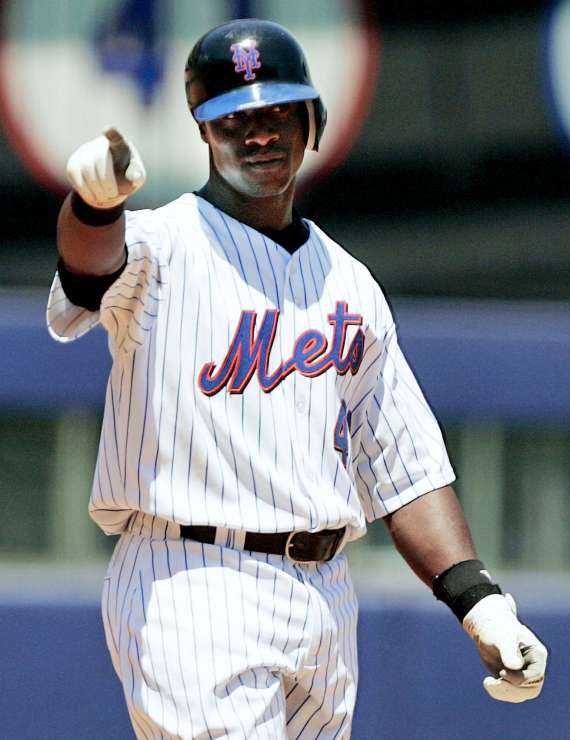
Showing posts with label Bernard Gilkey. Show all posts

Wednesday, August 31, 2016

Yoenis Céspedes vs. Other Mets in Their First 162 Games

Yoenis Cespedes's 162-game start gets a big thumbs up!  (Ed Leyro/Studious Metsimus)

Yoenis Céspedes has meant everything to the Mets since he was acquired at the trade deadline last July.  But because of nagging injuries and a trip to the disabled list earlier this season, Céspedes didn't get to play in his 162nd career game with the team until Wednesday, as he has missed 28 games during the 2016 campaign after resting for only two games with the Mets in 2015, both of which came after the team had clinched the division title.

Céspedes's numbers with the team in those 162 games are astounding, as he has produced 34 doubles, 44 homers, 112 RBI and has compiled a .583 slugging percentage and .941 OPS in a full season's worth of games.  Those five categories are traditionally recognized as categories in which sluggers generally excel, and Céspedes ranks favorably with the team's all-time greats in all five.

In doing research for hot starts by Mets players to see where Céspedes ranked, I found some interesting names that I did not expect to find among those franchise legends.  For every time Mike Piazza was in the top ten - he's the only player to be ranked in the top five in all five categories within his first 162 games with the team - there were a handful of "did they really have that type of start?" players.

Here are five lists, one each for doubles, home runs, runs batted in, slugging percentage and on-base plus slugging percentage, that show just how good Céspedes has been in his first 162 games with the Mets and how fortunate some other players were in their first full season's worth of contests with the club.


Doubles:

Bernard Gilkey
Mike Piazza - 46
Bernard Gilkey - 45
Paul Lo Duca - 44
David Wright - 41
Mike Cameron - 40
Rusty Staub - 39
Eddie Murray - 38
Robin Ventura - 38
Todd Zeile - 38
Ike Davis - 37


Home Runs:

Kevin McReynolds
Dave Kingman - 48
Yoenis Céspedes - 44
Carlos Delgado - 39
Mike Piazza - 38
Mike Cameron - 35
Gary Carter - 34
Frank Thomas - 34
Robin Ventura - 32
Cliff Floyd - 31
Bernard Gilkey - 31
Kevin McReynolds - 31
Darryl Strawberry - 31


Runs Batted In:

John Olerud
Carlos Delgado - 126
Bernard Gilkey - 124
Robin Ventura - 120
Mike Piazza - 119
Dave Kingman - 118
Gary Carter - 116
Yoenis Céspedes - 112
Donn Clendenon - 108
John Olerud - 107
Kevin McReynolds - 102


Slugging Percentage:

Mike Cameron
Mike Piazza - .604
Yoenis Céspedes - .583
Bernard Gilkey - .544
Rico Brogna - .529
Robin Ventura - .525
Cliff Floyd - .523
Carlos Delgado - .518
Donn Clendenon - .512
Dave Kingman - .511
Mike Cameron - .510


On-Base Plus Slugging Percentage:

Rico Brogna
Mike Piazza - 1.005
Yoenis Céspedes - .941
Bernard Gilkey - .930
Robin Ventura - .902
Cliff Floyd - .890
John Olerud - .889
Rico Brogna - .880
Carlos Delgado - .870
Benny Agbayani - .867
David Wright - .865


As you can see, there are several players whose names you would expect to see in multiple categories.  Power hitters such as Céspedes, Piazza, Carlos Delgado, Dave Kingman and others can be found in at least three of the five top-ten lists.  But did you really expect to see a guy like Rico Brogna appear on as many lists as David Wright?  What about Cliff Floyd and Mike Cameron showing up three times?  Or most surprisingly, what do you think of Bernard Gilkey and Robin Ventura joining Piazza as the only three players to rank in the top ten in all five categories?

Those unexpected players (Brogna, Floyd, Cameron, Gilkey, Ventura) all had sensational starts to their careers in Flushing, but they also suffered injuries (Brogna, Floyd and Cameron come to mind) or faded quickly (Gilkey and Ventura were both one-season wonders).

Meanwhile, a number of all-time team greats were absent from a number of these top-tens.  The late, great Gary Carter made it to the Hall of Fame and began a miraculous World Series rally that fueled the Mets to a championship.  But his excellent .490 slugging percentage and .861 OPS in his first 162 games with the team were both not high enough to appear on either category's respective top-ten list.  Darryl Strawberry may have won the National League Rookie of the Year award in 1983, but his only appearance on any of the above lists is a ninth-place tie in the homer department.  And Carlos Beltran may be the greatest free agent signing in Mets history, but a poor start to his career in New York kept him off every list.

It remains to be seen whether Céspedes will go down the road traveled by the great sluggers in Mets history or if the nagging injuries continue to increase and he will just be remembered for the incredible 162-game start to his Mets career, which included helping the team reach the 2015 World Series.

For now, Céspedes is one of only three Mets to have at least 30 doubles, 35 homers and 100 RBI in his first 162 games with the team, joining Carlos Delgado and Hall of Famer Mike Piazza.  Whether or not Céspedes joins Piazza in Cooperstown or even in the Mets Hall of Fame won't be known for years, but one thing's for certain.

Yoenis Céspedes has been gotten off to one of the best starts of any hitter in franchise history.  And there's nothing fluky about that.


Monday, January 12, 2015

One Mo-MET In Time: Dave Mlicki

Some players have careers that are so nondescript, it's fairly simple to find their greatest moment on a baseball diamond.  For Chicago Cubs rookie Jimmy Qualls, it was his clean single to left field that ended Tom Seaver's bid for a perfect game in 1969.  The safety was Qualls' 12th hit in the big leagues.  He would have just 19 more over a major league career that lasted parts of three seasons.

Qualls' career was quite brief, as he played in only 63 total games with the Cubs, Expos and White Sox.  It should come as no surprise, then, that the hit off Seaver would be the one he'd always be remembered for.

Sometimes, players who have just one defining moment can play in the majors for a decade or longer and never do anything else remotely worth remembering.  Their lengthy careers would be instantly forgotten if not for that one shining moment.  One such player played for the Mets in the mostly forgettable mid-1990s.  But no one will ever forget what he did on a late spring night in the Bronx.

Arguably the most memorable end-of-game reaction by a Mets pitcher since Jesse Orosco.  (Getty Images)

David John Mlicki was as average as average could be.  And that's probably giving him too much credit.  Mlicki pitched in the power-happy 1990s and early 2000s, spending a total of ten seasons in the big leagues.  In seven of those ten years, he made at least ten starts.  His ERA was 4.00 or higher in all seven of those seasons.  Mlicki also never had a season in which he finished more than two games above .500 and was within two games of the break-even point in seven of his ten campaigns.

In addition, Mlicki made 193 starts and pitched 69 games in relief, posting a 4.72 ERA in those 252 appearances.  That made Mlicki one of just eight pitchers in the long history of baseball to make that many starts and that many relief appearances with an ERA of at least 4.72.  Needless to say, Mlicki was lucky to have lasted in the big leagues as long as he did.

Mlicki made seven starts for the Cleveland Indians in 1992 and 1993.  He won none of them.  But that didn't discourage the Mets when Cleveland packaged him with two other pitchers - Paul Byrd and Jerry Dipoto - in exchange for Dallas Green doghouse resident Jeromy Burnitz.  The former 30/30 player in the minor leagues had incensed Mets manager Green with his poor plate discipline and perceived lack of hustle, making himself expendable.

Burnitz went on to become an All-Star and MVP candidate after the trade, while Byrd and Dipoto joined Burnitz as former Mets following the 1996 season.  Entering the 1997 campaign, Mlicki was the only player remaining from the ill-fated Burnitz trade.  Splitting time between the starting rotation and the bullpen, Mlicki had gone 15-14 with a 3.91 ERA and 1.36 WHIP in his first two years with the Mets, numbers that were fairly average but slightly better than the team's cumulative 4.06 ERA and 1.37 WHIP.

Under new manager Bobby Valentine, Mlicki became a full-time starter in 1997.  But while fellow starting pitchers Rick Reed and Bobby Jones were off to All-Star caliber starts, Mlicki regressed.  The Mets got off to a disappointing 8-14 start under Valentine, but the team then went on a roll, winning 20 of the next 29 contests from April 27 to May 28.  Mlicki did not receive credit for any of those 20 wins, going 0-2 with three no-decisions and an eye-popping 5.61 ERA during his team's unexpected hot streak.

By mid-June, Mlicki had won just two of his 13 starts, and his spot in the rotation was potentially in jeopardy.  But Valentine stuck with his beleaguered starter, putting him under the spotlight for the highly anticipated first-ever regular season matchup between the Mets and Yankees on June 16.  It was a decision that would be remembered well past the end of the 1997 season.

"I give Dave Mlicki a 50/50 chance at beating the Yankees on June 16."

The Yankees were the defending World Series champions, and by winning their first title in 18 years, had taken over the city much like the Mets had done so a decade earlier.  The Mets, on the other hand, had completed their sixth consecutive losing season in 1996.  But they were off to an impressive start in 1997 and were poised to claim bragging rights in the first regular season game played between two New York teams since the Brooklyn Dodgers and New York Giants squared off against each other on September 8, 1957.

Before a raucous Yankee Stadium crowd, the Mets got off to a quick start, scoring three runs in the top of the first.  Lance Johnson led off the game by grounding out, but over the next 16 pitches, the Mets produced two doubles, a walk, a single and a steal of home by the normally slow-footed Todd Hundley.  The unlikely theft occurred when Butch Huskey appeared to be picked off first base by Yankee starter Andy Pettitte.  Huskey stayed in the rundown long enough to allow Hundley to scamper home with the third tally of the inning.  The botched rundown gave Mlicki a comfortable lead before he had thrown his first pitch.

That first pitch by Mlicki, a single by Jeter - who reached second base on an error by center fielder Johnson - immediately gave the Yankees a chance to erase some of the momentum generated by the Mets in the top half of the inning.  But in a portent of things to come, Mlicki induced a groundout by Pat Kelly, followed by back-to-back strikeouts of Paul O'Neill and Cecil Fielder.  The Yankees had just gone 0-for-3 with runners in scoring position, and Mlicki wasn't done stranding base runners.

In the third inning, Yankee catcher Joe Girardi hit an one-out, opposite-field double.  He was stranded at second after Mlicki struck out the next two batters.  An inning later, it was Fielder's turn to hit a one-out double to the opposite field.  But yet again, the Yankees couldn't score the run, as Mlicki got Tino Martinez to ground out and Charlie Hayes to line out to end the inning.

The fifth inning saw the Yankees put another runner in scoring position, this time with two outs.  But Derek Jeter could not produce a clutch hit, and the score remained 3-0.  The Mets, however, were having no problems producing with runners in scoring position.

With two outs and runners on first and second in the top of the seventh, Bernard Gilkey drew a four-pitch walk to load the bases.  Gilkey's free pass was followed by an opposite-field single by John Olerud, which scored two runs.  Two innings later, it was Gilkey who drove in a runner in scoring position, lifting a sacrifice fly to left to make it 6-0.

Armed with a 6-0 lead, Mlicki continued to mow Yankee hitters down.  (Photo by Linda Cataffo/Daily News)

By then, it had become a foregone conclusion that the Mets were going to win the game.  The only thing left to be seen was whether Mlicki could finish off the Yankees without allowing any runs to score.  Mlicki appeared to struggle in the eighth when he allowed back-to-back one-out hits to Kelly and O'Neill.  But just as he had done in the earlier innings, he retired the next two batters, stranding both runners.

With a six-run lead going to the bottom of the ninth, Valentine could have pulled Mlicki from the game.  After all, Mlicki had already thrown 106 pitches and had far surpassed what the Mets expected from him in the game.  But Mlicki had never pitched a shutout in five seasons in the majors, nor had he ever pitched a complete game.  He had the opportunity to do both by getting three more outs against the defending world champions.

He was not coming out of that game.

Charlie Hayes led off the ninth with a single but was thrown out at second trying to take the extra base.  Mark Whiten followed with another single.

He was not coming out of that game.

After Chad Curtis grounded into a fielder's choice, Girardi followed with his third hit of the game.  Mlicki had allowed hits to three of the the first four batters to face him in the ninth inning.  He had thrown 114 pitches.  He was about to face Derek Jeter with two runners on base.  It was the Yankees' 11th at-bat of the game with a runner in scoring position.

He was NOT coming out of that game.

Mlicki alternated balls and strikes with Jeter at the plate.  Finally, on a 2-2 pitch and with thousands of Mets fans in attendance loudly cheering on every pitch, Mlicki froze Jeter, throwing strike three past the Yankee shortstop.  After 119 pitches, Mlicki could finally walk off the mound and into the waiting arms of catcher Todd Hundley, but not before he let out a celebratory whoop as he pumped his fists in victory.

27 outs, no runs.  Dave went where no Mlicki had gone before.  (Photo by Linda Cataffo/Daily News)

For one night, the Mets had taken over New York from the Yankees, and it was the most unlikely candidate who plastered the Mets all over the front and back pages of the following day's New York papers.

Dave Mlicki had never pitched a shutout or a complete game in his first 47 starts in the big leagues.  After holding the Yankees scoreless for nine innings on June 16, 1997, Mlicki started another 145 games until his retirement in 2002, completing just five of those contests and tossing one more shutout.

The win against the Yankees was one of only 24 victories posted by Mlicki in the three and a half years he played with the Mets.  It was also his only shutout as a Met.  In a year the Mets surprised all of baseball by going 88-74 and competing for the wild card until the final week of the season, Mlicki won just eight of 20 decisions.  But it was his third victory of the season that became the biggest of his career.

Since the Mets came into the league in 1962, they've shared the city with the Yankees.  They've also shared the city's baseball fans - supporters who have declared their loyalty to one team and strong dislike for the other.  But prior to 1997, Mets and Yankees fans could only watch the two teams face each other in Grapefruit League action and the Mayor's Trophy exhibition game.

When Dave Mlicki took the mound against Andy Pettitte on a late spring night at Yankee Stadium, it certainly wasn't an exhibition game.  The only thing being exhibited that night was Mlicki's finest performance as a Met.  In a ten-year career that saw Mlicki post a 66-80 won-loss record, it was his 18th career win that stood out above all others.

The Mets and Yankees had shared the spotlight in the city for 35 years.  But no one was going to share the spotlight with Dave Mlicki on the night of June 16, 1997.  Because of that one special moment in time, Mlicki will never be shut out from the minds and hearts of Mets fans.

Charles Wenzelburg/NY Post


"I felt like it was a World Series game.  I still have people who tell me I'm their hero because of that one game.  It's kind of cool."


Note:  One Mo-MET In Time is a thirteen-part weekly series spotlighting those Mets players who will forever be known for a single moment, game or event, regardless of whatever else they accomplished during their tenure with the Mets.  For previous installments, please click on the players' names below:

January 5, 2015: Mookie Wilson 

Saturday, July 12, 2014

Lucas Duda Could Make First-Half History For The Mets

Lucas Duda and David Wright might share more than a high-five if Duda's power surge continues. (Mike Stobe/Getty Images)

Lucas Duda has come a long way since making his major league debut under the tutelage of Jerry Manuel in 2010.  He's been a beleaguered outfielder that was sent down to the minors after every extended slump and he's also been a first baseman caught in a platoon with a player struggling to keep his batting average above the Mendoza Line.

But through it all, Duda has persevered.  Now, as the Mets' everyday first baseman, Duda has quietly put up some of the best first-half power numbers in franchise history.

You can laugh all you want at the statement in the previous paragraph, but it's true.  Let's take a look at all the players in Mets history who have produced 20 doubles, 15 homers and 50 RBI prior to the All-Star break.  As you can see from the chart below, there aren't many of them.


Player Split Year G PA GS 2B HR RBI
David Wright 1st Half 2008 94 432 94 24 17 70
Carlos Beltran 1st Half 2008 94 411 92 23 15 66
David Wright 1st Half 2006 87 386 87 22 20 74
David Wright 1st Half 2007 86 378 85 21 16 51
Bernard Gilkey 1st Half 1996 84 358 84 21 16 62
Robin Ventura 1st Half 1999 87 357 85 21 15 66
Howard Johnson 1st Half 1989 79 336 78 22 22 57
Provided by Baseball-Reference.com: View Play Index Tool Used
Generated 7/12/2014.


Only five players in club annals have managed to reach 20 doubles, 15 HR and 50 RBI before the midsummer hiatus, with David Wright producing three such seasons.  All five players went on to post incredible full seasons.

In Wright's three years achieving these first half numbers, he ended up averaging 41 doubles, 30 HR and 116 RBI per season.  The other four players also had productive full seasons, as Johnson (41 doubles, 36 HR, 101 RBI), Gilkey (44 doubles, 30 HR, 117 RBI), Ventura (38 doubles, 32 HR, 120 RBI) and Beltran (40 doubles, 27 HR, 112 RBI) put up some of the best full season extra-base hit and RBI totals in franchise history.

It should be noted that with two games to go before the 2014 All-Star break, Lucas Duda has amassed 20 doubles, 14 HR and 48 RBI.  That's right, Mets fans.  Duda is only a two-run blast away from joining this exclusive club.

When I first pondered this amazing feat immediately after Duda launched his 14th homer of the year last night, I was shot down by a gentleman on Twitter with the following tweet.


While it is true the Mets will have played 95 games by this year's All-Star break, allowing for players to pile up on cumulative stats, Duda began the season as a part-timer, sharing first base duties with the now-departed Ike Davis.  And since Davis' trade to the Pittsburgh Pirates, Duda has sacrificed occasional playing time to two first basemen who swing the bat from the right side of the plate.

Before his demotion to AAA-Las Vegas, Josh Satin was given seven starts at first base.  In addition, Eric Campbell has been penciled into the starting lineup ten times since his call-up from Vegas in early May.  Between Davis, Satin and Campbell, Duda has started 22 games on the Mets bench.  That's nearly 100 plate appearances Duda hasn't gotten this season.

Looking at the chart above, all five players in the 20 double, 15 HR, 50 RBI club stepped up to the plate at least 336 times before the All-Star break.  With two games left before this year's break, Duda has just 315 plate appearances.  Unless the Mets have a few 20-inning marathons against the Marlins this weekend, Duda will have come to bat fewer times than any of the members of the 20/15/50 club did in their historic campaigns, even with the All-Star Game being played later in the season than it has in the past.  All Duda needs is one homer and two RBI and he will have joined Johnson, Gilkey, Ventura, Beltran and Wright, despite the Fab Five needing more plate appearances to earn a spot in this exclusive club.

Say what you want about Lucas Duda.  He's a clumsy oaf.  He's a lousy interview.  He's never produced over a full season.  Depending on who you ask, all of those things might be true.  But with just one well-timed blast (and a teammate on the bases when said blast occurs), it will also be true that Lucas Duda will have engineered one of the most productive first halves with the bat in franchise history.

All this from a player who wasn't even guaranteed an everyday job at the beginning of the season.  History has a strange way of finding Mets players when they least expect it.

Monday, January 6, 2014

The Best On The Worst: Todd Hundley

With apologies to Jerry Grote, the two most beloved catchers in Mets history are Gary Carter and Mike Piazza.  Both Carter and Piazza were considered to be the best hitting catchers of their time and both made their teams better while they were in their prime.  Carter helped the Mets win two division titles and one World Series championship, while Piazza led the team to its only back-to-back postseason appearances and the 2000 National League pennant.

Because of their success and popularity, the uniform numbers of Carter and Piazza have been taken out of circulation, with fans clamoring for both No. 8 and No. 31 to be retired by the team.  Carter's five years with the Mets coincided with the team's greatest era, as New York won more games from 1985 to 1989 than any other team in baseball.  Similarly, Piazza kept the Mets competitive during his first four years with the club (1998-2001), with the team playing meaningful games in September and October all four seasons.

Carter entered the Hall of Fame in 2003.  Piazza hopes to follow in Carter's footsteps in 2014.  But there was a gap of nearly a decade between last game as a Met in 1989 and Piazza's inaugural contest with the team in 1998.  And there was one backstop who was behind the plate for most of that time, bridging the gap from one championship-caliber catcher to another.

This catcher never led the Mets to the playoffs, and most of his seasons ended with the team playing out the stretch in September in front of empty Shea Stadium seats.  But that didn't deter him from giving his best performance day in and day out, regardless of where the Mets stood in the division race.  It's too bad that he saw more losses behind the plate than any Mets catcher since Jerry Grote.

A young Todd Hundley keeps his eye on the ball. (Photo by Jonathan Daniel/Getty Images)

Todd Randolph Hundley was born on May 27, 1969, at a time when his father, Randy, was behind the plate for the division-leading Chicago Cubs.  Less than four months after Todd was born, Randy's squad had let its division lead slip away to the Miracle Mets.  It was something the Hundley family would get used to once Todd became a Met two decades later.

The Mets drafted Todd Hundley in the second round of the 1987 June amateur draft via the Baltimore Orioles, who lost a draft pick when World Series MVP Ray Knight signed a free agent contract with the O's following the 1986 season.  Hundley was a skinny kid with a familiar last name, especially within the catching community.  But Hundley made it to the majors on more than just nepotism; he made it with his superb talent.

Hundley struggled as a teenager in his first two minor league seasons, batting .146 in 34 games in 1987 and .186 in 53 games in 1988.  But everything came together for the young catcher in 1989, a year in which he batted .269 with 23 doubles, four triples, 11 homers and 66 RBI.  By 1990, Hundley was ranked as one of Baseball America's top prospects, earning him his first call-up to the big leagues in May.

Davey Johnson, who had a penchant for wanting good, young players on his team since becoming the Mets' manager in 1984, inserted Hundley into the starting lineup on May 18 against the San Diego Padres, and Hundley delivered a double off Bruce Hurst, who just four years earlier had almost been named World Series MVP as a member of the Boston Red Sox before the aforementioned Knight snatched it away from him.  Hundley would go on to start each of the next three games for the Mets, but would fail to get another hit.  Four days after his major league debut, Hundley saw his manager relieved of his duties by general manager Frank Cashen.  A week later, Hundley was back in the minor leagues and Mackey Sasser, with his .300-plus batting average, was named the team's primary backstop.  It would be another two years before Hundley took the job back from Sasser.

Hundley spent most of the 1990 and 1991 campaigns in the minor leagues, putting up excellent offensive numbers there, but struggling during his various call-ups to the big leagues.  Hundley combined to play in 57 games for the Mets in 1990 and 1991, batting .173 with one homer and nine RBI.  Hundley finally took over as the team's top catcher on Opening Day of the 1992 season, but by then, the Mets had turned into The Worst Team Money Could Buy.  A number of veteran players had been added to the team to complement Hundley, but many of them underachieved.  Players like Bobby Bonilla and Bret Saberhagen couldn't live up to the hype of the big stage in New York, and the team wilted in the hot, summer months.  As the team struggled, so did its young catcher, as Hundley could only muster one home run and 12 RBI in his last 68 games after posting six homers and 20 RBI in his first 55 contests.  But perhaps the misfortune of the team was a blessing in disguise for the 23-year-old Hundley, as the team focused more on the shortcomings of its high-priced veterans, allowing Hundley (who still had a .200 career batting average through 1992) to continue his development at the major league level.  The team sunk to new depths in 1993, but Hundley's star was just beginning to rise.

The 1993 season was one to forget for the Mets and their fans, as the team suffered its first 100-loss campaign since 1967.  But it an important year for Todd Hundley, as the switch-hitter reached double digits in home runs for the first time.  Hundley managed just a .228 batting average (which represented a career-high at the time), but he also had 11 HR and 53 RBI in 417 at-bats.

Over the next two seasons, both of which were shortened because of the players' strike, Hundley's power continued to evolve.  Because of the truncated seasons, Hundley combined to produce only 566 at-bats in 1994 and 1995, but in those at-bats, Hundley hit 31 homers and drove in 93 runs.  How far had Hundley advanced in the power department in those two years?  The only National League catcher with more home runs than Hundley in those two seasons was the Dodgers' Mike Piazza.  That's how much Hundley had improved.   In addition to his newfound power stroke, Hundley also showed dramatic improvement in his plate discipline, batting .258 with a .343 on-base percentage in '94 and '95, after posting .213 and .261 marks in those respective categories from 1990 to 1993.

Hundley's final 51 games in 1995 were very Piazza-like, as he batted .311 with 11 HR and 32 RBI.  The team also responded, going 27-24 in those 51 games.  For the first time since Hundley became a regular in the Mets' lineup, the team had something to look forward to in 1996.  Not only was Hundley turning into a top offensive threat, but a young trio of starting pitchers was about to burst onto the scene for the Mets.  The group of Jason Isringahusen, Bill Pulsipher and former No. 1 overall draft pick Paul Wilson, dubbed Generation K, was supposed to herald a new era of greatness in Mets history.  The threesome didn't become the second coming of Seaver, Koosman and Matlack, but the man who tried to mold them behind the plate did produce an historic season of his own.

In 1996, the Mets finished the year with a 71-91 record.  It was the sixth consecutive losing mark for a once-proud team who had ridden the championship wave just a decade before.  But when the trio of Isringhausen, Pulsipher and Wilson failed to live up to the lofty expectations, it was another trio who took baseball by storm in '96, as Bernard Gilkey, Lance Johnson and Todd Hundley set their sights on breaking as many offensive team records as they could.

Gilkey produced one of the most complete seasons ever put up by a Mets' everyday player in 1996, setting or tying club records in doubles (44) and runs batted in (117), while adding 30 homers, a .317 batting average and a league-leading 18 outfield assists.  Gilkey also became the first Met ever to have an 8.0 WAR in a single season.  Johnson, meanwhile, broke team records in hits (227), triples (21), total bases (327) and runs scored (117), becoming an All-Star for the first time.  But as mentioned in the 1990s Nike commercial, "chicks dig the long ball", and in 1996, everyone was digging the long balls being hit by Todd Hundley.

Hundley began the 1996 season the way he ended the previous year, batting .323 with eight homers and 19 RBI over his first 18 games.  Although his average dipped below .300 by May 1, Hundley continued to hit bombs with aplomb.  By the time the All-Star Game rolled around, Hundley had already taken 23 balls over the wall and had driven in 66 runs.  It was a Midsummer Classic Hundley would not miss, as the Mets' catcher was named to his first All-Star team in July.  After the break, Hundley continued to mash the ball.  By season's end, Hundley had become the first Met to reach 40 homers in a season.  His 41 taters also set a major league record for home runs by a catcher.  Furthermore, he became the first switch-hitter in National League history to hit more than 40 homers in a season.  The only major leaguer who had accomplished the feat before 1996 was Hall of Famer Mickey Mantle.  When all was said and done for the 1996 season, Hundley had batted .259 with 32 doubles, 41 homers and 112 RBI.  But he still had not played a meaningful game in September since his rookie season in 1990.  That all changed in 1997.

Under new manager Bobby Valentine, the losing attitude that had permeated the Mets clubhouse from 1991 to 1996 vanished.  Gone were the Vince Colemans, Bobby Bonillas and Bret Saberhagens from the previous six seasons.  Replacing them were players like Hundley, Butch Huskey (who posted a career-best .287, 24 HR, 81 RBI season in 1997) and veteran trade acquisition John Olerud, who brought an exceptional bat and glove with him to Shea Stadium from Toronto.  The pitching staff also finally came together, with Bobby Jones becoming an All-Star and Rick Reed getting a second chance to make a first impression.  Turk Wendell also came over to the Mets in an August deal that included center fielder Brian McRae.  Those extra pieces helped the Mets finish the year with an 88-74 record, with the team remaining in competition for the wild card until the final week of the season.  The seeds for success were planted in 1997, and Todd Hundley continued to blossom.

Although Hundley hit 11 fewer homers in 1997 than he did in '96, he still became the first Mets catcher to post multiple 30-homer seasons.  Hundley also made the All-Star team for a second consecutive season and walked a career-high 83 times in 1997, en route to posting a career-best .394 on-base percentage.  But a late-season slump by Hundley irked Bobby Valentine, causing him to lash out against his All-Star catcher.  The skipper caused headlines of his own when he was quoted as saying...


"I think he doesn't sleep enough.  He's a nocturnal person.  He needs more rest.  He has a really tough time getting to sleep after games.  I heard one night he stayed out until 4 o'clock in the morning before he was ready to go to sleep."


At the time, Hundley was going through many personal issues.  His wife was pregnant with their third child and his mother was very sick.  In addition, Hundley was recovering from nagging injuries to his toe and ribs.  But Hundley persevered through all of his distractions and still managed to lead the team to its best record since his rookie campaign.  The distraction he had in 1998, however, was one he could not recover from.

At the conclusion of the 1997 season, Hundley underwent a major surgical procedure on his right elbow.  It was a procedure his surgeon, Dr. David Altchek, claimed could have him out of action until the following April or could wipe out his entire 1998 season.  Mets general manager Steve Phillips prayed for the best but prepared for the worst.  The Mets began the season with Tim Spehr and Alberto Castillo as their top two catchers, but also used Rick Wilkins and Todd Pratt behind the plate in May.  By mid-May, it was clear Hundley was not going to be back any time soon.  It was also clear that the four-headed monster at the catcher's position needed a big-time upgrade.  Phillips immediately went to work, and despite denying he was interested in Mike Piazza, claiming he "wasn't a fit" for the Mets, acquired the slugging catcher in a trade with the Florida Marlins.

With Piazza now on the team, Hundley was out of a job.  And despite a valiant effort to redefine himself as an outfielder, the experiment flopped, as Hundley batted .161 with three homers and 12 RBI in 53 games.  During the offseason, the Mets signed Piazza to a seven-year, $91 contract and traded Hundley to Piazza's first team, the Dodgers.  Hundley played five more seasons in the majors with the Dodgers and Cubs, hitting 24 homers in both 1999 and 2000 for his first major league manager, Davey Johnson, who was now managing in Los Angeles.  Hundley had two subpar seasons in Chicago and 2001 and 2002, before returning to the Dodgers for his final major league season in 2003, the same year the Cubs won their first postseason series in 97 years.

In 14 major league seasons, Hundley hit 202 home runs, making him one of only 18 players who played the majority of his games at catcher to hit at least 200 homers.  As a Met, Hundley hit 124 home runs, which is currently the seventh-highest total for any player in franchise history.  Hundley also ranks in the team's top 20 in games played (829; 18th all-time), runs scored (340; 18th), RBI (397; 13th), walks (299; 20th), doubles (118; 19th), total bases (1,116; 16th) and slugging percentage (.438; 17th).  But most of those numbers were compiled on some bad Mets teams.  And Hundley also had some of the worst timing of any player in recent history.

Hundley began his career just two seasons after the Mets won a division title.  By his second year, the Mets were beginning the third-longest stretch of sub-.500 seasons in franchise history.  Hundley also played his last year as a Met just before the team embarked on their only back-to-back playoff appearances in club annals.  And Hundley's bad timing continued after he left the Mets, as he went back to Los Angeles from Chicago the year before the Cubs came five outs away from advancing to their first World Series in nearly six decades.

Wearing white or black, Todd Hundley knew how to attack.  (Photo by David Seelig/Getty Images)

Todd Hundley was one of the best players to ever put on a Mets uniform.  Unfortunately for him, his time with the team came during one of the most embarrassing eras in team history.  It also occurred between the careers of two of the most beloved catchers who ever called Flushing home - Gary Carter and Mike Piazza, two Hall of Fame-caliber players who are still respected and revered by Mets fans.

Hundley's Mets career began under the tutelage of Davey Johnson and ended with Bobby Valentine as his skipper - the two winningest managers in team history.  But Hundley saw very little winning during his nine seasons in New York.  The years Hundley spent with the Mets may have been some of the worst the team has experienced in the last few decades.  That doesn't mean Hundley shouldn't be remembered as one of the best players the team has ever seen.  He was one of the few reasons to look forward to a Mets game in the mid-1990s.


Note:  The Best On The Worst is a thirteen-part weekly series spotlighting the greatest Mets players who just happened to play on some not-so-great Mets teams.  Please come back next week for the next installment.

Saturday, May 4, 2013

May The 4th Be With You: The Mets Who Powered Up In New York

Just because Bernard Gilkey witnessed different Star Wars in this photo, the force was still with him as a Met.

Today is May 4, otherwise known as Star Wars Day to those who believe in the force.  (May the 4th be with you - get it?)  In honor of the special day, I decided to do some research on the Mets players who hit with more power after they came to New York.

Shea Stadium and Citi Field have never been confused with smaller, bandbox parks.  As a result, home run hitters have never been plentiful in Flushing.  But some have come to New York and thrived as home run hitters in parks that were never conducive to such displays of power.

Let's look at the ten players who unexpectedly gave the home run apple a workout after they came to New York, comparing their home run output before they called Flushing home to what they produced after they became Mets.

 
Player
AB
pre-NY
HR
pre-NY
AB
in NY
HR
in NY
AB/HR
pre-NY
AB/HR
in NY
Diff.
 B. Gilkey
2133
52
1353
52
41.0
26.0
15.0
 D. Clendenon
3651
110
861
45
33.2
19.1
14.1
 K. Hernandez
4076
81
3164
80
50.3
39.6
10.7
 B. Bonilla
3294
116
1779
95
28.4
18.7
9.7
 H. Johnson
576
19
3968
192
30.3
20.7
9.6
 M. Cameron
3528
131
801
42
26.9
19.1
7.8
 R. Ventura
4542
171
1513
77
26.6
19.6
7.0
 T. Agee
1230
37
2416
82
33.2
29.4
3.8
 C. Floyd
3132
132
1643
81
23.7
20.3
3.4
 C. Beltran
3467
146
3133
149
23.7
21.0
2.7


As you can see, only three players had a difference of 10.0 of better.  What does that mean in regular English for those of you who don't speak stats?  It means that Bernard Gilkey, Donn Clendenon and Keith Hernandez needed 10 fewer at-bats to homer as Mets as they did when they were with their old teams.

Gilkey homered every 26 at-bats as a Met, while it took him 41 at-bats on average to homer as a Cardinal.  Clendenon collected over 30 at-bats for every homer he hit before calling Shea home, but once he came to New York, he circled the bases every 19.1 at-bats.  Even Keith Hernandez, who never had a 20-homer season in the majors, found New York to his liking when it came to hitting home runs.  Hernandez homered once every 50 at-bats in St. Louis, but it took him fewer than 40 at-bats on average to jack one out in New York.

Much has been made of the power outage suffered by Jason Bay after coming to New York.  Bay averaged 30 homers per season during his first six full seasons in the majors, but managed a total of 26 homers in his three years as a Met.  But not much has been said about the players who displayed more power after reporting for duty in Flushing.

The force was with players like Bernard Gilkey, Donn Clendenon and Keith Hernandez after they were acquired by the Mets.  And once they arrived in New York, they hit the ball with more force then they ever had for their previous teams.