Showing posts with label Josh Thole. Show all posts

Monday, March 25, 2013

The Mets That Got Away: Ty Wigginton

Suppose you're an everyday player in the big leagues.  You're young.  You play hard.  You play multiple positions on the field.  Basically, you do whatever it takes to help your team win.  Then you get traded away because the team feels that a younger player would be even better for them than you are.  I think it's safe to assume that you'd be pretty miffed about that.  You'd also want to show your former team just how much you could have contributed to their success by doing well against them every time you faced them.

Stories like that occur every so often in the big leagues.  It happened to one particular player on the Mets in 2004.

This player was never viewed as a top prospect when the Mets drafted him in 1998, but he worked his way through the Mets' minor league system and forced his way into the starting lineup.  He played at five different defensive positions when he was first called up and showed the same determination to succeed on the field that he exhibited throughout his four-year rise through the minors.

But the Mets had a top prospect who was also climbing the ladder to the major leagues.  And once he got there, no one was going to stand in his way - not even a scrappy, versatile player who had proven that he belonged in the major leagues.  The writing was on the wall for Ty Wigginton, and he has repeatedly done his best to make the Mets pay for their decision to trade him.

Even as a 20-year-old, Ty Wigginton looked like he was going to run you over at the plate.

Ty Allen Wigginton was selected by the Mets in the 17th round of the 1998 June amateur draft.  Wigginton wasn't particularly impressive in his first professional season, batting .239 with eight homers and 29 RBIs in 70 games with the Pittsfield Mets.  But after getting the bugs out of his system, Wigginton blossomed.

With St. Lucie in 1999, Wigginton batted .292, leading the team in home runs (21) and RBIs (73).  Wigginton continued to excel in 2000, leading the Binghamton Mets to a division title.  The infielder finished first on his team in hits (129), doubles (27), home runs (20) and RBIs (77), while maintaining a solid .285 batting average.

Injuries provided a minor setback to Wigginton's advancement in 2001, as he managed only seven homers and 25 RBIs in 89 games.  But at Norfolk in 2002, Wigginton flew out of the gate, batting .374 through mid-May as a member of the Tides.  It was only a matter of time before the Mets would need his services at the big league level, and when infielder John Valentin was placed on the disabled list with a torn rotator cuff, the call for Wigginton finally came.

Although Wigginton only stayed in the majors for the two weeks Valentin was out, he got a chance to experience big league action for the first time.  Used mostly as a pinch-hitter and in double switches, Wigginton only got into six games during his initial time with the parent club, scoring one run and collecting one hit in four at-bats.  By the end of May, Wigginton was back in Norfolk, where he remained for the next two months.  Once he got back to the majors in early August, he never looked back.

As the summer progressed, it was becoming clear that the Mets were going nowhere in 2002.  Subpar performances by offseason acquisitions Mo Vaughn, Jeromy Burnitz and Roger Cedeño doomed the Mets by the beginning of August.  Injuries to second baseman Roberto Alomar (another failed addition to the team) and third baseman Edgardo Alfonzo created a gaping hole for the Mets in the infield.  To patch that hole, the Mets recalled Ty Wigginton from Norfolk and inserted their versatile neophyte into the starting lineup on August 4 against the Arizona Diamondbacks.  Wigginton's first major league start would become one of the best by a rookie in team history.

Wigginton went 4-for-5 in his first Shea Stadium start, providing a game-tying three-run homer in the third inning to erase a 5-2 deficit.  Wigginton also singled twice and hit a double in the 12-7 loss to Arizona.  It was the fourth loss in the Mets' franchise-record 15-game home losing streak.  The Mets failed to win a home game in August 2002, but they also failed to find a reason to take Wigginton out of the starting lineup.

After his auspicious debut as an everyday player, Wigginton continued to tear the cover off the ball.  He batted .500 (11-for-22) with four multi-hit games and five RBIs in his first five starts, then proceeded to have a tremendous month of September.  It was truly a September to remember for Wigginton, as the utility player batted .358 with six doubles, four homers, 11 RBIs and 11 runs scored in only 53 at-bats.  Wigginton accomplished this while playing five different positions, spending time at first base, second base, third base, left field and right field.

By season's end, Wigginton had left his mark on the team.  Although he had just 116 at-bats for the Mets in 2002 (thereby retaining his rookie status for 2003), Wigginton finished the year with a .302 batting average and .526 slugging percentage.  Forty percent of his hits went for extra bases, as Wigginton pounded eight doubles and six homers out of of his 35 total hits.  Wigginton also drove in 18 runs and crossed the plate 18 times, with some of those runs coming at the expense of the opposing catcher.

Wigginton was never shy about bowling over the catcher, doing so on numerous occasions with the Mets.  He got plenty of those opportunities in 2003, as the Mets gave him the starting third baseman's job after fan-favorite Edgardo Alfonzo signed a free agent contract with the San Francisco Giants.  Now guaranteed an everyday job from Day 1 of the new campaign, Wigginton went on to post one of the most unheralded rookie seasons in franchise history.

The Mets' new third baseman played in all but five of the team's 161 games in 2003 (one game was rained out and was not made up), setting numerous rookie records.  No Met rookie had ever played in as many games as Wigginton did in 2003.

In addition to his 156 games, Wigginton also set new club marks for rookies in at-bats (573), hits (146), extra-base hits (53) and doubles (36).  Wiggy scored 73 runs, which was one short of Cleon Jones' rookie record of 74, set in 1966.  His 71 RBIs fell three short of Darryl Strawberry's total of 74, which he accomplished during his Rookie of the Year campaign in 1983.  (Wigginton himself finished eighth in the 2003 National League Rookie of the Year vote, tied with teammate and fellow infielder Jose Reyes.)

But Wigginton wasn't just etching his name atop the Mets' all-time rookie leaders.  He was also becoming a top offensive threat over his non-rookie teammates, leading the 2003 Mets in every cumulative offensive category except home runs and stolen bases.  And he didn't do poorly in either of those categories, as Wigginton was only player on the '03 squad to reach double digits in home runs (11) and stolen bases (12). 

Prior to the 2004 season, the Mets signed Kazuo Matsui to a three-year deal, moving Jose Reyes to second base to accommodate the Japanese shortstop.  Wigginton remained at the hot corner for the Mets, but also started 22 games at second base, filling in at the position while Jose Reyes was on the disabled list.  But things were starting to get crowded for the Mets in the infield once Reyes returned.

Wigginton played all over the infield for the Mets in 2004, starting games at first base, second base and third base.  But veteran corner infielder Todd Zeile was being given an opportunity to start more games at third.  Manager Art Howe was also giving Zeile occasional starts at first base whenever Mike Piazza needed a day off or was catching.  Reyes was back in the starting lineup at second base and was not getting many days off.  And then, there was this kid named David Wright.

Wright was the Mets' top minor league prospect prior to the 2004 season.  The 21-year-old had dominated minor league pitching and was about to be called up to the major leagues.  There was only one problem.  Wright played third base.  So did Ty Wigginton.  Something had to give.  Something finally did.

Nine days after Wright made his major league debut for the Mets, Wigginton was sent packing.  General manager Jim Duquette, in a misguided effort to be a buyer at the July 31 trade deadline despite the team losing ground in the wild card race, jettisoned Wigginton, Jose Bautista and a minor leaguer to Pittsburgh for infielder Jeff Keppinger and former No. 1 overall draft pick Kris Benson.

Keppinger played in only 33 games with the Mets before being traded in 2006.  Since leaving New York, Keppinger has become one of the best contact hitters in baseball, batting .288 and striking out just 166 times in 2,343 at-bats.  Benson won 14 games as a Met and rarely showed the ability that made him the most coveted player in the 1996 June amateur draft.  (His wife, however, was coveted by more than just amateur baseball scouts.)

Meanwhile, Jose Bautista spent a few seasons bouncing around from team to team before finally finding a home in Toronto, where he became a three-time All-Star and two-time American League home run champion.

Ty Wigginton did his own share of bouncing around after leaving the Mets, but unlike Bautista, who waited many years before achieving success, Wigginton made positive contributions to his teams almost immediately.

Wigginton played in 115 games with the Pirates between 2004 and 2005, spending a few months in the minors in 2005.  Once he returned from his temporary minor league exile, Wigginton caught fire.  In 14 late-season starts, Wigginton batted .383 with seven extra-base hits and 13 RBIs.  Two months after his scalding finish, Wigginton was released by the Pirates.

The next stop for Wigginton was in Tampa, playing for the perennial cellar-dwelling Devil Rays.  Wigginton played everywhere for manager Joe Maddon, starting 37 games at first base, 37 games at second base and 32 games at third base.  Despite not having a steady position on the field, Wigginton was as steady as they came at the plate.  Wiggy got off to a tremendous start in 2006, batting .302 with eight homers and 20 RBIs in his first 16 games.  After another wonderful month in July (.317, 5 HR, 11 RBI, .650 slugging percentage in 60 at-bats), Wigginton missed the entire month of August with an injury but returned to hit .300 with six homers and 22 RBIs in the season's final month.

Wigginton had his finest season in the majors in 2006, setting career highs with 24 homers and 79 RBIs.  He continued to thrive in Tampa, collecting 21 doubles, 16 homers and 49 RBIs through the first four months of the 2007 season.  The Devil Rays then traded Wigginton to the Houston Astros on July 28, dealing him for his former Met teammate, Dan Wheeler.  Wigginton continued his strong season in Houston, batting .284 with 18 extra-base hits in 50 games.

In 2008, Wigginton began his first full season in Houston and quickly became a fan-favorite.  He also was finally playing for a winning team.  After six consecutive years playing for sub-.500 teams in New York, Pittsburgh and Tampa Bay, Wigginton got his first taste of a pennant race in Houston, although it didn't look like the Astros were going to be playing meaningful games in September for most of the season.

As July turned to August, Houston's record stood at 50-57, leaving them 11½ games behind the wild card-leading Milwaukee Brewers.  But over the final two months of the season, Houston posted the best record in baseball, winning 36 of their last 54 games.  The main reason for their resurgence was the record-breaking performance of Ty Wigginton.

Wigginton tied Jeff Bagwell's team record by blasting 12 home runs in August.  The Astros' third baseman also hit .379 during the month and drove in 26 runs.  By September 11, Houston had moved to within three games of Milwaukee for the wild card lead.  But Ty Wigginton had injured himself running out a ground ball five days earlier and did not play again until September 17.  By the time he returned to the lineup, Houston was in the middle of a costly five-game losing streak that effectively put an end to their playoff dreams.  That wasn't the only thing that ended in the fall of 2008.

In a move that was quite unpopular with Astros fans, Wigginton was not tendered a contract for the 2009 season.  General manager Ed Wade cited financial reasons for the split, but Wigginton was still taken aback by Houston's decision not to offer him a contract.


“I was thinking all along there was no way I would be non-tendered, to be honest with you.  It’s one of those things.  The last three years I’ve been as consistent as anybody out there, and I’ve hit 70 home runs or something like that in the last three years.  I’ve been consistent average-wise, and my on-base percentage keeps getting higher.”


Wigginton was right.  His numbers across the board were getting better and he was one of the most consistent players in the majors.  The Baltimore Orioles were looking for a player like Wigginton, hoping his consistently good play would help the O's end their streak of 11 consecutive losing seasons.  Baltimore signed Wigginton to a two-year, $6 million deal in 2009, using him at third base (a position already held by another former Met, Melvin Mora), first base and designated hitter.  But for the first time since 2005, Wigginton did not have a good season.

After averaging 27 doubles and 23 homers per season with Tampa Bay and Houston, Wigginton managed only 19 doubles and 11 homers with Baltimore in 2009.  Wigginton also scored 44 runs and collected 41 RBIs despite playing in 122 games.  Had the 32-year-old Wigginton not signed a two-year deal prior to the season, he might have had a tough time finding a new team in 2010.  But given a second chance in year two of the deal, Wigginton proved that his 2009 season was a fluke.

In 2010, Wigginton became an All-Star for the first time, leading the Orioles with 14 home runs and 43 RBIs by the Fourth of July.  Wigginton played in 154 games in his second year with Baltimore - his highest total since his first full season with the Mets in 2003.  By season's end, Wigginton was back to being his old consistent self, finishing the year with 29 doubles, 22 homers and 76 RBIs.  One other consistency returned to Wiggy's career - he became a free agent and signed with another team.

Colorado became Wigginton's sixth team in 2011, as the 33-year-old Wigginton once again replaced Melvin Mora as the team's versatile infielder.  Although Wigginton only had 401 at-bats with the Rockies, he still managed 21 doubles, 15 homers and 47 RBIs.

But once again, Wigginton was piling up his numbers with a non-contending team.  He thought that would finally change when he signed a one-year deal to play for the five-time NL East champion Phillies in 2012.  It did not, as the Phillies finished with the year with an 81-81 record.  But Wigginton did get to show the Mets what they had been missing over the years, batting .412 with four doubles, three homers and an incredible 15 RBIs in only 34 at-bats versus New York.


Video courtesy of MLB.com

Ty Wigginton has played 11 years in the major leagues, but has only been involved in one pennant race.  But the final chapter in Wigginton's book has not yet been written, as the veteran utility man signed a two-year, $5 million contract to play for the St. Louis Cardinals in 2013 and 2014.   The Redbirds have had winning seasons in 12 of the last 13 years and have made the playoffs nine times in that stretch, winnings three pennants and two World Series titles.

After years of playing games in September to earn a job the following season, Wigginton might finally be playing for a postseason berth instead.  A player who has fought so hard to achieve everything he has accomplished since receiving that first call-up to the major leagues in 2002 deserves that chance.

Ty Wigginton was never supposed to make it to the big leagues, let alone succeed in the majors for over a decade.  Most 17th round picks don't.  But the gritty, hard-nosed player did make it to the big show, doing it through sheer determination and a strong will to win (even if his teams had trouble doing so).  Although Wigginton only played parts of three seasons in New York, he still played more games with the Mets (288) than he has with any other team.  Yet despite that, Wigginton has still hit 176 doubles and 140 homers (and counting) after the Mets let him get away.

Two years before Jim Duquette traded Wigginton to Pittsburgh, he had this to say about the infielder:


''When we got him, he wasn't where he needed to be, defensively, at the professional level.  But through his work ethic alone, he's turned himself into a solid second baseman.  He hasn't been exposed as much at third, but we're going to look at him.''


Duquette thought the Mets had a solid second baseman in Wigginton, but manager Art Howe played him at third in 2003.  Wigginton remained at third base in 2004 because Jose Reyes was the team's second baseman.  For the record, Wigginton has played a total of 168 games at second base in his career, making 14 errors at the position.  But the Mets never thought to play him there.  Meanwhile, the team used Kaz Matsui at the position from 2004 to 2006 and Luis Castillo from 2007 to 2010.  That's seven seasons of boos at the second base position.  And seven seasons of wondering what might have been had the Mets just given the position to Wigginton.

Ty Wigginton has made a career out of being a consistent performer.  But the Mets delivered a knockout blow to his career in New York when they sent him to Pittsburgh in 2004.  Wigginton has been doing his best to knock out Mets pitchers and their battery mates since then, batting .313 with 14 extra-base hits and 27 RBIs in only 96 career at-bats against the team that originally drafted him in 1998.  Of course, former Mets catcher Josh Thole wouldn't know a thing about that.  He's still recovering from his close encounter of the Wigginton kind.

Ouch.


Note:  The Mets That Got Away is a thirteen-part weekly series that spotlights those Mets players who established themselves as major leaguers in New York, only to become stars after leaving town.  For previous installments, please click on the players' names below:

January 7, 2013: Nolan Ryan
January 14, 2013: Melvin Mora  
January 21, 2013: Kevin Mitchell 
January 28, 2013: Amos Otis
February 4, 2013: Jeff Reardon
February 11, 2013: Lenny Dykstra
February 18, 2013: Jeff Kent
February 25, 2013: Randy Myers
March 4, 2013: Ken Singleton 
March 11, 2013: Mike Scott
March 18, 2013: Jeromy Burnitz


Sunday, December 16, 2012

R.A. Dickey Goes From Cy Young To C-Ya

On June 1, 2012, Gary Cohen uttered the now-famous three-word sentence, "it has happened", after Johan Santana recorded the final out of the first no-hitter in Mets history.  Those words can now be repeated, although this time the sentiment is a little bit different.

After days of speculation and hours of hammering out names and details, Cy Young Award winner R.A. Dickey has been traded to the Toronto Blue Jays.  It has happened.

R.A. Dickey will be taking his celebrity and his knuckleball north of the border in 2013.

Dickey will now be moving to the American League East, a division he has dominated since his renaissance with the Mets began in 2010.  Over the past three seasons, Dickey has gone 4-0 with a 1.71 ERA in 42 innings against his new division rivals.  He also has a sparkling 0.74 WHIP and 45 strikeouts against the Orioles, Rays and Yankees (he never faced the Red Sox as a member of the Mets).

In return, the Mets acquired Toronto's top offensive prospect in catcher Travis d'Arnaud.  The Mets also received Toronto's top pitching prospect (Noah Syndergaard) and a second catcher, veteran John Buck.  In addition to Dickey, the Blue Jays received the man who was behind the plate on the night "it has happened" happened.  Josh Thole, who has plenty of experience catching Dickey's knuckleball, is now a Blue Jay as well, after spending the last four seasons with the Mets.  Two other mid-level prospects were swapped as well, with one going to Toronto and one coming to New York.

Dickey's departure is reminiscent of Frank Viola, but in reverse.  Viola won the Cy Young Award in 1988 as a member of the Minnesota Twins, then was traded to New York the following season.  In his first full year as a Met (1990), Viola won 20 games.  Dickey did it in reverse, winning 20 games in his last full year as a Met.  Instead of being traded to the Mets after winning the Cy Young, Dickey was dealt away from the team following his award-winning campaign.

Since Travis d'Arnaud is coming off a knee injury that limited him to 67 games at AAA-Las Vegas in 2012 (his only games above the AA level), it wouldn't come as a surprise if he began the season at Las Vegas (which is now a Mets triple-A affiliate) in 2013, with John Buck becoming this decade's Rey Sanchez.  Sanchez began the 2003 season as the Mets' shortstop before Jose Reyes was called up in June to take over the position.  Similarly, Buck would be the stopgap at catcher until d'Arnaud was deemed ready for big league action behind the plate.

Noah Syndergaard (who, coupled with Kirk Nieuwenhuis, would represent the final two names in any 2013 Mets spelling bee) would likely begin the 2013 season at AA-Binghamton.  In three professional seasons, Syndergaard has never pitched above the single-A level.  However, in 45 appearances (35 starts), he has been dominant, pitching to the tune of a 2.35 ERA and 1.085 WHIP.  He has also held opposing batters to a .211 batting average while striking out 196 batters in 176 innings.

R.A. Dickey was a beloved figure in Mets history.  But a trade for two top prospects was too hard to pass up, especially when those players could become major contributors for the Mets long after Dickey has retired from baseball.

Cy Young Award or not, the Mets did the right thing to trade Dickey when his value was at its highest.  Dickey was part of the team's past and present.  Syndergaard and d'Arnaud are part of the team's future, a future that looks much brighter now.

It's okay to be sad today.  Because if these prospects pan out, there will be plenty of happiness at Citi Field in the near future.  And then there will be plenty more of the good "it has happened" moments that we can all celebrate together.

Wednesday, November 21, 2012

A Charlie O'Brien Thanksgiving

In 1990, the Mets and Pirates were duking it out for supremacy in the National League East when New York acquired Charlie O'Brien from the Milwaukee Brewers to be the backup catcher to the incumbent Mackey Sasser.

Sasser was what we call a good-hit, no-throw catcher.  That meant he was a solid contact hitter (.307 batting average in 100 games in 1990) who had a little bit of a problem throwing the ball back to the pitcher.  Okay, it was a big problem, as opposing base runners would occasionally take advantage of Sasser's tap-tap-toss back to the pitcher by stealing a base.

Charlie O'Brien was an excellent defensive catcher who called a good game and had an outstanding arm behind the plate.  O'Brien would go on to throw out a whopping 30 would-be base stealers in 1990 and would erase a total of 95 men who attempted to steal during his four seasons in New York.

But O'Brien as a hitter?  That was another story.

This photo is almost as small as Charlie O'Brien's batting average.  Almost.

In four seasons with the Mets, spanning 659 plate appearances, the Bob Uecker look-alike was also a Bob Uecker hit-alike.  O'Brien had a .212 career batting average with the Mets to go with a .289 on-base percentage and .309 slugging percentage.  How bad was O'Brien as a hitter?  Over the same time period (1990-1993), his sometimes battery-mate, Dwight Gooden, hit .221 and slugged .336 in 318 plate appearances.  (At least O'Brien was a tad more patient than Doc, as Gooden "only" reached base at a .234 clip.)

Despite never being the team's top catcher (Rick Cerone caught most of the games in 1991 and Todd Hundley took over in 1992 and 1993), O'Brien remained a Met for those four seasons, even if his pitchers had a better chance to drive in a run than he did.

Fast forward two decades to the current Mets.  Josh Thole has been with the team for four seasons, although he didn't receive the bulk of the playing time until the second half of the 2010 season.  In 916 career at-bats with the Mets, Thole is a .261 hitter with a .331 on-base percentage.  He is not much of a power threat, as evidenced by his .333 slugging percentage, but then again, he was never counted on to be one.

Yet despite his decent batting average on on-base percentage, especially when compared to what O'Brien did 20 years earlier, the Mets are trying to replace Thole behind the plate.  To this I ask ... why?

Don't get Josh Thole angry.  You wouldn't want to see him angry.

Since becoming a Met in 2009, the team's ERA has been lower with Thole behind the plate than with any other catching option.  The following is Thole's "catcher's ERA" compared to the team's cumulative ERA for each season.

  • 2009: Josh Thole (4.10 ERA), Team (4.45 ERA)
  • 2010: Josh Thole (3.58 ERA), Team (3.70 ERA)
  • 2011: Josh Thole (4.25 ERA), Team (4.19 ERA)
  • 2012: Josh Thole (3.77 ERA), Team (4.09 ERA)
  • Total: Josh Thole (3.92 ERA), Team (4.10 ERA)

Simply stated, Thole makes his pitchers better when he's catching them.  And lest we forget, it was Josh Thole calling pitches for Johan Santana on the night of his historic no-hitter.

But no.  That's not good enough.  Thole is a decent hitter and a fine handler of pitchers.  But in this era, if a catcher can't hit 20 homers, then it's time to look for his replacement, as the Mets are seeking to do this off-season.

Just imagine what would have happened to Charlie O'Brien if he was catching in this era instead of the 1990s.  Four years with the Mets?  He'd have been lucky to just get four months on the team.

Charlie O'Brien toiled for 15 seasons behind the plate in the major leagues (1985, 1987-2000), hitting a measly .221.  Josh Thole, even if he slumps badly, will always be a better hitter than O'Brien was.  But do you really think Thole will be in the majors for 15 seasons if he continues to be primarily a singles hitter?

A certain Mets catcher from two decades past should be thankful he caught when he did.  He'd have no chance to stick around in Flushing in this era.

Saturday, May 26, 2012

If David Wright Is No. 1, Then Who's No. 2?

Even the most casual of Mets fans could probably tell you that David Wright's name is plastered all over the team's all-time leader board in various categories.  If he's not already the franchise leader in an offensive category (doubles, extra-base hits, total bases, times on base, RBI), he should be there by the end of the season (hits, runs scored).

Obviously, if Wright's name is all over the team's all-time record book, then it stands to reason that he is the current team leader in most, if not all, offensive categories.  But have you ever wondered which of the current Mets is second to Wright in those categories?  Well, that's what we're here for.

Get ready to be surprised, amazed, and in some rare cases, disgusted.  We're about to delve into the stat book to find out which current Mets are second to David Wright on the team in a plethora of the cumulative offensive categories.  We'll list the stat, David Wright's current number in that stat, and follow that up with which Met would be leading the team in that category if Wright were not on the current team.

But why stop there?  Let's add the players who are third through fifth in each category as well.  Fasten your seat belt.  It might be a bumpy ride.

David Wright is looking up here, but his teammates are looking up at him on the leader board.


Games Played:
David Wright - 1,148
Daniel Murphy - 359
Jason Bay - 233
Josh Thole - 230
Ike Davis - 227

At-Bats:
David Wright - 4,312
Daniel Murphy - 1,208
Jason Bay - 842
Ike Davis - 801
Josh Thole - 676

Hits:
David Wright - 1,308
Daniel Murphy - 354
Jason Bay - 211
Ike Davis - 202
Josh Thole - 187

Doubles:
David Wright - 297
Daniel Murphy - 88
Ike Davis - 45
Jason Bay - 41
Ruben Tejada - 37

Triples:
David Wright - 18
Daniel Murphy - 9
Jason Bay - 7
Lucas Duda - 3
Various - 2 (Mike Baxter, Ike Davis, Scott Hairston, Josh Thole)

Home Runs:
David Wright - 188
Ike Davis - 31
Jason Bay - 21
Daniel Murphy - 20
Lucas Duda - 19

The names on the backs of those uniforms look awfully familiar.  Have I seen them somewhere else?


Stolen Bases:
David Wright - 155
Jason Bay - 22
Daniel Murphy - 11
Ruben Tejada - 8
Justin Turner - 8

Runs Scored:
David Wright - 729
Daniel Murphy - 152
Jason Bay - 115
Ike Davis - 105
Ruben Tejada - 73

Runs Batted In:
David Wright - 753
Daniel Murphy - 146
Ike Davis - 115
Jason Bay - 109
Lucas Duda - 86

Bases on Balls:
David Wright - 565
Jason Bay - 106
Ike Davis - 100
Daniel Murphy - 95
Josh Thole - 75

Strikeouts:
David Wright - 924
Jason Bay - 217
Ike Davis - 213
Daniel Murphy - 164
Lucas Duda - 120

Overheard on the mound: "I wonder what it'll take for us to overtake David Wright on all these lists."


David Wright is everywhere on the Mets' leader board.  But as you can see, none of the current Mets are anywhere near him in any of the offensive categories.  In fact, some players with barely more than one year experience in the major leagues rank in the top five, but they aren't even visible in Wright's rear view mirror.

Without a doubt, David Wright is the face of the franchise.  But can you imagine what the team would look like without him?  Who would the face of the team be among hitters?  Daniel Murphy?  Ike Davis?  Jason (gulp!) Bay?

The Mets should make every effort to sign David Wright to a contract extension.  If not, the team might be a faceless bunch for years to come.

Saturday, April 14, 2012

Mets Have It Niese And Easy Against The Phillies


Before the season began, the Mets were picked by the general consensus to finish in last place in the NL East.  The main reason for the prediction?  The division was supposed to be so much stronger that the Mets would have no chance in head-to-head competition.  So if that's the case, then why are the Mets cruising with a 6-2 record, especially since all of their games have been against division opponents?

After today's 5-0 victory over the Phillies, the Mets are now 5-0 against Philadelphia and Atlanta, the two teams that finished atop the division in 2011.  The top three pitchers in the rotation (Johan Santana, R.A. Dickey and Jonathon Niese) have combined to post a 1.77 ERA in six starts, collecting more strikeouts (35) than hits allowed (28).  In addition, the bullpen has been superb, with the three new acquisitions (Frank Francisco, Jon Rauch and Ramon Ramirez) combining to allow one earned run in 13⅓ innings.

But the main reason why the Mets are playing so well is because each player is capable of picking up one of his teammates when that teammate doesn't perform.  For example, in today's game, Jason Bay came up to to bat in the fourth inning with the bases loaded and no outs.  He promptly grounded into a double play, scoring a run but leaving the Mets with two outs and a potential big inning squelched.  In the past, the next batter would have been retired and the Mets would be left to wonder "what if".  But not the 2012 Mets.

After Bay's double play, Lucas Duda smacked a two-run homer to give the Mets a 4-0 lead, which gave Niese all the cushion he needed.  The Phillies never really threatened after Duda muscled Vance Worley's pitch out of the ballpark.

The teams that were supposed to compete in the NL East all have flaws.  The Phillies and Braves can't hit.  The Marlins can't field.  The Nationals have fewer flaws than the other teams in the division, hence why they're in first place.  But the Mets are not far behind.  They know they have flaws but they're finding ways to play around them.  Whereas past Mets teams continued to repeat their mistakes, this Mets team is learning from them.

Jason Bay and Ike Davis are not hitting well over the first eight games of the season.  But Ruben Tejada, Daniel Murphy and Josh Thole are.  David Wright is not swinging and missing as much as he has in the past.  The result of his better approach at the plate is a 10-for-17 start with only one strikeout.  And the pitching staff has excelled during the first week and a half of the season.  Even when it experiences hiccups (such as Mike Pelfrey and Dillon Gee's first starts of the season), the bullpen has kept the damage to a minimum.

No one expected the Mets to do anything in the NL East in 2012.  No one except the Mets themselves, that is.  With continued belief in their ability to perform well on the field, plus a dash of good health (which hasn't exactly been the Mets' forté over the past few years), don't be surprised if the Mets shock the league this year.  The Mets might not make the playoffs in 2012, but they won't be pushovers either.

The first eight games have me believing in the team.  Are they making believers of you?

Thursday, May 5, 2011

Josh Thole Gives Signs At The Plate And At Home

For one day, let's forget about the Mets' inability to hit with runners in scoring position. Let's not dwell on their failure to capitalize on their emotional extra-inning victory against the Phillies on Sunday night. Let's not even discuss Josh Thole's slow start both at the plate and behind it.

However, we can and will discuss Josh Thole in regards to a set of signs he's giving in his household, signs that are helping a beloved family member cope with an otherwise difficult disability.

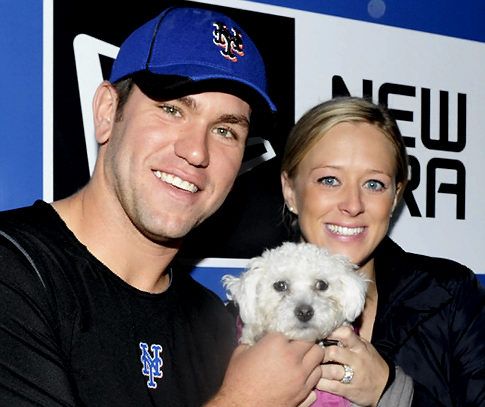
Josh Thole, his wife Kathryn and their dog, Picca, showing signs of a loving family. (Photo by NY Mets/Daily News)

According to an article by Nicholas Hirshon in today's Daily News, the Thole family adopted their dog, Picca, two years ago in Syracuse. But shortly thereafter, Kathryn Thole noticed that their Maltese-poodle mix wasn't acknowledging her whenever she'd call for her.

After taking their beloved dog to the veterinarian, it was discovered that Picca was deaf. However, instead of giving her up, the Tholes realized that Picca needed the love and support they were willing to give her. Therefore, Josh decided to pick up some sign language books and taught Picca how to respond to sign commands.

With a few simple hand gestures, Picca has now learned how to sit and stay, making it far easier for the Tholes to communicate with their dog and live a happy and normal life together. Well, normal in mostly everything. As Josh Thole says, Picca has been helpful in a few impromptu running exercises...


"If I was to go up to get the mail or something, my dog would follow me and take off. I couldn't call her. I'd have to chase her."


Studious Metsimus salutes Josh and Kathryn Thole for going the extra mile for their dog, Picca. She may not be able to hear her owners express their love for her, but she doesn't have to. After all, it's all in the signs.

Tuesday, January 25, 2011

Josh Thole Hopes To Give Mets Stability Behind The Plate

Josh Thole goes into spring training as the odds-on favorite to get the bulk of the playing time at catcher. Even if manager Terry Collins goes to a lefty-righty platoon with Thole and the newly acquired Ronny Paulino, it would be the left-handed hitting Thole getting the lion's share of at-bats. If Thole can handle the Mets' pitching staff and can successfully hit major league pitching on a regular basis, he stands to do something that hasn't been seen in Flushing since the days of Mike Piazza.

The Mets have played musical chairs at a number of positions, most notably at third base (until the arrival of David Wright in 2004) and right field. One position where they've had stability over the past half-century is at catcher.

Since 1962, the Mets have used 142 third basemen and 197 rightfielders (soon to be 198 if Carlos Beltran moves over to right). But they have only penciled in 81 catchers on their lineup cards, despite it being the most grueling position to play on the field.

It was original Met manager Casey Stengel who once famously said that you have to have a catcher, or else you're going to have a lot of passed balls. From 1962-1965 (which coincides with the time Casey was the Mets' skipper), the Mets didn't have a true #1 catcher, using 14 men at the position. Chris Cannizzaro played the most games at the position over the team's first four seasons, but that only added up to 236 games.

It wasn't until 1966, when Jerry Grote was traded to the Mets from the Houston Astros, that the Mets could boast finally having an everyday catcher. And once Grote took over the job, the catcher's position became as stable as any on the Mets.

From 1966-1976, Grote caught 1,176 games, which still represents the most games caught by any player in Mets history. Except for the 1972 season, when he was sidelined by injuries, Grote was the team's #1 catcher. With the emergence of John Stearns, Grote was deemed expendable, and he was traded to the Los Angeles Dodgers on August 31, 1977.

John Stearns was the Mets' regular catcher during the team's lean years from 1977-1982. In addition, he was also one of the team's best players, providing some pop (tying for the team lead with 12 HR in 1977 and hitting a career-high 15 HR in 1978) and exceptional speed for a catcher (91 stolen bases as a Met, including 25 SB in 1978).

Stearns was the first Mets position player to be selected to four All-Star teams (1977, 1979, 1980, 1982), but his career was cut short by a severe case of elbow tendinitis. Unable to throw, Stearns barely played in 1983 (4 games) and 1984 (8 games), appearing mostly as a pinch-runner.

The main backup catcher for both Grote and Stearns was Ron Hodges. He began his career in 1973 for the "Ya Gotta Believe" Mets, playing in 45 games and walking in his only postseason plate appearance in Game 1 of the World Series. From 1973-1981, Hodges backed up both Grote and Stearns, never appearing in more than 59 games in any season.

Then in 1982, he finally got his chance to be the team's #1 catcher when John Stearns succumbed to his elbow injury. Hodges became the team's everyday catcher at the end of the 1982 season and continued to hold the position in 1983, before going back to being the #2 guy in 1984 behind Mike Fitzgerald.

After Hodges retired, the top man behind the plate for the Mets became one of the most beloved figures in Mets history. Gary Carter was acquired via a trade with the Montreal Expos prior to the 1985 season and immediately became the best offensive catcher in franchise history. In five years as a Met, Carter caught in 566 games, picking up 89 HR and 349 RBI along the way. He became the first Met to drive in 100 or more runs in back-to-back seasons when he accomplished the feat in 1985 (100 RBI) and 1986 (105 RBI).

Along with first baseman Keith Hernandez, Carter was named co-captain of the Mets in 1988, even though he was already on the downside of his Hall of Fame career. Despite this, he was still named to the All-Star team in each of his five seasons in New York.

Once the '90s began, the Mets returned to the pre-Grote system of "let's send this guy out there to see how he does". Most of the time, it was Mackey Sasser who went behind the plate, but his unusual (how shall we say this politely) "throwing disability" prevented him from ever taking over the everyday job. It wasn't until 1992 when a homegrown talent took the position and made it his own.

After a few brief appearances in 1990 (36 games) and 1991 (21 games), Todd Hundley became the Mets' #1 catcher in 1992 at the tender age of 22. He went through the usual growing pains in his first full season as a Met, hitting .209, with 7 HR and 32 RBI. But as he got older, his power made its presence felt. From 1993-1995, Hundley averaged 14 HR and 49 RBI, numbers that would have been higher had the players' strike not wiped out parts of the 1994 and 1995 seasons. Then came 1996, the year Todd Hundley broke out in a major way.

In his fifth full season in the major leagues, Hundley obliterated his previous career highs in home runs and RBI. He became the first player in franchise history to surpass the 40 HR mark in 1996, and his 41 bombs set the all-time major league record for home runs by a catcher (which was surpassed by the Braves' Javy Lopez in 2003). He also recorded 112 RBI, which at the time, was the most by any catcher in Mets' history.

Hundley followed up his record-setting season with another good year, although not quite at his 1996 levels. He became the first Mets catcher to record back-to-back seasons with 30 or more homers in 1997, when he finished with 30 HR and 86 RBI. Unfortunately, that would be his last full season as a Met, as injuries limited Hundley to 53 games in 1998. However, the Mets did have a good backup plan, one that involved a certain trade with the Florida Marlins.

On May 22, 1998, the Mets traded Preston Wilson, Ed Yarnall and Geoff Goetz to the Florida Marlins for a catcher who had only been in Florida for one week. He went on to become the best hitting catcher, and perhaps the best hitter, in franchise history. That catcher was Mike Piazza.

Opposing pitchers feared him. Opposing baserunners? Not so much.

Piazza heard some boos early on from the Shea Stadium crowd. After all, he only drove in 20 runs over his first 47 games in New York, far less than the numbers he was accustomed to posting. Then Piazza caught fire, and he took the team with him. Over his final 62 games (57 starts), Piazza hit .362, had an on-base percentage of .434 and a slugging percentage of .670. He hit 19 doubles, 16 HR and drove in 56 runs over that two-month stretch. Amazingly, his power did not come along with a high strikeout total, as Piazza whiffed a mere 26 times over his final 62 games.

Piazza did not lead the Mets to the postseason in 1998, but he was able to carry them into October the following two years, including the franchise's fourth World Series appearance in 2000. In 2001, the Mets were struggling before September 11. After the season resumed on September 17, Piazza put the team on his back and almost led them back to the playoffs. Over the team's final 16 games, Piazza hit .364. He picked up 12 extra-base hits (seven doubles, five homers) and drove in 16 runs.

The 2002 season began a downward turn for Piazza, as he went from out-of-this-world numbers for a catcher to just very good numbers. Although he still had 33 HR and 98 RBI, he failed to hit .300 for the first time since in a full season, finishing the year with a .280 batting average. Piazza rejoined the human race from 2003-2005, averaging 17 HR and 50 RBI, to go with a .265 batting average. Despite his return back to Earth, Piazza still finished his Mets career with 220 HR and 655 RBI, numbers that rank him near the top of the franchise leaderboard.

For 40 seasons (1966-2005), the Mets basically used only six catchers (Grote, Stearns, Hodges, Carter, Hundley, Piazza). However, since Piazza played his last game as a Met in 2005, no Mets catcher has been the #1 guy behind the plate for more than two seasons. It's now up to Josh Thole to bring stability back to a position that was known for it throughout the majority of the team's existence.

Born during the 1986 World Series, the new "kid" hopes to reach the heights the old "Kid" (Gary Carter) reached during that magical World Championship season.

Thole has already proven he can handle a major league pitching staff. In 73 games last season, Thole's catcher's ERA (which calculates the ERA of the Mets' pitchers while Thole is catching them) was 3.58, which was lower than the overall team ERA of 3.73. He has also shown he can get on base. In 255 career plate appearances, Thole's batting average is .286 and his on-base percentage is .357. In fact, Thole's OBP would have led the Mets in 2010 had he registered enough at-bats.

For now, the future for the Mets at the catcher's position lies in the hands of Josh Thole. As long as he plays the way he is capable of playing, the 24-year-old Thole could join the exclusive list of catchers who have enjoyed great success behind the plate for the Mets. A long run at the catcher's position hasn't been seen since 2005. It's time for Thole to bring back stability behind the plate.

Wednesday, January 19, 2011

Pelfrey and Thole: The Battery That Energizes The Mets

Earlier today, Mike Pelfrey and Josh Thole both appeared on WFAN, with Pelfrey talking to Boomer Esiason and Craig Carton and Thole discussing the Mets with Joe Benigno and Evan Roberts. Both Pelfrey and Thole are enthused about the new regime at Citi Field, offering nothing but positive thoughts on the Mets and the direction of the team.

Some highlights of the conversation with the newly re-signed Mike Pelfrey include the following:

  • Although he feels bad about what happened to Jerry Manuel and Omar Minaya, he feels the Mets did the right thing by hiring Terry Collins and Sandy Alderson.
  • Feels the rotation is fine, especially with the recent signings of Chris Capuano and Chris Young
  • Brushes away doubts that this year's rotation needs work by mentioning that last year's rotation did better than anyone expected.
  • Quite pleased with his new contract (one-year, $3.925 million), which represents a significant raise from his $500,000 salary in 2010.
  • Says agent Scott Bora$ was pleased with the Mets initial offer of "between $3.5 and $4 million, but closer to $4 million."
  • Embraces his new role as the ace of the staff while Johan Santana recovers from surgery.
  • Doesn't think the Jets have a chance against the Steelers.

Photo taken by Studious Metsimus staff. That's right, we bad!

Aside from the last comment about the Jets' chances against the Steelers in the AFC Championship Game, Big Pelf gave Mets fans hope that 2011 will not be a disappointing season. He expects to be on the mound every fifth day, regardless of how he feels, and will not make excuses for poor play. He recognized that he had a poor month in 2010 (from June 30 to August 4, Pelfrey did not win a game and gave up 62 hits in 30 innings, leading to a bloated 9.00 ERA over that five week stretch), but vows to learn from that shaky month to be the pitcher he knows he has to be.

Whereas Pelfrey talked mostly about the pitching staff and his own status on the team, Josh Thole talked about every aspect of the team. He talked about the pitching staff as well, but also discussed his hitting style and the outlook for the Mets' everyday lineup. Among the topics Thole discussed with Joe Benigno and Evan Roberts were:

  • Expects fire and ambition from Terry Collins.
  • Not expecting the starting job to be handed to him.
  • Going into spring training with the mindset that he's fighting for a job.
  • Likes to hit in the 2-hole, but will hit anywhere TC puts him.
  • Won't try to hit home runs, but thinks Citi Field plays perfectly for his type of swing, allowing him to collect more hits.
  • Clicked the most with R.A. Dickey, since he caught him often at AAA-Buffalo and always sat with him the day after Dickey's starts to discuss what went wrong and what they can improve upon for the next start.
  • Expects Dickey to improve on last year's performance since last year was Dickey's first year as a full-time knuckleballer and has a much faster kunckleball than most other knucklers, giving hitters less time to react.
  • Thinks Mets have the bats in the lineup to hit the Phillies' pitching since they have former Silver Sluggers and All-Stars in the lineup.

Photo not taken by Studious Metsimus staff. Guess we not so bad as we claimed.

With the departure of Pedro Feliciano, Mike Pelfrey is now the longest tenured pitcher on the Mets, having been with the team since 2006. With Johan Santana's status for the first half of the season unknown, it will be up to Pelfrey to become the ace of the staff. Other than the aforementioned horrible five-week stretch from late June to early August, Big Pelf pitched like a wily veteran.

Prior to June 30, Pelfrey was 10-2 with a 2.71 ERA. After August 4, Mike was 5-3 with a 2.78 ERA. That's a 15-5 record with a sub-3.00 ERA for 27 starts. Like it or not, the 27-year-old Pelfrey is the leader of the staff. He might still be young, but he's not a kid anymore in baseball terms. It's time for Pelfrey to be consistently good for all 34 of his starts.

As for Josh Thole, he sounds much wiser than his 24 years. He's not taking anything for granted and is willing to learn from the team's veterans. He's cognizant of his role on the team and will not hesitate to talk to his teammates whenever he needs advice.

Until Johan Santana returns, Mike Pelfrey will be the #1 guy in the rotation. For the time being, Josh Thole is the team's #1 catcher. Both players are going to have to bring their "A" game to the table if the Mets are going to improve in the National League East. From what they said today on WFAN, it looks like they're both eagerly anticipating showing New York and the rest of the baseball world that the Mets are going to be a big surprise in 2011.

Monday, December 6, 2010

Why All The Interest In Russell Martin?

It's Day One of the Late Fall Meetings and there have already been a number of moves made. Mark Reynolds was traded from Arizona to Baltimore, taking his Citi Field home run launcher with him. The Adrian Gonzalez trade to Boston (and subsequent contract extension) was finalized. Also, former Met Melvin Mora signed a one-year deal with Arizona.

What have the Mets done? They signed two players to minor league deals.

Although Sandy Alderson has said that the Mets will not make many moves in the offseason, they have developed an interest in Dodger catcher Russell Martin. As tweeted by Buster Olney, the Mets were one of four teams that asked to review Martin's medical information (Red Sox, Yankees and Blue Jays were the others).

Martin would more than likely sign a one-year deal with the team he chooses and the Mets would use him in the event that Josh Thole has difficulty handling the everyday catching duties.

But why Russell Martin? Although he is just now entering his prime (Martin will be 28 in February), his production has slipped considerably since his breakout 2007 season, as seen below:

  • 2007: .293, 19 HR, 87 RBI, 87 runs, 21 SB, 32 doubles
  • 2008: .280, 13 HR, 69 RBI, 87 runs, 18 SB, 25 doubles
  • 2009: .250, 7 HR, 53 RBI, 63 runs, 11 SB, 19 doubles
  • 2010: .248, 5 HR, 26 RBI, 45 runs, 6 SB, 13 doubles

From 2007-2009, Martin had over 500 at-bats each season, which decreased to 331 in 2010. Still, players in their mid-to-late 20s don't usually start producing less unless something is wrong with them.

Russell Martin is clearly a shadow of the player he used to be. Yet the Mets are still looking into the possibility of bringing him over to New York.

Is it because the Mets are obsessed with signing or trading for every former Dodger catcher (Mike Piazza in 1998, Paul Lo Duca in 2006)? Is it because they miss Frenchy so much that they feel the need to replace him with a French Canadian?

No, my friends. If we take a deeper look into the stats, we might be able to uncover the reasons as to why Sandy Alderson and the Mets appear to be going head over heels over Russell Martin.

Although Martin's last four seasons have produced a .293, .280, .250 and .248 batting average, his on-base percentages in those years have been .374, .385, .352 and .347. In fact, over his five-year career in the big leagues, Martin's OBP is an above-average .365. The Mets' team OBP in 2010 was .314 and no regular player had an on-base percentage above .354 (David Wright). Josh Thole, who only picked up 202 at-bats, was the only Met with a higher on-base percentage than David Wright, but his .357 OBP was still lower than Martin's career percentage.

So although Russell Martin's offensive production has gone down, he is still finding ways to get on base. As we know, Sandy Alderson and his Merry Men LOOOOOOOOOOVE guys who can get on base, and since Alderson has stated that he's not sure if Thole can be a #1 catcher, a player like Russell Martin would satisfy his need for another catcher and fulfill his dream to acquire every player who knows the meaning of "ball four".

The Russell Martin deal might not happen, but that doesn't mean he wouldn't be a good fit for the Mets. If other teams become hesitant to sign him, you never know. He may just be in Flushing next year.

Sunday, September 5, 2010

Gee Whiz! Dillon Gee To Get First Start On Tuesday

If I were a faster typist, this would truly be breaking news. In case you haven't heard it yet, SNY is reporting that Johan Santana will not make his scheduled start on Tuesday night against the Washington Nationals. In his stead will be Dillon Gee, promoted from AAA-Buffalo to make his first major league start.

In SNY's post-game show, Jerry Manuel stated that Johan Santana wants to pitch through his injury in the worst way, but will not be swayed to start his ace, as it is in the best interests of the organization for Santana to skip a start. 'Han the Man will continue to receive treatment and will be re-evaluated before the decision is made whether or not he will make his next scheduled start against Pittsburgh on Monday, September 13.

Manuel also stated that Dillon Gee will make the start for the Mets on Tuesday. In 28 starts for AAA-Buffalo, Gee finished with a 13-8 record, but his ERA was very high (4.96). One of the main reasons for his high ERA was the career-high 23 hone runs he allowed. Prior to the 2010 season, Gee had only allowed 13 HR in 45 starts and three relief appearances. On the bright side, Gee struck out 165 batters in 161.1 innings, while only walking 41 batters.

Dillon Gee has proven that he can throw strikes. He fans over one batter per inning, while maintaining a 4:1 strikeout to walk ratio. Unfortunately, some of his strikes are so good that opposing batters have yanked them out of the park.

In a season filled with successful rookie seasons (Ike Davis, Jonathon Niese) and other young players being given an extended look-see (Ruben Tejada, Josh Thole, Lucas Duda), Dillon Gee will try to become the latest Mets player to make the transition from the minor leagues to the big stage.

The future is now for the Mets. These will be the players who will replace the high-priced stars and overpaid busts in the coming years. For Dillon Gee, he will be getting his first shot to join these young players at the big league level on Tuesday night. Will it be a "Gee Whiz" moment for Dillon or a "Gee, I'm being overmatched" outing against the Nationals? Until then, we'll have to wait and Gee.

Thursday, September 2, 2010

Hello And Goodbye (Part 2): Duda Hustle!

When the Mets traded rightfielder Jeff Francoeur to the Texas Rangers for infielder Joaquin Arias earlier this week, it opened up a spot for Lucas Duda to play every day. Wait. Lucas Who-da?

Before this season, Lucas Duda wasn't considered one of the Mets' top prospects. In fact, in this year's Maple Street Press Mets Annual, Duda wasn't even listed as one of the top 25 prospects (for position players). When you look at his performance at AA-Binghamton in 2009, it's easy to see why he was overlooked. Last year, Duda played 110 games at Binghamton and managed a .281 batting average. His 9 HR and 53 RBI was a slight decline from his 2008 numbers at St. Lucie, when he produced 11 HR and 66 RBI. Neither year was spectacular.

However, one thing that few people noticed was his doubles production. It is said that with age, doubles turn into homers, and an increased amount of doubles usually leads to a power surge once a player gains valuable experience.

At Brooklyn in 2007, Duda hit 20 doubles. That number rose to 26 in 2008 at St. Lucie and 29 in 2009 at Binghamton. Then came his 2010 season.

Duda began the 2010 season again at Binghamton, where he started hitting double after double, picking up an amazing 17 doubles (along with 6 HR) in only 45 games. That earned him a promotion to AAA-Buffalo, where the doubles continued, but the homers finally arrived as well. In 70 games at Buffalo, Duda hit 23 more doubles, but also added 17 HR.

Between AA and AAA, Duda hit a combined .304, with 40 doubles, 23 HR and 87 RBI, numbers that are very similar to what David Wright has produced for the Mets in 2010 (.292, 32 doubles, 22 HR, 87 RBI entering today's game against the Cubs).

That earned Duda a promotion to the Mets, where he has played every day since being called up on Wednesday, the day after Jeff Francoeur's spot in the outfield opened up due to his trade to Texas.

What will the future hold for Duda? That remains to be seen. But should he do well, the headlines of the New York tabloids will be splashed with "DUDA HUSTLE" and "DUDA RIGHT THING". If he is seen in public wearing the outfits that the veterans force rookies to wear during their hazing, the headlines might say "DUDA, LOOKS LIKE A LADY" after the Aerosmith song with the similar title.

Speaking of music, his entrance song when he makes his first appearance at Citi Field might end up being "Lucas With The Lid Off" , the 1995 kinda-sorta hit by one-hit wonder Lucas.

One thing is for sure with new Mets outfielder Lucas Duda. He has improved from year to year, going from a non-prospect to a major leaguer virtually overnight. His progress in the minor leagues looks very similar to David Wright's year-to-year progress, especially in the extra-base hit department:

Lucas Duda:
2008: .263 average, 26 doubles, 11 HR, 66 RBI
2009: .281 average, 29 doubles, 9 HR, 53 RBI
2010: .304 average, 40 doubles, 23 HR, 87 RBI

David Wright:
2002: .266 average, 30 doubles, 11 HR, 93 RBI
2003: .270 average, 39 doubles, 15 HR, 75 RBI
2004: .320 average, 52 doubles, 32 HR, 97 RBI (combined between minors and majors)

The homegrown movement has begun for the Mets. With Lucas Duda joining Ike Davis, Josh Thole, Ruben Tejada and Jonathon Niese, the Mets have proven that they had a better farm system than most experts gave them credit for. Before this year, the farm system had only produced Jose Reyes, David Wright and Mike Pelfrey (Angel Pagan came up through the Mets' farm system, but made his major league debut for the Cubs before coming back to the Mets in 2008).

Once the Mets shed themselves of the cancers in the clubhouse (El Perez-idente, Frankie Knuckles) and the bad contracts given to gimpy players (Luis Cast-"E"-llo), their youth movement will shine.

Lucas Duda is just the latest in a string of young players who will do his best to carry this team back to respectability. The future will be bright at Citi Field, so long as "the Duda abides" and takes the rest of the young Mets stars with him.

For Part 1 of "Hello And Goodbye", please click here.

Friday, June 4, 2010

Private Matthews Is Finally Given His Discharge

The Gary Matthews, Jr. Experiment is no more. Earlier today, the Mets decided to designate Private Matthews for assignment. To replace Matthews on the roster, the Mets called up catcher Omir Santos from Double-A Binghamton.

The plea by Mets fans and fellow bloggers to DFA GMJ ASAP didn't happen PDQ, but at least it happened. The outfielder was being booed mercilessly and failed to produce much during his short stay in New York.

In 36 games, mostly as the Mets' DAO (designated automatic out), Private Matthews hit .190 and drove in one more run than the Studious Metsimus staff has this season. For as much as David K. Wright has struck out this year, Private Matthews had a far worse strikeout percentage, whiffing 24 times in 58 at-bats.

Although Omir Santos hit .260 last year for the Mets last year, with seven home runs and 40 RBI, the acquisitions of Thunder and Lightning (Rod Barajas and Henry Blanco) made Santos obsolete. He was sent to Triple-A Buffalo before the beginning of the season to serve as a mentor to catching prospect Josh Thole. The only problem was that Santos didn't hit a lick at Buffalo. His .194 average (7-for-37) and two RBI earned him a first-class ticket to Double-A Binghamton, where he fared even worse, batting .074 (2-for-27).

However, with Blanco hurting, the Mets felt the need to have some insurance behind the plate, necessitating the Santos call-up.

So the Mets discharged Private Matthews and his .190 average from their battalion and promoted Omir-acle Whip and his combined .143 minor league batting average.

All I have to say is that Rod Barajas better stay healthy and hitting. I'm sure the Mets and their fans would rather see their power hitting Batman at the plate than having to settle for his new sidekick.


Monday, February 22, 2010

Mets Sign A Rod; Too Bad It's Barajas

Sorry about the title (and for the photo to the left), Mets fans. The Mets did sign "a Rod" over the weekend, but it happened to be Rod Barajas, who should take over as the #1 catcher for the Mets this season.

After failing to sign other potential #1 catchers, most notably Funky Cold Molina, the Mets were able to sign Barajas to a one-year deal for a very reasonable dollar amount ($1 million, plus $1 million in incentives). This will allow Josh Thole to play another season in the minor leagues in the hopes that he can be major league ready in 2011.

So what are the pros and cons of the Rod Barajas signing? Let's start with the pros.

Since the Texas Rangers signed him as a free agent prior to the 2004 season, Barajas has become a good source for extra-base hits, especially from the catchers' position. He was the #1 catcher for Texas from 2004-2006 and Toronto from 2008-2009 (he had an injury-plagued season for the Phillies in 2007 and only played 48 games for our hated rivals). In the five seasons Barajas was an everyday player, he hit 77 HR (with a career high of 21 HR in 2005), 112 doubles (consistently hitting between 19 and 26 doubles in each of the five seasons) and collected 279 RBI (with a career high of 71 RBI in 2009). An average season for Barajas over those five years meant 22 doubles, 15 HR and 56 RBI. By comparison, the combination of Brian Schneider and Omir Santos hit 25 doubles, 10 HR and collected 64 RBI for the Mets in 2009. The combined total for those two catchers were nearly identical to the numbers produced by Barajas in an average season.

Defensively, Barajas has been consistently good at throwing out would-be base stealers. Over his career, he has nailed 34% of those who have attempted to swipe a base against him. That same percentage was registered by Barajas over each of the past two seasons. Over those same two seasons, which coincide with Brian Schneider's two years in New York, Schneider also threw out 34% of opposing base stealers. Omir Santos nabbed 30% of the would-be base stealers against him in his one big league season.

Now what is there not to like about Barajas? How about a career .238 batting average and a frighteningly low .284 career OBP? The numbers were even worse last year (.226 batting average, .258 OBP). He has never walked more than 26 times in a single season and has only collected 100 hits in a season once (104 hits in 2005). He also tends to pick up his share of errors. In the five seasons Barajas has been a #1 catcher, he has commited 38 errors (an average of nearly eight errors per season). In those same five seasons, Brian Schneider commited half that total (19 errors). Also, Omir Santos only committed three errors in his one season with the Mets.

Before I end this, I do need to point out that Barajas has fared well against the three teams that finished ahead of the Mets in the NL East last year (Phillies, Marlins, Braves). In 187 career at-bats against those three teams, Barajas has hit .316, with 18 doubles, 13 HR and 35 RBI. Considering he will be seeing those teams more than teams in the NL Central and NL West, those numbers cannot be ignored.

So now that you have the pros and cons, what do you think of the signing, my fellow SMFs? Is this an upgrade over whatever combination of catchers the Mets would have employed? Do you think Barajas will end up helping the team more with his bat or with his defense? Will Barajas be the #1 catcher for the entire 2010 season? The floor is yours, Mets fans! Talk amongst yourselves!