Showing posts with label Keith Miller. Show all posts

Sunday, November 16, 2014

Doc Gooden's Greatness On The Mound Extended Past The 1986 Season

Photo by Ray Stubblebine/AP

Dwight Gooden, the Mets' hurler who helped exhume the team from Grant's Tomb and brought Shea Stadium back to life in the mid-'80s, is celebrating his 50th birthday today.  When Gooden was at his peak three decades ago, the baseball cognoscenti agreed that his first three seasons in the major leagues were among the best by a young pitcher in the game's history.  Gooden took the mound 99 times from 1984 to 1986, going 58-19 with a 2.28 ERA, 1.04 WHIP, 35 complete games, 13 shutouts and 744 strikeouts - reaching 200 or more strikeouts in each season.

But after off-the-field problems came to light prior to the 1987 campaign, Gooden went from being Dr. K to being Dr. Just OK.  Or did he?

From 1987 to 1991, Doc's numbers were clearly not the same as they were during his first three seasons.  But they were still pretty darn good.  In his fourth through eighth seasons with the Mets, Gooden went 74-34 with a 3.39 ERA and 1.23 WHIP, striking out 797 batters, completing 22 games and tossing eight shutouts.  He also finished in the top five in the Cy Young Award voting twice.  (Gooden was fifth in the Cy Young balloting in 1987 and fourth in 1990.)  He accomplished all of this from 1987 to 1991 despite making fewer than 28 starts in three of the five seasons.

Perhaps his greatest and most underappreciated accomplishment occurred in 1991.  After seven consecutive seasons of winning 87 or more games, the Mets finished under .500 in '91.  But Gooden still managed to finish with a 13-7 record, 3.60 ERA and 150 strikeouts in only 27 starts.  In 15 of those 27 starts, Gooden allowed two earned runs or fewer, but received losses or no-decisions in six of the games, mainly because he was surrounded by a putrid offense.

Keith Miller (.280) and Gregg Jefferies (.272) were the only players with 300 or more plate appearances to finish the year with a batting average north of .260.  Howard Johnson (38 HR, 117 RBI, 108 runs) was the sole Met with more than 16 homers, 74 RBI or 65 runs scored.  Gooden basically had to help himself when he was in the game, as he batted .238 with three doubles, a homer, six RBI and seven runs scored in only 63 at-bats.  His .333 slugging percentage was higher than the marks posted by Mark Carreon (.331 in 254 AB), Vince Coleman (.327 in 278 AB) and Garry Templeton (.306 in 219 AB).

In the five seasons immediately following the 1986 championship campaign, when Gooden supposedly went from being a great pitcher to just being a very good pitcher, the right-hander's winning percentage was .685 in 137 starts.  That was the highest winning percentage for all pitchers who made 100 or more starts from 1987 to 1991.  The rest of the top five included Dave Stieb, Roger Clemens, Bob Welch and Dave Stewart - pitchers who combined to win 909 games over their long and successful major league careers.


Player W-L% GS W L ERA FIP BA OBP SLG OPS
Dwight Gooden .685 137 74 34 3.39 2.78 .249 .304 .342 .647
Dave Stieb .667 137 68 34 3.32 3.78 .226 .306 .332 .638
Roger Clemens .662 172 94 48 2.74 2.61 .227 .284 .329 .613
Bob Welch .662 174 88 45 3.47 3.93 .245 .313 .375 .689
Dave Stewart .629 181 95 56 3.54 3.66 .246 .314 .366 .680
Provided by Baseball-Reference.com: View Play Index Tool Used
Generated 11/15/2014.


The Mets averaged nearly 99 wins a season from 1984 to 1986, with Gooden accounting for 58 of the team's 296 wins in those three campaigns.  Although several stints on the disabled list caused Gooden to miss significant time in 1987, 1989 and 1991, Doc still won 74 games in the five years immediately following the team's championship in 1986.

Averaging 27 starts per season from 1987 to 1991 should have allowed other National League pitchers to finish well ahead of Gooden in wins, but that never happened.  In fact, only Doug Drabek won more games in the Senior Circuit than Dwight Gooden did during that five-year stretch, as seen in the chart below.


Player W G GS CG SHO W-L% IP H BB SO
Doug Drabek 77 165 162 26 12 .602 1106.0 1009 283 643
Dwight Gooden 74 139 137 22 8 .685 969.0 911 283 797
Greg Maddux 73 171 168 32 9 .549 1143.0 1107 374 718
Tom Browning 72 176 175 19 5 .576 1141.1 1123 297 573
David Cone 67 155 138 27 10 .620 994.2 829 336 945
Provided by Baseball-Reference.com: View Play Index Tool Used
Generated 11/15/2014.


When Gooden was at his best from 1984 to 1986, he was the league's premier strikeout pitcher, fanning 200 or more batters in each of his first three seasons and averaging nearly 250 Ks per year.  Gooden's propensity for throwing strike three earned him the nickname Dr. K, but just because he wasn't leading the league in strikeouts from 1987 to 1991 as he did in his first two seasons didn't mean he was no longer frustrating batters at the plate.

In his fourth through eighth seasons in the big leagues, the good Doctor struck out 797 batters.  Only one pitcher in the National League had more strikeouts than Gooden did during those five "post-dominant Doc" seasons - his teammate, David Cone, who won two strikeout titles of his own in 1990 and 1991.


Player SO SO/9 SO/BB K% GS W L W-L% IP BF
David Cone 945 8.55 2.81 23.1% 138 67 41 .620 994.2 4092
Dwight Gooden 797 7.40 2.82 19.8% 137 74 34 .685 969.0 4023
Sid Fernandez 733 8.40 2.55 22.8% 128 48 40 .545 785.2 3211
Mike Scott 719 7.13 2.72 19.4% 134 59 46 .562 908.0 3715
Greg Maddux 718 5.65 1.92 14.9% 168 73 60 .549 1143.0 4831
Provided by Baseball-Reference.com: View Play Index Tool Used
Generated 11/15/2014.


There's one last thing that won't show up in a boxscore or a Baseball Reference chart that helps assess Dwight Gooden's value to the Mets after his first three historic seasons with the team.  During the five-year period from 1987 to 1991, Gooden was outstanding at helping the Mets win games that immediately followed a loss, thereby preventing the Mets from suffering through extended losing streaks.  In Gooden's 137 starts during those five years, 65 of them came after a loss by the team.  The Mets' record in those 65 contests was 41-24, giving the team a .631 winning percentage in post-loss games started by Doc.  When any other starting pitcher took the mound immediately following a Mets loss during that five-year stretch, the team's record in those games was 147-148, for a .498 winning percentage.  That's how valuable Gooden was to the team after he had supposedly lost his ability to dominate hitters.

Dwight Gooden never had a winning percentage under .650 in any season from 1987 to 1991, while the Mets never posted a winning percentage above .625 in any of those five campaigns.  The entire team stopped being as great as they were in 1986, but not Doc.  He just continued to find ways to win.  If anything, he was one of the main reasons why the team continued to be competitive for as long as they did, until the bottom fell out in the early '90s.

Today is Doc's 50th birthday, making it a perfect day to look back at how golden he was not just during his first three seasons with the Mets, but in the years immediately following the team's World Series championship.  The baseball pundits might say Gooden wasn't the same pitcher after 1986, but that didn't make him any less valuable to the Mets.  The numbers don't lie.  Doc Gooden never lost his ability to be among the best pitchers in the league even when his club stopped being one of the best teams in the league.
    

Sunday, May 4, 2014

A Different Kind of Banner Day

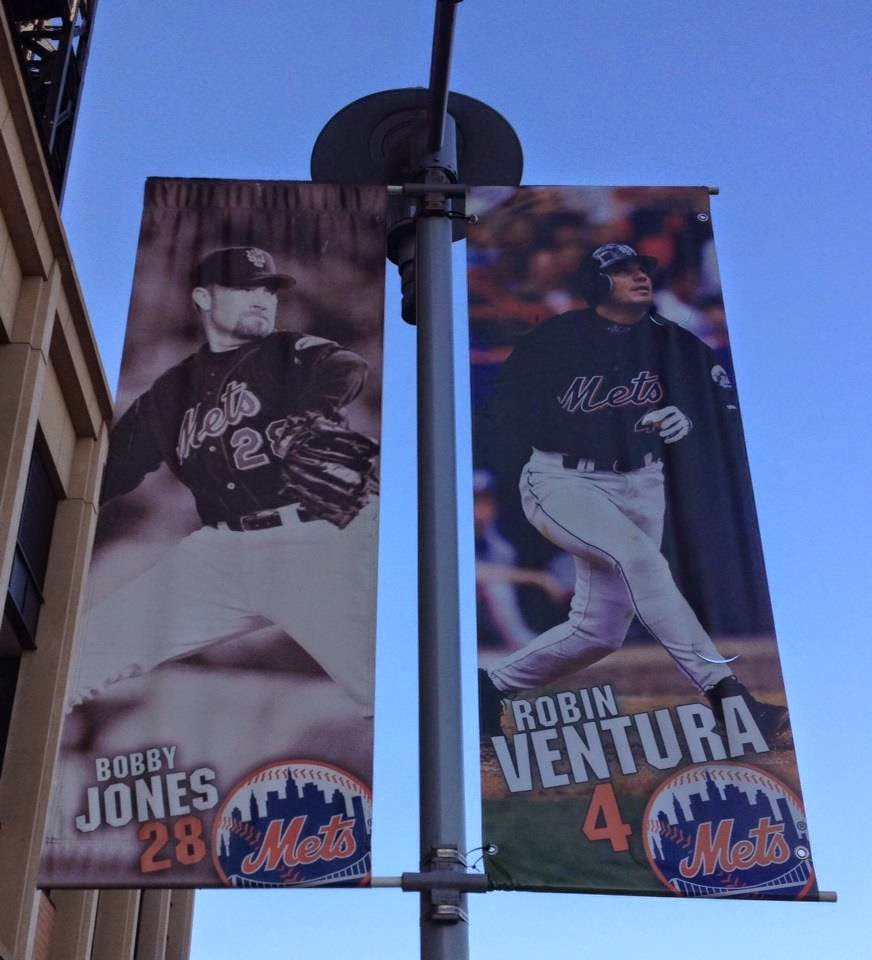
With the Mets on the road for over a week, I took advantage of Citi Field being devoid of fans walking around the outside plaza (which isn't all that different from game days) and decided to take some photos of the banners hanging on the light poles near the various entrances to the ballpark.  In doing so, I noticed some interesting pairings on those poles.

Six particular pairings caught my eye.  As shown in the photos below, these conscious couplings had to have been as intentional as Roger Clemens' broken bat-flinging incident in Game 2 of the 2000 World Series.  Take a look.


The above photo depicts Nolan Ryan and Robin Ventura, two former Mets who are connected by more than just a light pole.  In 1993, Ventura famously charged the mound when Ryan hit him with a pitch, only to be confronted by Ryan's Noogie Express.

Ventura's White Sox teammates and Ryan's cronies in Texas separated the two back then, but now the Mets are keeping them together, separated by just a metal light pole.


Ventura appears on another banner outside Citi Field.  This time, he's paired with Bobby Jones, a former Met who won 74 games in his pitching career as a Met, good for the ninth-highest total in club history.

Despite his lofty win total and status as an underrated Met, Jones is known primarily for his complete-game one-hit shutout over the San Francisco Giants in Game 4 of the 2000 NLDS.  Jones would get all the runs he needed in the first inning, when Robin Ventura crushed a two-run homer to give the Mets a 2-0 lead.  Eight innings later, Ventura and Jones celebrated their series clinching victory along with the rest of their teammates.  


This pairing should be obvious to even the most casual of Mets fans.  John Franco pitched for the Mets in 14 seasons (1990-2001, 2003-04) while Ed Kranepool appeared in a Mets uniform for 18 campaigns (1962-79).

Their longevity puts both players atop the team's all-time leaderboard in several offensive and pitching categories.  It also ranks them No. 1 (Kranepool) and No. 2 (Franco) in seasons played in New York.


Unlike the players represented in the first three photographs, Pedro Martinez and Carlos Delgado were teammates for three seasons (2006-08) in New York.  But they could have been teammates longer had it not been for the way general manager Omar Minaya pursued Delgado.

In Minaya's first off-season as the Mets GM, he signed two of the top available free agents in Pedro Martinez and Carlos Beltran.  But when Minaya sought the services of Delgado, he was turned away because the first baseman was uncomfortable with the way Minaya was appealing to his Latin-American heritage.  Delgado was eventually traded to the Mets in 2006, becoming a teammate of Pedro Martinez - the first player signed by Minaya in what some people have since referred to as the "Los Mets" era of the team.


Gil Hodges made his mark as a member of the Brooklyn Dodgers, then became an original Met in 1962.  Seven years later, as the team's manager, he led the Mets to their first World Series championship.  Meanwhile, Lee Mazzilli was born in Brooklyn in 1955 - the same year Hodges helped the Dodgers win their only World Series in the borough.  Mazzilli was one of the team's brightest stars in the late 1970s before being traded away in 1982.  But just like Hodges, Mazzilli was brought back to help the Mets win a championship.

For Hodges and Mazzilli, their seeds were planted in Brooklyn.  But both men blossomed for the Mets in Queens, winning championships and making the entire city proud.


The oddest pairing might be this David Wright-Keith Miller pole.  Wright is the Mets' all-time leader in various offensive categories and is one of the most beloved figures in recent club history.  Keith Miller was a utility player for the Mets from 1987 to 1991, never collecting more than 275 at-bats in any season and finishing his Mets career with just seven homers and 48 RBI - numbers Wright can easily put up in half a season.

As random as this pairing might seem, these two players have quite a personal connection to each other.  Prior to the 2013 season, Wright signed the most lucrative contract in team history, a deal that pays him $138 million over eight seasons.  Every time Wright thanks his agent for that contract, all he has to say is, "Thank you, Keith Miller."  Miller gave the Mets little run production as a player, but he gave the team eight extra years of run production as David Wright's agent.


Plenty of room for more banners, don't you think?

The Mets have set up various banner displays on poles outside Citi Field.  The banners feature several random pairings of the team's best players.  But not all of them are random.  Some of them, as seen in the six photos above, appear to be quite intentional.  And who knows, maybe the Mets aren't done with intentional banner pairings.

For example, there are still no banners pairing up Mike Piazza and Guillermo Mota.  They got into a famous spring training bench-clearing brawl in 2003 when Mota was a Dodger and Piazza was an ex-Dodger.  Similarly, there are no Gregg Jefferies-Roger McDowell pairings in the plaza.  Maybe the reason for that is because Gary Carter had to spend his final home game as a Met separating the two after they got into a brawl following the game's final out.  And don't get me started on an Armando Benitez-Graeme Lloyd pole.  The two had to be separated in a fight between the Orioles and Yankees in 1998, then briefly became teammates with the Mets five years later.

In addition, there are no banners teaming up Jesse Orosco and Jerry Koosman, two pitchers who were traded for each other following the 1978 season and remain the only pitchers who can say they recorded the final out in a World Series-clinching game for the Mets.  (Seriously, Mets, this pairing has to get done.)

If the Mets wanted some comic pairings, they could have a Follicle Follies-themed pole featuring Nino Espinosa and Jenrry Mejia.  Or perhaps Don Aase (a Met reliever in 1989) and Al Schmelz (a Met reliever in 1967) could have shared an Aase-Schmelz pole.  Aase could also appear on a pole with 1969 World Series hero Al Weis, but that pairing would probably be shot down, because no one likes a Weis-Aase.

The opportunity is there for the Mets to have a different kind of Banner Day at Citi Field.  They just need to show a little extra creativity.  They tried (and failed) to be creative by getting "True New Yorkers" to respond to a letter they sent out.  The team was chased up a pole on that one.  At least there were no banners on that pole.  I'd say it's because those are the poles being reserved for the Terrence Long and R.A. Dickey banners, but knowing the Mets, fans would probably get stiffed on that pairing as well.
 

Saturday, November 16, 2013

Doc Gooden Was Great After He Stopped Being Great

Photo by Ray Stubblebine/AP

Baseball historians will say that Dwight Gooden's first three seasons in the major leagues were some of the best by a young pitcher in the game's history.  Gooden took the mound 99 times from 1984 to 1986, going 58-19 with a 2.28 ERA, 1.04 WHIP, 35 complete games, 13 shutouts and 744 strikeouts - reaching 200 or more strikeouts in each season.

But after off-the-field problems came to light prior to the 1987 campaign, Gooden went from being Dr. K to being Dr. Just OK.  Or did he?

From 1987 to 1991, Doc's numbers were clearly not the same as they were during his first three seasons.  But they were still pretty darn good.  In his fourth through eighth seasons with the Mets, Gooden went 74-34 with a 3.39 ERA and 1.23 WHIP, striking out 797 batters, completing 22 games and tossing eight shutouts.  He also finished in the top five in the Cy Young Award voting twice.  (Gooden was fifth in the Cy Young balloting in 1987 and fourth in 1990.)  He accomplished all of this from 1987 to 1991 despite making fewer than 28 starts in three of the five seasons.

Perhaps his greatest and most underappreciated accomplishment occurred in 1991.  After seven consecutive seasons of winning 87 or more games, the Mets finished under .500 in '91.  But Gooden still managed to finish with a 13-7 record, 3.60 ERA and 150 strikeouts in only 27 starts.  In 15 of those 27 starts, Gooden allowed two earned runs or fewer, but received losses or no-decisions in six of the games, mainly because he was surrounded by a putrid offense.

Keith Miller (.280) and Gregg Jefferies (.272) were the only players with 300 or more plate appearances to finish the year with a batting average north of .260.  Howard Johnson (38 HR, 117 RBI, 108 runs) was the sole Met with more than 16 homers, 74 RBI or 65 runs scored.  Gooden basically had to help himself when he was in the game, as he batted .238 with three doubles, a homer, six RBI and seven runs scored in only 63 at-bats.  His .333 slugging percentage was higher than the marks posted by Mark Carreon (.331 in 254 AB), Vince Coleman (.327 in 278 AB) and Garry Templeton (.306 in 219 AB).

In the five seasons immediately following the 1986 World Series championship campaign, when Gooden supposedly went from being a great pitcher to just being a very good pitcher, the right-hander's winning percentage was .685 in 137 starts.  That was the highest winning percentage for all pitchers who made 100 or more starts from 1987 to 1991.  The rest of the top five included Dave Stieb (68-34, .667), Roger Clemens (94-48, .662), Bob Welch (88-42, .662) and Dave Stewart (95-56, .629) - pitchers who combined to win 909 games over their long and successful major league careers.

Despite his dropoff in strikeouts following the 1986 season, Gooden's 797 Ks from 1987 to 1991 was surpassed by just one pitcher in the National League - his teammate, David Cone.  Cone struck out 945 batters over the five-year stretch.  Gooden's 74 wins was also second in the NL to Doug Drabek, who won 77 games for the Pittsburgh Pirates from '87 to '91.

One other thing that Gooden was great at from 1987 to 1991 was something that never showed up in the boxscore.  During those five years, Gooden was outstanding at helping the Mets win games immediately following a loss, thereby preventing the Mets from suffering through extended losing streaks.  Doc started 65 games following a Mets loss from 1987 to 1991.  The Mets were 41-24 in those games.

Photo by Ed Leyro/Studious Metsimus
Today is Dwight Gooden's 49th birthday.  It's been nearly three decades since he rocketed onto the major league scene with his blazing fastball and devastating curveball as a rookie in 1984.  It's also been almost two decades since he threw his final pitch as a member of the New York Mets.

From the ages of 19 to 21, Gooden was arguably the best pitcher in the game.  Then, as his off-the-field habits started to come to light, he failed to approach his otherworldly numbers from 1984 to 1986.  But that didn't mean he stopped being a great pitcher.  In fact, no one in baseball gave his team a better chance to win from 1987 to 1991 than Gooden, and only a handful of pitchers sent as many opposing batters back to the bench without putting the ball in play than Doc did.

Just because he wasn't leading the league in strikeouts and threatening to throw a no-hitter in every start didn't mean he wasn't the Doctor anymore.  In fact, he continued to operate with surgical precision for quite some time after the 1986 campaign.

Doc Gooden never stopped being great on the mound.  It's a shame that some people thought his greatness just wasn't good enough.