Showing posts with label Armando Benitez. Show all posts

Wednesday, January 24, 2018

Ken Griffey Jr. Once Rejected a Trade to the Mets For a Rejected Met

Imagine if a scene like this had happened at Shea Stadium with Griffey wearing a Mets uniform.  (Elaine Thompson/AP)

With today's news that Seattle legend Edgar Martinez failed to garner the votes necessary for Hall of Fame election, that leaves Ken Griffey Jr. as the only player with a Mariners cap on his plaque in Cooperstown.  But nearly two decades ago, a deal was in place that could have seen Griffey change the "S" on his cap to an interlocking "NY".  That is, if Griffey hadn't rejected the trade.

According to the Seattle Times, Mariners general manager Pat Gillick and his Mets counterpart Steve Phillips had discussed a trade in December 1999 that would have brought Griffey to New York to join fellow 2016 Hall of Fame inductee Mike Piazza in the middle of a formidable Mets lineup that had come within two wins of a National League pennant just two months earlier.  But Griffey was adamant about only playing in Seattle or Cincinnati, where he grew up and went to high school.  As a 10-and-5 player (ten years in the majors, the last five with his current team), it was Griffey's right to reject any trade he didn't approve of, which he did after the Mariners asked for his approval of a potential move to New York.

Who would the Mets have sent to Seattle for the future Hall of Famer?  Well, Roger Cedeño would have taken his .313 batting average and then-club record 66 stolen bases to the Pacific Northwest in the nixed deal.  So would Octavio Dotel, who ended up pitching for a major league record 13 teams in his 15 major league seasons.  A third player would also have been jettisoned to Seattle to go with the speedy Cedeño and the peripatetic Dotel.  That player would have been Armando Benitez.

Yes, that Armando Benitez.

Benitez had become the Mets' closer in 1999 after John Franco was lost for two months with an injury.  Although Benitez had a dominant regular season (22 saves, 1.85 ERA, 128 Ks in 78 IP), he was just ordinary in the postseason, blowing a save in the division series (a game the Mets eventually won in extra innings) and failing to hold a one-run lead in the tenth inning of Game Six of the NLCS (the Mets lost that heartbreaker to the Braves).

Booooo!!!   (Gregory Bull/AP)
Had Griffey just said yes to the Mets, Benitez would have been in Seattle in 2000.  That means he wouldn't have allowed a game-tying three-run homer to the Giants' J.T. Snow in the ninth inning of Game Two of the 2000 NLDS.  And he certainly wouldn't have blown a ninth inning lead to the Yankees in Game One of that year's World Series, which completely changed the course of that Fall Classic.  And let's not forget how Benitez allowed eight runs in two late-season appearances against the Braves in 2001, coughing up a three-run lead and four-run advantage in those ill-fated outings, all but ending the Mets' unlikely post-9/11 push to a potential division title.

Benitez remained a Met until 2003, which was more than enough for him to incur the wrath of long-time Mets fans as well as recent converts.  Dotel and Cedeño, who were two-thirds of the rejected trade for Griffey in 1999, were eventually traded that winter to the Houston Astros for Derek Bell and Mike Hampton, with Hampton eventually being named the Most Valuable Player of the 2000 National League Championship Series.  Fortunately for Hampton, Benitez didn't blow any of his leads in his two NLCS starts, although Benitez did allow two runs in the ninth inning of Hampton's first NLCS start, turning a comfortable 6-0 lead into a 6-2 final.

Could the Mets have won the 2000 World Series if Griffey had okayed the trade?  Would John Franco have gone back to being the Mets' closer and would he have held the leads that Benitez blew in so many crucial situations?  We'll never know.  But the thing we can say with certainty is that every person who booed Benitez would have cheered for Griffey.  And Mets history would have looked a whole lot different.


Monday, February 27, 2017

The Thrill of Victory, The Agony of the Mets: John Franco and Armando Benitez

In New York sports, an athlete has to be great more often than not to be fully loved.  Players like Tom Seaver and Mike Piazza aren't revered just because they have phenomenal statistics; they're beloved because they produced in key spots when the Mets needed them to.

Similarly, a lesser player like Benny Agbayani will always have a special place in the hearts of Mets fans because he was a clutch performer even if his cumulative career numbers don't necessarily say he was one of the top players on the team.

On the other hand, a player who produces in non-pressure situations more often than he does when the stakes are higher will also be remembered by the Flushing faithful, but not in a way he'd like.  And even breaking a franchise record or two can't change the minds of fans with long memories.

The Mets' top two closers, if you go by saves alone.  (Focus on Sport/Getty Images; Corey Sipkin/NY Daily News)

As a child growing up in Brooklyn, John Anthony Franco - the son of a New York City sanitation worker - dreamed of delivering a title to the Mets.  Nearly two thousand miles away, Armando German Benitez was developing his heater in the Dominican town of San Pedro de Macoris, whose primary export was major league shortstops.

Franco attended Lafayette High School, the same school that produced Hall of Fame pitcher Sandy Koufax and Mets owner Fred Wilpon.  He then attended St. John's University and was drafted by the Los Angeles Dodgers after his junior year in 1981.  Two years later, the Dodgers traded Franco to Cincinnati, the team for which he made his major league debut in 1984.  Franco was brilliant as the Reds' closer, posting a 2.49 ERA in six seasons and saving 148 games, including a league-leading 39 saves in 1988.  But after making his third All-Star team in 1989, Franco was awful following the mid-season hiatus, blowing five saves in 15 opportunities and recording a 4.87 ERA.  As a result, the Reds replaced Franco during the off-season, trading him to the Mets for fellow southpaw Randy Myers in a deal that shocked Myers and delighted Franco.

"John had a great first half last season and a not-so-great second half," Mets' vice president Joe McIlvane said.  "We're hoping that a change of scenery will bring him back.  When we called him tonight, he was so happy he was bouncing off the wall."

Franco had a triumphant first season with the Mets, as he led the league in saves with 33 and became an All-Star for the fourth time in his career.  But Myers had greater team success, as he and his fellow Nasty Boys in the Reds' hard-throwing bullpen celebrated a World Series title in 1990.

The 1990 baseball season also saw the professional debut of another flame-throwing reliever, as Armando Benitez was signed as an amateur free agent with the Baltimore Orioles in April.  Four years later, Benitez made his major league debut, allowing one run in ten innings while striking out 14 batters.  While Benitez was blowing hitters away with his fastball, Franco was nibbling his way to success with the Mets.

From 1990 to 1998, Franco posted five years of 30 or more saves, after only one Met (Jesse Orosco) had reached the 30-save plateau in the franchise's first 28 seasons.  Franco's ERA during the nine-year period was a splendid 2.80, but he was constantly pitching in and out of trouble, as evidenced by his 1.346 WHIP and the .255 batting average against him.  Meanwhile, Benitez was practically unhittable as a member of the Orioles through the 1998 season, as he averaged nearly 12 strikeouts per nine innings and held opposing hitters to a .197 average.

The Mets failed to qualify for the postseason in 1998, as they coughed up a slim lead in the wild card race during their season-ending five-game losing streak.  Going into the off-season, general manager Steve Phillips was looking to upgrade the bullpen, especially after reliever Mel Rojas posted a 6.05 ERA in 50 games - the highest single-season ERA in club history for a pitcher who made at least 50 appearances.  Phillips filled that hole by acquiring Benitez in a three-team trade in December.

"We feel we've added in Armando Benitez one of the best power pitchers in the game," Phillips said, "and somebody who will give us a completely different look in the bullpen - somebody who will give us someone who can get a strikeout coming out of the bullpen."

(Eliot J. Schecter/Getty Images)
Indeed, with the addition of Benitez, the Mets now had one of the best relief corps in baseball, as Benitez was now part of a bullpen that included closer Franco, as well as the righty-lefty set-up combo of Turk Wendell and Dennis Cook.

The Mets began the 1999 season using Benitez primarily as an eighth-inning pitcher and he was dominant in the role, posting a 1.34 ERA in his first 40 appearances and holding opposing hitters to a microscopic .119 batting average.  But on June 30, Benitez surrendered a walk-off home run to the Marlins' Mark Kotsay.  It would be a portent of things to come for Benitez, who would have a new job with the team two days later, and it had nothing to do with his poor outing against Florida.

On July 2, the Mets hosted the division rival Atlanta Braves in front of 51,979 fans on Fireworks Night at Shea Stadium.  The outcome of the game was decided early, as the Braves pummeled starter Masato Yoshii for eight runs in three innings.  With the Braves leading 12-0 by the time the ninth inning rolled around, Mets manager Bobby Valentine surprisingly brought in his closer to start the final frame.  Franco allowed a double and two walks before he was taken out of the game with a strained tendon in the middle finger of his pitching hand.  Relieving him was utility man Matt Franco, who promptly allowed a three-run homer to the first batter he faced, causing Valentine to regret his decision immediately.

"I should have had Matty start the ninth, as it turns out," Valentine said.  "I had the wrong Franco start the ninth."

Franco's injury sidelined him for two months, as the lefty didn't pitch again until September 5.  While the former closer was recovering, the new closer was thriving in his new role.  During Franco's absence, Benitez recorded three wins, 13 saves and struck out 38 batters in just 23 innings.  But like Franco before him, Benitez constantly had to pitch his way out of jams he created, as he also walked 16 batters in those 23 frames.

Once Franco returned from the disabled list, Benitez continued to be the Mets' ninth-inning guy while Franco settled into a set-up role.  Both Franco (0.96 ERA in 12 appearances) and Benitez (0.64 ERA in 13 games) had strong Septembers, helping the Mets win the wild card berth to advance to the postseason for the first time since 1988.  It would be the first playoff trip for Franco in his 16-year career, while Benitez was making his third journey to the postseason.  (He was a member of the Orioles' bullpen when they qualified for the playoffs in 1996 and 1997.)

In the Division Series against Arizona, both Franco and Benitez were unscored upon, although Benitez couldn't hold a one-run lead in Game Four, allowing two inherited runners to cross the plate in the eighth inning.  With the Mets needing one win to advance to the National League Championship Series and avoid facing Randy Johnson in a potential fifth and deciding game, Valentine gave the ball to Franco as the game moved into extra innings.  Franco pitched a perfect frame and earned the win when Todd Pratt hit a series-ending home run off Diamondbacks' closer Matt Mantei in the bottom of the tenth.

Ten days after Franco bailed out Benitez, neither pitcher could bail out the Mets.  With the Mets desperately trying to force a seventh game against the Braves in the National League Championship Series, Franco couldn't hold a one-run lead in the eighth inning.  Two innings later, Benitez blew a one-run lead as well, as he allowed light-hitting Ozzie Guillen to drive in the tying run in the bottom of the tenth.  The Braves won the pennant an inning later when Kenny Rogers walked in the winning run.  Franco was one of many Mets who were disappointed by the way the team's storybook season came to a close.

"We had a good feeling about everything," Franco said.  "We just didn't get it done.  It took me 16 years to get here and to come so close, it's hard."

The Mets entered the 2000 season on a mission to play in the World Series, but by mid-May, their mission was just to stay above .500.  After 40 games, the Mets' record stood at 20-20.  The strong bullpen general manager Steve Phillips had constructed was falling apart, as Turk Wendell's slider was sliding off the plate (19 walks in 25⅓ innings) and Dennis Cook's ERA was approaching the Rojasphere.  Franco and Benitez were also not immune to the bullpen blues, as Franco struggled to keep his ERA under 4.00 and Benitez couldn't keep the ball in the park.  In fact, Benitez finished the year allowing ten homers, three of which were grand slams.  And out of the 24 runs he allowed on the season, 17 of them scored on home runs.  Fortunately for the Mets, their explosive offense was able to overcome the underachieving bullpen, as the team recovered from its slow start to win the wild card for a second consecutive season.

Once the 2000 postseason began, Franco was able to put his subpar season behind him.  Benitez, on the other hand, continued to struggle under the spotlight.  After losing Game One of the NLDS to the San Francisco Giants, the Mets were two outs away from knotting the series when Benitez surrendered a game-tying three-run homer to pinch-hitter J.T. Snow.  The Mets then retook the lead in the top of the tenth on a two-out double by Darryl Hamilton and an RBI single by Jay Payton.  Benitez started the bottom of the tenth, but was quickly removed after allowing a leadoff single to pinch-hitter Armando Rios.  Once again, Franco was called upon to bail out the man who took his job the year before.  In a pressure-packed situation, the veteran left-hander retired the first two batters he faced, then froze Barry Bonds on a 3-2 pitch to send the Mets back to Shea Stadium with a series-tying victory.  The Giants wouldn't win another game, as the Mets took Games Three and Four at home to advance to the next round.

Benitez fails, Franco prevails.  (NY Daily News Archives)

The Mets' opponent in the NLCS was the St. Louis Cardinals.  New York won the first game of the series at Busch Stadium, then took a 5-3 lead into the eighth inning of Game Two.  But this time it was Franco who coughed up the lead with a walk, a single and a wild pitch.  The Mets charged back in front an inning later, with Payton once again delivering the go-ahead RBI single.  And this time, Benitez came through, keeping the Cardinals off the scoreboard in the bottom of the ninth to save the game.  The series then shifted back to Shea Stadium, where the Mets would take two out of three to win their first pennant in 14 years and set up New York's first Subway World Series since 1956.

It took Franco seventeen long and sometimes tumultuous seasons in the big leagues, but he was finally going to the World Series.  Benitez was also playing in his first Fall Classic, but by the time Game One was over, Benitez had once again experienced a classic fall.

After seven strong innings by starting pitcher Al Leiter and a scoreless eighth by Franco, Benitez was called upon to shut down the Yankees in the ninth inning.  But the two-time defending world champions would not go down without a fight, as they scratched out a walk, two singles and sacrifice fly to send the game to extra innings, where they won it in the 12th on a bases-loaded single by former Met Jose Vizcaino.  The blown save was the third time in two postseasons that Benitez had coughed up a lead that would have given Leiter a victory.  Leiter never did win a playoff game for the Mets.  Two games later, Franco did what his fellow southpaw couldn't do.

The Mets returned to Shea Stadium for Game Three after dropping the first two games of the series at Yankee Stadium.  With the score tied in the eighth inning, Franco entered the game with no outs and the go-ahead run on first base.  Three pitches later, he coaxed Jorge Posada to ground into a 5-4-3 double play.  Six pitches after that, he got out of the inning.  The Mets then scored twice in the bottom of the eighth and Benitez held down the fort in the ninth inning to give Franco and the Mets a much-needed win.

Unfortunately, that would be the only victory for the Mets in the 2000 World Series, as the Yankees took Games Four and Five to win their third consecutive championship.  Just as the Brooklyn Dodgers would say after each defeat to the Bronx Bombers in the Fall Classic, it was "wait 'till next year" for the Mets.  Unfortunately, next year - and the promises of another postseason run - never came.

After two seasons of ups and downs, featuring both shaky and thrilling performances by Franco and Benitez, the Mets struggled for most of the 2001 campaign.  By mid-August, the Mets appeared to be in need of a defibrillator, as their record stood at 54-68.  Playoffs?  They weren't talking about playoffs, especially when they were 13½ games out of first place and just two games ahead of the cellar-dwelling Montreal Expos in the National League East.  Most teams would have called it a season at that point.  Not the Mets, who remembered how to win when they and the rest of the city needed it the most.

From August 18 to September 9, the Mets won 17 of 22 contests, which allowed them to pull to within two games of .500.  But baseball was forced to put its pennant races on hold after the tragic events of September 11, as the terrorist attacks in New York and Washington postponed all games for a week.  When the Mets returned to action in Pittsburgh on September 17, the country's eyes were focused on New York's National League team.  The Mets did not disappoint.

The week away from the game did nothing to quash the Mets' momentum, as New York defeated Pittsburgh on the strength of a three-run ninth inning.  As important as the victory was for the Mets, Franco knew that the game meant so much more to the people watching back in his home city.

"For three hours, I hope we gave some pleasure to the guys who have been working," Franco said.  "We're not just playing for ourselves, we're playing for the whole city of New York."

(Keith Srakocic/AP)
With the Big Apple clearly on their minds, the Mets brought out the big brooms in Pittsburgh, sweeping the three-game set to move above .500 for the first time since they were 2-1.  Up next was a huge series against Atlanta at Shea Stadium, where another clean sweep would cut the Braves' lead to a mere 2½ games.  The opener would also be the first sporting event held in New York since 9/11.  For seven innings, there was a solemn atmosphere at the ballpark.  But in the bottom of the eighth, Mike Piazza's two-run lead-changing homer off Steve Karsay brought the crowd to its feet in celebration.  Benitez, who had allowed the Braves to take the lead in the top of the eighth on a Brian Jordan double, was taken off the hook by Piazza's long ball.  Two days later, there would be no one to save the Mets' closer.

After taking the first two games of the crucial series to cut the Braves' once insurmountable lead from 13½ games lead to just 3½, the Mets were poised for another sweep, especially after taking a three-run lead into the top of the ninth inning in the series finale.  But once again, Jordan produced another long hit against Benitez, taking him out of the park for a two-run homer - the 12th home run allowed by Benitez in 2001.  With the lead down to a single tally, Valentine left Benitez in, only to watch him surrender a two-out walk and back-to-back singles, the latter of which tied the game.  Two innings later, Jordan hit another home run, this time off reliever Jerrod Riggan, to stun the Mets and push the lead in the division back up to 4½ games.  The loss was just the sixth for the Mets in their last 28 games.

The following weekend, the Mets took on the Braves again, although this time the venue for the showdown was Turner Field.  Incredibly, the Mets had pulled back to within three games of the Braves and were just a sweep away from completing an inspired comeback and moving into a tie for first place.  It took a month for the team to move back into contention.  It only took a one-inning meltdown by Benitez and Franco to fall out of it.

Since becoming teammates in 1999, Benitez and Franco had combined for 130 saves.  There was no save situation for either pitcher in the first game against Atlanta, as Tom Glavine defeated the Mets in the series opener, 5-3.  The second game also went into the ninth inning without a save being at stake, but this time it was because the Mets had a four-run lead entering the final frame.  Starting pitcher Al Leiter had dominated the Braves for eight innings, holding Atlanta to one run on four hits.  That was enough for the manager, as Valentine went with Benitez to start the ninth.

Benitez got two outs, but not before he allowed a run to cut the Mets' lead to 5-2.  He then walked pinch-hitter Keith Lockhart, who was hitting just .228 at the time, and followed that up by surrendering a two-run double to Marcus Giles.  After Benitez issued an intentional walk to Julio Franco - a questionable call since Franco represented the go-ahead run - Valentine brought in John Franco to stop the bleeding.  Instead, he just poured salt into the open wound.

With two men on base, Franco walked pinch-hitter Wes Helms, whose .214 average made Lockhart look like a batting champion.  That loaded the bases for Met killer du jour, Brian Jordan.

A week earlier, Jordan had taken Benitez deep in the ninth inning.  This time, Jordan swung and missed at Franco's first pitch.

Two innings after Jordan tagged Benitez, he blasted an extra-inning long ball against Jerrod Riggan.  This time, Jordan hit nothing but air as he missed Franco's second offering.

John Franco had saved 422 games in his career - the most by a left-handed pitcher in history - and was one strike away from recording No. 423.  More importantly, he was a strike away from pulling the Mets back to within three games of the Braves.  Franco peered in at catcher Mike Piazza's low target and then fired a pitch that was belt-high and on the outside part of the plate.  In other words, it was right in Jordan's wheelhouse.

Just a bit outside.  Just a bit out of the ballpark.  And just a bit out of the playoff race.  (MLB.com screen shot)

Jordan's walk-off grand slam capped a seven-run ninth inning and gave the Braves an 8-5 win over the Mets.  For all intents and purposes, it was the night the lights went out in Georgia for the Mets' postseason aspirations.

"We've come back from a lot," a dejected Franco said after the game.  "But I don't know how you get over this."

The Mets never did get over their bullpen's meltdowns against the Braves.  In the two games, Benitez and Franco combined to face 17 batters.  They retired just five of them and allowed ten runs to score.  The second ninth-inning collapse in as many weeks dropped the Mets five games behind the Braves with seven games to play.  Four days later, New York was officially eliminated from the playoff race.

The 2001 campaign was just the second time in Franco's dozen seasons with the Mets that he ended the year with an ERA north of 4.00.  Benitez finished the year with a 3.77 ERA, which was more than a run and a half higher than the 2.22 ERA he posted in his first two years with the team.  Although the Mets posted their fifth consecutive winning season - barely, at 82-80 - the club was clearly in decline.  And they had to play the following year without their longest tenured player.

Franco, who had been named the team's captain in 2001, was forced to drop the anchor on his 2002 season, as an injury to his left elbow required Tommy John surgery.  That left Benitez as the only experienced closer on the team.  It also left him alone as the recipient of the fans' wrath when he once again couldn't keep the ball in the park.

As July turned to August, the Mets were four games over .500 and were within striking distance of the wild card-leading Dodgers.  But in the first game of a doubleheader at Shea Stadium on August 3, Benitez was called upon to protect a one-run lead against the Arizona Diamondbacks and promptly allowed a home run to Craig Counsell, a hitter who had produced just 12 homers in nearly 2,000 career plate appearances before he took Benitez deep.  Counsell's blast was also the fourth home run Benitez had allowed in his last six outings.  The Mets would go on to lose the game to the D-Backs in extra innings.  They then went on to lose every game they played at home in the month of August.

With Franco on the sidelines, the Mets would finish the 2002 campaign in last place with a 75-86 record - their first losing season since 1996.  By the time Franco returned to the mound in late May 2003, the Mets were already buried in the division standings.  The team ended the year in the N.L. East cellar once again, marking the first time in 20 years that the Mets finished in last place in back-to-back seasons.  Franco played one more year in New York, posting a horrid 5.28 ERA in 52 appearances, before signing a free agent contract to pitch for the Houston Astros in 2005.  His 21-year career ended when he was released by the Astros in July, just three months before Houston won its first pennant.

While Franco was closing out his Mets career in 2004, Benitez was closing out the Mets as a member of the division rival Florida Marlins.  Just one year after he played his final game for the Mets, Benitez dominated his former team to the tune of a 0.68 ERA and 0.30 WHIP in 12 appearances, notching an incredible 11 saves against the Mets in 2004 alone.  It took him six years and a change of teams, but Benitez had finally learned how to block out the boos in order to perform well in New York, much to the chagrin of long-suffering Mets fans.

Franco and Benitez saved 436 Mets wins, but couldn't save themselves from hearing boos.  (Keith Torrie/NY Daily News)

John Franco and Armando Benitez rank No. 1 and No. 2 in saves in Mets history.  Ordinarily, that would make them beloved former members of the team.  But both pitchers, especially Benitez, have had their share of unflinching detractors.

Throughout his career, Franco was respected by Mets fans.  A member of the Mets Hall of Fame, Franco was a New Yorker through and through and always took pride in representing the team and the city.  But Franco was never a "lights out" pitcher, and quite often had to escape a jam of his own creation when he was on the mound, as evidenced by his commendable 3.10 ERA as a Met but less-than-stellar 1.365 WHIP.  Benitez, on the other hand, was supposed to be a "game over" type of pitcher when he replaced Franco as the team's closer, and for the most part he was, as long as those games weren't of great import to the Mets.  Sure, he had a 2.70 ERA and averaged nearly a dozen strikeouts per nine innings while he was with the team.  In fact, no pitcher who threw at least 300 innings in club history averaged more strikeouts per nine innings than Benitez and only Tom Seaver had a lower ERA (2.57) as a Met than the team's beleaguered former closer.  But he also had a penchant for allowing the biggest hits at the worst possible moments, which fans tend to remember more than the times he struck out the side in the month of May.

Mets fans love to cheer for a winner, and Franco and Benitez were certainly part of one of the more successful eras in team history.  But those same fans also have certain expectations for their star players, and if those stars fail to shine at the most crucial moments, their legacies in New York are forever dimmed.  Franco and Benitez have the numbers to be considered among the best at their position.  But unfortunately, too many opposing players had their numbers when they were on the mound.  And for many of the die-hards who watched them pitch, that's enough to take some of the shimmer off their otherwise respectable careers.


Note: The Thrill of Victory, The Agony of the Mets is a thirteen-part weekly series spotlighting those Mets players and personnel who experienced the best of times and the worst of times with the team.  For previous installments, please click on the names below:

January 2, 2017: Tom Seaver
January 9, 2017: Mike Piazza
January 16, 2017: Wally Backman
January 23, 2017: Daniel Murphy
January 30, 2017: Frank Cashen
February 6, 2017: Ed Kranepool
February 13, 2017: Doug Sisk
February 20, 2017: Joan Whitney Payson


Sunday, May 3, 2015

The Jeurys Out: Familia Is Guilty of Being a Top Closer

The Mets have not had too many "lights out" closers since the dawn of the 21st century.  Armando Benitez is the only Mets closer with multiple 40-save seasons.  But he walked too many hitters and was a Mr. April type pitcher, meaning he was wonderful when games weren't critical but always seemed to allow a crushing hit or home run in September and October.  Similarly, Braden Looper was booed off the Shea Stadium mound several times in his two-year stretch as the team's closer, yet somehow ranks in the team's all-time top ten in saves despite allowing more hits than innings pitched in both of his seasons here.  And since Francisco Rodriguez punched his ticket (quite literally) out of Citi Field in 2011, a total of ten pitchers have filled in as closer for the Mets, including Jason Isringhausen, Manny Acosta, Jon Rauch, LaTroy Hawkins, Kyle Farnsworth and Jose Valverde.

Stability has never been a word associated with the closer position in Flushing in the past 15 seasons.  But after injuries and/or suspensions curtailed the ninth inning duties for both Bobby Parnell and Jenrry Mejia, a third homegrown pitcher was called upon to put on his closer shoes.  And this time, the Mets may have finally found the dependable closer they've been looking for all these years.

Jeurys Familia has been pumping his fist quite often during the season's first month.  (Getty Images)

After starting 111 games in parts of six minor league seasons, Jeurys Familia was thrust into the bullpen once he made it to the big show.  Familia only pitched 23 innings for the Mets in 2012 and 2013, but finally stayed with the team for good in 2014.  Since earning a full-time gig in the bullpen, Familia has been nothing short of spectacular, posting a 2.11 ERA and 1.09 WHIP in 88 appearances.  He has also struck out nearly a batter per inning and allowed just 63 hits to the 365 batters he has faced.

Familia got some save opportunities here and there in 2014, racking up five saves in his first full season in the majors - a year that saw him finish seventh in the National League Rookie of the Year vote.  But once Mejia was suspended 80 games for a banned substance violation earlier this season, Familia became the team's full-time closer, and he has been as close to perfect as we've seen in Flushing in quite some time.

Through Saturday's game, Familia is a perfect 10-for-10 in save opportunities, leading all of baseball in that department.  He also became the first Met to rack up eight saves in an 11-game stretch and the first to record more than eight saves before the end of April.  But what's more impressive than the total number of saves is how he's getting those saves.  He's basically doing it without even working up a sweat.

Since coming into the game for his first save opportunity on April 12, Familia has appeared in ten games.  He retired every batter he faced in five of those ten appearances and allowed exactly one base runner in each of the other five.  Familia has faced a total of 35 batters in those ten relief outings, allowing just five of them to reach base - and one of them was later erased on a double play.

This isn't a new thing for Familia, who has been on top of his game since last June.  Familia appeared in 50 games after the calendar turned from May to June in 2014.  He faced the minimum number of hitters in almost half of those outings (23 in all) and allowed no more than one base runner in 34 of the 50 contests.  Compare those numbers to what Jenrry Mejia produced as the team's closer in 2014 (56 relief appearances; allowed multiple base runners in 28 of them and faced the minimum just 20 times) and it's clear that Familia's appearances have given Mets fans less stress than Mejia's outings ever did.

After years of suffering through less-than-dependable closers and going with the closer du jour, it looks as if the Mets have finally found what they were looking for in their ninth-inning pitcher.  Jeurys Familia throws strikes that aren't hit 400 feet.  He's also efficient (13.2 pitches per inning in 2015) and limits stress-inducing innings.

Through injuries (Parnell) and poor choices (Mejia), Familia has been given a chance to be the team's closer.  He's done nothing to make manager Terry Collins regret his decision.  And he's done everything to become one of the top closers in the game.  Not bad for a pitcher who was once being groomed to be a starter instead of one who has done quite a bit of finishing.

Tuesday, July 8, 2014

4,000 Wins: A Brief History of Mets Milestone Victories

Jacob deGrom's second major league win was the franchise's 4,000th victory. (Photo by Elsa/Getty Images)

It took the Mets 8,020 games to record their first no-hitter.  It took them a little longer to record their 4,000th regular season victory.  With tonight's 8-3 decision over the Atlanta Braves, the Mets have now won 4,000 times in 8,382 regular season games, becoming the ninth National League team to reach that milestone.  (Houston won 3,999 games as a National League franchise before moving to the AL West in 2013.)

In honor of this historic victory, let's look back at the other games in which the Mets clicked the thousands digit up by one.  Unlike tonight's victory, all three landmark wins came during seasons in which the Mets finished above .500 and all three occurred on the road.


Win No. 1,000:  May 22, 1976 @ Montreal

Under first-year manager Joe Frazier, the Mets got off to a quick start in 1976.  New York was 19-11 and in a first place tie with the Philadelphia Phillies through 30 games.  But the Phillies then reeled off 16 wins in their next 19 games and were well on their way to their first postseason appearance in 26 years.  During the Phillies' hot stretch in late May, the Mets struggled, embarking on four separate losing streaks of three games or more.  But on May 22, the Mets did manage to come from behind to post a rare victory at a time when wins were becoming scarce.

Trailing 1-0 at Parc Jarry in Montreal, the Mets appeared to have wasted a solid effort by Jerry Koosman.  The veteran southpaw pitched seven solid innings, scattering four hits, but left for a pinch-hitter in the eighth inning down by a single run.  New York then tallied four runs in the eighth - all with two outs - to take a 4-1 lead.  Skip Lockwood tossed two perfect innings in relief of Koosman to give the lefty his 113th career win and the team its 1,000th regular season victory.

The all-time winningest lefty in Mets history led the team right to its 1,000th victory.  (Getty Images)


Win No. 2,000: May 2, 1989 @ Atlanta

In 1989, Davey Johnson's team was coming off its second division crown in three seasons.  But the Mets struggled early, losing eight of their first 12 games to find themselves in last place in the NL East after the season's first two weeks.  The team then embarked on its hottest streak of the season, winning 12 of their next 14 games.  The final win in that torrid stretch occurred on May 2, and it gave the Mets their 2,000 victory.

After defeating Zane Smith the night before, the Mets beat up on another Smith.  New York knocked Braves starter Pete Smith out of the game in the fourth inning, scoring six runs against him.  Darryl Strawberry kicked off the scoring party with a two-run homer in the first inning and Smith was sent to the showers after a single by Keith Hernandez in the fourth inning plated Mets starting pitcher Bob Ojeda, who had singled earlier in the inning.  Ojeda was brilliant for the Mets, allowing just one unearned run in eight innings.  The Mets claimed a 7-1 victory over the Braves, and in doing so, also claimed the 2,000th win in franchise history.

Before taking this winning photo, Bob Ojeda got a "W" in the Mets' 2,000th victory.  (Photo by Sharon Chapman)


Win No. 3,000: Sept. 3, 2001 @ Philadelphia

The Mets' resurgence during the final month of the 2001 season gave the city hope following the tragic events of 9/11, but New York actually began their charge back into contention two weeks before that horrific day.

On the morning of August 18, the Mets had a lowly 54-68 record and were 13½ games out of first place.  But New York won 10 of its next 14 games to cut the deficit to 8½ games as the team traveled to Philadelphia to take on the Phillies on September 3.  The Mets looked as if they were going to drop the opener of the series, as they trailed the Phillies by two runs going into the ninth inning.  But before you could say "Ya Gotta Believe", the Mets exploded for five runs in the final frame, turning a 7-5 deficit into a 10-7 lead.  Armando Benitez pitched a scoreless inning in the bottom of the ninth to save what became the Mets' 3,000th victory.  Ironically, the pitcher who got credit for the team's 3,000th win, C.J. Nitkowski, was making his first appearance in a Mets uniform in that game.  It would be his only win as a New York Met.

Why isn't C.J. Nitkowski in a Mets uniform?  Because he only wore it for win No. 3,000 and four other games. (CNN photo)

The Mets defeated the Atlanta Braves tonight to secure their 4,000th regular season win.  But everything about this win was different from the team's three previous milestone wins.  The Mets won their 1,000th, 2,000th and 3,000th games on the road.  Win No. 4,000 came at home.  Also, the winning pitcher in all three historic wins was left-handed (Koosman, Ojeda, Nitkowski).  Tonight's lucky winner was Jacob deGrom, a righty.  Furthermore, all three milestone victories came in a season that ended with the Mets having more wins than losses.  This year's milestone?  Well, let's just say the Mets have some work to do to before they can reach the break-even point.

It's been a long and crazy ride for the Mets since their first season in 1962.  After a slow start (to say the least), it took the team until its 15th season to claim its 1,000th win.  Since then, the Mets have won 1,000 games every 12 or 13 seasons.  If the current trend continues, the team will be gunning for its 5,000th regular season win sometime around the year 2027.  (They will probably fall for the 5,000th time approximately four or five years before that.)

When and where will that 5,000th win occur?  And what will the circumstances be surrounding that milestone victory?  There's no way to know for sure.  But one thing is certain.  If you consider yourself to be a long-time Mets fan, you know there's bound to be an Amazin' story behind it. 


Sunday, May 4, 2014

A Different Kind of Banner Day

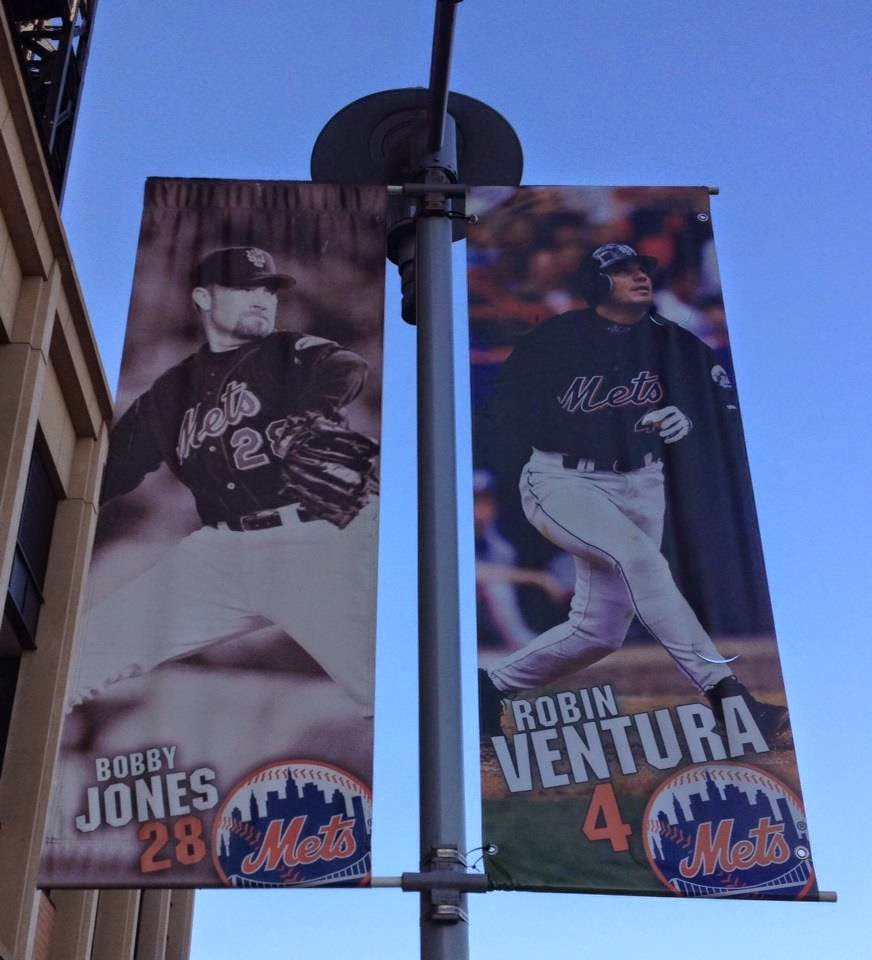
With the Mets on the road for over a week, I took advantage of Citi Field being devoid of fans walking around the outside plaza (which isn't all that different from game days) and decided to take some photos of the banners hanging on the light poles near the various entrances to the ballpark.  In doing so, I noticed some interesting pairings on those poles.

Six particular pairings caught my eye.  As shown in the photos below, these conscious couplings had to have been as intentional as Roger Clemens' broken bat-flinging incident in Game 2 of the 2000 World Series.  Take a look.


The above photo depicts Nolan Ryan and Robin Ventura, two former Mets who are connected by more than just a light pole.  In 1993, Ventura famously charged the mound when Ryan hit him with a pitch, only to be confronted by Ryan's Noogie Express.

Ventura's White Sox teammates and Ryan's cronies in Texas separated the two back then, but now the Mets are keeping them together, separated by just a metal light pole.


Ventura appears on another banner outside Citi Field.  This time, he's paired with Bobby Jones, a former Met who won 74 games in his pitching career as a Met, good for the ninth-highest total in club history.

Despite his lofty win total and status as an underrated Met, Jones is known primarily for his complete-game one-hit shutout over the San Francisco Giants in Game 4 of the 2000 NLDS.  Jones would get all the runs he needed in the first inning, when Robin Ventura crushed a two-run homer to give the Mets a 2-0 lead.  Eight innings later, Ventura and Jones celebrated their series clinching victory along with the rest of their teammates.  


This pairing should be obvious to even the most casual of Mets fans.  John Franco pitched for the Mets in 14 seasons (1990-2001, 2003-04) while Ed Kranepool appeared in a Mets uniform for 18 campaigns (1962-79).

Their longevity puts both players atop the team's all-time leaderboard in several offensive and pitching categories.  It also ranks them No. 1 (Kranepool) and No. 2 (Franco) in seasons played in New York.


Unlike the players represented in the first three photographs, Pedro Martinez and Carlos Delgado were teammates for three seasons (2006-08) in New York.  But they could have been teammates longer had it not been for the way general manager Omar Minaya pursued Delgado.

In Minaya's first off-season as the Mets GM, he signed two of the top available free agents in Pedro Martinez and Carlos Beltran.  But when Minaya sought the services of Delgado, he was turned away because the first baseman was uncomfortable with the way Minaya was appealing to his Latin-American heritage.  Delgado was eventually traded to the Mets in 2006, becoming a teammate of Pedro Martinez - the first player signed by Minaya in what some people have since referred to as the "Los Mets" era of the team.


Gil Hodges made his mark as a member of the Brooklyn Dodgers, then became an original Met in 1962.  Seven years later, as the team's manager, he led the Mets to their first World Series championship.  Meanwhile, Lee Mazzilli was born in Brooklyn in 1955 - the same year Hodges helped the Dodgers win their only World Series in the borough.  Mazzilli was one of the team's brightest stars in the late 1970s before being traded away in 1982.  But just like Hodges, Mazzilli was brought back to help the Mets win a championship.

For Hodges and Mazzilli, their seeds were planted in Brooklyn.  But both men blossomed for the Mets in Queens, winning championships and making the entire city proud.


The oddest pairing might be this David Wright-Keith Miller pole.  Wright is the Mets' all-time leader in various offensive categories and is one of the most beloved figures in recent club history.  Keith Miller was a utility player for the Mets from 1987 to 1991, never collecting more than 275 at-bats in any season and finishing his Mets career with just seven homers and 48 RBI - numbers Wright can easily put up in half a season.

As random as this pairing might seem, these two players have quite a personal connection to each other.  Prior to the 2013 season, Wright signed the most lucrative contract in team history, a deal that pays him $138 million over eight seasons.  Every time Wright thanks his agent for that contract, all he has to say is, "Thank you, Keith Miller."  Miller gave the Mets little run production as a player, but he gave the team eight extra years of run production as David Wright's agent.


Plenty of room for more banners, don't you think?

The Mets have set up various banner displays on poles outside Citi Field.  The banners feature several random pairings of the team's best players.  But not all of them are random.  Some of them, as seen in the six photos above, appear to be quite intentional.  And who knows, maybe the Mets aren't done with intentional banner pairings.

For example, there are still no banners pairing up Mike Piazza and Guillermo Mota.  They got into a famous spring training bench-clearing brawl in 2003 when Mota was a Dodger and Piazza was an ex-Dodger.  Similarly, there are no Gregg Jefferies-Roger McDowell pairings in the plaza.  Maybe the reason for that is because Gary Carter had to spend his final home game as a Met separating the two after they got into a brawl following the game's final out.  And don't get me started on an Armando Benitez-Graeme Lloyd pole.  The two had to be separated in a fight between the Orioles and Yankees in 1998, then briefly became teammates with the Mets five years later.

In addition, there are no banners teaming up Jesse Orosco and Jerry Koosman, two pitchers who were traded for each other following the 1978 season and remain the only pitchers who can say they recorded the final out in a World Series-clinching game for the Mets.  (Seriously, Mets, this pairing has to get done.)

If the Mets wanted some comic pairings, they could have a Follicle Follies-themed pole featuring Nino Espinosa and Jenrry Mejia.  Or perhaps Don Aase (a Met reliever in 1989) and Al Schmelz (a Met reliever in 1967) could have shared an Aase-Schmelz pole.  Aase could also appear on a pole with 1969 World Series hero Al Weis, but that pairing would probably be shot down, because no one likes a Weis-Aase.

The opportunity is there for the Mets to have a different kind of Banner Day at Citi Field.  They just need to show a little extra creativity.  They tried (and failed) to be creative by getting "True New Yorkers" to respond to a letter they sent out.  The team was chased up a pole on that one.  At least there were no banners on that pole.  I'd say it's because those are the poles being reserved for the Terrence Long and R.A. Dickey banners, but knowing the Mets, fans would probably get stiffed on that pairing as well.
 

Saturday, March 29, 2014

The Magic 8-Ball Predicts The 2014 Mets Season

It's almost time to begin another 162-game journey with the Mets.  But will it be a journey that leads us to unexpected happiness or another season of "been there, done that"?

At Studious Metsimus, we always want to know in advance what the Mets are going to do prior to Opening Day.  We figure that if there's something to look forward to during the upcoming season, we should be prepared for it.  Similarly, if there's something we wish we didn't know, we should also share it with our readers.  Why should we keep all the yummy disappointment to ourselves?

Since the end of the 2013 campaign, the Mets have added two new outfielders in Chris Young and Curtis Granderson.  Young is signed to a one-year deal because the Mets want to be winners of this year's Marlon Byrd Award.  That's the honor given to the front office who gets lucky with a reclamation project for one year, then trades him away for prospects at the trade deadline, hoping he signs a multi-year deal the following season with a division rival (preferably the Phillies) who foolishly overpays for his services.  Granderson was brought aboard with a four-year contract because the Mets want to prove that not every power-hitting outfielder who comes to Citi Field on a four-year deal is going to turn into Jason Bay.

In addition to Young and Granderson, the Mets added 40-year-old Bartolo Colon to be the team's temporary replacement for the injured Matt Harvey, as well as the club's elder statesman and nutrition consultant.  This probably also explains why Harvey is adamant about returning before the end of the 2014 season.  Not because he wants to be the oldest guy in the clubhouse (which he won't be for many years), but because he doesn't want to trip over empty KFC buckets in the clubhouse.

Will the Mets' new additions cause the team's fans to party like it's 1986?  Or will they get over this off-season's acquisitions almost as quickly as Cole Hamels racks up losses against the Mets?

The answers to those questions and more are the reasons why we have awoken our Magic 8-Ball from its yearly hibernation.  So sit back, relax, make yourself some chicken nachos (not necessarily in that order - we realize it would be difficult to make yourself a snack after you've sat down and begun to relax), and prepare yourselves for the wise words that can only come from a quick shake of the Studious Metsimus Magic 8-Ball!  Take it away, M8B!


Oh, sorry about that.  I won't make that mistake again.  So let's jump right into it, Magic 8-Ball.  What are your thoughts on the team this year?  Do you think they'll be competitive in the NL East?


My bad.  How do you feel the Mets will fare in the division in 2014?


 You do realize there are only five teams in the NL East, right?


Let's move on.  The Mets signed Chris Young, Curtis Granderson and Bartolo Colon to free-agent contracts during the off-season.  Which of the three players do you think will have the greatest impact at Citi Field?


Wow, you seem quite sure of yourself.  Why do you think it's absolutely Chris Young?


I don't understand.  What does his proximity to Shake Shack have to do with his value on the team?


Okay.  I think we're beyond fat jokes here.  Everyone's doing them.  You're better than that.


I'll forget I ever asked that question.  Now, Magic 8-Ball, if you were manager Terry Collins, who would you want to have a bounceback season from the most?


Zack Wheeler?  Are you crazy?  Wheeler had a great rookie season, going 7-5 with a 3.42 ERA.  Why would you think Terry Collins would want him to bounce back?  What is he bouncing back from?


I see your point.  So let's shift back to the offense.  Ike Davis and Lucas Duda both spent extended periods of time at AAA-Las Vegas, yet still managed to strike out a combined 203 times at the major league level.  They drove in a total of 66 runs for the Mets, so for every RBI they produced, they struck out more than three times.  Now they're both vying for playing time at first base.  What's the easy solution for this conundrum?


If only the batting-helmeted one was still active and not about to turn 46 this coming August.


That's another outstanding point, Magic 8-Ball!  You're on a roll today!


Alas, Tejada is no Jose Reyes on the field.


You're quite the savvy sphere!  Let's try a lighter question now.  David Wright was just named the face of MLB.  If baseball named other players as the arm or leg of baseball, which players would those be?


Excuse me?  What are you talking about?  Did I say something wrong?


So because you're an armless, legless face, that means no one can ask you a question about those body parts?


You're a little too sensitive for a Magic 8-Ball, you know that?  So I'm not getting anything from you on this topic?


I guess that's better than nothing.  So one more question on an individual player before I ask you for your prediction for the Mets' record in 2014.  What do you think Matt Harvey will do to stay occupied during his year of rehab and recovery from Tommy John surgery?


What's that?


I didn't know he was trying to take your job.  Oh, wait.  You're talking about that tweet he put out predicting that Harvey Day would happen in 2014.  I honestly don't think you have to worry about him challenging you in the prognosticating profession.


>Snicker<  You really didn't just say you were "quite shaken" after reading Harvey's tweet, did you?  A Magic 8-Ball being shaken?  >Chuckle<


Okay, I'm sorry.  Final question.  What do you think will be the Mets' final record in 2014 and where will they finish in the NL East?


Aw, come on!  Can't you give the Mets an extra win so they can at least finish the year with a .500 record?


And on that note, I think it's time to pack away the Studious Metsimus Magic 8-Ball in a box, preferably a dark one with no air holes, and not let it out for another year at the very least.  Hmmm, I wonder what Matt Harvey is doing right now...

Enjoy the upcoming baseball season, Mets fans!  And as always, please help control the snarky sphere population.  Have your Magic 8-Ball spayed or neutered.

LET'S GO METS!!


Hey, kids!  The Magic 8-Ball has made predictions before.  To see what it said prior to each of the previous four seasons, please click on the links below: