Showing posts with label Lance Johnson. Show all posts

Sunday, September 7, 2014

The Mets' Hitting Record David Wright May or May Not Want

David Wright has usually been a spectator when the home run apple has risen at Citi Field.  (Photo by Kathy Kmonicek/AP)

David Wright will be the first to tell you that he's had a disappointing season.  Entering Sunday's rubber match against the Cincinnati Reds, Wright is batting .270 with eight home runs and 63 RBI.  His .371 slugging percentage would not only represent a career-low for Wright, but it would also be lower than his .377 lifetime on-base percentage (which was .382 coming into the 2014 campaign).

Needless to say, Wright has not done many positive things to help the Mets' struggling offense in 2014.  However, he is close to accomplishing something with his bat that has never been done by a Met in a single season.

There are currently eight players in franchise history who have driven in 60 or more runs in a season that did not see the player reach double digits in home runs.  The chart below lists those eight players and adds a ninth - David Wright - with his numbers entering today's game.  The chart is sorted by runs batted in and also lists the number of home runs hit by each player during his tenure with the team.


Player
Year
Home Runs
RBI
Career HR as a Met
Dave Magadan
1990
6
72
21
Joel Youngblood
1980
8
69
38
Lance Johnson
1996
9
69
10
John Stearns
1979
9
66
46
Daniel Murphy
2012
6
65
48
David Wright
2014
8
63
230
Gregg Jefferies
1991
9
62
42
Doug Flynn
1979
4
61
5
Rey Ordoñez
1999
1
60
8


As of today, David Wright has the sixth-highest RBI total of all players in Mets history who failed to hit a minimum of ten home runs in a season.  Wright needs seven RBI in the team's last 20 games to become the second Mets player to have a 70-RBI campaign without the benefit of a double-digit home run total.  Should Wright drive in ten runs before the end of the season without hitting more than one ball out of the park, he'd set a new team record, becoming the most prolific single season run-producer of all Mets players who failed to hit 10 HR.

What makes Wright's name look completely out of place on the list above is that Wright has 230 career home runs, which are second in franchise history behind Darryl Strawberry's lifetime total of 252.  Incredibly, the other eight players listed above combined to hit 218 homers during their time with the Mets, or a dozen fewer than Wright has hit by himself.  (That number can still rise, as Daniel Murphy is still active.)

Wright owns or will own most of the Mets' hitting records, but this is one single-season achievement he probably wasn't counting on.  Dave Magadan, who hit 21 home runs in seven seasons as a Met, most likely never expected to hold on to this unusual team record forever.  But he surely never thought it would be David Wright who was about to knock him off his perch.
 

Monday, January 6, 2014

The Best On The Worst: Todd Hundley

With apologies to Jerry Grote, the two most beloved catchers in Mets history are Gary Carter and Mike Piazza.  Both Carter and Piazza were considered to be the best hitting catchers of their time and both made their teams better while they were in their prime.  Carter helped the Mets win two division titles and one World Series championship, while Piazza led the team to its only back-to-back postseason appearances and the 2000 National League pennant.

Because of their success and popularity, the uniform numbers of Carter and Piazza have been taken out of circulation, with fans clamoring for both No. 8 and No. 31 to be retired by the team.  Carter's five years with the Mets coincided with the team's greatest era, as New York won more games from 1985 to 1989 than any other team in baseball.  Similarly, Piazza kept the Mets competitive during his first four years with the club (1998-2001), with the team playing meaningful games in September and October all four seasons.

Carter entered the Hall of Fame in 2003.  Piazza hopes to follow in Carter's footsteps in 2014.  But there was a gap of nearly a decade between last game as a Met in 1989 and Piazza's inaugural contest with the team in 1998.  And there was one backstop who was behind the plate for most of that time, bridging the gap from one championship-caliber catcher to another.

This catcher never led the Mets to the playoffs, and most of his seasons ended with the team playing out the stretch in September in front of empty Shea Stadium seats.  But that didn't deter him from giving his best performance day in and day out, regardless of where the Mets stood in the division race.  It's too bad that he saw more losses behind the plate than any Mets catcher since Jerry Grote.

A young Todd Hundley keeps his eye on the ball. (Photo by Jonathan Daniel/Getty Images)

Todd Randolph Hundley was born on May 27, 1969, at a time when his father, Randy, was behind the plate for the division-leading Chicago Cubs.  Less than four months after Todd was born, Randy's squad had let its division lead slip away to the Miracle Mets.  It was something the Hundley family would get used to once Todd became a Met two decades later.

The Mets drafted Todd Hundley in the second round of the 1987 June amateur draft via the Baltimore Orioles, who lost a draft pick when World Series MVP Ray Knight signed a free agent contract with the O's following the 1986 season.  Hundley was a skinny kid with a familiar last name, especially within the catching community.  But Hundley made it to the majors on more than just nepotism; he made it with his superb talent.

Hundley struggled as a teenager in his first two minor league seasons, batting .146 in 34 games in 1987 and .186 in 53 games in 1988.  But everything came together for the young catcher in 1989, a year in which he batted .269 with 23 doubles, four triples, 11 homers and 66 RBI.  By 1990, Hundley was ranked as one of Baseball America's top prospects, earning him his first call-up to the big leagues in May.

Davey Johnson, who had a penchant for wanting good, young players on his team since becoming the Mets' manager in 1984, inserted Hundley into the starting lineup on May 18 against the San Diego Padres, and Hundley delivered a double off Bruce Hurst, who just four years earlier had almost been named World Series MVP as a member of the Boston Red Sox before the aforementioned Knight snatched it away from him.  Hundley would go on to start each of the next three games for the Mets, but would fail to get another hit.  Four days after his major league debut, Hundley saw his manager relieved of his duties by general manager Frank Cashen.  A week later, Hundley was back in the minor leagues and Mackey Sasser, with his .300-plus batting average, was named the team's primary backstop.  It would be another two years before Hundley took the job back from Sasser.

Hundley spent most of the 1990 and 1991 campaigns in the minor leagues, putting up excellent offensive numbers there, but struggling during his various call-ups to the big leagues.  Hundley combined to play in 57 games for the Mets in 1990 and 1991, batting .173 with one homer and nine RBI.  Hundley finally took over as the team's top catcher on Opening Day of the 1992 season, but by then, the Mets had turned into The Worst Team Money Could Buy.  A number of veteran players had been added to the team to complement Hundley, but many of them underachieved.  Players like Bobby Bonilla and Bret Saberhagen couldn't live up to the hype of the big stage in New York, and the team wilted in the hot, summer months.  As the team struggled, so did its young catcher, as Hundley could only muster one home run and 12 RBI in his last 68 games after posting six homers and 20 RBI in his first 55 contests.  But perhaps the misfortune of the team was a blessing in disguise for the 23-year-old Hundley, as the team focused more on the shortcomings of its high-priced veterans, allowing Hundley (who still had a .200 career batting average through 1992) to continue his development at the major league level.  The team sunk to new depths in 1993, but Hundley's star was just beginning to rise.

The 1993 season was one to forget for the Mets and their fans, as the team suffered its first 100-loss campaign since 1967.  But it an important year for Todd Hundley, as the switch-hitter reached double digits in home runs for the first time.  Hundley managed just a .228 batting average (which represented a career-high at the time), but he also had 11 HR and 53 RBI in 417 at-bats.

Over the next two seasons, both of which were shortened because of the players' strike, Hundley's power continued to evolve.  Because of the truncated seasons, Hundley combined to produce only 566 at-bats in 1994 and 1995, but in those at-bats, Hundley hit 31 homers and drove in 93 runs.  How far had Hundley advanced in the power department in those two years?  The only National League catcher with more home runs than Hundley in those two seasons was the Dodgers' Mike Piazza.  That's how much Hundley had improved.   In addition to his newfound power stroke, Hundley also showed dramatic improvement in his plate discipline, batting .258 with a .343 on-base percentage in '94 and '95, after posting .213 and .261 marks in those respective categories from 1990 to 1993.

Hundley's final 51 games in 1995 were very Piazza-like, as he batted .311 with 11 HR and 32 RBI.  The team also responded, going 27-24 in those 51 games.  For the first time since Hundley became a regular in the Mets' lineup, the team had something to look forward to in 1996.  Not only was Hundley turning into a top offensive threat, but a young trio of starting pitchers was about to burst onto the scene for the Mets.  The group of Jason Isringahusen, Bill Pulsipher and former No. 1 overall draft pick Paul Wilson, dubbed Generation K, was supposed to herald a new era of greatness in Mets history.  The threesome didn't become the second coming of Seaver, Koosman and Matlack, but the man who tried to mold them behind the plate did produce an historic season of his own.

In 1996, the Mets finished the year with a 71-91 record.  It was the sixth consecutive losing mark for a once-proud team who had ridden the championship wave just a decade before.  But when the trio of Isringhausen, Pulsipher and Wilson failed to live up to the lofty expectations, it was another trio who took baseball by storm in '96, as Bernard Gilkey, Lance Johnson and Todd Hundley set their sights on breaking as many offensive team records as they could.

Gilkey produced one of the most complete seasons ever put up by a Mets' everyday player in 1996, setting or tying club records in doubles (44) and runs batted in (117), while adding 30 homers, a .317 batting average and a league-leading 18 outfield assists.  Gilkey also became the first Met ever to have an 8.0 WAR in a single season.  Johnson, meanwhile, broke team records in hits (227), triples (21), total bases (327) and runs scored (117), becoming an All-Star for the first time.  But as mentioned in the 1990s Nike commercial, "chicks dig the long ball", and in 1996, everyone was digging the long balls being hit by Todd Hundley.

Hundley began the 1996 season the way he ended the previous year, batting .323 with eight homers and 19 RBI over his first 18 games.  Although his average dipped below .300 by May 1, Hundley continued to hit bombs with aplomb.  By the time the All-Star Game rolled around, Hundley had already taken 23 balls over the wall and had driven in 66 runs.  It was a Midsummer Classic Hundley would not miss, as the Mets' catcher was named to his first All-Star team in July.  After the break, Hundley continued to mash the ball.  By season's end, Hundley had become the first Met to reach 40 homers in a season.  His 41 taters also set a major league record for home runs by a catcher.  Furthermore, he became the first switch-hitter in National League history to hit more than 40 homers in a season.  The only major leaguer who had accomplished the feat before 1996 was Hall of Famer Mickey Mantle.  When all was said and done for the 1996 season, Hundley had batted .259 with 32 doubles, 41 homers and 112 RBI.  But he still had not played a meaningful game in September since his rookie season in 1990.  That all changed in 1997.

Under new manager Bobby Valentine, the losing attitude that had permeated the Mets clubhouse from 1991 to 1996 vanished.  Gone were the Vince Colemans, Bobby Bonillas and Bret Saberhagens from the previous six seasons.  Replacing them were players like Hundley, Butch Huskey (who posted a career-best .287, 24 HR, 81 RBI season in 1997) and veteran trade acquisition John Olerud, who brought an exceptional bat and glove with him to Shea Stadium from Toronto.  The pitching staff also finally came together, with Bobby Jones becoming an All-Star and Rick Reed getting a second chance to make a first impression.  Turk Wendell also came over to the Mets in an August deal that included center fielder Brian McRae.  Those extra pieces helped the Mets finish the year with an 88-74 record, with the team remaining in competition for the wild card until the final week of the season.  The seeds for success were planted in 1997, and Todd Hundley continued to blossom.

Although Hundley hit 11 fewer homers in 1997 than he did in '96, he still became the first Mets catcher to post multiple 30-homer seasons.  Hundley also made the All-Star team for a second consecutive season and walked a career-high 83 times in 1997, en route to posting a career-best .394 on-base percentage.  But a late-season slump by Hundley irked Bobby Valentine, causing him to lash out against his All-Star catcher.  The skipper caused headlines of his own when he was quoted as saying...


"I think he doesn't sleep enough.  He's a nocturnal person.  He needs more rest.  He has a really tough time getting to sleep after games.  I heard one night he stayed out until 4 o'clock in the morning before he was ready to go to sleep."


At the time, Hundley was going through many personal issues.  His wife was pregnant with their third child and his mother was very sick.  In addition, Hundley was recovering from nagging injuries to his toe and ribs.  But Hundley persevered through all of his distractions and still managed to lead the team to its best record since his rookie campaign.  The distraction he had in 1998, however, was one he could not recover from.

At the conclusion of the 1997 season, Hundley underwent a major surgical procedure on his right elbow.  It was a procedure his surgeon, Dr. David Altchek, claimed could have him out of action until the following April or could wipe out his entire 1998 season.  Mets general manager Steve Phillips prayed for the best but prepared for the worst.  The Mets began the season with Tim Spehr and Alberto Castillo as their top two catchers, but also used Rick Wilkins and Todd Pratt behind the plate in May.  By mid-May, it was clear Hundley was not going to be back any time soon.  It was also clear that the four-headed monster at the catcher's position needed a big-time upgrade.  Phillips immediately went to work, and despite denying he was interested in Mike Piazza, claiming he "wasn't a fit" for the Mets, acquired the slugging catcher in a trade with the Florida Marlins.

With Piazza now on the team, Hundley was out of a job.  And despite a valiant effort to redefine himself as an outfielder, the experiment flopped, as Hundley batted .161 with three homers and 12 RBI in 53 games.  During the offseason, the Mets signed Piazza to a seven-year, $91 contract and traded Hundley to Piazza's first team, the Dodgers.  Hundley played five more seasons in the majors with the Dodgers and Cubs, hitting 24 homers in both 1999 and 2000 for his first major league manager, Davey Johnson, who was now managing in Los Angeles.  Hundley had two subpar seasons in Chicago and 2001 and 2002, before returning to the Dodgers for his final major league season in 2003, the same year the Cubs won their first postseason series in 97 years.

In 14 major league seasons, Hundley hit 202 home runs, making him one of only 18 players who played the majority of his games at catcher to hit at least 200 homers.  As a Met, Hundley hit 124 home runs, which is currently the seventh-highest total for any player in franchise history.  Hundley also ranks in the team's top 20 in games played (829; 18th all-time), runs scored (340; 18th), RBI (397; 13th), walks (299; 20th), doubles (118; 19th), total bases (1,116; 16th) and slugging percentage (.438; 17th).  But most of those numbers were compiled on some bad Mets teams.  And Hundley also had some of the worst timing of any player in recent history.

Hundley began his career just two seasons after the Mets won a division title.  By his second year, the Mets were beginning the third-longest stretch of sub-.500 seasons in franchise history.  Hundley also played his last year as a Met just before the team embarked on their only back-to-back playoff appearances in club annals.  And Hundley's bad timing continued after he left the Mets, as he went back to Los Angeles from Chicago the year before the Cubs came five outs away from advancing to their first World Series in nearly six decades.

Wearing white or black, Todd Hundley knew how to attack.  (Photo by David Seelig/Getty Images)

Todd Hundley was one of the best players to ever put on a Mets uniform.  Unfortunately for him, his time with the team came during one of the most embarrassing eras in team history.  It also occurred between the careers of two of the most beloved catchers who ever called Flushing home - Gary Carter and Mike Piazza, two Hall of Fame-caliber players who are still respected and revered by Mets fans.

Hundley's Mets career began under the tutelage of Davey Johnson and ended with Bobby Valentine as his skipper - the two winningest managers in team history.  But Hundley saw very little winning during his nine seasons in New York.  The years Hundley spent with the Mets may have been some of the worst the team has experienced in the last few decades.  That doesn't mean Hundley shouldn't be remembered as one of the best players the team has ever seen.  He was one of the few reasons to look forward to a Mets game in the mid-1990s.


Note:  The Best On The Worst is a thirteen-part weekly series spotlighting the greatest Mets players who just happened to play on some not-so-great Mets teams.  Please come back next week for the next installment.

Tuesday, September 18, 2012

On The Road With Joey & Iggy: The Real Chicago Bears


Hi, everyone!  We're Joey and Iggy Beartran and we'll be your tour guides today.  Where are we taking you?  How about the Windy City, the Second City, the city that Jake and Elwood tore apart (especially the cop cars).  We're talking about Chicago!  So sit back, have yourself a nice Polish sausage or some deep dish pizza and enjoy the ride.  Batter up!

We flew out to Chicago on Thursday morning, one day after the Mets completed their second 0-6 homestand since the All-Star Break.  Fortunately, the Mets were off on Thursday so they couldn't lose that night.  To celebrate the Mets' inability to lose that night, we had a delicious breakfast of biscuits and gravy.  Then we made our way to the Loop and the Chicago River, where we found the famed Chicago Theatre.  Iggy was so excited, she shook her Mets pom pom in jubilation.  (I always wondered where she keeps that thing.  It's not like she has any pockets for it.)

That night, we wanted to experience what a pennant race feels like since the Mets haven't been involved in one since 2008.  So we hopped on the Red Line and got off at Sox-35th St.  It was time to visit U.S. Cellular Field, home of the Chicago White Sox.


The White Sox, who are managed by the great singles hitter, Robin Ventura (the Grand Slam Single was a single and it was great), were hosting the team directly behind them in the American League Central, the Detroit Tigers.  At the time, the Tigers were one game behind the White Sox and were looking to pull into a first-place tie with the Pale Hose.

Although it was a cloudy night, we made it inside the ballpark on time and were looking forward to the first pitch.   But 7:10 PM came and went and there was no "play ball".  Why?  Because this happened...


No, we're not talking about blurry pictures.  We're talking about rain.  Lots and lots of rain.  Enough to delay the start of the game by one hour.  Then at around 8:15 PM, after we had sampled some of the tasty burritos and nachos the Cell had to offer, my colleague went out to snap more pictures of the field.  When he came back, he showed us this photo...

Clearly they didn't get the memo that we were only going to be in Chicago until September 15.

That's right, loyal readers.  Despite the fact that the game had playoff implications and was to feature an outstanding pitching matchup of Justin Verlander (the reigning AL MVP and Cy Young Award winner) against up-and-coming Chris Sale (a 16-game winner for the White Sox), the weather gods had something else to say.  The game was postponed, to be made up two days after we'd be returning to New York.

Sigh.

But the trip to the South Side of Chicago was not a complete washout, as we were able to get these photos inside the ballpark (see below).  The first one is the White Sox homage to "The Franchise", Tom Seaver, celebrating his 300th win with fellow future Hall of Famer Carlton Fisk in 1985.  The photo in the middle is another shot of Tom Terrific in his hideous mid-'80s White Sox duds, as he set the major league record for most Opening Day starts when he took the mound for the 16th time in the season's first game in 1986.  The bottom photo is a shot of John Travolta with various members of the late '80s Southsiders, including Fisk, Ozzie Guillen, Steve Lyons and future Mets centerfielder Lance Johnson.


Well, if we couldn't watch baseball in the South Side of Chicago, perhaps we'd be luckier on the North Side.  And lucky we were!

On Saturday, we made our way to the Friendly Confines of Wrigley Field, by far the oldest ballpark in the National League.  It's about the same age as Jamie Moyer, who might just be the only person alive who can remember the last time the Cubs won the World Series (it was in 1908, for those who don't know).

The Cubs were entertaining the Pittsburgh Pirates on a beautiful late summer day, but it was us who were entertained.  Just check out the photos below!


No, the six-foot-tall bear in the photos is not related to us.  His name is Billy Cub and he and his siblings were standing near the corner of Addison and Clark Streets as well as the corner of Waveland and Sheffield Avenues.  The humans in the photos are our Studious Metsimus colleagues.  But you already knew that.

The game itself was all Pirates for the first seven innings.  Pittsburgh, who has slumped recently but is still fighting for the second wild card spot in the National League, scored in each of the first three innings and held a 7-3 lead going to the bottom of the eighth.  But the Cubs pushed across a run in the eighth to cut the Bucs' lead to three, then scored twice in their final at-bat before a bases loaded strikeout ended the rally and the game.  Even the Wrigley Field scoreboard operator was pretty bummed out about the failed comeback attempt by the home team.


Well, that does it for the recap on our trip to Chicago.  We visited U.S. Cellular Field on Thursday for the White Sox game that never started and Wrigley Field on Saturday for the Cubs game that almost never ended.  So what did we do on Friday?  Hmmm...

Maybe we took a side trip.  Maybe we went north to Milwaukee.  Maybe we visited Miller Park to see the Mets play the Brewers.  Maybe we did and maybe ... WE DID!

(Click on "WE DID!" for the recap of our Milwaukee trip.  But whether you click on the link or not, please try to keep quiet.  We're very tired after our trip to the great Midwest...)


Monday, March 19, 2012

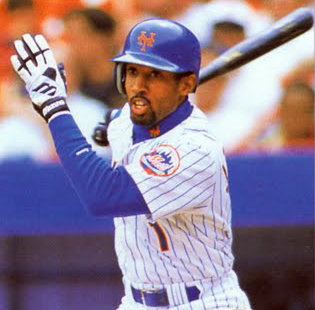
One Season Wonders: Lance Johnson

The 1995 Mets were only two years removed from the team's first 100-loss season since 1967.  But they were one of the surprise teams in the National League, finishing in a second-place tie in the NL East with a 69-75 record in the strike-shortened season.  The future looked bright for the Mets, especially with Generation K, their highly touted trio of homegrown pitchers, about to make a splash.

However, one thing was missing for the Mets going into the 1996 season.  In 1995, the Mets traded their leadoff hitter, Brett Butler, to the Los Angeles Dodgers during the stretch run.  That left the Mets with a musical chairs situation in the leadoff spot, with Damon Buford, Joe Orsulak and Alex Ochoa trying to be the last person to sit on the leadoff seat.

Neither Buford, Orsulak or Ochoa figured to be the team's leadoff hitter in 1996, especially with general manager Joe McIlvane openly shopping for one.  Two months after the conclusion of the 1995 season, the Mets found their man in Chicago.  And he provided the team with the best season a leadoff hitter had ever produced to date.

"Leading off and playing center field, No. 1, Mook -- correction -- Lance Johnson!"


Kenneth Lance Johnson was not a young player when the Mets signed him.  At 32, he was entering a time in his life when speedsters tend to lose a step or two.  But the Mets decided to take a chance on Johnson after he had reached career highs in at-bats (607), hits (186), runs scored (98), home runs (10) and RBI (57), while batting .306 with 12 triples and 40 stolen bases in his final year with the White Sox.

Despite the fact that the Texas Rangers offered Johnson a three-year deal with a fourth-year option, guaranteeing him $8.35 million, the centerfielder chose to take his talents eastward, signing with the Mets for two years and $5.7 million.  Johnson settled on the Mets after talking to Bobby Bonilla, Daryl Boston and Mookie Wilson, all former Mets and good friends.

The Mets now had their leadoff hitter in place, but Johnson was a centerfielder.  Their Opening Day starter from the previous year, Brett Butler, had been the team's leftfielder.  That was also the position played by Damon Buford and Joe Orsulak.  One month after the Mets acquired Johnson, they orchestrated a trade for leftfielder Bernard Gilkey.

With the outfield set, the addition of a defensive wunderkind at short in Rey Ordoñez, and Generation K on the way, the Mets were ready to take the 1996 season by storm.  They didn't wait very long to make a positive impression on the fans, and Lance Johnson had a lot to do with it.

On April 1, before a packed house at Shea Stadium, the season opened ominously for the Mets, who fell behind early to the Cardinals by six runs.  But the Mets began to chip away at the lead and by the seventh inning, the Cardinals' lead had been halved.  After an exciting conclusion to the top of the seventh, where a perfect relay from Gilkey to Ordoñez helped nail Royce Clayton at the plate to keep the score 6-3, the Mets rallied for four runs in the bottom of the inning.  Smack dab in the middle of the rally was Lance Johnson.  The Mets' new centerfielder used his speed to generate a run, plating Ordoñez with an infield hit, then scored the go-ahead run on a sacrifice fly by Rico Brogna.  Johnson's run proved to be the difference in the 7-6 Mets' victory.

Although Johnson helped contribute to the Mets' Opening Day victory, he didn't start the season very well.  One month after the season opener, Johnson had a decent batting average (.272), but was only reaching base at a .286 clip, drawing three walks in the season's first month.  The Mets expected more from their leadoff hitter, and beginning with the second game of a doubleheader against the Montreal Expos on May 1, Johnson gave the Mets exactly what they wanted and more.

Photo by David G. Whitham
Over a six-game stretch from May 1 to May 7, Johnson batted .500 (14-for-28), scoring five runs and driving in another.  He also collected his seventh triple of the season, after hitting six in the season's first month.  The season was barely a month old and Johnson was already only three triples short of Mookie Wilson's single-season franchise record for three-base hits.  Before the season was half over, that record would be history.

On June 16, Johnson picked up his 11th triple of the season against the St. Louis Cardinals, breaking Mookie Wilson's club record that he set in 1984.  For Johnson, the moment was extra-special because it was the Cardinals who originally drafted him in 1984 before trading him to the White Sox just months after he played for St. Louis in the 1987 World Series.

By the All-Star Break, Johnson was already having an historic season for the Mets.  Through his first 87 games, One-Dog (as he was affectionately referred to by his teammates) was hitting .322 with 16 doubles, 13 triples and five home runs.  He also had 40 RBI out of the leadoff spot, which was an unusually high number for a No. 1 hitter.  What was not unusual for a leadoff hitter was his 65 runs scored and 28 stolen bases.

For his efforts, Johnson was selected to his first All-Star team, joining catcher Todd Hundley to become the first Mets' teammates in five years to represent the club in the Midsummer Classic.  Due to an injury to Padres' outfielder Tony Gwynn, Johnson started the All-Star Game and surprised everyone by playing the entire game, going 3-for-4 with two singles, a double, a run scored and a stolen base in the 6-0 National League victory.

Johnson continued to hit after the All-Star Break.  In his first 32 games after the break, Johnson had 12 multi-hit games and stole 14 bases.  However, the team, who had remained within a few games of the .500 mark for most of the season, was starting to feel the dog days of August, especially the young pitching staff.  Generation K had become Generation K.O., as Jason Isringhausen's ERA was climbing near 5.00 and Paul Wilson's ERA had already gone north of that mark.

By August 18, the Mets had fallen 20 games behind the first-place Braves.  One week later, manager Dallas Green was gone, replaced by Bobby Valentine.  Despite the poor play on the field and the upheaval in the clubhouse, Lance Johnson continued to shine.

Beginning with his 2-for-4 performance on August 14, Johnson hit .399 over the team's final 41 games.  In addition, the centerfielder scored 35 runs and drove in 20 more during the final quarter of the season.  Mostly everyone else wilted in the summer heat (save for Gilkey and Hundley), but Johnson just got better.  Despite not being a big on-base percentage player or a slugger, Johnson had an impressive 1.004 OPS over the last month and a half of the season, reaching base at a .426 clip and producing a .578 slugging percentage (13 doubles, six triples, two home runs in 173 at-bats).  The Mets finished the season with a disappointing 71-91 record, but Johnson's season was anything but disappointing.

For the season, Lance Johnson hit .333.  At the time, it was the second-highest batting average in team history (Cleon Jones hit .340 in 1969).  Johnson also became the second Met to play in 160 games (Felix Millan played 162 games in 1975) and the second to reach the 50-steal plateau (Mookie Wilson stole 58 bases in 1982 and 54 bases in 1983).  But there were a number of offensive categories in which Johnson was second to none.

In 1996, Johnson set the Mets' single-season record for at-bats (682), runs scored (117), hits (227), total bases (327), multi-hit games (75), singles (166) and triples (21).  He also had the rare distinction of having more stolen bases (50) than strikeouts (40).  To this day, Johnson still holds the single-season franchise records for hits, multi-hit games, singles and triples.

Following Johnson's record-setting campaign, the Mets rewarded him with a two-year contract extension worth $10 million, keeping him under the team's control until 1999.  But Johnson was also a year older, and a year closer to breaking down.  The 33-year-old Johnson started the 1997 season where he left off in 1996, hitting .309 with five stolen bases over the Mets' first 13 games.  But shin splints knocked Johnson out of the lineup on May 1 and he missed six weeks of action, returning to the Mets just in time to see Dave Mlicki shut out the Yankees in the first regular season Subway Series game on June 16.

By early August, Johnson was still hitting above .300, but he was hitting mostly singles.  His 17 extra-base hits (ten doubles, six triples, one home run) were a far cry from his 1996 production, when he finished the year with 61 extra-base hits.  Johnson also wasn't running as much, stealing 15 bases in 25 attempts.  His 60% success rate was well below his 77% career rate.  Despite Johnson's regression, the Mets were overachieving and competing in the National League wild card race.  However, the team was leading the league in blown saves and needed to improve their bullpen if they wanted to have a realistic shot at making the playoffs.

On August 8, the Mets made a deal to improve their bullpen, but the cost was steep, as they had to part ways with Lance Johnson.  In a six-player deal with the Chicago Cubs, the Mets sent Johnson, starting pitcher Mark Clark and backup shortstop Manny Alexander to the Windy City for centerfielder Brian McRae, closer Mel Rojas and set-up man Turk Wendell.  Although McRae went on to record a 20-20 season with the Mets in 1998 (21 HR, 20 SB), he never quite replaced Lance Johnson in center.  Meanwhile, Mel Rojas went on to become one of the most hated relievers in Mets' history.  However, Turk Wendell became one of the most successful middle relievers in team history, and was a key player in the Mets' postseason runs in 1999 and 2000.

The injuries that sidelined Johnson during the 1997 season continued to keep him off the field for extended periods of time over the next three years.  As a member of the Cubs in 1998 and 1999, Johnson missed a total of 145 games.  He then played 18 games for the Yankees in 2000 before being released on June 6, just four months before he would have gotten the chance to play against the Mets in the World Series.  Although Johnson was only 36 years old, he would never play in the major leagues again.

Although his career was cut short by injuries, Lance Johnson still had plenty to smile about.


Lance Johnson became an everyday player in 1990 as a member of the Chicago White Sox.  Over the next six seasons, he was one of the best leadoff hitters in the game not named Rickey Henderson, batting .289 and averaging 12 triples and 34 stolen bases per year from 1990 to 1995.  Then he became a Met in 1996 and obliterated his six-year averages.  But injuries and a subsequent trade in 1997 curtailed his career, ending it at a relatively young age.

The Mets did not play well as a team in 1996, finishing 20 games below .500.  But Lance Johnson did all he could to make the season a memorable one for Mets fans.  Mookie Wilson captured the fans' hearts with his speed and smile in the 1980s.  Two decades later, Jose Reyes did the same.  The Mets did not have many players like that in the 1990s, but for one season, they did.

Lance Johnson was Mookie Wilson after the fan-favorite retired and he was Jose Reyes before anyone knew who Reyes was.  But without his one magnificent season in 1996, perhaps no Mets fan would have known who Lance Johnson was.  It's amazin' what one wonderful season can do to a player.


Note: One Season Wonders is a thirteen-part weekly series spotlighting those Mets who had one and only one memorable season in New York.  For previous installments, please click on the players' names below:
 
January 2, 2012: Bernard Gilkey
January 9, 2012: Terry Leach 
January 16, 2012: George Stone
January 23, 2012: Roger Cedeño
January 30, 2012: Frank Viola
February 6, 2012: Joe Christopher 
February 13, 2012: Dave Magadan 
February 20, 2012: Pedro Martinez
February 27, 2012: Bret Saberhagen 
March 5, 2012: Robin Ventura 
March 12, 2012: Willie Montañez