Last year, Cole Hamels signed a six year, $144 million contract to continue pitching in Philadelphia. On Friday night, Cole Hamels continued to thank the Phillies for their generosity by losing his major league-leading ninth game. You heard me right, baseball fans. Colbert Hamels is now 1-9.
In addition to his inordinate loss total, Hamels also has two no-decisions, both of which resulted in losses by the Phillies. That's 11 losses in games started by the wealthy lefty, or as many losses at Mets' wunderkind Matt Harvey has starts.
It would be easy to blame Philadelphia's hitters for Hamels' lack of success this year. After all, the Phillies have scored one run or less in six of his 12 starts. But Hamels has also contributed to his loss total by allowing a National League-leading 40 earned runs.
Hamels isn't just losing to good teams. He's being sent to the showers by some of the worst teams in baseball. Hamels allowed eight runs in a loss to the last-place Kansas City Royals on April 7. He was also battered around for seven runs (six earned) in last night's loss to the cellar-dwelling Milwaukee Brewers. And that's not even the worst of it. Cole Hamels has faced the Miami Marlins (who currently have a 14-41 record) three times this year. The Phillies have lost all three of those games, with Hamels tagged for two of the losses.
With the Phillies having just passed the one-third mark of the season (last night was their 55th game), Hamels is on pace for 27 losses. Now, we won't be naive enough to believe that Hamels will lose that many games (he doesn't have enough starts remaining against the Marlins), especially since no one has lost more than 22 games in a season since 1965, when the Mets' Jack Fisher saw an "L" next to his name in the paper 24 times. But don't be so sure that Hamels won't get to 20.
Fisher is one of five pitchers to lose 20 games in a season for the Mets. Out of curiosity, let's look at those Mets pitchers who were 20-game losers to see when they lost their ninth games. Then let's throw in Cole Hamels' name to see how he compares to them.
Roger Craig (1962): Became a nine-game loser on June 15, in the team's 57th game.
Al Jackson (1962): Became a nine-game loser on July 3, in the team's 76th game.
Roger Craig (1963): Became a nine-game loser on June 8, in the team's 56th game.
Al Jackson (1965): Became a nine-game loser on June 16, in the team's 63rd game.
Tracy Stallard (1964): Became a nine-game loser on June 21, in the team's 67th game.
Jack Fisher (1965): Became a nine-game loser on July 3, in the team's 80th game.
Jerry Koosman (1977): Became a nine-game loser on July 4, in the team's 79th game.
Cole Hamels (2013): Became a nine-game loser on May 31, in his team's 55th game.
A 20-loss season has been accomplished seven times in Mets history by five different pitchers. Of those five pitchers, Roger Craig was the quickest to nine losses, doing so in his team's 56th game during the second week of June in 1963. Cole Hamels reached nine losses before the end of May and did so in fewer games than it took any of the Mets' 20-game losers to achieve their nine-pack of losses.
It would take a tremendous effort by Hamels to turn his season around. But looking at the Mets pitchers who have lost 20 games in a single season, Hamels might need a Herculean effort just to avoid losing 20 games himself. Of course, he might not even notice or care. He's just laughing all the way to the bank after each loss.
Over the years, there have been a number of Mets players who were traded before they had a chance to blossom in the major leagues. Players like Amos Otis, Nolan Ryan and Ken Singleton all come to mind. But what about those players who were given a chance to become successful at the big league level but failed miserably as members of the Mets?
One of those players was given four years to realize his potential in Flushing. But after showing some promise in his third year, he completely regressed in year four. By then, the Mets had completely given up on him and decided to trade him away. Not only did he become one of the best pitchers in the league after the Mets cut ties with him, but he got there with the timely assistance of an original Met. And his newfound success almost prevented one of the most memorable moments in team history from ever occurring.
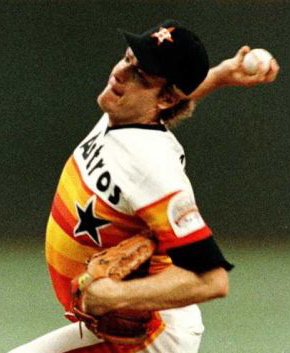
The Mets gave Nolan Ryan's old number to Mike Scott just a few years before making him Ryan's teammate in Houston.
Michael Warren Scott was drafted by the Mets out of Pepperdine University in the second round of the 1976 June amateur draft. During his first three years in the Mets organization, Scott was a so-so pitcher. He wasn't overpowering (209 Ks in 425 IP) and didn't make much of an improvement from year to year. (Scott's ERA rose from 2.86 at AA-Jackson in 1976 to 3.94 at AAA-Tidewater in 1978.) But that all changed in 1979, when Scott got his first chance to contribute at the big league level.
When the Mets broke camp in 1979, their roster consisted of ten new players on the 25-man roster, including five rookies. Two of those neophytes (Jesse Orosco, Neil Allen) would go on to become successful relievers for the Mets, while the third (Mike Scott) spent most of the season flip-flopping between starter, reliever, and eventually back to the minors.
Scott made his major league debut on April 18, pitching two innings of relief against the Montreal Expos. Six days later, Scott made his first start, pitching five solid innings against the San Francisco Giants to earn his first win in the majors. The win was surrounded by controversy, as both the Mets and Giants played the game under protest after an argument with the replacement umpires caused a 28-minute delay.
By May 8, Scott had made three starts and two relief appearances and had fared well in those outings, pitching to a 2.84 ERA. But his next four starts were not his best, as Scott failed to make it through the fifth inning in three of them.
After allowing four runs to the Cardinals in one-third of an inning on May 31, manager Joe Torre banished Scott to the bullpen, where he continued to pitch until he was sent back to Tidewater in mid-June. Scott pitched well for the Tides, going 8-4 with a 3.18 ERA in 18 appearances (15 starts), which earned him a second promotion to the Mets in September.
Upon his return to the majors, Scott had one scoreless relief effort and a hard-luck loss to the Expos as a starter. But in his third September appearance, Scott had one of the worst starts in Mets history, allowing seven runs in one-third of an inning to the Chicago Cubs on September 25. Scott's poor outing gave the Mets' their 99th loss of the season, their final defeat before embarking on a season-ending six-game winning streak to avoid their first 100-loss campaign since 1967. The Mets were smart enough not to give Scott a start in any of those six games.
Scott spent the majority of the 1980 season pitching for Tidewater, honing his craft at the minor league level before earning his next opportunity with the Mets. Scott was brilliant on a sub-.500 Tides team, going 13-7 with a 2.96 ERA for a squad that finished 67-72. When the Mets expanded their roster in September, Scott was called up once again, going 1-1 with a 4.30 ERA in six starts.
After two seasons of riding the Tidewater-to-Flushing shuttle, Scott began the 1981 campaign in New York. For the first time since being drafted by the team in 1976, Scott had finally earned his first one-way ticket to Shea Stadium.
The strike-shortened 1981 season was Scott's first full season in the major leagues and he performed well despite his ugly 5-10 record. Scott made 23 starts for the Mets in 1981 and posted a respectable 3.90 ERA. The main reason for his poor record was the Mets' inability to score runs whenever he was on the mound, as New York scored three runs or less in 16 of his 23 starts. Scott actually allowed one earned run or less in almost half (11) of his starts, but the Mets somehow managed to lose five of those games.
The Mets' lack of offense in Scott's starts were never more visible than they were in a three-start stretch in September when the team was fighting for an unlikely second-half division title. In those three starts, Scott allowed two earned runs in 20⅓ innings, holding opposing hitters to a .174 batting average. Naturally, the Mets lost all three games, effectively squashing any hopes of returning to the playoffs for the first time since 1973. Any hopes of Mike Scott becoming an effective pitcher with the Mets ended the following season. In 1982, Mike Scott had a dreadful season with the Mets, going 7-13 with a 5.14 ERA and 1.67 WHIP. Batters resembled Pavlov's dogs whenever they stepped into the box against Scott. Opposing hitters torched Scott for a .321 batting average and .381 on-base percentage in 1982, just one year after Scott held the opposition to a respectable .261 batting average and .306 on-base percentage. By the end of 1982 - the sixth consecutive losing season for the Mets - general manager Frank Cashen had had enough of the underachieving Scott, dumping him on the Houston Astros on December 10 for outfielder Danny Heep. Heep would go on to become a successful pinch-hitter with the Mets during his four seasons in New York, becoming the first player in team history to hit four pinch-hit home runs in a single season. Mike Scott, on the other hand, did just a bit more for his new team.
After spending parts of four seasons with the Mets, Scott was finally playing for a contending team. The Astros finished the year with an 85-77 record, six games behind the division-winning Dodgers. Scott had his first winning season in 1983, going 10-6 with a 3.72 ERA in 24 starts. But Scott regressed in 1984, winning only five of his 16 decisions and watching his ERA balloon nearly a run to 4.68. Not wanting Scott to fall out of favor with the team, Astros general manager Al Rosen asked a good friend to teach Scott how to throw a new pitch. That new pitch ended up saving Scott's career and gave the Astros an unexpected ace on the pitching staff.
Casey Stengel showed off "ace" Roger Craig before Craig showed Mike Scott how to become an ace with the Astros.
Roger Craig was a starting pitcher for the Mets during the team's first two seasons in the majors, going a combined 15-46 in 1962 and 1963. His .246 winning percentage as a Met is the lowest in franchise history for any pitcher who recorded over 40 decisions with the team.
Mike Scott went 14-27 as a Met from 1979 to 1982. His .341 winning percentage is the fifth-lowest in franchise history for a pitcher who racked up more than 40 decisions, but the lowest for any pitcher who didn't pitch in the Polo Grounds era. Their inability to win games with any regularity while they were members of the Mets was the only thing Craig and Scott had in common prior to the 1985 season. Following his 12-year playing career, Craig went on to become one of the most successful pitching coaches of his era. Craig's pupils helped the Detroit Tigers win the World Series in 1984, with relief pitcher Willie Hernandez taking home the AL MVP and Cy Young Award. Al Rosen, impressed with his longtime friend's success as a pitching coach, reached out to Craig and asked him to teach the 29-year-old Scott how to throw a split-fingered fastball. Scott met up with Craig in San Diego prior to the 1985 season. But they did not discuss their roles in Mets history. Instead, they began to discuss a pitch that would nearly make history of the Mets less than two years later. Craig had Scott throw for him, watching him carefully to see if there were any flaws in his pitching mechanics. Then he showed Scott how to grip the split-fingered fastball properly.According to Scott, the meeting was an instant success.
"Roger was great. We went over to Grossmont Junior College in San Diego and after watching me throw, he said my mechanics were fine. Then he said 'today we're going to talk about the pitch.' He meant the split-fingered fastball and he gave me three things to remember. He said first I had to make sure I threw it over the top. Second, I had to throw it exactly like a fastball, and third, if I wanted to control the pitch better, I had to put my fingers closer together on the ball."
When the 1985 season began, it was clear that Craig's tutelage had made quite an impression on Scott. In his first 12 starts, Scott went 5-2 with a 2.77 ERA. Included in the stretch was a dominant performance over the Mets on May 16. After going 0-3 with a 9.19 ERA against New York in 1984, Scott held the Mets scoreless through 8⅔ innings, outdueling Sid Fernandez, who gave up one run and two hits in seven innings. Scott set career highs across the board in 1985, going 18-8 with a 3.29 ERA and 137 strikeouts in 221⅔ innings. All this came from a pitcher whose previous career highs were ten wins, 83 strikeouts and 154 innings pitched. But 1985 was just a springboard for Scott. His performance in 1986 propelled him into the pitching stratosphere.
Prior to 1986, Scott had never struck out more than eight batters in a game, accomplishing the feat once in 1983 and twice in 1985. But if he was just learning the split-fingered fastball in 1985, then he had mastered it by 1986. In his third start of the season, Scott set a new career high by striking out nine Reds to record his first victory of the year. When he won his second game on April 30, Scott began a 22-start stretch in which he averaged nearly nine strikeouts per outing. Only once in those 22 starts did Scott fail to strike out at least seven batters. On September 14, Scott set a new career high with 14 strikeouts. Two starts later, he had the most memorable performance of his life.
On September 25, Scott pitched a no-hitter against the San Francisco Giants to clinch the National League West division title. Scott struck out 13 batters and walked only two in recording the first hitless game in a playoff-clinching victory. In an interesting bit of irony, Roger Craig - the man who was responsible for teaching Scott how to deceive batters with the split-fingered fastball - got to watch it all unfold from the visiting team's dugout as the Giants' manager.
By pitching the Astros into the postseason for only the third time in team history (Houston won the NL West in 1980 and a split-season division title in 1981), Scott would get a chance to face the team that gave him his first chance in the majors, but pulled the plug on him just four years into his major league career. Because of a scheduling conflict with the NFL's Houston Oilers, the Mets would have to open the NLCS in Houston even though they had won 12 more games than the Astros during the regular season. That gave Mike Scott the opportunity to pitch Game 1 in front of a raucous crowd at the Astrodome. Scott would not disappoint the hometown fans, striking out 14 batters in a complete game, five-hit shutout that left Gary Carter and the rest of his Metsteammates searching for scuff marks when they should have been searching for base hits.
''I think it did something funny that I normally didn't see. You look at the kind of success he's had. You've got
to think that he is doing something to the ball. Certainly, Mike Scott
has found a secret."
New York went on to win the next two games of the series before Scott returned to pitch Game 4 at Shea Stadium on three days rest. This time, the Mets weren't swinging and missing as much as they did in Game 1, striking out only five times against Scott. But they also weren't getting as many hits, as Scott allowed one run on three hits in pitching his second complete game of the series, a 3-1 victory that guaranteed a return trip to Houston. Fortunately, the Mets would not return to Texas to face an elimination game, as a walk-off single by Gary Carter in the 12th inning of Game 5 gave the Mets a 3-2 series lead.
Going into Game 6 at the Astrodome, the Mets knew they had to win that game. Otherwise, they would have to defeat Mike Scott in a seventh and deciding game to advance to the World Series. Houston starter Bob Knepper was poised to extend the series to a climactic seventh game, pitching eight shutout innings against the Mets. But the never-say-die Mets mounted a thrilling comeback in the ninth inning against Knepper and closer Dave Smith, scoring three runs to tie the game. Ironically, the Mets could have taken the lead in the ninth, but Danny Heep - who was traded for Mike Scott just four years earlier - swung at ball four with the bases loaded, striking out to end the Mets' late-inning threat.
Neither team scored until the 14th inning, when Wally Backman drove in Darryl Strawberry with the go-ahead run, only to have the Astros' Billy Hatcher respond with a game-tying home run that slid down the left field foul pole in the bottom half of the inning. Two frames later, the Mets took another lead, but this time they added two insurance runs, taking a 7-4 lead into the bottom of the 16th inning. The extra tallies proved to be huge for the Mets, not only because Jesse Orosco allowed the Astros to plate two runs in the bottom of the inning, but because the Mets were now realizing that they had the chance to avoid facing Mike Scott in a potential do-or-die Game 7. And once Orosco got Kevin Bass to chase a slider on a 3-2 pitch with the tying and winning runs on base, the Mets were National League champions, as Mike Scott was left to wonder on the bench what might have been had he been able to pitch in a deciding seventh game.
Mike Scott was all over the 1986 NLCS, including the 0:24 to 0:34 second mark of this video.
Despite losing a classic series to the Mets, Mike Scott was named the NLCS Most Valuable Player. He was responsible for both of Houston's victories in the series, pitching two complete games, allowing one run and striking out 19 batters. The Mets would go on to defeat the Boston Red Sox in the World Series in seven games, while the Astros were left to wonder "what if?". One thing they didn't have to wonder about anymore was if Mike Scott could become a big-game pitcher. He certainly proved it in 1986 and continued to prove it throughout the rest of his career.
In 1986, Scott led the National League in ERA (2.22), WHIP (0.92), shutouts (5), innings pitched (275⅓) and strikeouts (306). He earned his first All-Star selection, won the Cy Young Award and finished tenth in the NL MVP vote. Although Scott couldn't repeat his phenomenal numbers in 1987, he still had a magnificent year. Scott went 16-13 with a 3.23 ERA and 233 strikeouts. He also recorded eight of the team's 13 complete games and three of their four complete-game shutouts. After finishing 30 games above .500 in 1986, the Astros were a disappointing 76-86 in 1987. Their offense, which was among the best in the league in 1986, sputtered in 1987. In a year known for its offense, Houston finished last or next-to-last in the National League in batting average, on-base percentage, slugging percentage, hits and runs scored. The Astros' lack of offensive firepower made Scott's season look all the more impressive. Cy Young Award voters noticed as well, as Scott finished seventh in the vote despite posting a won-loss record that was only three games above .500. Once again, a lack of offense hurt the Astros in 1988, as the team finished fifth in the six-team NL West. It also hurt Mike Scott in the win column. Scott finished the year with a 14-8 record and a nifty 2.92 ERA, but he also had ten no-decisions. In eight of the ten starts he failed to earn a decision, Scott allowed three runs or less. In nine of his no-decisions, Scott left the game with his team tied or ahead. One year later, the team finally started to score more runs and Mike Scott was one of the main beneficiaries.
In 1989, Houston placed fourth in the National League in runs scored. The Astros finished the year with 86 wins, the fourth-highest total in team history at the time. Mike Scott helped the team contend for a division title by winning 17 games by the end of July. Houston fell short in their quest to win the NL West, finishing six games behind the eventual National League champion Giants. But Mike Scott became a 20-game winner for the first time in 1989, going 20-10 with a 3.10 ERA and a career-high nine complete games. Scott nearly won his second Cy Young Award in four seasons in 1989, as he was the runner-up to San Diego's Mark Davis. By 1990, Scott was reaching the end of the line. The 35-year-old veteran finished the year with a 9-13 record and a 3.81 ERA, although he did top the 200-inning mark for the sixth straight season. Scott made two starts in 1991, but pitched poorly in both of them, allowing a total of 12 runs in seven innings. Injuries did not allow him to pitch again in 1991, and Scott called it a career at the conclusion of the season. Scott's No. 33 was never worn again by an Astro, as his number was retired by the team in 1992. Mike Scott had a 13-year career in the major leagues, with nine of those seasons coming after he was traded from the Mets to the Astros. Although he only won 14 games as a Met in four years with the team, a meeting with former Met Roger Craig after his second season in Houston turned him from a less-than-mediocre pitcher to an All-Star almost overnight. Scott may or may not have scuffed the ball during his time in Houston, but there is no question that he became a top pitcher after he left the Mets.
In nine seasons with the Astros, Scott turned himself into one of the greatest pitchers on a team that has seen its share of great pitchers. Entering the 2013 season, Scott ranks in the Astros' all-time top ten in wins (110; 4th in Astros' history), starts (259; 6th), innings pitched (1,704; 7th), strikeouts (1,318; 5th), complete games (42; 5th), shutouts (21; T-2nd) and WHIP (1.14; 5th). In addition, Scott is one of only seven pitchers to record a 20-win season for the Astros, joining Larry Dierker, J.R. Richard, Joe Niekro, Jose Lima, Mike Hampton and Roy Oswalt.
When Scott struck out 306 batters in 1986, he joined J.R. Richard as the only Astros to strike out 300+ batters in a single season. But Scott stands alone when it comes to the lowest single-season WHIP in franchise history, as his 0.923 WHIP from 1986 is slightly lower than previous team record-holder J.R. Richard, who had a 0.924 WHIP in 1980. Scott was also the first Astro to win a Cy Young Award (also in 1986), made the All-Star team three times and is one of ten players to have his number retired by Houston. Not bad for a pitcher who was cast aside by a team that finished at least 20 games under .500 in each of his four seasons there.
Mike Scott at Shea Stadium during the 1986 NLCS was a far cry from Mike Scott at Shea Stadium from 1979 to 1982.
On December 10, 1971, the Mets traded Nolan Ryan to the California Angels. Eleven years to the day after the infamous Ryan-for-Fregosi deal, the Mets sent Mike Scott packing to Houston. Within four years of the deal, both Ryan and Scott were doing their best to prevent the Mets from winning their third National League pennant. The Astros failed in their quest to derail the Mets' juggernaut, but only because they couldn't pitch their aces in every game of the 1986 NLCS. Scott might never have gotten the opportunity to become the fearsome pitcher he was for the Astros in the mid-to-late '80s had he never been dealt away by the Mets. He certainly would not have become a Cy Young Award-winning All-Star had it not been for a career-changing encounter with former Met Roger Craig. And because of both events, the Mets almost didn't get a chance to win their second World Series championship. Sometimes the best thing that can happen to a player is for him to come to New York. It happened to Reggie Jackson when he became a Yankee and it happened to Keith Hernandez, Gary Carter and a number of other players when they joined the Mets. But sometimes the opposite is true.
For every Gary Carter who is thrilled to come to Gotham, there is a Jeff Kent who can't wait to get out. And for every Ron Darling, Sid Fernandez and David Cone - whose careers blossomed once they were traded to the Mets - there is a Mike Scott, who needed a change in scenery to become a star on the mound. There have been many Mets who got away before they became successful major leaguers. Mike Scott is one of them. But very few of them have gone on to hurt the Mets as much as Mike Scott almost did in 1986. Had the Mets dropped Game 6 of the 1986 NLCS to the Astros, Mike Scott would have gotten a chance to end the Mets' record-breaking season in Game 7. No player and no fan wanted that to happen. That's how dominant Mike Scott was in 1986. That's how Mike Scott became a deserving candidate in the ever-increasing list of the Mets that got away.
Mike Scott carried the Astros on his back during the mid-to-late '80s. His teammates had no problem returning the favor.
Note: The Mets That Got Away
is a
thirteen-part weekly series that spotlights those Mets players who
established themselves as major leaguers in New York, only to become
stars after leaving town. For previous
installments, please click on the players' names below:
On Thursday, R.A. Dickey pitched a complete game against the Miami Marlins to notch his 15th victory of the season. Dickey is now 12 games above .500 (15-3) for a team that's five games under .500 (54-59, entering Saturday night's game). How rare is it for a Mets pitcher to be that many games over the break-even point while pitching for a team with a losing record? Also, how unheard of would it be for Dickey to finish with that great of a percentage of his team's wins? To answer both questions, it would be rare and it would be unheard of.
Ten pitchers in Mets history have finished a season with at least 10 more wins than losses, accomplishing the feat a total of 14 times. Those pitchers are:
Tom Seaver (1969): 25-7
Tom Seaver (1971): 20-10
Tom Seaver (1975): 22-9
Jerry Koosman (1976): 21-10
Dwight Gooden (1985): 24-4
Ron Darling (1985): 16-6
Bob Ojeda (1986): 18-5
Dwight Gooden (1986): 17-6
Sid Fernandez (1986): 16-6
Terry Leach (1987): 11-1
David Cone (1988): 20-3
Dwight Gooden (1990): 19-7
Bret Saberhagen (1994): 14-4
Al Leiter (1998): 17-6
No Mets pitcher has finished at least 10 games over .500 in the 21st century, a feat that R.A. Dickey can accomplish this season. But let's look at one other thing regarding the pitchers listed above.
In 1969, when Tom Seaver became the first Met to win 10 more games than he lost in a single season, the Mets won 100 games and their first World Series championship. The 1971 Mets also finished above .500, when Seaver repeated his 10-games-over-.500 feat, as did the 1975 Mets, the 1976 Mets, and so on. It wasn't until Bret Saberhagen went 14-4 in the strike-shortened 1994 season that a Mets pitcher won 10 more games than he lost for a team that finished with a losing record.
In 1994, the Mets were 55-58 when the strike put the kibosh on the Major League Baseball season, giving Saberhagen the dubious distinction of being the only pitcher in Mets history to finish a season, albeit abbreviated, that many games above .500 while the team finished below that mark. R.A. Dickey could soon be joining Saberhagen if his teammates don't start winning when he's not on the mound.
Yes, R.A. That really is Bret Saberhagen's name above you.
Now let's look at Mets pitchers who won a high percentage of his team's games. Once again, there aren't many pitchers on this list, as only five hurlers have completed a season for the Mets in which he earned at least 25% of his team's victories. Those five pitchers have accomplished this rare feat a total of eight times. Here is a list of the seasons in which these pitchers joined this exclusive club:
1962 Mets (40-120): Roger Craig goes 10-24 (25.0% of the team's victories)
1963 Mets (51-111): Al Jackson goes 13-17 (25.5% of the team's victories)
1967 Mets (61-101): Tom Seaver goes 16-13 (26.2% of the team's victories)
1968 Mets (73-89): Jerry Koosman goes 19-12 (26.0% of the team's victories)
1969 Mets (100-62): Tom Seaver goes 25-7 (25.0% of the team's victories)
1972 Mets (83-73): Tom Seaver goes 21-12 (25.3% of the team's victories)
1975 Mets (82-80): Tom Seaver goes 22-9 (26.8% of the team's victories)
1994 Mets (55-58): Bret Saberhagen goes 14-4 (25.5% of the team's victories)
Of the five Mets pitchers who completed a season in which he earned at least 25% of his team's victories, only Bret Saberhagen did it in the last 37 seasons, doing so during the strike-shortened 1994 campaign.
R.A. Dickey currently has a 15-3 record for a team that's 54-59, accounting for 27.8% of the team's wins this year. Should Dickey maintain this pace, he would surpass "The Franchise" himself, Tom Seaver, to become the Mets pitcher with the greatest percentage of his team's victories in a single season.
Tom Seaver and R.A. Dickey, two masters of their craft.
The 2012 season has been full of ups and downs for the Mets. But one aspect of their season has been way up. R.A. Dickey has given the team one of the best seasons for a pitcher in their 50-year history. But unfortunately, the rest of the team has had a difficult time of replicating Dickey's dominance. In doing so, they might help Dickey accomplish two things that Tom Seaver, Dwight Gooden and Jerry Koosman never did.
If the Mets finish with a losing record and Dickey remains more than 10 games over .500, he would become the first pitcher in team history to finish that many games above .500 on a team that couldn't make it over that hump. Similarly, no Mets pitcher can claim to have won more than 26.8% of his team's victories in a single season. That could all change this year.
R.A. Dickey hasn't stopped making history since 2012 began. Now he can make some more. But oddly enough, had his teammates played better, this particular type of history-making achievement might never have been possible. As much as Dickey would appreciate becoming the first Mets pitcher to achieve the feats detailed above, he would surely trade both of those records for more victories by the team on days he didn't pitch. We all would.
I attended Saturday night's middle game of the Subway Series at The House That Juice Built and I came home with whiplash. No, it wasn't because Bartolo Colon fell on my lap. It was because of all the times I snapped my neck turning to watch 250-foot home run after 250-foot home run leave the park.
The Yankees hit four home runs off Chris Capuano, one short of the franchise record of five set by Roger Craig on May 4, 1963. They have now scored 226 runs this season. Only 99 of them have scored without the ball going over the wall. That means the Bronx Bombers average 2.25 runs per game that score on something other than a home run. They better hope they never have to use Citi Field as their home ballpark (the Yankees called Shea Stadium home in 1974 and 1975 while the old Yankee Stadium was being renovated) because they'll score less than Steve Urkel there.
Despite my neck pain, I still enjoyed myself at the ballpark. Since my paws were unaffected by the barrage of Bomber baseballs, I'll still be able to recap the game for you, one small bite at a time.
To honor all the players in tonight's game who started the season at AAA-Buffalo, I decided to feast on Buffalo wings.
A.J. Burnett entered the game with only four wins in 18 career starts against the Mets (six losses, eight no-decisions), and the Mets started the game as if they were going to make it four wins in 19 starts. They plated two runs in the first inning, the second coming off the bat of Justin Turner, who broke Ron Swoboda's franchise record when he drove in Daniel Murphy with an opposite field single.
But then the Yankees clicked their heels and said "there's no place like home (runs)". First, Russell Martin tied the game with a two-run homer in the second inning. An inning later, Mark Teixeira launched a two-run blast to give the Yankees the lead. After the Mets tantalized their fans by cutting the lead to one in the fifth inning on an RBI single by Carlos Beltran (I'm surprised it wasn't a home run. It was hit softly enough.), the Yankees homered twice in the sixth inning, as Curtis Granderson and Alex Rodriguez connected off Capuano.
The Yankees added a new word to their vocabulary in the eighth inning, when they learned how to manufacture a run, as the less famous No. 2 in New York singled, stole second, took third on a fly ball, and scored on a sacrifice fly.
The Mets' offense went to sleep after scoring their final run in the fifth, despite the fact that Le Grand Justin Turner batted twice in the late innings.
At least there was a bright side to the Mets' 7-3 loss, as Frankie Rodriguez didn't get to finish the game. (K-Rod has finished 18 of the Mets' first 45 contests, putting him on pace to finish 65 games, or 10 more than is needed to make his contract vest for the 2012 season.)
The Mets will try to do something on Sunday that they have not done well against the Yankees - winning a rubber game. Since 1997, the Mets and Yankees have split the first two games of their series 13 times. The Mets have only won the rubber game three times. They'll look to buck the trend on Sunday, sending the improved Mike Pelfrey to the hill. His counterpart will be Ivan Nova, who has never faced the Mets or any other National League team, for that matter.
The Mets spent an entire month taking small bites to get back to .500. Now that they're back on the south side of the break-even point, they'll need to make room for one more bite against the Yankees on Sunday. Gluttony is the only way to go for the Mets in this series.