Showing posts with label Bret Saberhagen. Show all posts

Thursday, May 3, 2018

Joey's World Tour: Missouri Madness (Part II - Royal Rumbin' in Kansas City)

Kauffman Stadium is middle-aged, but it still looks young to me.  (Photo by Ed Leyro/Studious Metsimus)

Hello again!  This is Studious Metsimus' one and only roving reporter and culinary expert, Joey Beartran, and this is the second part of my two-part Missouri Madness tour.  After slogging my way through St. Louis (and two Mets losses), I hopped on a bus going west to the BBQ capital of the world, Kansas City.

I thought the best part of this trip would be that the Mets weren't joining me in KC, meaning that I couldn't see them lose any games in person.  Then I thought the best part would be the sampling some Kansas City style barbecue.  I was wrong on both counts.  The best part of Kansas City was Kansas City as a whole.  Let's go on a virtual tour of a city that's the true crown jewel of Missouri.

Of course, the main reason the Studious Metsimus staff went to Kansas City was to attend a ballgame at Kauffman Stadium, home of the Royals.  Originally, we were going to go in 2016 when the Mets were scheduled to open the season there.  Then the 2015 World Series happened.  And we decided to go to cities that didn't open up fresh wounds instead.

Three years after that Fall Not-So-Classic, the Mets opened the season with one of the best records in the league and the Royals were at the bottom of their division.  So if you ask me, now seemed like a pretty good time to check out "The K".  And boy, did we ever check it out.  I mean, look at this view!


Sunset in KC is truly the place to be!  (EL/SM)

The Royals continued to disappoint as a team, losing to the equally inept White Sox, 7-4 in 11 innings, but nothing about my time at the game was disappointing to me.  For one thing, the food choices at Kauffman Stadium blew the door off anything served at Busch Stadium.

There was several food stands devoted to BBQ such as "The Pit", which served items such as brisket or pulled pork BBQ sandwiches, BBQ extreme fries (in a souvenir helmet, to boot!) and the cheesy corn brisket-achos that made their way to the recent MLB Food Fest.  But my favorite stand was "Sweet Baby Ray's" barbecue in center field.  I could have ordered a cheesesteak with burnt edges, but instead, I went with the mac and cheese with baked beans.  The woman behind the register accused me of being a vegetarian because I didn't order steak or brisket, but I was really just looking forward to chowing down on their famous BBQ Baked Beans.  And they did not disappoint.


Ooey gooey mac n' cheese and two bowls of BBQ baked beans.  And they were inexpensive, too!  (EL/SM)

This is most definitely a food stand I'm racing to the next time I attend a game at "The K".  The baked beans were even better than advertised and the mac and cheese was chewy, gooey and gone faster than you can say, "Why couldn't Lucas Duda have made a better throw to home plate to nail Eric Hosmer in Game Five?"

Oh, and speaking of Lucas Duda, he's a member of the Royals now.  And he even has own banner outside the ballpark.  I mean, Royals fans loved him since Game Five so they might as well shower him with gifts at Kauffman Stadium just like he gave them a gift as a member of the Mets in the World Series.

But I digress.


Eric Hosmer may be gone, but Lucas Duda still lives on.  (EL/SM)

Back to the topic of hand, namely, the tasty things I can put in my mouth at Kauffman Stadium.  In addition to all the barbecue stands in the ballpark, you can also have gourmet hot dogs with unique toppings at "Dogfather".  There are also berrie-kabobs for dessert.  This succulent snack has berries covered in chocolate and icing, which are then pierced by a long stick.  And for all you non-kids out there, you can have alcohol in a way you don't normally see at ballparks back east.

Kauffman Stadium has a pour-your-own-beer stand, where you choose your beer from either a tap wall or behind a bodega-style refrigerated display.  And if you like your alcohol just a little bit colder, you can order a vodka-infused sno cone (in cherry or blue raspberry flavors) or vodka lemonade.  It almost makes me wish I was already 21 so I could try one!


Imagine if they had these at Citi Field on hot days.  The lines would be longer than Shake Shack.  (EL/SM)

Another aspect of the park that put Citi Field to shame was the Royals Hall of Fame and Museum.  The Mets have seven more years of history than the Royals do, yet the studio apartment-sized Hall of Fame and Museum at Citi Field pales in comparison to the multi-room exhibit at Kauffman Stadium.

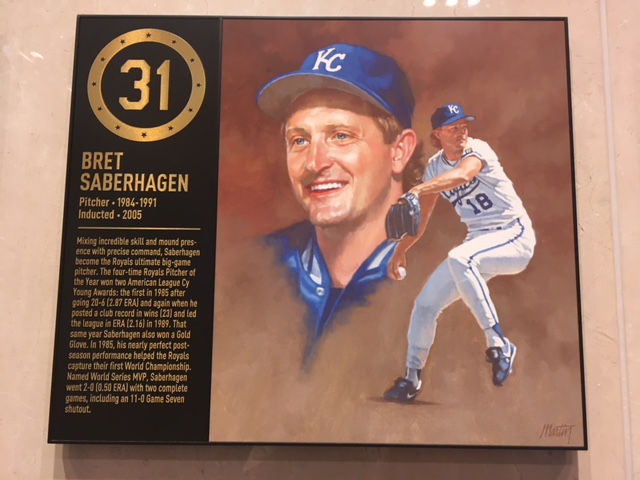
Located in the left field corner on the field level, the Royals Hall of Fame and Museum celebrates the team's best players, with a section for retired numbers and a wing devoted to the Royals' one Cooperstown honoree, George Brett.  It also has Dan Quisenberry's Rolaids Relief Man Award, team trophies, a history of the World Series (and not just the Royals' appearances in the Fall Classic), player lockers and bobbleheads.  In the area where the Royals Hall of Fame members are honored, a beautifully done painting of each honoree is displayed, along with a short history of the player depicted on the canvas.  It sure beats the traditional Hall of Fame plaque.  (And I was surprised to see so many former Mets who were honored for their playing and/or coaching careers in Kansas City.)

But my favorite display in the museum had to be the huge No. 5 made with 3,154 baseballs, or one for each hit collected by George Brett during his 21-year career in Kansas City.  In the middle of the display is Brett's 3,000th hit ball and the bat used to reach that milestone.  Incredibly, the bat is still loaded with pine tar as a reminder of just how much Brett applied to his lumber during his career.  And in case you were wondering, the Pine Tar Game is also discussed in the museum.

Of course, as a Mets fan, I was upset that the jersey worn by Eric Hosmer in Game Five of the 2015 World Series (complete with Citi Field dirt still on it) was prominently displayed, as well as the third base bag he was standing on before he made his mad dash to the plate,  But that was offset somewhat by the unexpected Gil Hodges Mets jersey from 1969 that was there to commemorate the team that won the championship during the Royals' inaugural season.


This trophy would have been ours if World Series games ended after seven innings.  (EL/SM)

Kauffman Stadium is a great place to watch a game, but if you have young kids who can't stay still in a seat for three hours, there are many activities to keep them occupied.  Whereas Citi Field only has a dunk tank, pitch speed machine and a mini field, Kauffman Stadium has so much more.

There's a baseball-themed carousel.  There's a much larger "mini" field where you can play actual baseball games.  There are pitching cages.  There are batting cages.  There's even a miniature golf course with baseball obstacles.  And of course, there are the beautiful fountains in center field that shoot water high up in the air between innings and when the Royals score.

All those things were great for a Mets fan like me.  Why is that, you ask?  Because they distracted me from the 2015 World Series flag flying in the wind and the large 2015 World Champions sign in center field.


I think I liked this sign better when it just said 1985 World Champions.  (EL/SM)

So that covers the ballpark in Kansas City.  But watching a game is far from the only thing you can do in this beautiful burgh and the nearby surrounding areas.

There are numerous great restaurants and venues to watch live music in the Power and Light District.  There's also the Harry S. Truman Presidential Library and Museum in nearby Independence, MO.  For music lovers, nothing beats the American Jazz Museum in the 18th and Vine District.  And housed in the same building is the Negro Leagues Baseball Museum, which I made sure to visit during my stay in the city.

Ordinarily, photos are not allowed in the NLBM.  This is done to protect the artifacts within the 10,000 square-foot space.  But my colleagues and I were given a green light to take all the photos we wanted to document our visit on the Studious Metsimus site.  My photographer took hundreds of photos, of which I will share a few here.


This was my field of dreams, which I shared with some of the greatest players of all-time.  (EL/SM)


So there you have it, my fellow Mets fans.  The baseball teams from Kansas City and St. Louis may have given the Mets lots of heartache in recent years, but the cities those teams call home made up for all the grief.  Well, at least Kansas City did.  And for all the things St. Louis didn't have, Kansas City picked up the slack and then some.

Busch Stadium and Kauffman Stadium are both beautiful ballparks.  Although the immediate area around Busch has more baseball-related activities to entertain fans when there are no games being played, Kauffman is the superior stadium.  The food is tastier and there is more variety.  And there's far more to do inside "The K" when the game isn't the only thing you're interested in.

I can't wait to rumble in the Royals' home town again.  Maybe next time I'll just fly over St. Louis and wave at Busch Stadium from the air while I count down the minutes until I touch down in Kansas City.  And by then, maybe losing the World Series to the Royals in 2015 won't sting as much as it still does and I'll just want BBQ because it's delicious rather than to wash away the memories of that Fall Classic.

Thanks for joining me on the latest legs of my baseball world tour.  Now excuse me while I try on my Negro Leagues apparel.  They may have allowed me to take photos in the museum but they still have to work on making clothes in my size.


Hope my colleagues kept the receipt for this.  (EL/SM)


For previous installments of Joey's World Tour, please click on the links below, where you will be entertained by Joey's wit, photos and love of ballpark cuisine:

World Tour Stop #1: Baltimore
World Tour Stop #2: Washington, DC
World Tour Stop #3: Pittsburgh
World Tour Stop #4: Texas
World Tour Stop #5: Los Angeles
World Tour Stop #6: San Diego
World Tour Stop #7: Toronto
World Tour Stop #8: Chicago (NL)
World Tour Stop #9: Milwaukee
World Tour Stop #10: Seattle
World Tour Stop #11: Cleveland
World Tour Stop #12: Brooklyn (Ebbets Field site) and Manhattan (Polo Grounds site)
World Tour Stop #13: Baltimore (again) and Pittsburgh (part deux)
World Tour Stop #14: Cincinnati
World Tour Stop #15: Colorado
World Tour Stop #16: Cooperstown (Baseball Hall of Fame)
World Tour Stop #17: Detroit
World Tour Stop #18: Atlanta
World Tour Stop #19: Miami
World Tour Stop #20: St. Louis


Saturday, June 6, 2015

This Is How Close The Mets Are To Being Crazy Good

Matt Harvey smiles as he realizes just how good this team could be very soon.  (Mike Stobe/Getty Images)

On Friday, Jonathon Niese allowed three runs in six innings of work in a game that was eventually lost by the Mets, 7-2.  The game marked just the sixth time all season that the Mets lost when their starting pitcher was credited with a quality start (six or more innings pitched, no more than three earned runs allowed).  By contrast, the Mets have won 27 times in games where the starter recorded a quality start.  That gives the team a 27-6 record in quality starts and a lowly 3-20 mark when the starting pitcher failed to give a quality performance.

To put this in layman's terms, the Mets have won over 80% of the time when their starting staff has kept them in games.  But once the starter falls apart, it becomes nearly impossible for the offense to bail him out.

I wanted to know how important quality starts have been for the Mets in determining where the team has finished in the season's final standings, so I did some research on the topic.  My findings were not only stunning, but proved just how close the Mets currently are to being one of the top teams in the league, as long as the offense doesn't let them down.

First, I wanted to see how many Mets teams have recorded 100 or more quality starts in a single season.  There were a dozen such teams, as shown by the chart below.


Of the 12 teams to reach triple digits in quality starts, nine finished with winning records and four reached the postseason, including both World Championship teams and all three 100-win squads.  The three teams that posted 100 or more quality starts, but still finished below .500 did so in 1968, 1974 and 2012.

Clearly, all three of those sub-.500 teams had excellent pitching, as evidenced by the overwhelming numbers of quality starts.  But one other thing they had in common was their anemic offense.

The 1968 campaign was known as "The Year of the Pitcher", as hurlers such as Bob Gibson (1.12 ERA; the lowest mark in the modern era of baseball) and Denny McLain (31 wins; the last pitcher to win 30 or more games) posted career years on the mound.  But as much as hitters struggled against pitchers in 1968, no team fared worse at the plate than the New York Mets.

In the final season before the leagues split up into divisions, the Mets finished dead last in the National League in team batting average (.228), on-base percentage (.281) and slugging percentage (.315), scoring just 473 runs - which remains the fewest tallies in club history in a non-strike shortened campaign.

Similarly, the 1974 club made most of the pitchers they faced look like Sandy Koufax on the mound.  The Mets finished the year in last place or next-to-last place in nearly every offensive category, including hits, doubles, triples, stolen bases, batting average, on-base percentage, slugging percentage, and of course, runs scored.  The pitcher who suffered the most for the Mets in 1974 was Jon Matlack, who incredibly tossed seven shutouts and posted a 2.41 ERA, but only managed a 13-15 won-loss record.  More than half of his wins in 1974 came in those seven shutouts, meaning that once he allowed a single run, his team's chances of winning went down the drain.

The third club with 100 quality starts that failed to post a winning record did it fairly recently.  In 2012, the Mets had the National League Cy Young Award winner in R.A. Dickey, who led the league in complete games, shutouts, innings pitched and strikeouts, as well as recording quality starts in 27 of his 33 starts.  They also had a staff that included Johan Santana, who pitched the team's first and only no-hitter, and Jonathon Niese, who quietly had the best season of his career, going 13-9 with a 3.40 ERA and 22 quality starts.  In addition, the 2012 campaign saw the debut of Matt Harvey, who dazzled in his ten late-season starts (2.73 ERA, 70 Ks in 59.1 IP).  Of course, none of that could help the team achieve a winning record.  While it's true that the bullpen was part of the reason for the team's failure to have many happy recaps, the offense didn't help much either.  The team batted .249 and finished outside of the league's top ten in home runs, stolen bases, runs scored, on-base percentage and slugging percentage.

Now let's take a look at the teams that posted the highest winning percentages in games where a starting pitcher recorded a quality start.


Once again, the teams that took advantage of quality starts were among the best in franchise history.  Eight of the top ten teams won 88 or more games and six of those eight teams made the playoffs.  The two teams that didn't win at least 88 games were the 1994 Mets, who never finished their 162-game schedule due to the players strike and this year's club, who are on pace for just under 87 victories.

The 1994 squad had a wonderful one-two tandem atop the rotation in Bret Saberhagen and Bobby Jones.  The two right-handers combined to go 26-11 with a 2.93 ERA, accounting for nearly half of the team's 55 victories.  However, the team's offense sputtered for most of the abbreviated season finishing at or near the bottom of the league in hits, doubles, triples, batting average, on-base percentage and slugging percentage.  New York also had no speed to speak of, as bench player John Cangelosi led the team with five stolen bases.  Also, making contact wasn't exactly the team's forte, as the Mets led the league in strikeouts and were next-to-last in walks.

And that brings us to this year's squad, who currently is one of just two teams in franchise history to win 80% of their quality starts - the other is the 1986 World Championship team.  With a rotation led by Bartolo Colon, Matt Harvey, Jacob deGrom and Noah Syndergaard, the 2015 Mets have been wonderful at limiting runs scored by the opposition.  Unfortunately, the hitters have prevented the team from winning games when the starting pitchers haven't been on top of their games.

The Mets have averaged 3.79 runs per game in the 56 contests they've played this year.  The last Mets team to score fewer runs per game was the 1992 squad, who crossed the plate 3.70 times per affair and famously became known as "The Worst Team Money Could Buy".  This year's team is also averaging 7.73 strikeouts per game.  The only teams with a higher strikeout rate were the last two - the 2013 and 2014 clubs.  It also doesn't help that the Mets are batting .241 and reaching base at a .305 clip.

It wouldn't take much for the 2015 Mets to win on a more consistent basis.  In fact, they don't even need a bunch of superstars to push them over the top.  They just need to be average at the plate.

The average National League hitter is putting up a .253/.314/.392 slash line.  Those numbers aren't spectacular, but they're much better than the current .241/.305/.367 slash line posted by the Mets.  In addition, the average National League team has 91 doubles, nine triples, 49 homers, 31 stolen bases and has scored 225 runs.  All of those numbers are greater than the 82 doubles, five triples, 47 homers, 19 stolen bases and 212 runs scored by the Mets.

It doesn't take a rocket scientist to postulate that quality starts usually help a team win ballgames.  But even having a staff that produces quality starts by the bunches doesn't guarantee a playoff berth or even a winning record.  The 1968, 1974 and 2012 Mets know all about that.  And despite the season-ending players strike that put the kibosh on the 1994 campaign, Jeff Kent, his epic mustache, and rest of the '94 club could attest that winning the majority of the team's quality starts doesn't mean very much if the team can't win its non-quality starts.

The best teams in Mets history had great starting pitchers and could also hit the ball around the park.  That's why the 1969, 1986 and 1988 squads are the only ones to appear on both of the above charts.  Neither of those three teams were offensive juggernauts, but they each had a balanced attack at the plate.  The '69 squad finished in the middle of the pack in most offensive categories, yet still won 100 games.  That's all the 2015 Mets need.  If they're just mediocre at the plate, their starting pitching will carry them to places they've rarely been.

All the quality starts in the world won't produce a memorable season if the team's hitters are less than average at the plate.  A little mediocrity may be just what the doctor ordered to prescribe a successful season at Citi Field in 2015.

Tuesday, January 6, 2015

Mets Almost Traded For Randy Johnson In 1991

(Photo by Elaine Thompson/AP)

In 1991, the Mets posted their first losing season in eight years.  After winning 87 or more games from 1984 to 1990, New York finished the 1991 campaign with a disappointing 77-84 record.  As a result, general manager Al Harazin decided to shed salaries without going through a rebuilding phase.

Kevin McReynolds, one of the team's best offensive players during his five-year tenure in New York, was dealt to Kansas City.  Hubie Brooks, who returned to the Mets for one season as Darryl Strawberry's replacement in right field, was jettisoned to the Angels.

The McReynolds trade (which also sent Gregg Jefferies and Keith Miller to the Royals) brought two-time Cy Young Award winner Bret Saberhagen to Flushing.  Saberhagen was part of Harazin's plan to create a top-notch starting rotation, as long-time Met Ron Darling had been traded to Montreal during the 1991 season and Frank Viola was about to leave via free agency.

But Saberhagen was not Harazin's first choice to lead a starting rotation that already featured David Cone, Dwight Gooden and Sid Fernandez.  His original plan was to send McReynolds to Seattle for one of the Mariners' top two young starting pitchers.

Coming to New York in exchange for McReynolds would have been either Erik Hanson, a 26-year-old right-hander who posted an 18-win, 211-strikeout campaign in 1990, or a lanky 28-year-old southpaw with a 37-34 career record, 4.01 ERA and a 1991 season in which he walked 152 batters - the first time since 1977 that a pitcher had issued over 150 bases on balls.

That skinny lefty was future Hall of Fame pitcher Randy Johnson.

Harazin knew Seattle was in need of a left fielder, and was willing to part ways with the veteran McReynolds, who had signed a three-year, $10 million contract extension the previous off-season.

But Seattle did not want to trade Hanson or Johnson for McReynolds, whose salary was supposedly too high for the penny-pinching Mariners.  (Seattle's $17.5 million team payroll was the fifth-lowest in the majors in 1991.)  At least that's what Harazin was led to believe.


"The conversation we had with them was such that I didn't think they were interested in anyone's $3 million player."


That's when Harazin opted for Plan B, trading McReynolds and two others to Kansas City for Saberhagen and infielder Bill Pecota.  There was only one problem.  Seattle ended up trading for a left fielder who was due more money than McReynolds, and parted ways with three pitchers to get him.

Former Met Kevin Mitchell, who was traded for McReynolds just five years prior, was acquired by the Mariners from San Francisco for pitchers Bill Swift, Mike Jackson and Dave Burba.  Mitchell was due $10.5 million through the 1994 season, an average of $3.5 million per year.

Mitchell flopped in Seattle, hitting just nine home runs in 99 games after averaging 36 homers per season during his final three years in San Francisco.  McReynolds wasn't much better in Kansas City and was out of baseball after the 1994 season.

Randy Johnson, on the other hand, learned how to control his wildness.  After one more subpar season in 1992 (12-14, 3.77 ERA, league-leading 144 walks), Johnson became one of the game's most dominant pitchers.  Over his next dozen campaigns, the Big Unit posted three 20-win seasons (and four other years with 18+ victories) and won nine strikeout titles.  He also led the league in winning percentage four times, ERA four times, complete games four times, shutouts three times and WHIP on three occasions - all in a span of 12 years.  And most importantly, he never walked 100 batters in a season again.

Almost a quarter century ago, Seattle was willing to trade three pitchers to San Francisco for a left fielder making $10.5 million for three seasons.  Had they listened to Al Harazin, they could have saved half a million dollars over those three campaigns and would have lost just one pitcher to acquire the Mets' left fielder.

But Seattle would have potentially lost a future Hall of Famer in Randy Johnson.

Imagine how different the histories of two franchises would have been had the McReynolds-for-Johnson trade been consummated.