Showing posts with label Barry Bonds*. Show all posts
Tuesday, September 24, 2013
With Pittsburgh In, Who Has The Longest Playoff Drought?
After two decades of futility, the Pittsburgh Pirates have qualified for the postseason for the first time since Barry Bonds' cap was three sizes smaller. (That's 1992 for all you kids out there.) In clinching a playoff berth, the Pirates have become the last National League team to qualify for the postseason in the 21st century. So now that Pittsburgh has ended its drought, which National League squad has gone the longest without appearing in the playoffs?
Well, the Braves, Cardinals, Reds and Dodgers are all joining the Pirates this year. The Giants and Nationals were playing in October last year. And in 2011, the Diamondbacks, Brewers and Phillies were competing for the pennant. That's ten of the fifteen teams in the N.L. qualifying for the playoffs in the last three seasons alone. So who's left?
The Rockies made the playoffs in 2009 and the Cubs last qualified in 2008. Both the Mets and Padres won their respective divisions in 2006. That's 14 teams. Which team has the longest playoff drought in the Senior Circuit?
The Florida (now Miami) Marlins.
The Marlins won the World Series in 2003, defeating the Yankees in six games. They haven't been invited to the postseason party since. So in the last decade, every National League team has made the playoffs. But there are two American League teams who haven't sprayed champagne since the 20th century.
The Toronto Blue Jays won their second consecutive World Series championship in 1993, defeating the Atlanta Braves in six games. Twenty years later, they're still waiting for their next postseason appearance. The only team with a longer playoff drought than the Blue Jays should never have won a World Series.
In 1985, the year before the Mets won their last title, Kansas City met intrastate rival St. Louis in the I-70 World Series (named because of Interstate 70, which connects the two cities). The Royals won their lone World Series championship with the aid of first base umpire Don Denkinger's blown call in the ninth inning of the sixth game. Kansas City won the title the next night. Nearly three decades later, the Royals have not yet returned to the postseason.
It seems like an eternity since the Mets last qualified for the playoffs. For many Mets fans, seven years does seem like forever. But be thankful you're not a Marlins fan. Or even worse, think about those Blue Jays and Royals fans out there. It's only been ten years since the Marlins and their dozen fans celebrated a postseason appearance. Fans in Toronto and Kansas City have been saying "wait 'till next century" for just a little bit longer.
Monday, February 18, 2013
The Mets That Got Away: Jeff Kent
There have been countless players who were drafted by the Mets or made their major league debuts wearing orange and blue. Some of these players became very successful in New York (Tom Seaver, David Wright), while others saw their careers fizzle once they made it to the majors (Bill Pulsipher, Paul Wilson).
There have also been quite a few players who weren't necessarily drafted by the Mets, but established themselves as major leaguers in New York. However, some of these players fell short of expectations and were later shipped off to another team, becoming stars for their new employers. One such player is Jeff Kent.
In 1992, the Mets acquired Kent from Toronto in a much-maligned trade for David Cone. Cone went on to win the World Series that year as a Blue Jay, then won a ring for each of his other four fingers as a member of the Yankees. Jeff Kent, on the other hand, never got to experience a winning season in New York.
Although Kent was producing offensive numbers the Mets had never seen before at the second base position, he wasn't about to replace David Cone in the hearts of Mets fans. Couple that with the fact that Kent was a loner in a city where no one is ever left alone and you have the recipe for a future trade. And that's exactly what happened four years after the Mets first acquired Kent. This time, a change in scenery did wonders for Kent's career.
Jeffrey Franklin Kent was not a top prospect when he was drafted by the Toronto Blue Jays in the 1989 June amateur draft. Drafted as a shortstop in the 20th round, Kent was a good, but not great, prospect. From 1989 to 1991, Kent showed decent pop in the minors, collecting 80 doubles and 41 homers. He also showed he could steal a base or two, swiping 47 bags. However, he had a penchant for striking out (283 Ks in 1,160 at-bats) and combined to hit .256 during those three seasons.
Despite his shortcomings at the plate, Kent was invited to spring training with the Blue Jays in 1992. A torrid spring allowed Kent to make the team, even though he didn't have a regular position to play. After being drafted as a shortstop, Kent played mostly second base and third base in the minors. But Kent was blocked at each position at the major league level by two Gold Glove-winning All-Stars in Roberto Alomar and Kelly Gruber. Kent also dabbled a little at first base but was blocked there by future batting champion John Olerud.
Kent played sparingly during his rookie season in Toronto, starting 52 of the team's first 126 games. The ample bench time dashed Kent's confidence at the plate, as the infielder was held to a .240 batting average in 192 at-bats. With the Blue Jays trying to win the AL East, they weren't about to give a rookie extended playing time. At the same time, they needed another arm in the rotation if they wanted to make a serious run at the World Series, a place they had never been even though they had won three division titles in seven years. Enter the New York Mets.
In 1991, the Mets completed their first losing season in eight years, causing them to retool their roster with former All-Stars. Gone were most of the players from the mid-to-late '80s teams, replaced by veterans such as Eddie Murray, Bobby Bonilla and Bret Saberhagen. But when those players didn't help the Mets return to prominence, the team realized that it had spent too much money and had gotten nothing in return. Therefore, the front office decided that if a player's contract was about to expire, especially a player who was due to earn a large sum of money in free agency, that player was going to be traded. One of the casualties of that new edict was David Cone.
In his five-plus seasons with the Mets, Cone had become one of the most dominant pitchers in the National League. He became only the fourth pitcher in franchise history to post a 20-win season in 1988 and won two league strikeout titles in 1990 and 1991. In 1992, as September approached and postseason rosters were due to be set, Cone was gunning for his third consecutive strikeout crown. But he was also gunning for a big payday as a free agent, and the Mets were not about to dole out another huge contract while the team was in the midst of another losing season. Cone never got to win that third National League strikeout crown, as he was traded to Toronto for Jeff Kent and outfielder Ryan Thompson.
The Coneheads at Shea Stadium were not happy with the deal, as their favorite son was going north of the border for two players who weren't on anyone's radar. Kent didn't help things either. He never went out of his way to endear himself to the fans and he also didn't earn the respect of his teammates, especially when he didn't go along with the rookie hazing that has become a tradition in baseball clubhouses. Kent raised a ruckus in the clubhouse when his clothes were taken from him and replaced with apparel only a rookie's mother could love. Kent went on to say:
Ordinarily, it would be a good thing to hear a player say that he won't be anyone's patsy. But normally, that player is referring to someone on an opposing team, not a teammate who is sharing locker space with him. Needless to say, Jeff Kent wasn't the most popular player in the clubhouse after making those remarks. Kent also wasn't becoming a fan favorite at Shea Stadium, as he batted .239 with three homers and 15 RBIs in 113 at-bats following the trade.
The 1993 season saw Kent finally establish himself as a major leaguer. Kent set team records for second baseman by blasting 21 homers and driving in 80 runs. But although he was hitting with power, he did not have very good plate discipline (88 Ks, 30 BB). Kent was also a horrible fielder. He led the league in errors by a second baseman (18) despite playing only 127 games at the position. Still, it was hard to get on him for his defense, especially when he was becoming one of the team's most productive hitters.
In the strike-shortened 1994 campaign, Kent led the Mets in batting average (.292), hits (121), doubles (24), triples (5) and RBIs (68). He also hit 14 home runs while playing 107 games at second base. But that wasn't the only thing he had 14 of. Once again, Kent played atrocious defense, making 14 errors at second base to tie for the league lead with the Marlins' Bret Barberie. But hey, at least he could still hit, right?
After two seasons of good hitting and poor fielding, Kent finally had a letdown at the plate in 1995. And once he started to struggle as a hitter, all of his other flaws became that much more evident. In 1994, Kent was one of the best hitters in baseball with runners in scoring position, posting a .385 average (40-for-104) in those situations. Just a year later, he was one of the worst, batting a miserable .199 (27-for-136) in those pressure-packed at-bats.
As a result, Kent saw drops in his overall batting average, on-base percentage and slugging percentage. He also had fewer doubles, triples and RBIs despite playing in 18 more games than he did in 1994. Not by coincidence, fans finally started to notice that he couldn't play a lick at second base (even though he made only ten errors in 1995) and started too rain boos on Kent from every level at Shea Stadium. The Mets also took notice and by 1996, Kent was the team's starting third baseman.
The 1995 Mets finished the season strongly, going a league-best 34-18 over their last 52 games. But the 1996 squad struggled out of the gate, losing ten of their first 14 games. By mid-May, the Mets were already facing a double-digit deficit in the NL East standings. Despite the career years being posted by players such as Todd Hundley, Bernard Gilkey and Lance Johnson, the Mets fell out of playoff contention before the All-Star Break. Although most of the team's struggles were caused by the failures of the much-hyped Generation K pitching triumvirate, Jeff Kent received some of the blame as well.
Through early June, Kent was hitting .257 and his on-base percentage was hovering around .300. Although Kent had hit 20+ home runs in two of his previous three seasons, he had only managed five round-trippers in his first 58 games and had a low RBI total (22) through June 7. And this was from a player who spent most of May and June hitting fourth or fifth in the lineup. Kent also did not adjust very well to his new position, committing 21 errors at the hot corner in only 89 games. (Houston's Sean Berry led all National League third basemen with 22 errors, but he played 43 more games at the position than Kent.)
By the All-Star Break, it was clear that the Mets were going to be sellers instead of buyers at the trade deadline. It was also clear that Jeff Kent had worn out his welcome in New York. He was a good hitter, but was not very patient at the plate. In four-plus seasons as a Met, Kent drew a mere 110 walks and struck out 346 times. That and his inability to handle the media, his teammates and the city made it easy for the Mets to part ways with Kent, which they did on July 29 when they sent him and Jose Vizcaino to Cleveland for three-time All-Star Carlos Baerga and veteran infielder Alvaro Espinoza.
Espinoza played well as a Met, batting .306 in 48 games before signing with the Seattle Mariners as a free agent in 1997. But Baerga, who averaged 19 HR and 97 RBIs as an Indian from 1992 to 1995, was a disappointment in New York, managing a total of 18 HR and 116 RBIs in 2½ seasons as a Met. Jeff Kent managed to do a heck of a lot more.
After playing in 39 games with the Indians and getting his first taste of the postseason (Kent went 1-for-8 in Cleveland's four-game ALDS loss to the Baltimore Orioles), Kent was traded to the San Francisco Giants in a six-player deal that netted Cleveland perennial All-Star and Gold Glove winner Matt Williams. With the Mets, Kent hit between guys like Carl Everett, Rico Brogna and Joe Orsulak. As a Giant, Kent hit behind Barry Bonds and his .446 on-base percentage and in front of J.T. Snow and his career-high 28 HR and 104 RBIs. Needless to say, Kent blossomed as a hitter in his new environment.
In 1997, Kent set career highs across the board, slamming 29 homers and driving in 121 runs. He also collected 38 doubles and scored 90 runs. Kent accomplished this despite a .250 batting average and 133 strikeouts. By 1998, low batting averages and high strikeout rates had become a thing of the past.
In his second year with the Giants, Kent's power numbers continued to impress (37 doubles, 31 HR, 128 RBI). But he had a marked improvement as a hitter, raising his batting average 47 points to .297, while striking out 23 fewer times than he did in 1997. One year later, Kent became an All-Star for the first time, finishing the year with his third consecutive 100-RBI season and his first 40-double campaign.
Going into the 2000 season, Jeff Kent had already completed three phenomenal years in San Francisco. Any one of those seasons could have been considered a career year for most players, especially for a middle infielder. But the 1997 to 1999 campaigns were just a springboard for what Kent achieved in 2000.
Kent finished the year with a .334 batting average and .424 on-base percentage. He also led the National League with 81 extra-base hits, collecting 41 doubles, seven triples and 33 home runs, while scoring 114 runs and driving in 125. For his efforts, Kent was voted the National League's Most Valuable Player and earned his first Silver Slugger Award as the Giants went on to win the NL West crown with a league-best 97 wins. Kent was in the playoffs for the third time in five seasons, but this time he was going to be facing the Mets.
After dropping the first game to the Giants in San Francisco, the Mets came back to win the next three games to take the NLDS in four games. New York held the Giants to a .205 batting average in the series, but had a tough time figuring out Jeff Kent. Kent batted .375 in the NLDS, leading the Giants with six hits and three runs scored. He also produced the only hit in Bobby Jones' series-clinching one-hit shutout.
It was more of the same for Kent in 2001 (.298, 49 doubles, 22 HR, 106 RBI) and 2002 (.313, 42 doubles, 37 HR, 108 RBI). In the latter season, Kent finally earned his first trip to the World Series, a hard-fought seven-game loss to the Anaheim Angels. Kent hit three home runs in the Fall Classic. He also scored six runs and led the team with seven runs batted in. But Kent and teammate Barry Bonds (.471, four homers) couldn't prevent the Angels from taking Games 6 and 7, sending the Giants home without a World Series title. Kent had fallen short of his goal to win a championship and was not going to get another chance to reach that goal in San Francisco.
Although Kent had had six incredibly productive seasons in San Francisco, the same problems that got him shipped out of New York in 1996 caused the Giants to let him walk as a free agent. First, Kent lied to the team about a wrist injury he suffered in spring training, claiming it was caused while he was washing his truck when in reality, it happened while he was riding his motorcycle. Second, he got into a dugout scuffle with Barry Bonds, who was the face of the franchise at the time. Both incidents contributed greatly in the Giants' decision not to re-sign Kent. Two months after Kent watched the Angels celebrate their World Series title, he signed a two-year, $18.2 million contract to play for the Houston Astros.
Injuries caused Kent to miss a month of action prior to the All-Star Break in 2003. But he was still quite productive when he was healthy enough to play. He finished his first year in Houston with a .297 average, 39 doubles, 22 homers and 93 RBIs. However, the month he missed due to tendinitis in his left wrist caused him to finish under 100 RBIs for the first time since 1996. It also dealt a serious blow to the Astros' playoff hopes. Houston went 12-11 during Kent's time on the disabled list. The team was 13 games over .500 when Kent was able to start. Kent's injury was a major reason why the Astros failed to make the playoffs in 2003, as Houston finished one game behind the Chicago Cubs for the National League Central division title.
Kent started a new triple digit RBI streak in 2004, batting .289 with 27 HR and 107 RBIs for the Astros. But this time Kent did not spend any time on the disabled list. And when Houston needed a miracle finish to avoid falling short of the playoffs for a second straight season, Kent carried them to the promised land.
Going into the final week of the regular season, Houston's record stood at 85-70. They were in third place in the National League wild card race, two games behind the Giants and 2½ games behind the Cubs. But the Astros went on a tear, winning their last seven games to finish one game ahead of the Giants and three games in front of Chicago.
Although Houston had MVP candidates Lance Berkman (.308, 1 HR, 4 RBI during the season-ending seven-game winning streak) and Carlos Beltran (.267, 0 HR, 2 RBI during the streak), it was Jeff Kent's bat that propelled the team during its run to the wild card. Kent hit .444 (12-for-27) during the season's final week. He slammed four homers (three of which gave Houston the lead), drove in eight runs and scored eight times. Kent's RBI single in the regular season finale proved to be the winning run in the Astros' wild card-clinching victory.
Houston fell one win short of their first World Series appearance, losing to the St. Louis Cardinals in the NLCS. But Kent did all he could to help the team make it to a seventh game, producing five extra-base hits (including a walk-off homer in Game 5) and seven RBIs in the series. Once again, Kent bolted for a new team as soon as his contract expired, this time ending up in Los Angeles.
Kent had a productive first season as a Dodger in 2005, batting .289 with 36 doubles, 29 homers and 105 RBIs in 149 games. But that would be the 37-year-old Kent's last great year in the major leagues.
In 2006, Kent had his least productive season since his final year in New York, collecting only 14 HR and 68 RBIs, while batting .292. When Kent posted those exact numbers for the Mets in 1994, they were considered to be outstanding. But they were considered subpar for a player who had already produced numerous 30 HR, 100 RBI seasons. The only thing that wasn't subpar for Kent in 2006 was his performance in the postseason. Just as he had done six years earlier as a member of the Giants, Kent took apart Mets pitching in the NLDS, batting .615 (8-for-13) in the series. But once again, his exploits at the plate were not enough to defeat his former team, as the Mets swept Los Angeles to advance to the NLCS. Kent did, however, take part in one of the most bizarre plays in the series in Game 1, when he and teammate J.D. Drew were both tagged out at home on the same play by Mets catcher Paul Lo Duca.
Kent played two more injury-riddled seasons in Los Angeles, averaging 16 HR and 69 RBIs in 2007 and 2008, before playing his final game in the big leagues in (you guessed it) a postseason loss. The Dodgers advanced to the NLCS in 2008, but fell to the eventual World Series champion Phillies in five games. Kent ended his career by going 0-for-8 with four strikeouts in the NLCS loss.
Jeff Kent was never supposed to accomplish much in the major leagues. If he had, he wouldn't have been bypassed by every team until the Blue Jays selected him in the 20th round of the 1992 amateur draft. But he proved the naysayers wrong, becoming one of the best hitting second basemen of all time.
Kent finished his 17-year career with 2,461 hits, which included 560 doubles and 377 home runs. Kent's 351 homers as a second baseman (he hit 26 at other positions) make him the all-time home run leader at the position. He also scored 1,320 runs and collected 1,518 RBIs. Kent was a five-time All-Star, won four Silver Slugger Awards and received MVP votes in seven different seasons, which includes four top ten finishes and the 2002 National League MVP Award.
During a nine-year stretch from 1997 to 2005, Kent was one of the most productive hitters in baseball. An average Kent season in his near-decade run of excellence consisted of a .296 batting average, 40 doubles, 28 home runs and 110 RBIs. Kent also made the playoffs seven times in his career and excelled against the Mets in two postseason meetings, batting .483 (14-for-29) in the 2000 and 2006 Division Series versus New York.
Finally, as a member of the San Francisco Giants, Kent put up some of the best power numbers in the franchise's long and storied history. On a team that can claim Mel Ott, Willie Mays, Willie McCovey, Orlando Cepeda, Matt Williams and Barry Bonds, to name a few, Jeff Kent's name can be found on the team's all-time home run list (175 - 10th all-time in Giants history) and slugging percentage (.535 - tied for 5th with Orlando Cepeda).
In many ways, Jeff Kent was like a modern-day Richie Hebner. Both players were frequent postseason participants, with Hebner's teams making the playoffs eight times and Kent appearing in seven postseasons. Both players were also very vocal about their displeasure with the Mets and the city they played in. But there was one major difference between Kent and Hebner.
Richie Hebner came to New York at the tail end of his career, after having played over a decade in Pittsburgh and Philadelphia, winning multiple division titles with each team. Jeff Kent became a Met during his rookie season in the major leagues, then went on to become one of the greatest hitting second basemen of all-time after he left the city he never cared for.
Had Jeff Kent never left New York, perhaps Edgardo Alfonzo wouldn't have become the legendary Met he became. Perhaps the Mets wouldn't have signed Robin Ventura, who was so instrumental during the team's run to the 1999 NLCS and 2000 World Series. Perhaps Mets history would have looked a lot different. (Just think - had Kent not carried the Astros on his back during the final week of the 2004 regular season, then Carlos Beltran might never have reached the postseason that year and would not have gotten a chance to parlay a record-setting playoff performance into a nine-figure deal with the Mets.)
But Kent did leave New York. And he became a superstar in San Francisco.
Sometimes Mets fans cringe when they think of great players the team let get away. But in Jeff Kent's case, fans would have cringed had he stayed in New York. Although Kent had a Hall of Fame-caliber career after he skipped town, his departure was probably the best thing that could have happened to both him and the Mets. This is one Met that should have gotten away and did. And everyone involved ended up better because of it.
Note: The Mets That Got Away is a thirteen-part weekly series that spotlights those Mets players who established themselves as major leaguers in New York, only to become stars after leaving town. For previous installments, please click on the players' names below:
January 7, 2013: Nolan Ryan
January 14, 2013: Melvin Mora
January 21, 2013: Kevin Mitchell
January 28, 2013: Amos Otis
February 4, 2013: Jeff Reardon
February 11, 2013: Lenny Dykstra
There have also been quite a few players who weren't necessarily drafted by the Mets, but established themselves as major leaguers in New York. However, some of these players fell short of expectations and were later shipped off to another team, becoming stars for their new employers. One such player is Jeff Kent.
In 1992, the Mets acquired Kent from Toronto in a much-maligned trade for David Cone. Cone went on to win the World Series that year as a Blue Jay, then won a ring for each of his other four fingers as a member of the Yankees. Jeff Kent, on the other hand, never got to experience a winning season in New York.
Although Kent was producing offensive numbers the Mets had never seen before at the second base position, he wasn't about to replace David Cone in the hearts of Mets fans. Couple that with the fact that Kent was a loner in a city where no one is ever left alone and you have the recipe for a future trade. And that's exactly what happened four years after the Mets first acquired Kent. This time, a change in scenery did wonders for Kent's career.
![]() |
| Jeff Kent's cap didn't fit him in New York, just as New York wasn't a good fit for Jeff Kent. |
Jeffrey Franklin Kent was not a top prospect when he was drafted by the Toronto Blue Jays in the 1989 June amateur draft. Drafted as a shortstop in the 20th round, Kent was a good, but not great, prospect. From 1989 to 1991, Kent showed decent pop in the minors, collecting 80 doubles and 41 homers. He also showed he could steal a base or two, swiping 47 bags. However, he had a penchant for striking out (283 Ks in 1,160 at-bats) and combined to hit .256 during those three seasons.
Despite his shortcomings at the plate, Kent was invited to spring training with the Blue Jays in 1992. A torrid spring allowed Kent to make the team, even though he didn't have a regular position to play. After being drafted as a shortstop, Kent played mostly second base and third base in the minors. But Kent was blocked at each position at the major league level by two Gold Glove-winning All-Stars in Roberto Alomar and Kelly Gruber. Kent also dabbled a little at first base but was blocked there by future batting champion John Olerud.
Kent played sparingly during his rookie season in Toronto, starting 52 of the team's first 126 games. The ample bench time dashed Kent's confidence at the plate, as the infielder was held to a .240 batting average in 192 at-bats. With the Blue Jays trying to win the AL East, they weren't about to give a rookie extended playing time. At the same time, they needed another arm in the rotation if they wanted to make a serious run at the World Series, a place they had never been even though they had won three division titles in seven years. Enter the New York Mets.
In 1991, the Mets completed their first losing season in eight years, causing them to retool their roster with former All-Stars. Gone were most of the players from the mid-to-late '80s teams, replaced by veterans such as Eddie Murray, Bobby Bonilla and Bret Saberhagen. But when those players didn't help the Mets return to prominence, the team realized that it had spent too much money and had gotten nothing in return. Therefore, the front office decided that if a player's contract was about to expire, especially a player who was due to earn a large sum of money in free agency, that player was going to be traded. One of the casualties of that new edict was David Cone.
In his five-plus seasons with the Mets, Cone had become one of the most dominant pitchers in the National League. He became only the fourth pitcher in franchise history to post a 20-win season in 1988 and won two league strikeout titles in 1990 and 1991. In 1992, as September approached and postseason rosters were due to be set, Cone was gunning for his third consecutive strikeout crown. But he was also gunning for a big payday as a free agent, and the Mets were not about to dole out another huge contract while the team was in the midst of another losing season. Cone never got to win that third National League strikeout crown, as he was traded to Toronto for Jeff Kent and outfielder Ryan Thompson.
The Coneheads at Shea Stadium were not happy with the deal, as their favorite son was going north of the border for two players who weren't on anyone's radar. Kent didn't help things either. He never went out of his way to endear himself to the fans and he also didn't earn the respect of his teammates, especially when he didn't go along with the rookie hazing that has become a tradition in baseball clubhouses. Kent raised a ruckus in the clubhouse when his clothes were taken from him and replaced with apparel only a rookie's mother could love. Kent went on to say:
"I paid my rookie dues in Toronto. I feel I have endured my embarrassments, my punishment. I felt I was being taken advantage of. They wanted to go overboard. I stuck up for myself. I won't be pushed around."
Ordinarily, it would be a good thing to hear a player say that he won't be anyone's patsy. But normally, that player is referring to someone on an opposing team, not a teammate who is sharing locker space with him. Needless to say, Jeff Kent wasn't the most popular player in the clubhouse after making those remarks. Kent also wasn't becoming a fan favorite at Shea Stadium, as he batted .239 with three homers and 15 RBIs in 113 at-bats following the trade.
The 1993 season saw Kent finally establish himself as a major leaguer. Kent set team records for second baseman by blasting 21 homers and driving in 80 runs. But although he was hitting with power, he did not have very good plate discipline (88 Ks, 30 BB). Kent was also a horrible fielder. He led the league in errors by a second baseman (18) despite playing only 127 games at the position. Still, it was hard to get on him for his defense, especially when he was becoming one of the team's most productive hitters.
In the strike-shortened 1994 campaign, Kent led the Mets in batting average (.292), hits (121), doubles (24), triples (5) and RBIs (68). He also hit 14 home runs while playing 107 games at second base. But that wasn't the only thing he had 14 of. Once again, Kent played atrocious defense, making 14 errors at second base to tie for the league lead with the Marlins' Bret Barberie. But hey, at least he could still hit, right?
After two seasons of good hitting and poor fielding, Kent finally had a letdown at the plate in 1995. And once he started to struggle as a hitter, all of his other flaws became that much more evident. In 1994, Kent was one of the best hitters in baseball with runners in scoring position, posting a .385 average (40-for-104) in those situations. Just a year later, he was one of the worst, batting a miserable .199 (27-for-136) in those pressure-packed at-bats.
As a result, Kent saw drops in his overall batting average, on-base percentage and slugging percentage. He also had fewer doubles, triples and RBIs despite playing in 18 more games than he did in 1994. Not by coincidence, fans finally started to notice that he couldn't play a lick at second base (even though he made only ten errors in 1995) and started too rain boos on Kent from every level at Shea Stadium. The Mets also took notice and by 1996, Kent was the team's starting third baseman.
![]() |
| Jeff Kent's bubble had already burst at second base. In 1996, his career as a Met popped as well. |
The 1995 Mets finished the season strongly, going a league-best 34-18 over their last 52 games. But the 1996 squad struggled out of the gate, losing ten of their first 14 games. By mid-May, the Mets were already facing a double-digit deficit in the NL East standings. Despite the career years being posted by players such as Todd Hundley, Bernard Gilkey and Lance Johnson, the Mets fell out of playoff contention before the All-Star Break. Although most of the team's struggles were caused by the failures of the much-hyped Generation K pitching triumvirate, Jeff Kent received some of the blame as well.
Through early June, Kent was hitting .257 and his on-base percentage was hovering around .300. Although Kent had hit 20+ home runs in two of his previous three seasons, he had only managed five round-trippers in his first 58 games and had a low RBI total (22) through June 7. And this was from a player who spent most of May and June hitting fourth or fifth in the lineup. Kent also did not adjust very well to his new position, committing 21 errors at the hot corner in only 89 games. (Houston's Sean Berry led all National League third basemen with 22 errors, but he played 43 more games at the position than Kent.)
By the All-Star Break, it was clear that the Mets were going to be sellers instead of buyers at the trade deadline. It was also clear that Jeff Kent had worn out his welcome in New York. He was a good hitter, but was not very patient at the plate. In four-plus seasons as a Met, Kent drew a mere 110 walks and struck out 346 times. That and his inability to handle the media, his teammates and the city made it easy for the Mets to part ways with Kent, which they did on July 29 when they sent him and Jose Vizcaino to Cleveland for three-time All-Star Carlos Baerga and veteran infielder Alvaro Espinoza.
Espinoza played well as a Met, batting .306 in 48 games before signing with the Seattle Mariners as a free agent in 1997. But Baerga, who averaged 19 HR and 97 RBIs as an Indian from 1992 to 1995, was a disappointment in New York, managing a total of 18 HR and 116 RBIs in 2½ seasons as a Met. Jeff Kent managed to do a heck of a lot more.
After playing in 39 games with the Indians and getting his first taste of the postseason (Kent went 1-for-8 in Cleveland's four-game ALDS loss to the Baltimore Orioles), Kent was traded to the San Francisco Giants in a six-player deal that netted Cleveland perennial All-Star and Gold Glove winner Matt Williams. With the Mets, Kent hit between guys like Carl Everett, Rico Brogna and Joe Orsulak. As a Giant, Kent hit behind Barry Bonds and his .446 on-base percentage and in front of J.T. Snow and his career-high 28 HR and 104 RBIs. Needless to say, Kent blossomed as a hitter in his new environment.
In 1997, Kent set career highs across the board, slamming 29 homers and driving in 121 runs. He also collected 38 doubles and scored 90 runs. Kent accomplished this despite a .250 batting average and 133 strikeouts. By 1998, low batting averages and high strikeout rates had become a thing of the past.
In his second year with the Giants, Kent's power numbers continued to impress (37 doubles, 31 HR, 128 RBI). But he had a marked improvement as a hitter, raising his batting average 47 points to .297, while striking out 23 fewer times than he did in 1997. One year later, Kent became an All-Star for the first time, finishing the year with his third consecutive 100-RBI season and his first 40-double campaign.
Going into the 2000 season, Jeff Kent had already completed three phenomenal years in San Francisco. Any one of those seasons could have been considered a career year for most players, especially for a middle infielder. But the 1997 to 1999 campaigns were just a springboard for what Kent achieved in 2000.
Kent finished the year with a .334 batting average and .424 on-base percentage. He also led the National League with 81 extra-base hits, collecting 41 doubles, seven triples and 33 home runs, while scoring 114 runs and driving in 125. For his efforts, Kent was voted the National League's Most Valuable Player and earned his first Silver Slugger Award as the Giants went on to win the NL West crown with a league-best 97 wins. Kent was in the playoffs for the third time in five seasons, but this time he was going to be facing the Mets.
After dropping the first game to the Giants in San Francisco, the Mets came back to win the next three games to take the NLDS in four games. New York held the Giants to a .205 batting average in the series, but had a tough time figuring out Jeff Kent. Kent batted .375 in the NLDS, leading the Giants with six hits and three runs scored. He also produced the only hit in Bobby Jones' series-clinching one-hit shutout.
It was more of the same for Kent in 2001 (.298, 49 doubles, 22 HR, 106 RBI) and 2002 (.313, 42 doubles, 37 HR, 108 RBI). In the latter season, Kent finally earned his first trip to the World Series, a hard-fought seven-game loss to the Anaheim Angels. Kent hit three home runs in the Fall Classic. He also scored six runs and led the team with seven runs batted in. But Kent and teammate Barry Bonds (.471, four homers) couldn't prevent the Angels from taking Games 6 and 7, sending the Giants home without a World Series title. Kent had fallen short of his goal to win a championship and was not going to get another chance to reach that goal in San Francisco.
Although Kent had had six incredibly productive seasons in San Francisco, the same problems that got him shipped out of New York in 1996 caused the Giants to let him walk as a free agent. First, Kent lied to the team about a wrist injury he suffered in spring training, claiming it was caused while he was washing his truck when in reality, it happened while he was riding his motorcycle. Second, he got into a dugout scuffle with Barry Bonds, who was the face of the franchise at the time. Both incidents contributed greatly in the Giants' decision not to re-sign Kent. Two months after Kent watched the Angels celebrate their World Series title, he signed a two-year, $18.2 million contract to play for the Houston Astros.
Injuries caused Kent to miss a month of action prior to the All-Star Break in 2003. But he was still quite productive when he was healthy enough to play. He finished his first year in Houston with a .297 average, 39 doubles, 22 homers and 93 RBIs. However, the month he missed due to tendinitis in his left wrist caused him to finish under 100 RBIs for the first time since 1996. It also dealt a serious blow to the Astros' playoff hopes. Houston went 12-11 during Kent's time on the disabled list. The team was 13 games over .500 when Kent was able to start. Kent's injury was a major reason why the Astros failed to make the playoffs in 2003, as Houston finished one game behind the Chicago Cubs for the National League Central division title.
Kent started a new triple digit RBI streak in 2004, batting .289 with 27 HR and 107 RBIs for the Astros. But this time Kent did not spend any time on the disabled list. And when Houston needed a miracle finish to avoid falling short of the playoffs for a second straight season, Kent carried them to the promised land.
![]() |
| Former Mets Jeff Kent and Jose Vizcaino celebrate while Met-hating umpire Angel Hernandez looks on. Shoot me now. |
Going into the final week of the regular season, Houston's record stood at 85-70. They were in third place in the National League wild card race, two games behind the Giants and 2½ games behind the Cubs. But the Astros went on a tear, winning their last seven games to finish one game ahead of the Giants and three games in front of Chicago.
Although Houston had MVP candidates Lance Berkman (.308, 1 HR, 4 RBI during the season-ending seven-game winning streak) and Carlos Beltran (.267, 0 HR, 2 RBI during the streak), it was Jeff Kent's bat that propelled the team during its run to the wild card. Kent hit .444 (12-for-27) during the season's final week. He slammed four homers (three of which gave Houston the lead), drove in eight runs and scored eight times. Kent's RBI single in the regular season finale proved to be the winning run in the Astros' wild card-clinching victory.
Houston fell one win short of their first World Series appearance, losing to the St. Louis Cardinals in the NLCS. But Kent did all he could to help the team make it to a seventh game, producing five extra-base hits (including a walk-off homer in Game 5) and seven RBIs in the series. Once again, Kent bolted for a new team as soon as his contract expired, this time ending up in Los Angeles.
Kent had a productive first season as a Dodger in 2005, batting .289 with 36 doubles, 29 homers and 105 RBIs in 149 games. But that would be the 37-year-old Kent's last great year in the major leagues.
In 2006, Kent had his least productive season since his final year in New York, collecting only 14 HR and 68 RBIs, while batting .292. When Kent posted those exact numbers for the Mets in 1994, they were considered to be outstanding. But they were considered subpar for a player who had already produced numerous 30 HR, 100 RBI seasons. The only thing that wasn't subpar for Kent in 2006 was his performance in the postseason. Just as he had done six years earlier as a member of the Giants, Kent took apart Mets pitching in the NLDS, batting .615 (8-for-13) in the series. But once again, his exploits at the plate were not enough to defeat his former team, as the Mets swept Los Angeles to advance to the NLCS. Kent did, however, take part in one of the most bizarre plays in the series in Game 1, when he and teammate J.D. Drew were both tagged out at home on the same play by Mets catcher Paul Lo Duca.
![]() |
| "Just your routine double play." |
Kent played two more injury-riddled seasons in Los Angeles, averaging 16 HR and 69 RBIs in 2007 and 2008, before playing his final game in the big leagues in (you guessed it) a postseason loss. The Dodgers advanced to the NLCS in 2008, but fell to the eventual World Series champion Phillies in five games. Kent ended his career by going 0-for-8 with four strikeouts in the NLCS loss.
Jeff Kent was never supposed to accomplish much in the major leagues. If he had, he wouldn't have been bypassed by every team until the Blue Jays selected him in the 20th round of the 1992 amateur draft. But he proved the naysayers wrong, becoming one of the best hitting second basemen of all time.
Kent finished his 17-year career with 2,461 hits, which included 560 doubles and 377 home runs. Kent's 351 homers as a second baseman (he hit 26 at other positions) make him the all-time home run leader at the position. He also scored 1,320 runs and collected 1,518 RBIs. Kent was a five-time All-Star, won four Silver Slugger Awards and received MVP votes in seven different seasons, which includes four top ten finishes and the 2002 National League MVP Award.
During a nine-year stretch from 1997 to 2005, Kent was one of the most productive hitters in baseball. An average Kent season in his near-decade run of excellence consisted of a .296 batting average, 40 doubles, 28 home runs and 110 RBIs. Kent also made the playoffs seven times in his career and excelled against the Mets in two postseason meetings, batting .483 (14-for-29) in the 2000 and 2006 Division Series versus New York.
Finally, as a member of the San Francisco Giants, Kent put up some of the best power numbers in the franchise's long and storied history. On a team that can claim Mel Ott, Willie Mays, Willie McCovey, Orlando Cepeda, Matt Williams and Barry Bonds, to name a few, Jeff Kent's name can be found on the team's all-time home run list (175 - 10th all-time in Giants history) and slugging percentage (.535 - tied for 5th with Orlando Cepeda).
![]() |
| Richie Hebner |
Richie Hebner came to New York at the tail end of his career, after having played over a decade in Pittsburgh and Philadelphia, winning multiple division titles with each team. Jeff Kent became a Met during his rookie season in the major leagues, then went on to become one of the greatest hitting second basemen of all-time after he left the city he never cared for.
Had Jeff Kent never left New York, perhaps Edgardo Alfonzo wouldn't have become the legendary Met he became. Perhaps the Mets wouldn't have signed Robin Ventura, who was so instrumental during the team's run to the 1999 NLCS and 2000 World Series. Perhaps Mets history would have looked a lot different. (Just think - had Kent not carried the Astros on his back during the final week of the 2004 regular season, then Carlos Beltran might never have reached the postseason that year and would not have gotten a chance to parlay a record-setting playoff performance into a nine-figure deal with the Mets.)
But Kent did leave New York. And he became a superstar in San Francisco.
Sometimes Mets fans cringe when they think of great players the team let get away. But in Jeff Kent's case, fans would have cringed had he stayed in New York. Although Kent had a Hall of Fame-caliber career after he skipped town, his departure was probably the best thing that could have happened to both him and the Mets. This is one Met that should have gotten away and did. And everyone involved ended up better because of it.
Note: The Mets That Got Away is a thirteen-part weekly series that spotlights those Mets players who established themselves as major leaguers in New York, only to become stars after leaving town. For previous installments, please click on the players' names below:
January 7, 2013: Nolan Ryan
January 14, 2013: Melvin Mora
January 21, 2013: Kevin Mitchell
January 28, 2013: Amos Otis
February 4, 2013: Jeff Reardon
February 11, 2013: Lenny Dykstra
Wednesday, January 9, 2013
Broken News: And Then There Were None (The Hall of Fame Edition)
Welcome to the latest edition of Broken News, where someone else breaks a news story, then we break it some more. In today's special edition, we're going to look at the Hall of Fame vote, which surprisingly enough yielded no new Hall of Famers.
Seven ex-Mets were on the Hall of Fame ballot. Roberto Hernandez (no votes), Mike Stanton (no votes), Jeff Conine (no votes), Aaron Sele (one vote - not a typo), Shawn Green (two votes) and Omar Minaya's bosom buddy, Julio Franco (six votes) did not generate enough support to remain on the ballot in 2014. The seventh former Met who received votes should have received a lot more support than he did, as Mike Piazza was named on 329 ballots (57.8% of the 569 ballots cast), which was 98 votes short of the 427 needed for election into the Hall of Fame. Clearly, those 240 members of the Baseball Writers Association of America (BBWAA) who chose not to scribble Piazza's name on their ballot either:
Whatever their reason was to not include Piazza on their ballots, he has officially (and more than likely undeservedly) been lumped into the group of players that include Barry Bonds, Roger Clemens, Mark McGwire, Sammy Sosa and Rafael Palmeiro.
Bonds and Clemens faced criminal charges because of their alleged links to steroid use. McGwire didn't want to hop into his andro-fueled DeLorean to revisit the past. Sammy Sosa left his English For Dummies book at home next to his cork collection. And Rafael Palmeiro was caught with his finger in the steroid jar ... period.
Now Piazza, who is widely considered to be the best-hitting catcher of all-time, has been kept out of the Hall of Fame in his first year of eligibility.
Another former Mets catcher, Gary Carter, received 42.3% of the Hall of Fame votes in his first year of eligibility, dropped to 33.8% in his second year (being on the ballot with first-timers Nolan Ryan, George Brett and Robin Yount will tend to get you overlooked), then climbed steadily year after year before he was finally inducted in his sixth year of eligibility in 2003.
Carter was an 11-time All-Star, three-time Gold Glove winner and five-time Silver Slugger recipient. He also hit only .262 over his 19-year career, failed to score 100 runs in any of those seasons and never hit more than 32 home runs or drove in more than 106 runs. Piazza, meanwhile, was a 12-time All-Star and 10-time Silver Slugger recipient (no Gold Gloves - nobody's perfect). Piazza hit .308 over his 16-year career, crossed the plate 100+ runs twice and reached or surpassed Carter's career-high in homers nine times while steamrolling past the Kid's career-high RBI total five times (and had another season in which he drove in 105 runs).
Suffice it to say, as good as Carter was, he would've been Piazza's backup had they been teammates. But that wasn't good enough for Piazza to be inducted into the Hall of Fame in 2013. And it may not be good enough for him to go in next year as well.
Whatever reason the writers had for keeping the best-hitting catcher of all-time out of Cooperstown this year won't be acceptable to me. Mike Piazza deserved to enter the hallowed Hall that is reserved for the all-time greats of the sport in his first year of eligibility.
The BBWAA might have been afraid a few blemishes on Piazza's back. But in my opinion, keeping him out of the Hall of Fame in 2013 was a far greater blemish.
Seven ex-Mets were on the Hall of Fame ballot. Roberto Hernandez (no votes), Mike Stanton (no votes), Jeff Conine (no votes), Aaron Sele (one vote - not a typo), Shawn Green (two votes) and Omar Minaya's bosom buddy, Julio Franco (six votes) did not generate enough support to remain on the ballot in 2014. The seventh former Met who received votes should have received a lot more support than he did, as Mike Piazza was named on 329 ballots (57.8% of the 569 ballots cast), which was 98 votes short of the 427 needed for election into the Hall of Fame. Clearly, those 240 members of the Baseball Writers Association of America (BBWAA) who chose not to scribble Piazza's name on their ballot either:
a) remembered Piazza's back acne story and proceeded to have wicked flashbacks to when they were pimply kids who were beat up regularly by the jocks in high school.
2) were afraid his Hall of Fame plaque would have him wearing a Marlins cap and wanted to spare the baseball-loving world of that potential atrocity, or
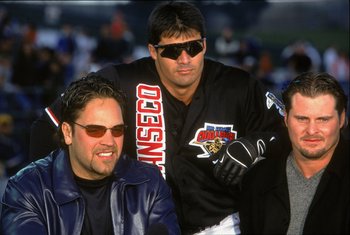
iii) saw the following picture of Piazza & Pals and naturally assumed that steroids can be passed from person to person through the air like the flu.
![]() |
| Oh, Mike. Why did you allow yourself to be photographed with Jose Canseco and Jason Giambi? |
Whatever their reason was to not include Piazza on their ballots, he has officially (and more than likely undeservedly) been lumped into the group of players that include Barry Bonds, Roger Clemens, Mark McGwire, Sammy Sosa and Rafael Palmeiro.
Bonds and Clemens faced criminal charges because of their alleged links to steroid use. McGwire didn't want to hop into his andro-fueled DeLorean to revisit the past. Sammy Sosa left his English For Dummies book at home next to his cork collection. And Rafael Palmeiro was caught with his finger in the steroid jar ... period.
Now Piazza, who is widely considered to be the best-hitting catcher of all-time, has been kept out of the Hall of Fame in his first year of eligibility.
Another former Mets catcher, Gary Carter, received 42.3% of the Hall of Fame votes in his first year of eligibility, dropped to 33.8% in his second year (being on the ballot with first-timers Nolan Ryan, George Brett and Robin Yount will tend to get you overlooked), then climbed steadily year after year before he was finally inducted in his sixth year of eligibility in 2003.
Carter was an 11-time All-Star, three-time Gold Glove winner and five-time Silver Slugger recipient. He also hit only .262 over his 19-year career, failed to score 100 runs in any of those seasons and never hit more than 32 home runs or drove in more than 106 runs. Piazza, meanwhile, was a 12-time All-Star and 10-time Silver Slugger recipient (no Gold Gloves - nobody's perfect). Piazza hit .308 over his 16-year career, crossed the plate 100+ runs twice and reached or surpassed Carter's career-high in homers nine times while steamrolling past the Kid's career-high RBI total five times (and had another season in which he drove in 105 runs).
| Gary Carter's numbers might have been dwarfed by Piazza, but Carter did have Piazza beat in one shiny category. |
Suffice it to say, as good as Carter was, he would've been Piazza's backup had they been teammates. But that wasn't good enough for Piazza to be inducted into the Hall of Fame in 2013. And it may not be good enough for him to go in next year as well.
Whatever reason the writers had for keeping the best-hitting catcher of all-time out of Cooperstown this year won't be acceptable to me. Mike Piazza deserved to enter the hallowed Hall that is reserved for the all-time greats of the sport in his first year of eligibility.
The BBWAA might have been afraid a few blemishes on Piazza's back. But in my opinion, keeping him out of the Hall of Fame in 2013 was a far greater blemish.
Monday, January 31, 2011
M.U.M.'s The Word (Most Underrated Mets): Bobby Jones
The 1990 season was a transitional one for the New York Mets. In May, long-time manager Davey Johnson was fired after a 20-22 start. Although the Mets recovered under new manager Bud Harrelson to finish with a 91-71 record, the team received a great blow during the offseason when Darryl Strawberry left the team as a free agent to sign with his hometown Los Angeles Dodgers.
With Strawberry gone, the Mets turned to Hubie Brooks to play right field. Brooks had a good 1990 season with the Dodgers (.266, 20 HR, 91 RBI), but he was already 34 years old when the Mets acquired him from Los Angeles for Bobby Ojeda and Greg Hansell. Asking a 34-year-old to replace a 28-year-old perennial All-Star was a recipe for disaster and sure enough, Brooks had one of his worst seasons in 1991, hitting .238, with 16 HR and 50 RBI.
Just like Hubie failed on the field, the Mets did the same in the standings, finishing in fifth place with their first losing record (77-84) since 1983. However, the 1991 season did have something positive come out of it.
When Darryl Strawberry left New York following the 1990 season, the Mets received a supplemental pick to be used between the first and second rounds of the 1991 amateur draft. That sandwich pick (the 36th overall draft selection) turned out to have a pretty good Mets career in his own right.
Bobby Jones was a right-handed pitcher from Fresno, California. Before the Mets drafted the All-American out of Fresno State University with the 36th pick of the 1991 amateur draft, Jones already had a Mets connection, as he attended the same high school (Fresno High School) as "The Franchise" himself, Tom Seaver.
Bobby Jones (wearing #22 in the back row) was partying like it was 1988 in this photo from his Fresno High School days. (photo courtesy of fresnohighalumni.com)
Like Tom Seaver before him, Bobby Jones' ascent to the major leagues was a quick one. After dominating minor league hitters at three different levels (27-15, 2.71 ERA, 304 Ks, 78 BB), Jones was called up to the major leagues in August of 1993, making his major league debut against the Philadelphia Phillies, the team that went on to win the National League pennant two months later.
Jones held the Phillies lineup in check, allowing one earned run in six innings of work. He gave up seven hits and walked one batter. Although the Mets defense threatened to ruin Jones' debut (their four errors led to four unearned runs), their offense (you may call him Tim Bogar) showed up to preserve his first major league win.
Tim Bogar collected two doubles and two home runs in the 9-5 Mets victory. His three-run homer in the sixth inning turned a one-run game into an 8-4 Mets lead. He then gave the Mets an insurance run in the ninth inning with an inside-the-park home run. However, just like the Mets in 1993, even when something went right, something else would go wrong. During his unnecessary head-first slide into home plate, Bogar tore a ligament in his left hand and would not play again in 1993.
The Mets went on to finish the 1993 season in last place in the NL East, with the expansion Florida Marlins finishing five games ahead of them. Their 59-103 record in 1993 would give us another Tom Seaver-Bobby Jones parallel, as Jones' initial campaign with the Mets was the team's first 100-loss season since 1967, the same year Tom Seaver made his major league debut for New York.
When the 1994 season began, Bobby Jones was firmly entrenched in the Mets' rotation, starting the third game of the season behind Doc Gooden and Pete Smith (feel free to chime in with a "who dat?"). But Jones (along with Bret Saberhagen) soon became one of the go-to guys in the rotation, as Gooden succumbed to his addictions for the final time as a Met. Pete Smith also gave in to his addictions, although his drug of choice was the gopher ball (Smith gave up a league leading 25 HR in 1994).
Despite the poor performances by Gooden (3-4, 6.31 ERA) and Smith (4-10, 5.55 ERA), the Mets flirted with the .500 mark for most of the year, finishing with a 55-58 record when the players' strike ended the 1994 season. Saberhagen's season (14-4, 2.74 ERA, a major league record 11:1 K/BB ratio) was nothing short of brilliant, but that was to be expected from a man who had already won two Cy Young Awards in his career (1985, 1989). It was Bobby Jones' performance in his first full season as a Met that kept the team from falling back to the depths they reached in 1993.
For the season, Jones went 12-7 with a 3.15 ERA, with the Mets winning 15 of his 24 starts. In 14 of those 24 starts, Jones gave up two earned runs or less. He also gave the Mets much-needed durability, especially with the bullpen being overworked due to the inefficiency of the other starters not named Saberhagen. Jones pitched at least six innings in all but four of his starts and made it through the seventh inning more than half the time (14 starts). For his efforts, Jones finished eighth in the National League Rookie of the Year voting, behind future Mets Steve Trachsel and Cliff Floyd.
After being tantalized by his excellent 1994 season, the 1995 and 1996 seasons would have to be considered a slight disappointment for Bobby Jones. Although Jones was rewarded with the Opening Day nod in each season, his performances in the other starts left a lot to be desired.
Jones followed up his 1994 season by going 10-10 in 1995 and 12-8 in 1996. The combined 22-18 record over the two seasons wasn't so bad, especially when the Mets' records during that span (69-75 in 1995, 71-91 in 1996) are taken into consideration. However, opposing batters learned how to hit Jones better during those two seasons than they did in 1994.
In 1994, the National League hit .257 against Jones, who gave up 157 hits in 160 innings. That number rose to .274 in 1995 (209 hits in 195.2 innings) and .288 in 1996 (219 hits in 195.2 innings). As a result, Jones' ERA rose from an exceptional 3.15 in 1994 to a mediocre 4.19 and 4.42 in 1995 and 1996, respectively. Fortunately for Jones, the youth movement known as Generation K (Bill Pulsipher, Paul Wilson, Jason Isringhausen) did not become the second coming of Seaver, Koosman and Matlack, thereby allowing Jones to retain his status at the top of the Mets' rotation. Jones rewarded the Mets for their patience in 1997.
After getting the ball on Opening Day in 1995 and 1996, Bobby Jones did not get that honor for the 1997 opener. Instead, new manager Bobby Valentine (who replaced Dallas Green during the latter part of the 1996 season) chose to bestow the Opening Day honor to veteran Pete Harnisch. Harnisch would pitch into the sixth inning, an inning in which the Mets allowed the San Diego Padres to score 11 runs. Soon after the Opening Day debacle, Harnisch was placed on the disabled list after feeling exhaustion and anxiety. It was later revealed that Harnisch was suffering from depression.
When Harnisch went down in April, it was up to the rest of the staff to step up, especially Bobby Jones, who hadn't lived up to expectations following his rookie season in 1994. Then something special happened. Bobby Jones became an effective pitcher again and for the first time during his tenure as a Met, the team started to win.
In the finale of the season-opening series against the Padres, Jones made his first start of the season, picking up the win by holding San Diego to one run over eight innings. It was the Mets' first victory of the season after losing their first two games. The performance by Jones in his first start would serve as a reminder that 1997 was going to be nothing like the previous two years.
From April 30 to June 9, Jones went on one of the most dominant stretches by any Met (Seaver and Gooden included) in franchise history. In eight starts, Jones allowed only ten earned runs for a 1.45 ERA. Opposing batters hit only .199 against him, and when they did get a hit, more often than not, it was a single (.271 slugging percentage over the eight starts). The most important stat during that stretch of starts was Jones' record, a perfect 8-0. For his efforts, Jones was named the National League's Player of the Month for May.
Before the first official day of summer arrived, Jones had already established himself as one of the best pitchers in the league. After Bobby Jones defeated the Pirates on June 20 by the score of 1-0, his record stood at 12-3. For his strong first half, Jones was rewarded with his first selection to the All-Star Game. He did not disappoint the fans in the Midsummer Classic, striking out sluggers Ken Griffey, Jr. and Mark McGwire (who combined to hit 114 HR in 1997) in succession during his one scoreless inning of work.
After his strong start, Jones came back to Earth, winning only three games after the All-Star Break. However, when the season ended, his overall numbers were still brilliant. For the year, Jones went 15-9, with a 3.63 ERA. After two years of allowing more base hits than innings pitched, Jones held opposing batters to a career-low .242 batting average, allowing 177 hits in 193.1 innings. Bobby Jones' breakout season coincided with the Mets' return to contention, as the team finished with an 88-74 record, their best mark since Darryl Strawberry's final year as a Met in 1990.
The Mets won 88 games again in 1998, but by then, Al Leiter and Rick Reed had already established themselves as the top two pitchers on the staff, winning 33 games between them. Despite another season giving up fewer hits than innings pitched (192 hits in 195.1 innings), Jones was the victim of the dreaded no-decision more times than he would have liked. In 30 starts, Jones was credited with 12 no-decisions. The Mets ended up winning eight of those 12 games. Therefore, despite the fact that the Mets won 17 of his starts, Bobby Jones finished the 1998 season with a career-low nine wins. It was the first time in his career that Jones failed to register double-digit victories over a full season.
The 1999 season was a memorable one for the Mets but a difficult one for Bobby Jones. For the first time in his career, the injury bug latched itself onto Jones, limiting him to 12 mostly unsuccessful starts. For the season, Jones finished with a 3-3 record and a career-worst 5.61 ERA. Because the Mets had depth in their rotation, Jones was left off the postseason roster. After experiencing hard times with the Mets early on in his career, Jones was now the odd man out when the team finally reached the playoffs. The postseason snub should have motivated Jones to have a strong 2000 season, but that was not the case during the early part of the year.
The Mets were on a mission in 2000. After losing their final five games of the 1998 season to narrowly miss out on the playoffs and falling two wins short of the World Series in 1999, the Mets were not going to settle for anything less than an appearance in the Fall Classic in 2000. For Bobby Jones, he had an additional goal on his mind. He wanted to make sure he wouldn't be an afterthought if the Mets reached the playoffs again. But after three poor starts to begin the season, Jones was placed on the disabled list with a strained right calf. After a one-month stay on the DL, Jones picked up right where he left off, giving the Mets less than they expected from a man who had been an All-Star just three years before. After a June 10 loss to the Yankees, Jones' ERA stood at 10.19. It was then that the Mets made the not-so-difficult decision to send Jones to the minor leagues.
Perhaps it was the embarrassment of being sent down to the minors for two weeks, but once Jones returned to the Mets, he was a completely different pitcher. In his first start with the Mets after being recalled from AAA-Norfolk, Jones pitched eight strong innings, holding the Pirates to one run and five hits, while striking out eight. The start against Pittsburgh was a sign of things to come.
Beginning with his June 23 start against the Pirates, Jones pitched as well as he had in 1997. After his short stint in the minor leagues, Jones went 10-3 with a 3.69 ERA. He saved his best for last, winning seven of his final eight decisions, as the Mets repeated as the National League's Wild Card winner. This time around, Bobby Jones would not be on the outside looking in, as his strong finish helped him earn a spot on the postseason roster. The longest tenured starting pitcher on the Mets was finally going to get his chance to shine in the playoffs.
From 1993-2000, Bobby Jones won 74 games in the regular season. But it was his 75th win that became the most memorable victory of his career.
After losing Game 1 to the NL West champion San Francisco Giants, the Mets pulled out two hard-fought extra-inning victories in Games 2 and 3. Benny Agbayani was the man who let the dogs out at Shea Stadium in Game 3 with his game-ending 13th inning homer off Aaron Fultz. The thrilling victory gave the Mets a 2-1 series lead, meaning that the clinching could come at Shea Stadium if the Mets won Game 4. Bobby Valentine gave the ball and his trust to Bobby Jones to pitch the Mets into the NLCS. The manager would not be disappointed.
Of course the Mets are ecstatic. After all, they had finally cracked the mystery that was on everyone's minds in the year 2000, for it was Benny Agbayani who was guilty of letting the dogs out.
Bobby Jones was making his first postseason start in Game 4 of the 2000 NLDS. Whereas most pitchers admit being nervous before their first playoff start, Jones pitched with ice water in his veins. He retired the first 12 Giants to face him, taking a 2-0 lead into the fifth inning, courtesy of a first-inning two-run homer by Robin Ventura. Then he ran into trouble in the fifth inning, allowing his first baserunner of the game when former Met (and 2000 NL MVP) Jeff Kent doubled down the left field line. Kent took third base when Ellis Burks flied out to rightfielder Timo Perez. J.T. Snow then walked, putting the tying runs on base for shortstop Rich Aurilia. Bobby Valentine could have taken Jones out of the game. Instead, he stayed with his veteran pitcher, allowing him to face Aurilia. Jones induced a short fly ball to left, keeping Kent at third base and Snow at first. After walking catcher Doug Mirabelli to load the bases, Jones retired opposing pitcher Mark Gardner on a pop-up to second baseman Edgardo Alfonzo, ending the Giants' threat. It would be the only time the Giants came close to scoring.
In the bottom of the fifth inning, the Mets added two runs to their lead, with Bobby Jones starting the rally. After Mike Bordick grounded out weakly to start the inning, Jones struck out. However, the alert veteran reached first base safely when Mark Gardner's pitch could not be handled by Doug Mirabelli. Timo Perez then sent Jones to third base with a double, which was followed by a two-run double by Alfonzo. The Mets now had a 4-0 lead and Bobby Jones, fresh off an inning where he escaped a bases-loaded jam, had all the extra run support he needed.
The Giants were retired in order in the sixth, seventh and eighth innings. When Bobby Jones came out to the mound for the ninth inning, the Shea Stadium crowd gave him a rousing ovation. This was a man who was there when the Mets were the laughingstock of the National League. Now all he was hearing were cheers from the Shea faithful. The Mets were three outs away from a return trip to the NLCS, and Bobby Jones was three outs away from finishing up the best start in Mets postseason history.
Jones had already thrown 109 pitches through eight innings. The Giants may have known that Jones' pitch count was already in triple digits, but you wouldn't have known it by the way they approached the ninth inning. After retiring Marvin Benard to start the inning, Bill Mueller grounded out on Jones' first pitch. Up came Barry Bonds*, one of the most patient hitters in the National League. Bonds* had already ended Game 2 of the NLDS by looking at strike three on a pitch by John Franco. He was not going to go down with the bat on his shoulders this time. On Jones' first pitch, Bonds* took a mighty cut and lined out to centerfielder Jay Payton. The man who was left off the postseason roster in 1999 had just pitched a complete game, one-hit shutout to catapult the Mets into their second consecutive NLCS. Bobby Jones went from a minor league demotion in June to the best postseason start in franchise history in October, the ultimate rags to riches story.
However, his 75th win as a Met was also his last. Jones took the mound for Game 4 of the NLCS against the St. Louis Cardinals and pitched poorly. Although the Mets staked him to an 8-3 lead, Jones couldn't get out of the fifth inning, allowing six runs in four-plus innings of work. Despite the subpar outing, the Mets won the game 10-6 and then won the pennant the following night.
Jones' final appearance for the Mets came in Game 4 of the 2000 World Series. After losing the first two games at Yankee Stadium, the Mets came back to win Game 3, putting Bobby Jones in position to tie up the Fall Classic with a victory in Game 4. The elation felt by the Mets after their Game 3 victory was short-lived, as Derek Jeter led off Game 4 with a home run. Jones didn't pitch badly in the game, allowing three runs and four hits in his five innings of work, but the Mets never recovered from Jeter's game-opening blast, losing the game 3-2.
The Mets failed to win their third World Championship in 2000, falling to the crosstown Yankees in five games. However, they did enjoy their most successful season in Bobby Jones' eight years in New York. Unfortunately for Jones, 2000 would be his last season as a Met. The Mets did not re-sign the free agent following the 2000 season, allowing him to sign with the San Diego Padres.
His first year in San Diego was terrible, to say the least. Jones allowed a league-leading 37 HR in 2001 and also led the league with his 19 losses. After finishing the 2002 season with a 7-8 record, Jones retired at the young age of 32.
Although he never approached the annual numbers expected of him following his rookie season, Bobby Jones still had quite a career as a Met. His 74 regular season victories are ninth on the team's all-time list and his .569 career winning percentage leaves him just shy of the top ten (Rick Aguilera is 10th with a .578 winning percentage). However, no Mets pitcher appeared on the 1990s leaderboard more than Bobby Jones.
For the decade (1990-1999), Jones finished first in starts, innings pitched and wins. He also finished in the top five in strikeouts, complete games, shutouts and winning percentage.
Sure, there were far better pitchers in Mets history. There were also pitchers who took the mound facing more pressure than Bobby Jones did. But when it comes time to consider the entire Mets résumé of Bobby Jones, no one can deny that he was truly one of the most underrated, if not forgotten, players in the history of the franchise. Anyone who remembers Bobby Jones solely for his one memorable performance in the 2000 NLDS has missed out on what was truly a solid career.
With Strawberry gone, the Mets turned to Hubie Brooks to play right field. Brooks had a good 1990 season with the Dodgers (.266, 20 HR, 91 RBI), but he was already 34 years old when the Mets acquired him from Los Angeles for Bobby Ojeda and Greg Hansell. Asking a 34-year-old to replace a 28-year-old perennial All-Star was a recipe for disaster and sure enough, Brooks had one of his worst seasons in 1991, hitting .238, with 16 HR and 50 RBI.
Just like Hubie failed on the field, the Mets did the same in the standings, finishing in fifth place with their first losing record (77-84) since 1983. However, the 1991 season did have something positive come out of it.
When Darryl Strawberry left New York following the 1990 season, the Mets received a supplemental pick to be used between the first and second rounds of the 1991 amateur draft. That sandwich pick (the 36th overall draft selection) turned out to have a pretty good Mets career in his own right.
Bobby Jones was a right-handed pitcher from Fresno, California. Before the Mets drafted the All-American out of Fresno State University with the 36th pick of the 1991 amateur draft, Jones already had a Mets connection, as he attended the same high school (Fresno High School) as "The Franchise" himself, Tom Seaver.
Bobby Jones (wearing #22 in the back row) was partying like it was 1988 in this photo from his Fresno High School days. (photo courtesy of fresnohighalumni.com) Like Tom Seaver before him, Bobby Jones' ascent to the major leagues was a quick one. After dominating minor league hitters at three different levels (27-15, 2.71 ERA, 304 Ks, 78 BB), Jones was called up to the major leagues in August of 1993, making his major league debut against the Philadelphia Phillies, the team that went on to win the National League pennant two months later.
Jones held the Phillies lineup in check, allowing one earned run in six innings of work. He gave up seven hits and walked one batter. Although the Mets defense threatened to ruin Jones' debut (their four errors led to four unearned runs), their offense (you may call him Tim Bogar) showed up to preserve his first major league win.
Tim Bogar collected two doubles and two home runs in the 9-5 Mets victory. His three-run homer in the sixth inning turned a one-run game into an 8-4 Mets lead. He then gave the Mets an insurance run in the ninth inning with an inside-the-park home run. However, just like the Mets in 1993, even when something went right, something else would go wrong. During his unnecessary head-first slide into home plate, Bogar tore a ligament in his left hand and would not play again in 1993.
The Mets went on to finish the 1993 season in last place in the NL East, with the expansion Florida Marlins finishing five games ahead of them. Their 59-103 record in 1993 would give us another Tom Seaver-Bobby Jones parallel, as Jones' initial campaign with the Mets was the team's first 100-loss season since 1967, the same year Tom Seaver made his major league debut for New York.
When the 1994 season began, Bobby Jones was firmly entrenched in the Mets' rotation, starting the third game of the season behind Doc Gooden and Pete Smith (feel free to chime in with a "who dat?"). But Jones (along with Bret Saberhagen) soon became one of the go-to guys in the rotation, as Gooden succumbed to his addictions for the final time as a Met. Pete Smith also gave in to his addictions, although his drug of choice was the gopher ball (Smith gave up a league leading 25 HR in 1994).Despite the poor performances by Gooden (3-4, 6.31 ERA) and Smith (4-10, 5.55 ERA), the Mets flirted with the .500 mark for most of the year, finishing with a 55-58 record when the players' strike ended the 1994 season. Saberhagen's season (14-4, 2.74 ERA, a major league record 11:1 K/BB ratio) was nothing short of brilliant, but that was to be expected from a man who had already won two Cy Young Awards in his career (1985, 1989). It was Bobby Jones' performance in his first full season as a Met that kept the team from falling back to the depths they reached in 1993.
For the season, Jones went 12-7 with a 3.15 ERA, with the Mets winning 15 of his 24 starts. In 14 of those 24 starts, Jones gave up two earned runs or less. He also gave the Mets much-needed durability, especially with the bullpen being overworked due to the inefficiency of the other starters not named Saberhagen. Jones pitched at least six innings in all but four of his starts and made it through the seventh inning more than half the time (14 starts). For his efforts, Jones finished eighth in the National League Rookie of the Year voting, behind future Mets Steve Trachsel and Cliff Floyd.
After being tantalized by his excellent 1994 season, the 1995 and 1996 seasons would have to be considered a slight disappointment for Bobby Jones. Although Jones was rewarded with the Opening Day nod in each season, his performances in the other starts left a lot to be desired.
Jones followed up his 1994 season by going 10-10 in 1995 and 12-8 in 1996. The combined 22-18 record over the two seasons wasn't so bad, especially when the Mets' records during that span (69-75 in 1995, 71-91 in 1996) are taken into consideration. However, opposing batters learned how to hit Jones better during those two seasons than they did in 1994.
In 1994, the National League hit .257 against Jones, who gave up 157 hits in 160 innings. That number rose to .274 in 1995 (209 hits in 195.2 innings) and .288 in 1996 (219 hits in 195.2 innings). As a result, Jones' ERA rose from an exceptional 3.15 in 1994 to a mediocre 4.19 and 4.42 in 1995 and 1996, respectively. Fortunately for Jones, the youth movement known as Generation K (Bill Pulsipher, Paul Wilson, Jason Isringhausen) did not become the second coming of Seaver, Koosman and Matlack, thereby allowing Jones to retain his status at the top of the Mets' rotation. Jones rewarded the Mets for their patience in 1997.After getting the ball on Opening Day in 1995 and 1996, Bobby Jones did not get that honor for the 1997 opener. Instead, new manager Bobby Valentine (who replaced Dallas Green during the latter part of the 1996 season) chose to bestow the Opening Day honor to veteran Pete Harnisch. Harnisch would pitch into the sixth inning, an inning in which the Mets allowed the San Diego Padres to score 11 runs. Soon after the Opening Day debacle, Harnisch was placed on the disabled list after feeling exhaustion and anxiety. It was later revealed that Harnisch was suffering from depression.
When Harnisch went down in April, it was up to the rest of the staff to step up, especially Bobby Jones, who hadn't lived up to expectations following his rookie season in 1994. Then something special happened. Bobby Jones became an effective pitcher again and for the first time during his tenure as a Met, the team started to win.
In the finale of the season-opening series against the Padres, Jones made his first start of the season, picking up the win by holding San Diego to one run over eight innings. It was the Mets' first victory of the season after losing their first two games. The performance by Jones in his first start would serve as a reminder that 1997 was going to be nothing like the previous two years.
From April 30 to June 9, Jones went on one of the most dominant stretches by any Met (Seaver and Gooden included) in franchise history. In eight starts, Jones allowed only ten earned runs for a 1.45 ERA. Opposing batters hit only .199 against him, and when they did get a hit, more often than not, it was a single (.271 slugging percentage over the eight starts). The most important stat during that stretch of starts was Jones' record, a perfect 8-0. For his efforts, Jones was named the National League's Player of the Month for May.
Before the first official day of summer arrived, Jones had already established himself as one of the best pitchers in the league. After Bobby Jones defeated the Pirates on June 20 by the score of 1-0, his record stood at 12-3. For his strong first half, Jones was rewarded with his first selection to the All-Star Game. He did not disappoint the fans in the Midsummer Classic, striking out sluggers Ken Griffey, Jr. and Mark McGwire (who combined to hit 114 HR in 1997) in succession during his one scoreless inning of work.
After his strong start, Jones came back to Earth, winning only three games after the All-Star Break. However, when the season ended, his overall numbers were still brilliant. For the year, Jones went 15-9, with a 3.63 ERA. After two years of allowing more base hits than innings pitched, Jones held opposing batters to a career-low .242 batting average, allowing 177 hits in 193.1 innings. Bobby Jones' breakout season coincided with the Mets' return to contention, as the team finished with an 88-74 record, their best mark since Darryl Strawberry's final year as a Met in 1990.
The Mets won 88 games again in 1998, but by then, Al Leiter and Rick Reed had already established themselves as the top two pitchers on the staff, winning 33 games between them. Despite another season giving up fewer hits than innings pitched (192 hits in 195.1 innings), Jones was the victim of the dreaded no-decision more times than he would have liked. In 30 starts, Jones was credited with 12 no-decisions. The Mets ended up winning eight of those 12 games. Therefore, despite the fact that the Mets won 17 of his starts, Bobby Jones finished the 1998 season with a career-low nine wins. It was the first time in his career that Jones failed to register double-digit victories over a full season.
The 1999 season was a memorable one for the Mets but a difficult one for Bobby Jones. For the first time in his career, the injury bug latched itself onto Jones, limiting him to 12 mostly unsuccessful starts. For the season, Jones finished with a 3-3 record and a career-worst 5.61 ERA. Because the Mets had depth in their rotation, Jones was left off the postseason roster. After experiencing hard times with the Mets early on in his career, Jones was now the odd man out when the team finally reached the playoffs. The postseason snub should have motivated Jones to have a strong 2000 season, but that was not the case during the early part of the year.
The Mets were on a mission in 2000. After losing their final five games of the 1998 season to narrowly miss out on the playoffs and falling two wins short of the World Series in 1999, the Mets were not going to settle for anything less than an appearance in the Fall Classic in 2000. For Bobby Jones, he had an additional goal on his mind. He wanted to make sure he wouldn't be an afterthought if the Mets reached the playoffs again. But after three poor starts to begin the season, Jones was placed on the disabled list with a strained right calf. After a one-month stay on the DL, Jones picked up right where he left off, giving the Mets less than they expected from a man who had been an All-Star just three years before. After a June 10 loss to the Yankees, Jones' ERA stood at 10.19. It was then that the Mets made the not-so-difficult decision to send Jones to the minor leagues.
Perhaps it was the embarrassment of being sent down to the minors for two weeks, but once Jones returned to the Mets, he was a completely different pitcher. In his first start with the Mets after being recalled from AAA-Norfolk, Jones pitched eight strong innings, holding the Pirates to one run and five hits, while striking out eight. The start against Pittsburgh was a sign of things to come.
Beginning with his June 23 start against the Pirates, Jones pitched as well as he had in 1997. After his short stint in the minor leagues, Jones went 10-3 with a 3.69 ERA. He saved his best for last, winning seven of his final eight decisions, as the Mets repeated as the National League's Wild Card winner. This time around, Bobby Jones would not be on the outside looking in, as his strong finish helped him earn a spot on the postseason roster. The longest tenured starting pitcher on the Mets was finally going to get his chance to shine in the playoffs.
From 1993-2000, Bobby Jones won 74 games in the regular season. But it was his 75th win that became the most memorable victory of his career.
After losing Game 1 to the NL West champion San Francisco Giants, the Mets pulled out two hard-fought extra-inning victories in Games 2 and 3. Benny Agbayani was the man who let the dogs out at Shea Stadium in Game 3 with his game-ending 13th inning homer off Aaron Fultz. The thrilling victory gave the Mets a 2-1 series lead, meaning that the clinching could come at Shea Stadium if the Mets won Game 4. Bobby Valentine gave the ball and his trust to Bobby Jones to pitch the Mets into the NLCS. The manager would not be disappointed.
Of course the Mets are ecstatic. After all, they had finally cracked the mystery that was on everyone's minds in the year 2000, for it was Benny Agbayani who was guilty of letting the dogs out. Bobby Jones was making his first postseason start in Game 4 of the 2000 NLDS. Whereas most pitchers admit being nervous before their first playoff start, Jones pitched with ice water in his veins. He retired the first 12 Giants to face him, taking a 2-0 lead into the fifth inning, courtesy of a first-inning two-run homer by Robin Ventura. Then he ran into trouble in the fifth inning, allowing his first baserunner of the game when former Met (and 2000 NL MVP) Jeff Kent doubled down the left field line. Kent took third base when Ellis Burks flied out to rightfielder Timo Perez. J.T. Snow then walked, putting the tying runs on base for shortstop Rich Aurilia. Bobby Valentine could have taken Jones out of the game. Instead, he stayed with his veteran pitcher, allowing him to face Aurilia. Jones induced a short fly ball to left, keeping Kent at third base and Snow at first. After walking catcher Doug Mirabelli to load the bases, Jones retired opposing pitcher Mark Gardner on a pop-up to second baseman Edgardo Alfonzo, ending the Giants' threat. It would be the only time the Giants came close to scoring.
In the bottom of the fifth inning, the Mets added two runs to their lead, with Bobby Jones starting the rally. After Mike Bordick grounded out weakly to start the inning, Jones struck out. However, the alert veteran reached first base safely when Mark Gardner's pitch could not be handled by Doug Mirabelli. Timo Perez then sent Jones to third base with a double, which was followed by a two-run double by Alfonzo. The Mets now had a 4-0 lead and Bobby Jones, fresh off an inning where he escaped a bases-loaded jam, had all the extra run support he needed.
The Giants were retired in order in the sixth, seventh and eighth innings. When Bobby Jones came out to the mound for the ninth inning, the Shea Stadium crowd gave him a rousing ovation. This was a man who was there when the Mets were the laughingstock of the National League. Now all he was hearing were cheers from the Shea faithful. The Mets were three outs away from a return trip to the NLCS, and Bobby Jones was three outs away from finishing up the best start in Mets postseason history.
Jones had already thrown 109 pitches through eight innings. The Giants may have known that Jones' pitch count was already in triple digits, but you wouldn't have known it by the way they approached the ninth inning. After retiring Marvin Benard to start the inning, Bill Mueller grounded out on Jones' first pitch. Up came Barry Bonds*, one of the most patient hitters in the National League. Bonds* had already ended Game 2 of the NLDS by looking at strike three on a pitch by John Franco. He was not going to go down with the bat on his shoulders this time. On Jones' first pitch, Bonds* took a mighty cut and lined out to centerfielder Jay Payton. The man who was left off the postseason roster in 1999 had just pitched a complete game, one-hit shutout to catapult the Mets into their second consecutive NLCS. Bobby Jones went from a minor league demotion in June to the best postseason start in franchise history in October, the ultimate rags to riches story.
However, his 75th win as a Met was also his last. Jones took the mound for Game 4 of the NLCS against the St. Louis Cardinals and pitched poorly. Although the Mets staked him to an 8-3 lead, Jones couldn't get out of the fifth inning, allowing six runs in four-plus innings of work. Despite the subpar outing, the Mets won the game 10-6 and then won the pennant the following night.
Jones' final appearance for the Mets came in Game 4 of the 2000 World Series. After losing the first two games at Yankee Stadium, the Mets came back to win Game 3, putting Bobby Jones in position to tie up the Fall Classic with a victory in Game 4. The elation felt by the Mets after their Game 3 victory was short-lived, as Derek Jeter led off Game 4 with a home run. Jones didn't pitch badly in the game, allowing three runs and four hits in his five innings of work, but the Mets never recovered from Jeter's game-opening blast, losing the game 3-2.
The Mets failed to win their third World Championship in 2000, falling to the crosstown Yankees in five games. However, they did enjoy their most successful season in Bobby Jones' eight years in New York. Unfortunately for Jones, 2000 would be his last season as a Met. The Mets did not re-sign the free agent following the 2000 season, allowing him to sign with the San Diego Padres.
His first year in San Diego was terrible, to say the least. Jones allowed a league-leading 37 HR in 2001 and also led the league with his 19 losses. After finishing the 2002 season with a 7-8 record, Jones retired at the young age of 32.
Although he never approached the annual numbers expected of him following his rookie season, Bobby Jones still had quite a career as a Met. His 74 regular season victories are ninth on the team's all-time list and his .569 career winning percentage leaves him just shy of the top ten (Rick Aguilera is 10th with a .578 winning percentage). However, no Mets pitcher appeared on the 1990s leaderboard more than Bobby Jones.
For the decade (1990-1999), Jones finished first in starts, innings pitched and wins. He also finished in the top five in strikeouts, complete games, shutouts and winning percentage.
Sure, there were far better pitchers in Mets history. There were also pitchers who took the mound facing more pressure than Bobby Jones did. But when it comes time to consider the entire Mets résumé of Bobby Jones, no one can deny that he was truly one of the most underrated, if not forgotten, players in the history of the franchise. Anyone who remembers Bobby Jones solely for his one memorable performance in the 2000 NLDS has missed out on what was truly a solid career.
Thursday, January 27, 2011
Wait, You Gave Him Hu's Number?
Yesterday at Citi Field, new Mets utility infielder Chin-lung Hu was introduced at a press conference. The soon-to-be 27-year-old Hu was acquired by the Mets from the Los Angeles Dodgers in an attempt to find Jose Reyes an adequate backup.If by adequate backup, the Mets mean a .191 career hitter in the major leagues over 96 games, then they've found the perfect man for the job.
Chin-lung Hu did have a good minor league career, batting .299 in 754 games. He provided some speed, hitting 154 doubles, 28 triples and stealing 97 bases. He also makes good contact, striking out only 332 times over those 754 games. However, he does not draw many walks (190 bases on balls in 3,434 career plate appearances between the minors and majors) and provides little pop, hitting 47 HR over his minor league career and only two in parts of four seasons in the major leagues, none since 2007.
Still, the Mets are not just handing him a major league job. He will have to earn it out of Spring Training. And if he does, he will have to deal with a Citi Field crowd that is quick to let you know whether or not they appreciate what you're doing on the field.
Does Hu have a chance to succeed at Citi Field? If you look at the recent history of the number he wore on his back during Wednesday's press conference, he might need a "Hu"-lot of luck.
When you think of current Mets who regularly receive one-finger salutes, the first names that come to mind are Oliver Perez and Luis Castillo. But if you go back just a few years, say from 2004-2006, the boobirds at Shea were reserved for another Met wearing number 25, Kaz Matsui.
When he was signed to a three-year deal prior to the 2004 season, Kaz Matsui looked like a savior from overseas. He was so highly regarded that the Mets immediately put him at shortstop, moving the incumbent (and injured) Jose Reyes over to second base. The move appeared to pay off after Matsui's first game of the season, a game in which he homered in his first major league at-bat and reached base all five times he batted.Matsui's hot start continued over the first two weeks of the season. In his first 12 games, he hit .333 and carried an on-base percentage of .456. He almost looked like a bargain at $20.1 million over three years. Then came this thing called reality, also known as the rest of the season.
After April 18, Matsui played in 102 games, hitting only .265. His on-base percentage (.315) was far below what was expected from the Mets' leadoff hitter. As the oh-fers piled up, so did the boos at Shea Stadium.
Matsui was traded to the Colorado Rockies on June 9, 2006, but not before he compiled jaw-dropping numbers. And by jaw-dropping, I mean everyone's jaw would drop whenever they thought about how much the Mets paid for a stiff like Matsui. Over the course of his 239-game Mets career, Matsui batted .256, with 106 runs scored, 11 HR and 75 RBI. Compare that to what Jose Reyes did in 2006 alone, when he hit .300, with 122 runs scored, 19 HR and 81 RBI. Is it no wonder that Matsui sounded more like Mat-BOO-i at Shea Stadium?
Prior to the failed Matsui experiment, another Met wore #25 for more years than he should have. The number was given to a hometown boy who was trying to bring the Mets back from the abyss. Instead, he pushed them further in to a place they didn't return from until after he left the team.
Bobby Bonilla was part of a fearsome twosome in Pittsburgh. Along with the skinny Barry Bonds (not to be confused with the asterisked Barry Bonds*), the Pirates won division title in 1990 and 1991. Bonilla was a major part of Pittsburgh's divisional dynasty, hitting 39 doubles, 32 HR and driving in 120 runs in 1990. He followed that up by hitting .302 in 1991 with a league-leading 44 doubles and another 100 RBI season. As one of the most feared sluggers in the league, the Mets made him a prime target during the 1991-1992 offseason.
On December 2, 1991, the Mets got their man, signing the Bronx-born Bonilla to a five-year, $29 million deal. How did the perpetually-smiling Bonilla handle his first year in New York? How does a .249, 19 HR, 70 RBI, 23 doubles season sound to you?
The team that Bob Klapisch and John Harper immortalized in their book "The Worst Team Money Could Buy: The Collapse of the New York Mets" was one of the biggest underachieving teams in franchise history. With Eddie Murray, Bret Saberhagen and Bonilla on board, along with new skipper Jeff Torborg, the Mets were supposed to return to the top of the NL East standings after finishing the 1991 season with their first losing record in eight years. Instead they continued their downward spiral.In Bonilla's second season in New York, he actually improved upon his atrocious 1992 season, batting .265, with 34 HR and 87 RBI. But despite his good season on the field, what he did off the field kept him stranded in Boo York City. Still fuming over his representation in the book, Bonilla confronted Bob Klapisch, threatening to "show him the Bronx", which was perceived as a not-so-veiled threat against the author. This was not the only time Bonilla's conduct became headline-worthy.
During his Mets career, he once called the press box to complain about an error given to him by the official scorer. He also made a famous fashion statement at Shea Stadium, wearing earplugs during a game to drown out the sea of boos that threatened to envelop him.
Bonilla was finally relieved of his Met duties when he was traded on July 28, 1995 to the Baltimore Orioles for supposed five-tool stud Alex Ochoa and Damon Buford, neither of whom ever became big-time players on the Mets. His time away from "home" was short-lived, as the Mets re-acquired Bonilla on November 11, 1998, by sending another boo-worthy player, Mel Rojas, to the Los Angeles Dodgers for Bobby Bo.
Just because the fans had more to cheer about in 1999 didn't mean everything was fine and dandy for the former superstar. Bonilla had a (how shall we say this to avoid being shown the northern-most borough of New York) putrid season in 1999. He played in 60 games and collected only 19 hits. His .160 batting average was lower than pitcher Masato Yoshii's .164 mark. Fans who weren't around during his first stint in New York got a quick education on how to boo Bobby Bonilla properly.
What was once a star player had shriveled into an aloof, uncaring "athlete", one who seemed to be more interested in getting to the World Series of Poker with Rickey Henderson during Game 6 of the 1999 NLCS than the actual World Series.
Pick a card, Bobby. Any card. If you can't hear me because of the earplugs you're wearing, have Rickey pick the card out for you.Thankfully, Bonilla was given his walking papers on January 3, 2000, never appearing in a Mets uniform again. However, due to a clause in his contract, Bobby Bonilla is back on the Mets payroll, receiving an estimated $29 million over the next 25 years. Although the deal is actually a good one from a financial standpoint, it's given Mets fans another reason to hate Bobby Bonilla.
So now it's Chin-lung Hu's turn to wear the number once worn by Kaz Matsui and Bobby Bonilla. Will he become the latest player to receive the boo treatment, which appears destined for anyone wearing #25? Pedro Feliciano seemed immune to it, as he wore the number from 2006 until his last game as a Met in 2010, but perhaps that was only an aberration.
For Chin-lung Hu to avoid the boobirds at Citi Field, he must play at a level expected of a major leaguer. If he doesn't improve upon his career .191 batting average, he won't be able to block out the boos, even if he finds one of Bobby Bonilla's old earplugs.
Hu must remember that he is there to back up Jose Reyes, not to be Jose Reyes. No one on the Mets is like the effervescent Reyes. His charismatic personality and All-Star caliber play on the field has endeared him to Mets fans since 2003. Hu can't possibly expect to achieve that status overnight. But what he can do is play as hard as he can, whether it be in a pinch-hitting role or just giving Jose Reyes a day off here and there.
Chin-lung Hu will either be accepted as a quality utility player in New York or he will be booed out of town if his performance warrants it. Hu's it going to be?
Thursday, January 13, 2011
From Angel Pagan's Mouth To God's Ears
Angel Pagan might have been heaven sent over the past two seasons, but now he seems to have his head up in the clouds. According to today's Daily News, Anthony McCarron reports that the outfielder still believes the Mets can compete with the Phillies for the NL East division title, despite the fact that the Mets have done very little to upgrade the team during the offseason, while the Phillies now have the Four Horsemen in their rotation with the December acquisition of Cliff Lee. Pagan goes on to say the following:


"If we have health, we can give them a fight. Everyone is counting on Philadelphia, but they have to do it. I got my money on my team, bro. I love challenges and that's why I'm looking forward to it. I believe in surprises."
We all know Angel Pagan is not going to say that the Mets' goal for the 2011 season is to hold off the Washington Nationals for fourth place, especially now that Jayson Werth is there because he wants to win. But to say that the Mets can be part of the same stratosphere that the Phillies currently inhabit, although commendable for its optimistic perspective, is a little bit of a stretch.
Has Angel Pagan become aware of a top secret radical realignment plan by Bud Selig that would put the Mets in the NFC West for the 2011 season? If so, will Carlos Beltran be assessed a 15-yard penalty the next time he tries to take out Chase Utley at second base with a hard slide? Does R.A. Dickey have to trade in his Thesaurus for shoulder pads? Will Ruben Tejada be declared ineligible because he isn't three years removed from his high school days?
I'm sure there's a player on the Pirates who believes his team is going to win the NL Central, when the more realistic goal should be to just finish at .500. That's something the Bucs haven't done since 1992, when Barry Bonds* was a skinny MVP candidate who was feared on the bases and Bobby Bonilla still wasn't collecting his Millionaire For Life winnings from the Mets.
For now, getting over .500 would be a good start for the Mets. If they go from 79-83 to 83-79, that would be a good stepping stone. The 2005 Mets improved to 83-79 after suffering through three consecutive losing seasons. The year after their rise above .500, they went to the postseason. The 2011 Mets can plant the seeds that will begin to bloom in 2012. Angel Pagan shouldn't expect the moon this year. But he can be a part of the team that gets blasted off in 2011, with the potential to land in the playoffs in the coming years.
Has Angel Pagan become aware of a top secret radical realignment plan by Bud Selig that would put the Mets in the NFC West for the 2011 season? If so, will Carlos Beltran be assessed a 15-yard penalty the next time he tries to take out Chase Utley at second base with a hard slide? Does R.A. Dickey have to trade in his Thesaurus for shoulder pads? Will Ruben Tejada be declared ineligible because he isn't three years removed from his high school days?
I'm sure there's a player on the Pirates who believes his team is going to win the NL Central, when the more realistic goal should be to just finish at .500. That's something the Bucs haven't done since 1992, when Barry Bonds* was a skinny MVP candidate who was feared on the bases and Bobby Bonilla still wasn't collecting his Millionaire For Life winnings from the Mets.
For now, getting over .500 would be a good start for the Mets. If they go from 79-83 to 83-79, that would be a good stepping stone. The 2005 Mets improved to 83-79 after suffering through three consecutive losing seasons. The year after their rise above .500, they went to the postseason. The 2011 Mets can plant the seeds that will begin to bloom in 2012. Angel Pagan shouldn't expect the moon this year. But he can be a part of the team that gets blasted off in 2011, with the potential to land in the playoffs in the coming years.It's one thing to expect great things for your team, but it's another thing to say that the Mets are ready to compete with the team that finished with the best record in the National League in 2010, a team whose victory total has improved every year since 2006. The Phillies have their own version of the Fantastic Four (with Cole Hamels playing the role of the Invisible Woman), while the Mets have their Fantastic One (Johan Santana) out for a big chunk of the season.
Angel Pagan should just concentrate on being the best player he can be, giving 100% on the field, and not making 100% unreasonable predictions off the field. With Sandy Alderson having a definite plan on how to improve the team without doling out contracts that come back to bite him in the Bor-a$$, the competitive team Pagan wants will be there eventually. Just don't expect it to be an overnight success.
Wednesday, August 25, 2010
PNC Park: The House That Sid Bream Built
This past weekend, the Studious Metsimus / My Summer Family World Tour touched down in the Iron City, Pittsburgh, hoping to see the Mets win a series at a ballpark they've not had much success in (13-15 at PNC Park since it opened its mustard colored doors in 2001).The trip there was long and filled with Cracker Barrel meals, but after what seemed like days, we finally made it to The House That Sid Bream Built.
Excuse me? The House That Sid Bream Built? In a city known for its steel workers and some football team that plays in Ketchup Field (which probably explains why the Pirates play in a mustard colored park), why would Sid Bream get the credit for building the stadium? Please allow us to elaborate for you.
Sidney Eugene Bream (no relation to Dwight Eugene Gooden and Darryl Eugene Strawberry) was sent to the Pirates by the Dodgers in 1985 to complete a deal in which four-time National League batting champion Bill Madlock was shipped off to Los Angeles. Bream was stuck playing first base, a position that was on lockdown due to the emergence of legendary Dodger first baseman Greg Brock, who hit all of .233 in his five Bream-repelling seasons in the City of Angels.
Once he arrived in Pittsburgh, he was part of a team that rose from the catacombs of the NL East (57-94 in 1985) to the division champions they became in 1990 (95-67). He formed a nucleus that included some of the most well-known Pirates in franchise history, like Jose Lind, Sammy Khalifa and Orlando Merced.With Sid Bream anchoring the infield, the Pirates looked like a dynasty in the making. The supporting cast of Barry Bonds* and Bobby Bonilla served as fine complementary pieces to the team, but the glue that kept it together was Sid Bream.
However, after five and a half years in Pittsburgh, Sid Bream was due to become a free agent, and the $510,000 he was being paid by the Pirates just wasn't enough to keep the glue sticking to the team. With the Pirates deciding that the future at first base was the hitting machine known as Orlando Merced, Bream was deemed expendable.
Although the Atlanta Braves were a horrible team in 1990, Bream decided to go where the money was, and Atlanta had the green for him. Bream signed a three-year deal to play first base for the Braves and was paid far more money than he would have gotten to stay in Pittsburgh ($5.6 million over the three years).
The move appeared to benefit both Bream's former team and his new team. Orlando Merced hit .275, with 10 HR and 50 RBI in his first full season as a Pirate, finishing second in the NL Rookie of The Year balloting, robbed of his glory by some guy named Jeff Bagwell. Bream was the starting first baseman on the worst-to-first Braves and was part of a team that helped defeat the Pirates in the 1991 NLCS.
The defining moment of Bream's career came in the 1992 NLCS, also against the Pirates. After his Braves held a commanding 3-1 series lead in the NLCS, the Bucs stormed back, blowing out Atlanta in Games 5 and 6. Their convincing victories (7-1 in Game 5 and 13-4 in Game 6) gave Pittsburgh hope that they would finally make it to the World Series for the first time since 1979, after falling just short in 1990 and 1991. Everything looked set for the Pirates' first pennant in thirteen years when they took a 2-0 lead into the bottom of the ninth inning in Game 7. Then poop happened, and Sid Bream was one of the fecal, I mean, focal points of the rally.
Starting pitcher Doug Drabek had been in complete command over the first eight innings of Game 7 and manager Jim Leyland decided to keep him in the game for the ninth inning. The former Cy Young Award winner was still the ace of the staff, leading the Pirates with 15 wins and a 2.77 ERA during the 1992 season.However, Drabek had not been particularly effective against lefties in 1992 (.261 batting average for lefties against Drabek in '92, as opposed to a .189 batting average for righties) and the Braves had two of the best left-handed hitters in the game leading off the ninth inning in Terry Pendleton and David Justice.
Pendleton led off the inning with a double, bringing up the power-hitting David Justice, who represented the tying run. Drabek got Justice to hit a ground ball to the normally sure-handed Jose Lind at second base. However, there was nothing normal about what happened next.
Stan Belinda was called upon to put out the fire started by Drabek and Lind. His first batter, Ron Gant, hit a sacrifice fly to plate the first run and cut the Pirates' lead in half. A walk to Damon Berryhill reloaded the bases for Brian Hunter, but Belinda got Hunter to pop up to the shortstop, Jay Bell, for the second out of the inning.
The Braves were down to their last out and the Pirates had visions of champagne dancing in their heads, especially when the Braves were forced to call upon seldom-used Francisco Cabrera to pinch-hit in the most crucial at-bat of the series.
Cabrera lined a base hit to left that fell in front of Barry Bonds*. The tying run had scored. Chugging around third was Sidney Eugene Bream, hoping to score around Popeye's #1 fan (the restaurant, not the cartoon), Mike LaValliere. Bonds*' throw was slightly up the first base line. Bream slid at the same time that LaValliere threw his ample body at the plate in an attempt to block it. In a bang-bang play, Bream scored the winning run, sending the Braves back to the World Series and the Pirates back to the steel mills.
So let's get back to the title of this blog, in the event that you're still awake. Why do we call PNC Park "The House That Sid Bream Built"?Well, when the Mets defeated the Pirates on Friday night, it gave the Pirates their 82nd loss of the season. This clinched their record-setting 18th consecutive losing season. Doing the math, that means their last winning season was in that fateful 1992 season.
After the Pirates dismantled their team following their devastating loss to the Braves in the 1992 NLCS, their attendance at Three Rivers Stadium plummeted. After finishing 7th in attendance in 1992, the Pirates never finished higher than 12th in the years following '92. The team knew they had to do something to bring the fans back into the ballpark, since the product on the field wasn't doing the job.
Thus the idea of PNC Park was born. Once Sid Bream crossed the plate in 1992, he set in motion the events that would lead to the beautiful park on the banks of the Allegheny River. Had Sid Bream been thrown out at the plate in Game 7, perhaps the Pirates would have won the game in extra innings. Perhaps Barry Bonds* wouldn't have bolted for San Francisco, home of BALCO. Perhaps the fans would have continued to come to Three Rivers Stadium.
But Sid Bream scored that run. The Pirates didn't win the pennant. Barry Bonds* didn't stay in Steel Country and the fans didn't come out to the ballpark.
Without that run, perhaps PNC Park would not have been needed to bring the fans back to the ballpark. Sid Bream built that house with his mad dash for home plate, the same house that the Studious Metsimus / My Summer Family tour invaded this past weekend (see, it all comes full circle).
Although we didn't see any Sid Bream statues, we did see statues of Roberto Clemente and legendary Negro League players such as Cool Papa Bell, Satchel Paige and Josh Gibson.


We also saw a food court named after Pirate Hall-of-Famer Willie Stargell with Pops-themed eateries. (There was no "We Are Family" cookie stand there, because as we all know, the cookie stand is not part of the food court.)


The Mets and Pirates were dressed in throwback uniforms in honor of African-American Night. The Mets wore New York Cubans jerseys while the Pirates wore the uniforms of the old Pittsburgh Crawfords. Starting pitchers Jonathon Niese and James McDonald were kind enough to model the throwback jerseys for us when we watched them warm up in the bullpen prior to the game.


The game itself was a washout, and I mean that quite literally. The Mets had a slim 2-1 lead before David Wright hit a three-run homer to make it 5-1. During Wright's home run trot, the light drizzle that was falling throughout the game became heavier.
When the umpires realized that they had left their swim trunks and scuba gear in the hotel room, they decided to stop the game and put the tarp on the field.

After a one hour and six minute delay, Mr. Public Address Announcer told us that the game had been cancelled and that the Mets had come away with a rain-shortened victory. It was the first time the Mets had won a series on the road in a National League ballpark this season.
Unfortunately, the Mets were unable to sweep the Pirates, as Lastings Milledge and super-slugger Jose Tabata homered off Johan Santana in Sunday's series finale. At the same time, the Mets offense paid tribute to the late Three Rivers Stadium by imploding.

Lefty starter Zach Duke stifled the Mets' batters, allowing one run and five hits over his seven innings of work. That dang Duke boy had entered the game with a lowly 5-12 record and an ERA well over 5.00. But just like the Mets who played against those Sid Bream-led Pirates teams in the late '80s and early '90s, the Mets couldn't hit a Pirates lefty who had no success against any other teams in the National League.
Back then, it was the team of John Smiley, Zane Smith and Randy Tomlin who shut down the Mets and no one else. Now, it was the disciple of PSSST (Pitching School of Smiley, Smith and Tomlin) who handled the Mets.


The House That Sid Bream Built was a beautiful ballpark to visit, even if it was only for five innings. Pittsburgh embraces their history well, both Pirates history and Pittsburgh Crawfords history. The Wilpons should pay attention to that, noting that the city of Pittsburgh can be proud of their Pittsburgh Crawfords history without neglecting that the Pirates have history as well.
Pirates fans were far more polite than their counterparts across the state in Philadelphia. They did not insult fans and even suggested places to visit in the ballpark and around their city. They might not have a good team right now, but they're proud of their ballpark and their city and it showed in how they treated the "enemy" from New York.
Someday we'll go back to The House That Sid Bream built, but we will definitely do it by plane, even if it means sacrificing a trip or three to Cracker Barrel. Driving to Pittsburgh was a major chore, with traffic, poor weather, traffic, lack of scenery and traffic being the reasons why it almost became a good idea to hand over the car keys to Studious Metsimus blogger Joey Beartran.That's it for our road trips this year. Next year, we'll go to new ballparks, eat new food and hopefully come back with more Mets victories, especially ones that take more than five innings to complete.
Thanks for reading about the latest Studious Metsimus / My Summer Family tour stop. We hope you enjoyed our wordy beyond belief blog. Although our road trips have come to an end for 2010, the Mets will play on for the next six weeks. Perhaps with one last run, similar to the one that ya gotta believe happened in 1973, we'll have a road trip in late October / early November. So let's keep on cheering for our boys in orange and blue. Ya (still) gotta believe! Let's Go Mets!
Subscribe to:
Posts (Atom)