Showing posts with label Rafael Palmeiro. Show all posts

Wednesday, January 9, 2013

Broken News: And Then There Were None (The Hall of Fame Edition)

Welcome to the latest edition of Broken News, where someone else breaks a news story, then we break it some more.  In today's special edition, we're going to look at the Hall of Fame vote, which surprisingly enough yielded no new Hall of Famers.

Seven ex-Mets were on the Hall of Fame ballot.  Roberto Hernandez (no votes), Mike Stanton (no votes), Jeff Conine (no votes), Aaron Sele (one vote - not a typo), Shawn Green (two votes) and Omar Minaya's bosom buddy, Julio Franco (six votes) did not generate enough support to remain on the ballot in 2014.  The seventh former Met who received votes should have received a lot more support than he did, as Mike Piazza was named on 329 ballots (57.8% of the 569 ballots cast), which was 98 votes short of the 427 needed for election into the Hall of Fame.  Clearly, those 240 members of the Baseball Writers Association of America (BBWAA) who chose not to scribble Piazza's name on their ballot either:

a) remembered Piazza's back acne story and proceeded to have wicked flashbacks to when they were pimply kids who were beat up regularly by the jocks in high school.
2) were afraid his Hall of Fame plaque would have him wearing a Marlins cap and wanted to spare the baseball-loving world of that potential atrocity, or
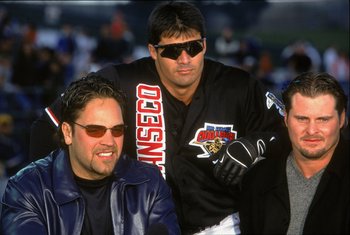
iii) saw the following picture of Piazza & Pals and naturally assumed that steroids can be passed from person to person through the air like the flu.

Oh, Mike.  Why did you allow yourself to be photographed with Jose Canseco and Jason Giambi?

Whatever their reason was to not include Piazza on their ballots, he has officially (and more than likely undeservedly) been lumped into the group of players that include Barry Bonds, Roger Clemens, Mark McGwire, Sammy Sosa and Rafael Palmeiro.

Bonds and Clemens faced criminal charges because of their alleged links to steroid use.  McGwire didn't want to hop into his andro-fueled DeLorean to revisit the past.  Sammy Sosa left his English For Dummies book at home next to his cork collection.  And Rafael Palmeiro was caught with his finger in the steroid jar ... period.

Now Piazza, who is widely considered to be the best-hitting catcher of all-time, has been kept out of the Hall of Fame in his first year of eligibility.

Another former Mets catcher, Gary Carter, received 42.3% of the Hall of Fame votes in his first year of eligibility, dropped to 33.8% in his second year (being on the ballot with first-timers Nolan Ryan, George Brett and Robin Yount will tend to get you overlooked), then climbed steadily year after year before he was finally inducted in his sixth year of eligibility in 2003.

Carter was an 11-time All-Star, three-time Gold Glove winner and five-time Silver Slugger recipient.  He also hit only .262 over his 19-year career, failed to score 100 runs in any of those seasons and never hit more than 32 home runs or drove in more than 106 runs.  Piazza, meanwhile, was a 12-time All-Star and 10-time Silver Slugger recipient (no Gold Gloves - nobody's perfect).  Piazza hit .308 over his 16-year career, crossed the plate 100+ runs twice and reached or surpassed Carter's career-high in homers nine times while steamrolling past the Kid's career-high RBI total five times (and had another season in which he drove in 105 runs).

Gary Carter's numbers might have been dwarfed by Piazza, but Carter did have Piazza beat in one shiny category.

Suffice it to say, as good as Carter was, he would've been Piazza's backup had they been teammates.  But that wasn't good enough for Piazza to be inducted into the Hall of Fame in 2013.  And it may not be good enough for him to go in next year as well.

Whatever reason the writers had for keeping the best-hitting catcher of all-time out of Cooperstown this year won't be acceptable to me.  Mike Piazza deserved to enter the hallowed Hall that is reserved for the all-time greats of the sport in his first year of eligibility.

The BBWAA might have been afraid a few blemishes on Piazza's back.  But in my opinion, keeping him out of the Hall of Fame in 2013 was a far greater blemish.     


Tuesday, January 8, 2013

If Studious Metsimus Had A 2013 Hall of Fame Vote...

On Wednesday, the National Baseball Hall of Fame will release the names of its newest inductees.  It will most certainly be the most scrutinized class of all time, considering all the new nominees that have been linked to steroids.  Players like Barry Bonds, Roger Clemens and Sammy Sosa have all had their names liked with performance-enhancing drugs.  Although their numbers scream out for inclusion in Cooperstown, how they achieved those numbers is up for discussion.

In addition to Bonds, Clemens and Sosa, other first-time nominees include former Mets Mike Piazza, Julio Franco and Shawn Green.  Also nominated for the first time are Curt Schilling, Kenny Lofton, Craig Biggio, David Wells, Steve Finley, Reggie Sanders, Jeff Cirillo, Woody Williams, Rondell White and Ryan Klesko.

Players who received at least five percent of the vote in previous years are allowed to reappear on this year's ballot.  Those players include Jack Morris, Jeff Bagwell, Lee Smith, Tim Raines, Alan Trammell, Edgar Martinez, Fred McGriff, Larry Walker, Mark McGwire, Don Mattingly, Dale Murphy, Rafael Palmeiro and Bernie Williams.  For Dale Murphy, it will be his 15th and final time on the ballot.  Should he not be elected to the Hall of Fame, he would be removed from next year's ballot.

This is the third consecutive year that Studious Metsimus was not allowed to formally cast a vote for players we deemed worthy of Hall of Fame enshrinement, but we ain't mad at'cha.  In fact, if it pleases the BBWAA, we'd like to send them a gift to let them know that there are no hard feelings because of our omission from their swanky club.  Please let us know when you receive the 1979 Mets highlight video (on Beta, of course), which is autographed by the one and only Richie Hebner.

Now, on to our votes!


Mike Piazza

Well, duh.  Who didn't see this pick coming?  There's no doubt Piazza belongs in the Hall of Fame as the best hitting catcher of all time.  But those who have a predisposed aversion to back acne would beg to differ.

Piazza spent the majority of his career with the Los Angeles Dodgers and New York Mets.  He also had a one-week tour of duty with the Florida Marlins and rode off into the sunset after one-year stints with the San Diego Padres and Oakland Athletics.  In 16 seasons in the major leagues, Piazza was a 12-time All-Star and 10-time recipient of the Silver Slugger Award.  Since the inception of the award in 1980, no other catcher has won it more than seven times and only Barry Bonds won more (12) at any position.  In addition, no catcher hit more home runs than Piazza (396 HR as a catcher, 427 HR overall) and no backstop has a higher career slugging percentage than Piazza (.545).

But power wasn't all Piazza was known for at the plate.  He was also an outstanding contact hitter.  In an era where striking out 150 times in a season is commonplace, Piazza never struck out more than 100 times in a season.  In fact, Piazza had almost twice as many hits (2,127) as strikeouts (1,113) in almost 7,000 career at-bats.

Piazza led his teams to the postseason five times.  He reached the playoffs as a Dodger in 1995 and 1996, as a Met in 1999 and 2000, and as a Padre in 2006.  In 2000, when Piazza reached his only World Series, he had an outstanding post-season, hitting .302 with six doubles, four homers and eight RBI in 14 games for the Mets.  Piazza also walked nine times in the 14 games to register a .403 on-base percentage.  His ten extra-base hits gave him a spectacular .642 slugging percentage.

Mike Piazza will reach the Hall of Fame.  His numbers say he should be a first ballot Hall of Famer.  The writers might say otherwise.


Craig Biggio

In the past, 3,000 hits was a surefire way to make it to the Hall of Fame.  Of course, in this questionable era of inflated offensive statistics, that may no longer be the case.  But Craig Biggio should not be bunched in with the Bondses and Palmeiros of this era.  Biggio belongs in the Hall of Fame.

Craig Biggio scored 1,844 runs in his 20-year career.  That's good for 12th in MLB history.  He reached the 100-run plateau eight times in his career and led the league twice.  He also collected 668 doubles, a number surpassed by only four players (Tris Speaker, Pete Rose, Stan Musial, Ty Cobb).  Of the top 13 players on the all-time doubles chart, 11 are already in the Hall of Fame.  The other two are Pete Rose (who is not eligible for enshrinement) and Craig Biggio.  Biggio led the NL in doubles three times and had seven 40-double seasons.

Biggio began his career as a catcher before moving to second base and center field.  He won five Silver Slugger Awards, earning his first as a catcher in 1989.  His other four came as a second baseman for the Astros in 1990s.  Second base was also where Biggio won all four of his Gold Glove Awards.

Biggio was also an outstanding base stealer, swiping 414 bags over his career, including a league-leading 39 steals in the strike-shortened 1994 season.  In 1998, at the age of 33, Biggio stole a career-high 50 bases, just one year after stealing 47.

Finally, Biggio finished his career with 1,014 extra-base hits, hitting 291 homers and 55 triples in addition to his 668 doubles.  He is one of only 34 players to reach 1,000 extra-base hits.  Of those 34 players, 21 are in the Hall of Fame.  12 of the other 13 are either still active, not yet eligible or wagging their fingers at Congress (even Redd Foxx thinks Rafael Palmeiro was a big dummy).  The other is Craig Biggio.

One more thing.  He also had 3,060 hits.  He's good enough for me.  He should be good enough for the Hall of Fame voters.  And if anyone thinks he used PEDs to help his power rise from a single-digit home run hitter in four of his first five seasons to a player who hit 20+ HR in eight of last 15 seasons, just look at Hall of Famer Carl Yastrzemski's home run numbers, especially what he did during the seventh to tenth seasons of his career.  Those same people probably wouldn't have voted him in either.


Holdovers Jeff Bagwell and Larry Walker

I could go on and on about why I feel they should be getting themselves plane tickets for Cooperstown in late July, but I'll just direct you to what I wrote about them last year when I felt they had a strong case for candidacy.

Jeff Bagwell, despite many people's beliefs concerning his connection to PEDs, received a nearly 15% increase in votes from his first time on the ballot in 2011 (41.7%) to his 2012 level (56.0%).  Meanwhile, Larry Walker had a more modest increase from his first time (20.3% in 2011) to his second (22.9% in 2012) and will probably use up much of the 15-year eligibility period if he is ever to make it to Cooperstown.  Bagwell will make it to the Hall someday, if not this year.  Walker might need to sway the voters with some of his patented Canadian charm, a big ol' helping of poutine and his slogan "at least I'm not Jason Bay, eh?"

This is how a Hall of Famer should always hit.

Just like every other year, several players will fall short of enshrinement.  Jack Morris, who was on two-thirds of the voter's ballots last year, might fall short again this year.  However, because the writers will intentionally leave off those players who are allegedly linked to steroids, Morris might get an extra vote or twelve.

The same thing applies to Lee Smith, Tim Raines, Edgar Martinez and Alan Trammell.  All four were among the greatest players at their positions in the era in which they played.  But none of the four are all-time greats in my opinion (except maybe Martinez, although he might always be overlooked because he was primarily a designated hitter).

In Trammell's case, his longevity contributed to his overall offensive numbers.  Yes, he was a six-time All-Star who won four Gold Gloves and three Silver Sluggers, but it took him until his 20th season to record his 1,000th RBI and he never quite made it to 200 HR, finishing with 185.  In two decades, Trammell only reached 70 RBI in a season three times.  Meanwhile, his double play partner in Detroit, Lou Whitaker, had six 70-RBI campaigns in 19 seasons, was a five-time All-Star, won three Gold Gloves and four Silver Sluggers.  It should also be noted that Whitaker was off the Hall of Fame ballot after his first year of eligibility, receiving only 2.9% of the vote.

The players listed above might make it someday, if not this year, as might most of the players suspected of using PEDs.  But I think only Mike Piazza and Craig Biggio will be elected this year, with Jeff Bagwell and Larry Walker deserving spots but perhaps having to wait longer.  Jack Morris was an all-time '80s great and terrific post-season pitcher, but might be shut out until his 15th and final year on the ballot in 2014.

Regardless of who gets in, it will be an historic Hall of Fame class, to say the least.


Monday, October 1, 2012

Stars The Mets Drafted But Couldn't Sign (Part One)

In a recent piece, I discussed the possibility of Jonathon Niese being the third-best homegrown left-handed starting pitcher in Mets history, after Jerry Koosman and Jon Matlack.  Niese ranks in the team's top three in each of the following categories for homegrown lefty pitchers - starts, wins, ERA, WHIP, strikeouts and strikeout-to-walk ratio.  The other two players in the top three for those categories are Koosman and Matlack.

Of course, although Niese's numbers have improved from year to year, he might be No. 3 only because the Mets have not had much success drafting and developing left-handed starting pitchers, as can be seen by the inclusion of such non-legends as Eric Hillman, Pete Schourek and Bill Pulsipher in the team's top five in various categories.  Even promising left-handed starters like Jason Jacome (drafted by the Mets in 1991; made his debut for the team in 1994) couldn't maintain any early success they had in the big leagues.

Jacome made eight starts for the Mets in 1994 and pitched very well, going 4-3 with a 2.67 ERA in 54 innings, averaging nearly seven innings per start.  But the young southpaw couldn't duplicate his rookie success in his sophomore season.  Jacome went 0-4 with a 10.29 ERA in 1995, throwing only 21 innings in five starts for the Mets.  His slow start caused the Mets to give up on his once-promising potential.  In July, Jacome was traded to the Kansas City Royals for three players, including Derek Wallace, whose sole claim to fame with the Mets came on September 13, 1996, when he became the first pitcher in team history to strike out four batters in one inning.  Jacome would go on to win six more games in the majors with the Royals and Indians before bouncing around the minor league systems of the Diamondbacks, Astros, Cardinals and Giants.

Simply stated, the Mets have fared poorly when it comes to drafting and developing left-handed starters.  But that's not the point of this blog post.  What I'd like to discuss is something I came across when doing my research on the Jonathon Niese piece, particularly something I uncovered when looking back at who the Mets have drafted since 1965.

Did you know Roger Clemens was originally drafted by the Mets, but chose not to sign because he wanted to become a Texas Longhorn?  Did you also know that '80s nemesis John Tudor was also drafted by New York but said "no thanks" when he was asked for his signature on the dotted line?  They're not the only ones who said no to the Mets before saying yes somewhere else.

The following are a select group of players who were originally drafted by the Mets, but did not sign with the team, finding success elsewhere while the Mets and their fans were left shaking their heads at what might have been:


Ron Cey

The man lovingly known as the Penguin was originally drafted by the Mets out of high school in 1966, but chose not to sign and instead enrolled at Washington State University.  Two years later, he was drafted by the Los Angeles Dodgers, making his major league debut for them in 1971.  Cey became part of the famous infield that also included Steve Garvey at first, Davey Lopes at second and Bill Russell at shortstop.  Along with Cey at third base, the quartet played eight and a half seasons together, the longest of any infield in major league history.

Over his 17-year career spent with the Dodgers, Cubs and A's, Cey launched 316 HR and had 1,139 RBI.  Cey was also selected to six All-Star teams and played in four World Series while in Los Angeles, winning his only World Series ring as a member of the 1981 Dodgers.

In 1984, Cey helped the Cubs reach the postseason for the first time in 39 years by collecting 25 HR and 97 RBI for the long-suffering franchise.  Cey had more RBIs against the Mets that year (13) than he had against any other National League squad, as the Cubs held off the team that originally drafted Cey 28 years earlier for their first-ever NL East title.


Burt Hooton

Like Cey, Burt Hooton also spent the majority of his career with the Dodgers and Cubs, but he played for the two teams in reverse, making his major league debut with the Cubs, before spending the majority of his career with the Dodgers.  Also like Cey, Hooton was originally drafted by the Mets, but did not sign with the team that drafted him in 1968.  Instead, he increased his draft value by going 35-3 at the University of Texas at Austin before being drafted by the Cubs in 1971.  Hooton didn't do much with the Cubs, going 34-44 from 1971 to 1975.  But his stock went way up once he was traded to the Dodgers in May 1975.

In ten seasons with the Dodgers, Hooton went 112-84 with a 3.14 ERA.  Hooton pitched in three World Series for Los Angeles (1977, 1978, 1981), with the latter year being his best in the postseason.  In five October starts that year, Hooton went 4-1 with a 0.82 ERA.  Hooton did not give up an earned run against the Expos in the 1981 NLCS, earning him the MVP award for that series.  Hooton was also the winning pitcher for the Dodgers in the sixth and deciding game of the 1981 World Series, which gave the Dodgers their first championship since 1965.

Hooton finished his career with the Texas Rangers in 1985, which was fine with Mets fans.  After all, over his long career in the big leagues, Hooton wore more games against the Mets (21) than any other team he faced.  In 43 appearances (37 starts) against the team that couldn't get him to sign in 1968, Hooton went 21-14 with a 2.62 ERA, holding the Mets to a .218 batting average against him, his lowest mark against any team he faced.


John Tudor

John Tudor was drafted by the Mets in 1975 but did not sign with New York.  Instead, he hung around for the January 1976 secondary draft, where he was picked by the Boston Red Sox.  Tudor had several good seasons for the Red Sox, despite Fenway Park being notoriously unkind to left-handed pitchers.  From 1979 to 1983, Tudor went 39-32 with a 3.96 ERA for Boston.  He was then traded to the Pirates for Mike Easler and won 12 games for Pittsburgh in 1984.  After one season in the Steel City, Tudor was then flipped to St. Louis for George Hendrick.  It was in St. Louis that Tudor experienced his best seasons in the majors.

In 1985, John Tudor had arguably the best season by a Cardinals pitcher since Bob Gibson in 1968.  Tudor finished the year with a 21-8 record and a 1.93 ERA.  He also led the league in WHIP (0.938), while holding opposing batters to a .209 batting average.  Furthermore, Tudor led the league with 10 complete game shutouts in 1985.  No pitcher has reached double digits in shutouts since then.  But Tudor finished second to Dwight Gooden in the Cy Young Award vote, as Doc won the pitching Triple Crown in 1985.  Tudor got the last laugh, however, as his Cardinals team edged out the Mets for the division title in 1985.  The Cardinals went on to win the NL pennant, but were denied a World Series title when umpire Don Denkinger blew a call at first base in Game 6.  Tudor then lost Game 7 (after winning Games 1 and 4) to the Royals, giving Kansas City their first and only World Series championship.

Tudor returned to the World Series in 1987, going 10-2 in an injury-plagued regular season and finally won a World Series ring in 1988 as a member of the Dodgers.  Tudor had been involved in a mid-season trade with Los Angeles that sent Pedro Guerrero to St. Louis (the third time Tudor had been traded for a veteran slugger, following the Mike Easler trade and the George Hendrick deal).  After one more injury-plagued season in L.A. in 1989, Tudor became a free agent and returned to St. Louis, where he went 12-4 with a 2.40 ERA in his final season in the big leagues.  Tudor finished his career with a .705 career winning percentage with the Cardinals and a 2.52 ERA.  Both numbers place Tudor in the top three all-time in Cardinals history.  As good as his ERA was against the rest of the league, it was even better against the Mets, as Tudor finished his career with a 2.41 ERA vs. New York in 22 starts.


Roger Clemens

Mets fans will always hate Roger Clemens for a number of reasons.  Whether it was his headhunting incident with Mike Piazza in 2000 or his inability to determine the difference between a broken bat shard and a baseball in that year's Fall Classic ("I thought it was the ball"), there was never any love lost between those who root for the Mets and Clemens.  But perhaps those same fans would have loved him had he chosen to sign with the Mets after they drafted him out of San Jacinto College in 1981.  But he didn't, choosing to go to the University of Texas before signing with the Boston Red Sox two years later.  The rest, as they say, is history.

Roger Clemens struck out more batters than any other Red Sox pitcher and his 192 wins in Boston tie him with Cy Young (the man, not the award named after him) for most in club history.  Speaking of Cy Young, Clemens won his award a record seven times, winning it thrice in Boston, twice in Toronto, once as a Yankee and once as an Astro.

The baseball history books might have looked completely different had the Mets been able to sign Clemens in 1981, but looking back, would we really want that negative publicity surrounding Clemens for his subsequent "alleged" steroid use?  I'd much rather remember Clemens for all the home runs Piazza hit off him, the homer Shawn Estes hit off him in 2002 after the Mets pitcher failed to plunk Clemens in an earlier inning, and most importantly, I'm quite fond of the memory of a clean-shaven Clemens waiting to celebrate a World Series title in 1986 that never happened.  Looks like Roger Clemens never got over '86.


Rafael Palmeiro

The Mets couldn't sign Roger Clemens in 1981, who was accused of taking steroids but never tested positive for them.  One year later, they tried to sign another player who would end up becoming linked to performance enhancing drugs.  However, unlike Clemens, this player eventually did test positive for steroid use.  That player was Rafael Palmeiro, who said thanks but no thanks to the Mets in 1982 before signing with the Cubs one year later.

Rafael Palmeiro wasn't much of a power hitter when he was called up by the Cubs in 1986, but he did hit his second career homer against Dwight Gooden in the game that clinched the Mets the National League East title on September 17.  After two-plus seasons in Chicago in which he only managed to hit 25 HR, the Cuban-born Palmeiro was traded along with Jamie "I'm Never Retiring" Moyer to the Texas Rangers.  It was in Texas that Palmeiro's power fully developed.  Whether it was artificially assisted is another question.

In each of his first three seasons in Arlington, Palmeiro's extra-base hit total increased rapidly.  Palmeiro went from 35 extra-base hits in 1989 to 55 extra-base hits in 1990 to 78 extra-base hits in 1991.  In the latter year, Palmeiro hit 26 HR and led the majors with 49 doubles.  But that was just the beginning.  From 1995 to 2003, Palmeiro hit at least 38 HR in every season, after only topping 30 HR once in his first nine seasons in the majors.  Then in 2005, after wagging his finger before Congress claiming that he had never done steroids - period - MLB drug tests proved otherwise, putting an exclamation point on his career.  Palmeiro finished his career with 3,020 hits, 569 HR and 1,835 RBIs, but no support for the Hall of Fame.


(To read the second part of this lengthier-than-expected blog post, where we reveal the next five stars the Mets drafted but couldn't sign, please click here.)

Wednesday, April 13, 2011

Carlos Delgado Retires; Is He A Hall of Famer?

Former Mets first baseman Carlos Delgado announced his retirement from baseball yesterday after a 17-year career that saw him become one of the most consistent power hitters in baseball.

From his major league debut as a catcher for the Toronto Blue Jays in 1993 to his final game as a Met in 2009, Delgado gave pitchers headaches by hurting them when he swung the bat (473 career HR) and when he didn't (1,109 career walks).

But is Carlos Delgado a Hall of Famer? Let's look at a few of his career numbers and decide for ourselves.

Delgado finished his career with 473 HR and 483 doubles, falling just short of the 500 mark in both categories. Only ten players in major league history have reached that number in both categories: Barry Bonds, Hank Aaron, Babe Ruth, Willie Mays, Ken Griffey Jr., Frank Robinson, Rafael Palmeiro, Manny Ramirez, Ted Williams and Eddie Murray. Of those ten, six are in the Hall of Fame. The other four are either not yet eligible (Bonds, Griffey) or admitted steroid users (Palmeiro, Ramirez). As of now, Delgado has never been attached to steroids, so one has to believe his power numbers were all attained legitimately.

Only six men in major league history hit 30 or more home runs in ten consecutive seasons. Alex Rodriguez (1998-2010), Barry Bonds (1992-2004), Jimmie Foxx (1929-1940), Sammy Sosa (1995-2004) and Albert Pujols (2001-2010) have all accomplished this rare feat. The other player to do it was Carlos Delgado, who hit 30 or more blasts every season from 1997 to 2006.

For 13 consecutive seasons, Delgado drove in at least 87 runs, including nine years of 100+ RBI and seven campaigns where he drove in no fewer than 114 runs. In two seasons that he failed to drive in 100 runs, he missed significant time with an assortment of injuries. Delgado picked up 99 RBI in 2004, despite not playing in 34 games. Then in 2007, as a member of the Mets, Delgado finished the year with 87 RBI. Although 2007 was viewed as an off-year for the slugger, he also missed 23 games, which denied him the opportunity to approach triple digits in RBI.

While on the topic of runs batted in, Carlos Delgado finished his career with 1,512 RBI, making him one of 51 players to surpass the 1,500 plateau. Thirty-six of those players have already received their golden ticket to Cooperstown, while the majority of the others are either still active or not yet eligible for the Hall of Fame.

Despite his gaudy power numbers, Delgado never won an MVP Award, although that could be attributed to the fact that he never played for a playoff team until he played for the Mets in 2006. He also only made two All-Star teams and won three Silver Slugger Awards, both numbers that are very low for potential Hall of Famers.

So does Delgado get elected to Cooperstown when he becomes eligible in 2015?

Rafael Palmeiro, whose power numbers exceed Delgado's, received support from only 11% of the voters in the most recent Hall of Fame election. However, he was found to have used steroids during the latter part of his career, which kept his vote total low. Jeff Bagwell was never directly linked to steroids, but only received 41% of the vote in January, despite averaging over 100 RBI and 100 runs scored per season throughout his entire career (1,529 RBI and 1,517 runs scored in 15 seasons). Both Palmeiro and Bagwell were contemporaries of Delgado. That could work against him in 2015.

Another thing that could work against him is the controversy he generated when he chose not to stand for the singing of "God Bless America" due to his personal convictions against the United States' involvement in Iraq. Although Delgado is entitled to his opinions, his silent protest came at a time when Americans were peaking with patriotism, and his stance was viewed by some as being unpatriotic and anti-American, although he has vehemently denied this on multiple occasions.

Despite the potential roadblocks, it cannot be denied that Delgado was highly successful as a major league baseball player. His power numbers are among the best of his era, if not all-time. But until players like Jeff Bagwell, Sammy Sosa and Mike Piazza get into the Hall of Fame (the latter two will become eligible in 2013), it will be difficult for Delgado to get in.

For a power hitter to reach the Hall of Fame in this era, he'll have to bring more to the table, whether it be speed, Gold Glove-caliber defense, or regular trips to the postseason. Carlos Delgado stole 14 bases in his career, never won a Gold Glove Award and only reached the playoffs once (he was not on the postseason roster when the Blue Jays won the World Series in 1993). Maybe someday Delgado will make the Hall of Fame, but don't expect it to be in 2015.

Thursday, March 17, 2011

Joey's Soapbox: Derek Jeter, Six Years Ago & If At Second You Don't Succeed

Greetings, fellow Mets fans! Winter will be officially over in a few days, which means two things.

First, I'll finally be able to finally put away my annoying poofball hat after a long, cold winter. But more importantly, it'll be time to hear the sweet sounds of Mets baseball at Citi Field, after what seemed like an interminable off-season.

Although my thoughts have turned to baseball bats, alternate caps and Shake Shack, there are still some things happening in the baseball world that I have to get off my hoodie.

I'm Joey Beartran and it's time for me to get on my soapbox.


Derek Jeter

Earlier this week, a recent poll conducted by the Siena College Research Institute named Yankee shortstop Derek Jeter the greatest New York athlete of all-time. Let me repeat that. In a town that seen Babe Ruth, Lou Gehrig, Joe DiMaggio, Mickey Mantle, Joe Namath and several outstanding thoroughbred race horses, Derek Jeter was the one who was named best New York athlete.

Who were the people voting in this poll, 14-year-old girls? I guess the same people who cast their votes in this poor excuse for a poll also voted for Kurt Rambis as the best Los Angeles athlete, Cliff Clavin as Boston's finest athletic star and Lazy Smurf as the top athlete of Smurf Village? Give me a break, people!


Six Years Ago


On this date in 2005, 'roids were all the rage in Washington, as Congress called for a special hearing featuring past and present baseball players to discuss the presence of steroids in baseball. It was during these hearings that Mark McGwire realized that he didn't want to dwell on the past, Sammy Sosa forgot how to speak English and Rafael Palmeiro gave the finger to Congress.

Six years later, all of these players are out of baseball and none of them has reached the Hall of Fame, as McGwire received less than 25% of the vote in each of his five eligible years for enshrinement, Palmeiro garnered the support of 11% of the voters in 2011 and Sammy Sosa has to wait until 2013 to see if he'll be able to pop the cork (no pun intended) on his Cooperstown Champagne.

So where are these players now?

Mark McGwire is now the hitting coach of the St. Louis Cardinals. That means a man who never hit 30 doubles in a single season and only finished with 265 more career hits than Ed Kranepool is now coaching Albert Pujols on how to hit. To have McGwire impart his hitting "wisdom" on Pujols is like having Kate Moss teach me how to eat chicken nachos. That's all I have to say about that.

After playing his last game as a member of the Texas Rangers in 2007, Sammy Sosa has done his best to stay out of the spotlight, disappearing from the public eye. The last time he was spotted in public, he was overheard humming Michael Jackson's "Black or White" as he was shopping for, as he called it, one of the most important works in American literature (see photo, right). His interpreter then corrected him by saying that a CD-ROM isn't technically a piece of literature.

When not complaining about his low Hall of Fame vote, Rafael Palmeiro has quietly become one of the country's premier hand models. The former Mets' eighth round draft pick's work can now be seen wherever hand sanitizers are sold.


If At Second You Don't Succeed

We've been getting conflicting reports from the Mets on who the starting second baseman will be in 2011. Terry Collins wants Luis Hernandez. Sandy Alderson wants an offensive-minded second baseman. That would probably eliminate Hernandez, who has eight extra-base hits in 265 major league at-bats, to go with a .286 OBP in the majors and a .302 OBP in the minors.

Brad Emaus and Daniel Murphy are still candidates for the position, but their defensive "skills" make former Marlins' second baseman Dan Uggla look like a Gold Glover at the position.

There is no truth to the rumor that Uggla traded in his old No. 6 uniform number with the Marlins for a No. E-4 jersey with the Braves.

Here's what I think. Wally Backman was promoted from Brooklyn to AA-Binghamton. Tim Teufel made the jump from Binghamton to AAA-Buffalo. I think they're just going to manage their respective minor league ballclubs until Labor Day weekend (the traditional end of the minor league season). Once their managerial duties are done, they will be promoted to the Mets, where they will compete for the second baseman's job. Terry Collins will be happy with the feisty Backman, while Sandy Alderson will take comfort that he has the bat of Tim Teufel. Is it a bad thing that I think a Backman/Teufel platoon would still be better than anything the Mets could throw out there right now?

I think I've worn out my welcome on the soapbox. It's time to get into mid-season form, which means I'll be sitting in front of the TV with a bunch of chicken nachos. Who knows what will happen before Opening Day? Will Carlos Beltran start the season on the disabled list? Will Oliver Perez and Luis Castillo be on the unemployment line? Will I get a tryout to play second base? Hey, if no else wants it, I'll take it (see photo below). Enjoy the last two weeks of Spring Training!


Friday, February 18, 2011

Gary Sheffield Retires; Is He A Hall of Famer?

Gary Sheffield formally announced his retirement from baseball yesterday, calling it quits after playing 22 seasons in the major leagues, the last of which came in 2009 as a member of the Mets. He leaves the game as one of the most prodigious sluggers in history and one of the most feared hitters of his era. But is he a Hall of Famer? The numbers seem to say yes.

Beginning in 1988 as a 19-year-old shortstop for the Milwaukee Brewers, making him a Robin Yount for a new generation, Sheffield went on to fill up the stat sheet for over two decades. Consider that in addition to his 509 home runs (No. 500 happened in a Mets uniform at Citi Field, as seen in the photo to the right), Sheffield hit 467 doubles and 27 triples, making him one of only 33 players in major league history to collect over 1,000 extra-base hits. The other 32 are either in the Hall of Fame, not yet eligible for the Hall of Fame, still active, or have been kept out of the Hall of Fame because of a lifetime ban (Pete Rose) or steroid involvement (Rafael Palmeiro).

Sheffield put up huge numbers across the board during his 22 years in the majors. Over his career, he had nine seasons with a .300+ batting average, eight seasons with 30+ HR, eight seasons with 100+ RBI (including four seasons with at least 120 RBI), seven seasons with 100+ runs scored and 16 seasons with double-digit steals. Although Sheffield never challenged for a stolen base title, he stole 253 bases in his career, including 22 steals as a 38-year-old in 2007. Every player with at least 1,600 runs scored and 1,600 RBI (Sheffield finished with 1,636 runs scored and 1,676 RBI) who is eligible for the Hall of Fame has been inducted, except for Rafael Palmeiro, but Palmeiro didn't have the stolen base potential that Sheffield had (Raffy stole 97 bases in 20 seasons).

There actually was one offensive category in which Sheffield failed to put up big numbers, but it was a category that will enhance his Hall of Fame candidacy. For all the power generated by his trademark waggle of the bat and ferocious swings, Sheffield never struck out more than 100 times in a season. In fact, when he struck out 83 times as a Yankee in 2004, that represented the most strikeouts Sheffield collected in a single season (later matched in 2007 as a member of the Detroit Tigers).

Sheffield's lack of strikeouts showed how good of an eye he had at the plate, but he was also very selective. Despite never striking out more than 83 times in a single season, he did find a way to draw more than 83 walks in a season nine times, including a career-high 142 in 1996, when he led the National League with a .465 on-base percentage. From 1995-2003, it seemed as if Sheffield was always on base, as he registered a .400+ OBP in each of those nine seasons, averaging .428 over the time period.

Although he never won an MVP Award, Sheffield did finish in the top ten six times. He also was a nine-time All-Star and won five Silver Slugger Awards.

Many Mets players lost their power stroke at Citi Field in 2009. Not Gary Sheffield. Until he got hurt in late August, Sheffield was the team leader in home runs despite having only 268 at-bats. (Photo by Andrew Savulich)

However, many players from the so-called Steroid Era are having a tough time getting the Hall of Fame to open its doors for them (Mark McGwire and the aforementioned Palmeiro, to name a few). Some players, like Jeff Bagwell, are guilty either by association or because they looked like stunt doubles for He-Man. Where that leaves Gary Sheffield, who admitted to taking "the cream" unknowingly, is something for the Hall of Fame voters to decide when his name appears on the ballot for the first time in 2015.

Gary Sheffield had a long and illustrious career in baseball. As a youngster, he was mostly known for being Dwight Gooden's nephew and for intentionally throwing balls away in an effort to get himself traded out of Milwaukee. As he matured, both physically and mentally, Sheffield became one of the best hitters in the game, reaching base by any means possible and not giving away at-bats via the strikeout. To me, that's the trademark of a Hall of Famer. Let's see if the actual voters think the same way in four years.

Wednesday, January 5, 2011

Mike Francesa And The Case of Roberto Alomar vs. Craig Biggio

Earlier this afternoon on WFAN, Mike Francesa was talking about the Hall of Fame vote when a caller asked him about his opinion on Craig Biggio's chances to get into Cooperstown now that Roberto Alomar was elected. To my surprise (and the caller as well), Francesa said that Biggio should not be elected into the Hall of Fame.

The caller vociferously disagreed with Francesa's statement that Alomar was superior to Biggio in every way, leading Mike to huff and puff and blow the caller's opinion down.

Between every other sentence ending with "Alomar hit 20-something points higher than Biggio" (despite the fact that Robbie's career batting average was .300 as opposed to Biggio's .281, a difference of 19 points on every planet not inhabited by Francesa), Francesa went on to toss random stats on why Alomar was far better than Biggio and why Biggio is not a Hall of Famer. He said:

  • Alomar won 10 Gold Glove Awards to Biggio's four.
  • Alomar made 12 All-Star teams to Biggio's seven.
  • In Alomar's best season, he drove in 120 runs; Biggio's career-high was 88.
  • Alomar hit .313 in 58 postseason games; Biggio hit .234 in 40 playoff games.

Okay, I'll give Francesa the benefit of the doubt on the last comparison. Alomar was a better postseason player than Biggio. As a result, his teams were better. Alomar won two World Series and played in the League Championship Series five times. Biggio, on the other hand, didn't even make it to the NLCS until his 17th season in the majors. Overall, he appeared in two League Championship Series and one World Series (losing to the White Sox in 2005).

But the caller was not trying to argue that Biggio was better than Alomar. Rather, he was merely attempting to say that Biggio should join Alomar in the Hall of Fame when he becomes eligible to do so in 2013.

All Francesa did was run down the list of categories that Alomar was better in. Not once did he look at the stats that Biggio was better than Alomar in. In addition, he made no consideration of certain variables that would bring down Biggio's numbers.

For example, when Francesa mentioned that Alomar drove in 120 runs in his best season (1999), he did not say that Robbie was Cleveland's #3 hitter that year (149 starts in the three-hole). The year Biggio drove in 88 runs (1998), he was the Astros' leadoff hitter in 155 games. Many hitters drive in 120 runs or more hitting third in the batting order. Not too many hitters can drive in as many as 88 runs batting leadoff. In addition, Biggio was hitting directly behind the pitcher for most of his career, while Alomar played the majority of his career in the American League, where everyday players bat in the ninth spot.

Craig Biggio played in 2,850 games over his major league career. He was the Astros' leadoff hitter 1,564 times and their #2 hitter 754 times. That's over 2,300 games batting in a spot in the order where you're not expected to be an RBI guy. Yet Biggio found a way to drive in 1,175 runs over his major league career, which Francesa failed to mention was MORE THAN the 1,134 runs Roberto Alomar drove in over his career. Oh yeah, both Alomar and Biggio started their careers in 1988 so they perfectly overlapped each other.


What else did Francesa overlook while he was pounding his chest over Alomar's superiority to Biggio? Let's consider these five items:

1) Biggio scored 1,844 runs in his career to Alomar's 1,508. Only 12 men in baseball history have scored more runs than Biggio. All of them are in the Hall of Fame except for Pete Rose, who is ineligible for Hall of Fame consideration. By contrast, Johnny Damon has scored more runs (1,564) than Roberto Alomar and I don't think the Hall is going to be calling Damon five years after he retires.

2) Craig Biggio hit 668 doubles in his career, while Alomar hit 504. It is true that Alomar is one of only 51 men to ever surpass the 500 double plateau, but Biggio's total is fifth on the all-time list, surpassed only by Tris Speaker, Pete Rose, Stan Musial and Ty Cobb. If they sound like Hall of Famers, that's because they are (except for the man who liked the horsetrack a little too much).

3) Biggio hit 291 HR as opposed to Alomar's 210. Whereas Alomar only had three seasons of 20+ HR, Biggio produced eight such seasons. In fact, Biggio had as many 20+ HR seasons after his 38th birthday (three) as Alomar had in his entire career.

4) For as great a hitter as Alomar was, he only won four Silver Slugger Awards over his career. Biggio did him one better by winning five. Maybe Biggio's extra Silver Slugger Award had something to do with the fact that he picked up over 1,000 extra-base hits over his career (1,014 to be exact) compared to Alomar's 794.

5) Alomar's career fizzled out after he was 33. Once he turned 33, he only hit .262, with 58 doubles, 20 HR, 116 RBI, 167 runs scored and 28 stolen bases. After Biggio turned 33, he hit .266, but had 279 doubles, 139 HR, 469 RBI, 724 runs scored and 68 stolen bases. Biggio actually started driving the ball more as an elder statesman than as a spry youngster.


Now let's stop comparing the two and just focus on Biggio. Tell me these numbers aren't Hall of Fame-worthy...

.281 batting average, 1,844 runs scored, 414 stolen bases, 668 doubles, 55 triples, 291 HR, 1,175 RBI (mostly as a leadoff hitter, which by the way, was the position in the order Rickey Henderson batted out of. Henderson had 1,115 RBI despite the fact that he played five more seasons than Craig Biggio.)

I feel like I'm forgetting something. Something's missing up there that would shut Mike Francesa up regarding his anti-Craig Biggio shpiel. Ah, yes. Now I remember. Come closer to your screen so that you can't miss it.

CRAIG BIGGIO HAD 3,060 HITS!!

The last time I checked, if you had 3,000 hits, you were going to the Hall of Fame, assuming that you weren't on the permanently banned list (you're such a dummy, Pete Rose) or tested positive for steroids. (Don't point your finger at me, Rafael Palmeiro. You know I'm talking to you.)


Alomar didn't make it to 3,000 hits, calling it a career after picking up 2,724 safeties. Even if Mike Francesa ignored all of the other statistics, surely the 3,000+ hits for a non-gambling, non-PED using Biggio would have been enough to make him change his mind on his Hall of Fame candidacy.

But alas, we're talking about Mike Francesa here. Whatever he says is gospel. Who are we to disagree with him? He's the one with the radio show. We're just little ol' sports fans.

Be thankful he's not in charge of the Hall of Fame Committee. If he was, Craig Biggio would have to pay his way to Cooperstown to see all the players he should be enshrined with.

Wednesday, November 11, 2009

No Gold Glove For Wright; Guess He Didn't Hit Well Enough

The National League Gold Glove winners were announced on Wednesday but no Mets received the Midas Touch. There was no bling presented to Carlos Beltran or David Wright this year. Beltran's was expected since he missed half of the season. But what about Wright? Didn't he hit well enough?

Before you think I've forgotten that the Gold Glove is for defensive excellence and is not supposed to have anything to do with a player's hitting prowess, let me explain what I mean about Wright not hitting well enough to win the Gold Glove.

A few years ago, Derek Jeter was voted the worst shortstop in the American League. Although I don't think he's the worst, I also don't think he's the best. However, he won the Gold Glove this year despite what all the "experts" say about his defensive ability. Let's look at the stat sheet to see what Jeter did offensively this year.

He hit .334, which was his highest average since 2006 (he won the Gold Glove in 2006). He hit 18 HR, which was his greatest home run output since 2005 (he won the Gold Glove in 2005). He scored 107 runs, which was also his highest total since the Gold Glove season of 2005. He stole 30 bases, which was more than he had stolen in his two previous seasons combined. He did not win the Gold Glove in 2007 and 2008.

As 70s comedic icon Arte Johnson would say, that bit of news is "very interesting". In the two years that he did not win the Gold Glove, Jeter never surpassed 15 HR or 15 SB. He also did not hit for as high a batting average or score as many runs. But what do you know? He upped his batting average to .334, had an 18/30 split in the HR and SB department and voila! His glove automatically becomes golden!

This isn't as bad as 1999, when Rafael Palmeiro played primarily as a DH (only playing 28 games at first base) and was still awarded with the American League Gold Glove at first base. However, he did hit .324 with 47 HR and 148 RBI for the Texas Rangers that year, all of which were career highs and all of which were done while he was not doing steroids...period.

So that brings us to David Wright. This year, Ryan Zimmerman replaced Wright as the National League Gold Glove winner at third base. Wright had been bestowed the prestigious award each of the last two seasons. In both seasons, he was in the 30 HR, 100 RBI club.

Zimmerman has always been very good defensively, perhaps even better than Wright, but he averaged 19 HR and 71 RBI during the two seasons Wright won the Gold Glove.

In 2009, Zimmerman established career highs with a .292 average and 33 HR. He also added 106 RBI. On the other hand, Wright had the worst power season of his career, finishing with only 10 HR and 72 RBI. Of course, Zimmerman won the Gold Glove this season.

For the Mets to compete in 2010, they will need a bounceback season from David Wright, especially in the power department. Not only will a power surge help the Mets score more runs, but it might be enough to wrest the Gold Glove away from Ryan Zimmerman. After all, pitching wins championships but sluggers win Gold Gloves, right?