Showing posts with label Kaz Matsui. Show all posts

Monday, March 14, 2016

The Most With The Least: Jose Valentin (2006)

Before anyone had ever heard of Bernard Madoff and Ponzi schemes, the Mets were a free-spending team.  Under general manager Omar Minaya, the team gave Carlos Beltran a seven-year, $119 million contract, then topped that three years later when Johan Santana signed a six-year deal for $137.5 million to pitch for the Mets.

Along the way, Minaya doled out four-year contracts to a quartet of thirty-somethings when he recruited Pedro Martinez, Billy Wagner, Luis Castillo and Jason Bay to play for the team.  The foursome went on to spend as much time on the disabled list or in the doghouse as they did on the field.

Omar Minaya loved to make a splash with lucrative free agent signings, even if they ended up hurting the team in hindsight.  But one acquisition that cost the team less than $1 million ended up paying unexpected dividends for the Mets on the way to their sole postseason appearance in the Minaya era.  Minaya signed many former All-Stars near the end of their careers.  But this player never made an All-Star team, nor did he ever win a Gold Glove or Silver Slugger award in his 16-year career.  He did, however, play a key role in the Mets' push toward the playoffs, surprising everyone who thought he would be nothing more than a bench player.

Jose Valentin went from bench player to everyday middle infielder on a division-winning team.  (Al Pereira/Getty Images)

Jose Antonio Valentin was signed as an amateur free agent by the San Diego Padres on his 17th birthday in 1986.  Twenty years after signing his first professional contract, he became a member of the New York Mets, inking a one-year deal worth $912,500.  Valentin had just come off an injury-plagued season with the Los Angeles Dodgers in 2005, batting .170 with two home runs in 56 games.  But Minaya was confident in Valentin's versatility and ability to produce off the bench in the late innings, citing those attributes as reasons for the signing of the 14-year veteran.

"(Valentin) can play anywhere," said Minaya.  "He can hit the fastball at the end of the game.  He's got power."

Valentin did hit a career-high 30 home runs in 2004 as a member of the Chicago White Sox, which was also his fifth consecutive season of 25 or more homers.  (Valentin was one of 18 players to hit 25+ HR in each season from 2000 to 2004.)  However, the version of Valentin being acquired by the Mets was 36 years old, battling injuries and coming off the worst season of his career.  At best, he was expected to be the team's top pinch-hitter, occasionally getting a start in left field for the injury-prone Cliff Floyd or allowing one of the infielders to get a day off here and there.  And that's exactly what Valentin did during the first month and a half of the season, although he didn't do it very well.

Through May 12, Valentin appeared as a pinch-hitter in 23 of the team's first 35 games.  He also appeared in three other games as a left fielder and once as a first baseman.  Valentin batted a mere .167 in those 27 games with no extra-base hits and just two RBI.  But in a rare start against one of his former teams in Milwaukee (Valentin spent the first eight seasons of his major league career with the Brewers), Valentin produced a two-run single and a two-run homer to help the Mets to a wild, 9-8 victory.  The following afternoon, Valentin delivered four hits and drove in two more runs in the Mets' 6-5, extra-inning loss to the Brewers.  Four days later, manager Willie Randolph gave Valentin a start at second base for the first time as a Met.  Although Valentin had started just nine games at the position prior to 2006, Randolph's decision ended up being one of the most important choices he made all year.

Although the Mets lost on May 18 to the St. Louis Cardinals, Valentin homered and scored two runs in the 6-3 defeat.  He also played flawless defense at second base, handling seven chances (five assists, two putouts) without an error.  Even before Valentin's first start at the position, the Mets' incumbent second baseman, Kaz Matsui, had fallen out of favor with the team and its fans.  Matsui was struggling to keep his batting average above .200 and as a result, was being constantly booed at Shea Stadium.  Following Valentin's impressive debut at second, Matsui continued to start at the position.  However, Matsui put up a horrendous .129/.182/.161 slash line over the next eight games, causing Randolph to give Valentin another start at second base on May 28.  Valentin rewarded his manager by driving in two runs in the Mets' 7-3 victory over the Florida Marlins.

Jose Valentin points at all the Kaz Matsui haters.  That's a lot of people he's pointing at.  (NY Daily News/Getty Images)

Valentin's performance against the Marlins earned him another start at second base the following night against the Arizona Diamondbacks.  Trailing 1-0 in the second inning, Valentin delivered a two-run single to give the Mets an early lead.  Four innings later, Valentin homered to give the Mets a much-needed insurance run in a game eventually won by New York, 8-7.

After the game, Randolph insisted that Valentin had not supplanted Matsui as the team's everyday second baseman, despite Valentin's resurgence at the plate after his slow start.

"I have a feeling (Matsui will) be making more starts," said Randolph.  "He's not totally out of the picture.  Everyone thinks he's lost his job, but that's not the case.  He's struggling a little bit, and we want to get him going again."

One day after Randolph claimed Matsui hadn't lost his job, Valentin homered again as the team's starting second baseman.  Ten days after that, the Mets sent Matsui - and $4.5 million in cash - to the Colorado Rockies for utility player Eli Marrero.  Second base now belonged to Jose Valentin for the remainder of the season, and Valentin made sure that no one would take the position from him.

From May 28 to June 21, Valentin batted .364 with a 1.060 OPS, producing 14 extra-base hits and 13 RBI in 19 starts to raise his batting average for the season above .300 for the first time.  Six of Valentin's 14 extra-base hits came during the Mets' season-changing ten-game road trip in Los Angeles, Arizona and Philadelphia.  New York began the long trip with a 4½-game lead over Philadelphia and a six-game advantage over Atlanta.  After winning nine of ten games away from Shea, including a three-game sweep in the city of Brotherly Love, the Mets' first-place lead had ballooned to 9½ games over the Phillies and a whopping 13 games over the Braves.

By the time July rolled around, the Mets' lead in the division had grown to a dozen games and top pitching prospect Mike Pelfrey had been called up to temporarily fill a spot in the rotation.  Pelfrey won his major league debut against the Marlins at Shea Stadium on July 8, but much of the credit for the victory belonged to Jose Valentin, who hit a grand slam in the first inning and nearly hit another one in the second, settling for a three-run triple off the base of the right field wall.  Valentin became just the second player in Mets history to drive in seven runs in the first two innings of a game, joining Gary Carter, who accomplished the feat on July 11, 1986.  


Video courtesy of MLB.com's YouTube channel


Less than two weeks after Valentin cleared the bases twice against the Marlins, he continued to mash in bases-loaded situations when the Mets took on the Houston Astros on July 21, as he broke a scoreless tie with a grand slam against Astros starter Taylor Buchholz.  This time, Valentin's blast helped John Maine earn his first win as a Met, as Maine completed a four-hit shutout in the 7-0 victory over the Astros.  Five days later, Valentin played the hero once again, delivering a walk-off single against Cubs reliever (and former Met) Glendon Rusch with two outs in the tenth inning to plate the game's only run.

Valentin continued to produce in August and September, coming through in a memorable way on September 18.  Valentin homered in his first two at-bats, leading the Mets to a 4-0 victory over the Marlins that clinched the National League East division title for New York - the team's first division crown since 1988.  Although Valentin had only 384 at-bats in his first season in Flushing, he still produced 24 doubles, three triples, 18 homers and 62 RBI.  Valentin also had an impressive .490 slugging percentage and .820 OPS.  And on a team filled with All-Stars, his 3.6 WAR ranked fourth behind Carlos Beltran (8.2), Jose Reyes (5.8) and David Wright (4.1).

Prior to his comeback campaign in 2006, the only second basemen in Mets history to hit more home runs than Valentin in a single season were Jeff Kent (1993, 1995) and Edgardo Alfonzo (1999, 2000).  In addition, the only second sacker in club annals to boast a higher slugging percentage than Valentin's .490 mark in 2006 was Alfonzo.

After the Mets swept the Los Angeles Dodgers in the division series (Valentin took an oh-fer in the three games), Valentin finished second on the team in RBI in the National League Championship Series against the St. Louis Cardinals.  The second baseman drove in five runs in the series, which was only surpassed by Carlos Delgado's nine runs batted in.  But much like Carlos Beltran was unjustly vilified for striking out with the bases loaded in the ninth inning to end the series, Valentin is remembered negatively by some fans for fanning with the bases loaded in the sixth inning, just minutes after Endy Chavez's leaping catch had apparently shifted the momentum of the game in the Mets' favor.  However, it was Valentin who started the failed ninth inning rally against Cardinals closer Adam Wainwright by delivering a single on a 3-2 pitch.

Just three weeks after Beltran took strike three from Wainwright, the Mets re-signed Valentin for one year and $3.8 million - approximately four times as much money as he earned in 2006.  Unfortunately, the injury bug that stayed away from Valentin during his first season with the Mets found him repeatedly in his second.  In spring training, Valentin missed some time because of a sleeping injury; he claimed to have slept incorrectly on the team bus.  Valentin then missed the entire month of May with a knee injury. 

Valentin's season came to an end shortly after the All-Star Break in a bizarre series of events.  First, he punched a wall in Puerto Rico out of frustration during the mid-season hiatus following an argument that took place while he was attempting to sell the local baseball team he owned.  A week later, a foul ball broke his leg, causing his season to come to an abrupt end.  Valentin re-signed with the Mets in 2008, but never played for the team and was released in June.  The team then gave him one last shot in 2009, signing the 39-year-old Valentin to a minor league contract, but released him before the end of spring training.  Valentin then retired to become a baseball instructor in his native Puerto Rico.  He returned to the majors as a first base coach for the Padres in 2014 and 2015, but he still holds out hope for a managerial position in the near future.
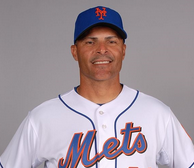
Photo by Doug DuKane/Getty Images

"I think I can be a good manager.  I would like to take my chances and see if I can be one of those Puerto Ricans that are managing in the big leagues.  Or a coach.  I would do it; start in the minor leagues.  I'd do it as a coach or as an instructor.  That's my goal - to make it to the big leagues again."


Jose Valentin had a solid 16-year career in the major leagues.  Although he hit over 300 doubles and nearly 250 homers, he never made an All-Star team or played in a World Series.  The closest he ever got to the Fall Classic was in 2006, when he had his final hurrah as a productive big league ballplayer - a last go-round that might never had happened had Omar Minaya not signed him for under a million dollars.

Valentin had one of the finest offensive seasons ever produced by a second baseman in Mets history and did all he could to help the Mets win the pennant, including leading off the ninth inning of Game Seven with a base hit.  But in the end, all he could do was watch the Cardinals celebrating their National League crown from third base, where he was left stranded along with the dreams of his teammates and the club's fans.

The 2006 season is bittersweet for anyone associated with the Mets, as the team had one of the most successful regular seasons in franchise history, only to be followed up by a disappointing postseason.  But for Jose Valentin, the 2006 campaign marked his final moment in the sun.  And no one will ever be able to take that season away from him.


Note:  The Most With The Least is a thirteen-part weekly series spotlighting those Mets players who performed at a high level without receiving the accolades or playing time their more established teammates got, due to injuries, executive decisions or other factors.  For previous installments, please click on the players' names below:

January 4, 2016: Benny Agbayani
January 11, 2016: Donn Clendenon
January 18, 2016: Tim Teufel
January 25, 2016: Hisanori Takahashi
February 1, 2016: Chris Jones
February 8, 2016: Claudell Washington
February 15, 2016: Moises Alou
February 22, 2016: Pat Zachry
February 29, 2016: Art Shamsky
March 7, 2016: Mark Carreon 


Monday, January 25, 2016

The Most With The Least: Hisanori Takahashi (2010)

Ever since Hideo Nomo burst onto the major league scene with the Los Angeles Dodgers in 1995, creating a craze at Chavez Ravine not seen since the days of Fernando-mania, the pipeline for Japanese players has remained quite active in the United States, particularly for the Mets.  Two years after Nomo became the first player from Japan to win the Rookie of the Year award - edging out future Mets killer Chipper Jones for the honor - the Mets signed their first Japanese player in reliever Takashi Kashiwada.

Kashiwada became the first of 15 players born in Japan to play for the Mets from 1997 to 2010, making Flushing the top destination in the major leagues for Japanese players.  However, none of the 15 athletes achieved the success and adulation that Nomo (who was one of the 15, becoming a Met in 1998) earned in Los Angeles.

Masato Yoshii won 12 games for the Mets in 1999 - albeit with a high ERA (4.40) and WHIP (1.30) - then fizzled in the postseason, pitching just 13 innings in three starts.  Tsuyoshi Shinjo became the first position player from Japan to don a Mets uniform in 2001.  But after a decade of being a rock star in Japan, he became soft rock in New York and was gone after just one somewhat productive season (returning for a shorter, less productive stint with the Mets in 2003).  And who could forget Kaz Matsui?  If the Mets signed him specifically to hit home runs in his first at-bat each season, then they were wildly successful, as Matsui did just that in each of this three years in New York.  But high expectations, in addition to temporarily displacing the more popular Jose Reyes to second base in 2004, caused the Matsui era in Flushing to be mostly forgettable.

It wasn't until 2010, when a lesser-known veteran pitcher joined the Mets, that the team found a Japanese player who actually exceeded expectations in New York.  He also developed an unexpected following and redefined himself during his one season with the Mets to became a lights-out reliever, helping the team improve by nine wins after a disappointing season the year before.

Hisanori Takahashi found success in New York in multiple roles.  (Doug Pensinger/Getty Images)

Hisanori Takahashi played ten years in his native Japan from 2000 to 2009.  Unlike some of his more celebrated peers, Takahashi didn't begin his Japan Central League career until he was 25 years old.  And although he was a popular player in his home country, his career as a starting pitcher and sometimes reliever had its share of ups and downs.  He was an All-Star who helped the Yomiuri Giants win three championships, but he also had a number of poor seasons, which made several major league teams hesitant to sign him when he declared his interest to pitch in the United States as a 35-year-old in 2010.  But the Mets were a team in disarray and needed all the help they could get, especially in the pitching department.

After winning the N.L. East division crown in 2006 and falling one game short of the playoffs in 2007 and 2008, the Mets crumbled completely in 2009, finishing the year with a 70-92 record as several key players spent a significant amount of time on the disabled list.  One of the glaring weaknesses on the 2009 team was its pitching, as the staff finished the year with a 4.45 ERA - the third-worst mark in franchise history, surpassed by only the 2003 club (4.48 ERA) and the inaugural 1962 squad (5.04 ERA).

John Maine and Oliver Perez combined to make just 29 starts in 2009 and Johan Santana also had his season cut short due to injuries.  The only pitcher who remained healthy in 2009 and was guaranteed a spot in the starting rotation in 2010 was Mike Pelfrey, who became the first and only pitcher in team history to make 30 or more starts and finish the year with an ERA above 5.00, as he posted a 5.03 ERA in 31 starts during the nightmarish 2009 campaign.  Needless to say, the Mets went into the 2009-2010 off-season needing to bolster its pitching in the worst way.

A week before the start of spring training, the Mets signed Takahashi to a one-year, $1 million deal, with the potential to earn $2 million more in performance bonuses.  At the time, Anthony Nakanishi - who worked for Takahashi's team of agents - was quite optimistic for his agency's client.

"This could work out very well for the Mets," said Nakanishi.  "Hisanori is a bit of a late bloomer and like some other left-handed pitchers from Japan, like Hideki Okajima, his pitching style may translate even better in major league baseball.  Who knows, he could win 15 games.  It's a possibility."

Of course, Nakanishi had to say positive things about Takahashi to give Mets fans a reason to be optimistic and not boo his client from day one.  Those same fans had seen several Japanese players try to succeed in New York, with most of them failing miserably.  But predicting 15 wins for a pitcher competing for the role of fifth starter on a 70-win team?  That seemed like quite a stretch.  But before long, Nakanishi's words almost seemed prophetic, even after his client failed to earn a spot in the starting rotation coming out of spring training.

"What has my agent gotten me into?  15 wins?  Really?"  (Kyodo News, via AP)

Takahashi pitched very well for the Mets in his first spring training outside of Japan, holding opposing hitters to a .170 batting average and collecting 14 strikeouts in 13 innings of work.  But even with Jonathon Niese struggling in his Grapefruit League appearances, opening the potential for Takahashi to sneak into the rotation, manager Jerry Manuel preferred to see Takahashi in the bullpen.  When Opening Day arrived, the Mets' rotation consisted of Santana, Maine, Perez, Pelfrey and Niese, with Takahashi joining Pedro Feliciano as the team's second lefty option in the bullpen.

Takahashi's major league debut did not go well.  On April 7, 2010, the Mets erased a five-run, seventh-inning deficit against the Florida Marlins, scoring two runs in the seventh and three more in the eighth to tie the game, 6-6.  Closer Francisco Rodriguez had been used to preserve the tie in the top of the ninth inning, but was due to lead off in the bottom of the frame, causing Manuel to insert Ruben Tejada (who was also making his debut in the big leagues) into the game as a pinch hitter.  When Tejada and the rest of the team failed to push across a run, Manuel gave the ball to Takahashi to start the tenth, who allowed the Marlins to score the go-ahead run on two singles and a walk.  Takahashi was saddled with the loss in the debut, as the Mets fell to Florida, 7-6.

Although Takahashi did not have the debut he wanted, he quickly learned from his mistakes.  Manuel started to use Takahashi as a long man in the bullpen and was rewarded instantly.  From April 13 to May 16, Takahashi made 12 relief appearances, pitching three innings or more in four of those outings and striking out 32 batters in 23⅔ innings.  His best performance during the five-week stretch came on April 23, when he struck out seven Atlanta Braves hitters in three innings, earning his first big league victory in the process.

As the calendar flipped from April to May, the Mets found themselves in a surprising position - first place in the N.L. East.  But the seeds planted in April did not lead to a full bloom in May, as the Mets lost 13 of their first 18 games in the season's second month.  Games weren't the only things being dropped by the Mets, as three-fifths of the starting rotation went down, either to injury (Jonathon Niese strained his right hamstring) or ineffectiveness (Oliver Perez allowed too many long balls and John Maine allowed too many balls).  With all the tumult going on with the starting rotation, manager Jerry Manuel needed to make some decisions.  One of them was made when R.A. Dickey was inserted into the rotation, launching what became a magical three-year tenure in New York for the rejuvenated knuckleball pitcher.  Manuel's next decision involved Takahashi's move from the bullpen to make a start against the New York Yankees on May 21.  It was then that Takahashi's season really took off.

Takahashi pitched six scoreless innings against the Yankees in his first big league start, scattering five hits and striking out five batters.  But one year after Mets second baseman Luis Castillo made a costly error to give the Yankees a come-from-behind victory, it was another second sacker - Alex Cora - who tossed the game away.  Cora's throwing error on a potential double play ball was followed by a two-run double by seldom-used outfielder Kevin Russo.  (Russo had just four RBI in his entire major league career, with half of them coming in that one game-changing swing.)  Those were the only tallies needed by the Yankees in their 2-1 victory over the Mets.

The Mets lost the game, but found a new starting pitcher in Takahashi.  The southpaw continued his scoreless streak by putting six more zeroes on the scoreboard in his next start - a 5-0 victory over the Philadelphia Phillies.  Although he had some hiccups along the way, Takahashi allowed one run or fewer in five of his 12 starts, which included a second brilliant performance against the Yankees on June 18, a game in which he threw another six scoreless innings.  This time, the bullpen and the defense came through for the Mets, as four relievers combined with Takahashi on the shutout.  Most importantly, the victory was the Mets' eighth straight and improved the team's record to 39-28.

Unfortunately, the Mets regressed from late June to early August, dropping 23 of 34 games to fall below .500 for the first time since late May.  The wheels came completely off the Mets' bus on August 11 when K-Rod attempted to KO his children's grandfather in the Citi Field family lounge after the team's 6-2 loss to the Colorado Rockies.  Rodriguez was arrested and missed the rest of the season with torn ligaments in his right thumb, which he suffered during the altercation.

A portrait of Citi Field's Least Wanted.  (Debbie Egan-Chin/NY Daily News)

Although the Mets were under .500 and their playoff hopes were all but gone, the team still needed to play the games on its schedule.  They also needed a closer for the rest of the season, with Rodriguez out for the year.  Once again, Manuel turned to Takahashi to fill a specific role and the 35-year-old responded with aplomb.

Takahashi got his first save opportunity on August 16, retiring the Houston Astros in order in the ninth inning of a 3-1 Mets victory.  From that point to the end of the season, Takahashi was brilliant in his new role, earning three wins and going 8-for-8 in save opportunities.  In 19 appearances, Takahashi had a 0.84 ERA and 0.94 WHIP, holding opposing hitters to a .197/.247/.289 slash line, which was slightly better than the .213/.289/.308 slash line allowed by Rodriguez prior to his season-ending scuffle.

The Mets ended the 2010 season with a 79-83 record, which represented a nine-game improvement over their 2009 performance.  Takahashi's first season in the majors was an unexpected success.  Although he didn't quite reach the 15 wins predicted by his agent at the beginning of the year, he did notch ten wins and eight saves, becoming the fifth Met - and the first since 1986 - to reach double digits in wins while saving eight or more games, joining Tug McGraw (11 wins, 8 saves in 1971), Skip Lockwood (10 wins, 19 saves in 1976), Jesse Orosco (13 wins, 17 saves in 1983; 10 wins, 31 saves in 1984) and Roger McDowell (14 wins, 22 saves in 1986) in this exclusive club.  But those four pitchers combined to make one start in their spectacular seasons (McGraw got a no-decision in that start), meaning they earned all their wins in relief.  Takahashi was the only true starter/reliever hybrid of the group, earning four of his wins as a starting pitcher.  Takahashi was also the Mets' first "rookie" pitcher to earn 10 or more wins in his inaugural major league season since 1985, when Rick Aguilera posted a 10-7 record as a first-year player for the team.

Unfortunately, once the 2010 season ended, the Mets cleaned house, ridding themselves of manager Jerry Manuel and general manager Omar Minaya.  The new regime (featuring Terry Collins and Sandy Alderson) did not see the soon-to-be 36-year-old Takahashi as part of the team's future and allowed him to become a free agent, ending the respected pitcher's one-year stay in New York.  Takahashi spent the next three seasons with the Los Angeles Angels, Pittsburgh Pirates and Chicago Cubs, before returning to Japan to pitch for the Yokohama Bay Stars in 2014.

There have been many pitchers in team history who were never expected to amount to much when they joined the big league roster.  Except for his agent, no one expected Hisanori Takahashi to contribute much to the team.  But the left-hander silenced all his critics, and in doing so, became one of the most appreciated Japanese players to ever play for the Mets.

Photo by Lucy Nicholson/Reuters


"Eight months here in the United States, I'll spend most of the time in New York.  I kind of like New York."

--Hisanori Takahashi (September 2010)


And New York kind of liked Takahashi back.  After years of high expectations for Japanese players such as Tsuyoshi Shinjo and Kaz Matsui, it was a player originally brought in to compete for the fifth starter job that finally succeeded in every role he was called upon to fill.

Hisanori Takahashi had a short career in New York, but accomplished things that very few pitchers in team history had been able to do.  In a year that provided very few highlights for the Mets, Takahashi was a bright spot, making the most of his varied opportunities and giving Mets fans a reason to cheer whenever he set foot on the mound.


Note:  The Most With The Least is a thirteen-part weekly series spotlighting those Mets players who performed at a high level without receiving the accolades or playing time their more established teammates got, due to injuries, executive decisions or other factors.  For previous installments, please click on the players' names below:

January 4, 2016: Benny Agbayani
January 11, 2016: Donn Clendenon
January 18, 2016: Tim Teufel

Friday, November 8, 2013

Players Who Led The Mets In Unexpected Categories

When you think of the greatest home run hitters in Mets history, Darryl Strawberry, Mike Piazza, David Wright and Dave Kingman come to mind.  Similarly, no list of great Mets starting pitchers or relief pitchers can be generated without a mention of Tom Seaver, Dwight Gooden, Jerry Koosman, Jesse Orosco and John Franco.

All of those players led the team in several hitting and pitching categories over the years.  But what about those players who led the team in unexpected categories - categories they weren't known for as hitters or pitchers?  What about players who were never above-average at anything, but were fortunate to have one great season or two in a particular category?  And don't forget the handful of players who were strongly disliked by Mets fans, but still managed to lead the team in something other than boos.

Today, we'll discuss a dozen of those players.  You'll be educated.  You'll be amazed.  You'll be awestruck.  (But you'll probably still boo those players who you always booed in the past.)  Let's begin!


Johnny Lewis leads the 1965 Mets in runs scored

In 1965, the Mets were in their fourth year of existence, but they were still looking and playing like an expansion team.  After upping their win total in 1963 and 1964, the Mets regressed in 1965, losing 112 games.  The Mets also lost their manager as well, as the charismatic Casey Stengel was forced to retire as the team's skipper due to a hip injury.  But one bright spot on the 1965 team was the play of outfielder Johnny Lewis.

Lewis was playing in his first season with the Mets after being traded to New York by the St. Louis Cardinals following the 1964 campaign.  Through late July, Lewis was the best player on the team.  In just 81 starts, Lewis was batting .260 with 14 homers, 37 RBI and 49 runs scored.  He also was among the league leaders in outfield assists, finishing the year with 14.  But once Wes Westrum replaced the injured Casey Stengel as manager, Lewis' performance suffered.  Over the last two months of the season, Lewis batted .219 with just one homer, eight RBI and 15 runs scored in 53 games.  Despite his two-month post-Stengel slump, Lewis still managed to lead the Mets in runs scored with 64.

Lewis' run total in 1965 represented approximately two-thirds of the times he crossed the plate in his career, as he played in three other seasons in the majors and managed to score a total of 33 runs in those campaigns.

Honorable mention goes to Joel Youngblood, who paced the 1979 Mets with 90 runs scored.  Although he played 14 seasons in the big leagues, averaging over 100 games played per season, Youngblood finished his career with 453 runs scored (an average of 39.5 runs per season) and never scored more than 59 runs in any other season.


Ted Martinez leads the 1972 and 1974 Mets in triples

Players with good speed and an ability to hit the ball in the power alleys or down the right field line usually rack up their share of triples.  Ted Martinez played nine seasons in the big leagues without ever showing much speed (29 career stolen bases) or an ability to get hits that weren't singles (50 doubles, 16 triples, seven home runs).  But somehow he managed to lead the Mets in three-base hits twice.

In 1972, Martinez hit played six defensive positions for the Mets as their utility man.  He didn't hit much (.224 batting average) or walk much (.254 on-base percentage), but he did find a way to collect a team-leading five triples, one more than Bud Harrleson and Jim Fregosi.  What makes his feat all the more impressive is that Martinez only hit five doubles all season to go with his five triples.

Two years later, Martinez once again became an unexpected triples machine, leading the team with a career-high seven three-baggers despite posting a lower batting average (.219) and on-base percentage (.247) than he did when he was the team's triples leader in 1972.  Martinez had no real challenge to the team lead as Wayne Garrett finished second on the team with three triples.  His time as a top triples producer ended almost as soon as it began, as Martinez didn't collect another three-base hit until 1977 as a member of the Dodgers.


Dave Kingman leads the 1975 Mets in stolen bases

In the mid-'70s and early '80s, no Mets fan left his or her seat whenever Dave Kingman stepped up to the plate.  Prior to his arrival in New York in 1975, no Met had ever hit as many as 35 homers in a single season.  Kingman surpassed that total three times in Flushing, including a 37-HR campaign in 1982, when he became the Mets' first home run champion.  Kingman left the Mets after the 1983 season as the team's all-time home run leader with 154.  But his first season in New York saw him lead the team in something other than homers.

Kingman stole a team-leading seven bases for the Mets in 1975, a year that saw the club steal a league-low 32 bases.  None of Kingman's teammates stole more than four bases in 1975.  Kingman was also the only Met to reach double digits in stolen base attempts, as he was caught stealing five times in 12 tries.  Gene Clines was second on the team with eight attempts.

The Sky King was the Steals King in 1975, proving that he was more than just a home run and strikeout machine for the Mets.  But in reality, what it really proved was that the Mets were a station-to-station team, depending on their excellent pitching and ability to hit home runs (the team finished sixth in the league in homers) to claw out victories.


Richie Hebner leads the 1979 Mets in RBI

After suffering through their second consecutive losing season in 1978, the Mets felt the need to upgrade their offense. To do so, they traded one of their best starting pitchers, Nino Espinosa, to the Philadelphia Phillies for veteran third baseman Richie Hebner.  Although Hebner had hit 156 homers prior to coming to the Mets in 1979, he had never driven in as many as 75 runs in a season until his one year in Flushing.  But if you ask Hebner, he would have gladly traded that first 75-RBI campaign for a ticket out of the Big Apple.  In other words, let's just say John Rocker enjoyed his short stays in New York more than Hebner did.

Despite his disdain for the Big Apple, Hebner actually performed fairly well for the Mets.  The surly slugger hit .268 with 25 doubles, 10 homers and 79 RBI.  Although he only played in 136 games (five of his teammates played 150+ games), Hebner tied Lee Mazzilli for the team lead in RBI.  Hebner was also one of the team's best clutch hitters, batting .308 with men on base and .310 with a runner on third and less than two out.  He also fared well against division rivals, batting an even .300 (87-for-290) versus NL East pitchers.

Hebner was not long for New York, as his insensitive comments were hurting the team more than his bat was helping it.  Just days after the 1979 World Series ended, Hebner was traded to the Detroit Tigers and Elliott Maddox became the Mets' third baseman until top prospect and fan favorite Hubie Brooks was ready to take over the position in September.  Boos for third basemen stopped soon after Brooks' promotion.


Mark Bomback leads the 1980 Mets in wins

From 1971 to 1978, Mark Bomback was a minor leaguer in the Milwaukee Brewers organization.  In those eight seasons, his major league experience consisted of one start and one relief appearance.  But Bomback couldn't crack the Brewers' starting rotation in 1979, even after a career year at the Triple-A level in which he went 22-7 with a 2.56 ERA.  The Brewers traded Bomback to the Mets after the 1979 season and he was immediately given a chance to succeed in New York.

Bomback began the 1980 campaign in the bullpen, making three relief appearances in April before earning his first start on April 23.  Bomback was superb against the Phillies in that start, earning his first major league victory.  He was even better in his next start (also against the Phillies), as he pitched a complete-game two-hit shutout against the eventual World Series champions.

The Mets were marketing that "the magic was back" at Shea Stadium, and part of that magic came from the right arm of Mark Bomback.  Bomback won nine of his first 12 decisions in 1980, as the Mets made a surprising run at the .500 mark in mid-July.  But Bomback faded down the stretch, and his career came crashing down soon after.  Although Bomback led the team with ten victories in 1980, it was his only year with the Mets.  Bomback pitched three other seasons in the big leagues, making 20 starts and 18 relief appearances.  He was the winning pitcher in just six of those 38 appearances.


Pete Falcone leads the '80 and '82 Mets in strikeouts

Pete Falcone was drafted by the San Francisco Giants with the fourth overall pick in the 1973 June amateur draft.  Two years later, he won 12 games as a rookie with the Giants and won 12 more as a Cardinal in his sophomore season in the majors.  But St. Louis gave up on Falcone after he combined to post a 6-15 record with a 5.56 ERA in 1977 and 1978.  After surpassing 130 strikeouts in each of his first two seasons in the majors, Falcone's final season in St. Louis saw him strike out only 28 batters in 75 innings.  As a result, the Cardinals traded him to the Mets following the 1978 campaign.

Falcone posted a 26-37 record during his four-year tenure with the Mets, but his 3.91 ERA showed the lack of run support he got in New York.  Although he wasn't a dominant strikeout pitcher, Falcone led the team in strikeouts twice.  He needed just 109 strikeouts in 1980 and 101 strikeouts in 1982 to lead the team - the lowest totals for a team strikeout leader in a non-strike shortened season.  Ironically, neither total was Falcone's career high as a Met.  The lefty from Brooklyn's Lafayette High School (which also produced fellow southpaws Sandy Koufax and John Franco) fanned 113 batters for the Mets in 1979, which was second on the team to Craig Swan's 145 Ks.

How low were Falcone's team-leading strikeout totals in 1980 and 1982?  They were fewer than the 128 whiffs posted by Armando Benitez in relief in 1999.  Yeah, that low.  Falcone finished his ten-year big league career in 1984, having struck out just 865 batters despite making 217 starts and 108 relief appearances.  In four years with the Mets, Falcone pitched in 145 games (86 starts) striking out 379 batters, or three fewer than fellow Lafayette alum Koufax fanned in 1965 alone.


Anthony Young leads the 1992 Mets in saves

Mention Anthony Young's name to any long-time Mets fan and they'll tell you that his full name should have been Anthony L. Young since the letter "L" was seen next to his name in the boxscore quite often in 1992 and 1993.  But Young was more than just a hard-luck loser for the Mets in that awful Jeff Torborg era.  He actually was a team leader in a positive pitching category, as he tied John Franco for the team lead in saves in 1992 with 15.

After losing eight consecutive decisions as a starter in May and June, manager Jeff Torborg decided to give Young a chance as a closer, becoming the right-handed portion of a lefty-righty closer combo with John Franco.  The move seemed to pay off, as Young did not give a run in 20 straight appearances in July and August, recording nine saves and two holds along the way.  But Young was atrocious in September, blowing five saves and adding five losses to what became a major league record 27-game losing streak.  He would only save three more games as a Met following the 1992 season.

Young's 5-35 won-loss record is the worst for any Mets pitcher with 40 or more decisions in franchise history, but he truly wasn't a bad pitcher, posting a 3.82 ERA in 101 appearances.  And he also accomplished something that wasn't surpassed by a Met in over two decades, as no homegrown Met saved more than 15 games after Young did in 1992 until Bobby Parnell recorded 22 saves for the Mets in 2013.


Desi Relaford leads the 2001 Mets in batting and SB

On a team that was coming off a World Series appearance and featured Mike Piazza, Robin Ventura, Todd Zeile and Edgardo Alfonzo, it was Desi Relaford who led the team in batting average (.302) and stolen bases (13).  Relaford also nearly led the team in doubles, as his 27 two-baggers were second to Piazza's 29.  The 2001 campaign also saw Relaford finish second on the team to Piazza in slugging percentage (.472) and OPS (.836).  Relaford's .364 on-base percentage was tied for second with Benny Agbayani.

If leading the team in two offensive categories (and nearly leading the club in several others) wasn't enough for the utility infielder, Relaford also pitched a perfect inning of relief on May 17, 2001, striking out the first batter he faced on three pitches and inducing two fly ball outs from the next two batters.  It was the best pitching performance by a position player in Mets history.

Relaford played a total of 11 years in the big leagues and never had as complete a season as he had in only 340 plate appearances in 2001.  He finished his career with a .243 batting average, 147 doubles and 81 steals, averaging 12 doubles and seven stolen bases per season in the years prior to and after 2001.


Timo Perez leads the '02 Mets in doubles and triples

The Mets entered the 2002 season with high expectations and a plethora of new players, as newcomers Mo Vaughn, Jeromy Burnitz and Roberto Alomar joined veteran returnees Mike Piazza and Edgardo Alfonzo.  On paper, that team should have produced many extra-base hits.  But none of those players led the team in doubles in 2002.  Similarly, none of them led the team in triples.  But like Ted Martinez before him, the team leader in three-base hits (and two-base hits) was a versatile player with little power, not much speed and an aversion to drawing ball four.

Timo Perez was a cult hero for the Mets during their run to the World Series in 2000.  But he never lived up to the potential he showed during September and October of their pennant-winning campaign.  By 2002, he was playing almost every day, mainly because outfielders Roger Cedeño, Jay Payton and Jeromy Burnitz either underperformed or were injured.  As a result, Perez managed to collect 27 doubles and six triples in 136 games, leading the team in both categories despite being eighth on the Mets in plate appearances.

Perez played seven other seasons in the major leagues, but was only able to collect 64 doubles and four triples in those seven campaigns.  He also collected two other things in those seven seasons - World Series rings - as Perez was a member of the 2005 White Sox and 2006 Cardinals, playing a total of 99 games between the two championship teams.


Jason Phillips leads the '03 Mets in batting average

To many Mets fans, Jason Phillips was primarily known for two things.  He, along with Vance Wilson, was one of the catchers who allowed Mike Piazza to move to first base on a full-time basis (temporarily) and he was also known for the goggles he wore as a hitter.  But those goggles did the trick for Phillips in 2003, as he did what Piazza did regularly for the Mets for many years - he led the team in hitting.

When Mo Vaughn was lost to what became a career-ending injury, Phillips took over at first base, even though he was primarily a catcher.  Phillips was just so-so a hitter through June 16, batting .242 and giving no indication that he was going to compete for a batting title.  For a two-month stretch from mid-June to mid-August, Phillips produced a Piazza-esque .364/.420/.531 slash line.  Phillips was hitting .316 as late as September 7 before a slump over the last three weeks of the season caused his batting average to fall below .300.  However, his .298 average was the highest of all the regular players on the 2003 squad.  (Jose Reyes batted .307, but he only played in 69 games.)

Phillips was never able to repeat his 2003 success in ensuing seasons.  His average dropped 80 points to .218 as the Mets' primary catcher in 2004.  He played three more seasons in the majors for the Dodgers and Blue Jays after 2004, never hitting above .250 in any of those seasons.  His post-2003 batting average was just .227.


Kaz Matsui leads the 2004 Mets in hits, 2B and 3B

In a move that generated much pomp and circumstance in two countries, former Japanese League All-Star (and hot dog) Kaz Matsui became the first infielder from Japan to sign a major league contract when he agreed to a three-year deal in 2004 to play shortstop for the Mets, despite the team already having 20-year-old Jose Reyes playing the position.  Reyes, who only had half a season of major league experience under his belt, moved to second base for the 2004 campaign to allow Matsui to take over his former (and future) position.

Matsui, a former 30-30 player in Japan, couldn't reach 30 homers or 30 steals in two and a half seasons as a Met, totaling 11 homers and 22 steals from 2004 to 2006.  But somehow, amid the growing crescendo of boos emanating from every level of Shea Stadium, Matsui was the team leader in a number of offensive categories in his rookie season, despite missing 43 games in August and September due to an injury.

Although he only played in 114 games in 2004, Matsui led the team in hits (125), doubles (32) and tied for the team lead in triples (2).  The whole team had just 20 triples, or one fewer than Lance Johnson had by himself in 1996.  Matsui's numbers were good enough to make him finish sixth in the Rookie of the Year vote, behind future All-Stars Jason Bay and Matt Holliday.  But in the years following his rookie campaign, Matsui's career veered more toward Bay than Holliday.  By mid-2006, Matsui had played himself out of New York, as the infielder was traded to Colorado, where he enjoyed a wonderful postseason (.304 batting average, five extra-base hits, eight RBI in 11 games) during the Rockies' run to an unexpected World Series berth.


Daniel Murphy leads the 2009 Mets in home runs

When he was first called up to the Mets in 2008, Daniel Murphy was known as a hard-working player who could hit to all fields with extra-base power.  However, he was not much of a home run hitter.  In fact, in his first four seasons with the Mets, Murphy hit more than six homers just once.  But that one season came in 2009, when everyone and his mother ended up checking in to the DL Hotel.

Only three players had more than 380 plate appearances for the Mets in 2009.  One of them was Luis Castillo, who made jaws drop whenever he hit a ball that hit the outfield fence on three hops.  Another was David Wright, who took some time to get adjusted to Citi Field's pitcher-friendly dimensions.  Wright hit a career-low 10 homers in 144 games.  Castillo and Wright both made short visits to the disabled list.  Daniel Murphy did not, playing in all but seven games in 2009.

On a team that had Carlos Delgado, Carlos Beltran, Gary Sheffield and Jeff Francoeur on its roster at various points of the season, Murphy was the only one to hit more than ten homers.  He needed five long balls in September to take over the team lead, but his 12 homers for the year were good enough to make him "Daniel Murphy, Home Run Machine" for one season.

Monday, March 25, 2013

The Mets That Got Away: Ty Wigginton

Suppose you're an everyday player in the big leagues.  You're young.  You play hard.  You play multiple positions on the field.  Basically, you do whatever it takes to help your team win.  Then you get traded away because the team feels that a younger player would be even better for them than you are.  I think it's safe to assume that you'd be pretty miffed about that.  You'd also want to show your former team just how much you could have contributed to their success by doing well against them every time you faced them.

Stories like that occur every so often in the big leagues.  It happened to one particular player on the Mets in 2004.

This player was never viewed as a top prospect when the Mets drafted him in 1998, but he worked his way through the Mets' minor league system and forced his way into the starting lineup.  He played at five different defensive positions when he was first called up and showed the same determination to succeed on the field that he exhibited throughout his four-year rise through the minors.

But the Mets had a top prospect who was also climbing the ladder to the major leagues.  And once he got there, no one was going to stand in his way - not even a scrappy, versatile player who had proven that he belonged in the major leagues.  The writing was on the wall for Ty Wigginton, and he has repeatedly done his best to make the Mets pay for their decision to trade him.

Even as a 20-year-old, Ty Wigginton looked like he was going to run you over at the plate.

Ty Allen Wigginton was selected by the Mets in the 17th round of the 1998 June amateur draft.  Wigginton wasn't particularly impressive in his first professional season, batting .239 with eight homers and 29 RBIs in 70 games with the Pittsfield Mets.  But after getting the bugs out of his system, Wigginton blossomed.

With St. Lucie in 1999, Wigginton batted .292, leading the team in home runs (21) and RBIs (73).  Wigginton continued to excel in 2000, leading the Binghamton Mets to a division title.  The infielder finished first on his team in hits (129), doubles (27), home runs (20) and RBIs (77), while maintaining a solid .285 batting average.

Injuries provided a minor setback to Wigginton's advancement in 2001, as he managed only seven homers and 25 RBIs in 89 games.  But at Norfolk in 2002, Wigginton flew out of the gate, batting .374 through mid-May as a member of the Tides.  It was only a matter of time before the Mets would need his services at the big league level, and when infielder John Valentin was placed on the disabled list with a torn rotator cuff, the call for Wigginton finally came.

Although Wigginton only stayed in the majors for the two weeks Valentin was out, he got a chance to experience big league action for the first time.  Used mostly as a pinch-hitter and in double switches, Wigginton only got into six games during his initial time with the parent club, scoring one run and collecting one hit in four at-bats.  By the end of May, Wigginton was back in Norfolk, where he remained for the next two months.  Once he got back to the majors in early August, he never looked back.

As the summer progressed, it was becoming clear that the Mets were going nowhere in 2002.  Subpar performances by offseason acquisitions Mo Vaughn, Jeromy Burnitz and Roger Cedeño doomed the Mets by the beginning of August.  Injuries to second baseman Roberto Alomar (another failed addition to the team) and third baseman Edgardo Alfonzo created a gaping hole for the Mets in the infield.  To patch that hole, the Mets recalled Ty Wigginton from Norfolk and inserted their versatile neophyte into the starting lineup on August 4 against the Arizona Diamondbacks.  Wigginton's first major league start would become one of the best by a rookie in team history.

Wigginton went 4-for-5 in his first Shea Stadium start, providing a game-tying three-run homer in the third inning to erase a 5-2 deficit.  Wigginton also singled twice and hit a double in the 12-7 loss to Arizona.  It was the fourth loss in the Mets' franchise-record 15-game home losing streak.  The Mets failed to win a home game in August 2002, but they also failed to find a reason to take Wigginton out of the starting lineup.

After his auspicious debut as an everyday player, Wigginton continued to tear the cover off the ball.  He batted .500 (11-for-22) with four multi-hit games and five RBIs in his first five starts, then proceeded to have a tremendous month of September.  It was truly a September to remember for Wigginton, as the utility player batted .358 with six doubles, four homers, 11 RBIs and 11 runs scored in only 53 at-bats.  Wigginton accomplished this while playing five different positions, spending time at first base, second base, third base, left field and right field.

By season's end, Wigginton had left his mark on the team.  Although he had just 116 at-bats for the Mets in 2002 (thereby retaining his rookie status for 2003), Wigginton finished the year with a .302 batting average and .526 slugging percentage.  Forty percent of his hits went for extra bases, as Wigginton pounded eight doubles and six homers out of of his 35 total hits.  Wigginton also drove in 18 runs and crossed the plate 18 times, with some of those runs coming at the expense of the opposing catcher.

Wigginton was never shy about bowling over the catcher, doing so on numerous occasions with the Mets.  He got plenty of those opportunities in 2003, as the Mets gave him the starting third baseman's job after fan-favorite Edgardo Alfonzo signed a free agent contract with the San Francisco Giants.  Now guaranteed an everyday job from Day 1 of the new campaign, Wigginton went on to post one of the most unheralded rookie seasons in franchise history.

The Mets' new third baseman played in all but five of the team's 161 games in 2003 (one game was rained out and was not made up), setting numerous rookie records.  No Met rookie had ever played in as many games as Wigginton did in 2003.

In addition to his 156 games, Wigginton also set new club marks for rookies in at-bats (573), hits (146), extra-base hits (53) and doubles (36).  Wiggy scored 73 runs, which was one short of Cleon Jones' rookie record of 74, set in 1966.  His 71 RBIs fell three short of Darryl Strawberry's total of 74, which he accomplished during his Rookie of the Year campaign in 1983.  (Wigginton himself finished eighth in the 2003 National League Rookie of the Year vote, tied with teammate and fellow infielder Jose Reyes.)

But Wigginton wasn't just etching his name atop the Mets' all-time rookie leaders.  He was also becoming a top offensive threat over his non-rookie teammates, leading the 2003 Mets in every cumulative offensive category except home runs and stolen bases.  And he didn't do poorly in either of those categories, as Wigginton was only player on the '03 squad to reach double digits in home runs (11) and stolen bases (12). 

Prior to the 2004 season, the Mets signed Kazuo Matsui to a three-year deal, moving Jose Reyes to second base to accommodate the Japanese shortstop.  Wigginton remained at the hot corner for the Mets, but also started 22 games at second base, filling in at the position while Jose Reyes was on the disabled list.  But things were starting to get crowded for the Mets in the infield once Reyes returned.

Wigginton played all over the infield for the Mets in 2004, starting games at first base, second base and third base.  But veteran corner infielder Todd Zeile was being given an opportunity to start more games at third.  Manager Art Howe was also giving Zeile occasional starts at first base whenever Mike Piazza needed a day off or was catching.  Reyes was back in the starting lineup at second base and was not getting many days off.  And then, there was this kid named David Wright.

Wright was the Mets' top minor league prospect prior to the 2004 season.  The 21-year-old had dominated minor league pitching and was about to be called up to the major leagues.  There was only one problem.  Wright played third base.  So did Ty Wigginton.  Something had to give.  Something finally did.

Nine days after Wright made his major league debut for the Mets, Wigginton was sent packing.  General manager Jim Duquette, in a misguided effort to be a buyer at the July 31 trade deadline despite the team losing ground in the wild card race, jettisoned Wigginton, Jose Bautista and a minor leaguer to Pittsburgh for infielder Jeff Keppinger and former No. 1 overall draft pick Kris Benson.

Keppinger played in only 33 games with the Mets before being traded in 2006.  Since leaving New York, Keppinger has become one of the best contact hitters in baseball, batting .288 and striking out just 166 times in 2,343 at-bats.  Benson won 14 games as a Met and rarely showed the ability that made him the most coveted player in the 1996 June amateur draft.  (His wife, however, was coveted by more than just amateur baseball scouts.)

Meanwhile, Jose Bautista spent a few seasons bouncing around from team to team before finally finding a home in Toronto, where he became a three-time All-Star and two-time American League home run champion.

Ty Wigginton did his own share of bouncing around after leaving the Mets, but unlike Bautista, who waited many years before achieving success, Wigginton made positive contributions to his teams almost immediately.

Wigginton played in 115 games with the Pirates between 2004 and 2005, spending a few months in the minors in 2005.  Once he returned from his temporary minor league exile, Wigginton caught fire.  In 14 late-season starts, Wigginton batted .383 with seven extra-base hits and 13 RBIs.  Two months after his scalding finish, Wigginton was released by the Pirates.

The next stop for Wigginton was in Tampa, playing for the perennial cellar-dwelling Devil Rays.  Wigginton played everywhere for manager Joe Maddon, starting 37 games at first base, 37 games at second base and 32 games at third base.  Despite not having a steady position on the field, Wigginton was as steady as they came at the plate.  Wiggy got off to a tremendous start in 2006, batting .302 with eight homers and 20 RBIs in his first 16 games.  After another wonderful month in July (.317, 5 HR, 11 RBI, .650 slugging percentage in 60 at-bats), Wigginton missed the entire month of August with an injury but returned to hit .300 with six homers and 22 RBIs in the season's final month.

Wigginton had his finest season in the majors in 2006, setting career highs with 24 homers and 79 RBIs.  He continued to thrive in Tampa, collecting 21 doubles, 16 homers and 49 RBIs through the first four months of the 2007 season.  The Devil Rays then traded Wigginton to the Houston Astros on July 28, dealing him for his former Met teammate, Dan Wheeler.  Wigginton continued his strong season in Houston, batting .284 with 18 extra-base hits in 50 games.

In 2008, Wigginton began his first full season in Houston and quickly became a fan-favorite.  He also was finally playing for a winning team.  After six consecutive years playing for sub-.500 teams in New York, Pittsburgh and Tampa Bay, Wigginton got his first taste of a pennant race in Houston, although it didn't look like the Astros were going to be playing meaningful games in September for most of the season.

As July turned to August, Houston's record stood at 50-57, leaving them 11½ games behind the wild card-leading Milwaukee Brewers.  But over the final two months of the season, Houston posted the best record in baseball, winning 36 of their last 54 games.  The main reason for their resurgence was the record-breaking performance of Ty Wigginton.

Wigginton tied Jeff Bagwell's team record by blasting 12 home runs in August.  The Astros' third baseman also hit .379 during the month and drove in 26 runs.  By September 11, Houston had moved to within three games of Milwaukee for the wild card lead.  But Ty Wigginton had injured himself running out a ground ball five days earlier and did not play again until September 17.  By the time he returned to the lineup, Houston was in the middle of a costly five-game losing streak that effectively put an end to their playoff dreams.  That wasn't the only thing that ended in the fall of 2008.

In a move that was quite unpopular with Astros fans, Wigginton was not tendered a contract for the 2009 season.  General manager Ed Wade cited financial reasons for the split, but Wigginton was still taken aback by Houston's decision not to offer him a contract.


“I was thinking all along there was no way I would be non-tendered, to be honest with you.  It’s one of those things.  The last three years I’ve been as consistent as anybody out there, and I’ve hit 70 home runs or something like that in the last three years.  I’ve been consistent average-wise, and my on-base percentage keeps getting higher.”


Wigginton was right.  His numbers across the board were getting better and he was one of the most consistent players in the majors.  The Baltimore Orioles were looking for a player like Wigginton, hoping his consistently good play would help the O's end their streak of 11 consecutive losing seasons.  Baltimore signed Wigginton to a two-year, $6 million deal in 2009, using him at third base (a position already held by another former Met, Melvin Mora), first base and designated hitter.  But for the first time since 2005, Wigginton did not have a good season.

After averaging 27 doubles and 23 homers per season with Tampa Bay and Houston, Wigginton managed only 19 doubles and 11 homers with Baltimore in 2009.  Wigginton also scored 44 runs and collected 41 RBIs despite playing in 122 games.  Had the 32-year-old Wigginton not signed a two-year deal prior to the season, he might have had a tough time finding a new team in 2010.  But given a second chance in year two of the deal, Wigginton proved that his 2009 season was a fluke.

In 2010, Wigginton became an All-Star for the first time, leading the Orioles with 14 home runs and 43 RBIs by the Fourth of July.  Wigginton played in 154 games in his second year with Baltimore - his highest total since his first full season with the Mets in 2003.  By season's end, Wigginton was back to being his old consistent self, finishing the year with 29 doubles, 22 homers and 76 RBIs.  One other consistency returned to Wiggy's career - he became a free agent and signed with another team.

Colorado became Wigginton's sixth team in 2011, as the 33-year-old Wigginton once again replaced Melvin Mora as the team's versatile infielder.  Although Wigginton only had 401 at-bats with the Rockies, he still managed 21 doubles, 15 homers and 47 RBIs.

But once again, Wigginton was piling up his numbers with a non-contending team.  He thought that would finally change when he signed a one-year deal to play for the five-time NL East champion Phillies in 2012.  It did not, as the Phillies finished with the year with an 81-81 record.  But Wigginton did get to show the Mets what they had been missing over the years, batting .412 with four doubles, three homers and an incredible 15 RBIs in only 34 at-bats versus New York.


Video courtesy of MLB.com

Ty Wigginton has played 11 years in the major leagues, but has only been involved in one pennant race.  But the final chapter in Wigginton's book has not yet been written, as the veteran utility man signed a two-year, $5 million contract to play for the St. Louis Cardinals in 2013 and 2014.   The Redbirds have had winning seasons in 12 of the last 13 years and have made the playoffs nine times in that stretch, winnings three pennants and two World Series titles.

After years of playing games in September to earn a job the following season, Wigginton might finally be playing for a postseason berth instead.  A player who has fought so hard to achieve everything he has accomplished since receiving that first call-up to the major leagues in 2002 deserves that chance.

Ty Wigginton was never supposed to make it to the big leagues, let alone succeed in the majors for over a decade.  Most 17th round picks don't.  But the gritty, hard-nosed player did make it to the big show, doing it through sheer determination and a strong will to win (even if his teams had trouble doing so).  Although Wigginton only played parts of three seasons in New York, he still played more games with the Mets (288) than he has with any other team.  Yet despite that, Wigginton has still hit 176 doubles and 140 homers (and counting) after the Mets let him get away.

Two years before Jim Duquette traded Wigginton to Pittsburgh, he had this to say about the infielder:


''When we got him, he wasn't where he needed to be, defensively, at the professional level.  But through his work ethic alone, he's turned himself into a solid second baseman.  He hasn't been exposed as much at third, but we're going to look at him.''


Duquette thought the Mets had a solid second baseman in Wigginton, but manager Art Howe played him at third in 2003.  Wigginton remained at third base in 2004 because Jose Reyes was the team's second baseman.  For the record, Wigginton has played a total of 168 games at second base in his career, making 14 errors at the position.  But the Mets never thought to play him there.  Meanwhile, the team used Kaz Matsui at the position from 2004 to 2006 and Luis Castillo from 2007 to 2010.  That's seven seasons of boos at the second base position.  And seven seasons of wondering what might have been had the Mets just given the position to Wigginton.

Ty Wigginton has made a career out of being a consistent performer.  But the Mets delivered a knockout blow to his career in New York when they sent him to Pittsburgh in 2004.  Wigginton has been doing his best to knock out Mets pitchers and their battery mates since then, batting .313 with 14 extra-base hits and 27 RBIs in only 96 career at-bats against the team that originally drafted him in 1998.  Of course, former Mets catcher Josh Thole wouldn't know a thing about that.  He's still recovering from his close encounter of the Wigginton kind.

Ouch.


Note:  The Mets That Got Away is a thirteen-part weekly series that spotlights those Mets players who established themselves as major leaguers in New York, only to become stars after leaving town.  For previous installments, please click on the players' names below:

January 7, 2013: Nolan Ryan
January 14, 2013: Melvin Mora  
January 21, 2013: Kevin Mitchell 
January 28, 2013: Amos Otis
February 4, 2013: Jeff Reardon
February 11, 2013: Lenny Dykstra
February 18, 2013: Jeff Kent
February 25, 2013: Randy Myers
March 4, 2013: Ken Singleton 
March 11, 2013: Mike Scott
March 18, 2013: Jeromy Burnitz