Showing posts with label Mets Hall of Fame. Show all posts

Monday, March 6, 2017

The Thrill of Victory, The Agony of the Mets: Dwight Gooden

There have been many highly touted prospects who never lived up to the lofty expectations after they were called up to the majors.  Former No. 1 overall pick David Clyde went from being a Texas high school superstar (18-0, 0.18 ERA, 328 Ks in 148 IP) to the Texas Rangers almost overnight in 1973.  He pitched his final game in the majors before his 25th birthday.  Similarly, Joe Charboneau's first season with the Cleveland Indians in 1980 saw him win the American League Rookie of the Year Award and be the subject of a novelty song ("Go Joe Charboneau").  He played just 70 more games in the big leagues after his inaugural campaign, setting the record for fewest career games by a former Rookie of the Year.

Charboneau played his final game in the majors in June 1982, the same month that the Mets drafted a 17-year-old high school pitching phenom from Tampa, Florida with the fifth overall pick.  Before he was out of his teens, the prospect would win his own Rookie of the Year Award.  Then at age 20, he was the unanimous winner of the Cy Young Award.  A year later, he helped the Mets win a World Series trophy.  Three years, three individual and team awards.  But what should have been the beginning of a Hall of Fame career ended up leading to his downfall as a major league pitcher.  A small taste of success on the field led to a much larger taste in illegal activities off it.  And before long, his performance on the field for the Mets became the least of his worries.

Oh, what might have been for the good doctor.  (Ronald C. Modra/Sports Imagery/Getty Images)

Dwight Eugene Gooden was the third pitcher selected in the 1982 June Amateur Draft after Jimmy Jones (Padres) and Bryan Oelkers (Twins).  But whereas Jones and Oelkers failed to have much of an impact on the teams that drafted them, Gooden made the Mets better as soon as he put on a major league uniform for the first time in 1984.

At Hillsborough High School in Tampa, Gooden struck out 130 batters in just 74 innings during his senior year.  As he adjusted to minor league baseball, Gooden struck out fewer batters.  Doc - as he was so named by a family friend when he was in Little League - made 11 starts in his first professional season and fanned 84 batters in 78⅔ innings.  Promoted to Single-A Lynchburg in 1983, Gooden became unhittable, striking out 300 batters in 191 innings.  When the Mets' Triple-A team qualified for the International League playoffs, Gooden made the jump from Lynchburg to Tidewater at the request of Tides' manager Davey Johnson.

"I kept asking for him that year," Johnson said.  "I knew his command.  The Mets had taken Walt Terrell and Tom Gorman away from me that year, they took Ron Darling, and I kept yelling, 'Give me Gooden.'  After he pitched a 1-0 shutout that won the championship for Lynchburg, they finally let me have him in the playoffs."

Facing hitters who were one step away from the majors didn't faze the 18-year-old Gooden, as he struck out 19 more batters and recorded a complete-game victory over the Denver Bears.  Tidewater ended up winning the Little World Series, earning Johnson a promotion to the Mets to manage the big league club.  Although Gooden was still in his teens, Johnson wanted him on the Opening Day roster in 1984, which made general manager Frank Cashen uneasy because of what had happened to another top prospect just three years earlier.

"Davey told us he'd protect the kid, but Frank Cashen was leery," Mets vice president of operations Lou Gorman said.  "Frank remembered how Tim Leary had hurt his arm and he didn't want to take a chance on an 18-year-old hurting his arm after a long season."

In 1981, Leary - another former first round pick - was promoted from Double-A to the big leagues, making his debut with the Mets on April 12 at cold Wrigley Field in Chicago.  His first appearance lasted two innings, as an elbow injury forced him out of the game.  By the time Gooden was pitching for Tidewater in September 1983, Leary had not yet returned to the majors and would only start nine more games for the Mets before he was traded to the Milwaukee Brewers in 1985.

With a feeling of trepidation, Cashen agreed to have Gooden on the Mets' Opening Day roster as a 19-year-old in 1984.  There were no weather concerns for Doc in his first start, as the game was played indoors at the Houston Astrodome.  Gooden was sharp in his debut, holding the Astros to one run and three hits in five innings to earn his first major league victory.  He was not as fortunate in his second appearance, which, in an interesting bit of irony, was also played at a chilly Wrigley Field.

One day after the three-year anniversary of Leary's ill-fated debut, Gooden was knocked out of the game in the fourth inning after allowing six runs and ten base runners.  Much to the relief of Cashen, Gooden felt fine physically after the game.  In fact, Doc took the lessons he learned from the defeat and used it to carve out a wildly successful career against the Cubs, winning 28 of his next 31 decisions versus Chicago.

Rick Sutcliffe beat Doc for the 1984 Cy Young, but Doc beat Chicago the rest of his career.  (Ronald C. Modra/Getty Images)

Through his first eight starts, Gooden was just 3-3 with a 4.15 ERA.  But in late May, after a 14-strikeout performance against the Los Angeles Dodgers at Shea Stadium, Gooden became the pitcher Johnson saw in the minors.  In his final 23 starts, Doc went 14-6 with a 2.22 ERA, holding opposing hitters to a .197 batting average and .539 OPS.  Gooden struck out 217 batters in those 23 starts en route to setting a new single-season strikeout record for rookies.  Included in his stellar second half were back-to-back 16-strikeout games against the Pittsburgh Pirates and Philadelphia Phillies in mid-September when the Mets were trying to stay in their first pennant race in nearly a decade.

Unfortunately, the Mets lost Gooden's second 16-K game, and with it, lost any hope of catching the first-place Cubs in the division.  Despite having to settle for a second-place finish, the Mets had ended a seven-year stretch of losing baseball at Shea, one that began when the last pitching virtuoso, Tom Seaver, was traded away from the team.  New York finished the 1984 campaign with a 90-72 record, just the second time in franchise history that the team reached the 90-win plateau.  It would not be the last time the Mets won that many games during Gooden's tenure in New York.

The 1985 campaign began with the National League's Rookie of the Year trying to avoid the dreaded sophomore slump.  It ended with Gooden completing what is arguably the greatest season by a Mets starting pitcher in franchise history.  With off-season acquisition Gary Carter behind the plate, Gooden flourished in his second year with the team, winning the Triple Crown of pitching, as he led the league in wins (24), ERA (1.53) and strikeouts (268).  Doc also paced all National League pitchers in innings pitched (276⅔) and complete games (16), often pitching like a seasoned veteran despite being only 20 years old.  After failing to be the unanimous winner in the Rookie of the Year vote the previous season (future teammate Juan Samuel got one first place vote), Gooden received every first place vote for the Cy Young Award in 1985, becoming the first Met since Tom Seaver in 1975 to take home the coveted pitching prize.

For the second straight year, the Mets were runners-up in the division, this time finishing second to the St. Louis Cardinals.  The Mets were determined to not let it happen three years in a row, with Johnson going so far as saying that the team wouldn't just win; they would dominate.  Gooden also looked to improve upon his 1985 campaign.  But how does one improve a product that's already nearly perfect?

One thing that got better in 1986 was Gooden's bank account, as he received a hefty raise before his third season from $450,000 to $1,320,000.  That money did not include what he was earning from all the endorsement deals that were coming his way.  A 21-year-old whose face was plastered everywhere - including a larger-than-life mural on 42nd Street - became instantly recognizable to everyone; even non-baseball fans knew who Gooden was.  That recognition and success in turn led to all kinds of temptations.  And as strong as Gooden was on the mound, he was weak off it, especially when the high of doing lines became greater than the rush of pitching between them.

In the mid-'80s, Doc Gooden was larger than life.  (Matt Weber Street Photography)

In 1986, Gooden picked up where he left off the previous year, winning his first five decisions and posting a stellar 1.04 ERA through his first six starts.  But Doc was merely human after his strong first month of the season, as he pitched to a 3.32 ERA and 1.207 WHIP in his final 27 starts.  Gooden also needed to strike out the last batter he faced in his final regular season start just to reach 200 strikeouts, a number he had reached by the end of August in each of his first two seasons.  But with the Mets fulfilling their manager's prophecy by dominating the division, Gooden's so-so season never became an issue.  That is, until the postseason started.

In the National League Championship Series, Gooden pitched well against the Astros, allowing just two runs in 17 innings.  But he only struck out nine batters in his two starts and failed to earn a win in either game.  When Gooden took the mound against the Boston Red Sox in the World Series, he was hit quite hard.  Boston's hitters operated on Doc twice in the series, scoring ten runs (eight earned) and collecting 17 hits in his nine innings of work against the American League champions.  Although the Red Sox defeated Gooden twice in the series, the Mets would go on to win the Fall Classic in seven games.

The Mets lost five postseason games in 1986.  Three of the losses were charged to Gooden.  It was alarming to see the Mets' ace not come through for the team in the postseason.  It was even more alarming not to see him at the Mets' victory parade up the Canyon of Heroes.

As the team celebrated with its fans, Gooden was watching the parade from his bed after spending the previous night drinking heavily and doing drugs.  In his autobiography, "Doc: A Memoir", Gooden recounted his post-Game Seven activities.

"I was drinking shots of vodka," Gooden wrote.  "I was snorting lines of cocaine.  And more lines of cocaine - and more lines of cocaine.  I didn't leave the drug party until after the sun came up.  As my teammates toasted our triumph, I was nursing a head-splitting coke-and-booze hangover, too spent, too paranoid, and too mad at myself to drag my sorry butt to my own victory parade."

Drugs had taken over Gooden's life in 1986.  When he wasn't pitching or preparing to pitch, he was nose deep in cocaine.  And when there was no baseball to play, there was more time to do drugs.  For the better part of a year, Gooden had been able to keep his off-the-field exploits a secret from the fans and the press.  By the end of spring training, however, his addiction had become public knowledge.

In March 1987, a urine sample submitted by Gooden tested positive for cocaine.  Faced with the option of a one-year suspension without pay or going to a drug rehabilitation center while continuing to be paid, Gooden chose the latter, checking himself into the Smithers Alcoholism and Treatment Center in Manhattan, where he would remain for a month.  Once Gooden completed his rehab, he made five starts in the minors before returning to the Mets on June 5.

Gooden had no idea what to expect from the Shea Stadium crowd that night.  In his absence, the defending champion Mets had become a mediocre team, entering the Friday night matchup against the Pittsburgh Pirates in fourth place with a 25-25 record.  Sportswriter Dick Young, whose articles had contributed to the departure of Tom Seaver a decade earlier, encouraged Mets fans to "stand up and boo" Gooden when he took the mound.

"If I could choreograph things tonight," Young wrote, "I would do it this way: Enter Dwight Gooden ... 50,000 people boo loudly.  That's to let him know how society feels about the wrong he has done, about the damage he has committed to the millions of kids who worshipped him."

Throw a Lord Charles like this and you'll never get booed.  (Focus On Sport/Getty Images)

Instead of booing, Gooden received a rousing ovation from the sellout crowd.  The extra support from the fans helped Doc pitch into the seventh inning, and when he was removed from the game with two outs, he exited to more thunderous applause.  The Mets won the game, 5-1, and more importantly, they had their ace back.  Although the Mets failed to return to the playoffs in 1987, they did improve from a .500 team without Gooden to a team that went 67-45 with Doc on the active roster.  And despite missing nearly a third of the season, Gooden still won 15 games for the Mets, which helped him place fifth in the Cy Young Award vote - his third top five finish in his first four seasons.

Unlike the 1987 season, Gooden was with the team from the start of the '88 campaign.  His drug demons supposedly behind him, Gooden finished the year with an 18-9 record and ten complete games.  It was the last time Gooden - or any other Mets pitcher - reached double digits in complete games.  For the first time in his career, Gooden pitched to contact instead of going for the strikeout, as he struck out just 175 batters in 248⅓ innings and averaged a career-low 2.1 walks per nine innings.  But as well as Gooden's pitch-to-contact mantra worked during the regular season in 1988, it came back to haunt him and the Mets in the postseason.

The Mets won 100 games in 1988 and cruised to their second division title in three years.  Their opponent in the NLCS was the Los Angeles Dodgers, a team New York had defeated ten times in 11 regular season matchups.  The Mets' fortunes against the Dodgers continued in the first three games of the series, as they took two of those three contests and had Gooden on the mound for Game Four.  Gooden struggled early, allowing two runs in the first inning before striking out Mike Scioscia to limit the damage.  Gooden's strikeout of Scioscia got him back on track, as Doc allowed just one hit over the next seven innings.  Meanwhile, Dodgers' starter John Tudor - who was the runner-up to Gooden for the Cy Young Award just three years earlier - was knocked around for four runs in five innings.

Through eight innings, the Mets held a 4-2 lead with Gooden throwing 118 pitches.  Still, Johnson kept Gooden in the game to face John Shelby, who had driven in the only two runs scored by the Dodgers.  Shelby fouled off Gooden's first pitch, then took a curveball for strike two.  Needing one pitch to retire the leadoff batter in the ninth, Gooden threw six more pitches before walking Shelby.  Doc was now up to 126 pitches, but there was still no one warming up in the Mets' bullpen.

And then, with one swing of the bat, Scioscia happened.

Mike Scioscia had gone deep just three times in 452 regular season at-bats in 1988.  He made it four on Gooden's first pitch to him, taking Doc over the right field wall for a game-tying, stadium-quieting home run.  It was like déjà vu all over again for Gooden and Scioscia, as the light-hitting Scioscia's first-ever homer at Shea Stadium back in 1984 had also been hit off Gooden, although that blast didn't come in a critical postseason game.  With the wind taken out of the Mets' sails, the Dodgers eked out an extra-inning win on a home run by Kirk Gibson.  Three games later, New York abandoned ship on their season, dropping the seventh and deciding game at Dodger Stadium.

Make that 2 wins, 60 losses after what transpired in Game Four.  (Screen shot courtesy of MLBClassics YouTube channel)

The heartbreaking loss in the 1988 NLCS was the beginning of the end for the Mets, as general manager Frank Cashen began to slowly dismantle the team that won him a championship.  By the end of the 1989 campaign, fan-favorites Wally Backman, Lenny Dykstra, Roger McDowell, Mookie Wilson and Lee Mazzilli were all gone.  Gooden's perfect health was also gone, as the 24-year-old veteran was placed on the disabled list because of an actual injury for the first time in his career in July.  Originally thought to be out three to four weeks with a slight tear of a muscle in his right shoulder, Gooden didn't return to the team until mid-September, making two relief appearances before being shut down for the final two weeks of the season.  Gooden finished the year with a 9-4 record; it was the first time he failed to win at least 15 games in a season.

New York bid adieu to the the 1980s with just one championship despite having one of the best pitching staffs in the league.  And less than two months into the first season of the 1990s, the team also said goodbye to its long-time manager, as Davey Johnson was removed from the position following a less-than-mediocre 20-22 start.  Gooden's early season performance matched the team's, as Doc started the year with a 3-5 record and 4.44 ERA in his first 12 starts.  But with the arrival of new manager Buddy Harrelson, the team started hitting.  And hitting.  And hitting some more.

Dave Magadan competed for the batting title.  Darryl Strawberry set the single-season franchise record for RBI.  Even Mackey Sasser hit over .300, becoming the first catcher in team history to reach that lofty level while playing in at least 100 games.  One of the main beneficiaries of the increased run production was Doc Gooden, who went 16-1 from mid-June to late September.  But just because he was winning almost every start didn't mean he was pitching like vintage Gooden.  Case in point, in back-to-back starts against the Dodgers and Giants in August, Gooden allowed a total of 13 runs (all earned), 15 hits and eight walks in just 11 innings.  Incredibly, he was the winning pitcher in both games.

For the season, the Mets averaged over six runs per game in Gooden's 34 starts.  As a result, Gooden won 19 games in 1990, losing his final start as he attempted to become a 20-game winner for the second time in his career.  Gooden also struck out 223 batters, his highest total since his Cy Young season in 1985.  But Doc's 3.83 ERA was the highest of his career and was more than a run higher than his 2.64 lifetime ERA coming into the season.  The years of sub-3.00 ERAs would become a thing of the past for Gooden, as would winning seasons for the Mets.

In 1991, the Mets finished the year with a 77-84 record; their first losing season since Gooden was pitching for Single-A Lynchburg.  Although Gooden won 13 of 20 decisions, his campaign was curtailed by another injury to his pitching arm, which required season-ending surgery in early September.  Prior to Opening Day of the '91 campaign, a healthier Gooden had signed the richest contract in National League history, which guaranteed him $15.45 million through 1994 (the contract wouldn't kick in until the 1992 season).  Unfortunately, Gooden had difficulty living up to his end of the deal.

From 1984 to 1991, Gooden finished at least five games over .500 in each season.  But from 1992 to 1994 - which covered the length of his new contract - Gooden had a losing record in each campaign.  His 1994 season was especially harsh, beginning with his Opening Day outing, when he allowed three home runs to Tuffy Rhodes at Wrigley Field.  Gooden also injured his toe during the season opener and exacerbated the injury over his next two starts, which caused him to spend nearly two months on the disabled list.  During his time away from the team, Gooden was randomly tested for drugs as part of his after-care program.  He returned to the team in early June, just three weeks before the results of his drug test were made public.  The news was not what the Mets and their fans wanted to hear.

Gooden was caught with cocaine in his system.  Again.  And this time, he was suspended by Major League Baseball for 60 days.

"I have been suspended for breaking the rules of my aftercare program," Gooden said in a prepared statement.  "I'm truly sorry it happened.  I will be back stronger and better."
 
Gooden never did come back to the Mets, as the 1994 players' strike canceled the remainder of the season before his suspension had come to an end.  Then, just days after the World Series would have ended had it been played, it was revealed that Gooden had tested positive for cocaine multiple times after completing his rehabilitation in August.  He was suspended for the entire 1995 season, which disappointed Joe McIlvaine, the team's executive vice president of baseball operations.

"Right now our only concern is for Dwight Gooden the person," McIlvaine said.  "Any speculation about his baseball future is secondary and unimportant.  It's a shame at the age of 29 his future is so much in doubt."

Gooden's declaration of coming back stronger and better would have to come in another team's uniform, as the Mets did not offer their former ace a contract after he completed his suspensions.  Gooden signed with the crosstown Yankees in 1996 and almost immediately pitched a no-hitter for his new team.  He went on to win two World Series rings with the Yankees and made a triumphant return to Shea Stadium in 2000, defeating the Mets in the first game of a two-stadium doubleheader.

Gooden retired just days before the start of the 2001 season, ending his 16-year major league career six wins shy of 200 for his career.  All but 37 of his 194 victories came as a member of the New York Mets.

"It's a sad and enjoyable day for myself," Gooden said upon announcing his retirement.  "I've enjoyed a great career.  It's been a joyous ride."

Dwight Gooden played 11 seasons with the Mets.  His once-promising career should have yielded so many memorable moments, but instead ended up seeing Gooden with more drug suspensions as a Met than championship trophies.  Despite the personal demons that he could never quite conquer, even well after his retirement as a player, Gooden has remained quite popular with Mets fans.  Gooden received the loudest ovation when he returned to Shea Stadium for the park's closing ceremonies in 2008 and was inducted into the Mets Hall of Fame in 2010.

Doc's memorabilia is in Cooperstown, but not Doc himself. (Ed Leyro/Studious Metsimus)

In 1984, a 19-year-old rookie gave fans a reason to come to the ballpark after the Mets had spent seven seasons as the dregs of the league.  Dr. K had his own "Korner" at Shea Stadium.  He also had his own six-story mural on one of New York's busiest streets.  But for all the hold Gooden had on the city of New York, he couldn't control his own vices.  And a road that should have led to Cooperstown ended up leading to one rehab trip after another.

There's an old saying that reminds us "it's not where you start, it's where you finish."  Players like David Clyde and Joe Charboneau are quite familiar with that quote.  So is Dwight Gooden.  His first few years in the majors had many pundits mentioning his name in the same sentence as the game's all-time greats.  By the time his career ended, those same people were including Gooden on their lists of the game's greatest disappointments.

The Mets won one World Series during Gooden's tenure in Flushing.  Gooden then missed the parade that celebrated that lone title.  Just like Mets fans missed out on what should have been a legendary career in orange and blue.


Note: The Thrill of Victory, The Agony of the Mets is a thirteen-part weekly series spotlighting those Mets players and personnel who experienced the best of times and the worst of times with the team.  For previous installments, please click on the names below:

January 2, 2017: Tom Seaver
January 9, 2017: Mike Piazza
January 16, 2017: Wally Backman
January 23, 2017: Daniel Murphy
January 30, 2017: Frank Cashen
February 6, 2017: Ed Kranepool
February 13, 2017: Doug Sisk
February 20, 2017: Joan Whitney Payson 
February 27, 2017: John Franco and Armando Benitez


Monday, February 27, 2017

The Thrill of Victory, The Agony of the Mets: John Franco and Armando Benitez

In New York sports, an athlete has to be great more often than not to be fully loved.  Players like Tom Seaver and Mike Piazza aren't revered just because they have phenomenal statistics; they're beloved because they produced in key spots when the Mets needed them to.

Similarly, a lesser player like Benny Agbayani will always have a special place in the hearts of Mets fans because he was a clutch performer even if his cumulative career numbers don't necessarily say he was one of the top players on the team.

On the other hand, a player who produces in non-pressure situations more often than he does when the stakes are higher will also be remembered by the Flushing faithful, but not in a way he'd like.  And even breaking a franchise record or two can't change the minds of fans with long memories.

The Mets' top two closers, if you go by saves alone.  (Focus on Sport/Getty Images; Corey Sipkin/NY Daily News)

As a child growing up in Brooklyn, John Anthony Franco - the son of a New York City sanitation worker - dreamed of delivering a title to the Mets.  Nearly two thousand miles away, Armando German Benitez was developing his heater in the Dominican town of San Pedro de Macoris, whose primary export was major league shortstops.

Franco attended Lafayette High School, the same school that produced Hall of Fame pitcher Sandy Koufax and Mets owner Fred Wilpon.  He then attended St. John's University and was drafted by the Los Angeles Dodgers after his junior year in 1981.  Two years later, the Dodgers traded Franco to Cincinnati, the team for which he made his major league debut in 1984.  Franco was brilliant as the Reds' closer, posting a 2.49 ERA in six seasons and saving 148 games, including a league-leading 39 saves in 1988.  But after making his third All-Star team in 1989, Franco was awful following the mid-season hiatus, blowing five saves in 15 opportunities and recording a 4.87 ERA.  As a result, the Reds replaced Franco during the off-season, trading him to the Mets for fellow southpaw Randy Myers in a deal that shocked Myers and delighted Franco.

"John had a great first half last season and a not-so-great second half," Mets' vice president Joe McIlvane said.  "We're hoping that a change of scenery will bring him back.  When we called him tonight, he was so happy he was bouncing off the wall."

Franco had a triumphant first season with the Mets, as he led the league in saves with 33 and became an All-Star for the fourth time in his career.  But Myers had greater team success, as he and his fellow Nasty Boys in the Reds' hard-throwing bullpen celebrated a World Series title in 1990.

The 1990 baseball season also saw the professional debut of another flame-throwing reliever, as Armando Benitez was signed as an amateur free agent with the Baltimore Orioles in April.  Four years later, Benitez made his major league debut, allowing one run in ten innings while striking out 14 batters.  While Benitez was blowing hitters away with his fastball, Franco was nibbling his way to success with the Mets.

From 1990 to 1998, Franco posted five years of 30 or more saves, after only one Met (Jesse Orosco) had reached the 30-save plateau in the franchise's first 28 seasons.  Franco's ERA during the nine-year period was a splendid 2.80, but he was constantly pitching in and out of trouble, as evidenced by his 1.346 WHIP and the .255 batting average against him.  Meanwhile, Benitez was practically unhittable as a member of the Orioles through the 1998 season, as he averaged nearly 12 strikeouts per nine innings and held opposing hitters to a .197 average.

The Mets failed to qualify for the postseason in 1998, as they coughed up a slim lead in the wild card race during their season-ending five-game losing streak.  Going into the off-season, general manager Steve Phillips was looking to upgrade the bullpen, especially after reliever Mel Rojas posted a 6.05 ERA in 50 games - the highest single-season ERA in club history for a pitcher who made at least 50 appearances.  Phillips filled that hole by acquiring Benitez in a three-team trade in December.

"We feel we've added in Armando Benitez one of the best power pitchers in the game," Phillips said, "and somebody who will give us a completely different look in the bullpen - somebody who will give us someone who can get a strikeout coming out of the bullpen."

(Eliot J. Schecter/Getty Images)
Indeed, with the addition of Benitez, the Mets now had one of the best relief corps in baseball, as Benitez was now part of a bullpen that included closer Franco, as well as the righty-lefty set-up combo of Turk Wendell and Dennis Cook.

The Mets began the 1999 season using Benitez primarily as an eighth-inning pitcher and he was dominant in the role, posting a 1.34 ERA in his first 40 appearances and holding opposing hitters to a microscopic .119 batting average.  But on June 30, Benitez surrendered a walk-off home run to the Marlins' Mark Kotsay.  It would be a portent of things to come for Benitez, who would have a new job with the team two days later, and it had nothing to do with his poor outing against Florida.

On July 2, the Mets hosted the division rival Atlanta Braves in front of 51,979 fans on Fireworks Night at Shea Stadium.  The outcome of the game was decided early, as the Braves pummeled starter Masato Yoshii for eight runs in three innings.  With the Braves leading 12-0 by the time the ninth inning rolled around, Mets manager Bobby Valentine surprisingly brought in his closer to start the final frame.  Franco allowed a double and two walks before he was taken out of the game with a strained tendon in the middle finger of his pitching hand.  Relieving him was utility man Matt Franco, who promptly allowed a three-run homer to the first batter he faced, causing Valentine to regret his decision immediately.

"I should have had Matty start the ninth, as it turns out," Valentine said.  "I had the wrong Franco start the ninth."

Franco's injury sidelined him for two months, as the lefty didn't pitch again until September 5.  While the former closer was recovering, the new closer was thriving in his new role.  During Franco's absence, Benitez recorded three wins, 13 saves and struck out 38 batters in just 23 innings.  But like Franco before him, Benitez constantly had to pitch his way out of jams he created, as he also walked 16 batters in those 23 frames.

Once Franco returned from the disabled list, Benitez continued to be the Mets' ninth-inning guy while Franco settled into a set-up role.  Both Franco (0.96 ERA in 12 appearances) and Benitez (0.64 ERA in 13 games) had strong Septembers, helping the Mets win the wild card berth to advance to the postseason for the first time since 1988.  It would be the first playoff trip for Franco in his 16-year career, while Benitez was making his third journey to the postseason.  (He was a member of the Orioles' bullpen when they qualified for the playoffs in 1996 and 1997.)

In the Division Series against Arizona, both Franco and Benitez were unscored upon, although Benitez couldn't hold a one-run lead in Game Four, allowing two inherited runners to cross the plate in the eighth inning.  With the Mets needing one win to advance to the National League Championship Series and avoid facing Randy Johnson in a potential fifth and deciding game, Valentine gave the ball to Franco as the game moved into extra innings.  Franco pitched a perfect frame and earned the win when Todd Pratt hit a series-ending home run off Diamondbacks' closer Matt Mantei in the bottom of the tenth.

Ten days after Franco bailed out Benitez, neither pitcher could bail out the Mets.  With the Mets desperately trying to force a seventh game against the Braves in the National League Championship Series, Franco couldn't hold a one-run lead in the eighth inning.  Two innings later, Benitez blew a one-run lead as well, as he allowed light-hitting Ozzie Guillen to drive in the tying run in the bottom of the tenth.  The Braves won the pennant an inning later when Kenny Rogers walked in the winning run.  Franco was one of many Mets who were disappointed by the way the team's storybook season came to a close.

"We had a good feeling about everything," Franco said.  "We just didn't get it done.  It took me 16 years to get here and to come so close, it's hard."

The Mets entered the 2000 season on a mission to play in the World Series, but by mid-May, their mission was just to stay above .500.  After 40 games, the Mets' record stood at 20-20.  The strong bullpen general manager Steve Phillips had constructed was falling apart, as Turk Wendell's slider was sliding off the plate (19 walks in 25⅓ innings) and Dennis Cook's ERA was approaching the Rojasphere.  Franco and Benitez were also not immune to the bullpen blues, as Franco struggled to keep his ERA under 4.00 and Benitez couldn't keep the ball in the park.  In fact, Benitez finished the year allowing ten homers, three of which were grand slams.  And out of the 24 runs he allowed on the season, 17 of them scored on home runs.  Fortunately for the Mets, their explosive offense was able to overcome the underachieving bullpen, as the team recovered from its slow start to win the wild card for a second consecutive season.

Once the 2000 postseason began, Franco was able to put his subpar season behind him.  Benitez, on the other hand, continued to struggle under the spotlight.  After losing Game One of the NLDS to the San Francisco Giants, the Mets were two outs away from knotting the series when Benitez surrendered a game-tying three-run homer to pinch-hitter J.T. Snow.  The Mets then retook the lead in the top of the tenth on a two-out double by Darryl Hamilton and an RBI single by Jay Payton.  Benitez started the bottom of the tenth, but was quickly removed after allowing a leadoff single to pinch-hitter Armando Rios.  Once again, Franco was called upon to bail out the man who took his job the year before.  In a pressure-packed situation, the veteran left-hander retired the first two batters he faced, then froze Barry Bonds on a 3-2 pitch to send the Mets back to Shea Stadium with a series-tying victory.  The Giants wouldn't win another game, as the Mets took Games Three and Four at home to advance to the next round.

Benitez fails, Franco prevails.  (NY Daily News Archives)

The Mets' opponent in the NLCS was the St. Louis Cardinals.  New York won the first game of the series at Busch Stadium, then took a 5-3 lead into the eighth inning of Game Two.  But this time it was Franco who coughed up the lead with a walk, a single and a wild pitch.  The Mets charged back in front an inning later, with Payton once again delivering the go-ahead RBI single.  And this time, Benitez came through, keeping the Cardinals off the scoreboard in the bottom of the ninth to save the game.  The series then shifted back to Shea Stadium, where the Mets would take two out of three to win their first pennant in 14 years and set up New York's first Subway World Series since 1956.

It took Franco seventeen long and sometimes tumultuous seasons in the big leagues, but he was finally going to the World Series.  Benitez was also playing in his first Fall Classic, but by the time Game One was over, Benitez had once again experienced a classic fall.

After seven strong innings by starting pitcher Al Leiter and a scoreless eighth by Franco, Benitez was called upon to shut down the Yankees in the ninth inning.  But the two-time defending world champions would not go down without a fight, as they scratched out a walk, two singles and sacrifice fly to send the game to extra innings, where they won it in the 12th on a bases-loaded single by former Met Jose Vizcaino.  The blown save was the third time in two postseasons that Benitez had coughed up a lead that would have given Leiter a victory.  Leiter never did win a playoff game for the Mets.  Two games later, Franco did what his fellow southpaw couldn't do.

The Mets returned to Shea Stadium for Game Three after dropping the first two games of the series at Yankee Stadium.  With the score tied in the eighth inning, Franco entered the game with no outs and the go-ahead run on first base.  Three pitches later, he coaxed Jorge Posada to ground into a 5-4-3 double play.  Six pitches after that, he got out of the inning.  The Mets then scored twice in the bottom of the eighth and Benitez held down the fort in the ninth inning to give Franco and the Mets a much-needed win.

Unfortunately, that would be the only victory for the Mets in the 2000 World Series, as the Yankees took Games Four and Five to win their third consecutive championship.  Just as the Brooklyn Dodgers would say after each defeat to the Bronx Bombers in the Fall Classic, it was "wait 'till next year" for the Mets.  Unfortunately, next year - and the promises of another postseason run - never came.

After two seasons of ups and downs, featuring both shaky and thrilling performances by Franco and Benitez, the Mets struggled for most of the 2001 campaign.  By mid-August, the Mets appeared to be in need of a defibrillator, as their record stood at 54-68.  Playoffs?  They weren't talking about playoffs, especially when they were 13½ games out of first place and just two games ahead of the cellar-dwelling Montreal Expos in the National League East.  Most teams would have called it a season at that point.  Not the Mets, who remembered how to win when they and the rest of the city needed it the most.

From August 18 to September 9, the Mets won 17 of 22 contests, which allowed them to pull to within two games of .500.  But baseball was forced to put its pennant races on hold after the tragic events of September 11, as the terrorist attacks in New York and Washington postponed all games for a week.  When the Mets returned to action in Pittsburgh on September 17, the country's eyes were focused on New York's National League team.  The Mets did not disappoint.

The week away from the game did nothing to quash the Mets' momentum, as New York defeated Pittsburgh on the strength of a three-run ninth inning.  As important as the victory was for the Mets, Franco knew that the game meant so much more to the people watching back in his home city.

"For three hours, I hope we gave some pleasure to the guys who have been working," Franco said.  "We're not just playing for ourselves, we're playing for the whole city of New York."

(Keith Srakocic/AP)
With the Big Apple clearly on their minds, the Mets brought out the big brooms in Pittsburgh, sweeping the three-game set to move above .500 for the first time since they were 2-1.  Up next was a huge series against Atlanta at Shea Stadium, where another clean sweep would cut the Braves' lead to a mere 2½ games.  The opener would also be the first sporting event held in New York since 9/11.  For seven innings, there was a solemn atmosphere at the ballpark.  But in the bottom of the eighth, Mike Piazza's two-run lead-changing homer off Steve Karsay brought the crowd to its feet in celebration.  Benitez, who had allowed the Braves to take the lead in the top of the eighth on a Brian Jordan double, was taken off the hook by Piazza's long ball.  Two days later, there would be no one to save the Mets' closer.

After taking the first two games of the crucial series to cut the Braves' once insurmountable lead from 13½ games lead to just 3½, the Mets were poised for another sweep, especially after taking a three-run lead into the top of the ninth inning in the series finale.  But once again, Jordan produced another long hit against Benitez, taking him out of the park for a two-run homer - the 12th home run allowed by Benitez in 2001.  With the lead down to a single tally, Valentine left Benitez in, only to watch him surrender a two-out walk and back-to-back singles, the latter of which tied the game.  Two innings later, Jordan hit another home run, this time off reliever Jerrod Riggan, to stun the Mets and push the lead in the division back up to 4½ games.  The loss was just the sixth for the Mets in their last 28 games.

The following weekend, the Mets took on the Braves again, although this time the venue for the showdown was Turner Field.  Incredibly, the Mets had pulled back to within three games of the Braves and were just a sweep away from completing an inspired comeback and moving into a tie for first place.  It took a month for the team to move back into contention.  It only took a one-inning meltdown by Benitez and Franco to fall out of it.

Since becoming teammates in 1999, Benitez and Franco had combined for 130 saves.  There was no save situation for either pitcher in the first game against Atlanta, as Tom Glavine defeated the Mets in the series opener, 5-3.  The second game also went into the ninth inning without a save being at stake, but this time it was because the Mets had a four-run lead entering the final frame.  Starting pitcher Al Leiter had dominated the Braves for eight innings, holding Atlanta to one run on four hits.  That was enough for the manager, as Valentine went with Benitez to start the ninth.

Benitez got two outs, but not before he allowed a run to cut the Mets' lead to 5-2.  He then walked pinch-hitter Keith Lockhart, who was hitting just .228 at the time, and followed that up by surrendering a two-run double to Marcus Giles.  After Benitez issued an intentional walk to Julio Franco - a questionable call since Franco represented the go-ahead run - Valentine brought in John Franco to stop the bleeding.  Instead, he just poured salt into the open wound.

With two men on base, Franco walked pinch-hitter Wes Helms, whose .214 average made Lockhart look like a batting champion.  That loaded the bases for Met killer du jour, Brian Jordan.

A week earlier, Jordan had taken Benitez deep in the ninth inning.  This time, Jordan swung and missed at Franco's first pitch.

Two innings after Jordan tagged Benitez, he blasted an extra-inning long ball against Jerrod Riggan.  This time, Jordan hit nothing but air as he missed Franco's second offering.

John Franco had saved 422 games in his career - the most by a left-handed pitcher in history - and was one strike away from recording No. 423.  More importantly, he was a strike away from pulling the Mets back to within three games of the Braves.  Franco peered in at catcher Mike Piazza's low target and then fired a pitch that was belt-high and on the outside part of the plate.  In other words, it was right in Jordan's wheelhouse.

Just a bit outside.  Just a bit out of the ballpark.  And just a bit out of the playoff race.  (MLB.com screen shot)

Jordan's walk-off grand slam capped a seven-run ninth inning and gave the Braves an 8-5 win over the Mets.  For all intents and purposes, it was the night the lights went out in Georgia for the Mets' postseason aspirations.

"We've come back from a lot," a dejected Franco said after the game.  "But I don't know how you get over this."

The Mets never did get over their bullpen's meltdowns against the Braves.  In the two games, Benitez and Franco combined to face 17 batters.  They retired just five of them and allowed ten runs to score.  The second ninth-inning collapse in as many weeks dropped the Mets five games behind the Braves with seven games to play.  Four days later, New York was officially eliminated from the playoff race.

The 2001 campaign was just the second time in Franco's dozen seasons with the Mets that he ended the year with an ERA north of 4.00.  Benitez finished the year with a 3.77 ERA, which was more than a run and a half higher than the 2.22 ERA he posted in his first two years with the team.  Although the Mets posted their fifth consecutive winning season - barely, at 82-80 - the club was clearly in decline.  And they had to play the following year without their longest tenured player.

Franco, who had been named the team's captain in 2001, was forced to drop the anchor on his 2002 season, as an injury to his left elbow required Tommy John surgery.  That left Benitez as the only experienced closer on the team.  It also left him alone as the recipient of the fans' wrath when he once again couldn't keep the ball in the park.

As July turned to August, the Mets were four games over .500 and were within striking distance of the wild card-leading Dodgers.  But in the first game of a doubleheader at Shea Stadium on August 3, Benitez was called upon to protect a one-run lead against the Arizona Diamondbacks and promptly allowed a home run to Craig Counsell, a hitter who had produced just 12 homers in nearly 2,000 career plate appearances before he took Benitez deep.  Counsell's blast was also the fourth home run Benitez had allowed in his last six outings.  The Mets would go on to lose the game to the D-Backs in extra innings.  They then went on to lose every game they played at home in the month of August.

With Franco on the sidelines, the Mets would finish the 2002 campaign in last place with a 75-86 record - their first losing season since 1996.  By the time Franco returned to the mound in late May 2003, the Mets were already buried in the division standings.  The team ended the year in the N.L. East cellar once again, marking the first time in 20 years that the Mets finished in last place in back-to-back seasons.  Franco played one more year in New York, posting a horrid 5.28 ERA in 52 appearances, before signing a free agent contract to pitch for the Houston Astros in 2005.  His 21-year career ended when he was released by the Astros in July, just three months before Houston won its first pennant.

While Franco was closing out his Mets career in 2004, Benitez was closing out the Mets as a member of the division rival Florida Marlins.  Just one year after he played his final game for the Mets, Benitez dominated his former team to the tune of a 0.68 ERA and 0.30 WHIP in 12 appearances, notching an incredible 11 saves against the Mets in 2004 alone.  It took him six years and a change of teams, but Benitez had finally learned how to block out the boos in order to perform well in New York, much to the chagrin of long-suffering Mets fans.

Franco and Benitez saved 436 Mets wins, but couldn't save themselves from hearing boos.  (Keith Torrie/NY Daily News)

John Franco and Armando Benitez rank No. 1 and No. 2 in saves in Mets history.  Ordinarily, that would make them beloved former members of the team.  But both pitchers, especially Benitez, have had their share of unflinching detractors.

Throughout his career, Franco was respected by Mets fans.  A member of the Mets Hall of Fame, Franco was a New Yorker through and through and always took pride in representing the team and the city.  But Franco was never a "lights out" pitcher, and quite often had to escape a jam of his own creation when he was on the mound, as evidenced by his commendable 3.10 ERA as a Met but less-than-stellar 1.365 WHIP.  Benitez, on the other hand, was supposed to be a "game over" type of pitcher when he replaced Franco as the team's closer, and for the most part he was, as long as those games weren't of great import to the Mets.  Sure, he had a 2.70 ERA and averaged nearly a dozen strikeouts per nine innings while he was with the team.  In fact, no pitcher who threw at least 300 innings in club history averaged more strikeouts per nine innings than Benitez and only Tom Seaver had a lower ERA (2.57) as a Met than the team's beleaguered former closer.  But he also had a penchant for allowing the biggest hits at the worst possible moments, which fans tend to remember more than the times he struck out the side in the month of May.

Mets fans love to cheer for a winner, and Franco and Benitez were certainly part of one of the more successful eras in team history.  But those same fans also have certain expectations for their star players, and if those stars fail to shine at the most crucial moments, their legacies in New York are forever dimmed.  Franco and Benitez have the numbers to be considered among the best at their position.  But unfortunately, too many opposing players had their numbers when they were on the mound.  And for many of the die-hards who watched them pitch, that's enough to take some of the shimmer off their otherwise respectable careers.


Note: The Thrill of Victory, The Agony of the Mets is a thirteen-part weekly series spotlighting those Mets players and personnel who experienced the best of times and the worst of times with the team.  For previous installments, please click on the names below:

January 2, 2017: Tom Seaver
January 9, 2017: Mike Piazza
January 16, 2017: Wally Backman
January 23, 2017: Daniel Murphy
January 30, 2017: Frank Cashen
February 6, 2017: Ed Kranepool
February 13, 2017: Doug Sisk
February 20, 2017: Joan Whitney Payson


Friday, January 27, 2012

I'm Glad For John Franco, But Where's Jesse Orosco?

I’m very happy that John Franco has become the latest member of the Mets’ Hall of Fame.  He is more than deserving of the honor, having pitched 14 seasons with the Mets and becoming the franchise’s all-time saves leader.  However, I am surprised by the fact that Franco was inducted this year, when there is another reliever who’s been waiting longer and is equally, if not more deserving of enshrinement into the team’s hallowed Hall.  My friends, where’s the love for Jesse Orosco?

When John Franco became the Mets’ all-time leader in saves in 1994, he broke Jesse Orosco’s record.  Prior to 1984, when the Mets became a perennial contender, Orosco was the sole bright spot on a last-place team.

In 1983, he went 13-7 with a 1.47 ERA and 17 saves.  He actually led the team in wins that year despite pitching exclusively out of the bullpen.  For his efforts, Orosco made his first All-Star team, finished 3rd in the Cy Young vote and actually finished 17th in MVP despite playing for a 94-loss team.  The following year, Orosco became the first Met to surpass 30 saves in a single season and was voted to his second All-Star team, the first reliever in franchise history to make multiple trips to the Midsummer Classic.  Two years later, Orosco made the final outs (and taught us all how to toss our gloves in the air in celebration properly) in both the NLCS and the World Series.

From 1981-1986, Orosco was 43-36 with a 2.31 ERA and 91 saves.  Think about that for a second.  He had a 2.31 ERA over a six-year span, a period in which he tossed 483.2 innings.  This is not a small sample of innings.  Simply stated, Jesse Orosco was one of the most consistent and effective relievers in Mets history.

It might be said that Franco’s selection was made so that each of the past two Hall of Fame classes wouldn’t focus so much on the 1986 team, what with Davey Johnson, Darryl Strawberry, Dwight Gooden and Frank Cashen getting the call in 2010.  But Mookie Wilson (1996), Keith Hernandez (1997) and Gary Carter (2001) were selected consecutively (no Met was selected from 1998-2000).  Tom Seaver and Jerry Koosman were also selected in consecutive years when they got the call in 1988 and 1989, respectively.

If you want to take things a little further, here's another Hall of Fame nugget for you.  Tug McGraw pitched in eight postseason games for the Mets.  In those eight games, he was 1-0 with two saves and a 1.66 ERA.  Jesse Orosco also pitched in eight postseason games as a Met.  In his eight appearances, Orosco went 3-0 with two saves and a 1.97 ERA.  Both McGraw and Orosco played longer for other teams than they did for the Mets (the Tugger pitched ten seasons in Philadelphia, while Orosco pitched for another 16 years with various teams after leaving the Mets) and they both won another World Series elsewhere, with McGraw recording the final out of the Phillies' first-ever title in 1980 and Orosco winning a ring as a member of the 1988 Dodgers.  Of course, Tug McGraw has been in the Mets' Hall of Fame since 1993, while Jesse is still in limbo.

Speaking of the World Series, John Franco was the last Mets pitcher to win a World Series game, as he was given credit for the victory in Game 3 of the 2000 World Series.  Jesse Orosco is the last Mets pitcher to be on the mound when the Mets won a World Series.  There’s a big difference between winning a World Series game and winning a World Series.

Hey, I have no problem with John Franco making it into the Mets’ Hall of Fame and I congratulate him for becoming the 26th Met to receive the honor.  But he shouldn’t have been selected before Jesse Orosco.  Orosco had just as many accomplishments as a Met as Franco did, but he’s been waiting for the Hall honor longer than Franco did.  Hopefully, the Mets will get it right and induct Orosco next year.  He’s sure waited long enough to get that call.

Thursday, January 26, 2012

Ten Things You May Have Forgotten About John Franco

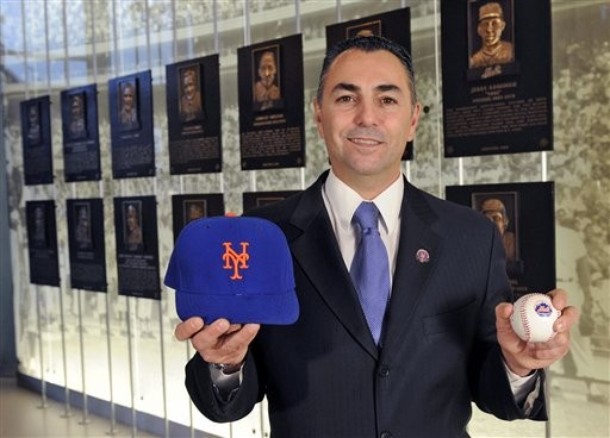
Photo courtesy of Associated Press/New York Mets

Earlier today, the Mets announced that John Franco will be inducted into the team's Hall of Fame in a ceremony prior to the June 3rd game against the World Champion St. Louis Cardinals.  Franco will become the 26th member of the Mets' Hall of Fame and the first to be inducted since Davey Johnson, Darryl Strawberry, Dwight Gooden and Frank Cashen were bestowed the honor in 2010.

Many people know that John Franco played more years for the Mets (14) than any player not named Ed Kranepool and was the team's last captain.  It's also fairly common knowledge amongst Mets fans that Franco holds the club record for saves (276) and is the all-time leader for saves by a left-handed pitcher (424).

But what about the things you may have forgotten about the Brooklyn-born Franco?  He was much more than just a pitcher who racked up saves and years played with the team.  In fact, I've come up with ten things you may not remember about the man who came into games as Chuck Berry serenaded him over the Shea Stadium speakers.  In honor of the newest member of the Mets' Hall of Fame, I present to you...


Ten Things You May Have Forgotten About John Franco

1.  Before Mike Piazza became synonymous with No. 31, John Franco wore the number.  In fact, he wore it longer than Piazza did as a Met, but gave it up to the superstar catcher upon his arrival in May 1998.  Franco switched to No. 45, the number he wore as a player at St. John's University and the number of his childhood hero, Tug McGraw.

2.  When John Franco was traded from Cincinnati to the Mets in December 1989, he was the Reds' all-time saves leader with 148.  In 1994, Franco recorded his 108th save as a Met, taking over the team's top spot from Jesse Orosco.  For ten seasons, John Franco held the No. 1 spot in saves for both the Reds and the Mets until Reds' closer Danny Graves surpassed Franco in 2004.

3.  John Franco is one of only two Mets players who played for both Davey Johnson and Bobby Valentine, joining his battery mate, Todd Hundley.  Johnson was fired as Mets' manager during Franco's first season in New York, while Valentine dialed Franco's number in the bullpen 295 times.  Unfortunately for Johnson, Franco gave up two runs in two-thirds of an inning during a loss to the Padres on May 27, 1990.  It would be Davey's final game as Mets' manager.

4.  Although most fans remember Tom Seaver throwing out the first pitch at Citi Field, it was actually John Franco who threw out the ceremonial first pitch at the inaugural baseball game played at the Mets' home.  On March 29, 2009, Franco took the mound before the college baseball game between St. John's and Georgetown, opening up the ballpark with its first toss to the plate.

5.  The Mets lost the 2000 World Series to the Yankees in five games.  Who was the only Mets' pitcher credited with a victory in the first Subway Series in 44 years?  None other than John Franco, who earned the victory in Game 3 after Benny Agbayani's RBI double gave the Mets an eighth-inning lead.

6.  John Franco was once relieved by Matt Franco.  On Fireworks Night in 1999, Matt Franco traded in his pinch-hitting role to be the "pinch-pitcher" after John Franco left the game with a strained tendon in the middle finger of his throwing hand.  Franco (Matt) would give up a three-run homer to the first batter he faced, adding two runs to Franco's (John) pitching line for the night.  The Mets would go on to lose the game to the Braves, 16-0.  That wouldn't be the only thing lost that night, as Franco (John, not Matt) lost his job as Mets' closer to Armando Benitez because of his injury.

7.  Darryl Strawberry and David Wright are widely considered to be the two best homegrown hitters in franchise history, with both players popping up all over the Mets' all-time offensive leaderboards.  John Franco is the only player who was a teammate of both players while with the Mets.  Franco's first season in New York (1990) coincided with the Straw Man's last year as a Met, while his last year (2004) was the year David Wright made his Met debut.

8.  John Franco is one of only three Mets' relievers to finish in the top ten in the Cy Young Award vote in a particular year.  In the strike-shortened 1994 season, Franco led the National League with 30 saves and placed 7th in the Cy Young vote.  Jesse Orosco (3rd in 1983) and Billy Wagner (6th in 2006) are the other Mets who have received Cy Young Award votes in addition to Franco.

9.  With 33 saves in 1990, John Franco became the first Met ever to lead the league in saves.  He repeated the feat in 1994 when he saved 30 games for the Mets to pace the NL.  To this day, Franco remains the only Mets pitcher to lead the National League in saves.

10.  John Franco is one of only two men to pitch for the Mets at age 44.  In 1965, Hall of Famer Warren Spahn became the first player to accomplish the feat, pitching in 20 games (19 starts) for the Mets at the age of 44.  Franco's final appearance as a Met (October 3, 2004) was also his only appearance as a 44-year-old.  That's not the only thing Spahn and Franco have in common.  Both pitchers are first all-time in wins and saves for left-handed pitchers, respectively.  Spahn's 363 career victories and Franco's 424 saves lead all southpaws in major league history.

Sunday, November 27, 2011

Misleading Stats On David Wright Change Everything

Since 2004, David Wright has been a fan favorite.  His name can be found all over the Mets' all-time offensive leaderboard and he has accomplished this all before his 29th birthday.  Because of this, some Mets fans would find it impossible to see the team without David Wright and would consider it sacrilege to trade him.

However, I've been doing some research on the Mets' career leaderboard and made some comparisons to another team's leaderboard.  Fans who bring up the fact that David Wright holds or is close to holding many of the club's all-time offensive records might change their minds on their favorite player once they read this.

The Mets came into existence in 1962, joining the National League with the Houston Colt .45s (who became the Astros in 1965).  Therefore, it would be fair to assume that both teams would have similar cumulative offensive statistics since they have both completed 50 seasons of play.  It would also be fair to assume that since David Wright has cemented his name at or near the top of the Mets' all-time leaderboard in many offensive categories, he'd rank just as highly in those categories had he been a member of the Astros.  Unfortunately for Wright, that is not the case.

Currently, David Wright ranks in the Mets' top ten in the following cumulative offensive categories:

  • Games played: 1,106 (8th)
  • At-bats: 4,161 (5th)
  • Plate appearances: 4,782 (4th)
  • Runs scored: 699 (2nd)
  • Hits: 1,248 (3rd)
  • Total bases: 2,112 (1st)
  • Doubles: 281 (1st)
  • Home runs: 183 (4th)
  • RBI: 725 (2nd)
  • Bases on balls: 535 (4th)
  • Stolen bases: 151 (6th)
  • Runs created: 825 (1st)
  • Extra-base hits: 481 (1st)
  • Times on base: 1,816 (2nd)
  • Sacrifice Flies: 53 (2nd)

 Wright's bat has taken him far up the Mets' all-time leaderboard, but how great does that make him?


David Wright is currently the all-time Mets leader in total bases, doubles, runs created and extra-base hits and ranks in the top five in nine other categories.  Barring injury (and the potential departure of Jose Reyes via free agency), he could break the career club records for hits, RBIs, walks, times on base and sacrifice flies in 2012.

In addition to the above categories, if Wright plays 130 games in 2012, he will move into the No. 3 spot in games played for the Mets, surpassing Darryl Strawberry, Mookie Wilson, Howard Johnson, Cleon Jones and Jerry Grote.  He can also realistically enter the top three in at-bats, plate appearances and home runs during the upcoming season.

Without question, David Wright is one of the best offensive players in Mets history.  His high ranking in many of the club's career offensive categories clearly establishes that.  However, it would be a whole different story if Wright had achieved his numbers as a member of that other expansion team from 1962.  Let's look at where Wright's numbers would rank him on the all-time Houston Astros' offensive leaderboards in the same categories listed above.

  • Games played: 1,106 (14th)
  • At-bats: 4,161 (11th)
  • Plate appearances: 4,782 (10th)
  • Runs scored: 699 (7th)
  • Hits: 1,248 (9th)
  • Total bases: 2,112 (8th)
  • Doubles: 281 (6th)
  • Home runs: 183 (5th)
  • RBI: 725 (7th)
  • Bases on balls: 535 (8th)
  • Stolen bases: 151 (12th)
  • Runs created: 825 (7th)
  • Extra-base hits: 481 (7th)
  • Times on base: 1,816 (9th)
  • Sacrifice Flies: 53 (T-5th)

 David Wright's bat wouldn't get him very far up the Houston Astros' all-time leaderboard.


If David Wright had been in Houston since 2004 and compiled the same offensive numbers he has for the Mets as an Astro, he wouldn't be considered an all-time great for that franchise.  Wright ranks in the Mets' top five in 13 different categories and is the team's all-time leader in four of them.  As an Astro, he wouldn't rank higher than fifth place in any of Houston's all-time cumulative offensive categories.  He wouldn't even rank in the top ten in three of them.

The fans who don't think Wright should be traded usually make their point by saying he's been one of the Mets' best players of all-time and he's not even 30 yet.  Yes, it's true that Wright has been one of the Mets' best offensive players of all-time.  It's also true that he's accomplished all of his accolades before age 30.

But the reason why Wright has been one of the all-time greatest Mets is because the Mets haven't had many great offensive players for him to be compared to, and when the Mets have had a game-changing offensive player, they've either traded him away (Rusty Staub), let him walk as a free agent (Darryl Strawberry and perhaps Jose Reyes) or acquired him after he established himself with another franchise (Keith Hernandez, Gary Carter, Mike Piazza).

Simply stated, the Mets haven't had a homegrown offensive player stay with them long enough to become a bonafide all-time great of the game.  The Astros had Craig Biggio and Jeff Bagwell, two of the game's best players during their time in Houston and both potential Hall of Famers.  The Mets' sole Hall of Famer has been Tom Seaver, a pitcher.  Sure, the Mets have had future Hall of Famers play for them in the past, but most of those players had already locked up their ticket to Cooperstown before they became Mets (Yogi Berra, Warren Spahn, Willie Mays, Duke Snider, Richie Ashburn, Gary Carter, Eddie Murray, Rickey Henderson, Roberto Alomar).  Only Seaver and Nolan Ryan came up through the Mets' farm system, but both of them were pitchers.

It's sad to say it, but as of right now, there has never been an everyday player inducted into the Hall of Fame who was developed in the New York Mets' farm system and came into the major leagues as a member of the Mets.

David Wright will someday have his plaque displayed in the Mets' Hall of Fame and Museum to recognize him as an all-time great Met, but unfortunately, he is not an all-time great of the game.   When fans realize this instead of trying to make him bigger than what he really is, perhaps they'd realize that he'd have more value to the Mets as trade bait than he would have as a player for the team.