Showing posts with label 2015 Mets. Show all posts

Sunday, August 12, 2018

Three-Run Leads Are a Recipe For Disaster For the Mets

"You know what, Mickey?  My high school sweetheart, Sandy Koufax, never blew a three-run lead." (R. Schultz/Getty Images)


Good baseball teams know how to hold leads when they have them.  And as a team's lead increases, the odds of ending the game with a happy recap usually increase as well.

That is, unless you're talking about the 2018 Mets.

The Mets lost Saturday night's game to the Miami Marlins in 11 innings.  New York dropped the 4-3 decision after taking an early 3-0 lead.  If that kind of result sounds familiar to you, you're not alone.  In fact, just minutes after the walk-off defeat was complete, I was asked this question on Twitter.


I can't confirm if the Mets have set some kind of record for losing games after holding a three-run lead, mainly because I'm lazier than the average blogger, but thanks to baseball-reference.com, I can say that the Mets have lost an incredibly high percentage of games in which their opponent had to erase a deficit of three or more runs.  But before we get to that, here's a little background research.

For the Mets to lose a game in which they held a three-run lead, that implies that they had to score at least three runs.  (Duh!)  And in their 66 losses to date, they were held to fewer than three runs a total of 36 times.  For all you kids out there, that's a lot of defeats in which the Mets couldn't have possibly held a three-run lead.

So that leaves just 30 losses in which the Mets could have been up by three runs.  You would think that given the fact that I only had to go through two-and-a-half dozen boxscores, I would find maybe five or six instances in which the Mets lost after they had taken a three-run advantage on their opponent.  If you thought that was the case, then clearly you haven't been following the 2018 Mets closely.

Here are all the games so far this season in which the Mets gave us temporary pleasure by taking a three-run lead before reminding us that they're still the 2018 Mets.

  • April 16:  Mets lead Nationals, 6-1.  Lose 8-6.
  • April 21:  Mets lead Braves, 3-0.  Lose 4-3.
  • May 26:  Mets lead Brewers, 3-0.  Lose 17-6.
  • May 27:  Mets lead Brewers, 4-1.  Lose 8-7.
  • May 29:  Mets lead Braves, 4-0.  Lose 7-6.
  • June 9:  Mets lead Yankees, 3-0.  Lose 4-3.
  • June 20:  Mets lead Rockies, 4-1.  Lose 10-8. 
  • June 27:  Mets lead Pirates, 3-0.  Lose 5-3.
  • July 3:  Mets lead Blue Jays, 5-0.  Lose 8-6.
  • July 27:  Mets lead Pirates, 3-0.  Lose 5-4.
  • Aug. 5:  Mets lead Braves, 3-0.  Lose 5-4.
  • Aug. 11:  Mets lead Marlins, 3-0.  Lose 4-3.

The Mets have lost 30 games this season in which they scored at least three runs.  And in a dozen of those contests - that's an incredible 40% of the defeats - they held a lead of at least three runs.  It's so unbelievable, even Tom Glavine would be devastated by it.  (His former team, the Atlanta Braves, have no problem with the Mets' generosity, as they've engineered three of those 12 comebacks.)

Do you remember earlier when I said that good teams know how to hold leads?  The 2015 National League champion Mets - otherwise known as a good team - lost just six games all year in which they held a three-run lead.  This year's squad has doubled that total with 48 games still left to play.

On Sunday, less than 24 hours after suffering their 12th defeat in a game where they held a lead of at least three runs, the Mets defeated the Marlins, 4-3.  How did they manage to hold the lead in this game?  It's simple, really.  They never allowed their lead to reach three runs at any point in the game.  If only they had followed that formula all year.


Monday, January 23, 2017

The Thrill of Victory, The Agony of the Mets: Daniel Murphy

When a young player experiences a pennant race for the first time, he's told to savor the moment because there's no guarantee that it'll happen again.  For one former Met who was thrust into the spotlight from the moment he first set foot on a major league diamond, he relished every opportunity to play meaningful games in September.  Alas, the calendar was only thing that made it to October that season, as the Mets fell short of their postseason quest.

The bright-eyed neophyte who tasted the sweet nectar of a playoff chase so early in his career became a grizzled veteran just six years later, one who played for a losing Mets team in each of those half-dozen seasons.  But just as the sun appeared to have set on another season, the Mets shocked the baseball cognoscenti by winning an unlikely pennant, giving their veteran second baseman a chance to finally play in the postseason after having just missed during his rookie campaign.  And once he got there, he turned October into his own personal stage.

Daniel Murphy's good side will always feature a bat in his hands.  (Jim McIsaac/Getty Images)

Daniel Thomas Murphy was drafted by the Mets in the 13th round of the 2006 June Amateur Draft.  Murphy, who played third base at Jacksonville University, was a college teammate of Tony Bernazard's son when Bernazard was the Mets' vice president of player development.  Murphy's development in the Mets' minor league system began slowly, as the infielder batted just .213 during his first season as a professional.  Murphy's second year showed a marked improvement in his hitting ability, as he batted .285 for the St. Lucie Mets and led the team with 34 doubles and 78 RBI.  His defensive skills, however, were another story.

Flash back a few years to when Murphy was a student-athlete at Jacksonville.  While attending a team meeting, Murphy was once asked to state his name and defensive position.  Without hesitating, Murphy answered the question.

"I'm Daniel Murphy," he said, "and I bat third."

Defense was never one of Murphy's strong suits, which became quite obvious during his time in St. Lucie, as the third baseman committed 35 errors in 131 games with the team.  But as long as Murphy kept on hitting, his name would always find a way to be included on the lineup card.

In 2008, Murphy began the season playing above A-ball for the first time in his career.  He ended the year in the middle of a playoff race at Shea Stadium.  At Double-A Binghamton, Murphy batted .308 with an .870 OPS and spent time at every infield position except shortstop.  He even played four games in left field while in Binghamton, which came in handy later that summer when the Mets were looking for an injury replacement with some experience at the position.

The Mets began the 2008 campaign with Angel Pagan in left field filling in for the injured Moises Alou.  By the time the dog days of summer began in August, the Mets had used more left fielders than Spinal Tap used drummers.  Through the end of July, the Mets had played 108 games.  Incredibly, a total of 11 players had started in left field for the team by then, with none of them playing more than 20 games at the position.  Players such as Brady Clark, Trot Nixon, Andy Phillips and Chris Aguila all "earned" starts in left field for a team that was considered one of the best in the game.  Another participant in the season-long game of left field musical chairs was Marlon Anderson, who started 20 games before pulling his left hamstring on August 1.  The following night, left fielder No. 12 made his debut for the Mets, and his name was Daniel Murphy.

"I'm ecstatic to be here," Murphy said prior to the game.  "It'll probably hit me when I'm out in left field with 40,000 people around me."

Tony Bernazard, who was instrumental in the Mets' signing of Murphy in 2006, knew that Murphy was the right man to call up at that time.

"(Murphy's) the one who is most ready," Bernazard said.  "He will give you good at-bats all the time."

Put a bat in his hands and Murphy could do anything with the ball, even bunting it.  (Jim McIsaac/Getty Images)

For years, Bernazard knew how great a hitter Murphy was, but even he couldn't have expected the start Murphy would have in the majors.  In his first three weeks with the Mets, Murphy started 11 games in left field and appeared in seven games as a pinch-hitter, batting .404 with a .491 OBP in those 18 games.  Murphy also collected two doubles, a triple, two homers and 11 RBI in his first 55 plate appearances.  A reason for Murphy's early success was his ability to make the pitcher throw many pitches per at-bat, allowing him to see the pitcher's full repertoire.  In fact, Murphy worked a full count in more than 20% of his plate appearances (Murphy saw a 3-2 pitch in 31 of his 151 times at the plate).

Without question, Murphy's promotion gave the Mets a spark they hadn't experienced for the first two-thirds of the season.  When Murphy played his first game with the team on August 2, the Mets were in third place in the N.L. East and stood 3½ games behind the wild card-leading Milwaukee Brewers.  A month and a day later, the Mets completed a three-game sweep of the Brew Crew that gave them a 21-9 record since Murphy's debut.  Heading into the final week of the season, the Mets were in a race with the Phillies for the division title and the Brewers for the wild card.  They began the week with a four-game series against the N.L. Central champion Chicago Cubs.

Chicago had already wrapped up the best record in the National League by the time they arrived at Shea Stadium, but manager Lou Piniella continued to trot out his best players for the critical series.  The Mets and Cubs split the first two games and were knotted in the third contest as it went to the bottom of the ninth.  Murphy then brought the Shea Stadium crowd to its feet by leading off the inning with a triple off veteran reliever Bob Howry.  The 54,416 fans in attendance were eagerly anticipating a thrilling walk-off victory, especially with David Wright about to bat, Carlos Delgado on deck and Carlos Beltran in the hole, but Piniella continued to manage the game as if it were the seventh game of the World Series instead of a meaningless game for his club.

Wright struck out.  Delgado and Beltran were intentionally walked.  Ryan Church grounded out, with Murphy being forced out at the plate.  Ramon Castro fanned on three pitches.  Inning over.  Rally over.

Murphy tried to be the hero, and he would have been had the Mets defeated the Cubs in the bottom of the ninth inning on September 24.  But the Mets didn't win.  And they also didn't win their season-ending series against the Florida Marlins.  The Brewers won the wild card.  The Phillies clinched the division title and went on to win the World Series.  The Mets got nothing, other than the start of Daniel Murphy's major league career.

Although Murphy started only 30 games in left field for the Mets after his August call-up, that somehow led the injury-riddled team at the position.  Murphy entered the 2009 season hoping to give the Mets more stability at the position after the team saw a dozen players patrol left field in 2008.  It did not take long for the Mets to realize that perhaps Murphy wasn't the best option for the job.

On the first Sunday of the season, Johan Santana dominated the Marlins, striking out 13 batters in seven masterful innings.  But Santana was pinned with the loss, as Florida scored two unearned runs in the third inning after Murphy dropped a routine fly ball.  After the game, a clearly frustrated Santana was quick to throw Murphy under the bus for the loss.

Whoomp, there it isn't.  (Rothstein/Daily News)
"It's one mistake that he made," Santana said.  "It cost us the whole ballgame, but it's part of the game."

Not mentioned by Santana was the fact that he walked Jeremy Hermida prior to Murphy's gaffe and then allowed an RBI single to No. 8 hitter Ronny Paulino after the miscue.  Nor did Santana mention that the Mets' offense failed to show up for the game, as the team was shut out by Marlins starting pitcher Josh Johnson for 8⅔ innings.  Santana very well may have been speaking out of frustration, but the stigma of being a bad fielder, regardless of the position he was playing, stuck with Murphy for the rest of his career as a Met.

After starting 13 of the first 14 games of the 2009 season in left field, the lefty-swinging Murphy began to platoon at the position with the right-handed batting Gary Sheffield, who had played the majority of his career in the outfield.  But when starting first baseman Carlos Delgado suffered what became a career-ending injury on May 10 and after Jeremy Reed - who had played all of three games in his career at first base - made a crucial error at first that cost the Mets a game in Los Angeles a week later, the Mets decided to move Murphy back to the infield.

Murphy adjusted well to the infield life.  But once Murphy stopped worrying about dropping fly balls, it would be his teammates who would start dropping like flies.  In addition to Delgado, Jose Reyes' season also ended in May.  Carlos Beltran, who was among the league's leading hitters during the first two months of the 2009 campaign, eventually missed half of the season with a knee injury.  David Wright remained healthy until he was felled by a Matt Cain fastball to the noggin.  Sheffield, who for a while was the team leader in home runs, missed extended periods of time late in the season.  And how can we forget Luis Castillo falling down the Citi Field dugout steps in August, just two months after he dropped a fly ball of his own?  When everyone else went down, sometimes literally, Murphy remained the last Met standing.

The Mets could not overcome the rash of injuries that befell them in 2009, finishing the year with a 70-92 record, but Murphy's first full season in the majors was one of the few success stories for the team.  Although his batting average dipped to .266, Murphy managed to hit 38 doubles and a team-leading 12 homers.  He also led the club in games played and finished second to Wright in runs batted in.  But Murphy's injury-free campaign caught up with him over the next two seasons.

The 2010 season opened with Murphy on the disabled list due to a right knee sprain suffered at the end of spring training.  Due to the emergence of rookie first baseman Ike Davis, Murphy began to play games at second base during his minor league rehab assignment.  Unfortunately, a hard takeout slide while covering second caused Murphy to tear the MCL in his right knee, ending his season before he could return to the majors.  A year later, Murphy's season ended prematurely once again, and for the second straight year, it involved a collision at second base.

In 2011, Murphy was among the league leaders in hitting, boasting a robust .320 batting average in early August.  But after Braves' outfielder Jose Constanza spiked Murphy at second base on a stolen base attempt on August 7, Murphy suffered his second medial collateral ligament tear in a span of 14 months and would miss the rest of the season.

Murphy finally stayed healthy in 2012 and 2013, playing in 317 of a possible 324 games, and took over the everyday job at second base.  In 2012, Murphy became the first left-handed hitter in club history to hit 40 doubles in a single season and followed that up with a brilliant 2013 campaign, setting new career highs in homers (13), runs batted in (78), runs scored (92) and stolen bases (23).  And yet, for all the progress Murphy had made as a hitter, the focus still remained on his defense, as Murphy posted a -0.8 dWAR in 2012 and an even worse -1.5 dWAR in 2013.

The 2013 season also marked the fifth consecutive season that Murphy played for a losing team.  But things started to change for the Mets in 2014 and for Murphy as well.  The Mets won five more games in 2014 than they did in the previous season and finished in a tie for second place in the N.L. East.  They also outscored the opposition by 11 runs and saw an improvement in attendance at Citi Field for the first time since the park opened in 2009.  As for Murphy, he was finally recognized for his offensive talents by earning his first All-Star selection.  By the end of June, Murphy was batting .303 with 19 doubles, six homers, 32 RBI, 51 runs scored and 11 stolen bases.   He maintained a .300 batting average until late August, when a strained quad led to a stint on the disabled list.  The injury caused Murphy to struggle upon his return, as he ended the year with a .289 average.

Despite the slow finish, Murphy still led the Mets in hits, doubles and runs scored.  His recognition as a first-time All-Star capped a six-year period in which Murphy pushed himself to improve every facet of his game.  And when he finally received the All-Star nod, Murphy was humbled by the honor.

"It's a blessing," Murphy said.  "And I don't work any harder on this ballclub than anyone else does.  There's no doubt about that.  There's 24 men in here who work really hard.  It's just an honor.  It's humbling.  It's a fantastic blessing."

Daniel Murphy, All-Star.  (Elsa/Getty Images)

Murphy wasn't the only Met in 2014 to receive national attention, as pitcher Jacob deGrom ended a three-decade Rookie of the Year drought for the Mets, becoming the first Met to win the award since Dwight Gooden in 1984.  The emergence of deGrom, plus the return of fellow moundsman Matt Harvey from Tommy John surgery and the forthcoming debut of top pitching prospect Noah Syndergaard gave the Mets hope that they would finally turn the corner in 2015.

The 2015 season would also be Murphy's final season before becoming a free agent for the first time, giving him extra incentive to have a solid season.  But even though the Mets got off to a fast start, tying a franchise record with an 11-game winning streak in April, Murphy did not.  When the calendar turned from April to May, Murphy was batting just .198.  But Murphy became a one-man hitting machine over the team's next 29 games, batting .352 with an .869 OPS.  Unfortunately, just like it did in 2014, a quad injury caused Murphy to miss 22 games in June.  And faster than you can say abracadabra, the Mets' offense disappeared.

In the three weeks they played without their second baseman, the Mets batted .217 as a team and scored an average of 2.8 runs per game.  The low point of Life Without Murphy occurred on June 9, when the Mets were no-hit by Giants' starter Chris Heston, who had just 12 major league starts prior to his gem at Citi Field.

Murphy eventually returned from his injury and three weeks later, the Mets returned to relevance with the acquisitions of Kelly Johnson, Juan Uribe and Yoenis Céspedes.  While all the attention was placed on the team's new members - which also included the team's top hitting prospect, Michael Conforto - Murphy quietly began to rake at the plate, batting .309 over the next two months.  Murphy also added something Mets fans weren't accustomed to seeing from him - power.

From July 25 through September 26, Murphy slammed eight homers and posted a .549 slugging percentage.  Included in his home run barrage was a mammoth blast into the Pepsi Porch during a nationally televised game against the Washington Nationals on August 2 and a game-tying, three-run homer in Atlanta on September 13 when the Mets were down to their final out of the game.  And of course, the Mets won both games.  In fact, the Mets had a 33-14 record when Murphy was in the starting lineup from July 25 (the night Johnson and Uribe made their Mets debuts) to September 26 (the day the team clinched the N.L. East division title).

From the night Murphy made his debut on August 2, 2008 until the final regular season game of the 2015 campaign, Murphy had played in 903 games for the Mets and had never appeared in the postseason, breaking Ed Kranepool's club record of 887 games played to start a career without a playoff game in the mix.  But that streak would end in 2015, as the Mets advanced to the National League Division Series to face the Los Angeles Dodgers.  It wouldn't take long for Murphy to begin a different kind of streak.

In Game One, Murphy was responsible for the series' first run, homering off three-time Cy Young Award winner Clayton Kershaw in the Mets' 3-1 victory.  Murphy took Kershaw deep again in Game Four, but the Mets lost that game to force a fifth and deciding game - a game that was single-handedly won by Murphy's bat and brain.

In the first inning, Murphy delivered an RBI double to give the Mets an early lead.  But the Dodgers proceeded to take the lead in the bottom of the first, a lead that remained intact until Murphy came up to the plate in the fourth frame.  On the first pitch delivered by Zack Greinke, himself a former Cy Young Award recipient, Murphy pulled a single to right.  Two batters later, Lucas Duda drew a walk, moving Murphy to second.  But with the Dodgers' infield employing a shift for the pull-happy Duda, third base was left vacated.  An observant Murphy noticed the lack of a fielder near the bag and took off for third, arriving safely without a throw.  Murphy then scored the tying run on a sacrifice fly by Travis d'Arnaud, literally stealing a run.

Murphy had already contributed to both of the Mets' runs in his first two at-bats.  When he faced Greinke for the third time in the sixth, he introduced the baseball to the right field seats.  On a 3-2 pitch from the Dodgers right-hander, Murphy lined a home run down the right field line, giving the Mets a 3-2 lead.  Starter Jacob deGrom and the bullpen (including Noah Syndergaard, who pitched a scoreless seventh) combined to keep the Dodgers hitless in their last four turns at bat to preserve the one-run lead and send the Mets to the National League Championship Series.

Flip that bat, Daniel!  You just sent the Mets to the NLCS!  (Harry How/Getty Images)

For five games, Murphy teed off against the best the Dodgers had to offer, clubbing three homers off Kershaw and Greinke.  Murphy would face another challenge in the NLCS, facing Jon Lester and Cy Young Award winner Jake Arrieta.  Challenge accepted.

  • Game One, first inning vs. Jon Lester:  Home run.  Mets lead, 1-0, and go on to win, 4-2.
  • Game Two, first inning vs. Jake Arrieta:  Home run.  Mets lead, 3-0, and go on to win, 4-1.

With the Cubs' top two starting pitchers out of the way, Murphy and the Mets coasted in the next two games at Wrigley Field.  With Game Three knotted in the fourth inning, Murphy delivered a tie-breaking blast against Kyle Hendricks to give the Mets a 2-1 lead.  The Mets held on to win, 5-2.  Murphy had now hit home runs in five straight postseason games.  Former teammate Carlos Beltran had been the only player to ever accomplish the feat in the playoffs, doing so with the Houston Astros in 2004.  And just one Met had ever homered in five consecutive games prior to Murphy.  That was Richard Hidalgo, who turned the trick during the 2004 regular season.  Both records would fall in a memorable Game Four.

The Mets were one win away from their first National League pennant in 15 years.  It took just 15 batters for the game to turn into a laugher.  New York scored six runs in the first two innings to take a commanding 6-0 lead.  The Mets scored their final two runs of the game in the eighth inning on a home run by - who else? - Daniel Murphy.

Murphy had homered in six straight games - a postseason record and a Mets' all-time mark - to lead the Mets to the World Series.  The former 13th round draft pick who had been with the Mets since they called Shea Stadium home had finally reached the promised land.  But alas, Murphy's dream postseason turned into a nightmare in the Fall Classic.  Not only did Murphy fail to hit a home run, he was also held without an RBI by the Kansas City Royals.  In addition, Murphy struck out seven times in the five-game series after being the toughest player to strike out in the National League during the regular season (38 Ks in 538 plate appearances).  And of course, his costly error in the eighth inning of Game Four allowed the tying run to score and led to the eventual winning run crossing the plate.

The Royals ended the Mets' season in Game Five, winning their first championship in three decades.  Kansas City also ended Murphy's tenure in New York, as the Washington Nationals gave Murphy 37.5 million reasons to leave the only team he had ever known.

"I've seen plenty of Daniel Murphy, believe me, as a general manager - often from the other side of the field," Nationals GM Mike Rizzo said.  "He is a player that plays the game the right way.  We love his attitude, his grit.  When the bright lights - not only in New York City - are on, (Murphy) shines the brightest." 

In 2008, rookie Daniel Murphy joined a Mets team that was poised to make it to the postseason, but fell short on the season's final day.  He then suffered through a number of personal injuries, several defensive position changes and more than enough losing baseball for six seasons before finally enjoying another September to remember as a 30-year-old veteran.  This time, Murphy and the team made it to the postseason party and extended their season all the way to November before the glass slippers finally came off.  And along the way, Murphy etched his name into the record books in a way no one could have expected.

Before he became a postseason hero for the Mets, Murphy was criticized for just about everything.  He wasn't a good defensive player.  He didn't hit with enough power.  He was a poor base runner.  Even off-the-field issues like missing Opening Day in 2014 to attend the birth of his first child and his comments about homosexuality due to his religious beliefs left Murphy open for criticism from fans and the media.

But with one amazing and unexpected postseason appearance, Murphy became the brightest star in a city full of them.  No one will ever be able to question his role in one of the most unlikely pennant runs in recent history.  And no one will ever be able to forget the story of the Met who once claimed his defensive position was batting third.

Daniel Murphy and his son, Noah, celebrate a memorable 2015 campaign.  (Ed Leyro/Studious Metsimus)


Note: The Thrill of Victory, The Agony of the Mets is a thirteen-part weekly series spotlighting those Mets players and personnel who experienced the best of times and the worst of times with the team.  For previous installments, please click on the names below:

January 2, 2017: Tom Seaver
January 9, 2017: Mike Piazza
January 16, 2017: Wally Backman


Wednesday, August 31, 2016

Yoenis Céspedes vs. Other Mets in Their First 162 Games

Yoenis Cespedes's 162-game start gets a big thumbs up!  (Ed Leyro/Studious Metsimus)

Yoenis Céspedes has meant everything to the Mets since he was acquired at the trade deadline last July.  But because of nagging injuries and a trip to the disabled list earlier this season, Céspedes didn't get to play in his 162nd career game with the team until Wednesday, as he has missed 28 games during the 2016 campaign after resting for only two games with the Mets in 2015, both of which came after the team had clinched the division title.

Céspedes's numbers with the team in those 162 games are astounding, as he has produced 34 doubles, 44 homers, 112 RBI and has compiled a .583 slugging percentage and .941 OPS in a full season's worth of games.  Those five categories are traditionally recognized as categories in which sluggers generally excel, and Céspedes ranks favorably with the team's all-time greats in all five.

In doing research for hot starts by Mets players to see where Céspedes ranked, I found some interesting names that I did not expect to find among those franchise legends.  For every time Mike Piazza was in the top ten - he's the only player to be ranked in the top five in all five categories within his first 162 games with the team - there were a handful of "did they really have that type of start?" players.

Here are five lists, one each for doubles, home runs, runs batted in, slugging percentage and on-base plus slugging percentage, that show just how good Céspedes has been in his first 162 games with the Mets and how fortunate some other players were in their first full season's worth of contests with the club.


Doubles:

Bernard Gilkey
Mike Piazza - 46
Bernard Gilkey - 45
Paul Lo Duca - 44
David Wright - 41
Mike Cameron - 40
Rusty Staub - 39
Eddie Murray - 38
Robin Ventura - 38
Todd Zeile - 38
Ike Davis - 37


Home Runs:

Kevin McReynolds
Dave Kingman - 48
Yoenis Céspedes - 44
Carlos Delgado - 39
Mike Piazza - 38
Mike Cameron - 35
Gary Carter - 34
Frank Thomas - 34
Robin Ventura - 32
Cliff Floyd - 31
Bernard Gilkey - 31
Kevin McReynolds - 31
Darryl Strawberry - 31


Runs Batted In:

John Olerud
Carlos Delgado - 126
Bernard Gilkey - 124
Robin Ventura - 120
Mike Piazza - 119
Dave Kingman - 118
Gary Carter - 116
Yoenis Céspedes - 112
Donn Clendenon - 108
John Olerud - 107
Kevin McReynolds - 102


Slugging Percentage:

Mike Cameron
Mike Piazza - .604
Yoenis Céspedes - .583
Bernard Gilkey - .544
Rico Brogna - .529
Robin Ventura - .525
Cliff Floyd - .523
Carlos Delgado - .518
Donn Clendenon - .512
Dave Kingman - .511
Mike Cameron - .510


On-Base Plus Slugging Percentage:

Rico Brogna
Mike Piazza - 1.005
Yoenis Céspedes - .941
Bernard Gilkey - .930
Robin Ventura - .902
Cliff Floyd - .890
John Olerud - .889
Rico Brogna - .880
Carlos Delgado - .870
Benny Agbayani - .867
David Wright - .865


As you can see, there are several players whose names you would expect to see in multiple categories.  Power hitters such as Céspedes, Piazza, Carlos Delgado, Dave Kingman and others can be found in at least three of the five top-ten lists.  But did you really expect to see a guy like Rico Brogna appear on as many lists as David Wright?  What about Cliff Floyd and Mike Cameron showing up three times?  Or most surprisingly, what do you think of Bernard Gilkey and Robin Ventura joining Piazza as the only three players to rank in the top ten in all five categories?

Those unexpected players (Brogna, Floyd, Cameron, Gilkey, Ventura) all had sensational starts to their careers in Flushing, but they also suffered injuries (Brogna, Floyd and Cameron come to mind) or faded quickly (Gilkey and Ventura were both one-season wonders).

Meanwhile, a number of all-time team greats were absent from a number of these top-tens.  The late, great Gary Carter made it to the Hall of Fame and began a miraculous World Series rally that fueled the Mets to a championship.  But his excellent .490 slugging percentage and .861 OPS in his first 162 games with the team were both not high enough to appear on either category's respective top-ten list.  Darryl Strawberry may have won the National League Rookie of the Year award in 1983, but his only appearance on any of the above lists is a ninth-place tie in the homer department.  And Carlos Beltran may be the greatest free agent signing in Mets history, but a poor start to his career in New York kept him off every list.

It remains to be seen whether Céspedes will go down the road traveled by the great sluggers in Mets history or if the nagging injuries continue to increase and he will just be remembered for the incredible 162-game start to his Mets career, which included helping the team reach the 2015 World Series.

For now, Céspedes is one of only three Mets to have at least 30 doubles, 35 homers and 100 RBI in his first 162 games with the team, joining Carlos Delgado and Hall of Famer Mike Piazza.  Whether or not Céspedes joins Piazza in Cooperstown or even in the Mets Hall of Fame won't be known for years, but one thing's for certain.

Yoenis Céspedes has been gotten off to one of the best starts of any hitter in franchise history.  And there's nothing fluky about that.


Saturday, April 23, 2016

Matt Harvey and the Mets' Mediocrity in His Starts

Until last night, the Mets hadn't won a regular season game started by Matt Harvey since last season's division clincher.  (Photo by Ed Leyro/Studious Metsimus)

Matt Harvey earned his first regular season victory in last night's 6-3 win over the Atlanta Braves.  But more importantly, the Mets earned their first win in a Matt Harvey start since last year's division clincher.  Harvey had made four regular season appearances since the team won the N.L. East crown on September 26.  Those four contests included his un-Harvey-like three-game start to this season and the next-to-last regular season game of 2015 - a game in which the Mets were no-hit by Max Scherzer.

All told, Harvey has made 69 starts in his Mets career and the team has lost more than half of them, going 34-35 in the Dark Knight's appearances.  There are many reasons for the Mets' mediocrity in starts made by the pitcher many deemed to be the future of the franchise.

Harvey's bullpen has failed to protect his leads.  Like Johan Santana in 2008, who had seven leads blown by the team's bullpen, turning a potential 23-win, Cy Young campaign into a 16-win, third place finish in the balloting for top pitcher in the National League, Harvey has been occasionally victimized by his relief corps as well.  It all began in his final start in 2012, when Harvey pitched seven innings of one-hit ball against the Phillies, leaving the game with a 2-1 lead, only to see Josh Edgin surrender a two-run homer to Ryan Howard with two outs in the ninth.  The Mets lost that game, 3-2.

In 2013, the Mets won each of Harvey's first five starts, but then went 8-13 in his next 21 starts before his season was cut short in August due to the injury that caused him to undergo Tommy John surgery.  In three of those 13 losses, the Mets were leading the game when Harvey was removed by Terry Collins, only to see the bullpen become BFFs with opposing hitters, giving up Harvey's leads in eventual Mets losses.

Upon returning from Tommy John surgery in 2015, Harvey finally had some success helping the Mets earn victories, but the team still lost a dozen times in Harvey's 29 starts.  Once again, New York dropped three games in which Harvey left them with a lead to protect.  Add it all up and the Mets have lost seven games when Harvey was removed with the lead - or the same number of times the Mets' bullpen blew leads for Johan Santana in 2008 alone.  Had the bullpen been more successful for Harvey and the Mets in those seven instances, the team's 34-35 record in Harvey's starts could have been a more impressive 41-28.

But don't just blame the bullpen for the team's mediocrity in Harvey's starts.  In fact, the team has saved Harvey from a number of losses several times during his career as well.

On April 24, 2013, Harvey allowed three runs to the Dodgers in six innings.  When he left the game, the Mets trailed Los Angeles, 3-1.  New York tied the game in the ninth, then won it in the tenth on Jordany Valdespin's walk-off grand slam.  A month later, Harvey was all set to pick up a hard-luck loss when he pitched eight masterful innings against the Yankees but left the game with his team down, 1-0.  The Mets rallied for two runs in the ninth, marking the only time in Mariano Rivera's career that he came into a save situation and earned the loss without retiring a batter.

Fast forward two years later during the Mets' run to the N.L. East title in 2015.  On September 8, Harvey pitched an awful game in Washington, allowing seven runs to the Nats before he was removed with one out in the sixth and his team trailing by six.  Then Wilmer Flores happened (RBI single).  Then Curtis Granderson happened (bases-loaded walk).  Then Yoenis Cespedes joined the party (three-run bases-clearing double).  Then Lucas Duda remained patient (game-tying bases-loaded walk).  Finally, an inning later, Kirk Nieuwenhuis hit his final homer as a Met, taking Jonathan Papelbon deep for what became the winning run in the Mets' 8-7 victory.

There were also a game in 2015 where Harvey was actually helped out by his bullpen to help the Mets earn a victory.  On July 31, Harvey was removed from a 1-1 game against the Nationals with two runners on base.  But Tyler Clippard won a 13-pitch battle against Jayson Werth, striking out the hirsute slugger to preserve the tie.  Had Werth driven in a run or two against Clippard, those runs would have been charged to Harvey and the game might never have gone to extra innings.  But because Clippard and the rest of the bullpen (and eventually Wilmer Flores in the 12th inning) did their jobs, Harvey escaped with a no-decision and the Mets escaped with a much-needed win.

So that's four wins where Harvey could very well have been saddled with a loss, but the Mets stormed back to victory.  That 34-35 overall record by the team could have been a more disturbing 30-39 had those rallies not ensued.

It's true that Harvey has been more effective than not.  His 2.66 ERA and 1.03 WHIP in his career says that's the case.  It's also true that the Mets' bats have had a tendency to hit the snooze button more than they've hit baseballs in too many of Harvey's starts.  Harvey has allowed two runs or fewer in 45 of his 69 starts, or 65.2% of the time.  In those starts, the Mets are just 27-18, for a .600 winning percentage.  That might seem okay until you look at how the Mets have fared when Jacob deGrom has allowed two runs or fewer.  DeGrom has held opponents to two runs or fewer in 36 of his 53 starts, or 67.9% of the time, which is not much higher than Harvey's percentage.  However, New York has a phenomenal 29-7 record when deGrom holds opponents to no more than two tallies.  That's good for an .806 winning percentage, which is far higher than Harvey's mark in similar outings.

To summarize, Matt Harvey has been a victim of everything that can contribute to his team's mediocre record in his starts.  He's been a victim of an occasionally shoddy bullpen.  He's also had his teammates take several days off at the plate when he's been on the mound.  But on the flip side, both the bullpen and the offense have also bailed Harvey out a few times.

Sometimes, it's better to be lucky than good.  In Matt Harvey's case, he's been very good throughout his career, but he also hasn't had the best of luck.  Put it all together and you have a four-year career that has produced just 34 victories by his team in his 69 starts.  It's a trend that's been going on for far too long and needs to change very soon if Harvey is ever going to be the type of pitcher everyone expects him to be.  His win against Atlanta last night needs to be the stepping stone for bigger and better things in the future.

Sunday, April 3, 2016

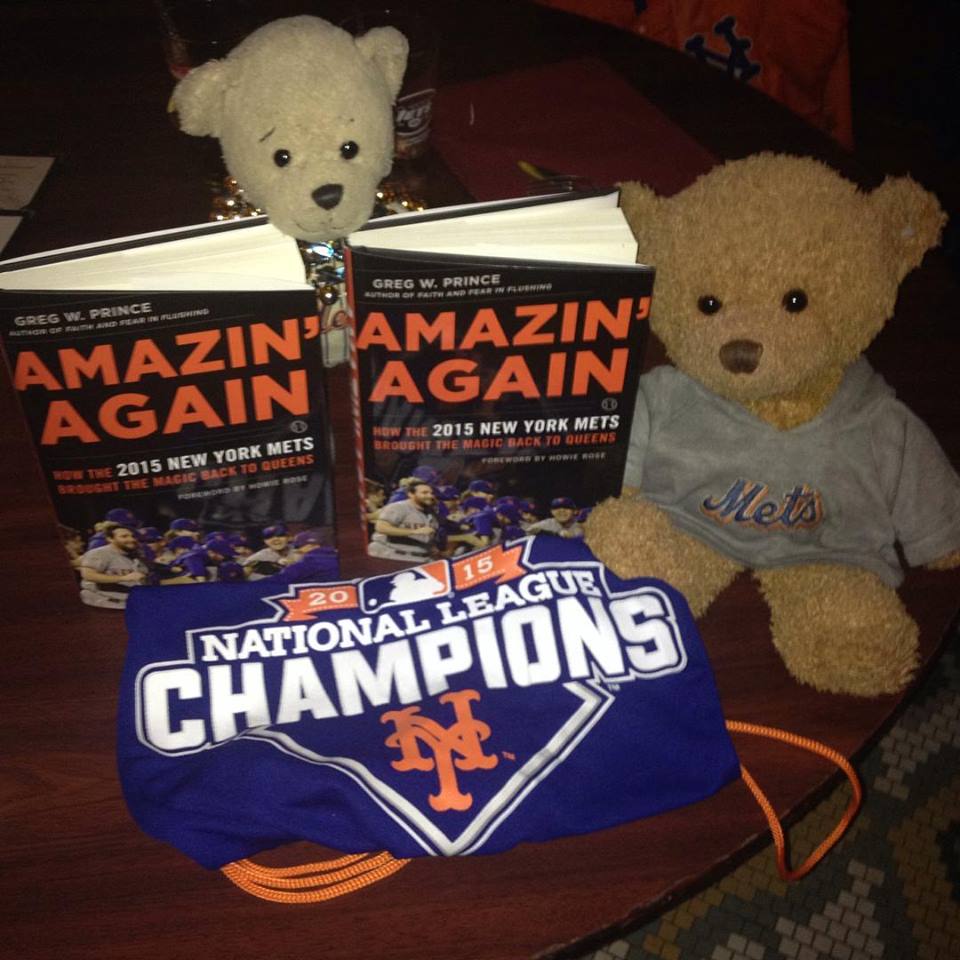
Bears On Books: Amazin' Again

Just like Mets baseball, your favorite bears who like to sit on books are back!

Happy Opening Day, everyone!  We're Joey and Iggy Beartran and we couldn't think of a more fitting way to celebrate the beginning of the 2016 campaign - a year the Mets open as defending National League champions - with a review of the book that gave us a happy recap of the previous season that the late Bob Murphy would be proud of.

Today, we'll be reviewing "Amazin' Again: How the 2015 New York Mets Brought the Magic Back to Queens" by Greg Prince.  It was a season Mets fans won't soon forget, just like this book is one Mets fans won't soon put down.

Mr. Prince, whose Faith and Fear in Flushing blog inspired the book of the same name and also laid down the blueprint for his second book, The Happiest Recap, wrote his latest work almost as quickly as it took the Mets to erase the Washington Nationals from the postseason picture.  But just because this wasn't a book that was painstakingly put together over a period of several years doesn't mean the quality suffers.  In fact, it's quite the contrary.

When Casey Stengel "perfessed" that the first words spoken by children in the 1960s had changed from "Mama" or "Papa" to "Metsie, Metsie, Metsie", he was clearly referring to Mr. Prince.  The foremost authority on all things Metsie could have written this book in one sitting and we'd believe it.  His love of the Mets permeates throughout the 215 pages dedicated to the 2015 pennant winners.

One thing that rivals Mr. Prince's love of the Mets is his love of the English language.  His pun-tastic wordplay is evident in each chapter, making a story every Mets fan remembers as if it occurred yesterday (or 155 yesterdays ago, if you want to be precise) seem fresh and new.

If a band performed at Citi Field in 2015, Mr. Prince would find a way to reference as many song titles into his review of the game that preceded each show.  Yes, this isn't just a by-the-numbers recap of the season (although numbers do find a way into the story in a way that non-mathophiles can enjoy).  Then again, it's to be expected that Mr. Prince would entertain you even when he's discussing the otherwise somber truth of the team's injury announcements.  You know, the ones that begin with "He's not going to throw today as scheduled" and end with "The Mets haven't yet announced whether they will wear a patch in his memory in 2016."

In an era where people's attention spans get shorter and shorter by the minute, it didn't take too many 60-second intervals to finish reading this book.  In fact, we devoured page after page as if they were bacon on a stick and were done with Amazin' Again less than 36 hours after we started, or about 36 hours longer than the Cubs held a lead in the National League Championship Series.  (And just wait till you get to the chapter on the NLCS.  It's totally Murphalicious.)

So as you get ready for the 2016 campaign with the memorable 2015 campaign still visible in your rear view mirror, take time out to read a wonderful work dedicated to that most recently completed campaign.  Don't be surprised if you end up shedding tears of joy after finishing Mr. Prince's book (even if you weren't just traded for Carlos Gomez).

As the subtitle of Amazin' Again says, the Mets brought the magic back to Queens.  And Mr. Prince certainly brought the magic back into our minds with his amazin' book.  We give it two very enthusiastic paws up.

Amazin' Again was so well-written, we may just have to read it again.

Wednesday, December 30, 2015

Studious Metsimus Presents The Happy/Crappy Recap For 2015

Another year has come and gone, Mets fans.  And for the first time since 2008, we're not saying goodbye to a year in which our favorite team had more losses than wins.  Does that mean this recap will be more happy than crappy?  Not exactly, especially if you've been following the goings-on in the National League East over the last few days.

The 2015 season began with Mets fans hoping the team would play their first-ever meaningful game in September at Citi Field and ended with the team playing their first-ever game in November in any of its three home stadiums.  In between, we saw new arrivals (Noah Syndergaard, Steven Matz, Michael Conforto), some departures (Kirk Nieuwenhuis left, came back and then left again) and some arrivals who departed with dignity and class (we hardly knew ye, Michael Cuddyer).

It was also the year Yoenis Cespedes gave us two memorable months and no one had any memory of Dillon Gee pitching for the team.  What else happened?  Let's see.  Daniel Murphy deep-sixed the Dodgers and Cubs.  Jeurys Familia became a lights-out closer who got lit up to close out the season.  Matt Harvey came back and then became the Pedro Martinez to Terry Collins's Grady Little in the World Series.  The Mets got no-hit by a player who had five career wins at the time and by another player who had two eye colors.  And oh yeah, there were three National League teams that had to supply with Mets with champagne and the extended use of the road clubhouse for party purposes.

Is that all?  Not exactly.  Here's more of what made us all happy in 2015 and what made us feel crappy.  As usual, let's all get happy first.

         
The Mets ripped off 11 consecutive victories in April, tying a franchise record.  When the streak began, New York was three games out of first place.  Eleven victories later, they led the N.L. East by 4½ games.  All 11 wins came at the expense of the Braves, Phillies and Marlins - teams that combined to go 201-285 during the 2015 campaign.  A non-believer in the Mets (let's call them Nationals fans) might say that anyone could have won that many games in a row against those three teams.  A believer (let's call them intelligent baseball fans) would say that one of the reasons Atlanta, Philadelphia and Miami had such poor records was because the Mets pounded them into oblivion early on, giving them no hope to be competitive for the remainder of the season.

Eric Campbell started more games at third base than David Wright.  Kevin Plawecki was behind the plate more times than Travis d'Arnaud.  The team's closer at the beginning of the season (Jenrry Mejia) was suspended not once, but twice, for the same drug.  Juan Lagares replaced his Gold Glove with one made of stone.  Michael Cuddyer reminded us of Jason Bay minus the concussion excuse.  Campbell, John Mayberry, Darrell Ceciliani, Danny Muno and Johnny Monell combined to have nearly 500 plate appearances.  And the Mets still won 90 games.  Just imagine what they could have done had they been healthy, made better decisions on which prescriptions to pick up at Walgreen's, and not been so dependent on Quadruple-A players.

Generation KO delivered a knockout blow every time one of its members took the mound.  Defending rookie of the year Jacob deGrom was better as a sophomore than he was as a Mets freshman.  Matt Harvey showed no ill effects from sitting out a year to recover from Tommy John surgery.  Noah Syndergaard was in character as Thor for the entire season, dropping the hammer on opposing hitters.  And Steven Matz made it back home, bringing his exuberant Grandpa Bert along for the ride to cheer him on after every victory.

The Mets entered uncharted waters in late July when Sandy Alderson decided to be a buyer at the trade deadline for the first time in his five-year tenure as the team's general manager.  First, he brought in Kelly Johnson and Juan Uribe to be super subs.  Then he was hip to be square, deciding to keep the emotional Wilmer Flores, while balking at Carlos Gomez and his medical records.  Finally, as the clock approached midnight in Moscow (that's 4:00pm in the Eastern Time Zone) on July 31, the cold war being staged between Alderson and rival general managers reached a truce when Tigers G.M. Dave Dombrowski agreed to trade Yoenis Cespedes to the Mets for top pitching prospect Michael Fulmer and Luis Cessa.  The stage had been set for a magical summer at Citi Field.

Once the Mets swept the Nationals at a raucous Citi Field, then repeated the feat at Nationals Park a month later, it was a foregone conclusion that the Mets were going to win the N.L. East crown for only the sixth time in franchise history.  And when Daniel Murphy put the team on his shoulders in the division series and league championship series, the Mets played their way to an improbable pennant.

And that's when things got crappy...


The Kansas City Royals remembered all too well how close they came to winning it all in 2014.  This time, they would make sure no Mets lead was safe.  And in fact, the Mets led in all five World Series games and had the lead going to the eighth inning in four of the five contests.  But through poor fielding, a lack of hitting in the late innings and Jeurys Familia doing something completely un-Familia-r (blowing late leads), the Mets couldn't ride their October momentum to a World Series championship.

And once they lost Game Five on November 1, the dominoes started to fall.  Jon Niese was traded to Pittsburgh for Neil Walker.  Wilmer Flores lost his starting job to Asdrubal Cabrera, who had a Wilmer Flores-type season at the plate in 2015 but is six years older and is costing the Mets an extra eight million dollars-plus in 2016.  But hey, at least Bartolo Colon is back to provide comic relief at the plate.

Speaking of walking up to the plate, who will replace Murphy and Cespedes's production in 2016?  With Murphy gone to the Nationals and Cespedes gone fishing for a new team, the Mets have lost the man who tied for the team lead in RBI in 2015 (Murphy) and the neon-sleeved savior who made everyone forget about Eric Campbell and his clueless cohorts.  Will Walker and Cabrera be able to replace them in the hearts of Mets fans, and more importantly, in the stat sheets of those same fans?

Finally, the Mets acquired Alejandro De Aza to platoon with Lagares in center field.  Maybe Sandy Alderson goofed and thought De Aza's last name began with a lower case D and wanted to corner the market on similarly named players (he already has d'Arnaud and deGrom on the team).  But other than the fact that De Aza was probably cheaper than Denard Span, Gerardo Parra or Max Venable and was more likely to sign a one-year deal, why the fudge was he the guy targeted to be Lagares's platoon partner?  De Aza's dWAR hasn't been above zero since 2011 and he's started a total of 13 games in center field since the end of the 2013 season, or eight more games than Darrell Ceciliani started in center for the Mets last year alone and a baker's dozen more than you and I started.

I hope Sandy Alderson knows something we don't.  Then again, in 2015, he had all the right answers to all the question marks surrounding the team, even if he had to cough and clear his throat ten times before uttering each answer.


And there you have it, Mets fans.  You now know what was happy about 2015 and what was crappy about it.  Then again, if you've been following the Mets as carefully as the Studious Metsimus staff has over the past few years, you probably didn't need a 2,000-word blog post to tell you something you already knew.

One thing you may not have known is that our staff is heavily inspired by other Mets blogs.  And as we do every year, we'd like to give a shout-out to those sites in appreciation of their hard work and to thank them for not using a teddy bear as a roving reporter/culinary expert.  We'd like to think we've cornered the market with that.  So give a hand and show your support to each of the following Mets sites: A Gal For All Seasons, Faith and Fear in Flushing, Mets Merized Online, MetsMinors.Net, Amazin' Avenue, Metstradamus, Remembering Shea, The Daily Stache, Mets360, Rising Apple, Kranepool Society, Mets Police, MetSilverman, Converted Mets Fan and Mets Daddy.

On that note, we'd like to wish you the happiest of holiday seasons.  And by "we", we're talking about Ed Leyro (that's the guy pushing the word count of this post up near Bartolo Colon's cholesterol level), Joey Beartran (the aforementioned roving reporter/culinary expert), Iggy Beartran (your source for all things related to Cole Hamels) and Taryn "The Coop" Cooper (she's just here so she won't get fined).

And remember, Mets fans, if you see a team celebrating on an opposing team's field after recording the final out of the game, it doesn't always have to be Chris Heston or Max Scherzer celebrating a no-hitter.  Nor does it have to be the Kansas City Royals whooping it up as a World Series winner for the first time in 30 years.  Sometimes it might be a team decked in blue and orange celebrating a division title, division series victory or perhaps even a pennant.

Thanks so much for your support!  See you next year!

See, players celebrating on the field sometimes ARE the Mets.

Thursday, November 26, 2015

A Joey and Iggy Beartran Thanksgiving (2015)

This blog post will go on Snoopy.  Just let us know when Snoopy is behind us.  (Ed Leyro/Studious Metsimus)

Greetings and happy Thanksgiving, Mets fans!  I'm Joey Beartran and I'm spending the holiday with my sister, Iggy.  On this special day, we're not going to say anything bad about the Mets, the Wilpons or Cole Hamels.  Instead, we're going to celebrate Bartolo Colon's favorite holiday by sharing what we are most thankful for.

Why are we sharing this on a day when no one reads Mets blog posts because they're either watching football or eating Friday and Saturday's leftovers before they become leftovers?  Because what else are you going to do during the boring halftime shows or while your Aunt Tillie is giving her ten-minute thank you speech at the dinner table making everyone at the table wonder why she was invited in the first place?

So sit back, relax and enjoy what we're most thankful for this Thanksgiving.  We promise we'll be thankful for something other than the gif that keeps on gif-ing.

Gotta work out the arms and hands that hold his knife and fork.

Joey:  I'm thankful Iggy and I have been Mets fans since birth.  Because we're such die-hard fans, no one thinks it's unusual when we travel to so many cities to attend baseball games.

Iggy:  I'm thankful we also have a designated driver in the family.  We needed someone to drive us to Cincinnati, Baltimore and Pittsburgh to watch the Mets play on the road.  We couldn't drive because ... well ... see for yourself.

I'd actually be a great driver if I could see where I was going.

Joey:  I'm thankful the Mets haven't signed any free agents so early in the off-season.  The last two years, the Mets acquired Chris Young and Michael Cuddyer before Thanksgiving.  They both ended up being turkeys for the Mets.  And not the good kind.

Iggy:  Speaking of turkey, I'm thankful we got to try new foods while we were away on our road trips.  It helped us forget that Young was ever on our team and that Cuddyer ... oh wait ... he's still on our team, isn't he?  Well, at least we'll always have coneys and chili cheese fries.  Or at least you did.  I was busy taking this photo of you while you were enjoying the Cincinnati staple.

Why doesn't Coney Island have coneys?  And why isn't it an island?  Something to ponder as I chow down.

Joey:  I'll always be thankful for what Yoenis Cespedes did to get the Mets to the playoffs and what Daniel Murphy did to carry the Mets to the World Series.  Without them, my dreams of attending a Fall Classic game with Iggy would not have come true.

Iggy:  Aw, thank you, Joey.  And I'm thankful that Murphy showed he can hit left-handers in the playoffs, homering twice off Clayton Kershaw and once off Jon Lester.  Speaking of southpaws, did you know that Daniel Murphy has owned that smiling ass, Cole Hamels, over his major league career, batting .321 with four doubles and a homer off Hamels in 53 lifetime at-bats?  What?  I wasn't supposed to say anything bad about Hamels?  But I wasn't.  I was complimenting Daniel Murphy.

Will Cespedes and Murphy be back to pose for more photos like this?  (Photo courtesy of SI.com)

Joey:  Finally, I'm thankful that we're going into the 2016 campaign as defending National League champions.  With Jacob deGrom and Matt Harvey leading the rotation and a full season of Noah Syndergaard and Steven Matz's services, not to mention the return of Zack Wheeler, the Mets look like they will be in contention for another postseason berth next year and in the years to come.

Iggy:  I'm just thankful this blog post is over.  All this talk about baseball and Thanksgiving dinner made me hungry for peanuts, Cracker Jack, hot dogs, turkey, stuffing ... oh, and Joey would probably want something, too.

These are just our appetizers until we get the main course.

Well, I guess we've reached the end of our annual Thanksgiving Day post.  We're glad we were able to provide a distraction from your Aunt Tillie's Thanksgiving Thesis.  And we're even more glad that you (the reader) and us (Joey and Iggy) all have something in common.  We're all fans of the defending National League champion New York Mets.

It's been a wonderful year - one we will not soon forget.  You should all be thankful that you got to experience it with your fellow Mets fans.  Let's make 2016 even more special.

From our family to yours, we hope you have a happy and healthy Thanksgiving.  And never stop believing in your team.

LET'S GO METS!!

Keep reaching for the stars and you'll always believe!


Saturday, October 17, 2015

The Cubs May Hit Their Share of Home Runs, But...


During the 2015 regular season, the Chicago Cubs became the first team to ever sweep a season series of more than six games against the Mets.  The Cubs outscored the Mets, 27-11 en route to a 7-0 record against New York.  Chicago hit seven home runs in the seven games, en route to a season total of 171 long balls.

Chicago's penchant for hitting the ball out of the park continued in the postseason, as they homered twice in the wild card game against the Pirates and walloped ten home runs in the four NLDS games versus the Cardinals, including six in Game Three.

When you combine the Cubs' power with an ace pitcher like Jake Arrieta, it's not surprising that Chicago won 97 games in 2015.  However, they can be beaten, and the Mets may just be the right team to keep the curse of Murphy the billy goat intact.

As much as the Cubs flexed their muscles at the plate during the regular season, it was the Mets who finished with more home runs.  New York hit 177 homers, or six more than the Chicago's total.

Kris Bryant was one of the Cubs' top home run hitters, smacking 26 homers in 151 games.  However, it should be noted that he hit just five of those home runs on the road, and that handful of homers came off the following pitchers:

  • Kyle Lohse, Brewers (5.85 ERA, 1.46 WHIP)
  • Odrisamer Despaigne, Padres (5.80 ERA, 1.39 WHIP)
  • David Murphy, Indians (a position player)
  • Alex Wood, Dodgers (4.35 ERA, 1.27 WHIP)
  • Alec Asher, Phillies (9.31 ERA, 1.79 WHIP)

For all you kids out there, those four pitchers and one position player combined for a 5.82 ERA and 1.43 WHIP during the 2015 campaign.  Those were the only players Bryant could muster a homer against away from the Friendly Confines.  It should be noted that the Mets will have home field advantage in the NLCS.

With great power comes great strikeout-ability, and the Cubs created enough of a breeze with their swings and misses to power a wind turbine.  Led by Bryant's league-leading 199 whiffs, Chicago batters struck out a mind-boggling 1,518 times during the regular season.  That's the most in franchise history, surpassing the team's old mark of 1,477, which was set just last year.  Prior to then, no Cubs team had ever struck out more than 1,269 times.  In addition, the Cubs had more strikeouts than any other team in the majors.  Houston had the second-most strikeouts in the big leagues with 1,392, but was still well behind Chicago's total.  And with six of the seven games potentially being started by Matt Harvey, Noah Syndergaard and Jacob deGrom, who combined to fan 559 batters in 530 innings, Cubs batters should be seeing strike three quite often in the series.

Speaking of the Mets starting pitchers, let's talk about what they did against the Dodgers in the division series.  For as many home runs as Chicago hit, it was Los Angeles that led the National League, as Dodgers players circled the bases 187 times in 2015.  That gave the Mets valuable experience against a team that knows how to hit balls out of the park.  So how many times did the Dodgers take Mets starting pitchers deep in the five-game series?


That's a big fat zero.  Zilch.  Nada.  Cubs batters might have done well against lesser hurlers this season, but they're in for quite a surprise when they face the velocity and movement of pitches thrown by Harvey, Syndergaard and deGrom.

So if the Mets prevent the Cubs from hitting homers, can Chicago score any other way?  The answer is one that even Grumpy Cat can agree with.

As mentioned before, the Cubs hit 171 home runs during the regular season.  They accomplished this in 5,491 at-bats.  They also had 1,174 hits that didn't leave the yard.  That means when the Cubs kept the ball in front of the outfield fence, they only batted .221.  Chicago scored 414 runs this year that didn't cross the plate on the strength of a home run.  That's just 2.6 non-homer aided runs per game.  In the division series against the Cardinals, it was homer-or-nothing for the Cubs, as ten of their 30 hits in the series left the yard.  Chicago batted just .175 (20-for-114) when they didn't hit the ball out of the park and scored 14 of their 20 runs on homers, averaging just 1.5 runs per game that weren't because of home runs.

The Mets, in particular their starting pitchers, have done their best to limit their opponents from producing big innings against them.  One way they've done this is by keeping the ball in the park.  Including the postseason, Harvey, Syndergaard and deGrom did not allow a home run in 50 of their 87 starts.  Harvey, the Mets' Game One starter, has not allowed a home run since September 2.  He has pitched 28 consecutive innings without giving up a tater.

So yes, it's true that the Cubs' offense revolves around the home run ball.  But they may be running into the worst possible team at the worst possible time if they plan on continuing to score most of their runs on 360-foot trots around the bases.  The Mets will still have to score some runs of their own, but they may not have to out-slug the Cubs to do so.