Showing posts with label Tom Glavine. Show all posts

Thursday, June 11, 2020

The Von Hayes Game Haunts Me to This Day

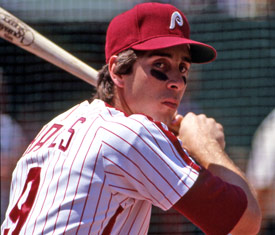
Forget Freddy Krueger.  This is the true man of my nightmares.  (MLB.com)

On June 11, 1985, the Mets took on the Philadelphia Phillies at Veterans Stadium.  New York entered the game with a 31-22 record, leaving them just three games behind the first place Chicago Cubs.  The Phillies, on the other hand, were already falling out of contention in the N.L. East with a 20-34 mark.  Only the Pittsburgh Pirates and Cleveland Indians had a worse record in the majors than the phloundering Phils at the time.

Starting for the Mets that night was Tom Gorman, who was making just his seventh start in the big leagues but was entering the game with a solid 2.52 ERA.  Philadelphia countered with Charles Hudson, who had lost each of his previous four starts, with the Phillies having scored a total of seven runs in those four contests.

Clearly, the Mets appeared to have an advantage coming in to the game.  Then Von Hayes happened.  And I haven’t recovered since.

Without going into too much detail for fear that I’ll suffer a post-traumatic Mets disorder breakdown, Gorman faced seven batters and retired one of them.  He couldn’t retire Von Hayes, who led off the game with a home run.  Gorman had already been replaced by Calvin Schiraldi by the time Hayes batted for a second time in the first frame, not like Hayes could tell the difference, as he launched a grand slam off Schiraldi.  An inning later, with Schiraldi still in the game, Hayes singled and scored a run.

After two innings, the Mets were losing, 16-0.  And then it got worse.

Schiraldi allowed ten runs before manager Davey Johnson ended his suffering.  The Mets then scored seven unanswered runs to make it 16-7, at which time Johnson summoned Joe Sambito from the bullpen to relieve Doug Sisk, who had pitched 2 scoreless innings.  Clearly, Sambito decided he was going to pay homage to Schiraldi’s performance, as he gave up ten runs of his own.  Included in the carnage was a bases loaded walk to Von Hayes, who later came around to score his fourth run of the game on a groundout.

The final straw in what became a 26-7 loss came during the WHN radio post-game show when the turning point of the game was announced.  Was it Von Hayes’ leadoff homer or his grand slam?  How about Sambito giving up a ten-spot after the Mets had cut the deficit to a “manageable” nine runs?  Nope, it happened well before either of those events took place, as fellow Von Hayes Game sufferer Vince Vincenzo can attest.


Oh say, can you see how much this game affected me.

Things eventually got better for the Mets following their historic loss to the Phillies, a game that forever put Von Hayes’ name in the minds of Mets fans who obsess over every little thing about their team.  (And by “Mets fans who obsess over every little thing about their team”, I mean me.)

New York passed the first place Cubs in the standings and went on to win 98 games in 1985, just two victories shy of a franchise record.  Yes, they lost the division to the St. Louis Cardinals instead of the Cubs, but they proved that the 1984 campaign - a year in which they won 90 games and finished above .500 for the first time in eight years - was not a fluke.  They continued their climb in 1986, a season that culminated in the franchise’s second World Series championship.

Since winning it all just sixteen months and sixteen days after the Von Hayes Game took place, the Mets have reached the playoffs six times, including three division titles and two National League pennants.  One would think that success would erase the events of June 11, 1985 from my mind.  One would be wrong.

The truly Hayesian effort continues to haunt me to this day.  Every time the Mets fall behind by a significant number of runs early in a game, I find myself saying aloud, “Who’s going to be Von Hayes in this game?”  Whenever a Mets reliever comes into the game in a mop-up role, proceeds to get shelled and then is left on the mound to take one for the team, the Schiraldi and Sambito Wrecking Crew come to mind.

Even while watching a Mets game that ends up well for the good guys, the Von Hayes Game is inevitably brought up.

During the current pandemic, SNY has taken to showing classic Mets games from years past.  One contest that has been aired ad nauseam is Game Seven of the 1986 World Series.  As we all know, while Von Hayes and his Phillies’ teammates were watching this game at home, the Mets were putting together their second straight comeback win against the Red Sox.  With the score tied in the seventh inning, Boston manager John McNamara brought in Calvin Schiraldi to face Ray Knight, who had delivered a key single against Schiraldi in the miraculous tenth inning comeback just two nights before.  Knight followed up his bloop in Game Six with a blast in Game Seven, taking Schiraldi out of the park to give the Mets the lead.  But they weren’t done yet.

After Knight circled the bases, Schiraldi allowed a hit to Lenny Dykstra, uncorked a wild pitch on a pitchout to Rafael Santana, then gave up another hit to Santana.  After Roger McDowell moved Santana into scoring position with a sacrifice bunt, McNamara replaced Schiraldi with Joe Sambito, who continued to add gas to the fire.  Sambito issued two walks and allowed a sacrifice fly to Keith Hernandez, which scored the sixth run of the game, otherwise known as the run that was the difference in the 8-5 championship-clinching win by the Mets.

A normal fan would have just celebrated the rally by the Mets, praising their clutch hitters coming up big in key late-inning situations.  I guess I’m not a normal fan.  Because this is what I was doing while watching that seventh inning (even though I mistakenly referred to it as happening in the sixth; I blame Von Hayes for my error).


We all have games that give us a kind of post-traumatic Mets disorder; games that are forever associated with the opposing player responsible for our pain.  Whenever someone mentions the Terry Pendleton Game, we know what they’re referring to.  The Mike Scioscia Game?  Don’t get me started.  Some people even can’t let go of the Jason Jennings Game (although I think those people remember it more for Donne Wall than for what Jennings did to the Mets).  Personally, I’m surprised that after his devastating performance against the Marlins to close out the 2007 season, Tom Glavine didn’t say, “I’m disappointed, but at least it wasn’t the Von Hayes Game.”

See what I mean about PTMD and not being able to let things go?

For me, I can’t seem to rid myself of the Von Hayes Game, which took place 35 years ago today.  It comes back to me during blowouts.  It comes back to me during World Series viewings.  It comes back to me when I flip the channel past VH-1 and think it stands for “Von Hayes Won”.  Heck, I can’t even see the Van Halen logo and not think of Von Hayes.


You can't unsee it, can you?


A third of a century after “The Von Hayes Game” became part of my vocabulary, the Mets defeated the Phillies at Citizens Bank Park, 24-4.  In that game, played on August 16, 2018, the Mets broke a 31-year franchise record for runs scored in a game.  They pounded out 25 hits, of which 11 went for extra bases.  It got so bad for the home team that they used two position players to pitch the final three innings.  The Mets knocked them around as well, crossing the plate nine times in those three frames.

I should have been ecstatic at the offensive outburst.  I should have been thrilled the Mets beat up on a division rival.  I should have celebrated a long standing franchise record being toppled.  Instead, I just said four words as the game came to its conclusion.

“TAKE THAT, VON HAYES!!”

I guess it just goes to say that in good times and in bad, the man and the game that put his name in my brain will always find a way to haunt me.  Anyone know the number of a good exorcist?


Call the Ghostbusters.  I'm being haunted by Von Hayes. (Scott Halleran/Getty Images)


Sunday, August 12, 2018

Three-Run Leads Are a Recipe For Disaster For the Mets

"You know what, Mickey?  My high school sweetheart, Sandy Koufax, never blew a three-run lead." (R. Schultz/Getty Images)


Good baseball teams know how to hold leads when they have them.  And as a team's lead increases, the odds of ending the game with a happy recap usually increase as well.

That is, unless you're talking about the 2018 Mets.

The Mets lost Saturday night's game to the Miami Marlins in 11 innings.  New York dropped the 4-3 decision after taking an early 3-0 lead.  If that kind of result sounds familiar to you, you're not alone.  In fact, just minutes after the walk-off defeat was complete, I was asked this question on Twitter.


I can't confirm if the Mets have set some kind of record for losing games after holding a three-run lead, mainly because I'm lazier than the average blogger, but thanks to baseball-reference.com, I can say that the Mets have lost an incredibly high percentage of games in which their opponent had to erase a deficit of three or more runs.  But before we get to that, here's a little background research.

For the Mets to lose a game in which they held a three-run lead, that implies that they had to score at least three runs.  (Duh!)  And in their 66 losses to date, they were held to fewer than three runs a total of 36 times.  For all you kids out there, that's a lot of defeats in which the Mets couldn't have possibly held a three-run lead.

So that leaves just 30 losses in which the Mets could have been up by three runs.  You would think that given the fact that I only had to go through two-and-a-half dozen boxscores, I would find maybe five or six instances in which the Mets lost after they had taken a three-run advantage on their opponent.  If you thought that was the case, then clearly you haven't been following the 2018 Mets closely.

Here are all the games so far this season in which the Mets gave us temporary pleasure by taking a three-run lead before reminding us that they're still the 2018 Mets.

  • April 16:  Mets lead Nationals, 6-1.  Lose 8-6.
  • April 21:  Mets lead Braves, 3-0.  Lose 4-3.
  • May 26:  Mets lead Brewers, 3-0.  Lose 17-6.
  • May 27:  Mets lead Brewers, 4-1.  Lose 8-7.
  • May 29:  Mets lead Braves, 4-0.  Lose 7-6.
  • June 9:  Mets lead Yankees, 3-0.  Lose 4-3.
  • June 20:  Mets lead Rockies, 4-1.  Lose 10-8. 
  • June 27:  Mets lead Pirates, 3-0.  Lose 5-3.
  • July 3:  Mets lead Blue Jays, 5-0.  Lose 8-6.
  • July 27:  Mets lead Pirates, 3-0.  Lose 5-4.
  • Aug. 5:  Mets lead Braves, 3-0.  Lose 5-4.
  • Aug. 11:  Mets lead Marlins, 3-0.  Lose 4-3.

The Mets have lost 30 games this season in which they scored at least three runs.  And in a dozen of those contests - that's an incredible 40% of the defeats - they held a lead of at least three runs.  It's so unbelievable, even Tom Glavine would be devastated by it.  (His former team, the Atlanta Braves, have no problem with the Mets' generosity, as they've engineered three of those 12 comebacks.)

Do you remember earlier when I said that good teams know how to hold leads?  The 2015 National League champion Mets - otherwise known as a good team - lost just six games all year in which they held a three-run lead.  This year's squad has doubled that total with 48 games still left to play.

On Sunday, less than 24 hours after suffering their 12th defeat in a game where they held a lead of at least three runs, the Mets defeated the Marlins, 4-3.  How did they manage to hold the lead in this game?  It's simple, really.  They never allowed their lead to reach three runs at any point in the game.  If only they had followed that formula all year.


Monday, February 16, 2015

Three Mo-METS In Time: Kenny Rogers, Aaron Heilman, Tom Glavine (The Three Enemigos)

A general manager can acquire baseball players in several ways.  These ways include - but are not limited to - trading for players, signing free agents or drafting players.  From 1997 to 2003, the man who traded, signed and drafted players for the Mets was general manager Steve Phillips.

Phillips helped build the Mets into a contender, adding proven talent like Mike Piazza and Robin Ventura to a squad that had ended a six-year run of futility during the first year of Phillips' tenure.  He also set the Mets up for success after his departure by drafting David Wright and signing Jose Reyes.

But Phillips also had his share of duds, as anyone who remembers the 2002 season can attest.  (The law office of Alomar, Vaughn, Burnitz and Cedeño lost a lot of cases for that team.)  He also failed to keep quality players when he had them.

Phillips could not re-sign first baseman John Olerud, who went back home to the Pacific Northwest after Phillips made a poorly-timed comment about the World Trade Organization riots going on in Seattle, saying, "I can't understand why anybody would want to play in Seattle after seeing the chaos.  I would think there'd be a mass exodus."  Olerud went on to win three Gold Gloves and made an All-Star team with the Mariners (he accomplished neither in his three years as a Met).  He also played in the postseason four times after leaving the Mets.

In addition to Olerud, who left via free agency, Phillips also pushed the panic button when shortstop Rey Ordoñez got hurt in 2000, trading Melvin Mora to the Orioles for short-term solution Mike Bordick.  The 35-year-old Bordick, who was having a career year in Baltimore (.831 OPS), underperformed in New York (.685 OPS).  Mora went on to become a two-time All-Star and Silver Slugger recipient in ten seasons with the O's, while Bordick went on to become an Oriole again in 2001, leaving the Mets as a free agent.

Needless to say, Phillips had his ups and downs as general manager of the Mets.  But three players - players who are now vilified in New York - were originally viewed as key pieces to helping the team either make a push for the postseason or bringing the team back to respectability.  One was acquired via a trade.  Another was drafted by Phillips.  The third came to New York as a free agent.  For the most part, they performed well while in New York.  But no one ever remembers that.  The only thing anyone remembers about them was their contribution to three of the lowest moments in Mets history, essentially turning them into the Three Enemigos - enemies of Mets fans who wanted so badly to taste postseason success, only to have it taken from them through three epic meltdowns.

Kenny Rogers, Aaron Heilman and Tom Glavine - the Three Enemigos!

In 1998, the Mets failed to end a ten-year postseason drought, coughing up a one-game lead in the wild card race in the season's final five games.  Although New York added future Hall of Famer Mike Piazza in May, the team only made minor moves at the trade deadline in 1998, dealing for players such as Tony Phillips, Wille Blair, Jorge Fabregas and Mike Kinkade.  Not wanting to use the same approach in 1999, general manager Phillips went all-out at the trade deadline, acquiring veterans Darryl Hamilton and Shawon Dunston.  He also made two separate trades with Oakland, dealing away former Generation K member Jason Isringhausen for reliever Billy Taylor and shipping off outfield prospect Terrence Long (who became the AL Rookie of the Year runner-up in 2000) for starting pitcher Kenny Rogers.

Rogers pitched well for the Mets during the season's final two months, tossing two complete games, one of which was a four-hit shutout against the San Francisco Giants on September 6.  The Mets won ten of the 12 starts made by Rogers, including his critical performance in the first game of the season-ending series versus the Pittsburgh Pirates.  With the Mets two games out of the wild card with three games to play, Rogers held the Bucs scoreless into the eighth inning, striking out a season-high ten batters.  But Rogers allowed a run in the eighth, then watched from the bench as a walk by Turk Wendell and a single off John Franco allowed the tying run to score.  The Mets eventually won the game in 11 innings to keep their postseason hopes alive and three days later, their playoff dreams came true after they defeated the Cincinnati Reds in the season's 163rd game.

In his first nine starts for the Mets following the trade, Rogers was a perfect 5-0 with a 3.23 ERA and 1.26 WHIP.  The Mets won eight of those nine starts, which impressed manager Bobby Valentine.

''He surprises me with his curveball, something I didn't know he had developed so well,'' said Valentine.  ''He's a much better pitcher than I remembered. ... He's everything that we had hoped for.'' 

What Valentine hadn't hoped for was Rogers falling apart in his next two starts, allowing a total of ten runs and not making it past the fifth inning in either game, both of which came against the sub-.500 Phillies.  His strong performance against the Pirates in his final regular season start only served to place a bandage on a cracking dam.  That crack would burst in the postseason.

The Mets lost a total of five games against the Arizona Diamondbacks and Atlanta Braves in the 1999 postseason.  Three of those five losses were charged to Kenny Rogers.  A home run by backup catcher Todd Pratt ended the division series in four games, temporarily making Mets fans forget that Rogers was responsible for the team's only loss in the series, a game in which he allowed four runs in 4⅓ innings.

Rogers didn't fare much better a week later in his first NLCS start.  After dropping the first game to Atlanta, the Mets desperately needed a series-tying win before coming back home to Shea Stadium.  Although Rogers kept the Braves scoreless through the first five innings, he was constantly pitching in and out of trouble, allowing eight base runners in those five frames.  But the Braves squandered several scoring opportunities, grounding into two double plays and getting picked off first base on two occasions.  Rogers was more lucky than good in the first five innings.  His luck ran out in the sixth, as he allowed a game-tying two-run homer to Mets killer Brian Jordan, followed by another two-run homer by light-hitting catcher Eddie Perez.

"I can't believe I just gave up a homer to Eddie Perez." (Steve Schaefer/AFP/Getty Images)

It was bad enough that Rogers had coughed up the lead in the critical Game Two loss to the Braves.  But that's not what Mets fans remember him for.  The moment that truly made Rogers an enemy of the Mets' state happened four games later, when two of his fellow pitchers blew late-inning leads and he was called upon to keep the game tied.  Until it wasn't.

As a result of the game-winning Grand Slam Single by Robin Ventura in Game Five - a game in which Kenny Rogers pitched two scoreless innings of relief, the Mets became just the second team in big league history to force a Game Six after dropping the first three games of a best-of-seven series.  The series shifted back to Atlanta for the sixth game, but the Mets didn't show up for that game until after it had begun, falling behind by five runs in the first inning.

The never-say-die Mets did not panic, despite the early 5-0 deficit.  New York scored eight runs from the sixth through the eighth innings, taking a one-run lead into the bottom of the eighth.  But John Franco allowed a one-out single to Eddie Perez (you may remember him as the aforementioned light-hitting catcher), a stolen base by pinch-runner Otis Nixon and a run-scoring single by Brian Hunter.  Once again, the Mets and Braves were going to extra innings with the Braves a run away from winning the pennant.

In Game Five, Todd Pratt tied the game in the 15th inning with a bases-loaded walk.  Two days later, Pratt gave the Mets an extra-inning lead, hitting a sacrifice fly to score Benny Agbayani in the tenth.  But once again, the Mets bullpen could not hold the lead, as Armando Benitez allowed a one-out RBI single to yet another light-hitting Brave - pinch-hitter Ozzie Guillen.  The game was now tied, 9-9, as the teams moved on to the 11th inning.  This time, the Mets could not push across a run to take the lead in their half of the inning, a frame that saw the Mets use Shawon Dunston as a pinch-hitter for Benitez.  New York had used nine pitchers in their Game Five victory.  With Benitez now out of the game, the Mets needed an eighth pitcher to start the bottom of the 11th in Game Six.  Valentine rolled the dice and turned to Kenny Rogers.  The decision ended up costing the Mets their magical season.

Rogers allowed a leadoff double to Gerald Williams, who advanced to third on Bret Boone's sacrifice bunt.  Valentine then had Rogers intentionally walk Chipper Jones and Brian Jordan to set up a force play at every base.  But that also forced Rogers to pitch with pinpoint control to slugger Andruw Jones.  Finally, on a 3-2 count, Rogers threw a pitch that wasn't even close to the strike zone, allowing Williams to scamper home with the pennant-winning run and the Mets to fly home with their season coming to a screeching halt.

Although he pitched fairly well during the regular season following his mid-season trade to the Mets, Rogers fell apart in the postseason, going 0-3 with a 6.75 ERA.  Rogers pitched 12 innings in two starts and two relief appearances, allowing 26 base runners (16 hits, nine walks, one hit batsman).  The Mets eventually did win the pennant in 2000, but they did so without Rogers, who signed as a free agent with the Texas Rangers following his postseason pratfalls.  For many Mets fans, he left the team four balls too late.

After the Mets lost the 2000 World Series to the Yankees (without Rogers), Steve Phillips went into the 2001 June amateur draft hoping to find a talented arm who could help the team in the near future.  After all, four of the club's five starting pitchers in 2001 were already in their thirties and the team had just lost starting pitcher Mike Hampton to free agency.  However, as a result of Hampton's defection to the thin air and utopian school system in Denver, the Mets received two first round draft picks from the Rockies.  With their supplemental pick from Colorado, the Mets chose infielder David Wright and with their compensation pick, New York selected pitcher Aaron Heilman.

At least David Wright turned out okay.  (Doug Benc/Getty Images)

As a student-athlete at Notre Dame, Heilman set school records in career wins (43) and strikeouts (425).  He also rarely gave up home runs, allowing just 12 homers in 393⅔ innings.  That trend continued in the minor leagues, as Heilman surrendered just 15 homers in three minor league seasons before making his major league debut for the Mets in 2003.  Unfortunately, Heilman took some time to adjust to major league hitters, especially ones with power.

From 2003 to 2004, Heilman made 18 starts for the Mets, allowing 17 homers in 93⅓ innings.  It was more of the same for Heilman in his first start of the 2005 campaign, as he allowed home runs to noted Met-killers Brian Jordan and Chipper Jones in a loss to the Braves on April 9.  His next start was a revelation, as Heilman pitched a complete-game one-hit shutout against the Florida Marlins, allowing just a fourth-inning single to future Met Luis Castillo.  But when Heilman faced the Marlins again in his next start, he allowed seven runs and 11 hits in just four innings of work.  A month later, Heilman had lost his spot in the starting rotation.

The home run ball was one of the reasons why Heilman never made it as a starting pitcher, as he served up 22 taters in his first 25 career starts.  But once he moved to the bullpen, Heilman thrived.  He allowed just one homer in 45 relief appearances, with that long ball coming in garbage time on August 24 during the late innings of an 18-4 Mets victory over the Diamondbacks.

In 2006, Heilman once again finished strongly.  From July 19 to the end of the season, Heilman made 33 relief appearances, posting four wins, 12 holds, a 2.29 ERA and a stellar 0.93 WHIP.  Opposing batters hit just .190 off Heilman in those 33 games and most importantly, failed to hit any home runs off him in 35⅓ innings.  Heilman went nearly three months without allowing a home run until he surrendered what appeared to be a meaningless home run to Wilson Betemit in Game Two of the division series against the Los Angeles Dodgers.  It was the only run allowed by the Mets in a 4-1 victory.  Two weeks later, Heilman allowed another home run.  This time, the blast wasn't so meaningless.

In a tension-filled seventh game of the NLCS against the St. Louis Cardinals, the Mets and Cards were tied, 1-1, going to the eighth inning.  As he had done throughout the season, manager Willie Randolph brought in Heilman to pitch the eighth inning.  Heilman rewarded his manager by pitching a scoreless frame, sandwiching two strikeouts around an intentional walk to Albert Pujols.  But instead of bringing in closer Billy Wagner to start the ninth, even though there was no chance for a save situation with the Mets playing at home, Randolph decided to hold Wagner in case the game went into extra innings, allowing Heilman to pitch the ninth.

Heilman had pitched beautifully in 2006, but he was most effective as a one-inning pitcher.  During the regular season, Heilman was asked to pitch more than one inning in 17 of his 74 relief appearances.  He allowed runs in nine of those 17 outings.  When asked to pitch no more than one inning, Heilman held the opposition scoreless in 45 of those 57 appearances.  But Game Seven was a different animal, and Heilman was going to pitch as long as Randolph needed him to stay on the mound.  Three batters into the ninth, Heilman became a part of Mets history, but not for a moment he wanted.

I wonder what's got everyone's attention in this photo.  (Photo by Bill Kostroun/AP)

During the 2006 regular season, Cardinals catcher Yadier Molina batted .216 and had a .271 on-base percentage.  He also was not a threat to go deep, as he had notched just 16 career homers in 1,033 plate appearances.  Clearly, Molina was not a Mike Piazza-type hitting catcher.  In fact, he couldn't even be compared to someone like, oh, let's say Mike Scioscia.  Although Molina's power was comparable to Scioscia, who hit 35 homers in 3,295 plate appearances through 1988, at least Scioscia knew how to reach base (.263 batting average, .350 on-base percentage during the same span).

In 1988, Scioscia had 31 plate appearances against the Mets during the regular season.  He produced no homers and one RBI against them.  Similarly, in his short career, Molina had 32 lifetime regular season plate appearances versus the Mets entering the 2006 NLCS.  Those plate appearances produced - you guessed it - no homers and one RBI for Molina.  In the 1988 National League Championship Series, Scioscia pulled a two-run homer off Dwight Gooden in the ninth inning at Shea Stadium in what was considered the turning point of the series.  Eighteen years later, a catcher with little power was batting in the ninth inning at Shea during a critical moment of the NLCS.  Once again, the light-hitting catcher had a runner on base and was facing a homegrown, first round draft pick.  And once again, the ball was pulled out of the yard.

Ever since becoming a relief pitcher in 2005, Aaron Heilman had become a master of keeping the ball in the park, allowing just six homers in 119 relief appearances during the 2005 and 2006 campaigns.  But once Molina beat him for a pennant-winning two-run homer in Game Seven of the 2006 NLCS, Heilman became quite susceptible to the long ball, serving up 18 homers in 159 games over the next two seasons.  And it wasn't just the fact that he was giving up homers.  He was also giving them up with men on base.

From 2003 to 2006, Heilman allowed 28 homers.  Exactly half of them (14) were solo shots.  After giving up the fateful home run to Molina, Heilman yielded 18 homers in his final two years as a Met.  Only four of them were hit with no one on base.  Six of them came with at least two runners aboard (four three-run homers, two grand slams).

Aaron Heilman was supposed to be a top prospect for the Mets who prided himself on keeping the ball in the park.  As a relief pitcher in 2005 and 2006, he was one of the best at doing just that.  That is, until Yadier Molina took a page out of the Mike Scioscia Guide to Hitting Devastating Home Runs.  Heilman - and the entire Mets franchise, for that matter - never recovered.

Speaking of being devastated, one player who signed with the Mets as a free agent during Steve Phillips' tenure as general manager was present at both the Kenny Rogers and Aaron Heilman meltdowns.  As a member of the Braves in 1999, he was in a celebratory mood when Rogers walked Andruw Jones to force in the decisive run, but seven years later he was more somber as a member of the Mets who witnessed the Molina home run.  One year after the Molina bomb, he put up a stinker of his own, not that he was all that devastated by it.

Tom Glavine was an enemy before and after he became an "enemigo".  In 17 years with the Braves (1987-2002, 2008), Glavine made 36 regular season starts against the Mets, posting a 17-7 record and 2.82 ERA.  His .708 winning percentage versus New York made him one of just three pitchers (min. 35 starts) who won at least 70% of his decisions against the Mets, joining two former Giants - Juan Marichal (26-8, .765 winning percentage) and Mike Krukow (22-7, .759).  But when Phillips needed to make a splash following the Mets' first losing season in six years, he turned to the Mets' nemesis, signing Glavine to a three-year, $35 million contract with a fourth-year option.  Glavine, who had 242 career wins at the time, thought he needed four productive seasons to reach 300 victories.

''I want to have the opportunity to win 300 games, and I think in order to do that, I have to pitch four years,'' said Glavine.  ''So I don't want to make a decision and in three years have to find a team to pitch for in the fourth year.  That fourth year is an important part of it.''

Glavine needed more than four years to reach 300 wins, as he produced 48 victories in his first four seasons as a Met.  But after becoming the only Mets pitcher to win multiple games during the 2006 postseason and needing just ten wins to become the first pitcher to win his 300th game while wearing a Mets uniform, the Mets almost had to bring Glavine back, which they did when they signed him to a one-year, $10.5 million contract to pitch for the team in 2007.

The Mets weren't nearly as successful in 2007 as they had been a year earlier.  Neither was Glavine, for that matter.  After going 15-7 with a 3.82 ERA in 2006, allowing three runs or fewer in all but seven of his 32 starts, his 2007 campaign was quite pedestrian (13-8, 4.45 ERA).  Glavine also allowed six runs or more in seven of his 34 starts in 2007.  One of those seven poor efforts came in Glavine's next-to-last start of the season, when he allowed six runs in five innings against Washington.  The Mets scored six runs in the ninth inning to make the Nationals sweat, but fell short by a single tally, losing a 10-9 heartbreaker.

Although Glavine could have easily been remembered for that subpar performance, the Mets still had a two-game lead in the division over the Phillies with five games to play.  Glavine would get one more opportunity to pitch before the end of the regular season, with the Mets hoping that the division could be clinched before then.  But it wasn't.  And Glavine's final start would determine if there would be October baseball at Shea Stadium.  Spoiler alert: There wasn't.

One day after John Maine had one of the best pitching performances in franchise history (no runs, one hit allowed, 14 strikeouts, no-hitter broken up with two outs in the eighth), Glavine had one of the worst.  Four batters into the game, Glavine had already given up more hits than Maine did the previous day.  Glavine faced every batter in the Marlins' lineup in the regular season finale.  He retired one of them.  The southpaw allowed four singles, a double, two walks and made a throwing error before hitting opposing pitcher Dontrelle Willis with the bases loaded to force in a run.  When reliever Jorge Sosa allowed a two-run double to Dan Uggla - the only batter Glavine retired in his abbreviated outing - the book on Glavine was closed.

In the Mets' biggest game of the season, Glavine pitched one-third of an inning, allowing seven runs - all of them earned.  His ERA for the day was an unfathomable 189.00.  The only thing larger than his earned run average was the enormity of the loss, as the 8-1 defeat, coupled with the Phillies' 6-1 victory, gave Philadelphia its first division crown in 14 years.  The crushing loss also sent the Mets home prematurely after the team held a seven-game lead in the division with 17 games to play.

As upset as Mets fans were with the team's collapse during the final three weeks of the season, they became even more incensed after hearing how Glavine felt about his performance, especially his choice of words when asked by a reporter if he was devastated by the loss.


"I'm not devastated, but I am disappointed.  Devastated is a word used for greater things in life than a game.  I was disappointed in the way I pitched."


For Mets fans who lived and died with the team since before Glavine had thrown his first pitch in the majors, the season-ending loss in 2007 was one of the toughest to comprehend, almost as difficult to swallow as Glavine's post-game comments.  Glavine's performance not only capped an historic collapse, it reinforced the notion that the Mets could not win the big game, similar to Kenny Rogers' loss in Game Six of the 1999 NLCS and Aaron Heilman's defeat in Game Seven of the 2006 NLCS.

The Mets once again lost a late-season division lead in 2008, although that one was just a three-and-a-half game lead, then followed that up with six consecutive losing seasons.  If only Kenny Rogers had not suffered a postseason meltdown in 1999, or if Aaron Heilman had known that light-hitting catchers can indeed become supermen at Shea Stadium in October, or even if Tom Glavine had been a little more terrific and a little less horrific in his final start as a Met, the history of the franchise could have been quite different.

Steve Phillips helped put together a team that made the only back-to-back playoff appearances in club annals.  He also helped lead the team down a dark path with some ill-fated trades, draft picks and free agent signings.  Three of those acquisitions had success with the Mets for most of the time they toiled in New York.  But they wilted horribly when the team needed them the most.

Kenny Rogers (traded to the Mets), Aaron Heilman (drafted by the Mets) and Tom Glavine (signed as a free agent with the Mets) could have been remembered for many things.  But their legacies will always come down to three heartbreaking defeats, turning three potential heroes into villains in the eyes of long-suffering Mets fans.

Nothing the Three Enemigos did prior to their untimely performances with the Mets will ever matter.  Whether they admitted it or not, those three moments in time will always be devastating.


Note:  One Mo-MET In Time is a thirteen-part weekly series spotlighting those Mets players who will forever be known for a single moment, game or event, regardless of whatever else they accomplished during their tenure with the Mets.  For previous installments, please click on the players' names below:

January 5, 2015: Mookie Wilson 
January 12, 2015: Dave Mlicki
January 19, 2015: Steve Henderson 
January 26, 2015: Ron Swoboda
February 2, 2015: Anthony Young
February 9, 2015: Tim Harkness


Saturday, August 9, 2014

Bartolo Colon: The 40-Year-Old Surgeon

Bartolo Colon can afford to smile.  He now has 200 wins and a place in Mets history.  (Photo by Mitchell Leff/Getty Images)

On Friday, 41-year-old Bartolo Colon earned his 200th career victory by pitching eight innings of one-run ball against the Philadelphia Phillies at Citizens Bank Park.  Colon needed to sweat out a three-run rally by the Phillies in their last at-bat, but the bullpen eventually recorded the third out before allowing a fourth run to score to give Colon the milestone win.

Colon's 200th win was also his 11th victory for the Mets in 2014.  And in earning his 11th win of the year, he became just the third Mets pitcher to record as many as 11 victories in a season after his birth certificate turned 40.  See the chart below for the exclusive club joined by Colon.


Name W ▾ Year Age GS W-L% IP H ER BB SO ERA FIP BA OBP SLG OPS
Tom Glavine 15 2006 40 32 .682 198.0 202 84 62 131 3.82 4.30 .267 .325 .421 .746
Tom Glavine 13 2007 41 34 .619 200.1 219 99 64 89 4.45 4.86 .281 .338 .438 .776
Orel Hershiser 13 1999 40 32 .520 179.0 175 91 77 89 4.58 4.63 .260 .342 .401 .742
Bartolo Colon 11 2014 41 23 .550 154.1 159 68 20 117 3.97 3.50 .261 .287 .401 .688
Provided by Baseball-Reference.com: View Play Index Tool Used
Generated 8/9/2014.


A 40-year-old (or older) starting pitcher has posted an 11-win season for the Mets four times, with Tom Glavine accomplishing the feat twice, and Orel Hershiser and Colon turning the trick once.  But what separates Colon from Glavine and Hershiser is that Colon has won his 11 games (and counting) for a Mets team that has been struggling all season to get to .500.  Meanwhile, both Glavine and Hershiser won their games for Mets teams that qualified for the postseason.  Glavine won 15 games in 2006 for the NL East champions, while Hershiser notched 13 wins for a Mets team that fell two wins short of a World Series berth.  Glavine's 2007 squad failed to crash the postseason party, but the Mets still won 88 games that year.

Colon also has far better control than his 40-year-old brethren, as Glavine averaged nearly two walks per start in his two 11-plus win seasons and Hershiser walked nearly two-and-a-half batters per appearance.  This year, Colon has issued 20 free passes in 23 starts, an average of less than one walk per start.  Because of his surgical precision on the mound, opposing batters have a .287 on-base percentage and .688 OPS against Colon, as opposed to Glavine and Hershiser, who would've traded in their AARP cards just to have the opportunity to lower their OBP and OPS to .300 and .700, respectively, in their 11-plus win seasons.

In addition, Colon's 3.50 FIP (Fielding Independent Pitching) is by far the best of the three forty-something hurlers, dwarfing the 4.30 FIP posted by Glavine in 2006.  Colon's FIP as a 41-year-old in 2014 in just slightly higher than the 3.45 career FIP posted by former Cy Young Award winner and MVP Justin Verlander.  It should also be noted that Verlander is ten years Colon's junior.  By contrast, the FIP posted by Glavine and Hershiser in their 11-plus win campaigns rivals that of former Met Kris Benson, who had a 4.54 FIP in his career (4.46 as a Met).

When Tom Glavine and Orel Hershiser had their high-win seasons for the Mets, both pitchers were beginning to show signs of wear, as they were allowing more opposing hitters to reach base than they had earlier in their careers.  However, they were constantly being bailed out - and therefore were afforded more opportunities to earn wins - by their explosive hitters.  The 1999 squad had John Olerud, Edgardo Alfonzo, Mike Piazza and Robin Ventura, to name a few, while the 2006 and 2007 teams scored aplenty with Jose Reyes, David Wright and the two Carloses (Beltran and Delgado) supplying the firepower.  Bartolo Colon's offense consists of Daniel Murphy, Lucas Duda and a subpar Wright.  In other words, Colon has had to truly earn his wins.

Bartolo Colon is signed for one more season - his age 42 season.  Should he remain in the Mets starting rotation in 2015 (not exactly a lock because of trade talks and the expected return of Matt Harvey), he stands to become the first 42-year-old in franchise history to earn a minimum of 11 wins.  Considering what he's done in 2014, and the fact that he's not showing any signs of his age, who's to say he can't be productive for another season?  We'll just have to wait and see if that productive season comes in a Mets uniform.

Sunday, July 27, 2014

Tom Glavine and the Hall of Overrated

Tom Glavine went as high as his teammates would take him.  (Photo by Rob Kim/Getty Images)

Today, Tom Glavine joins his long-time teammate Greg Maddux, as well as Frank Thomas, Bobby Cox, Joe Torre and Tony La Russa into the Hall of Fame.  Glavine's 305 wins and .600 winning percentage are certainly nothing to scoff at, but those numbers may have been more due to the teams he was on rather than his own talent.

As my Gal For All Seasons so eloquently detailed in her recent post called "The Pity Vote", the former Brave (and I guess you have to call him a former Met as well) wasn't as good as his numbers say he was.

Let's take a look at some of the points she brought up in "The Pity Vote" and add a few of my own.

  • Almost half of Glavine's wins (149 out of 305) came when his teams scored six or more runs.  On 226 occasions, Glavine received that type of run support, or slightly over ten times per season.
  • In 22 seasons in the big leagues, Glavine was pinned with a no-decision or loss a whopping 77 times when his teams scored at least half a dozen runs.  That's three-and-a-half times a season in which he couldn't get a win with excellent run support.
  • Glavine's teams scored two runs or less in 176 of his 682 starts.  The southpaw won just 26 of those games.  By comparison, Curt Schilling won 24 games when he received two runs of support or fewer.  That's just two wins shy of Glavine's total.  However, Schilling did this despite making 246 fewer starts than Glavine.  For the record, Schilling has been eligible for the Hall of Fame for the past two seasons and has yet to receive more than 38.8% of the votes.
  • Speaking of Schilling, the 20-year veteran was one of the best postseason pitchers of all time, going 11-2 with a 2.23 ERA and 0.968 WHIP in 19 career starts.  Glavine, on the other hand, went 14-16 with a 3.30 ERA and 1.273 WHIP.  It should also be noted that Glavine's 16 postseason losses are the most by any pitcher in the history of the game.
  • Glavine had five 20-win seasons, going 103-40 in those campaigns.  That means he went 202-163 in his other 17 seasons, which averages to a 12-10 record over those 17 years in which he didn't win 20 games.  That's not exactly what I would call Hall of Fame-caliber for the majority of his career.
  • In the year he set a career high in victories (1993), Glavine posted a 1.365 WHIP.  Glavine and fellow lefty Andy Pettitte are the only pitchers since 1980 to post a WHIP higher than 1.35 in a year they won 20+ games.  In addition, Glavine is the only pitcher since 1950 to win 22 or more games in a single season and have a 1.35 WHIP in the same year.  That's over six decades of baseball, kids.
  • Finally, while we're on the topic of base runners, there are only 14 pitchers in history (since 1900) to allow 6,000 base runners over their careers.  Tom Glavine is one of them, but he pitched the fewest innings of those 14 hurlers, tossing 4413.1 frames.  In fact, the only pitcher on this list within 150 innings of Glavine is Jim Kaat, who, by the way, IS NOT IN THE HALL OF FAME!

"It's okay, Greg.  We were the best pitchers on the Braves.  Tommy just rode our coattails."  (Photo by John Bazemore/AP)

Tom Glavine's high win total was a product of the teams he was on.  They scored lots of runs when he was on the mound, making it so easy to win that even his brother, Mike, could have earned victories in those games.  In the five seasons Glavine won 20 or more games, the Braves' offense ranked in the top four in runs scored every year.  Meanwhile, when he was a Met from 2003 to 2007, the Mets' offense ranked in the top four in runs scored just twice (2006, 2007).  Not surprisingly, Glavine went 28-15 in those two seasons.  Without a good offense behind him in his first three seasons as a Met, his record was just 33-41.

Pitchers who earn enshrinement in the Hall of Fame should be the dominant pitchers of their era.  No one who allows as many base runners as Glavine did in as few innings as he pitched should get his ticket punched to Cooperstown.  Jim Kaat and his 1.259 career WHIP is still waiting for his plaque.  So is Tommy John, who allowed 6,479 base runners in 4710.1 innings for a 1.283 WHIP.  But Tom Glavine, with his 1.314 lifetime WHIP, has his Hall of Fame plaque ready to be put on display.

Likewise, Hall of Fame pitchers should have been clutch performers in the postseason.  It's true that Glavine was the winning pitcher in Atlanta's only World Series-clinching victory in 1995.  However, it's also true that no pitcher in postseason history has been saddled with an "L" more than Glavine has.  But don't tell that to the people ogling at Glavine's newly installed plaque, one of whom might be Curt Schilling, who was a far better pitcher when the games mattered the most but still needs to buy his own ticket to get into Cooperstown.

Tom Glavine was never the best pitcher on the Braves (Maddux and Smoltz outperformed him in the '90s) and quite possibly wasn't the best pitcher on the Mets when he toiled in Flushing (Steve Trachsel was 44-35 as Glavine's teammate from 2003 to 2006, while Glavine was just 48-48 during those seasons).  But none of that mattered to the baseball writers who voted him into the hallowed halls of Cooperstown.

For 22 seasons, Tom Glavine was a very good pitcher.  Now, he will forever be known as a Hall of Fame pitcher.  It's just too bad there isn't a Hall of Overrated in baseball.  Glavine would have been a first-ballot inductee there as well.
 

Monday, January 27, 2014

The Best On The Worst: Steve Trachsel

There have been dozens of Mets teams that finished with mediocre or losing records.  Yet despite the poor records sported by these teams, there have always been players on each squad who performed well and became fan favorites.

In the early-to-mid 1960s, Al Jackson performed better than his Mets colleagues and became the first ace on a team that lost in spades.  During the late 1970s to early 1980s, the Mets fell on hard times again, but Lee Mazzilli thrived on the diamond and off it.  And during a six-year, sub-.500 stretch in the 1990s, Todd Hundley caught his share of pitchers, then caught the eye of Mets fans as the team's best player.

The Mets had a fourth period of non-competitiveness in the early-to-mid 2000s, one that produced three consecutive losing seasons that could easily have ballooned to five had the team not finished strongly in 2001 and 2005.  Those teams had their share of popular players, such as Mike Piazza, Al Leiter and two budding talents in Jose Reyes and David Wright.  But one of the better players on the Mets during that frustrating five-year period was never going to win any popularity contests.  In fact, a sizable contingent of Mets fans would rather forget he was ever on the team.  But well-liked or not, there's no question that he was one of the most successful players on a team that did not enjoy much success.

Like him or not, Steve Trachsel was a big winner for the Mets when the team wasn't doing much winning.

Stephen Christopher Trachsel was never supposed to be a big winner for the Mets.  In fact, when the Mets signed him to a two-year, $7 million contract in December 2000, he was coming off a two-year stretch in which he was a combined 16-33 for the Chicago Cubs, Tampa Bay Devil Rays and Toronto Blue Jays.  Trachsel's 33 losses in 1999 and 2000 were the most of any pitcher in baseball, three more than Brad Radke lost for the Twins.  But Trachsel was also coming off his fifth consecutive season of 200 or more innings, making him quite valuable to the Mets, who were unable to retain the services of 15-game winner and NLCS MVP Mike Hampton and were not interested in bringing back Bobby Jones.

Trachsel, along with fellow free agent signee Kevin Appier, was part of general manager Steve Phillips' plan to incorporate more right-handed pitchers in the starting rotation because, as he put it, "the Braves are much better against left-handed pitching".  Appier, who won 12 or more games eight times from 1990 to 2000 (one of only nine pitchers to do so), managed just 11 victories for the Mets in 2001, his only year in Flushing.  Trachsel also won 11 games in his first season with the Mets, but his road was far bumpier than the one taken by Appier.

On April 7, 2001, Trachsel made his debut for the Mets.  His effort - or lack of one - was memorable for all the wrong reasons.  Trachsel allowed ten earned runs in a 10-0 loss to the Montreal Expos, becoming just the third pitcher (and second starting pitcher) in Mets history to allow ten or more earned runs in a single game.

The debacle in his first start was just the beginning of a six-week nightmare for Trachsel, who slogged his way to a 1-6 record and an 8.24 ERA in his first eight starts.  That, and the endless chorus of boos from unforgiving Mets fans, led to Trachsel's demotion to the minor leagues after becoming the first pitcher in team history to allow four home runs in one inning on May 17.  It was an embarrassing and unexpected development for the right-hander, but one that produced a stunning resurgence after he was called back up to the Mets in June.

Trachsel spent three weeks in the minors at AAA-Norfolk trying to correct his flaws.  It took him only two starts to regain his confidence, as Trachsel fired a no-hitter for the Tides in the first game of a doubleheader on May 30.  A week later, he was back in the majors.  Trachsel pitched slightly better upon his return to the Mets, but a lack of run support prevented him from winning games.  Trachsel lost three of his first four appearances following his call-up.  In the game he didn't lose, he earned a no-decision, despite allowing just one run against the Expos.

With his record sitting at 1-9 and the Mets losing patience in him, Trachsel turned in his most important performance of the season on June 29.  The right-hander pitched seven strong innings in Atlanta, holding the Braves to one unearned run and five hits.  It would be the first of nine victories for Trachsel over the Braves over the next four seasons, as his general manager expected him to do when he signed him the previous winter.  It would also be the first of many wins Trachsel would earn over the last three months of the 2001 season.

The Mets limped their way to the All-Star Break in fourth place, 13 games behind the first place Braves.  With a 38-51 record, New York looked nothing like the team that won the National League pennant just nine months earlier.  Steve Trachsel was a huge reason for the team's first-half failures, going 2-10 with a 6.72 ERA.  But once the Mets returned from their mid-season hiatus, Trachsel became one of the best pitchers in the league.

From July 16 to September 22, Trachsel made a dozen starts for the Mets, going 8-2 with a 2.72 ERA.  His eighth win in that stretch, a 7-3 decision over the Braves, pulled the Mets to within 3½ games of first place Atlanta.  Unfortunately, it would be the closest the Mets would get to the Braves in 2001, as Atlanta held on to win the division title.

After a horrid start to his Mets career - a start that included a three-week stint in the minors - Trachsel rebounded to finish the year with a 4.46 ERA.  His 11 wins tied Al Leiter and Kevin Appier for the team lead.  Trachsel's second half numbers (9-3, 2.74 ERA, 0.95 WHIP) were nothing short of spectacular.  He made 14 starts after the All-Star Break and pitched at least seven innings in 11 of them, including a complete-game two-hit shutout of the Pittsburgh Pirates in his final start of the season.

Trachsel had regained his confidence after his poor start in 2001 and hoped to carry his second-half success over to the 2002 season.  He would, but the same could not be said for the rest of the team, as the new-look Mets, with Roberto Alomar, Mo Vaughn and Jeromy Burnitz, fizzled at the plate and in the standings.

The Mets finished the 2002 campaign in the NL East cellar with a 75-86 record, their first sub-.500 season since 1996.  It was also the first time they had finished in last place since 1993.  Once again, Trachsel won 11 games for the Mets.  But Trachsel had a more complete season for the Mets in his sophomore year with the team, lowering his ERA to a team-leading 3.37.  He also carried a perfect game into the seventh inning in a matchup against the Minnesota Twins on June 20.  A year later, Trachsel would flirt with no-hit history on more than one occasion.

Just like their 2002 counterparts, the 2003 Mets finished in last place under new manager Art Howe.  With a 66-95 record, the '03 squad remains the only Mets team in the last 20 years to lose at least 95 games.  But Steve Trachsel, who was re-signed by the Mets prior to the 2003 season, barely noticed he was pitching for a last place team.  In fact, he had his best year as a Met during their worst season in the last two decades.  Trachsel finished the year with a 16-10 record and a 3.78 ERA, leading the team in wins, starts, innings pitched, complete games and shutouts.  And those two complete-game shutouts made team history.

On June 15, Trachsel pitched the 24th one-hitter in franchise history, allowing just a sixth-inning double to the Angels' David Eckstein.  Trachsel's gem would be the first of three consecutive one-hitters the Mets would participate in, as New York was held to one hit by the Marlins' Dontrelle Willis on June 16 just one day before three Mets pitchers combined to one-hit Florida.  Two months later, Trachsel was at it again.  This time, it was Rockies pitcher Chin-hui Tsao who provided the only hit against him, as his double in the sixth inning ended Trachsel's bid to become the first Met to throw a no-hitter.  Although he failed to pitch the team's first no-no, Trachsel did become the first pitcher in team history to toss two complete-game one-hitters in the same season.  (David Cone participated in two one-hitters in 1991, but he needed relief help in the first game - a game he ended up losing.)

Trachsel's 2004 season wasn't quite as good as his 2003 campaign, but he still managed to win a dozen games for a Mets team that finished 20 games under .500.  And yes, those 12 victories once again led the team.  It was the third time in four years with the Mets that Trachsel led or tied for the team lead in wins.  Trachsel defeated the Braves three times in 2004, which was quite an accomplishment considering the Mets only won seven of 19 games against their division rivals.

From 2001 to 2004, the Mets won 294 games and lost 352.  Yet somehow, Steve Trachsel - the pitcher who led the majors in losses in the two seasons prior to becoming a Met - managed to go 50-47 over those four seasons.  No pitcher on the Mets won as many games as Trachsel did from 2001 to 2004.  In fact, Trachsel and Al Leiter were the only pitchers on the team to record more than 20 wins during those four otherwise forgetful years. 

Injuries kept Trachsel off the field for most of the 2005 season, limiting him to just one win in his fifth year with the Mets.  Trachsel didn't pitch for manager Willie Randolph until August 26, when he tossed eight scoreless innings against the San Francisco Giants.  In that game, a 1-0 victory at SBC Park, Trachsel held the Giants hitless until Randy Winn laced a two-out single in the sixth inning.  Trachsel continued to pitch well during the season's final month, posting a 2.78 ERA going into his final start of the season.  But a shellacking at the hands of the Philadelphia Phillies on September 28 inflated his ERA to a rather pedestrian 4.14.

After spending much of his career with the Mets getting poor run support (he recorded a solid 3.91 ERA in his first five years as a Met, yet only managed to win 50% of his decisions), Trachsel finally got the bats he coveted in the lineup in 2006.  With Jose Reyes and Paul Lo Duca setting the table for Carlos Beltran, Carlos Delgado and David Wright, the Mets became an offensive juggernaut, with Trachsel receiving unprecedented support when he was on the mound.  Trachsel allowed four earned runs or more ten times in 2006.  The Mets won six of those starts.  By late August, Trachsel had a 14-5 record, which put him among the league leaders in winning percentage.  But he had an ERA approaching 5.00, which was his highest since becoming a Met in 2001.  Trachsel's ERA did go above 5.00 in early September, but went below the mark on September 18, when he pitched 6 shutout innings against the Florida Marlins to clinch the Mets' first division title in 18 years.  In doing so, Trachsel became the fifth pitcher to win a division-clinching game for the Mets, joining Gary Gentry, Tom Seaver, Dwight Gooden and Ron Darling.

After the game, Trachsel reflected on his career with the Mets.  As the longest-tenured player on the team, he had seen his share of highs and lows.  When he became a Met, he expected to be part of a perennial playoff powerhouse.  After all, the Mets had just appeared in two consecutive postseasons and were coming off a World Series appearance in 2000.  Instead, he saw the team get completely rebuilt, before finally seeing the payoff in 2006.  Trachsel went on to say:


"[Making the playoffs] was the whole point of me coming over here.  It took a little longer than I hoped, but now that we're here, we've got to make the best of it and get this thing finished."


At the end of the 2006 regular season, Trachsel was the owner of a 15-8 record and a 4.97 ERA.  But the division clincher ended up being his last victory in a Mets uniform, as Trachsel's first postseason experience as a Met did not end well for him or the team.  Although Trachsel started the NLDS-clinching game on October 7, 2006, he had already been sent to the showers by the time the Mets rallied to take the lead from the Dodgers in the sixth inning.  Trachsel allowed just two runs in 3⅓ innings, but he was constantly pitching under pressure, as eight of the 17 batters he faced reached base.  As ineffective as he was against Los Angeles in the NLDS, he was even worse against the Cardinals in the NLCS.

In his one LCS start (Game 3), Trachsel faced 12 batters.  Ten of those batters reached base, including opposing pitcher Jeff Suppan, who homered off Trachsel to lead off the second inning.  The Mets recovered from that loss to force a seventh game, but chose not to start Trachsel on normal rest.  Rather, they sent Oliver Perez to the mound on three days rest with the Mets' season riding on his left arm.  Perez pitched well, but the Mets lost the deciding game when Yadier Molina hit a home run off Aaron Heilman to break a ninth-inning tie.  Steve Trachsel, who could have entered the game had it gone into extra innings, could only watch from the bench as his season - and his Mets career - had come to an unexpected end.

Steve Trachsel was never beloved as a Met.  After all, when fans came to see the team on a day he was scheduled to pitch, they knew they were in for a long game, especially if Trachsel got into trouble on the mound.  Trachsel was very deliberate to the plate when runners were on base, causing many a fan to yell "throw the ball" whenever Trachsel wasn't.  Trachsel also didn't have a promising debut with the Mets, nor did he fare well at the end of his career when the games mattered the most.  In many ways, his Mets career was similar to Carlos Beltran - another player who started off slowly, then had a number of successful seasons, but will always be remembered (unfairly) for not coming through against the Cardinals when his team needed him the most.

Mets fans remember Trachsel's inauspicious debut, the four homers in one inning, the demotion to the minors and the postseason failures.  But they might have a tough time remembering his numerous flirtations with no-hitters, including his two complete-game one-hitters in 2003.  They also would be hard-pressed to remember that Trachsel won 15 or more games twice with the Mets, making him one of only seven pitchers in team history with multiple 15-win seasons.  To put that into perspective, David Cone, Frank Viola and R.A. Dickey were all 20-game winners for the Mets.  Neither pitcher won as many as 15 games in any other season with the team.  And finally, unless you're a Mets savant, you'd have a tough time believing that Steve Trachsel's 66 wins as a Met put him in the team's all-time top ten victory leaders.  But there he is, sitting at No. 10, ahead of several formidable pitchers in team history like Rick Reed, Craig Swan, Bob Ojeda, Johan Santana and ... ahem ... Tom Glavine.

Steve Trachsel was a solid pitcher for six years as a Met.  But most of those seasons were spent with bad or mediocre teams, making it easy to overlook his success.  It also didn't help that Trachsel was often overshadowed by the loquacious Al Leiter at the beginning of his Mets career and by future Hall of Famer Tom Glavine at the end of his tenure with the team.  Trachsel was never going to be crowned Mr. Popular, nor was he ever going be confused for the Flash, especially with runners on base.  But man, was he a good pitcher!  It's too bad no one seemed to notice.

Smile, Steve!  You had a heck of a Mets career.  Seriously, you did.

Note:  The Best On The Worst is a thirteen-part weekly series spotlighting the greatest Mets players who just happened to play on some not-so-great Mets teams.  For previous installments, please click on the players' names below:

January 6, 2014: Todd Hundley 
January 13, 2014: Al Jackson
January 20, 2014: Lee Mazzilli