Showing posts with label Fred Wilpon. Show all posts

Sunday, August 12, 2018

Three-Run Leads Are a Recipe For Disaster For the Mets

"You know what, Mickey?  My high school sweetheart, Sandy Koufax, never blew a three-run lead." (R. Schultz/Getty Images)


Good baseball teams know how to hold leads when they have them.  And as a team's lead increases, the odds of ending the game with a happy recap usually increase as well.

That is, unless you're talking about the 2018 Mets.

The Mets lost Saturday night's game to the Miami Marlins in 11 innings.  New York dropped the 4-3 decision after taking an early 3-0 lead.  If that kind of result sounds familiar to you, you're not alone.  In fact, just minutes after the walk-off defeat was complete, I was asked this question on Twitter.


I can't confirm if the Mets have set some kind of record for losing games after holding a three-run lead, mainly because I'm lazier than the average blogger, but thanks to baseball-reference.com, I can say that the Mets have lost an incredibly high percentage of games in which their opponent had to erase a deficit of three or more runs.  But before we get to that, here's a little background research.

For the Mets to lose a game in which they held a three-run lead, that implies that they had to score at least three runs.  (Duh!)  And in their 66 losses to date, they were held to fewer than three runs a total of 36 times.  For all you kids out there, that's a lot of defeats in which the Mets couldn't have possibly held a three-run lead.

So that leaves just 30 losses in which the Mets could have been up by three runs.  You would think that given the fact that I only had to go through two-and-a-half dozen boxscores, I would find maybe five or six instances in which the Mets lost after they had taken a three-run advantage on their opponent.  If you thought that was the case, then clearly you haven't been following the 2018 Mets closely.

Here are all the games so far this season in which the Mets gave us temporary pleasure by taking a three-run lead before reminding us that they're still the 2018 Mets.

  • April 16:  Mets lead Nationals, 6-1.  Lose 8-6.
  • April 21:  Mets lead Braves, 3-0.  Lose 4-3.
  • May 26:  Mets lead Brewers, 3-0.  Lose 17-6.
  • May 27:  Mets lead Brewers, 4-1.  Lose 8-7.
  • May 29:  Mets lead Braves, 4-0.  Lose 7-6.
  • June 9:  Mets lead Yankees, 3-0.  Lose 4-3.
  • June 20:  Mets lead Rockies, 4-1.  Lose 10-8. 
  • June 27:  Mets lead Pirates, 3-0.  Lose 5-3.
  • July 3:  Mets lead Blue Jays, 5-0.  Lose 8-6.
  • July 27:  Mets lead Pirates, 3-0.  Lose 5-4.
  • Aug. 5:  Mets lead Braves, 3-0.  Lose 5-4.
  • Aug. 11:  Mets lead Marlins, 3-0.  Lose 4-3.

The Mets have lost 30 games this season in which they scored at least three runs.  And in a dozen of those contests - that's an incredible 40% of the defeats - they held a lead of at least three runs.  It's so unbelievable, even Tom Glavine would be devastated by it.  (His former team, the Atlanta Braves, have no problem with the Mets' generosity, as they've engineered three of those 12 comebacks.)

Do you remember earlier when I said that good teams know how to hold leads?  The 2015 National League champion Mets - otherwise known as a good team - lost just six games all year in which they held a three-run lead.  This year's squad has doubled that total with 48 games still left to play.

On Sunday, less than 24 hours after suffering their 12th defeat in a game where they held a lead of at least three runs, the Mets defeated the Marlins, 4-3.  How did they manage to hold the lead in this game?  It's simple, really.  They never allowed their lead to reach three runs at any point in the game.  If only they had followed that formula all year.


Monday, February 20, 2017

The Thrill of Victory, The Agony of the Mets: Joan Whitney Payson

All things considered, I've had a pretty fortunate run as a Mets fan.  Shortly after signing up to bleed Met blue at a very young age, they won a championship shortly into my run as a fan and were a very celebrated team.  An organization comprised of very colorful individuals (Mex, Kid, to name a few) and budding superstars (Straw, Doc, to complement the veterans) helped cement me as a Mets fan for life.

Thanks, Dad.

Being a student of history and literature as well, I was always fascinated by the Mets' overall past and how they came to be.  Little did I know, at age 10, that 1962 was just a mere 25 seasons prior in 1986.  As someone who celebrated her Tom Seaver birthday recently, 25 years is a drop in the hat.

Then by watching the video An Amazin' Era, I realized how the Mets were born.  It was hard for me to imagine at age 10, and even later in my 20s and 30s by reading books like Bums, Amazin', and Boys of Summer, what it might be like to see one of my teams (or my teams' rivals) leave town and go straight cross the country.  Because without the loss of the Brooklyn Dodgers (now of Los Angeles) and New York (baseball) Giants (now San Francisco), the Mets may not exist.  I'm sure I'd still love baseball.  But the idea of no Mets is disconcerting to me, despite how much they like to mess with my feelings.                                                                                                                                             

In the 2007 HBO documentary, The Ghosts of Flatbush, an older fan who was quite young when the Dodgers left town in 1957 said that "Los Angeles may have been Siberia, it was so far away."  So from 1958 through 1961, there was no New York National League baseball team.  And according to many amateur baseball historians (like my father, who I have to blame for being in this mess), New York always was and always will be a National League city.  Despite what those pinstripe dummies in the Bronx try to tell you.

Meanwhile, in that same documentary, not to mention countless books written about those bums of Kings County, a few lines were devoted to "that other" National League ball club that shared success in the same municipality but rival boroughs, and their fans shared a heated passion that was reminiscent of the Hatfields and the McCoys.  You'd never know, given the ink and video devoted to reminding us about the Brooklyn Dodgers, that the other team that inspired the Mets' color orange played at the Polo Grounds, the Mets' first home.  The other team that won a championship as late as 1954 in New York.  And had storied players like Willie Mays, who made the infamous "Catch" in that same World Series. (And Mays is why I believe I'd have been a Polo Grounds inhabitant).

And the other team, that according to the many books written on the era, made majority owner Horace Stoneham out to be a "patsy" who was cajoled by Dodger owner Walter O'Malley to provide a natural rival to the Dodgers on the west coast, who had one proverbial foot out the door to L.A. 

Stoneham's team was his primary source of income.  It was an eat or be eaten situation for him to move the team to make it more profitable.  While he originally thought "midwest," to go further west wasn't much of a stretch for him.

Yet, a Giants' minority shareholder was very vocal about the team not leaving town.  In fact, hers was the only dissenting vote to move the team to San Francisco.  Several years later, that voter got her own wish: to bring National League baseball back to the Big Apple in a big way.

(Photo courtesy of National Baseball Hall of Fame and Museum)

Joan Whitney Payson was not only a philanthropist, coming from a very well-known and well-to-do socialite family, but she was a huge baseball fan as well.  She was a known art collector, but she mostly wanted to collect ticket stubs to baseball games.  (I also believe her to be my spirit animal).

Yet for how revered Mrs. Payson (as she is still referred to this day by several prominent former Mets like Tom Seaver and Ed Kranepool) was and is in Mets lore, she presided over some of the most disastrous Mets teams.  While no one would ever question her Mets love and baseball fandom, her baseball legacy was tarnished by her family who inherited the team after she passed.  A family who didn't give a hoot about baseball or running a team, and allowed the team franchise player to be traded on their watch, a move that ultimately led to several years of hardship in Queens.

We know how the current front office ownership is viewed by most fans today.  But would Mrs. Payson been given the benefit of the doubt had she owned the team today?  I mean, would Joan Payson have been essentially "Frederica" Wilpon, someone who loved baseball so much that they just wanted to own a team, and thought fans were a means to an end to obtain that goal?

That may be a bit of an unfair judgment, but let's take a look at how the team operated in the Payson years.  (This also accounts for the de Roulet ownership after her death, since they inherited the team.)

It goes without saying that in 1962, the Mets were historically bad.  Monumentally bad.  Horrific.  Yet, fans were so hard up for National League baseball in the Big Apple, that they went and root root rooted for the Metsies (and went home not too happy 120 times in '62, but that's okay).  Though by 1968, they didn't have another 100+ loss season.  So that's a plus, I guess. 


Year W L W-L% Finish
1962 40 120 0.250 10th of 10
1963 51 111 0.315 10th of 10
1964 53 109 0.327 10th of 10
1965 50 112 0.309 10th of 10
1966 66 95 0.410 9th of 10
1967 61 101 0.377 10th of 10
1968 73 89 0.451 9th of 10
1969 100 62 0.617 1st of 6
1970 83 79 0.512 3rd of 6
1971 83 79 0.512 3rd of 6
1972 83 73 0.532 3rd of 6
1973 82 79 0.509 1st of 6
1974 71 91 0.438 5th of 6
1975 82 80 0.506 3rd of 6
1976 86 76 0.531 3rd of 6
1977 64 98 0.395 6th of 6
1978 66 96 0.407 6th of 6
1979 63 99 0.389 6th of 6


And yet the two standout seasons, 1969 and 1973, almost happened by accident.  The Mets were hardly world beaters during Payson's ownership, but they did have success that ultimately made the struggles worth it.  Some high highs, and low lows, if you will. 

On the back end of the operation, though, Payson seemed to be a shrewd investor, but establishing her own level of cronyism that impacted the team well after her death.  According to Amazin' by Peter Golenbock, Mrs. Payson was approached to be an investor in the "Continental League" team that would be based in New York.  Initially, she declined, until she was given a piece of information that this was a ploy to get the National League to expand in New York.  She later bought out the original minority shareholders, ultimately acquiring 80% of the team (A percentage, related in her obituary, that she wasn't even sure of, and responded with child-like glee, "Oh I think I own somewhere around 80-85%!").

The remaining 20% was held by a relative of the political Bush family, Herbert Walker...and M. Donald Grant, her personal stockbroker.

Oh.

Yet, from a business standpoint, the Mets probably would not exist had she not been eager to bring baseball back to New York.  But she did not seem interested in fielding a winning team, or at the very least, not willing to invest much in the team.  Also according to Amazin', when Branch Rickey was approached to run the new team, he insisted on a $5 million budget.  (In today's dollars, it would be in the neighborhood of $41 million...which is chump change for today's baseball, but back then probably astronomical, pre-free agency era).

They declined Rickey's demands...and named Grant team president.  On the general manager front, they hired George Weiss to run the team who had a reputation of being, shall we say, "frugal."  Weiss was tasked with finding "retreads" (i.e. ex-Giants and Dodgers who were beloved by the fans who stayed behind).  These players were also tasked to bring fans back to the Polo Grounds.  Basically, every Mets game early on was a Old Timers' Day parade featuring old Dodgers or Giants.

Until 1967, though, when a young upstart pitcher named Tom Seaver joined the team, the Mets had a nondescript team fielding some flashy but mostly nondescript players. 

If you think about it, the team got lucky when they got Seaver.  THEY WON A FREAKING LOTTERY DRAWING, FOR PETE'S SAKE.

Sporting News/Getty Images)
Yet the drafting of Seaver, not to mention the breakout of 1968 rookie pitcher Jerry Koosman (who finished in second to future Hall of Famer Johnny Bench in the ROY awards that year...I just like throwing that out there), the addition of former Brooklyn Dodger great Gil Hodges as team manager, plus some trades that got the likes of Tommie Agee, along with Mets old schoolers Cleon Jones and Ed Kranepool got them to a 100-win season in 1969...AND a World Championship. 

Mrs. Payson, from most reports though, preferred to stay in the shadows, and was more than happy to just funnel the funds and be a matronly figure for her boys.  Yet, by anointing Grant (not a baseball guy) with decision-making powers, well, she may have had more of a Nelson Doubleday attitude towards being an owner (minus getting the correct baseball guys making the baseball decisions).  Grant himself certainly operated from a Wilpon very-hands-on perspective.

While the Mets finished in third place in each of the 1970-72 seasons, the only time Mrs. Payson "intervened," for lack of a better term, in baseball operations was to bring Willie Mays back to New York.  As legend had it, Mays was her favorite former New York Giant, and wanted him so badly on the Mets that, as Golenbock reported in Amazin', she offered to buy him from the San Francisco team for $1 million years before the actual trade went down.  Horace Stoneham ultimately acquiesced in 1972, and she brought Mays back to the city where he started defining his legacy as one of the all-time greats.

1973 was Mays' last year in baseball, but he managed to be part of a wild run for the "Ya Gotta Believe" team that won the NL East, went on to win the National League Championship, but lost to the Oakland A's in a seven-game World Series. 

By 1975, the Mets had finished two seasons, finishing in fifth and third place, respectively, after their YGB run.  Yet, the biggest loss of all that was a catalyst for sending the team into relative obscurity in the late '70s was the loss of Mrs. Payson herself, who passed away in September of '75.   Unfortunately, her love for baseball wasn't inherited by her family, who were now in charge of the Mets.  The de Roulet family entrusted M. Donald Grant with more baseball powers, preferring to follow his lead.

Generally, the landscape of baseball as we know it today also changed after the 1975 season with the advent of free agency.  With Mrs. Payson gone, and her family knowing little about baseball and caring less, M. Donald Grant had more reign over the team's payroll than ever before.

Under her family's watch, the team lost Tom Seaver in the "Steve Henderson" trade (Joe Torre once referred to the deal as such, and it always made me laugh).  Grant got rid of basically anyone who contributed to the Mets' successful years, because Grant had unquestioned power, and therefore, wanted to keep the payroll as low as possible.  The new baseball team owners didn't know squat about running a baseball team.

I have to wonder, actually, if that Midnight Massacre trade that has defined so many Mets fans' identities, would have taken place if Mrs. Payson was still alive. Here's my genuine curiosity: if free agency existed on the level when Mrs. Payson was still alive, would she have encouraged Grant to write out the blank checks?  I have to believe she would have personally intervened with Seaver and not allowed that infamous hatchet job by Dick Young to happen.  Even she knew how important Tom Terrific was to the Mets' name.

Evidence points to the fact that while the team loved her and thought she was a good owner who didn't meddle, it's possible that she, too, might have listened to Grant's suggestions to keep payroll low.  The alternative is that she would have done what she needed to do to keep her players happy - namely Seaver, Koosman and Dave Kingman - and would've made sure they were paid to market standards.

Joan Whitney Payson, original Mets owner.  Source: Pinterest

There aren't many quotes attributed to Joan Payson, mostly because she let her front office do the talking for her.  Her talking was to sign the checks and go to the games.  Unfortunately, it wasn't enough.

But with the passing of Mrs. Payson, and the Mets being sold to the Doubleday/Wilpon consortium in 1980, it was the end of an era.  That era being a throwback to how baseball used to operate under a "gentlemen's agreement" where owners called the shots and were nice enough to give jobs to scrappy baseball players.

But one woman broke that glass ceiling, and it's a shame we never knew how the team would have operated had she not put cronies at the top who didn't keep her best interests and wishes for a successful team at heart. 

So to recap, Joan Whitney Payson was a wealthy woman who loved baseball so much, she owned her own team.  Preferring to stay in the background, she let people loyal to her do the baseball work for her.  Yet, under her ownership, the team had two very successful years culminating in a World Championship and a National League Championship.  For those "highest of highs," the team suffered some abominable lows, like their 120-loss inaugural season to the trade of the team's "Franchise player" after her death, whose loss took years to overcome, even after the team was sold by the surviving de Roulet family.

Since 1962, the Mets have had four major ownership changes: Mrs. Payson, the de Roulets (her surviving family), Nelson Doubleday/Fred Wilpon, then the Wilpon/Katz Sterling Equities consortium.  There's been some overlap, yet no owner was quite as beloved as Mrs. Payson, who was the old grande dame of the organization and of baseball.

As Terence Mann spoke in Field of Dreams, the one constant through the years has been baseball.  It has been erased, rebuilt and erased again.  Mrs. Payson's ownership brings us back to a simpler time of baseball, and clearly could adapt to changes that sadly the people she put in the charge were not able to do.  There are signs of Mrs. Payson around Citi Field today, especially in the Mets Hall of Fame, where she was enshrined as a member in 1981.

Yes, under Joan Payson, the Mets had the thrill of some victorious years, but there was plenty of agony to go around.


Editor's note:  In case you hadn't noticed, this piece was written by Taryn "The Coop" Cooper", because she knows a thing or two about being a woman who loves baseball.


Note: The Thrill of Victory, The Agony of the Mets is a thirteen-part weekly series spotlighting those Mets players and personnel who experienced the best of times and the worst of times with the team.  For previous installments, please click on the names below:

January 2, 2017: Tom Seaver
January 9, 2017: Mike Piazza
January 16, 2017: Wally Backman
January 23, 2017: Daniel Murphy
January 30, 2017: Frank Cashen
February 6, 2017: Ed Kranepool
February 13, 2017: Doug Sisk


Saturday, April 4, 2015

The Magic 8-Ball Predicts The 2015 Mets Season

As the long winter turns to spring in the Big Apple, our thoughts turn from yellow snow and dodging slush puddles to the green grass of the ballpark and the smells of hot dogs, Pat LaFrieda meats and bacon on a stick.  Or if you're a vegan, perhaps you're into the smells of veggie dogs, Terra chips and edamame.

No matter what tickles your olfactory senses, your other senses are about to come to life on Monday when the Mets return to action, opening the curtain on the 2015 campaign.  And with the return of Matt Harvey, the potential of new hitting instructor Kevin Long waking up the bats of a team that hit .239 last season and the arrival of David Wright's BFF, Michael Cuddyer, it's the first time in the Citi Field era that fans are optimistic about the return of winning baseball to Flushing.

With that in mind, I decided it was time to wake up our old friend, the Magic 8-Ball, to see what it thought about the upcoming baseball season.  Would it finally acknowledge that the Mets were close to contending for a playoff spot?  Or would it be its crotchety old self, threatening to call the cops on me for not getting off its lawn?

Why don't we just let the Magic 8-Ball give you all the answers to the questions you were afraid to ask?  The floor's all yours, M8B!


Oh, sorry about that.  But now that you're up, I'd like to ask you a few questions about the 2015 Mets.  I promise it won't take up much of your time and you'll be to get back to your comfortable bed in no time.


Really?  What do you sleep on then, if you don't mind me asking?


And why's that?


I should have seen that response coming from a mile away.  Anyway, let's just get to the first question.  Do you feel the Mets improved enough to contend for a playoff berth in 2015?


Just one trade?  What would it be?  Trading prospects for a more experienced shortstop?  Sending Dillon Gee packing for a legitimate bat?  Re-acquiring Scott Atchison so he can serve as a father figure to Bartolo Colon?


Wow!  A two-for-one deal!  I'm sure many long-suffering Mets fans would approve that transaction.


A steal of a deal!  Let's hope Sandy Alderson is reading this so he can trade away the people who sign his paycheck.  Speaking of paychecks, do you think Lucas Duda is worth a long-term contract extension after his first good season as a Met?


I never knew you were such a believer in the talent of Lucas Duda.


Moving on to the pitching side of things, what do you expect from Matt Harvey this year?  Will he be able to lead the Mets to their first postseason berth since 2006?


He did?  I don't remember him doing that.  That would have been a major news story.  Where did he make such a prediction?


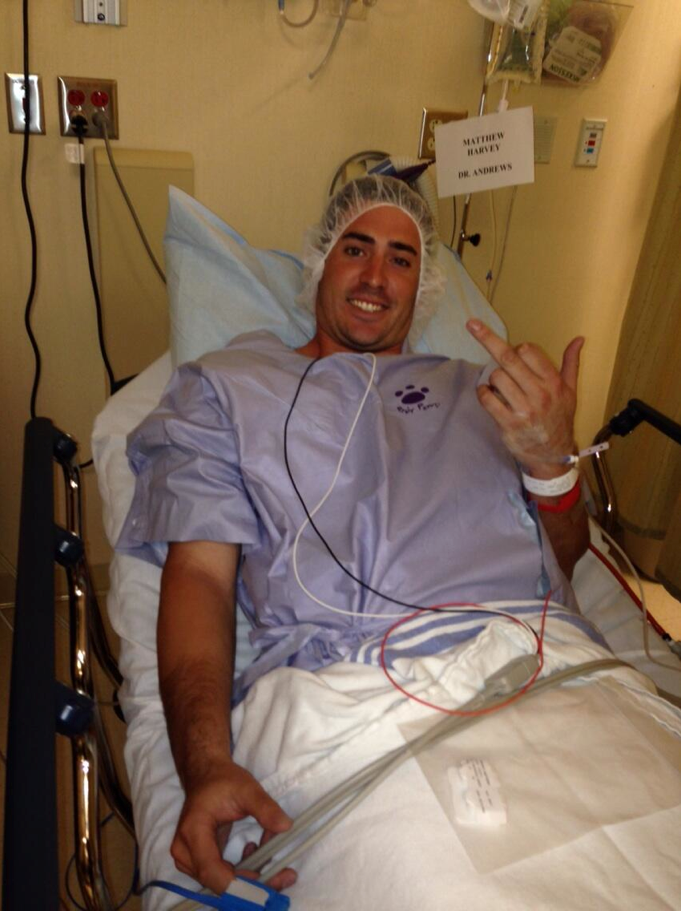
Oh, wait.  You're talking about when he tweeted a photo of his middle finger from his hospital bed as he was about to undergo Tommy John surgery, aren't you?


I guess he was.  So let's move on to the team's closer situation.  Do you think Bobby Parnell will take over as closer once he comes off the disabled list?  Or will Jenrry Mejia continue to hold the position?


Even with the more experienced Parnell wanting to reclaim what was once his?  Parnell had a wonderful season in 2013 (2.16 ERA, 1.00 WHIP, .211 batting average against him).  Mejia was a little more shaky as a closer (2.72 ERA, 1.42 WHIP, .265 batting average against him).  Can't there be a compromise between the bearded Parnell and the stomping Mejia?


That's downright frightening.  Plus, I didn't know Magic 8-Balls were capable of altering photographs in such a way.  I thought you were just a one-tool player.


Did you just use ball (snicker) and tools (giggle) in the same sentence?


Sorry.  That was very unprofessional of me.  Let's get to a true professional - David Wright.  The Mets captain had a subpar season in 2014, but he appears to have fully recovered from the shoulder injury that limited him to a .269 batting average and a career-low eight home runs.  Will he be able to produce better numbers in 2015?


He has to what?  You'll have to be a little more specific.


And which horrible memories are you referring to?


Ouch.  That is a horrible memory.  Okay, so I just have one more question to ask you before I get your prediction on the team's final record.  Then you can go back to your box for nap time.


This is the final year of Terry Collins's current contract.  If he leads the Mets to the playoffs, will he come back to manage the team in 2016 and beyond?


How would he not keep his job if he manages the team to its first winning season since 2008 and first postseason appearance since 2006?   It would seem like a slam dunk for the team to bring him back following that type of success.


Good point.  So let's end this by asking you for your prediction on the team's final record and standing in the NL East. 


But you said Matt Harvey predicted back in 2013 that the Mets would finish in first place this year.


And that's why Matt Harvey works his magic on the mound and you're the prognostication expert.  Thanks for taking the time to be with us today, M8B.  And I'm sorry for waking you up earlier.


Did I just shake the Magic 8-Ball to sleep?  Well, as a Mets fan, the time for sleep is over because we're on the cusp of a new season - one that might produce meaningful games in September and beyond.  And also one that could potentially cause the Wilpons to break open their piggy banks at the trade deadline for a change.  Assuming they're not traded with Saul Katz for a legitimate owner and a Mex Burger, of course.

Have fun this season, Mets fans!  It should be a pretty cool ride this summer.  And lest I forget, please help control the restless sphere population.  Have your Magic 8-Ball spayed or neutered.

LET'S GO METS!!


Hey, kids!  The Magic 8-Ball has been making predictions since 2010, the year Jason Bay first soiled us with his presence.  To see what the Magic 8-Ball said prior to each of the previous five seasons, please click on the links below:


Tuesday, May 14, 2013

DJ Joey B Presents: A Scott Atchison Top Ten List

What's up, Mets fans?  It's time for our latest countdown.  Today, I'm spinning a special playlist for you.  You see, everyone's favorite AARP member, Scott Atchison, has been placed on the disabled list with bone spurs in his elbow.  He has been replaced on the active roster by Collin McHugh, a pitcher young enough to be his son. 

That's what the Mets want you to believe.  But this DJ knows better.

It's no secret that Scott Atchison has not been pitching well this year.  And after I reveal my special top ten list, it'll also be no secret what the real reasons are for the Mets reserving a room for Captain Graybeard at the DL Hotel.  Let's boogie!


Top Ten Reasons Why Scott Atchison Was Really Replaced On The 25-Man Roster:


10.  Julio Franco was upset that Atchison was about to pass him as the oldest player to ever don a Mets uniform.

9.  The Mets were afraid that the Geritol in Atchison’s locker would cause him to test positive for PEDs.

8.  Shaun Marcum felt uncomfortable that reporters were mistakenly calling him Scott Atchison.


"Hello, SNY viewers.  Please don't call me Scott Atchison.  I'm Shaun Marcum."

7.  There was no money in the budget for a Scooter to transport Atchison from the bullpen to the mound.

6.  Justin Turner was afraid he’d knock out Atchison’s dentures if Atchison ever did anything pie-worthy.

5.  Fred Wilpon found out that Atchison was the one stealing signs at the Polo Grounds when Bobby Thomson hit the Shot Heard ‘Round The World to take the pennant from his beloved Brooklyn Dodgers.

4.  When Jay Horwitz butt-dialed Scott Atchison, Atchison responded by saying he didn’t accept collect calls.


Scott Atchison doesn't accept collect calls?  He is a pitied fool.

3.  The Mets did not want turmoil in the clubhouse after Matt Harvey took offense to Atchison calling him a young whippersnapper.

2.  Atchison was taking up too much space on team flights by insisting on carrying his Betamax and 8-track tape players on every road trip. 


… and the No. 1 reason why Scott Atchison was really replaced on the 25-man roster is …


1.  Betty White kept calling the clubhouse asking when Atchison was getting off work. 


 "Scott!  Oh, Scott!  Don't you walk away from me!  I can hear your creaking joints all the way over here!"

Thursday, February 14, 2013

Heartbreaking Transactions: A Mets Valentine's Day Special

Mets chief cook and bottle washer Fred Wilpon has announced to the world that the team is no longer in debt and can spend on free agents if there are good players to be had.  Papa Smirk made the announcement yesterday as pitchers and catchers have been trickling in to training camp in Port St. Lucie.

The news was meant to coincide with the comments made by manager Terry Collins and general manager Sandy Alderson on the state of the team.  However, at Studious Metsimus, we know better than that.  We know that Wilpon wanted to make the announcement in time for Valentine’s Day, a day known for spending money on unnecessary gifts, an intense outpouring of love, and a famous massacre.  And who knows more about spending money on unnecessary things (Luis Castillo, Oliver Perez, Jason Bay), unconditional love (Sandy Koufax) and massacres (damn you, M. Donald Grant!) than the Mets?

In honor of Papa Smirk’s Valentine’s Day announcement, let’s take a look at what the Mets have done over the years when they’ve spent money for players they thought fans would love, only to see them revolt when those players failed to live up to expectations:

I'm in the mood for love...

In the 1970s, the Mets boasted wonderful starting pitching and a woeful offense.  Throughout the decade, the Mets tried to acquire a top slugger.  Joe Foy and Jim Fregosi were supposed to improve the offense.  Instead, they became answers to trivia questions about the worst trades in Mets history.  The closest they ever came to acquiring a top hitting talent was when they traded for Rusty Staub in 1972.  Of course, after the 1975 season, one-month wonder Mike Vail pushed the team to trade Staub to Detroit for Mickey “The Refrigerator” Lolich.  One can only imagine that if Twitter had existed in the mid-1970s, that deal would have been referred to as the #LOL-ich trade.  Have another donut, Mickey.

So the 1970s didn’t quite work out with regards to trading for a top hitter.  But once Frank Cashen came on board with his pedigree for winning (Baltimore won several American League pennants under his watch), it was assumed that the Mets would finally sign a premier slugger to give them a legitimate power threat in the lineup.  They thought they added that punch when they signed former home run champion George Foster to a five-year, $10 million deal in 1982.  A .300, 30 HR, 100 RBI season was commonplace for Foster in Cincinnati.  As a Met, he never hit .300, never hit 30 HR and never drove in 100 runs in a season.  Foster was as punchless at the plate as he was on the field.  The leftfielder refused to participate in a bench-clearing brawl against his former team in Cincinnati, citing that it would be a bad example for kids.  This, of course, from the same man who thought “Get Metsmerized” would be a hit rap album.

"I'm George Foster and I'm here to say - if there's a fight, on the bench I'll stay."

Cashen did well after learning from the George Foster fiasco.  But his replacement did not.  After Cashen’s departure in the early 1990s, the Mets tried to put together the best team money could buy, signing former All-Stars like Eddie Murray and Bret Saberhagen, as well as manager Jeff Torborg.  They also brought in the Bronx’s most famous tour guide, Bobby Bonilla.  Just as the Mets made Foster the highest paid player in baseball in 1982, they did the same one decade later for Bonilla.  The more things change, the more they stay the same.  Bonilla spent his hard(ly)-earned money on a wonderful pair of earplugs in four so-so seasons with the Mets.  Bonilla actually did reach the 30-HR mark that eluded Foster, but he also surpassed the ‘80s “slugger” in boos and phone calls placed to the official scorer.  Bonilla should have just stuck to being a tour guide to authors and reporters.  At least he was pretty good at that.

Sometime between being picked before Roger Clemens and Lenny Dysktra in the 1981 June amateur draft and being accused of sexual misbehavior as an ESPN baseball analyst, Steve Phillips was the Mets general manager.  Phillips continued the once-a-decade tradition of trying to upgrade the offense in a year ending in the number “2”, signing and/or trading for Mo Vaughn, Roberto Alomar, Jeromy Burnitz, Roger Cedeño, Shawn Estes, Jeff D’Amico and Pedro Astacio.  Had Stifler’s mom been available, he probably would have made a run at her, too.  (Rumor has it that she was already locked up in a deal with a relative of former Met phenom Sidd Finch.)  Phillips eventually took care of his sexual frustration when he became ESPN’s resident lothario.  His class of 2002 gave Mets fans a different kind of frustration.

Finally, Omar Minaya didn’t wait until a year ending in “2”, acquiring Pedro Martinez, Carlos Beltran, Carlos Delgado, Orlando “The Dookie” Hernandez, Duaner Sanchez, Roberto Hernandez, Oliver Perez, Guillermo Mota, Luis Castillo, Julio Franco, Moises Alou, Johan Santana (see a pattern forming here?) and honorary “Los Mets” players Paul Lo Duca, Billy Wagner and Jason Bay.  Under Minaya, the team had what can now be called a fluke season in 2006, claiming the NL East division crown with a league-best 97 wins.  Unfortunately, the 83-win Cardinals led the National League in World Series championships that year with one.  After two late-season collapses by the rapidly aging team in 2007 and 2008 and two injury-riddled sub-.500 campaigns in 2009 and 2010, Minaya was relieved of his duties.  He can now be seen signing players left and right on Metstradmus’ Facebook page and Twitter account.


For many years, the Mets were content to toss money at players, hoping they would produce in Flushing the way they produced with their former teams.  But for every player that actually does well after coming to New York (we miss you, R.A. Dickey), there are a handful of players that don’t (Vincenzo Grucci – you may know his as Vince Coleman – comes to mind).

According to Fred Wilpon, the team now has money to spend, which it will most likely do in 2014.  Wilpon made this announcement as a pre-Valentine’s Day gift to fans who have been forced to sit through four straight seasons of fourth place finishes.  We’ll see if Wilpon really does have money to spend or if he was just yanking our chains to get us to come back to Citi Field for something other than Pat LaFrieda steaks.  If we find out that he cut back on Valentine’s Day flowers and chocolates for high school sweetheart Sandy Koufax, then perhaps this time we might have to believe him.

Smooch, there it is!

Monday, January 21, 2013

The More Teams Change, The More The Mets Stay The Same


I try to look at the MLB Trade Rumors site as often as I can to see what the Mets and their division rivals are up to.  More often than not, I find what their fellow NL East residents are doing long before I find any new information on the Mets.  Today was no exception.

Sandy Alderson has wanted to add a new arm in the bullpen (since most of the new arms he added last off-season pitched so miserably), a new starting pitcher to replace the Cy Young Award winner he traded away, and a major league outfielder to add to the Quadruple-A players the Mets already have.

So of course, I woke up this morning hoping to find something new on MLB Trade Rumors.  I found their "Week In Review" segment and perused the list of transactions and rumors for all major league teams.  This is an example of what I found.  (Thanks to Daniel Seco at mlbtraderumors.com for his thorough work.  For the complete "Week In Review" list, please click here.)

  • The Rangers agreed to a five-year, $55MM extension with Matt Harrison. The contract contains an team option for a sixth year in 2018 that can become a vesting option if Harrison pitches certain innings plateaus.
  • The Nationals agreed to sign free agent closer Rafael Soriano to a two-year, $28MM contract. Soriano posted a 2.26 ERA with 9.2 K/9, 3.2 BB/9 and a 35.9% ground ball rate for the Yankees this past season.
  • The Red Sox and Mike Napoli reached an agreement on a new contract. Napoli gets $5MM plus incentives for the one-year deal that could reach $13MM.
  • The Mariners, Nationals and Athletics combined on a three-team trade that will send Michael Morse to the Mariners, John Jaso to the A's and a three-player package to the Nationals that includes minor league right-handers A.J. ColeBlake Treinen and a player to be named from the Athletics. 
  • The Diamondbacks agreed to sign J.J. Putz to a one-year extension that will keep him in Arizona through 2014.The LSW Baseball client will reportedly receive a $7MM salary in 2014.
  • The Pirates agreed to sign right-hander Jeff Karstens to a one-year deal worth $2.5MM.
  • The Rockies signed Miguel Batista to a minor league contract with an invitation to Spring Training. Batista, 41, posted a 4.61 ERA with 6.2 K/9 and 5.6 BB/9 in 52 2/3 innings for the Mets and Braves last season. 
  • The White Sox agreed to sign Matt Lindstrom to a one-year contract with a club option. Lindstrom, 32, pitched to a 2.68 ERA with 7.7 K/9 and 2.7 BB/9 in 47 innings for the Orioles and Diamondbacks last season.
  • The Indians signed Ryan Raburn to a minor league contract with an invitation to Spring Training. Raburn averaged 15 home runs per season from 2009-11 and owns a career batting line of .256/.311/.430.
  • The Phillies signed right-hander Juan Cruz to a minor league contract with an invitation to Spring Training.
  • The Marlins signed Austin Kearns to a minor league deal with an invitation to MLB Spring Training.

Austin Kearns, International Marlin of Mystery

I see where the defending NL East champion Nationals traded away outfielder Michael Morse to Seattle and signed closer Rafael Soriano to a two-year deal.  I also see that the Phillies signed reliever Juan Cruz and plan to invite him to Spring Training.  Heck, even the frugal Marlins signed outfielder Austin Kearns to a minor league deal.  I see many teams in the majors mentioned here.

I don't see the Mets.

Well, if you want to be technical about it, the Mets are mentioned, but only because the Rockies signed Miguel Batista off the Mets' scrap heap.

Almost every team in baseball is wheeling and dealing, signing and refining, moving and improving.  The Mets, on the other hand, are not doing anything worthy of a rhyme.  In fact, they're not doing anything at all.

Since trading R.A. Dickey to the Blue Jays on December 17, the Mets have done the following:


Never mind the fact the MLB Trade Rumors didn't mention anything about the Mets making a transaction last week (Landon Powell).  All the Mets have done over the last month is sign journeyman players, including a former Met who hasn't pitched since the last time he was a Met in 2010 (Pedro Feliciano).  Sure, they've re-signed some of their own players, like Tim Byrdak and David Wright, and avoided arbitration with Bobby Parnell and Ike Davis.  But that about sums up their activity.

The Mets say they're interested in starting pitcher Carl Pavano.  They would like to remain in the mix for outfielder Michael Bourn.  They gave a look-see at closer Brian Wilson.  But I wouldn't bet all the money in Papa Smirk's piggy bank that either of those players will be receiving their fan mail at Citi Field in 2013.

"Seriously, why do you call me Papa Smirk so much?"

Sandy Alderson is asking the fans to be patient.  Although he claims that he is not sacrificing 2013 for the future, he also hasn't been doing anything to make the upcoming season more than just a battle for fourth place with the Marlins.

Alderson has acquired some good young talent since he came on board prior to the 2011 season.  Through shrewd trades, he's been able to add a number of top prospects, like Zack Wheeler, Travis d'Arnaud and Noah Syndergaard, to name a few.  But the major league talent at Citi Field still leaves a lot to be desired.

Scott Hairston is a good outfielder and a fine hitter.  Against lefties, he's as good as they get.  It should be a no-brainer for Alderson to bring him back into the fold.  But he's waiting ... and waiting ... and waiting some more, just to get Hairston to bite on a one-year deal.  If Hairston really is seeking a two-year deal worth somewhere in the $8 million range, why wouldn't Alderson take that chance?

He already doled out two-year contracts to relievers D.J. Carrasco and Frank Francisco, but he can't do the same for an outfielder (a position the Mets desperately need to fill) who actually has produced during his time with the team?  As a famous entertainer once said, "what up with that?"


Say Hairston is signed by the Mets to a two-year deal worth $8 million ($4 million annually).  And say he doesn't produce as well as he did in 2012.  Given his history against left-handed pitching and the team control until 2014, as well as his relatively low annual salary, wouldn't he be a valuable trade commodity?  What team wouldn't want him at that price?  But if the Mets were to give him a one-year deal, he'd just be a rental for a potential playoff contender.

For the Mets, it should begin with Scott Hairston.  Then they should add pieces who are ready to contribute at the major league level.  Then, and only then, will I believe the Mets are doing something to make this season more than just a competition with the Marlins for fourth place.

Frank Cashen had a five-year plan for the Mets when he came aboard as the Mets general manager in 1980.  By year five, the team was competitive.  However, Cashen inherited a team that hadn't won 70 games since 1976 and needed a complete overhaul.  The current Mets, despite their shortcomings, have won at least 70 games in each of the last four seasons and have been in the playoff mix at the All-Star Break every year.  But they've fallen apart every season after the break and haven't truly shown any type of improvement in the last four years.

Year five for Sandy Alderson will be in 2015.  Will the Mets have what it takes to contend for an NL East title by then?  We know the teams around them aren't going to be steadfast with their major league rosters.  It's time for the Mets to change.  We already know what happens to them when they remain the same.

Wednesday, December 19, 2012

The Final Dickeypedia Word of the Week: Steadfast


All good things must come to an end.  And with this week's news that R.A. Dickey was traded to the Toronto Blue Jays, that means the non-weekly Dickeypedia Word of the Week has reached its final installment as well.

Before he left the bright lights of New York for the poutine of Toronto, Dickey left us with three heartfelt tweets:


It was a wonderful gesture by a classy pitcher like R.A. Dickey to thank his fans in New York.  It was also wonderful to see him use the word "steadfast" in one of his tweets.  As most casual baseball fans know, that word is not one that's dropped very often in cliché-filled post-game interviews.  In fact, according to our soon-to-be-put-away-for-good volume of Dickeypedia, here is the definition of the word:


steadfast:

  • fixed in direction; steadily directed.
  • firm in purpose, resolution, faith, attachment, etc., as a person.
  • unwavering, as resolution, faith, adherence, etc.
  • firmly established, as an institution or a state of affairs.
  • firmly fixed in place or position.


All I got from those definitions is that firmness has something to do with being steadfast.  Perhaps if we used the word in a sentence, it might clear things up a bit.

To do that, we did what we always do in these situations - we contacted a member of the Mets organization.  We've never showed much concern for whether or not we enlisted the services of a current Met or a former Met.  We just needed someone who was breathing and could give us a sentence or two.  That's not much to ask for, right?

So for this final Dickeypedia segment, we went to the Grand Poobah himself.  The chief cook and bottle washer.  The Big Kahuna.  That's right, loyal readers.  We went to Fred Wilpon, affectionately known around these parts as Papa Smirk.

Papa Smirk was more than happy to enlighten his paying customers with a sentence or seven using Dickey's firm word so that no one would be confused by its meaning.  He used it in his reflection of former players that have called Citi Field home:


"I did everything I could to keep players around as they were approaching free agency.  But we had to trade Carlos Beltran after some schmuck overpaid him to come to New York based on one playoff series.  We finished in fourth place with R.A. Dickey winning the Sandy Koufax Award; we can finish there without him.  And Jose Reyes thought he would get Carl Crawford money, but he's had everything go wrong with him.  Perhaps had he steadfast and healthy, we would have signed him.  I'd rather use that money to buy more Sandy Koufax autographed game-used Dodger boxers instead.  Mmmm, I love the smell of Koufax in the morning."


Uh, on that note, perhaps it's a good thing we'll never be doing another Dickeypedia Word of the Week piece.  Some of those sentences have gotten a little too personal for our tastes.

As we wrap up this final Dickeypedia segement, we'd like to thank all the former Mets who contributed with their vocabulary skills.  Players such as Gregg Jefferies, Bobby Bonilla and Victor Zambrano, to name a few, all taught us how NOT to use certain words in Dickey's lexicon, even if they thought they were showing off their linguistic skills.

Good luck to R.A. Dickey in Toronto.  And thank you for being so steadfast and loyal to your fans!


Even though he is no longer toiling for the Mets, you can still follow R.A. Dickey on Twitter by clicking here.  For more vocabulary assistance, please read the following Dickeypedia entries:

Feb. 22, 2011: Dickeypedia Word of the Week: Narrative (featuring Gregg Jefferies)
Feb. 25, 2011: A Double Dose of Dickeypedia (Rudiments, Vernacular) (featuring Armando Benitez)
Mar. 10, 2011: Dickeypedia Word of the Week: Syntax (featuring Bobby Bonilla)
Apr. 2, 2011: Dickeypedia Word of the Week: Asphyxiation (featuring Oliver Perez)
May 15, 2011: Dickeypedia Word of the Week: Fortitude (featuring Victor Zambrano)
Aug. 14, 2011: Dickeypedia Word of the Week: Fodder (featuring Jeff Kent)
Sept. 3, 2011: Dickeypedia Word of the Week: Hyperbole (featuring Lenny Dykstra)
Jan. 8, 2012: Dickeypedia Word of the Week: Acclimatize (featuring Mike Scott)

Tuesday, March 20, 2012

Joey's Soapbox: What The Wilpons Should Do With Their Money


Over the past 24 hours, two seasons officially ended.  For those not involved in Ponzi schemes, winter turned to spring at 1:14 AM.  For those whose surname is Wilpon, your winter of discontent has also ended.  Now that the Mets’ owners and Irving Picard have settled for $162 million before the case went to trial, the focus can now shift completely to what’s happening on the field and not what could have happened off it.

But before we return to the action between the foul lines, I wanted to hop on my soapbox.  If I may, I’d like to share my thoughts with you on what I think the brothers-in-law Wilpon and Katz should do now that they won’t have to fork over $386 million to the Picard peeps.  Who knows?  Maybe they might actually listen to me this time.  Who am I?  I'm Joey Beartran, and I'm about to take you for a ride on my soapbox.


Sign a starting pitcher that can actually stay on the mound

In 2006, the Mets won 97 games.  They also used 13 starting pitchers, all of whom made at least three starts for the team.  Only Tom Glavine and Steve Trachsel were able to make more than 23 starts.  Of course, the Mets' lack of depth and health in the starting rotation caught up with them in the National League Championship Series, especially when both Pedro Martinez and Orlando "The Dookie" Hernandez couldn't pitch in the postseason due to injuries.

Two years later, the Mets traded for Johan Santana and gave him a six-year contract extension.  To date, Santana has given the Mets one DL-free season.  Looks like it's obvious here.  The Wilpons should use their money to sign a dependable starting pitcher that can actually stay on the mound.  The Phillies did it with Roy Halladay and Cliff Lee and they've been able to withstand all sorts of injuries to their everyday players.  The Mets should follow suit.  Or they should find a way to injure Roy Halladay and Cliff Lee.


How about a pitcher who can strike out a batter or ten?

In 1984, Dwight Gooden struck out 276 batters as a rookie, fanning ten or more batters in 15 of his 31 starts.  In 2011, a Mets' starting pitcher reached double digits in strikeouts in a single game twice.  That's two times in 162 games.  Only R.A. Dickey and Chris Capuano reached the level that Gooden reached regularly, and they were only able to do it once apiece.

Since 1992, the only Mets pitchers to strike out 200 or more batters in a single season have been Al Leiter (2000, 200 Ks), Pedro Martinez (2005, 208 Ks) and Johan Santana (2008, 206 Ks).  In each of the years they accomplished their hefty strikeout totals, the Mets finished with a winning record.  That's not a coincidence.

With Citi Field's fences moving in for the start of the 2012 season, it would behoove the Mets to find pitchers who can keep the ball in the ballpark.  Either that or they'll need pitchers with the ability to get opposing batters to hit the ball on the ground, preferably away from Daniel Murphy at second base.  Of course, we wouldn't even have to discuss this if the Mets had pitchers who could strike out a batter or ten.


Spend money on scouting and minor league development

Over the past decade, the only two pitching prospects to stick around have been Mike Pelfrey and Jonathon Niese.  Both players have losing records in the major leagues and neither has made the All-Star team.  In fact, other than Jose Reyes and David Wright, the last homegrown All-Star (regardless of whether he was a pitcher or everyday player) was Edgardo Alfonzo in 2000.  Who was the last homegrown All-Star pitcher?  You have to go back to 1997 and Bobby Jones.

Winning teams succeed with the right combination of veteran leadership and homegrown talent.  The Mets haven't been able to get this consistently right for over a decade.  A few extra bucks spent on their scouts and the development of players in the minor leagues should help the Mets in that regard.


Don't spend on a big-name free agent; spend on a big-name exorcist

On the night Citi Field hosted its first regular season game, a frisky feline darted onto the field and crept past David Wright, who was standing in the on-deck circle.  It was a scene reminiscent of the black cat that ran behind Cubs' third baseman Ron Santo at Shea Stadium in 1969.  Just as the black cat served as the superstitious impetus for the Cubs' demise, the Citi kitty might have done the same to the Mets.

I don't usually believe in curses or the supernatural, but surely a lower power must be involved in the Mets' misfortunes.  Therefore, instead of throwing cash at the next hot ticket free agent, why don't the Mets just hire the best exorcist money can buy?  Clearly, Fred Wilpon already used an exorcist on himself, as his head is no longer spinning due to the resolution of the Madoff mess.  Now it's time to use it on the team.  It might be our only hope.


Give Jeff Wilpon a makeover

New York is the media capital of the world.  Because of that, Jeff Wilpon has found himself in front of the TV cameras quite a bit over the years.  This would normally be a good thing for someone who bears a strong facial resemblance to a popular TV star, as Wilpon does.  However, when that popular television character is Alfalfa from The Little Rascals, it’s a sign that Little Jeffy needs a makeover.

Perhaps a new hairstyle would work.  It doesn’t have to be outlandish like the blond curls sported by the late Jose Lima during his month-long stay in New York in 2006.  (If you don’t remember Lima ever being a Met, it’s probably because you were in an alcohol-induced stupor due to his constant poundings on the mound.)  All his new "do" must do is say “I want you to believe that I’m going to put the best team on the field” instead of “I want you to believe that Darla will one day fall in love with me”.  It’s time for Jeff Wilpon to change the way he looks.  Even Buckwheat would say “o-tay” to that.


Invest in antivenom

In last year’s infamous New Yorker interview, Fred Wilpon stated that Jose Reyes would never get Carl Crawford’s money.  He was right.  He also said that David Wright was a good, but not great player.  With Wright’s latest injury keeping him out of action, he may be right on that front, too.  Papa Smirk is definitely not a saint, but he might be a prophet.

Since everything Wilpon said in the article has come true, then we should also believe him when he says “we’re snakebit, baby!”  In that case, I’d like to make a suggestion to our fearless leader.  Snakes have venom.  Antivenom can combat snake bites.  You now have extra money that won’t be siphoned out of your Sandy Koufax piggy back.  Do the math.


As things stand now, even if the Mets improve upon last year’s 77-85 record, they might still finish in last place.  Every team in the National League East is better on paper.  The Nationals and Marlins, who finished in third and fifth place in the division last year, respectively, are exponentially better this year.  The Nationals added Gio Gonzalez and Edwin Jackson to their starting rotation (not to mention a healthy Stephen Strasburg) and will now have Brad Lidge closing games for them.  Meanwhile, the Marlins added Mark Buehrle to anchor their rotation and All-Star Heath Bell to seal the deal in the ninth inning.  The Braves have the best one-two punch in the bullpen in Jonny Venters and Craig Kimbrel, in addition to a solid starting rotation.  Even with an off-year by rightfielder Jason Heyward, the Braves still competed for a playoff spot until the last day of the season.  And the Phillies?  They’re pretty good.

The Mets have a long way to go if they want to be mentioned in the same sentence as the other teams in the division.  Right now, the only way the Mets could realistically compete in the National League East is if they faced Cole Hamels every day.  That’s about as likely as Shane Victorino learning how not to complain like a little … ahem … sorry,  I got carried away there.  It’s just that I’m very passionate about my team, and I want them to do well.

Surely, the team’s owners want the same thing for their team as I do.  Throwing money at the best available free agent just won’t cut it anymore.  Doing that just gets you Oliver Perez or Jason Bay.  Perhaps Los Wilpons will read this and get an idea or six.  My suggestions can’t hurt as much as the Wilpons have hurt the fan base over the past few years, right?