Showing posts with label Kevin Appier. Show all posts

Thursday, May 3, 2018

Joey's World Tour: Missouri Madness (Part II - Royal Rumbin' in Kansas City)

Kauffman Stadium is middle-aged, but it still looks young to me.  (Photo by Ed Leyro/Studious Metsimus)

Hello again!  This is Studious Metsimus' one and only roving reporter and culinary expert, Joey Beartran, and this is the second part of my two-part Missouri Madness tour.  After slogging my way through St. Louis (and two Mets losses), I hopped on a bus going west to the BBQ capital of the world, Kansas City.

I thought the best part of this trip would be that the Mets weren't joining me in KC, meaning that I couldn't see them lose any games in person.  Then I thought the best part would be the sampling some Kansas City style barbecue.  I was wrong on both counts.  The best part of Kansas City was Kansas City as a whole.  Let's go on a virtual tour of a city that's the true crown jewel of Missouri.

Of course, the main reason the Studious Metsimus staff went to Kansas City was to attend a ballgame at Kauffman Stadium, home of the Royals.  Originally, we were going to go in 2016 when the Mets were scheduled to open the season there.  Then the 2015 World Series happened.  And we decided to go to cities that didn't open up fresh wounds instead.

Three years after that Fall Not-So-Classic, the Mets opened the season with one of the best records in the league and the Royals were at the bottom of their division.  So if you ask me, now seemed like a pretty good time to check out "The K".  And boy, did we ever check it out.  I mean, look at this view!


Sunset in KC is truly the place to be!  (EL/SM)

The Royals continued to disappoint as a team, losing to the equally inept White Sox, 7-4 in 11 innings, but nothing about my time at the game was disappointing to me.  For one thing, the food choices at Kauffman Stadium blew the door off anything served at Busch Stadium.

There was several food stands devoted to BBQ such as "The Pit", which served items such as brisket or pulled pork BBQ sandwiches, BBQ extreme fries (in a souvenir helmet, to boot!) and the cheesy corn brisket-achos that made their way to the recent MLB Food Fest.  But my favorite stand was "Sweet Baby Ray's" barbecue in center field.  I could have ordered a cheesesteak with burnt edges, but instead, I went with the mac and cheese with baked beans.  The woman behind the register accused me of being a vegetarian because I didn't order steak or brisket, but I was really just looking forward to chowing down on their famous BBQ Baked Beans.  And they did not disappoint.


Ooey gooey mac n' cheese and two bowls of BBQ baked beans.  And they were inexpensive, too!  (EL/SM)

This is most definitely a food stand I'm racing to the next time I attend a game at "The K".  The baked beans were even better than advertised and the mac and cheese was chewy, gooey and gone faster than you can say, "Why couldn't Lucas Duda have made a better throw to home plate to nail Eric Hosmer in Game Five?"

Oh, and speaking of Lucas Duda, he's a member of the Royals now.  And he even has own banner outside the ballpark.  I mean, Royals fans loved him since Game Five so they might as well shower him with gifts at Kauffman Stadium just like he gave them a gift as a member of the Mets in the World Series.

But I digress.


Eric Hosmer may be gone, but Lucas Duda still lives on.  (EL/SM)

Back to the topic of hand, namely, the tasty things I can put in my mouth at Kauffman Stadium.  In addition to all the barbecue stands in the ballpark, you can also have gourmet hot dogs with unique toppings at "Dogfather".  There are also berrie-kabobs for dessert.  This succulent snack has berries covered in chocolate and icing, which are then pierced by a long stick.  And for all you non-kids out there, you can have alcohol in a way you don't normally see at ballparks back east.

Kauffman Stadium has a pour-your-own-beer stand, where you choose your beer from either a tap wall or behind a bodega-style refrigerated display.  And if you like your alcohol just a little bit colder, you can order a vodka-infused sno cone (in cherry or blue raspberry flavors) or vodka lemonade.  It almost makes me wish I was already 21 so I could try one!


Imagine if they had these at Citi Field on hot days.  The lines would be longer than Shake Shack.  (EL/SM)

Another aspect of the park that put Citi Field to shame was the Royals Hall of Fame and Museum.  The Mets have seven more years of history than the Royals do, yet the studio apartment-sized Hall of Fame and Museum at Citi Field pales in comparison to the multi-room exhibit at Kauffman Stadium.

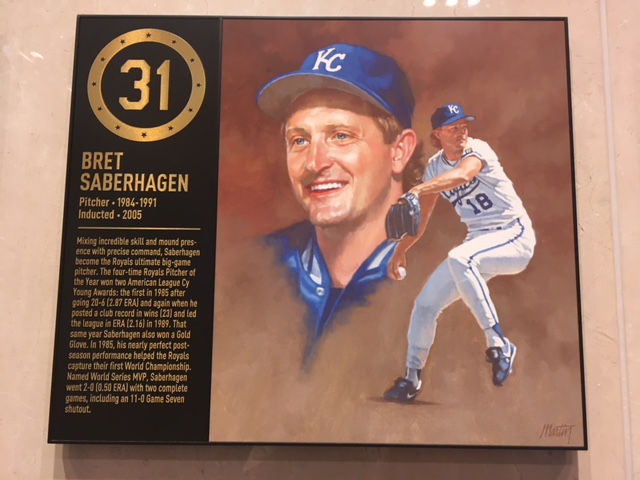
Located in the left field corner on the field level, the Royals Hall of Fame and Museum celebrates the team's best players, with a section for retired numbers and a wing devoted to the Royals' one Cooperstown honoree, George Brett.  It also has Dan Quisenberry's Rolaids Relief Man Award, team trophies, a history of the World Series (and not just the Royals' appearances in the Fall Classic), player lockers and bobbleheads.  In the area where the Royals Hall of Fame members are honored, a beautifully done painting of each honoree is displayed, along with a short history of the player depicted on the canvas.  It sure beats the traditional Hall of Fame plaque.  (And I was surprised to see so many former Mets who were honored for their playing and/or coaching careers in Kansas City.)

But my favorite display in the museum had to be the huge No. 5 made with 3,154 baseballs, or one for each hit collected by George Brett during his 21-year career in Kansas City.  In the middle of the display is Brett's 3,000th hit ball and the bat used to reach that milestone.  Incredibly, the bat is still loaded with pine tar as a reminder of just how much Brett applied to his lumber during his career.  And in case you were wondering, the Pine Tar Game is also discussed in the museum.

Of course, as a Mets fan, I was upset that the jersey worn by Eric Hosmer in Game Five of the 2015 World Series (complete with Citi Field dirt still on it) was prominently displayed, as well as the third base bag he was standing on before he made his mad dash to the plate,  But that was offset somewhat by the unexpected Gil Hodges Mets jersey from 1969 that was there to commemorate the team that won the championship during the Royals' inaugural season.


This trophy would have been ours if World Series games ended after seven innings.  (EL/SM)

Kauffman Stadium is a great place to watch a game, but if you have young kids who can't stay still in a seat for three hours, there are many activities to keep them occupied.  Whereas Citi Field only has a dunk tank, pitch speed machine and a mini field, Kauffman Stadium has so much more.

There's a baseball-themed carousel.  There's a much larger "mini" field where you can play actual baseball games.  There are pitching cages.  There are batting cages.  There's even a miniature golf course with baseball obstacles.  And of course, there are the beautiful fountains in center field that shoot water high up in the air between innings and when the Royals score.

All those things were great for a Mets fan like me.  Why is that, you ask?  Because they distracted me from the 2015 World Series flag flying in the wind and the large 2015 World Champions sign in center field.


I think I liked this sign better when it just said 1985 World Champions.  (EL/SM)

So that covers the ballpark in Kansas City.  But watching a game is far from the only thing you can do in this beautiful burgh and the nearby surrounding areas.

There are numerous great restaurants and venues to watch live music in the Power and Light District.  There's also the Harry S. Truman Presidential Library and Museum in nearby Independence, MO.  For music lovers, nothing beats the American Jazz Museum in the 18th and Vine District.  And housed in the same building is the Negro Leagues Baseball Museum, which I made sure to visit during my stay in the city.

Ordinarily, photos are not allowed in the NLBM.  This is done to protect the artifacts within the 10,000 square-foot space.  But my colleagues and I were given a green light to take all the photos we wanted to document our visit on the Studious Metsimus site.  My photographer took hundreds of photos, of which I will share a few here.


This was my field of dreams, which I shared with some of the greatest players of all-time.  (EL/SM)


So there you have it, my fellow Mets fans.  The baseball teams from Kansas City and St. Louis may have given the Mets lots of heartache in recent years, but the cities those teams call home made up for all the grief.  Well, at least Kansas City did.  And for all the things St. Louis didn't have, Kansas City picked up the slack and then some.

Busch Stadium and Kauffman Stadium are both beautiful ballparks.  Although the immediate area around Busch has more baseball-related activities to entertain fans when there are no games being played, Kauffman is the superior stadium.  The food is tastier and there is more variety.  And there's far more to do inside "The K" when the game isn't the only thing you're interested in.

I can't wait to rumble in the Royals' home town again.  Maybe next time I'll just fly over St. Louis and wave at Busch Stadium from the air while I count down the minutes until I touch down in Kansas City.  And by then, maybe losing the World Series to the Royals in 2015 won't sting as much as it still does and I'll just want BBQ because it's delicious rather than to wash away the memories of that Fall Classic.

Thanks for joining me on the latest legs of my baseball world tour.  Now excuse me while I try on my Negro Leagues apparel.  They may have allowed me to take photos in the museum but they still have to work on making clothes in my size.


Hope my colleagues kept the receipt for this.  (EL/SM)


For previous installments of Joey's World Tour, please click on the links below, where you will be entertained by Joey's wit, photos and love of ballpark cuisine:

World Tour Stop #1: Baltimore
World Tour Stop #2: Washington, DC
World Tour Stop #3: Pittsburgh
World Tour Stop #4: Texas
World Tour Stop #5: Los Angeles
World Tour Stop #6: San Diego
World Tour Stop #7: Toronto
World Tour Stop #8: Chicago (NL)
World Tour Stop #9: Milwaukee
World Tour Stop #10: Seattle
World Tour Stop #11: Cleveland
World Tour Stop #12: Brooklyn (Ebbets Field site) and Manhattan (Polo Grounds site)
World Tour Stop #13: Baltimore (again) and Pittsburgh (part deux)
World Tour Stop #14: Cincinnati
World Tour Stop #15: Colorado
World Tour Stop #16: Cooperstown (Baseball Hall of Fame)
World Tour Stop #17: Detroit
World Tour Stop #18: Atlanta
World Tour Stop #19: Miami
World Tour Stop #20: St. Louis


Monday, January 27, 2014

The Best On The Worst: Steve Trachsel

There have been dozens of Mets teams that finished with mediocre or losing records.  Yet despite the poor records sported by these teams, there have always been players on each squad who performed well and became fan favorites.

In the early-to-mid 1960s, Al Jackson performed better than his Mets colleagues and became the first ace on a team that lost in spades.  During the late 1970s to early 1980s, the Mets fell on hard times again, but Lee Mazzilli thrived on the diamond and off it.  And during a six-year, sub-.500 stretch in the 1990s, Todd Hundley caught his share of pitchers, then caught the eye of Mets fans as the team's best player.

The Mets had a fourth period of non-competitiveness in the early-to-mid 2000s, one that produced three consecutive losing seasons that could easily have ballooned to five had the team not finished strongly in 2001 and 2005.  Those teams had their share of popular players, such as Mike Piazza, Al Leiter and two budding talents in Jose Reyes and David Wright.  But one of the better players on the Mets during that frustrating five-year period was never going to win any popularity contests.  In fact, a sizable contingent of Mets fans would rather forget he was ever on the team.  But well-liked or not, there's no question that he was one of the most successful players on a team that did not enjoy much success.

Like him or not, Steve Trachsel was a big winner for the Mets when the team wasn't doing much winning.

Stephen Christopher Trachsel was never supposed to be a big winner for the Mets.  In fact, when the Mets signed him to a two-year, $7 million contract in December 2000, he was coming off a two-year stretch in which he was a combined 16-33 for the Chicago Cubs, Tampa Bay Devil Rays and Toronto Blue Jays.  Trachsel's 33 losses in 1999 and 2000 were the most of any pitcher in baseball, three more than Brad Radke lost for the Twins.  But Trachsel was also coming off his fifth consecutive season of 200 or more innings, making him quite valuable to the Mets, who were unable to retain the services of 15-game winner and NLCS MVP Mike Hampton and were not interested in bringing back Bobby Jones.

Trachsel, along with fellow free agent signee Kevin Appier, was part of general manager Steve Phillips' plan to incorporate more right-handed pitchers in the starting rotation because, as he put it, "the Braves are much better against left-handed pitching".  Appier, who won 12 or more games eight times from 1990 to 2000 (one of only nine pitchers to do so), managed just 11 victories for the Mets in 2001, his only year in Flushing.  Trachsel also won 11 games in his first season with the Mets, but his road was far bumpier than the one taken by Appier.

On April 7, 2001, Trachsel made his debut for the Mets.  His effort - or lack of one - was memorable for all the wrong reasons.  Trachsel allowed ten earned runs in a 10-0 loss to the Montreal Expos, becoming just the third pitcher (and second starting pitcher) in Mets history to allow ten or more earned runs in a single game.

The debacle in his first start was just the beginning of a six-week nightmare for Trachsel, who slogged his way to a 1-6 record and an 8.24 ERA in his first eight starts.  That, and the endless chorus of boos from unforgiving Mets fans, led to Trachsel's demotion to the minor leagues after becoming the first pitcher in team history to allow four home runs in one inning on May 17.  It was an embarrassing and unexpected development for the right-hander, but one that produced a stunning resurgence after he was called back up to the Mets in June.

Trachsel spent three weeks in the minors at AAA-Norfolk trying to correct his flaws.  It took him only two starts to regain his confidence, as Trachsel fired a no-hitter for the Tides in the first game of a doubleheader on May 30.  A week later, he was back in the majors.  Trachsel pitched slightly better upon his return to the Mets, but a lack of run support prevented him from winning games.  Trachsel lost three of his first four appearances following his call-up.  In the game he didn't lose, he earned a no-decision, despite allowing just one run against the Expos.

With his record sitting at 1-9 and the Mets losing patience in him, Trachsel turned in his most important performance of the season on June 29.  The right-hander pitched seven strong innings in Atlanta, holding the Braves to one unearned run and five hits.  It would be the first of nine victories for Trachsel over the Braves over the next four seasons, as his general manager expected him to do when he signed him the previous winter.  It would also be the first of many wins Trachsel would earn over the last three months of the 2001 season.

The Mets limped their way to the All-Star Break in fourth place, 13 games behind the first place Braves.  With a 38-51 record, New York looked nothing like the team that won the National League pennant just nine months earlier.  Steve Trachsel was a huge reason for the team's first-half failures, going 2-10 with a 6.72 ERA.  But once the Mets returned from their mid-season hiatus, Trachsel became one of the best pitchers in the league.

From July 16 to September 22, Trachsel made a dozen starts for the Mets, going 8-2 with a 2.72 ERA.  His eighth win in that stretch, a 7-3 decision over the Braves, pulled the Mets to within 3½ games of first place Atlanta.  Unfortunately, it would be the closest the Mets would get to the Braves in 2001, as Atlanta held on to win the division title.

After a horrid start to his Mets career - a start that included a three-week stint in the minors - Trachsel rebounded to finish the year with a 4.46 ERA.  His 11 wins tied Al Leiter and Kevin Appier for the team lead.  Trachsel's second half numbers (9-3, 2.74 ERA, 0.95 WHIP) were nothing short of spectacular.  He made 14 starts after the All-Star Break and pitched at least seven innings in 11 of them, including a complete-game two-hit shutout of the Pittsburgh Pirates in his final start of the season.

Trachsel had regained his confidence after his poor start in 2001 and hoped to carry his second-half success over to the 2002 season.  He would, but the same could not be said for the rest of the team, as the new-look Mets, with Roberto Alomar, Mo Vaughn and Jeromy Burnitz, fizzled at the plate and in the standings.

The Mets finished the 2002 campaign in the NL East cellar with a 75-86 record, their first sub-.500 season since 1996.  It was also the first time they had finished in last place since 1993.  Once again, Trachsel won 11 games for the Mets.  But Trachsel had a more complete season for the Mets in his sophomore year with the team, lowering his ERA to a team-leading 3.37.  He also carried a perfect game into the seventh inning in a matchup against the Minnesota Twins on June 20.  A year later, Trachsel would flirt with no-hit history on more than one occasion.

Just like their 2002 counterparts, the 2003 Mets finished in last place under new manager Art Howe.  With a 66-95 record, the '03 squad remains the only Mets team in the last 20 years to lose at least 95 games.  But Steve Trachsel, who was re-signed by the Mets prior to the 2003 season, barely noticed he was pitching for a last place team.  In fact, he had his best year as a Met during their worst season in the last two decades.  Trachsel finished the year with a 16-10 record and a 3.78 ERA, leading the team in wins, starts, innings pitched, complete games and shutouts.  And those two complete-game shutouts made team history.

On June 15, Trachsel pitched the 24th one-hitter in franchise history, allowing just a sixth-inning double to the Angels' David Eckstein.  Trachsel's gem would be the first of three consecutive one-hitters the Mets would participate in, as New York was held to one hit by the Marlins' Dontrelle Willis on June 16 just one day before three Mets pitchers combined to one-hit Florida.  Two months later, Trachsel was at it again.  This time, it was Rockies pitcher Chin-hui Tsao who provided the only hit against him, as his double in the sixth inning ended Trachsel's bid to become the first Met to throw a no-hitter.  Although he failed to pitch the team's first no-no, Trachsel did become the first pitcher in team history to toss two complete-game one-hitters in the same season.  (David Cone participated in two one-hitters in 1991, but he needed relief help in the first game - a game he ended up losing.)

Trachsel's 2004 season wasn't quite as good as his 2003 campaign, but he still managed to win a dozen games for a Mets team that finished 20 games under .500.  And yes, those 12 victories once again led the team.  It was the third time in four years with the Mets that Trachsel led or tied for the team lead in wins.  Trachsel defeated the Braves three times in 2004, which was quite an accomplishment considering the Mets only won seven of 19 games against their division rivals.

From 2001 to 2004, the Mets won 294 games and lost 352.  Yet somehow, Steve Trachsel - the pitcher who led the majors in losses in the two seasons prior to becoming a Met - managed to go 50-47 over those four seasons.  No pitcher on the Mets won as many games as Trachsel did from 2001 to 2004.  In fact, Trachsel and Al Leiter were the only pitchers on the team to record more than 20 wins during those four otherwise forgetful years. 

Injuries kept Trachsel off the field for most of the 2005 season, limiting him to just one win in his fifth year with the Mets.  Trachsel didn't pitch for manager Willie Randolph until August 26, when he tossed eight scoreless innings against the San Francisco Giants.  In that game, a 1-0 victory at SBC Park, Trachsel held the Giants hitless until Randy Winn laced a two-out single in the sixth inning.  Trachsel continued to pitch well during the season's final month, posting a 2.78 ERA going into his final start of the season.  But a shellacking at the hands of the Philadelphia Phillies on September 28 inflated his ERA to a rather pedestrian 4.14.

After spending much of his career with the Mets getting poor run support (he recorded a solid 3.91 ERA in his first five years as a Met, yet only managed to win 50% of his decisions), Trachsel finally got the bats he coveted in the lineup in 2006.  With Jose Reyes and Paul Lo Duca setting the table for Carlos Beltran, Carlos Delgado and David Wright, the Mets became an offensive juggernaut, with Trachsel receiving unprecedented support when he was on the mound.  Trachsel allowed four earned runs or more ten times in 2006.  The Mets won six of those starts.  By late August, Trachsel had a 14-5 record, which put him among the league leaders in winning percentage.  But he had an ERA approaching 5.00, which was his highest since becoming a Met in 2001.  Trachsel's ERA did go above 5.00 in early September, but went below the mark on September 18, when he pitched 6⅓ shutout innings against the Florida Marlins to clinch the Mets' first division title in 18 years.  In doing so, Trachsel became the fifth pitcher to win a division-clinching game for the Mets, joining Gary Gentry, Tom Seaver, Dwight Gooden and Ron Darling.

After the game, Trachsel reflected on his career with the Mets.  As the longest-tenured player on the team, he had seen his share of highs and lows.  When he became a Met, he expected to be part of a perennial playoff powerhouse.  After all, the Mets had just appeared in two consecutive postseasons and were coming off a World Series appearance in 2000.  Instead, he saw the team get completely rebuilt, before finally seeing the payoff in 2006.  Trachsel went on to say:


"[Making the playoffs] was the whole point of me coming over here.  It took a little longer than I hoped, but now that we're here, we've got to make the best of it and get this thing finished."


At the end of the 2006 regular season, Trachsel was the owner of a 15-8 record and a 4.97 ERA.  But the division clincher ended up being his last victory in a Mets uniform, as Trachsel's first postseason experience as a Met did not end well for him or the team.  Although Trachsel started the NLDS-clinching game on October 7, 2006, he had already been sent to the showers by the time the Mets rallied to take the lead from the Dodgers in the sixth inning.  Trachsel allowed just two runs in 3⅓ innings, but he was constantly pitching under pressure, as eight of the 17 batters he faced reached base.  As ineffective as he was against Los Angeles in the NLDS, he was even worse against the Cardinals in the NLCS.

In his one LCS start (Game 3), Trachsel faced 12 batters.  Ten of those batters reached base, including opposing pitcher Jeff Suppan, who homered off Trachsel to lead off the second inning.  The Mets recovered from that loss to force a seventh game, but chose not to start Trachsel on normal rest.  Rather, they sent Oliver Perez to the mound on three days rest with the Mets' season riding on his left arm.  Perez pitched well, but the Mets lost the deciding game when Yadier Molina hit a home run off Aaron Heilman to break a ninth-inning tie.  Steve Trachsel, who could have entered the game had it gone into extra innings, could only watch from the bench as his season - and his Mets career - had come to an unexpected end.

Steve Trachsel was never beloved as a Met.  After all, when fans came to see the team on a day he was scheduled to pitch, they knew they were in for a long game, especially if Trachsel got into trouble on the mound.  Trachsel was very deliberate to the plate when runners were on base, causing many a fan to yell "throw the ball" whenever Trachsel wasn't.  Trachsel also didn't have a promising debut with the Mets, nor did he fare well at the end of his career when the games mattered the most.  In many ways, his Mets career was similar to Carlos Beltran - another player who started off slowly, then had a number of successful seasons, but will always be remembered (unfairly) for not coming through against the Cardinals when his team needed him the most.

Mets fans remember Trachsel's inauspicious debut, the four homers in one inning, the demotion to the minors and the postseason failures.  But they might have a tough time remembering his numerous flirtations with no-hitters, including his two complete-game one-hitters in 2003.  They also would be hard-pressed to remember that Trachsel won 15 or more games twice with the Mets, making him one of only seven pitchers in team history with multiple 15-win seasons.  To put that into perspective, David Cone, Frank Viola and R.A. Dickey were all 20-game winners for the Mets.  Neither pitcher won as many as 15 games in any other season with the team.  And finally, unless you're a Mets savant, you'd have a tough time believing that Steve Trachsel's 66 wins as a Met put him in the team's all-time top ten victory leaders.  But there he is, sitting at No. 10, ahead of several formidable pitchers in team history like Rick Reed, Craig Swan, Bob Ojeda, Johan Santana and ... ahem ... Tom Glavine.

Steve Trachsel was a solid pitcher for six years as a Met.  But most of those seasons were spent with bad or mediocre teams, making it easy to overlook his success.  It also didn't help that Trachsel was often overshadowed by the loquacious Al Leiter at the beginning of his Mets career and by future Hall of Famer Tom Glavine at the end of his tenure with the team.  Trachsel was never going to be crowned Mr. Popular, nor was he ever going be confused for the Flash, especially with runners on base.  But man, was he a good pitcher!  It's too bad no one seemed to notice.

Smile, Steve!  You had a heck of a Mets career.  Seriously, you did.

Note:  The Best On The Worst is a thirteen-part weekly series spotlighting the greatest Mets players who just happened to play on some not-so-great Mets teams.  For previous installments, please click on the players' names below:

January 6, 2014: Todd Hundley 
January 13, 2014: Al Jackson
January 20, 2014: Lee Mazzilli
  

Sunday, February 12, 2012

Long-Term Deals Lead To Long-Term Headaches


In 2006, the Mets needed one more win to reach the World Series.  When they failed to do that, they decided to go shopping for a pitcher that would help them get that win.  Barry Zito was the name on everyone's minds that offseason.  In seven years with Oakland, Zito had an impressive 102-63 record and a 3.55 ERA.  From 2001 to 2006, Zito made at least 34 starts in every season and did not pitch fewer than 213 innings in any of those campaigns.  He was also a three-time All-Star and a former Cy Young Award winner.  But to get him, the Mets would have to pay a pretty penny.  They'd also have to give him many years.

The San Francisco Giants beat the Mets to the punch, signing Zito to a seven-year, $126 million contract.  At the time, it was the largest contract ever offered to a pitcher.  Zito has thanked the Giants for their generosity by going 43-61 with a 4.55 ERA over the first five years of his contract.  The Giants thanked him back by leaving him off the World Series roster in 2010.

It could have been the Mets paying for Zito over the past five seasons.  Before becoming a Giant, Zito's lifetime numbers (102-63, 3.55 ERA, 222 starts, 1,096 strikeouts) looked a lot like what Ron Darling put up with the Mets (99-70, 3.50 ERA, 241 starts, 1,148 strikeouts).  Since then, Zito has been paid an average of $18 million per year to pitch like Al Jackson.  (Jackson went 43-80 with a 4.26 ERA as a Met.)

Fortunately, the Mets didn't give Zito the long-term deal afforded to him by the Giants.  But that hasn't stopped them from giving other deals of four years or more to pitchers.  In fact, over the past decade the Mets have given a number of long-term deals (four years or more) to various pitchers and although they haven't been Zito-esque, they still weren't rewarded the way they expected to be.  Let's take a look at those faulty deals.


2000:  Armando Benitez - Four years, $22 million

After long-time Mets closer John Franco was sidelined with an injury in 1999, Armando Benitez stepped in and became the team's closer.  Benitez helped the Mets end an 11-year playoff drought in 1999, but gave up a game-tying single to Ozzie Guillen (yes, that Ozzie Guillen) in the tenth inning of Game 6, with the Mets two outs away from forcing an improbable Game 7 after losing the first three games of the series.  It would not be the first time Benitez would blow a lead in a crucial game.  However, it didn't stop the Mets from signing him to a four-year deal during that offseason.

In 2000, Benitez was armed with a new contract to go with his blazing fastball.  He set the Mets' single season record with 41 saves and was part of the team's first World Series appearance since 1986.  But he gave up a game-tying three-run homer to the Giants' J.T. Snow in Game 2 of the NLDS, a game eventually won by the Mets in extra innings when John Franco, the man Benitez replaced as closer only a year before, struck out Barry Bonds to tie the series.  Franco couldn't help him in Game 1 of the World Series, as Benitez gave up a walk, two singles and a game-tying sacrifice fly in the ninth inning, blowing yet another save in a crucial postseason game.  The Mets went on to lose the game and the series to the Yankees.

The following season, the Mets didn't make the playoffs, but that didn't stop Benitez from blowing huge saves.  In 2001, the Mets were attempting to make a 1973-like run to the top of the division.  After starting the year with a 54-68 record, the Mets went on a tear, winning 22 of their next 27 games to pull to within 3½ games of the first place Braves.  With the Mets one out away from cutting the lead to 2½ games, Armando Benitez gave up a two-run homer to Brian Jordan and an RBI single to B.J. Surhoff, in a game eventually lost by the Mets in 11 innings, when Jordan hit his second home run in as many at-bats.  A week later, Benitez was at it again, blowing a four-run ninth inning lead by giving up five runs in two-thirds of an inning to the Braves.  By then, Benitez had worn out his welcome in New York, with fans booing loudly every time he came into a game.  With a few months left on his contract in 2003, the Mets were finally able to unload Benitez, trading him to the Yankees who in turn flipped him to Seattle.  Benitez thanked the Mets in 2004 by saving 11 games against them as a member of the Florida Marlins.  He's still waiting for a "you're welcome".


2001: Kevin Appier - Four years, $42 million

After the Mets went to the World Series in 2000, Mike Hampton defected to the Colorado Rockies in order to pay the $121 million tuition bill for their precious school system. (That was his reason for leaving, right?)  Needing to fill the void left by Hampton's departure, the Mets turned to free agent Kevin Appier.  Appier was a 12-year veteran with 136 career wins and a respectable 3.63 career ERA.  Those numbers look good on paper, but most of them were achieved during his first five seasons in the majors.

From 1989-1993, Appier was 59-38 for the Kansas City Royals with a stellar 2.95 ERA.  In the seven years prior to becoming a Met, Appier had gone 77-67 with a 4.11 ERA for the Royals and Oakland A's, hardly the numbers that would earn a player a four-year, $42 million deal in 2001.  But the Mets were desperate, so they overpaid for Appier.

Appier pitched one year for the Mets, going 11-10 with a 3.57 ERA.  Although the ERA was his lowest since 1997, it was still not the kind of season the Mets expected from their $42 million man.  The Mets traded Appier after only one season in New York, sending him to Anaheim for the past-his-prime Mo Vaughn.  Appier won 22 games over the remaining three years of his contract, never pitching again after the deal was done.  Vaughn played 166 games for the Mets, before retiring due to knee problems.  Who says the stomach isn't connected to the knee bone?


2003: Tom Glavine - Four years, $42.5 million

In 2002, the Mets suffered their first losing season since 1996 and first last place finish since 1993.  Much of the blame was placed on their free agent flops, as Mo Vaughn, Roberto Alomar and Jeromy Burnitz brought underachieving to new depths. But another reason for their failures was their pitching staff.  Al Leiter and Steve Trachsel were .500 pitchers.  Pedro Astacio was the rotation's sole winning pitcher at 12-11.  Jeff D'Amico (another free agent flop) won six games.  And Shawn Estes couldn't hit the strike zone or Roger Clemens.  To fix the pitching mess, general manager Steve Phillips imported one of the best pitchers from the Mets' fiercest rival.

Tom Glavine had always been a thorn in the Mets' side.  Prior to 2003, Glavine had gone 17-7 with a 2.82 ERA in 36 starts against the Mets.  The Mets expected great things from the 242-game winner and got a season reminiscent of another eventual 300-game winner named Tom.  Unfortunately, that season was Tom Seaver's 1983 campaign, a season that Glavine mirrored two decades later by going 9-14 for the Mets.

Although Glavine did up his win by two every year for the next three years, he still failed to pitch like the Hall of Famer he will probably become.  Throughout the length of his original four-year deal (the fourth year was an option year based on innings pitched), Glavine was merely a .500 pitcher, going 48-48.  But the sting of losing to the Cardinals in the 2006 NLCS left Glavine wanting more, so he signed a one-year deal to pitch the Mets back to the playoffs.  He got his chance on the final day of the 2007 season.  How did he do?  Let's just say that instead of being the second coming of Tom Terrific, he became the first coming of Tom Horrific, but at least he wasn't devastated by it.  Too bad the same couldn't be said for Mets fans.


2005: Pedro Martinez - Four years, $53 million

In 2004, the Mets had just come off their third consecutive losing season and new general manager Omar Minaya felt the need to make a big splash (a common theme during his time in New York).  Free agent pitcher Pedro Martinez was the big name on the market and Minaya was adamant about signing him.  Martinez was arguably the best pitcher in the American League during his seven-year stay in Boston, going 117-37 with a 2.52 ERA.  He was also a six-time All-Star, three-time Cy Young Award winner, five-time ERA leader and three-time strikeout champion.  But one overlooked fact about Pedro was that in his final season in Boston, his ERA ballooned to 3.90 and his 193 hits allowed were the most he had ever given up in a full season.

Speaking of full seasons, Martinez had only surpassed 30 starts in four of the 11 seasons since he became a full-time starter.  Over his final six seasons in Boston, he had only gone past 30 starts once.  His fragility was the reason why Boston wouldn't guarantee a fourth year, something the Mets eventually did in order to bring him into the fold.

The contract looked like a bargain in 2005.  In his first season in New York, Pedro went 15-8 with a 2.82 ERA and 208 strikeouts.  He also made 31 starts and led the major leagues with his 0.95 WHIP.  However, after winning his first five starts in 2006, Martinez broke down.  And broke down.  And broke down some more.  From May 2006 to the end of his contract in 2008, Martinez went 12-15 with a 5.00 ERA, making only 48 starts, none of which came in the playoffs during the Mets' run to Game 7 of the NLCS.  His contract and injury history made him untradeable, and Martinez did not pitch again in the major leagues until late in the 2009 season, when he helped the Phillies reach the World Series.  Of course.


2006: Billy Wagner - Four years, $43 million

The Braden Looper experiment of 2004 and 2005 failed, to put it mildly.  Although the Mets were headed in the right direction in 2005, improving by 12 wins under first-year manager Willie Randolph, Looper wasn't the right fit for the team coming into late-inning pressure situations.  General manager Omar Minaya felt that a change was needed at the closer position, so he dipped his toe into the free agent waters again.  Enter Billy Wagner, as the Sandman who did his best to give opposing hitters nightmares.

Wagner was outstanding in 2006, becoming the first left-handed pitcher in club history to record 40 saves in a single season.  But Wagner started to fall apart late over the next two seasons.  In 2007, it was his performance on the mound towards the end of the season (6.91 ERA, three blown saves in his final 14 appearances) that helped the Mets give up their seemingly insurmountable lead in the division.  One year later, it was his lack of appearances on the mound that led to the Mets' downfall.

After blowing a save against the Astros on August 2, Wagner did not pitch again in 2008, needing Tommy John surgery to repair his damaged elbow.  Two weeks after Wagner's season-ending injury, the Mets acquired Luis Ayala and he became the club's fill-in closer.  This was the same Luis Ayala who had racked up a whopping nine saves in four seasons with the Washington Nationals.  Two blown saves, two losses and a 5.50 ERA later, Ayala had done more than just blow the lead in various games.  He helped blow the Mets' lead in the division, all while Billy Wagner was collecting his paycheck in the recovery room.  Ayala was gone by 2009, as was Billy Wagner, who made two token appearances after the All-Star Break to up his trade value from getting a bag of golf balls to getting Chris Carter from the Boston Red Sox.  Perhaps the golf balls would have been the better deal.


2008:  Johan Santana - Six years, $137.5 million

A year after the Mets failed to make Barry Zito the highest paid pitcher in baseball, they pulled out their wallets for a far more deserving candidate in Johan Santana.  After completing a deal with the Minnesota Twins for the star lefty (not the first time the Mets sent a bushel of young players to Minnesota for a former Cy Young Award winning southpaw), the Mets signed Santana to a six-year extension, hoping the put the stunning late-season collapse of 2007 behind them.

In his first year in New York, Santana gave the Mets everything they could have wanted and more.  The 29-year-old finished the season with a 16-7 record and a major league-leading 2.53 ERA.  Santana finished third in the Cy Young Award vote and could have finished higher had it not been for the seven games he handed over to the bullpen with the lead that they failed to hold.  (Dang you, Billy Wagner and Luis Ayala!)

In 2009, Santana started the season well (8-3, 2.39 ERA over his first 12 starts), but became an average pitcher over his final 13 starts (5-6, 3.80 ERA) before missing the final six weeks of the season with an elbow injury.  The 2010 season wasn't much different for Santana, who had a fine start (8-5, 2.79 ERA), followed by a sluggish finish (3-4, 3.47 ERA) and another season-ending injury.  However, this injury ended two seasons, as Santana has not thrown a baseball in a major league game since then.  Santana is entering his fifth season with the Mets with a 40-25 career mark in New York, which isn't bad, but the Mets probably expected him to be in the franchise's top ten in wins by now (Steve Trachsel currently rounds out the top ten with 66 wins as a Met).  Instead, Santana is still chasing guys like Craig Swan (59 wins), Mike Pelfrey (50 wins), Al Jackson (43 wins) and Pat Zachry (41 wins).  That's what $137.5 million buys you in the Mets' world.

The Mets have flushed a lot of their money down the toilet by signing pitchers to long-term deals.


In 2007, The Mets wouldn't offer Barry Zito the long-term commitment the Giants did, and rightfully so, as Zito has been one of the worst free-agent signings in baseball history.  However, that doesn't mean the Mets haven't given away (literally) their money to other top pitchers over the past decade.

Since the advent of the 21st century, the Mets have signed six pitchers to deals of four years or more.  Armando Benitez almost made it through the four years, but not before having to tell his kids that the correct pronunciation of their last name wasn't Boo-nitez.  Kevin Appier was traded away after one season for a player who retired before Appier's contract was up.  Tom Glavine was a .500 pitcher throughout his four-year deal, which of course translated into another one-year contract that the Mets and their fans would like to forget.  Pedro Martinez might have ushered in the "New Mets" before Carlos Beltran coined the phrase, but really ushered out his own career after one successful campaign.  Billy Wagner celebrated a division title in the arms of Paul LoDuca, but then had arm troubles of his own.  And Johan Santana still has a chance to earn some of his record-setting contract, but has thus far given the Mets one start in the month of September since becoming the last Met pitcher to record a win at Shea Stadium in 2008.

Bad contracts of four years or more have not been limited to pitchers (see Castillo, Luis) and not all bad contracts doled out to pitchers have been for four years or more (see Perez, Oliver).  But ever since the Mets signed Al Leiter to a four-year deal following the 1998 season, they haven't had much success with long-term contracts for pitchers.  Perhaps Sandy Alderson knows what he's doing by not giving out any contracts of more than two years to a pitcher since his arrival in 2010.  Either that or he's well-read on how Mets pitchers have fared after signing long-term deals in the 21st century.  My guess is on the latter.  Then again, like an Armando Benitez fastball in a crucial spot, it's kind of hard to miss.