Showing posts with label Jason Isringhausen. Show all posts

Sunday, May 8, 2016

How the Mets Fare When Their Starting Pitcher Homers

Bartolo Colon, Slugger.  (Photo by Denis Poroy/Getty Images)

It.  Has.  Happened.

Bartolo Colon accomplished what was thought to be impossible, crushing an offering by Padres' starter James Shields into the Western Metal Supply Co. building.  It was the 266th tater served up by Shields in his career, but the first he had ever allowed to an opposing pitcher.  Colon's two-run shot gave the Mets a 4-0 lead in a game they ended up winning, 6-3, which continued an odd two-decades long winning streak.

Beginning with former No. 1 overall pick Paul Wilson's homer against the Phillies on September 20, 1996, the Mets have now won 14 consecutive games in which their starting pitcher homered.  That includes blasts by beloved and respected pitchers (Rick Reed, Johan Santana, Noah Syndergaard, Matt Harvey), pitchers who are among the team's all-time top ten in victories (Bobby Jones, Steve Trachsel), pitchers who were barely on the Mets (Armando Reynoso, Jeremy Hefner) and a pitcher who had better success hitting a Roger Clemens pitch than he did at hitting Roger Clemens with a pitch (Shawn Estes).

The Dirty Baker's Dozen, BC (Before Colon).

Interestingly enough, prior to Wilson's round tripper, his former Generation K teammate, Jason Isringhausen, was responsible for the team's two previous homers by starting pitchers, going deep twice in a five-week period during the summer of '96, but the Mets lost both contests, dropping a 6-5 decision to the Pirates on June 19 and a 7-6 game at Coors Field against the Rockies on July 24.  And before Isringhausen, Dwight Gooden was the last pitcher to homer in a game, doing so against the Marlins in 1993.  Yup, the Mets lost that game, too.

For a time, the Mets could only lose games in which their starting pitcher hit a home run.  Now, they can't lose when the pitcher trots around the bases.  The Mets' decades-long winning streak when the starting pitcher homers is now up to 14 games, and it was extended by the unlikeliest candidate in hefty hurler Bartolo Colon.

Death, taxes and the Mets winning ballgames when the starter goes yard.  There are currently no surer things in life.

Sunday, May 3, 2015

The Jeurys Out: Familia Is Guilty of Being a Top Closer

The Mets have not had too many "lights out" closers since the dawn of the 21st century.  Armando Benitez is the only Mets closer with multiple 40-save seasons.  But he walked too many hitters and was a Mr. April type pitcher, meaning he was wonderful when games weren't critical but always seemed to allow a crushing hit or home run in September and October.  Similarly, Braden Looper was booed off the Shea Stadium mound several times in his two-year stretch as the team's closer, yet somehow ranks in the team's all-time top ten in saves despite allowing more hits than innings pitched in both of his seasons here.  And since Francisco Rodriguez punched his ticket (quite literally) out of Citi Field in 2011, a total of ten pitchers have filled in as closer for the Mets, including Jason Isringhausen, Manny Acosta, Jon Rauch, LaTroy Hawkins, Kyle Farnsworth and Jose Valverde.

Stability has never been a word associated with the closer position in Flushing in the past 15 seasons.  But after injuries and/or suspensions curtailed the ninth inning duties for both Bobby Parnell and Jenrry Mejia, a third homegrown pitcher was called upon to put on his closer shoes.  And this time, the Mets may have finally found the dependable closer they've been looking for all these years.

Jeurys Familia has been pumping his fist quite often during the season's first month.  (Getty Images)

After starting 111 games in parts of six minor league seasons, Jeurys Familia was thrust into the bullpen once he made it to the big show.  Familia only pitched 23 innings for the Mets in 2012 and 2013, but finally stayed with the team for good in 2014.  Since earning a full-time gig in the bullpen, Familia has been nothing short of spectacular, posting a 2.11 ERA and 1.09 WHIP in 88 appearances.  He has also struck out nearly a batter per inning and allowed just 63 hits to the 365 batters he has faced.

Familia got some save opportunities here and there in 2014, racking up five saves in his first full season in the majors - a year that saw him finish seventh in the National League Rookie of the Year vote.  But once Mejia was suspended 80 games for a banned substance violation earlier this season, Familia became the team's full-time closer, and he has been as close to perfect as we've seen in Flushing in quite some time.

Through Saturday's game, Familia is a perfect 10-for-10 in save opportunities, leading all of baseball in that department.  He also became the first Met to rack up eight saves in an 11-game stretch and the first to record more than eight saves before the end of April.  But what's more impressive than the total number of saves is how he's getting those saves.  He's basically doing it without even working up a sweat.

Since coming into the game for his first save opportunity on April 12, Familia has appeared in ten games.  He retired every batter he faced in five of those ten appearances and allowed exactly one base runner in each of the other five.  Familia has faced a total of 35 batters in those ten relief outings, allowing just five of them to reach base - and one of them was later erased on a double play.

This isn't a new thing for Familia, who has been on top of his game since last June.  Familia appeared in 50 games after the calendar turned from May to June in 2014.  He faced the minimum number of hitters in almost half of those outings (23 in all) and allowed no more than one base runner in 34 of the 50 contests.  Compare those numbers to what Jenrry Mejia produced as the team's closer in 2014 (56 relief appearances; allowed multiple base runners in 28 of them and faced the minimum just 20 times) and it's clear that Familia's appearances have given Mets fans less stress than Mejia's outings ever did.

After years of suffering through less-than-dependable closers and going with the closer du jour, it looks as if the Mets have finally found what they were looking for in their ninth-inning pitcher.  Jeurys Familia throws strikes that aren't hit 400 feet.  He's also efficient (13.2 pitches per inning in 2015) and limits stress-inducing innings.

Through injuries (Parnell) and poor choices (Mejia), Familia has been given a chance to be the team's closer.  He's done nothing to make manager Terry Collins regret his decision.  And he's done everything to become one of the top closers in the game.  Not bad for a pitcher who was once being groomed to be a starter instead of one who has done quite a bit of finishing.

Tuesday, November 19, 2013

Fill In At Closer, Fill Out Your Pink Slip

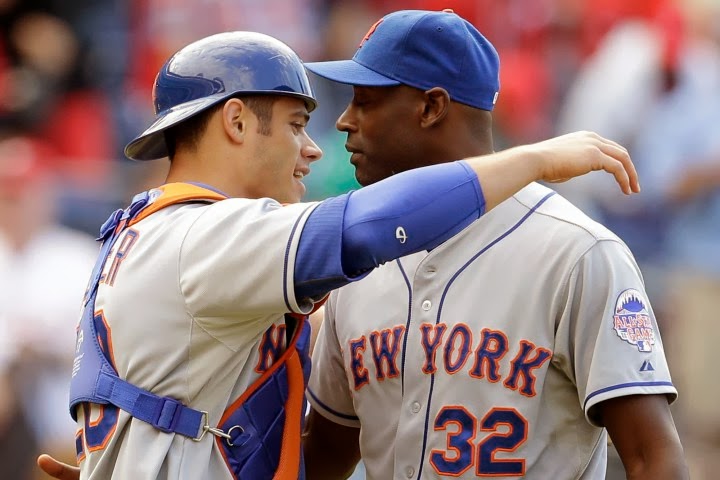
A hug before leaving.  (Getty Images Photo)

After having an excellent season with the Mets in 2013, LaTroy Hawkins will be pitching elsewhere in 2014.  Hawkins, who finished the year as the Mets' closer after Bobby Parnell was sidelined with a season-ending injury, signed a one-year, $2.5 million deal with the Colorado Rockies on Monday.

Never mind that Sandy Alderson said he wouldn't pay a 41-year-old reliever that kind of money, even though Hawkins gave the Mets his best statistical season since 2004, posting a 2.93 ERA, 1.15 WHIP and 13 saves at the age of 40.  But if Hawkins was aware of recent Mets history, he should've known that he was about to become a goner.

In 2011, Francisco Rodriguez was dealt to the Milwaukee Brewers during the All-Star Break.  After the trade, Jason Isringhausen became the Mets' closer, saving seven games - including his 300th career save.  The following season, he traded apples for oranges, leaving the Big Apple for Orange County.  Isringhausen pitched in 50 games for the Los Angeles Angels in 2012, but did not pitch in the majors in 2013.

One year before Isringhausen finished the year for K-Rod, another pitcher was forced into closer duties for the Mets when Francisco Rodriguez couldn't finish the year with the team.  After injuring himself when he became Frankie Knuckles in front of his son's grandfather, Hisanori Takahashi filled in as the team's closer, notching three wins and eight saves over the season's final two months.  The 35-year-old Takahashi was not re-signed by the Mets following his versatile "rookie" season in 2010.  Instead, he chose to sign with the Angels, spending a year and a half in Los Angeles, followed by short tenures in Pittsburgh and Chicago.

Billy Wagner began the final season at Shea Stadium as the Mets' closer.  But a season-ending injury forced Omar Minaya to acquire Luis Ayala in August 2008.  Ayala saved nine games as Wagner's temporary replacement.  And by temporary, I mean his two blown saves, two losses and 14.40 ERA over the season's final two weeks guaranteed he wouldn't be a Met in 2009.  Since then, Ayala has bounced around more than his pitches did in the left and right field corners of Shea Stadium in his six weeks with the team.  The right-hander has collected paychecks from the Twins, Marlins, Yankees, Orioles and Braves since he allowed the final run to cross the plate at Shea Stadium on a back-breaking blast by Dan Uggla on September 28, 2008.

When Braden Looper was in the final days of the two-year contract he signed with the Mets prior to the 2004 season, he required season-ending surgery to repair a blown AC joint in his right shoulder.  In stepped Roberto Hernandez, who picked up two wins and three saves over the final two weeks of the 2005 campaign.  But the Mets allowed Hernandez to leave as a free agent, and the 40-year-old reliever inked a one-year deal to pitch for the Pittsburgh Pirates in 2006.  Hernandez was traded back to the Mets (along with Oliver Perez) when Duaner Sanchez had a case of the munchies and got into the wrong taxi cab in Miami, but Hernandez did not record another save as a Met.

Roberto Hernandez should've pitched in this game instead of Braden Looper.

LaTroy Hawkins had a wonderful season for the Mets in 2013.  After becoming the team's closer on August 6, Hawkins pitched in 23 games and was 13-for-14 in save attempts.  Hawkins had pinpoint control as the team's closer, striking out 18 batters and walking only one in 22⅓ innings.  Opposing hitters had a .229 on-base percentage and a miniscule .272 slugging percentage against Hawkins, collecting just two extra-base hits in 81 at-bats.

Usually, those numbers are what you'd expect from a young, stud closer.  Someone like Craig Kimbrel.  In fact, going back to August 6 - the day Hawkins became the Mets' fill-in closer for the injured Bobby Parnell, Kimbrel went 16-for-17 in save opportunities with 31 strikeouts and five walks in 23⅔ innings, allowing a .211 on-base percentage and .224 slugging percentage (three extra-base hits in 85 at-bats).  Those numbers weren't that much better than what Hawkins did as the Mets' closer.  But because Hawkins is going to be 41 next month, he's not worth $2.5 million for one year, according to Sandy Alderson.

Perhaps Alderson should have given Hawkins another chance to be one of the team's top relievers in 2014, just like he was in 2013.  But Alderson must know about the team's recent history.  He surely has to know how relievers who fill in as temporary closers for the Mets never stick around with the team.  And who is Sandy Alderson to mess with tradition, right?  

Goodbye and thanks for playing, LaTroy Hawkins.  You should have been given another chance next year.  Instead, you're just in the same class as Roberto Hernandez, Luis Ayala, Hisanori Takahashi and Jason Isringhausen.  That's some consolation prize.


Tuesday, June 19, 2012

Is Ike Davis This Year's Dan Uggla?


Over the first two months of the season, Ike Davis stunk more than a zombie wearing limburger cheese cologne.  Through June 8, the Mets' first baseman was hitting .158 (29-for-183), with a .234 on-base percentage and .273 slugging percentage.  Just how bad are those numbers?  In 113 plate appearances, former Mets pitcher Jason Isringhausen had higher career numbers as a Met in all three categories (.196/.238/.299).  Yeah.  Davis was that bad.

But Davis isn't the only National League East infielder to struggle for an extended period of time over the past couple of seasons.  Anyone remember Dan Uggla's start with Atlanta last season?

Through games of July 4 last year, Uggla was hitting .173 (55-for-318), with a .241 on-base percentage and .327 slugging percentage.  Then he embarked on one of the most unexpected long hitting streaks in baseball history.  After his poor start, Uggla hit in 33 consecutive games.  From July 5 to August 13, Uggla batted .377 (49-for-130).  The Braves' second baseman reached base at a .438 clip and slugged .762.  Over the skein, Uggla also displayed tremendous power and drove in nearly a run per game (15 HR, 32 RBI).

That brings us back to Ike Davis.  After slugging the go-ahead grand slam last night against the Baltimore Orioles, Davis is currently riding a nine-game hitting streak.  In those nine games, Davis is smoking the ball at a .462 clip (12-for-26).  Davis also owns a .576 on-base percentage and .769 slugging percentage since June 8, driving in 11 runs over the nine games.  More importantly, he has shown better plate discipline, fanning a mere five times while drawing seven walks.  (Prior to his hot streak, Davis had struck out 59 times as opposed to 18 walks.)  This was not the case with Uggla during his streak in 2011, as he struck out 27 times but only drew a dozen walks over his 33-game bat-a-thon.

The Mets have been able to remain competitive in the NL East with their strong starting pitching and a tremendous ability to drive in runs with two outs.  But prior to June 8, they were playing winning baseball without a significant offensive contribution from Ike Davis.  That was then.  This is now.  And now is the time that Ike Davis is getting as hot as Dan Uggla was last summer.

The summer heat will arrive tomorrow in New York.  But Ike Davis has shown signs of heating up for over a week now.  The Mets will need Davis to continue his recent production at the plate if they're going to avoid melting this summer as they have over the past few seasons. 

Sunday, July 31, 2011

July 31 Has Provided Many Infamous Days In Mets History

Before 1986, the trade deadline used to be June 15, a date Mets fans most associated with the Midnight Massacre in 1977 and the acquisition of Keith Hernandez in 1983. Over the past 25 years, teams have been allowed to make non-waiver trades up to the July 31 deadline.

This year, there have been a frenzy of deals in the last days and hours before the non-waiver trade deadline. Carlos Beltran was traded by the Mets to the Giants. Kosuke Fukudome was dealt to the Indians by the Cubs. Hunter Pence, born and raised in Texas, was shipped off by the Astros to the one place in America that's the polar opposite to the politeness of the Lone Star State, Philadelphia. Michael Bourn became a Brave, Derrek Lee became a Pirate and Ubaldo Jimenez pitched one inning for the Rockies, was traded to Cleveland during his start, and was spared getting his final loss as a Rockie while being a member of the Indians when Colorado rallied to defeat the Padres.

Got that? Those were only a few of the dozens of trades made throughout major league baseball over the past few days. Even Joey Beartran considered trading away his colleague (yours truly) to a different Mets blog for Rich Harden and a toasted bagel with cream cheese, but that trade was pulled back once Joey realized that Harden would probably get injured picking up that bagel.

The Mets haven't been strangers to the last-minute deal since the trade deadline was pushed back to July 31. In fact, the team has made 13 deals on July 31 in the last 25 years. Unfortunately, most of the 13 have proven to be unlucky for the Mets. Let's review some of these trades (with thanks to Ultimate Mets Database for providing the trade details).

On July 31, 1989, the Mets engineered two deals, neither of which worked in the long run. They traded Rick Aguilera, David West, Kevin Tapani, Tim Drummond and Jack Savage to the Minnesota Twins for former Cy Young Award winner and Long Island native Frank Viola.

Those shades can't hide you, Frank Viola. We know you weren't worth Rick Aguilera and Kevin Tapani.

Although Viola went on to win 20 games for the Mets in 1990, becoming the last Met pitcher to accomplish that feat, his stay in New York was short. Viola finished 38-32 in 2½ seasons with the Mets. In his final year in New York (1991), Viola struggled, going 13-15 and leading the major leagues in hits allowed (259). He also lost the ability to strike out batters, finishing the season with 132 strikeouts, after registering at least 182 whiffs in each of his previous five seasons.

Meanwhile, two of the players he was traded for flourished in Minnesota. Kevin Tapani won 75 games in six seasons as a Twin, finishing fifth in the Rookie of the Year voting in 1990 and seventh in the Cy Young Award balloting in 1991 when he finished 16-9 with a 2.99 ERA. Rick Aguilera was turned into the Twins' closer and became the franchise's all-time saves leader. (His 254 saves have since been tied by Joe Nathan.) Aguilera's 42 saves in 1991 tied Jeff Reardon's club record and was one of the main reasons why the Twins went from worst to first, as they won the World Series that year over the Atlanta Braves. The 1991 season also marked the first of three consecutive years that Aggie was selected to the American League All-Star team. Aguilera's 318 career saves (of which only seven came as a Met) rank 15th on the all-time saves list.

On the same day the Mets traded away the winning pitcher in Game 6 of the 1986 World Series, they also dealt the man who hit the little roller up along first that enabled Aguilera to be credited with the win, as fan-favorite Mookie Wilson was sent to Toronto for Jeff Musselman.

This picture is wrong, just wrong.

Mookie would end up helping the Blue Jays win the 1989 American League East division title, even garnering consideration for the 1989 AL MVP award. Jeff Musselman, on the other hand, didn't do quite as well with his new team. After a decent end to the 1989 season (3-2, 3.08 ERA for the Mets), Musselman was downright atrocious in 1990, going 0-2 with a 5.63 ERA for a Mets team that won 91 games. Although he was only 27 years old in 1990, Musselman never pitched again in the major leagues following that awful season.

Ten years to the day after the trade for Frank Viola and the trading of Mookie Wilson, the Mets conducted another ill-fated deal, sending Jason Isringhausen (and Greg McMichael) to the Oakland Athletics. In return, the Mets received A's closer Billy Taylor, who was 37 at the time. After coming to the Mets, Taylor showed his age, appearing in 18 games for New York and registering an ungodly 8.10 ERA and 2.18 WHIP. In only 13.1 innings, he allowed 29 baserunners (20 hits, 9 walks) and opponents hit .345 against him.

Meanwhile, Jason Isringhausen became one of the best closers in baseball over the next decade. He pitched two years in Oakland, saving 33 games (and making the All-Star team) in 2000 and 34 games in 2001. He then signed a free-agent contract with the St. Louis Cardinals following the 2001 season and became the all-time saves leader of that storied franchise, surpassing such greats as former all-time saves leader Lee Smith and Hall of Famer Bruce Sutter.

Isringhausen is now back with the Mets, becoming the de facto closer after the trade of Francisco Rodriguez to the Brewers. Interestingly enough, Izzy's next save will be the seventh of his Mets career (he saved one game in his first stint as a Met), which will tie him for 31st on the Mets' all-time saves list. Who will he tie? None other than Rick Aguilera, the other player the Mets traded away on a July 31st who became his new team's all-time saves leader.

At least we got Izzy back, even if it was a decade too late.

We could stop here, ending this piece with the symmetry of the Aguilera and Isringhausen deals, but there's one more July 31 non-waiver trade deadline deal we have to discuss. It happened only five years ago, but the Mets are still paying for it today. In this case, they're paying for it quite literally.

On July 31, 2006, the Mets traded rightfielder Xavier Nady to the Pittsburgh Pirates for Roberto Hernandez and some guy you might have heard of. His name is Oliver Perez.

At the time of the deal, which was only made because Duaner Sanchez had a case of the midnight munchies and was injured in a taxicab accident on his way to sate his grumbling tummy, Nady appeared to be on his way to his finest season in the major leagues. He had 30 extra-base hits (15 doubles, one triple and 14 home runs) and had driven in 40 runs. All of those numbers were compiled in only 75 games and 265 at-bats with the Mets. To put this into perspective, two years earlier, a Mets player was called up from the minor leagues in July and also picked up exactly 14 and 40 RBI, doing so in 263 at-bats, or two less than Xavier Nady needed to achieve the same statistics in 2006. That player was David Wright.

Over the next two full seasons after the trade, Nady blossomed, hitting .278 with 20 HR and 72 RBI in 2007 for Pittsburgh. He followed that up with an All-Star-caliber year in 2008, splitting his year between the Pirates and Yankees, and hitting .305 with 37 doubles, 25 HR and 97 RBI, all of which were career-highs. Meanwhile, while Nady was having excellent years in 2007 and 2008, the Mets were choking away their seasons, employing rightfielders Shawn Green (.291, 10 HR, 46 RBI) in 2007 and Ryan Church (.276, 12 HR, 49 RBI) to replace Xavier Nady. Green and Church combined to produce 22 HR and 95 RBI over those two seasons, numbers that were surpassed by Nady in 2008 alone.

As for the pitchers the Mets received in the Nady trade, Roberto Hernandez pitched in only 22 games for the Mets before signing a free-agent contract with the Cleveland Indians following the 2006 season, while Oliver Perez...ah, you know the rest.


Because Duaner Sanchez wanted the plate on the right, we got a plateful of Ollie.

Sure, the Mets made some decent deals on July 31, like the trade that brought them Shawon Dunston in 1999, who engineered one of the most important at-bats in franchise history, leading off the bottom of the 15th inning in Game 5 of the 1999 NLCS with a base hit, setting up the inning that ended with Robin Ventura's Grand Slam Single.

That same day, they also traded for Darryl Hamilton, whose biggest moment as a Met came in Game 2 of the 2000 NLDS against the Giants, when he ripped a two-out double in the 10th inning and eventually scored the winning run on Jay Payton's single.

You know what? Come to think of it, if the only good trades the Mets have made on July 31 have involved players who were only known for one at-bat with the team, then maybe the Mets shouldn't make last-minute trades at the non-waiver trade deadline. Let other teams make moves for the Hunter Pences, Ubaldo Jimenezes and Michael Bourns of the world. We'll make do with what we have. We don't need any more Billy Taylors, Jeff Musselmans or that Other Pitcher whose name escapes me at the moment.

Tuesday, June 28, 2011

Texas Two-Step (Part I): Coop & Ed's Tex-cellent Adventure

Last year, the cast and crew of Studious Metsimus embarked on a world tour. No, we didn't tour with Weezer (although that would be super-sweet). Instead, we toured the country following the Mets to different ballparks. We attended games at Camden Yards (Baltimore), Nationals Park (Washington), AT&T Park (San Francisco) and PNC Park (Pittsburgh), cheering for the Mets every step of the way. (We also ventured to Citizens Bank Park in Philadelphia, but that city doesn't need to be linked out to here.)

This year, we decided to pack our bags and take a trip to Texas. Who's "we"? Why, it's yours truly, along with correspondent Taryn (Coop) Cooper, culinary expert/investigative reporter Joey Beartran and his sister, Iggy. (Joey and Iggy's report will be featured in a separate piece.)

We followed the Mets to Texas, where we were told everything is bigger. Apparently, that statement was spot on, as our smiles and Mets' pride were never bigger than they were in Arlington.

Photo by Sharon Chapman, who joined us in Texas with her family. Thanks, Sharon!

Scheduling (and this thing called a "day job") prevented us from attending the finale of the three-game series between the Mets and the Rangers, but we were able to go to the first two games. We can skip over the first game, which was another off-day for Mike Pelfrey and the bullpen. Then again, the final result (an 8-1 loss by the Mets) was nothing new for Big Pelf, as his road woes are no longer a secret.

So let's move on to the middle game of the series. After the first loss, the Mets had sunk to two games under .500 for the millionth time this season. But Jonathon Niese was on the mound for the Mets against the Rangers. Unlike Pelfrey, Niese has had more success on the road (10-7) than at home (8-11) and it showed. Then again, even Victor Zambrano could have won the game with the fireworks supplied by the Mets' bats.

Who needs the long ball? Chicks dig singles as well.

The Mets pounded out 17 hits, with nary a home run in sight, en route to a 14-5 thrashing of the Rangers. The 14 runs represented a season-high for the Mets, who desperately needed a game in which the bullpen was either not used or used in a less stressful environment.

Unfortunately, with Jonathon Niese succumbing to the heat, it was up to Bobby Parnell and DJ Carrasco to finish the game. Jason Isringhausen was not called upon because he was too busy playing with his big red ball and Manny Acosta was on bathroom security duty (see photos below).


While we are the game in our Mets gear, we were actually heckled by four Rangers fans. That's right, not everyone in Texas is polite. The first three fans apparently got together before the game because all they could come up with was "BOOOOO" as we walked by.

The fourth fan was a little more original with his insult, as he showed his extensive knowledge of pronouns with his "BOO YOU" epithet. Then again, perhaps he wasn't being derisive to us at all and was just stating the college he was attending. (BOO U, anyone?)

We did have to give credit to one Rangers fan who actually was quite creative in expressing his love for his team, dressing as a masked Lucha Libre fighter called "El Rangerdoro". He posed for some photos with us, where he showed off his signature "chokehold while wearing batting gloves" move and his ability to point at the camera. (For those of you who still thinking wrestling is real, I regret to inform you that the pointing was indeed choreographed.)


Although we couldn't attend the final game of the series, we did go out to the ballpark that morning to take some exterior shots of the ballpark and its surroundings. We didn't run into any players entering the stadium, but we did run into long-time Mets' PR dude, Jay Horwitz. (I assure you he's in one of the photos below.)


To recap our trip to Texas...

It was hot. No, seriously. Just look at that wet stain on my Mets T-shirt in the collage of photos above. That didn't come from the guy who attended BOO U.

Jon Niese did wonderfully in his start, despite sweating through his uniform (perhaps nervous that El Rangerdoro was waiting for him outside the visitors' clubhouse).

Manny Acosta might have a new job in sanitation soon if he continues to give up runs at an alarming rate.

Arlington has a really great ballpark. No joke needed there. It's just a really sweet park.

From the tributes to Nolan Ryan (including the large statue in center field of the Ryan Express doffing his cap) to the frequent fireworks (not all of them came from the Mets' bats), our ballpark experience was one to remember. It was indeed (dare I say it) a Tex-cellent adventure!

Sunday, June 5, 2011

If You're Not Booing Jason Bay Yet, Perhaps This Will Help

Jason Bay is being paid $66 million by the New York Mets to suck. Judging by the boos at Citi Field, he is earning every penny of it. But what are they booing exactly? Is it the lack of home runs by Bay after smashing 36 longballs for Boston in 2009? Is it the failure to drive in runs after recording four 100 RBI seasons in the five seasons prior to becoming a Met? Or is it just that Oliver Perez and Luis Castillo are no longer around, so someone's gotta get the boo treatment.

Well, my fellow Mets fans, I think it's a combination of all those things. Jason Bay has been a disappointment. He's barely been worth $66, let alone $66 million. So feel free to boo him if you choose to do so. If you still don't see why he should be booed, let me throw some numbers at you about Jason Bay that you might not have known.

There have been 96 everyday players (non-pitchers) in history to strike out at least 125 times as members of the Mets. Of those 96, only one of them did not register at least 500 career at-bats for the Mets. That player is Jason Bay (127 Ks in 482 at-bats).

This year, Jason Bay has a slugging percentage of .291 in 134 at-bats. To put that into perspective, Jason Isringhausen has a .299 slugging percentage in 97 career at-bats for the Mets. Sticking on the Jason vs. Jason theme, Bay has 10 RBI this season in those 134 at-bats. In 37 fewer career at-bats, Izzy has 11 RBI.

Jason Bay has 38 extra-base hits in his Mets career (482 at-bats), which means he collects an extra-base hit every 12.7 at-bats. Here are former Mets with similar numbers:

  • Victor Diaz: 39 XBH in 350 at-bats.
  • Tsuyoshi Shinjo: 38 XBH, 514 at-bats.
  • Luis Lopez: 37 XBH, 548 at-bats.
  • Desi Relaford: 35 XBH, 301 at-bats.
  • Marlon Anderson: 33 XBH, 446 at-bats.
  • Dave Gallagher: 33 XBH, 376 at-bats.
  • Eric Valent: 33 XBH, 313 at-bats.
  • Marv Throneberry: 31 XBH, 371 at-bats.
  • Tim Bogar: 30 XBH, 491 at-bats.
  • Chico Walker: 30 XBH, 440 at-bats.

None of those hitters would be considered a great, or even good hitter. Similarly, none of those hitters ever earned anything near $66 million or a comparable amount for the era in which they played.

Let's face it. Power hitters are going to suffer when they sign with or are traded to the Mets. Citi Field is the park where home runs go to die. However, the dimensions of the park should not do anything to a player's extra base-hit total or strikeout total. Apparently, Jason Bay never got that memo.

So if you still don't think Jason Bay should be booed at Citi Field, perhaps the reasons listed above might cause you to rethink your booing strategy. $66 million bought the Mets a plate at Jason Bay's all-you-can-K buffet. All you have to do is buy a ticket for far less than that to let Bay know that he hasn't been worth the price of a Happy Meal.

Saturday, February 26, 2011

Izzy Lightning In A Bottle?

Jason Isringhausen was one of three members of Generation K, the triumvirate of young pitchers who were supposed to be the '90s version of Seaver, Koosman and Matlack. Isringhausen had the most success after his initial call-up to the majors in 1995, going 9-2 with a 2.81 ERA in 14 starts.

However, injuries took their toll on Izzy and he was dealt to Oakland at the trade deadline in 1999 for reliever Billy Taylor. Taylor's career with the Mets lasted all of 18 games, as his 8.10 ERA probably had something to do with the length of his stay in New York. Meanwhile, Isringhausen went on to become an All-Star closer with the Athletics and Cardinals, saving 293 games over the course of his career.

Had Isringhusen stayed in New York as a reliever (he picked up one save for the Mets in 1999), perhaps Mets fans would never have been subjected to watching Armando Benitez, Braden Looper or Luis Ayala putting the BS in Blown Save. However, that was then and this is 2011, a year that has brought Izzy's baseball odyssey back to New York.

This has happened before, when a pitcher who made a splash with the Mets went elsewhere, made the postseason repeatedly, including a World Series championship, and then came back at the end of his career in an attempt to close out his career where it all began.

David Cone pitched for the Mets from 1987-1992 and had some of the best seasons of his career in Flushing. But after being traded to the Toronto Blue Jays for the underachieving Jeff Kent and Ryan Thompson (whose sole claim to fame was hitting a grand slam off John Smoltz in 1994 that preceded a bench-clearing brawl when Smoltz intentionally hit mighty mite John Cangelosi with his next pitch), Cone had his greatest success in the majors. He won the Cy Young Award in 1994 with Kansas City, threw a perfect game as a member of the Yankees in 1999 and won a total of five World Series rings (one with Toronto in 1992 and four with the Yankees in 1996, 1997, 1998 and 2000). He then came back to the Mets in 2003 and surprised everyone by making the team out of Spring Training. However, his comeback was short-lived, as he went 1-3 with a 6.50 in five games (four starts).

Jason Isringhausen, on the other hand, pitched for the Mets from 1995-1999 before his trade to Oakland in July of 1999. Because of the trade, he missed out on the Mets' first playoff appearance in 11 years. But beginning the following year (2000), Isringhausen would become a staple in the playoffs.

In 2000, the A's won the AL West and in 2001, Oakland made the playoffs as a 102-win wild card team. After signing with the Cardinals as a free agent, Izzy helped St. Louis win the NL Central division title in 2002. The Cardinals failed to make the playoffs in 2003, but then won three straight division titles, winning the National League pennant in 2004 and the World Series in 2006.

Injuries took their toll on Isringhausen following his last successful season as the Cardinals' closer (2007) and he required Tommy John surgery in June of 2009, while a member of the Tampa Bay Rays.

Now Isringhausen is back on the Mets, and he is impressing the coaching staff to the point where he might pull a David Cone and make the team out of Spring Training. Mets' pitching coach Dan Warthen has monitored Isringhausen closely in camp and had this to offer on his progress:

"I've seen a lot more than I expected at any time. The ball is coming out of his hand great. He still has the Izzy curveball, and he's added a nice little cutter and changeup. I couldn't be more pleased. If Izzy can come in and continue to do exactly what he's doing right now, he is a major part of this."


If Isringhausen does make the team, he may be wearing his old No. 44 (which symbolizes the fact that he was a 44th round draft pick in 1991). Right now, Jason Bay is currently wearing the number, but he has only worn it since being traded from the Pirates to the Red Sox in 2008. When Bay was making a name for himself in Pittsburgh, he wore No. 38. Although he hasn't said that he will go back to wearing his old number with the Pirates (currently new acquisition Chris Capuano is the wearer of No. 38), he has said that he would gladly give up No. 44 to Isringhausen:


“I’ve tried to hit against him and I know how good he is. I hope he makes it because he’s a great pitcher and he’ll make our team better. And if he does, I’m giving him the shirt. It’s his. I want him to have it.”


David Cone tried to recapture some of his old magic when he broke camp with the Mets in 2003 after not pitching in the major leagues in 2002. Unfortunately for him, he wasn't able to come back successfully. Jason Isringhausen didn't pitch in the majors in 2010 while recovering from Tommy John surgery. Will Izzy be able to make the team and succeed in the bullpen? If so, the Mets might have found lightning in a bottle.

There are less than five weeks to go until Opening Day. If there is something left in Izzy's tank, now is the time to prove that he is still capable of helping a big league team. With the departure of Pedro Feliciano and Hisanori Takahashi, the Mets are going to need all the help they can get in the bullpen. Jason Isringhausen might be one of those relievers, and if he is, lightning will have indeed struck twice for Izzy in New York.