Showing posts with label Francisco Rodriguez. Show all posts

Monday, January 25, 2016

The Most With The Least: Hisanori Takahashi (2010)

Ever since Hideo Nomo burst onto the major league scene with the Los Angeles Dodgers in 1995, creating a craze at Chavez Ravine not seen since the days of Fernando-mania, the pipeline for Japanese players has remained quite active in the United States, particularly for the Mets.  Two years after Nomo became the first player from Japan to win the Rookie of the Year award - edging out future Mets killer Chipper Jones for the honor - the Mets signed their first Japanese player in reliever Takashi Kashiwada.

Kashiwada became the first of 15 players born in Japan to play for the Mets from 1997 to 2010, making Flushing the top destination in the major leagues for Japanese players.  However, none of the 15 athletes achieved the success and adulation that Nomo (who was one of the 15, becoming a Met in 1998) earned in Los Angeles.

Masato Yoshii won 12 games for the Mets in 1999 - albeit with a high ERA (4.40) and WHIP (1.30) - then fizzled in the postseason, pitching just 13 innings in three starts.  Tsuyoshi Shinjo became the first position player from Japan to don a Mets uniform in 2001.  But after a decade of being a rock star in Japan, he became soft rock in New York and was gone after just one somewhat productive season (returning for a shorter, less productive stint with the Mets in 2003).  And who could forget Kaz Matsui?  If the Mets signed him specifically to hit home runs in his first at-bat each season, then they were wildly successful, as Matsui did just that in each of this three years in New York.  But high expectations, in addition to temporarily displacing the more popular Jose Reyes to second base in 2004, caused the Matsui era in Flushing to be mostly forgettable.

It wasn't until 2010, when a lesser-known veteran pitcher joined the Mets, that the team found a Japanese player who actually exceeded expectations in New York.  He also developed an unexpected following and redefined himself during his one season with the Mets to became a lights-out reliever, helping the team improve by nine wins after a disappointing season the year before.

Hisanori Takahashi found success in New York in multiple roles.  (Doug Pensinger/Getty Images)

Hisanori Takahashi played ten years in his native Japan from 2000 to 2009.  Unlike some of his more celebrated peers, Takahashi didn't begin his Japan Central League career until he was 25 years old.  And although he was a popular player in his home country, his career as a starting pitcher and sometimes reliever had its share of ups and downs.  He was an All-Star who helped the Yomiuri Giants win three championships, but he also had a number of poor seasons, which made several major league teams hesitant to sign him when he declared his interest to pitch in the United States as a 35-year-old in 2010.  But the Mets were a team in disarray and needed all the help they could get, especially in the pitching department.

After winning the N.L. East division crown in 2006 and falling one game short of the playoffs in 2007 and 2008, the Mets crumbled completely in 2009, finishing the year with a 70-92 record as several key players spent a significant amount of time on the disabled list.  One of the glaring weaknesses on the 2009 team was its pitching, as the staff finished the year with a 4.45 ERA - the third-worst mark in franchise history, surpassed by only the 2003 club (4.48 ERA) and the inaugural 1962 squad (5.04 ERA).

John Maine and Oliver Perez combined to make just 29 starts in 2009 and Johan Santana also had his season cut short due to injuries.  The only pitcher who remained healthy in 2009 and was guaranteed a spot in the starting rotation in 2010 was Mike Pelfrey, who became the first and only pitcher in team history to make 30 or more starts and finish the year with an ERA above 5.00, as he posted a 5.03 ERA in 31 starts during the nightmarish 2009 campaign.  Needless to say, the Mets went into the 2009-2010 off-season needing to bolster its pitching in the worst way.

A week before the start of spring training, the Mets signed Takahashi to a one-year, $1 million deal, with the potential to earn $2 million more in performance bonuses.  At the time, Anthony Nakanishi - who worked for Takahashi's team of agents - was quite optimistic for his agency's client.

"This could work out very well for the Mets," said Nakanishi.  "Hisanori is a bit of a late bloomer and like some other left-handed pitchers from Japan, like Hideki Okajima, his pitching style may translate even better in major league baseball.  Who knows, he could win 15 games.  It's a possibility."

Of course, Nakanishi had to say positive things about Takahashi to give Mets fans a reason to be optimistic and not boo his client from day one.  Those same fans had seen several Japanese players try to succeed in New York, with most of them failing miserably.  But predicting 15 wins for a pitcher competing for the role of fifth starter on a 70-win team?  That seemed like quite a stretch.  But before long, Nakanishi's words almost seemed prophetic, even after his client failed to earn a spot in the starting rotation coming out of spring training.

"What has my agent gotten me into?  15 wins?  Really?"  (Kyodo News, via AP)

Takahashi pitched very well for the Mets in his first spring training outside of Japan, holding opposing hitters to a .170 batting average and collecting 14 strikeouts in 13 innings of work.  But even with Jonathon Niese struggling in his Grapefruit League appearances, opening the potential for Takahashi to sneak into the rotation, manager Jerry Manuel preferred to see Takahashi in the bullpen.  When Opening Day arrived, the Mets' rotation consisted of Santana, Maine, Perez, Pelfrey and Niese, with Takahashi joining Pedro Feliciano as the team's second lefty option in the bullpen.

Takahashi's major league debut did not go well.  On April 7, 2010, the Mets erased a five-run, seventh-inning deficit against the Florida Marlins, scoring two runs in the seventh and three more in the eighth to tie the game, 6-6.  Closer Francisco Rodriguez had been used to preserve the tie in the top of the ninth inning, but was due to lead off in the bottom of the frame, causing Manuel to insert Ruben Tejada (who was also making his debut in the big leagues) into the game as a pinch hitter.  When Tejada and the rest of the team failed to push across a run, Manuel gave the ball to Takahashi to start the tenth, who allowed the Marlins to score the go-ahead run on two singles and a walk.  Takahashi was saddled with the loss in the debut, as the Mets fell to Florida, 7-6.

Although Takahashi did not have the debut he wanted, he quickly learned from his mistakes.  Manuel started to use Takahashi as a long man in the bullpen and was rewarded instantly.  From April 13 to May 16, Takahashi made 12 relief appearances, pitching three innings or more in four of those outings and striking out 32 batters in 23⅔ innings.  His best performance during the five-week stretch came on April 23, when he struck out seven Atlanta Braves hitters in three innings, earning his first big league victory in the process.

As the calendar flipped from April to May, the Mets found themselves in a surprising position - first place in the N.L. East.  But the seeds planted in April did not lead to a full bloom in May, as the Mets lost 13 of their first 18 games in the season's second month.  Games weren't the only things being dropped by the Mets, as three-fifths of the starting rotation went down, either to injury (Jonathon Niese strained his right hamstring) or ineffectiveness (Oliver Perez allowed too many long balls and John Maine allowed too many balls).  With all the tumult going on with the starting rotation, manager Jerry Manuel needed to make some decisions.  One of them was made when R.A. Dickey was inserted into the rotation, launching what became a magical three-year tenure in New York for the rejuvenated knuckleball pitcher.  Manuel's next decision involved Takahashi's move from the bullpen to make a start against the New York Yankees on May 21.  It was then that Takahashi's season really took off.

Takahashi pitched six scoreless innings against the Yankees in his first big league start, scattering five hits and striking out five batters.  But one year after Mets second baseman Luis Castillo made a costly error to give the Yankees a come-from-behind victory, it was another second sacker - Alex Cora - who tossed the game away.  Cora's throwing error on a potential double play ball was followed by a two-run double by seldom-used outfielder Kevin Russo.  (Russo had just four RBI in his entire major league career, with half of them coming in that one game-changing swing.)  Those were the only tallies needed by the Yankees in their 2-1 victory over the Mets.

The Mets lost the game, but found a new starting pitcher in Takahashi.  The southpaw continued his scoreless streak by putting six more zeroes on the scoreboard in his next start - a 5-0 victory over the Philadelphia Phillies.  Although he had some hiccups along the way, Takahashi allowed one run or fewer in five of his 12 starts, which included a second brilliant performance against the Yankees on June 18, a game in which he threw another six scoreless innings.  This time, the bullpen and the defense came through for the Mets, as four relievers combined with Takahashi on the shutout.  Most importantly, the victory was the Mets' eighth straight and improved the team's record to 39-28.

Unfortunately, the Mets regressed from late June to early August, dropping 23 of 34 games to fall below .500 for the first time since late May.  The wheels came completely off the Mets' bus on August 11 when K-Rod attempted to KO his children's grandfather in the Citi Field family lounge after the team's 6-2 loss to the Colorado Rockies.  Rodriguez was arrested and missed the rest of the season with torn ligaments in his right thumb, which he suffered during the altercation.

A portrait of Citi Field's Least Wanted.  (Debbie Egan-Chin/NY Daily News)

Although the Mets were under .500 and their playoff hopes were all but gone, the team still needed to play the games on its schedule.  They also needed a closer for the rest of the season, with Rodriguez out for the year.  Once again, Manuel turned to Takahashi to fill a specific role and the 35-year-old responded with aplomb.

Takahashi got his first save opportunity on August 16, retiring the Houston Astros in order in the ninth inning of a 3-1 Mets victory.  From that point to the end of the season, Takahashi was brilliant in his new role, earning three wins and going 8-for-8 in save opportunities.  In 19 appearances, Takahashi had a 0.84 ERA and 0.94 WHIP, holding opposing hitters to a .197/.247/.289 slash line, which was slightly better than the .213/.289/.308 slash line allowed by Rodriguez prior to his season-ending scuffle.

The Mets ended the 2010 season with a 79-83 record, which represented a nine-game improvement over their 2009 performance.  Takahashi's first season in the majors was an unexpected success.  Although he didn't quite reach the 15 wins predicted by his agent at the beginning of the year, he did notch ten wins and eight saves, becoming the fifth Met - and the first since 1986 - to reach double digits in wins while saving eight or more games, joining Tug McGraw (11 wins, 8 saves in 1971), Skip Lockwood (10 wins, 19 saves in 1976), Jesse Orosco (13 wins, 17 saves in 1983; 10 wins, 31 saves in 1984) and Roger McDowell (14 wins, 22 saves in 1986) in this exclusive club.  But those four pitchers combined to make one start in their spectacular seasons (McGraw got a no-decision in that start), meaning they earned all their wins in relief.  Takahashi was the only true starter/reliever hybrid of the group, earning four of his wins as a starting pitcher.  Takahashi was also the Mets' first "rookie" pitcher to earn 10 or more wins in his inaugural major league season since 1985, when Rick Aguilera posted a 10-7 record as a first-year player for the team.

Unfortunately, once the 2010 season ended, the Mets cleaned house, ridding themselves of manager Jerry Manuel and general manager Omar Minaya.  The new regime (featuring Terry Collins and Sandy Alderson) did not see the soon-to-be 36-year-old Takahashi as part of the team's future and allowed him to become a free agent, ending the respected pitcher's one-year stay in New York.  Takahashi spent the next three seasons with the Los Angeles Angels, Pittsburgh Pirates and Chicago Cubs, before returning to Japan to pitch for the Yokohama Bay Stars in 2014.

There have been many pitchers in team history who were never expected to amount to much when they joined the big league roster.  Except for his agent, no one expected Hisanori Takahashi to contribute much to the team.  But the left-hander silenced all his critics, and in doing so, became one of the most appreciated Japanese players to ever play for the Mets.

Photo by Lucy Nicholson/Reuters


"Eight months here in the United States, I'll spend most of the time in New York.  I kind of like New York."

--Hisanori Takahashi (September 2010)


And New York kind of liked Takahashi back.  After years of high expectations for Japanese players such as Tsuyoshi Shinjo and Kaz Matsui, it was a player originally brought in to compete for the fifth starter job that finally succeeded in every role he was called upon to fill.

Hisanori Takahashi had a short career in New York, but accomplished things that very few pitchers in team history had been able to do.  In a year that provided very few highlights for the Mets, Takahashi was a bright spot, making the most of his varied opportunities and giving Mets fans a reason to cheer whenever he set foot on the mound.


Note:  The Most With The Least is a thirteen-part weekly series spotlighting those Mets players who performed at a high level without receiving the accolades or playing time their more established teammates got, due to injuries, executive decisions or other factors.  For previous installments, please click on the players' names below:

January 4, 2016: Benny Agbayani
January 11, 2016: Donn Clendenon
January 18, 2016: Tim Teufel

Tuesday, November 19, 2013

Fill In At Closer, Fill Out Your Pink Slip

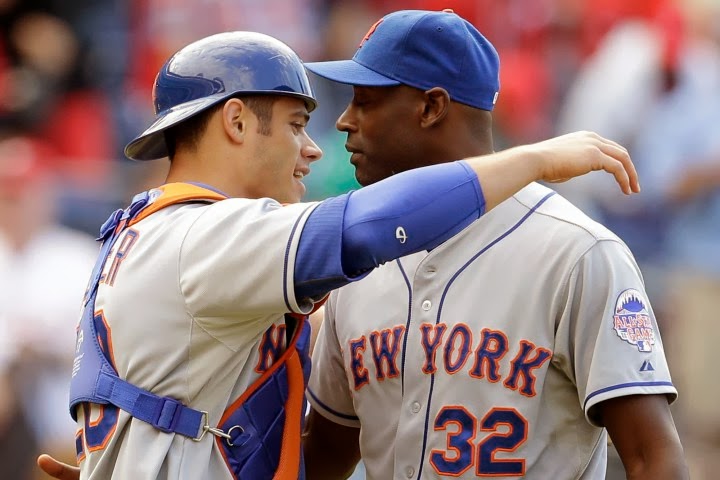
A hug before leaving.  (Getty Images Photo)

After having an excellent season with the Mets in 2013, LaTroy Hawkins will be pitching elsewhere in 2014.  Hawkins, who finished the year as the Mets' closer after Bobby Parnell was sidelined with a season-ending injury, signed a one-year, $2.5 million deal with the Colorado Rockies on Monday.

Never mind that Sandy Alderson said he wouldn't pay a 41-year-old reliever that kind of money, even though Hawkins gave the Mets his best statistical season since 2004, posting a 2.93 ERA, 1.15 WHIP and 13 saves at the age of 40.  But if Hawkins was aware of recent Mets history, he should've known that he was about to become a goner.

In 2011, Francisco Rodriguez was dealt to the Milwaukee Brewers during the All-Star Break.  After the trade, Jason Isringhausen became the Mets' closer, saving seven games - including his 300th career save.  The following season, he traded apples for oranges, leaving the Big Apple for Orange County.  Isringhausen pitched in 50 games for the Los Angeles Angels in 2012, but did not pitch in the majors in 2013.

One year before Isringhausen finished the year for K-Rod, another pitcher was forced into closer duties for the Mets when Francisco Rodriguez couldn't finish the year with the team.  After injuring himself when he became Frankie Knuckles in front of his son's grandfather, Hisanori Takahashi filled in as the team's closer, notching three wins and eight saves over the season's final two months.  The 35-year-old Takahashi was not re-signed by the Mets following his versatile "rookie" season in 2010.  Instead, he chose to sign with the Angels, spending a year and a half in Los Angeles, followed by short tenures in Pittsburgh and Chicago.

Billy Wagner began the final season at Shea Stadium as the Mets' closer.  But a season-ending injury forced Omar Minaya to acquire Luis Ayala in August 2008.  Ayala saved nine games as Wagner's temporary replacement.  And by temporary, I mean his two blown saves, two losses and 14.40 ERA over the season's final two weeks guaranteed he wouldn't be a Met in 2009.  Since then, Ayala has bounced around more than his pitches did in the left and right field corners of Shea Stadium in his six weeks with the team.  The right-hander has collected paychecks from the Twins, Marlins, Yankees, Orioles and Braves since he allowed the final run to cross the plate at Shea Stadium on a back-breaking blast by Dan Uggla on September 28, 2008.

When Braden Looper was in the final days of the two-year contract he signed with the Mets prior to the 2004 season, he required season-ending surgery to repair a blown AC joint in his right shoulder.  In stepped Roberto Hernandez, who picked up two wins and three saves over the final two weeks of the 2005 campaign.  But the Mets allowed Hernandez to leave as a free agent, and the 40-year-old reliever inked a one-year deal to pitch for the Pittsburgh Pirates in 2006.  Hernandez was traded back to the Mets (along with Oliver Perez) when Duaner Sanchez had a case of the munchies and got into the wrong taxi cab in Miami, but Hernandez did not record another save as a Met.

Roberto Hernandez should've pitched in this game instead of Braden Looper.

LaTroy Hawkins had a wonderful season for the Mets in 2013.  After becoming the team's closer on August 6, Hawkins pitched in 23 games and was 13-for-14 in save attempts.  Hawkins had pinpoint control as the team's closer, striking out 18 batters and walking only one in 22⅓ innings.  Opposing hitters had a .229 on-base percentage and a miniscule .272 slugging percentage against Hawkins, collecting just two extra-base hits in 81 at-bats.

Usually, those numbers are what you'd expect from a young, stud closer.  Someone like Craig Kimbrel.  In fact, going back to August 6 - the day Hawkins became the Mets' fill-in closer for the injured Bobby Parnell, Kimbrel went 16-for-17 in save opportunities with 31 strikeouts and five walks in 23⅔ innings, allowing a .211 on-base percentage and .224 slugging percentage (three extra-base hits in 85 at-bats).  Those numbers weren't that much better than what Hawkins did as the Mets' closer.  But because Hawkins is going to be 41 next month, he's not worth $2.5 million for one year, according to Sandy Alderson.

Perhaps Alderson should have given Hawkins another chance to be one of the team's top relievers in 2014, just like he was in 2013.  But Alderson must know about the team's recent history.  He surely has to know how relievers who fill in as temporary closers for the Mets never stick around with the team.  And who is Sandy Alderson to mess with tradition, right?  

Goodbye and thanks for playing, LaTroy Hawkins.  You should have been given another chance next year.  Instead, you're just in the same class as Roberto Hernandez, Luis Ayala, Hisanori Takahashi and Jason Isringhausen.  That's some consolation prize.


Sunday, October 27, 2013

The Mets Have Also Had Weird Walk-Off Losses

Photo by Elsa/GettyImages (via the NY Times)

On Saturday night, the Cardinals defeated the Red Sox in Game 3 of the World Series in bizarre fashion.  St. Louis had runners on second and third with one out in the bottom of the ninth inning and the game tied, 4-4.  Jon Jay then hit a ground ball to second baseman Dustin Pedroia, who made an outstanding diving stop before throwing home to nail Yadier Molina at the plate.  Allen Craig, who was not running at 100% because of a sprained foot, then took off slowly for third base.  Seeing Craig scrambling to reach third, Jarrod Saltamacchia attempted to throw him out.  But his throw hit Craig and caromed into foul territory, where it was picked up by left fielder Daniel Nava.  His throw back to Saltalamacchia appeared to get Craig at the plate for the third out, but umpire Jim Joyce called interference on third baseman Will Middlebrooks, allowing Craig to score the winning run.  Middlebrooks had tripped up Craig after Saltalamacchia's throw sailed down the left field line.

It was as strange an ending to a game as Game 6 of the 1986 World Series, also lost when a Red Sox corner infielder allowed the winning run to score, this time against the Mets.  Although the Mets have never lost a game on an interference call, they have lost their share of games in other weird walk-off ways.  Let's take a look at some of them.

In addition to losing hundreds of games on game-ending hits, sacrifice flies and bases loaded walks (Kenny Rogers, you will never be forgiven), the Mets have also lost three games when a runner on third scored on a balk (most recently accomplished by Collin McHugh, who balked home Miami's Donovan Solano in R.A. Dickey's last start as a Met on October 2, 2012).

Similarly, there have been three instances in Mets history in which a pitcher forced in the winning run by hitting a batter with the bases loaded.  One such hit batsman helped set in motion the firing of the team's manager.

On June 5, 2008, the Mets were opening a four-game series in San Diego after taking two of three from the Giants in San Francisco.  They entered the series against the Padres playing good baseball, having won seven of their previous nine games to go from three games under .500 (23-26) to two games over (30-28).  But in a 1-1 tie, Scott Schoeneweis walked future Met Scott Hairston to lead off the bottom of the ninth.  Schoeneweis then issued two more walks (one of which was intentional) to set up a bases loaded matchup with Paul McAnulty, who sported a Mario Mendoza-like .210 career batting average entering the game.  Schoeneweis was trying to induce an inning-ending double play from the Padres' left fielder.  But he hit McAnulty with his first pitch, forcing in the winning run.  The loss ignited a five-game losing streak for the Mets.  One week later, manager Willie Randolph was fired.

A week after Schoeneweis plunked a Padre, Willie Randolph was "schoen" the door by the Mets.

Another rare way the Mets have lost in walk-off fashion is via the groundout.  On nine occasions, a ground ball out has failed to prevent the winning run from scoring.  And once, a double play couldn't even stop a walk-off loss.  On July 21, 1973, the Mets and Pirates went to the bottom of the ninth deadlocked at one.  Mets reliever Buzz Capra loaded the bases on a single and two walks.  With no outs, Tug McGraw came into the game and induced a ground ball from Bucs first baseman Bob Robertson.  The Mets were able to get a force at home and another out at second, but Dave Cash came all the way around from second base to score the winning run while the Mets were throwing the ball all over the place.  Therefore, a 4-2-9-6 double play produced a W-A-L-K-off loss.

The Mets have lost 21 games on a walk-off error, including one by the normally sure-handed Keith Hernandez on July 2, 1983, just two and a half weeks after the Mets acquired him from St. Louis.  Doug Sisk and Francisco Rodriguez are the only two pitchers to be victimized by walk-off errors twice.  Sisk was on the mound when the Mets lost games in 1984 and 1985 on miscues by Hubie Brooks and Rafael Santana, respectively.  Similarly, K-Rod walked off the field in disgust when Daniel Murphy made an error in September 2009.  It was the second time that season that Rodriguez witnessed a walk-off error from the mound, as just three months earlier, Luis Castillo made everyone want to "Forget Lou" after he failed to use two hands on an Alex Rodriguez pop-up at Yankee Stadium.

All of the above were certainly odd ways to lose games in walk-off fashion.  But perhaps the most bizarre walk-off loss in Mets history took place on July 27, 1967, in a game the Mets lost to the Dodgers in 11 innings, 7-6.  The Mets were already shorthanded, as only 21 players suited up for the team that day.  John Sullivan started for the Mets at catcher and delivered an RBI single in the seventh inning to pull the Mets to within one run of the Dodgers.  But manager Wes Westrum then foolishly used Jerry Grote - his sole remaining catcher on the bench - as a pinch-runner for Sullivan.  When Grote came in to catch in the bottom of the seventh, he started barking at home plate umpire Bill Jackowski about his strike zone.  After the inning was over, Grote continued to voice his displeasure over balls and strikes from the dugout and was tossed from the game.  That left Westrum without a catcher on his bench.  That is, until he called upon Tommie Reynolds to put on the catcher's gear.

Tommie Reynolds
Reynolds had never played the position before in a major league game.  But he took one for the team and squatted behind the plate for what he thought would be no more than two innings.  Of course, the game went into extra innings and the inexperienced Reynolds stayed in the game as the team's catcher.  Finally, in the 11th inning, with one out and runners at the corners, Reynolds couldn't handle a Jack Fisher pitch, allowing the winning run to score for the Dodgers.  The ruling by the official scorer was a passed ball by Reynolds.  It was the only time in Mets history that the team suffered a walk-off loss on a passed ball, and it was committed by a player who never caught another game in his career.

So you see, Red Sox fans, you're not alone when it comes to weird walk-off losses.  The Mets have done it all the time, even against your team in World Series play.  After all, this is baseball, where you're always bound to see something you've never seen before, just like Tommie Reynolds never saw that Jack Fisher pitch in 1967, a year the Red Sox also played the Cardinals in the World Series.

Will Middlebrooks is now part of a weird walk-off family.  But don't worry.  He'll have new family members to keep him company before too long.
 

Sunday, May 19, 2013

Our Savior Has Arrived!


On Sunday, Bobby Parnell notched his sixth save of the season, recording the final three outs of the Mets' 4-3 victory over the Cubs.  With the save, Parnell now has 20 in his six-year career with the Mets.  Now that may not seem like much, but it does give Parnell a special title.

Tell me, my fellow Mets fans.  Do you know which homegrown Met has the most saves in team history?  That would be Tug McGraw, who had 86 saves in a Mets uniform.  (Jesse Orosco, who had 107 saves in Flushing, made his major league debut with the Mets, but was originally drafted by the Minnesota Twins and made his professional debut in their minor league system.)

McGraw is followed by Roger McDowell (84 saves), Neil Allen (69 saves), Randy Myers (56 saves), Doug Sisk (33 saves), Bob Apodaca (26 saves), Danny Frisella (24 saves) and Parnell.

Did you notice that all of the homegrown relievers ahead of Parnell pitched for the Mets exclusively in the '60s, '70s and '80s?  When Randy Myers was traded for John Franco after the 1989 season, that began a nearly quarter century stretch in which the Mets went with closers whom they traded for or signed as free agents.

First it was John Franco (acquired from Cincinnati).  Then it was Armando Benitez (acquired from Baltimore).  Benitez was followed by Braden Looper (free agent signing), Billy Wagner (free agent signing), Francisco Rodriguez (free agent signing) and Frank Francisco (yup, another free agent signing).  During that 20-plus year stretch, homegrown pitchers were used to close games primarily when the incumbent closer needed a day of rest or was on the disabled list.

So since the departure of Randy Myers following the 1989 campaign, which homegrown pitchers have registered the most saves for the Mets?  Here is the top three list:

  • Bobby Parnell (20 saves)
  • Anthony Young (18 saves)
  • Aaron Heilman (9 saves)

The only homegrown pitchers to record at least ten career saves for the Mets since Randy Myers' last season in New York are Anthony Young and Bobby Parnell.  Young is also the only homegrown closer since 1990 to record an individual season of more than seven saves when he saved 15 games in 1992 - the same year he began his major league-record 27-game losing streak.

Bobby Parnell has been given the closer duties by manager Terry Collins.  He is the first homegrown pitcher since 1989 to earn that responsibility out of spring training.  And he is now the team's all-time saves leader for homegrown pitchers since that year.

The Mets have not developed many closers over the past quarter century, choosing to bring in closers from other teams.  Bobby Parnell is finally getting a chance to become the next Tug McGraw, Roger McDowell or Randy Myers.  If he succeeds, he stands to join those pitchers as the best homegrown closers in franchise history.

Our ninth inning savior has finally arrived!  And his name is Bobby Parnell.  It sure is nice to see a familiar face on the mound in the ninth inning instead of a recruit from another team.

This is a scene that very few homegrown closers have been able to repeat.

Thursday, March 7, 2013

Mariano Rivera And Tom Seaver Are "The Franchises"

On Saturday, all-time saves leader Mariano Rivera will formally announce that the 2013 season will be his last in the majors.  He will retire with a handful of World Series rings and the unofficial title of  greatest closer in baseball history.

How great has Rivera been over his career?  Let's look at a few examples, comparing Rivera's accomplishments to those of various Mets greats.


Entering the 2013 campaign, Rivera has notched 608 saves.  That's more than twice the amount recorded by John Franco on his way to becoming the Mets' all-time leader and surpasses the combined total posted by Armando Benitez, Jesse Orosco, Billy Wagner, Tug McGraw and Roger McDowell by 70 saves.  It should be noted that those five pitchers rank No. 2 through 6 all-time on the Mets' saves leaderboard.

Just four pitchers in Mets history have recorded a single-season ERA under 2.00 with at least 50 innings pitched.  Tom Seaver (1.76 ERA in 1971), Jesse Orosco (1.47 ERA in 1983) and Dwight Gooden (1.53 ERA in 1985) accomplished the feat once, while Tug McGraw (1.70 ERA in both 1971 and 1972) is the only Met to have two separate sub-2.00 ERA seasons.  Mariano Rivera has 11 such seasons, including eight sub-2.00 ERA campaigns over a nine-year stretch (2003-2011).

Only six Mets relievers (Tug McGraw, Jesse Orosco, John Franco, Armando Benitez, Billy Wagner, Francisco Rodriguez) have been selected to represent the team in the All-Star Game, combining to appear in eight Midsummer Classics.  (Orosco and Wagner were selected to two All-Star Games.)  Rivera has gotten the call a dozen times.

And although we're loath to admit this as Mets fans, we have to acknowledge one more important fact about Mariano Rivera.  Rivera has saved 42 postseason victories for the Yankees.  The Mets have 43 postseason victories ... period.

Tom Seaver has always been known as "The Franchise" to Mets fans.  And why wouldn't he be?  After all, he holds virtually every pitching record for the team and won two pennants and one World Series during his 12½ seasons in New York.

When Seaver was elected to the Hall of Fame in 1992, his name was on a record 98.8% of the ballots.  Former teammate Nolan Ryan, Baltimore Orioles legend Cal Ripken, Jr. and Kansas City Royals great George Brett came closest to Seaver's percentage, but couldn't quite match him.  Mariano Rivera will become eligible for the Hall of Fame in 2019.  Surely, he will be a first ballot Hall of Famer.  But can anyone see him not getting at least 98.8% of the votes?

Derek Jeter has contributed greatly to the Yankees during their near-two decade run of excellence.  But as much as he's meant to the franchise, Mariano Rivera has been "The Franchise" in the Bronx.  Rivera is to the Yankees what Seaver was to the Mets.  And all baseball fans, even Mets fans, have to agree that there will never be another closer like him.


Tuesday, July 31, 2012

As The Trade Winds Blow, The Mets Just Say No


Today is July 31, the day circled on baseball calendars as the non-waiver trade deadline.  Many teams took advantage of the situation.  Some sold off their players to add young pieces to a puzzle not meant to be put together until next year at the earliest.  Others added talent, hoping that their new acquisitions can push them, as they say in the baseball vernacular, over the top.

After a surprisingly good start, the Mets thought they would be one of the latter teams, buying spare parts in order to put together a machine that would still be running in October.  But then they lost 13 of their first 15 games after the All-Star Break, going from six games over .500 and half a game out of the second wild card spot to five games below mediocrity and 8½ lengths behind the final playoff horse.

The question then became, “will Sandy Alderson still be a buyer come July 31 or will he be a seller?”  It turns out he was neither, as the clock struck four without any changes being made to the Mets.

The Marlins and the Phillies both became poster children for underachievement, spending the majority of the season at the bottom of the National League East, the chunk of real estate that was supposed to be inhabited by the Mets in 2012.  As a result, both teams pretty much had to become sellers at the trade deadline, with Miami dealing away half of their team and the Phillies air-mailing Shane Victorino and Hunter Pence to the Dodgers and Giants, respectively.

The Mets, on the other hand, did not fold.  Nor did they go for broke.  Instead, they decided to step away from the table and watch the game in front of them unfold.  And that’s not such a bad thing.

In 2012, the Mets didn’t have any players on the roster they had to get rid of.  Last year, Francisco Rodriguez and Carlos Beltran had to be dealt.  The former could not stay with the team for fear that has bazillion dollar option would kick in and the latter was not going to be re-signed at season’s end, meaning he would walk away for basically nothing.  By July 31, 2011, the Mets had rid themselves of the potential payroll-busting Rodriguez by trading him to the Milwaukee Brewers.  They also fleeced the Giants, acquiring their top pitching prospect in Zack Wheeler for Carlos Beltran, who ended up being a two-month rental.  This year, things are different.

The Mets’ payroll is now under $100 million.  They do not have any players about to reach an eight-figure vesting option.  They also do not have any high-priced potential free agents (a la Beltran) that they have to trade for prospects.  Instead, all they have are the relatively low-salaried Scott Hairston and Tim Byrdak as potential trade-bait.  Both veteran players could have potentially helped other teams, but the Mets weren’t going to get a top prospect for either of them and neither player was breaking the bank anyway, so there was no urgency to move them.  Teams inquired, but the Mets said “thanks, but no thanks.” 

Let other fringe contenders sell off their future in an attempt to defy the odds and make the playoffs.  The Mets will be just fine as they are.  The offseason will be the time for Sandy Alderson to carefully move pieces into place, not July 31.  The team will be better off in the future by not making unnecessary moves in the present.

Sunday, April 22, 2012

Did Terry Collins Say What I Think He Said?


In Saturday's 5-4 victory over the San Francisco Giants, the Mets blew a three-run lead in the ninth inning, costing Mike Pelfrey a chance to get his first win of the season.  Pelfrey pitched eight strong innings, allowing one run on six hits while throwing 102 pitches.  Despite stifling the Giants' bats all day, manager Terry Collins decided to pull Pelfrey from the game and go with Frank Francisco in the ninth inning, less than 24 hours after the Mets' closer was defeated by the Giants in the team's 4-3, 10-inning loss.

Maybe Mike Pelfrey couldn't go much more than 100 pitches so early in the season.  Maybe Frank Francisco was brought into the game to get on the right track after his poor performance the previous night.  Maybe Fred Wilpon needed to sell more hot dogs so he called the dugout to get Collins to slow the game down as much as possible.

But no.  Those weren't the reasons why Pelfrey was removed from the game.  According to Zach Berman in the New York Times, Collins would have sent Pelfrey to the mound in the ninth inning had there not been a save situation intact for Francisco.  But with a three-run lead, Collins made up his mind to send his starter to the showers and his closer to get rained upon.

Francisco faced four batters, retiring one of them.  He allowed a walk and two hits, with the second hit driving in a run.  That was all for Francisco, who wasn't in the dugout to watch the misplayed fly ball by Kirk Nieuwenhuis, which caused his ERA to balloon to 8.53.  Although the Mets did rally to win the game in the bottom of the ninth, Terry Collins' words still resonated many hours later.  Let me repeat them.

He didn't allow Pelfrey, a pitcher who had dominated the Giants all day, to pitch a complete game because the rulebook said it was a save situation.  Therefore, he chose to send in his erratic closer, who was great in the season-opening sweep of Atlanta, but has since been quite hittable.

Over his last three appearances, Francisco has faced 16 batters, allowing nine of them to reach base.  He also has an astronomical 23.14 ERA over those three appearances, earning a loss and a near-loss in the process.

In 2011, Terry Collins said that he didn't care about Francisco Rodriguez's 55-games-finished clause in his contract; he was going to use him every time a save could be had.  Apparently, the same goes for Frank Francisco, even if his starter would be a much more viable option.  Can you imagine what he'd do if a starting pitcher was one inning away from throwing the team's first no-hitter, but had already surpassed 100 pitches and was in a one-run game?  Wait, you don't have to imagine that, as Collins was already quoted as saying he would have pulled Jonathon Niese from a game earlier this season in which Niese took a no-hitter into the seventh inning.

There is such a thing as "going by the book".  But there is also such a thing as "going with your gut".  Terry Collins should have gone with his gut on Saturday.  Instead, his decision-making almost cost the team a victory that seemed inevitable after Pelfrey came back to the dugout in the eighth inning.  Collins will have to return that book that he keeps going by before it becomes overdue, because once it does, both he and the team might be suffering the consequences of a long, lost season.

Wednesday, March 7, 2012

A Short Post on Daniel Herrera

Last year, the Mets acquired Daniel Herrera from the Milwaukee Brewers in the Francisco Rodriguez deal.  The diminutive lefty pitched surprisingly well for the Mets after his acquisition, allowing only one run in 16 appearances.  At Citi Field, he allowed no runs in ten relief appearances.

Despite his unexpected success with the Mets, Herrera was placed on waivers in January to make room for backup infielder Ronny Cedeño on the 40-man roster.  Two months later, after not being claimed by another team, Herrera has found his way back to the Mets, trying to compete for a spot in the bullpen.

As of now, the only lefty guaranteed to be a part of the relief corps is Tim Byrdak.  Robert Carson was vying to become the second lefty in the Mets bullpen, but he suffered an abdominal muscle strain last week, making it unlikely for him to break camp when the team comes north in four weeks.

So why not give Daniel Herrera a chance to make the team out of spring training?  We already saw what can happen when a team relies too much on one lefty specialist in the bullpen.  The Mets used Pedro Feliciano ad nauseum from 2008 to 2010.  Then he signed with the Yankees prior to the 2011 season and is currently tied with me in relief appearances for the Bronx Bombers.

Over the past three seasons, Tim Byrdak has not been used as much as Feliciano was.  (Byrdak has made 212 appearances since 2009, while Feliciano appeared in 266 games over his last three seasons in the majors.)  But Byrdak is now 38.  If he's the only lefty in the Mets' bullpen, he may be overused.  Overusage and advanced age don't mix very well.

Daniel Herrera is only 27.  He has only pitched in 131 games in parts of four seasons in the majors.  That's less than half the games Feliciano pitched in during his final three seasons with the Mets.  He is also effective against lefties, allowing only three hits to them after his trade to the Mets.  It appears as if the bullpen will be comprised of Frank Francisco, Jon Rauch, Ramon Ramirez, Tim Byrdak and Manny Acosta, with two (or three, if the Mets choose to go with 13 pitchers) of the remaining spots to be filled by either Bobby Parnell, D.J. Carrasco, Miguel Batista, Pedro Beato or Herrera.  It should be noted that Herrera is the only southpaw in that final group.

The Mets might have more experience with Parnell, Carrasco, et al., but they really need another lefty in the bullpen after Byrdak.  Byrdak's ERA has gone up in every year since 2009 and over the past two seasons, he has allowed 113 base runners in 76.1 innings.  That's not good enough if he's to be the Mets' sole southpaw.  If the Mets want another option to face lefties, then the man they should turn to is Daniel Herrera.  He's earned his chance.  Now it's time to give him the ball.  Herrera might be small in stature, but given the opportunity, he can play a big role in the Mets bullpen.

Friday, July 15, 2011

DJ Joey B Presents: Frankie Knuckles' Greatest Hits

What's up, homies? You may know me as Joey Beartran, the roving reporter and culinary expert for Studious Metsimus. But ever since I met Howie Rose during a Mets game in Texas a few weeks ago, I've begun to dream about a career in radio.

The Mets aren't currently hiring, so I decided to go into the radio business for myself as DJ Joey B. And as a bonus to you, the Studious Metsimus reader, I've decided to give you a firsthand look at my first Top Ten countdown. Today's countdown will focus on a former Met who was just traded to Milwaukee. That's right, Mets fans. I'm talking about Frankie Knuckles.

Now, in case you forgot, Frankie Knuckles is not the name of the newest character on MTV's "Jersey Shore". Rather, it is the pseudonym for Francisco Rodriguez, a nickname given to him by my colleague after he took part in last year's "Beat Your Dad-In-Law At Work" Day.

Now that Frankie Knuckles has been traded to the Milwaukee Brewers for two players to be named later, (I'm surprised they don't have names yet. Their parents are either very slow or expected to have a girl.) I'd like to present to you Frankie Knuckles' Greatest Hits (pun very much intended). These are the top ten infamous moments in Francisco Rodriguez's short Mets career.


10. Justin Maxwell Goes Grand (9/30/09)

With the season winding down and the Mets already having lost over 90 games for the first time since 2004, Frankie Knuckles was called upon to protect a two-run lead in the ninth inning against the Washington Nationals. In what was a microcosm of the Mets' lost season, K-Rod loaded up the bases with two outs, then forced in a run by walking Adam Dunn. He then found the plate and Justin Maxwell found his home run swing. Maxwell's walk-off grand slam gave the Mets their final loss of the season.


9. Second Verse, Same As The First (7/3/10)

Less than a year after his Maxwell Meltdown, it was deja vu all over again for Frankie Knuckles and the Mets. In a game started by Nationals' phenom Stephen Strasburg, it was the Mets who held a 5-3 lead going to the bottom of the ninth inning. Three walks and three hits later (including a two-run double by Adam Dunn that might have been called a walk-off grand slam had it not been for instant replay), the Nationals had the victory and K-Rod had ruined my first Mets game in Washington (yes, I was there...you can read about my experience at the game here.)


8. When A Win Feels Like A Loss (7/18/10)

In yet another game I attended (this time at AT&T Park in San Francisco), the Mets held a two-run lead over the Giants going to the bottom of the ninth inning. Of course, your fav'rit Mr. Knuckles coughed up the lead, giving up two runs in the inning. However, it should have been three runs and a loss for K-Rod and the Mets, but a blown call by home plate umpire Phil Cuzzi on what should have been Travis Ishikawa's game-winning run, gave the Mets a second chance. The Mets took advantage of Cuzzi's call, scoring a run in the tenth inning, before K-Rod got out of a self-induced jam in the bottom of the inning. We gave a courtesy cheer after K-Rod retired the final batter with the tying and winning runs on base, but it sure felt like a loss.


7. The Game Just Kept Going...And Going...And Going (4/17/10)

In one of the craziest games in recent memory, the Mets and Cardinals played to a scoreless tie through 18 innings at Busch Stadium. St. Louis had already used their entire bullpen and utility infielder Felipe Lopez (who pitched a scoreless 18th). Then they relieved their position player with another position player, Joe Mather, who promptly gave up the first run of the game in the top of the 19th inning. Enter Frankie Knuckles. He allowed St. Louis to tie the game in the bottom of the 19th. Fortunately, Mather was left in the game to pitch the 20th inning and the Mets re-took the lead. This time, K-Rod was not allowed to finish what he started, and Mike Pelfrey was brought in to record his first career save.


6. S.D.S.D. (San Diego Slam Dancing) (8/7/09)

Everth Cabrera had hit a whopping one home run in his major league career. Then he came up to bat against Frankie Knuckles with the bases loaded in the bottom of the ninth inning after the Padres had already tied the game. Nine pitches later, Cabrera had doubled his career home run total. Another day, another walk-off grand slam.


5. What The 'Eck Is Going On Here? (6/2/10)

Little David Eckstein, all three feet, six inches of him (give or take a few inches) was the Padres' last chance when he batted against Frankie Knuckles with two outs in the bottom of the ninth inning in a game led by the Mets, 1-0. K-Rod had just struck out the previous two batters (Matt Stairs, Jerry Hairston) with the tying run in scoring position. First pitch to Eckstein, strike one. Second pitch, strike two. Third pitch, base hit up the middle, tying run scores. Sigh. At least K-Rod didn't lose this game. That "honor" went to Raul Valdes, who gave up the Frankie Knuckles Special, a walk-off grand slam to Adrian Gonzalez.


5. Thank You Sir, May I Have Another? (5/27/11)

The Mets had come from behind against their arch-rivals from Philadelphia at Citi Field, erasing a 2-0 deficit by scoring single runs in the fifth, sixth and seventh innings. They kept that 3-2 lead until the eighth inning, when the Phillies tied it. With the game knotted at 3 going to the ninth inning, Frankie Knuckles was summoned from the bullpen, trying desperately to keep the game tied. He started out fine, retiring Raul Ibañez on a fly ball to center. Then the hits kept coming, and coming, and coming some more. Carlos Ruiz stroked a single. Then Ross Gload picked up a hit. Then Domonic Brown did the same. So did Chase Utley. And Placido Polanco. When all was said and done, the Phillies had scored three runs on five hits off K-Rod. At least there was a bright side to this performance, as K-Rod didn't give up a grand slam.


4. A Gift For Mariano (6/28/09)

In this game, K-Rod did not blow a lead. Rather, he was called upon to keep the game close. The Mets were trailing the Yankees by a run in the ninth inning. However, K-Rod decided to give the gift that keeps on giving, walking Brett Gardner and Derek Jeter after allowing a leadoff single to Jorge Posada. Up came Mariano Rivera, the Yankees' closer who had never driven in a run in his storied major league career. After this at-bat, that was no longer the case, as Frankie Knuckles gave Rivera a free pass, forcing in a run. Mariano went on to record his 500th career save after retiring the Mets in the bottom of the ninth, making K-Rod's gift take on a special meaning.


3. Conrad The Barbarian (6/16/11)

In the most recent addition to the list, the Mets appeared to have registered one of their most spirited wins of the year, erasing a four-run deficit against the Braves to take an 8-6 lead into the bottom of the ninth inning. Terry Collins brought in K-Rod to protect the two-run lead, but he gave up a one-out single to Jason Heyward. Up came pinch-hitter Brooks Conrad, who wasn't exactly tearing it up at the major league level (.205, 1 HR, 5 RBI, 17 strikeouts in 39 at-bats) at the time. Too bad Frankie Knuckles wasn't aware of those numbers, as Conrad launched a game-tying two-run homer off the Mets closer. The Braves went on to win the game in the tenth inning, preventing the Mets from going above .500.


2. Two Hands (6/12/09)

Although this moment ranks at No. 2, it was the lack of that number that caused K-Rod to lose the game, as Luis Castillo failed to use two hands to catch Alex Rodriguez's pop-up on what should have been the final out in a Mets victory. Instead, he dropped the ball, the Yankees scored the tying and winning runs (with Mark Teixeira hustling all the way home from first), and Frankie Knuckles probably pondered using those knuckles on Luis Castillo's head. Speaking of using one's fists...


The No. 1 Infamous Moment For Frankie Knuckles As A Met Is...

What else could it be? It's the one moment that didn't take place on the baseball diamond, but got more coverage than anything K-Rod ever did on the field. On August 11, 2010, Francisco Rodriguez earned the name Frankie Knuckles by assaulting his girlfriend's father in the Mets clubhouse following the Mets' 6-2 loss to the Colorado Rockies. He was arrested and did not play for the Mets again in 2010, as the Papi Punch tore a ligament in K-Rod's thumb. It also bought him an anger management course and began the countdown towards his departure from the Mets, which was made official after this week's All-Star Game.

So long, K-Rod. You can leave your time card behind. We'll remember to punch out for you.

Thursday, July 14, 2011

The K-Rod Deal: Rejected Players To Be Named Later

Yesterday, we speculated about who the two players to be named later would be in the deal that sent Francisco Rodriguez to the Milwaukee Brewers. From Bernie Brewer to Rollie Fingers’ mustache and everyone in between, we pondered whether or not each candidate would be a good choice for the team.

As of today, the Mets have not made their decision public as to who’s coming to New York from Milwaukee. But Studious Metsimus has learned who’s NOT coming to Citi Field. In addition, we have determined why these potential trades, all of which were discussed, did not become a reality. Some may disappoint you, some may shock you, while some may cause you to say “I’ll have what he’s having”.

Regardless of what you may think, you won’t have to worry about seeing the following people, places and things at Citi Field anytime soon. Here are the failed trades, in no particular order:


Wiener & Sausage From The Sausage Race

Middle of the inning races. Washington has the Presidents Race. Pittsburgh has the Pierogies Race. Even Texas has a person in a huge Nolan Ryan costume racing against American historical figures such as Davy Crockett and Sam Houston. But perhaps the most well-known race is the Sausage Race in Milwaukee.

The Brewers would have sent the duo of Wiener & Sausage to the Mets for K-Rod so that the Mets could have their own race between innings, but the Mets declined. Apparently, the Mets scoffed at the deal when the Brewers suggested they create a larger-than-life costume of the beloved R.A. Dickey to be worn by a third participant in the race. The reason for the scoff? Because that would create a race between a Dickey, a Wiener and a Sausage.


Arthur Fonzarelli

Although it was tough to turn down a deal for the Fonz (especially since the Mets already had success with another Fonz in Edgardo Alfonzo), the Mets felt that the acquisition would not have brought Happy Days to Citi Field, especially since the Brewers insisted that the Mets take their DVD set of “Joanie Loves Chachi: The Complete Series” as part of the deal. An anonymous source with knowledge of the failed trade overheard the Mets claiming that the deal jumped the shark at that point.


Arnold’s Drive-In

Once the trade for the Fonz fell through, the Brewers tried to package a deal around Arnold's Drive-In, the ‘50s-style joint frequented by such notable Milwaukee residents such as Richie Cunningham, Potsie Weber and Ralph Malph. Arnold’s would have joined famed Citi Field eateries Shake Shack, Blue Smoke, Box Frites and El Verano Taqueria and given fans a place other than McFadden’s to enjoy a game when they didn’t want to be allowed back into the park.

Before Sandy Alderson could make a decision whether or not to accept the deal, Mets’ chief cook and bottle washer Fred Wilpon vetoed the trade, saying the Mets should also get Arnold himself as part of the deal. Brewers’ ownership didn’t have the heart to tell Wilpon that Pat Morita had died years ago.


Cheeseheads

A group of Cheeseheads was also offered to the Mets for Francisco Rodriguez, which initially appealed to Sandy Alderson. The thought of having a boisterous, loyal group of people in the stands at Citi Field instead of the fickle fans who frequent it today was hard to turn down. However, Alderson thought of the long-term ramifications of this potential trade and decided against pulling the trigger on the deal. Being as media-savvy as he is, he did not want to be cornered into keeping the Cheeseheads around if they spoiled. He knew that if he had to give them their unconditional release, the following day’s headlines would announce to Mets fans that “Sandy Alderson Cut The Cheese”.


Brett Favre

Speaking of Cheeseheads, as a last-ditch effort, the Brewers attempted to send local hero (until he retired for the umpteenth time and decided to play for the Jets and the hated Vikings) Brett Favre to the Mets. Do we really need to go there again? Granted, he’d probably have the best arm on the staff, but instead of throwing on the side between starts, he’d probably spend that time sending Anna Benson suggestive texts. Plus, he’d never retire. Ever. He’d fester like Oliver Perez did for the past two years. Thanks, but no thanks.


Be happy you didn’t get any of the above in the K-Rod trade. Sandy Alderson knows what he’s doing and knows who wouldn’t be a good fit on the Mets. He’s shown that he has the long-term interests of the Mets in mind when he makes or doesn’t make a deal. He’s not like Omar Minaya, who would have either:

  • a) Not traded K-Rod at all, or
  • 2) Traded him for two guys who were once quite popular in Milwaukee, but are now past their prime. That’s right, Mets fans. I’m talking about Lenny & Squiggy.

It could have been worse. Omar Minaya could have settled for the Big Ragu instead of Lenny and Squiggy.

Someday soon, we’ll know the identities of the players to be named later in the Francisco Rodriguez trade. Until then, we’ll be treated to the closer committee of Jason Isringhausen, Pedro Beato and Bobby Parnell trying to throw his 100 MPH fastball past the National League’s best hitters (and Jimmy Rollins).

For now, K-Rod is in Milwaukee, the Mets are trying to compete for the National League wild card and Joanie Loves Chachi is still one of the worst spinoffs in television history. Yup, everything seems right to me.

Wednesday, July 13, 2011

The K-Rod Deal: Who Could The Possible PTBNL Be?

PTBNL. No, it doesn't stand for Perhaps Tim Bogar Needs Listerine. It stands for Player To Be Named Later. There will be two PTBNL coming to New York from Milwaukee in exchange for former Mets closer Francisco Rodriguez.

So who could the two players to be named later be? Sandy Alderson gave no hints in his conference call with members of the media earlier today. Of course, we have some ideas at Studious Metsimus. Who knows? Some of them might actually be right...

Bernie Brewer

The fun-loving Brewers mascot would come to the Mets and set up shop by the Beers of the World stand. While kids are having their pictures taken with Mr. Met, their parents could get a high four from Bernie (since he only has four fingers) and indulge in an adult beverage or three.

Bernie's slide from Milwaukee, which he rides down after every home run hit by the Brewers, would not come with him to Citi Field, as the Mets don't hit home runs there, making the slide nothing but an expensive dust collector.


Bob Eucker

Upon arriving at Citi Field, he’d say "great seats, eh, buddy" like in the old Miller Lite commercials, only to be reminded that his seat has an obstructed view. Then during a pitch, he’d utter "just a bit outside", before being corrected that the pitch hit the batter, to which he’d say "well, with all these obstructions at Citi Field, how can anyone be expected to call a game properly?"


Robin Yount's statue

Since the Mets either haven't thought about it or can’t afford to pay for a statue of Tom Seaver to be erected outside Citi Field, they figured they'd just trade for one and hope that their fans don’t notice the difference.

Of course, if the fans dress up as empty seats during the second half of the season, they probably won't have to worry about it.


Rollie Fingers' mustache

The Mets haven’t had a player with a killer mustache since the '80s when Keith Hernandez’s ‘stache patrolled first base at Shea Stadium. With the team trading away their closer and Brian Wilson’s beard being all the rage among ninth inning specialists, the Mets would give the lip hair to Bobby Parnell to make his 100 MPH fastball look all the more intimidating.

On a related follicle note, the Mets did try to trade Francisco Rodriguez to San Francisco for Brian Wilson’s beard but pulled the trade off the table when the Giants asked for a package of K-Rod, Carlos Beltran and a Shake Shack burger. Was the addition of Beltran the dealbreaker? Not exactly.

The Mets claimed that the state of California already has the In-N-Out Burger chain while New York doesn’t, so they felt the Giants asking for Shake Shack would be an embarrassment of riches.


For now, we'll have to wait and see who the players to be named later will be in the Frankie Rodriguez trade to Milwaukee. Perhaps they'll get a mascot. Perhaps it'll be Mr. Belvedere's sidekick.

Regardless of who the players are, the Mets had to make this trade if they wanted to have any chance of signing Jose Reyes in 2012. With K-Rod's vesting option no longer a concern, the Mets will need plenty of funds to have a chance of keeping Reyes in 2012 and beyond. After all without Reyes, it would take more than Bernie Brewer to bring Mets fans back to Citi Field.

Thursday, June 30, 2011

Halfway To Sanity: First Half Recap

The Mets lost to the Detroit Tigers today by the score of 5-2, ending their four-game winning streak, a streak that pushed them over .500 for the first time since the fifth game of the season. With today's loss, the Mets dropped to 41-40 at the midway point of the season.

While some people expected the Mets to be right around the .500 mark, including yours truly, the fact that they've achieved their record without Johan Santana throwing a single pitch and with their corner infielders and leading power hitters (David Wright, Ike Davis) disabled for a good chunk of the first half is all the more Amazin'.

Now that the Mets have reached the 81-game plateau, let's look back at the first half and dig up some interesting stats on your fav'rit men in blue and orange.

By pitching the final inning of today's loss, Francisco Rodriguez reached the season's midway point with 30 games finished, putting him on pace for 60 such games, or five above the 55 needed for his contract to vest for 2012. Even if K-Rod doesn't get traded to another team, he might have difficulty reaching 55 games finished, and it might be his own fault. Here are his stats before and after his team's 81st game over the past few seasons:

  • 2010: First half - 1.99 ERA; Second half - spent most of it either disabled or in handcuffs.
  • 2009: First half - 1.59 ERA; Second half - 6.67 ERA.
  • 2008: First half - 1.88 ERA; Second half - 2.70 ERA.
  • 2007: First half - 2.27 ERA; Second half - 3.41 ERA.

Historically, Frankie Rodriguez has performed extremely well in the first half of the season, only to come back to Earth in the second half. If 2011 becomes his fifth consecutive season with a sluggish second half, he might be taken out of games he would normally finish, due to a rough outing or twelve. So far this season, he has finished 30 of the 38 games in which he has appeared.

Jose Reyes. What else can we say about him that hasn't already been said ad nauseum? After today's 2-for-3 performance, his batting average is up to a lofty .352, with an on-base percentage hovering around .400. He leads or is among the league leaders in batting average, hits, multi-hit games, runs scored, doubles, triples and stolen bases. But there might be some things you didn't know about his historical season.

Did you know that Reyes is also the toughest player to strike out in the National League, fanning 26 times in 374 plate appearances? Did you know that Reyes is sixth in the National League in slugging percentage (.529), despite having only three home runs? Did you know that Reyes has more triples (15) than eight National League teams do? (For the record, here are the other teams and their total number of triples: St. Louis (13), Los Angeles (12), Florida (11), San Francisco (11), Washington (11), Pittsburgh (10), Cincinnati (9), Atlanta (6).)

For our final stat, let's look at the team as a whole and compare them to the Philadelphia Phillies. No one will confuse the Mets for the Phillies, the team with the best record in the National League and one of the favorites to represent the NL in the World Series. However, statistically speaking, the Mets are better than the Phillies in a number of unexpected categories.

The Mets are "up top" in many offensive categories that the Phillies used to dominate.

The Mets are second in the National League in batting average (.264). Where are the Phillies? All the way down at No. 10 with a .246 average.

For all the great sluggers the Phillies have, it is the Mets who have the higher slugging percentage (.388), while the Phillies are 11th in the league with their .375 mark.

The Phillies have a number of players who might receive an intentional walk or two. However, it is the Mets and their singles-hitting lineup who lead the National League in walks, drawing 293 free passes over their first 81 games. The Phillies have 272 in the same amount of games.

As expected, the Phillies have more home runs than the Mets, leading New York in that category, 67-52. But for all those balls leaving the yard, it is the Mets who have crossed the plate more often, and it's not even close. The Mets have outscored Philadelphia over their first 81 games, 369-327, showing that small ball can be just as effective in the run-scoring process as looking for the three-run homer.

Alas, despite the unexpected offensive superiority of the Mets over the Phillies, they still trail Philadelphia by 9½ games in the NL East. Why is that? Well, the Phillies happen to lead the major leagues with a 2.98 ERA, while the Mets are near the bottom of the league with their 4.06 ERA through 81 games. As the old saying goes, pitching wins championships. It also does a good job of hiding the fact that the Phillies are a very flawed team offensively, while negating many of the fine hitting performances by the Mets.

As much as it pains me to say it, the Mets' pitchers have to bow down in front of the great Phillies' staff.

If the Mets are going to compete for the a playoff spot in the second half, they'll need to improve their pitching. Their starters have been decent, for the most part, but decent equals mediocre. They'll need to step it up on the mound if they're going to go far enough above .500 so that they don't even see it in their rearview mirror. And if they can do that, they'll also lose sight of various National League teams in the rearview mirror as well.

The second half of the season will be very interesting indeed. The team that finishes the second half might not be the same team that begins it tomorrow against the Yankees at Citi Field. David Wright, Ike Davis and Johan Santana may or may not be back in the second half (let's cross our fingers and hope for "may" instead of "may not"), but at the same time, players like Carlos Beltran and Frankie Rodriguez might be trying to help another team get into the postseason.

To paraphrase one-time Mets' nemesis, Joaquin Andujar, the baseball season can be summed up with one word, and that word is "you never know". With the 2011 Mets, you never know which team is going to show up. Will they be the team that scored 52 runs in four games or will they be the team that mysteriously forgot how to use their home field to their advantage?

You never know with these Mets. That's why they're so much fun to watch.