The Mets have not had too many "lights out" closers since the dawn of the 21st century. Armando Benitez is the only Mets closer with multiple 40-save seasons. But he walked too many hitters and was a Mr. April type pitcher, meaning he was wonderful when games weren't critical but always seemed to allow a crushing hit or home run in September and October. Similarly, Braden Looper was booed off the Shea Stadium mound several times in his two-year stretch as the team's closer, yet somehow ranks in the team's all-time top ten in saves despite allowing more hits than innings pitched in both of his seasons here. And since Francisco Rodriguez punched his ticket (quite literally) out of Citi Field in 2011, a total of ten pitchers have filled in as closer for the Mets, including Jason Isringhausen, Manny Acosta, Jon Rauch, LaTroy Hawkins, Kyle Farnsworth and Jose Valverde.
Stability has never been a word associated with the closer position in Flushing in the past 15 seasons. But after injuries and/or suspensions curtailed the ninth inning duties for both Bobby Parnell and Jenrry Mejia, a third homegrown pitcher was called upon to put on his closer shoes. And this time, the Mets may have finally found the dependable closer they've been looking for all these years.
Jeurys Familia has been pumping his fist quite often during the season's first month. (Getty Images)
After starting 111 games in parts of six minor league seasons, Jeurys Familia was thrust into the bullpen once he made it to the big show. Familia only pitched 23 innings for the Mets in 2012 and 2013, but finally stayed with the team for good in 2014. Since earning a full-time gig in the bullpen, Familia has been nothing short of spectacular, posting a 2.11 ERA and 1.09 WHIP in 88 appearances. He has also struck out nearly a batter per inning and allowed just 63 hits to the 365 batters he has faced.
Familia got some save opportunities here and there in 2014, racking up five saves in his first full season in the majors - a year that saw him finish seventh in the National League Rookie of the Year vote. But once Mejia was suspended 80 games for a banned substance violation earlier this season, Familia became the team's full-time closer, and he has been as close to perfect as we've seen in Flushing in quite some time.
Through Saturday's game, Familia is a perfect 10-for-10 in save opportunities, leading all of baseball in that department. He also became the first Met to rack up eight saves in an 11-game stretch and the first to record more than eight saves before the end of April. But what's more impressive than the total number of saves is how he's getting those saves. He's basically doing it without even working up a sweat.
Since coming into the game for his first save opportunity on April 12, Familia has appeared in ten games. He retired every batter he faced in five of those ten appearances and allowed exactly one base runner in each of the other five. Familia has faced a total of 35 batters in those ten relief outings, allowing just five of them to reach base - and one of them was later erased on a double play.
This isn't a new thing for Familia, who has been on top of his game since last June. Familia appeared in 50 games after the calendar turned from May to June in 2014. He faced the minimum number of hitters in almost half of those outings (23 in all) and allowed no more than one base runner in 34 of the 50 contests. Compare those numbers to what Jenrry Mejia produced as the team's closer in 2014 (56 relief appearances; allowed multiple base runners in 28 of them and faced the minimum just 20 times) and it's clear that Familia's appearances have given Mets fans less stress than Mejia's outings ever did.
After years of suffering through less-than-dependable closers and going with the closer du jour, it looks as if the Mets have finally found what they were looking for in their ninth-inning pitcher. Jeurys Familia throws strikes that aren't hit 400 feet. He's also efficient (13.2 pitches per inning in 2015) and limits stress-inducing innings.
Through injuries (Parnell) and poor choices (Mejia), Familia has been given a chance to be the team's closer. He's done nothing to make manager Terry Collins regret his decision. And he's done everything to become one of the top closers in the game. Not bad for a pitcher who was once being groomed to be a starter instead of one who has done quite a bit of finishing.
Some players aren't pegged to be stars by the teams that employ them, even as they're coming up through their minor league system. Edgardo Alfonzo was never expected to become the player he turned into as a member of the Mets. He's now considered to be one of the most underrated and beloved Mets of all-time, as evidenced by his selection as the greatest second baseman in the history of the franchise.
It took Alfonzo a few years to become an All-Star caliber player in the major leagues, but at least the Mets gave him a chance to become that player. The Mets gave the kid from Venezuela his first shot at the big league level four years after they drafted him in 1991. One of Alfonzo's fellow countrymen waited a bit longer to make his big league debut with the Mets after toiling in the minor leagues for the better part of a decade. He was never considered to be a top prospect at any minor league level, but gradually moved up the minor league chain until he made his debut with the Mets in 1999. One year later, he was gone.
Trying to find a short-term solution, general manager Steve Phillips created a long-term problem when he traded away Melvin Mora to the Baltimore Orioles for fill-in shortstop Mike Bordick. Although the Mets didn't know it at the time, they were letting go of a player whose offensive numbers would rival and eventually surpass those put up by fellow Venezuelan and former teammate Edgardo Alfonzo. The trade marked the unofficial beginning of the downfall of Phillips as the team's GM, which was followed soon after by the regression of the team in the NL East standings.
Melvin Mora, before he was a Met that got away.
Melvin Mora was originally drafted as a 19-year-old by the Houston Astros in 1991. Mora made his professional debut with the Gulf Coast League Astros in 1992, hitting .222 with only three extra-base hits in 144 at-bats. Mora did not have much power as a young minor leaguer, managing only 23 home runs in six seasons with various Astros' farm teams. He did, however, possess good speed, stealing 83 bases in 126 attempts from 1992 to 1995. But in 1996, Mora only stole seven bases in 19 attempts between the Double-A and Triple-A level. One year later, he once again managed only seven stolen bases, but saw his batting average drop from .284 to .257. He also saw a drop in what little power he had picked up over the years, falling from eight homers in 1996 to two homers in 1997.
After six years in the Astros' organization (and a stint in the Chinese Professional Baseball League), Mora was granted free agency. Halfway through the 1998 season, Mora contacted Edgardo Alfonzo's brother, Edgar, who was a coach with the Mets' Class A affiliate in St. Lucie. Not wanting to go back to Taiwan, Mora accepted a job as a utility player and spent the rest of the year in St. Lucie and AAA-Norfolk. In 28 games, Mora's numbers resembled the ones he put up during his first professional season in 1992, as he batted .241 with only one extra-base hit in 96 plate appearances. Once again, Mora was granted free agency, but after receiving no offers from other teams, Mora re-signed with the Mets in February 1999.
Eight years after signing his first professional contract with the Astros, Mora was invited to spring training with the Mets, hoping to make the team. He responded by putting up fantastic Grapefruit League numbers, batting nearly .400 and providing extra-base hit after extra-base hit. He also showed off the versatility he acquired at St. Lucie by playing six different defensive positions. Mora didn't make the team out of spring training, as the final roster spot was given to Mike Kinkade. Upon hearing the news, a clearly disappointed Mora was quoted as saying "I feel like I want to go to a bridge and jump off."
Mora was sent back to Norfolk, where he performed brilliantly. While Mora was flourishing at Triple-A, Kinkade was languishing in his role as one of the Mets' top utility players. Through May 20, Kinkade could only manage a .196 batting average. He also had three times as many strikeouts as walks and was downright dreadful as a sub, batting .125 in 19 games. Kinkade's failures as a Met led to his demotion to Norfolk and finally gave Mora the long-awaited break he needed to reach the majors for the first time.
On May 30, 1999, Mora played in his first game with the Mets, starting at shortstop against the Arizona Diamondbacks. However, he was given the unenviable task of facing perennial All-Star Randy Johnson, who was in the middle of a Cy Young Award-winning campaign. Naturally, Mora went 0-for-3 against Johnson, but was not one of the Big Unit's ten strikeout victims in the Mets' 10-1 loss to the Diamondbacks. The loss was the third in a row for the Mets, a skein that reached eight consecutive losses before Phillips cleaned house by firing most of the Mets' coaching staff. The Mets' bench was now full of new coaches for Mora to learn from. Mora would get plenty of opportunities to get that education as he didn't start another game for the Mets until July 17.
More spent the month of June and the first two weeks of July as a late-inning defensive replacement and pinch-hitter. Through his first 19 games in the big leagues, Mora had only collected 13 at-bats and was still looking for his first big league hit. On July 6, more than five weeks after playing in his first game with the Mets, Mora finally collected his first hit as a major leaguer. With the Mets already blowing out the Montreal Expos, Mora pinch-hit for third baseman Robin Ventura, delivering a single off future Met pitcher Miguel Batista.
Mora would continue to play sparingly for the Mets after July 6. Through August 1, Mora had played in 38 games for the Mets, but had only started three of them. The extended stays on the bench caused Mora's bat to suffer, as he was hitting an anemic .083 (2-for-24) through the first of August. Mora spent the next month of the season at AAA-Norfolk, where he once again began to pound the baseball. Combined with the numbers he put up at Norfolk prior to his first call-up to the Mets, Mora hit .303 with 17 doubles, eight home runs and 18 stolen bases for the Tides in only 82 games. He also reached base at a .393 clip and continued to play various positions while getting the regular playing time he was denied at the major league level.
When the rosters expanded on September 1, Mora was once again promoted to the parent squad to serve as a late-inning defensive replacement and pinch-hitter. Mora only had six official at-bats from September 1 to October 2, collecting two hits during that stretch. Mora had played in 64 of the team's first 161 games, collecting only four hits and scoring five runs as the forgotten man on the roster. But when he collected his fifth hit and scored his sixth run, everyone knew who Melvin Mora was.
On October 3, 1999, the Mets went into their 162nd game of the season deadlocked with the Cincinnati Reds in the National League wild card race. After finding themselves two games off the pace entering their season-ending three-game series with the Pittsburgh Pirates, the Mets took the first two games against the Bucs while the Reds dropped their first two games against the Milwaukee Brewers. The Mets needed to win the series finale to guarantee themselves of at least one more game. After a relatively easy 7-0 win over the Pirates in the middle game of the series, the Mets found themselves in a taut, tension-filled game in Game No. 162. Future Met Kris Benson and former Met killer Orel Hershiser were locked up in a pitcher's duel at Shea Stadium, with each pitcher allowing one run. The game remained tied as the Mets came up with a chance to win it in the bottom of the ninth.
Bobby Bonilla, who had been booed for much of his two stints with the Mets, was greeted with cheers when he was announced as a pinch-hitter for Shane Halter leading off the ninth. Four pitches later, those rare cheers morphed back into the more customary boos, as Bonilla grounded out to first.
That brought up Melvin Mora, who had entered the game in the seventh inning as a pinch-runner for all-time stolen base king Rickey Henderson. On a 1-0 pitch, Mora lined an opposite field single to right field off reliever Greg Hansell. Mora then advanced to third base on a single to right by Edgardo Alfonzo. After intentionally walking John Olerud to set up a force out at any base, Hansell was relieved by former Met Brad Clontz. With Mike Piazza now standing at the plate and Mora standing 90 feet away from extending the Mets season, Clontz uncorked a wild pitch that bounced up into the netting behind home plate, allowing Mora to scamper home with the winning run and whipping the Shea Stadium crowd (myself included) into a joyous frenzy.
After defeating Cincinnati in a one-game playoff the following day (Cincinnati had defeated Milwaukee in their 162nd game to force Game No. 163), the Mets advanced to the postseason for the first time in 11 years. Despite only having a .161 average in 31 big league at-bats, Mora had proven himself to be a valuable commodity to the Mets. Six months after being the final man cut by the team after spring training, Mora did not find himself on the outside looking in when the postseason rosters were set. He was joining his teammates in Arizona for their National League Division Series matchup against the Diamondbacks.
Just as he had done in his major league debut in May, Mora's first postseason at-bat came against Randy Johnson. Mora had been inserted into the lineup via a double switch in the sixth inning by manager Bobby Valentine and came up to the plate to face Johnson in a tie game in the seventh. Mora did not contribute to a potential go-ahead rally in that at-bat, grounding out to third. But he was a major contributor to a go-ahead rally the next time he faced Johnson.
The game was still tied at 4 when the Mets came up to bat against Johnson in the top of the ninth. Robin Ventura led off the inning with only the tenth hit by a left-handed batter off Johnson all year. Roger Cedeño tried to sacrifice Ventura to second but popped out to Johnson for the first out. Light-hitting shortstop Rey Ordoñez then pulled a single to left, advancing Ventura to second base.
Up stepped Melvin Mora, who had never struck out against Johnson in four previous at-bats, but had also never reached base against him. A double play could have gotten Johnson out of the inning. Instead, Mora drew a walk off the tiring southpaw, loading the bases and sending Johnson to the showers and Bobby Chouinard into the game to face Rickey Henderson. After Henderson hit into a force play, with Ventura being thrown out at home, Edgardo Alfonzo launched a grand slam down the left field line, scoring Ordoñez, Mora and Henderson to give the Mets an 8-4 lead, a lead they would hold on to for a Game 1 victory.
Mora would not collect an official at-bat for the rest of the series,
coming into Games 3 and 4 as a late-inning defensive replacement, but his walk off Randy Johnson in
Game 1 helped set up what might have been the turning point of the
series. By winning Game 1, as well as taking Games 3 and 4 at Shea Stadium, the Mets did not have to face Randy Johnson in the series again. Once Todd Pratt blasted a series-ending home run off closer Matt Mantei, the Mets advanced to face the division rival Atlanta Braves in the National League Championship Series. The Mets fell short in their quest to reach the World Series, but Melvin Mora did everything he could to get them as close as possible to the pennant.
Edgardo Alfonzo's grand slam might not have been possible without Melvin Mora's key walk against Randy Johnson.
After playing in three of the four division series games, but collecting only one official at-bat, Mora was given an increased role in the NLCS against the Braves. But he needed the removal of Rickey Henderson in Game 2 to prove that he could be productive in a role other than designated double switch player.
After Henderson ran gingerly to first base on a groundout in the second inning, he was replaced in the lineup by Mora, who promptly blasted a home run - his first in the majors - in his first at-bat following Henderson's removal. Mora's homer extended the Mets' lead to 2-0, a lead they held until Kenny Rogers allowed a game-tying two-run homer to Brian Jordan and a go-ahead two-run homer to Eddie Perez in the bottom of the sixth. Mora did his best to start a rally for the Mets in the eighth inning, reaching base on an error and scoring all the way from first on a double by Edgardo Alfonzo. Mora's 270-foot-dash cut Atlanta's lead to a single run, but the Mets failed to produce the tying run after Alfonzo's two-bagger and went down in order in the ninth. The Mets lost the game, 4-3, to fall behind the Braves in the NLCS, two games to none.
Mora got his first postseason start in Game 3 at Shea Stadium and got into the action quickly, although this time it wasn't with his bat. In the top of the first, the Braves pushed across an unearned run against Mets starter Al Leiter. After a leadoff walk to Gerald Williams, Leiter allowed Bret Boone to reach on an error. A second error, this time on a throw by catcher Mike Piazza on an attempted double steal, allowed Williams to score and Boone to move to third base. But with the Braves threatening to score more, Melvin Mora caught a fly ball by Brian Jordan and threw Boone out at the plate, keeping the score 1-0.
At the plate, Mora also contributed, collecting hits in each of his first two at-bats against Braves starter Tom Glavine. But Mora's first career multi-hit game was not enough, as Glavine devastated the Mets with seven shutout innings. The bullpen did the rest, as the lone run scored by the Braves in the first held up. Atlanta won the game, 1-0, to put the Mets one game away from elimination. But Mora would not let the Mets go down without a fight.
Rick Reed started Game 4 for the Mets and was absolutely brilliant through seven innings, facing the minimum 21 batters through seven innings. The only baserunner he allowed - Bret Boone, who singled in the fourth inning - was erased on a failed stolen base attempt. The Mets had taken a 1-0 lead on a solo homer by John Olerud and were six outs away from ending the Braves' chances of a sweep. But before you could say Chief Noc-A-Homa, Brian Jordan and Ryan Klesko blasted back-to-back home runs off Reed, quickly turning one of the greatest pitching performances by a Met into a 2-1 deficit. Melvin Mora got a good view of both home runs, as he had just been inserted into the game as a defensive replacement for Rickey Henderson. The Braves didn't score again in the inning, but were now in position to close out the series. All they needed were six outs.
Roger Cedeño led off the bottom of the eighth with a single, but was still standing on first after Rey Ordoñez popped up a bunt attempt and Benny Agbayani struck out. Up stepped Melvin Mora, who needed to get on base to continue the rally. After a stolen base by Cedeño, Mora worked out a walk to bring up John Olerud. Braves manager Bobby Cox replaced reliever Mike Remlinger with Public Enemy No. 1, John Rocker, who watched helplessly as Cedeño and Mora pulled off a daring double steal. Olerud followed the timely steals with a two-run single, plating Cedeño and Mora to give the Mets a 3-2 lead.
Roger Cedeño and Melvin Mora celebrate at the plate, allowing John Rocker to ponder what time the next 7 train arrives.
The Mets held on to the lead in the ninth and avoided the sweep, needing to win one more game to send the series back to Atlanta. They would get that win in Game 5, and once again, Melvin Mora was an unlikely contributor.
Game 5 of the 1999 National League Championship Series was an all-time classic. Both teams scored early, with Olerud providing a two-run homer off Greg Maddux to give the Mets a first inning lead, only to have Masato Yoshii give it back in the fourth on an RBI double by Chipper Jones and a run-scoring single by Brian Jordan. The game was still tied, 2-2, when the Braves came up to bat in the top of the thirteenth inning.
After using eight pitchers through the first twelve innings, the Mets were down to their final relief pitcher to start the 13th. Rookie Octavio Dotel was the only non-starter left for the Mets and was sent to the mound to face the Braves. Dotel had made only one appearance for the Mets in the postseason and fared miserably in Game 2 of the NLDS, allowing a double, two walks and a hit batsman in one-third of an inning against Arizona. Now he was being called upon to save the Mets season after not having pitched in 11 days. He might not have been able to do so without the help of Melvin Mora.
Dotel retired the first two batters he faced in the 13th inning, striking out pinch-hitter Jorge Fabregas and retiring Gerald Williams on a grounder to short. If he could retire Keith Lockhart, he would avoid facing eventual league MVP Chipper Jones with the go-ahead run on base. But Dotel couldn't retire the side in order, allowing Lockhart to reach him for a single. Up stepped the man who was constantly reminded of his given first name by Mets fans at Shea Stadium. But this time, the name on everyone's mind would be Melvin Mora. Jones laced a double down the right field line, which was picked up by a hustling Mora near the right field corner. Mora threw the ball to cut-off man Edgardo Alfonzo, who fired a quick throw to catcher Mike Piazza, nailing Lockhart at the plate by about 20 feet. Mora's defensive effort took Dotel off the hook and sent the game on into the rain-soaked night.
The Mets did not score in their half of the 13th and neither team scored in the 14th inning. Dotel was still on the hill in the 15th, facing the light-hitting part of the Braves' lineup. But Walt Weiss led off the inning with a single and then surprised everyone by stealing second. (Weiss stole only seven bases during the regular season and was never a big base-stealer during his 14-year major league career.) Weiss was still on second base when Dotel retired Gerald Williams on a fly ball to left. But Keith Lockhart, who was denied the opportunity to score the go-ahead run two innings earlier, delivered an RBI triple, scoring Weiss to give the Braves a 4-3 lead.
In the bottom of the 15th, the Mets refused to give in to exhaustion. They rallied against Kevin McGlinchy, tying the game on a single and stolen base by Shawon Dunston, a walk to Matt Franco, a sacrifice by Edgardo Alfonzo, an intentional walk to John Olerud and an unintentional walk to Todd Pratt. With Melvin Mora waiting on deck and pinch-runner Roger Cedeño standing 90 feet away from a hard-fought Mets victory, Robin Ventura delivered the now-famous Grand Slam Single, giving the Mets their second consecutive victory in their final turn at bat.
Although Mora went 1-for-6 in the 15-inning thriller, his defensive play in the 13th inning kept the season alive for the Mets and allowed Ventura to come through with his titanic blast two innings later. The series moved on to Atlanta for Game 6. Mora did not start the game, but provided a spark off the bench, and it almost led to another thrilling Mets victory.
The Mets fell behind early to the Braves as Al Leiter allowed five runs in the first inning without retiring a single batter. Despite the quick punch to the gut, the Mets did not stop fighting. First, they cut the Braves' lead to 5-3. Then, after the Braves added two insurance runs in the sixth, the Mets tied the game at 7-7 in the seventh, using a home run by Mike Piazza to knot the score. One inning later, Benny Agbayani led off with a single off reliever Mike Remlinger. After Agbayani advanced to second on a sacrfice bunt by Rey Ordoñez, Melvin Mora was called upon to pinch-hit for pitcher Orel Hershiser. Just three games earlier, Mora drew a crucial walk off Remlinger in the eighth inning to set up the go-ahead run. This time, Mora took it upon himself to supply the go-ahead run in the eighth off Remlinger, delivering an RBI single to give the Mets an 8-7 lead. Unfortunately, that lead was short-lived, as John Franco allowed the Braves to tie the game in the bottom of the eighth. The game went on to extra innings, where once again Mora was in the middle of a run-scoring rally.
With John Rocker entering his second inning of work after a 1-2-3 ninth, the Mets pounced on the reliever. Benny Agbayani drew a leadoff walk to get things started in the tenth. Two batters later, Rocker attempted to pick off Agbayani and would have been successful had it not been for a miscue by first baseman Brian Hunter. (Ironically, it was Hunter who had tied the game two innings earlier with an RBI single off John Franco.) With the Mets getting unexpected help on Hunter's error, Mora came up and delivered a single that moved Agbayani to third. Agbayani came around to score on Todd Pratt's sacrifice fly to give the Mets a 9-8 lead. Mora then stole third, but was stranded there when Edgardo Alfonzo went down on a rare strikeout. Mora's insurance run would have been the difference had he scored, especially after the Braves tied the game on an RBI single by Ozzie Guillen in the bottom of the tenth. Unfortunately, Mora never got a chance to play postseason hero again, as the Mets walked off a loser when Kenny Rogers threw ball four to Andruw Jones in the 11th.
Although the Mets lost the NLCS to the Braves in six games, Melvin Mora did everything he could to extend the series. After collecting just five hits in 66 regular season games, Mora picked up six hits in the NLCS, batting .429 with a home run, two runs batted in, three runs scored and two stolen bases. He reached base in half of his 16 plate appearances and also began two plays in the outfield that resulted in runners being thrown out at the plate. Despite the sad ending to the 1999 campaign, the future looked bright for Mora and the Mets. But little did Mora know how short that Mets future would be.
Melvin Mora glided his way into Mets fans hearts in 1999, but he was skating on thin ice in the summer of 2000.
For the first time since signing his first professional contract in 1991, Melvin Mora began a season on a major league roster, accompanying the Mets on their season-opening trip to Tokyo to face the Chicago Cubs. Mora still didn't have a regular defensive position, but was getting more at-bats than he did in 1999. Mora played in 31 of the team's first 37 games, starting ten of them. But he was only batting .245 with four extra-base hits in those 31 games, although one of those extra-base hits was a walk-off home run off Milwaukee's Curt Leskanic on April 20 - the first regular season home run of Mora's career. After a 1-for-3 performance against the Marlins on May 12, Mora was sent back to AAA-Norfolk to get some regular at-bats. Less than three weeks later, he would be getting regular at-bats at the major league level, but at the expense of a key member of the team.
On May 29, three-time Gold Glove winner Rey Ordoñez fractured his left forearm while attempting to tag the Dodgers' F.P. Santangelo. Ordoñez would be lost for the season. The Mets immediately recalled Mora from Norfolk and inserted him into the lineup the next day. Mora reached base four times against the Dodgers on May 30, scoring three times and driving in a run. Over the next month, Mora was unstoppable at the plate, batting .338 with seven doubles, three homers, 12 RBIs, 20 runs scored and five stolen bases.
By late June, Mora had taken over the everyday job at shortstop, even though general manager Steve Phillips was still looking for a veteran with better defensive skills to play the position. Phillips was considering Rich Aurilia and Mike Bordick in a potential trade, as well as perennial All-Star and former NL MVP Barry Larkin. But with Mora hitting and the Mets winning, it appeared as if Mora would be able to keep the job in Ordoñez's absence. But everything changed once the Mets stopped winning.
After defeating the Braves on July 1, the Mets were tied with the Braves in the loss column. But the Mets then lost 12 of their next 19 games, and after dropping two out of three in Atlanta from July 21-23, found themselves six games out of first. Part of the problem was Melvin Mora, who hit .194 over the 19-game stretch and reached base at a .243 clip. Mora would go on to play two more games with the Mets before Phillips had seen enough. The slump in the win column, as well as Mora's slump at the plate, caused Phillips to pull the trigger on a deal with the Orioles, sending Mora to Baltimore for All-Star shortstop Mike Bordick. (The Mets also sent Pat Gorman, Leslie Brea and Mike Kinkade to Baltimore in the deal - the same Mike Kinkade who almost caused Mora to jump off a bridge in 1999 after he made the team out of spring training and Mora didn't.)
Things were looking up for the Mets after the Mike Bordick trade. No, wait. That was just Mike Bordick looking up. My bad.
At the time of the trade, Bordick was three weeks removed from playing in his first All-Star Game. He had also already established a career high with 16 HR and was on his way to a career high in RBIs. Mora, on the other hand, was hitting .260 with six HR and 30 RBI in 215 at-bats with the Mets. On paper, it appeared to be a good deal. After one at-bat, it looked even better, as Bordick hit a home run to endear himself to the fans for all of one game. Bordick went 2-for-3 in his Mets debut and continued to do fairly well over the next three weeks, batting .311 with four homers. But over his final 37 games, Bordick turned into Rey Ordoñez but without the flashy defense. From August 18 till season's end, Bordick hit .229 with no homers and 12 RBIs. The Mets would have loved to receive that production in the playoffs.
Bordick hit .167 (2-for-12) in the four-game NLDS against the Giants, then hit .077 (1-for-13) in the NLCS against the Cardinals, a series in which five of the other seven regulars hit over .300. Bordick continued his cold hitting in the World Series against the Yankees, batting .125 (2-for-16) over the first four games before being benched so that Kurt Abbott could start at shortstop in Game 5. In 14 postseason games, Bordick combined to hit .121 (4-for-33) with no extra-base hits and eight strikeouts. For his efforts, or lack of them, Bordick was not offered a contract to play for the Mets in 2001, instead choosing to return to Baltimore as a free agent.
As fate would have it, Bordick would only play 58 games for the Orioles in 2001, suffering a season-ending injury against the Mets on June 13. He played one more year in Baltimore in 2002, before finishing his career as a member of the Blue Jays in 2003. While Bordick's career was coming to a close, Mora's career was just taking off.
Mora's first full season in Baltimore had plenty of ups and downs. Mora finished the season with a .250 average, 28 doubles, 7 HR, 48 RBI, 11 SB and 5 NB (newborn babies), as his wife, Gisel, gave birth to quintuplets on July 28, 2001. He celebrated in 2002 by starting more games than he ever had in the past (145), albeit at five different positions. Mora started 63 games in left field, 36 games at shortstop, 31 games in center field, nine games at second base and three games in right field. He also started three games as Baltimore's designated hitter. Mora only hit .233 in 2002, but set career highs in hits (130), doubles (30), home runs (19), RBI (64), runs scored (86) and stolen bases (16).
Although Mora was limited to 96 games in 2003, he showed great improvement at the plate and was rewarded for his efforts by being selected to his first All-Star team. In his third full season as an Oriole, Mora hit .317 and reached base at a .418 clip, a figure that would have ranked third in the AL had he compiled enough at-bats. Compiling the necessary number of at-bats was not a problem for Mora in 2004.
Photo by Brad Mangin
In 2004, Mora took his game to a level no one could ever have expected. Mora finally had a position he could call his own, taking over as the Orioles' full-time third baseman after Tony Batista - an All-Star at the position for Baltimore in 2002 - left the Orioles to sign a free agent contract with the Montreal Expos. In 140 games as the team's new third baseman, Mora batted .340, finishing second to Ichiro Suzuki in the batting race (Ichiro set a major league record with 262 base hits in 2004). Mora did lead the league with his .419 on-base percentage and finished among the league leaders in hits (187), doubles (41), home runs (27), runs scored (111), RBI (104) and slugging percentage (.562). Mora's spectacular season earned him his first Silver Slugger Award and MVP consideration.
To put Mora's 2004 campaign into perspective, consider this. The Orioles franchise has been around since 1901, when they were playing as the Milwaukee Brewers. After one season in Milwaukee, they moved to St. Louis to become the Browns, where they played for 52 seasons. Since 1954, they have called Baltimore home. In over a century of existence, no player had ever had a season for the Orioles in which he hit at least .320, with 40 doubles, 25 HR, 100 RBI and 100 runs scored. Not Frank Robinson. Not Eddie Murray. Not even Cal Ripken. The only player to accomplish all of those numbers in the same season is Melvin Mora, the same man Steve Phillips traded away because he wanted to rent Mike Bordick for half a season. You're welcome, Baltimore.
Mora followed up his record-breaking season with another fine year in 2005, batting .283 with 30 doubles, 27 HR and 88 RBI. Although the numbers were a slight dropoff from his 2004 form, he still managed to secure his second All-Star selection in 2005, after being snubbed for the team during his historic 2004 campaign. Mora had two similar seasons in 2006 (.274, 25 doubles, 16 HR, 83 RBI, 96 runs scored, 11 SB) and 2007 (.274, 23 doubles, 14 HR, 58 RBI, 67 runs, 9 SB) before rebounding to give the Orioles one more great season in 2008 (.285, 29 doubles, 23 HR, 104 RBI, 77 runs scored) despite missing 27 games.
For the first time in nearly a decade with the Orioles, Mora had a subpar season in 2009, batting .260 with only eight home runs and 48 RBI in 125 games. Mora was granted free agency following the 2009 season, finishing out his career in 2010 with the Colorado Rockies and 2011 with the Arizona Diamondbacks. But before saying his final goodbyes to the big leagues, he gave the Mets one final reminder of what might have been on August 11, 2010, hitting a grand slam off Manny Acosta at Citi Field to turn a one-run Mets lead into a three-run deficit in the eighth inning.
"Oh, snap! Did I just give up a grand slam to Melvin Mora?"
Although no one would ever confuse Melvin Mora with the great hitters in Orioles history, Mora compares favorably with those greats on the team's all-time leaderboard. Since the team moved to Baltimore in 1954, Mora ranks in the team's top ten in games played (1,256; 10th in Orioles history), runs scored (709; 9th), hits (1,323; 10th), doubles (252; 8th), home runs (158; 9th), RBIs (662; 8th), walks (465; 10th) and total bases (2,073; 8th). Had Mora compiled those numbers as a Met, he'd be fourth in games played, third in runs scored, third in hits, second in doubles, fifth in home runs, third in RBIs, seventh in walks and second in total bases. In other words, he'd be one of the best Mets hitters of all-time.
In 1971, the Mets needed help in the infield and traded a player that was incomplete in their minds, along with three other players, for an All-Star shortstop. That incomplete player was Nolan Ryan and the All-Star shortstop was Jim Fregosi. Ryan went on to become a Hall of Famer and Fregosi went on to become the answer to a trivia question that Mets fans would rather not answer. Almost three decades later, the Mets once again needed help in the infield and traded away a player that had not performed well, along with three other players, for an All-Star shortstop. This time, it was Melvin Mora who became an All-Star on his new team, while the player the Mets got in return (Mike Bordick) did almost nothing before going back to his old team the following season.
Melvin Mora has no business being mentioned in the same sentence as Nolan Ryan. But like Ryan three decades before him, Mora is one of those Mets who never should have gotten away, but did. The Mets thought they were helping their team by trading away these raw, but talented players. They were wrong both times. And the record books for several other teams serve as a constant reminder of what the Mets could have had.
Note: The Mets That Got Away is a
thirteen-part weekly series that spotlights those Mets players who established themselves as major leaguers in New York, only to become stars after leaving town. For previous
installments, please click on the players' names below:
The upcoming All-Star Break is what is traditionally considered to be the end of the first half of the season. But being the stickler that I am for mathematical detail, I know that all teams in baseball have already passed the halfway point of the season, having played at least 81 games of their schedules.
Since teams now have less than half of their schedules remaining to be played, now would be a good time to start looking at the playoff race in the National League. And what an odd race it's shaping out to be. As of today, the three division winners in the NL would be the Washington Nationals, Pittsburgh Pirates and Los Angeles Dodgers, with the two wild card spots being claimed by the San Francisco Giants and Cincinnati Reds. The Mets are a half-game behind the Reds for the second wild card spot. The Braves are a half-game behind the Mets and the Cardinals are a half-game behind the Braves. Got that? Good. Because it just gets more confusing after that.
None of the five teams currently holding playoff spots made the playoffs last year. The top two teams on the outside looking in (Mets, Braves) also failed to crash the 2011 postseason party. Are those seven teams really that good to be competing for the right to extend their season well into October? Or are they just winning with smoke and mirrors?
The Washington Nationals currently have the best record in the National League. They have had this success while being in the lower half of the league in batting average, stolen bases, on-base percentage and runs scored. As of today, Bryce Harper leads the team with a .283 batting average. He is also the only regular on the team with an on-base percentage higher than .340. Second baseman Danny Espinosa leads the team with 14 stolen bases, but he is one of only four Nationals who have stolen more than three bases. Meanwhile, the Mets' Jordany Valdespin stole four bases in one game on Monday before being recalled to the majors this week.
The Nationals are winning with pitching, pitching and more pitching. Washington leads the league with a 3.23 ERA. None of their starters has an ERA above 3.73 and four of their relievers (Tyler Clippard, Craig Stammen, Sean Burnett, Ryan Mattheus) have ERAs below 2.00. Those four pitchers have combined to allow 27 earned runs in 141.1 IP. Compare that to former Met Manny Acosta, who allowed 29 earned runs BY HIMSELF in only 22 IP.
The only thing scarier than this photo of Manny Acosta was Manny Acosta's ERA.
The Pittsburgh Pirates have the second-best record in the National League, one percentage point ahead of the Los Angeles Dodgers. Pittsburgh hasn't had a winning season since Willie Randolph was a Met ... as their second baseman! Since Barry Bonds* defected to the land of BALCO following the 1992 campaign, the Pirates' best season was in 1997, when they finished in second place in the NL Central with a 79-83 record. But with a 46-37 record this year, they might just finish with their best record in two decades. As bad as the Nationals are offensively, the Pirates are even worse. The team is batting .243 (13th in the NL) with a league-worst .298 on-base percentage. They're also near the bottom of the league in runs scored (12th), hits (15th), doubles (13th), stolen bases (14th) and walks (15th). But for all the flaws they might have, the Pirates are winning with the two Ps - power and pitching.
The Pirates have hit 85 HR, good for 6th in the NL. They are led by third baseman Pedro Alvarez and centerfielder (and top MVP candidate) Andrew McCutchen, who have both hit 16 HR. Utility player Garrett Jones has also shown impressive power in limited plate appearances, stroking a dozen home runs on the season. Over 40% (137) of the Pirates' 329 runs have scored on home runs this year, which has offset the team's low on-base percentage. In addition to their long ball prowess, the Pirates have also had exceptional pitching performances from unexpected sources. James McDonald has pitched like a Cy Young Award candidate all year, going 8-3 with a 2.45 ERA while holding opposing hitters to a .197 batting average. And seriously, who expected Yankee castoff A.J. Burnett to be 9-2 at this point of the season? In the bullpen, Joel Hanrahan has saved 22 games and is on pace for his second straight 40-save season.
The Los Angeles Dodgers were riding on MVP candidate Matt Kemp's coattails for the first month of the season en route to the best record in baseball. Then Kemp went on the disabled list and the offense crashed harder than a Chicago Police Department cruiser chasing Jake and Elwood. Take Kemp's numbers out of the Dodgers' team stats and the rest of the roster has combined for 37 HR in 2,661 at-bats. That's worse than Joel Youngblood's power numbers as a Met (38 HR in 1,897 at-bats for the Mets from 1977 to 1982). Despite the fact that Kemp has been out of action for nearly two months, his 28 RBI are still the second highest total on the team. Simply stated, the Dodgers sans Kemp make the Nationals and Pirates look like offensive juggernauts. But just like the Nats and Bucs, the Dodgers can claim one key strength - they can throw the baseball with the best of them.
Kemp and the Youngbloods - a much better name for a band than Hootie and the Blowfish.
The Dodgers are second to the Nationals in team ERA (3.26) and have an impressive front of the rotation with reigning Cy Young Award winner Clayton Kershaw (6-5, 2.91 ERA. 1.06 WHIP) and former Met Chris Capuano (9-3, 2.62 ERA, 1.12 WHIP). To close games, they have one of the best young studs in the game in 24-year-old Kenley Jansen. Jansen has 15 saves since becoming the team's closer in late April. In his last 33 appearances, Jansen has been practically unhittable, holding opponents to a .111 batting average while compiling a 1.39 ERA. For the year, Jansen has struck out almost half of the batters he's faced and has a phenomenal 14.3 K/9 IP rate, which is actually slightly lower than his 15.0 K/9 IP rate for his career.
The San Francisco Giants have no power (50 HR, good for next-to-last in the NL), strike out way too much (555 Ks, also next-to-last in the NL) and don't walk enough (239 BB; 13th in the NL). They also lost their closer (Brian Wilson) to an injury and their ace (Tim Lincecum) has been lit up like the Rockefeller Center Christmas Tree (6.08 ERA, 1.55 WHIP). So how are they competing for the division in the NL West? By beating up on the NL Central.
The Giants are 17-9 against the six teams in the Central division, but are a .500 team (29-29) against all other opponents. The other four teams in the NL West are a combined 37-41 against the teams from the Midwest. Of course, it's not just their dominance over their Central division foes that has kept the Giants in contention. The three-headed pitching monster of Matt Cain, Madison Bumgarner and Ryan Vogelsong have combined to go 26-11 with a 2.73 ERA and 1.05 WHIP for the Giants. Also, fill-in closer Santiago Casilla has been Brian Wilson-esque, racking up 21 saves with a 2.84 ERA. And who actually expected Melky Cabrera to hit almost .360 in the first half of the season?
The Cincinnati Reds had recent playoff experience two years ago, but stumbled in 2011. Now they're back in contention for their second division title in three years after failing to make the playoffs in every season since 1995. They're not succeeding because they get on base. In fact, their .248 team batting average and .314 on-base percentage puts them 10th in the National League in both categories. They're not succeeding because of their starting pitching. Other than All-Star snub Johnny Cueto (9-5, 2.35 ERA, 1.13 WHIP), the rest of the staff is mediocre at best. Bronson Arroyo, Mat Latos, Mike Leake and Homer Bailey have yet to miss a start (the Reds have only used five starting pitchers all year), but perhaps they should since all they've been able to produce is a combined 20-19 record with a 4.02 ERA and 1.24 WHIP. But they are succeeding greatly in two places.
The Reds hit for power. Lots of it. Other than catcher Ryan Hanigan, the other seven regular starters have all hit at least eight home runs. They also hit a ton of doubles. Seven players have hit at least 11 doubles, with three of those doubles already having reached 20 doubles. Joey Votto leads the planet in two-base hits with 35, putting him on pace to break Earl Webb's 81-year-old record of 67 doubles in a season. In addition to the extra-base excellence, the Reds also have a sneaky good bullpen. Of the eight pitchers the Reds have used in relief this year, only one (Bill Bray) has an ERA above 4.00. Five of the eight relievers (Aroldis Chapman, Jose Arredondo, Sean Marshall, Alfredo Simon, J.J. Hoover) have ERAs of 3.00 or lower. They also strike out a ton of batters, fanning 243 batters in 215.1 IP.
The Braves and the Mets are currently on the outside looking in, but both teams have gaping holes that leave people wondering how they've been able to contend for the majority of the season. The Braves do not have anyone on the team with more than 50 RBIs yet. Michael Bourn has nearly half of the team's stolen bases. (Bourn has 23 SB; the rest of the team has 26.) Take out the lost-for-the-season Brandon Beachy (2.00 ERA) and closer Craig Kimbrel (1.45 ERA), and you're left with a team that has a 4.31 ERA. That's not a very good team.
Forget the planet. The Mets have the worst bullpen in the Milky Way. No other bullpen is even close. The Mets' bullpen ERA has been at or above 5.00 for most of the season. Plus Ike Davis has hit like Mario Mendoza. Plus Lucas Duda's would be the worst fielder on Charlie Brown's team. Plus the Mets have used 22 pitchers this season (the Reds have only used 13). So why are the Braves and Mets competing? Each team can do something better than anyone else in the league.
Sorry, Charlie. We didn't mean to insult your team by comparing their defense to Lucas Duda's.
The Braves have the best road record in the National League. At 24-17, they have a winning percentage of .585 away from the House that Ted Built. The ability to win on the road has kept the Braves from languishing in the depths currently occupied by the Marlins and Phillies in the NL East. (Both Miami and Philadelphia have losing records on the road.) What about the Mets?
The Mets hit better than any team in baseball when the number '2' is flashing under the word 'outs' on the scoreboard. The Mets have scored nearly half of their runs (185 out of 391) and have hit nearly 50% of their home runs (33 out of 71) after two men have been retired in an inning. Furthermore, with multiple men on base, the Mets have hit an astounding .309 (134-for-434), with a .376 on-base percentage and .493 slugging percentage. Of course, having a top three in the rotation of R.A. Dickey, Johan Santana and Jonathon Niese doesn't hurt either.
So in conclusion, there isn't a dominant team in the National League. You won't find a 1986 Mets in this year's crop of contestants. Every division race is still up for grabs. Both wild card spots have multiple teams gunning for them. The teams that make up the top half of the National League all have good reasons for being up there. But they also have some pretty big holes they'll need to fill if they want to remain in contention throughout the second half of the season.
The Mets have been winning with smoke, mirrors and two-out hits for three months now. But what happens if the mirror breaks? What happens if the fire is put out? What happens if those two-out hits find opponents' gloves? The team needs to repair its leaky bullpen, add a potent right-handed bench not named Jason Bay and hope the starting rotation holds up or three more months. If they don't, then they'll need more smoke, more mirrors and more teams to fold so that they can still be playing meaningful games in September for the first time since 2008. It's certainly going to make for an exciting second half of the season.
There has been much talk about the failures of the Mets' bullpen this year. Although it is true that most of the bullpen has underachieved, save for Bobby Parnell and Tim Byrdak, I'm not placing all the blame on the relievers. In fact, it's not WHO is giving up the runs, but WHEN and HOW they're being given up. Let me explain what I mean.
In 2011, Mets pitchers (starters and relievers) allowed 147 home runs. Here is the breakdown of those homers:
Solo homers: 94 (63.9% of all homers hit producing 94 runs)
Two-run homers: 34 (23.1%, 68 runs scored)
Three-run homers: 16 (10.9%, 48 runs scored)
Grand slams: 3 (2.0%, 12 runs scored)
Total homers: 147 (producing 222 runs, an average of 1.51 runs scoring on each homer)
Now let's do a similar breakdown for 2012. In the season's first 41 games, the Mets have allowed 44 home runs. The results are quite different, especially the percentages and the runs scored per homer.
Solo homers: 18 (40.9% of all homers hit producing 18 runs)
Two-run homers: 16 (36.4%, 32 runs scored)
Three-run homers: 7 (15.9%, 21 runs scored)
Grand slams: 3 (6.8%, 12 runs scored)
Total homers: 44 (producing 83 runs, an average of 1.89 runs scoring on each homer)
In 2011, the majority of the homers given up by Mets pitchers were of the solo variety. This year, almost 60% of home runs allowed have come with men on base. That means more runs are coming via the homer and the opposition is putting up more crooked numbers on the scoreboard.
But it's not just the abundance of base runners scoring on balls that leave the yard that's troubling to me. It's when these blasts are occurring. Let's look at 2011 vs. 2012 and compare the home runs hit in each season, looking specifically at the number of outs in the inning at the time the home runs were hit.
2011: 147 home runs allowed
No outs: 48 HR
One out: 64 HR
Two outs: 35 HR
2012: 44 home runs allowed
No outs: 13 HR
One out: 14 HR
Two outs: 17 HR
As you can see, in 2011, Mets pitchers were especially stingy with the long ball when they were one out away from ending the inning. The exact opposite has been true in 2012, as opposing hitters have been more likely to hit home runs as the inning progresses.
The 2012 Mets have been at or above .500 all year. But looking at the pitching stats above, if things don't change soon with regards to home runs allowed, the Mets might be on the south side of .500 before long. Giving up too many home runs with men on base and allowing home runs with two outs will tend to do that to a team.
After the Mets' meltdown across the border in Toronto, where they allowed 14 runs to the Blue Jays (including six more runs given up by the bullpen), the team decided a change needed to be made. As per ESPNNewYork's own Adam Rubin, the Mets are expected to call up Jeremy Hefner to fortify their tattered bullpen. Although the Mets have made no formal announcement of this transaction as of this writing, the prime candidate for demotion/release/being sent to the principal's office is Manny Acosta (although the team is leaning toward demoting Jordany Valdespin and his "I own Jonathan Papelbon" shirt).
Acosta allowed five runs to the Blue Jays last night in two innings of so-called "work". For the season, Acosta has allowed 27 runs (23 earned) in 19⅔ innings. He has allowed more runs than any pitcher on the Mets' staff except Dillon Gee. Yes, you read that correctly. A relief pitcher is second on the team in runs allowed. R.A. Dickey, who has thrown 30⅔ innings more than Acosta, has allowed five fewer runs (two fewer earned runs) than the man who has continued the tradition of putrid pitching in uniform No. 46.
Jeremy Hefner had a cup of coffee in the major leagues earlier this season, pitching three innings of scoreless relief in a loss to the Giants. That's fine and dandy. But it's still only three innings of major league experience. He might not be the long-term solution. But I might just have a better solution.
Earlier today, I had a discussion with Clayton Collier. (Follow him on Twitter here, why don't ya?) Clayton is a writer for numerous sites, such as Mets Merized Online, and is the founder/head baseball writer at Trifecta Sports, so it's safe to say he knows what he's talking about when it comes to baseball and the Mets.
In our discussion, we talked about some previous faux suggestions for bullpen help, such as Tim Tebow, whose erratic left arm would strike the fear of God into opposing batters. Clayton also suggested Jeremy Lin, although his curveball isn't as good as his crossover.
That's when the eco-friendly light bulb lit up above my head (albeit dimly). I know what the Mets have to do to strengthen their bullpen. Cue up the video...
That's right, kids! I'm throwing my own Mets hat into the ring. I'm nominating myself to help the Mets' relief corps.
You see, when R.A. Dickey gave me tips on how to throw a knuckleball, I shocked him by not only throwing a perfect strike, but by knocking his ball out of the hole. (Dickey threw a practice pitch and embedded it into the haystack that served as the strike zone. My pitch hit his ball in the center of the strike zone and dislodged it.)
Hitters would be so confounded by my knuckleball, a stark contrast to the 100-MPH heat thrown by Bobby Parnell and the assortment of other pitches thrown by the rest of the crew, that they wouldn't know what to do with it. Either that or they'd just laugh so hard at the out-of-shape noob on the mound that they wouldn't notice strike three fluttering by.
Think about it, Mets fans. It makes sense on so many levels. I have acquired pitching experience from my personal lesson with knuckleball guru R.A. Dickey. I also own many personalized Mets jerseys, so I'd even save the cash-strapped Wilpons some money since they wouldn't have to make new uniforms for me.
It's time to get the campaign rolling! Let's get some fresh blood into the Mets bullpen! No more turning the relief corps into the relief corpse!
Put me in, coach! I'm ready to play! Look at me, I can be ... your reliever!
The Mets gave up a couple of touchdowns to the Toronto Blue Jays in their 14-5 loss on Friday. But I'm not going to talk about that. I'm also not going to talk about the whiplash Jonathon Niese must have suffered from turning his neck so quickly to watch all the home runs leaving the yard. Here, let me just show you what I'm going to talk about.
Do you see the problem there? No? Perhaps this will help you see. The Mets as a team have pitched 345⅓ innings in 2012. That means more than one-third of the innings pitched (35.3% to be exact) have been pitched by relievers.
And who are those relievers? Well, you have Manny Acosta (10.53 ERA), Frank Francisco (8.04 ERA), the recently-ousted D.J. Carrasco (7.36 ERA), Jon Rauch (4.32 ERA) and Ramon Ramirez (4.30 ERA). Only Bobby Parnell and Tim Byrdak have ERAs under 4.00 of relievers with at least four appearances. (That's why you're not seeing backup catcher Rob Johnson's 0.00 ERA. Oh, you didn't hear? He pitched one inning of relief during Friday night's debacle, doing his best Desi Relaford impression by retiring the side in order. Here's photo evidence...)
When Josh Thole returns from the DL, Rob Johnson might still have a role on the team as a reliever.
Anytime a bullpen gives up more than a run every other inning, you have a flawed bullpen. But when that bullpen is getting as much use as the Mets are giving them, then you have a flawed team.
The Mets are still doing better than expected, with a 21-18 record, but in the stacked NL East, that's just barely keeping them out of last place. (The Phillies bring up the rear with a 21-19 mark.) If the starting pitchers can't give the team a minimum of six innings, and hopefully more, then all the positivity built up from the team's strong start will go out the window. The bullpen, as it stands, is simply not very good. Unfortunately, they're being given too many chances to show us that.
It's time for Santana, Dickey, Niese, Batista and Gee to eat up innings for the Mets. If they don't, it'll be the opposing hitters who will continue to feast on the bullpen. And that will leave a bad taste in the mouths of all Mets fans.
Jonathon Niese pitched six shutout innings. Kirk Nieuwenhuis started yet another rally. Mike Baxter got well-deserved respect as a premier pinch-hitter. Justin Turner won another battle against Heath Bell.
And the Mets still lost.
After Nieuwenhuis started a two-run inning for the Mets in the fourth inning with a single, Niese continued to pitch shutout ball before being lifted for a pinch-hitter in the seventh. Ramon Ramirez relieved Niese hoping to protect the lead.
Triple.
Home run.
Game tied at 2.
The Mets regrouped as they have been wont to do during the first month and a half of the season. Against Marlins' closer Heath Bell in the ninth, the Mets got a one-out double from Daniel Murphy, Doubles Machine. Two walks later (including an intentional walk to Mike Baxter, who carried a .438 batting average as a pinch-hitter into the at-bat), Justin Turner whacked a double to right to score two runs. Then Frank Francisco came into the game to save it and give the Mets a series victory.
Triple.
Walk.
Single.
Hit the showers, Frank.
Stop sniffing yourself, Frank. We all know you stink.
That was all for Armando Benitez-lite. Frank Francisco was removed from the game by manager Terry Collins, but not before he stopped by home plate umpire Todd Tichenor to wish his mother a Happy Mother's Day. (At least I thought I heard him say something about Tichenor's mother.) Manny Acosta was summoned into the game to stop the bleeding but was "Acosta-ed" by the Marlins.
Sacrifice fly.
Tie game.
Pop out. (I guess you can't put 'em all on base.)
Walk.
Hit by pitch.
Giancarlo Stanton.
Say hello to my little friend.
The Mets will now retreat to Citi Field after a 4-2 road trip against the Phillies and Marlins. If you had asked me before the season started that the Mets would win four out of six against the two teams expected to compete for the NL East title, I would have been thrilled. But I'm not.
I'm mad.
Very mad.
Smoke coming out of my ears mad.
Paul LoDuca mad.
Paul LoDuca SMASH!!!
Something has to be done about the bullpen situation. Sandy Alderson did not have much money to work with during the off-season. But what money he had, he used to upgrade the bullpen. That "upgrade" has now had a part in several late-inning meltdowns.
Both losses to the Marlins this weekend were charged to Frank Francisco. Prior to Friday night's loss, the Mets' last loss was a 5-4 setback to Arizona on May 4. That game was lost by Jon Rauch, who allowed three hits, two inherited base runners to score and a run of his own. What about Ramon Ramirez? He's allowed 31 base runners (21 hits, 10 walks) in only 19⅓ innings.
Even a certain holdover, wearing Oliver Perez's old No. 46, has pitched like dookie. (And I'm not talking about Orlando "The Dookie" Hernandez, although I think he'd have better success right now than the current members of the Gasoline Brigade.) Including today, Manny Acosta has faced 85 batters this year. Almost half of them (36) have reached base. Four of them reached base and then continued running around them. That includes Giancarlo Stanton, who touched Acosta for a game-ending grand slam today.
The Mets have done quite well so far. That doesn't mean they shouldn't play angry after games like today. There should be 25 mad men in the dugout tomorrow against Milwaukee. They should let it be known to each other that losses like today's will no longer be tolerated. The bullpen must improve. The team must improve. They're better than that. And they should know it.
Last year, the cast and crew of Studious Metsimus embarked on a world tour. No, we didn't tour with Weezer (although that would be super-sweet). Instead, we toured the country following the Mets to different ballparks. We attended games at Camden Yards (Baltimore), Nationals Park (Washington), AT&T Park (San Francisco) and PNC Park (Pittsburgh), cheering for the Mets every step of the way. (We also ventured to Citizens Bank Park in Philadelphia, but that city doesn't need to be linked out to here.)
This year, we decided to pack our bags and take a trip to Texas. Who's "we"? Why, it's yours truly, along with correspondent Taryn (Coop) Cooper, culinary expert/investigative reporter Joey Beartran and his sister, Iggy. (Joey and Iggy's report will be featured in a separate piece.)
We followed the Mets to Texas, where we were told everything is bigger. Apparently, that statement was spot on, as our smiles and Mets' pride were never bigger than they were in Arlington.
Photo by Sharon Chapman, who joined us in Texas with her family. Thanks, Sharon!
Scheduling (and this thing called a "day job") prevented us from attending the finale of the three-game series between the Mets and the Rangers, but we were able to go to the first two games. We can skip over the first game, which was another off-day for Mike Pelfrey and the bullpen. Then again, the final result (an 8-1 loss by the Mets) was nothing new for Big Pelf, as his road woes are no longer a secret.
So let's move on to the middle game of the series. After the first loss, the Mets had sunk to two games under .500 for the millionth time this season. But Jonathon Niese was on the mound for the Mets against the Rangers. Unlike Pelfrey, Niese has had more success on the road (10-7) than at home (8-11) and it showed. Then again, even Victor Zambrano could have won the game with the fireworks supplied by the Mets' bats.
Who needs the long ball? Chicks dig singles as well.
The Mets pounded out 17 hits, with nary a home run in sight, en route to a 14-5 thrashing of the Rangers. The 14 runs represented a season-high for the Mets, who desperately needed a game in which the bullpen was either not used or used in a less stressful environment.
Unfortunately, with Jonathon Niese succumbing to the heat, it was up to Bobby Parnell and DJ Carrasco to finish the game. Jason Isringhausen was not called upon because he was too busy playing with his big red ball and Manny Acosta was on bathroom security duty (see photos below).
While we are the game in our Mets gear, we were actually heckled by four Rangers fans. That's right, not everyone in Texas is polite. The first three fans apparently got together before the game because all they could come up with was "BOOOOO" as we walked by.
The fourth fan was a little more original with his insult, as he showed his extensive knowledge of pronouns with his "BOO YOU" epithet. Then again, perhaps he wasn't being derisive to us at all and was just stating the college he was attending. (BOO U, anyone?)
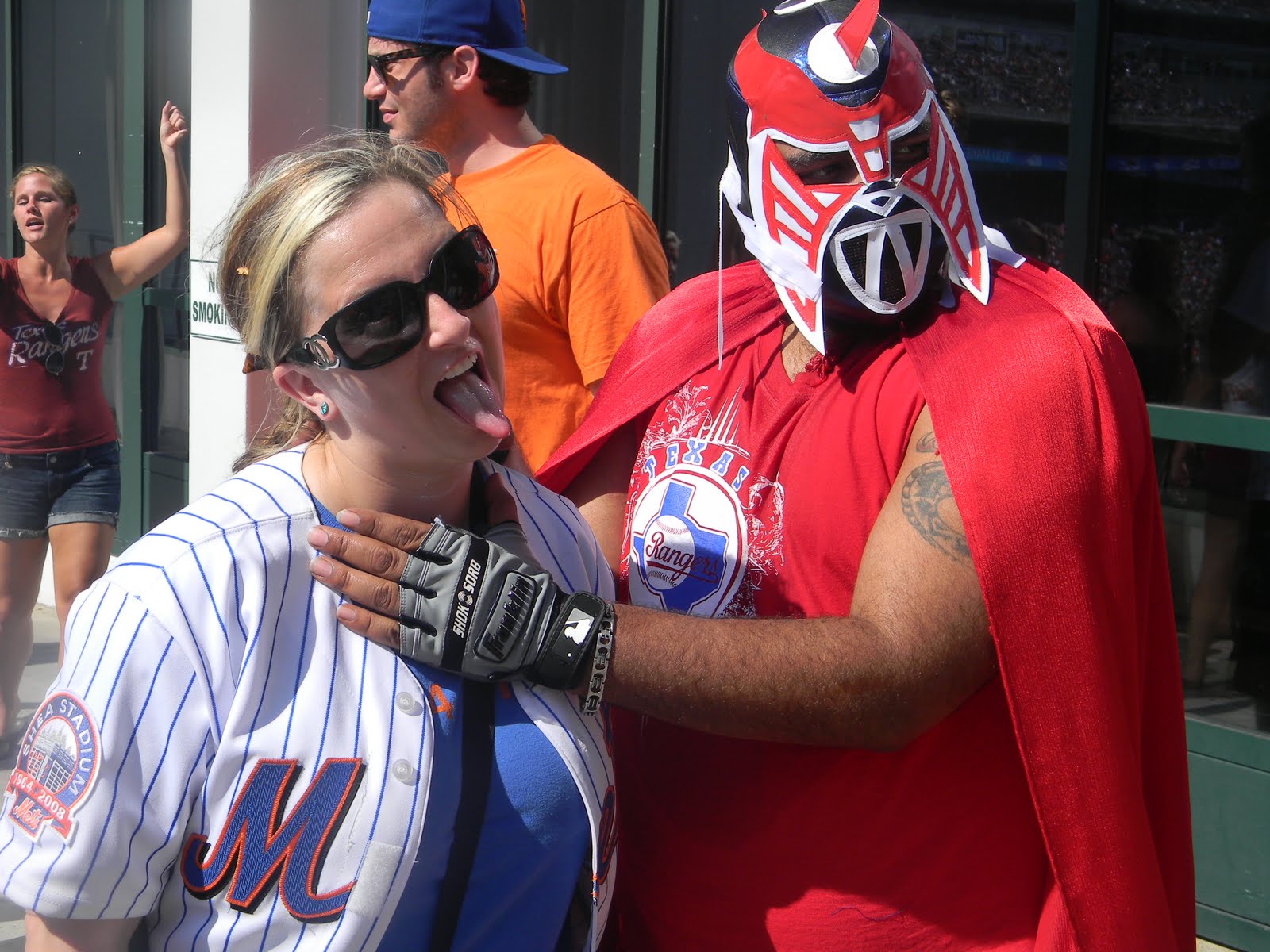
We did have to give credit to one Rangers fan who actually was quite creative in expressing his love for his team, dressing as a masked Lucha Libre fighter called "El Rangerdoro". He posed for some photos with us, where he showed off his signature "chokehold while wearing batting gloves" move and his ability to point at the camera. (For those of you who still thinking wrestling is real, I regret to inform you that the pointing was indeed choreographed.)
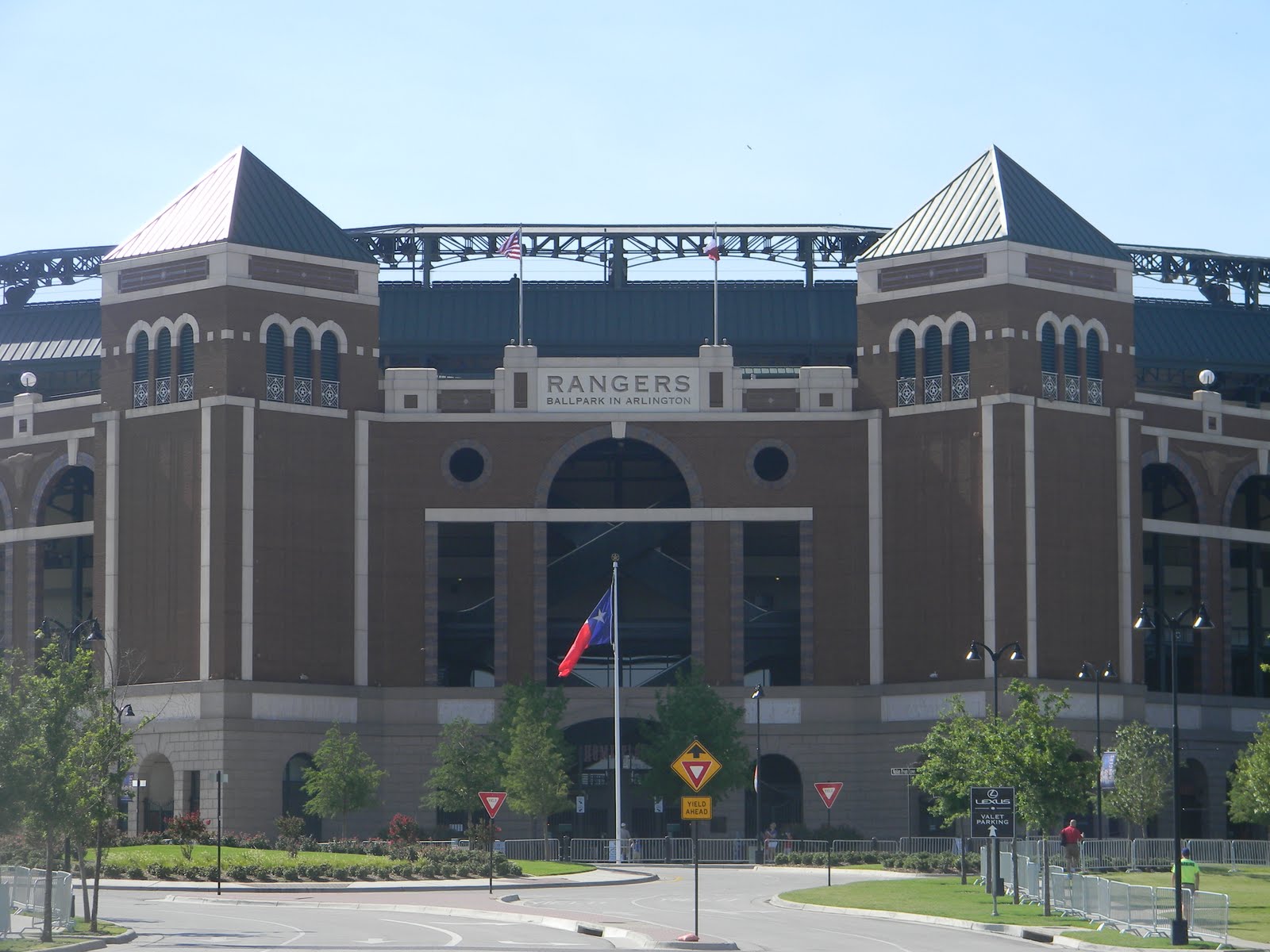
Although we couldn't attend the final game of the series, we did go out to the ballpark that morning to take some exterior shots of the ballpark and its surroundings. We didn't run into any players entering the stadium, but we did run into long-time Mets' PR dude, Jay Horwitz. (I assure you he's in one of the photos below.)
To recap our trip to Texas...
It was hot. No, seriously. Just look at that wet stain on my Mets T-shirt in the collage of photos above. That didn't come from the guy who attended BOO U.
Jon Niese did wonderfully in his start, despite sweating through his uniform (perhaps nervous that El Rangerdoro was waiting for him outside the visitors' clubhouse).
Manny Acosta might have a new job in sanitation soon if he continues to give up runs at an alarming rate.
Arlington has a really great ballpark. No joke needed there. It's just a really sweet park.
From the tributes to Nolan Ryan (including the large statue in center field of the Ryan Express doffing his cap) to the frequent fireworks (not all of them came from the Mets' bats), our ballpark experience was one to remember. It was indeed (dare I say it) a Tex-cellent adventure!