Showing posts with label Billy Wagner. Show all posts

Saturday, January 23, 2021

If Studious Metsimus Had a 2021 Hall of Fame Vote...

On Tuesday, January 26, the baseball world will know if any new inductees will be entering the Hall of Fame with the members of the Class of 2020, whose induction ceremony was postponed until this year due to the COVID-19 pandemic.

Last year's class featured Ted Simmons, Marvin Miller, Larry Walker and a gift basket provider.  This year's potential class does not have a first-ballot no-brainer on it, which means that Simmons, Miller, Walker and the other guy whose name escapes me at the moment might not have company on the stage, assuming they don't have to give their speeches via Zoom.  (Although a Zoom speech would allow Larry Walker to give it while wearing his famous Spongebob Squarepants shirt.)

There are 25 players on this year's ballot, which includes 14 holdovers and 11 newcomers.  Of those 25 nominees, six are former Mets, as Billy Wagner, Gary Sheffield, Jeff Kent and Bobby Abreu are still on the ballot, joining first-timers Michael Cuddyer and LaTroy Hawkins.  Other notable players who are making their initial appearance on the ballot are two-time no-hitter thrower Mark Buehrle, nine-time Gold Glove winner Torii Hunter, one-million-word-per-minute talker Nick Swisher and the only player who has blocked the Studious Metsimus staff on Twitter, Shane Victorino.  No, really.  He doesn't like us.


As usual, the Studious Metsimus staff isn't allowed to vote for this year's Hall of Fame class.  (We were told it has nothing to do with Shane Victorino but everything to do with the fact that we're not actually writers.)  But we aren't barred from sharing our opinion as to who should join Miller, Simmons, Walker and what's-his-face as new members of the Hall.  So let's stop lamenting about Cryin' Hawaiians and start presenting our imaginary Hall of Fame vote!


Scott Rolen

Scott Rolen never led the league in any category.  Not one major category.  Not one minor category.  Nothing.  In fact, the closest he came to finding his name atop the league leaderboard was in 2004 when his 124 RBI were second to Vinny Castilla's total of 131 ribbies. But his consistency at the plate and impeccable fielding throughout his career helped him finish his 17-year tour of duty in the majors with an impressive 70.1 bWAR. 

Injuries cost Rolen hundreds of games, as he missed 20 or more contests in a dozen different campaigns.  But that didn't stop him from collecting 517 doubles, 316 homers, 1,287 RBI, 1,211 runs scored and 2,077 hits.  He was also the owner of a lifetime .855 OPS and 122 OPS+.

Rolen won the National League Rookie of the Year Award in 1997 and his eight Gold Gloves at third base were more than anyone not named Brooks Robinson or Mike Schmidt, otherwise known as Hall of Famers Brooks Robinson and Mike Schmidt.  The seven-time All-Star also produced in the postseason, helping the Cardinals win their first N.L. pennant in 17 years by batting .310 with a 1.044 OPS in the 2004 NLCS.  Two years later, Rolen was a key contributor in St. Louis' first World Series victory in 24 seasons, hitting .421 with a 1.213 OPS in the Fall Classic.

The injury bug that constantly sidelined Rolen during the second half of his career more than likely kept him from reaching 1,000 extra-base hits and 2,500 total hits, as well as 1,500 runs scored and 1,500 runs batted in.  But that's what WAR is good for.  And because of it, we know that Rolen was invaluable to the teams he played for.

The next team he should be a part of is the one that calls Cooperstown home.


Scott Rolen was booed in Philly as an opposing player.  Or maybe he was booed because he was a person.  (Sporting News)
Scott Rolen was booed in Philly as an opposing player.  Or maybe he was just booed there because he was a person.     (Photo by Sporting News)


Curt Schilling

If you thought Scott Rolen's 70.1 bWAR was high, you should see Curt Schilling's.  His 79.5 bWAR fully shows how valuable he was to his teams.  And by teams, I'm talking about the Philadelphia Phillies (who won a pennant with Schilling in 1993), the Arizona Diamondbacks (who won their first and only title in 2001 with World Series co-MVP Schilling leading the way) and the Boston Red Sox (who ended an 86-year championship drought with Schilling in 2004 and then repeated the feat three years later in the right-hander's final active season).

Schilling was nearly perfect in the postseason, going 11-2 with a 2.23 ERA, 0.968 WHIP and 120 strikeouts in 19 starts.  As dominant as he was in October, he was just as impressive in the regular season.

Pitching in an era that doesn't require its starters to go deep into games, Schilling recorded 83 complete games and 20 shutouts.  He is also one of only five pitchers in history with 3,000-plus strikeouts and fewer than 1,000 walks.  The other four are Hall of Famers Greg Maddux, Ferguson Jenkins, Pedro Martinez and future Hall of Famer Justin Verlander.  But none of those four pitchers could boast the 4.38 K/BB ratio that Schilling had over his twenty-year career.

It's one thing to lead the league in a major category once.  It's another thing to be a league leader multiple times, which shows a player's consistency and excellence.  So how many different major categories did Schilling lead the league in on more than one occasion?  Well, there's wins (2001, 2004), games started (1997, 1998, 2001), complete games (1996, 1998, 2000, 2001) and innings pitched (1998, 2001).

But wait, there's more!

Schilling also led the league multiple times in strikeouts (1997, 1998), WHIP (1992, 2002) and strikeouts per walk (2001, 2002, 2003, 2004, 2006).

Somehow, Schilling never won a Cy Young Award.  But he was a three-time runner-up and finished fourth in another season.  He also earned MVP votes four times, which is rare for a pitcher in this or any other era.

Curt Schilling may not be on your most-liked player list.  But he should be on your Hall of Fame list.  Schilling has waited long enough to finally have his day in Cooperstown.  That wait should come to an end this year. 


 Don't like that I'm voting for Curt Schilling?  Suture self.  (Al Bello/Getty Images)


Billy Wagner

It's a shame Billy Wagner hasn't gotten more recognition from the BBWAA voters, as he was far more dominant than 2018 Hall of Fame inductee Trevor Hoffman and 2019 enshrinee Lee Smith ever were.  Hoffman and Smith got the job done as effectively as any other closer who ever lived.  But Wagner would eat a hitter up and spit him out.

Injuries curtailed Wagner's career, but any pitcher who averaged nearly 12 strikeouts per nine innings, four whiffs per walk and finished his career with a WHIP under 1.00 (Wagner's WHIP was 0.998, which was lower than all-time best closer Mariano Rivera's 1.000 lifetime WHIP) deserves serious Hall of Fame consideration.

Speaking of Rivera, he held opposing batters to a .211/.262/.295 career slash line.  How did hitters slash against Wagner?  They didn't.  All they could manage was a .187/.262/.296 mark against the flame-throwing southpaw.

With all the praise we just heaped on Wagner, we didn't even mention that he was a seven-time All Star, recorded 422 saves and put up a 2.31 ERA.  Okay, maybe we just did.  


Southpaw, Flamethrower, Hall of Famer.  Billy Wagner should be all three.  (Jim McIsaac/Getty Images)


Todd Helton

Like former teammate (and current Hall of Famer) Larry Walker, Helton's candidacy will be questioned because of the Coors Field factor.

During his best eight-year stretch (1998-2005), Helton averaged 46 doubles, 33 HR, 113 RBI and 114 runs scored, while striking out just 76 times and drawing 96 walks per season.  That contributed to his absolutely off-the-charts .338/435/.610 slash line during the eight years.

Wanna know what his average season from 1998 to 2005 looked like in road games, otherwise known as games not played at Coors Field?  While wearing road grays during those eight seasons, Helton slashed .298/.398/.520 and produced 277 extra-base hits, drove in 347 runs and scored 337 times.  That's an average of 73 extra-base hits, 91 RBI and 89 runs scored per 162 road games.  And for those who are mathematically challenged, Helton produced a .918 OPS in all road games from '98 to '05.  In other words, Helton was still up in the elite hitter stratosphere when he wasn't taking his hacks one mile above sea level.

Even with an assortment of nagging injuries sapping his power in his later years, Helton still managed to finish in the top 100 all-time in home runs, doubles, extra-base hits, hits, RBI and runs scored.  There are over 100 hitters in the Hall of Fame and Helton ranks in the top 100 in many major hitting categories.  And he wasn't just a one-dimensional player, as evidenced by his three Gold Gloves.  You do the math if he belongs in the Hall or not. 


Here's Helton fielding at Shea.  You don't need a reminder of his .323/.413/.581 slash line there.  (Rich Pilling/Getty Images)
 

Jeff Kent's Mustache

Jeff Kent was a very good player.  His mustache, on the other hand, was the stuff of legend.

Sure, Kent had nearly 1,000 extra-base hits and had a .500 lifetime slugging percentage in the regular season and postseason.  And yes, he had over 1,500 RBI, including eight seasons in which he reached triple digits in that category.

Kent also won the 2000 N.L. Most Valuable Player Award, received MVP votes in six other seasons and hit more home runs than any second baseman in history.

But all of those accomplishments take a backseat to his classic lip hair.

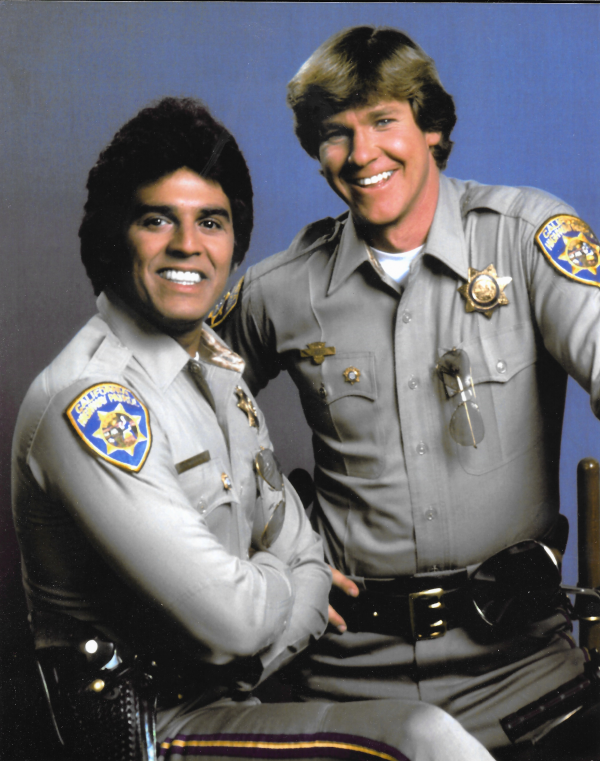
A clean shaven Kent might still have produced above-average offensive numbers, but would have left him with nothing else that set him apart from his ballplaying brethren.  His 'stache allowed him to play a villain on a TV remake of CHiPs (that never made it past the writers' room) and a stunt double on the sequel to Boogie Nights (that was never filmed).  

The only former player with a more recognizable mustache is Rollie Fingers and he's already in the Hall.  That bodes well for Jeff Kent's mustache to finally get the recognition it deserves.


A mustache like Kent's deserves its own black-and-white headshot.  (Bruce Bennett/Getty Images)


And that just about does it for our annual Hall of Fame ballot that no one takes seriously.

Actual voters are allowed to check off a maximum of ten players on their Hall of Fame ballots.  This year, the Studious Metsimus staff did not find that many players worthy of enshrinement, only voting for the four players and one body part listed above.

So if you're unhappy that we didn't vote for for players like Barry Bonds, Roger Clemens, Gary Sheffield, Andruw Jones and Omar Vizquel, you can take it up with Shane Victorino.  He's already reached his blocking quota for the day anyway.


Sunday, January 19, 2020

If Studious Metsimus Had a 2020 Hall of Fame Vote...

On Tuesday, January 21, the National Baseball Hall of Fame will be reaching out to its newest enshrinees to inform them that they should cancel all plans for the final weekend in July because they'll be going to Cooperstown instead.  Those all-time greats of the game will be joining Ted Simmons and Marvin Miller, who were voted in by the Modern Baseball Era Committee, as the newest members of the hallowed Hall.

Last year, six former players were inducted, including the first player ever to have his name checked off on 100% of the ballots (Mariano Rivera).  In addition to Rivera, fellow pitchers Lee Smith, Mike Mussina and the late Roy Halladay received the game's greatest individual honor, as well as a pair of designated hitters (Harold Baines and Edgar Martinez).

This year's class does not appear to be as crowded as last year's, if we're to believe Ryan Thibodaux's Hall of Fame ballot tracker.  But that doesn't mean hotels in Cooperstown will be hanging vacancy signs outside their doors.  On the contrary, one potential enshrinee might attract fans from California to Kalamazoo, while another could bring the entire population of Canada with him.  And then there are those who would just show up to boo in the event a seven-time MVP and seven-time Cy Young Award recipient are inducted, not to mention an outspoken pitcher who contributed to two bitter postseason defeats of one of New York's baseball teams.  (Spoiler alert:  It's not the Mets.)

There are seven former Mets on this year's ballot, but no one is expecting Billy Wagner, Gary Sheffield, Jeff Kent, J.J. Putz, Heath Bell, Bobby Abreu or the great Jose Valverde to give a speech on July 26.  For them to get up on stage at the Clark Sports Center, they would each need approximately 309 votes, or 75% of the 412 ballots cast.  Either that or they could channel their inner Kanye West and pretend one of the actual inductees is Taylor Swift.

But we digress.

The cast and crew of Studious Metsimus aren't eligible to vote for this year's Hall of Fame induction class.  (We were told that it had something to do with the fact that we're not actual writers.)  But we are eligible to submit an opinion as to who we'd like to see immortalized with a plaque in Cooperstown.  Just like the BBWAA, we'll limit our selections to a maximum of ten deserving candidates.  Or nine deserving players and a guy with balls on his face.  Here's our imaginary vote!


Is this the face of a Hall of Famer?  (Photo courtesy of GQ Magazine)


Larry Walker    

The best everyday player to come out of Canada hasn't gotten as much support as he should because of one nagging element - the Coors Field factor.

Prior to becoming a member of the Colorado Rockies, Walker was already a good hitter and complete player.  In his final three years with his original team, the Montreal Expos, Walker had a .294 batting average, .371 on-base percentage and .516 slugging percentage, averaging 33 doubles, 21 HR, 88 RBI and 21 SB.  He was also an All-Star, won a Silver Slugger Award and two Gold Gloves while in Montreal.  Although those numbers are not quite Hall of Fame worthy, they were still very good.  Then he signed with Colorado and became one of the best players in the major leagues.

In his first season with the Rockies (1995), Walker hit .306 with 36 HR and 101 RBI.  His .607 slugging percentage was second in the league and he helped lead the third-year Rockies to their first-ever playoff appearance.  Year two in Colorado was fraught with injuries, as Walker played in only 83 games but still managed 18 HR, 58 RBI and 18 SB in approximately half a season's worth of games.  Fully healthy in 1997, Walker's career took off into the stratosphere.  Walker's 1997 numbers (.366 batting average, 46 doubles, 49 HR, 130 RBI, 143 runs scored, 33 SB, .452 OBP, .720 SLG, 1.172 OPS) almost looked like they came straight from a video game.  But Walker wasn't done after his phenomenal '97 campaign.  Over the next five seasons, Walker won three batting titles (1998, 1999, 2001), finished second another year (2002) and had a combined .350 batting average over those five seasons.  Basically, he was Tony Gwynn with power and Gwynn was a first-ballot Hall of Famer.

In ten years as a Rockie, Walker posted a .334 batting average, .426 on-base percentage, .618 slugging percentage and 1.044 OPS.  Only 24 players in major league history finished with a higher career batting average than what Walker put up in that ten-year span.  Of those 24, the only three who finished with a higher on-base percentage, slugging percentage and OPS were Ted Williams, Babe Ruth and Lou Gehrig, all first ballot Hall of Famers and all legends of the sport.

Larry Walker played 17 years in the major leagues.  However, because of injuries, he only had four seasons in which he played at least 140 games.  From 1994-2005, Walker missed an average of 44 games per season, failing to play more than 103 games in five of those 12 campaigns.  Despite his multiple trips to the disabled list, Walker finished his career with 2,160 hits, including 471 doubles and 383 HR.  He also stole 230 bases, scored 1,355 runs and drove in 1,311.  His combined averages (.313 BA, .400 OBP, .565 SLG) are among the highest career marks of anyone not already in the Hall of Fame, as is his 72.7 bWAR.  And he wasn't just a product of Coors Field.

Walker played in 674 games for the Expos prior to his time in Colorado and 144 games for the Cardinals after leaving the Rockies, which is approximately five full 162-game seasons.  In those 818 games in non-Rockies uniforms, Walker posted an .851 OPS and 129 OPS+, averaging 63 extra-base hits and 21 steals per 162 games.  And those numbers weren't fueled by the thin air in Denver.

All told, Walker was a five-time All-Star, won seven Gold Gloves and three Silver Slugger Awards.  He also finished in the top 20 in the MVP vote seven times, winning the 1997 N.L. Most Valuable Player Award.  Not all of his awards and accolades came as a member of the Colorado Rockies, proving that Walker was an exceptional player before and after his time in Colorado.  Simply stated, Larry Walker has earned the right to become the first player with a Rockies hat on his Hall of Fame plaque.


Larry Walker waits to see if the tenth time is the charm.  (Vincent Laforet/AllSport)


Curt Schilling

If you thought Larry Walker's 72.7 bWAR was high, you should see Curt Schilling's.  His 79.5 bWAR fully shows how valuable he was to his teams.  And by teams, I'm talking about the Philadelphia Phillies (who won a pennant with Schilling in 1993), the Arizona Diamondbacks (who won their first and only title in 2001 with World Series co-MVP Schilling leading the way) and the Boston Red Sox (who ended an 86-year championship drought with Schilling in 2004 and then repeated the feat three years later in the right-hander's final active season).

Schilling was nearly perfect in the postseason, going 11-2 with a 2.23 ERA, 0.968 WHIP and 120 strikeouts in 19 starts.  As dominant as he was in October, he was just as impressive in the regular season.

Pitching in an era that doesn't require its starters to go deep into games, Schilling recorded 83 complete games and 20 shutouts.  He is also one of only five pitchers in history with 3,000-plus strikeouts and fewer than 1,000 walks.  The other four are Hall of Famers Greg Maddux, Ferguson Jenkins, Pedro Martinez and future Hall of Famer Justin Verlander.  But none of those four pitchers could boast the 4.38 K/BB ratio that Schilling had over his twenty-year career.

It's one thing to lead the league in a major category once.  It's another thing to be a league leader multiple times, which shows a player's consistency and excellence.  So how many different major categories did Schilling lead the league in on more than one occasion?  Well, there's wins (2001, 2004), games started (1997, 1998, 2001), complete games (1996, 1998, 2000, 2001) and innings pitched (1998, 2001).

But wait, there's more!

Schilling also led the league multiple times in strikeouts (1997, 1998), WHIP (1992, 2002) and strikeouts per walk (2001, 2002, 2003, 2004, 2006).

Somehow, Schilling never won a Cy Young Award.  But he was a three-time runner-up and finished fourth in another season.  He also earned MVP votes four times, which is rare for a pitcher in this or any other era.

Curt Schilling has waited long enough to finally have his day in Cooperstown.  That wait should come to an end this year.


 Don't like that I'm voting for Curt Schilling?  Suture self.  (Al Bello/Getty Images)


Scott Rolen

Unlike Walker and Schilling, Scott Rolen never led the league in any category.  Not one major category.  Not one minor category.  Nothing.  But his consistency at the plate and impeccable fielding throughout his career helped him finish his 17-year stay in the majors with a 70.2 bWAR. 

Injuries cost Rolen hundreds of games, as he missed 20 or more contests in a dozen different seasons.  But that didn't stop him from collecting 517 doubles, 316 homers, 1,287 RBI, 1,211 runs scored and 2,077 hits.  He was also the owner of a lifetime .855 OPS and 122 OPS+.

Rolen won the National League Rookie of the Year Award in 1997 and his eight Gold Gloves at third base were more than anyone not named Brooks Robinson or Mike Schmidt.  The seven-time All-Star also produced in the postseason, helping the Cardinals win their first N.L. pennant in 17 years by batting .310 with a 1.044 OPS in the 2004 NLCS.  Two years later, Rolen was a key contributor in St. Louis' first World Series victory in 24 seasons, hitting .421 with a 1.213 OPS in the Fall Classic.

The injury bug that constantly sidelined Rolen during the second half of his career more than likely kept him from reaching 1,000 extra-base hits and 2,500 total hits, as well as 1,500 runs scored and 1,500 runs batted in.  But that's what WAR is good for.  And because of it, we know that Rolen was invaluable to the teams he played for.

The next team he should be a part of is the one that calls Cooperstown home.


Scott Rolen was booed in Philly as an opposing player.  Or maybe he was booed because he was a person.  (Sporting News)


Although voters are allowed to check off a maximum of ten players on their Hall of Fame ballots, there are only four other players we'd vote for if, you know, we were allowed to vote.


  • Todd Helton:  Like former teammate Larry Walker, Helton's candidacy will be questioned because of the Coors Field factor.  After all, during his best eight-year stretch (1998-2005), Helton averaged 46 doubles, 33 HR, 113 RBI and 114 runs scored, while striking out just 76 times and drawing 96 walks per season.  That's absolutely tremendous.  Wanna know what his average season was like in road games, otherwise known as games not played at Coors Field?  While wearing road grays during those eight seasons, Helton slashed .298/.398/.520 and produced 277 extra-base hits, drove in 347 runs and scored 337 times.  That's an average of 73 extra-base hits, 91 RBI and 89 runs scored per 162 road games.  In other words, still up in the elite hitter stratosphere.  Even with injuries sapping his power in his later years, Helton still managed to finish in the top 100 all-time in home runs, doubles, extra-base hits, hits, RBI and runs scored.  There are over 100 hitters in the Hall of Fame and Helton ranks in the top 100 in many major hitting categories.  And he wasn't just a one-dimensional player, as evidenced by his three Gold Gloves.  You do the math if he belongs in the Hall or not.
  • Jeff Kent:  Kent was more than just his 1970s porn star 'stache.  He was one of the best hitting second basemen of all-time.  For a guy whose career didn't take off until his age-29 season, Kent finished just 16 extra-base hits shy of 1,000.  The pressures of playoff baseball didn't faze him, as Kent posted an identical .500 career slugging percentage in the regular season and postseason.  And let's not forget his eight seasons with 100+ RBI, the 1,518 runs he drove in for his career, his 2000 N.L. MVP Award and the title of all-time leading home run hitter at the second base position.
  • Billy Wagner:  It's a shame Wagner hasn't gotten more recognition, as he was far more dominant than 2018 Hall of Fame inductee Trevor Hoffman and 2019 enshrinee Lee Smith ever were.  Hoffman and Smith got the job done as effectively as any other closer who ever lived.  But Wagner would eat a hitter up and spit him out.  Injuries curtailed Wagner's career, but any pitcher who averaged nearly 12 strikeouts per nine innings, four whiffs per walk and finished his career with a WHIP under 1.00 (Wagner's WHIP was 0.998, which was lower than all-time best closer Mariano Rivera's 1.000 lifetime WHIP) deserves Hall of Fame consideration.  And speaking of Rivera, he held opposing batters to a .211/.262/.295 career slash line.  How did hitters slash against Wagner?  They didn't.  All they could manage was a .187/.262/.296 against the flamethrowing southpaw.  And with all the praise we just heaped on Wagner, we didn't even mention his 422 saves and 2.31 ERA.  Okay, maybe we just did. 
  • Dirk Jitters:  Yes, we're changing the name of the former Yankee shortstop because we don't want anyone to think that we, as Mets fans, believe that he was an all-time great of the game.  On the contrary, he was a liability on defense, as evidenced by his -243.3 defensive runs saved throughout his career.  Jitters also produced a lifetime 115 OPS+.  If that number looks familiar to you, it's because it's the same lifetime OPS+ as the one produced by Lucas Duda.  The however-many-times world champ struck out 1,840 times, which is an enormous amount of whiffs for a player who had over 11,000 plate appearances in the leadoff spot or No. 2 hole, otherwise known as the tablesetting positions in the lineup.  But he's also responsible for getting rid of that eyesore of a home run sculpture in Miami.  That, and that alone, is why he deserves a plaque in Cooperstown.


Those are our seven selections for this year's Hall of Fame class.  Some of them might get voted in.  Some of them might not.  Heck, some of them might even wonder why Jeff Kent's mustache hasn't earned him an honorary AVN Award.  But all of the candidates are worthy of at least being in the Hall of Fame conversation.  Yes, even Dirk Jitters.

So who will actually get the coveted call from the Hall?  The answer will be revealed to all on January 21, or earlier if any Astros players intercept that information.


Monday, January 21, 2019

If Studious Metsimus Had a 2019 Hall of Fame Vote...

On Tuesday, January 22, the National Baseball Hall of Fame will be using its speed dial to inform several players and their families that they'll need to cancel any plans they have for the penultimate weekend in July because new plans have been made for them.  Those players who receive 75% of the Hall of Fame vote will be joining Modern Baseball Era inductees Lee Smith and Harold Baines on stage at the Clark Sports Center in Cooperstown, New York.

Last year's class saw a starting pitcher, a closer, three infielders and an outfielder receive their plaques, as Jack Morris, Trevor Hoffman, Jim Thome, Alan Trammell, Chipper Jones and Vladimir Guerrero were immortalized as six of the game's all-time greats.  Don't be surprised if a similar number of hotel rooms need to be booked for this year's inductees.

Fifteen players returned to the ballot this year, after receiving the minimum five percent of the vote last year, but not quite the 75% needed for induction.  Three former Mets (Jeff Kent, Billy Wagner, Gary Sheffield) are among them.  In addition to the 15 returnees, there are 20 first-timers on the ballot, with three of them also wearing a Mets cap at some point in their career.  Those three are lefty long-man Darren Oliver, the underachieving Jason Bay and the winner of the "Wait, He Was A Met?" award, Rick Ankiel, who helped the Mets more as a member of 2000 Cardinals than he did as a member of the Mets in 2013.

According to Ryan Thibodaux and his helpful Hall of Fame ballot tracker, there are 412 ballots out there, with 309 votes needed for induction.  Players will be five-percented off the ballot if they do not receive a minimum of 21 votes.  And by players, I mean Darren Oliver, Jason Bay and Rick Ankiel.  Sorry, guys.  At least you played long enough to get on the ballot.

Had Studious Metsimus been honored with the right to vote, players would have needed 310 votes to be inducted, so if someone like Roger Clemens or Barry Bonds misses the cut by one vote this year, they can file a formal complaint to make my vote officially count instead of it just being a feeble attempt to get me a few dozen page views every January.  Not that I would have voted for Clemens or Bonds anyway.  I'm not a fan of bat-tossing misrememberers or people who try to compete with Bruce Bochy (another former Met!) for the title of largest noggin in baseball.

Here's what would have been Ballot No. 413, focusing on three players I would personally like to see in the Hall, followed by the other seven who would get the "X" mark next to their names on my imaginary ballot.


Baseball Mecca.  (Photo courtesy of the Cooperstown/Otsego County website)


Edgar Martinez

Face it, the only reason Martinez is still on the ballot in his tenth and final year of eligibility is because he played a significant portion of his career as a designated hitter.  How else can you explain a lifetime .312 hitter with a .933 OPS and OPS+ just short of 150 not having a plaque in Cooperstown yet?

The voters of this generation who use the DH argument to foil the case of Martinez are like the previous generation's voters who couldn't bear to see relief pitchers making the Hall.  "If they can't pitch more than a few innings, I can't vote for them," those misinformed voters would say.  But relievers such as Rollie Fingers, Goose Gossage and Bruce Sutter (all Hall of Famers) paved the way for the one-inning closer to get recognition from the Hall.  Dennis Eckersley has a plaque in Cooperstown.  John Smoltz's three-and-a-half year period as a dominant closer also helped fuel his candidacy.  Trevor Hoffman got his Hall call last year and Lee Smith just impressed the Modern Era voters.  And who, pray tell, is going to keep Mariano Rivera out of Cooperstown this year, other than Boston bloviator Bill Ballou?

The same people who are now accepting one-inning closers as potential Hall of Famers now need to focus their attention on players who left their gloves at home.  Frank Thomas, who started more than 100 games at first base in just three of his 19 seasons and played in over 1,300 games exclusively as a designated hitter, was a first ballot Hall of Famer.  Why is his lifetime .301/.419/.555 slash line considered worthy of enshrinement and Edgar's .312/.418/.515 isn't?  Is it because Thomas produced the sexy hits (521 HR) and Martinez didn't (309 HR)?  It's true Thomas had 11 seasons with 100+ RBI while Edgar had just six.  But did you know the great Mickey Mantle only had four such seasons?  No one used that argument against Mantle and no one should.  But had he played in the DH era, Mantle's knee injuries would have relegated him to "leave your glove behind" status and then people would be questioning what should have been obvious about him; that he is undoubtedly a Hall of Famer.

Martinez won two batting titles.  He was also a league leader in runs scored, RBI, OPS, OPS+ and finished first multiple times in doubles and on-base percentage.  For seven seasons (1995-2001), which coincided with all of the Mariners' postseason trips in franchise history, Martinez's averages per 162 games were mindboggling.  He produced a .329/.446/.574 slash line.  That's a 1.020 OPS in 1,020 games.  And if that's not good enough, how about his 162-game average of 47 doubles, 32 homers, 123 RBI and 111 runs scored during the seven-year stretch?

There's a reason why the annual outstanding designated hitter award is named after Edgar Martinez.  That's because he was the best at what he did.  And those who are the best deserve to be with the best in Cooperstown.


This mustache should be on Edgar's plaque.  It's Hall of Fame worthy by itself.  (Bruce Bennett/Getty Images)


Larry Walker

Similar to Edgar Martinez, Walker hasn't gotten as much support as he should because of one nagging element.  Martinez has failed to get votes because of the DH factor, while Walker has the Coors Field factor looming over him.

Prior to becoming a Colorado Rockie, Larry Walker was already a good hitter and complete player.  In his final three years in Montreal, Walker had a .294 batting average, .371 on-base percentage and .516 slugging percentage, averaging 33 doubles, 21 HR, 88 RBI and 21 SB.  He was also an All-Star, won a Silver Slugger Award and two Gold Gloves while in Montreal.  Although those numbers are not quite Hall of Fame worthy, they were still very good.  Then he signed with Colorado and became one of the best players in the major leagues.

In his first season with the Rockies (1995), Walker hit .306 with 36 HR and 101 RBI.  His .607 slugging percentage was second in the league and he helped lead the third-year Rockies to their first-ever playoff appearance.  Year two in Colorado was fraught with injuries, as Walker only played in 83 games but still managed 18 HR, 58 RBI and 18 SB in half a season's worth of games.  Fully healthy in 1997, Walker's career took off into the stratosphere.  Walker's 1997 numbers (.366 batting average, 46 doubles, 49 HR, 130 RBI, 143 runs scored, 33 SB, .452 OBP, .720 SLG, 1.172 OPS) almost looked like they came straight from a video game.  But Walker wasn't done after his phenomenal '97 campaign.  Over the next five seasons, Walker won three batting titles (1998, 1999, 2001), finished second another year (2002) and had a combined .350 batting average over those five seasons.  Basically, he was Tony Gwynn with power and Gwynn was a first-ballot Hall of Famer.

In ten years as a Rockie, Walker posted a .334 batting average, .426 on-base percentage, .618 slugging percentage and 1.044 OPS.  Only 24 players in major league history finished with a higher career batting average than what Walker put up in that ten-year span.  Of those 24, the only three who finished with a higher on-base percentage, slugging percentage and OPS were Ted Williams, Babe Ruth and Lou Gehrig, all first ballot Hall of Famers and all legends of the sport.

Larry Walker played 17 years in the major leagues.  However, because of injuries, he only had four seasons in which he played at least 140 games.  From 1994-2005, Walker missed an average of 44 games per season, failing to play more than 103 games in five of those 12 campaigns.  Despite his multiple trips to the disabled list, Walker finished his career with 2,160 hits, including 471 doubles and 383 HR.  He also stole 230 bases, scored 1,355 runs and drove in 1,311 more.  His combined averages (.313 BA, .400 OBP, .565 SLG) are among the highest career marks of anyone not already in the Hall of Fame, as is his 72.6 bWAR.  And he wasn't just a product of Coors Field.

Walker played in 674 games for the Expos prior to his time in Colorado and 144 games for the Cardinals after leaving the Rockies, which is approximately five full 162-game seasons.  In those 818 games in non-Rockies uniforms, Walker posted an .851 OPS and 129 OPS+, averaging 63 extra-base hits and 21 steals per 162 games.  And those numbers weren't fueled by the thin air in Denver.

All told, Walker was a five-time All-Star, won seven Gold Gloves and three Silver Slugger Awards.  He also finished in the top 20 in the MVP vote seven times, winning the 1997 N.L. Most Valuable Player Award.  Not all of his awards and accolades came as a member of the Colorado Rockies, proving that Walker was an exceptional player before and after his time in Colorado.  Simply stated, Larry Walker has earned the right to become the first player with a Rockies hat on his Hall of Fame plaque.


Larry Walker sticks out his tongue to all those who won't vote for him.  (David Seelig/AllSport)


Mariano Rivera

He blew a save in the 1997 ALCS, which allowed the Cleveland Indians to stave off elimination and led to the Yankees' sole postseason series loss in a five-year period.

He couldn't hold a lead in the ninth inning of Game Seven of the 2001 World Series, allowing the Arizona Diamondbacks to celebrate their first and only championship.

He was credited with back-to-back blown saves in the 2004 ALCS, when converting any one of them would have resulted in a pennant for the Yankees instead of what became a curse-ending title run for the Boston Red Sox.

He lost four games to the Mets and allowed runs in six of his final 11 appearances against his crosstown rivals, allowing players such as Matt Franco (1999), Timo Perez (2001), Raul Gonzalez (2003), Damion Easley (2007), Ike Davis (2010), Ronny Paulino (2011) and Lucas Duda (2013) to drive in runs against him.

Clearly, after suffering so much in the postseason and failing repeatedly against the Mets, especially when facing less than legendary players, it's time to give Mariano Rivera a break.  He gets my sympathy vote for the Hall.


Down, but not out (of the Hall of Fame).  (Keith Torrie/NY Daily News Archive/Getty Images)


In addition to the marvelous Martinez, the wonderful Walker and the wretched Rivera, these are the other seven players I'd vote for Hall of Fame induction:

  • Roy Halladay:  Some people wonder if he'd have gotten as much support for the Hall had he not tragically passed away in 2017.  Those people probably don't realize that for a ten-year period (2002-11), Halladay was arguably one of the top three pitchers in baseball.  In that decade of excellence, Halladay earned a victory in nearly 70% of his decisions, had three 20-win seasons and posted a 2.97 ERA (148 ERA+) with a 1.11 WHIP.  He also led the league in innings pitched and shutouts four times each and finished first in complete games an incredible seven times.  That's Hall of Fame worthy, even if he's not here to accept the honor.
  • Todd Helton:  Like former teammate Larry Walker, Helton's candidacy will be questioned because of the Coors Field factor.  After all, during his best eight-year stretch (1998-2005), Helton averaged 46 doubles, 33 HR, 113 RBI and 114 runs scored, while striking out just 76 times and drawing 96 walks per season.  That's absolutely tremendous.  Wanna know what his average season was like in road games, otherwise known as games not played at Coors Field?  While wearing road grays during those eight seasons, Helton slashed .298/.398/.520 and produced 277 extra-base hits, drove in 347 runs and scored 337 times.  That's an average of 73 extra-base hits, 91 RBI and 89 runs scored per 162 road games.  In other words, still up in the elite hitter stratosphere.  Even with injuries sapping his power in his later years, Helton still managed to finish in the top 100 all-time in home runs (80th all-time), doubles (19th), extra-base hits (40th), hits (97th), RBI (97th) and runs scored (96th).  There are over 100 hitters in the Hall of Fame.  Helton ranks in the top 100 in many major hitting categories.  You do the math if he belongs in the Hall or not.
  • Fred McGriff:  I hadn't voted for him before, but now I see the error of my ways.  The 1994-95 strike that cancelled the World Series also did a number on McGriff's Hall of Fame candidacy.  Had the Crime Dog played in the 66 games that were cancelled, he likely would have collected the seven home runs he needed for 500 and the ten hits required to get to 2,500.  He also might have approached 1,600 RBI, as he finished 50 short of that lofty total.  A total of 17 players have collected 500 HR, 2,500 hits and 1,600 RBI.  Four of them have steroid suspicions (Barry Bonds, Rafael Palmeiro, Manny Ramirez, Gary Sheffield) and two are not yet eligible for the Hall (Alex Rodriguez, Albert Pujols).  The other 11 are already in Cooperstown.  McGriff played clean, he played hard and he played consistently well.  He gets my vote.
  • Curt Schilling:  Like Hoffman, he posted an impressive WHIP during an era known for its offense.  From 1992 to 2004, Schilling was the owner of a 1.091 WHIP, while averaging 202 strikeouts and just 44 walks per season.  In fact, of all pitchers with at least 3,000 strikeouts, no one posted a better strikeout-to-walk ratio than Schilling's 4.38 K/BB (3,116 K, 711 BB).  And then there's this posteason thing; the one with him going 11-2 with a 2.23 ERA and 0.968 WHIP in 19 starts.  He's one of the all-time greats.
  • Mike Mussina:  Schilling is considered one of the best pitchers of his era.  Modern metrics says Mussina was a better player, as his 83.0 bWAR puts him ahead of Schilling's 79.9 bWAR.  Mussina finished in the top-six in Cy Young Award balloting nine times and won seven Gold Glove Awards.  And of all pitchers who made at least 500 starts, only Hall of Famers Christy Matthewson, Pete Alexander, Randy Johnson and maybe-someday Hall of Famer Roger Clemens posted a higher winning percentage than Mussina's .638 mark. 
  • Billy Wagner:  It's a shame Wagner hasn't gotten more recognition, as he was far more dominant than 2018 Hall of Fame inductee Trevor Hoffman and 2019 enshrinee Lee Smith ever were.  Hoffman and Smith got the job done as effectively as any other closer who ever lived.  But Wagner would eat a hitter up and spit him out.  Injuries curtailed Wagner's career, but any pitcher who averaged nearly 12 strikeouts per nine innings, four whiffs per walk and finished his career with a WHIP under 1.00 (Wagner's WHIP was 0.998) deserves Hall of Fame consideration.  And I didn't even mention his 422 saves and 2.31 ERA.  Okay, maybe I just did. 
  • Jeff Kent:  Kent was more than just his 1970s porn star 'stache.  He was one of the best hitting second basemen of all-time.  For a guy whose career didn't take off until his age-29 season, Kent finished just 16 extra-base hits shy of 1,000.  The pressures of playoff baseball didn't faze him, as Kent posted an identical .500 career slugging percentage in the regular season and postseason.  And let's not forget his eight seasons with 100+ RBI, the 1,518 runs he drove in for his career and the title of all-time leading home run hitter at the second base position.


Those are my ten Hall of Fame selections.  Some will get in.  Some won't.  And some will continue to wonder why they have to keep paying for a ticket to get in to see their contemporaries' plaques.  (I'm talking to you, Clemens and Bonds.)  As always, some candidates didn't make my cut.  But every player on the Hall of Fame ballot in 2019 had an outstanding career and all of them had qualities that at the very least put them in the Hall of Fame conversation.  Except Rick Ankiel, who needed 14 seasons to reach the ten-year minimum needed to qualify for Hall of Fame consideration.

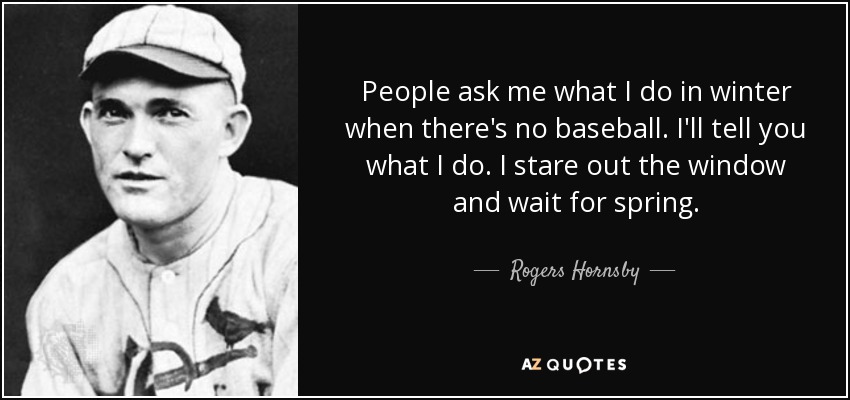
Who will get in?  And who will be joining Ankiel by buying a ticket for themselves?  That will be revealed on January 22.  Until then, we'll just follow the advice of Hall of Famer Rogers Hornsby and just stare out the window, waiting for spring to arrive.


Saturday, January 6, 2018

If Studious Metsimus Had a 2018 Hall of Fame Vote...

On Wednesday, January 24, the National Baseball Hall of Fame will call several worthy inductees and tell them to book a flight to Cooperstown in the summer.  Those new members will join former Detroit Tigers teammates Jack Morris and Alan Trammell on the stage, as those former players were inducted via the Modern Baseball Era ballot last month.

Last year's class saw the inductions of Jeff Bagwell, Tim Raines and Ivan Rodriguez, as well as executives John Schuerholz and Bud Selig.  Going by this year's early indications, the Hall of Fame stage in 2018 may be just as crowded.

A total of 14 players have returned to the ballot this year, after earning at least 5% of the vote in previous elections, but not quite receiving the 75% needed for enshrinement.  Among them are three former Mets (Jeff Kent, Billy Wagner, Gary Sheffield).  In addition to those players, there are 19 first-timers on the ballot, including two former Mets pitchers (Jason Isringhausen, Johan Santana).  And of course, there's a former Met killer on the ballot named Larry; no nicknames or surnames needed for him.

According to Hall of Fame ballot tracker Ryan Thibodaux, a total of 424 ballots will by cast by those BBWAA members who are fortunate enough to have a vote.  For all you kids out there, that means 318 votes will be needed for players to receive that snazzy Hall of Fame jersey.  That also means a player will need the support of 22 voters to avoid falling off the ballot.

Had Studious Metsimus gotten a vote, the number of ballots cast would have jumped to 425.  But since the "W" in BBWAA stands for "writers" and not "wannabes" (as a blogger, I suppose I fall under the latter category), I won't be able to help some poor athlete worth tens of millions of dollars achieve legendary status.  Then again, perhaps it's best that I don't get a vote, especially since I'd enshrine Jeff Kent just to get his CHiPs era mustache into the Hall.

And now, before you get a chance to search on eBay for a vintage Ponch and Jon poster, it's time to reveal the ten former players who would have been on Ballot No. 425 had such a vote existed, focusing on the three players I loved to watch play the most, followed by the remaining seven in condensed form.


Baseball Mecca.  (Photo courtesy of the Cooperstown/Otsego County website)


Edgar Martinez

Face it, the only reason he's not in the Hall already is because he played a significant portion of his career as a designated hitter.  How else can you explain a lifetime .312 hitter with a .933 OPS and OPS+ just short of 150 not having a plaque in Cooperstown yet?

The voters of this generation who use the DH argument to foil the case of Martinez are like the previous generation's voters who couldn't bear to see relief pitchers making the Hall.  "If they can't pitch more than a few innings, I can't vote for them," those misinformed voters would say.  But relievers such as Rollie Fingers, Goose Gossage and Bruce Sutter (all Hall of Famers) paved the way for the one-inning closer to get recognition from the Hall.  Dennis Eckersley has a plaque in Cooperstown.  John Smoltz's three-and-a-half year period as a dominant closer also helped fuel his candidacy.  Trevor Hoffman (more on him later) is knocking on the Hall's door.  And who's going to keep Mariano Rivera out of Cooperstown once he's eligible in 2019?

The same people who are now accepting one-inning closers as potential Hall of Famers now need to focus their attention on players who left their gloves at home.  Frank Thomas, who started more than 100 games at first base in just three of his 19 seasons and played in over 1,300 games exclusively as a designated hitter, was a first ballot Hall of Famer.  Why is his lifetime .301/.419/.555 slash line considered worthy of enshrinement and Edgar's .312/.418/.515 isn't?  Is it because Thomas produced the sexy hits (521 HR) and Martinez didn't (309 HR)?  It's true Thomas had 11 seasons with 100+ RBI while Edgar had just six.  But did you know the great Mickey Mantle only had four such seasons?  No one used that argument against Mantle and no one should.  But had he played in the DH era, Mantle's knee injuries would have relegated him to "leave your glove behind" status and then people would be questioning what should have been obvious about him; that he is undoubtedly a Hall of Famer.

Martinez won two batting titles.  He was also a league leader in runs scored, RBI, OPS, OPS+ and finished first multiple times in doubles and on-base percentage.  For seven seasons (1995-2001), which coincided with all of the Mariners' postseason trips in franchise history, Martinez's averages per 162 games were mindboggling.  He produced a .329/.446/.574 slash line.  That's a 1.020 OPS in 1,020 games.  And if that's not good enough, how about his 162-game average of 47 doubles, 32 homers, 123 RBI and 111 runs scored during the seven-year stretch?

There's a reason why the annual outstanding designated hitter award is named after Edgar Martinez.  That's because he was the best at what he did.  And those who are the best deserve to be with the best in Cooperstown.

Even Jeff Kent's mustache can't compare to Edgar Martinez's classic lip fuzz. (Bruce Bennett/Getty Images)


Larry Walker

Similar to Edgar Martinez, Walker hasn't gotten as much support as he should because of one nagging element.  Martinez has failed to get votes because of the DH factor, while Walker has the Coors Field factor looming over him.

Prior to becoming a Colorado Rockie, Larry Walker was already a good hitter and complete player.  In his final three years in Montreal, Walker had a .294 batting average, .371 on-base percentage and .516 slugging percentage, averaging 33 doubles, 21 HR, 88 RBI and 21 SB.  He was also an All-Star, won a Silver Slugger Award and two Gold Gloves while in Montreal.  Although those numbers are not quite Hall of Fame worthy, they were still very good.  Then he signed with Colorado and became one of the best players in the major leagues.

In his first season with the Rockies (1995), Walker hit .306 with 36 HR and 101 RBI.  His .607 slugging percentage was second in the league and he helped lead the third-year Rockies to their first-ever playoff appearance.  Year two in Colorado was fraught with injuries, as Walker only played in 83 games but still managed 18 HR, 58 RBI and 18 SB in half a season's worth of games.  Fully healthy in 1997, Walker's career took off into the stratosphere.  Walker's 1997 numbers (.366 batting average, 46 doubles, 49 HR, 130 RBI, 143 runs scored, 33 SB, .452 OBP, .720 SLG, 1.172 OPS) almost looked like they came straight from a video game.  But Walker wasn't done after his phenomenal '97 campaign.  Over the next five seasons, Walker won three batting titles (1998, 1999, 2001), finished second another year (2002) and had a combined .350 batting average over those five seasons.  Basically, he was Tony Gwynn with power and Gwynn was a first-ballot Hall of Famer.

In ten years as a Rockie, Walker posted a .334 batting average, .426 on-base percentage, .618 slugging percentage and 1.044 OPS.  Only 24 players in major league history finished with a higher career batting average than what Walker put up in that ten-year span.  Of those 24, the only three who finished with a higher on-base percentage, slugging percentage and OPS were Ted Williams, Babe Ruth and Lou Gehrig, all first ballot Hall of Famers and all legends of the sport.

Larry Walker played 17 years in the major leagues.  However, because of injuries, he only had four seasons in which he played at least 140 games.  From 1994-2005, Walker missed an average of 44 games per season, failing to play more than 103 games in five of those 12 campaigns.  Despite his multiple trips to the disabled list, Walker finished his career with 2,160 hits, including 471 doubles and 383 HR.  He also stole 230 bases, scored 1,355 runs and drove in 1,311 more.  His combined averages (.313 BA, .400 OBP, .565 SLG) are among the highest career marks of anyone not already in the Hall of Fame, as is his 72.6 bWAR.  And he wasn't just a product of Coors Field.

Walker played in 674 games for the Expos prior to his time in Colorado and 144 games for the Cardinals after leaving the Rockies, which is approximately five full 162-game seasons.  In those 818 games in non-Rockies uniforms, Walker posted an .851 OPS and 129 OPS+, averaging 63 extra-base hits and 21 steals per 162 games.  And those numbers weren't fueled by the thin air in Denver.

All told, Walker was a five-time All-Star, won seven Gold Gloves and three Silver Slugger Awards.  He also finished in the top 20 in the MVP vote seven times, winning the 1997 MVP Award.  Not all of his awards and accolades came as a member of the Colorado Rockies, proving that Walker was an exceptional player before and after his time in Colorado.  Simply stated, Larry Walker has earned the right to become the first player with a Rockies hat on his Hall of Fame plaque.

Larry Walker sticks out his tongue to all those who won't vote for him.  (David Seelig/AllSport)


Vladimir Guerrero

He didn't reach 3,000 hits.  He didn't hit 500 homers.  He didn't collect 1,000 extra-base hits.  He didn't score 1,500 runs, nor did he drive in that amount.  And despite having a feared throwing arm, he somehow never won a Gold Glove.  (Too bad there's no Gold Arm Award.)  None of that matters.  Because Vladimir Guerrero is definitely a Hall of Famer.

Guerrero played only 14 full seasons in the major leagues.  (He played a total of 99 games between the 1996 and 1997 campaigns.)  But he was a feared player both at the plate and in the field.  Guerrero never batted lower than .290 in any of his full seasons and was a .300 hitter in 11 of the 12 years he qualified for the batting title, becoming one of just 30 players to have that many .300 campaigns.  Although he never won a batting title, Guerrero had four years with 200+ hits, leading the league in 2002.  Guerrero also had eight seasons with 30+ homers and an incredible ten years with 100+ RBI, making him one of only 18 players to have double digit seasons with triple digit RBIs.  In addition, Vlad was a nine-time All-Star and eight-time Silver Slugger recipient.

Opposing pitchers feared facing Guerrero, as evidenced by the five seasons in which he was the league leader in intentional walks.  Only Barry Bonds (12 times) and Wade Boggs (six times) led the league in intentional passes more often.  Guerrero was walked intentionally 250 times - the fifth highest total in major league history.

It wasn't just moundsmen who hated to face him; opposing base runners were afraid to run on Guerrero as well.  Guerrero had 126 outfield assists, leading the league in 2002 and 2004.  He could have thrown out many more runners, but they got the memo later in his career and stopped trying to run on his cannon.

And in case you thought it's just me singing his praises, in 2004 Guerrero won the A.L. Most Valuable Player Award.  Nice, right?  Well, that season was one of a dozen years in which the right fielder received MVP votes.  That's just about every year he played in the big leagues, meaning Guerrero was recognized as one of the best players in the game for nearly the entirety of his career.

2,590 hits.  477 doubles.  449 homers.  181 stolen bases.  1,328 runs scored.  1,496 runs batted in.  A .318 lifetime batting average.  A .553 career slugging percentage.  Never striking out 100 times in a season.  Two 30 homer/30 steal seasons.  Lots of accolades.  Lots of respect.

Without question, Vladimir Guerrero is a Hall of Famer (and he should have gotten in on the first ballot last year).

Vladimir Guerrero terrorized the Mets at Shea Stadium and other teams at their parks.  (Heinz Kluetmeier/Sports Illustrated)


In addition to Edgar Martinez, Vladimir Guerrero and Larry Walker, my other seven Hall of Fame selections would be:

  • Chipper Jones:  He didn't just destroy Mets' pitching; he hit every team's pitchers.  Jones is one of 21 players with 1,600+ RBI and 1,600+ runs scored.  Fifteen of the other 20 are already in the Hall.  The other five are not yet eligible or had steroid suspicions.  Jones is not part of that latter group and should become part of that first group.
  • Jim Thome:  Anyone who hits 612 HR and drives in 1,699 runs without any talk of steroid use has earned his pass to Cooperstown on the first ballot.  Nine seasons of 100+ walks and a .402 lifetime OBP also help his case, as do his nine 100-RBI seasons and eight campaigns with 100 or more runs scored.
  • Trevor Hoffman:  A reliever with 30 saves in a season is considered dependable.  If that dependable reliever collects 30 saves every season for two full decades, he would still fall short of Hoffman's career total of 601.  In over 1,000 innings pitched during an era that catered to hitters, Hoffman produced a 2.87 ERA and 1.058 WHIP.  That's not Hall of Very Good.  That's Hall of Fame.
  • Curt Schilling:  Like Hoffman, he posted an impressive WHIP during an era known for its offense.  From 1992 to 2004, Schilling was the owner of a 1.091 WHIP, while averaging 202 strikeouts and just 44 walks per season.  In fact, of all pitchers with at least 3,000 strikeouts, no one posted a better strikeout-to-walk ratio than Schilling's 4.38 K/BB (3,116 K, 711 BB).  And then there's this posteason thing; the one with him going 11-2 with a 2.23 ERA and 0.968 WHIP in 19 starts.  He's one of the all-time greats.
  • Mike Mussina:  Schilling is considered one of the best pitchers of his era.  Modern metrics says Mussina was a better player, as his 83.0 bWAR puts him ahead of Schilling's 79.9 bWAR.  Mussina finished in the top-six in Cy Young Award balloting nine times and won seven Gold Glove Awards.  And of all pitchers who made at least 500 starts, only Hall of Famers Christy Matthewson, Pete Alexander, Randy Johnson and soon-to-be Hall of Famer Roger Clemens posted a higher winning percentage than Mussina's .638 mark.
  • Billy Wagner:  It's a shame Wagner hasn't gotten more recognition, as he was far more dominant than Hoffman ever was.  Hoffman got the job done as effectively as any other closer who ever lived.  But Wagner would eat a hitter up and spit him out.  Injuries curtailed Wagner's career, but any pitcher who averaged nearly 12 strikeouts per nine innings, four whiffs per walk and finished his career with a WHIP under 1.00 (Wagner's WHIP was 0.998) deserves Hall of Fame consideration.  And I didn't even mention his 422 saves and 2.31 ERA.  Okay, maybe I just did.
  • Jeff Kent:  Kent was more than just a mustache.  He was one of the best hitting second basemen of all-time.  For a guy whose career didn't take off until his age-29 season, Kent finished just 16 extra-base hits shy of 1,000.  The pressures of playoff baseball didn't faze him, as Kent posted an identical .500 career slugging percentage in the regular season and postseason.  And let's not forget his eight seasons with 100+ RBI, the 1,518 runs he drove in for his career and the title of all-time leading home run hitter at the second base position.


Those are my ten Hall of Fame selections.  Some will get in.  Some won't.  And some will want to know Jeff Kent's grooming techniques.  (Or Edgar Martinez's, circa 1990.)  As always, some candidates didn't make my cut.  (Yes, I know Barry Bonds and Roger Clemens aren't among my ten guys.  They'll be there ... someday.)  But every player on the Hall of Fame ballot in 2018 had an outstanding career and all of them had qualities that at the very least put them in the Hall of Fame conversation.

Who will get in?  And who will have to be like Johnny Damon and buy a ticket for themselves?  That will be revealed on January 24.  Until then, we'll just follow the advice of Hall of Famer Rogers Hornsby and just stare out the window, waiting for spring to arrive.


Saturday, May 31, 2014

A Curious Comparison Between Jonathan Papelbon and Mariano Rivera

Maybe this is why Jonathan Papelbon gets no respect.  He's a catcher fondler.  (Photo by Drew Hallowell/Getty Images)

Disclaimer:  I know no one compares to Mariano Rivera.  Without question, Rivera was the best closer in the history of the game.  Even we Mets fans can admit that without cringing.  But the point of this blog post is to point out a stunning similarity between the careers of Rivera and Jonathan Papelbon.  I respect Rivera.  I hate Papelbon.  But those numbers tell quite a story - a story that I will share right now...


Jonathan Papelbon is 33 years old, an age when most players begin to enter their "past-their-prime" years.  Papelbon has had a solid career, but no one has ever thought of him as the best closer in the game.  Meanwhile, back in 2003, Mariano Rivera was also in his age 33 season, but by then everyone considered him the top fireman in baseball.

Papelbon doesn't have Rivera's reputation as being the dominant closer of his day, but looking at their stats through their age 33 season, we may have to think of Papelbon a little differently.

Here are the key stats for both Papelbon and Rivera, looking at Papelbon's entire career and Rivera's career through the 2003 season - the year in which he pitched as a 33-year-old.  The similarities, as you'll be able to see, are quite shocking.

  • Papelbon: 549 GP, 299 saves, 2.38 ERA, 1.04 WHIP, 676 K, 153 BB, 185 ERA+, 2.69 FIP
  • Rivera: 512 GP, 283 saves, 2.49 ERA, 1.07 WHIP, 582 K, 177 BB, 186 ERA+, 2.94 FIP

Papelbon has pitched in 37 more games through his age 33 season than Rivera did, which explains his 16 save lead over the future Hall of Fame closer.  But Papelbon has a better ERA, lower WHIP and has nearly 100 more strikeouts than Rivera did at age 33.  Papelbon also has better control than Rivera, as evidenced by the two dozen fewer walks despite pitching in more games than Rivera.  Furthermore, Papelbon has a lower FIP than Rivera and has a nearly identical ERA+.

Now let's look at postseason numbers, which is where Rivera cemented his career as a Hall of Famer.  Through 2003, Rivera had a mindboggling 0.75 ERA and a similar 0.75 WHIP.  He also recorded 30 saves and allowed opposing hitters to post a .176/.208/.241 slash line.  Papelbon has not pitched nearly as much in the postseason as Rivera did, which is more the fault of his teams than the individual, but in 18 postseason appearances, he has a 1.00 ERA and 0.815 WHIP.  And what about his slash line?  Well, that's a Rivera-esque .154/.220/.209.  Or perhaps I should say Rivera has a Papelbon-esque postseason slash line?

Before you forget that this is a Mets site, let's consider one other closer's numbers through his age 33 season.  He began his Mets career at age 34, but by that time, his pitching statistics were just as good, if not better, than both Papelbon and Rivera.  Let's look at the career numbers of Billy Wagner through 2005, the year he began as a 33-year-old.

  • Wagner: 584 GP, 284 saves, 2.40 ERA, 0.99 WHIP, 840 K, 217 BB, 182 ERA+, 2.77 FIP

Now you can see why former Mets general manager Omar Minaya was adamant about bringing Wagner into the fold.  His numbers were virtually identical to what Rivera produced through his age 33 season and are right on par with what Papelbon has accomplished.  But the reason why my main comparison is between Papelbon and Rivera and not all three pitchers is because Wagner - to put it bluntly - sucked in the postseason.  Through his age 33 season, Wagner posted a 9.64 ERA in October and allowed hitters to bat .364 against him.

No one will ever confuse Jonathan Papelbon with Mariano Rivera.  Rivera posted a major league record 652 saves and was undoubtedly the best relief pitcher in postseason history.  But through age 33, Papelbon and Rivera have been virtually the same pitcher.  And although Papelbon's total postseason numbers aren't as gaudy as Rivera's because his teams have not been annual playoff participants, his October averages (ERA, WHIP, BAA, OBP, SLG) are quite comparable to the Sandman.

As Mets fans, we may hate Jonathan Papelbon.  We may also make fun of him because he gave up game-winning home runs to non-prime-time-players Omir Santos and Jordany Valdespin.  But he deserves to be mentioned in the same sentence as Mariano Rivera, at least as far as his accomplishments through his age 33 season are concerned.

Papelbon may not continue to dominate until he's 43 like Rivera did.  And he may never appear in as many postseason games.  But as loath as I am to admit it, he's far better than most of us would like to admit, even if he does like to grope his catcher at times.

Tuesday, November 19, 2013

Fill In At Closer, Fill Out Your Pink Slip

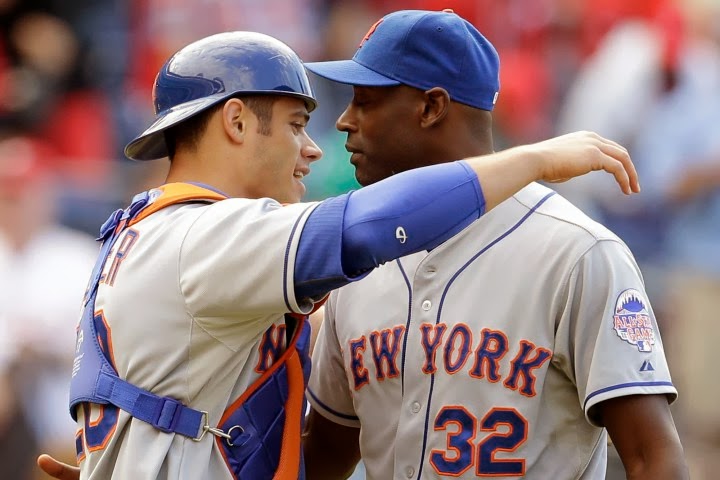
A hug before leaving.  (Getty Images Photo)

After having an excellent season with the Mets in 2013, LaTroy Hawkins will be pitching elsewhere in 2014.  Hawkins, who finished the year as the Mets' closer after Bobby Parnell was sidelined with a season-ending injury, signed a one-year, $2.5 million deal with the Colorado Rockies on Monday.

Never mind that Sandy Alderson said he wouldn't pay a 41-year-old reliever that kind of money, even though Hawkins gave the Mets his best statistical season since 2004, posting a 2.93 ERA, 1.15 WHIP and 13 saves at the age of 40.  But if Hawkins was aware of recent Mets history, he should've known that he was about to become a goner.

In 2011, Francisco Rodriguez was dealt to the Milwaukee Brewers during the All-Star Break.  After the trade, Jason Isringhausen became the Mets' closer, saving seven games - including his 300th career save.  The following season, he traded apples for oranges, leaving the Big Apple for Orange County.  Isringhausen pitched in 50 games for the Los Angeles Angels in 2012, but did not pitch in the majors in 2013.

One year before Isringhausen finished the year for K-Rod, another pitcher was forced into closer duties for the Mets when Francisco Rodriguez couldn't finish the year with the team.  After injuring himself when he became Frankie Knuckles in front of his son's grandfather, Hisanori Takahashi filled in as the team's closer, notching three wins and eight saves over the season's final two months.  The 35-year-old Takahashi was not re-signed by the Mets following his versatile "rookie" season in 2010.  Instead, he chose to sign with the Angels, spending a year and a half in Los Angeles, followed by short tenures in Pittsburgh and Chicago.

Billy Wagner began the final season at Shea Stadium as the Mets' closer.  But a season-ending injury forced Omar Minaya to acquire Luis Ayala in August 2008.  Ayala saved nine games as Wagner's temporary replacement.  And by temporary, I mean his two blown saves, two losses and 14.40 ERA over the season's final two weeks guaranteed he wouldn't be a Met in 2009.  Since then, Ayala has bounced around more than his pitches did in the left and right field corners of Shea Stadium in his six weeks with the team.  The right-hander has collected paychecks from the Twins, Marlins, Yankees, Orioles and Braves since he allowed the final run to cross the plate at Shea Stadium on a back-breaking blast by Dan Uggla on September 28, 2008.

When Braden Looper was in the final days of the two-year contract he signed with the Mets prior to the 2004 season, he required season-ending surgery to repair a blown AC joint in his right shoulder.  In stepped Roberto Hernandez, who picked up two wins and three saves over the final two weeks of the 2005 campaign.  But the Mets allowed Hernandez to leave as a free agent, and the 40-year-old reliever inked a one-year deal to pitch for the Pittsburgh Pirates in 2006.  Hernandez was traded back to the Mets (along with Oliver Perez) when Duaner Sanchez had a case of the munchies and got into the wrong taxi cab in Miami, but Hernandez did not record another save as a Met.

Roberto Hernandez should've pitched in this game instead of Braden Looper.

LaTroy Hawkins had a wonderful season for the Mets in 2013.  After becoming the team's closer on August 6, Hawkins pitched in 23 games and was 13-for-14 in save attempts.  Hawkins had pinpoint control as the team's closer, striking out 18 batters and walking only one in 22⅓ innings.  Opposing hitters had a .229 on-base percentage and a miniscule .272 slugging percentage against Hawkins, collecting just two extra-base hits in 81 at-bats.

Usually, those numbers are what you'd expect from a young, stud closer.  Someone like Craig Kimbrel.  In fact, going back to August 6 - the day Hawkins became the Mets' fill-in closer for the injured Bobby Parnell, Kimbrel went 16-for-17 in save opportunities with 31 strikeouts and five walks in 23⅔ innings, allowing a .211 on-base percentage and .224 slugging percentage (three extra-base hits in 85 at-bats).  Those numbers weren't that much better than what Hawkins did as the Mets' closer.  But because Hawkins is going to be 41 next month, he's not worth $2.5 million for one year, according to Sandy Alderson.

Perhaps Alderson should have given Hawkins another chance to be one of the team's top relievers in 2014, just like he was in 2013.  But Alderson must know about the team's recent history.  He surely has to know how relievers who fill in as temporary closers for the Mets never stick around with the team.  And who is Sandy Alderson to mess with tradition, right?  

Goodbye and thanks for playing, LaTroy Hawkins.  You should have been given another chance next year.  Instead, you're just in the same class as Roberto Hernandez, Luis Ayala, Hisanori Takahashi and Jason Isringhausen.  That's some consolation prize.