Showing posts with label Jonathon Niese. Show all posts

Saturday, September 10, 2016

Pitching Wins Don't Matter ... Tell That to Bartolo Colón

It's been very difficult to cool down Bartolo Colón recently.  (Joe Robbins/Getty Images)

Decades ago, pitching victories were viewed as the standard by which to judge a pitcher's success.  If he won a lot of games, he was considered to be a good pitcher.  That was then, this is now.  And wins don't mean what they used to.  Just ask Seattle Mariners pitcher Felix Hernandez, who won the American League Cy Young Award in 2010 despite finishing the season with a mediocre 13-12 won-loss record.

In the days of yore, the man known as King Felix wouldn't have been considered a candidate for the ultimate pitching honor with that record, but Hernandez led the American League during the 2010 campaign in innings pitched, ERA and fewest hits per nine innings, while also finishing high among the league leaders in the new stats of the day, like ERA+ (174; 2nd in A.L.), FIP (3.04; 4th in A.L.) and WAR for pitchers (7.1; 1st in A.L.).

Not only did Hernandez win the Cy Young over 19-game winner David Price and 21-game winner CC Sabathia, but the voting wasn't particularly close, as Hernandez earned 21 of the 28 first-place votes cast for the award in 2010.

Voters for regular season awards already know that there is more to determine the value of a pitcher than pitching wins.  But Mets pitcher Bartolo Colón doesn't have time for that talk.  He's too busy helping the Mets inch closer to an unlikely postseason berth by racking up win after win.  And in doing so, he finds himself just one victory away from joining an exclusive Mets pitching club.

Most of the time, when a player becomes "one of only so-and-so players to do something in club history", he's joined by a hodgepodge of players.  Some of these players are usually among the better players to suit up for the team, while others can sometimes be of the "what's he doing on this list?" variety.

For example, when you think of the top home run hitters in Mets history, your thoughts usually turn to guys like Darryl Strawberry, Mike Piazza and Dave Kingman - three guys who were known for their prodigious power.  But rounding out the top ten on the team's all-time home run list is Ed Kranepool, who never hit more than 16 home runs in any season and averaged a long ball every 50.8 plate appearances in his career.  Longevity had more to do with him appearing on this list than anything else.

Similarly, when one thinks of the top strikeout pitchers to put on the orange and blue, immediately visions of the Seavers, Koosmans and Goodens of the Mets universe come to mind.  No one would ever think of including a player like Jonathon Niese in the conversation, but there he is, sitting at No. 9 among the top strikeout pitchers in team history.  That's more a testament to how few great strikeout pitchers have managed to stick around with the Mets than it is of Niese's ability to throw strike three by an opposing batter.

That brings us back to Bartolo Colón, who currently sports a 13-7 won-loss record.  His excellent 2016 campaign comes on the heels of a 14-win season in 2015 and a 15-victory campaign in his inaugural season as a Met in 2014.  A win on Saturday against the Atlanta Braves would give him his third consecutive year with 14 or more victories and would put him on the short list of players who have accomplished that feat in a Mets uniform.  And believe me when I say that the players he'd be joining are not of the Ed Kranepool and Jonathon Niese ilk.

Steve Trachsel (Getty Images)
Entering 2016, a total of 27 pitchers (including Colón) had won 14 or more games for the Mets in a single season.  By accomplishing the feat in each of his first two seasons with the team, Colón had become one of ten Mets hurlers to post multiple seasons of 14+ victories.  However, one of the other nine was Steve Trachsel, which suggests that the company wasn't really that exclusive.  But should Colón win his 14th game of the season tonight or in any of his subsequent starts over the final three weeks of the season, he'd join pitchers like Jon Matlack, Ron Darling, Sid Fernandez and Al Leiter as three-time 14-game winners.  It's a slightly more impressive list, but none of those guys would ever appear on the Mount Rushmore of Mets starting pitchers.

Matlack, Darling, Fernandez and Leiter all had varying degrees of success with the Mets, but none of them put together at least three consecutive seasons of 14 or more victories while they were on the team.  Only four pitchers have ever done that.  You may have heard of them.  Those players are:

  • Tom Seaver (1967-73)
  • Jerry Koosman (1973-76)
  • Dwight Gooden (1984-88)
  • David Cone (1988-91)

If you were going to sculpt a Mets-style Mount Rushmore using the top four starting pitchers in Mets history, the noggins of those four players would more than likely be permanently chiseled in granite.  Basically, any positive pitching records in team history will feature most, if not all of those pitchers.  Their constant success from year to year made them aces or co-aces of the staffs they pitched for and resulted in lots of wins for the team and themselves.

And to think, Bartolo Colón is just one victory away from joining them.

Over the years, the importance of the pitching victory has been lessened.  A leaky pen can cost a starting pitcher a well-deserved win just as easily as an explosive offense can help a starter earn an ugly "W".  But a win is a win is a win, and pitchers still love getting them.  (Just ask Rick Porcello.)

Bartolo Colón has been in baseball long enough that he remembers when pitching victories were still used to determine how valuable a pitcher was.  But you don't have to tell anyone in this day and age just how valuable Colón has been to the Mets.  And should he earn a victory tonight over the Braves, his value as a winning pitcher will elevate him into the pantheon that includes the best starting pitchers in the history of the franchise.

Yeah, wins for pitchers don't matter as much as they used to.  But I don't think anyone is complaining  that Bartolo Colón is still racking up that "meaningless stat" for the Mets.


Thursday, December 10, 2015

And Then There Were Three... (Soon To Be Two, Then One)

Wright may be Shea Stadium's sole survivor in 2016.  Niese is now a Pirate and Murphy and Parnell will be ex-Mets soon.  (All photos by Ed Leyro/Studious Metsimus)

During the 2015 season, a total of 49 players played for the Mets.  Of those players, four of them - David Wright, Daniel Murphy, Jonathon Niese and Bobby Parnell - had been with the team since the days when the Mets called Shea Stadium home.

But with yesterday's trade of Niese to the Pittsburgh Pirates for second baseman Neil Walker, that number has dwindled to three.  And with Walker taking up residence in Murphy's primary defensive home, there might soon be two Mets left who played for the team at Shea.

The number could very well be one by Opening Day, as Parnell has pitched just 25 innings over the last two seasons and they haven't been very good innings, as he's allowed 21 runs (18 earned) and 50 base runners (32 hits, 18 walks) in those 25 frames.  For all you kids out there, that's a 6.48 ERA and 2.00 WHIP since the start of the 2014 campaign.  In other words, if Bobby Parnell was left off the postseason roster in 2015, he should be missing in non-action again in 2016 and beyond.

Once David Wright becomes the last Met standing from the halcyon days of Shea, the honor of being the second longest tenured Met will go from a soon-to-be former second baseman (Murphy) to a player who's familiar with seconds (Jenrry Mejia), as his second drug suspension for the same drug in 2015 will cost him much of his 2016 campaign as well.  Mejia will be the second longest tenured Met by a matter of minutes, as he made his Mets debut during the sixth inning of a game on April 7, 2010, just three innings before Ruben Tejada graced us with his presence for the first time.  And yes, that means that not a single player of the 26 men who made their Mets debut in the same year Citi Field made its debut (2009) remains on the team.

Besides Mejia and Tejada, the only other players who played for the Mets as far back as 2010 and were still members of the team last season were Lucas Duda and Dillon Gee (remember him?), although Gee has been granted free agency and will probably join forces with Bobby Parnell in the Land of Make Believe You Were Never A Met.

Just like 2009, there are no players who made their Mets debut in 2011 who are still with the team.  In fact, of the 22 players who suited up as a Met for the first time just four years ago, only one - Josh Satin - made it as far as the 2014 campaign, but he and his eyebrows are now property of the Cincinnati Reds.

That bring us to the 2012 season, a year that saw the Mets debuts of just three players who played for the team in the just-completed 2015 campaign.  And one of those players (Kirk Nieuwenhuis) had a cup of coffee with the Los Angeles Angels of Anaheim in Orange County near Disneyland this past season.  That leaves Matt Harvey (Mets debut in July 2012) and Jeurys Familia (Mets debut in September 2012) as the only players from the Year of the No-Hitter who are still with the team and have only played with the Mets.

So let's review.

There were four players on the 2015 roster who were in uniform at the Shea Goodbye ceremony.  One of those players (Jon Niese) will now be partaking of pierogies and Primanti Brothers sandwiches as a pitcher for the Pittsburgh Pirates.  Another one (Daniel Murphy) will be counting his money and his defensive lapses as a member of a new team in 2016.  A third (Bobby Parnell) was less dependable than Alex Torres's hat and is more than likely also going to be an ex-Met in 2016 - something Bartolo Colon will not be, no matter how much he slips up on the mound or elsewhere.


YouTube video posted by psu19420

Jenrry Mejia, Ruben Tejada and Lucas Duda will now replace Murphy, Niese and Parnell as the second, third and fourth longest tenured Mets.  They will join David Wright as the only players who know what it's like to be managed by Jerry Manuel and who remember firsthand what the Great Wall of Flushing used to look like before half of it was blocked by the Party City Deck.

Since Kirk Nieuwenhuis sported Angels red for a spell in 2015, that will leave Matt Harvey and Jeurys Famila as the fifth and sixth longest tenured Mets, respectively.  So who rounds out the top ten as far as longest tenured Mets are concerned?  Try this on for size.

  • No. 7 - Juan Lagares (Mets debut on April 23, 2013)
  • No. 8 - Carlos Torres (Mets debut on June 16, 2013)
  • No. 9 - Zack Wheeler (Mets debut on June 18, 2013)
  • No. 10 - Wilmer Flores (Mets debut on August 6, 2013)

With Neil Walker and new Mets shortstop Asdrubal Cabrera on board, the days for Ruben Tejada as a Met could be numbered.  Jenrry Mejia is one suspension away from not only being an ex-Met, but also an ex-major league baseball player.  That means Lucas Duda might soon find himself as the only Met besides Wright who remembers Omar Minaya signing anyone.

The days of players who were continuously with the Mets for nearly a decade are long gone.  The way things are going, half-decade players could be a thing of the past for the Mets as well.  How long will it be before players on the team start calling Wilmer Flores the old man on the team, assuming Flores sticks around long enough?
 

Monday, September 28, 2015

Joey's World Tour: Coronation in the Queen City

I'm ready for a clinching in Cincinnati!

Hello, everyone!  This is Joey Beartran and this is a special edition of my world tour.  In the past, I've shared my experiences of various ballparks and the cuisines found in those parks.  But this past weekend when I attended my first game in Cincinnati, I didn't eat a single thing at Great American Ball Park.  You see, something else captured my undivided attention.  And it was sweeter than anything I could have eaten at the ballpark.

When I left New York on Thursday, the Mets' magic number stood at five.  Since I was only going to Friday and Saturday's games, I needed the Mets to win every game between Thursday and Saturday and I also needed the Nationals to lose at least twice.  Considering that Washington was playing the sub-.500 Baltimore Orioles on Thursday and was then beginning a series against the team with the worst record in baseball - you might know them as the Philadelphia Phillies - the odds were not very good that I would see the Mets clinching the division in person.

But as Mets fans, we've been taught that we have to believe.  And I had a belief that I was going to be celebrating in Cincinnati.  At a rest stop near Columbus, Ohio, I found out the Nationals had lost their Thursday afternoon affair.  And soon after we arrived in Cincinnati, the Mets took the first game of their series against the Reds.  The magic number was down to three and my odds for seeing it go down to zero shifted so much in my favor, even Pete Rose would bet on my chances.

Friday night was my first time inside the Reds' ballpark, making it the 18th stadium I've had the pleasure to put my paws in.  By the time the third inning rolled around, both the Mets and Nationals had taken 1-0 leads in their respective games.  (Pitcher Noah Syndergaard's RBI single gave New York its early lead.)  But then things changed when Lucas Duda hit a long three-run homer and Philadelphia's Aaron Altherr completed a 120-yard dash, clearing the bases on an inside-the-park grand slam.  The scores were now 4-0 in favor of the Mets and 4-1, Phillies over Nats.  I was as happy as the statues of Pete Rose and George Foster were in the Reds' Hall of Fame and Museum, but I knew there was still plenty of baseball yet to be played.
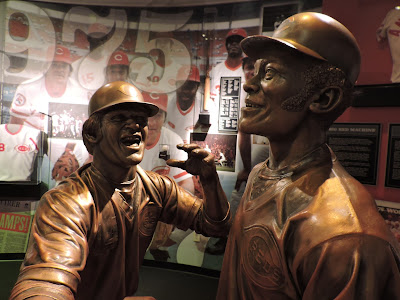
(Photo by Ed Leyro/Studious Metsimus)

The fifth inning in Washington caused me to throw my paws up in the air and wave them around as if there were no repercussions, as Aaron Altherr hit an outside-the-park home run and was followed two batters later by Darin Ruf's solo shot.  Washington did pull back to within four runs in the sixth inning, but by then I wasn't constantly looking at the out of town scoreboard, mainly because I was too busy cheering for Lucas Duda and Curtis Granderson.  Both lefty-swinging sluggers launched matching three-run blasts to extend the Mets' lead to a dozen runs.  The Mets eventually allowed five meaningless runs in the eighth and ninth frames, while the Phillies tacked on two insurance runs against the Nationals in the late innings.

The Mets had defeated the Reds, 12-5, and the Nationals had fallen to the Phillies, 8-2.  The magic number was down to one and after thinking I wouldn't get a chance to see it, I was poised to witness the potential division clinching game on Saturday.

It was difficult hibernating on Friday.  I was tossing and turning throughout the night.  Once Saturday morning came around, I needed to do something to get the butterflies out of my tummy, so I paid a visit to the Reds Hall of Fame and Museum, which I soon realized had a lot more to offer than just Rose and Foster statues.

Upon entering the two-story museum, I saw an exhibit on the original 1869 Cincinnati Red Stockings - baseball's first professional team.  The following room contained the Kings of the Queen City exhibit and a 100-seat theater.  I wasn't really in a movie-watching mood, mainly because they didn't have any popcorn, but I was intrigued by the other exhibit in the room.

Along with Pete Rose memorabilia and old uniforms, the wall around the room served as a timeline in Reds history, and it wasn't just all the positive moments in Cincinnati's long and proud history.  Just take a look at these photos from the 1973 and 1999 wall entries and you'll see what I mean.


From there, I took the stairs to the upper level.  Even the area near the staircase had something to behold, as there were 4,256 baseballs - one for each of Pete Rose's base hits accumulated over his illustrious 24-year playing career - going up the face of the wall.

Upon entering the second floor, I was greeted by a wing dedicated to Hall of Famer Tony Perez, which includes the uniforms he wore for every team he played for - not just the Reds.  The next room is devoted to all the men and women who have been part of the team's front office.  Yes, that means there is a mention of Marge Schott and her dog, Schottzie.

The following room has a wall that has photos of every Reds player who has participated in an All-Star Game.  The room also has a replica locker room, where guests can put on a Reds uniform, hold a bat or wear a Reds batting helmet.

From there, I went down a hall that had memorabilia from those All-Stars and to the left of that hall is a room where I could throw baseballs at a catcher.  I didn't want to undergo emergency Tommy John surgery, so I moved on to an area that housed a dugout and a statue of Hall of Fame manager Sparky Anderson.

My sister, Iggy, and I wanted to pick Sparky's brain, but he wasn't talking.  It's like he was a statue.

One sweet feature on the second floor was the Ultimate Reds Room, which is a fancy term for a "man cave".  As a bear, I know a thing or two about caves.  But this "man cave" - which was stacked with Reds photos, posters, replica ballpark seats and a TV showing Reds highlights - was missing the most important thing.  It didn't have a fridge.  So naturally, I didn't pose for photos there and instead moved on to the next room, which featured great teams in Reds history.

What I liked about this room was that it didn't just include championship teams.  Oh, there were a number of World Series trophies present, but there were also mentions of Reds teams that didn't even qualify for the postseason, including the 1999 team that lost to the Mets in Game No. 163.  And of course, the centerpiece of the room was the Big Red Machine.  And by Big Red Machine, I mean statues of the eight position players on the teams that won five division titles, three pennants and two World Series championships in a seven-year span from 1970 to 1976.  (Cincinnati also won a division crown in 1979, but Pete Rose and Tony Perez had already parted ways with the team.)

Remember the photo of Rose and Foster I shared above?  That was part of a much larger photo, which you can see below.

(Photo by Ed Leyro/Studious Metsimus)

One thing I noticed about the Reds Hall of Fame and Museum compared to what the Mets have at Citi Field (besides the obvious difference in size) was that the statues could be touched by anyone.  There were no ropes keeping paws and hands away from the works of art, a la the Mr. Met that's cordoned off from guests in the Mets Hall of Fame and Museum.  Out of respect, I didn't touch the statues and instead moved on to the final room, which houses the plaques of all the players in Reds Hall of Fame.

I noticed a plaque for Pedro Borbon, who Mets fans know as the Reds player who bit off part of Buzz Capra's cap during the Pete Rose-Bud Harrelson fist-filled fracas in the 1973 National League Championship Series.  I also smiled at Chris Sabo's plaque, which featured the bespectacled third baseman of the 1990 World Championship team in his signature goggles.  There also may have been a plaque for Tom Seaver, but I'd rather not talk about that one.  Besides, wouldn't you rather hear about the game between the Reds and Mets on Saturday, which I was about to be late for because I spent so much time in the museum?

Why did you have to go to Cincinnati, Tom?  You don't even look right in that uniform.

I made it to my seat just in time to see the Mets come to bat in the top of the first inning.  Had I spent more time looking at statues or staring at Pete Rose's balls (Iggy, why are you giggling?), I would have missed Lucas Duda hitting his third home run of the series.  This one was a grand slam - the first of Duda's career - and it gave Mets starting pitcher Matt Harvey a four-run lead before he threw his first pitch of the game.  A solo shot by Granderson an inning later gave the Mets a 5-0 advantage.

Harvey was a little shaky in the second inning, allowing hits to four of the first five batters to face him in the inning.  But he limited the damage to two runs, and in the next half-inning, the Mets got those runs right back on a two-run double by Michael Cuddyer, who may or may not be Scott Atchison's lost twin brother.

David Wright isn't sure if that's BFF Michael Cuddyer or former teammate Scott Atchison.  (Ed Leyro/Studious Metsimus)

As the innings progressed and Matt Harvey continued to mow down Reds hitters while keeping them off the scoreboard, I proceeded to count down the outs.

Fifteen outs to go.  Twelve outs to go.  Nine outs to go.

Harvey surprised all the fans sitting with me behind the Mets dugout when he came out to pitch the seventh inning.  It was innings limits, schminnings limits for Harvey on this overcast day.  And as light sprinkles continued to fall from the southern Ohio sky, I started to feel a new appreciation for Harvey.  Or maybe it was just hunger pangs because I hadn't eaten at either of the two games I attended.  It didn't help that I had just seen a subliminal Skyline Chili ad disguised as a "guess which plate of spaghetti and chili the baseball is hidden under" game on the scoreboard.

(Photo by Ed Leyro/Studious Metsimus)

Harvey couldn't complete the seventh inning, but he did receive a rousing ovation from the thousands of Mets fans in attendance as he walked off the mound.  Once Addison Reed recorded the final out of the inning, the Mets were just six outs away from a division title.  And when Tyler Clippard pitched a 1-2-3-4-5 inning in the eighth, the Mets were three outs away from the promised land.

I wanted so badly for Mets batters to swing at the first pitch they saw in the top of the ninth, just to get Jeurys Familia on the mound for the bottom of the ninth.  Some batters did swing at the first pitch, but they ended up getting on base.  And when David Wright sent a Burke Badenhop pitch in the direction of the Ohio River - it splashed down in the seats just left of straightaway center field - it provided a fitting capper to a wonderful game and prompted fans to show off their best congratulatory signs for the longest tenured Mets player.

It was indeed worth the wait for David Wright and the Mets.  (Ed Leyro/Studious Metsimus)

Even though the Mets now had an eight-run lead, manager Terry Collins called upon Familia to close out the race for the NL East title.  Familia needed just six pitches - all strikes - to retire the first two batters in the ninth.  Fans behind the Mets dugout - myself included - had already been standing since the start of the inning.  A nine-year period of pent-up frustration was one out away from being over.  The anticipation was, pardon the pun, unbearable.

Then Familia allowed a single to Joey Votto, followed by a Brandon Phillips infield single.  The next batter would be Jay Bruce - the same Jay Bruce who was almost traded to the Mets before the team decided they could swing a deal with Detroit for the services of Yoenis Cespedes.

The first pitch to Bruce was fouled off, as was the second pitch.  The Mets were one strike away from winning the National League East.  As Familia looked for the sign from catcher Travis d'Arnaud, camera phones were up the air hoping to capture the moment when the team's biggest out in nearly a decade was recorded.  Familia came to the set position and fired the ball to the plate.  And four-tenths of a second later, there was joy in Metsville - mighty Brucey had struck out.

 
David Wright, Jon Niese and Daniel Murphy - the three longest tenured Mets - celebrate the victory.  (Ed Leyro/Studious Metsimus)


I had been to various ballparks over the past five years.  But all of those stadium visits involved me watching Mets teams that would go on to finish with losing records.  That's seventeen parks and nearly two dozen nondescript ballgames featuring mediocre-at-best Mets teams.

But this stop of my world tour was so much different than all of my previous stops.  My trip to the Queen City had resulted in the coronation of the Mets as division champions.

My world tour is not yet over, as I still have a dozen more ballparks and cities to visit.  Maybe I'll even sample some of the food in those not-yet-visited stadiums.  But I don't think I'll ever have a memory of a ballpark greater than the one I had in Cincinnati.  From the hospitality (not a single Reds fan said anything negative to me or my fellow Mets fans) to the incredible Hall of Fame and Museum to the games themselves, my trip to southern Ohio produced the happiest recap I could have ever asked for.

This is the look of a fan of a division champion.
For more of Joey's World Tour, please click on the links below, where you will be entertained by Joey's wit, photos and love of ballpark cuisine:

World Tour Stop #1: Baltimore
World Tour Stop #2: Washington, DC
World Tour Stop #3: Pittsburgh
World Tour Stop #4: Texas
World Tour Stop #5: Los Angeles
World Tour Stop #6: San Diego
World Tour Stop #7: Toronto
World Tour Stop #8: Chicago
World Tour Stop #9: Milwaukee
World Tour Stop #10: Seattle
World Tour Stop #11: Cleveland
World Tour Stop #12: Brooklyn (Ebbets Field site) and Manhattan (Polo Grounds site)
World Tour Stop #13: Baltimore (again) and Pittsburgh (part deux)
 

Saturday, April 11, 2015

An Open Letter To Those Who Don't Like Jon Niese

Photo by Anthony Causi/NY Post

Dear Mets fans,

I've been a Mets supporter for 34 years, investing my time - and occasional money - in the team since the year after the magic was supposedly back (it wasn't).  In those three and a half decades, I've seen hundreds of players come and go.  Some of these players have been universally beloved by the fans, while others are married to Mrs. Armando Benitez.

While some of the vitriol dished out to those less fortunate players has been well-deserved, others have received the hate for reasons unknown.  One such player is Jonathon Joseph Niese.

Was Niese voted "Mr. Personality" in his high school yearbook?  Probably not.  Is he a "rah-rah" type of guy?  Not that I've ever seen.  Does he have a cool super-hero nickname like Matt Harvey?  Only if you consider Super Schnoz to be a sweet moniker.

Are these reasons for Mets fans to dislike Niese as much as they do?  Not at all.  But somehow, in seven-plus seasons as a Met, the 28-year-old southpaw has never been a fan-favorite.  And he's done nothing to make this happen other than be a serviceable pitcher.

Jon Niese is not paid like an ace, so no one should expect him to pitch like one.  But for several years, he's pitched better than an average pitcher.

Since 2012, Niese has a 30-28 record for a team that has finished below .500 in each season.  He has made 85 starts in the last three-plus seasons, posting a 3.47 ERA.  Of all the pitchers who have made that many starts since the start of the 2012 campaign, only 18 have posted a lower ERA, including Clayton Kershaw, Felix Hernandez, David Price, Adam Wainwright, Madison Bumgarner and Max Scherzer - all of whom are considered to be among the best pitchers in baseball.  In addition, 16 of those 18 hurlers have made at least one All-Star team in that time frame, with the two exceptions being Kyle Lohse (3.34 ERA) and Hiroki Kuroda (3.44 ERA).

Going back to August 2012, Niese has also allowed three earned or fewer in 55 of his last 63 starts.  That's just eight starts where Niese gave up four earned runs or more in two and a half seasons, which is amazing when you consider that last year alone, Madison Bumgarner had ten such games and Max Scherzer had nine.  You may know Bumgarner as the most recent World Series most valuable player and Scherzer as the $210 million man.

But those who don't like Niese fail to notice things like that.  Instead, they look at how he gets rattled when his teammates make errors behind him, thereby forcing Niese to record extra outs.  Well, guess what?  That happens to most pitchers!

Including the two unearned runs allowed in Friday night's loss to the Braves, Niese has allowed 25 such runs since 2012.  That's fewer than the number of unearned runs allowed by Stephen Strasburg (30 unearned tallies), Jon Lester (28) and R.A. Dickey (27) over the same time period.  And all three of those pitchers made All-Star teams since 2012 as well.

Finally, for those who are sabermetrically inclined, Niese has a 104 ERA+ over the last three-plus seasons.  Those are pretty solid numbers for a pitcher who, for some reason, is a disappointment to so many fans.  That's also better than the ERA+ posted by Tim Hudson (101 ERA+ since 2012), Matt Cain (100 ERA+) and Scott Kazmir (100 ERA+).  And you guessed it.  Hudson, Cain and Kazmir have all been All-Stars in that time period, with Cain starting the 2012 Midsummer Classic and Hudson and Kazmir both selected for last year's game.

Jon Niese has never blown hitters away, but he still has the ninth-most strikeouts in franchise history.  The eight pitchers ahead of him are a who's who of the greatest Mets pitchers of all-time.  Tom Seaver, Dwight Gooden, Jerry Koosman, Sid Fernandez, David Cone, Ron Darling, Al Leiter and Jon Matlack are the only hurlers in club annals who can claim more whiffs than Niese - a fact that still doesn't get Niese a whiff of respect.

When the Mets were in the midst of their second consecutive late-season collapse in 2008, one of their own pitched eight shutout innings to temporarily halt the bleeding in a mid-September victory over the Braves.  Who was that clutch pitcher?  That was Jonathon Joseph Niese.  But because the Mets didn't make the playoffs, Niese's effort was largely forgotten.

In 1969, Tom Seaver had one of the greatest pitching performances in team history, retiring the first 25 batters he faced in a crucial matchup against the Chicago Cubs before allowing a single to Jimmy Qualls.  He then retired the final two batters and settled for a one-hit shutout.  Forty-four years later, Matt Harvey had his bid for a perfect game broken up on an infield single by Alex Rios of the Chicago White Sox.  The seventh inning roller was the only base runner allowed by Harvey in his nine innings of work - a game won by the Mets in ten innings.  Seaver and Harvey are two of the three pitchers in Mets history to pitch nine innings and allow just one base runner in a single game, facing 28 batters to record 27 outs.  Who was the third?  That would be Jonathon Joseph Niese, who allowed just a third-inning double to the Padres' Chris Denorfia in June 2010.  The two-bagger was all that stood between Niese and a perfect game.

Jon Niese was almost perfect once, even if fans don't have an almost perfect recollection of that game.

People who weren't around in 1969 are constantly reminded of Seaver's imperfect game, just as current Mets fans remember Harvey's gem as if it were yesterday.  But hardly anyone - other than those who were in attendance at Citi Field for the second game of a day-night doubleheader on a chilly June evening in 2010 - can recall Niese's effort.  Perhaps it's because he has never been a must-watch pitcher the way Seaver was and Harvey is.  Or perhaps it's because no one wants to admit that Niese actually accomplished such a rare feat.

Jon Niese came up late in the 2008 season and was immediately thrust into a playoff race.  He has yet to play in a meaningful late-season game since.  That means he doesn't have the big-game experience that fellow southpaws (and more treasured former Mets) Jerry Koosman, Jon Matlack, Sid Fernandez and Al Leiter have.  Perhaps that's another reason why Niese isn't appreciated, even though he ranks just behind all four of those pitchers on the team's all-time ranks for left-handed starting pitchers.

You may think he's boring.  You may also think he doesn't have charisma, talent and various other intangibles.  But what you should really do is reconsider your opinions about Jon Niese, especially when you weigh the facts and realize how much better he's been than what you may have thought.

Since signing his team-friendly five-year, $25.5 million contract at the outset of the 2012 campaign, Niese has performed as well as - if not better than - several All-Star pitchers.  Niese has suffered some nagging injuries over the years, but has still made at least 24 starts in every season since 2010, making him one of only 32 pitchers who has made 24 or more starts in each of the last five campaigns.  In fact, Niese is one of just a dozen pitchers in Mets history to make two dozen starts in five separate seasons.  And if Niese reaches 24 starts in 2015, he'd be one of nine Mets pitchers to reach that total six times.

So what does everybody want from Niese?  He's not Matt Harvey.  He's not someone who's going to strike out 10 or more batters every game.  And he's not going to pitch a shutout all the time.  What Niese will do is keep his team in the game more often than not.  He will also keep opposing teams from putting up crooked numbers on the scoreboard.  And he's not making the money that a perennial All-Star makes.  But no matter what he does, it will never be good enough for Mets fans.

I'm sure many teams would love to have a pitcher of Jonathon Niese's caliber.  And I'd bet fans of those teams wouldn't pick apart everything he does on the mound the way Mets fans do.  Jon Niese will never be the best pitcher on the team.  But he doesn't have to be.  He just has to pitch the way he has over the past three-plus seasons.  And that's probably better than what his haters deserve.

Sincerely,
A Jon Niese appreciator


It's a crying shame that Mets fans don't appreciate Jon Niese more.


Saturday, April 4, 2015

Milestones Within Reach For Members of the 2015 Mets

The Mets lost their first eight Opening Day games from 1962 to 1969 before getting off to their first 1-0 start in 1970.  Since then, they have lost back-to-back Opening Day games just once in the last four and a half decades, dropping their season openers in 1999 and 2000.  And of course, New York made the playoffs in both of those campaigns.

The 2015 squad is trying to avoid becoming just the second Mets team to drop consecutive Opening Day affairs since those 1960s clubs.  That's a team mark no one on the current club wants, especially with hopes being so high for this year's club.  However, several players on the current squad can reach individual milestones that are mostly positive.  And of course, since these are the Mets we're talking about, there are some milestones that can potentially be reached that players would rather not discuss.

The time for dilly-dallying is done.  By the power of Scott Atchison's stubble, I give you the list of individual Mets milestones within reach (even if some players would rather I keep some of these milestones to myself).


Attainable Individual Milestones (Position Players)


Juan Lagares doesn't need anything but his Gold Glove.  (Getty Images)


David Wright:

  • Needs 93 runs scored for 1,000 in his career.
  • Needs 61 RBI to reach 1,000 as well.
  • Needs 22 home runs to tie Darryl Strawberry for the franchise lead.
  • Needs nine stolen bases for 200 lifetime steals.
  • Needs 12 SB to be ahead of every Met not named Jose Reyes or Mookie Wilson.
  • Needs a return to his non-injured self to validate his continued use in the No. 3 hole.


Daniel Murphy:

  • Needs 173 hits for 1,000.  (Only nine Mets have reached that figure.)
  • Needs 10 doubles for 200.
  • Needs 36 doubles to become the second-most prolific Doubles Machine in team history.
  • Needs to be careful what he says when asked for his opinion on certain "lifestyles".


Lucas Duda:

  • Needs 26 home runs for 100.  (Just 11 Mets have reached triple digits in homers.)
  • Needs 55 RBI for 300.
  • Needs 136 strikeouts to enter the team's all-time top ten in whiffs.  (Boo.)
  • Needs to string together two complete sentences in a post-game interview.


Curtis Granderson:

  • Needs 13 home runs for 250.
  • Needs seven blasts to pass Jason Bay for 65th place on the Mets' all-time home run list.
  • Needs to make sure hitting coach Kevin Long never leaves his side.
  • Needs to smile more.  (He doesn't do it nearly enough.)


Michael Cuddyer:

  • Needs 13 homers for 200.
  • Needs 76 hits to be halfway to 3,000.
  • Needs to let Juan Lagares catch every fly ball hit in the left-center field gap.
  • Needs to check out of the DL Hotel.  (He's been staying there way too often.)


Ruben Tejada:

  • Needs to accept that Wilmer Flores isn't going to give him back his job at shortstop.


Attainable Individual Milestones (Pitchers)


Matt Harvey needs to pitch so he can make money to buy clothes again.  (Martin Schoeller/ESPN)


Bartolo Colon:

  • Needs to pitch 214 innings for 3,000 in his career.
  • Needs 166 strikeouts to enter baseball's all-time top 50.  (He'd pass Roy Halladay, Vida Blue, Jim Palmer and Lefty Grove along the way.)
  • Needs to allow 20 home runs to become the 27th pitcher in history to allow 350.  (On the bright side, 14 of the other 26 pitchers are in the Hall of Fame.)
  • Needs his batting helmet to continue flying off his head for a good belly laugh.


Jonathon Niese:

  • Needs two strikeouts to pass Bobby Jones for 9th place on the Mets' all-time list.
  • Needs 22 starts to enter the top ten in team history, displacing David Cone from 10th place.
  • Needs 14 wins to tie Steve Trachsel for 10th place in Mets history.
  • Needs to stay off the disabled list so the Mets can always have a lefty starter in the rotation.


Matt Harvey:

  • Needs 27 starts to establish a new single-season career high.
  • Needs 239 strikeouts to become the 22nd Mets pitcher to reach 500 career strikeouts.  (Hey, if Oliver Perez could strike out 239 batters in just 196 innings in 2004, why can't Harvey do the same?)
  • Needs to give upper management the middle finger if they try to make him change his ways.


Bobby Parnell:

  • Needs one appearance for 300 in his career.
  • Needs 63 appearances to move into 6th place in club history, behind only John Franco, Pedro Feliciano, Tom Seaver, Jerry Koosman and Jesse Orosco.
  • Needs 51 strikeouts to become 7th pitcher in team history to record 300 whiffs as a reliever.
  • Needs to give the team more than the one inning he pitched for them in 2014.


Jenrry Mejia:

  • Needs 29 saves to crack the team's all-time top ten in career saves.
  • Needs to pitch more 1-2-3 innings.  (He allowed at least one base runner in 28 of his last 40 appearances in 2014.  He allowed two or more base runners in half of those 40 outings.)
  • Needs his new haircut to not get in the way of his game-ending stomp after each time the Mets put it in the books.


Attainable Individual Milestones
(People Who Have "Manager" In Their Title)


"You think I'm not going to win more games than I lose this year?  Don't make me laugh!"  (Jeff Roberson/AP)


Terry Collins:

  • Needs 36 wins to pass Gil Hodges to become the third winningest manager in team history, behind only Davey Johnson and Bobby Valentine.  Seriously.
  • Needs 76 losses to tie Joe Torre for second-most defeats for a Mets manager.  (Collins would pass Casey Stengel and Davey Johnson along the way.)
  • Needs 39 games to pass Joe Torre for third place in games managed by a Mets skipper.
  • Needs to wear his pants a little lower.  He looks like a modern day Steve Urkel.


Sandy Alderson:

  • Needs a winning record to tie Frank Cashen by getting his team above .500 in his fifth season as the team's general manager.
  • Needs to borrow a couple million bucks to bring in a top offensive player.
  • Needs to stop posing with Mets teddy bears and start posing as a successful general manager.
  • Needs to prepare for meaningful games in September for the first time as the Mets' GM.


This bear will be very happy if the Mets play meaningful games in September.  (Ed Leyro/Studious Metsimus)

Saturday, November 22, 2014

Dillon Gee vs. Jonathon Niese: Who Should Be Traded?

Photo courtesy of USA Today Sports/Getty Images via ESPNNewYork.com

I love watching Dillon Gee pitch.  Similarly, I am a fan of Jonathon Niese.

Although the Mets have been under .500 every season Gee has pitched in the majors, Gee himself has a won-loss record that is six games over .500 and he has never been more than one game under the break-even mark over a full season.  Jonathon Niese, on the other hand, is one of the few Mets left on the team who played at Shea Stadium (David Wright, Daniel Murphy and Bobby Parnell are the others, although Murphy and Parnell may not be on this list much longer).  Niese is also the team's only southpaw on a staff filled with right-handed pitchers.

As much as I enjoy having Gee and Niese on the team, I understand that the starting rotation currently has Bartolo Colon, Matt Harvey, Zack Wheeler and Jacob deGrom taking up four spots, with Noah Syndergaard waiting in the wings.  Assuming Colon is traded at some point during the 2015 season (if not sooner), Syndergaard would be the obvious choice to replace him in the rotation.  That would leave one of the members of the Gee-Niese duo out of luck and perhaps out of a job in New York.

Knowing full well that either Gee or Niese will not be a Met by this time next year, I decided to see which player the Mets would be better off keeping.  One or both pitchers might be traded if the right deal comes along, but I think one of the two would be better off staying in the Mets' starting rotation.  Here's my reasoning for the player I would like to stick around.

Although he has a 3.91 ERA for his career, Dillon Gee has had only one full season in the majors in which he posted an ERA under 4.00.  Advanced metrics also have his lifetime FIP (Fielding Independent Pitching) at 4.23.  For all you kids out there, FIP measures how effective a pitcher is at limiting home runs, walks and hit batsmen while causing strikeouts.  Basically, those are the four categories in which fielders do not determine an outcome.  Therefore, Gee's 4.23 FIP is considered a little higher than what is expected from an average pitcher.

Jonathon Niese has a 3.87 career ERA, but has posted a sub-4.00 ERA in each of his last three seasons, going under 3.50 in two of the last three campaigns.  But on the FIP side, Niese has a lifetime 3.72 FIP and has posted a FIP under 4.00 in each of his last four seasons.  Niese has walked more batters than Gee, but has hit fewer batters and allowed fewer home runs per nine innings than Gee.  And when it comes to strikeouts, Niese is far superior to Gee, as Niese has surpassed 130 strikeouts in a season four times, while Gee has done it just once.

Speaking of strikeouts, although Niese is just 28 years old (he's actually six months younger than Dillon Gee), he's already in the Mets' all-time top ten in career strikeouts.  Niese's 713 Ks are tenth on the team's lifetime leaderboard and he is just one strikeout behind Bobby Jones for ninth place.  Once he passes Jones, the only pitchers in front of him will be Tom Seaver, Dwight Gooden, Jerry Koosman, Sid Fernandez, David Cone, Ron Darling, Al Leiter and Jon Matlack.  You may also know that octet as arguably the eight best pitchers in the history of the franchise.   Niese's strikeout-to-walk ratio (2.69; 713 K/265 BB) is also far better than Gee's ratio (2.26; 464 K/205 BB).

Let's look at another new metric to determine a pitcher's effectiveness - ERA+.  This metric compares a pitcher's earned run average to the league average and also accounts for park factors, with 100 being considered an average ERA+.  For example, Citi Field is generally considered a pitcher's park.  However, Dillon Gee has never posted an ERA+ of 100 in any of his four full seasons.  From 2011 to 2014, Gee has posted a 90 ERA+, with a career-best 98 ERA+ in 2013, which is still 2% worse than the average pitcher.  Meanwhile, Jonathon Niese has a 97 ERA+ since he became a regular in the rotation in 2010.  But since 2012, Niese has a 104 ERA+, making him 4% better than the average pitcher over the last three seasons.  Niese's career-best performance in this metric came in 2012, when he posted a 112 ERA+.

WAR (wins above replacement) is all the rage in this sabermetric era of baseball.  The higher the WAR, the better the player.  It's that simple.  Looking at the WAR posted by Gee and Niese since 2011 (the year both pitchers were rotation-mates for the first time), it's clear which pitcher has been more valuable to the team.  Gee has a 4.5 WAR since 2011, going above 1.0 just once in the four years (2013, when he posted a 2.2 WAR).  In the same time period, Niese has a 6.2 WAR, posting a 3.4 WAR in 2012 and a 1.7 WAR this past season.

WAR.  What is it good for?  For Niese, it might be good for keeping him in New York.  (Brad Penner/USA Today Sports)

Finally, let's look at one overlooked, but still important, part of the pitcher's game - his offense.  When a pitcher comes to bat, he's not expected to do much.  If there's a runner on base, he's expected to bunt him over.  If there's no one on base, the best a pitcher is expected to do is not get hurt swinging the bat and maybe make the opposing pitcher throw a few extra pitches.  When it comes to proficiency with the bat, there's no contest between Gee and Niese.

Since becoming a regular in the rotation in 2011, Dillon Gee has a .154 on-base percentage, reaching base 27 times (18 hits, nine walks) in 206 plate appearances.  Meanwhile, since Niese joined the rotation for good in 2010, he has reached base an incredible 66 times (38 hits, 28 walks) in 304 plate appearances, which is a .237 on-base percentage.  Of all pitchers with at least 200 plate appearances since 2010, only Zack Greinke (.274 OBP in 245 PA) and Mike Leake (.261 OBP in 338 PA) have a higher on-base percentage than Jonathon Niese and only Ian Kennedy has drawn more walks (32 BB in 342 PA) than Niese.  Kennedy and Niese are the only pitchers who have walked more than 20 times since 2010.

So let's review.  Jonathon Niese has a better ERA, ERA+, FIP and WAR than Dillon Gee.  Niese is also much more adept at recording strikeouts than Gee and has a better K/BB ratio.  And while Gee is almost an automatic out with the bat, Niese gives the Mets a ninth hitter in the lineup, reaching base just under a quarter of the time.  Niese isn't going to break into a home run trot any time soon, but he has proven to be one of the better handlers of the bat among National League pitchers.

Dillon Gee will blow out 29 candles during the first month of the 2015 campaign.  Jonathon Niese will be 28 all season.  Niese has more experience than Gee, having pitched at Shea Stadium.  Niese is also left-handed, something no other starting pitcher on the Mets can claim.  Although Gee is still arbitration eligible and will likely not command more than $5 million in 2015, Niese is due $7 million in 2015 and $9 million in 2016, hardly amounts that would break the Wilpon family piggy bank.

If the Mets are going to trade one of their veteran homegrown pitchers before the curtains rise on the 2015 season, it should be clear which one should go.  Although I've always enjoyed watching him pitch and still believe he can be successful in New York, Dillon Gee will probably be the victim of an overcrowded starting rotation.  Jonathon Niese, despite all the question marks surrounding his health, has still made at least 24 starts in each of his five full seasons in the majors.  Gee has surpassed 22 starts just twice in his four full seasons with the Mets.  Also, Niese may not always utter the most politically correct statements, especially when it comes to Mets fans' loyalty, but you can't say he was pulling things out of his posterior.  If the Mets are going to draw the crowds Niese was used to seeing when he was a neophyte, then the team has to play better.  And right now, I believe the team will perform better with Niese on the team instead of Gee.

Of course, trading Gee or Niese will depend on the package the Mets would receive in return, but if each package was similar and the Mets had an option of trading either player, then that player should be Gee.  The future of the team would look a lot brighter if it held on to Niese.
 

Thursday, August 7, 2014

In Defense of Jonathon Niese

Don't worry, Jon.  I've got your back.  (Getty Images)

For the first time since becoming a Met in 2008, Jonathon Niese has lost four consecutive starts, with all four defeats coming after his brief stint on the disabled list.  The losing streak has caused some Mets fans on Twitter and in the blogosphere to question whether the best days for the lefty are behind him.

But before you proclaim yourself ready to say uncle about Niese, take a look at a few facts.

Niese's four-game losing streak has come against the Mariners, Brewers, Giants and Nationals.  As of this writing, Seattle is only one game out of the second wild card spot in the American League.  Meanwhile, San Francisco holds the top wild card spot in the NL, while Milwaukee and Washington sit atop their respective divisions.  In other words, Niese lost to four good teams!

In addition to facing playoff contender after playoff contender during his skein, Niese has received no run support from his teammates whatsoever.  The Mets have scored two, two, one and one run in Niese's last four starts.  In fact, this poor support has victimized Niese all season, as the Mets have lost 11 of Niese's 21 starts, scoring two runs or fewer in ten of the 11 losses.  With that kind of support, it's a wonder Niese has WON as many games as he has.

Other than a three-start tryout in 2008, Niese has pitched his entire career for Mets teams that finished with sub-.500 records.  Yet it took him until his seventh season to lose four straight decisions in the same season.  Consider this.

In 1967, Mets rookie Tom Seaver lost four consecutive decisions in a five-start span.  Three years later, he was credited with a loss in four straight starts (August 15-28, 1970).

A quarter century after Seaver's rookie campaign, Dwight Gooden suffered the first four-game losing streak of his career, doing so in a five-start stretch from July 9 to August 19, 1992.  (Gooden was placed on the 15-day disabled list in the middle of that rough patch.)  A year later, Doc had two separate stretches in which he lost four consecutive starts, doing so from June 12 to July 1 and August 7-23.

In 2010, R.A. Dickey won his first six decisions as a Met.  He followed that up by losing four straight decisions in a period of five starts (June 28 to July 20).  Although Dickey never lost four straight starts, he did lose five consecutive decisions during a six-start stretch in 2011.

What do the above three pitchers have in common besides several losing streaks of four games or more?  All three won Cy Young Awards as members of the New York Mets.  Even Jerry Koosman, who never won a Cy Young Award, but still leads all Mets southpaws in career victories, had some tough times on the mound.  From August 2 to September 5, 1977, Koosman started eight games for the Mets.  Incredibly, he was pinned with a loss in all of them.

Like Koosman, Niese is a left-handed pitcher who has had his shares of ups and downs.  Koosman finished his 12-year Mets career just three games above .500 (140 wins, 137 losses), while Niese currently has a 48-48 won-loss record.  But as bad as Niese's current four-game stretch is, it's only halfway to the worst streak suffered by Koosman.  It's also not the first time a Met has lost four straight starts, as club legends Seaver and Gooden both accomplished the feat.

Tom Seaver lost four straight in 1967.  The Mets lost 101 games that year.  Dwight Gooden had three separate four-game losing streaks in 1992 and 1993.  Those are the teams most known for being "the worst team money could buy".  R.A. Dickey had losing streaks of four and five games in his short Mets career.  He never pitched for a winning Mets team.  And of course, Koosman's unfortunate streak in 1977 came in the first year of the Grant's Tomb era.

Someday, the Mets will finish a season above .500 again.  When that day comes, Jonathon Niese will surely have a better chance to win a greater percentage of his ballgames.  It's amazing that it took until his seventh season for him to put together a four-game losing streak, considering the teams he's played for.

So for all those people who are becoming impatient with Jonathon Niese, just remember this.  Some of the best pitchers to ever put on a Mets uniform suffered misfortunes just as much as Niese did.  Don't give up hope on the Mets' 27-year-old lefty yet.  He still has plenty of time to put up some fantastic numbers, just as long as his teammates remember to put up a few numbers of their own on the scoreboard.


Thursday, July 17, 2014

Broken News: Jonathon Niese Speaks!

Did Jon Niese's mouth turn him into a Royal pain?  Did he make a Giant mistake?  I say no!  (Justin K. Aller/Getty Images)

Welcome to the latest edition of Broken News, where someone else breaks the news and then we break it some more.  In today's segment, we'll discuss Mets pitcher Jonathon Niese, who shared a few interesting thoughts about Mets fans with Andrew Marchand of ESPNNewYork.com.

In the article, Niese claimed Mets fans really want their team to win, but also questioned their loyalty.  The 27-year-old southpaw noted that Mets fans showed up when the team played well at Shea Stadium, but have largely been absent at Citi Field, where the team has mostly struggled since the park opened in 2009.

Many fans didn't know what to make of Niese's statement.  My opinion on the matter can be stated in three words:  GOOD FOR HIM!!

Niese is the third longest-tenured player on the Mets behind David Wright and Daniel Murphy.  And no pitcher on the roster has toiled longer for the Mets than Niese.  That, my friends, makes him a veteran.  And that also gives him the right to speak his mind if he sees something that bothers him.  Niese has been there, seen that.  And he's just stating what everyone else has already seen with their own eyes.

Attendance at Citi Field has dropped steadily since the park opened its doors for the first time five years ago.  Half a decade of less-than-mediocre baseball will do that to a fanbase.  Sandy Alderson said earlier this year that if the fans come to the park, the team can generate more revenue which can then be reinvested in the team.

But what is Alderson giving the team right now?  Why should fans come out to see a team that is not good right now?  Would you pay top dollar for a Broadway show in 2014 if you knew that the best actors weren't going to appear on stage until 2015?  Of course not.  But that's what our general manager wants us to do.  Jon Niese knows we're not dummies.  And he knows fans will not come out to see a struggling team.

Sandy Alderson is a patient man, and wants Mets fans to follow his lead.  Jonathon Niese is more of a realist, and knows that fans in general - not just Mets fans - don't have the same type of patience his general manager has.

I have no problem with anything Jonathon Niese said.  He spoke from the heart and he spoke the truth.  And that's what veteran players are supposed to do.  But now it's up to him and his teammates to make sure the fans eventually come back to cheer them on.  A little more winning will make Mets fans, true or otherwise, make their way back through the turnstiles.


Sunday, May 11, 2014

The Sixth Starter Could Be the Savior of the Season

Can Rafael Montero save the Mets' season as a starting pitcher?  (Photo by Brad Barr/USA Today Sports)

When Jonathon Niese takes the hill today for the Mets, he will continue a pattern that hasn't been seen much in Flushing over the past few years.  Niese, Dillon Gee, Bartolo Colon, Zack Wheeler and Jenrry Mejia have been the only pitchers to start games for the Mets through the team's first 36 games.  That kind of stability is something that's becoming quite rare in today's game.

Last year, the Mets were forced to use a sixth starter in their 22nd game, when Shaun Marcum replaced the ineffective Aaron Laffey in the rotation.  In 2012, the Mets only needed 15 games before a sixth starting pitcher (Miguel Batista) was required.  The year before that, it was in game No. 14 that the Mets went to sixth starter D.J. Carrasco.  And let's not forget 1997, when the Mets used six starting pitchers in their first six games (Pete Harnisch, Mark Clark, Bobby Jones, Dave Mlicki, Rick Reed, Brian Bohanon).

The last time the Mets went past 36 games using only the pitchers in their original five-man rotation was 2010, when they played 40 contests until needing R.A. Dickey to fill in as a starter in game No. 41.  Before that, you have to go back to 2002, when they didn't need starter No. 6 until the midpoint of the season (Game No. 81).

Where do those teams rank as far as Mets squads that didn't need a sixth starter are concerned?  Let's take a look at the ten teams in franchise history that went the deepest into the season on just five starting pitchers.

 
Year
Sixth Starter
Game #
First Five Starters
1991
Sid Fernandez
89
Gooden, Viola, Cone, Whitehurst, Darling
2002
Mike Bacsik
85
Leiter, Trachsel, Estes, Astacio, D’Amico
1989
David West
81
Gooden, Ojeda, Darling, Cone, Fernandez
1978
Kevin Kobel
58
Koosman, Espinosa, Zachry, Bruhert, Swan
1976
Bob Apodaca
48
Seaver, Matlack, Lolich, Swan, Koosman
1973
Tommy Moore
41
Seaver, Matlack, Koosman, McAndrew, Parker
1992
W. Whitehurst
41
Cone, Saberhagen, Fernandez, Young, Gooden
2010
R.A. Dickey
41
Santana, Maine, Niese, Pelfrey, Perez
1975
Harry Parker
37
Seaver, Matlack, Koosman, Tate, Webb
2014
???????
36+
Gee, Colon, Wheeler, Mejia, Niese


Only nine times in team history have the Mets gone more than 36 games into a season without requiring the services of a sixth starter.  But by this time next week, the 2014 Mets might be surpassed by just five teams in this regard.

There has been speculation that Jenrry Mejia may be moved to the bullpen soon.  If so, the Mets will have to trot out a sixth starter for the first time this season.  But will it happen before the 2014 team can move further up the above chart?

With the way the Mets have been promoting young starting pitchers to the major leagues over the past two seasons (Matt Harvey in 2012, Zack Wheeler in 2013), it seems as if the 1991 squad will continue to be the Mets team who went the longest without requiring a sixth starter.  But take a look at the list above.  Other than the 1973 Mets, no team on the chart made the postseason.  And no team posted a better record than the 1989 squad, who went 87-75 that year.

The Mets have won 88 or more games in 14 different seasons.  They made the playoffs in six of those campaigns.  (The '73 squad that went to the World Series finished the year with an 82-79 record).  But in all of the years the Mets won 88-plus games, they needed to go to a sixth starter fairly early in the season.  Most of the Mets teams that used just five starters deep into the season failed to generate much success in the standings.

Is it possible that the use of five starters and only five starters wears down those pitchers to the point that the team can't remain competitive deep into the summer?  Past history has shown that good Mets teams have used other starting pitchers early in the season, which has curbed the workload of the top five guys in the rotation.  Or is it just coincidence that this is the case?

The 2014 season is still in its first few chapters, but it will be interesting to see how the book on the team's starting pitchers shapes up.  How those pitchers are used could very well determine how the season's final chapter will be written.