Showing posts with label Robin Ventura. Show all posts

Wednesday, August 31, 2016

Yoenis Céspedes vs. Other Mets in Their First 162 Games

Yoenis Cespedes's 162-game start gets a big thumbs up!  (Ed Leyro/Studious Metsimus)

Yoenis Céspedes has meant everything to the Mets since he was acquired at the trade deadline last July.  But because of nagging injuries and a trip to the disabled list earlier this season, Céspedes didn't get to play in his 162nd career game with the team until Wednesday, as he has missed 28 games during the 2016 campaign after resting for only two games with the Mets in 2015, both of which came after the team had clinched the division title.

Céspedes's numbers with the team in those 162 games are astounding, as he has produced 34 doubles, 44 homers, 112 RBI and has compiled a .583 slugging percentage and .941 OPS in a full season's worth of games.  Those five categories are traditionally recognized as categories in which sluggers generally excel, and Céspedes ranks favorably with the team's all-time greats in all five.

In doing research for hot starts by Mets players to see where Céspedes ranked, I found some interesting names that I did not expect to find among those franchise legends.  For every time Mike Piazza was in the top ten - he's the only player to be ranked in the top five in all five categories within his first 162 games with the team - there were a handful of "did they really have that type of start?" players.

Here are five lists, one each for doubles, home runs, runs batted in, slugging percentage and on-base plus slugging percentage, that show just how good Céspedes has been in his first 162 games with the Mets and how fortunate some other players were in their first full season's worth of contests with the club.


Doubles:

Bernard Gilkey
Mike Piazza - 46
Bernard Gilkey - 45
Paul Lo Duca - 44
David Wright - 41
Mike Cameron - 40
Rusty Staub - 39
Eddie Murray - 38
Robin Ventura - 38
Todd Zeile - 38
Ike Davis - 37


Home Runs:

Kevin McReynolds
Dave Kingman - 48
Yoenis Céspedes - 44
Carlos Delgado - 39
Mike Piazza - 38
Mike Cameron - 35
Gary Carter - 34
Frank Thomas - 34
Robin Ventura - 32
Cliff Floyd - 31
Bernard Gilkey - 31
Kevin McReynolds - 31
Darryl Strawberry - 31


Runs Batted In:

John Olerud
Carlos Delgado - 126
Bernard Gilkey - 124
Robin Ventura - 120
Mike Piazza - 119
Dave Kingman - 118
Gary Carter - 116
Yoenis Céspedes - 112
Donn Clendenon - 108
John Olerud - 107
Kevin McReynolds - 102


Slugging Percentage:
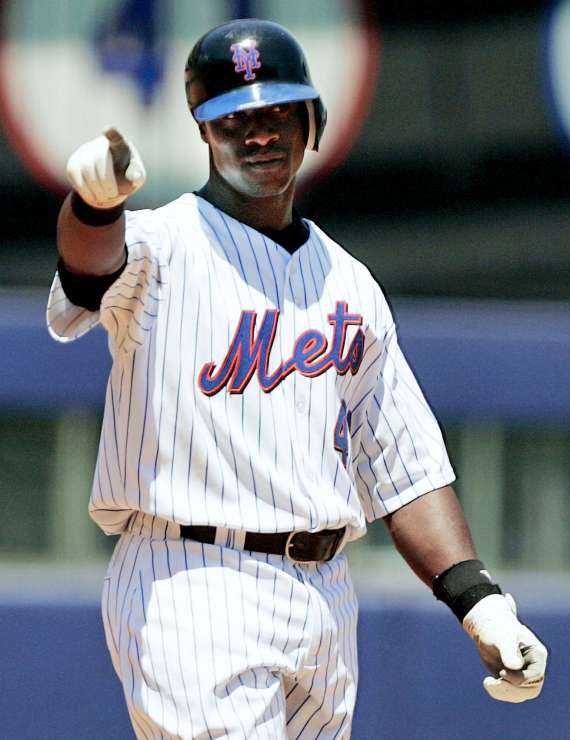
Mike Cameron
Mike Piazza - .604
Yoenis Céspedes - .583
Bernard Gilkey - .544
Rico Brogna - .529
Robin Ventura - .525
Cliff Floyd - .523
Carlos Delgado - .518
Donn Clendenon - .512
Dave Kingman - .511
Mike Cameron - .510


On-Base Plus Slugging Percentage:

Rico Brogna
Mike Piazza - 1.005
Yoenis Céspedes - .941
Bernard Gilkey - .930
Robin Ventura - .902
Cliff Floyd - .890
John Olerud - .889
Rico Brogna - .880
Carlos Delgado - .870
Benny Agbayani - .867
David Wright - .865


As you can see, there are several players whose names you would expect to see in multiple categories.  Power hitters such as Céspedes, Piazza, Carlos Delgado, Dave Kingman and others can be found in at least three of the five top-ten lists.  But did you really expect to see a guy like Rico Brogna appear on as many lists as David Wright?  What about Cliff Floyd and Mike Cameron showing up three times?  Or most surprisingly, what do you think of Bernard Gilkey and Robin Ventura joining Piazza as the only three players to rank in the top ten in all five categories?

Those unexpected players (Brogna, Floyd, Cameron, Gilkey, Ventura) all had sensational starts to their careers in Flushing, but they also suffered injuries (Brogna, Floyd and Cameron come to mind) or faded quickly (Gilkey and Ventura were both one-season wonders).

Meanwhile, a number of all-time team greats were absent from a number of these top-tens.  The late, great Gary Carter made it to the Hall of Fame and began a miraculous World Series rally that fueled the Mets to a championship.  But his excellent .490 slugging percentage and .861 OPS in his first 162 games with the team were both not high enough to appear on either category's respective top-ten list.  Darryl Strawberry may have won the National League Rookie of the Year award in 1983, but his only appearance on any of the above lists is a ninth-place tie in the homer department.  And Carlos Beltran may be the greatest free agent signing in Mets history, but a poor start to his career in New York kept him off every list.

It remains to be seen whether Céspedes will go down the road traveled by the great sluggers in Mets history or if the nagging injuries continue to increase and he will just be remembered for the incredible 162-game start to his Mets career, which included helping the team reach the 2015 World Series.

For now, Céspedes is one of only three Mets to have at least 30 doubles, 35 homers and 100 RBI in his first 162 games with the team, joining Carlos Delgado and Hall of Famer Mike Piazza.  Whether or not Céspedes joins Piazza in Cooperstown or even in the Mets Hall of Fame won't be known for years, but one thing's for certain.

Yoenis Céspedes has been gotten off to one of the best starts of any hitter in franchise history.  And there's nothing fluky about that.


Saturday, July 12, 2014

Lucas Duda Could Make First-Half History For The Mets

Lucas Duda and David Wright might share more than a high-five if Duda's power surge continues. (Mike Stobe/Getty Images)

Lucas Duda has come a long way since making his major league debut under the tutelage of Jerry Manuel in 2010.  He's been a beleaguered outfielder that was sent down to the minors after every extended slump and he's also been a first baseman caught in a platoon with a player struggling to keep his batting average above the Mendoza Line.

But through it all, Duda has persevered.  Now, as the Mets' everyday first baseman, Duda has quietly put up some of the best first-half power numbers in franchise history.

You can laugh all you want at the statement in the previous paragraph, but it's true.  Let's take a look at all the players in Mets history who have produced 20 doubles, 15 homers and 50 RBI prior to the All-Star break.  As you can see from the chart below, there aren't many of them.


Player Split Year G PA GS 2B HR RBI
David Wright 1st Half 2008 94 432 94 24 17 70
Carlos Beltran 1st Half 2008 94 411 92 23 15 66
David Wright 1st Half 2006 87 386 87 22 20 74
David Wright 1st Half 2007 86 378 85 21 16 51
Bernard Gilkey 1st Half 1996 84 358 84 21 16 62
Robin Ventura 1st Half 1999 87 357 85 21 15 66
Howard Johnson 1st Half 1989 79 336 78 22 22 57
Provided by Baseball-Reference.com: View Play Index Tool Used
Generated 7/12/2014.


Only five players in club annals have managed to reach 20 doubles, 15 HR and 50 RBI before the midsummer hiatus, with David Wright producing three such seasons.  All five players went on to post incredible full seasons.

In Wright's three years achieving these first half numbers, he ended up averaging 41 doubles, 30 HR and 116 RBI per season.  The other four players also had productive full seasons, as Johnson (41 doubles, 36 HR, 101 RBI), Gilkey (44 doubles, 30 HR, 117 RBI), Ventura (38 doubles, 32 HR, 120 RBI) and Beltran (40 doubles, 27 HR, 112 RBI) put up some of the best full season extra-base hit and RBI totals in franchise history.

It should be noted that with two games to go before the 2014 All-Star break, Lucas Duda has amassed 20 doubles, 14 HR and 48 RBI.  That's right, Mets fans.  Duda is only a two-run blast away from joining this exclusive club.

When I first pondered this amazing feat immediately after Duda launched his 14th homer of the year last night, I was shot down by a gentleman on Twitter with the following tweet.


While it is true the Mets will have played 95 games by this year's All-Star break, allowing for players to pile up on cumulative stats, Duda began the season as a part-timer, sharing first base duties with the now-departed Ike Davis.  And since Davis' trade to the Pittsburgh Pirates, Duda has sacrificed occasional playing time to two first basemen who swing the bat from the right side of the plate.

Before his demotion to AAA-Las Vegas, Josh Satin was given seven starts at first base.  In addition, Eric Campbell has been penciled into the starting lineup ten times since his call-up from Vegas in early May.  Between Davis, Satin and Campbell, Duda has started 22 games on the Mets bench.  That's nearly 100 plate appearances Duda hasn't gotten this season.

Looking at the chart above, all five players in the 20 double, 15 HR, 50 RBI club stepped up to the plate at least 336 times before the All-Star break.  With two games left before this year's break, Duda has just 315 plate appearances.  Unless the Mets have a few 20-inning marathons against the Marlins this weekend, Duda will have come to bat fewer times than any of the members of the 20/15/50 club did in their historic campaigns, even with the All-Star Game being played later in the season than it has in the past.  All Duda needs is one homer and two RBI and he will have joined Johnson, Gilkey, Ventura, Beltran and Wright, despite the Fab Five needing more plate appearances to earn a spot in this exclusive club.

Say what you want about Lucas Duda.  He's a clumsy oaf.  He's a lousy interview.  He's never produced over a full season.  Depending on who you ask, all of those things might be true.  But with just one well-timed blast (and a teammate on the bases when said blast occurs), it will also be true that Lucas Duda will have engineered one of the most productive first halves with the bat in franchise history.

All this from a player who wasn't even guaranteed an everyday job at the beginning of the season.  History has a strange way of finding Mets players when they least expect it.

Saturday, May 4, 2013

May The 4th Be With You: The Mets Who Powered Up In New York

Just because Bernard Gilkey witnessed different Star Wars in this photo, the force was still with him as a Met.

Today is May 4, otherwise known as Star Wars Day to those who believe in the force.  (May the 4th be with you - get it?)  In honor of the special day, I decided to do some research on the Mets players who hit with more power after they came to New York.

Shea Stadium and Citi Field have never been confused with smaller, bandbox parks.  As a result, home run hitters have never been plentiful in Flushing.  But some have come to New York and thrived as home run hitters in parks that were never conducive to such displays of power.

Let's look at the ten players who unexpectedly gave the home run apple a workout after they came to New York, comparing their home run output before they called Flushing home to what they produced after they became Mets.

 
Player
AB
pre-NY
HR
pre-NY
AB
in NY
HR
in NY
AB/HR
pre-NY
AB/HR
in NY
Diff.
 B. Gilkey
2133
52
1353
52
41.0
26.0
15.0
 D. Clendenon
3651
110
861
45
33.2
19.1
14.1
 K. Hernandez
4076
81
3164
80
50.3
39.6
10.7
 B. Bonilla
3294
116
1779
95
28.4
18.7
9.7
 H. Johnson
576
19
3968
192
30.3
20.7
9.6
 M. Cameron
3528
131
801
42
26.9
19.1
7.8
 R. Ventura
4542
171
1513
77
26.6
19.6
7.0
 T. Agee
1230
37
2416
82
33.2
29.4
3.8
 C. Floyd
3132
132
1643
81
23.7
20.3
3.4
 C. Beltran
3467
146
3133
149
23.7
21.0
2.7


As you can see, only three players had a difference of 10.0 of better.  What does that mean in regular English for those of you who don't speak stats?  It means that Bernard Gilkey, Donn Clendenon and Keith Hernandez needed 10 fewer at-bats to homer as Mets as they did when they were with their old teams.

Gilkey homered every 26 at-bats as a Met, while it took him 41 at-bats on average to homer as a Cardinal.  Clendenon collected over 30 at-bats for every homer he hit before calling Shea home, but once he came to New York, he circled the bases every 19.1 at-bats.  Even Keith Hernandez, who never had a 20-homer season in the majors, found New York to his liking when it came to hitting home runs.  Hernandez homered once every 50 at-bats in St. Louis, but it took him fewer than 40 at-bats on average to jack one out in New York.

Much has been made of the power outage suffered by Jason Bay after coming to New York.  Bay averaged 30 homers per season during his first six full seasons in the majors, but managed a total of 26 homers in his three years as a Met.  But not much has been said about the players who displayed more power after reporting for duty in Flushing.

The force was with players like Bernard Gilkey, Donn Clendenon and Keith Hernandez after they were acquired by the Mets.  And once they arrived in New York, they hit the ball with more force then they ever had for their previous teams. 
 

Thursday, May 2, 2013

The Mets Who Believed A Walk Was As Good As A Hit


Lucas Duda is a great admirer of pitches.  After all, he's kept the bat on his shoulder for 91% of first pitches he's seen and 68% of all pitches, regardless of the count.  By not taking his hacks at the plate, Duda has walked 21 times through the Mets' first 26 games.  But by the same token, it's quite a challenge to pick up a hit without swinging at a pitch every so often.  That would explain why Duda only has 19 hits.

Through the season's first month, the Mets' leftfielder has reached base via a hit two fewer times than he has taken ball four.  How rare has this been in franchise history?  Almost as rare as a Rey Ordoñez home run.

Let's take a look at the players who have come closest to accomplishing this rare feat for the Mets, considering only those players who played regularly or semi-regularly and had no more than 20 more hits than walks (min. 300 PA).

   
Player
Year
Plate Appearances
Hits
Walks
 Elio Chacon
1962
449
87
76
 Bobby Klaus
1965
337
55
45
 Joe Foy
1970
399
76
68
 Wayne Garrett
1970
454
93
81
 Ken Singleton
1971
366
73
61
 Wayne Garrett
1972
377
69
70
 Bud Harrelson
1974
412
75
71
 Wayne Garrett
1976
305
56
52
 Ron Hodges
1983
305
65
49
 Robin Ventura
2001
549
108
88


As you can see from the list above, there have been just ten instances in Mets history in which a player with at least 300 plate appearances came within 20 walks of his full-season base hit total.  Wayne Garrett is the only player to accomplish the rare feat more than once, doing it three times.  Garrett is also the sole player to have more walks than hits in a season in which he compiled at least 300 plate appearances.

But why stop with 300 plate appearances?  Why not delve a little deeper to see how many players had more walks than hits, regardless of the number of plate appearances?  So that we don't have players with one hit and two walks on the list, let's just consider players with at least twenty hits and walks.  The list is shorter than Bill Pulsipher's career in New York.

 
Player
Year
Plate Appearances
Hits
Walks
 Wayne Garrett
1972
377
69
70
 Ron Hodges
1984
132
22
23
 Tom Herr
1991
192
30
32
 Rickey Henderson
2000
124
21
25
 Jay Bell
2003
142
21
22


That brings us back to Lucas Duda.  With 19 hits and 21 walks in his first 99 plate appearances, Duda is one hit away from joining the walk firm of Garrett, Bell, Henderson, Herr and Hodges.  But since Duda stands to collect far more at-bats than his colleagues in the firm did in their unusual seasons, he might end up etching his name on the list that includes those everyday players with the best eyes and most patience at the plate.

Players such as Wayne Garrett, Bud Harrelson, Ron Hodges and Robin Ventura were fan-favorites during their time in New York, but none of them hit for a particularly high average.  Hodges was a .240 hitter in 12 years as a Met, while Garrett (.237) and Harrelson (.234) were regularly out of contention for the batting title by late April.  Ventura did hit .301 in his first year in New York, but hit .232 and .237 in his other two seasons as a Met.  They couldn't hit, but they didn't have to.  They found other ways to reach base.

Lucas Duda is hitting .250 through the Mets' first 26 games.  But with two more walks than hits, his on-base percentage sits at an impressive .424.  Duda is never going to compete for a batting title, but like a number of Mets before him, he doesn't have to.  He can still contribute to the team's offense even with his share of oh-fers at the plate, as long as those oh-fers include a walk or two.

Little leaguers are taught that a walk is as good as a hit.  For Lucas Duda and a select number of players in Mets history, it appears that major leaguers have been taught that mantra as well.