Showing posts with label Rico Brogna. Show all posts

Tuesday, May 11, 2021

25 Years Ago: When Mark Grace Punched Me in the Face

Twenty-five years ago today, I decided to take in a Saturday matinee at Shea Stadium to see the Mets take on the Chicago Cubs.  Although the 1996 squad had three offensive forces in center fielder Lance Johnson, left fielder Bernard Gilkey and catcher Todd Hundley, my favorite player on the team was first baseman Rico Brogna.

Brogna was only a Met for parts of three seasons and never played for a winning Mets team, but in his short time with the club, he became a beloved figure with the fans.  One of Brogna's many big moments with the team came on that particular Saturday - May 11, 1996 - when he delivered a walk-off home run to defeat the Chicago Cubs, 7-6, at Shea Stadium.

But the story of the game wasn't the Brogna blast that erased a four-run Cubs rally.  It was the bench-clearing brawl in the fifth inning that started when Mets starting pitcher Pete Harnisch and Cubs catcher (and good friend) Scott Servais got into a heated argument at the plate.  And before the 15-minute donnybrook was done, Mark Grace had punched me in the face.  Here's the story - 25 years later - of how a great contact hitter made some unwanted contact with my left cheek.

http://mlb.mlb.com/assets/images/3/5/8/42598358/cuts/markgrace640_1qjnv3kf_ovzjm02b.jpg
Is this what Mark Grace looked like before his fist came in the direction of my face?


The Mets were celebrating John Franco Day at Shea Stadium on May 11, 1996, to commemorate the reliever's 300th career save.  But Franco was not around to notch a save in this game, thanks to the fisticuffs that took place in the fifth inning of the Mets' 7-6 victory.

The seeds to the battle royale were planted in the first inning, when Mets catcher Todd Hundley had to duck out the way of a errant pitch by Cubs starter Kevin Foster.  When Foster came to bat for the first time in the second inning, Harnisch drilled him with his first pitch.  No warnings were issued at the time by home plate umpire Greg Bonin.

Harnisch expected retaliation by Foster when he came to bat, but fortunately for him, the Mets had two runners on base when he came up to the plate in the second inning and the bases loaded for his next at-bat in the third.  Neither Foster nor relief pitcher Rodney Myers (who came in for Foster in the third) could hit Harnisch with a pitch because doing so would damage the Cubs' chances at a scoreless inning.  Harnisch batted again in the fifth inning, but this time there were two outs and no one on base.  Terry Adams was now on the mound for the Cubs.  It didn't take long for the fracas to begin.

Adams threw his first pitch low and behind Harnisch.  Cubs catcher Scott Servais then started jawing at Harnisch, which caused the Mets pitcher to throw a punch at Servais.  Both benches and bullpens emptied and a violent brawl ensued.  The fight then moved in the direction of the Cubs dugout.  Guess where my seat was that day?

Now, you should know that I have always enjoyed taking photos at Mets games.  And in 1996, the Mets had a promotion where they gave fans in attendance a disposable Kodak camera.  It was a camera that had no zoom and could only be used for 24 photos before it had to be discarded.  It was as primitive as you could get for a wannabe photographer.  The Mets didn't draw well in 1996, so I was able to get a ticket three rows behind and slightly to the home plate side of the Cubs dugout.  Because I was so close to the field, I figured I'd use the disposable camera since I wouldn't need a zoom feature from that distance.

Of course, as soon as I saw the mountains of men pushing, shoving and trying to decapitate each other near the Cubs dugout, I ran down to the front row and tried to take a super close-up photo of the action.  That's when Cubs first baseman Mark Grace stepped in.  And my face and my camera checked out.


Video courtesy of MetsRewind


In his effort to try to separate Mets players from his teammates, Grace accidentally (or at least I think it was unintentional) took a swipe in my direction, landing his fist on my face between my left cheek and left eye.  I dropped the camera in shock, and of course, it broke upon impact with the field level concrete.  The area between my cheek and eye ended up slightly swollen, and it had the appearance of a piece of skin that had just been ripped off with a piece of tape.  Grace had as mean a left hook as he had a sweet lefty swing.  I just had a mean bruise on my face and a broken camera.

After the pugilists were sent back to their respective corners, nine players and coaches had been ejected, including the man who was celebrating his special day at Shea Stadium: John Franco.

The Mets, who at one point had a 6-2 lead in the game, saw their lead whittled down to two runs in the ninth.  With Franco stewing in the showers - he claimed he was unjustly ejected, saying "I'm too old to be doing that kind of stuff" - the Mets used three pitchers in a failed attempt to protect a 6-4 lead in the ninth.  A two-out, two-run single by Jose Hernandez off Doug Henry tied the game at six and put Rico Brogna in position to win it in the bottom of the ninth.

With one out and no one on, Brogna delivered a high fly ball deep down the right field line.  Right fielder Sammy Sosa climbed the fence right near the foul pole, but Brogna's blast just cleared the wall over Sosa's glove.  With Sosa still dangling on the wall, Brogna ran gingerly around the bases, having injured himself during the fifth-inning fracas.  It gave Brogna a four-hit, two-homer, four-RBI day and capped a thrilling 7-6 victory for the Mets.

Of course, I have no photographic evidence of this home run because my camera was in pieces thanks to Mark Grace, but I'll always have clear memories of that free-for-all, Rico Brogna's amazing day at the plate, and the shape of Grace's left fist - all of which happened 25 years ago today on a Saturday afternoon at Shea.

I guess I should be thankful Grace didn't sock me a few inches higher.  My memories might not have been so clear then.

************************

Big thanks to MetsRewind for the video of the fight.  I was standing near the dugout at the 0:49 mark of the video, but might have been bending over at the time picking up my damaged camera.  At least I had a ringside seat.

Please check out metsrewind.com for podcasts, blogs and much more amazin' Mets content.  You can also find MetsRewind on Facebook, Instagram and Twitter (@metsrewind, naturally).


Wednesday, August 31, 2016

Yoenis Céspedes vs. Other Mets in Their First 162 Games

Yoenis Cespedes's 162-game start gets a big thumbs up!  (Ed Leyro/Studious Metsimus)

Yoenis Céspedes has meant everything to the Mets since he was acquired at the trade deadline last July.  But because of nagging injuries and a trip to the disabled list earlier this season, Céspedes didn't get to play in his 162nd career game with the team until Wednesday, as he has missed 28 games during the 2016 campaign after resting for only two games with the Mets in 2015, both of which came after the team had clinched the division title.

Céspedes's numbers with the team in those 162 games are astounding, as he has produced 34 doubles, 44 homers, 112 RBI and has compiled a .583 slugging percentage and .941 OPS in a full season's worth of games.  Those five categories are traditionally recognized as categories in which sluggers generally excel, and Céspedes ranks favorably with the team's all-time greats in all five.

In doing research for hot starts by Mets players to see where Céspedes ranked, I found some interesting names that I did not expect to find among those franchise legends.  For every time Mike Piazza was in the top ten - he's the only player to be ranked in the top five in all five categories within his first 162 games with the team - there were a handful of "did they really have that type of start?" players.

Here are five lists, one each for doubles, home runs, runs batted in, slugging percentage and on-base plus slugging percentage, that show just how good Céspedes has been in his first 162 games with the Mets and how fortunate some other players were in their first full season's worth of contests with the club.


Doubles:

Bernard Gilkey
Mike Piazza - 46
Bernard Gilkey - 45
Paul Lo Duca - 44
David Wright - 41
Mike Cameron - 40
Rusty Staub - 39
Eddie Murray - 38
Robin Ventura - 38
Todd Zeile - 38
Ike Davis - 37


Home Runs:

Kevin McReynolds
Dave Kingman - 48
Yoenis Céspedes - 44
Carlos Delgado - 39
Mike Piazza - 38
Mike Cameron - 35
Gary Carter - 34
Frank Thomas - 34
Robin Ventura - 32
Cliff Floyd - 31
Bernard Gilkey - 31
Kevin McReynolds - 31
Darryl Strawberry - 31


Runs Batted In:

John Olerud
Carlos Delgado - 126
Bernard Gilkey - 124
Robin Ventura - 120
Mike Piazza - 119
Dave Kingman - 118
Gary Carter - 116
Yoenis Céspedes - 112
Donn Clendenon - 108
John Olerud - 107
Kevin McReynolds - 102


Slugging Percentage:

Mike Cameron
Mike Piazza - .604
Yoenis Céspedes - .583
Bernard Gilkey - .544
Rico Brogna - .529
Robin Ventura - .525
Cliff Floyd - .523
Carlos Delgado - .518
Donn Clendenon - .512
Dave Kingman - .511
Mike Cameron - .510


On-Base Plus Slugging Percentage:

Rico Brogna
Mike Piazza - 1.005
Yoenis Céspedes - .941
Bernard Gilkey - .930
Robin Ventura - .902
Cliff Floyd - .890
John Olerud - .889
Rico Brogna - .880
Carlos Delgado - .870
Benny Agbayani - .867
David Wright - .865


As you can see, there are several players whose names you would expect to see in multiple categories.  Power hitters such as Céspedes, Piazza, Carlos Delgado, Dave Kingman and others can be found in at least three of the five top-ten lists.  But did you really expect to see a guy like Rico Brogna appear on as many lists as David Wright?  What about Cliff Floyd and Mike Cameron showing up three times?  Or most surprisingly, what do you think of Bernard Gilkey and Robin Ventura joining Piazza as the only three players to rank in the top ten in all five categories?

Those unexpected players (Brogna, Floyd, Cameron, Gilkey, Ventura) all had sensational starts to their careers in Flushing, but they also suffered injuries (Brogna, Floyd and Cameron come to mind) or faded quickly (Gilkey and Ventura were both one-season wonders).

Meanwhile, a number of all-time team greats were absent from a number of these top-tens.  The late, great Gary Carter made it to the Hall of Fame and began a miraculous World Series rally that fueled the Mets to a championship.  But his excellent .490 slugging percentage and .861 OPS in his first 162 games with the team were both not high enough to appear on either category's respective top-ten list.  Darryl Strawberry may have won the National League Rookie of the Year award in 1983, but his only appearance on any of the above lists is a ninth-place tie in the homer department.  And Carlos Beltran may be the greatest free agent signing in Mets history, but a poor start to his career in New York kept him off every list.

It remains to be seen whether Céspedes will go down the road traveled by the great sluggers in Mets history or if the nagging injuries continue to increase and he will just be remembered for the incredible 162-game start to his Mets career, which included helping the team reach the 2015 World Series.

For now, Céspedes is one of only three Mets to have at least 30 doubles, 35 homers and 100 RBI in his first 162 games with the team, joining Carlos Delgado and Hall of Famer Mike Piazza.  Whether or not Céspedes joins Piazza in Cooperstown or even in the Mets Hall of Fame won't be known for years, but one thing's for certain.

Yoenis Céspedes has been gotten off to one of the best starts of any hitter in franchise history.  And there's nothing fluky about that.


Wednesday, May 11, 2016

20 Years Ago: When Mark Grace Punched Me in the Face

Twenty years ago today, I decided to take in a Saturday matinee at Shea Stadium to see the Mets take on the Chicago Cubs.  Although the 1996 squad had three offensive forces in center fielder Lance Johnson, left fielder Bernard Gilkey and catcher Todd Hundley, my favorite player on the team was first baseman Rico Brogna.

Brogna was only a Met for parts of three seasons and never played for a winning Mets team, but in his short time with the club, he became a beloved figure with the fans.  One of Brogna's many big moments with the team came on that particular Saturday - May 11, 1996 - when he delivered a walk-off home run to defeat the Chicago Cubs, 7-6, at Shea Stadium.

But the story of the game wasn't the Brogna blast that erased a four-run Cubs rally.  It was the bench-clearing brawl in the fifth inning that started when Mets starting pitcher Pete Harnisch and Cubs catcher (and good friend) Scott Servais got into a heated argument at the plate.  And before the 15-minute donnybrook was done, Mark Grace had punched me in the face.  Here's the story - 20 years later - of how a great contact hitter made some not-so-great contact with my left cheek.

http://mlb.mlb.com/assets/images/3/5/8/42598358/cuts/markgrace640_1qjnv3kf_ovzjm02b.jpg
Is this what Mark Grace looked like before his fist came in the direction of my face?

The Mets were celebrating John Franco Day at Shea Stadium on May 11, 1996, to commemorate the reliever's 300th career save.  But Franco was not around to notch a save in this game, thanks to the fisticuffs that took place in the fifth inning of the Mets' 7-6 victory.

The seeds to the battle royale were planted in the first inning, when Mets catcher Todd Hundley had to duck out the way of a errant pitch by Cubs starter Kevin Foster.  When Foster came to bat for the first time in the second inning, Harnisch drilled him with his first pitch.  No warnings were issued at the time by home plate umpire Greg Bonin.

Harnisch expected retaliation by Foster when he came to bat, but fortunately for him, the Mets had two runners on base when he came up to the plate in the second inning and the bases loaded for his next at-bat in the third.  Neither Foster nor relief pitcher Rodney Myers (who came in for Foster in the third) could hit Harnisch with a pitch because doing so would damage the Cubs' chances at a scoreless inning.  Harnisch batted again in the fifth inning, but this time there were two outs and no one on base.  Terry Adams was now on the mound for the Cubs.  It didn't take long for the fracas to begin.

Adams threw his first pitch low and behind Harnisch.  Cubs catcher Scott Servais then started jawing at Harnisch, which caused the Mets pitcher to throw a punch at Servais.  Both benches and bullpens emptied and a violent brawl ensued.  The fight then moved in the direction of the Cubs dugout.  Guess where my seat was that day?

I have always enjoyed taking photos at Mets games.  In 1996, the Mets had a promotion where they gave fans in attendance a disposable Kodak camera.  It was a camera that had no zoom and could only be used for 24 photos before it had to be discarded.  It was as primitive as you could get for a wannabe photographer.  Because the Mets didn't draw well in 1996, I was able to get a ticket three rows behind and slightly to the home plate side of the Cubs dugout.  Because I was so close to the field, I figured I'd use the disposable camera since I wouldn't need a zoom feature from that distance.

Of course, as soon as I saw the mountains of men pushing, shoving and trying to decapitate each other near the Cubs dugout, I ran down to the front row and tried to take a super close-up photo of the action.  That's when Cubs first baseman Mark Grace stepped in.  And my face and my camera checked out.

In his effort to try to separate Mets players from his teammates, Grace accidentally (or at least I think it was unintentional) took a swipe in my direction, landing his fist on my face between my left cheek and left eye.  I dropped the camera in shock, and of course, it broke upon impact with the field level concrete.  The area between my cheek and eye ended up slightly swollen, and it had the appearance of a piece of skin that had just been ripped off with a piece of tape.  Grace had as mean a left hook as he had a sweet lefty swing.  I just had a mean bruise on my face and a broken camera.

After the pugilists were sent back to their respective corners, nine players and coaches had been ejected, including the man who was celebrating his special day at Shea Stadium - John Franco.

The Mets, who at one point had a 6-2 lead in the game, saw their lead whittled down to two runs in the ninth.  With Franco stewing in the showers (he claimed he was unjustly ejected, saying "I'm too old to be doing that kind of stuff"), the Mets needed three pitchers in a failed attempt to protect a 6-4 lead in the ninth.  A two-out, two-run single by Jose Hernandez off Doug Henry tied the game at six, and put Rico Brogna in position to win it in the bottom of the ninth.

With one out and no one on, Brogna delivered a high fly ball deep down the right field line.  Right fielder Sammy Sosa climbed the fence right near the foul pole, but Brogna's blast just cleared the wall over Sosa's glove.  With Sosa still dangling on the wall, Brogna ran gingerly around the bases, having injured himself during the fifth-inning fracas.  It gave Brogna a four-hit, two-homer, four-RBI day and capped a thrilling 7-6 victory for the Mets.

Of course, I have no photographic evidence of this home run because my camera was in pieces thanks to Mark Grace, but I'll always have clear memories of that free-for-all, Rico Brogna's amazing day at the plate, and the shape of Grace's left fist - all of which happened 20 years ago today on a Saturday afternoon at Shea.

I guess I should be thankful Grace didn't sock me a few inches higher.  My memories might not have been so clear then.
 

Sunday, May 1, 2016

Broken News: Being in the Right Place at the Right Time

Welcome to another edition of Broken News, where someone else breaks the news and then we break it again.  In today's installment, we're going to look back at Friday night's game between the Mets and Giants, otherwise known as the game in which the bottom of the third inning turned into a matchup between the Gas-House Gorillas and the Tea Totallers.  (Go watch classic Bugs Bunny clips if you don't know what I mean.)

In the third, the Mets sent 15 men to the plate and scored a dozen runs, breaking the franchise record for tallies in a single frame.  Yoenis Céspedes put the icing on the inning by giving his regards to Giants reliever Mike Broadway, lining a grand slam to score the Mets' ninth, tenth, eleventh and twelfth runs of the frame.  Earlier in the third, Céspedes had driven in two runs with another hit.  His six RBI set a club record for a player in one inning.

The Mets basically did a conga line around the bases in the third, scoring half a dozen runs off starter Jake Peavy and another half dozen against Broadway to set a team mark with 12 runs in one inning, breaking the old record of 11, which was accomplished in 2006 in an inning where the Mets clubbed two grand slams.

I attended Friday night's game and got to witness the third inning in person.  It was the 13th grand slam hit by a Mets player that I've had the pleasure of seeing at Shea Stadium and Citi Field.  I've also had the honor of being at Citi Field for eight of the 12 walk-off homers hit in the park's history, including all six game-ending blasts since 2013 and the only two walk-off grand slams ever hit there.  I've been in the right place at the right time for many of these exciting finishes, which reminds me of the first times I ever saw a grand slam and a walk-off homer.

If you're a long-time reader, then you know about the first walk-off homer I ever saw in person.  It happened in 1996, when Rico Brogna accomplished the feat against the Chicago Cubs in the same game where Mark Grace punched me in the face.  But there were also fisticuffs in the game where I witnessed my first-ever grand slam, and it involved a mighty mite and a future Hall of Famer.

On May 14, 1994, the Mets and Braves hooked up for a Saturday matinee at Shea Stadium.  I got to my seat a little late for first pitch, but realized that I had a celebrity sitting next to me in my field level seat.  It was none other than MTV personality Dan Cortese.  That's right, the bandana enthusiast from MTV Sports and Rock n' Jock fame was my next-seat neighbor for the festivities.  Because I like to rock with the cool kids.

My seat mate for the game in which I witnessed my first grand slam in person.  (Photo by Jeff Kravitz/Getty Images)

The Mets took a 3-0 lead into the fifth inning and had two outs and no one on base.  It did not appear as if the Mets would be able to extend their lead against Braves starting pitcher John Smoltz in the frame.  But then Smoltz allowed singles to Bobby Bonilla and Jeff Kent and followed that up with a wild pitch that moved Kent into scoring position behind Bonilla, who was already at third.  Smoltz then intentionally walked David Segui to load the bases for Ryan Thompson.  On a 1-2 pitch, Thompson blasted a long home run off Smoltz to give the Mets a 7-0 lead and me my first in-person grand slam hit by a Met.  That brought up Brooklyn-born John Cangelosi to the plate and he made sure to let Smoltz know that he still had a lot of Brooklyn in him.

On the first pitch following Thompson's grand slam, Smoltz nailed Cangelosi in the back.  It was the second consecutive inning Smoltz had hit Cangelosi in the John-on-John crime, as he was plunked by the Braves starter in the fourth inning as well.  Bruised, but not battered, the diminutive Brooklynite then charged at Smoltz, who had seven inches and sixty pounds on the Mets left fielder, and a bench-clearing brawl ensued.  There is no truth to the rumor that I had to hold back Dan Cortese from joining the fracas, but he was throwing air punches in his seat as if he were mentally trying to show Mets players who were 200 feet away from us how to defend themselves against the big bad boys from Atlanta.

After the dust had settled and Smoltz and Cangelosi had been tossed, the game continued without incident and the Mets went on to record an 11-4 victory.  An interesting side note that was overshadowed by the boxing match was that Mauro Gozzo recorded the win for the Mets in the game, a win that was made possible by Thompson's grand slam.  Gozzo was originally drafted by the Mets in 1984, but was traded to Kansas City in 1987 in the deal that brought David Cone to New York.  Five years later, Cone was traded to Toronto for Jeff Kent and Ryan Thompson - the same Ryan Thompson who helped Gozzo defeat the Braves.  (Gozzo had returned to the Mets as a free agent following the 1992 campaign.)

Since Citi Field opened in 2009, I've had a better than 50-50 chance to be in attendance whenever a grand slam or walk-off home run has been hit by a Mets player, including the grand slam by Yoenis Céspedes on Friday night.  It's gotten to the point where I've kind of gotten used to seeing slams and walk-offs.  But prior to 1994, I had never seen either type of blast in person.  Then Ryan Thompson ended my grand slam drought in 1994, followed by Rico Brogna's walk-off blast two years later.  Both firsts were accompanied by fists.  (Only one was accompanied by Dan Cortese.)  At least both were also accompanied by Mets victories.


Saturday, February 8, 2014

A "Best On The Worst" Side Story: When Mark Grace Punched Me In The Face

Earlier this week, I shared the story of Rico Brogna, who played with the Mets from 1994 to 1996.  Brogna never played for a winning Mets team, but in his short time with the club, he became a beloved figure with the fans.  One of his many big moments with the team came on Saturday, May 11, 1996, when Brogna delivered a walk-off home run to defeat the Chicago Cubs, 7-6, at Shea Stadium.

But the story of the game wasn't the Brogna blast that erased a four-run Cubs rally.  It was the bench-clearing brawl in the fifth inning that started when Mets starting pitcher Pete Harnisch and Cubs catcher (and good friend) Scott Servais got into a heated argument at the plate.  And before the 15-minute donnybrook was done, Mark Grace had punched me in the face.  Here's the story of how a great contact hitter made some not-so-great contact with my left cheek.

http://mlb.mlb.com/assets/images/3/5/8/42598358/cuts/markgrace640_1qjnv3kf_ovzjm02b.jpg
Is this what Mark Grace looked like before his fist came in the direction of my face?

The Mets were celebrating John Franco Day at Shea Stadium on May 11, 1996, to commemorate the reliever's 300th career save.  But Franco was not around to notch a save in this game, thanks to the fisticuffs that took place in the fifth inning of the Mets' 7-6 victory.

The seeds to the battle royale were planted in the first inning, when Mets catcher Todd Hundley had to duck out the way of a errant pitch by Cubs starter Kevin Foster.  When Foster came to bat for the first time in the second inning, Harnisch drilled him with his first pitch.  No warnings were issued at the time by home plate umpire Greg Bonin.

Harnisch expected retaliation by Foster when he came to bat, but fortunately for him, the Mets had two runners on base when he came up to the plate in the second inning and the bases loaded for his next at-bat in the third.  Neither Foster nor relief pitcher Rodney Myers (who came in for Foster in the third) could hit Harnisch with a pitch because doing so would damage the Cubs' chances at a scoreless inning.  Harnisch batted again in the fifth inning, but this time there were two outs and no one on base.  Terry Adams was now on the mound for the Cubs.  It didn't take long for the fracas to begin.

Adams threw his first pitch low and behind Harnisch.  Cubs catcher Scott Servais then started jawing at Harnisch, which caused the Mets pitcher to throw a punch at Servais.  Both benches and bullpens emptied and a violent brawl ensued.  The fight then moved in the direction of the Cubs dugout.  Guess where my seat was that day?

I have always enjoyed taking photos at Mets games.  In 1996, the Mets had a promotion where they gave fans in attendance a disposable Kodak camera.  It was a camera that had no zoom and could only be used for 24 photos before it had to be discarded.  It was as primitive as you could get for a wannabe photographer.  Because the Mets didn't draw well in 1996, I was able to get a ticket three rows behind and slightly to the home plate side of the Cubs dugout.  Because I was so close to the field, I figured I'd use the disposable camera since I wouldn't need a zoom feature from that distance.

Of course, as soon as I saw the mountains of men pushing, shoving and trying to decapitate each other near the Cubs dugout, I ran down to the front row and tried to take a super close-up photo of the action.  That's when Cubs first baseman Mark Grace stepped in.  And my face and my camera checked out.

In his effort to try to separate Mets players from his teammates, Grace accidentally (or at least I think it was unintentional) took a swipe in my direction, landing his fist on my face between my left cheek and left eye.  I dropped the camera in shock, and of course, it broke upon impact with the field level concrete.  The area between my cheek and eye ended up slightly swollen, and it had the appearance of a piece of skin that had just been ripped off with a piece of tape.  Grace had as mean a left hook as he had a sweet lefty swing.  I just had a mean bruise on my face and a broken camera.

After the pugilists were sent back to their respective corners, nine players and coaches had been ejected, including the man who was celebrating his special day at Shea Stadium - John Franco.

The Mets, who at one point had a 6-2 lead in the game, saw their lead whittled down to two runs in the ninth.  With Franco stewing in the showers (he claimed he was unjustly ejected, saying "I'm too old to be doing that kind of stuff"), the Mets needed three pitchers in a failed attempt to protect a 6-4 lead in the ninth.  A two-out, two-run single by Jose Hernandez off Doug Henry tied the game at six, and put Rico Brogna in position to win it in the bottom of the ninth.

With one out and no one on, Brogna delivered a high fly ball deep down the right field line.  Right fielder Sammy Sosa climbed the fence right near the foul pole, but Brogna's blast just cleared the wall over Sosa's glove.  With Sosa still dangling on the wall, Brogna ran gingerly around the bases, having injured himself during the fifth-inning fracas.  It gave Brogna a four-hit, two-homer, four-RBI day and capped a thrilling 7-6 victory for the Mets.

Of course, I have no photographic evidence of this home run because my camera was in pieces thanks to Mark Grace, but I'll always have clear memories of that free-for-all, Rico Brogna's amazing day at the plate, and the shape of Mark Grace's left fist.  It's a good thing he didn't sock me a few inches higher.  My memories might not have been so clear then.
 

Monday, February 3, 2014

The Best On The Worst: Rico Brogna

There have been numerous occasions in which a Mets player burst onto the major league scene, captivating fans with a jolt of rookie energy.  But for every Tom Seaver, Darryl Strawberry and Dwight Gooden, who parlayed quick fame into long and successful careers, there exists the other side of the neophyte spectrum.  This side is home to players like Mike Vail, whose 23-game hitting streak in 1975 set a franchise record for rookies, but was the lone bright spot for a player who collected just 153 total hits as a Met.  Another such player is Benny Agbayani, who launched ten home runs in his first 73 at-bats in 1999, but only hit 25 more homers in a four-year career with the Mets.

Another former Met had a fantastic late-season performance for the team nearly two decades after Vail captured the hearts of the Flushing faithful.  But unlike Vail, this Met continued to play exceptionally well after his torrid start, becoming a fan favorite who appeared to have a bright future on a rebuilding Mets team.  But injuries slowed the progress of this sweet-swinging first baseman, and less than two years after making his debut with the team, he had played in his final game as a Met before he got a chance to play for a winning team.  Such was the unfortunate Mets career of Rico Brogna.

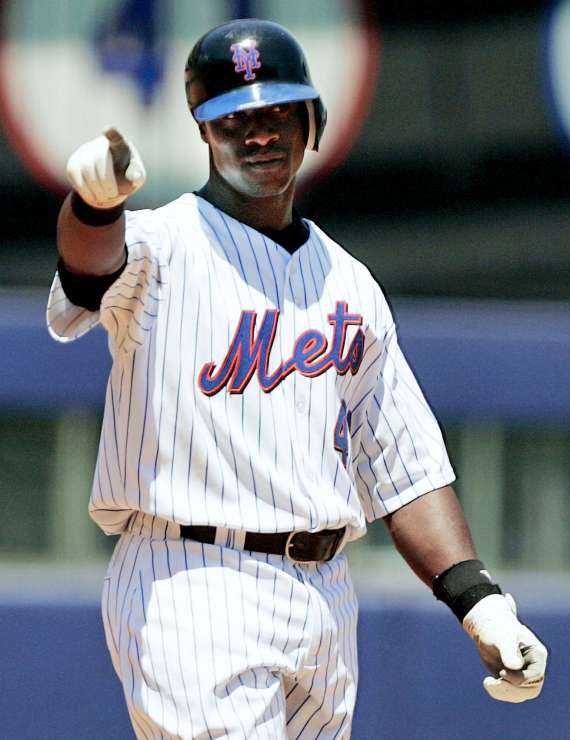
Photo by Otto Greule/Allsport

Rico Joseph Brogna grew up in Watertown, Connecticut, just a three-hour drive from Shea Stadium.  Brogna's talent on the diamond turned to gold in 1988 when he was selected by the Detroit Tigers in the first round of the June amateur draft.  But Brogna was a first baseman, and although he was named by Baseball America as one of baseball's top 100 minor league prospects in 1990, 1991 and 1992, the Tigers already had the über-powerful Cecil Fielder firmly entrenched at the position.  That made Brogna expendable.  On March 31, 1994, Brogna was traded to the Mets for fellow former first round draft pick Alan Zinter.  It didn't take long for Brogna to get his first extended stay in the majors.

In six years with the Tigers organization, Brogna collected only 26 at-bats at the major league level.  But after an impressive start at AAA-Norfolk in which Brogna was averaging an extra-base hit every eight at-bats, it was becoming increasingly difficult for the Mets to keep him in the minors.  Brogna finally got his first chance at regular action in the majors when first baseman David Segui was placed on the disabled list with a hamstring injury in late June 1994.  The Connecticut kid made sure to take full advantage of the opportunity.

After going for 0-for-5 in his first three games with the Mets, Brogna responded with three consecutive multi-hit games.  He also hit five home runs in a two-week stretch from June 28 to July 10, which was the final game before the All-Star Break.  The Midsummer Classic did nothing to slow the red-hot Brogna, as he went on the type of tear that hadn't been seen by Mets fans in several years.  From July 15 to August 2, Brogna batted .473 with nine extra-base hits in 17 games.  The Mets, who had just come off their first 100-loss season in over a quarter century in 1993, won 11 of those 17 affairs.

Brogna had two particularly memorable games during his summer sizzle.  On July 25, Brogna became the 11th Met to go 5-for-5 in a single game.  His three singles and two doubles helped the Mets defeat the Cardinals, 7-1.  The next night, Brogna was held to just two hits, but one of them was a two-run homer that broke an 11th-inning tie.  Brogna drove in a career-high four runs in the Mets' thrilling, 10-9 victory over St. Louis.

It wasn't just Cardinals pitchers who had a tough time with Brogna in 1994; it was the entire league.  In fact, the only thing that stopped Brogna in '94 was the players' strike that ended the season prematurely on August 11.  But what an incredible seven-week run it was for Brogna.  In 39 games, Brogna hit .351 with 11 doubles, two triples, seven homers and 20 RBI.  He also played stellar defense, making Mets fans quickly forget about David Segui.  Although the strike ended the team's run at the .500 mark (they were 55-58 at the time of the work stoppage), Mets fans were no longer feeling as negative about the team as they were during its 103-loss season in 1993.  And Rico Brogna was part of that new positive feeling at Shea Stadium.

Brogna went into the 1995 campaign as the team's starting first baseman.  He began his first full season in the majors as if the strike had never occurred, batting .410 with five doubles and three homers in his first 12 games.  But then the Mets went into a tailspin for two months going into the All-Star Break, losing 36 of 55 games from May 12 to July 9.  The main reason for the poor stretch was the pitching, as the Mets allowed five or more runs in 28 of the 55 games.  But it wasn't just the pitching.  In fact, the Mets' slump in the win column coincided with Brogna's first extended slump in the majors.

During the 55-game stretch prior to the All-Star Break, Brogna posted a .247/.294/.379 slash line, producing just seven doubles, six homers and 23 RBI while striking out 49 times.  After giving fans hope by approaching the .500 mark in 1994, the Mets were a pitiful 25-44 at the break in 1995.  But once again, the Mets came together as a team in the second half of the season, with Brogna serving as the catalyst for the team's resurgence.

From July 13 to September 20, Brogna batted .319 with 14 doubles, two triples and 13 homers.  He also scored 40 runs and drove in 39.  The Mets, who were a season-high 22 games under .500 in early August, went 34-18 in their last 52 games to finish the year with a 69-75 mark, which tied them with the Philadelphia Phillies for second place in the NL East.  Brogna finished his first full season in the majors as the team leader in doubles (27), home runs (22), runs scored (72) and RBI (76), becoming just the fifth player in franchise history to lead the team in all four categories.  The other four were Frank Thomas (1962), Tommy Davis (1967), Lee Mazzilli (1980) and Howard Johnson (1989, 1991).

After two seasons in which the Mets finished close to the break-even point, the team had reason to be optimistic going into the 1996 season.  The Mets added a leadoff hitter in Lance Johnson, a defensive wizard in shortstop Rey Ordoñez, and a productive left fielder in Bernard Gilkey.  They were also about to unleash former No. 1 overall draft pick Paul Wilson, the third member of the much-heralded "Generation K" trio of young starting pitchers.  It looked as if Rico Brogna was finally going to be part of a winning team in New York.  And then he wasn't.

Brogna was healthy throughout the 1995 season, playing in 134 of the Mets' 144 games.  But he was far more brittle in 1996.  After undergoing off-season arthroscopic surgery on his right knee, Brogna missed four games in early May, then sat out nine straight games a month later, both times because of right shoulder pain that required cortisone shots.  When he was able to play, Brogna continued to produce at the plate.  In 188 at-bats, Brogna collected 18 extra-base hits and drove in 30 runs.  He even hit a walk-off homer on May 11 to defeat the Chicago Cubs in a brawl-filled game at Shea.  But Brogna's aches and pains never subsided, and the team placed him on the disabled list on June 21.  Ten days later, Brogna underwent season-ending surgery to repair a torn labrum in his right shoulder.  He never played for the Mets again.

After completing their sixth consecutive losing season in 1996 (their third with Rico Brogna as the team's first baseman), the Mets decided to upgrade their bullpen.  The team felt that they were fine offensively and were also not ready to give up on Generation K even though Wilson and Jason Isringhausen combined to go 11-26 with an ERA over 5.00 in 1996.  (Bill Pulsipher did not pitch for the team in '96.)  So Jerry Dipoto (4.19 ERA), Paul Byrd (4.24 ERA) and Doug Henry (4.68) became ex-Mets, and Greg McMichael, Takashi Kashiwada, Toby Borland and Ricardo Jordan joined the team's relief corps in 1997.  The latter two hurlers were acquired by the Mets after the team completed a trade with the Philadelphia Phillies.  The cost?  Rico Brogna.  And no one was more surprised by the trade than the 26-year-old Brogna himself.


"I've come to learn that anything can happen in baseball, but I didn't figure I would be traded.  I came here when the Mets were rebuilding and I thought I'd be a mainstay with them.  It's a sad time, but I guess it's part of the game."


Borland and Jordan combined to pitch 35 games for the Mets in 1997.  Neither pitcher was with the team in 1998.  Meanwhile, Brogna became a star in Philly, averaging 21 HR and 92 RBI per season from 1997 to 1999.  Brogna recorded back-to-back 100-RBI campaigns in 1998 and 1999, becoming just the ninth Phillie to record consecutive seasons of 100 or more RBI in team history.  But as successful as he was on a personal level in Philadelphia, Brogna couldn't shake being "the best on the worst" in his new city.  The Phillies never won more than 77 games in any of Brogna's three full seasons with the team.  Meanwhile, Brogna's replacement in New York, John Olerud, helped the Mets record the first of five consecutive winning seasons in 1997.

Just as the injury bug helped end Brogna's career with the Mets in 1996, several maladies contributed to the end of his playing days in 2001 after playing one season with the Atlanta Braves.  Brogna was just 31 when he left the game as a player for good, retiring to become a high school football coach in his home state of Connecticut after an eight-year career in the big leagues.  After a 12-year absence, Brogna is now back in majors, working as a special assistant to Angels general manager Jerry Dipoto - the same Jerry Dipoto who was part of Mets general manager Joe McIlvaine's Great Bullpen Purging of 1996.

Rico Brogna played in his first game with the Mets on June 22, 1994.  Less than two years later, on June 19, 1996, he played in his final game with the team.  But in one full season and parts of two others, Brogna became a fan favorite on a Mets team that had very few players who were worth rooting for.

Although he only played in 228 games with the team, he still managed to hit .291 and posted a .495 slugging percentage.  Only four players in Mets history have batted .290 or higher, while posting a slugging percentage of .490 or greater in at least 200 games with the team.  Those players are Mike Piazza (.296 BA, .542 SLG), David Wright (.301 BA, .506 SLG), John Olerud (.315 BA, .501 SLG) and - like you need to ask - Rico Brogna.

Brogna never played for a winning team when he was on the Mets.  But he was still a beloved player.  He also never played for a winning team in Philadelphia, even though he had his best years in the majors as a member of the Phillies.  The fans in Philly, who don't love much of anything, cheered for Brogna.  That's a testament to how special a player Brogna was.  It wasn't his fault the teams he played for had so many flaws.

A sweet swing.  A solid glove.  A great player.  That was Rico Brogna in a nutshell.

Note:  The Best On The Worst is a thirteen-part weekly series spotlighting the greatest Mets players who just happened to play on some not-so-great Mets teams.  For previous installments, please click on the players' names below:

January 6, 2014: Todd Hundley 
January 13, 2014: Al Jackson
January 20, 2014: Lee Mazzilli
January 27, 2014: Steve Trachsel

Friday, December 7, 2012

The Real Reason Why The Mets Should Bring Back Scott Hairston


Earlier this week, I wrote a humor piece on the real reason why the Yankees want Scott Hairston.  Today, I felt like shifting gears.  The Yankees may secretly want Scott Hairston because they still long for Joe Torre, or someone who looks like him, but the Mets should make no secret about why they should re-sign Scott Hairston.  All they have to do is read their team history books for the reason why.

This site has reported in the past that Scott Hairston set a team record by finishing the season with at least 20 homers and 20 doubles in only 377 at-bats.  Only Mike Piazza had reached the 20/20 mark in both figures in fewer than 400 at-bats prior to Hairston.  (Piazza accomplished the feat in 1998 when he compiled 394 at-bats after his trade to the Mets.)

Hairston's record came on the heels of a 2011 season in which he collected 16 extra-base hits (eight doubles, one triple, seven home runs) in 132 at-bats.  With 48 extra-base hits in 2012 (25 doubles, three triples, 20 homers), Hairston now has accumulated 64 extra-base hits in only 509 at-bats as a Met, meaning he's collected an extra-base hit in 12.57% of his at-bats.

That got me thinking.  How many other Mets players over the years have gotten an extra-base hit in at least 10% of their at-bats?  Not many.  And who has the highest percentage?  I think you can figure that out by the title of this post.

 
Player
Extra-Base Hits
At-Bats
Percentage
Scott Hairston
64
509
12.57%
Mike Cameron
98
801
12.23%
Darryl Strawberry
469
3903
12.02%
Carlos Beltran
374
3133
11.94%
Mike Piazza
415
3478
11.93%
Carlos Delgado
207
1754
11.80%
David Wright
545
4742
11.49%
Bobby Bonilla
201
1779
11.30%
Rico Brogna
89
814
10.93%
Jose Valentin
60
550
10.91%
Ike Davis
127
1171
10.85%
Cliff Floyd
178
1643
10.83%
Bernard Gilkey
146
1353
10.79%
Howard Johnson
424
3968
10.69%
John Olerud
177
1662
10.65%
Ramon Castro
74
701
10.56%
Robin Ventura
159
1513
10.51%
Ty Wigginton
104
1001
10.39%


Only 18 players in team history (min. 500 at-bats) have collected an extra-base hit in at least 10% of their at-bats.  Some of the team's all-time greats are there (Darryl Strawberry, Carlos Beltran, Mike Piazza, Howard Johnson), as is one of the team's least popular players (Bobby Bonilla).  In addition, there are fan-favorites who had short careers in New York (Rico Brogna, John Olerud, Ty Wigginton), as well as current players (David Wright, Ike Davis).

All of those players were exceptional when it came to getting extra-base hits in a Mets uniform.  And all of those players have a lower percentage than the team's all-time leader in extra-base hit percentage, Scott Hairston.

When some of the team's greatest hitters such as Jose Reyes (402 XBH in 4,453 AB), Edgardo Alfonzo (346 XBH in 3,897 AB), Cleon Jones (308 XBH in 4,223 AB) and Keith Hernandez (249 XBH in 3,164 AB) fail to make this type of list, you can imagine how exclusive it is.

The numbers don't lie.  No player in Mets history with at least 500 at-bats has given the team a better chance at collecting an extra-base hit than Scott Hairston.

And yet despite this, the Mets are reluctant to offer Hairston anything more than a one-year deal, even though Kevin Burkhardt believes that all it would take to bring Hairston back is a two-year, $9 million deal.  That's not a lot of money or commitment to a 32-year-old who's clearly one of the team's best right-handed power threats, along with the recently signed David Wright (who, in case the team has already forgotten, required $129 million more than Hairston would to stay in New York).

Sandy Alderson recently said at the Winter Meetings that the team is in need of more power at the plate.  He doesn't have to look very far to find it.  His power source has been wearing No. 12 for the Mets each of the past two seasons, stroking extra-base hits at a rate that no Met has ever reached before him.