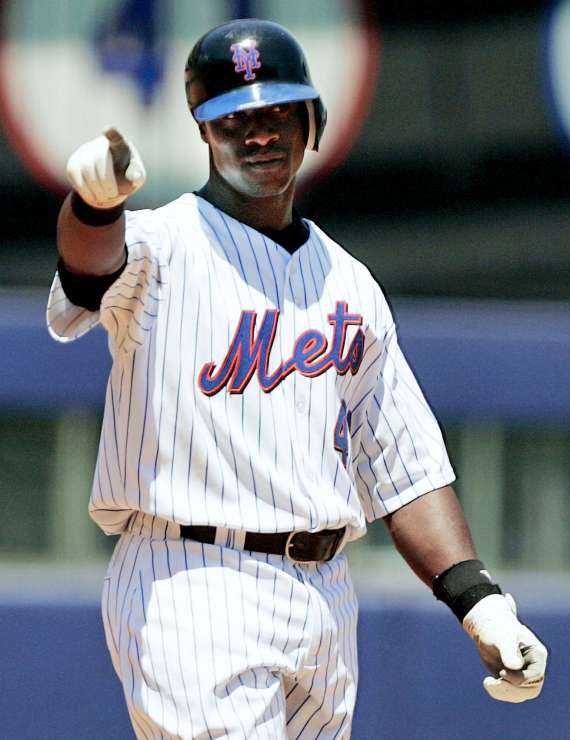
Showing posts with label Carlos Delgado. Show all posts

Wednesday, August 31, 2016

Yoenis Céspedes vs. Other Mets in Their First 162 Games

Yoenis Cespedes's 162-game start gets a big thumbs up!  (Ed Leyro/Studious Metsimus)

Yoenis Céspedes has meant everything to the Mets since he was acquired at the trade deadline last July.  But because of nagging injuries and a trip to the disabled list earlier this season, Céspedes didn't get to play in his 162nd career game with the team until Wednesday, as he has missed 28 games during the 2016 campaign after resting for only two games with the Mets in 2015, both of which came after the team had clinched the division title.

Céspedes's numbers with the team in those 162 games are astounding, as he has produced 34 doubles, 44 homers, 112 RBI and has compiled a .583 slugging percentage and .941 OPS in a full season's worth of games.  Those five categories are traditionally recognized as categories in which sluggers generally excel, and Céspedes ranks favorably with the team's all-time greats in all five.

In doing research for hot starts by Mets players to see where Céspedes ranked, I found some interesting names that I did not expect to find among those franchise legends.  For every time Mike Piazza was in the top ten - he's the only player to be ranked in the top five in all five categories within his first 162 games with the team - there were a handful of "did they really have that type of start?" players.

Here are five lists, one each for doubles, home runs, runs batted in, slugging percentage and on-base plus slugging percentage, that show just how good Céspedes has been in his first 162 games with the Mets and how fortunate some other players were in their first full season's worth of contests with the club.


Doubles:

Bernard Gilkey
Mike Piazza - 46
Bernard Gilkey - 45
Paul Lo Duca - 44
David Wright - 41
Mike Cameron - 40
Rusty Staub - 39
Eddie Murray - 38
Robin Ventura - 38
Todd Zeile - 38
Ike Davis - 37


Home Runs:

Kevin McReynolds
Dave Kingman - 48
Yoenis Céspedes - 44
Carlos Delgado - 39
Mike Piazza - 38
Mike Cameron - 35
Gary Carter - 34
Frank Thomas - 34
Robin Ventura - 32
Cliff Floyd - 31
Bernard Gilkey - 31
Kevin McReynolds - 31
Darryl Strawberry - 31


Runs Batted In:

John Olerud
Carlos Delgado - 126
Bernard Gilkey - 124
Robin Ventura - 120
Mike Piazza - 119
Dave Kingman - 118
Gary Carter - 116
Yoenis Céspedes - 112
Donn Clendenon - 108
John Olerud - 107
Kevin McReynolds - 102


Slugging Percentage:

Mike Cameron
Mike Piazza - .604
Yoenis Céspedes - .583
Bernard Gilkey - .544
Rico Brogna - .529
Robin Ventura - .525
Cliff Floyd - .523
Carlos Delgado - .518
Donn Clendenon - .512
Dave Kingman - .511
Mike Cameron - .510


On-Base Plus Slugging Percentage:

Rico Brogna
Mike Piazza - 1.005
Yoenis Céspedes - .941
Bernard Gilkey - .930
Robin Ventura - .902
Cliff Floyd - .890
John Olerud - .889
Rico Brogna - .880
Carlos Delgado - .870
Benny Agbayani - .867
David Wright - .865


As you can see, there are several players whose names you would expect to see in multiple categories.  Power hitters such as Céspedes, Piazza, Carlos Delgado, Dave Kingman and others can be found in at least three of the five top-ten lists.  But did you really expect to see a guy like Rico Brogna appear on as many lists as David Wright?  What about Cliff Floyd and Mike Cameron showing up three times?  Or most surprisingly, what do you think of Bernard Gilkey and Robin Ventura joining Piazza as the only three players to rank in the top ten in all five categories?

Those unexpected players (Brogna, Floyd, Cameron, Gilkey, Ventura) all had sensational starts to their careers in Flushing, but they also suffered injuries (Brogna, Floyd and Cameron come to mind) or faded quickly (Gilkey and Ventura were both one-season wonders).

Meanwhile, a number of all-time team greats were absent from a number of these top-tens.  The late, great Gary Carter made it to the Hall of Fame and began a miraculous World Series rally that fueled the Mets to a championship.  But his excellent .490 slugging percentage and .861 OPS in his first 162 games with the team were both not high enough to appear on either category's respective top-ten list.  Darryl Strawberry may have won the National League Rookie of the Year award in 1983, but his only appearance on any of the above lists is a ninth-place tie in the homer department.  And Carlos Beltran may be the greatest free agent signing in Mets history, but a poor start to his career in New York kept him off every list.

It remains to be seen whether Céspedes will go down the road traveled by the great sluggers in Mets history or if the nagging injuries continue to increase and he will just be remembered for the incredible 162-game start to his Mets career, which included helping the team reach the 2015 World Series.

For now, Céspedes is one of only three Mets to have at least 30 doubles, 35 homers and 100 RBI in his first 162 games with the team, joining Carlos Delgado and Hall of Famer Mike Piazza.  Whether or not Céspedes joins Piazza in Cooperstown or even in the Mets Hall of Fame won't be known for years, but one thing's for certain.

Yoenis Céspedes has been gotten off to one of the best starts of any hitter in franchise history.  And there's nothing fluky about that.


Friday, May 17, 2013

Flashback: May 17, 2007 - Rally At The Old Shea Corral

Photo by Lucas Jackson/Reuters

Six years ago today, the Mets were playing the finale of a three-game series against the Chicago Cubs at Shea Stadium.  Because the Mets were about to play their crosstown rivals in the Subway Series the following night, manager Willie Randolph decided to keep most of his regular players on the bench for the Thursday matinee to keep them fresh for their weekend tilt against the Yankees.

Out were Jose Reyes, David Wright and Carlos Beltran.  In were Ruben Gotay, Julio Franco and Endy Chavez.

By the sixth inning, the Cubs had a four-run lead on the Mets behind starting pitcher Juan Guzman.  When the Mets came up to bat in the bottom of the ninth, they were trailing 5-1 and closer Ryan Dempster was summoned by manager Lou Piniella in a non-save situation to record the final three outs.  Dempster never even recorded out No. 2.

Randolph was content to let his big boppers stay on the bench in the ninth, but his replacement corps made him reconsider his original plan by reaching base against Dempster.  First, David Newhan lined a single to center.  Then Carlos Gomez stroked a one-out single of his own.  A walk to pinch-hitter Carlos Beltran loaded the bases for Endy Chavez, who also took ball four.  That made the score 5-2.  With Dempster needing to throw strikes, Ruben Gotay lined an 0-2 pitch to left for an RBI single.  Now the tying run was in scoring position and the winning run was on first.  That was all for the Cubs' closer, as Lou Piniella removed a livid Dempster for the left-handed Scott Eyre.

With the bases loaded and the Mets now trailing 5-3, David Wright came off the bench to pinch-hit for the lefty-swinging Shawn Green.  Prior to the at-bat, Wright had never appeared as a pinch-hitter in 1,776 career plate appearances.  It took one pitch for Wright to have a 1.000 career batting average as a pinch-hitter.  Wright’s RBI single off Eyre closed the deficit to 5-4 and kept the bases loaded for Carlos Delgado - one of the few everyday players who played all nine innings.

After a 2006 season in which Delgado produced 38 HR and 114 RBI, the first baseman underachieved during the first month and a half of 2007.  Entering the day, Delgado was batting .217 with three homers and 19 RBI in 36 games.  But he had always done well against Scott Eyre, collecting three hits and four walks against the southpaw in 11 career plate appearances for a gaudy .636 on-base percentage.  After taking a first-pitch ball from Eyre, Delgado grounded a hard smash that found a hole between first and second, scoring Chavez from third base with the tying run and Gotay from second with the winning run.

Photo by Kathy Willens/Associated Press

Incredibly, the Mets scored five runs in the ninth inning, snatching an improbable 6-5 victory from Lou Piniella and the Cubs.  The win allowed the Mets to go into the Subway Series on a high note, while the Cubs went back to Chicago wondering what went wrong.

This year, neither New York nor Chicago are doing particularly well.  With the Astros now playing in the American League, the Cubs have spent most of the season in Houston’s customary spot - the basement of the National League Central - while the Mets are playing like a team determined to finish in fourth place for the fifth consecutive season.

Today, on the six-year anniversary of their thrilling come-from-behind win against Chicago, the Mets are opening up a three-game series with the Cubs at Wrigley Field.  Only David Wright remains from the team that rallied from a four-run ninth inning deficit on May 17, 2007.  But just because most of the names have changed doesn’t mean the Mets aren’t capable of giving their fans a reason to believe.

Anything can happen on the field on any given day.  Six years ago today, something special did happen on the field at Shea Stadium.  Through sheer willpower and their unwavering desire to win, the Mets pulled off an unlikely victory over the eventual Central division champion Cubs.  It just goes to show that even when all appears lost, there is always a glimmer of hope that the day can end with a happy recap.

Thursday, September 6, 2012

Ike Davis Continues To Rack Up Extra-Base Hits


On Wednesday, R.A. Dickey cruised to his 18th victory of the season, defeating the Cardinals, 6-2.  Dickey wasn't cruising the entire time, taking a precarious 2-1 lead into the middle innings.  But with one swing of Ike Davis' bat, a one-run lead turned into a four-run cushion, which was more than enough for Dickey and the bullpen.

Davis' three-run blast was his 26th homer of the year.  He also has 22 doubles to give him 48 extra-base hits on the season.  The stunning thing about Davis' extra-base hit total is that he still has not reached 100 total hits on the season.

An incredible 48.5% of Davis' 99 hits have gone for extra bases this season, which is one of the main reasons why he has 77 RBI despite his low .224 batting average.  At his current pace, Davis would finish the year with 57 extra-base hits, which would make him the 25th Met with that many extra-base hits in a single season.  However, very few of those players have had as high an extra-base hit percentage as Davis.  Here are the ten highest extra-base hit percentages in Mets history (min. 57 XBH).

  1. Carlos Beltran (2006): 140 hits, 80 XBH (57.1%)
  2. Mike Cameron (2004): 114 hits, 61 XBH (53.5%)
  3. Todd Hundley (1996): 140 hits, 74 XBH (52.9%)
  4. Howard Johnson (1991): 146 hits, 76 XBH (52.1%)
  5. Dave Kingman (1975): 116 hits, 59 XBH (50.9%) 
  6. Carlos Delgado (2006): 139 hits, 70 XBH (50.4%)
  7. Darryl Strawberry (1987): 151 hits, 76 XBH (50.3%)
  8. Howard Johnson (1989): 164 hits, 80 XBH (48.8%)
  9. Darryl Strawberry (1986): 123 hits, 59 XBH (48.0%)
  10. Darryl Strawberry (1988): 146 hits, 69 XBH (47.3%)

Note: In 1989, Darryl Strawberry collected 107 hits, of which 56 went for extra bases.  A total of 52.3% of his hits were of the extra-base variety.  Also, Mike Piazza's best extra-base hit percentage was 43.3%, which he accomplished in 2002 (134 hits, 58 XBH).


Should Ike Davis continue his extra-base hit pace, he would enter the top ten with his 48.5% XBH rate, just three-tenths of one percent behind Howard Johnson for eighth place.  But Davis also has a chance to post only the eighth season in franchise history in which at least half of a player's hits went for extra bases (min. 57 XBH), especially considering what he has done at the plate over the past three months.

Since June 6, Davis has collected 71 base hits.  But only 33 of them have been singles.  A total of 53.6% of all his hits since June 6 have gone for extra bases (17 doubles, 21 HR).

Yes, Ike Davis is still sporting a Kingman-esque batting average.  But like the Sky King, Davis is making the most of his safeties, cranking out extra-base hit after extra-base hit.  If he can keep this up, he's going to join some exclusive company at the end of the season.  No wonder Mets fans like Ike.

Saturday, January 28, 2012

The Perfect Way For The Mets To Stick It To The Marlins


As all Mets fans know, the Marlins have been a thorn in the team's side since 2007.  First, Tom Glavine was able to retire only one more batter than I did in the 2007 regular season finale, completing the Mets' collapse.  One year later, the Marlins wouldn't get off the field after they once again eliminated the Mets (and Shea Stadium) in Game No. 162.  Three years after that, they stuck it to the Mets again, this time by signing Jose Reyes to a six-year deal worth $106 million, or about $106 million more than Fred Wilpon has stored away in his souvenir Sandy Koufax piggy bank.

In fact, if you really want to get technical about it, the Marlins have been one-upping the Mets since 1997, when they replaced the Mets as the fastest expansion team to win a World Series.  (The Marlins have since been knocked off that perch by the fourth-year Arizona Diamondbacks in 2001.)

But other than the Mets celebrating their 2006 NL East title in front of their home fans while the Marlins watched in the road dugout, they haven't really done anything that would be considered negative to the Marlins.  Are they upset that the Mets took Mike Piazza and Carlos Delgado from them?  Did Fred Wilpon insult Marlins' owner Jeffrey Loria's mother because he found out Loria grew up as a Yankee fan during the era in which the Brooklyn Dodgers kept losing to them in the World Series?

The time has come for the Mets to stand up to the Marlins once and for all.  And I know just how they can do it.

Earlier today, it was reported that Bud Selig expects two extra wild-card teams to be in place for this season, rather than the 2013 campaign.  Therefore, with five teams now qualifying for the playoffs in the National League instead of the usual four, the Marlins have reasonable expectations that they will be one of those five teams.

More than likely, the Phillies will win the NL East for the sixth consecutive season.  But the Atlanta Braves are coming off an epic late-season collapse.  The St. Louis Cardinals and Milwaukee Brewers both lost their top power hitters (Albert Pujols, Prince Fielder) to free agency.  With all those windows being opened in the National League, the Miami Marlins are poised to break through and crash the playoff party for the first time since Art Howe was supposedly managing the Mets.

Like many other teams competing for the wild card spots, the Marlins might not play a potential clinching game until the final series of the season.  And who, pray tell, will the Marlins be playing on October 1, 2 and 3 in front of their dozens of fans at their brand spanking-new ballpark?

The New York Mets.

Wouldn't it be something if the Marlins needed to win their final series of the season and the newly-signed (and former Met) Heath Bell blew a save or two to the Mets?  Or how about if Jose Reyes, representing the tying run in the bottom of the ninth was caught stealing to end a game?  What if the Marlins' new ace, Mark Buehrle, only lasted a third of an inning in the regular season finale, as the Mets battered him for run after run in the opening frame?  Would that be devastating to them?

It's been too long since the Marlins have been a thorn in the Mets' side.  Ever since Steve Trachsel's arm and Jose Valentin's bat took them down in the 2006 division clincher, the artists formerly known as the Florida Marlins have been giving the Mets and their fans recurring nightmares.

Hey, we all know the Marlins are just one poor finish away from conducting their once-a-decade fire sale.  Why not speed up the inevitable and give them a chance to do it this year?  The Marlins have been sticking it to the Mets every chance they've gotten since 2007.  It's time for the Mets to stick it right back to them in 2012.  Ya gotta believe.

Monday, November 7, 2011

David Wright Hasn't Been The Same Since Matt Cain

Ever since Shea Stadium closed its doors for the final time in 2008, David Wright has not been the same player.  At least that's what I hear from many Mets fans.  Although I do think the move from Shea Stadium to Citi Field has hurt Wright's power stroke, I don't think the ballpark is to blame for his overall decline at the plate from All-Star hitter to strikeout-prone former slugger.

As a matter of fact, I believe I can pinpoint the exact moment David Wright went from a hitter that was always among the league leaders in batting average to the current player that's become so divisive among Mets fans.  It all began on August 15, 2009, when Wright wore a blue and orange target for Matt Cain's head-seeking missile.

This is where the poop started hitting the fan for David Wright.

The 2009 season was difficult for fans and players alike.  The Mets were coming off four consecutive winning seasons, although they had fallen one win short of the playoffs in each of the previous two campaigns.  Still, one couldn't hope but think that the 2009 season would be different, especially with the Mets moving into a new ballpark.  Then the season began and the DL Hotel opened for business.

Within a short period of time, Jose Reyes, Carlos Delgado and Carlos Beltran all went on the disabled list.  Reyes didn't play again in 2009.  Delgado didn't play again...ever.  Beltran came back late in the season, but was a shell of his former self.  While Reyes, Delgado and Beltran were on the sidelines, David Wright was forced to become the main offensive threat in the lineup.

Wright was not hitting home runs in 2009 the way he had in the past, but then again, no Met was.  However, Wright was getting on base.  A lot.  And it didn't stop when his teammates started dropping like flies.

 
Ouch.                    Ouch.                    Ouch.

Carlos Delgado played his last game as a Met on May 10, 2009.  At the time, his hip injury was not deemed to be serious, and he was listed as day-to-day.  Jose Reyes played his final game of the season ten days later after he aggravated a calf injury.  Carlos Beltran was forced out of the lineup with a knee injury after playing on June 21, 2009.  He spent the next two and a half months on the disabled list.

David Wright was hitting fifth in the lineup prior to Delgado's injury.  The first baseman's trip to the disabled list forced Wright to move into the cleanup spot for a number of games (sharing the spot with Gary Sheffield), where he thrived.

Before May 10, Wright was hitting .304 and had an on-base percentage of .391, both excellent numbers and on par with his career averages (.309/.389 through the 2008 season).  But with one less offensive weapon in the lineup (two if you count Reyes, who was disabled shortly after Delgado), Wright reached base at a frenetic pace.  In the 36 games between the injuries to Delgado and Beltran, Wright batted .387 and reached base at a robust .472 clip.  In the 49 games following Beltran's last game, Wright's batting average slipped to .287, but his .384 on-base percentage was still quite respectable.

That brings us to August 15, 2009.  In the fourth inning of a nationally televised game, David Wright was felled by a 93 MPH fastball delivered by the Giants' Matt Cain.  As a result, Wright suffered a concussion and was placed on the disabled list for the first time in his career.  When he returned to the lineup on September 1, Wright was a completely different player.

I spy with my little eye ... nothing ... probably because I have a concussion.

From September 1 to season's end, Wright played in 29 games, batting .239 with a .289 on-base percentage.  More importantly, he struck out a whopping 35 times while drawing only nine walks.  Prior to his concussion, Wright had played in 115 games, striking out 105 times and taking 65 bases on balls.

Let's look at Wright's strikeout totals from year to year prior to his close encounter with Matt Cain's heater, beginning with his first full season in 2005 and including his 2009 season totals up to August 15.  In addition, let's also consider his batting average and on-base percentage:

  • 2005: 160 games played, .306/.388, 113 strikeouts
  • 2006: 154 games played, .311/.381, 113 strikeouts
  • 2007: 160 games played, .325/.416, 115 strikeouts
  • 2008: 160 games played, .302/.390, 118 strikeouts
  • 2009: 115 games played, .324/.414, 105 strikeouts

Even though his power was dampened by Citi Field in 2009, Wright's other numbers were very consistent and in line with his career averages.  He also averaged fewer than one strikeout per game in every season prior to August 15, 2009.

Now let's look at what Wright has done since returning from the disabled list on September 1, 2009.  The numbers aren't pretty:

  • 2009: 29 games played, .239/.289, 35 strikeouts
  • 2010: 157 games played, .283/.354, 161 strikeouts
  • 2011: 102 games played, .254/.345, 97 strikeouts

Before his concussion, Wright played in a total of 818 games (he appeared in 69 games for the Mets in 2004) and had a .311/.392 cumulative split in batting average and on-base percentage.  He also struck out a total of 604 times over those 818 games.  Post-concussion, Wright's numbers have taken a hit across the board.  The third baseman has batted .268 since September 1, 2009, while reaching base at a .344 clip.  He has also averaged over a strikeout per game, fanning a total of 293 times in 288 games.

Looks like Matt Cain's head-seeking missile has caused David Wright to fear approaching baseballs.  (Notice how he's running away in fear of the baseball to the right of his right foot.)

The Mets are moving in the fences at Citi Field in the hopes that players like Jason Bay and David Wright can hit for more power.  But the power isn't the only thing that's been missing from David Wright's game.

Since August 15, 2009, everything has changed for David Wright at the plate.  Even without the homers (although he did recover to hit 29 HR in 2010), Wright has been getting fewer hits, while striking out more and drawing fewer walks, giving the team no indication that he's figured out how to become the player he once was.

Regardless of what many people might believe, the dimensions at Citi Field haven't had as much of an impact on David Wright's game as has been publicized.  His batting average and on-base percentage was very consistent with his career averages over the first four months of the 2009 season, even without Jose Reyes, Carlos Beltran and Carlos Delgado in the lineup and with Wright playing half of his games at cavernous Citi Field. 

Citi Field isn't the problem.  It's what happened at Citi Field on the afternoon of August 15, 2009.

Concussions are no joke.  A person with a traumatic brain injury (i.e. a concussion) can suffer long-term effects to his health.  This can include difficulty in concentration and a slower reaction to stimuli.  Usually, once a pitch leaves the pitcher's hand, a hitter only has about four-tenths of a second to judge what type of pitch he's seeing, where that pitch is going and whether or not he's going to swing at it.  That's not much time to make an educated decision and it's certainly not much time for a person who's suffered from a concussion.

Although David Wright might be loath to admit it, his career has taken a downward turn since he was introduced to Matt Cain's fastball in 2009.  It's amazing what a concussion can do to a promising player's career.

Wednesday, April 13, 2011

Carlos Delgado Retires; Is He A Hall of Famer?

Former Mets first baseman Carlos Delgado announced his retirement from baseball yesterday after a 17-year career that saw him become one of the most consistent power hitters in baseball.

From his major league debut as a catcher for the Toronto Blue Jays in 1993 to his final game as a Met in 2009, Delgado gave pitchers headaches by hurting them when he swung the bat (473 career HR) and when he didn't (1,109 career walks).

But is Carlos Delgado a Hall of Famer? Let's look at a few of his career numbers and decide for ourselves.

Delgado finished his career with 473 HR and 483 doubles, falling just short of the 500 mark in both categories. Only ten players in major league history have reached that number in both categories: Barry Bonds, Hank Aaron, Babe Ruth, Willie Mays, Ken Griffey Jr., Frank Robinson, Rafael Palmeiro, Manny Ramirez, Ted Williams and Eddie Murray. Of those ten, six are in the Hall of Fame. The other four are either not yet eligible (Bonds, Griffey) or admitted steroid users (Palmeiro, Ramirez). As of now, Delgado has never been attached to steroids, so one has to believe his power numbers were all attained legitimately.

Only six men in major league history hit 30 or more home runs in ten consecutive seasons. Alex Rodriguez (1998-2010), Barry Bonds (1992-2004), Jimmie Foxx (1929-1940), Sammy Sosa (1995-2004) and Albert Pujols (2001-2010) have all accomplished this rare feat. The other player to do it was Carlos Delgado, who hit 30 or more blasts every season from 1997 to 2006.

For 13 consecutive seasons, Delgado drove in at least 87 runs, including nine years of 100+ RBI and seven campaigns where he drove in no fewer than 114 runs. In two seasons that he failed to drive in 100 runs, he missed significant time with an assortment of injuries. Delgado picked up 99 RBI in 2004, despite not playing in 34 games. Then in 2007, as a member of the Mets, Delgado finished the year with 87 RBI. Although 2007 was viewed as an off-year for the slugger, he also missed 23 games, which denied him the opportunity to approach triple digits in RBI.

While on the topic of runs batted in, Carlos Delgado finished his career with 1,512 RBI, making him one of 51 players to surpass the 1,500 plateau. Thirty-six of those players have already received their golden ticket to Cooperstown, while the majority of the others are either still active or not yet eligible for the Hall of Fame.

Despite his gaudy power numbers, Delgado never won an MVP Award, although that could be attributed to the fact that he never played for a playoff team until he played for the Mets in 2006. He also only made two All-Star teams and won three Silver Slugger Awards, both numbers that are very low for potential Hall of Famers.

So does Delgado get elected to Cooperstown when he becomes eligible in 2015?

Rafael Palmeiro, whose power numbers exceed Delgado's, received support from only 11% of the voters in the most recent Hall of Fame election. However, he was found to have used steroids during the latter part of his career, which kept his vote total low. Jeff Bagwell was never directly linked to steroids, but only received 41% of the vote in January, despite averaging over 100 RBI and 100 runs scored per season throughout his entire career (1,529 RBI and 1,517 runs scored in 15 seasons). Both Palmeiro and Bagwell were contemporaries of Delgado. That could work against him in 2015.

Another thing that could work against him is the controversy he generated when he chose not to stand for the singing of "God Bless America" due to his personal convictions against the United States' involvement in Iraq. Although Delgado is entitled to his opinions, his silent protest came at a time when Americans were peaking with patriotism, and his stance was viewed by some as being unpatriotic and anti-American, although he has vehemently denied this on multiple occasions.

Despite the potential roadblocks, it cannot be denied that Delgado was highly successful as a major league baseball player. His power numbers are among the best of his era, if not all-time. But until players like Jeff Bagwell, Sammy Sosa and Mike Piazza get into the Hall of Fame (the latter two will become eligible in 2013), it will be difficult for Delgado to get in.

For a power hitter to reach the Hall of Fame in this era, he'll have to bring more to the table, whether it be speed, Gold Glove-caliber defense, or regular trips to the postseason. Carlos Delgado stole 14 bases in his career, never won a Gold Glove Award and only reached the playoffs once (he was not on the postseason roster when the Blue Jays won the World Series in 1993). Maybe someday Delgado will make the Hall of Fame, but don't expect it to be in 2015.

Monday, January 3, 2011

M.U.M.'s The Word (Most Underrated Mets): John Olerud

Greetings, Earthlings! Welcome to the first installment of M.U.M.'s The Word, a feature that will focus on the most underrated Mets players over the years. In this inaugural episode, we will turn the spotlight on a man who was only a Met for three seasons, but was instrumental in the team's return to respectability in the late '90s. Ladies and Gentle-Mets, today's Most Underrated Met is John Olerud.

Underrated first baseman John Olerud

In 1996, the Mets had a triumvirate of stars in centerfielder Lance Johnson (.333 batting average, 50 stolen bases and a franchise record 227 hits and 21 triples), leftfielder Bernard Gilkey (.317, 30 HR, 117 RBI, 108 runs scored and a franchise record 44 doubles) and catcher Todd Hundley (41 HR, which at the time set the major league record for home runs by a catcher as well as the Mets single season home run record). Despite the trio's phenomenal success at the plate, the Mets struggled in the win column, finishing fourth in the NL East with a 71-91 record, leading to the dismissal of Dallas Green as Mets manager in August and the beginning of the Bobby Valentine era.

The Mets began the 1996 season with fan-favorite Rico Brogna at first base, but injuries limited him to 55 games. Butch Huskey took over for Brogna on an interim basis and performed well (.278, 15 HR, 60 RBI), but Huskey was a third baseman/outfielder. Entering the 1997 season, the Mets wanted a dependable sure-handed first baseman who was not susceptible to injuries like Rico Brogna. Enter John Olerud.

On November 27, 1996, the Mets traded Rico Brogna to the Philadelphia Phillies. They were now on the lookout for his permanent replacement. When the Toronto Blue Jays dangled John Olerud in front of the Mets and all they asked for in return was Robert Person, a starting pitcher who won a total of five games for the Mets in 1995 and 1996, the Mets jumped at the opportunity.

Olerud had won two World Series rings as a member of the Blue Jays in 1992 and 1993. His 1993 season saw him flirt with a .400 batting average for most of the season, before a late-season slump caused him to "settle" for a .363 mark, which was still good enough to win the American League batting title.

His next three seasons were a bit of a disappointment, as Olerud could not regain the batting stroke that made him one of the top hitters in the American League during his magical '93 season.

In 1993, Olerud led the league with 54 doubles and also set career highs with 24 HR and 107 RBI. However, from 1994-1996, despite having a respectable .287 average, Olerud's extra-base hit and RBI figures dropped dramatically. He averaged 29 doubles, 13 HR and 61 RBI per season over the three-year span, numbers which were not only well below his breakout 1993 figures, but were also far below the numbers expected from a corner infielder.

At the same time, Carlos Delgado was starting to break out in Toronto. Delgado had just come off his first full season as a Blue Jay in 1996. His 25 HR, 92 RBI season dwarfed Olerud's pedestrian numbers, making John expendable.

Once the Mets showed interest and offered Robert Person to the Blue Jays, the former AL batting champion switched leagues hoping the change in scenery would revitalize his career. Not only did the deal bring Olerud's production back from the dead, it did the same for the Mets in the NL East standings.

The 1997 Mets were not expected to do much in the NL East. Finishing at .500 would have sufficed for a team that had suffered through six consecutive seasons with a losing record. But then things started clicking in Bobby Valentine's first full season at the helm with John Olerud at the center of the Mets' rebirth.

After three consecutive subpar seasons in Toronto, Olerud found his batting stroke in Flushing. He produced the second 100+ RBI season of his career by driving in 102 runs. Also, his 34 doubles and 22 homers were the most he had produced since, you guessed it, 1993. In addition, his keen batting eye led to a .400 on-base percentage. Combine that with steady defense at first base, and you can see how his presence in the lineup and on the field led to the Mets' resurgence in the standings. The Mets finished the 1997 season with an 88-74 record, remaining in contention for the wild card until the last week of the season before eventually falling short by four games to the Florida Marlins, who went on to win the World Series.

Now that the Mets had established themselves as contenders in the National League, it was up to Olerud to continue his renaissance into 1998. What happened in his second season as a Met was far more than anyone could have expected.

In 1998, the Mets acquired Mike Piazza in a trade with the Florida Marlins (who had traded for the All-Star catcher a week earlier). The acquisition of one of the game's premier sluggers to serve as protection for John Olerud in the lineup elevated the first baseman's game to another level.

Prior to Piazza's first game as a Met on May 23, 1998, the Mets had played 44 games. In those 44 games, Olerud was hitting a lofty .345, but had only banged out 12 extra-base hits (seven doubles, five home runs), scored 19 runs and picked up 23 RBI. Those were all good numbers, but once Piazza was inserted behind Olerud in the batting order, John's numbers became otherworldly.

In his first seven games after the trade for Piazza, Olerud hit .500 and reached base in 18 of his 32 plate appearances (.563 OBP). He scored eight runs, drove in six and roped five doubles. The Olerud from 1993 was back and the Mets were more than happy to see him.

With Mike Piazza firmly entrenched in the middle of the Mets lineup, the hits just kept on coming for Olerud. John nearly registered the first 200 hit, 100 walk season in Mets history, falling just short with 197 hits and 96 walks. Still, the 197 hits were the second most hits in franchise history and the 96 walks were one short of the team record held by Keith Hernandez and Darryl Strawberry. At the end of the season, Olerud had racked up 36 doubles, 22 HR and 93 RBI. Of course, those numbers were nothing compared to these two numbers: .354 and .447.

The first number represented Olerud's batting average, which became (and still is) the Mets' all-time single season record. Olerud would have led the league in hitting if not for Larry Walker's .363 average for the Colorado Rockies. The second number was Olerud's on-base percentage for the year, also a still-standing Mets record and second in the league to Mark McGwire's .470 OBP. Of course, McGwire drew a ton of walks in 1998 to pad that on-base percentage. Seventy steroid-assisted home runs will tend to do that to a person's OBP.

Unfortunately, the 1998 season ended in disappointment for the Mets, as they lost a one-game lead in the wild card race by dropping their final five games of the season. Of course, Olerud was one of the few bright spots on the Mets during this season-ending slump, reaching base in 12 of his 22 plate appearances over those five games.

The Mets had something to prove in 1999. With the help of John Olerud, the Mets returned to contention in 1997. They failed to improve in 1998, falling short of the postseason on the final day of the regular season, despite a record-setting season by Olerud. The Mets' first baseman had already been quite successful in his first two years on the team. From an individual standpoint, Olerud had nothing left to prove. All that was left was for him to lead the team into the postseason.

The names might have been missing from the backs of the Mets' jerseys in 1999, but the mojo was risin' at Shea Stadium that year. Robin Ventura was added to the team and Edgardo Alfonzo was coming into his own. Both players had career years in 1999. Mike Piazza was his usual self, but this time he had a full season (and a new seven year, $91 million contract) in which to be that usual self. New acquisitions Rickey Henderson (signed as a free agent) and Roger Cedeño (acquired in the Todd Hundley trade) gave the Mets a speed combo at the top of the order they hadn't had since the days of Mookie, Lenny and Wally.

With the addition of these players, it was easy to overlook John Olerud. Then again, he never wanted the spotlight to be on him. Olerud just wanted to come in, do his job and help the Mets win as many games as he could. He saved his most clutch performances for his final season in New York.

On September 29, 1999, with the Mets in the midst of a seven-game losing streak that dropped them out of the wild card lead, John Olerud put on his cape and became Captain Clutch. The Mets were facing the NL East Champion Braves at Shea Stadium and their nemesis, Greg Maddux.

Is Greg Maddux about to throw a pitch or is he looking over his shoulder as he's running away from John Olerud?

The all-time leader in victories against the Mets (Maddux retired with a 35-19 record against New York in his career), Greg Maddux took the mound on that fateful night with the Mets trying desperately to stay alive in the wild card race. The Mets had already fallen behind 2-1 as they entered the fourth inning. But in that fourth inning, the Mets scored two runs on six hits to take a 3-2 lead on their arch-rivals. They had the bases loaded, nobody out and their first baseman coming up to bat. Captain Clutch had entered the building and no one, not even the nefarious Mr. Maddux, could stand a chance. With one swing of the bat, the Mets had an unscheduled Fireworks Night, capped by a John Olerud cherry bomb. The grand slam by Olerud gave the Mets a 7-2 lead, knocked Maddux out of the game under a sea of sarcastic tomahawk chops, and propelled the Mets back onto the wild card track.

The Mets started to win again after the Olerud grand slam, but they still needed to pull out a win against the Pittsburgh Pirates on the last day of the regular season to guarantee that Game No. 162 would not be the last game of the season for the Mets as it had been during the final week collapse of the previous year.

As he did in the previous two seasons, John Olerud always found a way to get on base. He delivered his share of hits but also knew how to draw a walk. In 1999, he became the first (and to this date, the only) Met in franchise history to draw 100 walks. He shattered the previous record of 97 by drawing 125 bases on balls. His biggest walk came in the bottom of the ninth inning in Game No. 162.

After Melvin Mora and Edgardo Alfonzo delivered one-out singles, the stage was set for Olerud to deliver the game-winning hit. Unfortunately, the Pirates had other ideas. They walked the slow-footed Olerud intentionally to load up the bases for Mike Piazza. Despite the fact that a ground ball by Olerud would have surely led to an inning-ending double play, the Pirates decided they had a better chance to get Mike Piazza to do the same. This was not the end-of-his-career, let's-move-him-to-first-base Mike Piazza. This was the in-his-prime Mike Piazza, who was finishing up a season in which he hit .303, with 40 HR and 124 RBI. John Olerud was intentionally walked to get to an offensive behemoth. As Aretha Franklin would say, that's what I call R-E-S-P-E-C-T!

You know what happened after that. Brad Clontz was called in to face Piazza, threw one pitch, gave a souvenir to a fan sitting in the loge level and Mora joyously scampered home with the winning run to set up the winner-take-all Game No. 163 against the Cincinnati Reds the following night, which the Mets won to earn them their first trip to the playoffs since 1988.

Upon reaching the big stage of the playoffs for the first time as a Met, Olerud continued to be a marquee player under the bright lights. The Mets played a total of ten games in the NLDS and the NLCS that year. Over those ten games, Olerud was an absolute beast. He hit .349 (15-for-43) over those ten games and reached base an astounding 20 times (15 hits, five walks).

Most people remember Edgardo Alfonzo as being the star of the first game of the NLDS. After all, he hit two homers in that game, including the go-ahead ninth inning grand slam off Bobby Chouinard. However, John Olerud played a big role in that game as well. His third inning two-run homer against Randy Johnson (a rare lefty vs. lefty shot against the Big Unit) gave the Mets a 3-0 lead. He also added two other hits in that game to help the Mets to the 8-4 series-opening victory.

After the Diamondbacks tied the series with a Game 2 victory, Olerud came up in big again in Game 3. His two-run single in the sixth inning was part of a six-run rally by the Mets, blowing the game wide open in the eventual 9-2 victory. It was his second run-scoring hit of the game, as his RBI single in the third inning had given the Mets a 2-0 lead.

It was then on to Game 4, with the Mets trying to close out the series at home. But the Diamondbacks were not going to go away easily. Arizona took a 3-2 lead into the bottom of the eighth inning, six outs away from forcing a fifth and deciding game to be played in their ballpark. The Mets did not want to have to fly to Arizona for Game 5, especially knowing that they would be facing Randy Johnson again.

The eighth inning began with a walk to Edgardo Alfonzo. Up stepped John Olerud to the plate. He delivered a long fly ball to right, which rightfielder Tony Womack (who had just been moved from second base prior to the start of the eighth inning) dropped for a two-base error. The Mets tied the game on a Roger Cedeño sacrifice fly and the game went into extra innings.

After Arizona failed to score in the top of the tenth inning, Todd Pratt (filling in for the injured Mike Piazza) became a household name with his walk-off home run over Steve "I'm no Endy Chavez" Finley's outstretched glove. It was on to the NLCS against the hated Braves for John Olerud and the Mets.

The photo may be small, but the moment was certainly big.

The Mets started out slowly against the Braves, losing three tight games to Atlanta. The team could have rolled over and played dead, but Olerud wasn't about to let them fade away. He took his game up a notch over the next three games, trying desperately to lead the Mets to an historic NLCS comeback. In those three games, Olerud reached base seven times (six hits, one walk). He banged out two home runs, drove in six runs and scored four more.

In Game 4, after Brian Jordan and Ryan Klesko had hit back-to-back home runs to give the Braves a 2-1 lead, it was John Olerud who played the hero by lashing a two-out, two-run single to center off fellow lefty and Public Enemy #1 John Rocker, scoring Roger Cedeño with the tying run and Melvin Mora with the go-ahead run. Olerud was responsible for all three runs the Mets scored in the game, as in his previous at-bat, he had homered off John Smoltz to break the scoreless tie.

Following his Game 4 heroics, John Olerud started off with a bang in Game 5. His two-run homer off Greg Maddux in the first inning (the same Maddux responsible for giving up Olerud's season-changing grand slam on September 29) gave the Mets an early 2-0 lead. Those were the only runs the Mets would score until the 15th rain-soaked inning.

Chicks may dig the longball, but apparently so did John Olerud.

With the Braves up 3-2, the Mets were trying to save their season in the bottom of the 15th. After Shawon Dunston led off the inning with an epic 12-pitch at-bat that ended when he singled up the middle, Matt Franco walked (Dunston had already stolen second base before the walk to Franco). Edgardo Alfonzo laid down a sacrifice bunt to move both runners into scoring position for John Olerud. Braves manager Bobby Cox ordered pitcher Kevin McGlinchy to intentionally walk Olerud to load up the bases in an attempt to set up a potential inning-ending double play.

However, this also left the Braves with no room for error. They had no place to put Todd Pratt, who was the next batter up, and were hoping for a strikeout or a double play. They got neither, as McGlinchy walked Pratt to bring home the tying run, then gave up the Grand Slam Single to Robin Ventura that would have scored Olerud had Todd Pratt heeded Ventura's wish to keep running.

Todd Pratt's heave-ho of Robin Ventura after his Grand Slam Single denied John Olerud (bottom of photo) an opportunity to score yet another run in the 1999 NLCS.

The hard-fought series shifted to Atlanta for Game 6. However, the Mets did not fill up their tanks for the trip, running out of gas in the 11th inning when Kenny Rogers gambled on a 3-2 pitch to Andruw Jones and ended up walking in the pennant-winning run.

Of course, Olerud did his part to help the Mets get to extra innings after the team was down by five runs at one point. His sixth inning single and subsequent run scored was a key part of the Mets' three-run sixth inning. With the Mets down 7-4 in the seventh inning, Olerud laced an RBI single, scoring Rickey Henderson and bringing up Mike Piazza as the potential tying run. Naturally, Piazza homered to temporarily tie the game at 7, but the bullpen could not continue the momentum the hitters generated for them.

After the 1999 season ended, Olerud became a free agent. Instead of returning to the Mets, he opted to sign a three-year, $20 million deal with his hometown Seattle Mariners. From 2000-2002, Olerud continued to be the star player he was on the Mets. He hit for a high average (.296), was among the league leaders in on-base percentage (.399), drove in a ton of runs (300 RBI over the three years, an average of 100 per season) and continued to be among the league leaders in doubles (116 two-base hits from 2000-2002).

He also brought along the glove that helped him become the anchor of the best infield ever, according to Sports Illustrated. As a member of the Mariners, Olerud won three Gold Glove awards for defensive excellence.

In the 11 seasons that have passed since Olerud's departure to the Pacific Northwest, the Mets have used 46 men at first base, hoping that current first baseman Ike Davis will finally bring stability to the position.

Wherever John Olerud played, postseason success was sure to follow. He was a member of two World Series-winning teams (1992, 1993 Blue Jays) and made the playoffs eight times with five different teams (1991-93 Blue Jays, 1999 Mets, 2000-01 Mariners, 2004 Yankees, 2005 Red Sox).

John Olerud also has a rare distinction in the major leagues. As slow as he was, Olerud always seemed to have his share of "leg hits", most of them doubles. However, he is one of only two players in major league history (the other being Bob Watson) to have hit for the cycle in both leagues. He picked up a single, double, triple and home run for the Mets in 1997, then repeated the feat in 2001 for Seattle. What's odd about this accomplishment? Olerud only hit 13 triples over his 17-year career, but two of them came in games where he hit for the cycle.

The Toronto Blue Jays thought John Olerud was washed up when they traded him to the Mets prior to the 1997 season. Olerud had not performed at the level Toronto expected of him after he set the bar so high during his memorable 1993 season. Then something changed once the first baseman came to New York. Just as he helped bring the Mets back from the depths of the National League, he did the same thing to his career, revitalizing it to the point where he is now on the Hall of Fame ballot.

Olerud finished his career with a .295 career batting average and a .398 career on-base percentage. He also racked up 2,239 base hits, including a whopping 500 doubles (one of only 50 players ever to achieve that figure).

Despite the fact that Olerud never hit more than 24 home runs in a single season, he still managed to hit 255 career longballs. Over his 17-year career, which included two All-Star Game selections, Olerud scored 1,139 runs and drove in 1,230 more. As mentioned before, Olerud was not only a threat at the plate, but was also a stalwart defensive player, as evidenced by his three Gold Gloves.

Those numbers, although good, might not be enough to earn Olerud his way into Cooperstown. They might not even be enough to get him the necessary 5% of the votes needed to remain on the Hall of Fame ballot. But his three years as a member of the New York Mets will always be Hall of Fame-worthy in the eyes of Mets fans.

John Olerud's sweet swing at sweet Shea.

Olerud's .315 career batting average and .425 career on-base percentage as a Met are the highest marks in franchise history. In fact, before Olerud, no Met had ever compiled a .425 OBP in a single season. Olerud averaged that over three years! Perhaps even more surprising is that John Olerud has the franchise record for highest career OPS (on-base percentage plus slugging percentage) with his .926 mark. He is directly ahead of three genuine power hitters (Mike Piazza, David Wright, Darryl Strawberry) despite the fact that Olerud wasn't considered a power hitter himself.

In the eyes of Mets fans, John Olerud might have been the best first baseman (and perhaps the most clutch player) since Keith Hernandez. His stay in New York may have been abbreviated, but the memories of the first baseman who always wore a batting helmet on the field will always remain strong. John Olerud was never the star of the team and he was never in your face. However, he was the rock for some very good late '90s teams, and always seemed to come up with a big performance when the team needed it the most. John Olerud was truly an underrated Met and his time with the team will always be remembered as one of the most successful periods in franchise history.

Thursday, January 28, 2010

Show Us Your Tatis! Fernando Re-Signs For 2010

According to Mike Puma's blog for the New York Post, Fernando Tatis has re-signed with the Mets for the 2010 season. Terms of the deal were not disclosed, but it is believed to be less than the $1.7 million he earned during the 2009 season, although incentives could allow him to come close to that figure.

In 340 at-bats with the Mets last season, Tatis hit .282, with 21 doubles, eight HR and 48 RBI. In two years with the Mets, Tatis has accumulated about a full season's worth of at-bats (613). In those 613 at-bats, the utility man has hit .289, with 37 doubles, 19 HR and 95 RBI.

The signing of Tatis will likely end the Mets' pursuit of Carlos Delgado. The brittle first baseman has been doing his best to hide a limp while playing winter ball in his native Puerto Rico, but just like Takeru Kobayashi at a fasting convention, he's failing miserably.

Tatis can now be used in a first base platoon with Daniel Murphy. He can also fill in at every other infield position when needed and can give Sgt. Bay of The Yukon and Jeff Francoeur a rest whenever Jerry Manuel decides to give either outfielder a day off.

Fernando Tatis has been an important part of the Mets bench since 2008. He has performed well when called upon in a pinch-hitting role and filled in nicely as an everyday player when David Wright succumbed to Matt Cain's head-seeking missile last August.

Welcome back, Fernando! Studious Metsimus thanks you for re-signing with the Mets so that you can "Show Us Your Tatis" once again in 2010!

Thursday, November 19, 2009

Free Agent Season Has Begun; Shop Early, Shop Often

Attention, GM shoppers! The Free Agent Warehouse is officially open for business. Throughout our store, you will find everything to help fix your team. From starting pitchers to power hitters. From bullpen help to role players. Everything is here to satisfy your needs. Please be aware that there are no rain checks in case we are sold out of the players you’re looking for. Also, we do not accept coupons. Yes, we’re talking to you, Daddy Less-bucks and Little Orphan Jeffy, so stop asking us if we have any “buy one, get one free” deals. It doesn’t work that way at the Free Agent Warehouse.

We hope you brought your checkbooks. We will have many registers open to help speed up your free agent shopping and numerous player agents will be on hand to assist you. If you have any questions, please direct them to our manager, Mr. Bora$. Now let’s take you on a tour of our store.


First, we have our electronics department. Here is where you will find all the gamers, such as John Lackey. His tenacity, determination and consistency will help your team fill a very important spot in the starting rotation. If you do not find John Lackey on the shelves, perhaps we can interest you in a different pitcher. We always have Joel Piñeiro and Jason Marquis in stock. They’re not the hot item of the week, but they can provide a cheaper alternative to John Lackey. For those inquiring about when Roy Halladay will be in stock, we were told that he will not be available at the Free Agent Warehouse for another year. If you are here for Halladay and only Halladay, please report to the corner pawn shop, where trading is encouraged.

You will also find batteries in our electronics department. A good battery consists of a pitcher who can throw any pitch and spot it exactly where his catcher wants. We just received a new shipment of Bengie Molina for any team who needs a replacement battery. Brian Schneider is somewhere on the battery wall, but he’s in need of some recharging.

From here, we take you to our lighting department. Without proper lighting, your home stadium will suffer from a lack of power. We have multiple items that may be to your liking. We have received many requests for Matt Holliday and Jason Bay. As you all know, without our customers we have nothing. Therefore, we are proud to announce that both Holliday and Bay are available. Power is not cheap, so we hope you came prepared to spend if you choose to brighten your stadium with those bulbs. If you have dark corners in your home stadium, we have Adam LaRoche, Russell Branyan and Hank Blalock, all of which can provide temporary power help. Of course, we still have our older models like Carlos Delgado, but we cannot guarantee that he will be bright for an entire season.

Over here, we have our hardware section. These players have the tools to bring a team together. They might not light up the scoreboard, but they provide the glue that solidifies the team. Orlando Hudson and Chone Figgins are our most requested items. Another item that may intrigue you is Mark DeRosa. He is one of our most versatile tools, providing assistance in your infield and outfield.

Our toddler section is under renovation, so you will not find any players there at the moment. We hope to reopen it by next year at the earliest, or perhaps in two seasons. By then, we’ll have Manny Ramirez and Milton Bradley as the toddler section’s main attractions.

Although you have all winter to buy the free agents we have in stock, please remember that all purchases are final. Also, we are not responsible for damaged goods. We are not forcing you to buy anything in our store. You’re making that decision on your own. If you make a poor purchase, it’s on your hands. However, if you find free agent gold, your fans will be dancing in the streets.


That’ll end the tour of the Free Agent Warehouse. We hope you found something of interest for your team. For those of you who need to use the rest room before leaving, please be careful when you flush so that your wallets don’t accidentally fall in. Yes, Mr. Minaya. I’m talking to you. We don’t want you to come up with a convenient excuse if someone else comes in and scoops up one of the players on your shopping list.

Don’t forget to come again soon. We’ll be open 24 hours a day, 7 days a week throughout the winter to serve all of your shopping needs. We’re the Free Agent Warehouse, where no one has to go home empty-handed.

Note: The photo of the $100 bills at the top of this blog has a hidden meaning behind it. Besides the obvious reminder to Omar Minaya to use some of those bills this off-season, the #100 is special because this is the 100th Studious Metsimus blog. On behalf of Joey, I would like to thank all of our loyal readers for making the first 100 blogs a blast. Time to get started on the next 100!


Tuesday, November 10, 2009

Oldies Aren't Necessarily Goodies

When Julio Franco was a Met, he vowed to play until he was 50. That didn't happen, but the way Omar Minaya has put this team together, the Mets might have a few AARP members before too long.

When the 2009 season began, more than half of the 25-man roster (13 players in all) was on the wrong side of age 30. Of those 13 players, only three of them made it out of the 2009 season alive (where alive is defined as not having been placed on the disabled list) and still on the 25-man roster. Those three players were Luis Castillo, Fernando Tatis and Pedro Feliciano.

The Mets did well to trade one of the members of the over-30 brigade for a younger player when they sent Ryan Church to Atlanta for 25-year-old Jeff Francoeur. They must continue to get younger if they don't want to break down again next season.

Over the past few years, Omar Minaya has tried to make splashes in the offseason through trades and free agent acquisitions. The problem with the moves Omar has made in the past is that he's gotten players who were past their prime, players who might help the Mets early on, but fall apart before their contracts end (see Pedro Martinez, Carlos Delgado and Billy Wagner). These players were under contract until they were past their mid-thirties.

When the Mets put together their back-to-back playoff teams in 1999 and 2000, the core players were Edgardo Alfonzo, Mike Piazza and Robin Ventura. Alfonzo was entering his prime and Piazza and Ventura were in their prime.

Those teams did well because they depended on the senior citizens to be role players and guidance counselors, not EVERYDAY PLAYERS! The Mets have depended too much on the elder statesmen over the past few years and as a result, they have broken down physically.

Generally speaking, a player is considered to be in his prime from the ages of 28 to 32. If the Mets sign someone to a long-term deal (i.e. at least four years), he cannot be older than 32. Should they sign a player who is already over the age of 32, it should only be as a role player and it should be a short-term deal. Surely, the Mets have learned from the mistakes they made in the past. Let someone else sign a player past his prime to the long-term deal and watch as they struggle to replace him when he breaks down.

If the Mets want to get back on the winning track, they should follow the program they used in 1999 and 2000, when they signed and traded for players in their prime (Piazza and Ventura) and used the veterans in smaller roles where they could be more effective (Rickey Henderson). Stay young, stay healthy, stay competitive. Is that so hard for Omar to understand?

Saturday, October 24, 2009

Albert Pujols: Player of The Decade

Studious Metsimus has been reporting on all things Mets for a few months now, but today we're going to step aside and give credit where credit is due. We're going to acknowledge the amazing accomplishments of an opposing player, a man who has taken the baseball world by storm since making his major league debut in 2001 and has become the model of consistency and excellence that all players strive for.

Today we're reserving a special blog for Albert Pujols of the St. Louis Cardinals, Studious Metsimus' player of the decade.

José Alberto Pujols was born on January 16, 1980 in the Dominican Republic and moved to the United States in 1996. Mets fans might be curious to know that Pujols and his family first moved to New York upon arriving in the United States. However, it is not true that the presence of Rico Brogna at first base for the Mets caused Pujols' family to move to Independence, Missouri.

After a spectacular high school baseball career in which he twice earned all-state honors, Pujols spent one season in a Kansas City area community college, where he continued to mash the ball at a torrid pace, hitting .461 in his only college season.

Despite his accomplishments on the field, major league teams were hesitant to sign Pujols. His hometown Kansas City Royals passed on him even though they barely had a major league team to put on the field. The Tampa Bay Rays were so unimpressed with Pujols that they asked him to try out for the team as a catcher. Scouts did not believe that Pujols was still in his teens and shied away from the older-looking player.

It wasn't until the St. Louis Cardinals decided to take a chance on El Hombre (which is Spanish for "The Man", which was the nickname of Cardinals' legend Stan Musial) by selecting him in the 13th round of the 1999 draft with the 402nd overall pick that Pujols got his chance to show off his natural ability and God-given talent to the masses.

After a superb season in the minor leagues in 2000, the Cardinals still planned on sending Pujols to Triple-A Memphis for the start of the 2001 season. Then a funny thing happened on the way to the minors.

Former Met whipping boy and then-Cardinals' third baseman Bobby Bonilla, the same man who threatened reporter Bob Klapisch by "showing him the Bronx", hurt his hamstring (poor baby), opening a spot on the roster at third base for Pujols. Once Bonilla returned, Pujols bounced around between the infield and the outfield. Although Mark McGwire was still a Cardinal, injuries prevented him from playing the entire season at first base. Pujols' versatility and big bat forced manager Tony La Russa to find a place in the lineup for him every day and the Cardinals were rewarded with a phenomenal rookie season that earned Pujols the 2001 NL Rookie of The Year Award.

Pujols didn't become a full-time first baseman until 2004 as he spent two seasons as the Cardinals' left fielder in 2002 and 2003. By then, he had already established himself as one of the premier players in the game, ranking high on most of the offensive leaderboards.

Still, one thing eluded El Hombre. He didn't have a World Championship ring to go with all his other hardware that he had collected in his early career. He had appeared in one World Series in 2004, but the Cardinals were swept by the Boston Red Sox in that year's Fall Classic. Two years later, Pujols' dream came true. My fellow Mets fans, I advise you not to read the next paragraph.

After a mediocre regular season in which they went 83-78, the Cardinals snuck into the playoffs as the 2006 NL Central division champions. However, they saved their best for last as they defeated the San Diego Padres and the New York Mets in the playoffs. The Cardinals went on to defeat the Detroit Tigers in five games to win their first championship since 1982 and their tenth World Series overall.

Pujols already had the accolades and respect from his teammates and the rest of the league. Now he had the ring to cap it off (and his first Gold Glove Award, also won in 2006). According to a recent article by Joe Strauss in the St. Louis Post-Dispatch, even Mets manager Jerry Manuel couldn't help but praise Pujols as the biggest star in the game.


"I don't think there's any doubt where he stands. From what I know of him as an opposing manager and what little relationship I have with him, the man seems as good as the player. It adds up to be a superstar and that's what he is."


Albert Pujols has been one of the most consistent hitters since his rookie season in 2001. His numbers compare favorably with some of the all-time great hitters in baseball. Consider his year-to-year production with the St. Louis Cardinals and you tell me if there's any hitter in baseball who can match his offensive output:
  • 2001: .329, 37 HR, 130 RBI
  • 2002: .314, 34 HR, 127 RBI
  • 2003: .359, 43 HR, 124 RBI
  • 2004: .331, 46 HR, 123 RBI
  • 2005: .330, 41 HR, 117 RBI
  • 2006: .331, 49 HR, 137 RBI
  • 2007: .327, 32 HR, 103 RBI
  • 2008: .357, 37 HR, 116 RBI
  • 2009: .327, 47 HR, 135 RBI
If you take his "worst" numbers for each offensive category mentioned above (if you can call it worst), he's never hit less than .314 and never had less than 32 HR and 103 RBI. What player wouldn't take a season like that? And that's the LEAST you can expect from Pujols!


So why is Studious Metsimus naming Albert Pujols as its Player of The Decade? If what you've read so far is not enough, ponder this.

For the decade of the '00s, (I know some people say the decade lasts from 2001-2010, but for this blog, let's just use the 10-year span from '00 to '09.) Albert Pujols led the National League in all three Triple Crown categories (batting average, home runs, runs batted in). Very few players even challenged him in those three categories.

Pujols hit .334 over the past decade with 366 HR and 1,112 RBI. The runners-up in each category are Todd Helton (.331 average), Adam Dunn (316 HR) and Lance Berkman (1,026 RBI). Please note that Berkman is almost 100 RBI behind Pujols but he played all ten years from 2000-2009, whereas Pujols was still in the minors in 2000, making Albert's RBI output all the more impressive.

His work on the field has been wonderful, but his work off the field is just as special, if not more special. In 2005, along with his wife Deidre, the couple started the Pujols Family Foundation, which serves to help people living with Down syndrome and their families. The foundation also helps raise money for the poor in Pujols' native Dominican Republic.

Note: For more information and to donate to the foundation, please click here: Pujols Family Foundation.

Multiple MVP Awards, two NL pennants, one World Series championship, the Gold Glove in 2006 and the Triple Crown winner for the decade of the '00s. It all adds up to a well-deserved Player of The Decade honor from Studious Metsimus to José Alberto Pujols.

Just think, Mets fans. Had the Mets' scouts noticed Pujols before the Cardinals did in the 13th round of the 1999 baseball draft, we wouldn't have to be wondering who our first baseman would be in 2010. Look how many players have spent significant time at first base for the Mets since 2001: Todd Zeile, Mo Vaughn, Jason Phillips, Mike Piazza, Doug Mientkiewicz, Carlos Delgado and Daniel Murphy. All those years without a steady first baseman (other than Delgado) while the Cardinals have employed the dictionary definition of steady.

Congratulations to El Hombre, the steady Albert Pujols for his Studious Metsimus Player of The Decade honor. Since Pujols won't turn 30 until January, don't be surprised if another Player of The Decade honor is bestowed upon him for the decade of the '10s. That's consistency. That's a Hall-of-Famer. That's Albert Pujols.