Showing posts with label Subway Series. Show all posts

Monday, March 16, 2015

One Mo-MET In Time: Dae-Sung Koo

Throughout the years, there have been many Mets players who were on the team for such a short period of time, you'd be hard-pressed to find anything of interest to remind you that they were ever on the team.  Mention the names Matt Wise, Lino Urdaneta and Jon Switzer to most Mets fans and they'll have no clue who you're talking about, even though all of these players appeared in games for the Mets in the 21st century.

Neither player - they were all pitchers, by the way - spent more than a few months on the major league roster and none of them accomplished anything of note to endear themselves to those fortunate Mets fans who actually saw them play and can vouch that they were not a figment of our collective imaginations.

But every once in a while, there comes a short-term player who saves himself from blue-and-orange obscurity by doing something that no one expected to see him do on a baseball field.  Occasionally, that player will accomplish his feat in front of a sellout crowd.  And sometimes, that packed house will witness that player cementing his legacy against a Hall of Fame pitcher on a legendary team.

Those who were in attendance at Shea Stadium on May 21, 2005 can confirm that one such player will never be forgotten.

How do you do, Mr. Koo?  (Chris Trotman/Getty Images)

Dae-Sung Koo was a journeyman pitcher before he ever stepped on a mound in the United States.  From 1993 to 2000, he pitched in the Korean Baseball Organization, winning the league's Most Valuable Player Award in 1996 when he notched 18 wins, 24 saves and posted a league-best 1.88 ERA.  He then spent the next four years of his professional career pitching in the Japanese Pacific League before announcing his desire to play in the major leagues.  Koo was courted by both New York teams, but chose the Mets over their crosstown rivals because the Yankees took too much time to make him an offer.

Upon his arrival at the Mets' spring training facility in Port St. Lucie, Florida, the 35-year-old southpaw immediately let it be known how he wanted to be identified, knowing that his new teammates and fans could have a problem with his name.

"For Americans, my first name is very hard to pronounce," said Koo through his interpreter.  "Over here, I will go by my last name only.  My teammates can call me Koo."

And thus, the legend of Mr. Koo was born.

Although Mr. Koo was a grizzled veteran with a dozen years of professional baseball experience, he was not a lock to break camp with the Mets in 2005.  At Port St. Lucie, Mr. Koo was competing with the likes of Matt Ginter, Scott Stewart and Scott Strickland for a coveted spot in the bullpen.  Ginter, Stewart and Strickland did not come north with the team.  Mr. Koo did.

Mr. Koo got off to a fast start in the big leagues, allowing no runs in his first six appearances and holding hitters to a .200 batting average and .294 on-base percentage.  As with most newcomers to the majors, Mr. Koo had some blemishes during his first few months, allowing three runs to the Washington Nationals in a mop-up role on April 23 and a game-tying three-run homer in an outing against the Chicago Cubs sixteen days later.  But even those hiccups didn't hurt Mr. Koo or the Mets, as the team was victorious in both efforts.

By late May, Mr. Koo had become the team's top left-handed reliever, as fellow southpaw Mike Matthews (10.80 ERA in six appearances) failed miserably and was designated for assignment before completing his first month in a Mets uniform.  That made Mr. Koo a valuable asset when the Mets squared off against the Yankees - a team loaded with left-handed hitters and switch hitters - during the Shea Stadium portion of the Subway Series.  But no one could have expected that his bat and legs would be just as important as his arm.

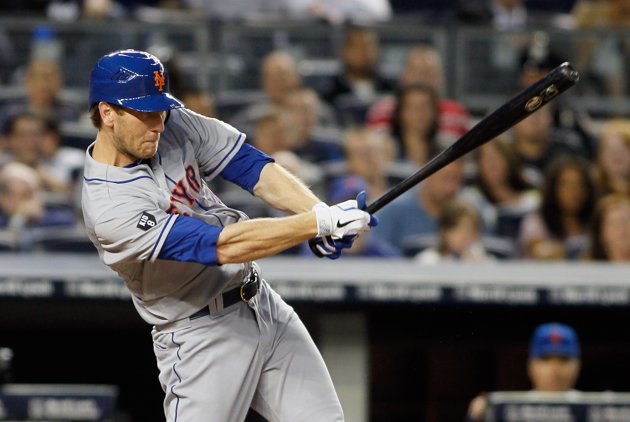
A sweet swing by a lefty wearing No. 17 at Shea Stadium.  Wait, that's not Keith Hernandez!  (Chris Trotman/Getty Images)

On May 21, the Mets entered the seventh inning of their showdown with the Yankees with a slim 2-0 lead.  But after Alex Rodriguez singled off Mets starter Kris Benson to lead off the inning, manager Willie Randolph decided to bring in his lefty specialist to fan the flames.  Mr. Koo would have to face Tino Martinez, Jorge Posada and Robinson Cano - all left-handed hitters - with each batter representing the tying run as long as Rodriguez was on base.  Unfortunately for the Yankees, A-Rod wasn't on base very long.

On a 1-1 pitch from Mr. Koo, Rodriguez took off for second base.  But upon realizing he was going to be thrown out by catcher Mike Piazza, Rodriguez retreated to first base, only to be tagged out by first baseman Doug Mientkiewicz.  Without the added pressure of facing the tying run, Mr. Koo proceeded to strike out Martinez and Posada to end the inning and give his manager an interesting problem.

Mr. Koo pitched quite well in the top half of the seventh, but was due to lead off for the Mets in the bottom half of the inning.  Meanwhile, the Yankees still had the lefty-swinging Robinson Cano due to bat first in the eighth inning and the Mets had no other southpaws in the bullpen.  Keeping that in mind, Randolph decided to let Mr. Koo bat for himself to lead off the bottom of the seventh against hard-throwing lefty Randy Johnson.

In his short major league career, Mr. Koo had never swung the bat in a game.  That's not to say that he hadn't had an at-bat in a game.  Just five days earlier, Mr. Koo had his first plate appearance when he strolled up to the plate against the Cincinnati Reds, but kept the bat on his shoulders as he watched three strikes from Todd Coffey go untouched into the catcher's mitt.

No one will ever confuse Todd Coffey with Randy Johnson.  So no one would have been upset or surprised had Mr. Koo also taken three straight strikes from the flame-throwing Yankee.  Well, no one except Mr. Koo, that is.

After Johnson's first two pitches to Mr. Koo - both of which were taken by the Mets reliever - FOX analyst Tim McCarver opined that Mr. Koo was going to be completely overmatched by the future Hall of Famer, basically saying that the 35-year-old "rookie" might as well just give up against Johnson.


"I'm just going to go out on a limb and say that this is, thus far in this young season, this is the biggest give-up at-bat."


Before McCarver had even finished his statement, Mr. Koo had already taken the bat off his shoulders for the first time in his short career, taking a hack at Johnson's third pitch.  To everyone's amazement and amusement, Mr. Koo made solid contact, driving the ball over the head of center fielder Bernie Williams, who was playing as shallow as can be expected against a hitter of Mr. Koo's caliber.

The ball landed just in front of the center field fence, approximately 400 feet from home plate.  Mr. Koo rounded second base and thought about stretching his first major league hit to a triple, but thought better of it, choosing to remain at second base.

With the energetic crowd and his teammates in the dugout all serenading him with a thunderous "KOOOOOOOOO!!!", Johnson turned away from the unlikely slugger and prepared to face shortstop and leadoff hitter Jose Reyes.  On Johnson's second pitch, Reyes dropped a successful sacrifice bunt, moving Mr. Koo to third base and putting him in position to score on something other than a hit.  Except the next batter never got a chance to drive him in, because by the time No. 2 hitter Miguel Cairo stepped up to the plate, Mr. Koo had already crossed it.

When Reyes dropped his bunt, catcher Jorge Posada ran out to field the ball and throw it to first.  Johnson, perhaps still disgusted with himself for allowing a hit to a relief pitcher who had never swung the bat in a major league game, forgot to cover the plate.  Johnson's mental fart allowed an astute Mr. Koo to round third and make a break for home.  Posada raced back and took first baseman Tino Martinez's throw about ten feet in front of the plate, then lunged toward a diving Mr. Koo.

With Reyes's bat resting across the batter's box, Mr. Koo used a head-first slide as he somehow maneuvered around both Reyes's lumber and the lumbering Posada before looking up to see that home plate umpire Chuck Meriwether had called him safe.  The daring base running by Mr. Koo gave the Mets a 3-0 lead, and gave Mets fans (and Tim McCarver) something they would talk about long after they left Shea Stadium that afternoon.

Mr. Koo finishes the most incredible trip around the bases in recent memory.  (Vincent Laforet/NY Times)

Following Mr. Koo's 360-foot Tour de Flushing, the Mets added another run in the seventh on a solo home run by Cairo just moments after Mr. Koo had scampered home.  They tacked on three additional runs an inning later to blow the game wide open.  By then, Mr. Koo's day was already done, as he exited to a thunderous ovation from the 55,800 fans in attendance after striking out Robinson Cano in the top of the eighth.  The Mets won the game handily, 7-1, leaving the Yankees to wonder about the Koo-tastrophe that had occurred before their stunned eyes.

Prior to May 21, 2005, Randy Johnson had excelled against the Mets, going 6-3 with a 2.32 ERA and 1.09 WHIP in ten regular season starts.  But beginning with the game of Mr. Koo's life, Johnson struggled mightily versus New York's National League squad.  The Big Unit shriveled in his last six starts versus the Mets, going 0-4 with an ungodly 7.90 ERA and 1.75 WHIP.

Johnson's 6-7 lifetime record against the Mets was the only losing mark he posted against any National League team.  The 4.26 ERA he put up in 16 career starts was also his worst against any of the sixteen Senior Circuit squads.  (Houston moved to the American League in 2013, four years after Johnson retired.)

As for Mr. Koo, he never batted again for the Mets, appearing exclusively on the mound for each of his final 15 appearances on a major league diamond.  Perhaps it was for the best that Mr. Koo never took a bat in his hands again, as two weeks after he completed his memorable day on the mound, at the plate and around the bases, Mr. Koo was placed on the disabled list with a rotator cuff injury that he suffered during his Slide Heard 'Round The World.  Despite pitching well upon his return from the DL, posting a 1.04 ERA in 11 appearances, Mr. Koo was optioned to AAA-Norfolk in late August and was designated for assignment a month later.  He never pitched again in the majors, but that didn't deter him, as he is still playing professionally at the age of 45 for the Sydney Blue Sox in the Australian Baseball League.

In 33 appearances with the Mets during his only season with the team in 2005, Mr. Koo did not record a win, loss or save.  His 33 career appearances remain the most by any pitcher in franchise history whose name never appeared in the win column, loss column or save column.  But just because he had a zero in all three categories doesn't mean he couldn't be a hero for one glorious day in 2005.

Dae-Sung Koo was respectfully known as Mr. Koo by his teammates and fans.  And although he barely played for the Mets, he earned his respect with an unlikely series of events that made him the talk of the town during a spring weekend in 2005.  The Subway Series made household names out of players like Dave Mlicki, Matt Franco and Shawn Estes.  It did the same for a journeyman pitcher from South Korea.

When he first came to the Mets, Mr. Koo didn't expect anyone to know how to pronounce his first name.  But by the end of his short tenure on the team, everyone certainly knew his last name.  Fifty-five thousand Koo-ing fans can vouch for that.


YouTube video courtesy of kifan


Note:  One Mo-MET In Time is a thirteen-part weekly series spotlighting those Mets players who will forever be known for a single moment, game or event, regardless of whatever else they accomplished during their tenure with the Mets.  For previous installments, please click on the players' names below:

January 5, 2015: Mookie Wilson 
January 12, 2015: Dave Mlicki
January 19, 2015: Steve Henderson 
January 26, 2015: Ron Swoboda
February 2, 2015: Anthony Young
February 9, 2015: Tim Harkness
February 16, 2015: Kenny Rogers, Aaron Heilman, Tom Glavine
February 23, 2015: Mike Vail
March 2, 2015: Matt Franco
March 9, 2015: Shawn Estes
 

Monday, March 9, 2015

One Mo-MET In Time: Shawn Estes

The 1999 season marked the first time that both the Mets and Yankees qualified for the postseason in the same year.  Although the two teams failed to meet in the World Series in 1999, they did provide several memorable moments during their regular season matchups, including Matt Franco's game-winning hit against Mariano Rivera on July 10.

But the day before the Franco walk-off, the Mets used a late three-run homer by catcher Mike Piazza off Yankees starter Roger Clemens to break a 2-2 tie in a game the Mets eventually won, 5-2.  It was Piazza's second career homer off Clemens, with the first one coming in the Rocket's previous start against the Mets a month earlier at Yankee Stadium.

One year later, Piazza continued his torrid hitting against Clemens, launching a grand slam to straightaway center field - just the second grand slam allowed by Clemens in 17 seasons - to help the Mets cruise to a 12-2 victory.  A single in his next plate appearance gave Piazza seven hits in 12 at-bats against Clemens, including three homers and nine RBI.   The next time Clemens started a game against the Mets, he hit Piazza in the helmet with a fastball, knocking the Mets catcher out of the game.  General manager Steve Phillips shared his thoughts on the beaning after the game, saying, "I don't know if things are ever over.  Guys have long memories in baseball."

Things weren't over between Clemens and Piazza.  And apparently, the memory of Piazza's ownership of Clemens resonated more with the Rocket than it did with the Mets' All-Star catcher.

When the two teams squared off in the 2000 World Series, Piazza faced Clemens for the first time since he was the target of Clemens's head-seeking missile.  It only took four pitches for Clemens to once again have Piazza in his sights, although this time it was with a broken bat instead of a fastball.  Swinging on a 1-2 pitch, Piazza hit a foul ball that shattered his bat into several pieces, with one of the shards bouncing toward the pitcher's mound.  Instinctively, Clemens fielded the sharp piece of wood, then threw it in the direction of a dumbfounded Piazza, claiming that he thought it was the ball.  Never mind that Clemens's initial reaction was to hop around as if a spear was coming right at him (which it was) instead of a spherical, blunt object (which it wasn't).

The Yankees went on to win the game and the World Series.  Although Clemens was fined $50,000 for his unexpected javelin toss, he could easily afford to pay for it with his World Series-winning share of $294,783.41.  A year later, Clemens didn't have to worry about retaliation by the Mets because Yankees manager Joe Torre went out of his way to ensure that Clemens wouldn't have to pitch at Shea Stadium, where he'd be forced to bat.

By the 2002 season, much had changed for the crosstown rivals.  The Yankees were no longer the defending World Series champions and the Mets were no longer playoff contenders in the National League.  One thing that hadn't changed was that the Mets were still fuming over Roger Clemens and his approach to facing Mike Piazza.  Three years after Piazza took Clemens deep for the first time and two years after Clemens aimed a fastball and a fast bat in the direction of Piazza's body, the stage was set for Clemens to finally step up to the plate as a hitter at Shea Stadium.  And it was up to a new member of the Mets - one who wasn't present for each of the previous incidents - to show Clemens exactly how the Mets felt about him.

Shawn Estes may have missed Roger Clemens with a pitch, but he didn't miss a Roger Clemens pitch.  (Getty Images)

Aaron Shawn Estes was a former first round draft pick who had his share of ups and downs in the big leagues.  In 1997, Estes was an All-Star for San Francisco, going 19-5 with a 3.18 ERA to help the Giants reach the playoffs for just the fifth time in 40 seasons in the Bay Area.  But the '97 campaign was also the first of three seasons that Estes reached triple digits in walks.  Estes was never known for his control, as evidenced by his 521 walks in seven seasons as a Giant, a number that puts him in the team's top 20 in free passes - a team that has been in existence since 1883 and has used 731 pitchers through the 2014 season.

When Mets general manager Steve Phillips wanted to overhaul the team after it barely finished above .500 in 2001, he added several former All-Stars to the roster (Roberto Alomar, Mo Vaughn) and re-acquired players who used to call Flushing home (Jeromy Burnitz, Roger Cedeño).  Phillips also looked to bolster his pitching staff, sending utility infielder Desi Relaford and popular outfielder Tsuyoshi Shinjo to the Giants in exchange for Estes.

Estes's first win as a Met was a complete-game, one-hit shutout on April 26, a game in which the left-hander didn't allow a base runner until the seventh inning.  Ironically, Estes's masterpiece came against Milwaukee's Glendon Rusch, the pitcher he essentially replaced in New York's starting rotation and the last hurler to start a one-hitter for the Mets.  (Rusch combined with Armando Benitez on a one-hitter in 2001.)

Following his gem against the Brewers, Estes struggled mightily.  The southpaw won just one of his next seven starts, posting a 5.84 ERA and allowing opposing hitters to bat .343 against him.  Not once in those seven starts did Estes pitch into the seventh inning and in five of the seven outings, he failed to pitch more than five innings.  Needless to say, Estes was not winning over many fans in New York, especially after a five-inning, six-run debacle against the Indians on June 9 that brought him into his first Subway Series experience in his next start.  And what a start it would be, as Estes would be facing none other than Roger Clemens in his first Shea Stadium appearance since the 1999 season.

Shawn Estes was toiling a coast away in San Francisco during the 1999 and 2000 seasons when the Clemens-Piazza feud was at its peak.  But it would fall upon Estes to protect his new battery mate by sending a message to Clemens and the Yankees that the Mets were not going to be bullied by anyone.  On an unusually cool mid-June afternoon at Shea Stadium, the tension was palpable.  Estes started the game by striking out four of the first eight Yankee batters to face him.  That brought up Roger Clemens, as Public Enemy No. 1 was also Yankee batter No. 9.

With all eyes in the Shea Stadium crowd focused on the Estes-Clemens matchup, Estes fired his first pitch to the plate.  Naturally, aiming at a particular target - even a six-foot, four inch target - wasn't a strong suit for a pitcher who had walked 100 or more batters in a season three times in his career.  Estes's first pitch went behind Clemens, missing his rear end by about a foot.  Home plate umpire Wally Bell issued warnings to both dugouts and Clemens continued his at-bat against Estes, eventually striking out on a 3-2 pitch.

To most fans at the time, Estes had failed in doing his job, just as he had done in most of his starts during the season's first two months.  Striking out Clemens wasn't what they wanted to see.  Striking him was.  And by not doing so, the two-year wait for retribution lingered on.  After Estes retired the side in order in the top of the third, it was his turn to take a bat in his hands to face Clemens.  Although Estes's sacrifice bunt did allow shortstop Rey Ordoñez to score all the way from second base - the Yankees left home plate unattended - to give the Mets an early lead, it still didn't give fans what they desired.  Two innings later, Estes made up for missing Clemens in the third.  He didn't miss this time.

Shawn Estes hits Roger Clemens in a way no one expected.  (Photo by Steve Crandall/Reuters)

With the Mets clinging to a 1-0 lead in the fifth, Roger Cedeño led off the inning with a double down the left field line.  Rey Ordoñez then swung away at the first pitch he saw, flying out to center fielder Bernie Williams, which left Cedeño at second and brought up Shawn Estes.  Had there been no outs, Estes would have been instructed to bunt the runner to third base.  But with one out, Estes was allowed to swing away - and what a swing it was!

Estes hit a high fly ball down the left field line that cleared the outfield wall for a jaw-dropping two-run homer.  Estes's first hit as a Met - he began the season by going 0-for-18 - was not the first time he had taken an opposing pitcher deep, as he had homered once in 1997 and also hit a grand slam in 2000.  But it was the first time Clemens had ever allowed a long ball to a fellow moundsman in his 19-year career.  (Clemens would allow just one more homer to an opposing pitcher, serving up a two-run shot to Montreal Expos starting pitcher Jon Rauch in 2004.  It was one of only 11 starts made by Rauch in his career and his only home run.)

Clemens would later stroke a double off Estes in the top of the sixth - just the third hit of the Rocket's career - but was left stranded on the bases.  If Clemens thought he had gotten some sort of payback off Estes by banging out an extra-base hit of his own, he was in for a rude awakening when he went back to the mound for the bottom of the sixth when his nemesis, Mike Piazza, stepped into the batter's box to lead off the inning.

Piazza, who claimed that he "never really went to the plate with any ulterior motive",  took Clemens's first offering and deposited it over the wall to give the Mets a 4-0 lead.  Clemens was never allowed to finish the sixth inning, as he was taken out of the game two batters later.  The Mets went on the win the game, 8-0, with Estes picking up his third win of the season.

Estes pitched seven shutout innings against the Yankees, allowing five hits, one walk and matching a career high with 11 strikeouts.  But despite pitching (and hitting) beautifully against the Yankees in June, Estes became a former Met less than two months later.  The southpaw would win just one more game in New York, as he was traded to the Cincinnati Reds in August as part of a package that netted the team long-time middle reliever Pedro Feliciano.

Roger Clemens had been disliked by Mets fans since the 1986 World Series, when he was seen clean-shaven prior to what he thought was going to be a championship-clinching win by his team at the time, the Boston Red Sox.  (Clemens had a five-o'clock shadow during the game, but shaved off his stubble in anticipation of a celebratory post-game interview that never happened.)  More than a decade later, Clemens infuriated fans once again when he took out beloved catcher Mike Piazza with a fastball to the helmet, then tried to do the same with a broken bat in that season's Fall Classic.

The Mets waited patiently for two seasons to get their revenge on Clemens.  The opportunity almost passed them by when Shawn Estes failed to hit Clemens with a pitch on a cool June day in 2002.  But before the day was over, Estes found a different way to hit Clemens, shaming him more than a fastball to the body ever could.  Piazza also exacted a modicum of payback against Clemens by homering off him an inning after Estes took him out of the park.  It turned out to be Piazza's final hit off Clemens after spending the previous half-decade hitting rockets off the Rocket.


''I don't think revenge mattered.  Hopefully today beating the Yankees and doing it the way we did is the key to getting some momentum.  That was really all we were trying to do.''

--Mike Piazza, following the June 15, 2002 game against the Yankees 


Shawn Estes never did bolster the starting rotation as general manager Steve Phillips expected, going 4-9 with a 4.55 ERA in 23 starts.  But he did provide the team and its fans with one magical day at Shea Stadium.  Estes was pitching across the country when the bad blood between Clemens and Piazza started to boil in 1999.  But when the book on the storied feud was closed, it was Estes who provided one of the final chapters, nailing a Roger Clemens pitch just two innings after he failed to nail Clemens at the plate.

A total of 72 players in Mets history (through the 2014 season) finished their careers in New York with just one home run to their credit.  Of those six dozen players, none of them hit a blast that resonated more with Mets fans than the one hit by Shawn Estes on June 15, 2002.

The man who came to New York with a history of being wild around the plate couldn't hit Roger Clemens with a pitch (yet still managed to get fined $750 for his efforts).  However, he did hit Clemens where it hurt the most - his ego - when he did something no pitcher had ever done before against him.  And in doing so, he helped provide closure to one of ugliest pitcher-batter feuds in recent memory.

Shawn Estes couldn't have picked a better time to have his one memorable moment as a Met.


Note:  One Mo-MET In Time is a thirteen-part weekly series spotlighting those Mets players who will forever be known for a single moment, game or event, regardless of whatever else they accomplished during their tenure with the Mets.  For previous installments, please click on the players' names below:

January 5, 2015: Mookie Wilson 
January 12, 2015: Dave Mlicki
January 19, 2015: Steve Henderson 
January 26, 2015: Ron Swoboda
February 2, 2015: Anthony Young
February 9, 2015: Tim Harkness
February 16, 2015: Kenny Rogers, Aaron Heilman, Tom Glavine
February 23, 2015: Mike Vail
March 2, 2015: Matt Franco

Monday, March 2, 2015

One Mo-MET In Time: Matt Franco

Prior to 1997, the Mets had only faced their crosstown rivals from the Bronx in Grapefruit League games and Mayor's Trophy exhibitions.  In addition, neither the Mets nor the Yankees had ever qualified for the postseason in the same year.  But thanks to interleague play, meaningful games between the two squads became a reality as the 20th century came to a close.

The first regular season contest between the two teams in 1997 ended with Dave Mlicki pumping his fists on the Yankee Stadium mound in celebration of the Mets' 6-0 victory over the Bronx Bombers.  It was the defining game for the journeyman Mlicki - an extraordinary moment in an otherwise ordinary ten-year major league career.

The Subway Series has become a venue for some of the most dramatic victories in Mets history.  Entering the 2015 season, the Mets have won 42 regular season games against the Yankees, including 13 one-run victories and six walk-off wins.  Perhaps the most dramatic of these one-run, walk-off triumphs occurred on July 10, 1999, as both the Mets and Yankees were trying to reach the playoffs in the same season for the first time.  And when the game ended, one Met became a hero for life, delivering the game-winning hit in a pinch.

Matt Franco proves that even bench players can become Mets legends.  (AP Photo)

Matthew Neil Franco was born for Hollywood endings.  His uncle, Kurt Russell, has been an actor since childhood, following in the footsteps of Franco's grandfather, Bing Russell.  Franco also has immediate family working behind the scenes, as his father is acclaimed movie producer Larry Franco.

Franco was drafted by the Chicago Cubs in the seventh round of the 1987 June amateur draft.  As is the case with many struggling actors, it took Franco several years to make it to the big show.  He didn't advance past the Double-A level until his seventh professional season and didn't make his major league debut until the final month of the 1995 campaign.

Following his 16-game cup of coffee with the Cubs in 1995, Franco was traded to the Mets at the outset of the 1996 season.  Once again, Franco's only time spent in the big leagues in 1996 was during a brief September call-up.  But after starting the 1997 campaign in the minors, Franco was called up by the Mets following an injury to outfielder Andy Tomberlin, who also served as the team's primary pinch-hitter from the left side of the plate.  Tomberlin never played for the Mets again as Franco took over as the team's top lefty-swinging pinch-hitter, batting .306 with three homers and 13 RBI in 66 plate appearances as a pinch-hitter.

In 1998, Franco continued to be one of the baseball's most productive pinch-hitters, reaching base 26 times (14 hits, 12 walks) in 68 pinch-hitting appearances.  But his best season off the bench came in 1999, and he punctuated his year with a dramatic at-bat against the top closer in the game.

On July 10, the Mets and Yankees entered the second game of their three-game set at Shea Stadium with both teams playing their best baseball.  The Yankees were in first place in the AL East and were owners of the third-best record in the game.  Meanwhile, the Mets were the hottest team in the sport, winning 22 of their last 32 games to move them within striking distance of the first-place Braves.

The Mets took the first game of the series, 5-2, with the deciding runs scoring on a tie-breaking three-run homer by Mike Piazza off Roger Clemens in the sixth inning.  Power was on full display in the second game - a Saturday matinee at Shea - but most of it came from the players sitting in the road team's dugout.

The Yankees hit six home runs that afternoon (two by Paul O'Neill, two by Jorge Posada, one each by Ricky Ledee and Chuck Knoblauch), becoming the seventh team to hit at least six homers in one game against the Mets.  The Mets had lost the six previous contests in which they were taken deep half a dozen times, losing those games by a combined 94-26 score.  They were determined not to go 0-for-7 in those situations.

Mike Piazza did his part, hitting one of the longest home runs in Shea Stadium's history - a 482-foot blast over the picnic area tents in left field - to give the Mets a temporary 7-6 lead in the seventh inning.  But a two-run homer by Jorge Posada an inning later helped the Yankees retake the lead.  The score remained 8-7 as future Hall of Fame closer Mariano Rivera came into the game in the ninth inning.

Rivera had never allowed a run to the Mets in four career appearances, notching saves in all four games.  But that streak was in jeopardy when Edgardo Alfonzo followed Rickey Henderson's one-out walk with a double.  With the tying and winning runs in scoring position, John Olerud grounded out to first baseman Tino Martinez, leaving Henderson and Alfonzo on base and Yankees manager Joe Torre with a decision to make.  Should he have Rivera face cleanup hitter Mike Piazza or should he walk him intentionally to face Melvin Mora, who had entered the game two innings earlier as a late-inning defensive replacement for Benny Agbayani?  Torre chose the latter, and had Rivera issue a four-pitch free pass to the Mets catcher.

Mets manager Bobby Valentine counteracted by inserting Matt Franco into the game to pinch-hit for Mora.  Franco had never gotten a hit against Rivera in two previous plate appearances, but he had drawn a walk.  And a walk against Rivera with the bases loaded would have tied the game.  But Franco had his eye on a bigger prize, and with the Mets down to their final strike, Franco delivered.


YouTube video courtesy of Courtside Tweets


After taking a borderline 0-2 pitch from Rivera that was called a ball by home plate umpire Jeff Kellogg - a call that did not please Torre, who could be seen mouthing "that ball's not low" in the Yankee dugout - Franco laced a single to right on Rivera's next offering.  Running on contact, Henderson scored easily from third base and Alfonzo slid home safely ahead of Paul O'Neill's throw, giving the Mets a thrilling 9-8 victory before 53,792 raucous fans at Shea Stadium.

The two-run single by Franco would be the only safety he'd record against Rivera in four career plate appearances.  Franco's clutch hit was also the first of four times the Mets defeated Rivera during his illustrious career.  The only teams to defeat Rivera more often during his 19-year tenure with the Yankees were the Orioles (nine losses), Red Sox (seven) and Rays (six) - all teams that played in Rivera's division.

Matt Franco's game-winning single on July 10 was one of 14 pinch-hits he collected in 1999.  Franco also set a major league record in 1999 when he walked 20 times as a pinch-hitter.  By reaching base 34 times in 80 pinch-hit appearances, Franco posted a stellar .425 on-base percentage, one of the highest marks in team history.

But despite being one of the best substitute players in club annals, Franco is mainly remembered for his one big hit on a warm summer day at Shea.

Photo by Ed Leyro


''In batting practice alone, I've been through that same situation a million times.  Everyone has.  Bottom of the ninth, bases loaded, two outs, two strikes.  To get the game-winning hit at Shea Stadium, playing the Yankees, with 53,000 people in the stands, the bases loaded, down a run, in the bottom of the ninth, I don't know how it's going to get any better than that.  It's a dream come true.''


Ed Kranepool set a team record with 90 pinch-hits.  Rusty Staub's 72 RBI are also best among all Mets' subs.  Both figures are nearly double the amount of hits and RBI put by Matt Franco as a pinch-hitter (58 hits, 37 RBI) during his five seasons with the Mets.  But for all the regular season records set by Kranepool and Staub during their times as the top hitter off the bench for the Mets, none of their hits or runs batted in have resonated as much with Mets fans as Franco's game-winner off Mariano Rivera.

Matt Franco was born to a family that spent a lot of time in front of the camera.  But in a season where the Yankees and Mets qualified for the postseason together for the first time and one year before the teams squared off in the first Subway World Series in 44 years, it was Franco who took center stage in a mid-July game at Shea Stadium.

Hollywood is known for producing storybook endings in film and television.  On July 10, 1999, Matt Franco produced a storybook ending of his own.  And in doing so, he became a beloved Met for life, all because he came through in a pinch against one of the most dependable pitchers of this or any other generation.

No script could have produced a better ending.


Note:  One Mo-MET In Time is a thirteen-part weekly series spotlighting those Mets players who will forever be known for a single moment, game or event, regardless of whatever else they accomplished during their tenure with the Mets.  For previous installments, please click on the players' names below:

January 5, 2015: Mookie Wilson 
January 12, 2015: Dave Mlicki
January 19, 2015: Steve Henderson 
January 26, 2015: Ron Swoboda
February 2, 2015: Anthony Young
February 9, 2015: Tim Harkness
February 16, 2015: Kenny Rogers, Aaron Heilman, Tom Glavine
February 23, 2015: Mike Vail

Monday, January 12, 2015

One Mo-MET In Time: Dave Mlicki

Some players have careers that are so nondescript, it's fairly simple to find their greatest moment on a baseball diamond.  For Chicago Cubs rookie Jimmy Qualls, it was his clean single to left field that ended Tom Seaver's bid for a perfect game in 1969.  The safety was Qualls' 12th hit in the big leagues.  He would have just 19 more over a major league career that lasted parts of three seasons.

Qualls' career was quite brief, as he played in only 63 total games with the Cubs, Expos and White Sox.  It should come as no surprise, then, that the hit off Seaver would be the one he'd always be remembered for.

Sometimes, players who have just one defining moment can play in the majors for a decade or longer and never do anything else remotely worth remembering.  Their lengthy careers would be instantly forgotten if not for that one shining moment.  One such player played for the Mets in the mostly forgettable mid-1990s.  But no one will ever forget what he did on a late spring night in the Bronx.

Arguably the most memorable end-of-game reaction by a Mets pitcher since Jesse Orosco.  (Getty Images)

David John Mlicki was as average as average could be.  And that's probably giving him too much credit.  Mlicki pitched in the power-happy 1990s and early 2000s, spending a total of ten seasons in the big leagues.  In seven of those ten years, he made at least ten starts.  His ERA was 4.00 or higher in all seven of those seasons.  Mlicki also never had a season in which he finished more than two games above .500 and was within two games of the break-even point in seven of his ten campaigns.

In addition, Mlicki made 193 starts and pitched 69 games in relief, posting a 4.72 ERA in those 252 appearances.  That made Mlicki one of just eight pitchers in the long history of baseball to make that many starts and that many relief appearances with an ERA of at least 4.72.  Needless to say, Mlicki was lucky to have lasted in the big leagues as long as he did.

Mlicki made seven starts for the Cleveland Indians in 1992 and 1993.  He won none of them.  But that didn't discourage the Mets when Cleveland packaged him with two other pitchers - Paul Byrd and Jerry Dipoto - in exchange for Dallas Green doghouse resident Jeromy Burnitz.  The former 30/30 player in the minor leagues had incensed Mets manager Green with his poor plate discipline and perceived lack of hustle, making himself expendable.

Burnitz went on to become an All-Star and MVP candidate after the trade, while Byrd and Dipoto joined Burnitz as former Mets following the 1996 season.  Entering the 1997 campaign, Mlicki was the only player remaining from the ill-fated Burnitz trade.  Splitting time between the starting rotation and the bullpen, Mlicki had gone 15-14 with a 3.91 ERA and 1.36 WHIP in his first two years with the Mets, numbers that were fairly average but slightly better than the team's cumulative 4.06 ERA and 1.37 WHIP.

Under new manager Bobby Valentine, Mlicki became a full-time starter in 1997.  But while fellow starting pitchers Rick Reed and Bobby Jones were off to All-Star caliber starts, Mlicki regressed.  The Mets got off to a disappointing 8-14 start under Valentine, but the team then went on a roll, winning 20 of the next 29 contests from April 27 to May 28.  Mlicki did not receive credit for any of those 20 wins, going 0-2 with three no-decisions and an eye-popping 5.61 ERA during his team's unexpected hot streak.

By mid-June, Mlicki had won just two of his 13 starts, and his spot in the rotation was potentially in jeopardy.  But Valentine stuck with his beleaguered starter, putting him under the spotlight for the highly anticipated first-ever regular season matchup between the Mets and Yankees on June 16.  It was a decision that would be remembered well past the end of the 1997 season.

"I give Dave Mlicki a 50/50 chance at beating the Yankees on June 16."

The Yankees were the defending World Series champions, and by winning their first title in 18 years, had taken over the city much like the Mets had done so a decade earlier.  The Mets, on the other hand, had completed their sixth consecutive losing season in 1996.  But they were off to an impressive start in 1997 and were poised to claim bragging rights in the first regular season game played between two New York teams since the Brooklyn Dodgers and New York Giants squared off against each other on September 8, 1957.

Before a raucous Yankee Stadium crowd, the Mets got off to a quick start, scoring three runs in the top of the first.  Lance Johnson led off the game by grounding out, but over the next 16 pitches, the Mets produced two doubles, a walk, a single and a steal of home by the normally slow-footed Todd Hundley.  The unlikely theft occurred when Butch Huskey appeared to be picked off first base by Yankee starter Andy Pettitte.  Huskey stayed in the rundown long enough to allow Hundley to scamper home with the third tally of the inning.  The botched rundown gave Mlicki a comfortable lead before he had thrown his first pitch.

That first pitch by Mlicki, a single by Jeter - who reached second base on an error by center fielder Johnson - immediately gave the Yankees a chance to erase some of the momentum generated by the Mets in the top half of the inning.  But in a portent of things to come, Mlicki induced a groundout by Pat Kelly, followed by back-to-back strikeouts of Paul O'Neill and Cecil Fielder.  The Yankees had just gone 0-for-3 with runners in scoring position, and Mlicki wasn't done stranding base runners.

In the third inning, Yankee catcher Joe Girardi hit an one-out, opposite-field double.  He was stranded at second after Mlicki struck out the next two batters.  An inning later, it was Fielder's turn to hit a one-out double to the opposite field.  But yet again, the Yankees couldn't score the run, as Mlicki got Tino Martinez to ground out and Charlie Hayes to line out to end the inning.

The fifth inning saw the Yankees put another runner in scoring position, this time with two outs.  But Derek Jeter could not produce a clutch hit, and the score remained 3-0.  The Mets, however, were having no problems producing with runners in scoring position.

With two outs and runners on first and second in the top of the seventh, Bernard Gilkey drew a four-pitch walk to load the bases.  Gilkey's free pass was followed by an opposite-field single by John Olerud, which scored two runs.  Two innings later, it was Gilkey who drove in a runner in scoring position, lifting a sacrifice fly to left to make it 6-0.

Armed with a 6-0 lead, Mlicki continued to mow Yankee hitters down.  (Photo by Linda Cataffo/Daily News)

By then, it had become a foregone conclusion that the Mets were going to win the game.  The only thing left to be seen was whether Mlicki could finish off the Yankees without allowing any runs to score.  Mlicki appeared to struggle in the eighth when he allowed back-to-back one-out hits to Kelly and O'Neill.  But just as he had done in the earlier innings, he retired the next two batters, stranding both runners.

With a six-run lead going to the bottom of the ninth, Valentine could have pulled Mlicki from the game.  After all, Mlicki had already thrown 106 pitches and had far surpassed what the Mets expected from him in the game.  But Mlicki had never pitched a shutout in five seasons in the majors, nor had he ever pitched a complete game.  He had the opportunity to do both by getting three more outs against the defending world champions.

He was not coming out of that game.

Charlie Hayes led off the ninth with a single but was thrown out at second trying to take the extra base.  Mark Whiten followed with another single.

He was not coming out of that game.

After Chad Curtis grounded into a fielder's choice, Girardi followed with his third hit of the game.  Mlicki had allowed hits to three of the the first four batters to face him in the ninth inning.  He had thrown 114 pitches.  He was about to face Derek Jeter with two runners on base.  It was the Yankees' 11th at-bat of the game with a runner in scoring position.

He was NOT coming out of that game.

Mlicki alternated balls and strikes with Jeter at the plate.  Finally, on a 2-2 pitch and with thousands of Mets fans in attendance loudly cheering on every pitch, Mlicki froze Jeter, throwing strike three past the Yankee shortstop.  After 119 pitches, Mlicki could finally walk off the mound and into the waiting arms of catcher Todd Hundley, but not before he let out a celebratory whoop as he pumped his fists in victory.

27 outs, no runs.  Dave went where no Mlicki had gone before.  (Photo by Linda Cataffo/Daily News)

For one night, the Mets had taken over New York from the Yankees, and it was the most unlikely candidate who plastered the Mets all over the front and back pages of the following day's New York papers.

Dave Mlicki had never pitched a shutout or a complete game in his first 47 starts in the big leagues.  After holding the Yankees scoreless for nine innings on June 16, 1997, Mlicki started another 145 games until his retirement in 2002, completing just five of those contests and tossing one more shutout.

The win against the Yankees was one of only 24 victories posted by Mlicki in the three and a half years he played with the Mets.  It was also his only shutout as a Met.  In a year the Mets surprised all of baseball by going 88-74 and competing for the wild card until the final week of the season, Mlicki won just eight of 20 decisions.  But it was his third victory of the season that became the biggest of his career.

Since the Mets came into the league in 1962, they've shared the city with the Yankees.  They've also shared the city's baseball fans - supporters who have declared their loyalty to one team and strong dislike for the other.  But prior to 1997, Mets and Yankees fans could only watch the two teams face each other in Grapefruit League action and the Mayor's Trophy exhibition game.

When Dave Mlicki took the mound against Andy Pettitte on a late spring night at Yankee Stadium, it certainly wasn't an exhibition game.  The only thing being exhibited that night was Mlicki's finest performance as a Met.  In a ten-year career that saw Mlicki post a 66-80 won-loss record, it was his 18th career win that stood out above all others.

The Mets and Yankees had shared the spotlight in the city for 35 years.  But no one was going to share the spotlight with Dave Mlicki on the night of June 16, 1997.  Because of that one special moment in time, Mlicki will never be shut out from the minds and hearts of Mets fans.

Charles Wenzelburg/NY Post


"I felt like it was a World Series game.  I still have people who tell me I'm their hero because of that one game.  It's kind of cool."


Note:  One Mo-MET In Time is a thirteen-part weekly series spotlighting those Mets players who will forever be known for a single moment, game or event, regardless of whatever else they accomplished during their tenure with the Mets.  For previous installments, please click on the players' names below:

January 5, 2015: Mookie Wilson 

Friday, May 31, 2013

An Interesting Fact About The Mets And Season Series Sweeps


On Thursday night, the Mets completed a season sweep of the Yankees, taking their second consecutive affair at Yankee Stadium after claiming two wins at Citi Field.

It's quite rare for the Mets to sweep a season series from anyone.  It's almost as rare for them to take all but one game from a team over an entire campaign.  Here is a list of all the season series in which the Mets missed going undefeated against a particular team by one game, followed by the much shorter list of those teams who failed to defeat the Mets even once in a single season.  Please note that only those season series in which the Mets played their opponent at home and on the road are being considered.  That eliminates teams that played only one series against the Mets over an entire season.


One-Loss Season Series (min. one home series, one road series)

1969: San Diego Padres (11-1)
1986: Pittsburgh Pirates (17-1)
1988: Los Angeles Dodgers (10-1)
1994: Chicago Cubs (4-1)
1998: Milwaukee Brewers (8-1)
2002: Chicago Cubs (5-1)
2002: Milwaukee Brewers (5-1)
2004: Colorado Rockies (5-1)
2005: Arizona Diamondbacks (6-1)
2006: Arizona Diamondbacks (6-1)
2006: Colorado Rockies (5-1)
2008: San Francisco Giants (5-1)
2009: Houston Astros (5-1)
2010: Pittsburgh Pirates (6-1)


Undefeated Season Series (min. one home series, one road series)

2013: New York Yankees (4-0)


See anything interesting with those lists?  Of course you did.  Over their first 51 seasons, the Mets had never swept a season series from any team when the season series included games at home and on the road.  Never.  Until now.

The Mets' four-game party versus the Yankees this week represents the first time in franchise history that they won every home game and every road game against a particular team in a single season.  First.  Time.  Ever.

Prior to the 2013 season, the Mets came within one game of sweeping a season series against a team 14 times, most recently in 2010 when they took six of seven from the Pirates.  But now they have their first season sweep of more than three games.  And it came at the expense of their crosstown rivals, the New York Yankees.

It's always difficult to win both ends of a doubleheader.  It's even harder to win every game against an opponent over an entire season.  Leave it to the Mets to finally accomplish this rare feat against that other New York team.  Taking out the brooms never felt sweeter.

Wednesday, May 29, 2013

Song Parody: Turner Pie

On Tuesday night at Citi Field, the Mets scored two runs off Mariano Rivera in the bottom of the ninth to walk off with an unexpected victory.  The winning run was driven in by Lucas Duda, who sacrficed his bat for the decisive RBI single.

As has become custom for the Mets following a walk-off victory at Citi Field, Duda became Soupy Sales after the win, taking not one, but two pies to the face courtesy of Ruben Tejada and the pie-father himself, Justin Turner.

Justin Turner has made it clear to his teammates that if they are responsible for a thrilling walk-off victory, a congratulatory pie in the face is warranted.  On that note, I think a parody based on a song by late '80/early '90s hair band, Warrant, is in order. (See what I did there?)

In 1990, Warrant used several baseball references in their top ten smash, "Cherry Pie".  Now it's Justin Turner who is smashing pies on the faces of his fellow baseball players.  Ladies and gentle-Mets, here is my own smash hit inspired by Justin Turner's literal smash hits.  This song parody is called "Turner Pie".


Here’s my Turner pie
Cool Whip for walk-offs
Right into your eyes
Tastes so good
Even Burkhardt would try
Sweet Turner pie

Swingin’ for the Pepsi Porch
Swingin’ till it’s gone
Swingin’ for a walk-off
Sendin’ everybody home
Swingin’ toward left field
Swingin’ toward right
If I see a good fastball
I’ll swing all night, yeah

Swingin’ till I make it boom
Swingin’ cause I’m itchin’
Most pitchers don’t
‘Cause they’re too busy pitchin’
Pitch it in there
‘Cause I want to see your heater
But you mixed in a hanger
That’s uglier than Jeter

I scream, you scream
We all scream harder
Don’t even run
From the Mets’ pie-father

Here’s my Turner pie
Cool Whip for walk-offs
Right into your eyes
Tastes so good
Even Burkhardt would try
Sweet Turner pie (oh yeah)
Here’s my Turner pie
Smothered on your face
In your eyes
Looks so good
When it’s on SNY
Sweet Turner pie

Swingin’ (not a bunt)
Swingin’ (it went far)
Swingin’ for a place
That is out of the yard
Ain’t got a strikeout
Ain’t got a free pass
But I’ll get that Cool Whip
If I drive ‘em in last

I scream, you scream
We all scream harder
Don’t even run
From the Mets’ pie-father

Here’s my Turner pie
Cool Whip for walk-offs
Right into your eyes
Tastes so good
Even Burkhardt would try
Sweet Turner pie (oh yeah)
Here’s a Turner pie
Smothered on your face
In your eyes
Looks so good
When it’s on SNY
Sweet Turner pie

Swing it!
Walk-off run!
Swing it!

Swingin’ for the Shea Bridge
Swingin’ so we score
Swingin’ so hard
We’re not takin’ ball four
In walks Duda
Standin’ six-foot-fo’
He said “I ain’t ‘fraid to swing
At that Yankee named Mo.”

Here’s my Turner pie
Cool Whip for walk-offs
Right into your eyes
Tastes so good
Even Burkhardt would try
Sweet Turner pie (oh yeah)
Here’s my Turner pie
Smothered on your face
In your eyes
Looks so good
When it’s on SNY
Sweet Turner pie
Sweet Turner pie!

Swing it!


Friday, June 22, 2012

Frank Francisco Doesn't Choke Anything But Chickens


After providing bulletin board material earlier today, Frank Perdue, I mean Frank Francisco, plucked the competition in the first game of the Subway Series, helping preserve the Mets' 6-4 win over their crosstown rivals.

After a nearly one hour rain delay prior to the first pitch, the Mets kept the thunder rolling, scoring five runs off Yankees starter Andy Pettitte.  The big blow came off the bat of Ike Davis, who used Nick Swisher's glove to his advantage.  The Yankee loudmouth helped push Davis' high fly ball over the right field wall for a three-run homer, giving the Mets the big early lead.

As is what usually happens with the Yankees, the Bronx Bummers chipped away at the Mets' lead with three home runs.  All four of their runs scored on longballs.  Solo shots by Alex Rodriguez and Andruw Jones, followed by a two-run blast by Robinson Cano, cut the Mets' lead to 6-4.  That set the stage for Francisco to come into the game in the ninth.

Russell Martin, whose cheap Yankee Stadium home run helped defeat the Mets two weeks ago, sent another ball deep into the night.  But this time, the venue was different and Andres Torres was able to track the long fly ball down, flopping to the ground as he caught it in center field, Lenny Dykstra style.

Then Frank Squared allowed a couple of chickens to cross the road, walking Raul Ibañez and allowing a single to Derek Jeter.  The Yankees now had the tying runs on base, with Curtis Granderson and Mark Teixeira waiting to pluck back.  Instead, Frank Francisco roasted them.

Granderson struck out looking at a fastball down the middle and Teixeira popped up to the middle of the infield, where shortstop Omar Quintanilla did his best not to copy Luis Castillo, catching the ball for the final out.

It could have been a fowl moment for Frank Francisco and the Mets tonight.  But the closer backed up his words and sealed the deal on the Mets' victory.  Perhaps the great Metstradamus said it best when he tweeted the following:


Frank Francisco might have been foolish to say what he said.  In the past, those words would have come back to bite the Mets in their collective @$$e$.  But this isn't the past.  And these aren't those Mets.

The Mets are now 39-32 heading into Saturday night's middle game of the Subway Series.  Their 23 home victories are second in the majors to the Dodgers, who have an MLB-best 24 home wins.  The Mets are proving that they're not hanging on in the division race on a wing and a prayer (and a drumstick).  They really are a good team.  And they're not chicken to prove it to anyone who gets in their way.

Sunday, June 10, 2012

Today's Lineup Might Not Look Pretty, But...


After losing the first two games of this weekend's Subway Series, the Mets will try to salvage the final game of the series when they take their hacks against Yankees starting pitcher Andy Pettitte.  They will attempt to do so by trotting out the following starting lineup, courtesy of the team's official Twitter account:


That doesn't look too imposing, does it?  There's no Kirk Nieuwenhuis, no Daniel Murphy, no Ike Davis (which isn't necessarily a bad thing) and no Josh Thole to be found in the starting lineup.  But before you start waving the white flag, let's look at what each player has done against Andy Pettitte in his career, listing the number of hits that player has collected followed by his batting average, on-base percentage, extra-base hits (if any) and runs batted in (if any).


Five of the nine hitters in the starting lineup have never faced Pettitte.  The other four batters are hitting a combined .420 against him (29-for-69) and have reached base at a .467 clip, while slugging .696 versus Andy Pettitte.

So before you decide to throw in the towel for this series, have some faith in your team.  The lineup might not be the one you'd like to see when trying to avoid a sweep at the hands at your crosstown rivals.  But Terry Collins knows what he's doing.  He knows the numbers against Pettitte.  He knows that the Yankees might look at the Mets' lineup and think this game is in the bag.

It's not.  And nine innings from now, the brooms might have to be put away in deference to a Mets victory.

Sunday, May 22, 2011

Joey's Small Bites: Be Careful What You Wish For

Last night I was at Yankee Stadium hoping to see the Mets take the second game of the Subway Series (and sampling some tasty Yankee Stadium chicken nachos, as you can see from the photo to the left). If you read my post-game recap, you'd know that I was complaining about how the Yankees can only score runs when they hit the ball over the wall. After all, they had scored more than half of their runs on homers. No other team in baseball based their offense on the home run more than the Yankees. (Arizona was second, scoring 38% of their runs on homers.)

I wasn't the only one to notice this, as today both SNY and the YES Network brought it to their viewers' attention. (Thanks so much for sharing that with your viewers, but I kinda beat you to the punch.)

So apparently the Yankees must have read my post last night. How else could you explain what happened in the seventh inning today in the rubber match of the Subway Series? Let's set up the situation in case you were doing something else like doing the math to figure out when the next "End of Days" was going to be.

The Mets were leading 3-1 going to the bottom of the seventh inning. On Friday night, the Mets held a 2-1 lead going into the seventh inning and went to their bullpen. Mike O'Connor, Jason Isringhausen and Francisco Rodriguez combined to retire all nine Yankee batters to face them to preserve the victory for R.A. Dickey.

Today, Terry Collins left Mike Pelfrey in the game to start the seventh inning. A few minutes later, the tying runs were on base with no one out. Did Collins take out Pelfrey there so that he couldn't lose the ballgame even if both runs scored? No, he left him in there to face Francisco Cervelli, who was trying to sacrifice the runners to second and third. Cervelli sacrificed his body instead, getting plunked by Pelfrey's first pitch near his left shoulder.

So did Collins take Big Pelf out then? No, he left him in to face Derek Jeter, who has the highest batting average against the Mets of any player in history. Of course, Jeter promptly singled up the middle to tie the game. A few batters too late, Collins popped his head out of the dugout and removed Pelfrey, but the damage was done. Actually, the damage was just beginning and some of it was my fault.

If you remember, I kept making fun of the Yankees for not being able to manufacture runs. Prior to the seventh inning of today's game, the Bronx Bummers had only scored one run all series without the benefit of a home run. Then came Derek Jeter's two-run single. That was followed by every bloop and bleeder you could imagine. By the time the inning was over, the Yankees had scored eight runs to turn a 3-1 Mets lead into a 9-3 debacle. It was enough to drive a bear to drink. And drink. And drink some more.

I have no idea what's going on.

So to recap today's game, the Mets had the lead for most of the game, the Yankees told me to "take my blog and shove it" and I'm about to throw up.

At least the Mets won't have to play at The House That Juice Built until next season. I don't think I could take another series of Yankee fans teaching us how to count to 27. (Yes, we know how many championships you've won. We're also aware of your IQ. You don't need to tell us both at the same time.) Let's hope things finish for the better when the Yankees visit Citi Field in July. Let's also hope I feel better by then. I might have to lay off the chicken nachos for a...a...HWAAAARRRRFFFF!! (Excuse me.)