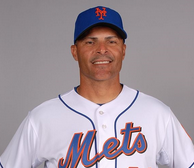
Showing posts with label Edgardo Alfonzo. Show all posts

Wednesday, August 16, 2017

30 Years Ago Today: Mets Score Club Record 23 Runs in a Game

The late Harry Caray probably wishes he hadn't been taken out to the ballgame on August 16, 1987.

The New York Mets are currently playing the crosstown rival Yankees in a four-game home-and-home series.  Thirty years ago today, the Mets were playing another of baseball's storied franchises, taking on the Chicago Cubs on a lazy Sunday afternoon at Wrigley Field.  One year after winning the 1986 World Series, the Mets were battling the St. Louis Cardinals for the division title and needed to win the finale of their four-game set against the Cubs after dropping the first three games.  They were in the throes of a poor stretch that saw them lose six out of eight games after they had cut the Cardinals’ lead in the division from 10½ to 3½ games.  In that eight-game stretch, they had scored only 20 runs.  They needed to bust out of their slump quickly if they were going to continue to stay in the race with St. Louis.  Fortunately, the wind was blowing out at Wrigley Field on August 16, 1987 and the Mets’ bats were ready to take advantage.

The starting pitchers were Ron Darling for the Mets and a kid for the Cubs who had just been recalled from the minors after being sent down two weeks earlier due to a poor 6-10 start for the big club.  You may have heard of him.  He was a scrawny 21-year-old kid named Greg Maddux.

The Mets jumped out of the box quickly, scoring three runs in the first inning to take an early lead.  The lead had extended to 7-0 by the time the Cubs came up to bat in the bottom of the fourth inning.  However, Darling struggled in the fourth, giving up a grand slam to catcher Jody Davis.  That was followed up by a home run from the next batter, a rookie who was pinch-hitting for Cubs reliever (and former Met) Ed Lynch.  That neophyte was Rafael Palmeiro, who hit the tenth of his 569 career home runs to cut the Mets lead to 7-5.

Fortunately for Darling, manager Davey Johnson did not remove him from the game despite the poor inning.  He was allowed to put out the fire he started and pitch the minimum five innings required to qualify for the victory.  Because of that, Darling was able to stick around to reap the benefits of the additional fireworks displayed by his teammates as they continued to ride the jet stream out of Wrigley Field.

The Mets immediately responded to the Cubs’ five-run fourth by scoring three runs in the fifth inning and seven additional runs in the sixth.  They now had a commanding 17-5 lead, but the Cubbie carnage continued.  Not satisfied with a lead of a dozen runs, they scored three additional runs in both the seventh and eighth innings.  Jesse Orosco relieved Darling in the seventh and gave up four runs in his inning of work, but by then, the Mets had already put the game away.  A run by Chicago in the ninth inning off Jeff Innis produced the final tally in the Mets’ 23-10 shellacking of the Cubs.

The offense was powered by Lenny Dykstra and Darryl Strawberry.  Eights were wild for the two Met outfielders, as they combined for eight hits, eight runs scored and eight runs batted in.  Strawberry in particular smoked the Cubs’ pitchers, as all four of his hits went for extra bases (two doubles, a triple and a home run).

Dykstra and Strawberry - two smiling California kids who put lots of frowns on Cubs fans' faces on August 16, 1987.

In doing so, Strawberry became just the third Met to produce four extra-base hits in one game, joining Joe Christopher, who accomplished the feat in 1964, and Tim Teufel, who turned the trick just six weeks prior to Strawberry.  Strawberry added a stolen base in the second inning, making him the first Met to collect four extra-base hits and a stolen base in the same game.  The Straw Man was the only Met to accomplish this feat until Yoenis Céspedes matched him with four extra-base hits (three homers, one double) and a steal against the Colorado Rockies on August 21, 2015.

Strawberry also became just the third Met to score five runs in a game, after Lenny Randle in 1978 and Lee Mazzilli in 1979.  In addition, the Straw Man drove in five runs, making him the first Mets player to have a five-run, five-RBI game in franchise history.  The only other Mets to accomplish that rare feat since August 16, 1987 are Edgardo Alfonzo, who produced six runs and five RBI against the Houston Astros on August 30, 1999, and Céspedes in the aforementioned 2015 affair.  He had seven RBI to go with his five runs scored.

Dykstra also made Mets history in the game, becoming the first Met to collect seven at-bats in a nine-inning game.  The only Met to match Dykstra since then is Luis Hernandez, who went 3-for-7 in an 18-5 thrashing of the Cubs in 2010, which, just like Dykstra's record-setting effort 23 years earlier, took place on a lazy Sunday afternoon at Wrigley Field.

Strawberry and Dykstra victimized several Cubs pitchers that day, including starting pitcher Greg Maddux.  Maddux collected almost 10% of his 355 career wins against the Mets.  His 35 victories (against 19 losses) are the most by any pitcher against New York.  However, one of his worst pitching performances against the Mets (or any other club) took place on that Sunday afternoon in the North Side of Chicago.

Throughout his major league career, which resulted in a much-deserved call to the Baseball Hall of Fame this year, Maddux was always known as a control pitcher, as he walked fewer than 1,000 batters in over 5,000 innings.  But on August 16, 1987 against the Mets, Maddux pitched 3 innings and was charged with seven earned runs allowed.  He gave up six hits and a very un-Maddux-like five bases on balls.  Let's dissect Maddux's effort to see just how much of an anomaly this game was for him.

Greg Maddux would have preferred starting at Shea Stadium on August 16, 1987.

Greg Maddux made 740 starts in his big league career.  He issued five bases on balls or more in just 20 of those starts.  But in 14 of those 20 starts, he lasted at least six innings, giving him more time to issue those free passes.  Maddux wouldn't have another game in which he lasted fewer than four innings and allowed five or more walks until 2004, a year in which he produced his first ERA above 4.00 since - you guessed it - 1987.

Maddux also allowed seven earned runs in the game, which was the first time he had ever allowed that many runs in one of his starts.  Maddux would go on to allow seven or more earned runs in a start a total of 27 times in his career, including three more times against the Mets, but he never walked more than three batters in any of his other seven-run efforts.  The game on August 16, 1987 was the only time in his 23-year career that Maddux allowed seven or more runs and walked more than three batters.  And that was from a future Hall of Famer who beat the Mets more than any other pitcher in the 56-year history of the club.

Going into their series finale against the Cubs on August 16, 1987, the Mets were in a hitting slump and got out of it in a major way at Wrigley Field.  They scored more runs in that one game than they did in their previous eight contests combined.  By doing so, the Mets established a new franchise record with their 23-run outburst in Chicago and were able to use that game as a stepping stone that carried them all the way until the last week of the season, when they were eliminated from playoff contention by the Cardinals.  And it all happened exactly 30 years ago today.


Thursday, August 3, 2017

Michael Conforto Could Join an Exclusive OBP Club

Make way for Michael Conforto, the OBP Machine!  (Mike Stobe/Getty Images)

In Wednesday's 10-5 victory over the Colorado Rockies, Michael Conforto reached base twice in five plate appearances, holding his on-base percentage at an impressive .401.  Despite Conforto's inability to crack the starting lineup early on (he started just four of the team's first 15 games), his 359 plate appearances currently qualify him for all full-season leaderboards, and as such, allow him to rank seventh in the National League in OBP.

Should Conforto maintain his .400-plus on-base percentage and reach the minimum 502 plate appearances to qualify for the batting title (or OBP title), he would join a very exclusive club of Mets players to accomplish that feat.  In fact, during the team's first 55 seasons, only seven players have reached base in at least 40% of their plate appearances when they had a sufficient number of trips to the plate.


Rk Player Year OBP PA AB R H 2B 3B HR RBI BB HBP SH SF BA SLG OPS
1Cleon Jones1969.42255848392164254127564713.340.482.904
2Keith Hernandez1984.40965755083171310159497109.311.449.859
3Keith Hernandez1986.41365255194171341138394403.310.446.859
4Dave Magadan1990.41754145174148286672742410.328.457.874
5John Olerud1997.4006305249015434122102851308.294.489.889
6John Olerud1998.44766555791197364229396417.354.551.998
7Rickey Henderson1999.42352643889138300124282213.315.466.889
8John Olerud1999.42772358110717339019961251106.298.463.890
9Edgardo Alfonzo2000.425650544109176402259495506.324.542.967
10David Wright2007.4167116041131964213010794607.325.546.963
11Michael Conforto2017.4013593026189191215647802.295.573.974
Provided by Baseball-Reference.com: View Play Index Tool Used
Generated 8/3/2017.


Cleon Jones became the first Met to do so in 1969, reaching base at a .422 clip and propelling the team to a World Series title.  It wasn't until the Mets' 23rd season that Jones had company in this formerly one-man club, as Keith Hernandez produced a .409 on-base percentage in 1984; the Mets' first 90-win season since Jones and his teammates won it all 15 years prior.

Hernandez repeated his .400-plus OBP feat two years later, when he helped the Mets take home their second World Series trophy.  Keith's fill-in at first base in the 1986 division clincher became the third Met to play a full season with an on-base percentage greater than .400, as Dave Magadan flirted with a batting title in 1990 before settling for third place in that race, but still managed to produce a lofty .417 OBP in 541 plate appearances.

After Magadan's one-year wonder campaign, the Mets played musical chairs at first base.  From 1991 to 1996, the Mets had a plethora of players who became their everyday first baseman, including Magadan himself in '91, future Hall of Famer Eddie Murray in '92 and '93, David Segui in '94, Rico Brogna in '95 and Butch Huskey in '96.  It wasn't until they made one of the most one-sided trades in club history that they found a starter for more than two seasons, and he became the team's all-time OBP king.

John Olerud was a Met for only three seasons, but he reached base at least 40% of the time in all three campaigns.  In 1997, he became the first Met with a .400 OBP over a full season in seven years.  He then followed it up with a .447 OBP in 1998, which remains a single-season franchise record, and a .427 OBP in 1999, when he helped the team advance to within two victories of a World Series berth.  His 1999 teammate, Rickey Henderson, didn't want Olerud to party alone in the .400 club, so he crossed the velvet rope and put up a .423 on-base percentage of his own.

A year after Olerud and Henderson became the team's first pair of .400 OBP players, they were both gone, as Olerud signed a free-agent contract to return home to Seattle and Henderson played his way out of New York, earning his release from the team in May.  But a new man took over the reins as the team's resident .400 on-base guy in 2000, as Edgardo Alfonzo posted a career-high .425 OBP in helping the team win its fourth National League pennant.

In the 16 seasons since Fonzie went over .400 in the OBP column, only one Met has joined him in the .400 club.  That would be David Wright, who in 2007 became the most recent player to achieve an on-base percentage of .400 or greater, as he reached base at a .416 clip for the 88-win Mets.

For the past ten seasons, Cleon Jones, Keith Hernandez, Dave Magadan, John Olerud, Rickey Henderson, Edgardo Alfonzo and David Wright have been the only seven players to post a .400 OBP over a season of at least 502 plate appearances.  Now Michael Conforto and his .401 on-base percentage are threatening to make this an eight-man club.  But one other thing stands out among the members of the .400 club that Conforto could have a tough time duplicating.

When Jones became the first Met to post a .400 OBP over a full season in 1969, he did so for a 100-win team.  Hernandez had his .400 seasons in 1984 and 1986 when the Mets won 90 and 108 games, respectively.  Magadan's 1990 campaign ended with 91 Mets victories, while Olerud's three .400 OBP seasons occurred during 88, 88 and 97-win campaigns.  (Rickey's season gave us 97 wins as well.)  When Fonzie did it, the Mets won 94 regular season games.  And Wright's high OBP helped the Mets win 88 games.

See a pattern forming there?  Every player who produced a .400 OBP over a full season played for a Mets team that finished with a winning record.  In fact, the worst record by a Mets team that had such a player was 88-74.  That's a far cry from the current Mets team, which is currently seven games under .500 at 49-56.

This year has been an anomaly for the Mets; a year in which the pitching has been the team's greatest disappointment when it was supposed to be an asset.  If Michael Conforto finishes the season with an on-base percentage above .400, it will be anomaly for another reason.  Barring a late-season push in the standings, it would mark the first time a Mets team employed a player with a .400-plus OBP and failed to produce a winning record.  Even with a surge in August and September, the team would be hard pressed to reach 88 victories; the minimum number of wins produced a Mets club that had a .400 OBP player.

Michael Conforto has been a steady presence in the field and at the plate.  He's also been a steady presence on the basepaths, reaching base more than 40% of the time in 2017.  However, his team hasn't been able to take advantage of his keen ability to not make outs.  The potential to join an exclusive seven-man club that includes several all-time Mets greats is a fine accomplishment.  It would be far better if Conforto could match Jones, Hernandez, Magadan, Olerud, Henderson, Alfonzo and Wright by joining that club while playing for a competitive Mets team.


Monday, March 14, 2016

The Most With The Least: Jose Valentin (2006)

Before anyone had ever heard of Bernard Madoff and Ponzi schemes, the Mets were a free-spending team.  Under general manager Omar Minaya, the team gave Carlos Beltran a seven-year, $119 million contract, then topped that three years later when Johan Santana signed a six-year deal for $137.5 million to pitch for the Mets.

Along the way, Minaya doled out four-year contracts to a quartet of thirty-somethings when he recruited Pedro Martinez, Billy Wagner, Luis Castillo and Jason Bay to play for the team.  The foursome went on to spend as much time on the disabled list or in the doghouse as they did on the field.

Omar Minaya loved to make a splash with lucrative free agent signings, even if they ended up hurting the team in hindsight.  But one acquisition that cost the team less than $1 million ended up paying unexpected dividends for the Mets on the way to their sole postseason appearance in the Minaya era.  Minaya signed many former All-Stars near the end of their careers.  But this player never made an All-Star team, nor did he ever win a Gold Glove or Silver Slugger award in his 16-year career.  He did, however, play a key role in the Mets' push toward the playoffs, surprising everyone who thought he would be nothing more than a bench player.

Jose Valentin went from bench player to everyday middle infielder on a division-winning team.  (Al Pereira/Getty Images)

Jose Antonio Valentin was signed as an amateur free agent by the San Diego Padres on his 17th birthday in 1986.  Twenty years after signing his first professional contract, he became a member of the New York Mets, inking a one-year deal worth $912,500.  Valentin had just come off an injury-plagued season with the Los Angeles Dodgers in 2005, batting .170 with two home runs in 56 games.  But Minaya was confident in Valentin's versatility and ability to produce off the bench in the late innings, citing those attributes as reasons for the signing of the 14-year veteran.

"(Valentin) can play anywhere," said Minaya.  "He can hit the fastball at the end of the game.  He's got power."

Valentin did hit a career-high 30 home runs in 2004 as a member of the Chicago White Sox, which was also his fifth consecutive season of 25 or more homers.  (Valentin was one of 18 players to hit 25+ HR in each season from 2000 to 2004.)  However, the version of Valentin being acquired by the Mets was 36 years old, battling injuries and coming off the worst season of his career.  At best, he was expected to be the team's top pinch-hitter, occasionally getting a start in left field for the injury-prone Cliff Floyd or allowing one of the infielders to get a day off here and there.  And that's exactly what Valentin did during the first month and a half of the season, although he didn't do it very well.

Through May 12, Valentin appeared as a pinch-hitter in 23 of the team's first 35 games.  He also appeared in three other games as a left fielder and once as a first baseman.  Valentin batted a mere .167 in those 27 games with no extra-base hits and just two RBI.  But in a rare start against one of his former teams in Milwaukee (Valentin spent the first eight seasons of his major league career with the Brewers), Valentin produced a two-run single and a two-run homer to help the Mets to a wild, 9-8 victory.  The following afternoon, Valentin delivered four hits and drove in two more runs in the Mets' 6-5, extra-inning loss to the Brewers.  Four days later, manager Willie Randolph gave Valentin a start at second base for the first time as a Met.  Although Valentin had started just nine games at the position prior to 2006, Randolph's decision ended up being one of the most important choices he made all year.

Although the Mets lost on May 18 to the St. Louis Cardinals, Valentin homered and scored two runs in the 6-3 defeat.  He also played flawless defense at second base, handling seven chances (five assists, two putouts) without an error.  Even before Valentin's first start at the position, the Mets' incumbent second baseman, Kaz Matsui, had fallen out of favor with the team and its fans.  Matsui was struggling to keep his batting average above .200 and as a result, was being constantly booed at Shea Stadium.  Following Valentin's impressive debut at second, Matsui continued to start at the position.  However, Matsui put up a horrendous .129/.182/.161 slash line over the next eight games, causing Randolph to give Valentin another start at second base on May 28.  Valentin rewarded his manager by driving in two runs in the Mets' 7-3 victory over the Florida Marlins.

Jose Valentin points at all the Kaz Matsui haters.  That's a lot of people he's pointing at.  (NY Daily News/Getty Images)

Valentin's performance against the Marlins earned him another start at second base the following night against the Arizona Diamondbacks.  Trailing 1-0 in the second inning, Valentin delivered a two-run single to give the Mets an early lead.  Four innings later, Valentin homered to give the Mets a much-needed insurance run in a game eventually won by New York, 8-7.

After the game, Randolph insisted that Valentin had not supplanted Matsui as the team's everyday second baseman, despite Valentin's resurgence at the plate after his slow start.

"I have a feeling (Matsui will) be making more starts," said Randolph.  "He's not totally out of the picture.  Everyone thinks he's lost his job, but that's not the case.  He's struggling a little bit, and we want to get him going again."

One day after Randolph claimed Matsui hadn't lost his job, Valentin homered again as the team's starting second baseman.  Ten days after that, the Mets sent Matsui - and $4.5 million in cash - to the Colorado Rockies for utility player Eli Marrero.  Second base now belonged to Jose Valentin for the remainder of the season, and Valentin made sure that no one would take the position from him.

From May 28 to June 21, Valentin batted .364 with a 1.060 OPS, producing 14 extra-base hits and 13 RBI in 19 starts to raise his batting average for the season above .300 for the first time.  Six of Valentin's 14 extra-base hits came during the Mets' season-changing ten-game road trip in Los Angeles, Arizona and Philadelphia.  New York began the long trip with a 4½-game lead over Philadelphia and a six-game advantage over Atlanta.  After winning nine of ten games away from Shea, including a three-game sweep in the city of Brotherly Love, the Mets' first-place lead had ballooned to 9½ games over the Phillies and a whopping 13 games over the Braves.

By the time July rolled around, the Mets' lead in the division had grown to a dozen games and top pitching prospect Mike Pelfrey had been called up to temporarily fill a spot in the rotation.  Pelfrey won his major league debut against the Marlins at Shea Stadium on July 8, but much of the credit for the victory belonged to Jose Valentin, who hit a grand slam in the first inning and nearly hit another one in the second, settling for a three-run triple off the base of the right field wall.  Valentin became just the second player in Mets history to drive in seven runs in the first two innings of a game, joining Gary Carter, who accomplished the feat on July 11, 1986.  


Video courtesy of MLB.com's YouTube channel


Less than two weeks after Valentin cleared the bases twice against the Marlins, he continued to mash in bases-loaded situations when the Mets took on the Houston Astros on July 21, as he broke a scoreless tie with a grand slam against Astros starter Taylor Buchholz.  This time, Valentin's blast helped John Maine earn his first win as a Met, as Maine completed a four-hit shutout in the 7-0 victory over the Astros.  Five days later, Valentin played the hero once again, delivering a walk-off single against Cubs reliever (and former Met) Glendon Rusch with two outs in the tenth inning to plate the game's only run.

Valentin continued to produce in August and September, coming through in a memorable way on September 18.  Valentin homered in his first two at-bats, leading the Mets to a 4-0 victory over the Marlins that clinched the National League East division title for New York - the team's first division crown since 1988.  Although Valentin had only 384 at-bats in his first season in Flushing, he still produced 24 doubles, three triples, 18 homers and 62 RBI.  Valentin also had an impressive .490 slugging percentage and .820 OPS.  And on a team filled with All-Stars, his 3.6 WAR ranked fourth behind Carlos Beltran (8.2), Jose Reyes (5.8) and David Wright (4.1).

Prior to his comeback campaign in 2006, the only second basemen in Mets history to hit more home runs than Valentin in a single season were Jeff Kent (1993, 1995) and Edgardo Alfonzo (1999, 2000).  In addition, the only second sacker in club annals to boast a higher slugging percentage than Valentin's .490 mark in 2006 was Alfonzo.

After the Mets swept the Los Angeles Dodgers in the division series (Valentin took an oh-fer in the three games), Valentin finished second on the team in RBI in the National League Championship Series against the St. Louis Cardinals.  The second baseman drove in five runs in the series, which was only surpassed by Carlos Delgado's nine runs batted in.  But much like Carlos Beltran was unjustly vilified for striking out with the bases loaded in the ninth inning to end the series, Valentin is remembered negatively by some fans for fanning with the bases loaded in the sixth inning, just minutes after Endy Chavez's leaping catch had apparently shifted the momentum of the game in the Mets' favor.  However, it was Valentin who started the failed ninth inning rally against Cardinals closer Adam Wainwright by delivering a single on a 3-2 pitch.

Just three weeks after Beltran took strike three from Wainwright, the Mets re-signed Valentin for one year and $3.8 million - approximately four times as much money as he earned in 2006.  Unfortunately, the injury bug that stayed away from Valentin during his first season with the Mets found him repeatedly in his second.  In spring training, Valentin missed some time because of a sleeping injury; he claimed to have slept incorrectly on the team bus.  Valentin then missed the entire month of May with a knee injury. 

Valentin's season came to an end shortly after the All-Star Break in a bizarre series of events.  First, he punched a wall in Puerto Rico out of frustration during the mid-season hiatus following an argument that took place while he was attempting to sell the local baseball team he owned.  A week later, a foul ball broke his leg, causing his season to come to an abrupt end.  Valentin re-signed with the Mets in 2008, but never played for the team and was released in June.  The team then gave him one last shot in 2009, signing the 39-year-old Valentin to a minor league contract, but released him before the end of spring training.  Valentin then retired to become a baseball instructor in his native Puerto Rico.  He returned to the majors as a first base coach for the Padres in 2014 and 2015, but he still holds out hope for a managerial position in the near future.

Photo by Doug DuKane/Getty Images

"I think I can be a good manager.  I would like to take my chances and see if I can be one of those Puerto Ricans that are managing in the big leagues.  Or a coach.  I would do it; start in the minor leagues.  I'd do it as a coach or as an instructor.  That's my goal - to make it to the big leagues again."


Jose Valentin had a solid 16-year career in the major leagues.  Although he hit over 300 doubles and nearly 250 homers, he never made an All-Star team or played in a World Series.  The closest he ever got to the Fall Classic was in 2006, when he had his final hurrah as a productive big league ballplayer - a last go-round that might never had happened had Omar Minaya not signed him for under a million dollars.

Valentin had one of the finest offensive seasons ever produced by a second baseman in Mets history and did all he could to help the Mets win the pennant, including leading off the ninth inning of Game Seven with a base hit.  But in the end, all he could do was watch the Cardinals celebrating their National League crown from third base, where he was left stranded along with the dreams of his teammates and the club's fans.

The 2006 season is bittersweet for anyone associated with the Mets, as the team had one of the most successful regular seasons in franchise history, only to be followed up by a disappointing postseason.  But for Jose Valentin, the 2006 campaign marked his final moment in the sun.  And no one will ever be able to take that season away from him.


Note:  The Most With The Least is a thirteen-part weekly series spotlighting those Mets players who performed at a high level without receiving the accolades or playing time their more established teammates got, due to injuries, executive decisions or other factors.  For previous installments, please click on the players' names below:

January 4, 2016: Benny Agbayani
January 11, 2016: Donn Clendenon
January 18, 2016: Tim Teufel
January 25, 2016: Hisanori Takahashi
February 1, 2016: Chris Jones
February 8, 2016: Claudell Washington
February 15, 2016: Moises Alou
February 22, 2016: Pat Zachry
February 29, 2016: Art Shamsky
March 7, 2016: Mark Carreon 


Monday, March 2, 2015

One Mo-MET In Time: Matt Franco

Prior to 1997, the Mets had only faced their crosstown rivals from the Bronx in Grapefruit League games and Mayor's Trophy exhibitions.  In addition, neither the Mets nor the Yankees had ever qualified for the postseason in the same year.  But thanks to interleague play, meaningful games between the two squads became a reality as the 20th century came to a close.

The first regular season contest between the two teams in 1997 ended with Dave Mlicki pumping his fists on the Yankee Stadium mound in celebration of the Mets' 6-0 victory over the Bronx Bombers.  It was the defining game for the journeyman Mlicki - an extraordinary moment in an otherwise ordinary ten-year major league career.

The Subway Series has become a venue for some of the most dramatic victories in Mets history.  Entering the 2015 season, the Mets have won 42 regular season games against the Yankees, including 13 one-run victories and six walk-off wins.  Perhaps the most dramatic of these one-run, walk-off triumphs occurred on July 10, 1999, as both the Mets and Yankees were trying to reach the playoffs in the same season for the first time.  And when the game ended, one Met became a hero for life, delivering the game-winning hit in a pinch.

Matt Franco proves that even bench players can become Mets legends.  (AP Photo)

Matthew Neil Franco was born for Hollywood endings.  His uncle, Kurt Russell, has been an actor since childhood, following in the footsteps of Franco's grandfather, Bing Russell.  Franco also has immediate family working behind the scenes, as his father is acclaimed movie producer Larry Franco.

Franco was drafted by the Chicago Cubs in the seventh round of the 1987 June amateur draft.  As is the case with many struggling actors, it took Franco several years to make it to the big show.  He didn't advance past the Double-A level until his seventh professional season and didn't make his major league debut until the final month of the 1995 campaign.

Following his 16-game cup of coffee with the Cubs in 1995, Franco was traded to the Mets at the outset of the 1996 season.  Once again, Franco's only time spent in the big leagues in 1996 was during a brief September call-up.  But after starting the 1997 campaign in the minors, Franco was called up by the Mets following an injury to outfielder Andy Tomberlin, who also served as the team's primary pinch-hitter from the left side of the plate.  Tomberlin never played for the Mets again as Franco took over as the team's top lefty-swinging pinch-hitter, batting .306 with three homers and 13 RBI in 66 plate appearances as a pinch-hitter.

In 1998, Franco continued to be one of the baseball's most productive pinch-hitters, reaching base 26 times (14 hits, 12 walks) in 68 pinch-hitting appearances.  But his best season off the bench came in 1999, and he punctuated his year with a dramatic at-bat against the top closer in the game.

On July 10, the Mets and Yankees entered the second game of their three-game set at Shea Stadium with both teams playing their best baseball.  The Yankees were in first place in the AL East and were owners of the third-best record in the game.  Meanwhile, the Mets were the hottest team in the sport, winning 22 of their last 32 games to move them within striking distance of the first-place Braves.

The Mets took the first game of the series, 5-2, with the deciding runs scoring on a tie-breaking three-run homer by Mike Piazza off Roger Clemens in the sixth inning.  Power was on full display in the second game - a Saturday matinee at Shea - but most of it came from the players sitting in the road team's dugout.

The Yankees hit six home runs that afternoon (two by Paul O'Neill, two by Jorge Posada, one each by Ricky Ledee and Chuck Knoblauch), becoming the seventh team to hit at least six homers in one game against the Mets.  The Mets had lost the six previous contests in which they were taken deep half a dozen times, losing those games by a combined 94-26 score.  They were determined not to go 0-for-7 in those situations.

Mike Piazza did his part, hitting one of the longest home runs in Shea Stadium's history - a 482-foot blast over the picnic area tents in left field - to give the Mets a temporary 7-6 lead in the seventh inning.  But a two-run homer by Jorge Posada an inning later helped the Yankees retake the lead.  The score remained 8-7 as future Hall of Fame closer Mariano Rivera came into the game in the ninth inning.

Rivera had never allowed a run to the Mets in four career appearances, notching saves in all four games.  But that streak was in jeopardy when Edgardo Alfonzo followed Rickey Henderson's one-out walk with a double.  With the tying and winning runs in scoring position, John Olerud grounded out to first baseman Tino Martinez, leaving Henderson and Alfonzo on base and Yankees manager Joe Torre with a decision to make.  Should he have Rivera face cleanup hitter Mike Piazza or should he walk him intentionally to face Melvin Mora, who had entered the game two innings earlier as a late-inning defensive replacement for Benny Agbayani?  Torre chose the latter, and had Rivera issue a four-pitch free pass to the Mets catcher.

Mets manager Bobby Valentine counteracted by inserting Matt Franco into the game to pinch-hit for Mora.  Franco had never gotten a hit against Rivera in two previous plate appearances, but he had drawn a walk.  And a walk against Rivera with the bases loaded would have tied the game.  But Franco had his eye on a bigger prize, and with the Mets down to their final strike, Franco delivered.


YouTube video courtesy of Courtside Tweets


After taking a borderline 0-2 pitch from Rivera that was called a ball by home plate umpire Jeff Kellogg - a call that did not please Torre, who could be seen mouthing "that ball's not low" in the Yankee dugout - Franco laced a single to right on Rivera's next offering.  Running on contact, Henderson scored easily from third base and Alfonzo slid home safely ahead of Paul O'Neill's throw, giving the Mets a thrilling 9-8 victory before 53,792 raucous fans at Shea Stadium.

The two-run single by Franco would be the only safety he'd record against Rivera in four career plate appearances.  Franco's clutch hit was also the first of four times the Mets defeated Rivera during his illustrious career.  The only teams to defeat Rivera more often during his 19-year tenure with the Yankees were the Orioles (nine losses), Red Sox (seven) and Rays (six) - all teams that played in Rivera's division.

Matt Franco's game-winning single on July 10 was one of 14 pinch-hits he collected in 1999.  Franco also set a major league record in 1999 when he walked 20 times as a pinch-hitter.  By reaching base 34 times in 80 pinch-hit appearances, Franco posted a stellar .425 on-base percentage, one of the highest marks in team history.

But despite being one of the best substitute players in club annals, Franco is mainly remembered for his one big hit on a warm summer day at Shea.

Photo by Ed Leyro


''In batting practice alone, I've been through that same situation a million times.  Everyone has.  Bottom of the ninth, bases loaded, two outs, two strikes.  To get the game-winning hit at Shea Stadium, playing the Yankees, with 53,000 people in the stands, the bases loaded, down a run, in the bottom of the ninth, I don't know how it's going to get any better than that.  It's a dream come true.''


Ed Kranepool set a team record with 90 pinch-hits.  Rusty Staub's 72 RBI are also best among all Mets' subs.  Both figures are nearly double the amount of hits and RBI put by Matt Franco as a pinch-hitter (58 hits, 37 RBI) during his five seasons with the Mets.  But for all the regular season records set by Kranepool and Staub during their times as the top hitter off the bench for the Mets, none of their hits or runs batted in have resonated as much with Mets fans as Franco's game-winner off Mariano Rivera.

Matt Franco was born to a family that spent a lot of time in front of the camera.  But in a season where the Yankees and Mets qualified for the postseason together for the first time and one year before the teams squared off in the first Subway World Series in 44 years, it was Franco who took center stage in a mid-July game at Shea Stadium.

Hollywood is known for producing storybook endings in film and television.  On July 10, 1999, Matt Franco produced a storybook ending of his own.  And in doing so, he became a beloved Met for life, all because he came through in a pinch against one of the most dependable pitchers of this or any other generation.

No script could have produced a better ending.


Note:  One Mo-MET In Time is a thirteen-part weekly series spotlighting those Mets players who will forever be known for a single moment, game or event, regardless of whatever else they accomplished during their tenure with the Mets.  For previous installments, please click on the players' names below:

January 5, 2015: Mookie Wilson 
January 12, 2015: Dave Mlicki
January 19, 2015: Steve Henderson 
January 26, 2015: Ron Swoboda
February 2, 2015: Anthony Young
February 9, 2015: Tim Harkness
February 16, 2015: Kenny Rogers, Aaron Heilman, Tom Glavine
February 23, 2015: Mike Vail

Saturday, August 16, 2014

August 16, 1987: Mets Score Club-Record 23 Runs

The late Harry Caray probably wishes he hadn't been taken out to the ballgame on August 16, 1987.

Note:  I originally published this piece five years ago on Mets Merized Online, but this Mets game from 1987 has always fascinated me, and I have since uncovered some more oddities about this game.  Therefore, I felt compelled to make some quick edits and share this piece once again with you.  Enjoy!


The New York Mets are currently playing a three-game set against the Chicago Cubs at Citi Field.  Twenty-seven years ago today, the Mets were also playing the Cubs, although the venue on that lazy Sunday afternoon was Wrigley Field in Chicago.  One year after winning the 1986 World Series, the Mets were battling the St. Louis Cardinals for the division title and needed to win the finale of their four-game series against the Cubs after dropping the first three games.  They were in the throes of a poor stretch that saw them lose six out of eight games after they had cut the Cardinals’ lead in the division from 10½ to 3½ games.  In that eight-game stretch, they had scored only 20 runs.  They needed to bust out of their slump quickly if they were going to continue to stay in the race with St. Louis.  Fortunately, the wind was blowing out at Wrigley Field on August 16 and the Mets’ bats were ready to take advantage.

The starting pitchers were Ron Darling for the Mets and a kid for the Cubs who had just been recalled from the minors after being sent down two weeks earlier due to a poor 6-10 start for the big club.  You may have heard of him.  He was a scrawny 21-year-old kid named Greg Maddux.

The Mets jumped out of the box quickly, scoring three runs in the first inning to take an early lead.  The lead had extended to 7-0 by the time the Cubs came up to bat in the bottom of the fourth inning.  However, Ron Darling struggled in the fourth, giving up a grand slam to catcher Jody Davis.  That was followed up by a home run from the next batter, a rookie who was pinch-hitting for Cubs reliever (and former Met) Ed Lynch.  That rookie was Rafael Palmeiro, who hit the tenth of his 569 career home runs to cut the Mets lead to 7-5.

Fortunately for Darling, manager Davey Johnson did not remove him from the game despite the poor inning.  He was allowed to put out the fire he started and pitch the minimum five innings required to qualify for the victory.  Because of that, Darling was able to stick around to reap the benefits of the additional fireworks displayed by his teammates as they continued to ride the jet stream out of Wrigley Field.

The Mets immediately responded to the Cubs’ five-run fourth by scoring three runs in the fifth inning and seven additional runs in the sixth.  They now had a commanding 17-5 lead, but the Cubbie carnage continued.  Not satisfied with a lead of a dozen runs, they scored three additional runs in both the seventh and eighth innings.  Jesse Orosco relieved Darling in the seventh and gave up four runs in his inning of work, but by then, the Mets had already put the game away.  A run by Chicago in the ninth inning off Jeff Innis produced the final tally in the Mets’ 23-10 shellacking of the Cubs.

The offense was powered by Lenny Dykstra and Darryl Strawberry.  Eights were wild for the two Met outfielders, as they combined for eight hits, eight runs scored and eight runs batted in.  Strawberry in particular smoked the Cubs’ pitchers, as all four of his hits went for extra bases (two doubles, a triple and a home run).

Dykstra and Strawberry - two smiling California kids who put lots of frowns on Cubs fans' faces on August 16, 1987.

In doing so, Strawberry became just the third Met to produce four extra-base hits in one game, joining Joe Christopher, who accomplished the feat in 1964, and Tim Teufel, who turned the trick just six weeks prior to Strawberry.  Strawberry added a stolen base in the second inning, making him the first and only Met to collect four extra-base hits and a stolen base in the same game.

Strawberry also became just the third Met to score five runs in a game, after Lenny Randle in 1978 and Lee Mazzilli in 1979.  In addition, the Straw Man drove in five runs, making him the first Mets player to have a five-run, five-RBI game in franchise history.  The only other Met to accomplish that rare feat since August 16, 1987 is Edgardo Alfonzo, who produced six runs and five RBI against the Houston Astros on August 30, 1999.

Dykstra also made Mets history in the game, becoming the first Met to collect seven at-bats in a nine-inning game.  The only Met to match Dykstra since then is Luis Hernandez, who went 3-for-7 in an 18-5 thrashing of the Cubs in 2010, which, just like Dykstra's record-setting effort 23 years earlier, took place on a lazy Sunday afternoon at Wrigley Field.

Strawberry and Dykstra victimized several Cubs pitchers that day, including starting pitcher Greg Maddux.  Maddux collected almost 10% of his 355 career wins against the Mets.  His 35 victories (against 19 losses) are the most by any pitcher against New York.  However, one of his worst pitching performances against the Mets (or any other club) took place on that Sunday afternoon in the North Side of Chicago.

Throughout his major league career, which resulted in a much-deserved call to the Baseball Hall of Fame this year, Maddux was always known as a control pitcher, as he walked fewer than 1,000 batters in over 5,000 innings.  But on August 16, 1987 against the Mets, Maddux pitched 3 innings and was charged with seven earned runs allowed.  He gave up six hits and a very un-Maddux-like five bases on balls.  Let's dissect Maddux's effort to see just how much of an anomaly this game was for him.

Greg Maddux would have preferred starting at Shea Stadium on August 16, 1987.

Greg Maddux made 740 starts in his big league career.  He issued five bases on balls or more in just 20 of those starts.  But in 14 of those 20 starts, he lasted at least six innings, giving him more time to issue those free passes.  Maddux wouldn't have another game in which he lasted fewer than four innings and allowed five or more walks until 2004, a year in which he produced his first ERA above 4.00 since - you guessed it - 1987.

Maddux also allowed seven earned runs in the game, which was the first time he had ever allowed that many runs in one of his starts.  Maddux would go on to allow seven or more earned runs in a start a total of 27 times in his career, including three more times against the Mets, but he never walked more than three batters in any of his other seven-run efforts.  The game on August 16, 1987 was the only time in his 23-year career that Maddux allowed seven or more runs and walked more than three batters.  And that was from a future Hall of Famer who beat the Mets more than any other pitcher in the 53-year history of the club.

Going into their series finale against the Cubs on August 16, 1987, the Mets were in a hitting slump and got out of it in a major way at Wrigley Field.  They scored more runs in that one game than they did in their previous eight contests.  By doing so, the Mets established a new franchise record with their 23-run outburst in Chicago and were able to use that game as a stepping stone that carried them all the way until the last week of the season, when they were eliminated from playoff contention by the Cardinals.  And it all happened 27 years ago today.
 

Saturday, October 5, 2013

Daniel Murphy Appreciation Day

This is where I tip my cap to Daniel Murphy. (Photo by Greg Fiume/Getty Images)

Before I begin, let me preface this by saying that if you're not a Daniel Murphy supporter, then in all likelihood you will not be a fan of this post.  (And for the record, the title of this piece was suggested by my Gal For All Seasons, so I'm not alone in my appreciation for the Mets' second baseman.)

Look back at the great second baseman in Mets history.  There's Edgardo Alfonzo and there's ... uh ... well ...  there's not much else.  Sure, there were some second basemen who had good years, like two-time All-Star and Rookie of the Year runner-up Ron Hunt, but he was mostly a singles hitters who made as much contact with the ball using his bat (.282 lifetime average as a Met) as he did with his body (41 HBP in four seasons in New York).

In addition to Hunt, the Mets have employed other fine second sackers such as Felix Millan (who made Ron Hunt look like an extra-base hit machine), Doug Flynn (ditto) and Wally Backman (double ditto).  Ken Boswell had some pop, if you want to call a career-high nine home runs in 1972 "some pop".

There have also been a number of second basemen who were great before they came to the Mets, then underachieved in New York.  Do the names Carlos Baerga, Roberto Alomar and Luis Castillo ring a bell?

Basically, after Alfonzo, the next-best second baseman in club annals might have been Jeff Kent, who had some solid years in Flushing when he wasn't thinking about being on his ranch in Texas.  And Kent probably couldn't concentrate much on that ranch with all those boos from the Shea Faithful permeating the daydream sensors in his brain.

But that No. 2 spot behind Fonzie on the unofficial list of greatest second basemen in Mets history might have a new resident taking off the vacancy sign very soon.  And that resident's name is Daniel Murphy.

Make room for Daniel Murphy at second base.

Daniel Murphy had one of the greatest seasons ever recorded by a Mets second baseman in 2013.  He finished the year with a .286 batting average, 38 doubles, 13 homers, 78 RBI, 92 runs scored and 23 stolen bases.  Prior to Murphy, the only second basemen in franchise history to reach double digits in both home runs and RBI in the same season were Gregg Jefferies and Roberto Alomar.  But neither player matched Murphy's totals in batting average, runs scored, runs batted in and stolen bases.  In fact, the only two players in team history who had better numbers than Murphy in all six offensive categories (batting average, doubles, home runs, RBI, runs scored, stolen bases), regardless of their defensive position, were Howard Johnson in 1989 (.287 average, 41 doubles, 36 HR, 101 RBI, 104 runs scored, 41 SB) and David Wright in 2007 (.325 average, 42 doubles, 30 HR, 107 RBI, 113 runs scored, 34 SB).

Murphy's 2013 campaign saw him finish among the National League leaders in a number of offensive categories.  Murphy was in the top ten in games played (161; 2nd in the NL), hits (188; 2nd), singles (133; 2nd), doubles (38; T-7th), total bases (273; 8th), runs scored (92; 8th) and stolen bases (23; T-7th).  The only other player in the National League to finish in the top ten in all of those categories was MVP candidate Andrew McCutchen.  (Oh, and did I mention that Murphy finished first in the league in stolen base percentage, as he was caught stealing only three times in 26 attempts?  Andrew McCutchen, on the other hand, was caught stealing ten times, making him one of only nine players in the National League to reach double digits in that category.)

Offensively, there are few second basemen in the league who can match Daniel Murphy's overall production.  However, there have been some questions posed about Murphy's ability to handle the defensive side of the position.  It's true that Murphy had an unfavorable defensive WAR (-1.5) and made 16 errors at second base.  But that doesn't mean he was a complete wash at the position.

Murphy finished second in the league in putouts to three-time Gold Glove winner Brandon Phillips.  In addition, Murphy finished third in the NL in assists (behind Phillips and Neil Walker) and third in double plays turned (behind Walker and MVP candidate Matt Carpenter).

Now let's look at the 16 errors committed by Murphy, a total that was surpassed in the Senior Circuit only by Chase Utley, who made one more miscue.  Murphy played 150 games at second base in 2013 (his other 11 games were at first base and pinch-hitter).  The three second basemen who finished directly behind Murphy in errors committed were Dan Uggla, Marco Scutaro and Rickie Weeks, who made 14, 13 and 10 errors, respectively.  But Uggla, Scutaro and Weeks all spent time on the disabled list, combining to miss 119 games this past season with each player missing at least 26 games.  Had they all remained on the field, perhaps one or more of them could have committed more gaffes at second base than Murphy.

Doubles, stolen bases, death-defying leaps over catchers.  Is there anything Daniel Murphy can't do?

For his career, Daniel Murphy has been known as a doubles machine.  He has the only 40-double campaign for a left-handed hitter in team history.  Murphy is also one of only two Mets (David Wright is the other) with three or more seasons of 35+ doubles.  And with 73 more doubles (about two average Daniel Murphy seasons), Murphy will pass Ed Kranepool to become the second-most prolific doubles hitter in franchise history.  But Murphy is more than just a producer of two-base hits.  He proved that (and then some) in 2013.

In my opinion, Daniel Murphy has not been appreciated enough by Mets fans.  Just like Carlos Beltran (who continues to be remembered more for keeping the bat on his shoulders as a Lord Charles curveball danced on by than for the complete player that he was), Daniel Murphy will always have detractors who will complain that he doesn't take enough walks or that he's a horrible defensive player.

To those detractors, I have one thing to say.  Be careful what you wish for.  Many players have been run out of town only to come back and haunt the Mets.  Don't let Daniel Murphy become another one of those players.  Take time to appreciate what Daniel Murphy has done for the team and what he hopefully will continue to do for the team as its second baseman.  The Mets have not had many productive second basemen like Daniel Murphy in their 52-year history.

Not everyone can be Edgardo Alfonzo at second base.  It's a good thing Daniel Murphy doesn't try to be.