Showing posts with label Omar Minaya. Show all posts

Monday, March 14, 2016

The Most With The Least: Jose Valentin (2006)

Before anyone had ever heard of Bernard Madoff and Ponzi schemes, the Mets were a free-spending team.  Under general manager Omar Minaya, the team gave Carlos Beltran a seven-year, $119 million contract, then topped that three years later when Johan Santana signed a six-year deal for $137.5 million to pitch for the Mets.

Along the way, Minaya doled out four-year contracts to a quartet of thirty-somethings when he recruited Pedro Martinez, Billy Wagner, Luis Castillo and Jason Bay to play for the team.  The foursome went on to spend as much time on the disabled list or in the doghouse as they did on the field.

Omar Minaya loved to make a splash with lucrative free agent signings, even if they ended up hurting the team in hindsight.  But one acquisition that cost the team less than $1 million ended up paying unexpected dividends for the Mets on the way to their sole postseason appearance in the Minaya era.  Minaya signed many former All-Stars near the end of their careers.  But this player never made an All-Star team, nor did he ever win a Gold Glove or Silver Slugger award in his 16-year career.  He did, however, play a key role in the Mets' push toward the playoffs, surprising everyone who thought he would be nothing more than a bench player.

Jose Valentin went from bench player to everyday middle infielder on a division-winning team.  (Al Pereira/Getty Images)

Jose Antonio Valentin was signed as an amateur free agent by the San Diego Padres on his 17th birthday in 1986.  Twenty years after signing his first professional contract, he became a member of the New York Mets, inking a one-year deal worth $912,500.  Valentin had just come off an injury-plagued season with the Los Angeles Dodgers in 2005, batting .170 with two home runs in 56 games.  But Minaya was confident in Valentin's versatility and ability to produce off the bench in the late innings, citing those attributes as reasons for the signing of the 14-year veteran.

"(Valentin) can play anywhere," said Minaya.  "He can hit the fastball at the end of the game.  He's got power."

Valentin did hit a career-high 30 home runs in 2004 as a member of the Chicago White Sox, which was also his fifth consecutive season of 25 or more homers.  (Valentin was one of 18 players to hit 25+ HR in each season from 2000 to 2004.)  However, the version of Valentin being acquired by the Mets was 36 years old, battling injuries and coming off the worst season of his career.  At best, he was expected to be the team's top pinch-hitter, occasionally getting a start in left field for the injury-prone Cliff Floyd or allowing one of the infielders to get a day off here and there.  And that's exactly what Valentin did during the first month and a half of the season, although he didn't do it very well.

Through May 12, Valentin appeared as a pinch-hitter in 23 of the team's first 35 games.  He also appeared in three other games as a left fielder and once as a first baseman.  Valentin batted a mere .167 in those 27 games with no extra-base hits and just two RBI.  But in a rare start against one of his former teams in Milwaukee (Valentin spent the first eight seasons of his major league career with the Brewers), Valentin produced a two-run single and a two-run homer to help the Mets to a wild, 9-8 victory.  The following afternoon, Valentin delivered four hits and drove in two more runs in the Mets' 6-5, extra-inning loss to the Brewers.  Four days later, manager Willie Randolph gave Valentin a start at second base for the first time as a Met.  Although Valentin had started just nine games at the position prior to 2006, Randolph's decision ended up being one of the most important choices he made all year.

Although the Mets lost on May 18 to the St. Louis Cardinals, Valentin homered and scored two runs in the 6-3 defeat.  He also played flawless defense at second base, handling seven chances (five assists, two putouts) without an error.  Even before Valentin's first start at the position, the Mets' incumbent second baseman, Kaz Matsui, had fallen out of favor with the team and its fans.  Matsui was struggling to keep his batting average above .200 and as a result, was being constantly booed at Shea Stadium.  Following Valentin's impressive debut at second, Matsui continued to start at the position.  However, Matsui put up a horrendous .129/.182/.161 slash line over the next eight games, causing Randolph to give Valentin another start at second base on May 28.  Valentin rewarded his manager by driving in two runs in the Mets' 7-3 victory over the Florida Marlins.

Jose Valentin points at all the Kaz Matsui haters.  That's a lot of people he's pointing at.  (NY Daily News/Getty Images)

Valentin's performance against the Marlins earned him another start at second base the following night against the Arizona Diamondbacks.  Trailing 1-0 in the second inning, Valentin delivered a two-run single to give the Mets an early lead.  Four innings later, Valentin homered to give the Mets a much-needed insurance run in a game eventually won by New York, 8-7.

After the game, Randolph insisted that Valentin had not supplanted Matsui as the team's everyday second baseman, despite Valentin's resurgence at the plate after his slow start.

"I have a feeling (Matsui will) be making more starts," said Randolph.  "He's not totally out of the picture.  Everyone thinks he's lost his job, but that's not the case.  He's struggling a little bit, and we want to get him going again."

One day after Randolph claimed Matsui hadn't lost his job, Valentin homered again as the team's starting second baseman.  Ten days after that, the Mets sent Matsui - and $4.5 million in cash - to the Colorado Rockies for utility player Eli Marrero.  Second base now belonged to Jose Valentin for the remainder of the season, and Valentin made sure that no one would take the position from him.

From May 28 to June 21, Valentin batted .364 with a 1.060 OPS, producing 14 extra-base hits and 13 RBI in 19 starts to raise his batting average for the season above .300 for the first time.  Six of Valentin's 14 extra-base hits came during the Mets' season-changing ten-game road trip in Los Angeles, Arizona and Philadelphia.  New York began the long trip with a 4½-game lead over Philadelphia and a six-game advantage over Atlanta.  After winning nine of ten games away from Shea, including a three-game sweep in the city of Brotherly Love, the Mets' first-place lead had ballooned to 9½ games over the Phillies and a whopping 13 games over the Braves.

By the time July rolled around, the Mets' lead in the division had grown to a dozen games and top pitching prospect Mike Pelfrey had been called up to temporarily fill a spot in the rotation.  Pelfrey won his major league debut against the Marlins at Shea Stadium on July 8, but much of the credit for the victory belonged to Jose Valentin, who hit a grand slam in the first inning and nearly hit another one in the second, settling for a three-run triple off the base of the right field wall.  Valentin became just the second player in Mets history to drive in seven runs in the first two innings of a game, joining Gary Carter, who accomplished the feat on July 11, 1986.  


Video courtesy of MLB.com's YouTube channel


Less than two weeks after Valentin cleared the bases twice against the Marlins, he continued to mash in bases-loaded situations when the Mets took on the Houston Astros on July 21, as he broke a scoreless tie with a grand slam against Astros starter Taylor Buchholz.  This time, Valentin's blast helped John Maine earn his first win as a Met, as Maine completed a four-hit shutout in the 7-0 victory over the Astros.  Five days later, Valentin played the hero once again, delivering a walk-off single against Cubs reliever (and former Met) Glendon Rusch with two outs in the tenth inning to plate the game's only run.

Valentin continued to produce in August and September, coming through in a memorable way on September 18.  Valentin homered in his first two at-bats, leading the Mets to a 4-0 victory over the Marlins that clinched the National League East division title for New York - the team's first division crown since 1988.  Although Valentin had only 384 at-bats in his first season in Flushing, he still produced 24 doubles, three triples, 18 homers and 62 RBI.  Valentin also had an impressive .490 slugging percentage and .820 OPS.  And on a team filled with All-Stars, his 3.6 WAR ranked fourth behind Carlos Beltran (8.2), Jose Reyes (5.8) and David Wright (4.1).

Prior to his comeback campaign in 2006, the only second basemen in Mets history to hit more home runs than Valentin in a single season were Jeff Kent (1993, 1995) and Edgardo Alfonzo (1999, 2000).  In addition, the only second sacker in club annals to boast a higher slugging percentage than Valentin's .490 mark in 2006 was Alfonzo.

After the Mets swept the Los Angeles Dodgers in the division series (Valentin took an oh-fer in the three games), Valentin finished second on the team in RBI in the National League Championship Series against the St. Louis Cardinals.  The second baseman drove in five runs in the series, which was only surpassed by Carlos Delgado's nine runs batted in.  But much like Carlos Beltran was unjustly vilified for striking out with the bases loaded in the ninth inning to end the series, Valentin is remembered negatively by some fans for fanning with the bases loaded in the sixth inning, just minutes after Endy Chavez's leaping catch had apparently shifted the momentum of the game in the Mets' favor.  However, it was Valentin who started the failed ninth inning rally against Cardinals closer Adam Wainwright by delivering a single on a 3-2 pitch.

Just three weeks after Beltran took strike three from Wainwright, the Mets re-signed Valentin for one year and $3.8 million - approximately four times as much money as he earned in 2006.  Unfortunately, the injury bug that stayed away from Valentin during his first season with the Mets found him repeatedly in his second.  In spring training, Valentin missed some time because of a sleeping injury; he claimed to have slept incorrectly on the team bus.  Valentin then missed the entire month of May with a knee injury. 

Valentin's season came to an end shortly after the All-Star Break in a bizarre series of events.  First, he punched a wall in Puerto Rico out of frustration during the mid-season hiatus following an argument that took place while he was attempting to sell the local baseball team he owned.  A week later, a foul ball broke his leg, causing his season to come to an abrupt end.  Valentin re-signed with the Mets in 2008, but never played for the team and was released in June.  The team then gave him one last shot in 2009, signing the 39-year-old Valentin to a minor league contract, but released him before the end of spring training.  Valentin then retired to become a baseball instructor in his native Puerto Rico.  He returned to the majors as a first base coach for the Padres in 2014 and 2015, but he still holds out hope for a managerial position in the near future.

Photo by Doug DuKane/Getty Images

"I think I can be a good manager.  I would like to take my chances and see if I can be one of those Puerto Ricans that are managing in the big leagues.  Or a coach.  I would do it; start in the minor leagues.  I'd do it as a coach or as an instructor.  That's my goal - to make it to the big leagues again."


Jose Valentin had a solid 16-year career in the major leagues.  Although he hit over 300 doubles and nearly 250 homers, he never made an All-Star team or played in a World Series.  The closest he ever got to the Fall Classic was in 2006, when he had his final hurrah as a productive big league ballplayer - a last go-round that might never had happened had Omar Minaya not signed him for under a million dollars.

Valentin had one of the finest offensive seasons ever produced by a second baseman in Mets history and did all he could to help the Mets win the pennant, including leading off the ninth inning of Game Seven with a base hit.  But in the end, all he could do was watch the Cardinals celebrating their National League crown from third base, where he was left stranded along with the dreams of his teammates and the club's fans.

The 2006 season is bittersweet for anyone associated with the Mets, as the team had one of the most successful regular seasons in franchise history, only to be followed up by a disappointing postseason.  But for Jose Valentin, the 2006 campaign marked his final moment in the sun.  And no one will ever be able to take that season away from him.


Note:  The Most With The Least is a thirteen-part weekly series spotlighting those Mets players who performed at a high level without receiving the accolades or playing time their more established teammates got, due to injuries, executive decisions or other factors.  For previous installments, please click on the players' names below:

January 4, 2016: Benny Agbayani
January 11, 2016: Donn Clendenon
January 18, 2016: Tim Teufel
January 25, 2016: Hisanori Takahashi
February 1, 2016: Chris Jones
February 8, 2016: Claudell Washington
February 15, 2016: Moises Alou
February 22, 2016: Pat Zachry
February 29, 2016: Art Shamsky
March 7, 2016: Mark Carreon 


Monday, February 15, 2016

The Most With The Least: Moises Alou (2007)

It's not exactly a secret that older players tend to break down during the long baseball season more often than their younger counterparts do.  Through the 2015 season, Mets players have appeared in 150 or more games in a single season a total of 88 times.  Sixty-two of those 88 instances were by players who had yet to turn 30 when they accomplished the feat.  And when 37-year-old Eddie Murray played in 154 games for the Mets in 1993, he became the oldest player in franchise history to complete a season in which he appeared in a minimum of 150 games.

Murray is one of just six players in club annals to play at least 100 games in a season after he had blown out 37 candles.  He's also one of three former Mets - Brett Butler and Rickey Henderson are the others - who had at least 350 at-bats in a season after turning 37.  Needless to say, older position players have rarely contributed on an everyday basis for the Mets, and even fewer have been as productive as they were during their younger years.

One former Met in particular had a fantastic - albeit abbreviated - season with the team after he was signed as a free agent four months after his 40th birthday.  Injuries curtailed his first season with the club, causing him to miss over two months of action.  But when he returned from his extended stay on the disabled list, the quadragenarian embarked on a record-setting stretch with his bat, doing everything he could to prevent the team from falling victim to what became an epic collapse.

Omar Minaya finally got his man when he signed Moises Alou.  (Doug Benc/Getty Images)

Moises Rojas Alou always had trouble staying healthy throughout his entire major league career.  In the 1990s, he missed two entire years (1991, 1999) because of injuries.  He also missed at least 26 games in ten other seasons.  When he was healthy, he was one of the best hitters in the sport, batting .330 or higher three times.  He also produced three 30-HR campaigns and five 100-RBI seasons.

But after a seven-year stretch from 1997 to 2003 in which Alou helped three teams reach the postseason, which included winning a World Series title with the Florida Marlins in 1997, the left fielder's luck with team success faded.  It began with the moment Alou could not catch a foul ball in Game Six of the 2003 National League Championship Series - a moment that Chicago Cubs fan Steve Bartman is still catching hell for.  Alou and his Cubs teammates failed to win the game and the pennant.  A year later, the Cubs finished in third place in the N.L. Central, despite Alou's best efforts (39 HR, 106 RBI) to carry the team back to the playoffs.  The 38-year-old Alou then left the Cubs to play two seasons in San Francisco, where his father, Felipe, was the team's manager.  But the Giants, who had just completed their eighth consecutive winning season in 2004, were tremendous disappointments in 2005 and 2006, finishing below .500 in both years.

Alou had already turned 40 when he became a free agent for the last time following the 2006 campaign.  He also had not appeared in a postseason game in three consecutive seasons after making four trips to playoffs in the previous seven years.  The Mets, who had come within one win of a trip to the World Series in 2006, were in dire need of a right-handed bat, particularly one who could hit left-handed pitchers effectively.  They found their man in Alou, whose lifetime .332/.399/.559 slash line against southpaws was exactly what general manager Omar Minaya was looking for in a middle-of-the-order hitter.  Minaya signed Alou to a one-year, $7.5 million contract, with a second year club option.  According to Alou, winning was the main reason why he chose to sign with the Mets.

"The length of the contract doesn't matter to me at this point in my career," Alou said.  "I want to win this year.  And if things work out the way I think they will, I will play two years in New York."

With the soon-to-be 41-year-old on board, the Mets began the 2007 season by winning their first four games in convincing fashion.  Alou collected five hits and two walks in the four games - games the Mets won by a combined 31-3 score.  By late April, Alou was on a tear, batting just under .400 with an OPS over 1.000.  But the injury bug found its way back into Alou's system, as the left fielder strained his left quadriceps muscle in a game against the Milwaukee Brewers on May 12.  With Alou out of the lineup, the team struggled on offense, batting .252 with a .308 on-base percentage in the month of June, after collectively batting .281 and reaching base at a .352 clip prior to Alou's injury.

Alou tried to get back in the lineup in early June, but when his doctors allowed him to resume running, he continued to feel pain in his left leg.  The Mets were in the midst of a three-week stretch in which they lost 13 of 16 games, and the time off the field was clearly upsetting Alou.

Travis Lindquist/Getty Images


 "I'm frustrated.  I came here to play, not get hurt.  I mean, I have to play.  I didn't think it would be this long, and I'm very disappointed.  When you're hurt and you're on a good team, you feel like you're in everybody's way.  I don't like that feeling."


Alou wasn't the only one frustrated, as manager Willie Randolph couldn't decide on which player was best suited to replace Alou during his time on the disabled list.  By the time Alou returned from what became an unwanted 66-game vacation, Randolph had called upon Carlos Gomez (20 starts), Endy Chavez (12 starts), Ricky Ledee (9 starts), Lastings Milledge (8 starts), Ben Johnson (5 starts), David Newhan (5 starts), Marlon Anderson (4 starts) and Damion Easley (3 starts) to fill in for Alou in left field.  But once Alou shook off the rust from his extended stay on the D.L., he became the hottest hitter on the team.

After not collecting a hit in four of his first ten games following his return to the team (which briefly lowered his batting average under .300), Alou went on an 11-game hitting streak, in which he produced five homers and drove in 13 runs.  The Mets won seven of those 11 games.  Then, after going 0-for-4 against the San Diego Padres on August 22, Alou embarked on another hitting streak - one that wouldn't end until he entered the Mets' record books.

Alou collected at least one hit in the six games he started from August 23 to August 29.  Alou didn't the start the game against the Phillies on August 30, but he did come into the game as a pinch-hitter in the eighth inning, where he walked to helped fuel a five-run rally by the Mets.  Although Alou did not collect a hit in the game, his hitting streak would be allowed to continue, as MLB rules dictate that such a skein cannot by terminated if all of a player's plate appearances in a game result in either a walk, hit batsman, defensive indifference and/or sacrifice bunt.

Following his appearance as a pinch-hitter in Philadelphia, Alou started nine of the team's next ten games.  The Mets won all nine of the games he started and were shut out in the one game he didn't start.  When the Mets defeated the Atlanta Braves on September 12, their lead in the N.L. East grew to a season-high seven games with 17 games to play.  Alou was one of the main reasons for the team's early September success, batting .421 with eight extra-base hits, ten runs scored and five RBI in the month through the 12th.  His hitting streak also stood at 17 games, which was just nine short of the team's all-time record of 26, set by David Wright earlier in the 2007 season (the streak began at the end of the 2006 campaign and continued into 2007) and seven games short of the team's single-season record (Hubie Brooks and Mike Piazza shared that record).

But then the Mets went into a free fall, losing their next five games.  At the same time, the Phillies won six games in a row to cut the Mets' lead in the division to a scant 1½ games.  Alou did all he could to help the Mets during their losing streak, collecting nine hits in the five games, but the team's suspect pitching was mostly responsible for the defeats, allowing 39 runs in the handful of contests.  The Mets recovered to win four of the next five games, with Alou contributing eight hits and five RBI.  In the fifth game, one in which the Mets defeated the Marlins, 7-6 in 11 innings, Alou drove in the tying run with a single in the eighth inning after failing to collect a hit in his first three at-bats.  The single extended his hitting streak to a team-record 27 games and also made him the oldest player in history with a skein of that length.  

New York entered the final week of the regular season with a 2½-game lead over the Phillies.  On paper, they appeared to be in good shape as they entered their three-game series in Washington against the Nationals, who were 69-87 and had scored just 636 runs all season, which were the fewest runs scored by any team in the majors.  Incredibly, Washington scored 32 runs in the three-game sweep of the Mets, and not even Alou's hitting clinic in the three games (seven hits, five RBI) could prevent the Mets from having their division lead over the Phillies whittled to just half a game.

Travis Lindquist/Getty Images
Despite the devastating loss in the final game of the series, one in which the Mets blew an early 5-0 lead, Alou's first-inning home run did extend his hitting streak to 30 games and gave him a .403 batting average and 1.029 OPS over the 30-game period, to go with eight doubles, one triple, four homers, 17 RBI and 22 runs scored.  But his individual success could not translate into team success, as the Mets went just 15-15 in the 30 games.  Alou's hitting streak ended on September 27, in a 3-0 loss to the Cardinals and the Mets' season ended three days later when they lost for the 12th time in their last 17 games.

After the heartbreaking conclusion of the 2007 campaign, the Mets decided to pick up Alou's $7.5 million option for the 2008 season.  General manager Omar Minaya expected Alou to be on a mission to help the team get back to the postseason after falling just short of their goal in 2007.  Alou certainly agreed with Minaya, and was not afraid to share his thoughts on the team's September collapse.

"I'm angry at what happened last year and our fans deserved better," Alou said.  "I'm coming back to help us win a championship.  From the first day of spring training we have to show people that 2008 will be different."

Unfortunately, the 2008 season was anything but different.  Once again, the Mets squandered a division lead in late September and once again, Alou could not stay healthy.  In fact, he barely played for the Mets in 2008, appearing in only 15 games, with all but one of them coming in the month of May.  (Alou had hernia surgery in March, a strained calf in late May and a torn left hamstring while rehabbing at AA-Binghamton in July.)  During the brief time Alou was healthy in 2008, he was just a singles hitter for the Mets, collecting just two doubles and no homers, despite a .347 batting average.  Alou's final injury put a nail in the 42-year-old's major league career, one that ended with five years of missing the postseason.

Alou's time in New York - when he was healthy - showed that he could still be one of the best hitters in the game even at his advanced age.  In parts of two seasons with the Mets, Alou had just 414 plate appearances, but he still batted an impressive .342 with a .507 slugging percentage, adding 21 doubles, 13 homers and 58 RBI.  This made Alou one of just six players in club annals to play multiple seasons with the team and have at least a .500 slugging percentage (with a minimum of 400 plate appearances), joining Mike Piazza (.542), Darryl Strawberry (.520), Carlos Delgado (.506), John Olerud (.501) and Carlos Beltran (.500).  Alou also has the highest lifetime batting average of any Mets player with at least 400 plate appearances, comfortably ahead of the .326 mark produced by Lance Johnson during his two-year stay in New York from 1996 to 1997.

In addition to his slugging prowess, Alou rarely struck out as a Met, fanning just 34 times over his two seasons with the team.  In fact, Alou became just the third Met in franchise history in 2007 to produce a season with 30 or more extra-base hits and 30 or fewer strikeouts, joining Ron Hunt and Felix Millan.  However, Alou had by far the highest batting average, OBP, slugging percentage and OPS of the three players.

Thanks for this, Baseball Reference Play Index!

Moises Alou could have been the right player to push the Mets to the pennant they failed to capture in 2006.  But he just couldn't stay healthy enough to contribute.  When he wasn't on the field in 2007, the Mets couldn't decide on a proper replacement for him in left, and the team failed to increase their lead in the division, going 35-31 during his time on the disabled list.  Had Alou remained healthy and productive, perhaps the team would have had a double-digit cushion in the standings in September instead of just a seven-game lead in the middle of the month.

Then again, even when Alou was healthy and charging forward with his team-record hitting streak, he still couldn't do anything about the shortcomings of the team's pitchers.  With every hit and RBI picked up by Alou, he had to watch his pitchers give up several of their own, and as a result, the pennant that eluded him when Steve Bartman got in his way in Chicago also got away from him in New York.

The 2007 season is one most Mets fans would like to forget.  But if one thing from that season should be held on to, it's that fans got to see a tremendous player at the end of his career doing what he did best over a career that spanned nearly two decades.  It's just too bad that one of the things he did best (hitting) got overshadowed by the other (getting hurt).  And because of that, the physical pain felt by Alou will always by rivaled by the emotional pain still felt by Mets fans whenever the year 2007 is brought up as a topic of discussion.


Note:  The Most With The Least is a thirteen-part weekly series spotlighting those Mets players who performed at a high level without receiving the accolades or playing time their more established teammates got, due to injuries, executive decisions or other factors.  For previous installments, please click on the players' names below:

January 4, 2016: Benny Agbayani
January 11, 2016: Donn Clendenon
January 18, 2016: Tim Teufel
January 25, 2016: Hisanori Takahashi
February 1, 2016: Chris Jones
February 8, 2016: Claudell Washington
 

Saturday, May 9, 2015

The Future Is Now For The Mets

The recent past has not been kind to the New York Mets.  Since opening its new ballpark in 2009, the team has given its fan base a state-of-the-art facility, delicious food options, Free Shirt Fridays and six consecutive losing seasons. 

The Mets left Shea Stadium in 2008 and apparently also left their winning ways in the rubble of their former home.  General managers Omar Minaya and Sandy Alderson tried to give fans hope by signing veteran players like Francisco Rodriguez, Jason Bay, Jose Valverde and both Chris Youngs.  But none of those players were able to repeat the successes they had as younger players.  Other than the Bartolo Colon signing by Alderson, neither general manager had much success when it came to the veteran players they chose to sign as free agents.  Fortunately, they had success in other areas.  And those areas are now paying great dividends for the Mets.

They may not have always looked sure of themselves, but at least Minaya and Alderson got something right.

Omar Minaya may have been responsible for some off-the-wall signings and inexcusable long-term deals, but no one can complain about his skills at drafting amateur players.  Gold Glove winner Juan Lagares was a Minaya guy, as was 30-homer hitter Lucas Duda.  From a pitching standpoint, Matt Harvey, Jacob deGrom and Jeurys Familia are all pitching at an All-Star level for the Mets.  All three standout pitchers were brought aboard by Minaya.

Similarly, Sandy Alderson has tried throwing a potpourri of players on the proverbial wall to see which ones will stick, but most of them have turned into former pitcher and current semi-pro football player Kyle Farnsworth.  Where Alderson has excelled is in the wheeling and dealing department, as he has completed several shrewd trades of veteran players for young talent.

Zack Wheeler was Alderson's first big acquisition, and although Wheeler will not pitch in 2015 as he recovers from Tommy John surgery, he was a key contributor in 2014 and figures to continue to bolster the starting rotation once he returns in 2016.  Travis d'Arnaud and Noah Syndergaard became property of the Mets following Alderson's second year as the team's GM, even though the team had to part with a popular Cy Young Award winner in R.A. Dickey.  Dickey has since become the definition of mediocre in Toronto (29-29, 4.00 ERA in 74 starts), while d'Arnaud has established himself as an offensive threat for the Mets behind the plate and Syndergaard is about to make his major league debut on Tuesday after blasting his way through Triple-A lineups in 2015.

But the Alderson guy who has given the most to the Mets even after he announced his retirement from baseball is John Buck.  Buck was a throw-in in the same deal that brought d'Arnaud and Syndergaard to the Mets.  A tremendous first month with the team in 2013 - Buck had ten homers and 29 RBI in his first 23 starts - made Buck trade bait in July, as Alderson sent Buck and right fielder Marlon Byrd, who was having an offensive renaissance of his own in New York, to Pittsburgh in exchange for reliever Vic Black and second baseman Dilson Herrera.  Black pitched beautifully out of the bullpen for the Mets in 2014 (2.60 ERA, 8.3 K/9 IP in 41 appearances) and figures to continue in that role once he recovers from a herniated disc in his neck.  Meanwhile, Herrera is currently the team's second baseman until David Wright returns from the disabled list.  But after collecting three homers and 11 RBI in an 18-game tryout last season, Herrera is doing even better in his first week back with the Mets, posting a .263/.333/.474 slash line in six games after torching Triple-A pitchers to the tune of a .370 batting average and nine extra-base hits in 20 games prior to his call-up.

William Shakespeare wrote in "The Tempest" that "what's past is prologue".  The past has certainly been quite tempestuous for the Mets and their fans, especially since the team moved from Shea Stadium to Citi Field.  But events of that past, particularly the amateur drafts and international signings overseen by Omar Minaya and the trades orchestrated by Sandy Alderson for top prospects, are now serving as a prologue for the winning baseball that is currently being seen at Citi Field.  With an 18-11 record, the Mets have been in first place for most of the season.  Their lead in the National League East has not been below 3½ games since April 21.  And most of their success has been due to young players who project to be part of the team's future for years to come.

The Mets struggled to be relevant for six long years.  Those tumultuous half-dozen seasons are now in the past.  Fans have looked forward to the future for much too long.  The future is now meeting the present with the call-up of Noah Syndergaard, who joins players like Matt Harvey, Jacob deGrom, Jeurys Familia, Juan Lagares and Dilson Herrera to form what could be the core of winning Mets teams well into the next decade.  (And let's not forget Steven Matz, who should also make his major league debut at some point in 2015.)

It's a good time to be a Mets fan.  And the present success of the team bodes well for the club as it continues to march toward what appears to be more and more like a bright future.

Saturday, May 31, 2014

A Curious Comparison Between Jonathan Papelbon and Mariano Rivera

Maybe this is why Jonathan Papelbon gets no respect.  He's a catcher fondler.  (Photo by Drew Hallowell/Getty Images)

Disclaimer:  I know no one compares to Mariano Rivera.  Without question, Rivera was the best closer in the history of the game.  Even we Mets fans can admit that without cringing.  But the point of this blog post is to point out a stunning similarity between the careers of Rivera and Jonathan Papelbon.  I respect Rivera.  I hate Papelbon.  But those numbers tell quite a story - a story that I will share right now...


Jonathan Papelbon is 33 years old, an age when most players begin to enter their "past-their-prime" years.  Papelbon has had a solid career, but no one has ever thought of him as the best closer in the game.  Meanwhile, back in 2003, Mariano Rivera was also in his age 33 season, but by then everyone considered him the top fireman in baseball.

Papelbon doesn't have Rivera's reputation as being the dominant closer of his day, but looking at their stats through their age 33 season, we may have to think of Papelbon a little differently.

Here are the key stats for both Papelbon and Rivera, looking at Papelbon's entire career and Rivera's career through the 2003 season - the year in which he pitched as a 33-year-old.  The similarities, as you'll be able to see, are quite shocking.

  • Papelbon: 549 GP, 299 saves, 2.38 ERA, 1.04 WHIP, 676 K, 153 BB, 185 ERA+, 2.69 FIP
  • Rivera: 512 GP, 283 saves, 2.49 ERA, 1.07 WHIP, 582 K, 177 BB, 186 ERA+, 2.94 FIP

Papelbon has pitched in 37 more games through his age 33 season than Rivera did, which explains his 16 save lead over the future Hall of Fame closer.  But Papelbon has a better ERA, lower WHIP and has nearly 100 more strikeouts than Rivera did at age 33.  Papelbon also has better control than Rivera, as evidenced by the two dozen fewer walks despite pitching in more games than Rivera.  Furthermore, Papelbon has a lower FIP than Rivera and has a nearly identical ERA+.

Now let's look at postseason numbers, which is where Rivera cemented his career as a Hall of Famer.  Through 2003, Rivera had a mindboggling 0.75 ERA and a similar 0.75 WHIP.  He also recorded 30 saves and allowed opposing hitters to post a .176/.208/.241 slash line.  Papelbon has not pitched nearly as much in the postseason as Rivera did, which is more the fault of his teams than the individual, but in 18 postseason appearances, he has a 1.00 ERA and 0.815 WHIP.  And what about his slash line?  Well, that's a Rivera-esque .154/.220/.209.  Or perhaps I should say Rivera has a Papelbon-esque postseason slash line?

Before you forget that this is a Mets site, let's consider one other closer's numbers through his age 33 season.  He began his Mets career at age 34, but by that time, his pitching statistics were just as good, if not better, than both Papelbon and Rivera.  Let's look at the career numbers of Billy Wagner through 2005, the year he began as a 33-year-old.

  • Wagner: 584 GP, 284 saves, 2.40 ERA, 0.99 WHIP, 840 K, 217 BB, 182 ERA+, 2.77 FIP

Now you can see why former Mets general manager Omar Minaya was adamant about bringing Wagner into the fold.  His numbers were virtually identical to what Rivera produced through his age 33 season and are right on par with what Papelbon has accomplished.  But the reason why my main comparison is between Papelbon and Rivera and not all three pitchers is because Wagner - to put it bluntly - sucked in the postseason.  Through his age 33 season, Wagner posted a 9.64 ERA in October and allowed hitters to bat .364 against him.

No one will ever confuse Jonathan Papelbon with Mariano Rivera.  Rivera posted a major league record 652 saves and was undoubtedly the best relief pitcher in postseason history.  But through age 33, Papelbon and Rivera have been virtually the same pitcher.  And although Papelbon's total postseason numbers aren't as gaudy as Rivera's because his teams have not been annual playoff participants, his October averages (ERA, WHIP, BAA, OBP, SLG) are quite comparable to the Sandman.

As Mets fans, we may hate Jonathan Papelbon.  We may also make fun of him because he gave up game-winning home runs to non-prime-time-players Omir Santos and Jordany Valdespin.  But he deserves to be mentioned in the same sentence as Mariano Rivera, at least as far as his accomplishments through his age 33 season are concerned.

Papelbon may not continue to dominate until he's 43 like Rivera did.  And he may never appear in as many postseason games.  But as loath as I am to admit it, he's far better than most of us would like to admit, even if he does like to grope his catcher at times.

Sunday, April 7, 2013

Will John Buck Be Another Rod Barajas?

Photo by Ed Leyro/Studious Metsimus

Ever since the Mets sent Cy Young Award winner R.A. Dickey to Toronto in December, the hot topic of conversation has centered around when the Mets would call up Travis d'Arnaud, the key player acquired from Toronto in the deal.  Would it be in June?  Would it be earlier?

But the Mets also acquired another catcher in the trade, one that would be the team's No. 1 option at the position until d'Arnaud was deemed ready to take over behind the plate.  John Buck - a catcher with a reputation of being a fine handler of a pitching staff, but not a fine handler of the bat - was sent to the Mets in the Dickey deal to keep the immediate area behind home plate warm for d'Arnaud (and also to prevent a plethora of passed balls, as Casey Stengel would have wanted from his backstop).

Buck is now off to a tremendous start for the Mets, hitting .421 with two homers and a league-leading nine RBIs.  He has also started two day games after night games with no ill effects, as clearly evidenced by his four-RBI performance on Saturday against the Marlins, just hours after catching every pitch in a 3½-hour loss to Miami the night before.

As great as Buck's first five games have been, causing many a Mets fan to reconsider how long they want d'Arnaud to remain in Las Vegas, we've seen hot starts by journeymen catchers before.  Anyone remember how we went bonkers for Barajas?

In 2010, Omar Minaya signed Rod Barajas to a one-year deal to become the starting catcher for the Mets.  Barajas was coming off a year in which he had a low batting average (.226) and low on-base percentage (.258), but showed good pop (19 HR) in his final year with the Toronto Blue Jays.  Barajas became an unexpected offensive sensation for the Mets, hitting .269 with 11 homers and 30 RBIs through the end of May.  During his hot two-month stretch, Barajas had three multi-homer games and provided Citi Field's first walk-off home run when he took Giants' reliever Sergio Romo deep for a two-run blast on May 7.

But once the calendar turned to June, Barajas went into a swoon.  Following his torrid start, Barajas began to hit like the pitchers he was asked to catch.  From June 1 to July 19, the former Hot Rod displayed a cold stick at the plate, batting .161 with no homers and just two ribbies in 101 plate appearances.  Barajas finally ended his seven-week homerless streak on July 21, but only started two more games for the Mets after his final clout.  Four months after endearing himself to Mets fans with his powerful bat, Barajas was a Dodger, as Los Angeles claimed him off waivers on August 22.

The Mets allowed Rod Barajas to walk off to Los Angeles three months after he walked off against the Giants.

Prior to becoming a Met, Barajas was a lifetime .238 hitter who had reached double figures in home runs in five of his previous six seasons.  In his final year before coming to Flushing (2009 with Toronto), Barajas posted his lowest full-season batting average since becoming a No. 1 catcher.

Meanwhile, John Buck was a .235 career hitter before becoming a Met.  Buck hit ten or more homers in seven of his nine seasons, but in his last year prior to his trade to the Mets (2012 with Toronto), Buck posted a career-low .192 batting average.

I don't know about you, but I think I see a similarity there.

It's great that John Buck is off to a fast start.  He's helping the team at the plate with his bat and he's also helping the team behind it by getting the most out of his pitchers (Mets starters have combined to give up five earned runs over the team's first five games).  But don't automatically assume that Buck's quick start will allow Travis d'Arnaud to stay at the Triple-A level for a long period of time.

The Mets have been down this road before.  They've seen a journeyman catcher perform brilliantly out of the box, only to see his production tail off dramatically before the first day of summer.  I tip my hat to John Buck for a wonderful first week, but I'm not ready to announce that he should be the team's starting catcher past the All-Star Break just yet.  We have our recent catching history to thank for that.

Wednesday, September 12, 2012

If Only This Trade Had Been Made...

In December 2009, the Mets were coming off their worst season in six years and were looking for a way to upgrade their team, especially in the power department after Daniel Murphy led the team with 12 home runs.  They needed a power-hitting outfielder and settled for Jason Bay after Matt Holliday signed with the Cardinals.

But one other option that eventually fizzled was a trade between the Mets and Brewers that would have netted the Mets the power-hitting outfielder they coveted and all it would have cost them was John Maine.  The outfielder in question was Corey Hart.

Corey Hart could have had many more high-fives at Citi Field had he been traded to the Mets in 2009.

At the time of the potential deal, the Brewers were desperately seeking a starting pitcher, as CC Sabathia was leaving behind all the bratwurst and cheese he could eat for the filet mignon of the Yankee organization.  Corey Hart was considered a trade chip since he was coming off a poor season with the Brewers.  After a two-year stretch that saw him average .280, 39 doubles, 22 HR, 86 RBI and 23 SB in 2007 and 2008, Hart suffered a dramatic dropoff in 2009 (.260, 24 doubles, 12 HR, 48 RBI, 11 SB).

With Rick Peterson in Milwaukee as the Brewers' pitching coach, it made sense that his previous relationship with Maine while with the Mets would benefit the right-hander, who was coming off an injury-plagued 2009 campaign.

But alas, the trade was never consummated and Maine remained a Met.  After the non-deal, John Maine won one more game in New York before being granted free agency at the end of the 2010 season.  Since then, he's been bouncing around the minor league systems of the Rockies, Red Sox and Yankees, hoping to get another shot in the majors.

Meanwhile, Hart proved that the 2009 season was a fluke, averaging .282, 31 doubles, 28 HR and 81 RBI per season since then.  (His steals have dropped to about half a dozen per season.)  The power-hitting outfielder the Mets signed instead still hasn't hit a total of 28 home runs in nearly three seasons as a Met.

So the next time you think of the gaping hole in the outfield for the Mets, think of the deal that never was.  The trade that brought John Maine to the Mets in 2006 was considered one of the best made by Omar Minaya during his tenure in New York.  But the one he didn't make involving Maine could have helped the team far more than the first.

The Mets will be playing against Corey Hart and the surging Milwaukee Brewers this weekend at Miller Park.  John Maine will be playing golf.  Somewhere.  If only the Mets had been able to pull off this deal...

Monday, March 26, 2012

One Season Wonders: The 2006 Mets

After their improbable run to the 2000 World Series, it seemed like the Mets were always one player away from taking it all.  By 2002, with deals made for Mo Vaughn, Roberto Alomar and Jeromy Burnitz, it seemed as though then-GM Steve Phillips was serious about making the Mets legitimate. By then, however, Mike Piazza had started to show signs of wear and tear for a catcher, and fan-favorite manager Bobby Valentine had shown signs of wearing out his welcome in New York.

The Mets needed a philosophy change, desperately.  Then came 2004 and the "Black Friday" deal of trading Scott Kazmir for Victor Zambrano, and it was decided that enough was enough.  Then-GM Jim Duquette and then-manager Art Howe were no longer lighting up the room, and something needed to be done.

Former Montreal Expos General Manager, Omar Teodoro Antonio Minaya y Sánchez, was hired to be the autonomous General Manager of the New York Metropolitan Baseball Club.  One of the first things he did was hire rookie manager Willie Randolph to head up his team, under the philosophy of "pitching, speed and defense."  With Minaya on board for his first full season, he made it clear that losing was not going to be an option in 2005.  And what better way to show fans he was being serious about it than by bringing in Pedro Martinez, perhaps the most sought after free-agent pitcher on the market and starter for the defending World Series champion Boston Red Sox.  Add Carlos Beltran to this mix of New Mets and the team improved from 71-91 in 2004 to 83-79 in 2005.  The seeds for success had been planted in 2005.  One year later, the team was ready to bloom.

Going into the 2006 season, the Mets still had some holes to fill.  After Mike Piazza hit a career-low .251 in 2005, it was clear that the Mets needed to go in a different direction behind the plate.  Enter Paul Lo Duca, who was an All-Star for the Florida Marlins in 2005.  At first base, the Mets turned to Carlos Delgado, the slugger who had spurned the Mets one year earlier for playing the Latino card in their attempt to sign him.  In right field, Xavier Nady was signed to replace Mike Cameron, whose 2005 season ended abruptly when the former centerfielder butted heads with the current centerfielder (literally) on the field in San Diego.

Finally, the team needed a dependable closer to replace Braden Looper, who was absolutely awful during the final two months of the 2005 season (0-3, 6-for-10 in save opportunities, 6.35 ERA, 1.65 WHIP over his final 18 appearances).  Enter Billy Wagner, the Sandman who gave opposing batters nightmares.

Once the Mets added a few role players who weren't expected to produce much for the team (Jose Valentin, Endy Chavez and Duaner Sanchez, to name a few), the team was ready for Opening Day.  After losing their first five games to start the 2005 season, the Mets needed to get off to a quick start in 2006.  They responded by getting off to one of the best starts in franchise history.

After splitting their first two games of the 2006 season, the Mets tallied seven consecutive victories, sweeping a pair of series against the Marlins and Nationals by a combined score of 35-11.  By April 17, the Mets were 10-2 and became the first team to lead its division by five games after the 12-game mark.  After a victory over the Atlanta Braves on April 29, the Mets' lead in the NL East had grown to seven games, but they had already suffered their first casualty on the mound.  It would become a recurring theme throughout the season.

Brian Bannister was drafted by the Mets in the seventh round of the 2003 amateur draft and made a quick ascent through the Mets' minor league system.  After a sensational 2005 campaign split between AA-Binghamton and AAA-Norfolk (13-5, 2.74 ERA), Bannister joined the major league squad out of spring training in 2006 and made his first start in the second game of the season.  In his first month in the major leagues, Bannister did not disappoint, going 2-0 with a sensational 2.89 ERA, never giving up more than three runs in any of his five April starts.

However, in his fifth start on April 26, Bannister injured his right hamstring while attempting to score on Kaz Matsui's double.  Although the rookie pitcher did score the run, it would be his final appearance until August, as he spent the next four months on the disabled list.

Bannister's injury would lead to the first start made by a pitcher who wasn't one of the original five starters.  On May 2, John Maine became the first pitcher other than Bannister, Pedro Martinez, Tom Glavine, Steve Trachsel and Victor Zambrano to make a start.  Other injuries would beset the team during the season and other starters were brought in to replace the injured starters in the rotation.  Some fared well in their unexpected roles (Maine, Orlando Hernandez), while others did not (Geremi Gonzalez, Jose Lima, Mike Pelfrey, Oliver Perez, Alay Soler and Dave Williams, all of whom made at least three starts for the 2006 Mets).

Only Maine and Glavine had a sub-4.00 ERA of the 13 pitchers who started at least one game for the Mets in 2006, while seven of the unlucky 13 had ERAs north of 5.00 (Steve Trachsel just missed becoming the eighth member of the mile-high ERA club, finishing the year with a 4.97 ERA despite winning 15 games).  The team's 4.14 ERA was its fifth-highest mark since the Gil Hodges era began in 1968.  Despite their makeshift, lackluster pitching staff, the 2006 Mets found a way to win 97 games.  Needless to say, it was the offense that carried the team to victory more often than not.

Newcomers Paul Lo Duca, Carlos Delgado and Xavier Nady all became major contributors in the Mets' offense.  Lo Duca finished seventh in the National League with his .318 batting average, picking up 163 hits and 39 doubles along the way.  Both of Lo Duca's totals in base hits and doubles represent franchise records for a catcher, breaking Mike Piazza's team records in both categories.

Carlos Delgado did not disappoint with his power production.  His subpar batting average (.265) was barely noticed after he rocketed 38 HR and drove in 114 runs for the Mets in 2006.  Only Darryl Strawberry (39 HR in 1987 and 1988) and Robin Ventura (120 RBI in 1999) had surpassed Delgado's totals in both categories for left-handed hitters in team history.

Xavier Nady was a quiet contributor on the 2006 Mets.  After making his major league debut with the San Diego Padres in 2000, Nady never became a constant presence in their lineup, collecting only 775 at-bats during his tenure in San Diego.  But given the everyday rightfielder's job in New York, Nady blossomed, hitting .310 with 14 extra-base hits (seven doubles, seven home runs) in his first 26 games as a Met.  By late July, Nady was quietly producing the best season of his career.  Then fellow newcomer Duaner Sanchez got the midnight munchies in Miami and Xavier Nady was no more.

By not getting a food plate delivered, Duaner Sanchez could not deliver to the plate after July 30.


Prior to the trade deadline, the Mets were not looking to make a deal for a set-up man.  After all, Duaner Sanchez had performed very well in that role, going 5-1 with a 2.60 ERA.  But when Sanchez was involved in a traffic accident while looking for late-night grub, the Mets needed to find a replacement fast.  As a result of Sanchez's taxicab collision, the Mets were forced to part ways with Xavier Nady in order to acquire set-up man Roberto Hernandez and throw-in Oliver Perez from the Pittsburgh Pirates.

With Nady no longer in right field, Lastings Milledge became the everyday rightfielder.  But Milledge was not ready to become a full-time player in the major leagues, hitting .189 with nine strikeouts in his first 12 starts after the trade.  Three weeks after becoming the everyday rightfielder, Milledge was back on the bench, with newly-acquired veteran Shawn Green replacing him.

Despite the Mets opening up a double-digit lead in the division (due mostly to an impressive 9-1 road trip in June), there was something missing from the team, and that was the team itself.  Due to injuries and poor performances by those enlisted to replace the injured players, the Mets had no consistency in their everyday lineup and starting rotation.

In addition to the 13 pitchers who made at least one start for the Mets in 2006, a total of 15 position players started at least 20 games at a position.  The fact that Paul Lo Duca (117 starts) and Ramon Castro (32 starts) were part of this list is not unexpected, as teams usually use their backup catchers often to give their No. 1 catcher at least one day off per week.  Also not unexpected were David Wright (153 starts at third base) and Jose Reyes (148 starts at shortstop) taking their positions almost every day.  But the other five positions on the field saw 11 different players make at least 20 starts.

Did anyone expect Julio Franco to start 20 games at first base in 2006, especially with Carlos Delgado having a monster year?  He did.  What about Chris Woodward making 33 starts at second base despite Kaz Matsui being the team's everyday second sacker to start the season and Jose Valentin ending the year there?  Woodward got to see more double play balls than he expected.  The oft-injured Cliff Floyd allowed Endy Chavez to start 22 games in left field.  But Chavez actually started more games in center (25 starts) and right (32 starts) than he did in left.

Clearly, there was no consistency to the team, especially in their starting lineup.  That lack of consistency would become more noticeable as the team entered the final month of the season.

The two Mets teams that followed the 2006 squad would be known for what they did over their final 17 games.  But the roots of those late-season collapses may have been traced back to 2006.  After 145 games, the 2006 Mets were proud owners of a 90-55 record and a 16-game lead in the division.  Their fourth 100-win season was within reach, as was their fifth division title.  But with the Mets needing one win against lowly Pittsburgh, the team's play became lackadaisical.  The Mets were swept in Pittsburgh and returned home to face the Florida Marlins.  The Mets did defeat the Marlins on September 18 to clinch their first National League East crown in 18 years, but it was one of their few victories over the final three weeks of the season.

Did Jose Reyes borrow those goggles from Duaner Sanchez?


After their 90-55 start, the Mets lost 10 of their next 13 games (with one of their three victories being the division clincher), before recovering to win their final four games of the regular season.  Although the team struggled to the finish line, they did finish a National League-best 97-65, with no other team in the league winning more than 88 games.  It was on to the NLDS against the wild card-winning Los Angeles Dodgers, but the Mets were going into that series missing a few key pieces.

Original Game 1 starter Pedro Martinez was scratched due to a pair of injuries in his shoulder and calf.  When word came down that Martinez's replacement, Orlando "The Dookie" Hernandez, was also unable to make the Game 1 start due to a calf injury, the Mets went with plan C, John Maine.  The first man to make a start for an injured player during the regular season was now being called upon to do the same in the postseason.  But just as the offense had picked up the beleaguered staff during the regular season, they came through again in the NLDS.

Carlos Delgado, who had never taken part in a playoff game prior to 2006, made quite a splash in his postseason debut, going 4-for-5 with a home run.  Also coming through with their bats were Cliff Floyd, who followed Delgado's blast with a homer of his own, and David Wright, who collected a pair of doubles and drove in three runs.  But the Mets might not have won the game had it not been for an odd play involving Paul Lo Duca at the plate.

With the game scoreless in the top of the second inning, the Dodgers had Jeff Kent at second base and J.D. Drew at first with no outs.  Russell Martin then drove a ball off the right field wall that should have scored at least one run.  However, Kent was slow getting around the bases and was thrown out at home.  Meanwhile, Drew, who never stopped running, was just a few feet behind Kent.  After an alert Lo Duca turned around to see Drew headed toward the plate, he made a quick tag of Drew to complete the unusual double play.  Almost forgotten in the aftermath of the play was that the Dodgers did eventually score a run in that inning to take a 1-0 lead, but it could have been much worse if not for the Dodgers' poor baserunning and the cat-like reflexes of Paul Lo Duca.  That play proved to be the difference in the Mets' 6-5 victory.

 Ernie Banks might have said "let's play two", but Paul Lo Duca said "let's tag two".


Compared to Game 1, the Mets had a relatively easy time with the Dodgers in Game 2, with Tom Glavine pitching beautifully in the team's 4-1 victory, but things got a little dicey in Game 3 with Steve Trachsel on the mound.

After the Mets spotted the longest-tenured Met with a four-run lead in Game 3, Trachsel gave it all back and then some.  By the time the Mets came to bat in the sixth inning, a 4-0 lead had turned into a 5-4 deficit.  But the Mets strung together four hits and a walk to score three runs in the sixth to retake the lead.  They added two insurance runs in the eighth inning before Billy Wagner came into the game in the ninth and got pinch-hitter Ramon Martinez to fly out to former Dodger Shawn Green to end the game, giving the Mets a 9-5 victory and a series sweep.  The Mets had advanced to the NLCS, with the 83-win St. Louis Cardinals standing in the way of their fifth National League pennant.  It looked as if the Mets were going to have an easy ride to the World Series.  But that did not end up being the case.

In a hard-fought Game 1 of the NLCS, the Mets defeated the Cardinals, 2-0, with all the runs scoring on a sixth inning home run by Carlos Beltran.  But in Game 2, the Mets failed to hold a late-inning lead, allowing the Cardinals to score two runs in the seventh to tie the game and three runs in the ninth to win it.  The big blow came off the bat of the light-hitting So Taguchi, who gave the Cards a 7-6 lead with a home run of Billy Wagner in the ninth.  St. Louis added two more runs off Wagner en route to a 9-6 series-tying victory.  The devastating Game 2 loss might still have been on the minds of the Mets as they traveled to St. Louis.  Either that or they lost their bats at the airport, as Jeff Suppan stymied the Mets' high-powered offense, holding them to three hits over eight innings.  Suppan also provided an unexpected blow, hitting a home run off Steve Trachsel to lead off the second inning.  Three batters later, Trachsel threw his final pitch as a Met.  The Mets lost Game 3, 5-0, and were now trailing the series, two games to one.

After feeling good about themselves following their Game 1 victory, the Mets were now one loss away from playing an elimination game.  The Mets had to win Game 4 to prevent that game from happening in front of the raucous Busch Stadium crowd and to guarantee a trip back to New York.  Oliver Perez, who had not pitched in two weeks and had only won one game in seven starts since being traded to the Mets at the trade deadline, was called upon to end the Mets' misfortunes in Missouri.  Needless to say, many people weren't very optimistic about the Mets' chances with Perez on the mound.  Perez didn't pitch very well, allowing five runs on nine hits in 5⅔ innings, but the offense bailed him out.  The Mets' 3 through 7 hitters combined to go 10-for-20 with two doubles and four homers (including two by Carlos Beltran).  They also drove in all of the runs in the Mets' 12-5 win.  With the Mets now assured of making a trip back to Shea Stadium, all they needed to do was win Game 5 in St. Louis and a pennant would be within reach.  That was easier said than done.

Similar to the Mets using Oliver Perez in Game 4, the Cardinals turned to a pitcher they had acquired in July who had underperformed in the regular season.  Jeff Weaver was awful for both the Angels and Cardinals, finishing the 2006 regular season with a combined 8-14 record and a 5.76 ERA.  But despite his poor season, the Cardinals gave him the ball in Game 5.  Weaver shocked the Mets by holding them to two runs in six innings of work, while his counterpart on the mound, Tom Glavine was knocked out of the game before he had recorded an out in the fifth inning.  The Cardinals went on to defeat the Mets, 4-2, to put them within one win of the World Series.  If the 1973 Mets could reach the World Series after only winning 82 regular season games, then the 2006 Cardinals figured they could do the same with 83 victories.  But the 1973 Mets also taught us that "ya gotta believe", and the 2006 version of the team was trying to do just that as they returned to Shea Stadium for Game 6.

With the Mets down three games to two, it was up to rookie John Maine to force a seventh game.  Maine was brilliant for the Mets, pitching into the sixth inning while keeping the Cardinals off the scoreboard, allowing only two hits along the way.  All the tension felt by the fans prior to the game was lifted after only one batter, when Jose Reyes led off the game with a home run.  The Mets added one run in the fourth and two runs off former Met Braden Looper in the seventh to take a 4-0 lead.  Despite another shaky outing by Billy Wagner in the ninth, giving up a two-run double to his NLCS nemesis, So Taguchi, the Mets escaped with a 4-2 victory and were on to their first Game 7 at Shea Stadium since the 1986 World Series.  But because of their lack of starting pitching depth, the Mets had to give the ball to Oliver Perez on only three days rest.  Perez would be facing Jeff Suppan, who had toyed with the Mets with his arm and his bat in Game 3.  One team was about to win the National League pennant, but it was two long fly balls that became the story of the game.

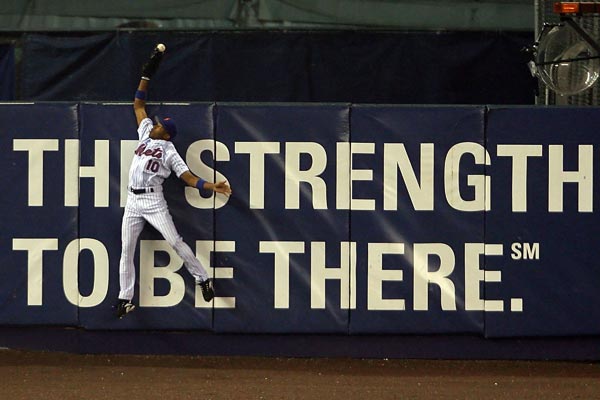
After not fooling the Cardinals in Game 4, Oliver Perez pitched very well in the biggest game of his life, allowing one run through the first five innings.  But after a one-out walk to Jim Edmonds in the sixth, Scott Rolen stepped up to the plate.  Rolen was a .450 career hitter (9-for-20) against Perez with five doubles.  However, he had never hit a home run off the Mets' lefty.  It looked as if that was about to change after only one pitch.  But Endy Chavez had something to say about that.  On Perez's first pitch to the Cardinals' third baseman, Rolen lifted a high fly ball that appeared to be headed for the Cards' bullpen.  But Chavez had the speed and the strength to be there, timing his leap perfectly to rob Rolen of a tiebreaking two-run homer.  After checking to see that the snowconed ball was in his glove, Chavez quickly threw the ball to second baseman Jose Valentin, who fired the ball to Carlos Delgado to double off Jim Edmonds for an inning-ending double play.  Shea Stadium was rocking like it had never rocked before with the Mets seemingly taking the momentum away from the Cardinals.  But they could not capitalize on Chavez's catch for the ages.

In the bottom of the sixth, the Mets loaded the bases with one out, with two participants in the previous half-inning's double play, Valentin and Chavez, coming up.  Cardinals' manager Tony La Russa could have taken starting pitcher Jeff Suppan out of the game at that moment, but chose to leave him in.  It was perhaps the most important managerial decision made in the series.  On a 1-2 pitch, Suppan struck out Jose Valentin, then got Endy Chavez to hit a routine fly ball to center to end the inning.  Neither team threatened in the seventh or eighth innings.  It was on to the ninth inning with the game still tied at one apiece.  Aaron Heilman, who had pitched the eighth inning for the Mets, was allowed to start the ninth.  Before long, his name would permanently become a part of Mets history, but not in the way he intended.

Billy Wagner had not fared very well in the ninth inning during the NLCS, giving up three runs in Game 2 and two more runs in Game 6.  Perhaps that factored into manager Willie Randolph's mind when he left Heilman in the game for the ninth inning.  The move appeared to be a good one after Heilman struck out Jim Edmonds to lead off the ninth.  But then Scott Rolen grounded a single to left to bring up Yadier Molina.  Doing his best Mike Scioscia impression, Molina lifted a long fly ball that carried out of the ballpark, far away from Endy Chavez's glove for a two-run homer.  The light-hitting Molina, who had only hit six home runs during the regular season brought back painful memories of Scioscia, another light-hitting catcher who in 1988 hit a two-run ninth-inning home run in the NLCS at Shea Stadium.  But Scioscia's home run came in Game 4 and only tied the game.  Molina's home run was in Game 7 and gave the Cardinals a two-run lead.

The Mets were now down 3-1 as they came to bat in the bottom of the ninth inning, three outs away from elimination.  Rookie closer Adam Wainwright was called upon to pitch the Cardinals into the World Series.  But he struggled early, allowing back-to-back singles to Jose Valentin and Endy Chavez to lead off the inning.  With the tying runs on base, Cliff Floyd was not called upon to bunt the runners over.  The move ended up being costly, as Floyd struck out on six pitches.  After Jose Reyes lined out to centerfielder Jim Edmonds, Paul Lo Duca, doing his best Gary Carter impersonation, refused to be the final out at Shea Stadium.  Lo Duca walked on five pitches to load the bases and bring up Carlos Beltran.  Wainwright threw two strikes to Beltran to go ahead in the count.  Then this happened...

Boo.

If you were to look at the big picture of the Mets in the last decade, 2006 was the blip on the radar, not the other way around.  Overall, 2006 was no different in how the Mets operated in years past, namely with injuries, bad contracts and reliance upon out-of-their-prime veterans and not-so-ready-for-prime-time rookies.  They were just more successful on paper than previous and post years.   

In fact, if you were to look at how the Mets started to slowly unravel at the end of the 2006 season, it was clear we all were just willing to overlook their shortcomings simply because of how good they did that year.  Most certainly Omar Minaya, Willie Randolph and Fred Wilpon did.  It is true, then, that winning makes you forget about these things.  Now that the Mets haven't won in a few years, we're able to look at 2006 more objectively, as being the one season wonder, the year that maybe shouldn't have been.  

Look at Steve Trachsel, who was an underrated and under-appreciated pitcher for the Mets in his years, winning 15 games that year but under the guise getting great run support.

Look at Jose Valentin and Chris Woodward, starting all those games at second base when they were supposed to be at best super utility players.  Who besides the Mets would give Julio Franco that much playing time, as a 48-year-old man?

Xavier Nady is seen to this day as a cult hero in Mets lore.  The fact that a middle reliever's injury caused so much of a domino effect on the dynamic of the team is a testament to not only how valuable Duaner Sanchez was to the bullpen, but conversely how that team was just one player short of imploding.  

Paul Lo Duca and Billy Wagner had great seasons in 2006, never to be replicated again in a Mets uniform.  

Carlos Beltran and Carlos Delgado fed off of each others production, and paved the way for future leaders of the team Jose Reyes and David Wright.  Now, Reyes is playing for the NL East rival Miami Marlins, and Wright has yet to take that leap to making the Mets his team. 

Lastly, trotting out 13 different starting pitchers, including Jose Lima, and they still won?  Chances are, this was not a formula for success but how lucky are you feeling, punk?   When your postseason hopes are foisted upon the likes of John Maine, Oliver Perez and Orlando "The Dookie" Hernandez, it's evident the 2006 Mets were just lucky to be there.

Prior to 2006, the Mets had made the playoffs six times.  Each of the six trips could be separated into pairs.  The 1969 and 1973 Mets were represented by many of the same players.  The 1986 and 1988 Mets could also be paired off, as the majority of the team in 1986 was still intact in 1988.  And of course, the 1999 and 2000 Mets were practically the same, save for John Olerud and Mike Hampton.  But the 2006 Mets have no postseason cousins.  They're simply a standalone team, a one season wonder on their own.


Studious Metsimus would like to thank Taryn "The Coop" Cooper for her contributions to this piece.  Not only was it her idea for the entire 2006 Mets team to receive the One Season Wonders spotlight, but she also wrote 10½ paragraphs for the piece.  You guess which ones.  For more examples of her writing on the Mets and on her other sports loves, please check out her site, A Gal For All Seasons.


Note: One Season Wonders was a thirteen-part weekly series spotlighting those Mets who had one and only one memorable season in New York. (And on occasion, it wasn't just an individual player that was a One Season Wonder.)  For previous installments, please click on the players' names below:
 
January 2, 2012: Bernard Gilkey
January 9, 2012: Terry Leach 
January 16, 2012: George Stone
January 23, 2012: Roger Cedeño
January 30, 2012: Frank Viola
February 6, 2012: Joe Christopher 
February 13, 2012: Dave Magadan 
February 20, 2012: Pedro Martinez
February 27, 2012: Bret Saberhagen 
March 5, 2012: Robin Ventura 
March 12, 2012: Willie Montañez
March 19, 2012: Lance Johnson