Showing posts with label Team Leaders. Show all posts

Sunday, August 20, 2017

Broken News: Curtis Granderson, The Underappreciated Met

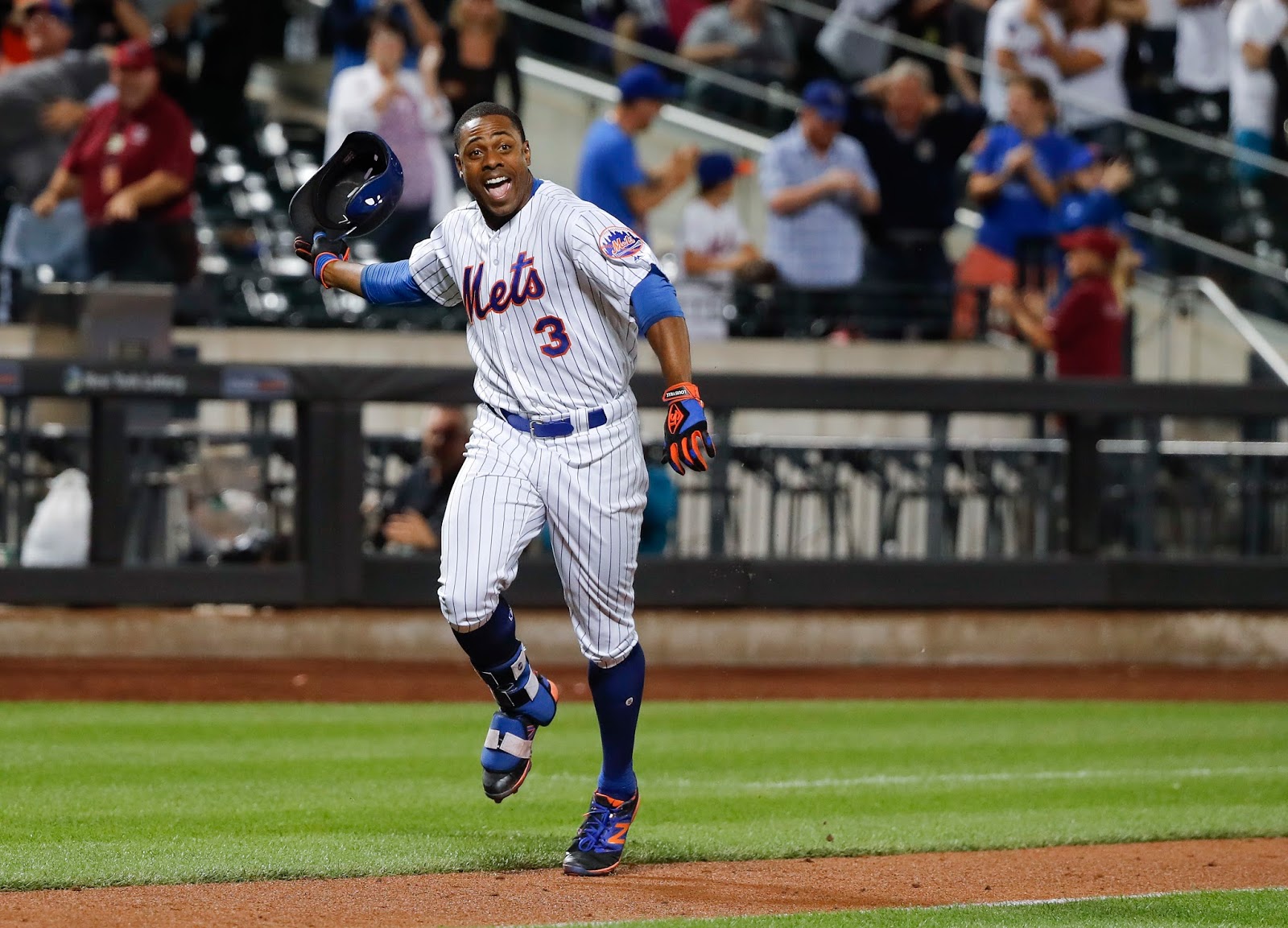
Curtis Granderson smiles one last time in a Mets uniform.  (Elsa/Getty Images)

Welcome to another edition of Broken News, where someone else breaks the news and then we break it some more.  As most of you know, Curtis Granderson was traded on Friday to the Los Angeles Dodgers, a team that's currently one thousand games over .500 (give or take a couple of games) and planning its World Series parade in August.

The departure of the veteran Granderson to the Dodgers was a move that many people expected to happen for months.  However, one thing that wasn't expected was the outpouring of love for a player who heard a few boos earlier this year after a slow start to the season.  One particular fan on Twitter couldn't help but notice that Saturday's first post-Granderson game caused others to dust off their Granderson apparel to wear at Citi Field.


Curtis Granderson went through his share of slumps in nearly four years as a Met, as evidenced by his .239 career batting average with the team.  However, in his short tenure in Flushing, he earned every penny of the free agent contract he signed prior to the 2014 season and provided several moments that caused many a fan to get out of their seats and cheer.  He was also much more valuable than most people think.

For example, as much as people say Daniel Murphy was a postseason hero in 2015, and he was, at least in the NLDS and NLCS, did you know that it was Granderson who led the team in RBIs during that magical playoff run?

Murphy may have hit seven home runs in 14 playoff games in 2015, but that only led to 11 RBIs.  Granderson drove in a dozen runs batting out of the leadoff spot in the batting order.  The right fielder reached base 24 times in those fourteen October and November games, stole four bases and scored ten runs, all while striking out just seven times in 64 plate appearances.  Compare that to Murphy, who struck out seven times in the World Series alone when he forgot that the postseason didn't end after the Mets won the pennant.

In the Division Series, Murphy hit three of his seven postseason homers and almost single-handedly won Game Five.  But there may not have been a Game Five had the Mets not won the critical Game Three, and Granderson collected the series-turning hit in that contest.  After the Mets lost the second game of the series on Chase Utley's leg-breaking slide, the Dodgers took an early 3-0 lead in Game Three.  Not wanting to face elimination in Game Four with Clayton Kershaw on the mound, the Mets stormed back against starter Brett Anderson.  New York scored a run in the third and loaded the bases for Granderson, who promptly cleared them with a long double to center field.  With that blast, the Mets took a lead they would not relinquish and went on to win the series.

Granderson continued to give the Mets leads in the NLCS, driving in the go-ahead run in the fifth inning of Game One against the Cubs.  His two-out RBI single broke a 1-1 tie and the Mets would never trail in the series; a four-game sweep in which Granderson reached base five times, scored three runs and stole three bases.

Had the Mets defeated the Royals in the World Series - a Fall Classic Murphy famously didn't show up for - Granderson would have been the odds-on favorite to take home the World Series MVP trophy.  In the five-game series, Granderson hit three homers and scored six runs.  No one else on the team crossed the plate more than two times.  Each of Granderson's three homers gave the Mets a lead, but unfortunately, the Mets could not capitalize on Granderson's penchant for providing emotional lifts with the fly balls he lifted into the outfield seats.  New York coughed up all three leads Granderson gave them and lost a heartbreaking World Series.

Murphy got all the accolades (and the lucrative free agent contract) for what he did in the 2015 postseason, but Granderson was the most consistent player the Mets had during their October run.  His clutch hitting should not be buried behind Murphy's exploits.

So what else did Granderson do as a Met that went largely ignored by his detractors?  During his tenure with the Mets, no position player had a higher WAR than Granderson.  His 10.4 bWAR is higher than the runner-up in this category, Juan Lagares, who posted an 8.0 bWAR from 2014 to 2017.  Everyday players like Yoenis Céspedes (6.3 WAR) and Michael Conforto (5.9 WAR) didn't play for the Mets in 2014 and the first half of 2015, but Granderson's 5.1 bWAR in 2015 alone was higher than the combined WAR put up by Céspedes (2.3) and Conforto (2.1) in just over 400 plate appearances between the two.  To put Granderson's Mets career in perspective, the only player on the team with a higher WAR since 2014 is Jacob deGrom, who has a 15.5 bWAR since his Rookie of the Year award-winning 2014 campaign.

Finally, had Granderson stayed a Met for another few weeks, he would have joined some elusive company.  Granderson hit 19 HR in 2017 before being traded to the Dodgers.  In his first three seasons with the team, he clubbed 20, 26 and 30 home runs.  Had he hit one more homer before the trade, he would have become just the sixth Met to reach 20 home runs in four consecutive seasons.  The other five?  You may have heard of them.  Their names are Darryl Strawberry, Kevin McReynolds, Howard Johnson, Mike Piazza and David Wright.  Not a stinker in the bunch.

Granderson finished his Mets career needing five homers to reach 100 with the team.  Had he reached triple digits, the Mets would have been the third team for which he hit 100 homers, as he accomplished the feat with the Tigers (102 HR) and the Yankees (115 HR).  Only five men have ever homered at least 100 times for three different teams.  Four of the five are Hall of Famers and potential Hall of Famers (Reggie Jackson, Jim Thome, Alex Rodriguez, Adrian Beltre).  The other is Darrell Evans, who hit 414 HR in his career and won a World Series ring with the 1984 Tigers, something Granderson is now shooting for as a member of the Los Angeles Dodgers.

Perhaps most importantly, in this era when Mets trainer Ray Ramirez is Public Enemy No. 1 because of all the injuries that have befallen Granderson's former Mets teammates, it should be noted that Granderson played in 573 of a possible 606 games during his time as a Met.  He played in 150+ games in each of his three full seasons with the team and had played in 111 games this season before the trade, putting him on pace for another 150-game campaign.  To put that in layman's terms, Granderson never went on the disabled list as a member of the Mets.  The Hospital For Special Surgery - also known as the second home for many members of the Mets - only saw him during the 2015 off-season, when he went in for thumb surgery.  But I'm sure he made several appearances visiting patients while he was there.  Because that's the kind of guy Granderson is.

Curtis Granderson was loved by his teammates and by members of the community.  His charitable efforts and work with children and the needy earned him the Roberto Clemente Award in 2016.  His performance in the 2015 World Series could very well have brought him an MVP trophy had the Mets not surrendered the crown to the Royals.  His career numbers with the team in less than four full seasons are among the best in franchise history.  And lest we forget, his final hit as a Met was a grand slam against the Yankees.  Despite all this, Granderson was very much underappreciated by Mets fans.  Or so we thought.  The love on Twitter after his departure and the plethora of Granderson shirts and jerseys at Citi Field last night tell another story.

Granderson was actually very much appreciated by supporters of the Mets.  It's too bad it took his departure for most of them to realize his value to the team and the city he played in.

We tip our cap to Curtis Granderson, who walks off to Los Angeles as a great Met. (Julie Jacobson/AP)

Thursday, September 3, 2015

Curtis Granderson's Resurgence Keeps the Naysayers at Bay

Curtis Granderson is rarely without a smile.  His 2015 production is making everybody smile.  (Ed Leyro/Studious Metsimus) 

Curtis Granderson did not have a good year offensively in 2014 - the first of four campaigns he was under contract with the Mets.  In his first season in Flushing, Granderson posted a .227/.326/.388 slash line.  The right fielder failed to record 50 extra-base hits and did not reach double-digit stolen bases after having seven straight seasons with 50+ XBH and six consecutive campaigns with 10+ SB through 2012, averaging 66 XBH and 18 SB per season.  (Granderson played just 61 games in 2013, notching 22 extra-base hits and eight steals.)  Granderson did lead the team in one offensive category in his first year, striking out 141 times in 564 at-bats.

But unlike the other free agent outfielder signed to a long-term deal by the Mets in the post-Shea Stadium era (Jason Bay), Granderson has turned things around quite nicely in his second season at Citi Field.  Through the team's first 133 games in 2015, Granderson has produced a .258/.351/.457 slash line, racking up 52 extra-base hits (28 doubles, one triple, 23 homers) and stealing 11 bases.  He has also scored 77 runs, has 59 RBI - a high number for a leadoff hitter - and has drawn 69 walks.

A year after he had fans wishing the team had never signed him to a four-year deal, Granderson is now leading the team in hits, walks, runs scored, home runs, RBI and stolen bases.  And that's not something that has happened much in team history.  Here are the players who have led the Mets in all six categories over a full season, with Granderson's numbers included in the mix.


Player
Year
Hits
Walks
Runs
HR
RBI
SB
Lee Mazzilli
1980
162
82
82
16
76
41
Howard Johnson
1989
164
77
104
36
101
41
Curtis Granderson
2015
128
69
77
23
59
11


In addition to Mazzilli, HoJo and Granderson, only two other players have led the team in five of the six categories in one season.  Darryl Strawberry's 1987 campaign saw him lead the Mets in walks (97), runs (108), home runs (39), RBI (104) and stolen bases (36).  However, the Straw Man finished third on team in hits behind Keith Hernandez and Kevin McReynolds.  David Wright has twice led the team in five of the six categories in a season.  The team's all-time leader in several offensive categories led the club in everything but home runs in 2009, finishing two taters behind unlikely team leader Daniel Murphy.  Three years later, Wright once again led the Mets in hits, walks, runs scored, RBI and stolen bases, but finished second to Ike Davis in home runs.

Should Granderson remain the team leader in the six offensive categories over the final month of the 2015 campaign, he would become just the third Met in franchise history to finish first in all six over a full season.  And he'd accomplish something never accomplished by Strawberry, Wright, Tommie Agee, Cleon Jones and other five-tool players that have worn a Mets uniform over the years.

Last year was widely considered to be a subpar season for Granderson, even though he hit 20 HR and drew 77 walks - the two categories coveted by Mets general manager Sandy Alderson.  The next time Granderson takes ball four in 2015, he will have his second consecutive 20 HR/70 BB campaign, which would make him just the tenth Met to have multiple seasons reaching both totals, joining Strawberry (1984-88, 1990), Johnson (1987-89, 1991), Todd Hundley (1996-97), John Olerud (1997-98), Edgardo Alfonzo (1999-2000), Robin Ventura (1999-2001), Wright (2005, 2007-08, 2012), Carlos Beltran (2006, 2008) and Carlos Delgado (2006, 2008).  You may know some of those players as among the best offensive stars in team history.

Granderson has two years left on the four-year, $60 million contract he signed prior to the 2014 season.  His first year left a lot to be desired.  But his second season has seen him lead the team's offensive charge in ways that have rarely been seen in club annals.  It remains to be seen how the rest of his tenure in Flushing will unfold.  But one thing is for sure.  Curtis Granderson is earning every penny of his contract this season.  He's regularly reaching base with hits and walks.  He's driving the ball out of the park.  He's running the bases with aplomb.  And he's hitting in the clutch, driving in his teammates from a spot in the batting order not usually known for its run-production.

The Mets owe their resurgence to a player whose renaissance couldn't have come at a better time.
 

Saturday, June 13, 2015

Wilmer Flores Is Already Approaching Several Hitting Records for Mets Shortstops

Wilmer Flores is improving with the glove, but he's really picking it up at the plate.  (Photo by Ed Leyro/Studious Metsimus)

Throughout the off-season and during the first month of the 2015 regular season, many Mets fans clamored for general manager Sandy Alderson to acquire a good-hitting, good-fielding shortstop.  The incumbent at the position, Wilmer Flores, was expected to hit well in the major leagues, but was considered a liability on defense.  In his first 30 games of 2015, Flores committed nine errors in 129 chances and wasn't contributing much with the bat, as he was hitting just .229 with three homers and eight RBI through May 8.

But since then, Flores has taken great strides in improving his defense, making just one error in his last 104 chances (.990 fielding percentage) and participating in 20 double plays.  He has also elevated his game at the plate, batting .263 with seven homers and 20 RBI over his last 31 games.  In fact, he has as many homers in that span as he does strikeouts - a rarity for a player who hits with power.

For the season, Flores has been hovering around the .250 mark, but his ten homers are tied for the most by a shortstop in the major leagues.  (The Cardinals' Jhonny Peralta also has ten.)  In addition, Flores ranks in the top five at the shortstop position in RBI (28) and slugging percentage (.433).  Among players on his own team, however, Flores ranks first in home runs, second in RBI (just one behind the injured Daniel Murphy), second in slugging percentage and third in runs scored.  Flores is in the top three in each of those categories despite having the sixth-most plate appearances on the team this season behind Juan Lagares, Curtis Granderson, Michael Cuddyer, Lucas Duda and Daniel Murphy.  And among all National League players, regardless of position, Flores is the ninth-toughest to strike out, as he has whiffed just 25 times in 201 at-bats.

On Friday night, Flores hit his tenth home run of the season, making him just the third Mets shortstop to reach double digits in homers over an entire season, joining Kevin Elster (1989) and Jose Reyes (2006, 2007, 2008, 2010).  [Note: Eddie Bressoud hit ten homers as the Mets' primary shortstop in 1966, but only eight of those homers came while Bressoud was playing shortstop.  He hit one as a first baseman and one as a second baseman.]  However, Elster didn't hit his tenth homer in 1989 until the final week of the season, while the earliest Reyes reached double figures in long balls was in 2008, when he launched his tenth rocket on July 12 during the team's 94th game of the year.  Flores turned the trick a full calendar month before the date Reyes did in 2008, doing so in the Mets' 62nd contest, leaving exactly 100 games for him to add to his total in 2015.

For his career, Flores has produced 25 doubles, 17 homers and 70 RBI in just 555 at-bats.  By comparison, Elster had 21 doubles, nine homers and 47 RBI in his first 555 at-bats, while Reyes had 32 doubles, ten homers and 52 RBI in the same number of at-bats.  Doubles-wise, Flores ranks in between Elster and Reyes, but Flores is already superior to both Elster and Reyes in home run and RBI production.

With the season still three weeks away from being halfway done, Flores is approaching 30 RBI, putting him on pace to easily surpass 60 RBI for the entire season.  Only two Mets shortstops have ever driven in at least 60 runs in a single season - Reyes, who owns the franchise mark at the position with 81 RBI in 2006 (he also produced 68 RBI in 2008) and the normally light-hitting Rey Ordoñez, who became the first shortstop to drive in 60 runs for the team when he reached that exact figure in 1999.

No Mets shortstop has ever led the team in home runs or RBI.  In fact, the closest any shortstop has ever come to leading the team in either category was in 1966, when Eddie Bressoud (10 HR, 49 RBI) finished six homers behind team leader Ed Kranepool and 12 RBI behind Ken Boyer for the club lead.  However, as mentioned before, Bressoud accumulated some of his offensive totals at other defensive positions.  The only true shortstops to finish within 20 RBI of the team leader were Roy McMillan, whose 42 RBI in 1965 left him twenty short of team leader Charley Smith, and Jose Vizcaino, who finished 20 RBI behind team leader Rico Brogna in 1995.  Vizcaino's 56 RBI during the strike-shortened 1995 campaign set the franchise record for runs batted in by a shortstop in a single season, a mark that was surpassed by Ordoñez four years later and Reyes seven years after that.

There haven't been too many offensive-minded shortstops in Mets history.  But there have been some standout seasons at the plate for some players who manned the position.  And if Wilmer Flores continues his recent power production, he might become the first to lead the team - or even come close to leading the team - in either of those categories over a full season.

With his offensive struggles and defensive shortcomings no longer as obvious as they were during the first month of the season, Mets fans are now clamoring for Flores to come up to the plate rather than asking for his head on a plate.  It's amazing what a little production and some historical perspective can do to calm the savage beast.


Friday, November 8, 2013

Players Who Led The Mets In Unexpected Categories

When you think of the greatest home run hitters in Mets history, Darryl Strawberry, Mike Piazza, David Wright and Dave Kingman come to mind.  Similarly, no list of great Mets starting pitchers or relief pitchers can be generated without a mention of Tom Seaver, Dwight Gooden, Jerry Koosman, Jesse Orosco and John Franco.

All of those players led the team in several hitting and pitching categories over the years.  But what about those players who led the team in unexpected categories - categories they weren't known for as hitters or pitchers?  What about players who were never above-average at anything, but were fortunate to have one great season or two in a particular category?  And don't forget the handful of players who were strongly disliked by Mets fans, but still managed to lead the team in something other than boos.

Today, we'll discuss a dozen of those players.  You'll be educated.  You'll be amazed.  You'll be awestruck.  (But you'll probably still boo those players who you always booed in the past.)  Let's begin!


Johnny Lewis leads the 1965 Mets in runs scored

In 1965, the Mets were in their fourth year of existence, but they were still looking and playing like an expansion team.  After upping their win total in 1963 and 1964, the Mets regressed in 1965, losing 112 games.  The Mets also lost their manager as well, as the charismatic Casey Stengel was forced to retire as the team's skipper due to a hip injury.  But one bright spot on the 1965 team was the play of outfielder Johnny Lewis.

Lewis was playing in his first season with the Mets after being traded to New York by the St. Louis Cardinals following the 1964 campaign.  Through late July, Lewis was the best player on the team.  In just 81 starts, Lewis was batting .260 with 14 homers, 37 RBI and 49 runs scored.  He also was among the league leaders in outfield assists, finishing the year with 14.  But once Wes Westrum replaced the injured Casey Stengel as manager, Lewis' performance suffered.  Over the last two months of the season, Lewis batted .219 with just one homer, eight RBI and 15 runs scored in 53 games.  Despite his two-month post-Stengel slump, Lewis still managed to lead the Mets in runs scored with 64.

Lewis' run total in 1965 represented approximately two-thirds of the times he crossed the plate in his career, as he played in three other seasons in the majors and managed to score a total of 33 runs in those campaigns.

Honorable mention goes to Joel Youngblood, who paced the 1979 Mets with 90 runs scored.  Although he played 14 seasons in the big leagues, averaging over 100 games played per season, Youngblood finished his career with 453 runs scored (an average of 39.5 runs per season) and never scored more than 59 runs in any other season.


Ted Martinez leads the 1972 and 1974 Mets in triples

Players with good speed and an ability to hit the ball in the power alleys or down the right field line usually rack up their share of triples.  Ted Martinez played nine seasons in the big leagues without ever showing much speed (29 career stolen bases) or an ability to get hits that weren't singles (50 doubles, 16 triples, seven home runs).  But somehow he managed to lead the Mets in three-base hits twice.

In 1972, Martinez hit played six defensive positions for the Mets as their utility man.  He didn't hit much (.224 batting average) or walk much (.254 on-base percentage), but he did find a way to collect a team-leading five triples, one more than Bud Harrleson and Jim Fregosi.  What makes his feat all the more impressive is that Martinez only hit five doubles all season to go with his five triples.

Two years later, Martinez once again became an unexpected triples machine, leading the team with a career-high seven three-baggers despite posting a lower batting average (.219) and on-base percentage (.247) than he did when he was the team's triples leader in 1972.  Martinez had no real challenge to the team lead as Wayne Garrett finished second on the team with three triples.  His time as a top triples producer ended almost as soon as it began, as Martinez didn't collect another three-base hit until 1977 as a member of the Dodgers.


Dave Kingman leads the 1975 Mets in stolen bases

In the mid-'70s and early '80s, no Mets fan left his or her seat whenever Dave Kingman stepped up to the plate.  Prior to his arrival in New York in 1975, no Met had ever hit as many as 35 homers in a single season.  Kingman surpassed that total three times in Flushing, including a 37-HR campaign in 1982, when he became the Mets' first home run champion.  Kingman left the Mets after the 1983 season as the team's all-time home run leader with 154.  But his first season in New York saw him lead the team in something other than homers.

Kingman stole a team-leading seven bases for the Mets in 1975, a year that saw the club steal a league-low 32 bases.  None of Kingman's teammates stole more than four bases in 1975.  Kingman was also the only Met to reach double digits in stolen base attempts, as he was caught stealing five times in 12 tries.  Gene Clines was second on the team with eight attempts.

The Sky King was the Steals King in 1975, proving that he was more than just a home run and strikeout machine for the Mets.  But in reality, what it really proved was that the Mets were a station-to-station team, depending on their excellent pitching and ability to hit home runs (the team finished sixth in the league in homers) to claw out victories.


Richie Hebner leads the 1979 Mets in RBI

After suffering through their second consecutive losing season in 1978, the Mets felt the need to upgrade their offense. To do so, they traded one of their best starting pitchers, Nino Espinosa, to the Philadelphia Phillies for veteran third baseman Richie Hebner.  Although Hebner had hit 156 homers prior to coming to the Mets in 1979, he had never driven in as many as 75 runs in a season until his one year in Flushing.  But if you ask Hebner, he would have gladly traded that first 75-RBI campaign for a ticket out of the Big Apple.  In other words, let's just say John Rocker enjoyed his short stays in New York more than Hebner did.

Despite his disdain for the Big Apple, Hebner actually performed fairly well for the Mets.  The surly slugger hit .268 with 25 doubles, 10 homers and 79 RBI.  Although he only played in 136 games (five of his teammates played 150+ games), Hebner tied Lee Mazzilli for the team lead in RBI.  Hebner was also one of the team's best clutch hitters, batting .308 with men on base and .310 with a runner on third and less than two out.  He also fared well against division rivals, batting an even .300 (87-for-290) versus NL East pitchers.

Hebner was not long for New York, as his insensitive comments were hurting the team more than his bat was helping it.  Just days after the 1979 World Series ended, Hebner was traded to the Detroit Tigers and Elliott Maddox became the Mets' third baseman until top prospect and fan favorite Hubie Brooks was ready to take over the position in September.  Boos for third basemen stopped soon after Brooks' promotion.


Mark Bomback leads the 1980 Mets in wins

From 1971 to 1978, Mark Bomback was a minor leaguer in the Milwaukee Brewers organization.  In those eight seasons, his major league experience consisted of one start and one relief appearance.  But Bomback couldn't crack the Brewers' starting rotation in 1979, even after a career year at the Triple-A level in which he went 22-7 with a 2.56 ERA.  The Brewers traded Bomback to the Mets after the 1979 season and he was immediately given a chance to succeed in New York.

Bomback began the 1980 campaign in the bullpen, making three relief appearances in April before earning his first start on April 23.  Bomback was superb against the Phillies in that start, earning his first major league victory.  He was even better in his next start (also against the Phillies), as he pitched a complete-game two-hit shutout against the eventual World Series champions.

The Mets were marketing that "the magic was back" at Shea Stadium, and part of that magic came from the right arm of Mark Bomback.  Bomback won nine of his first 12 decisions in 1980, as the Mets made a surprising run at the .500 mark in mid-July.  But Bomback faded down the stretch, and his career came crashing down soon after.  Although Bomback led the team with ten victories in 1980, it was his only year with the Mets.  Bomback pitched three other seasons in the big leagues, making 20 starts and 18 relief appearances.  He was the winning pitcher in just six of those 38 appearances.


Pete Falcone leads the '80 and '82 Mets in strikeouts

Pete Falcone was drafted by the San Francisco Giants with the fourth overall pick in the 1973 June amateur draft.  Two years later, he won 12 games as a rookie with the Giants and won 12 more as a Cardinal in his sophomore season in the majors.  But St. Louis gave up on Falcone after he combined to post a 6-15 record with a 5.56 ERA in 1977 and 1978.  After surpassing 130 strikeouts in each of his first two seasons in the majors, Falcone's final season in St. Louis saw him strike out only 28 batters in 75 innings.  As a result, the Cardinals traded him to the Mets following the 1978 campaign.

Falcone posted a 26-37 record during his four-year tenure with the Mets, but his 3.91 ERA showed the lack of run support he got in New York.  Although he wasn't a dominant strikeout pitcher, Falcone led the team in strikeouts twice.  He needed just 109 strikeouts in 1980 and 101 strikeouts in 1982 to lead the team - the lowest totals for a team strikeout leader in a non-strike shortened season.  Ironically, neither total was Falcone's career high as a Met.  The lefty from Brooklyn's Lafayette High School (which also produced fellow southpaws Sandy Koufax and John Franco) fanned 113 batters for the Mets in 1979, which was second on the team to Craig Swan's 145 Ks.

How low were Falcone's team-leading strikeout totals in 1980 and 1982?  They were fewer than the 128 whiffs posted by Armando Benitez in relief in 1999.  Yeah, that low.  Falcone finished his ten-year big league career in 1984, having struck out just 865 batters despite making 217 starts and 108 relief appearances.  In four years with the Mets, Falcone pitched in 145 games (86 starts) striking out 379 batters, or three fewer than fellow Lafayette alum Koufax fanned in 1965 alone.


Anthony Young leads the 1992 Mets in saves

Mention Anthony Young's name to any long-time Mets fan and they'll tell you that his full name should have been Anthony L. Young since the letter "L" was seen next to his name in the boxscore quite often in 1992 and 1993.  But Young was more than just a hard-luck loser for the Mets in that awful Jeff Torborg era.  He actually was a team leader in a positive pitching category, as he tied John Franco for the team lead in saves in 1992 with 15.

After losing eight consecutive decisions as a starter in May and June, manager Jeff Torborg decided to give Young a chance as a closer, becoming the right-handed portion of a lefty-righty closer combo with John Franco.  The move seemed to pay off, as Young did not give a run in 20 straight appearances in July and August, recording nine saves and two holds along the way.  But Young was atrocious in September, blowing five saves and adding five losses to what became a major league record 27-game losing streak.  He would only save three more games as a Met following the 1992 season.

Young's 5-35 won-loss record is the worst for any Mets pitcher with 40 or more decisions in franchise history, but he truly wasn't a bad pitcher, posting a 3.82 ERA in 101 appearances.  And he also accomplished something that wasn't surpassed by a Met in over two decades, as no homegrown Met saved more than 15 games after Young did in 1992 until Bobby Parnell recorded 22 saves for the Mets in 2013.


Desi Relaford leads the 2001 Mets in batting and SB

On a team that was coming off a World Series appearance and featured Mike Piazza, Robin Ventura, Todd Zeile and Edgardo Alfonzo, it was Desi Relaford who led the team in batting average (.302) and stolen bases (13).  Relaford also nearly led the team in doubles, as his 27 two-baggers were second to Piazza's 29.  The 2001 campaign also saw Relaford finish second on the team to Piazza in slugging percentage (.472) and OPS (.836).  Relaford's .364 on-base percentage was tied for second with Benny Agbayani.

If leading the team in two offensive categories (and nearly leading the club in several others) wasn't enough for the utility infielder, Relaford also pitched a perfect inning of relief on May 17, 2001, striking out the first batter he faced on three pitches and inducing two fly ball outs from the next two batters.  It was the best pitching performance by a position player in Mets history.

Relaford played a total of 11 years in the big leagues and never had as complete a season as he had in only 340 plate appearances in 2001.  He finished his career with a .243 batting average, 147 doubles and 81 steals, averaging 12 doubles and seven stolen bases per season in the years prior to and after 2001.


Timo Perez leads the '02 Mets in doubles and triples

The Mets entered the 2002 season with high expectations and a plethora of new players, as newcomers Mo Vaughn, Jeromy Burnitz and Roberto Alomar joined veteran returnees Mike Piazza and Edgardo Alfonzo.  On paper, that team should have produced many extra-base hits.  But none of those players led the team in doubles in 2002.  Similarly, none of them led the team in triples.  But like Ted Martinez before him, the team leader in three-base hits (and two-base hits) was a versatile player with little power, not much speed and an aversion to drawing ball four.

Timo Perez was a cult hero for the Mets during their run to the World Series in 2000.  But he never lived up to the potential he showed during September and October of their pennant-winning campaign.  By 2002, he was playing almost every day, mainly because outfielders Roger Cedeño, Jay Payton and Jeromy Burnitz either underperformed or were injured.  As a result, Perez managed to collect 27 doubles and six triples in 136 games, leading the team in both categories despite being eighth on the Mets in plate appearances.

Perez played seven other seasons in the major leagues, but was only able to collect 64 doubles and four triples in those seven campaigns.  He also collected two other things in those seven seasons - World Series rings - as Perez was a member of the 2005 White Sox and 2006 Cardinals, playing a total of 99 games between the two championship teams.


Jason Phillips leads the '03 Mets in batting average

To many Mets fans, Jason Phillips was primarily known for two things.  He, along with Vance Wilson, was one of the catchers who allowed Mike Piazza to move to first base on a full-time basis (temporarily) and he was also known for the goggles he wore as a hitter.  But those goggles did the trick for Phillips in 2003, as he did what Piazza did regularly for the Mets for many years - he led the team in hitting.

When Mo Vaughn was lost to what became a career-ending injury, Phillips took over at first base, even though he was primarily a catcher.  Phillips was just so-so a hitter through June 16, batting .242 and giving no indication that he was going to compete for a batting title.  For a two-month stretch from mid-June to mid-August, Phillips produced a Piazza-esque .364/.420/.531 slash line.  Phillips was hitting .316 as late as September 7 before a slump over the last three weeks of the season caused his batting average to fall below .300.  However, his .298 average was the highest of all the regular players on the 2003 squad.  (Jose Reyes batted .307, but he only played in 69 games.)

Phillips was never able to repeat his 2003 success in ensuing seasons.  His average dropped 80 points to .218 as the Mets' primary catcher in 2004.  He played three more seasons in the majors for the Dodgers and Blue Jays after 2004, never hitting above .250 in any of those seasons.  His post-2003 batting average was just .227.


Kaz Matsui leads the 2004 Mets in hits, 2B and 3B

In a move that generated much pomp and circumstance in two countries, former Japanese League All-Star (and hot dog) Kaz Matsui became the first infielder from Japan to sign a major league contract when he agreed to a three-year deal in 2004 to play shortstop for the Mets, despite the team already having 20-year-old Jose Reyes playing the position.  Reyes, who only had half a season of major league experience under his belt, moved to second base for the 2004 campaign to allow Matsui to take over his former (and future) position.

Matsui, a former 30-30 player in Japan, couldn't reach 30 homers or 30 steals in two and a half seasons as a Met, totaling 11 homers and 22 steals from 2004 to 2006.  But somehow, amid the growing crescendo of boos emanating from every level of Shea Stadium, Matsui was the team leader in a number of offensive categories in his rookie season, despite missing 43 games in August and September due to an injury.

Although he only played in 114 games in 2004, Matsui led the team in hits (125), doubles (32) and tied for the team lead in triples (2).  The whole team had just 20 triples, or one fewer than Lance Johnson had by himself in 1996.  Matsui's numbers were good enough to make him finish sixth in the Rookie of the Year vote, behind future All-Stars Jason Bay and Matt Holliday.  But in the years following his rookie campaign, Matsui's career veered more toward Bay than Holliday.  By mid-2006, Matsui had played himself out of New York, as the infielder was traded to Colorado, where he enjoyed a wonderful postseason (.304 batting average, five extra-base hits, eight RBI in 11 games) during the Rockies' run to an unexpected World Series berth.


Daniel Murphy leads the 2009 Mets in home runs

When he was first called up to the Mets in 2008, Daniel Murphy was known as a hard-working player who could hit to all fields with extra-base power.  However, he was not much of a home run hitter.  In fact, in his first four seasons with the Mets, Murphy hit more than six homers just once.  But that one season came in 2009, when everyone and his mother ended up checking in to the DL Hotel.

Only three players had more than 380 plate appearances for the Mets in 2009.  One of them was Luis Castillo, who made jaws drop whenever he hit a ball that hit the outfield fence on three hops.  Another was David Wright, who took some time to get adjusted to Citi Field's pitcher-friendly dimensions.  Wright hit a career-low 10 homers in 144 games.  Castillo and Wright both made short visits to the disabled list.  Daniel Murphy did not, playing in all but seven games in 2009.

On a team that had Carlos Delgado, Carlos Beltran, Gary Sheffield and Jeff Francoeur on its roster at various points of the season, Murphy was the only one to hit more than ten homers.  He needed five long balls in September to take over the team lead, but his 12 homers for the year were good enough to make him "Daniel Murphy, Home Run Machine" for one season.

Saturday, October 5, 2013

Daniel Murphy Appreciation Day

This is where I tip my cap to Daniel Murphy. (Photo by Greg Fiume/Getty Images)

Before I begin, let me preface this by saying that if you're not a Daniel Murphy supporter, then in all likelihood you will not be a fan of this post.  (And for the record, the title of this piece was suggested by my Gal For All Seasons, so I'm not alone in my appreciation for the Mets' second baseman.)

Look back at the great second baseman in Mets history.  There's Edgardo Alfonzo and there's ... uh ... well ...  there's not much else.  Sure, there were some second basemen who had good years, like two-time All-Star and Rookie of the Year runner-up Ron Hunt, but he was mostly a singles hitters who made as much contact with the ball using his bat (.282 lifetime average as a Met) as he did with his body (41 HBP in four seasons in New York).

In addition to Hunt, the Mets have employed other fine second sackers such as Felix Millan (who made Ron Hunt look like an extra-base hit machine), Doug Flynn (ditto) and Wally Backman (double ditto).  Ken Boswell had some pop, if you want to call a career-high nine home runs in 1972 "some pop".

There have also been a number of second basemen who were great before they came to the Mets, then underachieved in New York.  Do the names Carlos Baerga, Roberto Alomar and Luis Castillo ring a bell?

Basically, after Alfonzo, the next-best second baseman in club annals might have been Jeff Kent, who had some solid years in Flushing when he wasn't thinking about being on his ranch in Texas.  And Kent probably couldn't concentrate much on that ranch with all those boos from the Shea Faithful permeating the daydream sensors in his brain.

But that No. 2 spot behind Fonzie on the unofficial list of greatest second basemen in Mets history might have a new resident taking off the vacancy sign very soon.  And that resident's name is Daniel Murphy.

Make room for Daniel Murphy at second base.

Daniel Murphy had one of the greatest seasons ever recorded by a Mets second baseman in 2013.  He finished the year with a .286 batting average, 38 doubles, 13 homers, 78 RBI, 92 runs scored and 23 stolen bases.  Prior to Murphy, the only second basemen in franchise history to reach double digits in both home runs and RBI in the same season were Gregg Jefferies and Roberto Alomar.  But neither player matched Murphy's totals in batting average, runs scored, runs batted in and stolen bases.  In fact, the only two players in team history who had better numbers than Murphy in all six offensive categories (batting average, doubles, home runs, RBI, runs scored, stolen bases), regardless of their defensive position, were Howard Johnson in 1989 (.287 average, 41 doubles, 36 HR, 101 RBI, 104 runs scored, 41 SB) and David Wright in 2007 (.325 average, 42 doubles, 30 HR, 107 RBI, 113 runs scored, 34 SB).

Murphy's 2013 campaign saw him finish among the National League leaders in a number of offensive categories.  Murphy was in the top ten in games played (161; 2nd in the NL), hits (188; 2nd), singles (133; 2nd), doubles (38; T-7th), total bases (273; 8th), runs scored (92; 8th) and stolen bases (23; T-7th).  The only other player in the National League to finish in the top ten in all of those categories was MVP candidate Andrew McCutchen.  (Oh, and did I mention that Murphy finished first in the league in stolen base percentage, as he was caught stealing only three times in 26 attempts?  Andrew McCutchen, on the other hand, was caught stealing ten times, making him one of only nine players in the National League to reach double digits in that category.)

Offensively, there are few second basemen in the league who can match Daniel Murphy's overall production.  However, there have been some questions posed about Murphy's ability to handle the defensive side of the position.  It's true that Murphy had an unfavorable defensive WAR (-1.5) and made 16 errors at second base.  But that doesn't mean he was a complete wash at the position.

Murphy finished second in the league in putouts to three-time Gold Glove winner Brandon Phillips.  In addition, Murphy finished third in the NL in assists (behind Phillips and Neil Walker) and third in double plays turned (behind Walker and MVP candidate Matt Carpenter).

Now let's look at the 16 errors committed by Murphy, a total that was surpassed in the Senior Circuit only by Chase Utley, who made one more miscue.  Murphy played 150 games at second base in 2013 (his other 11 games were at first base and pinch-hitter).  The three second basemen who finished directly behind Murphy in errors committed were Dan Uggla, Marco Scutaro and Rickie Weeks, who made 14, 13 and 10 errors, respectively.  But Uggla, Scutaro and Weeks all spent time on the disabled list, combining to miss 119 games this past season with each player missing at least 26 games.  Had they all remained on the field, perhaps one or more of them could have committed more gaffes at second base than Murphy.

Doubles, stolen bases, death-defying leaps over catchers.  Is there anything Daniel Murphy can't do?

For his career, Daniel Murphy has been known as a doubles machine.  He has the only 40-double campaign for a left-handed hitter in team history.  Murphy is also one of only two Mets (David Wright is the other) with three or more seasons of 35+ doubles.  And with 73 more doubles (about two average Daniel Murphy seasons), Murphy will pass Ed Kranepool to become the second-most prolific doubles hitter in franchise history.  But Murphy is more than just a producer of two-base hits.  He proved that (and then some) in 2013.

In my opinion, Daniel Murphy has not been appreciated enough by Mets fans.  Just like Carlos Beltran (who continues to be remembered more for keeping the bat on his shoulders as a Lord Charles curveball danced on by than for the complete player that he was), Daniel Murphy will always have detractors who will complain that he doesn't take enough walks or that he's a horrible defensive player.

To those detractors, I have one thing to say.  Be careful what you wish for.  Many players have been run out of town only to come back and haunt the Mets.  Don't let Daniel Murphy become another one of those players.  Take time to appreciate what Daniel Murphy has done for the team and what he hopefully will continue to do for the team as its second baseman.  The Mets have not had many productive second basemen like Daniel Murphy in their 52-year history.

Not everyone can be Edgardo Alfonzo at second base.  It's a good thing Daniel Murphy doesn't try to be.

Saturday, September 29, 2012

Top 3 Lefty Homegrown Starters: Koosman, Matlack ... Niese?


On Friday night, Jonathon Niese made his 30th and final start of the season for the Mets, holding the Braves to one run in seven innings to collect his career-high 13th win.  Niese also held Chipper Jones hitless in three at-bats on the night the Braves were celebrating the future Hall of Famer's career in Atlanta.  This was nothing new for Niese, as he held Jones to a .174 career batting average against him (4-for-23), with half of those hits coming before Niese became a regular in the Mets' starting rotation.

Since Niese joined the staff for good in 2010, Jones has batted 21 times against the Mets' southpaw and has only reached base twice for a .095 on-base percentage.  Niese has also never walked Jones in 24 career plate appearances.  That's not a typo, as every Niese-Jones confrontation has ended without the home plate umpire telling Jones to take his base.

Jonathon Niese's ability to retire Chipper Jones is one that eluded many Mets pitchers over the years.  But Jones is not the only batter who has struggled against Niese.  In fact, as Niese has matured from a 21-year-old rookie pitching at Shea Stadium in 2008 to one of the most reliable arms on the staff as a 25-year-old, many hitters have gone back to the dugout shaking their heads after failing to reach base against him.

In 2012, Niese enjoyed his finest season to date, establishing career highs across the board.  Niese achieved personal bests in wins (13), ERA (3.40), WHIP (1.17), innings pitched (190⅓), strikeouts (155), batting average against (.241), walks per nine innings (2.3) and strikeout-to-walk ratio (3.2).  At age 25, Niese has been a Met for all or parts of five seasons, making his way up the franchise's all-time pitching leaderboards with every start he makes.

Those leaderboards are loaded with names like Seaver, Gooden, Darling, Cone, etc.  What do all of those pitchers have in common?  They were all right-handed starters.  Similarly, left-handed starting pitchers Sid Fernandez, Al Leiter and (ahem) Tom Glavine are also all over the Mets' all-time leaderboards for pitchers but none of them came up through the Mets' farm system and all of them made their major league debuts pitching for another team.

If not for Jerry Koosman and Jon Matlack, the Mets' all-time pitching leaderboards would be bereft of homegrown southpaws.  So if Koosman and Matlack are the two best homegrown left-handed starters in franchise history, then who would be third?  Believe it or not, that third member might just be Jonathon Niese.  Don't believe it?  Let's look at where Niese ranks among all other homegrown left-handed starting pitchers in Mets history who had a minimum of 20 starts and made at least half of his appearances in a starting role.


Starts:
Jerry Koosman
  1. Jerry Koosman - 346 
  2. Jon Matlack - 199
  3. Jonathon Niese - 94
  4. Pete Schourek - 47
  5. Eric Hillman - 36


Wins:
Jon Matlack
  1. Jerry Koosman - 140
  2. Jon Matlack - 82
  3. Jonathon Niese - 35
  4. Pete Schourek - 16
  5. Bill Pulsipher - 5


ERA:
Jonathon Niese
  1. Jon Matlack - 3.03
  2. Jerry Koosman - 3.09
  3. Jonathon Niese - 4.06
  4. Bill Pulsipher - 4.63
  5. Pete Schourek - 4.65


WHIP:
Eric Hillman
  1. Jon Matlack - 1.195
  2. Jerry Koosman - 1.219
  3. Jonathon Niese - 1.360
  4. Eric Hillman - 1.422
  5. Bill Pulsipher - 1.442


Strikeouts:
Pete Schourek
  1. Jerry Koosman - 1,799
  2. Jon Matlack - 1,023
  3. Jonathon Niese - 470
  4. Pete Schourek - 199
  5. Bill Pulsipher - 101


K/BB Ratio:
Bill Pulsipher
  1. Jonathon Niese - 2.73
  2. Jon Matlack - 2.44
  3. Jerry Koosman - 2.19
  4. Eric Hilman - 2.13
  5. Bill Pulsipher - 1.80


Did you notice anything interesting about each top five list?  In each list, the top three pitchers were always Jerry Koosman, Jon Matlack and Jonathon Niese, although not necessarily in that order.  Also, when players such as Pete Schourek, Bill Pulsipher and Eric Hillman start cracking all-time top five lists for the Mets, it's fairly obvious that the Mets haven't had much success drafting, developing and calling up left-handed starters.

Say what you what about Jonathon Niese.  Say he's only a middle-of-the-rotation starter.  Say he hasn't fully realized his potential.  Say all of that, but then don't forget to say that he's also one of the best homegrown left-handed starting pitchers in team history.  And with the improvement he continues to show year after year, we may have to remove the word "left-handed" from the previous sentence before long.  Not bad for a southpaw who has yet to reach his 26th birthday.