Showing posts with label Anthony Young. Show all posts

Saturday, March 21, 2015

Cram All You Want, You'll Still Lose With The Mets

Every once in a while, I'll find a statistic or story about a Mets player that's so far out there, I have to share it.  Similarly, on occasion I'll think of a title for a blog post that will go over everyone's head until they actually read the piece.  And sometimes those two worlds collide.  Today is one of those days.

About a month and a half ago, I wrote a piece on Anthony Young, the Mets pitcher who set a major league record by losing 27 consecutive decisions.  However, the Mets didn't lose every game he appeared in during his losing streak.  From the time his skein began on May 6, 1992 until he recorded his 27th straight loss on July 24, 1993, Young appeared in 77 games, making 17 starts and appearing in relief 60 times.  The Mets actually won 25 of those 77 games, but Young did not receive credit for a victory in any of those contests.

This morning, I woke up with Young on my mind and decided to do some research on which Mets player appeared in the most games without ever celebrating a victory after any of those affairs.  Well, thanks to the good folks who run the Baseball Musings Day-By-Day Database, I have my answer.  Now excuse me while I "cram" this information into your brain.

The name is Cram.  Jerry Cram.

Entering the 2015 season, a total of 62 players have appeared in at least one game for the Mets without ever going out for a winning hot dog and soda afterwards.  Of those 62 players, more than half of them (37) appeared in no more than three games for the team - all losses, of course.  But only four of those 62 players found their way into a game's boxscore at least 11 times.  And of those four, the Met who appeared in the most losses without ever seeing a win did so 14 times.  The unfortunate player's name was Jerry Cram.

Jerry Cram made his major league debut for the expansion Kansas City Royals in 1969, appearing in five games.  The Royals actually won two of those games, probably spoiling Cram for life.  He didn't appear in another major league game until 1974, a year after he had been traded to the Mets.

Cram pitched beautifully for the Mets in two seasons with the team, posting a 2.30 ERA in 14 relief appearances, tossing 27⅓ innings in those outings.  His greatest effort came on September 11, 1974, when he pitched eight shutout innings against the St. Louis Cardinals.  Cram entered the game in the 17th inning and pitched through the 24th frame, scattering seven hits and two walks.  He also went 1-for-3 at the plate, collecting the only hit of his career in the 18th inning.

Once Cram was taken out of the game for pinch-hitter Rusty Staub in the bottom of the 24th, the Cardinals took advantage, as speedy center fielder Bake McBride led off the top of the 25th inning with a single, then came all the way around to score on an errant pickoff throw by reliever Hank Webb, who was making his first appearance of the season for the Mets.  Webb's battery mate, Ron Hodges, was charged with the team's second error on the play, as he was unable to hold on to the throw by first baseman John Milner, allowing McBride to score the go-ahead run.

The Mets lost the game in 25 innings, which to this day remains the longest game in National League history that did not end in a tie.  (Brooklyn and Boston played a 26-inning affair in 1920 that ended in a 1-1 tie.)  The game was also Cram's fifth appearance for the Mets in 1974, with all of them ending in losses.  Cram appeared in five more games that month following his eight-inning relief effort and never celebrated a victory with his teammates.  The Mets went 0-10 in Cram's ten appearances in 1974.

Cram didn't appear in as many games during his second season with the Mets in 1975, making just four relief appearances for the team in April and May.  Once again, the Mets failed to win any of those games.  In fact, in all 14 of his games during his two-year tour of duty in Flushing, Cram never pitched with the lead.  Three times he entered a game with the score tied - the Mets eventually lost each game - and 11 times he came into a game with the Mets trailing.  They were trailing at the end of those games as well.

Three pitchers in Mets history appeared in exactly 11 games with nary a happy recap to show for it.  Jerry Hinsley made two starts and seven relief appearances for the Mets in 1964, then came out of the bullpen twice in 1967.  The only constant in Hinsley's career was that he only pitched in games the Mets lost.  Hinsley was a teammate of Joe Grzenda in 1967.  Like Hinsley, Grzenda was also used exclusively in relief during the 1967 campaign, making 11 appearances.  Each of those contests ended with the other team shaking hands after the game.  Finally, we have Collin McHugh, who made five starts and appeared in relief six times for the Mets between 2012 and 2013.

Collin McHugh fell short of Cram's mark.
McHugh pitched seven shutout innings in his major league debut, becoming the second Met to strike out as many as nine batters in his first big league start (Matt Harvey set the record with 11 strikeouts a month before McHugh.)  But unlike Harvey's effort in his debut, McHugh didn't earn a win in his, as no Mets hitter was able to cross the plate while McHugh - or any other Mets pitcher - was in the game.  That was as close as McHugh came to appearing in a Mets victory, as his next ten appearances in a Mets uniform resulted in ten losses for the team.  Now pitching for the Houston Astros, McHugh has left the losing behind, as he won 11 games in 2014 and posted a stellar 2.73 ERA in 25 starts.  Although the Astros finished 22 games under .500 in 2014, they posted a winning record (13-12) in McHugh's starts.

Hinsley, Grzenda and McHugh never appeared in a game won by the Mets, but at least they weren't as unlucky as Jerry Cram.  He and his teammates all experienced the agony of defeat in each of Cram's 14 appearances in a Mets uniform.  And for those of you curious about what happened to Cram after he pitched his final game for the Mets in 1975, well, he went back to Kansas City to pitch for a much-improved Royals team in 1976.  Kansas City won its division in 1976, finishing the year with a 90-72 record.  Cram appeared in four games for the A.L. West champions.  What happened in those games?  The Royals lost them all, meaning Cram never got to experience a victory in a game he pitched after the 1969 season.

Anthony Young lost 27 straight decisions, but at least his teams won 25 times when he took the mound during his 14-month streak of individual futility.  Jerry Cram probably wished he could have had Young's good fortune as a Met.
 

Monday, February 2, 2015

One Mo-MET In Time: Anthony Young

A moment, by definition, is a brief period in time.  The ground ball hit by Mookie Wilson is the 1986 World Series took three hops before it scooted by the closed glove of Bill Buckner.  All told, Mookie's moment lasted a few seconds, which was about two hours and 44 minutes less than the time it took Dave Mlicki to toss his gem against the Yankees in the first regular season matchup between the two city rivals.

It took three seconds for Wilson's moment to become legendary.  It took nine innings for Mlicki to do the same.  But what happens when a moment lasts just a tad bit longer?  And what happens when that moment becomes a microcosm of an era that most Mets fans do not look back upon fondly?

For one Mets player, his "moment" lasted for the better part of two seasons.  And although he and millions of the team's fans were at a "loss" to explain how his moment could have endured for as long as it did, he never became a hated Met for what he accomplished (or in his case, failed to accomplish).  In fact, despite his achievement becoming synonymous with the era he played in, he became somewhat of a beloved figure when all was said and done.

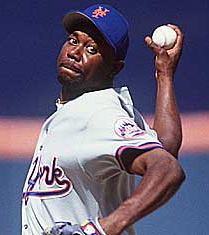
If Anthony Young looks happy here, it's because this photo was taken before his losing streak.  (Photo by Barry Colla)

Anthony Wayne Young was never supposed to make it to the major leagues.  As a 38th round draft pick in 1987 taken behind "studs" like Chris Kocman and Elgin Bobo, Young had to work his way to becoming a top prospect.  Young was inconsistent during his first three professional seasons, never advancing past the Single-A level until 1990, when he unexpectedly opened eyes with a phenomenal 15-3 record and 1.65 ERA in 23 starts for AA-Jackson.

Young's breakout 1990 campaign turned him into Baseball America's 26th-ranked prospect prior to the 1991 season.  The former 38th round draft pick was now the Mets' top minor league prospect and was on the fast track to the major leagues.  On August 5, 1991, his train pulled into Shea Stadium, where he made his big league debut against the Chicago Cubs.  Young pitched well in his debut, tossing 2⅓ innings of one-run ball in relief of starting pitcher (and fellow 1991 top prospect) Pete Schourek.  Four days later, Young faced the Cubs again in relief, allowing no runs and no hits in two innings.  He was then inserted into the starting rotation on August 29, where he remained until season's end.

In eight late-season starts for the Mets, Young was quite good, allowing more than two earned runs just twice in those eight appearances.  However, in a portent of things to come, Young lost his final four starts, with the Mets scoring a total of seven runs in those four efforts.

Change was in the air entering the 1992 season.  The team's first losing record in eight years caused a changing of the guard prior to the start of the '92 campaign, with Jeff Torborg coming aboard to sail the ship that now had a crew of All-Stars Bobby Bonilla, Bret Saberhagen and Eddie Murray.

A team chock full of veteran players was going to be a tough one to crack for the 26-year-old Young, but after holding opposing hitters to a .127 batting average and posting a team-best 2.23 ERA in four spring training starts, Torborg couldn't wait to pencil him as the team's No. 4 starter.

"Anthony Young has been as good as anybody," raved Torborg.  "He's blown the competition away."

Young had such a dominant spring that he was listed ahead of Dwight Gooden in the rotation - the same Gooden who had received the Opening Day assignment in each of the last four seasons and six of the previous seven.  Young rewarded Torborg by having a solid April, going 2-0 with a 2.96 ERA in four appearances (three starts).  But just three short months after his manager proclaimed him to be "as good as anybody", Young was better than no one, although he was not completely at fault.

In 1992, Anthony Young couldn't see anything at Shea Stadium but losses piling up.  (Keith Torrie/NY Daily News)

In May and June, Young lost eight consecutive decisions and watched his ERA balloon to 4.65.  The first three losses were squarely on his shoulders, as the right-hander allowed a total of 14 earned runs in losses to the Reds, Padres and Dodgers.  But in his next five defeats, Young pitched well, allowing no more than three runs in any of those appearances.  Of course, the Mets scored a total of five runs in those five games, making it a tough task for any pitcher to post a "W".

Despite pitching relatively well during his hard-luck losses in June, Young was replaced in the starting rotation by Wally Whitehurst at month's end.  Moving to his new role in the bullpen, Young earned his first major league save on July 1 in the Mets' 12-inning win over the Cubs.  Three days later, Young was tagged with his ninth straight loss before turning his season around in a new role.

With John Franco suffering from an inflamed tendon in his pitching elbow, Young began to share closing duties with the left-handed Franco and thrived in the role.  In fact, from July 7 through September 2, Young had one of the best extended stretches by a relief pitcher in the history of the franchise.  Seriously.

Young made 23 appearances during the two-month period, recording 11 saves and two holds.  More impressively, Young held opposing hitters to a ridiculously low .155/.212/.165 slash line, allowing 15 hits (14 singles, one double) in 28⅓ innings.  All told, Young allowed just one run in those 23 appearances for a miniscule 0.31 ERA.

Alas, Young's magical ride entered the station before the season ended, as his final ten appearances resulted in five blown saves, all of which saddled him with losses.  Young finished the year with 15 saves - an impressive total for a pitcher who made 13 starts from April to June - but also 14 consecutive losses.  Young became the 24th pitcher in history to have losses in 14 straight decisions and the fourth Met to do it, joining Craig Anderson (19 consecutive defeats from 1962-64), Roger Craig (18; 1963) and Skip Lockwood (14; 1978-79).

As a team, the 1992 Mets posted their first 90-loss season since 1983, but the club didn't hit rock bottom until the 1993 campaign, when they reached triple digits in losses for the first time in 26 years.  Once again, Anthony Young contributed several of those losses, and just like he did the year before, Young's performance was far better than his won-loss record suggested.

Photo by Mark Lennihan/AP
Following a rough first outing on April 9, a game in which he allowed four runs in two innings en route to his 15th consecutive loss, Young pitched beautifully over his next 14 appearances, posting a 1.53 ERA in 17⅔ innings.  But the Mets couldn't help him out, as Young failed to earn a win in any of those 14 relief efforts.  However, he did succeed in picking up his 16th, 17th and 18th straight defeats, even though he allowed just two earned runs in those three losses.  After picking up his 19th consecutive "L" on May 28, new manager Dallas Green - who had replaced Torborg just eight days earlier - tried to change Young's misfortune by inserting him back in the starting rotation.  But instead of helping Young earn a victory, the only thing Green's decision accomplished was helping Young rack up losses faster.

A no-decision in Young's first appearance as a starter on June 1 was followed by losses in each of his next seven starts.  His first eight starts of 1993 should have earned him at least a win or two, as he allowed three earned runs or fewer in six of those starts.  But once again, the Mets left their bats at home during Young's starts, averaging two runs per game in the eight appearances and not scoring more than three runs in any of them.

By failing to earn a win, Young broke an all-time major league record when he dropped his 24th straight decision on June 27 against the St. Louis Cardinals.  The loss broke the 82-year-old record held by Cliff Curtis, who lost 23 consecutive decisions for Boston's National League squad from 1910 to 1911.

A month after breaking Curtis's record, Young still had not earned a win.  He had notched two holds and a save, but had also added three more defeats, extending the new record to 27 straight losses.  Then on July 28, Young came on in relief to face the expansion Florida Marlins in the ninth inning of a 3-3 tie, but allowed a two-out, bunt single to speedster - and former Mets teammate - Chuck Carr to score the go-ahead run for the Marlins, a run that was unearned because of an earlier throwing error by catcher Todd Hundley.

Carr's hit moved Young ominously closer to his 28th consecutive loss, but the Mets were facing the Marlins, who were the only team they had success against in 1993.  New York's 9-4 record versus Florida in '93 was the only winning mark posted by the team against any of its opponents.  And when the Mets came up to bat in the bottom of the ninth, they were determined to continue that success against the Marlins.

Pinch-hitter Jeff McKnight led off with a single against Marlins closer Bryan Harvey.  Dave Gallagher then moved McKnight to second base with a sacrifice bunt.  Ryan Thompson followed by flaring an excuse-me single between first base and right field, scoring McKnight with the bloop hit.  Young was now off the hook for the loss.  Two batters later, he was on the field celebrating with his teammates, as Eddie Murray followed Joe Orsulak's fly out with a two-out double down the right field line, scoring a sprinting Thompson all the way from first base after right fielder Darrell Whitmore bobbled the ball.


Video courtesy of MLB.com's YouTube channel


Anthony Young first win since early in the 1992 campaign was one of the few highlights of an otherwise forgetful 59-103 season for the Mets in 1993, but it was retribution for the pitcher once deemed one of the top prospects in baseball.

Young didn't pitch terribly during his 27-game losing streak.  During the skid, he appeared in 77 games (17 starts, 60 relief appearances).  In the 50 games he was not credited with a loss, he pitched 75⅔ innings, allowing just 60 hits, of which only 11 went for extra bases (nine doubles, two homers).  Young also gave up just 14 earned runs in those 75⅔ innings for a stellar 1.67 ERA, racking up 16 saves along the way.

It wouldn't be a stretch to say that Young was one of the best pitchers the Mets had in 1992 and 1993.  He did just about everything he could possibly do as a pitcher during those two campaigns.  He started games when asked to.  He pitched in middle relief.  He went out there in mop-up duties.  He also served as the team's temporary closer.  He just didn't earn wins.

Young finished his three-year Mets career with a 5-35 record.  His .125 winning percentage as a Met is by far the lowest of any pitcher who pitched at least 250 innings for the team.  (The second-lowest winning percentage is the .246 mark posted by Roger Craig in 1962 and 1963, when he pitched 469⅓ innings en route to a 15-46 won-loss record.)  Young's final 15-48 record over his six-year major league career was helped only by the 10-13 mark he put up from 1994 to 1996 as a member of the Cubs and Astros.

But Young's career wasn't entirely sponsored by the letter "L".  He actually became the first pitcher in major league history to accomplish a positive pitching feat, which seems almost impossible for a pitcher who had more consecutive losses than there are letters in the English alphabet.

Since the save became an official statistic in 1969, Anthony Young became the first pitcher to have a minimum of 15 saves in a year he made at least 13 starts when he posted his 13-start, 15-save campaign in 1992.  Young remains just one of four pitchers to accomplish the feat, as he has since been joined by Tim Wakefield (1999; 17 starts, 15 saves), Octavio Dotel (2000; 16 starts, 16 saves) and Dustin Hermanson (2004; 18 starts, 17 saves).

Young also posted 18 total saves during his short time in New York, despite never being groomed to be a closer.  When he pitched his final game for the team in 1993, Young's 18 career saves as a Met was tied for the 12th-highest total in franchise history.  Incredibly, through the 2014 season, Young still ranks among the team's all-time top twenty leaders in career saves.  In addition, Young's 15 saves in 1992 remained the highest total by a homegrown pitcher until Bobby Parnell saved 22 games for the Mets in 2013.

Looking back on his career, Young believed he shouldn't be remembered for his two-year "moment" in the spotlight.  Rather, he'd prefer to be known as a pitcher who pitched well enough to win, but was a victim of circumstance.


"I always said I didn't feel like I was pitching badly.  It just happened to happen to me.  I don't feel like I deserve it, but I'm known for it.  It was an 82-year-old record and it might be 82 more years before it's broken.  Everything that could happen, happened.  It was just destiny, I guess."


Anthony Young played on a Mets team that was vilified for having several overpaid underachievers.  But Young himself was not one of those players.  In fact, he fulfilled everything he was asked to do by his managers.  But because of an unfortunate and untimely streak, Young will always have a connection to the team now referred to as "The Worst Team Money Could Buy".

If only Anthony Young could have bought a victory for himself along the way, there could have been many more happier moments for a pitcher whose talent was greater than his won-loss record.


Note:  One Mo-MET In Time is a thirteen-part weekly series spotlighting those Mets players who will forever be known for a single moment, game or event, regardless of whatever else they accomplished during their tenure with the Mets.  For previous installments, please click on the players' names below:

January 5, 2015: Mookie Wilson 
January 12, 2015: Dave Mlicki
January 19, 2015: Steve Henderson 
January 26, 2015: Ron Swoboda

Friday, November 8, 2013

Players Who Led The Mets In Unexpected Categories

When you think of the greatest home run hitters in Mets history, Darryl Strawberry, Mike Piazza, David Wright and Dave Kingman come to mind.  Similarly, no list of great Mets starting pitchers or relief pitchers can be generated without a mention of Tom Seaver, Dwight Gooden, Jerry Koosman, Jesse Orosco and John Franco.

All of those players led the team in several hitting and pitching categories over the years.  But what about those players who led the team in unexpected categories - categories they weren't known for as hitters or pitchers?  What about players who were never above-average at anything, but were fortunate to have one great season or two in a particular category?  And don't forget the handful of players who were strongly disliked by Mets fans, but still managed to lead the team in something other than boos.

Today, we'll discuss a dozen of those players.  You'll be educated.  You'll be amazed.  You'll be awestruck.  (But you'll probably still boo those players who you always booed in the past.)  Let's begin!


Johnny Lewis leads the 1965 Mets in runs scored

In 1965, the Mets were in their fourth year of existence, but they were still looking and playing like an expansion team.  After upping their win total in 1963 and 1964, the Mets regressed in 1965, losing 112 games.  The Mets also lost their manager as well, as the charismatic Casey Stengel was forced to retire as the team's skipper due to a hip injury.  But one bright spot on the 1965 team was the play of outfielder Johnny Lewis.

Lewis was playing in his first season with the Mets after being traded to New York by the St. Louis Cardinals following the 1964 campaign.  Through late July, Lewis was the best player on the team.  In just 81 starts, Lewis was batting .260 with 14 homers, 37 RBI and 49 runs scored.  He also was among the league leaders in outfield assists, finishing the year with 14.  But once Wes Westrum replaced the injured Casey Stengel as manager, Lewis' performance suffered.  Over the last two months of the season, Lewis batted .219 with just one homer, eight RBI and 15 runs scored in 53 games.  Despite his two-month post-Stengel slump, Lewis still managed to lead the Mets in runs scored with 64.

Lewis' run total in 1965 represented approximately two-thirds of the times he crossed the plate in his career, as he played in three other seasons in the majors and managed to score a total of 33 runs in those campaigns.

Honorable mention goes to Joel Youngblood, who paced the 1979 Mets with 90 runs scored.  Although he played 14 seasons in the big leagues, averaging over 100 games played per season, Youngblood finished his career with 453 runs scored (an average of 39.5 runs per season) and never scored more than 59 runs in any other season.


Ted Martinez leads the 1972 and 1974 Mets in triples

Players with good speed and an ability to hit the ball in the power alleys or down the right field line usually rack up their share of triples.  Ted Martinez played nine seasons in the big leagues without ever showing much speed (29 career stolen bases) or an ability to get hits that weren't singles (50 doubles, 16 triples, seven home runs).  But somehow he managed to lead the Mets in three-base hits twice.

In 1972, Martinez hit played six defensive positions for the Mets as their utility man.  He didn't hit much (.224 batting average) or walk much (.254 on-base percentage), but he did find a way to collect a team-leading five triples, one more than Bud Harrleson and Jim Fregosi.  What makes his feat all the more impressive is that Martinez only hit five doubles all season to go with his five triples.

Two years later, Martinez once again became an unexpected triples machine, leading the team with a career-high seven three-baggers despite posting a lower batting average (.219) and on-base percentage (.247) than he did when he was the team's triples leader in 1972.  Martinez had no real challenge to the team lead as Wayne Garrett finished second on the team with three triples.  His time as a top triples producer ended almost as soon as it began, as Martinez didn't collect another three-base hit until 1977 as a member of the Dodgers.


Dave Kingman leads the 1975 Mets in stolen bases

In the mid-'70s and early '80s, no Mets fan left his or her seat whenever Dave Kingman stepped up to the plate.  Prior to his arrival in New York in 1975, no Met had ever hit as many as 35 homers in a single season.  Kingman surpassed that total three times in Flushing, including a 37-HR campaign in 1982, when he became the Mets' first home run champion.  Kingman left the Mets after the 1983 season as the team's all-time home run leader with 154.  But his first season in New York saw him lead the team in something other than homers.

Kingman stole a team-leading seven bases for the Mets in 1975, a year that saw the club steal a league-low 32 bases.  None of Kingman's teammates stole more than four bases in 1975.  Kingman was also the only Met to reach double digits in stolen base attempts, as he was caught stealing five times in 12 tries.  Gene Clines was second on the team with eight attempts.

The Sky King was the Steals King in 1975, proving that he was more than just a home run and strikeout machine for the Mets.  But in reality, what it really proved was that the Mets were a station-to-station team, depending on their excellent pitching and ability to hit home runs (the team finished sixth in the league in homers) to claw out victories.


Richie Hebner leads the 1979 Mets in RBI

After suffering through their second consecutive losing season in 1978, the Mets felt the need to upgrade their offense. To do so, they traded one of their best starting pitchers, Nino Espinosa, to the Philadelphia Phillies for veteran third baseman Richie Hebner.  Although Hebner had hit 156 homers prior to coming to the Mets in 1979, he had never driven in as many as 75 runs in a season until his one year in Flushing.  But if you ask Hebner, he would have gladly traded that first 75-RBI campaign for a ticket out of the Big Apple.  In other words, let's just say John Rocker enjoyed his short stays in New York more than Hebner did.

Despite his disdain for the Big Apple, Hebner actually performed fairly well for the Mets.  The surly slugger hit .268 with 25 doubles, 10 homers and 79 RBI.  Although he only played in 136 games (five of his teammates played 150+ games), Hebner tied Lee Mazzilli for the team lead in RBI.  Hebner was also one of the team's best clutch hitters, batting .308 with men on base and .310 with a runner on third and less than two out.  He also fared well against division rivals, batting an even .300 (87-for-290) versus NL East pitchers.

Hebner was not long for New York, as his insensitive comments were hurting the team more than his bat was helping it.  Just days after the 1979 World Series ended, Hebner was traded to the Detroit Tigers and Elliott Maddox became the Mets' third baseman until top prospect and fan favorite Hubie Brooks was ready to take over the position in September.  Boos for third basemen stopped soon after Brooks' promotion.


Mark Bomback leads the 1980 Mets in wins

From 1971 to 1978, Mark Bomback was a minor leaguer in the Milwaukee Brewers organization.  In those eight seasons, his major league experience consisted of one start and one relief appearance.  But Bomback couldn't crack the Brewers' starting rotation in 1979, even after a career year at the Triple-A level in which he went 22-7 with a 2.56 ERA.  The Brewers traded Bomback to the Mets after the 1979 season and he was immediately given a chance to succeed in New York.

Bomback began the 1980 campaign in the bullpen, making three relief appearances in April before earning his first start on April 23.  Bomback was superb against the Phillies in that start, earning his first major league victory.  He was even better in his next start (also against the Phillies), as he pitched a complete-game two-hit shutout against the eventual World Series champions.

The Mets were marketing that "the magic was back" at Shea Stadium, and part of that magic came from the right arm of Mark Bomback.  Bomback won nine of his first 12 decisions in 1980, as the Mets made a surprising run at the .500 mark in mid-July.  But Bomback faded down the stretch, and his career came crashing down soon after.  Although Bomback led the team with ten victories in 1980, it was his only year with the Mets.  Bomback pitched three other seasons in the big leagues, making 20 starts and 18 relief appearances.  He was the winning pitcher in just six of those 38 appearances.


Pete Falcone leads the '80 and '82 Mets in strikeouts

Pete Falcone was drafted by the San Francisco Giants with the fourth overall pick in the 1973 June amateur draft.  Two years later, he won 12 games as a rookie with the Giants and won 12 more as a Cardinal in his sophomore season in the majors.  But St. Louis gave up on Falcone after he combined to post a 6-15 record with a 5.56 ERA in 1977 and 1978.  After surpassing 130 strikeouts in each of his first two seasons in the majors, Falcone's final season in St. Louis saw him strike out only 28 batters in 75 innings.  As a result, the Cardinals traded him to the Mets following the 1978 campaign.

Falcone posted a 26-37 record during his four-year tenure with the Mets, but his 3.91 ERA showed the lack of run support he got in New York.  Although he wasn't a dominant strikeout pitcher, Falcone led the team in strikeouts twice.  He needed just 109 strikeouts in 1980 and 101 strikeouts in 1982 to lead the team - the lowest totals for a team strikeout leader in a non-strike shortened season.  Ironically, neither total was Falcone's career high as a Met.  The lefty from Brooklyn's Lafayette High School (which also produced fellow southpaws Sandy Koufax and John Franco) fanned 113 batters for the Mets in 1979, which was second on the team to Craig Swan's 145 Ks.

How low were Falcone's team-leading strikeout totals in 1980 and 1982?  They were fewer than the 128 whiffs posted by Armando Benitez in relief in 1999.  Yeah, that low.  Falcone finished his ten-year big league career in 1984, having struck out just 865 batters despite making 217 starts and 108 relief appearances.  In four years with the Mets, Falcone pitched in 145 games (86 starts) striking out 379 batters, or three fewer than fellow Lafayette alum Koufax fanned in 1965 alone.


Anthony Young leads the 1992 Mets in saves

Mention Anthony Young's name to any long-time Mets fan and they'll tell you that his full name should have been Anthony L. Young since the letter "L" was seen next to his name in the boxscore quite often in 1992 and 1993.  But Young was more than just a hard-luck loser for the Mets in that awful Jeff Torborg era.  He actually was a team leader in a positive pitching category, as he tied John Franco for the team lead in saves in 1992 with 15.

After losing eight consecutive decisions as a starter in May and June, manager Jeff Torborg decided to give Young a chance as a closer, becoming the right-handed portion of a lefty-righty closer combo with John Franco.  The move seemed to pay off, as Young did not give a run in 20 straight appearances in July and August, recording nine saves and two holds along the way.  But Young was atrocious in September, blowing five saves and adding five losses to what became a major league record 27-game losing streak.  He would only save three more games as a Met following the 1992 season.

Young's 5-35 won-loss record is the worst for any Mets pitcher with 40 or more decisions in franchise history, but he truly wasn't a bad pitcher, posting a 3.82 ERA in 101 appearances.  And he also accomplished something that wasn't surpassed by a Met in over two decades, as no homegrown Met saved more than 15 games after Young did in 1992 until Bobby Parnell recorded 22 saves for the Mets in 2013.


Desi Relaford leads the 2001 Mets in batting and SB

On a team that was coming off a World Series appearance and featured Mike Piazza, Robin Ventura, Todd Zeile and Edgardo Alfonzo, it was Desi Relaford who led the team in batting average (.302) and stolen bases (13).  Relaford also nearly led the team in doubles, as his 27 two-baggers were second to Piazza's 29.  The 2001 campaign also saw Relaford finish second on the team to Piazza in slugging percentage (.472) and OPS (.836).  Relaford's .364 on-base percentage was tied for second with Benny Agbayani.

If leading the team in two offensive categories (and nearly leading the club in several others) wasn't enough for the utility infielder, Relaford also pitched a perfect inning of relief on May 17, 2001, striking out the first batter he faced on three pitches and inducing two fly ball outs from the next two batters.  It was the best pitching performance by a position player in Mets history.

Relaford played a total of 11 years in the big leagues and never had as complete a season as he had in only 340 plate appearances in 2001.  He finished his career with a .243 batting average, 147 doubles and 81 steals, averaging 12 doubles and seven stolen bases per season in the years prior to and after 2001.


Timo Perez leads the '02 Mets in doubles and triples

The Mets entered the 2002 season with high expectations and a plethora of new players, as newcomers Mo Vaughn, Jeromy Burnitz and Roberto Alomar joined veteran returnees Mike Piazza and Edgardo Alfonzo.  On paper, that team should have produced many extra-base hits.  But none of those players led the team in doubles in 2002.  Similarly, none of them led the team in triples.  But like Ted Martinez before him, the team leader in three-base hits (and two-base hits) was a versatile player with little power, not much speed and an aversion to drawing ball four.

Timo Perez was a cult hero for the Mets during their run to the World Series in 2000.  But he never lived up to the potential he showed during September and October of their pennant-winning campaign.  By 2002, he was playing almost every day, mainly because outfielders Roger Cedeño, Jay Payton and Jeromy Burnitz either underperformed or were injured.  As a result, Perez managed to collect 27 doubles and six triples in 136 games, leading the team in both categories despite being eighth on the Mets in plate appearances.

Perez played seven other seasons in the major leagues, but was only able to collect 64 doubles and four triples in those seven campaigns.  He also collected two other things in those seven seasons - World Series rings - as Perez was a member of the 2005 White Sox and 2006 Cardinals, playing a total of 99 games between the two championship teams.


Jason Phillips leads the '03 Mets in batting average

To many Mets fans, Jason Phillips was primarily known for two things.  He, along with Vance Wilson, was one of the catchers who allowed Mike Piazza to move to first base on a full-time basis (temporarily) and he was also known for the goggles he wore as a hitter.  But those goggles did the trick for Phillips in 2003, as he did what Piazza did regularly for the Mets for many years - he led the team in hitting.

When Mo Vaughn was lost to what became a career-ending injury, Phillips took over at first base, even though he was primarily a catcher.  Phillips was just so-so a hitter through June 16, batting .242 and giving no indication that he was going to compete for a batting title.  For a two-month stretch from mid-June to mid-August, Phillips produced a Piazza-esque .364/.420/.531 slash line.  Phillips was hitting .316 as late as September 7 before a slump over the last three weeks of the season caused his batting average to fall below .300.  However, his .298 average was the highest of all the regular players on the 2003 squad.  (Jose Reyes batted .307, but he only played in 69 games.)

Phillips was never able to repeat his 2003 success in ensuing seasons.  His average dropped 80 points to .218 as the Mets' primary catcher in 2004.  He played three more seasons in the majors for the Dodgers and Blue Jays after 2004, never hitting above .250 in any of those seasons.  His post-2003 batting average was just .227.


Kaz Matsui leads the 2004 Mets in hits, 2B and 3B

In a move that generated much pomp and circumstance in two countries, former Japanese League All-Star (and hot dog) Kaz Matsui became the first infielder from Japan to sign a major league contract when he agreed to a three-year deal in 2004 to play shortstop for the Mets, despite the team already having 20-year-old Jose Reyes playing the position.  Reyes, who only had half a season of major league experience under his belt, moved to second base for the 2004 campaign to allow Matsui to take over his former (and future) position.

Matsui, a former 30-30 player in Japan, couldn't reach 30 homers or 30 steals in two and a half seasons as a Met, totaling 11 homers and 22 steals from 2004 to 2006.  But somehow, amid the growing crescendo of boos emanating from every level of Shea Stadium, Matsui was the team leader in a number of offensive categories in his rookie season, despite missing 43 games in August and September due to an injury.

Although he only played in 114 games in 2004, Matsui led the team in hits (125), doubles (32) and tied for the team lead in triples (2).  The whole team had just 20 triples, or one fewer than Lance Johnson had by himself in 1996.  Matsui's numbers were good enough to make him finish sixth in the Rookie of the Year vote, behind future All-Stars Jason Bay and Matt Holliday.  But in the years following his rookie campaign, Matsui's career veered more toward Bay than Holliday.  By mid-2006, Matsui had played himself out of New York, as the infielder was traded to Colorado, where he enjoyed a wonderful postseason (.304 batting average, five extra-base hits, eight RBI in 11 games) during the Rockies' run to an unexpected World Series berth.


Daniel Murphy leads the 2009 Mets in home runs

When he was first called up to the Mets in 2008, Daniel Murphy was known as a hard-working player who could hit to all fields with extra-base power.  However, he was not much of a home run hitter.  In fact, in his first four seasons with the Mets, Murphy hit more than six homers just once.  But that one season came in 2009, when everyone and his mother ended up checking in to the DL Hotel.

Only three players had more than 380 plate appearances for the Mets in 2009.  One of them was Luis Castillo, who made jaws drop whenever he hit a ball that hit the outfield fence on three hops.  Another was David Wright, who took some time to get adjusted to Citi Field's pitcher-friendly dimensions.  Wright hit a career-low 10 homers in 144 games.  Castillo and Wright both made short visits to the disabled list.  Daniel Murphy did not, playing in all but seven games in 2009.

On a team that had Carlos Delgado, Carlos Beltran, Gary Sheffield and Jeff Francoeur on its roster at various points of the season, Murphy was the only one to hit more than ten homers.  He needed five long balls in September to take over the team lead, but his 12 homers for the year were good enough to make him "Daniel Murphy, Home Run Machine" for one season.

Tuesday, July 9, 2013

Shaun Marcum's Season Is Done, Which Puts Him In An Exclusive Club

According to various sources, including Ed Coleman and Adam Rubin, Shaun Marcum's season is over.  Marcum has been diagnosed with thoracic outlet syndrome, which occurs when blood vessels or nerves between the collarbone and ribs become compressed.  This, in turn, can cause shoulder pain and a numbing of the fingers.

Marcum's final numbers were not exactly what the Mets hoped for when they took a chance on him this past offseason.  After combining to go 54-32 with a 3.67 ERA over his last five seasons, including a 7-4 mark and 3.70 ERA last year when he was a member of the Brewers, Marcum was 1-10 with a 5.29 ERA for the Mets.

That 1-10 mark puts Marcum in a rare club, one that he never expected to join.  Marcum is just the fourth pitcher in Mets history to finish a season with 10 or more losses while winning exactly once.

In 1962, Bob L. Miller lost his first 12 decisions before winning his final start.  His 1-12 record was almost duplicated three years later by Tom Parsons, who went 1-10 for the Mets in 1965.  Nearly three decades passed before the Mets had another pitcher with double-digit losses and a single win.  In 1993, Anthony Young lost his first 13 decisions of the season, just one year after losing his final 14 decisions.  Young finally earned a win on July 28, 1993, when a walk-off victory saved him from what would have become his 28th consecutive loss.  Young's sole victory was followed by three more defeats, giving him the worst one-win season in Mets history, at 1-16.


Bob L. Miller (1962):  1-12
Tom Parsons (1965):  1-10
Anthony Young (1993):  1-16
Shaun Marcum (2013):  1-10


By suffering a season-ending injury, Shaun Marcum's 1-10 record in 2013 is now etched in stone.  He has joined Miller, Parsons and Young to become one-win wonders.  The quartet have the only one-win, double-digit loss seasons in franchise history, with Marcum becoming only the second pitcher in nearly half a century to accomplish the feat.

Losing and the Mets have gone hand-in-hand for most of the franchise's existence.  Even pitchers who won with great frequency before coming to New York aren't immune to the losing bug.  Just ask Shaun Marcum.

Saturday, June 22, 2013

Shaun Marcum's Winless Brethren

When the Mets signed Shaun Marcum to a one-year deal prior to the 2013 season, they thought they were getting a bargain.  After all, Marcum was one of the few pitchers in baseball with over 100 career starts who had a winning percentage over .600.  (At 57-36, Marcum had a .613 winning percentage in 149 starts.)

But Marcum has done everything but win for the Mets.  He's lost as a starting pitcher.  He's lost in relief.  He's lost after pitching seven shutout innings in a game that lasted longer than two games (the 20-inning loss to the Miami Marlins on June 8).  Through his first 11 appearances (9 starts) as a Met, Shaun Marcum is 0-9.  At least the Mets won his two no-decisions, so he has that to hang his hat on.  But that's not enough to keep him off an exclusive list.

Shaun Marcum is now the third pitcher in franchise history to begin a season with nine consecutive defeats.  Prior to this season, the only two hurlers to start a season with a goose egg in the win column and a nine under the "L" were Bob L. Miller in 1962 and Anthony Young in 1993.

Bob L. Miller started the Mets' inaugural campaign by losing his first 12 decisions.  After appearing in 32 games for the Mets in 1962 with nary a victory to show for his efforts (20 starts, 12 appearances in relief), Miller finally earned his first victory of the season in the Mets' last win of the year, beating the Cubs in a complete-game effort on September 29.  Miller defeated Cubs' starter Dick Ellsworth, handing Ellsworth his 20th loss on the season.  In doing so, Ellsworth became only the sixth Cubs pitcher to lose 20 games in the modern era of baseball (since 1900).
Miller left the Mets after the 1962 season and pitched for five first-place teams and three pennant-winners.  He won World Series rings as a member of the 1965 Dodgers and 1971 Pirates before coming back to pitch for the Mets in 1973 (his sixth first-place team and fourth pennant-winner) and 1974, where he fared slightly better than he did in 1962.  This time, Miller won two games in his second go-round in New York.

Anthony Young started the 1993 campaign with an 0-13 mark.  This came on the heels of a 2-14 record in 1992 in which he lost his final 14 decisions.  (Yes, that means Anthony Young began the 1992 season with a 2-0 record.)  Young was actually pretty decent during his 27-game losing streak.  He saved 16 games in between the two dozen-plus losses and had an extended period of dominance during a two-month stretch out of the bullpen.  From July 7 to August 28, 1992, Young made 20 appearances in relief for the Mets, allowing no runs in 23⅔ innings.  He also saved nine games, holding opposing hitters to a .154 batting average and no extra-base hits.  Basically, on the worst team money could buy, Young was a good buy.  He just couldn't buy a win.

On July 24, 1993, Young lost his 27th consecutive decision.  The loss dropped his record on the year to 0-13, making the hard-luck pitcher to first hurler in team history to begin a season with an 0-13 mark.  Four days after knocking Bob L. Miller out of the record books, Young was in line to lose his 28th straight after allowing an unearned run in the ninth inning to give the expansion Florida Marlins a 4-3 lead.  But run-scoring hits by Ryan Thompson and Eddie Murray not only took Young off the hook for the loss, it gave him his first win in 15 months.  It would also be his final win in a Mets uniform, as Young was traded to the Cubs prior to the start of the 1994 campaign.  He did, however, lose three more games as a Met before his trade to Chicago.

With losses in his first nine decisions, Shaun Marcum has turned the Miller and Young duo into a trio.  Surely, Marcum will notch a victory at some point this season.  But if he doesn't, he'll be the only Met to have a winless season with as many as nine losses.  In fact, there have been very few pitchers in Mets history with as many as four losses in a season that featured no victories.  And only two hurlers in club annals have ever completed a winless season with as many as five losses.  Those unlucky souls are:

  • John Franco (1998):  0-8
  • Oliver Perez (2010):  0-5
  • Sherman Jones (1962):  0-4
  • Phil Hennigan (1973):  0-4
  • Rick Aguilera (1988):  0-4
  • Jason Jacome (1995):  0-4
  • Donne Wall (2001):  0-4
  • Jose Lima (2006):  0-4
  • Jenrry Mejia (2010): 0-4
  • Pat Misch (2010):  0-4
  • Collin McHugh (2012):  0-4

As denoted in the list above, no Met pitcher has ever finished a season with no wins and more than eight losses.  Should Shaun Marcum not receive credit for a victory in 2013, he would become the losingest winless pitcher in franchise history.  But even if he wins one game, he stands to join a very exclusive list - albeit not one to be proud of.

Since the franchise came into existence over half a century ago, only three pitchers have ever lost nine games or more in a season in which they emerged victorious just once.  If you've been paying attention to the rest of this piece, two of the three names should look quite familiar.

  • Anthony Young (1993):  1-16
  • Bob L. Miller (1962):  1-12
  • Tom Parsons (1965):  1-10

(In case you were wondering, Tom Parsons lost his first four decisions for the Mets in 1965 before earning his sole victory of the season in a complete game shutout over the Cubs on July 5.  He never pitched again in the major leagues after the 1965 campaign even though he was only 25 at the time of his final appearance.  He toiled in the minor leagues in the Astros and Red Sox organizations for four years before leaving baseball for good following the 1969 season, the same year the Mets won a World Series championship without him.)

"D'oh!  I'm getting compared to Anthony Young!" (Photo by Paul J. Bereswill)

Shaun Marcum was signed by the Mets prior to the 2013 season in a move that was expected to bring a veteran arm into an otherwise young starting rotation.  But Marcum has been beaten to the victory column by every one of those young rotation members.  Even Zack Wheeler, who has made all of one start in the major leagues, earned a victory before Marcum.

Anthony Young.  Bob L. Miller.  Tom Parsons.  Shaun Marcum.  It's not a list of players Marcum expected to be associated with this late in the season.  And if Marcum doesn't earn a win at some point this season, John Franco might be popping the champagne cork at the end of the year.  It's too bad the champagne won't be for something to be proud of.

Sunday, May 19, 2013

Our Savior Has Arrived!


On Sunday, Bobby Parnell notched his sixth save of the season, recording the final three outs of the Mets' 4-3 victory over the Cubs.  With the save, Parnell now has 20 in his six-year career with the Mets.  Now that may not seem like much, but it does give Parnell a special title.

Tell me, my fellow Mets fans.  Do you know which homegrown Met has the most saves in team history?  That would be Tug McGraw, who had 86 saves in a Mets uniform.  (Jesse Orosco, who had 107 saves in Flushing, made his major league debut with the Mets, but was originally drafted by the Minnesota Twins and made his professional debut in their minor league system.)

McGraw is followed by Roger McDowell (84 saves), Neil Allen (69 saves), Randy Myers (56 saves), Doug Sisk (33 saves), Bob Apodaca (26 saves), Danny Frisella (24 saves) and Parnell.

Did you notice that all of the homegrown relievers ahead of Parnell pitched for the Mets exclusively in the '60s, '70s and '80s?  When Randy Myers was traded for John Franco after the 1989 season, that began a nearly quarter century stretch in which the Mets went with closers whom they traded for or signed as free agents.

First it was John Franco (acquired from Cincinnati).  Then it was Armando Benitez (acquired from Baltimore).  Benitez was followed by Braden Looper (free agent signing), Billy Wagner (free agent signing), Francisco Rodriguez (free agent signing) and Frank Francisco (yup, another free agent signing).  During that 20-plus year stretch, homegrown pitchers were used to close games primarily when the incumbent closer needed a day of rest or was on the disabled list.

So since the departure of Randy Myers following the 1989 campaign, which homegrown pitchers have registered the most saves for the Mets?  Here is the top three list:

  • Bobby Parnell (20 saves)
  • Anthony Young (18 saves)
  • Aaron Heilman (9 saves)

The only homegrown pitchers to record at least ten career saves for the Mets since Randy Myers' last season in New York are Anthony Young and Bobby Parnell.  Young is also the only homegrown closer since 1990 to record an individual season of more than seven saves when he saved 15 games in 1992 - the same year he began his major league-record 27-game losing streak.

Bobby Parnell has been given the closer duties by manager Terry Collins.  He is the first homegrown pitcher since 1989 to earn that responsibility out of spring training.  And he is now the team's all-time saves leader for homegrown pitchers since that year.

The Mets have not developed many closers over the past quarter century, choosing to bring in closers from other teams.  Bobby Parnell is finally getting a chance to become the next Tug McGraw, Roger McDowell or Randy Myers.  If he succeeds, he stands to join those pitchers as the best homegrown closers in franchise history.

Our ninth inning savior has finally arrived!  And his name is Bobby Parnell.  It sure is nice to see a familiar face on the mound in the ninth inning instead of a recruit from another team.

This is a scene that very few homegrown closers have been able to repeat.

Thursday, April 11, 2013

A Throwback Jersey That Should Definitely Be Thrown Back

You remember 1993, don't you?  It was the year Bill Clinton was inaugurated as the country's 42nd president, the year Prince became a squiggle (or The Artist Formerly Known as Prince), and the year Michael Jordan retired for the first time.  Good times, right?  Not if you were a Mets fan.

In 1993, the Mets reached triple digits in losses for the first time since 1967, when Tom Seaver was a major league neophyte.  How bad were the Mets in 1993?  They finished five games behind the expansion Florida Marlins and lost 13 more games than "The Worst Team Money Could Buy".  It's an era most Mets fans would rather forget.  But according to the Colorado Rockies' official Twitter account, our memories of that embarrassing year are about to come back to us, one throwback jersey at a time.


Next Tuesday, when the Rockies entertain the Mets in the second game of a four-game series, the two teams will be wearing the jerseys worn by their 1993 counterparts.  That's right, Mets fans.  The squiggle is coming back.  And this time I'm not talking about The Artist Formerly Known as Prince.

In 1993, New York added an underscore beneath a slightly modified Mets logo on the team's jerseys.  The Mets might have changed their look, but their performance on the field and in the standings took a turn for the worse.

But before the team went on to lose 103 games (a number that could have been higher had it not been for an unlikely six-game winning streak to close out the season), they opened the year on a high note, sweeping a two-game series from the expansion Colorado Rockies at Shea Stadium.  The series marked the debut of the team from the Mile High City and the now-ridiculed new Mets jerseys.

Twenty years later, the Rockies are celebrating their historic first season by bringing back the uniforms they wore when they played their inaugural game in the big leagues.  That means the godawful jerseys that became synonymous with Jeff Kent (before he was good), Anthony Young (while he was bad) and Bobby Bonilla (when he wasn't wearing his Bronx tour guide duds) will also be making a one-game comeback to mark the occasion.

And yes, for all you kids scoring at home, the Mets will be wearing their home squiggle jerseys on the road because everything about the 1993 team went against reason.

Will the Rockies ask Anthony Young to throw out the ceremonial first pitch in an effort to pin a loss on the Mets?  Will Jeff Torborg be secretly smuggled into the Mets' clubhouse for an impromptu pep talk?  Will Jeromy Burnitz - a member of the 1993 Mets who went on to collect 37 homers and 110 RBIs for the 2004 Rockies - be back at Coors Field?  For that matter, will the game even be played?  (Early weather forecasts for Tuesday night have temperatures dipping into the mid-20s with snow showers possible.)

The Mets have had their share of fashion faux pas over the years (snow white caps in 1997, the Mercury Mets one-shot in 1999).  But nothing was associated with embarrassing play as much as the squiggle uniforms that made their debut in 1993.  Thanks to the Colorado Rockies, that uniform will be making a one-game return on Tuesday night.  We can only hope the style of play that Mets fans saw in 1993 doesn't return with it.

Maybe Bret Saberhagen has some leftover bleach to get rid of that dirty underscore.

Monday, February 25, 2013

The Mets That Got Away: Randy Myers

In 1988, the Mets suffered an unexpected and heartbreaking loss to the Los Angeles Dodgers in the National League Championship Series.  Following the season, the team began what was to become a major 12-month overhaul.

By the end of the 1989 campaign, a year in which the Mets failed to win 90 games for the first time in the Davey Johnson era, the Mets had said their final goodbyes to Wally Backman, Terry Leach, Roger McDowell, Lenny Dykstra, Rick Aguilera, Lee Mazzilli, Mookie Wilson, Keith Hernandez and Gary Carter.  Replacing them were players such as Juan Samuel, Frank Viola, Jeff Musselman and a number of minor leaguers.  Samuel, Viola and Musselman were all ex-Mets by the end of the 1991 season, while the minor leaguers became never-Mets.

Only one trade produced a player who remained a Met past the 1991 season.  It gave the Mets a player who participated in their two postseason runs in 1999 and 2000, which would seem to suggest that the deal was a steal for New York.  Although John Franco became the team's all-time saves leader and was eventually enshrined into the Mets Hall of Fame, he did come at a price, and that price was a young relief pitcher who became one of the most dominant closers in baseball in the 1990s, helping three teams reach the postseason and setting all-time National League records for a fourth.

Randall K. Myers, before major league hitters discovered what the "K" was for.

Randall Kirk Myers was drafted by the Mets in the first round of the 1982 June secondary draft.  Myers was a starting pitcher at the time who had a blazing fastball, but no control over it.  In his first four years in the minors, Myers walked 343 batters and threw 56 wild pitches.  But when hitters took a hack at Myers' pitches, they usually came up empty.

From 1982 to 1985, Myers averaged nearly a strikeout per inning (597 Ks in 604 IP), allowed a mere 505 hits (7.5 H/9 IP) and gave up only 30 HR (less than one homer every 20 innings).  As a result, Myers posted an excellent 40-28 won-loss record and was able to maintain a fine 3.01 ERA.

But despite his fantastic minor league numbers as a starter, Myers was unable to crack the Mets' rotation, as the youth movement of Dwight Gooden, Ron Darling, Sid Fernandez and Rick Aguilera limited Myers' opportunities at the big league level.  Myers made one appearance for the Mets in 1985, pitching the final two innings of the season in relief.  Then in 1986, Myers was back in the minors, but this time he was there as a reliever.  It would turn out to be a career-changing decision.

Myers began the 1986 season at AAA-Tidewater, where he spent the first half of the season in the bullpen.  In 45 games with the Tides, Myers posted a 2.35 ERA and recorded 12 saves, striking out 79 batters and allowing only two homers in 65 innings.  Myers was called up to the Mets in July and got into ten games with the parent club, striking out 13 batters in 10⅔ innings.  By 1987, Myers became a bigger cog in the Mets bullpen.

In the year following the Mets' World Series championship, the two-headed closer combo of Roger McDowell and Jesse Orosco suffered from a post-title hangover.  Both pitchers had ERAs north of 4.00 and Orosco actually led the team in losses with nine.  The Mets bullpen as a whole did not fare well in 1987, but one of the bright spots was the emergence of Randy Myers.

Myers had a rough start in his first full season as a Met.  Manager Davey Johnson used the rookie reliever sparingly through the first four months of the season, with Myers appearing in only 29 of the team's first 102 games.  As a result, Myers was maddeningly inconsistent, sporting an ungodly 5.44 ERA for the third-place Mets.  But in the season's final two months, Myers was unhittable as he helped the team rise back into NL East contention.

Over the first three weeks of August, Myers struck out 17 batters in ten scoreless innings.  He also held opposing hitters to a .162 batting average, .184 on-base percentage and notched two saves.  Although the Mets finished short in their quest to repeat as division champions, Myers' performance over the final two months of the season (1.97 ERA, five saves, five holds, 43 Ks, eight walks, no homers allowed) gave the Mets hope that 1988 would be a more successful campaign.  Rookie of the Year voters also took notice of his final two months, as Myers finished tied for 6th in the 1987 vote.

The 1988 campaign started out with Myers in a new role as the team's left-handed closer, as long-time Met Jesse Orosco was traded to the Los Angeles Dodgers during the offseason.  Myers' start was as blazing as his fastball, as the lefty went 4-0 with nine saves and a microscopic 0.87 ERA through early June.  After allowing three runs without retiring a batter in a game against the Expos on June 12, Myers settled down, saving 17 games in 18 chances and posting a 1.52 ERA the rest of the way.  Myers finished his first season as a closer with a brilliant 1.72 ERA and 0.91 WHIP.  He also recorded 26 saves and struck out 92 batters in 75 innings.  More importantly, he finally started to control the fastball that constantly got away from him in the minors, as he walked just 30 batters and uncorked three wild pitches.

In 1987, Myers' strong finish didn't help the Mets reach the postseason.  That was not the case in 1988, as the Mets ran away with the NL East title.  Although the Mets lost a heartbreaking NLCS to the Dodgers in seven games, Myers was outstanding in his first playoff experience.  Myers got into three games, allowing no runs and one hit in 4⅔ innings.  But the series turned when Myers wasn't brought into a game.

With the left-handed hitting Mike Scioscia representing the tying run at the plate in the ninth inning of Game 4, manager Davey Johnson chose not to replace Dwight Gooden with Randy Myers to set up a lefty-lefty matchup.  The move went on to become one of the costliest decisions in Mets history, as Scioscia took Gooden deep to tie the game.  Myers eventually replaced Gooden in the ninth, pitching 2⅓ shutout innings before he was replaced by co-closer Roger McDowell.  One inning later, McDowell allowed a solo homer to NL MVP Kirk Gibson, a lefty just like the recently-removed Randy Myers.  Myers never threw another pitch in the series.

Following the disappointing end to the 1988 season, the Mets continued to underachieve in 1989.  The team won fewer than 90 games for the first time since 1983, spending most of the season alternating between third and fourth place before finally moving into second place to stay on the next-to-last day of the season after they had been eliminated from playoff contention.  Randy Myers, however, did not underachieve, going 7-4 with 24 saves and a 2.35 ERA.

With the Mets having traded Roger McDowell during the 1989 season, the team went into the Winter Meetings searching for a right-handed reliever to replace McDowell and serve as a complement to Randy Myers.  They succeeded in getting a reliever in Nashville, but he wasn't a righty.  And he also came at a price.

On December 6, 1989, Myers was traded to the Cincinnati Reds for fellow southpaw and Brooklyn native John Franco.  The move brought an ecstatic Franco back home, while Randy Myers was left stunned, especially since he had become one of the most dominant closers in the league.  Franco eventually became the longest tenured pitcher in Mets history, saving a team-record 276 games.  But Myers had more success on an individual level and a team level after the Mets let him get away.

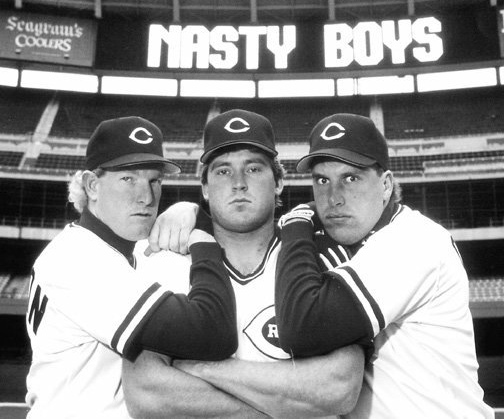
Who needs sleeves when you can have a Nasty Boy or two keeping you warm?

While Franco was saving games for a second-place Mets team in 1990, Randy Myers was becoming one of the "Nasty Boys" in the Reds bullpen.  The three-headed monster made up of Myers, fellow southpaw Norm Charlton and wide-eyed righty Rob Dibble became one of the most formidable relief trios of their generation.  The Nasty Boys combined to record 44 of the Reds' league-high 50 saves, in addition to their 2.14 ERA and 291 strikeouts in 235 innings.

With a steady offense, quality starting pitching and dominant relief corps, Cincinnati was never out of first place, keeping a firm grip on the division lead from Opening Day to the end of the season.  Randy Myers was one of the many contributors to the Reds' wire-to-wire success.  Myers led the team with 31 saves and posted a 2.08 ERA, striking out 98 batters in 86⅔ innings.  He was also one of the toughest pitchers to hit in the National League, holding opposing hitters to a .193 batting average and .281 slugging percentage.

For his efforts, Myers earned his first trip to the All-Star Game, finished fifth in the NL Cy Young Award vote and even received MVP consideration.  But he got a lot more consideration for MVP in the National League Championship Series.

Myers took home the top prize in the NLCS, saving three games for the Reds, including the Game 6 clincher that sent Cincinnati to the World Series for the first time since 1976.  Myers was also on the mound in the ninth inning of Game 4 of the World Series against the defending champion Oakland A's, retiring Carney Lansford on a foul pop-up to complete an unlikely four-game sweep that gave the Reds the title.

Myers did it all for Cincinnati in 1990, even taking time out to record a rap video as a member of "B-Lark and The Homeboys".  But Myers was just getting started in 1990, even if his fledgling music career was not.


In 1991, the Reds couldn't capitalize on their unexpected World Series-winning campaign.  Instead, they decided to convert Randy Myers into a starting pitcher, which he hadn't done since his days as a Mets farmhand.  Needless to say, it failed miserably.

Myers started 12 games for the Reds in 1991.  Although he had a respectable 3.45 ERA in those dozen starts, he pitched in and out of trouble regularly, allowing 106 base runners (62 hits, 43 walks, one hit batsman) in 70⅓ innings.  Myers' teammates didn't fare much better, as Cincinnati followed up its memorable 1990 campaign by finishing fifth in the six-team NL West with a disappointing 74-88 record in 1991. 

Two months and two days after he became a Red, Myers was sent packing again, this time to San Diego in a trade for infielder Bip Roberts.  After a so-so season with the Padres (3-6, 38 saves, 4.29 ERA, 1.48 WHIP), Myers became a free agent and signed a three-year deal with the Chicago Cubs.  The National League record book was not prepared for what Myers was about to accomplish.

In 1993, while the Mets were plodding through their first 100-loss campaign since 1967, their former closer was thriving as a North Sider.  Myers set a National League record by saving 53 games in his first season as a Cub, helping Chicago finish the year above .500 for only the third time in 21 seasons.  Myers' save total dropped to 21 in 1994, as the Cubs failed to give Myers many late-inning leads to protect.  Chicago finished the 1994 season in last place in the NL Central, winning only 49 games before the players' strike put the kibosh on the season.

The Cubs went back above .500 in 1995, finishing the year with a 73-71 record (the strike cut 18 games from the schedule) and contending for the first-ever National League wild card berth.  Chicago eventually fell short, finishing four games behind the Colorado Rockies for the additional playoff spot.  For the second time in three seasons, Myers led the National League in saves with 38.  He also became a three-time All-Star, earning his second consecutive nod as a Cub.  But his time with the Cubs ended with an unexpected bang, as Myers had to fend off a would-be attacker on the Wrigley Field mound after allowing a crushing home run to Houston's James Mouton.

Even a Getty Images watermark can't cover up the fact that Randy Myers is one tough badass.

The attack on the mound helped steer Myers to Baltimore when he became a free agent after the conclusion of the 1995 season.  As an Oriole, Myers was reunited with former Mets manager Davey Johnson, who gave him his first shot in the big leagues a decade earlier.  Myers did not disappoint, helping the Orioles make the playoffs in each of his two seasons in Baltimore.

Myers saved 31 games for Baltimore in 1996, as the Orioles ended a 13-year playoff drought by claiming the American League wild card.  Myers was especially productive during the season's final month.  On August 29, the Orioles found themselves in a virtual three-way tie with the White Sox and Mariners for the AL wild card lead.  From that point on, Baltimore was one of the hottest teams in the league, winning 12 of their next 16 games to take control of the wild card race.  Myers was particularly dominant during the season's final month, posting a barely-there 0.84 ERA in 13 games and allowing only nine hits - all singles - in 10⅔ innings.

Myers' regular season success in his first year as an Oriole continued in his second year with the team, as he led the American League with 45 saves in 1997.  In doing so, Myers set a new single-season team record, shattering the old mark of 37 set by Gregg Olson in 1990.  (Myers' record was eventually surpassed by Jim Johnson, who saved 51 games for the Orioles in 2012.)

Unfortunately, his success in the regular season didn't carry over into the playoffs, as Myers struggled in the postseason for the first time in his career.  After not having allowed an earned run in any of his first 12 postseason appearances with the Mets and Reds, Myers gave up an extra-inning walk-off home run to Bernie Williams, giving the Yankees the win in Baltimore's first ALCS game since 1983.

In 1997, Myers lost another ALCS game in walk-off fashion, although this one was far from being a conventional walk-off loss.  In what was perhaps the turning point of the series, Marquis Grissom of the Indians stole home off Myers in the bottom of the 12th inning on a failed suicide squeeze attempt by Omar Vizquel.  The Game 3 victory gave Cleveland a 2-1 lead in a series they went on to win in six games.

Randy Myers was one of the most dependable playoff relievers of all time.  But even he wasn't perfect all the time.

Once again, Myers was facing free agency and once again, he switched teams.  This time, Myers packed his bags for Toronto, who gave him a three-year, $18 million contract.  While in Toronto, Myers fared well in the saves department (28) but did not fare well with his ERA (4.46), leading the Blue Jays to bid farewell to Myers in August.  Toronto placed Myers on waivers, where he was unexpectedly claimed by the San Diego Padres.

The Blue Jays gladly traded their expensive reliever back to San Diego (Myers was a Friar in 1992), where he served as a lefty specialist and set-up man to closer Trevor Hoffman.  Myers didn't pitch well in his new role, posting a 6.28 ERA and 1.53 WHIP in 21 games with the Padres.  But the trade to San Diego did allow Myers to pitch in the World Series for a second time, eight years after winning a ring with Cincinnati.  Myers did not perform well in the playoffs, allowing four runs in three innings to the Braves and Yankees.

Since San Diego had claimed Myers off waivers, they were now on the hook for the remaining two years and $13 million left on his contract.  But Myers did not pitch at all in 1999 and 2000 because of a damaged shoulder and offseason rotator cuff surgery.  Myers' injuries caused the Padres to become involved in an ugly legal dispute with their insurance carrier, which was eventually settled in 2003.  By that time, Myers had already been out of baseball for two years.  Myers retired in 2001 after appearing in one game with the Seattle Mariners' Triple-A affiliate in Tacoma, allowing four runs without retiring a batter.

Randy Myers pitched 14 seasons in the major leagues with six different teams.  He finished in the league's top ten in saves at least once with each team.  In doing so, Myers became the only player in history to finish in his respective league's top ten in saves with at least six teams.  Myers also led the league in saves three times (1993, 1995, 1997) and finished second twice (1991, 1992).  Against the Mets, Myers was a perfect 21-for-21 in save opportunities.  And of course, Myers' 347 career saves are ninth all-time and third among left-handed pitchers.

The man affectionately referred to as Randall K. Myers by former Mets broadcaster Tim McCarver was a four-time All-Star who received Cy Young consideration in 1990, 1993 and 1997 and MVP votes in 1988, 1990, 1993 and 1997.  Myers also made the playoffs five times with three teams and posted a 2.35 ERA in 29 career postseason appearances.

In his short time with the Mets, Myers saved 56 games, which has him on the outside of the team's top ten list looking in (Braden Looper is 10th all-time with 57 saves as a Met).  His time as a starter in Cincinnati kept him from cracking the Reds' top ten as well.  But Myers is one of only four relievers to save as many as 100 games for the Cubs.  He is also eighth on the Padres' all-time saves list and ranks fifth on the Orioles' leaderboard.

Randy Myers last threw a pitch in a Mets uniform on September 30, 1989.  Since then, six pitchers have earned the right to be the Opening Day closers for the Mets.  Those six pitchers are:

Braden Looper
  • John Franco (1990-1999)
  • Armando Benitez (2000-2003)
  • Braden Looper (2004-2005)
  • Billy Wagner (2006-2008)
  • Francisco Rodriguez (2009-2011)
  • Frank Francisco (2012)

Besides being the team's Opening Day closers, the six pitchers listed above have another thing in common.  None of them were developed in the Mets' minor league system.  Franco and Benitez were acquired via trades, while Looper, Wagner, Rodriguez and Francisco all signed with the Mets as free agents.

The Mets have not developed a closer in their system since Randy Myers.  Sure, Aaron Heilman and Bobby Parnell have been used to close out games for limited stretches, with Heilman recording nine saves as a Met and Parnell notching 14, but the homegrown Met with the most saves since Randy Myers left New York is ... (drum roll please) ... Anthony Young!

Young is most known for his record-setting 27-game losing streak, but he also filled in for incumbent closer John Franco while the Mets' all-time saves leader was recovering from various injuries in 1992 and 1993.  Young saved 15 games for the Mets in 1992 and three more in 1993, ending his Mets career with 18 saves - a number that has only been surpassed by 16 players in Mets history, including the last homegrown Met to save that many games, Randy Myers.

The Mets haven't developed many closers over the last quarter century.  The last time they did, they traded him away for a hometown kid, but not a homegrown player.  The hometown kid (John Franco) became the team's all-time leader in saves, but was never an imposing figure on the mound and only led the league in saves twice as a Met.  The homegrown player (Randy Myers) went on to become one of the most dominant closers the game has ever known, becoming an All-Star with three different teams and setting the National League single season saves record.

Having veteran leadership is always beneficial to a contending team, but sometimes that leadership comes with a price.  The Mets paid that price when they traded Randy Myers to the Cincinnati Reds in 1989.  And they've been paying for other teams' closers ever since.  Sometimes it's best to give a kid a chance.  Otherwise, he might turn into a Met that got away.

Not even a black and white photo can mask how colorful Randy Myers was.

Note:  The Mets That Got Away is a thirteen-part weekly series that spotlights those Mets players who established themselves as major leaguers in New York, only to become stars after leaving town.  For previous installments, please click on the players' names below:

January 7, 2013: Nolan Ryan
January 14, 2013: Melvin Mora  
January 21, 2013: Kevin Mitchell 
January 28, 2013: Amos Otis
February 4, 2013: Jeff Reardon
February 11, 2013: Lenny Dykstra
February 18, 2013: Jeff Kent