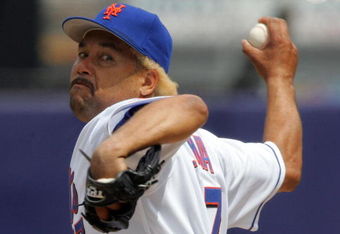
Showing posts with label Pedro Martinez. Show all posts

Saturday, May 23, 2020

Jose Lima and the Final Destination of the 2006 Mets' Starting Pitchers

Here's to you, Mr. Lima.  Hope you're able to pitch past the fifth inning in Heaven.  (Victor Baldizon/Getty Images)

Ten years ago today, the baseball world lost one of its true characters in Jose Lima.  The former Met, who had heart issues before his untimely death on May 23, 2010, finished his career with an 89-102 record and 5.26 ERA in 235 starts, which is the highest lifetime earned run average in major league history for a pitcher who made that many starts. 

Lima was the second pitcher who started at least one game for the 2006 Mets to pass away, following the death of Geremi Gonzalez (who was then known by his hip-hop nom de plume, Jeremi Gonzalez) in 2008.  Gonzalez was tragically killed at the age of 33 after being struck by lightning in Venezuela.

Back in 2009, Studious Metsimus jokingly reported that after the Mets released Jose Lima in 2006, he put a hex on the franchise, lovingly referred to as "The Curse of Lima Time".  The whammy was supposedly the reason for the Mets' failure to reach the World Series in 2006, as well as their late-season collapses in 2007 and 2008.

But is the curse real?  Has it expanded beyond a Studious Metsimus story?  A look at the thirteen starting pitchers who took the mound for the Mets in 2006 seems to suggest that it might have escaped the confines of this blog and gone searching for the Unlucky Thirteen.


************* 


Tom Glavine (32 starts) - Failed to get more than one out for the Mets in the 2007 season finale.  Later went back to Atlanta where he picked up two wins and was released by the team in 2009.  By co-inky-dink, he ended his career the way he began it, by going 2-4 with a 5.54 ERA for the Braves in 2008.  He also went 2-4 with a 5.54 ERA for the Braves in his first season with the team back in 1987.

Steve Trachsel (30 starts) - After leading the 2006 Mets with 16 wins, the Human Rain Delay II (with apologies to the original Human Rain Delay, Mike Hargrove) signed a free agent contract with the Baltimore Orioles in 2007.  He was traded in August 2007 to the Chicago Cubs, then re-signed by the Orioles the following off-season, before being released by Baltimore in June 2008.  His post-Mets stats for the 2007 and 2008 seasons featured an abysmal 9-16 won-loss record and a 5.60 ERA.

(David Zalubowski/AP)
Pedro Martinez (23 starts) - Started off brilliantly in 2006, earning wins in each of his first five starts.  Then he was placed on the disabled list after pitching horribly in his return to Fenway Park on June 28.  After coming back from his injury exactly one month later, Martinez pitched poorly in the potential division clincher at PNC Park and was caught weeping in the dugout.  In July 2009, Pedro signed a one-year deal with the Philadelphia Phillies, but his affiliation with the Bloods (see photo, right) helped bring about his downfall.  Facing the Yankees in the that year's Fall Classic also helped, as Pedro lost the two starts he made, including the game that gave the Yankees their sole championship of the last 19 seasons.  Following his defeat in Game Six, the 37-year-old Martinez never pitched again in the major leagues.

Orlando Hernandez (20 starts) - It looked as if the Curse of Lima Time was going to escape Orlando "The Dookie" Hernandez.  After all, he was surprisingly effective for the Mets after being acquired in a trade from the Arizona Diamondbacks.  The Dookie went 9-7 for the Mets and struck out nearly a batter per inning (112 Ks in 116.2 innings).  However, The Dookie met The Curse right after he was named the starting pitcher for Game One of the 2006 NLDS.  While running sprints in the outfield, the then-57 year old (give or take a few decades) tore a calf muscle and had to be removed from the postseason roster.  Despite his AARP membership and injury history, the Mets signed Mr. Dookie to a two-year, $12 million contract that off-season.  They were rewarded by getting 24 starts from His Dookness in 2007 and no starts in 2008.  He then signed a minor league deal with the Texas Rangers in 2009, only to be released a month later.  No longer in baseball, The Dookerino has apparently been offered three lucrative deals to be the spokesperson for Geritol, Metamucil and Depends undergarments.

John Maine (15 starts) - Maine was originally the throw-in when the Mets unloaded Kris and Anna Benson to the Baltimore Orioles for Jorge Julio (who was then traded to Arizona for The Dookie).  Maine impressed so much as a rookie for the Mets in 2006 that he earned a spot on the postseason roster.  His victory in Game Six of the NLCS helped the Mets reach the do-or-die Game Seven against the Cardinals.  Although Maine won 15 games in 2007, his ERA increased annually through 2010, when he won one game and posted a 6.13 ERA in nine starts.  Maine never won a game in the majors after his 29th birthday and appeared in just four games as a thirty-something, all of them coming for the lowly Marlins in 2013.  The scowl that once helped Maine get hitters out is now solely seen whenever someone utters Jerry Manuel's name.


The look of a man who just heard Jerry Manuel say "gangsta" for the umpteenth time. (AP Photo)

Alay Soler (8 starts) - Pitched a complete-game shutout against the Arizona Diamondbacks in his fourth major league start.  Three starts later, he gave up eight runs to the Boston Red Sox.  After that game, he was told to watch tapes of his outing against the Diamondbacks to prepare for his next start against the Yankees.  The Curse of Lima Time struck again, as the tapes were misplaced and instead Soler watched the tapes from his Boston Massacre.  He learned well, as he gave up another eight runs to the Yankees.  So long, Soler.  That marked the end of his short-lived major league career.

Oliver Perez (7 starts) - When the Mets needed a reliever to replace Dominican food aficionado Duaner Sanchez, they traded Xavier Nady to the Pittsburgh Pirates for 41-year-old Roberto Hernandez and Oliver Perez.  Perez did not pitch well for the Mets after his trade, going 1-3 with a 6.38 ERA.  He did pitch in Game Seven of the NLCS and then went 25-17 over the next two seasons, fooling the Mets into giving him a three-year, $36 million contract after the 2008 campaign.  Perez "rewarded" the Mets with three victories over the length of the contract.  However, sales of antacids did increase exponentially in Flushing during his time with the team, which was good news if your name was Duane or Reade.

Brian Bannister (6 starts) - The son of former major league pitcher Floyd Bannister was a respectable 2-0 with a 2.89 ERA for the 2006 Mets before the Curse of Lima Time found him on the bases at the ballpark formerly known as Pac Bell, SBC and AT&T Park.  While trying to score a run, Bannister left his hamstring in San Francisco and missed the next four months of the season.  Bannister was not himself after his return, going 0-1 with an 8.10 ERA.  He was traded that off-season to the Kansas City Royals for future felon Ambiorix Burgos, proving that the Curse of Lima Time was contagious.

Victor Zambrano (5 starts) - I won't waste your time.  You already know his story.  He was cursed before Lima could get to him.

Dave Williams (5 starts) - Williams was never meant to make that many starts for the Mets, but the team's membership with the Injury of The Week Club forced him into action five times.  Williams went 3-1 for the Mets in 2006, but the good record was due to excellent run support, as his ERA was a high 5.59.  Williams was not as lucky in 2007, appearing in only two games for the Mets.  Perhaps his 22.85 ERA had something to do with the lack of appearances.  Although he was only 28 at the time, Williams never pitched in the major leagues again.

Mike Pelfrey (4 starts) - Appeared to have been born with the antidote to the Curse of Lima Time in his blood.  After his breakout 2008 season, Big Pelf struggled a bit in 2009, but was been the Mets' most dependable starting pitcher in 2010, going 15-9 with a 3.66 ERA while surpassing the 200-inning mark for the first time in his career.  Pelfrey's success was short-lived, as he followed up his 2010 campaign by becoming one of the game's worst pitchers from 2011 until his final game in 2017.  Over those seven seasons, Pelfrey went 25-62 with a 4.99 ERA and 1.56 WHIP pitching for the Mets, Twins, Tigers and White Sox.  By age 33, the former ninth overall pick was out of the game.

The reason my wife drinks.  (Reuters)
Jose Lima (4 starts) - Just like Lou Gehrig wasn't immune to the disease named after him, Jose Lima fell to the Curse that took his name. Lima never pitched again in the majors after his brief tour of duty with the Mets, a tour that included an 0-4 record, a 9.87 ERA and a grand slam allowed to opposing pitcher Dontrelle Willis (which my future wife didn't remember even though she was at the game because Lima's appearance on the mound caused her to become best friends with her section's beer vendor).  Lima did, however, reach one milestone while in New York.  On May 12, 2006, Lima was credited with his 100th career loss, earning the landmark defeat by allowing five runs in 4⅔ innings against the Milwaukee Brewers.

Geremi Gonzalez (3 starts) - Gonzalez started against Randy Johnson in the first game of the 2006 Subway Series at Shea Stadium and gave up four runs in the first inning.  The Mets eventually won that game on David Wright's walk-off hit off Mariano Rivera in the bottom of the ninth inning, making Gonzalez the answer to the trivia question, "Who sucked so badly in Game One of the 2006 Subway Series that the Mets needed a walk-off hit by David Wright to win the game?"  Unfortunately for Gonzalez, he made a better lightning rod than starting pitcher, as he was killed during a thunderstorm in his native Venezuela.


*************


The starting pitchers for the 2006 Mets, otherwise known as the Unlucky Thirteen, have suffered professionally and personally since that 2006 campaign. The so-called Curse of Lima Time has claimed careers and lives, including the man for whom it was named.

Although this blog was written as a humor piece, we do not mean to poke fun at the expense of Jose Lima, who passed away ten years ago today at the age of 37.  Lima was a fun-loving man who had a respectable major league career, if you don't look at his ERA or X-Rays of my wife's liver.  Lima was also a positive presence in the clubhouse and was loved by his teammates.

Jose Lima will always be missed in the major league community and of course, in the blogging community.  May he continue to rest in peace.


This is how most Mets fans remember Jose Lima.  (Howard Earl Simmons/NY Daily News)

Thursday, September 14, 2017

Matt Harvey Could Make History, and Not In a Good Way

Looks like an Unhappy Harvey Day.  (Kevin C. Cox/Getty Images)

Matt Harvey's fall from All-Star Game starting pitcher to oft-injured, in-game batting practice pitcher has been well documented.  A year after going 4-10 with a 4.86 ERA and 1.468 WHIP, Harvey has somehow gotten worse.  Much, much worse.  In fact, if he doesn't show any kind of progress in his final few starts, he stands to make Mets history, and it's not the kind of history any pitcher would ever want to be associated with.

In 16 starts this season, Harvey has seen his ERA and WHIP go up to 6.14 and 1.574, respectively.  Should Harvey fail to lower his ERA under 6.00 before the end of the campaign, he would join an exclusive club.  How exclusive would it be?  Let's just say no one has been allowed to enter it yet.

Thanks to the baseball-reference.com Play Index, Pete Schourek and Matt Harvey can be mentioned in the same sentence.


Prior to Harvey's 2017 campaign, Pete Schourek was the Mets pitcher who came closest to posting an ERA north of 6.00 with at least 16 starts.  But Schourek's 5.96 ERA in 1993 was crafted as both a starter and reliever.  In Schourek's eighteen starts, he posted a 5.47 ERA, compared to the embarrassing 7.86 ERA he had in 23 relief appearances for the last Mets team to reach triple digits in losses.

Now if we only consider those Mets hurlers who made all of their appearances in a starting role, the closest one to Harvey is a another former ace whose career in New York was beleaguered by injuries.

What is it with guys named Pete or the Spanish equivalent of Pete and high ERAs?  Is Harvey secretly a Pete in disguise?

Harvey is not the only Mets starter this season to suffer from injuries, poor performance or a combination of the two.  Zack Wheeler had a 5.21 ERA in 17 starts before injuries curtailed his season.  Robert Gsellman is the owner of an unsightly 5.58 ERA in 19 starts and three relief appearances.  And had Steven Matz's season not come to a close after just 13 starts, he'd be in line to join Harvey in the Mile High ERA club (Matz finished the year with a 6.08 ERA).

But as awful as Mets pitchers have been this year, no pitcher in the 56-year history of the franchise who made as many as 16 starts has ever finished a season with an ERA higher than 6.00.  That may change when the curtain falls on the 2017 baseball season in a couple of weeks.  And a former Dark Knight could be facing some dark nights of his own during the off-season as he reflects upon his historically bad campaign.


Thursday, January 1, 2015

If Studious Metsimus Had A 2015 Hall of Fame Vote...

On Tuesday, January 6, the National Baseball Hall of Fame will reveal its newest inductees to the public.  This year, there were 17 new candidates to consider, as well as 17 holdovers from previous years.  Notable first-timers include Randy Johnson and John Smoltz, as well as former Mets Pedro Martinez, Carlos Delgado, Gary Sheffield, Cliff Floyd and Tony Clark.

There are also two former Mets who are returning to the ballot in 2015 (Mike Piazza, Jeff Kent), making the other 15 holdovers jealous because they never got the support of Mets fans during their active days as a player.  Well, technically Kent didn't get the support of Mets fans, either, but at least he got the support of the writers of the show "Reno 911!", who clearly modeled the character of Lt. Dangle after him.


For the fifth straight year, Studious Metsimus has been denied an "official" vote for the Hall of Fame, a travesty that has been overlooked for too long.  But we ain't mad at'cha.  Instead, the staff of this site has joined heads to give you our unofficial vote, along with brief reasons why these players should be allowed to have plaques in Cooperstown.

As Mets fans, we should know quite a bit about travesties and being overlooked.  After all, of the 14 players who received fewer than 5% of the Hall of Fame votes in 2014, thereby removing them from this year's ballot, five of them were former Mets.  Moises Alou, Hideo Nomo, Armando Benitez, Paul Lo Duca and the beloved Kenny Rogers will no longer be considered by the BBWAA for Hall of Fame enshrinement.  But that doesn't mean that a former Met or two will be denied this year.

Here's the list of players I'd vote for if not for that stupid "you're just a blogger, not a ten-year writer for a respected publication" rule.


Randy Johnson

For the early part of his career, Johnson was the left-handed version of Nolan Ryan.  From 1990 to 1992 (the first three seasons in which Johnson made 30+ starts), the lanky southpaw averaged 221 strikeouts and 139 walks per season and he barely had a winning record (39-35) in those three campaigns.  Then 1993 happened, and the man who possessed a slider named Mr. Snappy exploded as a perennial All-Star.

For a ten-year period (1993-2002), Johnson was the most dominant pitcher in baseball, going 175-58 with a 2.73 ERA, 1.08 ERA and an incredible 2,928 strikeouts.  He also learned how to throw pitches a little closer to the plate, as his walked just 712 batters over the decade.

Johnson finished his career as the second-greatest strikeout pitcher of all time, behind Nolan Ryan.  The ten-time All-Star won five Cy Young Awards, finishing in the top three in three other seasons.  He also received MVP votes in nine seasons, an almost unheard of feat for a pitcher.  And of course, he shared MVP honors in the 2001 World Series (with Curt Schilling) when he won three games against the Yankees.

Mr. Snappy and the man who threw him is without question deserving of the call from the Hall.

Mr. Snappy crackled in the air and popped in the catcher's mitt.  (Photo by Elaine Thompson/AP)


Pedro Martinez

Although Martinez "only" won 219 games in his 17-year career, his Hall of Fame candidacy rests on all the No. 1s he racked up in his career.  Are you ready for this long list?

Martinez led the league in wins once, winning percentage three times, ERA five times, WHIP six times, strikeouts four times (excuse me while catch my breath ... okay, let's continue), strikeouts per nine innings five times, fewest hits per nine innings five times, strikeout-to-walk ratio four times, shutouts once and complete games once.

The former Met pitched in two World Series, winning it all as a member of the Red Sox in 2004.  He also posted an 86.0 WAR as a pitcher, which ranks him 17th all-time in that category.  Fourteen of the 16 pitchers ahead of him are already in the Hall of Fame.  A fifteenth should enter this year (Randy Johnson), while the sixteenth is Roger Clemens, who would be a shoo-in for the Hall if the specter of PEDs wasn't scaring voters away.

Pedro Martinez once threw Don Zimmer to the ground.  Now he should throw down at Cooperstown as a slam dunk first-ballot Hall of Famer.

Pedro Martinez sprinkled in some fun during a wonderful major league career.  (Photo by Frank Franklin II/AP)


John Smoltz

The Braves had two eventual 300-game winners in Hall of Famers Greg Maddux and Tom Glavine.  But the most dominant pitcher during their era of greatness in the 1990s might have been John Smoltz.

Whereas Greg Maddux would paint the corners with the precision of a surgeon and Tom Glavine would confuse umpires into calling strikes on pitches that were off the plate, John Smoltz would come right after the hitter.  He did it as a starting pitcher.  He did it even better as a relief pitcher.  But he was truly at his best as a postseason pitcher.

After a slow start to his career (78-75, 3.59 ERA, 1.24 WHIP from 1988 to 1994), Smoltz turned the corner in 1995 by going 12-7 during the strike-shortened campaign and striking out over a batter per inning for the first time in his career.  A year later, Smoltz won 24 games and the Cy Young Award.  Two years after that, Smoltz led the league in winning percentage (17-3, .850 win %) and finished fourth in the Cy Young vote.  Injuries kept him from pitching in 2000, but when he came back in 2001, he became the Braves' closer.  Smoltz saved 154 games in three-and-a-half seasons, including 55 in 2002, which is still tied for the all-time National League record.

Smoltz pitched in 41 postseason games, both as a starter and reliever, winning 15 games and saving four others.  The 15 postseason wins are the second-highest total in history.  Smoltz also posted a 2.67 lifetime ERA in October and struck out 199 batters, the most of any pitcher in postseason history.

Had he not lost four-and-a-half years to injury and closer's duties, Smoltz might have approached 300 victories (he won 213).  He should approach (and surpass) the 75% minimum needed to enter the Hall of Fame.

Mets fans should tip their caps to John Smoltz on the day he enters the Hall of Fame. (Rich Pilling/MLB Photos)


Among returnees on the ballot, I would vote for Mike Piazza (duh) and Craig Biggio (double duh, which is appropriate since doubles were his specialty, as he hit the fifth-most doubles in MLB history).

The other five votes I'd be allowed to cast (if I were allowed to cast any at all ... stupid BBWAA not letting me play in their sandbox) would go to Jeff Bagwell, Curt Schilling, Larry Walker, Edgar Martinez and Jeff Kent.

Lieutenant Dangle's doppelganger may not have been the friendliest guy in the world, but he sure put up great numbers (regardless of position) for a large chunk of his career.  And "dangle" in the fact that he did all this as a middle infielder, well, he deserves to be mentioned among the best to play the game, as do Bagwell, Schilling, Walker and Edgar Martinez.


Monday, February 20, 2012

One Season Wonders: Pedro Martinez

In 2004, the Mets finished below .500 for the third consecutive season.  Attendance at Shea Stadium, which had averaged 2.7 million from 1999-2002, had plummeted to an average of 2.2 million in 2003 and 2004.  With the Yankees winning six American League pennants and four World Series championships in less than a decade, baseball fans in New York were not exactly lining up to buy tickets to see the Mets.

The Mets needed to make a change for the better and they needed to do it fast if they wanted to remain relevant in their own city.  To effect this change, Mets' owner Fred Wilpon gave full autonomy to new general manager Omar Minaya.  It was up to the Queens-raised Minaya to turn the Mets into kings of the National League East.  Realizing he had just gotten the keys to the castle, Minaya wasted no time in his efforts to make the Mets matter again.

First, he hired Willie Randolph to take over for the dismissed Art Howe.  Then came the hard part.  In Randolph, the Mets had a leader in the dugout.  But they needed a leader on the field.  Jose Reyes and David Wright were still soiling their baseball diapers at the time, so they were not viable candidates.  Instead, Omar Minaya set his sights on one player.  He was looking for a respected veteran presence on the team who could also serve as their Pied Piper, leading other talent out of their cities and into Shea Stadium.

Just before the Winter Meetings, Minaya boarded a plane for the Dominican Republic, spending his Thanksgiving in Santo Domingo.  Soon after, Mets fans were the ones giving thanks.

With Pedro Martinez on board, the Mets were hoping to hitch a ride to first place.


Less than three weeks after spending his Thanksgiving in the Dominican Republic, Omar Minaya gave Mets fans an early Christmas gift, signing Pedro Martinez to a four-year, $53 million deal.  Martinez, who had just led the Boston Red Sox to their first World Series championship in 86 years, would immediately give the Mets credibility, as well as a reason for other free agents to come to New York.

Martinez spent seven years in Boston, dominating opposing batters in a way not seen since the days of Sandy Koufax.  From 1998-2004, Martinez went 117-37 with a 2.52 ERA.  He also averaged 10.9 strikeouts per nine innings, leading the league in whiffs in four of his seven seasons with the Red Sox.  Despite his dominance, the Red Sox did not want to guarantee a fourth year to Pedro due to his injury history.  The Mets were not as timid.

With a bonafide ace to lead the pitching staff, the Mets expected the 2005 season to be different than their previous three campaigns.  But things didn't start off so well for Martinez in his first Opening Day assignment for the Mets, as Cincinnati's Adam Dunn hit a three-run homer in the bottom of the first inning to give the Reds the early lead.  Dunn's blast might have rattled an ordinary pitcher, but Pedro Martinez was no ordinary pitcher.  In fact, after the home run, the Mets got a taste of vintage Pedro, and what a fine vintage it was.

Martinez struck out nine of the next ten batters he faced, with only a third-inning walk to D'Angelo Jimenez on a 3-2 pitch preventing Pedro from tying Tom Seaver's major league record of ten consecutive strikeouts in one game.  But each strikeout made Martinez's pitch count rise near the triple digit mark.  By the end of the sixth inning, Martinez had fanned a dozen Cincinnati Reds, but had reached 103 pitches.  However, the Mets scored three runs in the seventh inning to take a 6-3 lead on the strength of Carlos Beltran's RBI single off former Met David Weathers (who was pitching in relief of another former Met, Paul Wilson) and Cliff Floyd's two-run homer off Kent Mercker.

With the Mets enjoying a three-run lead at the seventh inning stretch, manager Willie Randolph removed Pedro Martinez from the game, fully expecting his ace to come away with the victory.  But second-year closer Braden Looper blew the save in the ninth inning, allowing back-to-back homers to Adam Dunn and Joe Randa, with the latter blast coming in walk-off fashion.

Braden Looper had nowhere to hide after costing Pedro Martinez his first win as a Met.


Pedro Martinez was credited with a no-decision in his Opening Day start, a common occurrence throughout his first month and a half as a Met.  Over his first nine starts in 2005, Martinez was credited with four no-decisions, despite not allowing more than five hits in any of them.  Through May 22, Martinez was holding opposing hitters to a microscopic .155 batting average, but only had four wins to show for it.  That all changed in Pedro's next start.

On May 27, the Mets were once again hitting the snooze button instead of the baseball.  Brian Moehler started for the Florida Marlins against Pedro and the Mets that day.  This is the same Brian Moehler who was pitching for his fourth team in four years and had only won three games in the major leagues during his time as a baseball nomad.  Yet despite his recent lack of success, Moehler retired the first 11 batters he faced before allowing back-to-back doubles to Mike Cameron and Cliff Floyd.  Moehler then proceeded to retire 13 of the next 15 batters after the Mets had taken their 1-0 lead.  Faced with the daunting task of having to put up zeroes against the Marlins, Martinez accepted the challenge and put his teammates on his back, pitching eight shutout innings while striking out ten and walking no one.  This time, Braden Looper held the lead for Pedro and the Mets came away with a 1-0 victory.

Pedro's performance against the Marlins began a stretch in which he earned eight victories in 11 starts.  From May 27 to July 23, Martinez went 8-2 with a 2.51 ERA, striking out 74 batters and walking only 14.  During this two-month period, Martinez was selected for the National League All-Star team.  However, he did not play in the Midsummer Classic because he had pitched seven strong innings for the Mets in the last game before the break, a 6-1 victory over the Pittsburgh Pirates.

After July 23, the combination of poor relief work and a sputtering offense contributed to another stretch where wins were scarce for Pedro Martinez.  In an eight-start stretch from late July to early September, Martinez held opposing batters to a .226 batting average and .283 on-base percentage.  He also allowed three runs or less in six of the eight starts, but was the winning pitcher in only one of those starts.  During that eight-start period, one game stood out in particular.  It was a game in which Pedro was on teetering on the edge of Mets' immortality, only to fall off with one swing of the bat.

On August 14, the Mets were playing the Dodgers in the rubber game of a three-game series.  Only three days earlier, Carlos Beltran and Mike Cameron were involved in a horrific outfield collision at Petco Park, ending Cameron's season and taking Beltran out of action for a week.  As a result, Gerald Williams was starting for Beltran in center field for Pedro's start at Dodger Stadium.  This would come into play late in the game.

The Mets broke a scoreless tie in the fifth inning on an RBI double by Williams.  Meanwhile, Pedro Martinez was nearly perfect, allowing a first-inning walk to Milton Bradley before retiring the next 20 batters to face him.  Up came Antonio Perez, who had amassed 97 career hits in three major league seasons prior to his eighth inning at-bat against Pedro.  Three pitches later, that total had gone up to 98.

On a 1-1 count, Perez drilled a triple to deep center.  It was the first hit for the Dodgers and the only hit Perez would ever record off Martinez.  The ball might have been catchable, but with Gerald Williams playing center instead of Carlos Beltran, it became an easy triple for Perez.  Interestingly enough, almost five years to the day before Williams failed to catch Perez's fly ball, he was involved in an on-field altercation with Pedro Martinez.

Did Gerald Williams remember this moment when he was "chasing" after Antonio Perez's fly ball?


Martinez, then with the Red Sox, hit Gerald Williams with a pitch in the first inning, causing him to charge the mound.  Williams and several of his Devil Ray teammates were ejected from the game, a game in which Pedro threw (you guessed it) a one-hit shutout.  Five years later, Gerald Williams was once again instrumental in a Pedro Martinez-pitched game that had become a one-hit shutout.  Unfortunately, the game would not end that way.  One batter after the no-hitter was gone, the shutout and the lead were also no more, as Jayson Werth (yes, THAT Jayson Werth) hit a two-run homer off Martinez to give the Dodgers a 2-1 lead.  The Mets, despite outhitting the Dodgers, 10-2, lost the game and the series, with Pedro Martinez picking up the hard-luck loss.

After the disappointing loss to the Dodgers, Martinez did not give up a run in each of his next two starts.  But just like in his Opening Day start, the bullpen failed to help Pedro get a win.  On August 20, Martinez left his start against the Washington Nationals with a seemingly insurmountable 8-0 lead.  But the bullpen coughed up the lead, allowing the Nats to tie the game at 8.  The Mets eventually won the game in extra innings, but Pedro once again failed to get a win.  He did get the win in his next start, throwing six shutout innings against the Arizona Diamondbacks.  But in his final August start, Martinez had one of his few poor performances of the 2005 season.

On August 31, Pedro Martinez took the hill against the Phillies with a chance to pitch the Mets into the wild card lead.  Just one night before, the Mets had pulled to within half a game of the wild card on a late home run by Ramon Castro.  But with the Mets holding on to a slim 2-1 lead in the fifth inning, it wasn't the bullpen that cost Pedro the win.  It was Pedro himself, as the Phillies took the right-hander deep four times en route to an 8-2 victory at Shea Stadium.

Although the Mets failed to make a run at the wild card in September, Pedro Martinez continued to chug along.  After allowing four home runs to the Phillies in his final August start, Martinez did not allow a single home run in the month of September, recording a 2.25 ERA during the season's final month, a month that featured a complete-game, ten-strikeout gem against the division champion Braves on September 16 for his 15th and final win of the season.

Pedro Martinez helped bring other winners to New York, but had difficulty getting wins of his own.


The Mets finished the 2005 season with an 83-79 record, a 12-win improvement over their 2004 campaign.  Pedro Martinez's first year in New York was an overwhelming success, as the right-hander went 15-8 with a 2.82 ERA and 208 strikeouts.  The following year, Pedro started the season by winning each of his first five starts, giving fans hope that the best was yet to come.  Although the Mets had a memorable season in 2006, this time Pedro Martinez had very little to do with it.  In fact, he had very little to do with anything over the final three years of his four-year deal.

Following his 5-0 start to the 2006 season, Martinez won a total of 12 games for the Mets until his contract expired following the 2008 campaign.  This was mostly due to the ever-present injury bug; the same bug that scared Boston away from offering him a fourth year.  Because of this bug, Pedro was not able to pitch for the Mets in the 2006 playoffs, as well as most of the 2007 and 2008 seasons.  His 12-15 record and 5.00 ERA following the first month of the 2006 season was hardly what the Mets expected from the former Cy Young Award winner, and certainly not worthy of the tens of millions of dollars he was being paid by the team.  Upon the completion of the 2008 season, Martinez was not re-signed by the Mets and did not pitch again in the major leagues until the second half of the 2009 season, when the Phillies took a chance on him.  Naturally, Pedro went 5-1 for the defending World Series champions and helped them win a second consecutive National League pennant.

Pedro Martinez came to the Mets in 2005 with a big contract and a history of success in the major leagues.  In his first year in New York, he helped the Mets end a streak of three consecutive losing seasons, giving them hope that better days were still to come.  Although the Mets did win the division title in 2006 and narrowly missed the playoffs in 2007 and 2008, their success was due more to the players that followed Pedro to New York and not Pedro himself.

In 2005, the Mets paid Pedro Martinez $53 million to be a four-year wonder.  Instead, they got a one-year wonder and a total of 17 wins over the remaining three years.  Pedro was supposed to lead the Mets to a World Series title.  Instead, his former team accomplished the feat during the third year of his contract with the Mets.  With most one-season wonders, the Mets would be very happy with what they got.  Unfortunately, with Pedro Martinez, the Mets felt like they were short-changed.  There's nothing wonderful about that.


Note: One Season Wonders is a thirteen-part weekly series spotlighting those Mets who had one and only one memorable season in New York.  For previous installments, please click on the players' names below:
 
January 2, 2012: Bernard Gilkey
January 9, 2012: Terry Leach 
January 16, 2012: George Stone
January 23, 2012: Roger Cedeño
January 30, 2012: Frank Viola
February 6, 2012: Joe Christopher 
February 13, 2012: Dave Magadan

Sunday, February 12, 2012

Long-Term Deals Lead To Long-Term Headaches


In 2006, the Mets needed one more win to reach the World Series.  When they failed to do that, they decided to go shopping for a pitcher that would help them get that win.  Barry Zito was the name on everyone's minds that offseason.  In seven years with Oakland, Zito had an impressive 102-63 record and a 3.55 ERA.  From 2001 to 2006, Zito made at least 34 starts in every season and did not pitch fewer than 213 innings in any of those campaigns.  He was also a three-time All-Star and a former Cy Young Award winner.  But to get him, the Mets would have to pay a pretty penny.  They'd also have to give him many years.

The San Francisco Giants beat the Mets to the punch, signing Zito to a seven-year, $126 million contract.  At the time, it was the largest contract ever offered to a pitcher.  Zito has thanked the Giants for their generosity by going 43-61 with a 4.55 ERA over the first five years of his contract.  The Giants thanked him back by leaving him off the World Series roster in 2010.

It could have been the Mets paying for Zito over the past five seasons.  Before becoming a Giant, Zito's lifetime numbers (102-63, 3.55 ERA, 222 starts, 1,096 strikeouts) looked a lot like what Ron Darling put up with the Mets (99-70, 3.50 ERA, 241 starts, 1,148 strikeouts).  Since then, Zito has been paid an average of $18 million per year to pitch like Al Jackson.  (Jackson went 43-80 with a 4.26 ERA as a Met.)

Fortunately, the Mets didn't give Zito the long-term deal afforded to him by the Giants.  But that hasn't stopped them from giving other deals of four years or more to pitchers.  In fact, over the past decade the Mets have given a number of long-term deals (four years or more) to various pitchers and although they haven't been Zito-esque, they still weren't rewarded the way they expected to be.  Let's take a look at those faulty deals.


2000:  Armando Benitez - Four years, $22 million

After long-time Mets closer John Franco was sidelined with an injury in 1999, Armando Benitez stepped in and became the team's closer.  Benitez helped the Mets end an 11-year playoff drought in 1999, but gave up a game-tying single to Ozzie Guillen (yes, that Ozzie Guillen) in the tenth inning of Game 6, with the Mets two outs away from forcing an improbable Game 7 after losing the first three games of the series.  It would not be the first time Benitez would blow a lead in a crucial game.  However, it didn't stop the Mets from signing him to a four-year deal during that offseason.

In 2000, Benitez was armed with a new contract to go with his blazing fastball.  He set the Mets' single season record with 41 saves and was part of the team's first World Series appearance since 1986.  But he gave up a game-tying three-run homer to the Giants' J.T. Snow in Game 2 of the NLDS, a game eventually won by the Mets in extra innings when John Franco, the man Benitez replaced as closer only a year before, struck out Barry Bonds to tie the series.  Franco couldn't help him in Game 1 of the World Series, as Benitez gave up a walk, two singles and a game-tying sacrifice fly in the ninth inning, blowing yet another save in a crucial postseason game.  The Mets went on to lose the game and the series to the Yankees.

The following season, the Mets didn't make the playoffs, but that didn't stop Benitez from blowing huge saves.  In 2001, the Mets were attempting to make a 1973-like run to the top of the division.  After starting the year with a 54-68 record, the Mets went on a tear, winning 22 of their next 27 games to pull to within 3½ games of the first place Braves.  With the Mets one out away from cutting the lead to 2½ games, Armando Benitez gave up a two-run homer to Brian Jordan and an RBI single to B.J. Surhoff, in a game eventually lost by the Mets in 11 innings, when Jordan hit his second home run in as many at-bats.  A week later, Benitez was at it again, blowing a four-run ninth inning lead by giving up five runs in two-thirds of an inning to the Braves.  By then, Benitez had worn out his welcome in New York, with fans booing loudly every time he came into a game.  With a few months left on his contract in 2003, the Mets were finally able to unload Benitez, trading him to the Yankees who in turn flipped him to Seattle.  Benitez thanked the Mets in 2004 by saving 11 games against them as a member of the Florida Marlins.  He's still waiting for a "you're welcome".


2001: Kevin Appier - Four years, $42 million

After the Mets went to the World Series in 2000, Mike Hampton defected to the Colorado Rockies in order to pay the $121 million tuition bill for their precious school system. (That was his reason for leaving, right?)  Needing to fill the void left by Hampton's departure, the Mets turned to free agent Kevin Appier.  Appier was a 12-year veteran with 136 career wins and a respectable 3.63 career ERA.  Those numbers look good on paper, but most of them were achieved during his first five seasons in the majors.

From 1989-1993, Appier was 59-38 for the Kansas City Royals with a stellar 2.95 ERA.  In the seven years prior to becoming a Met, Appier had gone 77-67 with a 4.11 ERA for the Royals and Oakland A's, hardly the numbers that would earn a player a four-year, $42 million deal in 2001.  But the Mets were desperate, so they overpaid for Appier.

Appier pitched one year for the Mets, going 11-10 with a 3.57 ERA.  Although the ERA was his lowest since 1997, it was still not the kind of season the Mets expected from their $42 million man.  The Mets traded Appier after only one season in New York, sending him to Anaheim for the past-his-prime Mo Vaughn.  Appier won 22 games over the remaining three years of his contract, never pitching again after the deal was done.  Vaughn played 166 games for the Mets, before retiring due to knee problems.  Who says the stomach isn't connected to the knee bone?


2003: Tom Glavine - Four years, $42.5 million

In 2002, the Mets suffered their first losing season since 1996 and first last place finish since 1993.  Much of the blame was placed on their free agent flops, as Mo Vaughn, Roberto Alomar and Jeromy Burnitz brought underachieving to new depths. But another reason for their failures was their pitching staff.  Al Leiter and Steve Trachsel were .500 pitchers.  Pedro Astacio was the rotation's sole winning pitcher at 12-11.  Jeff D'Amico (another free agent flop) won six games.  And Shawn Estes couldn't hit the strike zone or Roger Clemens.  To fix the pitching mess, general manager Steve Phillips imported one of the best pitchers from the Mets' fiercest rival.

Tom Glavine had always been a thorn in the Mets' side.  Prior to 2003, Glavine had gone 17-7 with a 2.82 ERA in 36 starts against the Mets.  The Mets expected great things from the 242-game winner and got a season reminiscent of another eventual 300-game winner named Tom.  Unfortunately, that season was Tom Seaver's 1983 campaign, a season that Glavine mirrored two decades later by going 9-14 for the Mets.

Although Glavine did up his win by two every year for the next three years, he still failed to pitch like the Hall of Famer he will probably become.  Throughout the length of his original four-year deal (the fourth year was an option year based on innings pitched), Glavine was merely a .500 pitcher, going 48-48.  But the sting of losing to the Cardinals in the 2006 NLCS left Glavine wanting more, so he signed a one-year deal to pitch the Mets back to the playoffs.  He got his chance on the final day of the 2007 season.  How did he do?  Let's just say that instead of being the second coming of Tom Terrific, he became the first coming of Tom Horrific, but at least he wasn't devastated by it.  Too bad the same couldn't be said for Mets fans.


2005: Pedro Martinez - Four years, $53 million

In 2004, the Mets had just come off their third consecutive losing season and new general manager Omar Minaya felt the need to make a big splash (a common theme during his time in New York).  Free agent pitcher Pedro Martinez was the big name on the market and Minaya was adamant about signing him.  Martinez was arguably the best pitcher in the American League during his seven-year stay in Boston, going 117-37 with a 2.52 ERA.  He was also a six-time All-Star, three-time Cy Young Award winner, five-time ERA leader and three-time strikeout champion.  But one overlooked fact about Pedro was that in his final season in Boston, his ERA ballooned to 3.90 and his 193 hits allowed were the most he had ever given up in a full season.

Speaking of full seasons, Martinez had only surpassed 30 starts in four of the 11 seasons since he became a full-time starter.  Over his final six seasons in Boston, he had only gone past 30 starts once.  His fragility was the reason why Boston wouldn't guarantee a fourth year, something the Mets eventually did in order to bring him into the fold.

The contract looked like a bargain in 2005.  In his first season in New York, Pedro went 15-8 with a 2.82 ERA and 208 strikeouts.  He also made 31 starts and led the major leagues with his 0.95 WHIP.  However, after winning his first five starts in 2006, Martinez broke down.  And broke down.  And broke down some more.  From May 2006 to the end of his contract in 2008, Martinez went 12-15 with a 5.00 ERA, making only 48 starts, none of which came in the playoffs during the Mets' run to Game 7 of the NLCS.  His contract and injury history made him untradeable, and Martinez did not pitch again in the major leagues until late in the 2009 season, when he helped the Phillies reach the World Series.  Of course.


2006: Billy Wagner - Four years, $43 million

The Braden Looper experiment of 2004 and 2005 failed, to put it mildly.  Although the Mets were headed in the right direction in 2005, improving by 12 wins under first-year manager Willie Randolph, Looper wasn't the right fit for the team coming into late-inning pressure situations.  General manager Omar Minaya felt that a change was needed at the closer position, so he dipped his toe into the free agent waters again.  Enter Billy Wagner, as the Sandman who did his best to give opposing hitters nightmares.

Wagner was outstanding in 2006, becoming the first left-handed pitcher in club history to record 40 saves in a single season.  But Wagner started to fall apart late over the next two seasons.  In 2007, it was his performance on the mound towards the end of the season (6.91 ERA, three blown saves in his final 14 appearances) that helped the Mets give up their seemingly insurmountable lead in the division.  One year later, it was his lack of appearances on the mound that led to the Mets' downfall.

After blowing a save against the Astros on August 2, Wagner did not pitch again in 2008, needing Tommy John surgery to repair his damaged elbow.  Two weeks after Wagner's season-ending injury, the Mets acquired Luis Ayala and he became the club's fill-in closer.  This was the same Luis Ayala who had racked up a whopping nine saves in four seasons with the Washington Nationals.  Two blown saves, two losses and a 5.50 ERA later, Ayala had done more than just blow the lead in various games.  He helped blow the Mets' lead in the division, all while Billy Wagner was collecting his paycheck in the recovery room.  Ayala was gone by 2009, as was Billy Wagner, who made two token appearances after the All-Star Break to up his trade value from getting a bag of golf balls to getting Chris Carter from the Boston Red Sox.  Perhaps the golf balls would have been the better deal.


2008:  Johan Santana - Six years, $137.5 million

A year after the Mets failed to make Barry Zito the highest paid pitcher in baseball, they pulled out their wallets for a far more deserving candidate in Johan Santana.  After completing a deal with the Minnesota Twins for the star lefty (not the first time the Mets sent a bushel of young players to Minnesota for a former Cy Young Award winning southpaw), the Mets signed Santana to a six-year extension, hoping the put the stunning late-season collapse of 2007 behind them.

In his first year in New York, Santana gave the Mets everything they could have wanted and more.  The 29-year-old finished the season with a 16-7 record and a major league-leading 2.53 ERA.  Santana finished third in the Cy Young Award vote and could have finished higher had it not been for the seven games he handed over to the bullpen with the lead that they failed to hold.  (Dang you, Billy Wagner and Luis Ayala!)

In 2009, Santana started the season well (8-3, 2.39 ERA over his first 12 starts), but became an average pitcher over his final 13 starts (5-6, 3.80 ERA) before missing the final six weeks of the season with an elbow injury.  The 2010 season wasn't much different for Santana, who had a fine start (8-5, 2.79 ERA), followed by a sluggish finish (3-4, 3.47 ERA) and another season-ending injury.  However, this injury ended two seasons, as Santana has not thrown a baseball in a major league game since then.  Santana is entering his fifth season with the Mets with a 40-25 career mark in New York, which isn't bad, but the Mets probably expected him to be in the franchise's top ten in wins by now (Steve Trachsel currently rounds out the top ten with 66 wins as a Met).  Instead, Santana is still chasing guys like Craig Swan (59 wins), Mike Pelfrey (50 wins), Al Jackson (43 wins) and Pat Zachry (41 wins).  That's what $137.5 million buys you in the Mets' world.

The Mets have flushed a lot of their money down the toilet by signing pitchers to long-term deals.


In 2007, The Mets wouldn't offer Barry Zito the long-term commitment the Giants did, and rightfully so, as Zito has been one of the worst free-agent signings in baseball history.  However, that doesn't mean the Mets haven't given away (literally) their money to other top pitchers over the past decade.

Since the advent of the 21st century, the Mets have signed six pitchers to deals of four years or more.  Armando Benitez almost made it through the four years, but not before having to tell his kids that the correct pronunciation of their last name wasn't Boo-nitez.  Kevin Appier was traded away after one season for a player who retired before Appier's contract was up.  Tom Glavine was a .500 pitcher throughout his four-year deal, which of course translated into another one-year contract that the Mets and their fans would like to forget.  Pedro Martinez might have ushered in the "New Mets" before Carlos Beltran coined the phrase, but really ushered out his own career after one successful campaign.  Billy Wagner celebrated a division title in the arms of Paul LoDuca, but then had arm troubles of his own.  And Johan Santana still has a chance to earn some of his record-setting contract, but has thus far given the Mets one start in the month of September since becoming the last Met pitcher to record a win at Shea Stadium in 2008.

Bad contracts of four years or more have not been limited to pitchers (see Castillo, Luis) and not all bad contracts doled out to pitchers have been for four years or more (see Perez, Oliver).  But ever since the Mets signed Al Leiter to a four-year deal following the 1998 season, they haven't had much success with long-term contracts for pitchers.  Perhaps Sandy Alderson knows what he's doing by not giving out any contracts of more than two years to a pitcher since his arrival in 2010.  Either that or he's well-read on how Mets pitchers have fared after signing long-term deals in the 21st century.  My guess is on the latter.  Then again, like an Armando Benitez fastball in a crucial spot, it's kind of hard to miss.

Saturday, December 3, 2011

Where Are The 2006 Mets Now?

Don't let the title mislead you.  This post is not meant to inform you on what members of the Mets' last playoff team are up to.  On the contrary, it's meant to show you why that team might not have been as good as we thought they were at the time.

A total of 49 players suited up for the Mets in 2006.  As of this writing, only four of those players played for the Mets in 2011.  Those players were Jose Reyes, David Wright, Carlos Beltran and Mike Pelfrey.  However, Carlos Beltran was traded to the San Francisco Giants in July and Jose Reyes might have played his last game as a Met, leaving Wright and Pelfrey as the only two members of the '06 NL East champions who stand to be Mets in 2012.

Let's put it this way.  If Wright and Pelfrey are the only players left come Opening Day 2012, that'd mean the 2006 Mets would have the same number of players on the 2012 team as they have on the DL.  That doesn't stand for disabled list.  That stands for deceased list, as Jose Lima (four starts in '06) and Geremi Gonzalez (three starts in '06) are no longer with us.

The potential for having only two players left out of 49 a mere five years after that team steamrolled their way through the 2006 regular season is unusual in baseball, even in this day and age when free agents leave their teams frequently.  The 1996 Yankees, a team that won a World Series ten years before the Mets failed to get to one, had more players left on their 2011 roster (Derek Jeter, Jorge Posada, Mariano Rivera) than the Mets might have next April on Opening Day from their 2006 team.

But contrary to what it appears to be, this post is not about the few players left on the team from the 2006 roster.  It's not just that most of the players from 2006 are no longer members of the Mets.  It's that these players are no longer in major league baseball, period.

Of the 49 players who played for the 2006 squad, only 14 played in the major leagues in 2011.  Of those 14 players, two of them finished the season in the minor leagues (Aaron F. Heilman, Lastings Milledge) and another (Chris Woodward) collected only ten at-bats in the majors after spending the majority of the season playing at the Triple-A level.

It would take longer for you to read the list of 35 players from the 2006 Mets who did not make an appearance at the major league level in 2011 than it did for Steve Trachsel to deliver a pitch to home plate when there were runners on base, but we're going to do it anyway.  Here they are, in alphabetical order, with their current whereabouts and/or statuses.

  • Brian Bannister (retired)
  • Chad Bradford (retired)
  • Carlos Delgado (retired)
  • Victor Diaz (out of majors since 2007; played in Mexico in 2011)
  • Mike Difelice (out of majors since 2008; managed Kingsport Mets in 2009 and 2010)
  • Pedro Feliciano (signed two-year deal w/Yankees in 2011; might never pitch for them due to injuries)
  • Cliff Floyd (out of majors since 2009; broadcaster for FOX Sports Florida)
  • Bartolome Fortunato (out of majors since 2006; played in Canada in 2011)
  • Julio Franco (waiting for Omar Minaya's call from San Diego)
  • Tom Glavine (retired in non-devastating fashion)
  • Geremi Gonzalez (R.I.P.)
  • Shawn Green (retired; on book signing tours for his new book)
  • Anderson Hernandez (played w/Astros' AAA team in 2011)
  • Orlando Hernandez (played w/Nationals' AA team in 2010, left the team to walk the Earth)
  • Roberto Hernandez (retired)
  • Jorge Julio (out of majors since 2009; bouncing around in Pittsburgh's minor league organization)
  • Ricky Ledee (retired)
  • Jose Lima (R.I.P.)
  • Paul Lo Duca (out of majors since 2008; serves as a horse racing analyst)
  • John Maine (left Rockies' AAA team in 2011; might be walking the Earth with Orlando Hernandez)
  • Eli Marrero (out of majors since 2006; serves as batting coach for Reds' rookie affiliate)
  • Pedro Martinez (retired 10 minutes ago)
  • Kaz Matsui (out of majors since 2010; played in Nippon Professional Baseball league in 2011)
  • Henry Owens (out of majors since 2007; suspended for HGH in 2009 and hasn't played since)
  • Oliver Perez (played w/Nationals' AA team in 2011; not good enough to make AAA team)
  • Royce Ring (played w/Mariners and Red Sox AAA teams in 2011)
  • Duaner Sanchez (out of majors since 2009; played in Mexico and Independent League in 2010)
  • Alay Soler (retired)
  • Kelly Stinnett (retired)
  • Steve Trachsel (retired)
  • Michael Tucker (out of majors since 2006; played for various independent teams since 2009)
  • Jose Valentin (out of majors since 2007; player-owner for Santurce Crabbers in Puerto Rican league)
  • Billy Wagner (retired)
  • Dave Williams (out of majors since 2007; last played professionally w/Nationals' AAA team in 2009)
  • Victor Zambrano (don't ask)

Aaron F. Heilman and Lastings Milledge both ended their seasons at the minor league level in 2011.  Chris Woodward was lucky to get a late September call-up.  That leaves only 11 players from the 2006 Mets who played exclusively in the major leagues in 2011.  One of those 11 players (Ramon Castro) only played in 23 games with the White Sox in 2011, missing the majority of the season due to a right hand fracture.

That leaves only Heath Bell, Carlos Beltran, Endy Chavez, Philip Humber, Guillermo Mota, Xavier Nady, Darren Oliver, Mike Pelfrey, Jose Reyes and David Wright as the only players from the 2006 NL East champions to play exclusively in the majors only five years after they were teammates on the Mets.

Most of the players from 2006 are either retired, dead or Victor Zambrano.  It's also stunning to note that a large number of players who were good enough to be part of a division winner in 2006 were no longer worthy of playing in the major leagues just five years later.

If you recall, both Pedro Martinez and Orlando "The Dookie" Hernandez were scratched from the postseason roster in 2006 because of injuries.  Neither pitched well after 2006 (we don't recognize Pedro's renaissance with the Phillies in 2009 because that would be saying something positive about a member of the Phillies, which is taboo here).

Also, for those who blame Beltran for the Mets' failure to advance to the World Series in 2006, let me remind you that he wasn't the only Met to strike out with the bat on his shoulders in the ninth inning of Game 7.  Before Beltran, Cliff Floyd took strike three as a pinch-hitter with the tying runs on base and nobody out.  That's the same Cliff Floyd who was too hurt to start any of the games in the NLCS after Game 1.

The 2006 Mets steamrolled their way through the 162-game regular season.  But that team was full of players who were either one injury away from ending their careers or no-names who had no business being in the majors.  What do you know?  Only five years later, a great number of those players have suffered career-altering injuries or haven't sniffed the major leagues since Shea Stadium was still around.

A winning team needs a mix of veterans to guide the kids along.  But the 2006 Mets depended too much on veterans.  Now, those veterans are no longer around, succumbing to injuries and Father Time.  That has forced players who are still kids themselves (see Reyes, Jose and Wright, David) to be the team leaders.  Given those facts, is anyone surprised that the Mets have now trudged their way through three consecutive losing seasons? 

Sunday, May 23, 2010

Jose Lima And The Final Destination Of The 2006 Mets Starting Pitchers

We regret to inform you that former Mets pitcher and Studious Metsimus whipping boy Jose Lima passed away earlier today at the age of 37. The cause of death was reported to be a heart attack.

Lima is now the second pitcher who started at least one game for the 2006 Mets to pass away, following the death of Geremi Gonzalez (who was then known by his hip-hop nom de plume, Jeremi Gonzalez) in 2008. Gonzalez was killed at the age of 33 after being struck by lightning in Venezuela.

Back in October, Studious Metsimus jokingly reported that after the Mets released Jose Lima in 2006, he put a hex on the franchise, lovingly referred to as "The Curse of Lima Time". The hex was supposedly the reason for the Mets' failure to reach the World Series in 2006, as well as their late-season collapses in 2007 and 2008.

But is the curse real? Has it expanded beyond a Studious Metsimus story? A look at the 13 starting pitchers who took the mound for the Mets in 2006 seems to suggest that it might have escaped the confines of this blog and gone searching for the Unlucky 13.

Tom Glavine (32 starts) - Failed to get more than one out for the Mets in the 2007 season finale. Later went back to Atlanta where he picked up two wins and was released by the team in 2009. By co-inky-dink, he ended his career the way he began it, by going 2-4 with a 5.54 ERA for the Braves in 2008. He also went 2-4 with a 5.54 ERA for the Braves in 1987.

Steve Trachsel (30 starts) - After leading the 2006 Mets with 16 wins, the Human Rain Delay II (with apologies to the original Human Rain Delay, Mike Hargrove) signed a free agent contract with the Baltimore Orioles in 2007. He was traded in August 2007 to the Chicago Cubs, then re-signed by the Orioles the following off-season, before being released by Baltimore in June 2008. His post-Mets stats for the 2007 and 2008 seasons? How about a 9-16 record and a 5.60 ERA.

Pedro Martinez (23 starts) - Started off brilliantly in 2006, winning his first five decisions. Then he was placed on the disabled list after pitching horribly in his return to Fenway Park. After coming back from the DL, he pitched poorly in the potential division clincher at PNC Park and was caught weeping in the dugout. He signed with the Phillies in 2009, but his affiliation with the Bloods (see photo, below) helped bring about his downfall. As of now, Pedro is still unemployed.

Orlando Hernandez (20 starts) - It looked as if the Curse of Lima Time was going to escape Orlando "The Dookie" Hernandez. After all, he was surprisingly effective for the Mets after being acquired in a trade from the Arizona Diamondbacks. The Dookie went 9-7 for the Mets and struck out nearly a batter per inning (112 Ks in 116.2 innings). However, The Dookie met The Curse right after he was named the starting pitcher for Game 1 of the 2006 NLDS. While running sprints in the outfield, the then-57 year old Dookie tore a calf muscle and had to be removed from the postseason roster. Despite his AARP membership and injury history, the Mets signed Mr. Dookie to a two-year, $12 million contract that off-season. They were rewarded by getting 24 starts from The Dookie in 2007 and no starts in 2008. He then signed a minor league deal with the Texas Rangers in 2009, only to be released a month later. No longer in baseball, The Dookie has apparently been offered three lucrative deals to be the spokesperson for Geritol, Metamucil and Depends undergarments.

John Maine (15 starts) - Maine was originally the throw-in when the Mets unloaded Kris and Anna Benson to the Baltimore Orioles for Jorge Julio (who was then traded to Arizona for The Dookie). Maine impressed so much as a rookie for the Mets in 2006 that he earned a spot on the postseason roster. His victory in Game 6 of the NLCS helped the Mets reach the do-or-die Game 7 against the Cardinals. Nowadays, Maine can be seen moping around the clubhouse, weak shoulder dragging along beside him. The scowl that once helped get hitters out is now solely used whenever Jerry Manuel is in the room with him.

Alay Soler (8 starts) - Pitched a complete-game shutout against the Arizona Diamondbacks in his fourth major league start. Three starts later, he gave up eight runs to the Boston Red Sox. After that game, he was told to watch tapes of his outing against the Diamondbacks to prepare for his next start against the Yankees. The Curse of Lima Time struck again, as the tapes were misplaced and instead Soler watched the tapes from his Boston Massacre. He learned well, as he gave up another eight runs to the Yankees. So long, Soler. That marked the end of his short-lived major league career.

Oliver Perez (7 starts) - When the Mets needed a reliever to replace Duaner Sanchez, they traded Xavier Nady to the Pittsburgh Pirates for Dominican food intolerant Roberto Hernandez and Oliver Perez. Perez did not pitch well for the Mets after his trade, going 1-3 with a 6.38 ERA. He did pitch in Game 7 of the NLCS and then went 25-17 over the next two seasons, fooling the Mets into giving him a 3-year, $36 million contract after the 2008 season. Since signing the mega-deal, Perez has "rewarded" the Mets with three victories. However, sales of antacids have increased exponentially in Flushing.

Brian Bannister (6 starts) - The son of former major league pitcher Floyd Bannister was a respectable 2-0 with a 2.89 ERA for the 2006 Mets before the Curse of Lima Time found him on the bases at the park formerly known as Pac Bell. While trying to score a run, Bannister left his hamstring in San Francisco and missed the next four months of the season. Bannister was not himself after his return, going 0-1 with an 8.10 ERA. He was traded that off-season to the Kansas City Royals for future felon Ambiorix Burgos, proving that the Curse of Lima Time was contagious.

Victor Zambrano (5 starts) - I won't waste your time. You already know his story. He was cursed before Lima could get to him.

Dave Williams (5 starts) - Williams was never meant to make that many starts for the Mets, but the Mets membership in the Injury of The Week Club forced him into action five times. Williams went 3-1 for the Mets in 2006, but the good record was due to excellent run support, as his ERA was a high 5.59. Williams was not as lucky in 2007, appearing in only two games for the Mets. Perhaps his 22.85 ERA had something to do with the lack of appearances. Williams has not pitched in the major leagues since.

Mike Pelfrey (4 starts) - Apparently was born with the antidote to the Curse of Lima Time in his blood. After his breakout 2008 season, Big Pelf struggled in 2009, but has been the Mets' best starting pitcher in 2010, going 6-1 with a 2.86 ERA over the first quarter of the season. He may be the key to curing all those afflicted by the Curse.

Jose Lima (4 starts) - Just like Lou Gehrig wasn't immune to the disease named after him, Jose Lima fell to the Curse that took his name. Lima never pitched again in the major league after his brief tour of duty with the Mets, a tour that included an 0-4 record and a 9.87 ERA.

Geremi Gonzalez (3 starts) - Gonzalez started against Randy Johnson in the first game of the 2006 Subway Series at Shea Stadium and gave up four runs in the first inning. The Mets eventually won that game on David Wright's walk-off hit off Mariano Rivera in the bottom of the ninth inning, making Gonzalez the answer to the trivia question, "Who sucked so badly in Game 1 of the 2006 Subway Series that the Mets needed a walk-off hit by David Wright to win the game?" Unfortunately for Gonzalez, he made a better lightning rod than starting pitcher, as he was killed during a thunderstorm in his native Venezuela.

The Unlucky 13 (other than Mike Pelfrey) have suffered professionally and personally since the 2006 season. The so-called Curse of Lima Time has claimed careers and lives, including the man for whom it was named.

Although this blog was written as a humor piece, we do not mean to poke fun at the death of Jose Lima. Lima was a fun-loving man who had a respectable major league career. He was also a positive presence in the clubhouse.

Studious Metsimus would like to offer our condolences to the family and friends of Jose Lima. He will be missed in the major league community and of course, in the blogging community. May he rest in peace.