Showing posts with label Oliver Perez. Show all posts

Saturday, April 19, 2014

Home Field Disadvantage

You don't have to be a numbers-obsessed Mets fan like me to realize that the team has been playing pretty badly at Citi Field over the past few years.  But sometimes the numbers help to advance and enhance the narrative.

For example, since the beginning of the 2011 campaign, the Mets have gone 105-145 in games played at Citi Field.  Meanwhile, over the same time period, the team has posted a winning mark (128-124) on the road.  Should the Mets finish the 2014 season with a losing record at home, it would be the team's fourth consecutive sub-.500 record in their home ballpark.  Not since the Mets posted six straight losing seasons at home from 1977 to 1982 has the team been so futile before its fans.

But as bad as it's been at Citi Field for the Mets over the past three seasons, it looks like it's getting worse before it's getting better.  Please allow me to explain.

Through their first seven home games in 2014, the Mets have been outhit, 70-34.  They have failed to collect more than seven hits in any game at Citi Field, but their opponents haven't had that problem, as they have mustered seven or more hits in EVERY GAME played at Citi Field this season.

The Mets have batted .160 at home this year, while reaching base at a .246 clip.  Never has any team in Mets history posted a lower batting average through its first seven home games.  To put those numbers into perspective, the league batting average is .248.  That's two points higher than the Mets' on-base percentage at home this year.  (And for the record, the average National League team is posting a .313 on-base percentage.)

But there is one thing the Mets do well at home.  They strike out.  A lot.

In seven games at home, the Mets have fanned 69 times in 212 at-bats.  That's practically one strikeout every three at-bats.  And before you say, "Well, their pitchers have a lot to do with that, smarty pants, because they're forced to bat in the National League", allow me to retort.  Mets hurlers have struck out just six times at Citi Field this season.  (First-place Atlanta has played one fewer home game than the Mets, but their pitchers have struck out eight times.)  So it's mainly the everyday players who have been heading back to the dugout soon after taking or swinging through strike three.

Shake Shack might have a tasty burger, but what Mets fans really want to taste at Citi Field are Big Kahuna victories.

Just four short years ago, the Mets believed in home field advantage so much, they used their Citi Field success as part of a marketing campaign.  But that was then and this is now.  For as bad as the Mets have been at home since 2011, they've become even more lethargic in 2014.

The trade of Ike Davis actually removed one of the few players who was hitting well at Citi Field and wasn't striking out.  Davis was 4-for-8 with just one strikeout at home.  The rest of the team has gone 30-for-204 (for a .147 batting average) with 68 strikeouts.  If those numbers look familiar to you (which they shouldn't), that's because they're almost identical to the ones put up by Oliver Perez at the plate in his five seasons with the Mets.  Perez hit .147 with 53 strikeouts in 156 at-bats as a Met.

So tell me, my astute Mets fans.  If it's considered an insult for a Mets pitcher to be compared in any way to Oliver Perez, then what is it considered when a Mets hitter is compared to him?

The Mets used to believe in home field advantage.  But Citi Field has become a home field disadvantage for the team since 2011.  The Mets simply don't hit at home.  And that translates into not winning at home.  Clearly, the only teams that are taking advantage of Citi Field are the ones who call the third base dugout home.
 

Saturday, November 2, 2013

Was The Johan Santana Trade Worth It For The Mets?

"Who does this stupid blogger think he is, trying to say I wasn't worth the money?  I didn't see him pitch a no-hitter."

After a six-year relationship with the Mets, Johan Santana is no longer on the team's payroll, as the Mets paid the lefty $5.5 million to buy out his $25 million option for 2014.  With Santana no longer part of the team, the time has come to analyze whether or not the Mets did the right thing by trading for him in 2008.

At the time of the deal, which sent Carlos Gomez, Philip Humber, Kevin Mulvey and Deolis Guerra to the Minnesota Twins, the Mets were trying desperately to make amends with their fans after their epic collapse in 2007.  To complete the trade, the Mets signed Santana to a six-year, $137.5 million contract, which at the time was the most lucrative deal ever given to a pitcher.

Johan Santana was very good as a Met - when he was healthy.  In his first year in Flushing, Santana was 16-7 with 206 strikeouts and a league-leading 2.53 ERA.  Santana became the first left-handed pitcher in franchise history to lead the league in ERA in 2008, and the fourth Met overall to accomplish the feat, following right-handed starters Tom Seaver (1970, 1971, 1973), Craig Swan (1978) and Dwight Gooden (1985).  Santana's 206 strikeouts are also tops for a southpaw in club annals, surpassing Jon Matlack's record of 205 Ks, which he accomplished in 1973.

In his final start of the season, Santana gave one of the gutsiest performances by a pitcher in the team's history.  With the Mets needing to win to stay alive in the race for a postseason berth, Santana fired a three-hit shutout against the Florida Marlins on just three days rest.  And he did it with a torn meniscus in his left knee.  The Mets failed to make the playoffs in 2008 but succeeded in finally having a true ace atop their rotation.  Or so it seemed.

Santana's start on September 27, 2008 came in the first year of his six-year commitment to the Mets.  He would only make one more September start for the Mets over the last five years of his contract.  An assortment of injuries kept Santana on the disabled list for all of 2011 and 2013, and curtailed his 2009, 2010 and 2012 seasons.  But that 2012 campaign saw Santana do something no Mets fan ever thought he'd see.

On June 1, 2012, Johan Santana threw the first no-hitter in franchise history in the team's 8,020th regular season game.  Just like every Mets fan knows where he or she was on that unbelievable night, most Mets fans remember that he needed 134 pitches to complete his gem.  After he struck out David Freese to enter no-hit nirvana, Santana suffered through pitching purgatory.  An 8.27 ERA over his next ten starts left Terry Collins and Mets fans wondering if the inflated pitch count needed to secure his place in team history contributed to his post-no-hitter blues.  They continued to wonder for a year and a half, as Santana never pitched again for the Mets after August 17, 2012.

Johan Santana went 46-34 in 109 starts as a Met.  His 3.18 career ERA in New York is lower than the ERAs posted by all-time Met greats Ron Darling, Al Leiter and Rick Reed.  But for $137.5 million, we expected a little more.

For example, Santana's 46 victories fell short of the win total posted by relief pitchers John Franco (48), Jesse Orosco (47) and Tug McGraw (47).  Santana's 109 starts are also nine fewer than the number of starts made by Jonathon Niese, a pitcher who was still playing for AA-Binghamton when Santana made his first start for the Mets.

Great pitchers are supposed to produce great moments.  But other than the penultimate game of the 2008 season and the no-hitter, can anyone honestly remember another memorable pitching performance by Johan Santana?

Photo by Ed Leyro/Studious Metsimus

Mention Tom Seaver and you immediately think of the "imperfect game" or his ten-inning performance in Game 4 of the 1969 World Series (the Ron Swoboda game), or any of a number of dominant performances in 1973 when the rest of the team was floundering.  Similarly, say Doc Gooden's name and visions of back-to-back 16-strikeout games in 1984 and his 14-game winning streak in 1985 become crystal clear in your mind.

Johan Santana had two games that will forever be etched in the hearts and minds of Mets fans.  That's the same number of complete seasons he missed.

Don't get me wrong.  As a Mets fan who agonized over every late-inning first hit allowed by a starting pitcher, it was a dream come true to see someone like Johan Santana pitch the first no-hitter in team history.  Better him than someone like Oliver Perez.

But $137.5 million is just a tad too much for a no-hitter and a season-saving gritty performance - one that saved the season until it was lost the following day.  Carlos Gomez, the main piece in the deal that pried Santana away from the Twins, is now a Gold Glove-winning All-Star in Milwaukee.  His 24 homers and 40 stolen bases for the Brewers in 2013 would have led the Mets in both categories.  (Marlon Byrd's 21 homers and Eric Young's 38 steals led the team.)  Since 1989, only one Met has led the team in home runs and stolen bases in the same season.  That was Mike Cameron, who paced the 2004 Mets with 30 homers and 22 steals.

Carlos Gomez just completed the first year of a four-year, $28.3 million deal with the Brewers.  That's just barely more than the $25.5 million Johan Santana was paid in 2013 to not throw a single pitch for the Mets.

The no-hitter was great.  But I would have liked to see Santana win more games than Jesse Orosco.  A monkey's paw-like wish for a moment 8,020 games in the making doesn't seem to be worth what the Mets doled out for their smooth former All-Star.
 

Saturday, June 22, 2013

Shaun Marcum's Winless Brethren

When the Mets signed Shaun Marcum to a one-year deal prior to the 2013 season, they thought they were getting a bargain.  After all, Marcum was one of the few pitchers in baseball with over 100 career starts who had a winning percentage over .600.  (At 57-36, Marcum had a .613 winning percentage in 149 starts.)

But Marcum has done everything but win for the Mets.  He's lost as a starting pitcher.  He's lost in relief.  He's lost after pitching seven shutout innings in a game that lasted longer than two games (the 20-inning loss to the Miami Marlins on June 8).  Through his first 11 appearances (9 starts) as a Met, Shaun Marcum is 0-9.  At least the Mets won his two no-decisions, so he has that to hang his hat on.  But that's not enough to keep him off an exclusive list.

Shaun Marcum is now the third pitcher in franchise history to begin a season with nine consecutive defeats.  Prior to this season, the only two hurlers to start a season with a goose egg in the win column and a nine under the "L" were Bob L. Miller in 1962 and Anthony Young in 1993.

Bob L. Miller started the Mets' inaugural campaign by losing his first 12 decisions.  After appearing in 32 games for the Mets in 1962 with nary a victory to show for his efforts (20 starts, 12 appearances in relief), Miller finally earned his first victory of the season in the Mets' last win of the year, beating the Cubs in a complete-game effort on September 29.  Miller defeated Cubs' starter Dick Ellsworth, handing Ellsworth his 20th loss on the season.  In doing so, Ellsworth became only the sixth Cubs pitcher to lose 20 games in the modern era of baseball (since 1900).

Miller left the Mets after the 1962 season and pitched for five first-place teams and three pennant-winners.  He won World Series rings as a member of the 1965 Dodgers and 1971 Pirates before coming back to pitch for the Mets in 1973 (his sixth first-place team and fourth pennant-winner) and 1974, where he fared slightly better than he did in 1962.  This time, Miller won two games in his second go-round in New York.

Anthony Young started the 1993 campaign with an 0-13 mark.  This came on the heels of a 2-14 record in 1992 in which he lost his final 14 decisions.  (Yes, that means Anthony Young began the 1992 season with a 2-0 record.)  Young was actually pretty decent during his 27-game losing streak.  He saved 16 games in between the two dozen-plus losses and had an extended period of dominance during a two-month stretch out of the bullpen.  From July 7 to August 28, 1992, Young made 20 appearances in relief for the Mets, allowing no runs in 23⅔ innings.  He also saved nine games, holding opposing hitters to a .154 batting average and no extra-base hits.  Basically, on the worst team money could buy, Young was a good buy.  He just couldn't buy a win.

On July 24, 1993, Young lost his 27th consecutive decision.  The loss dropped his record on the year to 0-13, making the hard-luck pitcher to first hurler in team history to begin a season with an 0-13 mark.  Four days after knocking Bob L. Miller out of the record books, Young was in line to lose his 28th straight after allowing an unearned run in the ninth inning to give the expansion Florida Marlins a 4-3 lead.  But run-scoring hits by Ryan Thompson and Eddie Murray not only took Young off the hook for the loss, it gave him his first win in 15 months.  It would also be his final win in a Mets uniform, as Young was traded to the Cubs prior to the start of the 1994 campaign.  He did, however, lose three more games as a Met before his trade to Chicago.

With losses in his first nine decisions, Shaun Marcum has turned the Miller and Young duo into a trio.  Surely, Marcum will notch a victory at some point this season.  But if he doesn't, he'll be the only Met to have a winless season with as many as nine losses.  In fact, there have been very few pitchers in Mets history with as many as four losses in a season that featured no victories.  And only two hurlers in club annals have ever completed a winless season with as many as five losses.  Those unlucky souls are:

  • John Franco (1998):  0-8
  • Oliver Perez (2010):  0-5
  • Sherman Jones (1962):  0-4
  • Phil Hennigan (1973):  0-4
  • Rick Aguilera (1988):  0-4
  • Jason Jacome (1995):  0-4
  • Donne Wall (2001):  0-4
  • Jose Lima (2006):  0-4
  • Jenrry Mejia (2010): 0-4
  • Pat Misch (2010):  0-4
  • Collin McHugh (2012):  0-4

As denoted in the list above, no Met pitcher has ever finished a season with no wins and more than eight losses.  Should Shaun Marcum not receive credit for a victory in 2013, he would become the losingest winless pitcher in franchise history.  But even if he wins one game, he stands to join a very exclusive list - albeit not one to be proud of.

Since the franchise came into existence over half a century ago, only three pitchers have ever lost nine games or more in a season in which they emerged victorious just once.  If you've been paying attention to the rest of this piece, two of the three names should look quite familiar.

  • Anthony Young (1993):  1-16
  • Bob L. Miller (1962):  1-12
  • Tom Parsons (1965):  1-10

(In case you were wondering, Tom Parsons lost his first four decisions for the Mets in 1965 before earning his sole victory of the season in a complete game shutout over the Cubs on July 5.  He never pitched again in the major leagues after the 1965 campaign even though he was only 25 at the time of his final appearance.  He toiled in the minor leagues in the Astros and Red Sox organizations for four years before leaving baseball for good following the 1969 season, the same year the Mets won a World Series championship without him.)

"D'oh!  I'm getting compared to Anthony Young!" (Photo by Paul J. Bereswill)

Shaun Marcum was signed by the Mets prior to the 2013 season in a move that was expected to bring a veteran arm into an otherwise young starting rotation.  But Marcum has been beaten to the victory column by every one of those young rotation members.  Even Zack Wheeler, who has made all of one start in the major leagues, earned a victory before Marcum.

Anthony Young.  Bob L. Miller.  Tom Parsons.  Shaun Marcum.  It's not a list of players Marcum expected to be associated with this late in the season.  And if Marcum doesn't earn a win at some point this season, John Franco might be popping the champagne cork at the end of the year.  It's too bad the champagne won't be for something to be proud of.

Tuesday, November 13, 2012

Gettin' Iggy With It: The Iggy Beartran Experience

Hi!  This is Iggy Beartran.  You may know me as the younger sister of Joey Beartran, who recently wrote a recap of our tours of Safeco Field and CenturyLink Field in Seattle.  (If you didn’t read it yet, shame on you!  You’re either way behind in your Studious Metsimus reading or you’re a relative of the Safeco Field tour guide that Joey trashed because of her inability to share accurate Seattle Mariner facts.)   In today’s edition of Gettin’ Iggy With It, I’d like to share my thoughts on the Seattle trip.  In particular, I’d like to discuss why I couldn’t help but think of the Mets and a certain other “fishy” division rival while I was touring the stadiums and the city in which they were located.


As far as the tours went, I actually didn’t have a problem with the Safeco Field tour.  I’m not into the history of the Seattle Mariners so I didn’t mind the mistakes made by our tour guide.  The Safeco Field tour reminded me of the Mets tour at Citi Field, where I spent an hour visiting things I didn’t care about (suites I can’t afford to sit in, the press box I’ll never write stories from because bloggers such as myself don’t get the love we deserve, etc.) and a minute or two on the field.  As with the tour at Citi Field, I was told that security wouldn’t be very pleased with me if I touched the grass because apparently, billionaire owners can’t spend a few bucks on replacing a blade of grass that might have been damaged by my eight-ounce furry body.  Then again, what would you expect from the Mariners and the Mets?  They need to spend their money on better things, like Oliver Perez.


The CenturyLink Field tour guide actually allowed us to stand on the turf, albeit just one corner of it, but at least she had a good reason not to let us frolic on the field.  The Washington Huskies were going to play a game on that same field just four hours after we placed our paws on it, so they couldn’t let us claim it for ourselves.  No worries.  We found other places to frolic!


The city itself was lots of fun!  We went to many places in Seattle, such as the Public Market (where guys throw expensive fish around like the Marlins toss around their high-priced players –  I mean, Jose Reyes, Mark Buehrle and Josh Johnson to Toronto?  Great googly moogly!) and the iconic Space Needle, which looks quite a bit like the big syringe Marlins owner Jeffrey Loria must be using on himself before making these head-scratching trades.


The food in Seattle was even better than the food at Citi Field.  I never got to try the Ichi-roll (apparently, the Mariners don’t open their food courts during the off-season – bad business move in my opinion), but in downtown Seattle, I had the tastiest New England Clam Chowder ever made!!  Unfortunately, I ate it so fast that I don’t have photographic proof of this tasty meal so all I can give you is this photo from my breakfast trip to Denny’s.


So to recap this … uh … recap, I had great food in places other than Denny’s, the Marlins are selling off their players faster than you can say “the roof, the roof, the roof is on fire”, CenturyLink Field is pretty cool and bear-friendly, and Safeco Field wasn’t as bad as my brother described it, even if the team that plays there gladly employs Oliver Perez.  At least they’re not proud of the fact that they once had Rip Van Winkle himself on the team.  Oh wait, never mind.


That’s all for now, Mets fans.  I hope you enjoyed this edition of Gettin’ Iggy With It.  Till next time, keep your feet on the bases and keep an eye out for flying fish.  After all, you don’t want to get hit by a former Miami Marlin.

Sunday, September 2, 2012

Former Mets Are Playing Key Roles On Other Teams

It's a topic of discussion that pops up every year for fans of every team.  A player who used to be on their beloved team has moved elsewhere and is succeeding for his new employer, causing those fans to say "why couldn't he have done that for us?"  As Mets fans, we are no strangers to this discussion.

Over the past 50 years, we've all been guilty of asking aloud why Jeff Kent couldn't produce for us the way he produced in San Francisco.  Some of us have even been overheard saying "did Gregg Jefferies really hit .342 with 16 HR and 46 SB for the 1993 Cardinals?"  (Okay, that was me inquiring about the former Mets clubhouse cancer from the late '80s and early '90s, but you get what I'm saying about former players succeeding elsewhere.)

It happens all the time.  Players who either didn't get a fair shot, were traded prematurely, or were run out of town end up carving a successful career for themselves once they leave New York.  This season is no exception.  Let's look at a few former Mets who have turned in some fantastic seasons for their new teams in 2012.


Angel Pagan

When the four-year veteran was traded to San Francisco this past offseason for Andres Torres and Ramon Ramirez, many Mets fans were pleased to be rid of Pagan take a hike.  After a successful second half in 2009 and an unexpected great season in 2010 (.290, 11 HR, 69 RBI, 80 runs, 37 SB), Pagan became a liability in 2011.  He missed nearly 40 games due to injuries and when he did play, he reverted to the fundamentally unsound player that would give Keith Hernandez fits in the broadcast booth ("Fundies!")

When the Mets traded the player known as "Crazy Horse" to the Giants, they thought they were getting an adequate fill-in replacement in Andres Torres and a dependable reliever in Ramon Ramirez.  Neither player has performed to expectations.  But Pagan has been a key contributor for the NL West-leading Giants.

Through September 2, Pagan has been one of the Giants' spark plugs at the top of the order.  The centerfielder is batting .291 and is among the league leaders in triples (10; tied for second in NL) and offensive WAR (3.8; 9th in NL).  Pagan is also near the top ten in various other categories.  His 145 hits leave him only one hit outside the top ten.  He also has scored 76 runs (three runs away from the top ten), collected 30 doubles (two shy of the top ten) and stolen 23 bases (three away from the top ten).  Pagan is on pace to set career-highs in hits, runs scored, doubles, triples and walks.

Defensively, Pagan has improved, leading the league in range factor, which is defined as (putouts + assists) / games played.  His 2.67 range factor is higher than other speedy centerfielders such as Michael Bourn (2.59) and MVP candidate Andrew McCutchen (2.46).  Pagan has also cut his errors in half, from ten in his final season as a Met in 2011 to five this year.


Carlos Gomez

When the Mets acquired Johan Santana from Minnesota in 2008, they sent four young players to the Twins in return.  In addition to Deolis Guerra, Kevin Mulvey and Philip Humber (who has had a Santana-esque fall from grace since his perfect game in April), the Mets sent speedy Carlos Gomez to complete the deal.  Gomez had a decent first season in Minnesota (.259, 7 HR, 59 RBI, 33 steals), but was undisciplined at the plate, striking out 142 times.  After a poor second season for the Twins, he was shipped off to Milwaukee for J.J. Hardy.  As a part-time player for Brewers in 2010 and 2011, Gomez was unspectacular.  But in 2012, his third season with the Brew Crew, he has finally blossomed.

In only 319 at-bats, a total he has not surpassed since his first season in Minnesota, Gomez has set or is about to set career-highs in almost every major offensive category.  The former Met prospect is batting .257 and has an on-base percentage of .303, the first time it's been over .300 in his major league career.  Prior to 2012, Gomez had averaged 13 doubles, four triples, five home runs, 29 RBI and 19 stolen bases over his first five seasons in the majors.  This year, he's become a darling of fantasy baseball enthusiasts.

Gomez has hit a career-high 15 HR in 2012, which has contributed to his .473 slugging percentage and .776 OPS, numbers that would represent career highs if he can maintain them over the season's final month.  But Gomez is also on track to set career-highs in stolen bases (his 30 steals in 2012 are three short of his single-season high), while approaching his personal best in doubles, triples, RBI and runs scored.  He's done all this while becoming far more disciplined at the plate.  Although he's only walked 17 times this year, his strikeouts have dropped dramatically.  After the aforementioned 142 whiffs in 2008, Gomez has cut those numbers nearly in half, fanning a total of 74 times in 2012.

How much could the Mets use Carlos Gomez now?  His 15 HR would lead all Mets outfielders (Scott Hairston also has 15 HR, but two of them came as a pinch-hitter.  All 15 of Gomez's home runs have come as an outfielder.) and his 30 SB would be more than double that of the team's current leader, David Wright, who has 12 steals.  Gomez's 60 runs scored would also be second on the team to Wright, who has scored 79 times, although Gomez has 215 fewer plate appearances than the Mets third baseman.  Fantasy baseball players love that Gomez is one of only two players in the majors with 15 HR and 30 SB (AL MVP candidate Mike Trout is the other), but the Brewers probably love him even more.


Chris Capuano

After not making more than 25 starts in any season since 2006, Capuano made 31 starts for the Mets in 2011.  The southpaw led the team in strikeouts with 168 and tied fellow lefty Jonathon Niese for the second-most wins on the team with 11, just two victories behind rookie Dillon Gee.  But when the Dodgers offered Capuano a two-year, $10 million deal during the offseason, Mets general manager Sandy Alderson balked at bringing the lefty back for a second go-round.

Although the team has fared well in the starting rotation with R.A. Dickey, Jonathon Niese, and most recently, Matt Harvey, injuries that have shut down Mike Pelfrey, Dillon Gee and Johan Santana have made this Mets fan wonder if Alderson did wrong in not bringing back Capuano.

Capuano has continued his renaissance in Los Angeles, winning 11 games for the Dodgers.  His 3.63 ERA is nearly a run lower than the 4.55 ERA he compiled with the Mets in 2011, while his 1.186 WHIP is far below his career WHIP of 1.332.  Prior to this season, opponents were hitting .266 against Capuano.  In 2012, that number is down to .247.  Capuano has also done a fine job limiting the extra-base hits against him, as the .394 slugging percentage against him in 2012 is far lower than the .448 slugging percentage he had allowed prior to 2012.

Although Capuano has struggled recently (six earned runs allowed in two of his last three starts), that has been the exception rather than the rule, as the lefty has allowed three earned runs or less in 20 of his other 26 starts.  It's too bad the Dodgers have scored three runs or less in 15 of his 28 starts, or else his record would be far better than 11-10.


Oliver Perez

I'll wager an autographed Brad Emaus baseball card that you weren't expecting to see Oliver Perez on this list.  But the former Mets pitcher/pariah has been absolutely amazing after redefining himself as a lefty specialist coming out of the bullpen for the Mariners in Seattle, which is about as far as he could get away from the media spotlight cast upon him in New York.

After being released by the Mets in March 2011, the Nationals scooped him up and kept him in the minors for the entire season.  Once the Nats finally came to the realization that they had signed Oliver Perez, they chose to let him walk as a free agent.  In January 2012, Perez latched on to the Seattle Mariners in the hopes of getting one final shot at the major leagues.  After the unexpected success he has had for the Mariners so far this season, it appears as if Ollie will be in the majors to stay.

Since his call-up to the Mariners in June, Perez has been uncannily good.  In 24 games, Ollie has allowed only four earned runs for a sparkling 1.71 ERA.  He has also exhibited fine control of his pitches, walking only seven batters in 21 innings.  But it's what Perez has done over the last two months that has really opened some eyes around the league.

Since allowing a run to become the losing pitcher in a game played on July 8, Perez has put up nothing but zeroes.  In 16 relief appearances since the July 8 defeat, Perez has allowed no runs in 11.1 IP.  He has also been very stingy against opposing hitters, limiting them to singles and an occasional walk, as evidenced by the meager .295 slugging percentage and respectable .327 on-base percentage against him over the past eight weeks.  It's no surprise that Perez's resurgence since mid-July has coincided with the Mariners' hot streak, as Seattle has gone 29-19 since July 8.  Only the Oakland A's have a better record in the American League (33-14) than the Seattle Mariners since that date.  And Oliver Perez is part of that recent success.  Go figure.

These guys were teammates of all four players listed above, then joined them as former Mets.

The 2012 entered the season with Carlos Beltran having been traded away during the previous season and Jose Reyes taking his business to Miami.  Beltran is having a tremendous year in the first post-Pujols campaign in St. Louis, while Reyes isn't going to win a batting title, but he's still having a Reyes-type season.  But those players did well for extended periods of time as members of the Mets.

The four players detailed above were barely Mets (Carlos Gomez, Chris Capuano), had supposedly already played their best ball (Angel Pagan), or were winners of the Bobby Bonilla MVP Award (Most Vilified Player, which Oliver Perez won repeatedly).

There will always be players like Angel Pagan, Carlos Gomez, Chris Capuano and Oliver Perez to suit up for the Mets.  And those players will continue to be former Mets who will have wonderful seasons elsewhere.  So the next time you see a player and say "I wish we still had him", you're not alone.  The Mets have had a number of those players who have been responsible for those quotes from fans.


Sunday, August 12, 2012

Ryan Howard Fears Oliver Perez


I know this is a site for Mets fans.  I also know Ryan Howard is a Phillie and Oliver Perez still gives Mets fans nightmares even though he is a continent away in Seattle.  But I needed a distraction from last night's debacle, when Johan Santana went from being No-Han to retiring No One (give or take four batters).  So today I'm focusing on a little tidbit I found in the Sunday New York Times.

In Joe Brescia's weekly "30 Seconds..." piece, he interviewed Ryan Howard, asking him various questions about his health, his performance on the field and the state of the Phillies.  (In case you hadn't noticed, the sellout streak is over at Citizens Bank Park.  Phillies fans will tell you they're just getting ready for the Eagles' upcoming season, but methinks the NL East standings have something to do with the dearly departed streak.)

One question at the end of the interview caught my eye.  The Phillies' slugger was asked which pitcher was the toughest he ever faced.  His answer was Oliver Perez.

Before you chuckle at Ryan Howard's inability to hit a pitcher who allowed everyone and their mothers to reach base during the latter half of his tenure in New York, take a look at how Perez has fared against the Subway sandwich shill.

In 25 career at-bats against Perez, Howard has collected only three hits, batting .120 against the former Mets left-handed pariah ... I mean, pitcher.  Perez has had no trouble finding the plate against Howard, walking him twice while striking him out 14 times.  That's 14 times in 25 official at-bats.  Even Jason Bay doesn't strike out that often.

Of course, this season Howard must think he's facing Oliver Perez every time he comes to the plate.  In 100 at-bats following his return from the painful groundout that wiped out the Phillies' 2011 campaign and the first three months of his 2012 season, Howard has struck out 40 times while drawing only ten walks.  He also sees the dinner plate more than he does home plate, as Howard has scored ten runs, seven of which came when he drove himself in by hitting the ball out of the yard.

Meanwhile, Oliver Perez has taken what he learned from facing Ryan Howard and has become a serviceable reliever in Seattle.  In 20 games for the Mariners, Perez has a low 2.00 ERA in 18 innings, striking out 18 and walking only five.  Compare that to what El Perez-idente did in 2009 for the Mets, when he made 14 starts and walked at least five in half of those starts.

Ryan Howard is a large hulk of a man.  Pitchers should be afraid of him, not the other way around.  But Howard fears Oliver Perez the way Mets fans feared the bullpen phone ringing whenever Perez was warming up.  It just goes to show that you can't script baseball, especially if Ryan Howard and Oliver Perez are two of your main characters.

Friday, July 27, 2012

Stop! Harvey Time!


Matt Harvey made his major league debut for the Mets on Thursday and was showed why the Mets made him their first round draft pick in 2010.  In 5⅓ innings, Harvey allowed no runs and struck out 11 batters.  He also went 2-for-2 at the plate, with a double in his first major league at-bat followed by a single in his next plate appearance.  Let's put those numbers in perspective.

On April 13, 1967, Tom Seaver set the franchise record for most strikeouts by a pitcher in his major league debut when he struck out eight Pirates.  Seaver's record was tied three days later by Bill Denehy, who was more known as the player traded to the Washington Senators for manager Gil Hodges.  In the 45 years since Seaver and Denehy's eight-strikeout performances, no Met pitcher had ever struck out as many as eight batters in his major league debut.  No Met pitcher until Matt Harvey, that is, who shattered the record by three.

How rare is it for a Mets pitcher to strike out 11 or more batters while pitching fewer than six innings?  Prior to Harvey's performance on Thursday, it had only been accomplished twice before.  On July 30, 1986, Sid Fernandez struck out 11 batters in five innings of work.  Fernandez's feat was duplicated by a fellow lefty twenty years later, when Oliver Perez fanned 11 in his five-inning performance on September 12, 2006.  Harvey needed to record one more out than Fernandez or Perez did to record his 11 strikeouts, but still became only the third pitcher to come out of a game before the end of the sixth inning with as many as 11 strikeouts to his credit.

Taking that even further, both Fernandez and Perez allowed runs in their outings, while Harvey was unscored upon.  That makes Harvey the first pitcher in Mets history to fan as many as 11 batters in a game in which he pitched fewer than six innings and did not allow a run.  Tom Seaver did not accomplish that.  Neither did Dwight Gooden, Jerry Koosman, David Cone or any of the other great pitchers in team history.  Matt Harvey stands alone in that regard.

Finally, in addition to his historical outing on the mound, Harvey proved he could handle the bat as well, collecting two hits in his two at-bats.  In doing so, he became the first pitcher in the modern era of baseball (since 1900) to record double-digit strikeouts and a two-hit game in his major league debut.  That's not the first pitcher in Mets history, but the first pitcher in BASEBALL HISTORY!

On Thursday night, Matt Harvey had one of the most remarkable debuts by a Mets pitcher in their 50-year history.  If he continues to pitch the way he did against the Diamondbacks, then it should be Harvey Time at Citi Field for many years to come.

Monday, March 26, 2012

One Season Wonders: The 2006 Mets

After their improbable run to the 2000 World Series, it seemed like the Mets were always one player away from taking it all.  By 2002, with deals made for Mo Vaughn, Roberto Alomar and Jeromy Burnitz, it seemed as though then-GM Steve Phillips was serious about making the Mets legitimate. By then, however, Mike Piazza had started to show signs of wear and tear for a catcher, and fan-favorite manager Bobby Valentine had shown signs of wearing out his welcome in New York.

The Mets needed a philosophy change, desperately.  Then came 2004 and the "Black Friday" deal of trading Scott Kazmir for Victor Zambrano, and it was decided that enough was enough.  Then-GM Jim Duquette and then-manager Art Howe were no longer lighting up the room, and something needed to be done.

Former Montreal Expos General Manager, Omar Teodoro Antonio Minaya y Sánchez, was hired to be the autonomous General Manager of the New York Metropolitan Baseball Club.  One of the first things he did was hire rookie manager Willie Randolph to head up his team, under the philosophy of "pitching, speed and defense."  With Minaya on board for his first full season, he made it clear that losing was not going to be an option in 2005.  And what better way to show fans he was being serious about it than by bringing in Pedro Martinez, perhaps the most sought after free-agent pitcher on the market and starter for the defending World Series champion Boston Red Sox.  Add Carlos Beltran to this mix of New Mets and the team improved from 71-91 in 2004 to 83-79 in 2005.  The seeds for success had been planted in 2005.  One year later, the team was ready to bloom.

Going into the 2006 season, the Mets still had some holes to fill.  After Mike Piazza hit a career-low .251 in 2005, it was clear that the Mets needed to go in a different direction behind the plate.  Enter Paul Lo Duca, who was an All-Star for the Florida Marlins in 2005.  At first base, the Mets turned to Carlos Delgado, the slugger who had spurned the Mets one year earlier for playing the Latino card in their attempt to sign him.  In right field, Xavier Nady was signed to replace Mike Cameron, whose 2005 season ended abruptly when the former centerfielder butted heads with the current centerfielder (literally) on the field in San Diego.

Finally, the team needed a dependable closer to replace Braden Looper, who was absolutely awful during the final two months of the 2005 season (0-3, 6-for-10 in save opportunities, 6.35 ERA, 1.65 WHIP over his final 18 appearances).  Enter Billy Wagner, the Sandman who gave opposing batters nightmares.

Once the Mets added a few role players who weren't expected to produce much for the team (Jose Valentin, Endy Chavez and Duaner Sanchez, to name a few), the team was ready for Opening Day.  After losing their first five games to start the 2005 season, the Mets needed to get off to a quick start in 2006.  They responded by getting off to one of the best starts in franchise history.

After splitting their first two games of the 2006 season, the Mets tallied seven consecutive victories, sweeping a pair of series against the Marlins and Nationals by a combined score of 35-11.  By April 17, the Mets were 10-2 and became the first team to lead its division by five games after the 12-game mark.  After a victory over the Atlanta Braves on April 29, the Mets' lead in the NL East had grown to seven games, but they had already suffered their first casualty on the mound.  It would become a recurring theme throughout the season.

Brian Bannister was drafted by the Mets in the seventh round of the 2003 amateur draft and made a quick ascent through the Mets' minor league system.  After a sensational 2005 campaign split between AA-Binghamton and AAA-Norfolk (13-5, 2.74 ERA), Bannister joined the major league squad out of spring training in 2006 and made his first start in the second game of the season.  In his first month in the major leagues, Bannister did not disappoint, going 2-0 with a sensational 2.89 ERA, never giving up more than three runs in any of his five April starts.

However, in his fifth start on April 26, Bannister injured his right hamstring while attempting to score on Kaz Matsui's double.  Although the rookie pitcher did score the run, it would be his final appearance until August, as he spent the next four months on the disabled list.

Bannister's injury would lead to the first start made by a pitcher who wasn't one of the original five starters.  On May 2, John Maine became the first pitcher other than Bannister, Pedro Martinez, Tom Glavine, Steve Trachsel and Victor Zambrano to make a start.  Other injuries would beset the team during the season and other starters were brought in to replace the injured starters in the rotation.  Some fared well in their unexpected roles (Maine, Orlando Hernandez), while others did not (Geremi Gonzalez, Jose Lima, Mike Pelfrey, Oliver Perez, Alay Soler and Dave Williams, all of whom made at least three starts for the 2006 Mets).

Only Maine and Glavine had a sub-4.00 ERA of the 13 pitchers who started at least one game for the Mets in 2006, while seven of the unlucky 13 had ERAs north of 5.00 (Steve Trachsel just missed becoming the eighth member of the mile-high ERA club, finishing the year with a 4.97 ERA despite winning 15 games).  The team's 4.14 ERA was its fifth-highest mark since the Gil Hodges era began in 1968.  Despite their makeshift, lackluster pitching staff, the 2006 Mets found a way to win 97 games.  Needless to say, it was the offense that carried the team to victory more often than not.

Newcomers Paul Lo Duca, Carlos Delgado and Xavier Nady all became major contributors in the Mets' offense.  Lo Duca finished seventh in the National League with his .318 batting average, picking up 163 hits and 39 doubles along the way.  Both of Lo Duca's totals in base hits and doubles represent franchise records for a catcher, breaking Mike Piazza's team records in both categories.

Carlos Delgado did not disappoint with his power production.  His subpar batting average (.265) was barely noticed after he rocketed 38 HR and drove in 114 runs for the Mets in 2006.  Only Darryl Strawberry (39 HR in 1987 and 1988) and Robin Ventura (120 RBI in 1999) had surpassed Delgado's totals in both categories for left-handed hitters in team history.

Xavier Nady was a quiet contributor on the 2006 Mets.  After making his major league debut with the San Diego Padres in 2000, Nady never became a constant presence in their lineup, collecting only 775 at-bats during his tenure in San Diego.  But given the everyday rightfielder's job in New York, Nady blossomed, hitting .310 with 14 extra-base hits (seven doubles, seven home runs) in his first 26 games as a Met.  By late July, Nady was quietly producing the best season of his career.  Then fellow newcomer Duaner Sanchez got the midnight munchies in Miami and Xavier Nady was no more.

By not getting a food plate delivered, Duaner Sanchez could not deliver to the plate after July 30.


Prior to the trade deadline, the Mets were not looking to make a deal for a set-up man.  After all, Duaner Sanchez had performed very well in that role, going 5-1 with a 2.60 ERA.  But when Sanchez was involved in a traffic accident while looking for late-night grub, the Mets needed to find a replacement fast.  As a result of Sanchez's taxicab collision, the Mets were forced to part ways with Xavier Nady in order to acquire set-up man Roberto Hernandez and throw-in Oliver Perez from the Pittsburgh Pirates.

With Nady no longer in right field, Lastings Milledge became the everyday rightfielder.  But Milledge was not ready to become a full-time player in the major leagues, hitting .189 with nine strikeouts in his first 12 starts after the trade.  Three weeks after becoming the everyday rightfielder, Milledge was back on the bench, with newly-acquired veteran Shawn Green replacing him.

Despite the Mets opening up a double-digit lead in the division (due mostly to an impressive 9-1 road trip in June), there was something missing from the team, and that was the team itself.  Due to injuries and poor performances by those enlisted to replace the injured players, the Mets had no consistency in their everyday lineup and starting rotation.

In addition to the 13 pitchers who made at least one start for the Mets in 2006, a total of 15 position players started at least 20 games at a position.  The fact that Paul Lo Duca (117 starts) and Ramon Castro (32 starts) were part of this list is not unexpected, as teams usually use their backup catchers often to give their No. 1 catcher at least one day off per week.  Also not unexpected were David Wright (153 starts at third base) and Jose Reyes (148 starts at shortstop) taking their positions almost every day.  But the other five positions on the field saw 11 different players make at least 20 starts.

Did anyone expect Julio Franco to start 20 games at first base in 2006, especially with Carlos Delgado having a monster year?  He did.  What about Chris Woodward making 33 starts at second base despite Kaz Matsui being the team's everyday second sacker to start the season and Jose Valentin ending the year there?  Woodward got to see more double play balls than he expected.  The oft-injured Cliff Floyd allowed Endy Chavez to start 22 games in left field.  But Chavez actually started more games in center (25 starts) and right (32 starts) than he did in left.

Clearly, there was no consistency to the team, especially in their starting lineup.  That lack of consistency would become more noticeable as the team entered the final month of the season.

The two Mets teams that followed the 2006 squad would be known for what they did over their final 17 games.  But the roots of those late-season collapses may have been traced back to 2006.  After 145 games, the 2006 Mets were proud owners of a 90-55 record and a 16-game lead in the division.  Their fourth 100-win season was within reach, as was their fifth division title.  But with the Mets needing one win against lowly Pittsburgh, the team's play became lackadaisical.  The Mets were swept in Pittsburgh and returned home to face the Florida Marlins.  The Mets did defeat the Marlins on September 18 to clinch their first National League East crown in 18 years, but it was one of their few victories over the final three weeks of the season.

Did Jose Reyes borrow those goggles from Duaner Sanchez?


After their 90-55 start, the Mets lost 10 of their next 13 games (with one of their three victories being the division clincher), before recovering to win their final four games of the regular season.  Although the team struggled to the finish line, they did finish a National League-best 97-65, with no other team in the league winning more than 88 games.  It was on to the NLDS against the wild card-winning Los Angeles Dodgers, but the Mets were going into that series missing a few key pieces.

Original Game 1 starter Pedro Martinez was scratched due to a pair of injuries in his shoulder and calf.  When word came down that Martinez's replacement, Orlando "The Dookie" Hernandez, was also unable to make the Game 1 start due to a calf injury, the Mets went with plan C, John Maine.  The first man to make a start for an injured player during the regular season was now being called upon to do the same in the postseason.  But just as the offense had picked up the beleaguered staff during the regular season, they came through again in the NLDS.

Carlos Delgado, who had never taken part in a playoff game prior to 2006, made quite a splash in his postseason debut, going 4-for-5 with a home run.  Also coming through with their bats were Cliff Floyd, who followed Delgado's blast with a homer of his own, and David Wright, who collected a pair of doubles and drove in three runs.  But the Mets might not have won the game had it not been for an odd play involving Paul Lo Duca at the plate.

With the game scoreless in the top of the second inning, the Dodgers had Jeff Kent at second base and J.D. Drew at first with no outs.  Russell Martin then drove a ball off the right field wall that should have scored at least one run.  However, Kent was slow getting around the bases and was thrown out at home.  Meanwhile, Drew, who never stopped running, was just a few feet behind Kent.  After an alert Lo Duca turned around to see Drew headed toward the plate, he made a quick tag of Drew to complete the unusual double play.  Almost forgotten in the aftermath of the play was that the Dodgers did eventually score a run in that inning to take a 1-0 lead, but it could have been much worse if not for the Dodgers' poor baserunning and the cat-like reflexes of Paul Lo Duca.  That play proved to be the difference in the Mets' 6-5 victory.

 Ernie Banks might have said "let's play two", but Paul Lo Duca said "let's tag two".


Compared to Game 1, the Mets had a relatively easy time with the Dodgers in Game 2, with Tom Glavine pitching beautifully in the team's 4-1 victory, but things got a little dicey in Game 3 with Steve Trachsel on the mound.

After the Mets spotted the longest-tenured Met with a four-run lead in Game 3, Trachsel gave it all back and then some.  By the time the Mets came to bat in the sixth inning, a 4-0 lead had turned into a 5-4 deficit.  But the Mets strung together four hits and a walk to score three runs in the sixth to retake the lead.  They added two insurance runs in the eighth inning before Billy Wagner came into the game in the ninth and got pinch-hitter Ramon Martinez to fly out to former Dodger Shawn Green to end the game, giving the Mets a 9-5 victory and a series sweep.  The Mets had advanced to the NLCS, with the 83-win St. Louis Cardinals standing in the way of their fifth National League pennant.  It looked as if the Mets were going to have an easy ride to the World Series.  But that did not end up being the case.

In a hard-fought Game 1 of the NLCS, the Mets defeated the Cardinals, 2-0, with all the runs scoring on a sixth inning home run by Carlos Beltran.  But in Game 2, the Mets failed to hold a late-inning lead, allowing the Cardinals to score two runs in the seventh to tie the game and three runs in the ninth to win it.  The big blow came off the bat of the light-hitting So Taguchi, who gave the Cards a 7-6 lead with a home run of Billy Wagner in the ninth.  St. Louis added two more runs off Wagner en route to a 9-6 series-tying victory.  The devastating Game 2 loss might still have been on the minds of the Mets as they traveled to St. Louis.  Either that or they lost their bats at the airport, as Jeff Suppan stymied the Mets' high-powered offense, holding them to three hits over eight innings.  Suppan also provided an unexpected blow, hitting a home run off Steve Trachsel to lead off the second inning.  Three batters later, Trachsel threw his final pitch as a Met.  The Mets lost Game 3, 5-0, and were now trailing the series, two games to one.

After feeling good about themselves following their Game 1 victory, the Mets were now one loss away from playing an elimination game.  The Mets had to win Game 4 to prevent that game from happening in front of the raucous Busch Stadium crowd and to guarantee a trip back to New York.  Oliver Perez, who had not pitched in two weeks and had only won one game in seven starts since being traded to the Mets at the trade deadline, was called upon to end the Mets' misfortunes in Missouri.  Needless to say, many people weren't very optimistic about the Mets' chances with Perez on the mound.  Perez didn't pitch very well, allowing five runs on nine hits in 5⅔ innings, but the offense bailed him out.  The Mets' 3 through 7 hitters combined to go 10-for-20 with two doubles and four homers (including two by Carlos Beltran).  They also drove in all of the runs in the Mets' 12-5 win.  With the Mets now assured of making a trip back to Shea Stadium, all they needed to do was win Game 5 in St. Louis and a pennant would be within reach.  That was easier said than done.

Similar to the Mets using Oliver Perez in Game 4, the Cardinals turned to a pitcher they had acquired in July who had underperformed in the regular season.  Jeff Weaver was awful for both the Angels and Cardinals, finishing the 2006 regular season with a combined 8-14 record and a 5.76 ERA.  But despite his poor season, the Cardinals gave him the ball in Game 5.  Weaver shocked the Mets by holding them to two runs in six innings of work, while his counterpart on the mound, Tom Glavine was knocked out of the game before he had recorded an out in the fifth inning.  The Cardinals went on to defeat the Mets, 4-2, to put them within one win of the World Series.  If the 1973 Mets could reach the World Series after only winning 82 regular season games, then the 2006 Cardinals figured they could do the same with 83 victories.  But the 1973 Mets also taught us that "ya gotta believe", and the 2006 version of the team was trying to do just that as they returned to Shea Stadium for Game 6.

With the Mets down three games to two, it was up to rookie John Maine to force a seventh game.  Maine was brilliant for the Mets, pitching into the sixth inning while keeping the Cardinals off the scoreboard, allowing only two hits along the way.  All the tension felt by the fans prior to the game was lifted after only one batter, when Jose Reyes led off the game with a home run.  The Mets added one run in the fourth and two runs off former Met Braden Looper in the seventh to take a 4-0 lead.  Despite another shaky outing by Billy Wagner in the ninth, giving up a two-run double to his NLCS nemesis, So Taguchi, the Mets escaped with a 4-2 victory and were on to their first Game 7 at Shea Stadium since the 1986 World Series.  But because of their lack of starting pitching depth, the Mets had to give the ball to Oliver Perez on only three days rest.  Perez would be facing Jeff Suppan, who had toyed with the Mets with his arm and his bat in Game 3.  One team was about to win the National League pennant, but it was two long fly balls that became the story of the game.

After not fooling the Cardinals in Game 4, Oliver Perez pitched very well in the biggest game of his life, allowing one run through the first five innings.  But after a one-out walk to Jim Edmonds in the sixth, Scott Rolen stepped up to the plate.  Rolen was a .450 career hitter (9-for-20) against Perez with five doubles.  However, he had never hit a home run off the Mets' lefty.  It looked as if that was about to change after only one pitch.  But Endy Chavez had something to say about that.  On Perez's first pitch to the Cardinals' third baseman, Rolen lifted a high fly ball that appeared to be headed for the Cards' bullpen.  But Chavez had the speed and the strength to be there, timing his leap perfectly to rob Rolen of a tiebreaking two-run homer.  After checking to see that the snowconed ball was in his glove, Chavez quickly threw the ball to second baseman Jose Valentin, who fired the ball to Carlos Delgado to double off Jim Edmonds for an inning-ending double play.  Shea Stadium was rocking like it had never rocked before with the Mets seemingly taking the momentum away from the Cardinals.  But they could not capitalize on Chavez's catch for the ages.

In the bottom of the sixth, the Mets loaded the bases with one out, with two participants in the previous half-inning's double play, Valentin and Chavez, coming up.  Cardinals' manager Tony La Russa could have taken starting pitcher Jeff Suppan out of the game at that moment, but chose to leave him in.  It was perhaps the most important managerial decision made in the series.  On a 1-2 pitch, Suppan struck out Jose Valentin, then got Endy Chavez to hit a routine fly ball to center to end the inning.  Neither team threatened in the seventh or eighth innings.  It was on to the ninth inning with the game still tied at one apiece.  Aaron Heilman, who had pitched the eighth inning for the Mets, was allowed to start the ninth.  Before long, his name would permanently become a part of Mets history, but not in the way he intended.

Billy Wagner had not fared very well in the ninth inning during the NLCS, giving up three runs in Game 2 and two more runs in Game 6.  Perhaps that factored into manager Willie Randolph's mind when he left Heilman in the game for the ninth inning.  The move appeared to be a good one after Heilman struck out Jim Edmonds to lead off the ninth.  But then Scott Rolen grounded a single to left to bring up Yadier Molina.  Doing his best Mike Scioscia impression, Molina lifted a long fly ball that carried out of the ballpark, far away from Endy Chavez's glove for a two-run homer.  The light-hitting Molina, who had only hit six home runs during the regular season brought back painful memories of Scioscia, another light-hitting catcher who in 1988 hit a two-run ninth-inning home run in the NLCS at Shea Stadium.  But Scioscia's home run came in Game 4 and only tied the game.  Molina's home run was in Game 7 and gave the Cardinals a two-run lead.

The Mets were now down 3-1 as they came to bat in the bottom of the ninth inning, three outs away from elimination.  Rookie closer Adam Wainwright was called upon to pitch the Cardinals into the World Series.  But he struggled early, allowing back-to-back singles to Jose Valentin and Endy Chavez to lead off the inning.  With the tying runs on base, Cliff Floyd was not called upon to bunt the runners over.  The move ended up being costly, as Floyd struck out on six pitches.  After Jose Reyes lined out to centerfielder Jim Edmonds, Paul Lo Duca, doing his best Gary Carter impersonation, refused to be the final out at Shea Stadium.  Lo Duca walked on five pitches to load the bases and bring up Carlos Beltran.  Wainwright threw two strikes to Beltran to go ahead in the count.  Then this happened...

Boo.

If you were to look at the big picture of the Mets in the last decade, 2006 was the blip on the radar, not the other way around.  Overall, 2006 was no different in how the Mets operated in years past, namely with injuries, bad contracts and reliance upon out-of-their-prime veterans and not-so-ready-for-prime-time rookies.  They were just more successful on paper than previous and post years.   

In fact, if you were to look at how the Mets started to slowly unravel at the end of the 2006 season, it was clear we all were just willing to overlook their shortcomings simply because of how good they did that year.  Most certainly Omar Minaya, Willie Randolph and Fred Wilpon did.  It is true, then, that winning makes you forget about these things.  Now that the Mets haven't won in a few years, we're able to look at 2006 more objectively, as being the one season wonder, the year that maybe shouldn't have been.  

Look at Steve Trachsel, who was an underrated and under-appreciated pitcher for the Mets in his years, winning 15 games that year but under the guise getting great run support.

Look at Jose Valentin and Chris Woodward, starting all those games at second base when they were supposed to be at best super utility players.  Who besides the Mets would give Julio Franco that much playing time, as a 48-year-old man?

Xavier Nady is seen to this day as a cult hero in Mets lore.  The fact that a middle reliever's injury caused so much of a domino effect on the dynamic of the team is a testament to not only how valuable Duaner Sanchez was to the bullpen, but conversely how that team was just one player short of imploding.  

Paul Lo Duca and Billy Wagner had great seasons in 2006, never to be replicated again in a Mets uniform.  

Carlos Beltran and Carlos Delgado fed off of each others production, and paved the way for future leaders of the team Jose Reyes and David Wright.  Now, Reyes is playing for the NL East rival Miami Marlins, and Wright has yet to take that leap to making the Mets his team. 

Lastly, trotting out 13 different starting pitchers, including Jose Lima, and they still won?  Chances are, this was not a formula for success but how lucky are you feeling, punk?   When your postseason hopes are foisted upon the likes of John Maine, Oliver Perez and Orlando "The Dookie" Hernandez, it's evident the 2006 Mets were just lucky to be there.

Prior to 2006, the Mets had made the playoffs six times.  Each of the six trips could be separated into pairs.  The 1969 and 1973 Mets were represented by many of the same players.  The 1986 and 1988 Mets could also be paired off, as the majority of the team in 1986 was still intact in 1988.  And of course, the 1999 and 2000 Mets were practically the same, save for John Olerud and Mike Hampton.  But the 2006 Mets have no postseason cousins.  They're simply a standalone team, a one season wonder on their own.


Studious Metsimus would like to thank Taryn "The Coop" Cooper for her contributions to this piece.  Not only was it her idea for the entire 2006 Mets team to receive the One Season Wonders spotlight, but she also wrote 10½ paragraphs for the piece.  You guess which ones.  For more examples of her writing on the Mets and on her other sports loves, please check out her site, A Gal For All Seasons.


Note: One Season Wonders was a thirteen-part weekly series spotlighting those Mets who had one and only one memorable season in New York. (And on occasion, it wasn't just an individual player that was a One Season Wonder.)  For previous installments, please click on the players' names below:
 
January 2, 2012: Bernard Gilkey
January 9, 2012: Terry Leach 
January 16, 2012: George Stone
January 23, 2012: Roger Cedeño
January 30, 2012: Frank Viola
February 6, 2012: Joe Christopher 
February 13, 2012: Dave Magadan 
February 20, 2012: Pedro Martinez
February 27, 2012: Bret Saberhagen 
March 5, 2012: Robin Ventura 
March 12, 2012: Willie Montañez
March 19, 2012: Lance Johnson 


Saturday, March 17, 2012

I Tawt I Taw A Tim Byrdak

For many years, Sylvester the Cat has been foiled by Tweety Bird.  Similarly, for many months, Mets fans with Twitter accounts were foiled by Tim Byrdak not having his own account.  But fear not, Mets fans.  Your fav'rit Hulkamaniac is no longer sans Twitter account.  You heard me right.

Sylvester never caught Tweety Bird.  But we have now caught Byrdak tweeting.

I tawt I taw T.B.!  But is it Tweety Bird, Terry Bollea or Tim Byrdak?


At Studious Metsimus, we want all of our readers to get the full Mets experience, so we encourage all of you to follow Tim Byrdak on Twitter, which you can do by clicking here.

Here is our first tweet to the Mets' lefty specialist, who is currently "specializing" in torn meniscus surgery rehabilitation.


Here's hoping that Tim Byrdak recovers from his surgery soon to become an important part of the Mets bullpen.  The sooner he comes back, the sooner we can relax knowing that the Mets will not try to make a trade for Oliver Perez to fill in for him as the team's lefty specialist.


To follow other past, present and future Mets on Twitter, please click on the following links:

R.A. Dickey: @RADickey43
Justin Turner: @redturn2
Johan Santana: @johansantana
Zack Wheeler: @wheelerpro45
Sandy Alderson: @MetsGM
Dwight Gooden: @DocGooden16
Chris Schwinden: @CSchwinny


Monday, February 27, 2012

One Season Wonders: Bret Saberhagen

In 1991, the Mets went into the season with a manager other than Davey Johnson for the first time since 1983. Perhaps not coincidentally, the 1991 season ended with the Mets registering their first losing record since the aforementioned '83 campaign.

During the Mets' seven-year string of excellence from 1984-1990, the team prided itself on having a strong starting rotation.  Pitchers like Dwight Gooden, Ron Darling, Sid Fernandez, Bobby Ojeda, David Cone and Frank Viola had all contributed excellent seasons for the Mets during that period.  But a lot was changing as a result of the 1991 season.
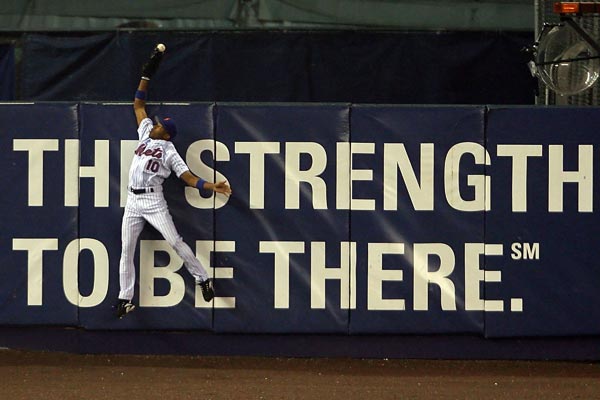
Ron Darling was traded to Montreal at the 1991 trade deadline. Also gone were Bobby Ojeda, who was traded to Los Angeles prior to the 1991 season, and Frank Viola, who signed as a free agent with the Boston Red Sox after losing 10 of his last 12 decisions with the Mets in 1991.

Of the pitchers still on the Mets,  Sid Fernandez was coming off an injury-plagued season in which he only made eight starts, winning one of them.  David Cone lost a career-high 14 games in 1991, despite leading the league with 241 strikeouts.  And Dwight Gooden, the long-time ace of the staff, had undergone rotator-cuff surgery in September and was not a lock to be ready for the start of the 1992 season.

The Mets needed a quality starting pitcher and they needed one fast.  They also wanted a young pitcher who was a proven winner and could give them plenty of innings.  Five years after acquiring David Cone from Kansas City, they went back to the Royals and found themselves the ace they wanted in 27-year-old Bret Saberhagen.

The Mets hoped Bret Saberhagen would be the apple of their eye when they traded for him in 1991.


Bret William Saberhagen had done it all in the major leagues before his 28th birthday.  He was a two-time All-Star (1987, 1990), a Gold Glove Award winner (1989), a two-time Cy Young Award winner (1985, 1989), had pitched a no-hitter (1991) and was a World Series MVP, pitching the Kansas City Royals to their first and only title in 1985.  One thing he hadn't done was pitch in a large market city, as Kansas City wasn't exactly the media capital of the world, or even Missouri for that matter.

But with the Mets in need of a quality arm to anchor their depleted staff, Saberhagen seemed like the perfect fit.  So on December 11, 1991, the Mets traded Kevin McReynolds, Gregg Jefferies and Keith Miller to the Royals for Saberhagen and Bill Pecota.  The cost to acquire the front-line starter they coveted was steep, as McReynolds, Jefferies and Miller were all regulars on the 1991 Mets, but the Mets were desperate for an ace, and Saberhagen fit the bill.

As good as Saberhagen was during his eight-year stay with the Royals, he did suffer from the even-year, odd-year syndrome.  Saberhagen finished with a losing record in every even-numbered year, going a combined 36-48 with a 3.70 ERA and 1.23 WHIP in 1984, 1986, 1988 and 1990.  However, in odd-numbered years, Saberhagen was an elite pitcher.  In 1985, 1987, 1989 and 1991, Sabes combined to go 74-30 with a 2.85 ERA and 1.06 WHIP.  His first year with the Mets was going to be an even-numbered year.  You can imagine what happened next.

Bret Saberhagen was one of a number of new faces brought in by general manager Al Harazin prior to the 1992 season.  With Eddie Murray, Bobby Bonilla and manager Jeff Torborg on board, Saberhagen was supposed to be the crown jewel of the offseason haul.  Instead, he turned out to be the cubic zirconia version of his former self.

Injuries prevented Saberhagen from performing at the level the Mets expected of him, and as a result, he was only able to make 15 starts, going 3-5 with a 3.50 ERA.  The next year, everyone expected a bounceback season from Saberhagen, especially since it was an odd-numbered year.  The only problem was that it was only Saberhagen who everyone expected to bounce back.  The rest of the team was another story.

In 1993, the Mets produced their worst record in twenty-six years.  Not since the days before Gil Hodges' arrival as manager had the Mets been so awful.  The '93 squad finished the year with a 59-103 record, and it could have been much worse had it not been for a season-ending six-game winning streak.  The Mets were so bad in 1993 that even the expansion Florida Marlins finished ahead of them in the seven-team National League East.  Needless to say, Bret Saberhagen did not win a lot of ballgames in '93.  However, he wasn't that bad compared to his teammates.

Although injuries curtailed Saberhagen's season for the second consecutive year, he was the only starter to not finish the season with a losing record.  In addition to his 7-7 record in 19 starts, Saberhagen had a respectable 3.29 ERA and an outstanding 1.06 WHIP.  The low WHIP was a direct result of Saberhagen's excellent control, as he walked a mere 17 batters in his 19 starts.

After two injury-plagued seasons in 1992 and 1993, the Mets still had not gotten what they expected from their ace.  However, when Saberhagen was healthy in 1993, he showed he could be one of the stingiest pitchers in baseball.  All he needed was one season of good health, just one, to prove that he could still be one of the best pitchers in the game.  That wish became a reality in 1994.

After their horrific 1993 season, the Mets weren't expected to do much in 1994.  But they surprised most experts over the first month and a half of the season, jumping out to a quick start.  The Mets weren't doing it with their hitting (they finished next-to-last in the NL in batting average in 1994) or their baserunning skills.  (Jose Vizcaino went 1-for-12 in stolen base attempts and John Cangelosi led the team in thefts with five - that's one, two, three, four, FIVE STEALS!)  But the one thing they had in 1994 that they didn't have in 1993 was a healthy Bret Saberhagen.  And his health was instrumental in getting the Mets off to their quick start.  In the team's first 32 games, Saberhagen was 4-1 with a 3.09 ERA.  As a result, through May 10, the Mets were in second place with an 18-14 record, just 2½ games behind the first place Atlanta Braves.

Saberhagen split his next four decisions as the Mets slipped below .500.  But beginning with his start on June 13 against the defending National League champion Phillies, Saberhagen went on a roll that lasted until the end of the season.  On that fateful night, Saberhagen pitched beautifully, allowing two runs (one earned) in seven innings, needing only 94 pitches to stifle the high-powered Phillies' offense.  It was a far cry from his previous outing against Philadelphia, a four-inning, seven-run debacle on May 21.  The confidence he gained by beating the Phillies in mid-June lasted for the rest of the season, as Saberhagen was pretty much unhittable after that game.


Beginning with his final start in June, Saberhagen had one of the finest extended stretches in club history.  From June 30 to his last start of the season, Sabes went 7-0 with a 1.51 ERA and 0.85 WHIP.  Even more impressive was his strikeout-to-walk ratio, as Saberhagen struck out 62 batters over his final nine starts while walking only five.  That's one, two, three, four, FIVE WALKS, as in the same number of steals John Cangelosi had all season.


During this second-half surge, Saberhagen pitched what was perhaps his best game as a Met against the San Diego Padres on July 15.  In the second game of a twi-night doubleheader against the Padres, Saberhagen pitched ten scoreless innings, allowing five hits (all singles) while striking out 11 and walking none.  Unfortunately, Padres' starter Andy Benes matched Saberhagen zero-for-zero, striking out 14 Mets batters in eight innings of work.  Saberhagen's valiant effort went for naught, as the Mets lost the game, 2-1 in 14 innings, when Mike Maddux allowed back-to-back home runs to Tony Gwynn (the best hitter in Padres' history) and Phil Plantier (the current hitting coach for the Padres).


After Saberhagen defeated the Phillies again on August 10 to improve his record to 14-4, the Mets stood only two games under .500 with a 55-57 record.  It was Saberhagen's seventh consecutive victory, a streak that began on June 30 when the Mets entered the day in last place with a 33-43 record.  Since then, the Mets had gone 22-14 and had climbed into third place in the NL East.  The Mets lost their next game in 15 innings and then lost the season soon after, as the baseball strike put an end to the 1994 season.  Who knows what Bret Saberhagen would have accomplished had the season not been cut short?

Despite the premature ending to the 1994 season, it still went down in history as the year in which Bret Saberhagen produced one of the best pitching performances in club annals.  For the year, Saberhagen went 14-4, but that didn't tell the whole story.  His 2.74 ERA and 1.03 WHIP were both second in the National League to Atlanta's Greg Maddux.  Saberhagen also finished in the top ten in wins (14, 3rd), winning percentage (.778, 2nd), innings pitched (177
⅓, 3rd), strikeouts (143, 4th) and complete games (4, 4th).  He also had the dubious distinction of finishing the year with more wins (14) than walks (13).  In addition, by recording 143 strikeouts against only 13 bases on balls, Saberhagen finished the year with an unheard of 11:1 K/BB ratio.  How unheard of was it?  To this day, it's still a major league record.

After two injury-plagued seasons in 1992 and 1993, Saberhagen finally produced the season the Mets expected from him during his third year in New York, making the All-Star team and finishing third in the Cy Young Award vote.  His 1994 campaign came on the heels of his infamous bleach-spraying incident, a matter that earned him a four-game suspension to start the '94 season and caused him to be discussed in trade talks with the Cleveland Indians, a trade that would have brought shortstop Felix Fermin and young right-handed starter Albie Lopez to the Mets.  Fortunately for the Mets, that deal was never consummated, as Fermin went on to hit .190 in 1995 and 1996 (after a .317 campaign in 1994) and Lopez posted a career ERA just under 5.00 in a decade-long major league career.

The 1995 season didn't begin as scheduled, as the strike knocked out the first three weeks of the regular season.  The season finally did get underway in late April, but Bret Saberhagen left his best stuff behind.  Although Saberhagen was decent in 16 starts for the Mets in 1995, he only won five games.  His 3.35 ERA and 1.14 WHIP, although both good, were nowhere near his numbers from his record-setting 1994 campaign.  Also, his strikeout-to-walk ratio decreased dramatically in 1995, as Saberhagen struck out 71 batters while walking 20 in his 16 starts.  The 3.55 K/BB ratio was a far cry from his major league record 11.00 K/BB mark in 1994.


As a result, Saberhagen was traded to the Colorado Rockies in July for minor league pitchers Arnold Gooch and Juan Acevedo.  Although the move was widely speculated to be payroll-related, Mets' co-owner Fred Wilpon said it was due to Saberhagen's injury history and lack of overall productivity during his 3½-year stay in New York.  Wilpon had decided that Mets needed to get younger to get better, and Saberhagen was not part of that equation.  Besides, Generation K was about to take Flushing by storm.  Until it didn't.

One thing Fred Wilpon was right about was that Bret Saberhagen wasn't very durable.  In fact, Saberhagen only had one more injury-free season left in him, going 15-8 in 31 starts for the 1998 Red Sox.  Although Saberhagen did pitch in the majors until 2001, he was never able to stay healthy once he left the Mets, save for that 1998 season.  A career that once looked so promising fizzled out earlier than expected, as Saberhagen appeared in only three games after his 36th birthday.

If not for injuries and Bleach-gate, Bret Saberhagen's career as a Met could have been truly special.


From 1992 to 1995, Bret Saberhagen was never as bad as people made him out to be.  Although he won only 29 games as a Met (the same total won by Oliver Perez, a pitcher who really was as bad as people made him out to be), he posted a 3.16 ERA and 1.08 WHIP in his nearly four-year career in orange and blue.  Let's put his Mets career in perspective. 

Only ten pitchers in Mets history had a lower ERA than Saberhagen's 3.16 mark.  Bret Saberhagen's winning percentage as a Met was .580.  The only pitchers in team history who topped that are Dwight Gooden (.649), Rick Reed (.621), Johan Santana (.615), Tom Seaver (.615), David Cone (.614), Ron Darling (.586), Al Leiter (.586) and Pedro Martinez (.582).  And about that WHIP.  The only Met with a better career WHIP than Bret Saberhagen is Tom Seaver, and you need to go to a third decimal point to determine that Seaver's 1.076 WHIP was only slightly better than Saberhagen's 1.079 WHIP.

For all the talk about how Bret Saberhagen underachieved, he really didn't.  Although he wasn't as healthy as he could have been, when he was on the mound, he was one of the best pitchers to ever put on a Mets uniform.  Unfortunately, his career on the field in New York was overshadowed by his mischief off the field.  But once you look past his off-field behavior, you'd see that Bret Saberhagen was really a special pitcher for the Mets.

To New York sports fans, 1994 was memorable because of the Rangers winning the Stanley Cup and the Knicks making it to the seventh game of the NBA Finals.  But for Mets fans, 1994 was the year Bret Saberhagen quietly put up one of the best seasons in team history, even if the season was cut short by the players' strike.  The Mets haven't had a player win more than 17 games in a season since Frank Viola and Dwight Gooden accomplished the feat in 1990.  Just imagine what Bret Saberhagen could have done had it not been for the strike.

Although he was technically a one-season wonder in New York, Bret Saberhagen's career as a Met was not too shabby.  But because his tenure in New York coincided with some of the worst seasons in recent history, his accomplishments on the field have been largely forgotten.  They shouldn't be.  Bret Saberhagen was pretty darn good.  No amount of bleach will ever erase that.


Note: One Season Wonders is a thirteen-part weekly series spotlighting those Mets who had one and only one memorable season in New York.  For previous installments, please click on the players' names below:
 
January 2, 2012: Bernard Gilkey
January 9, 2012: Terry Leach 
January 16, 2012: George Stone
January 23, 2012: Roger Cedeño
January 30, 2012: Frank Viola
February 6, 2012: Joe Christopher 
February 13, 2012: Dave Magadan 
February 20, 2012: Pedro Martinez