Thursday, June 5, 2014

Curtis Granderson and the Not-So-Sweet Sixteen

Curtis Granderson looks spooked at the plate.  Could the ghost of Jason Bay be haunting him?

On Wednesday, Curtis Granderson delivered two hits in the Mets' 5-4 loss to the Chicago Cubs, giving him 1,201 for his career.  It was not the first time this season Granderson hit the 1,200 mark in a lifetime offensive category.  However, the other category wasn't exactly something to be proud of, as on May 6, Granderson struck out for the 1,200th time in his career.

Entering tonight's series finale against the Cubs, Granderson is the owner of 1,231 strikeouts and 1,201 hits.  How rare is it for a player to have more strikeouts than hits when he has that many of both?  Well, the first player to end his career with more strikeouts than hits when he had at least 1,200 of both didn't play his last game in the majors until 1986.  And since this player (a former Met) retired, just 16 other players - including Granderson - have joined him.

Here are a list of those players, which include Curtis Granderson and the other not-so-sweet sixteen.  This list includes a Hall of Famer, a few All-Stars and probably more current and former Mets than you would like.


Player
Final Year
Career Strikeouts
Career Hits
Career HR
Career RBI
Dave Kingman
1986
1,816
1,575
442
1,210
Reggie Jackson
1987
2,597
2,584
563
1,702
Jesse Barfield
1992
1,234
1,219
241
716
Cecil Fielder
1998
1,316
1,313
319
1,008
Jay Buhner
2001
1,406
1,273
310
965
Jose Canseco
2001
1,942
1,877
462
1,407
Dean Palmer
2003
1,332
1,229
275
849
Greg Vaughn
2003
1,513
1,475
355
1,072
Richie Sexson
2008
1,313
1,286
306
943
Troy Glaus
2010
1,377
1,375
320
950
Pat Burrell
2011
1,564
1,393
292
976
Mike Cameron
2011
1,901
1,700
278
968
Jim Thome
2012
2,548
2,328
612
1,699
Jason Bay
2013
1,216
1,200
222
754
Adam Dunn
Still Active
2,280
1,574
449
1,128
Ryan Howard
Still Active
1,474
1,226
322
1,003
Curtis Granderson
Still Active
1,231
1,201
223
633


Notice that just about everyone on the list was a middle-of-the-order power hitter.  But Granderson hit at the top of the order for much of his career and has surpassed 25 homers in a season just three times, hence his low RBI total.

Also notice that four of the 17 players (Kingman, Cameron, Bay, Granderson) called Shea Stadium and Citi Field home for parts of their careers.  It could have been seven out of 20, had Darryl Strawberry (1,352 strikeouts, 1,401 hits), Jeromy Burnitz (1,376 strikeouts, 1,447 hits) and Jose Valentin (1,294 strikeouts, 1,348 hits) struck out just a little more in their respective careers.  But just like the hitters who actually did make the list, Strawberry, Burnitz and Valentin were cleanup-type power hitters (Valentin had five straight years of 25+ homers from 2000 to 2004), something Granderson is not.

If Curtis Granderson were a prototypical power hitter, perhaps his high strikeout rate would be more acceptable.  Likewise, if Granderson had more seasons of elite home run totals, his low hit count could be forgiven.  But Granderson is not Dave Kingman, Reggie Jackson, Jose Canseco or Jim Thome.  He's not even Jesse Barfield or Pat Burrell, for that matter.  The closest player he resembles on the list above is - here's that name again - Jason Bay.

Although he tried his best to fulfill the lofty expectations that go with a lucrative four-year contract, Jason Bay fizzled quickly as a Met.  During his time in New York, Bay had more strikeouts (258) than hits (231), despite having fewer strikeouts (896) than hits (927) before coming to the Big Apple.  He also hit 26 or more homers in five of the six seasons before his first year in New York.  Then he hit a grand total of 26 homers in three years as a Met.  Because of his low home run totals and high strikeout rate, Bay found himself in the dreaded New York doghouse - the same place Granderson appears to be heading.

Curtis Granderson is a nice guy.  But being nice doesn't get you anything in New York if you're paid to hit home runs, then proceed to strike out ten times for every long ball you hit.  (Granderson has hit six home runs in 2014, while striking out 64 times.)  We saw it before with Jason Bay.  We don't need to see it again with Curtis Granderson.

There are 151 players in major league history who collected at least 1,200 hits and 1,200 strikeouts.  Of those players, only 17 had more strikeouts than hits.  Curtis Granderson is one of those players.  And if he doesn't want to go down the road taken by Jason Bay before him, he'll need to get himself off this list pronto.


Tuesday, June 3, 2014

Wilmer Flores Has A Game For The Ages

Wilmer Flores (facing camera) slammed his way into the Mets history books (Photo by Drew Hallowell/Getty Images).

Wilmer Flores ended the series that wouldn't die by killing the Phillies with his bat.  In the finale to the five-game series at Citizens Bank Park, Flores delivered a two-run double in the sixth inning and a long grand slam in the ninth.  His six RBI helped the Mets defeat the Phillies, 11-2 - just the second time all season that the Mets won a game by more than five runs.

Flores' 6-RBI performance was accomplished in his 42nd major league game, making him the 45th player in major league history to drive in half a dozen runs in one of his first 50 games.  However, he was not the fastest Met to accomplish this.

The first Met to have a 6-RBI game within his first 50 big league games was Jeromy Burnitz, who drove in seven runs in his 37th game on August 5, 1993.  Burnitz held the mark until David Wright posted a 6-RBI game in his 14th major league game, which coincidentally took place 11 years to the day after Burnitz's breakout game.  Flores became the third Met to join this club last night.

In addition to becoming the third Met to have a 6-RBI game within his first 50 games in the big leagues, Flores also became the third shortstop to drive in six runs in a game for the Mets.

Prior to Monday night's game, exactly 22 players had driven in six or more runs in a game while wearing a Mets uniform, doing so a total of 32 times.  Flores became the 23rd Met to accomplish the feat.  But of those 23 players to accomplish the feat, just three did so playing shortstop, and none of them was named Jose Reyes.

In 1967, Jerry Buchek started 92 games at second base for the Mets, moving over to shortstop just five times in his first season in New York.  But one of those five starts was on September 22, in the second game of a doubleheader against the Houston Astros.  Buchek hit a three-run homer in the eighth inning to temporarily give the Mets a 5-4 lead.  Then, after the Astros tied in the ninth, Buchek hit his second three-run blast of the game in the tenth inning, giving the Mets a win in walk-off fashion.  How unusual was Buchek's performances in that game?  Take out his two-homer, six-RBI performance against the Astros and he hit just 20 homers and drove in 102 runs in his other 420 big league games.

A quarter-century later, another light-hitting shortstop produced a six-RBI game for the Mets when Dick Schofield turned the trick on July 19, 1992 in an 8-4 win over the San Francisco Giants.  In the fourth inning, Schofield broke a 2-2 tie by hitting a double with the bags full to clear the bases.  Four innings later, Schofield gave the Mets some extra insurance by hitting a three-run homer.  The 1992 season was Schofield's lone year in New York, a year in which he produced four homers and 36 RBI in 142 games.  That means the shortstop had 25% of his homers and one-sixth of his RBI total in just one game.

Last night, Flores became just the third Mets shortstop to collect six RBI in one game, doing so in his 42nd major league game and only his 11th at short.  It's a rarity for any Mets player to have a 6-RBI game.  It's even more unusual for a Met to have one so early in his career.  And it's just as rare for that player to do it as a shortstop.  Wilmer Flores joined all of those exclusive clubs with one monster game.

Without question, it truly was a game for the ages for Wilmer Flores on Monday night. 
 

Sunday, June 1, 2014

The Mets Set A Timely Record This Weekend

On Friday night (and Saturday morning), the Mets and Phillies took part in a 5-hour, 23 minute marathon that wasn't decided until the bottom of the 14th inning, when the Phillies walked off with a 6-5 victory.  As tiring as that game was for its participants and the fans, that was just the opening act for yesterday's affair.  Once again, the Mets and Phillies played a 14-inning affair, but this time they needed five hours and 32 minutes to decide a victor.  The Mets pulled out a 5-4 win by scoring a run in the top of the 14th and keeping the Phillies from crossing the plate in the bottom of the inning.

Two games, 28 innings, 10 hours and 55 minutes of game time.  It's almost enough to make even the biggest baseball lover put up the white flag.

So of course, with me being a numbers geek (so I've been told), I decided to see if the Mets had ever played back-to-back games of 14 innings or more.  I also fiddled around to find out if they had ever played consecutive five-hour games and if they had ever needed nearly 11 hours to complete two straight games, regardless of how many innings they needed to play those games.

Kids, we're looking at history here with these last two games.

Wake up, Mets fans!  You're missing out on history!  (Photo by Chuck Solomon/SI)

Prior to Friday and Saturday, the Mets had played consecutive games of 14 innings or more just once in their history.  That occurred on September 7 and September 8, 1979, when the Mets hosted the eventual World Series champion Pittsburgh Pirates at Shea Stadium.  On September 7, the Mets and Bucs played a 14-inning affair that ended in an 6-4 victory for Pittsburgh.  The Mets could have won the game in the 11th, but failed to score after loading the bases with no outs.  Pittsburgh won it when Mets third baseman Richie Hebner committed an error on what should have been the third out of the inning.  The Pirates took advantage of Hebner's gaffe, scoring on a single by Dave Parker and a passed ball by Alex Treviño, who caught all 14 innings.  No wonder long-time Mets fans hate Richie Hebner to this day.

Pittsburgh tied the September 7 game by scoring a run in the top of the eighth.  The next day, they scored twice in the eighth to knot the score again.  This time, the squads needed 15 innings until one team tasted victory.  Fortunately, the Mets did not have to endure a dual dose of defeat, as John Stearns singled home Lee Mazzilli with two outs in the bottom of the 15th inning to give the Mets a 3-2 victory.

Both games were played rather quickly, with the 14-inning game lasting three hours and 45 minutes and the 15-inning affair taking four hours and 18 minutes to complete.  Clearly, neither game approached the length of the two affairs played by the Mets and Phillies over the last two days.  But several consecutive games in the team's early days did.

The Mets didn't play the first five-hour game in team history until May 31, 1964, when they needed a record seven hours and 23 minutes to play a 23-inning game against the San Francisco Giants, a game they lost, 8-6.  That marathon was the second game of a doubleheader.  Fortunately, the first game lasted just two hours and 29 minutes, meaning the teams played the two games in under ten hours.  On June 2, 1964, the Mets played their first game after the 23-inning affair, taking a tidy two hours and 38 minutes to defeat the Houston Colt .45s by the final score of 7-4.  That means the Mets needed ten hours and one minute to play back-to-back games, the first time they had ever surpassed ten hours of playing time in consecutive games.

In 1968, the played another endless game, needing 24 innings before falling to Houston by a 1-0 count.  That game lasted six hours and six minutes.  However, neither the game preceding it nor the game immediately after the tense snoozefest made it to the three-hour mark, meaning the ten-hour, one-minute record for consecutive games was still intact.

The Mets did not play their third 5+ hour affair until 1973, when they took a 7-3, 19-inning decision over the Los Angeles Dodgers at Dodger Stadium.  Their next five-hour game took place a year later, when the Mets played a team-record 25-inning game at Shea Stadium against the St. Louis Cardinals.  The game took seven hours and four minutes to complete.  The following night, the Cardinals and Mets needed two hours and 57 minutes to play nine innings, giving them a record-tying ten hours and one minute of playing time for two straight games.  But the Mets still had not played back-to-back five-hour games.

After their 1974 marathon, New York played a handful of five-hour games.  They played exactly five hours in a 1979 game against Houston (an 18-inning loss) and competed for five hours and one minute versus San Diego in 1980 (another 18-inning loss).  The Mets played two five-plus hour games in 1985 and they actually won them both.  Of course, who can forget Fireworks Night in Atlanta on July 4 (and 5), when the Mets neeeded six hours and ten minutes to end the 19-inning rain-soaked slugfest?  That memorable game took place two months after New York claimed an 18-inning affair against Pittsburgh in five hours and 21 minutes.

The Mets came close to playing back-to-back five-hour games in 1986, when they lost to Houston in 15 innings on July 20 and defeated Cincinnati in a fight-filled 14-inning contest two nights later.  Both games lasted at least five hours.  However, the Mets played a game in three hours and seven minutes on July 21, making that game the meat in a five-hour marathon sandwich.  Those were two of the three five-hour matches the Mets played in their storybook 1986 campaign, as they played a long-since forgotten five hour and three minute game on April 12, when they lost in 14 innings to the Phillies.

From 1987 to 2012, the Mets played a total of 11 five-hour games, which includes Game 5 of the 1999 NLCS against the Braves and Game 3 of the 2000 NLDS versus the Giants.  Then in 2013, the Mets played five such games, including a notorious 20-inning affair against the Marlins on June 8 that took six hours and 25 minutes to complete.  The following day, the two teams squared off again and played another extra-inning contest.  However, that game ended in ten innings, taking three hours and 35 minutes to complete.  Still, it was the third time in franchise history that the Mets needed at least ten hours to play consecutive games.  But they still hadn't played back-to-back five-hour games.

Then May 30 and May 31, 2014 happened.  And history was made at Citizens Bank Park.  This tweet by yours truly says it all.


It took until the team's 53rd season, but they had finally done it.  At last, the team played consecutive games in which each contest took over five hours to complete.  And by playing a total of ten hours and 55 minutes over the two days and nights, the Mets shattered the team record of ten hours and one minute needed to play two straight games.  That record was first set in 1964 and then matched ten years later.

As the old adage goes, "You win some, you lose some."  That's exactly what the Mets did over the last two days.  They lost a game to the Phillies on Friday night (and Saturday morning) and then followed it up by defeating Philadelphia in their next game.  But they needed forever and a day (and some of the evening) to win one and lose one against their division rivals.

Baseball is beautiful because the game is not timed, unlike the other major team sports.  But just because there's no clock attached to it doesn't mean time is completely ignored.  If it was, then you wouldn't have just found out that the Mets just played back-to-back five-hour games for the first time in team history and needed nearly 11 hours to do so.  You also might not have known that it was just the second time in club annals that they needed to play 14 or more innings in consecutive games.

The Mets never make things easy for their fans.  But they do make things fun.  That's assuming you have the time for it.


Saturday, May 31, 2014

A Curious Comparison Between Jonathan Papelbon and Mariano Rivera

Maybe this is why Jonathan Papelbon gets no respect.  He's a catcher fondler.  (Photo by Drew Hallowell/Getty Images)

Disclaimer:  I know no one compares to Mariano Rivera.  Without question, Rivera was the best closer in the history of the game.  Even we Mets fans can admit that without cringing.  But the point of this blog post is to point out a stunning similarity between the careers of Rivera and Jonathan Papelbon.  I respect Rivera.  I hate Papelbon.  But those numbers tell quite a story - a story that I will share right now...


Jonathan Papelbon is 33 years old, an age when most players begin to enter their "past-their-prime" years.  Papelbon has had a solid career, but no one has ever thought of him as the best closer in the game.  Meanwhile, back in 2003, Mariano Rivera was also in his age 33 season, but by then everyone considered him the top fireman in baseball.

Papelbon doesn't have Rivera's reputation as being the dominant closer of his day, but looking at their stats through their age 33 season, we may have to think of Papelbon a little differently.

Here are the key stats for both Papelbon and Rivera, looking at Papelbon's entire career and Rivera's career through the 2003 season - the year in which he pitched as a 33-year-old.  The similarities, as you'll be able to see, are quite shocking.

  • Papelbon: 549 GP, 299 saves, 2.38 ERA, 1.04 WHIP, 676 K, 153 BB, 185 ERA+, 2.69 FIP
  • Rivera: 512 GP, 283 saves, 2.49 ERA, 1.07 WHIP, 582 K, 177 BB, 186 ERA+, 2.94 FIP

Papelbon has pitched in 37 more games through his age 33 season than Rivera did, which explains his 16 save lead over the future Hall of Fame closer.  But Papelbon has a better ERA, lower WHIP and has nearly 100 more strikeouts than Rivera did at age 33.  Papelbon also has better control than Rivera, as evidenced by the two dozen fewer walks despite pitching in more games than Rivera.  Furthermore, Papelbon has a lower FIP than Rivera and has a nearly identical ERA+.

Now let's look at postseason numbers, which is where Rivera cemented his career as a Hall of Famer.  Through 2003, Rivera had a mindboggling 0.75 ERA and a similar 0.75 WHIP.  He also recorded 30 saves and allowed opposing hitters to post a .176/.208/.241 slash line.  Papelbon has not pitched nearly as much in the postseason as Rivera did, which is more the fault of his teams than the individual, but in 18 postseason appearances, he has a 1.00 ERA and 0.815 WHIP.  And what about his slash line?  Well, that's a Rivera-esque .154/.220/.209.  Or perhaps I should say Rivera has a Papelbon-esque postseason slash line?

Before you forget that this is a Mets site, let's consider one other closer's numbers through his age 33 season.  He began his Mets career at age 34, but by that time, his pitching statistics were just as good, if not better, than both Papelbon and Rivera.  Let's look at the career numbers of Billy Wagner through 2005, the year he began as a 33-year-old.

  • Wagner: 584 GP, 284 saves, 2.40 ERA, 0.99 WHIP, 840 K, 217 BB, 182 ERA+, 2.77 FIP

Now you can see why former Mets general manager Omar Minaya was adamant about bringing Wagner into the fold.  His numbers were virtually identical to what Rivera produced through his age 33 season and are right on par with what Papelbon has accomplished.  But the reason why my main comparison is between Papelbon and Rivera and not all three pitchers is because Wagner - to put it bluntly - sucked in the postseason.  Through his age 33 season, Wagner posted a 9.64 ERA in October and allowed hitters to bat .364 against him.

No one will ever confuse Jonathan Papelbon with Mariano Rivera.  Rivera posted a major league record 652 saves and was undoubtedly the best relief pitcher in postseason history.  But through age 33, Papelbon and Rivera have been virtually the same pitcher.  And although Papelbon's total postseason numbers aren't as gaudy as Rivera's because his teams have not been annual playoff participants, his October averages (ERA, WHIP, BAA, OBP, SLG) are quite comparable to the Sandman.

As Mets fans, we may hate Jonathan Papelbon.  We may also make fun of him because he gave up game-winning home runs to non-prime-time-players Omir Santos and Jordany Valdespin.  But he deserves to be mentioned in the same sentence as Mariano Rivera, at least as far as his accomplishments through his age 33 season are concerned.

Papelbon may not continue to dominate until he's 43 like Rivera did.  And he may never appear in as many postseason games.  But as loath as I am to admit it, he's far better than most of us would like to admit, even if he does like to grope his catcher at times.

Sunday, May 25, 2014

Is Matt Harvey's Absence Hurting Zack Wheeler?

Zack Wheeler ponders what life will be like without Matt Harvey by his side.

On June 18, 2013, Zack Wheeler made his highly anticipated major league debut in the second game of a doubleheader against the Atlanta Braves.  Wheeler's opening act, Matt Harvey, took a no-hitter into the seventh inning and struck out a career-high 13 batters in the Mets' 4-3 first game victory.  Wheeler then went out and didn't allow a single run in his start, pitching six shutout innings of four-hit ball in the Mets' 6-1 win in the nightcap.  The evening was billed as Super Tuesday, a night Mets fans had been waiting for since Carlos Beltran was traded to San Francisco for Wheeler in 2011.

Wheeler suffered a few rookie bumps and bruises in his next two starts, but recovered quickly, going 6-2 with a 2.96 ERA in his next 11 starts.  In those starts, covering the months of July and August, Wheeler struck out 59 batters and walked 24.  Control had always been an issue with Wheeler in the minors, but in his strong 11-start stretch, he walked more than three batters in a game just once.  Wheeler also showed durability and an ability to keep his pitch count per inning down, as he pitched six or more innings in eight of the 11 starts, while averaging 16.8 pitches per inning.

Matt Harvey, on the other hand, pitched beautifully throughout the 2013 season.  But when he allowed 13 hits to the Detroit Tigers in 6⅔ innings on August 24, it caused concern that something was wrong with the Mets' All-Star Game starter.  The effort against the Tigers was part of a three-start stretch in which the normally unhittable Harvey allowed 27 hits in 18⅔ innings.  In addition, Harvey wasn't getting strike three as often as he was earlier in the season.  After striking out 178 batters in his first 159⅔ innings, Harvey managed just 13 punchouts in his last three starts, or as many as he had in his Super Tuesday start against the Braves in June.

Soon after his start against the Tigers on August 24, it was revealed that Harvey had a partially torn ulnar collateral ligament in his right elbow.  By the time the calendar had turned to September, Harvey's season was done.  And a month later, when Harvey decided to undergo Tommy John surgery, his 2014 campaign was wiped out as well.

Once it was known that Harvey would not be around to pitch for quite some time, Wheeler's fortunes began to turn.  Wheeler was 7-3 with a 3.46 ERA through his last start in August.  But without Harvey to compete with in the rotation, Wheeler had a poor month of September.  Wheeler was 0-2 in three starts and walked as many batters (12) as he struck out.  After posting a 1.25 WHIP in July and August, Wheeler allowed 28 baserunners in his three September starts for a 1.65 WHIP.

Some of the misfortune in September could be attributed to Wheeler's workload.  After all, prior to 2013, Wheeler had never pitched more than 149 innings in any minor league season.  He surpassed that total in his final start in August and finished the year with 168⅔ innings between the minors and majors.  That could help explain Wheeler's subpar finish after Harvey's season was done.  But Wheeler, like every other pitcher, began the 2014 season at zero innings.  To what do we attribute his poor pitching this year?

In ten starts this season, Wheeler has pitched just 56 innings, posting a 4.31 ERA and 1.51 WHIP.  After a 2013 campaign in which Wheeler allowed opponents to bat .243 against him and reach base at a .327 clip, this year's batters are hitting .271 and have a .355 on-base percentage against Wheeler.  Wheeler has also needed to throw 1,003 pitches to get through those 56⅓ innings - an average of nearly 18 pitches per inning.  In four of his ten starts this year, Wheeler has tossed 110 or more pitches.  He has yet to pitch more than 6⅔ innings in any of those starts.  In 2013, Wheeler pitched at least 6⅔ innings six times.  He threw 110 pitches just once in those six starts.

Matt Harvey and Zack Wheeler were supposed to be a modern-day version of Tom Seaver and Jerry Koosman, leading a young pitching staff to victory and erasing half a decade of frustration in Flushing.  But Harvey is now lost for the 2014 season and Wheeler just looks lost on the mound.  There is another parallel between the Harvey/Wheeler duo and the Seaver/Koosman combo.  When Seaver was traded to Cincinnati on June 15, 1977, Koosman suffered greatly on the mound.

Tom Seaver and Jerry Koosman, during happier times with the Mets.  (Photo by D.R. Burke/The Sporting News)

Prior to the Midnight Massacre, Koosman had begun the 1977 season with a 5-6 record and 2.82 ERA, holding opposing hitters to a .208/.285/.299 slash line.  After Seaver's departure, Koosman went 3-14 with a 4.02 ERA, allowing hitters to put up a .250/.313/.371 slash line.  In 1978, Koosman's only full season with the Mets without Seaver, he had arguably his worst full season as a Met, going 3-15 with a 3.75 ERA and 1.30 WHIP.

In one and a half seasons without Seaver by his side, Koosman went 6-29 with a 3.84 ERA and 1.29 WHIP.  With Seaver around from the time both pitchers made their debuts in 1967 until The Franchise's trade a decade later, Koosman posted a 134-108 won-loss record with a 2.97 ERA and 1.21 WHIP.  Clearly, Koosman was far more effective when he had a teammate like Seaver to compete with.  He was a totally different entity when he didn't share a dugout with Seaver.

This analogy doesn't just apply to dynamic duos in baseball.  Take the case of Scottie Pippen and Michael Jordan in the NBA.  Just like Koosman was a great pitcher but was always second fiddle to Seaver, Pippen became a Hall of Famer despite rarely being the best player on his own team.  During the Chicago Bulls' first three championships from 1991 to 1993, Pippen connected on 50.0% of his shots and made 71.4% of his free throws.  When Jordan retired for the first time, Pippen was forced to become the go-to guy in Chicago and his averages suffered.  During the '93-'94 season and '94-'95 campaign, Pippen made just 48.5% of his shots and his free throw percentage dropped to a below-average 68.5%.  Once Jordan came back, the Bulls won three more titles and Pippen became more effective, but after the Bulls broke up the band following their sixth championship in eight seasons, Pippen suffered.  After averaging over 20 points per game in his last eight seasons in Chicago, Pippen averaged just 11.5 PPG during his final six campaigns in the NBA.  His shooting also suffered, as he made just 43.6% of his shots from the field after winning his final championship in Chicago.

With Jordan, Pippen won six championships and played most effectively.  Without him, he made it past the second round of the playoffs just once and put too much pressure upon himself to be the same player he was when Jordan was with him on the court.  The same could be said for Jerry Koosman when Seaver was his teammate on the Mets and when he wasn't.  And now it appears Matt Harvey's absence could indirectly be affecting Zack Wheeler's performances on the mound.

Zack Wheeler has always been a very good pitcher since he was first drafted by the San Francisco Giants in 2009.  But he doesn't project the dominant persona of a Matt Harvey on the mound.  Harvey was always meant to be the big man on campus, and Wheeler was supposed to complement him as the No. 2 guy.  As a one-two punch in 2013, Harvey and Wheeler performed very well together, giving Mets fans hopes that the 2014 season would be the year the team finally turned it around.

But then Harvey suffered an injury that ended his 2013 season prematurely and erased his 2014 campaign completely.  That left Wheeler alone on the mound and thrust him into the spotlight once reserved for Harvey.  Wheeler has been less effective without Harvey by his side, just like Koosman and Pippen were less successful once their legendary teammates weren't there to push them to do better things.

Zack Wheeler is still a good pitcher.  But he's much better when he's just "one of the guys" and not "the guy".  The Mets will be better in 2015 when Matt Harvey returns to the mound.  Let's hope we can say the same for Zack Wheeler.
 

Saturday, May 17, 2014

Wherefore Art Thou, Wilmer?

This is how I would look if Ruben Tejada was keeping me on the bench.  (Photo by Mike Stobe/Getty Images)

Wilmer Flores was called up to the majors a little over a week ago to play shortstop for the slumping Ruben Tejada.  Flores started two games at short, collecting two hits and drawing a walk, then got sick and hasn't been seen in the starting lineup since May 10.

A day after Flores last played, Tejada went 2-for-4 and drove in the winning run in an extra-inning victory over the Phillies.  Tejada has been in the starting lineup ever since.  There's only one problem with this.

Tejada was hitting .181 before his extra-inning heroics.  He's hitting .176 since.  And Flores is no longer sick.  But not only is he not starting games, he hasn't even been used as a pinch-hitter.  At all.  That's zero at-bats, zero plate appearances.  And I have zero answers.

Earlier today, Adam Rubin tweeted that Tejada will continue to be the Mets' primary shortstop.  He also mentioned that Flores might move over to second base the next time the Mets face a southpaw to give the left-handed hitting Daniel Murphy a day off.  Again, there's a problem there.

Daniel Murphy is hitting .359 versus all left-handed pitchers and also has a .538 slugging percentage against them.  But that's actually low compared to his numbers in games started by southpaws.  In those games, Murphy is hitting .441 with seven extra-base hits (four doubles, one triple, two homers).  For all you kids out there, that's a .794 slugging percentage is games started by southpaws.

So let me get this straight.

Terry Collins would rather start a player who was having an awful time with the bat (Tejada had a .181 batting average and a .299 on-base percentage through May 9), then had one good game before getting even worse at the plate since then (.176 average, .263 OBP).  In addition, he'd like to find room for Flores by sitting Murphy when a left-handed starter is on the mound.  And of course, Murphy is hitting the cover off the ball under those circumstances.

Yup, that seems about right if you're taking notes from the "Managing For Dummies" manual.

Come on, Terry.  You're a better manager than that.  I understand that Flores was sick.  And I understand that Daniel Murphy needs a day off before the summer heat arrives.  But can't you find more time for Flores at shortstop instead of second?  I mean, Daniel Murphy on his worst hitting day is still better than Ruben Tejada on his best.  And if you really don't want to put Flores in the starting lineup, at least let him pinch-hit every once in a while, especially since it doesn't look like he's being sent back to Las Vegas anytime soon.

Wilmer, Wilmer, wherefore are thou, Wilmer?  If Terry Collins continues to have his way, the only place you will find Wilmer Flores these days is on the Mets bench.  And that just makes everyone sick, not just Flores.


Sunday, May 11, 2014

The Sixth Starter Could Be the Savior of the Season

Can Rafael Montero save the Mets' season as a starting pitcher?  (Photo by Brad Barr/USA Today Sports)

When Jonathon Niese takes the hill today for the Mets, he will continue a pattern that hasn't been seen much in Flushing over the past few years.  Niese, Dillon Gee, Bartolo Colon, Zack Wheeler and Jenrry Mejia have been the only pitchers to start games for the Mets through the team's first 36 games.  That kind of stability is something that's becoming quite rare in today's game.

Last year, the Mets were forced to use a sixth starter in their 22nd game, when Shaun Marcum replaced the ineffective Aaron Laffey in the rotation.  In 2012, the Mets only needed 15 games before a sixth starting pitcher (Miguel Batista) was required.  The year before that, it was in game No. 14 that the Mets went to sixth starter D.J. Carrasco.  And let's not forget 1997, when the Mets used six starting pitchers in their first six games (Pete Harnisch, Mark Clark, Bobby Jones, Dave Mlicki, Rick Reed, Brian Bohanon).

The last time the Mets went past 36 games using only the pitchers in their original five-man rotation was 2010, when they played 40 contests until needing R.A. Dickey to fill in as a starter in game No. 41.  Before that, you have to go back to 2002, when they didn't need starter No. 6 until the midpoint of the season (Game No. 81).

Where do those teams rank as far as Mets squads that didn't need a sixth starter are concerned?  Let's take a look at the ten teams in franchise history that went the deepest into the season on just five starting pitchers.

 
Year
Sixth Starter
Game #
First Five Starters
1991
Sid Fernandez
89
Gooden, Viola, Cone, Whitehurst, Darling
2002
Mike Bacsik
85
Leiter, Trachsel, Estes, Astacio, D’Amico
1989
David West
81
Gooden, Ojeda, Darling, Cone, Fernandez
1978
Kevin Kobel
58
Koosman, Espinosa, Zachry, Bruhert, Swan
1976
Bob Apodaca
48
Seaver, Matlack, Lolich, Swan, Koosman
1973
Tommy Moore
41
Seaver, Matlack, Koosman, McAndrew, Parker
1992
W. Whitehurst
41
Cone, Saberhagen, Fernandez, Young, Gooden
2010
R.A. Dickey
41
Santana, Maine, Niese, Pelfrey, Perez
1975
Harry Parker
37
Seaver, Matlack, Koosman, Tate, Webb
2014
???????
36+
Gee, Colon, Wheeler, Mejia, Niese


Only nine times in team history have the Mets gone more than 36 games into a season without requiring the services of a sixth starter.  But by this time next week, the 2014 Mets might be surpassed by just five teams in this regard.

There has been speculation that Jenrry Mejia may be moved to the bullpen soon.  If so, the Mets will have to trot out a sixth starter for the first time this season.  But will it happen before the 2014 team can move further up the above chart?

With the way the Mets have been promoting young starting pitchers to the major leagues over the past two seasons (Matt Harvey in 2012, Zack Wheeler in 2013), it seems as if the 1991 squad will continue to be the Mets team who went the longest without requiring a sixth starter.  But take a look at the list above.  Other than the 1973 Mets, no team on the chart made the postseason.  And no team posted a better record than the 1989 squad, who went 87-75 that year.

The Mets have won 88 or more games in 14 different seasons.  They made the playoffs in six of those campaigns.  (The '73 squad that went to the World Series finished the year with an 82-79 record).  But in all of the years the Mets won 88-plus games, they needed to go to a sixth starter fairly early in the season.  Most of the Mets teams that used just five starters deep into the season failed to generate much success in the standings.

Is it possible that the use of five starters and only five starters wears down those pitchers to the point that the team can't remain competitive deep into the summer?  Past history has shown that good Mets teams have used other starting pitchers early in the season, which has curbed the workload of the top five guys in the rotation.  Or is it just coincidence that this is the case?

The 2014 season is still in its first few chapters, but it will be interesting to see how the book on the team's starting pitchers shapes up.  How those pitchers are used could very well determine how the season's final chapter will be written.

Sunday, May 4, 2014

A Different Kind of Banner Day

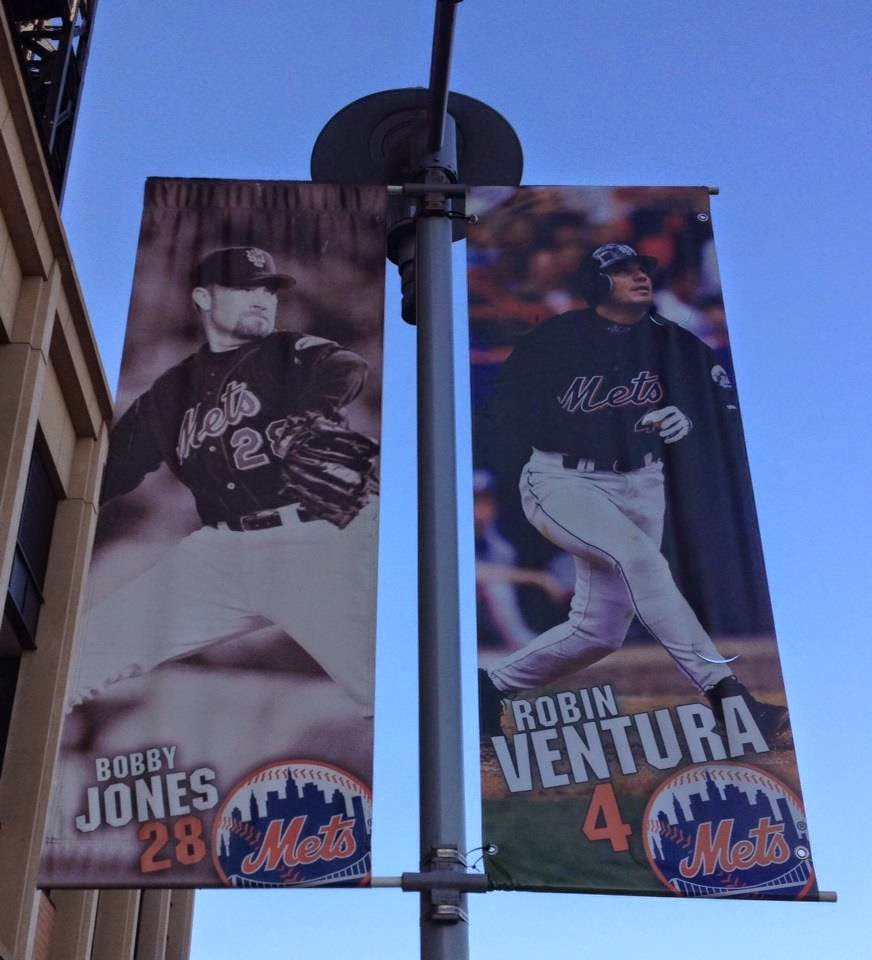
With the Mets on the road for over a week, I took advantage of Citi Field being devoid of fans walking around the outside plaza (which isn't all that different from game days) and decided to take some photos of the banners hanging on the light poles near the various entrances to the ballpark.  In doing so, I noticed some interesting pairings on those poles.

Six particular pairings caught my eye.  As shown in the photos below, these conscious couplings had to have been as intentional as Roger Clemens' broken bat-flinging incident in Game 2 of the 2000 World Series.  Take a look.


The above photo depicts Nolan Ryan and Robin Ventura, two former Mets who are connected by more than just a light pole.  In 1993, Ventura famously charged the mound when Ryan hit him with a pitch, only to be confronted by Ryan's Noogie Express.

Ventura's White Sox teammates and Ryan's cronies in Texas separated the two back then, but now the Mets are keeping them together, separated by just a metal light pole.


Ventura appears on another banner outside Citi Field.  This time, he's paired with Bobby Jones, a former Met who won 74 games in his pitching career as a Met, good for the ninth-highest total in club history.

Despite his lofty win total and status as an underrated Met, Jones is known primarily for his complete-game one-hit shutout over the San Francisco Giants in Game 4 of the 2000 NLDS.  Jones would get all the runs he needed in the first inning, when Robin Ventura crushed a two-run homer to give the Mets a 2-0 lead.  Eight innings later, Ventura and Jones celebrated their series clinching victory along with the rest of their teammates.  


This pairing should be obvious to even the most casual of Mets fans.  John Franco pitched for the Mets in 14 seasons (1990-2001, 2003-04) while Ed Kranepool appeared in a Mets uniform for 18 campaigns (1962-79).

Their longevity puts both players atop the team's all-time leaderboard in several offensive and pitching categories.  It also ranks them No. 1 (Kranepool) and No. 2 (Franco) in seasons played in New York.


Unlike the players represented in the first three photographs, Pedro Martinez and Carlos Delgado were teammates for three seasons (2006-08) in New York.  But they could have been teammates longer had it not been for the way general manager Omar Minaya pursued Delgado.

In Minaya's first off-season as the Mets GM, he signed two of the top available free agents in Pedro Martinez and Carlos Beltran.  But when Minaya sought the services of Delgado, he was turned away because the first baseman was uncomfortable with the way Minaya was appealing to his Latin-American heritage.  Delgado was eventually traded to the Mets in 2006, becoming a teammate of Pedro Martinez - the first player signed by Minaya in what some people have since referred to as the "Los Mets" era of the team.


Gil Hodges made his mark as a member of the Brooklyn Dodgers, then became an original Met in 1962.  Seven years later, as the team's manager, he led the Mets to their first World Series championship.  Meanwhile, Lee Mazzilli was born in Brooklyn in 1955 - the same year Hodges helped the Dodgers win their only World Series in the borough.  Mazzilli was one of the team's brightest stars in the late 1970s before being traded away in 1982.  But just like Hodges, Mazzilli was brought back to help the Mets win a championship.

For Hodges and Mazzilli, their seeds were planted in Brooklyn.  But both men blossomed for the Mets in Queens, winning championships and making the entire city proud.


The oddest pairing might be this David Wright-Keith Miller pole.  Wright is the Mets' all-time leader in various offensive categories and is one of the most beloved figures in recent club history.  Keith Miller was a utility player for the Mets from 1987 to 1991, never collecting more than 275 at-bats in any season and finishing his Mets career with just seven homers and 48 RBI - numbers Wright can easily put up in half a season.

As random as this pairing might seem, these two players have quite a personal connection to each other.  Prior to the 2013 season, Wright signed the most lucrative contract in team history, a deal that pays him $138 million over eight seasons.  Every time Wright thanks his agent for that contract, all he has to say is, "Thank you, Keith Miller."  Miller gave the Mets little run production as a player, but he gave the team eight extra years of run production as David Wright's agent.


Plenty of room for more banners, don't you think?

The Mets have set up various banner displays on poles outside Citi Field.  The banners feature several random pairings of the team's best players.  But not all of them are random.  Some of them, as seen in the six photos above, appear to be quite intentional.  And who knows, maybe the Mets aren't done with intentional banner pairings.

For example, there are still no banners pairing up Mike Piazza and Guillermo Mota.  They got into a famous spring training bench-clearing brawl in 2003 when Mota was a Dodger and Piazza was an ex-Dodger.  Similarly, there are no Gregg Jefferies-Roger McDowell pairings in the plaza.  Maybe the reason for that is because Gary Carter had to spend his final home game as a Met separating the two after they got into a brawl following the game's final out.  And don't get me started on an Armando Benitez-Graeme Lloyd pole.  The two had to be separated in a fight between the Orioles and Yankees in 1998, then briefly became teammates with the Mets five years later.

In addition, there are no banners teaming up Jesse Orosco and Jerry Koosman, two pitchers who were traded for each other following the 1978 season and remain the only pitchers who can say they recorded the final out in a World Series-clinching game for the Mets.  (Seriously, Mets, this pairing has to get done.)

If the Mets wanted some comic pairings, they could have a Follicle Follies-themed pole featuring Nino Espinosa and Jenrry Mejia.  Or perhaps Don Aase (a Met reliever in 1989) and Al Schmelz (a Met reliever in 1967) could have shared an Aase-Schmelz pole.  Aase could also appear on a pole with 1969 World Series hero Al Weis, but that pairing would probably be shot down, because no one likes a Weis-Aase.

The opportunity is there for the Mets to have a different kind of Banner Day at Citi Field.  They just need to show a little extra creativity.  They tried (and failed) to be creative by getting "True New Yorkers" to respond to a letter they sent out.  The team was chased up a pole on that one.  At least there were no banners on that pole.  I'd say it's because those are the poles being reserved for the Terrence Long and R.A. Dickey banners, but knowing the Mets, fans would probably get stiffed on that pairing as well.
 

Quick Starts Don't Always Guarantee Happy Endings

For Mets fans, Charlie Culberson is proof that Bichette happens quite often at Coors Field.  (AP Photo by David Zalubowski)

In 2006, the Mets rolled to a division title.  The turning point of the season came in early June, during a three-city, ten-game road trip.  The Mets had opened up a seven-game bulge in the NL East by late April, but their lead in the division had been halved to a more tenuous 3½-game lead by early June.

New York split the first two games of their long road trip in 2006, but then won each of the remaining eight games, scoring in the first inning of all eight contests.  By the time the Mets returned to Shea Stadium, they had increased their lead to 9½ games and had lost sight of every division rival in their rear view mirror.  By racing out to quick starts in each game, the Mets increased their chances to win ballgames, and they took advantage of the early leads throughout the road trip and for the rest of the season.

The 2006 Mets scored in the first inning in 61 of their 162 games.  They had the lead after one inning 44 times.  They won 33 of those 44 games, for a .750 winning percentage.  It's not uncommon for a team to win a ballgame when it gets out to a fast start.  Even the 1962 Mets, who finished the year with a 40-120 record, went 16-21 in games in which they held the lead after one inning.  Their .432 winning percentage in those games was significantly higher than their overall .250 winning percentage.

That brings us to the curious case of the 2014 Mets.  This year's squad has gotten out to a better-than-expected 15-14 record.  However, they have lost three straight following Saturday night's heartbreaking loss to the Rockies.  The Mets scored three runs in the first inning, extended that lead to 6-0 two innings later, then watched the Rockies take the lead in the fifth.  New York came back to take a one-run lead in the ninth only to watch Charlie Culberson (who had never homered at Coors Field in 80 career plate appearances) blast a game-winning two-run homer to straightaway center field off Mets "closer" Kyle Farnsworth.

When the Mets scored three runs in the first inning, it marked the 12th time in 29 games they had crossed the plate in an opening frame.  But once Charlie Culberson touched home in the ninth inning, the Mets' record dropped to 3-9 in those dozen affairs.  That's a .250 winning percentage.  In other words, the 2014 Mets have had as much of a chance of winning when they score in the first inning as the 1962 Mets had of winning any game.  But even the original Mets were able to play better when they scored in the first than this year's squad.

It's still early in the season, and the Mets' awful record when they score first could easily turn around.  But it's become an alarming trend that starting pitchers are having trouble holding early leads and relievers also are experiencing technical difficulties protecting those precious leads.

The 2014 Mets have won 12 of 17 games when they haven't scored in the first inning.  Their luck changes dramatically when they do score in the opening frame.  It doesn't make any sense why this should be true.  But it needs to be corrected or else Sandy Alderson's prediction of 90 wins will prove false.