Will my crew pick the Brew Crew to advance? Like I'd give that away in the opening photo. (Ed Leyro/Studious Metsimus)
What's going on? This is Joey Beartran, and I'm ready to roll out my picks for the American League and National League Division Series. And of course, as always, they will be completely unbiased. That means I won't pick a team because of how they did or didn't do when they played the Mets. I also won't pick against a team because they just happen to have someone on their roster that may have broken a former Met's leg, Nope, that would be biased.
I will, however, pick the teams I feel have the best chance to advance to the League Championship Series. And those picks will be based on pertinent statistics, postseason experience and whether or not they have Curtis Granderson on the team.
So who will move one step closer to the World Series just to have a light-hitting catcher such as Mike Scioscia or Yadier Molina deliver a key blow in the ninth inning? And who can't seem to get over the events of 1988 or 2006? (Spoiler alert: That would be me.)
It's time for me to put my Post-Traumatic Mets Disorder aside and share my picks for the 2018 A.L. and N.L. Division Series.
National League Division Series
Colorado Rockies vs. Milwaukee Brewers
The Rockies and Brewers have no World Series titles and just two Fall Classic appearances in their combined 75 years of existence. But once this best-of-five series is over, one of the two teams will be four wins away from a pennant.
Colorado wasn't expected to compete with the powerhouse Dodgers for the N.L. West title. Nor were they supposed to beat the battle-tested Cubs in the N.L. Wild Card game. But the Rockies did both, and now they might pay for it against the team with the best record in the National League.
Because ace pitcher Kyle Freeland was used in the Wild Card game, he will only be available to pitch once in the Division Series. And by the time he takes the mound in Game Three, the Rockies could very well be facing elimination.
Colorado is going with Antonio Senzatela as its Game One starter. Senzatela started just 13 games this season and was wild in his only appearance against the Brewers, walking three and hitting a batter in five innings of work. Game Two starter Tyler Anderson made 32 starts for the Rockies and won just seven of those starts. Was he just unlucky like Jacob deGrom in that his offense hit the snooze button whenever he was on the mound? Not exactly. Anderson pitched to a 4.55 ERA and allowed a team-high 30 home runs in 176 IP. That doesn't bode well against a Brewers team that finished second in the National League with 218 homers.
While Milwaukee is feasting on the likes of Homer Happy Anderson and Antonio Send Nutella (autocorrect works in mysterious ways), the Rockies will be facing Junior Guerra and Jhoulys Chacin. Neither pitcher is a household name or a Cy Young candidate. But against the Rockies, they won't need to be.
Game One starter Guerra has unreal home/road splits, boasting a 2.48 ERA on the Miller Park mound and a 6.97 ERA away from it. Where is Game One being played? In the city made famous by Lenny and Squiggy, of course. Meanwhile, Game Two starter Chacin became the first N.L. pitcher to make 35 starts in a season since Chris Carpenter in 2010. Chacin finished the year with a solid 3.50 ERA and a career-best 1.16 WHIP. And how has he fared in his career against the Rockies? He's held them to a .203 batting average and .642 OPS. No other National League team has a lower batting average against Chacin in his career and only the Giants, Diamondbacks and Phillies have a lower OPS.
By the time Freeland takes the mound in Game Three at Coors Field, the Rockies might be staring at elimination. They'll also be staring at the fearsome threesome of Jesus Aguilar, Travis Shaw and MVP frontrunner Christian Yelich, who combined to produce 103 HR and 304 RBI for the Brewers. And they did that without playing half of their games at 5,280 feet above sea level.
In the battle of beer cities, Miller > Coors. And it's not even close.
Prediction: Brewers in 3.
Did I mention that Curtis Granderson is a Brewer? Yet another reason to pick them to win. (Mitchell Layton/Getty Images)
Atlanta Braves vs. Los Angeles Dodgers
The Dodgers needed a 163rd game to win their sixth consecutive N.L. West title, or eight fewer than the Braves claimed during their unprecedented run of 14 straight division crowns. It's no surprise that Los Angeles is in the Division Series. What is surprising is that Atlanta is joining them, as the Braves entered the 2018 campaign just trying to avoid their fifth consecutive losing season and instead won 90 games after averaging 90 losses per season since 2014.
Los Angeles led the National League in ERA, which is not unusual for a team known for its pitching. But check this out. The Dodgers used a whopping 31 pitchers during the season, yet none of them pitched enough innings to qualify for the ERA title, not that Jacob deGrom was going to let any of them compete with him for that honor. Ninety-year-old Rich Hill was the only Dodger to reach double digits in wins and Alex Wood led the staff with just 27 starts. So I guess you could say they're well-rested. It was truly an odd season for the Dodgers' pitching staff.
Their hitters, on the other hand, were the epitome of all-or-nothing. The Dodgers set franchise records in both home runs (235) and strikeouts (1,436). But most of their homers came with no one on base. In fact, their 157 solo shots were more than the total number of homers hit by five major league teams. So basically, a good pitching staff that isn't susceptible to the long ball and can strike out a batter or ten should be able to handle the Dodgers' bats.
For the record, the Braves allowed the third-fewest homers in the majors (153) and finished in MLB's top ten in strikeouts recorded (1,423). Just like Chase Utley, this one's a no-brainer.
Prediction: Braves in 4.
Rejoice! Chase Utley will officially be retired after this series. (Jayne Kamin-Oncea/Getty Images)
American League Division Series
Cleveland Indians vs. Houston Astros
In this battle between the last two American League pennant winners, let's not look at the defending World Series champion Astros and instead focus on the three-time A.L. Central champion Cleveland Indians.
The Indians became the first team in history to have four pitchers strike out 200 or more hitters, as Carlos Carrasco (231 Ks), Corey Kluber (222 Ks), Trevor Bauer (221 Ks) and Mike Clevinger (207 Ks) spent most of the year sending opposing hitters back to their respective dugouts.
On the offensive side, Cleveland produced a trio of 30-HR hitters (Jose Ramirez, Francisco Lindor, Edwin Encarnacion) and was also the American League's biggest threat on the bases, producing a league-leading 135 stolen bases.
But there's just one problem with the Indians. And it's a pretty big one. Are you ready for this?
Oliver Perez is their best relief pitcher.
The former Met boo magnet made 51 appearances for the Indians in 2018 and produced a 1.39 ERA and 0.74 WHIP. He also struck out 43 batters while walking just seven. How did his colleagues in the bullpen fare? You may want to sit down for this one.
Closer Cody Allen had a 4.70 ERA and 1.36 WHIP in 70 appearances. Six other relievers not named Oliver Perez made at least 30 appearances for the Indians. All six had an ERA of at least 4.24 and a WHIP north of 1.26.
Basically, if your best option out of the bullpen is O.P., then you're pretty much D.O.A. against a team like the Astros. It also doesn't help that the Indians' 91-71 record was a product of playing in baseball's worst division, as they went 49-27 against their fellow A.L. Central teams and 42-44 versus non-division opponents. Needless to say, Houston doesn't call the A.L. Central home.
This series shouldn't be close.
Prediction: Astros in 3.
Playing the defending World Champions would make anyone go prematurely gray. (William Purnell/Getty Images)
New York Yankees vs. Boston Red Sox
I'll make this simple for you without being biased. The Red Sox became the fourth team in history to win exactly 108 games. They matched the victory total of the 1970 Baltimore Orioles, 1975 Cincinnati Reds and 1986 New York Mets. What do those three teams have in common besides the number of regular season happy recaps? Champagne in late October, that's what.
Had the Red Sox won 109 games instead of 108, there would be no guarantee of a parade because the 1969 Orioles had that many victories and didn't win it all. (I wonder who did...) Similarly, if the Red Sox had lost their final regular season game to finish the year with 107 wins, they would have matched the 1931 Philadelphia Athletics' victory total. The A's lost the Fall Classic that year to the St. Louis Cardinals.
Meanwhile, the Yankees became the ninth team since 1980 to finish the season with exactly 100 victories. How many championships were won by the previous eight 100-win teams? It's the same as the number of Washington Nationals postseason series victories. In fact, five of those eight 100-win teams didn't even make it to the League Championship Series.
So forget about the stats. Forget about head-to-head records. (The Red Sox won the season series against the Yankees anyway, in case you were wondering.) History cannot be denied. Teams with 108 wins take home the crown. Teams with 100 wins make plans to play golf during the World Series.
Prediction: Red Sox in 5.
Fenway Park, where Evil Empire dreams go to die. (EL/SM)
Remember, these are completely unbiased picks. So this photo of me at gorgeous Coors Field is just a total coincidence.
Hey, everyone! This is Joey Beartran, your furry fearless forecaster. And just like you, I'm only now starting to recover from the David Wright Kleenex Fest this past weekend at Citi Field. It's sad that the Captain's career is over, just like it's disappointing that the Mets are not in the postseason for a second consecutive campaign.
Because the Mets are emptying out their lockers instead of packing for an October road trip, that means we all have to watch teams in which we have no interest competing for a championship that has eluded our squad for nearly a third of a century.
Some of those non-Metsian teams were forced to play a 163rd game to determine who would get the chance to celebrate a division title and who would have to play in the same do-or-die game the Mets lost the last time they made the playoffs two seasons ago. The Cubs and Rockies both lost their 163rd and final regular season games, forcing them to play in a 164th and first postseason game against each other, with the loser not getting a chance to play in a 165th game. Meanwhile, the Yankees and A's already knew their wild card fate for some time, allowing them to prepare for the inevitable Yankee defeat. (Oops, I should've said "spoiler alert".)
As your prescient prognosticator, it's my duty to share my knowledge of what's going to happen in the American and National League Wild Card games. And hopefully, I won't spoil anything for you too soon like I did in the previous paragraph. (On an unrelated note, don't you just love the photo of me at the top of this post? Looks like the photo of a winning ballpark, doesn't it?)
National League Wild Card Game
Colorado Rockies vs. Chicago Cubs
Well, leave it to the Rockies to get so close to winning their first division title only to kiss it goodbye in their 163rd game. Then again, the Rockies are no strangers to making it to the playoffs as a second-place team. They've now qualified for the postseason five times in their quarter century of existence, with every appearance coming as the No. 2 team in the N.L. West. Meanwhile, the Cubs surrendered the N.L. Central crown in their 163rd game but still made the playoffs for a fourth consecutive season; the first time they've ever done that in their long history, which dates back to 1876, or the year Scott Atchison was born.
The Cubs won four more games than the Rockies did during the regular season and have far more playoff experience than Colorado does. Chicago manager Joe Maddon has taken his North Siders to the playoffs four times, immediately on the heels of taking his former team, the Tampa Bay Rays, to the postseason on four occasions. Maddon has also won more pennants (two) than his counterpart, Bud Black, has managed postseason games (one). And you can always expect the crowd at Wrigley Field to be raucous, especially in a do-or-die game.
Cole Hamels
Everything seems to suggest that the Cubs should easily dispose of the Rockies in the Wild Card game. Colorado has to overcome a playoff-tested opponent managed by a potential future Hall of Famer. They also have to play 4,683 feet closer to sea level than they're used to.
But the Rockies have one key advantage over the Cubs. Colorado doesn't have Cole Hamels on their payroll. Chicago does. And really, that's all that matters to me. Because no team that feels the need to fatten Hamels' wallet should ever be allowed to advance in the postseason.
Prediction: Colorado will advance to the NLDS.
American League Wild Card Game
Oakland A's vs. New York Yankees
The Yankees were expected to run roughshod over the rest of the American League this season. They didn't quite do that, finishing eight games behind the rival Red Sox in the A.L. East. Meanwhile, Oakland was expected to sell off their players at the trade deadline after a disappointing start. Instead, they added pitchers Edwin Jackson, Shawn Kelley, Mike Fiers, Fernando Rodney and some guy named Jeurys Familia and went 63-29 in their last 92 games to comfortably secure the second wild card spot.
A's versus Yankees usually doesn't end up well for the team from the left coast. The two teams have faced each other three times in the postseason (1981, 2000, 2001). New York emerged victorious on each occasion. (I have a selective memory, so I'm choosing to ignore what happened in
the World Series in 1973. If I ignore it, then it didn't happen.)
It's not just in baseball where New York takes care of Oakland in postseason affairs. On December 29, 1968, the New York Jets defeated the Oakland Raiders in the AFL Championship Game on their way to their first and only Super Bowl title.
If it seems like no one can remember the last time Oakland defeated New York in anything (remember, 1973 never happened in my mind), that's because no one was allowed to see it when it happened. I mean that literally, not figuratively.
Ever hear of "The Heidi Game"? On November 17, 1968, the Jets held a 32-29 lead over the Raiders with under a minute to play. The NBC television network was broadcasting the game, but because they were obligated to show the movie "Heidi" at 7:00pm, the game did not air to its conclusion and the football-loving audience instead saw the first few minutes of "Heidi" instead of two touchdowns by the Raiders, which turned an apparent New York victory into a bitter 43-32 defeat.
Sheldon, you're no Heidi.
The Heidi Game will be celebrating its 50th anniversary in less than seven weeks. I can't think of a better way to celebrate that special moment in sports history - one in which no one saw a team from Oakland defeating a club that calls New York home - than by having the A's ending the Yankees' season, hopefully without TBS switching off the game to show reruns of "The Big Bang Theory."
I wonder who I'm picking to win the N.L. Wild Card game. If only I had a sign to help me...
Hey, how's everybody doing? I'm playoff prognosticator Joey Beartran and I'm ready for some postseason baseball. This is the first season since 2014 that the Mets were not invited to the playoff party but many players who called Flushing home at some point in 2017 did receive - and accept - their invitations.
The Indians and Dodgers, owners of the best regular season records in their respective leagues, are bringing Jay Bruce and Curtis Granderson, respectively, to the postseason. Addison Reed will be coming out of the bullpen for the A.L. East champion Red Sox. Even Rene Rivera could crack the defending World Series champion Cubs' 25-man postseason roster.
Last year, the Yankees stayed home and the Mets played past their 162nd game. This year, New York (AL) is hosting the Minnesota Twins in the wild card game and New York (NL) is busy showing off videos of Jacob deGrom's haircut. Seriously, that's how the Mets are making news this October. (Well, that and Terry Collins saying adios to Mets fans.)
Say it ain't so, Jake! (Screen grab courtesy of Jose Reyes' Snapchat)
So since we don't have meaningful Mets baseball games until next March 29, we should probably focus on the wild card games set for Tuesday and Wednesday night. Will the Yankees win their first postseason game since Zach Lutz was a Met? Will the Twins finally end their 12-game postseason losing streak? Will the Rockies ride Chuck Nazty to the division series? Or will Arizona get their revenge on Colorado for the 2007 NLCS?
There's only one way to know what's going to happen before it happens. And that's by reading my wild card picks below; picks that are not biased at all. Trust me. I'm an expert.
American League Wild Card Game
Minnesota Twins vs. New York Yankees
The Twins have never defeated the Yankees in a postseason series, having dropped the ALDS to the Bronx Bummers in 2003, 2004, 2009 and 2010. More recently, New York won all three games played against Minnesota at Yankee Stadium in 2017. And to make matters worse for the Twins, their starting pitcher for the wild card game - Ervin Santana - has an 0-5 record with a 6.43 ERA in six career starts at the new House That Juice Built.
For the Yankees, starting pitcher Luis Severino struck out 230 batters during the regular season, which was tied for the third-highest total in Yankees history. In addition, his 153 ERA+ made him the first Yankees starting pitcher to register an ERA+ over 150 since David Cone had a 159 ERA+ in 1997.
I heart Bart. (Hannah Foslien/Getty Images)
The Yankees go into the postseason on a roll, having won 21 of their last 30 games. The Twins were a .500 team in September, going 14-14 in the month. New York has ten-foot tall Aaron Judge clubbing everything out of sight. Minnesota's top home run hitter is Brian Dozier, who's half the size of Judge and hit 18 fewer homers. Everything seems to be coming up Yankees in this game, right?
Nah.
Santana wins his first game at the new Yankee Stadium, Miguel Sanó does his best David Ortiz impression (but from the right side of the plate) and Bartolo Colón's career lives to see another round.
Prediction: Minnesota will advance to the ALDS.
National League Wild Card Game
Colorado Rockies vs. Arizona Diamondbacks
Both Colorado and Arizona reversed their fortunes in 2017. Literally. The Rockies improved their record from 75-87 to 87-75, while the D-Backs went from 69-93 to 93-69. But neither team came within striking distance of the first place Dodgers, necessitating this one-game face-off for the right to be swept by Justin Turner and Friends.
Last year, the Mets played in this game and ran into a buzzsaw on the mound in Madison Bumgarner. This season, Jon Gray and Zack Greinke will try to be this year's Bumgarner. It's too bad both pitchers will fail, as this game will be a Wild West shootout.
Gray will have to control the bats of Paul Goldschmidt and J.D. Martinez. It will not go smoothly. Greinke, on the other hand, will be staring down Nolan Arenado and batting champion Charlie Blackmon, among others. Because of his reputation, Greinke will be left in the game a little too long. Like five or six runs on the scoreboard too long.
Arizona may have finished ahead of Colorado in the standings, but the Rockies will finish ahead of the Diamondbacks in this game. And if Arizona ordered a large number of churro dogs in anticipation of a lengthy postseason run, I know someone who can help them reduce their inventory.
On Friday, the Mets defeated the Colorado Rockies by a final score of 14-2. As blogfather, author and respected Unicorn Score researcher Greg Prince noted, it was the first time in the team's 56-year history that they had won a game by that exact score. Hence, 14-2 is referred to as a Unicorn Score, which as defined by our fervent Faith and Fear friend is "a score by which the Mets win once and never again."
As of this writing, the fewest runs scored by the Mets in a Unicorn Score game is 11, which they accomplished on May 20, 1999 when they defeated the Milwaukee Brewers, 11-10. Not only is that the only time in Mets history that the team has won a game by an 11-10 score, but that May 20 affair was the first of two games played by the Mets that day; a day in which Robin Ventura clubbed grand slams in each game, which made him the first - and still only - player in big league history to accomplish that feat.
In addition, the Mets have never won a game by a 12-11 score in franchise history. That remains the fewest runs needed by New York to win a game by a Unicorn Score. (They've lost two games by a 12-11 score, but like the numbers of ringzzzz the Yankees have, we don't care about those.)
But what about anti-Unicorn Scores? Which scores are the most common in Mets history when the team has taken care of business and emerged victorious? I'm glad you asked. (Trust me, you asked. I heard you through the screen.)
The most common score in a Mets victory - an anti-Unicorn Score, if you will - is not surprisingly, a low-scoring game that was decided by one run. The Mets have won 291 games by the exact final score of 3-2. In their 1969 championship season alone, the Mets won 11 games by that score. Incredibly, the Mets have won at least one game by a 3-2 score in each of their first 55 seasons. However, they have yet to win a 3-2 game in 2017.
There are two other scores that have resulted in happy recaps more than 200 times. Those scores are 2-1 (Mets have won 247 games by that score) and 4-3 (241 of those).
Want more? The most repeated final score in Mets victories that weren't decided by a single tally is 4-2. New York has celebrated 182 of those identical wins. And the team the Mets have beaten the most by the exact same final result? That one is a surprise. Despite never playing in the same division and thereby having fewer games scheduled against them than they would against N.L. East squads, the Mets have defeated the Cincinnati Reds 33 times by a 3-2 score. All but one of those 3-2 victories happened from 1962 to 2002, as the Mets have only defeated the Reds once in the last 15 years by a 3-2 margin.
Blue and orange unicorns do exist.
In 2015, the Mets won a 14-9 game for the first time in team history, defeating the Rockies by that score. That Unicorn Score lasted 24 hours, as the following day, the Mets beat Colorado by that twice-in-a-lifetime score. Last night, the Mets put up another Unicorn Score against the Rockies in their 14-2 victory. Perhaps this time around, they'll follow it up by winning with the most common anti-Unicorn Score of 3-2. If they do, it would be the first time they've defeated anyone by that score this year.
As the saying goes, if you watch baseball long enough, you'll end up seeing something you've never seen before, like a Unicorn Score. Or maybe you'll see something you've seen over 200 times before, like a 3-2 Mets victory. I wonder what the team has in store for us tonight.
Earlier this morning, the MetsBlog Twitter account delivered this yummy bit of somewhat fictional information to its tens of thousands of followers.
Although the .196 team batting average is correct, the team had actually hit two homers during the season's first five games, with David Wright and John Mayberry connecting off Braves starter Eric Stults on back-to-back pitches during Friday night's game.
But perhaps the lack of extra-base hits produced by the Mets during the first week of the new season confused the fact checkers at MetsBlog. After all, with just four extra-base hits in five games, the Mets are dead last in the majors in that category. Let's put the anemic offense into perspective.
New York has 32 hits this season. That's just four more safeties than the Colorado Rockies have extra-base hits. The N.L. West leaders have hit 21 doubles and seven homers through their first five contests.
Speaking of the Rockies, their pitchers have accounted for two of their league-leading 21 doubles, as starting pitchers Kyle Kendrick and Tyler Matzek have both ripped two-baggers during the season's first week. Therefore, Colorado's pitchers have produced more doubles than the entire Mets team, as Lucas Duda is the only Met to stroke a double so far in 2015.
As previously mentioned, the Mets have four extra-base hits this season. How anemic is that? Let me count the ways.
The Detroit Tigers have as many triples as the Mets have extra-base hits.
There are 15 players in baseball with as many or more extra-base hits than the entire Mets team.
Nineteen of the other 29 teams have as many homers as the Mets have extra-base hits.
No extra-base production means no slugging percentage, and the Mets are dead last in the majors with a .252 slugging percentage. New York is one of just three teams in baseball with a higher on-base percentage (.264) than slugging percentage. The other two teams are the Miami Marlins (.285 OBP, .259 SLG) and the Minnesota Twins (.258 OBP, .256 SLG). It should be noted that the Marlins and Twins are tied for the worst record in baseball, as both teams are 1-4.
The Mets have more bearded players than they have extra-base hits. (Stacy Revere/Getty Images)
If the Mets offense is not going to produce, then the onus rests on the starting pitchers to keep the team's opponents off the scoreboard. But even the starting pitchers aren't going very deep during the first week of the season. The Mets are one of three teams who have not yet had one of its starters pitch into the seventh inning this year, joining the Arizona Diamondbacks and the New York Yankees. And why are Mets starters not going deeper into games? Some of it is ineffectiveness (see Niese, Jon and Gee, Dillon) and some of it is because of an innings limit (see Knight, Dark). But another reason why the starters have not pitched past the sixth inning is because the team has needed to pinch-hit for them earlier in games because the offense has not been effective.
On Opening Day, Bartolo Colon was cruising, allowing one run on three hits in six innings. But with the Mets holding on to a slim 2-1 lead in the top of the seventh, manager Terry Collins replaced Colon with pinch-hitter Kirk Nieuwenhuis, even though Colon had only thrown 86 pitches to that point. Nieuwenhuis failed to drive in Travis d'Arnaud, who had hit a triple two batters earlier, and Colon was out of the game.
Two nights later, it was Jacob deGrom's turn to be taken out of the game for a pinch-hitter. DeGrom had thrown just 92 pitches through six innings, shutting down the Nationals after allowing a two-run homer to Ryan Zimmerman in the first inning. But deGrom was trailing by a run when he was due to bat in the seventh. Once again, Collins pinch-hit Nieuwenhuis for his starting pitcher and the Mets failed to score.
Both Colon and deGrom could have pitched into the seventh inning had the Mets been more productive with their bats. But they weren't. And because of that, the bullpen has gotten a lot of early work and two starters have gotten early showers.
Look, I know it's only five games. I also know it's very possible the Mets might hit the stitches off the ball over their next five games and this blog post will be moot. But it's just frustrating that the lineup looked halfway decent coming into the season and they're struggling to produce a slugging percentage that resembles a typical batting average.
Mario Mendoza, whose name is so synonymous with a low batting average that a .200 hitter is said to be at the Mendoza Line - never mind that Mendoza actually had a .215 lifetime batting average - would look at the 2015 Mets and shake his head in disgust. That's what happens when an entire team can only muster a .196 batting average. And it's not just the lack of hits that would upset Mendoza. It's the lack of long hits. The Mets' .252 slugging percentage is also lower than Mendoza's .262 career mark.
All you have to know about the early season offensive production of the 2015 Mets is this. In last night's game, the Atlanta Braves produced three doubles and one triple in the sixth inning. The Braves' extra-base hit production in that one inning matched the total number of extra-base hits produced by the Mets in their first five games combined.
The offense is doing just enough to offend and not enough to contend. Let's hope "it's still early" doesn't turn into "it's getting late" for the team's lumber to awaken from its slumber.
This is what most Mets hitters have looked like in 2015. (Adam Hunger/USA TODAY)
Wouldn't Troy Tulowitzki be a hit if he found a fit in orange and blue? (Photo by Mike Ehrmann/Getty Images)
Have you checked the interwebs these days? Especially #MetsTwitter on (ahem) Twitter? It's impossible to find a Mets fan who doesn't have an opinion on current Rockies shortstop Troy Tulowitzki.
"Trade for Tulo," some fans say, noting that he would be an upgrade over the current Flores/Tejada two-headed monster.
"Get someone else," other fans say, knowing that Tulowitzki has an injury history and would cost the Mets an arm, a leg, a kidney, an appendix and a Syndergaard, at the very least.
"Keep Tejada. He hit five homers last year", says absolutely no one.
Needless to say, everyone has an opinion on the Mets' shortstop situation, and most of those opinions include one Troy Trever Tulowitzki. Even if he misses a month or four per season, he'd still probably put up better offensive numbers than Wilben Flojada. (Or was that Rumer Teres?)
And what about that Coors Field factor? Well, Tulowitzki has played 480 contests away from Denver's thin air - approximately three full seasons worth of games - and has posted a .274 batting average, .469 slugging percentage and .818 OPS in those affairs. Only nine players have ever posted an OPS higher than .818 while wearing a Mets uniform (Olerud, Piazza, Strawberry, Wright, Beltran, Delgado, Bonilla, Floyd, Ventura). Tulowitzki would be right up there with them. And that's only considering what he's done away from Coors Field.
So basically, as long as he's healthy, Troy Tulowitzki would have a chance to become one of the best hitters in Mets history. His offense is clearly needed on the 2015 squad. Tulo hits. And he most certainly fits. And New York is where he should set up shop in 2015.
So in honor of the "bat man" the Mets truly need, I'd like to share a song parody of a ditty originally performed by a former "bat boy". The song "2 Legit 2 Quit" was a top-five smash in 1991 for former A's bat boy Hammer, who had dropped the "M.C." from his stage name by then. Hammer didn't know it back then, but almost a quarter century later, his song would serve as the basis for a rallying cry - a cry penned by yours truly in the hopes that the Mets will go all out to acquire the premier offensive shortstop in the National League. And naturally, that rallying cry had to be called "Tulo Hits, He Fits".
Tulo hits! Tulo hits, he fits! Tulo hits! Tulo hits, he fits! Tulo hits! Tulo hits, he fits! Tulo hits! Tulo hits, he fits! Mets going on a shortstop quest Now don't quit (no!), get the best Ardor (yeah!), Sandy never showed before In bettering the team, especially its core He don't mind (mind!) if you think that he's fakin' it A shortstop bind that he'll fix, no mistakin' it today (No!) 'Cause Sandy don't play that He's watching his guy, Troy, not having setbacks Please (please!), we've got no one He hustles, he's got muscle, he's all we need, son Sandy's going for the guy he can get Startin' at the top, 'cause Tulo hits, he fits! (Cha-ching!) Tulo hits! Tulo hits, he fits! (Hey, hey!) Tulo hits! Tulo hits, he fits! (Heyyyyy!) Tulo hits! Tulo hits, he fits! (Tulo hits!) Tulo hits! When he feels right, most don't even play him close He hits a jack, he rounds the sacks, and then the pitcher's toast He's got that power, he flexes every hour The pitchers all shake, they all get devoured The fans are enthused, baseballs are abused Competitors petition to change all the rules Schoolin' the game, the man is insane Not ashamed I gotta say this, Tulo's going for Fame Unchained, no one's better, even flashes some leather Tulo is the tops when he keeps it all together So roll with this guy, his physique doesn't quit Now's the time, cause Tulo hits, he fits! (Bang!) Tulo hits! Tulo hits, he fits! (Hey, hey!) Tulo hits! Tulo hits, he fits! (Hey, hey!) Tulo hits! Tulo hits, he fits! (Tulo hits!) Tulo hits! Tulo hits, he fits! Tulo hits! Tulo hits, he fits! (Hey, hey!) Tulo hits! Tulo hits, he fits! (Heyyyyy!) Tulo hits! Tulo hits, he fits! (Tulo hits!) Tulo hits! Tulo hits, he fits! Get him this winter, he'll make the Mets a winner Hits away from Coors, not just where air's thinner (word!) He's not a noob, he's tried and true Revitalize fan interest (yo!), just bring him through We're through (Talk!), we've had it with the strife Ready for postseason, so believe the hype So get him (Get him!) or you're gonna regret it 'Cause the day you missed him is the day you lose the pennant Troy reminds me of the best in history Breakin' records, gettin' all the glory We're so ready, we're ready for it Hey, you! Come through! 'Cause Tulo, he fits! (Bang!) Tulo hits! Tulo hits, he fits! (Hey, hey!) Tulo hits! Tulo hits, he fits! (Hey, hey!) Tulo hits! Tulo hits, he fits! (Tulo hits!) Tulo hits! Tulo hits, he fits! Tulo hits! Tulo hits, he fits! Tulo hits! Tulo hits, he fits! Tulo hits! Tulo hits, he fits! Tulo hits! Tulo hits, he fits! Get Troy! Get Troy! Get Troy! Get Troy! Get Troy! Get Troy! Get Troy! Get Troy! Get Troy! Get Troy! Get Troy! Get Troy! Get Troy! Get Troy! Get Troy! Get Troy! Get Troy! Get Troy! Get Troy! Get Troy! So people, don't admit defeat We've waited long, to win the NL East Daily (every day!), we ask for moves Something to improve, make the team more cool So we pray (Yo!), that Tulo can play We used to feed the bottom, Troy can lead today Oh yeah! I know he fits! He'll get us to the top, cause Tulo hits, he fits! (Say it!) Tulo hits! Tulo hits, he fits! (Hey, hey!) Tulo hits! Tulo hits, he fits! (Hey, hey!) Tulo hits! Tulo hits, he fits! (Tulo hits!) Tulo hits! Tulo hits, he fits...
Michael Morse will be dancing to A-Ha in 2015, but not at Citi Field. (Photo by Thearon W. Henderson/Getty Images)
In early November, the Mets pulled off a stunningly quick free agent signing, inking Michael Cuddyer to a two-year, $21 million contract to play the outfield and fill in for Lucas Duda at first base whenever a tough left-handed pitcher was facing New York. The Mets made this move even though they knew they would have to part ways with their first round draft pick in 2015, as Cuddyer was given a qualifying offer by his former employers in Colorado that he chose not to accept. The signing reunites Cuddyer with his childhood friend, David Wright, as the two All-Stars grew up near each other in Virginia.
Cuddyer has an injury history, played his last three seasons in the thin air of the Mile High city and will be 36 years old by the time the curtains open on the 2015 season. Clearly, there are lots of question marks with this deal, but if Cuddyer stays healthy, he should still be a serviceable player who will make positive offensive contributions to the team. With that being said, why didn't the Mets make a stronger push for a fellow Michael who just won a World Series ring in San Francisco?
Michael Morse is coming off a season in which he missed 31 games. However, he still managed to produce 32 doubles, three triples, 16 home runs and 61 RBI in 438 at-bats, averaging an extra-base hit every 8.6 at-bats. In doing so, Morse was one of just six players in the majors who had at least 50 extra-base hits in fewer than 500 plate appearances. Morse's .811 OPS was quite good in a season where just nine National League players posted an OPS of .850 or higher.
In three seasons with the Rockies, Cuddyer produced an .886 OPS. However, that number was clearly inflated by playing his home games at Coors Field. From 2012 to 2014, Cuddyer's OPS at home (.984) was far superior to his road OPS (.795). His OPS on the road while with the Rockies was very similar to the overall .794 OPS he posted in 11 seasons with Minnesota, leading one to believe that he will produce around the same figure with the Mets. Morse, on the other hand, has played the majority of his career in home parks that are not among the best for sluggers (Safeco Field, Nationals Park, AT&T Park). However, he has been very consistent at home and on the road, posting an .809 lifetime OPS in his home parks, while producing an .807 OPS on the road
Going back to Cuddyer's injury history, the new member of the Mets has played 140 or more games in a season just four times since making his major league debut in 2001. And since 2011, Cuddyer has missed a total of 229 games. Morse is not the healthiest of players either, surpassing 130 games played just twice since becoming a regular player in 2010. However, Morse has missed "only" 181 games since 2011, meaning he remains on the field more than Cuddyer does.
When considering what a player - especially one who is injury-prone - would do over the course of a full season, a valuable tool to use is baseball-reference.com's "per 162 games" stat. Let's look at what Cuddyer and Morse have done per 162 games since both became everyday players in the big leagues.
Basically, they're the same player when healthy. But Cuddyer (born March 27, 1979) is three years older than Morse (born March 22, 1982) and could be on the decline sooner than Morse, especially now that he's left the thin-aired confines of Coors Field.
Now let's consider what Cuddyer has done against the NL East teams he will now be playing more regularly and compare that to what Morse has done against the same teams. Since Cuddyer has less experience playing National League teams than Morse does, we will only consider non-cumulative stats for both players.
Unlike the "per 162 games" stat, in this case Morse clearly has an edge over Cuddyer. The experience factor (all but 612 of Morse's 2,296 career at-bats have come as a National League player) also gives Morse an advantage over Cuddyer, who spent over a decade in Minnesota.
Finally, and this has always been important in the Sandy Alderson scheme of things, Michael Morse was not given a qualifying offer by the Giants when his contract expired at the end of the 2014 season. Therefore, had the Mets chosen to sign Morse, they would not have lost their first round draft pick next season as they did when they signed Cuddyer. Furthermore, Cuddyer was finishing up a three-year, $31.5 million deal with the Rockies, meaning the Mets were going to have to dole out over $10 million per season to a player of Cuddyer's talent and experience, even with his recent injury history. Meanwhile, Morse was coming off a one-year, $6 million deal with the Giants, just one season after finishing off a two-year, $10.5 million contract originally signed with Washington in 2012 (Morse was later traded to Seattle and Baltimore during those two seasons). Given Morse's injury history, he probably would not command more than a two-year deal. However, his average annual value would certainly not exceed $10 million per season. Perhaps a two-year, $18 million contract would have been enough to lure him to Flushing.
So let's summarize. Cuddyer is three years older than Morse, has similar offensive production to Morse (per 162 games) and is coming off a three-year stay in hitter-friendly Colorado to play at sea level in New York. And although Cuddyer hits well against his new division rivals, Morse's numbers are better against those teams and Morse has more experience playing those clubs. Oh, and lest we forget, Morse would probably have had a lower price tag than Cuddyer and would not have cost the Mets next year's first round draft pick - a pick they could have given up for another quality player in addition to Morse.
David Wright and Michael Cuddyer are friends. So it's entirely possible Wright had a big say in the team's hasty decision to sign Cuddyer. But had the team waited it out a little longer, they could have come up with a better deal in the still-unsigned Michael Morse. Like Cuddyer, Morse is a right-handed hitting outfielder who has experience at first base and could play there in place of Lucas Duda whenever a tough lefty was on the mound. But the Mets decided Cuddyer would be a better fit for the team. Let's just hope Morse doesn't turn into a good fit for one of the Mets' main rivals.
For Mets fans, Charlie Culberson is proof that Bichette happens quite often at Coors Field. (AP Photo by David Zalubowski)
In 2006, the Mets rolled to a division title. The turning point of the season came in early June, during a three-city, ten-game road trip. The Mets had opened up a seven-game bulge in the NL East by late April, but their lead in the division had been halved to a more tenuous 3½-game lead by early June. New York split the first two games of their long road trip in 2006, but then won each of the remaining eight games, scoring in the first inning of all eight contests. By the time the Mets returned to Shea Stadium, they had increased their lead to 9½ games and had lost sight of every division rival in their rear view mirror. By racing out to quick starts in each game, the Mets increased their chances to win ballgames, and they took advantage of the early leads throughout the road trip and for the rest of the season.
The 2006 Mets scored in the first inning in 61 of their 162 games. They had the lead after one inning 44 times. They won 33 of those 44 games, for a .750 winning percentage. It's not uncommon for a team to win a ballgame when it gets out to a fast start. Even the 1962 Mets, who finished the year with a 40-120 record, went 16-21 in games in which they held the lead after one inning. Their .432 winning percentage in those games was significantly higher than their overall .250 winning percentage. That brings us to the curious case of the 2014 Mets. This year's squad has gotten out to a better-than-expected 15-14 record. However, they have lost three straight following Saturday night's heartbreaking loss to the Rockies. The Mets scored three runs in the first inning, extended that lead to 6-0 two innings later, then watched the Rockies take the lead in the fifth. New York came back to take a one-run lead in the ninth only to watch Charlie Culberson (who had never homered at Coors Field in 80 career plate appearances) blast a game-winning two-run homer to straightaway center field off Mets "closer" Kyle Farnsworth. When the Mets scored three runs in the first inning, it marked the 12th time in 29 games they had crossed the plate in an opening frame. But once Charlie Culberson touched home in the ninth inning, the Mets' record dropped to 3-9 in those dozen affairs. That's a .250 winning percentage. In other words, the 2014 Mets have had as much of a chance of winning when they score in the first inning as the 1962 Mets had of winning any game. But even the original Mets were able to play better when they scored in the first than this year's squad. It's still early in the season, and the Mets' awful record when they score first could easily turn around. But it's become an alarming trend that starting pitchers are having trouble holding early leads and relievers also are experiencing technical difficulties protecting those precious leads. The 2014 Mets have won 12 of 17 games when they haven't scored in the first inning. Their luck changes dramatically when they do score in the opening frame. It doesn't make any sense why this should be true. But it needs to be corrected or else Sandy Alderson's prediction of 90 wins will prove false.
Afternot performing well at home all year, the Mets completed a three-game sweep of the Colorado Rockies on Thursday, taking the finale by the score of 2-1. The Mets will hope to continue their recent stretch of good pitching out west, beginning a four-city, 11-game road trip on Friday. Ten of the 11 games will be played in the Pacific Time Zone, with the last game of the road trip taking place in Minnesota, where the Mets were snowed out in April, necessitating this makeup game.
So how have the Mets fared over the years when they've played at least ten consecutive games three time zones from home?
Prior to 1969, there were only two teams playing in the Pacific Time Zone. Therefore, the Mets never played ten consecutive games out west. It wasn't until the miraculous year of 1969, when the San Diego Padres joined the National League, that the Mets took part in their first ten-game West Coast swing. From August 26 to September 3, the Mets played three games in San Diego, four in San Francisco and three in Los Angeles, taking six of the ten games en route to their first World Series championship.
The Mets have had several more California road trips of ten or more games over the years, but they had to wait until 1998 - when the Arizona Diamondbacks joined the Senior Circuit - to play a game in the Pacific Time Zone outside of the Golden State. And even with Arizona in the league, they had to wait until 2010 to play the Diamondbacks as part of a West Coast road trip of ten games or more.
Here is a list of every West Coast trip of ten or more games the Mets have played in their history, along with who they played and the team's record during those long trips three time zones away from home.
1969 - 10 games (3 vs. SD, 4 vs. SF, 3 vs. LA): 6-4
1970 - 10 games (3 vs. LA, 3 vs. SF, 4 vs. SD): 5-5
1973 - 10 games (4 vs. LA, 3 vs. SF, 3 vs. SD): 3-7
1974 - 10 games (3 vs. SD, 4 vs. SF, 3 vs. LA): 5-5
1975 - 11 games (4 vs. SF, 3 vs. SD, 4 vs. LA): 7-4
1976 - 11 games (3 vs. LA, 4 vs. SD, 4 vs. SF): 6-5
1977 - 11 games (3 vs. SD, 4 vs. LA, 4 vs. SF): 4-7
1978 - 10 games (4 vs. SD, 2 vs. SF, 4 vs. LA): 5-5
1979 - 11 games (4 vs. SF, 4 vs. LA, 3 vs. SD): 2-9
1980 - 11 games (4 vs. SF, 3 vs. LA, 3 vs. SD): 1-10
1983 - 10 games (3 vs. SD, 3 vs. SF, 4 vs. LA): 3-7
1984 - 10 games (3 vs. LA, 4 vs. SF, 3 vs. SD): 5-5
1985 - 10 games (4 vs. SF, 3 vs. SD, 3 vs. LA): 7-3
1988 - 10 games (3 vs. SF, 4 vs. SD, 3 vs. LA): 7-3
1990 - 10 games (3 vs. SF, 3 vs. SD, 4 vs. LA): 4-6
1992 - 10 games (3 vs. LA, 4 vs. SD, 3 vs. SF): 5-5
1993 - 11 games (4 vs. SF, 3 vs. SD, 4 vs. LA): 6-5
1994 - 11 games (4 vs. SD, 3 vs. SF, 4 vs. LA): 7-4
1995 - 10 games (3 vs. LA, 4 vs. SF, 3 vs. SD): 3-7
1996 - 10 games (4 vs. SD, 3 vs. SF, 3 vs. LA): 4-6
2010 - 11 games (4 vs. SF, 3 vs. AZ, 4 vs. LA): 2-9
2012 - 11 games (4 vs. AZ, 4 vs. SF, 3 vs. SD): 6-5
This fan hopes the Mets can make themselves at home out west with a bunch of victories.
In all, the Mets have had 22 road trips in which they played
ten or more consecutive games in the Pacific Time Zone, with only two of those trips occurring after 1996. (The Mets will embark on their third such trip Friday night.) New York has only been able to celebrate a winning record in eight of those 22 trips. Their overall record in the 229 games played on these trips is 101-128 (.441 winning percentage). Since 1977, however, their record is 69-98 (.413 winning percentage).
On Friday, the Mets will begin a stretch in which they play ten consecutive games in the Pacific Time Zone. The first three games will be played in Arizona, followed by three games in Los Angeles and four in San Diego. As they head west, the Mets find themselves in third place, eight games under .500 and only one game behind the second place Washington Nationals.
The left coast has rarely been a place for the Mets to recharge their batteries. In fact, sometimes a long trip out west has killed the Mets' season (does 2010 ring a bell?) or tried its best to choke the life out of the team (we almost stopped believing in 1973).
The 2013 Mets are probably not going to qualify for the playoffs. But they still have plenty to play for. A .500 record is still within reach. So is second place in the NL East. Some teams build on strong finishes to produce memorable years the following season. A successful road trip out west can go a long way towards producing the confidence a young team needs to build a successful franchise for the future. Otherwise, the Mets might continue to go south when they come back east.
Hello, everyone. This is your fav'rit Studious Metsimus correspondent/culinary expert, Joey Beartran. Although today I wish I was just being a culinary expert, because corresponding after this debacle of a series in Colorado is not something I would wish on my worst enemy. (Actually, that's not true. I would wish it on Cole Hamels now that I think about it.)
In today's series finale, the Mets fell to the Rockies, 11-3, in the team's first loss in a game started by either Jonathon Niese or Matt Harvey. Guess we can't blame this on Aaron Laffey. However, we can blame it on other things. And I'm just the non-person to do it!
Here are my small bites on today's game, the series in general, and the Mets' all-time history in the Rockies' mile-high ballpark:
Since Coors Field opened its doors in 1995, the Mets have gone 28-43 (.394 winning percentage) in the Rockies' ballpark. The only current National League ballpark in which the Mets have fared worse is Atlanta's Turner Field, where the Mets are 45-89 (.336 winning percentage).
Only two pitchers in Mets history can say they had an ERA under 4.00 at Coors Field (minimum 15 innings pitched). Those pitchers are Mike Pelfrey (3.47 ERA) and Steve Trachsel (3.71 ERA). For the record, today's losing pitcher (Jonathon Niese) allowed three earned runs in six innings, lowering his all-time ERA at Coors Field to 6.75.
The Mets allowed 28 runs (26 earned) to the Rockies in the three-game series. Compare that to the 27 runs (25 earned) that the Atlanta Braves have allowed ALL SEASON! And the Mets didn't even get to play the fourth game of the series because of last night's snow-aided postponement.
Troy Tulowitzki used to be Public Enemy No. 1 whenever the Mets played the Rockies. But Carlos Gonzalez stepped into that role in this series, going 8-for-13 with two doubles, a triple, a homer, seven runs scored and three RBIs in the three-game sweep. The Mets had last week's National League Player of the Week in pitcher Matt Harvey. Harvey's colleagues on the mound did their part to make CarGo this week's frontrunner for the award.
Speaking of the Mets' pitchers, how about that bullpen? Last year, the Mets were last in the league in bullpen ERA until the last week of the season. The 4.65 ERA recorded by Mets' relievers in 2012 was just a Bernie Brewer hair better than Milwaukee's 4.66 bullpen ERA. This year's bullpen wishes it was that good. Through 14 games, Mets relievers have a 5.52 ERA, which includes the eight runs given up by the pen in two innings today.
Believe it or not, there was a bright side to this series. Wednesday's game was snowed out, meaning the Mets only got the chance to lose three games instead of the four games they could have lost had yesterday's game not been affected by Mother Nature.
Other bright spots included David Wright (5-for-10, three runs, two homers, five RBIs, one stolen base) and Daniel Murphy (five runs scored, two doubles). But perhaps the biggest bright spot for the Mets is that they're coming back home (finally) and have Matt Harvey on the mound tomorrow night at Citi Field.
The road trip is finally over! Time for me (and the Mets) to get back to Citi Field!
The Mets have historically done poorly in Colorado. This series was no different. But after a 7-7 start against San Diego, Miami, Philadelphia, Minnesota and Colorado - teams that finished at or below .500 in 2012 - the Mets have to play better starting tomorrow. And now they have a week of games against the Washington Nationals and Los Angeles Dodgers to look forward to.
Last year, the Mets did not go below .500 until after the All-Star Break. This year, they've been at or above the break-even point for all 14 of their games. But they're going to have to play a lot better to avoid slipping under .500 during the upcoming homestand.
I'll always be a Mets fan, but if the team doesn't show a better effort on the field soon, I might be focusing more on the culinary expert part of my job. After all, the way this series went in snowy Colorado, I'm going to need something to remove the bad taste from my mouth.
Matt Harvey almost made history today for the Mets, coming within seven outs of pitching the franchise's second no-hitter. Although he didn't keep the Twins hitless, he did keep them behind the Mets all day en route to his third consecutive victory to start the season.
Given the weather forecasts for Minneapolis tomorrow and Denver next week, the Mets might have to shuffle their rotation if games get delayed or postponed. If that happens, Mets fans might be in for a real treat next Friday when their beloved team returns to Citi Field to open a ten-game homestand against the division rival Washington Nationals.
Washington has already announced that their starting pitcher for Friday night's game against the Mets will be Stephen Strasburg. Because of the uncertain weather conditions the Mets face in Minneapolis and Denver, Strasburg's opponent could very well be Matt Harvey.
As things currently stand, Dillon Gee is set to start tomorrow's finale against the Twins. Gee would be followed by Jeremy Hefner on Monday in Colorado, Aaron Laffey on Tuesday and Jonathon Niese on Wednesday. Harvey would be in line to pitch in the final game against the Rockies Thursday afternoon. However, if tomorrow's game in Minnesota is rained out (and there's a 90% chance of rain being forecast for Sunday afternoon), Gee's start would be pushed back to Monday.
Of course, if the Mets have a game postponed over the next few days, manager Terry Collins could bypass Aaron Laffey's spot in the rotation and continue to pitch the other starters on four days' rest. That would keep Harvey on pace to pitch Thursday. But there is an 80% chance of precipitation for the Mile High City on Monday. And on Wednesday night, the temperature is supposed to dip to a ridiculous-for-baseball 12°. That's 12° Fahrenheit, not 12° Celsius (which converts to a more baseball-friendly 53° F).
If any of the games in Colorado are postponed, we might get a pitching matchup to drool over on Friday night at Citi Field. It's such a juicy matchup, it deserves its own paragraph, italics, centering, boldface and a pair of photographs:
Matt Harvey vs. Stephen Strasburg
As Mets fans, we never want to see Mother Nature deny us the opportunity to see our beloved team on a day the schedule tells us that they're supposed to play. But the potential for a Harvey/Strasburg matchup at Citi Field is too intriguing to pass up.
Do yourselves a favor. Pay a visit to your local bookstore and ask if they have a "Raindancing For Dummies" manual. Then send it to a couple of displaced Mets fans living in Minnesota and Denver. You won't regret it if we get the once-in-a-lifetime pitching matchup of Harvey vs. Strasburg at Citi Field on Friday night.
You remember 1993, don't you? It was the year Bill Clinton was inaugurated as the country's 42nd president, the year Prince became a squiggle (or The Artist Formerly Known as Prince), and the year Michael Jordan retired for the first time. Good times, right? Not if you were a Mets fan.
In 1993, the Mets reached triple digits in losses for the first time since 1967, when Tom Seaver was a major league neophyte. How bad were the Mets in 1993? They finished five games behind the expansion Florida Marlins and lost 13 more games than "The Worst Team Money Could Buy". It's an era most Mets fans would rather forget. But according to the Colorado Rockies' official Twitter account, our memories of that embarrassing year are about to come back to us, one throwback jersey at a time.
Next Tuesday, when the Rockies entertain the Mets in the second game of a four-game series, the two teams will be wearing the jerseys worn by their 1993 counterparts. That's right, Mets fans. The squiggle is coming back. And this time I'm not talking about The Artist Formerly Known as Prince.
In 1993, New York added an underscore beneath a slightly modified Mets logo on the team's jerseys. The Mets might have changed their look, but their performance on the field and in the standings took a turn for the worse.
But before the team went on to lose 103 games (a number that could have been higher had it not been for an unlikely six-game winning streak to close out the season), they opened the year on a high note, sweeping a two-game series from the expansion Colorado Rockies at Shea Stadium. The series marked the debut of the team from the Mile High City and the now-ridiculed new Mets jerseys.
Twenty years later, the Rockies are celebrating their historic first season by bringing back the uniforms they wore when they played their inaugural game in the big leagues. That means the godawful jerseys that became synonymous with Jeff Kent (before he was good), Anthony Young (while he was bad) and Bobby Bonilla (when he wasn't wearing his Bronx tour guide duds) will also be making a one-game comeback to mark the occasion.
And yes, for all you kids scoring at home, the Mets will be wearing their home squiggle jerseys on the road because everything about the 1993 team went against reason.
Will the Rockies ask Anthony Young to throw out the ceremonial first pitch in an effort to pin a loss on the Mets? Will Jeff Torborg be secretly smuggled into the Mets' clubhouse for an impromptu pep talk? Will Jeromy Burnitz - a member of the 1993 Mets who went on to collect 37 homers and 110 RBIs for the 2004 Rockies - be back at Coors Field? For that matter, will the game even be played? (Early weather forecasts for Tuesday night have temperatures dipping into the mid-20s with snow showers possible.)
The Mets have had their share of fashion faux pas over the years (snow white caps in 1997, the Mercury Mets one-shot in 1999). But nothing was associated with embarrassing play as much as the squiggle uniforms that made their debut in 1993. Thanks to the Colorado Rockies, that uniform will be making a one-game return on Tuesday night. We can only hope the style of play that Mets fans saw in 1993 doesn't return with it.
Maybe Bret Saberhagen has some leftover bleach to get rid of that dirty underscore.
The Mets have made their fair share of questionable trades over the years. On occasion, some of those traded players found their way back to New York. Players like Rusty Staub, Dave Kingman, Tom Seaver and David Cone went on to accomplish great things in between their first and second stints with the Mets.
Staub was an RBI machine in Detroit. Kingman nearly had a 50-homer season with the Cubs. Seaver pitched a no-hitter in Cincinnati. Cone did the same in the Bronx, although his game was perfect and he also added World Series rings for each finger on his pitching hand.
All four returned to New York hoping to recapture their past glory. But Staub spent most of his time as a pinch-hitter (albeit a great one) before retiring in 1985. Kingman made Mario Mendoza look like a batting champion before he was released. Seaver had his worst season as a Met, then was left unprotected in the free agent compensation draft. And Cone made only four starts before calling it a career.
Staub, Kingman, Seaver and Cone aren't the only former Mets who were traded away before eventually returning to the team. In fact, one former Met has the dubious distinction of being jettisoned by the team twice, only to see his performance on the field improve exponentially both times he was dealt.
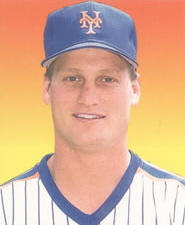
Jeromy Burnitz, in a baseball card photo taken before he was a two-time former Met.
Jeromy Neal Burnitz was the Mets' first round pick in the 1990 June amateur draft. Burnitz was selected 17th overall, three picks ahead of 270-game winner Mike Mussina. After splitting time between Pittsfield and St. Lucie in 1990, Burnitz had a stellar season at AA-Williamsport in 1991. Burnitz's first full minor league campaign resulted in the Eastern League's first 30-30 season, as the outfielder hit 31 home runs and stole 31 bases for the Bills. The Mets took notice of their young star's performance, honoring him with a Doubleday Award.
Burnitz was promoted to AAA-Tidewater in 1992, but saw a sharp decrease in his power numbers. The outfielder managed to hit only eight home runs in 121 games for the Tides, just one year after slamming nearly four times that amount at the Double-A level. In 1993, Burnitz found himself once again at Tidewater, hitting .227 with eight home runs in 65 games. But the Mets were having a rough time settling on a regular centerfielder, as Ryan Thompson, Joe Orsulak, Dave Gallagher and Darrin Jackson had all started at least ten games at the position before spring turned to summer. As a result, Burnitz was called up to the Mets on June 21. Eight days later, he let the world know he had arrived.
On June 29, the Mets won an extra-inning slugfest against the Florida Marlins, coming from behind to win, 10-9. Burnitz went 3-for-5 in the game with two doubles and a home run. He tied the game in the third inning with his first big league home run. Four innings later, Burnitz laced an RBI double to give the Mets a temporary two-run lead. Finally, in the 12th, Burnitz led off the inning with a long double and scored the eventual winning run on a sacrifice fly.
After smoking the Marlins in late June, Burnitz continued to scorch the rest of the National League in the month of July. In his first ten games in July, Burnitz hit .355 with three homers and 10 RBIs. But as great as he was in July, Burnitz saved his best game for August.
In a game against the Montreal Expos on August 5, Burnitz became the first Mets rookie (and sixth Met overall) to drive in seven runs in a game. Burnitz rapped an RBI single in the first and a grand slam in the fifth to give the Mets a seemingly insurmountable 9-1 lead. By the end of the sixth, the lead had evaporated, as three Mets pitchers combined to allow eight runs. The game remained tied until the 13th inning, when Joe Orsulak drove in the go-ahead run with a single and Burnitz added two insurance runs - his sixth and seventh RBIs of the game - with a double down the right field line. The Mets went on to win the game, 12-9. Burnitz's record-setting performance was accomplished off two of the best pitchers of the era, as his seven RBIs came against Dennis Martinez (245 career wins) and John Wetteland (330 lifetime saves).
Burnitz finished the season strongly, with a .260/.383/.506 slash line in September, collecting nine extra-base hits, scoring 15 runs and driving in ten. Burnitz only had 263 at-bats for the Mets in 1993, but they were quite productive, as he picked up ten doubles, six triples and 13 homers. He also scored 49 runs and had 38 RBIs, making it easy to overlook his .243 batting average. For all the promise Burnitz showed in 1993, he failed miserably one year later. And his disciplinarian manager was not amused.
Jeromy Burnitz was a hothead. So was his manager, Dallas Green. Something had to give, especially after Burnitz lost his temper during a poor spring training at-bat. When Burnitz was hitting .192 after the season's first month, something finally did give. Burnitz was sent back to the minors, less than a year after bursting onto the major league scene.
With Norfolk, Burnitz continued to hit with power (15 doubles, five triples, 14 homers) but maintained a low batting average (.239). After over two months at Norfolk, Burnitz was finally recalled on July 22. Three weeks later, Major League Baseball was shut down by a players' strike, but not before Burnitz got to play in 18 games. He continued to be an enigma at the plate, hitting a more respectable .292, but did so without hitting a home run and striking out 19 times in 65 at-bats.
By November, Burnitz had finally found a way out of Dallas Green's doghouse, as the former first round pick was traded to the Cleveland Indians for pitchers Paul Byrd, Jerry DiPoto and Dave Mlicki. Byrd and DiPoto were both ex-Mets by 1997, while Mlicki hung around until 1998 (one year after famously shutting out the Yankees in the first-ever regular season game between the two New York teams). Meanwhile, Burnitz was just getting started.
Burnitz only had seven at-bats with the Indians in 1995, as he spent the majority of the year in the minors. In 1996, Burnitz had trouble getting into the everyday lineup, collecting 128 at-bats for Cleveland. Of course, anyone would have had trouble cracking a lineup that featured outfielders Albert Belle, Kenny Lofton and Many Ramirez. Even the designated hitter position was occupied, as Cleveland was using Eddie Murray as their non-fielding batter.
With no definite position in Burnitz's immediate future, the Indians traded him to Milwaukee for six-time .300 hitter Kevin Seitzer. Seitzer played in 86 games with Cleveland before retiring after the 1997 campaign. Burnitz, on the other hand, went on to become one of the most feared power hitters in baseball.
After finishing out the 1996 season in Milwaukee, Burnitz had a true breakout year in 1997. In his first season as an everyday player, Burnitz set career highs across the board, batting .281 with 37 doubles, eight triples, 27 homers, 85 RBIs, 85 runs scored and 20 stolen bases. Burnitz became the second player in Brewers history to achieve to 20 HR/20 SB season, joining future Hall of Famer Robin Yount, who hit 23 homers and stole 20 bases for Milwaukee in 1980. As great as Burnitz's season was in 1997, he improved upon it in 1998.
Burnitz was a one-man wrecking crew in his second full season in Milwaukee. On a team in which no other player hit more than 16 homers or surpassed 68 RBIs, Burnitz had himself a 38 HR, 125 RBI campaign. At the time, the 38 home runs represented the fourth-highest single-season total in Brewers' history and the 125 RBIs were one short of Cecil Cooper's team record of 126 RBIs, which he set in 1983. Burnitz also became the eighth Brewer to amass 300 total bases in a single season, joining Robin Yount, Cecil Cooper, Ben Oglivie, Paul Molitor, George Scott, Tommy Harper and Gorman Thomas. As great as his season was, perhaps nothing satisfied Burnitz more than when he homered off Dave Mlicki - one of the players for whom he was traded - in his first career at-bat against the Mets.
Dave Mlicki might have been able to shut out the Yankees, but he couldn't shut down Jeromy Burnitz.
In 1999, Burnitz finally got some much-needed help in the lineup, as three of his teammates (Dave Nilsson, Geoff Jenkins, Marquis Grissom) reached the 20-HR mark. Burnitz finished the year with a .270 batting average, 33 doubles, 33 homers, 103 RBIs and 91 walks. The better plate discipline - which he never had as a Met, much to Dallas Green's dismay - helped Burnitz achieve a .400 on-base percentage for the first time in his career.
It was more of the same for Burnitz over the next two seasons, as his 2000 campaign (29 doubles, 31 homers, 98 RBIs, 91 runs scored, 99 walks) and 2001 season (32 doubles, 34 homers, 100 RBIs, 104 runs scored, 80 walks) were virtual mirror images of each other.
But after hitting .271 over his first three full seasons in Milwaukee, Burnitz experienced a steep decline in his batting average, combining to hit .242 in 2000 and 2001. The 2001 campaign would be Burnitz's last season in Milwaukee, as the Mets desperately needed to upgrade their offense and thought Burnitz would be part of the solution. If only they had bothered to notice the downward trend in his batting average.
Following the 2001 season, a year in which the Mets failed to defend their National League crown and needed a strong September to finish the year above .500, general manager Steve Phillips decided the team needed to go shopping. But with the Mets already trying to pare their lofty payroll, Phillips decided he would have to fix the team's deficiencies via the trade route rather than by signing free agents.
First, Phillips tried to pry John Smoltz away from the Braves to no avail. When that didn't pan out, Phillips focused squarely on upgrading the team's offense. By the time the calendar flipped to 2002, Roberto Alomar, Mo Vaughn and Roger Cedeño had been acquired by the Mets. The Mets then set their focus on acquiring one more big bat, doing so when they traded for Jeromy Burnitz. However, the cost for reacquiring the lefty slugger was steep, as the Mets lost Lenny Harris, Glendon Rusch, Benny Agbayani and Todd Zeile in the three-team deal.
The Mets were surprisingly competitive over the first four months of the 2002 season. Heading into August, the team was in second place in the NL East with a 55-51 record, leaving them a reachable 4½ games behind the wild card-leading Dodgers. The Mets were winning despite not having typical seasons by Alomar, Vaughn and Cedeño. But the one new addition who really underachieved to the point of having an awful season was Jeromy Burnitz.
Second verse, same as the first.
After reaching the 30-HR mark in each of his previous four seasons, Burnitz failed to hit 20 home runs for the Mets. His batting average, which had already begun to drop during his last two seasons in Milwaukee, plummeted in 2002. Burnitz struggled to stay above .200 all year and was drawing fewer walks than he did as a Brewer. During the Mets' season-changing 12-game losing streak in August, Burnitz managed only three hits and struck out in 40% of his at-bats. The Mets fell to last place for the first time since 1993, with Burnitz finishing the year with a .215 batting average, 15 doubles, 19 homers and 54 RBIs. The Mets began the 2003 season as poorly as they finished in 2002. By May 13, New York was already ten games behind Atlanta and seven games behind Montreal for the wild card. One month later, Steve Phillips was relieved of his duties, replaced by Jim Duquette. By the end of June, it was clear that the Mets were not going to compete for a playoff spot, as the team was buried in the NL East cellar. As a result, Duquette decided to restock the team's farm system by trading off its high-priced players. One of the casualties was Jeromy Burnitz. After an immensely disappointing season in 2002, Burnitz had actually earned some trade value during the first half of the 2003 campaign. Burnitz missed a month of action due to a broken hand caused by an errant Billy Wagner fastball, but once he returned on May 23, he started to tear the cover off the ball.
In his first nine games after returning from the disabled list, Burnitz hit .412 with four homers and 13 RBIs. By June 1, Burnitz had his batting average up to a season-high .324. Burnitz had another hot streak shortly before the All-Star Break, driving in at least one run in seven consecutive games from July 2 to July 9. One week later, Burnitz was gone, as Duquette jettisoned the outfielder to Los Angeles for three prospects, including Victor Diaz.
Burnitz's first-half totals with the Mets were excellent (.274, 18 doubles, 18 HR, 45 RBIs in only 65 games). With the Dodgers, Burnitz regressed, batting .204 with only four doubles, 13 HR and 32 RBIs in 61 games. Needless to say, the Dodgers let Burnitz leave as a free agent at the end of the 2003 season.
Now in his mid-thirties, Burnitz was hoping another team would give him a shot to prove that he could still play at a high level. He did get that shot, and it came with a team that was used to playing at a high level.
Would this be called a "Mile-High Five"?
The Colorado Rockies took a chance on Burnitz, signing him to a one-year deal to play in the Mile High City in 2004. Burnitz rewarded them immediately, batting .302 with 16 homers and 46 RBIs in his first 53 games. Burnitz saved his best month for July, when he had an incredible .360/.424/.809 slash line. During the month, Burnitz collected eight doubles, one triple, 10 homers and 27 RBIs despite starting only 22 games. His renaissance season saw Burnitz finish the year with a career-high .283 batting average. He also hit 30 doubles and 37 home runs, while driving in 110 runs and scoring 94 times.
Despite his phenomenal season, Colorado declined to pick up Burnitz's option for the 2005 campaign, allowing the slugger to become a free agent. Burnitz almost signed with Colorado's division rival in Arizona, agreeing in principle to a two-year deal with the Diamondbacks. But that deal was pulled from the table after Arizona completed a three-team trade with the Dodgers and Yankees that made Shawn Green their new rightfielder. The deal also sent Randy Johnson to the Yankees, while the Yankees shipped Javier Vazquez to the Dodgers. Although he was disappointed that he had just lost the security of a multi-year contract, Burnitz continued to look for a new team and finally found one when the Chicago Cubs signed him to a one-year, $4.5 million deal with a $7 million option for a second year. But Burnitz was going into a pressure situation with the North Siders, as he was being asked to replace Cubs' icon Sammy Sosa in right field. Burnitz had a solid season for the Cubs, batting .258 with 31 doubles, 24 homers, 87 RBIs and 84 runs scored while playing in a team-high 160 games. But those numbers paled in comparison to Sosa, who averaged 48 HR and 123 RBIs from 1995 to 2004. As a result, the Cubs decided to buy out Burnitz for $500,000 rather than pick up his option for 2006, leaving Burnitz to become a free agent for the third straight year. Once again, Burnitz had a two-year deal on the table, this time with the Baltimore Orioles. But because of language in the contract that would allow Baltimore to take their time making the deal official, Burnitz decided to sign a one-year contract with the Pittsburgh Pirates with a second year option that would pay him the same amount of money as Baltimore's two-year deal. Ironically, the Orioles' executive who tried to negotiate the deal with Burnitz was Jim Duquette, who only two years earlier had traded Burnitz to the Dodgers while he was the Mets' general manager. It's quite possible that one of the underlying reasons why Burnitz chose to pass on the deal with Baltimore was because of his relationship with the former Mets GM. Burnitz showed no love for his time with the Mets when he mentioned New York fans in a statement he made to reporters after failing to run out a ground ball in Pittsburgh.
"I apologize for that. It seems like I'd hit 20 balls in a row
like that, rollovers to first. The fact is, I went and looked at it,
and I had no chance. He would have thrown me out. But the effort that
they expect - and they jumped on me for it - I apologize if I don't
play hard enough. I have a reputation for playing hard. I
heard the boos. And I've heard 'em before. If I poke my head out of the
dugout in New York, there would be 40,000 of them. Loud, too."
If Burnitz didn't have love for New York, then he certainly couldn't have loved his time in Pittsburgh. After getting off to a slow start (.234, 8 HR, 26 RBI, .289 OBP in the team's first 50 games) and saying that manager Jim Tracy was forced to keep him in the everyday lineup because he was "Joe High-Paid Free Agent", Tracy decided to put Burnitz in a platoon with some of the Pirates' younger players.
As a result, Burnitz played in just 111 games, his lowest full-season total since becoming an everyday player with the Brewers in 1997. Burnitz finished the year with only 28 extra-base hits after averaging 29 doubles and 30 homers over the previous nine seasons. He also hit .230 and had a career-worst .289 on-base percentage, a number that was even lower than his OBP during his forgetful 2002 campaign with the Mets.
At season's end, Pittsburgh declined to pick up Burnitz's option for the 2007 season. This time, Burnitz was unable to find another suitor, causing him to retire from baseball at the age of 37.
Jeromy Burnitz was a five-tool player in the minor leagues who occasionally forgot to sharpen his fifth tool (batting average), while neglecting to use one of his other tools (speed). He was a 30-30 player as a Mets' farmhand, but surpassed seven stolen bases in the majors only twice in 14 seasons. The Mets never got the Burnitz they saw in the minor leagues and gave up on him two years into his major league career. Nearly a decade later, they gave him a second chance and once again, they decided to send him packing. Both times, Burnitz proved to the Mets that he was better off without them.
In 5½ years with Milwaukee, Burnitz became one of the Brewers' top power threats in franchise history. From 1997 to 2001, Burnitz averaged 32 doubles, 33 homers and 102 RBIs per season. His 125 RBIs in 1998 are more than any Met has ever achieved in 50-plus seasons (Mike Piazza and David Wright share the single-season franchise record with 124 RBIs). In 1997 and 1998, Burnitz received National League MVP votes and he was selected to represent the Brewers in the All-Star Game in 1999.
On a team that has had great hitters over the years (Robin Yount, Paul Molitor, Prince Fielder and Ryan Braun come to mind), Burnitz was able to crack Milwaukee's all-time top ten list in various offensive categories. He ranks among the team leaders in home runs (165; 9th in Brewers' history), walks (423; 8th), on-base percentage (.362; 7th), slugging percentage (.508; 4th) and OPS (.870; 4th). Burnitz's 525 RBIs as a Brewer had him in the top ten until recently, when both Prince Fielder and Ryan Braun passed him. Burnitz was also the first Brewer in team history to hit 30 or more home runs in four consecutive seasons, accomplishing the feat from 1998 to 2001. All this from a player who never hit 20 home runs in a season for the Mets in parts of four years with the team.
Although Jeromy Burnitz accomplished many things as an individual (six 30-HR seasons, four 100-RBI campaigns), he always seemed to achieve them on teams that did not go on to great things. The Brewers finished with a losing record in each of his nearly six seasons in Milwaukee. All four Mets teams he played for (1993, 1994, 2002, 2003) finished below .500, as did the 2004 Rockies, 2005 Cubs and 2006 Pirates.
Burnitz never got to taste the postseason as a major league player and rarely got to experience a pennant race. Still, he finished his career with 315 home runs, nearly 300 doubles and just under 1,000 RBIs. It's not a career that he should be ashamed of.
The Mets gave up on Burnitz twice during his career. The first time, it was because the manager didn't like him and he was underachieving. The second time, it was because he had finally started to achieve but was now too expensive to keep around on a rebuilding team. Both times, Burnitz blossomed after the Mets let him go. And both times, the Mets became competitive within a few years of his departure. But despite the team's successes soon after Burnitz's dual departures, the Mets have been missing one thing - a regular rightfielder. Darryl Strawberry left the Mets as a free agent following the 1990 season. Burnitz made his debut three years later, and spent parts of four seasons in New York during his two tours of duty with the team. In those four seasons, Burnitz started 262 games in right field. Believe it or not, that's more games than any Met has started in right field since the Straw Man's departure. The only other Mets to start more than 200 games in right field since 1990 are Bobby Bonilla (226 starts) and Butch Huskey (202 starts). Strawberry started 1,064 games in right field during his eight years as a Met. That's just 48 more starts than Jeromy Burnitz had as a rightfielder for the other teams he played for during his career. Perhaps the Mets shouldn't have let go of Burnitz's booming bat. Perhaps he would have accomplished great things in New York. And perhaps the Mets wouldn't have gone into a seemingly endless cycle of searching for a regular rightfielder. But one thing is for certain. Both Burnitz and the Mets accomplished great things when they weren't married to each other. The double divorce, though not exactly amicable, was the best thing that could have happened to all the parties involved.
Now if only the Mets could stop playing musical chairs with the right field position...
Judging by these quotes, Jeromy Burnitz wasn't exactly cut out to handle the New York media.
Note: The Mets That Got Away
is a
thirteen-part weekly series that spotlights those Mets players who
established themselves as major leaguers in New York, only to become
stars after leaving town. For previous
installments, please click on the players' names below: