Showing posts with label Greg Prince. Show all posts

Saturday, July 15, 2017

Move Along, People! No Unicorn Score to See Here!


On Friday, the Mets defeated the Colorado Rockies by a final score of 14-2.  As blogfather, author and respected Unicorn Score researcher Greg Prince noted, it was the first time in the team's 56-year history that they had won a game by that exact score.  Hence, 14-2 is referred to as a Unicorn Score, which as defined by our fervent Faith and Fear friend is "a score by which the Mets win once and never again."

As of this writing, the fewest runs scored by the Mets in a Unicorn Score game is 11, which they accomplished on May 20, 1999 when they defeated the Milwaukee Brewers, 11-10.  Not only is that the only time in Mets history that the team has won a game by an 11-10 score, but that May 20 affair was the first of two games played by the Mets that day; a day in which Robin Ventura clubbed grand slams in each game, which made him the first - and still only - player in big league history to accomplish that feat.

In addition, the Mets have never won a game by a 12-11 score in franchise history.  That remains the fewest runs needed by New York to win a game by a Unicorn Score.  (They've lost two games by a 12-11 score, but like the numbers of ringzzzz the Yankees have, we don't care about those.)

But what about anti-Unicorn Scores?  Which scores are the most common in Mets history when the team has taken care of business and emerged victorious?  I'm glad you asked.  (Trust me, you asked.  I heard you through the screen.)

The most common score in a Mets victory - an anti-Unicorn Score, if you will - is not surprisingly, a low-scoring game that was decided by one run.  The Mets have won 291 games by the exact final score of 3-2.  In their 1969 championship season alone, the Mets won 11 games by that score.  Incredibly, the Mets have won at least one game by a 3-2 score in each of their first 55 seasons.  However, they have yet to win a 3-2 game in 2017.

There are two other scores that have resulted in happy recaps more than 200 times.  Those scores are 2-1 (Mets have won 247 games by that score) and 4-3 (241 of those).

Want more?  The most repeated final score in Mets victories that weren't decided by a single tally is 4-2.  New York has celebrated 182 of those identical wins.  And the team the Mets have beaten the most by the exact same final result?  That one is a surprise.  Despite never playing in the same division and thereby having fewer games scheduled against them than they would against N.L. East squads, the Mets have defeated the Cincinnati Reds 33 times by a 3-2 score.  All but one of those 3-2 victories happened from 1962 to 2002, as the Mets have only defeated the Reds once in the last 15 years by a 3-2 margin.

Blue and orange unicorns do exist.
In 2015, the Mets won a 14-9 game for the first time in team history, defeating the Rockies by that score.  That Unicorn Score lasted 24 hours, as the following day, the Mets beat Colorado by that twice-in-a-lifetime score.  Last night, the Mets put up another Unicorn Score against the Rockies in their 14-2 victory.  Perhaps this time around, they'll follow it up by winning with the most common anti-Unicorn Score of 3-2.  If they do, it would be the first time they've defeated anyone by that score this year.

As the saying goes, if you watch baseball long enough, you'll end up seeing something you've never seen before, like a Unicorn Score.  Or maybe you'll see something you've seen over 200 times before, like a 3-2 Mets victory.  I wonder what the team has in store for us tonight.


Saturday, May 7, 2016

Few Runs, Nine Innings, Lots of Minutes

While staying up until 1:41 AM this morning to watch the Mets drop yet another game at Petco Park, I noticed this question being asked on Twitter by a good friend of the Studious Metsimus posse, Jason Bornstein (you may follow him on Twitter by clicking on his handle, @DyHrdMET).  Mr. Bornstein was wondering...


As you know, @greg_prince, otherwise known as Greg Prince of Faith and Fear in Flushing fame and the author of the recently released book, "Amazin' Again", is a noted Mets historian and one of the go-to guys when it comes to obscure Mets facts.

Being the buttinski that I am, I joined the conversation and suggested a game that oddly enough is not an SNY classic - a 1-0 loss to the Colorado Rockies in 2012 that ended three hours and ten minutes after the first pitch was thrown.  And after doing some extra research, I can confirm that this is indeed the longest nine-inning, 1-0 game in Mets history.  It's also one of only four 1-0 nine-inning contests the Mets have participated in that made it to the three-hour mark.

But of course, last night the Mets did not lose by a 1-0 score.  After Mr. Bornstein's question made the rounds on Twitter, the Mets allowed a second and final run in their 2-0 defeat at the hands of the San Diego Padres.  Despite the low score, the game took exactly three hours to complete.  So I did more research (because like everyone else, that's how I spend my Saturday mornings and afternoons) and determined that it was just the 13th time in team history that the Mets needed three or more hours to play a nine-inning game in which they and their opponent combined for no more than two runs (i.e. a 1-0 or 2-0 final score).  The Mets have won five of the 13 games, taking two 1-0 decisions and three 2-0 affairs.  They've also lost two 1-0 games that lasted 3+ hours and dropped six others - including last night's contest - by a score of 2-0.

Here is a complete list of all the 3+ hour, nine-inning games involving the Mets in which the hours outnumbered the runs scored.  (You may click on the links in the final score column to see the full boxscores of each game.)


Opponent
Date
Final Score
Time of Game
vs. Philadelphia
Sept. 8, 2000
3:13
vs. Washington
Sept. 12, 2012
3:12
@ Florida
July 3, 2000
3:11
vs. NY Yankees
July 9, 2000
3:11
vs. Colorado
Aug. 23, 2012
3:10
@ Milwaukee
July 27, 2014
3:10
@ San Diego
May 17, 1988
3:07
vs. Montreal
May 3, 1987
3:06
vs. NY Yankees
May 15, 2014
3:04
vs. Tampa Bay
June 3, 2000
3:01
@ NY Yankees
June 15, 2007
3:01
vs. San Francisco
May 4, 2011
3:00
@ San Diego
May 6, 2016
3:00


It should be noted that the Mets' 2-0 victory over the Yankees on July 9, 2000 would have been the longest game on this list had the Mets needed to bat in the bottom of the ninth inning, which they didn't because the game was played at Shea Stadium.

Also of note, three of the 13 games were Subway Series matchups.  Those are the only interleague games on the list.  In addition, the Mets only played two low-run, nine-inning games in their first 38 seasons (from 1962 to 1999) that took a minimum of three hours to complete, but in their last 17 campaigns (from 2000 to 2016), a total of 11 such games have taken place, including last night's affair against the Padres.

Usually, Mets games that have been seemingly interminable have also been accompanied by tons of runs.  But in some rare instances, pitchers' duels have also taken their sweet time to complete.  Last night was the 13th time in club annals that the Mets participated in a game that featured no more than two runs and took at least three hours to complete.  And for viewers in the Eastern Time Zone, the game didn't end until 1:41 AM.

It was certainly a case where lots of zeroes on the scoreboard led to lots of zzzzzzz's in New York.


Sunday, April 3, 2016

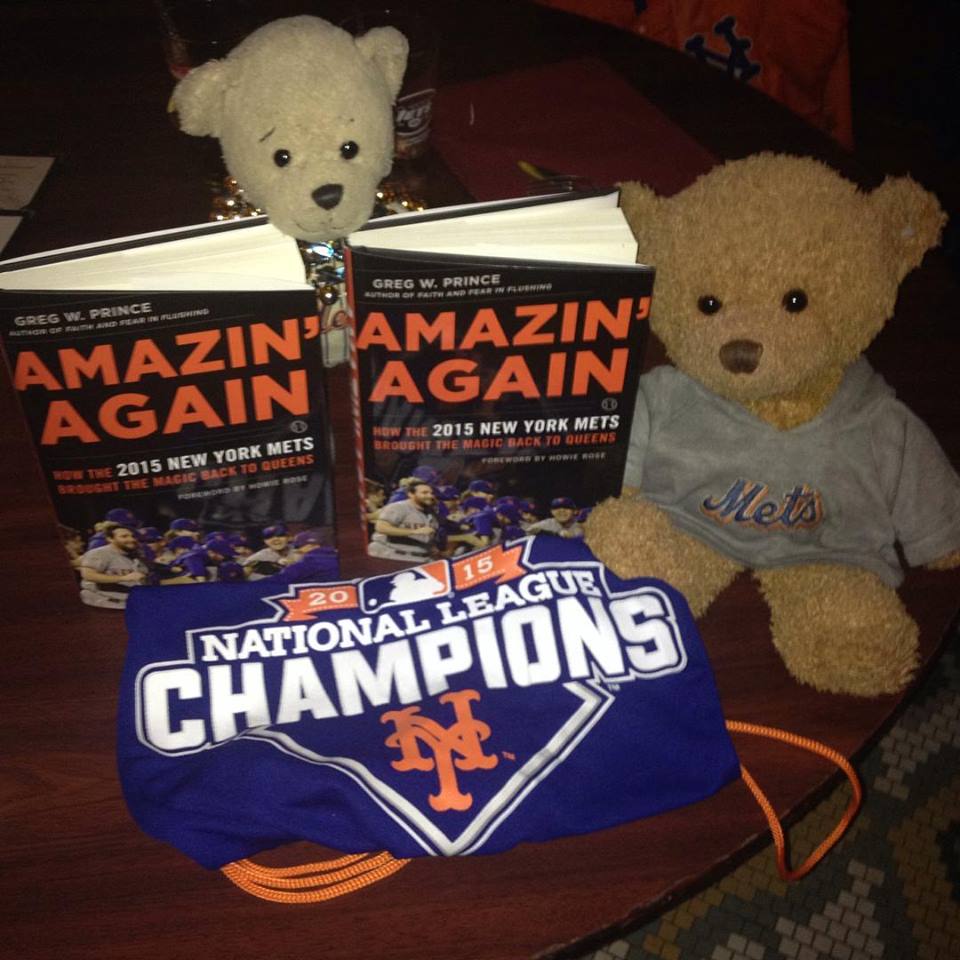
Bears On Books: Amazin' Again

Just like Mets baseball, your favorite bears who like to sit on books are back!

Happy Opening Day, everyone!  We're Joey and Iggy Beartran and we couldn't think of a more fitting way to celebrate the beginning of the 2016 campaign - a year the Mets open as defending National League champions - with a review of the book that gave us a happy recap of the previous season that the late Bob Murphy would be proud of.

Today, we'll be reviewing "Amazin' Again: How the 2015 New York Mets Brought the Magic Back to Queens" by Greg Prince.  It was a season Mets fans won't soon forget, just like this book is one Mets fans won't soon put down.

Mr. Prince, whose Faith and Fear in Flushing blog inspired the book of the same name and also laid down the blueprint for his second book, The Happiest Recap, wrote his latest work almost as quickly as it took the Mets to erase the Washington Nationals from the postseason picture.  But just because this wasn't a book that was painstakingly put together over a period of several years doesn't mean the quality suffers.  In fact, it's quite the contrary.

When Casey Stengel "perfessed" that the first words spoken by children in the 1960s had changed from "Mama" or "Papa" to "Metsie, Metsie, Metsie", he was clearly referring to Mr. Prince.  The foremost authority on all things Metsie could have written this book in one sitting and we'd believe it.  His love of the Mets permeates throughout the 215 pages dedicated to the 2015 pennant winners.

One thing that rivals Mr. Prince's love of the Mets is his love of the English language.  His pun-tastic wordplay is evident in each chapter, making a story every Mets fan remembers as if it occurred yesterday (or 155 yesterdays ago, if you want to be precise) seem fresh and new.

If a band performed at Citi Field in 2015, Mr. Prince would find a way to reference as many song titles into his review of the game that preceded each show.  Yes, this isn't just a by-the-numbers recap of the season (although numbers do find a way into the story in a way that non-mathophiles can enjoy).  Then again, it's to be expected that Mr. Prince would entertain you even when he's discussing the otherwise somber truth of the team's injury announcements.  You know, the ones that begin with "He's not going to throw today as scheduled" and end with "The Mets haven't yet announced whether they will wear a patch in his memory in 2016."

In an era where people's attention spans get shorter and shorter by the minute, it didn't take too many 60-second intervals to finish reading this book.  In fact, we devoured page after page as if they were bacon on a stick and were done with Amazin' Again less than 36 hours after we started, or about 36 hours longer than the Cubs held a lead in the National League Championship Series.  (And just wait till you get to the chapter on the NLCS.  It's totally Murphalicious.)

So as you get ready for the 2016 campaign with the memorable 2015 campaign still visible in your rear view mirror, take time out to read a wonderful work dedicated to that most recently completed campaign.  Don't be surprised if you end up shedding tears of joy after finishing Mr. Prince's book (even if you weren't just traded for Carlos Gomez).

As the subtitle of Amazin' Again says, the Mets brought the magic back to Queens.  And Mr. Prince certainly brought the magic back into our minds with his amazin' book.  We give it two very enthusiastic paws up.

Amazin' Again was so well-written, we may just have to read it again.

Thursday, April 25, 2013

Bears On Books: The Happiest Recap, Vol. 1

We're bears, and we're on books.  Get it?

Hi, everyone!  We're Joey and Iggy Beartran, and we'd like to welcome you to the premiere edition of Bears On Books.  Today, we'll be giving you our review of the first volume of "The Happiest Recap" by Greg Prince.  (Or to be exact, it's a review of "The Happiest Recap: 50 Years of the New York Mets As Told in 500 Amazin' Wins, Volume 1 - First Base: 1962-1973".  But we like the abridged title because we're more into the brevity thing.)

The Happiest Recap began as a series on Faith and Fear In Flushing in 2011.  The series recapped the best Game 1s, Game 2s, Game 3s, etc. in Mets history.  For the book version of "The Happiest Recap", Mr. Prince employed a double switch and inserted the best games in Mets history, regardless of which game it was on the schedule.  (Don't worry.  The Tim Harkness game was not double switched out of the book.  If you don't know what we're referring to, just ask Harkness or Jim Hickman or Mike Jorgensen or Tim Teufel or Kevin McReynolds or Jordany Valdespin.  We're sure they'll be glad to clarify things for you.)

In the first book of the four-volume series, Mr. Prince tackled 127 games from the team's first dozen seasons that resulted in happy recaps.  In other words, the team went a perfect 127-0 in those games.  From the team's seminal days in the Polo Grounds (#SLAMWATCH  #TimHarkness) to the advent of the state-of-the-art facility known as Shea Stadium to Look Who's No. 1 to Ya Gotta Believe (and the resignation of vice president Spiro Agnew), Mr. Prince has all the bases covered.

As always, Mr. Prince paints a colorful picture using the pages of his book as the canvas.  His mutual mastery of the English language and the language of the Mets is evident throughout the book.  And his frequent clever wordplay will bring a smile to your face faster than you can say "bring on Rod Stupid!" (For more on that, feel free to flip to Game No. 82 in the book.)

Do you need an example of Mr. Prince's clever wordplay?  You know you do.  And here it is, courtesy of Game No. 83 and Tommie Agee's glove (also known as the third game of the 1969 World Series).

"Tommie Agee made one of the most incredible catches in World Series history.  Then, just as remarkably, he maintained its integrity by gripping the ball in his glove's webbing.  From the Upper Deck, it looked like the most delightful scoop of vanilla a counterman ever served up at a Baskin-Robbins.  Tommie Agee kept 56,335 who screamed for the Mets in very good humor."

Thanks to Tommie Agee's catch and Greg Prince's words, I'm now in the mood for Baskin-Robbins.

Mr. Prince has an incredible mind for all things Mets and he doesn't mind sharing that Metsian knowledge with all of his readers.  Fans young and old will enjoy reading about teams that were far worse than the Mets teams we've gotten used to seeing over the past four seasons.  Those early-to-mid '60s teams might have had poor records (and by poor, we mean they stink, stank, stunk - they stunk worse than Moises Alou's hands after he toughened them), but they were lovable.

And most important, they were ours.

Mr. Prince reminds us that winning wasn't everything for those early Mets teams.  But fortunately, they had just enough happy recaps in those first few seasons or else his first volume would have been nothing more than a pamphlet.

Sure, the Mets might go through some rough patches every now and then.  Sometimes every now and then lasts for nearly a decade.  But with writers like Mr. Prince finding memorable moments in otherwise dismal seasons, aren't you glad you've kept your fandom despite all the hiccups our team has gone through over their 50-plus years of existence?

If you haven't purchased the first volume of "The Happiest Recap", please take a trip to your nearest bookstore or just click here if you're afraid to go outside for fear of missing an inning or two of Matt Harvey's latest phenomenal outing.  Where else will you get recaps of 127 thrilling victories and short Mets history lessons on players who shoulda, woulda, coulda been stars, but instead ending up being Les Rohr and Dick Rusteck?

Karl Ehrhardt - the Mets' original Sign Man - held up a sign that said "THERE ARE NO WORDS" when the Mets wrapped up their first World Series championship in 1969.  Fortunately for us, there are plenty of words in Greg Prince's latest book, and those words show his unabashed love and passion for the New York Mets.  After you read "The Happiest Recap", we're sure you'll have plenty of loving and passionate words to describe his book as well.

We're Joey and Iggy Beartran and we give volume 1 of "The Happiest Recap" two paws up.  Way up.  Like Tommie Agee's home run in the Upper Deck of Shea Stadium up.  And yes, you can read about that shot in Game No. 57 in the book.  After all, the Mets won that game...


Saturday, November 19, 2011

Joey's Small Bites: Dodgers & Padres & Bears, Oh My! (Part Two: Petco Park Tour)

Howdy doody, fellow Mets fans!  This is Joey Beartran, taking a break from dreaming about chicken nachos at Citi Field (a dream I have daily during the offseason) to share my experiences with you on our recent trip to the National League ballparks in Southern California.

In part one of this two-part series, I discussed our tour of Dodger Stadium (which you can read for yourself by clicking here), where there is plenty of love for the Brooklyn Dodgers and Fred Wilpon's high school sweetheart (Sandy Koufax) and hero (Jackie Robinson), in addition to all the Gil Hodges memorabilia that should be at Citi Field.

Part two of the Studious Metsimus Southern California tour took us to Petco Park in beautiful San Diego.  The ballpark is visually stunning from the outside, but it is inside where the beauty fully comes out to play.  Let's take a look!

Everything is beautiful in San Diego, which is why I fit in so well.

Our tour guide took us into the ballpark behind home plate, up the staircase that is adjacent to a cascading waterfall (which was not on at the time - water conservation is important everywhere, my friends).  He explained that Petco Park has some of the widest concourses for fans in the major leagues and has the most plants found in any major league ballpark.  The plants were carefully selected because San Diego doesn't get much rain (approximately 10-15" of precipitation falls in San Diego annually, according to our tour guide), so only plants that can withstand drought were planted in and around the ballpark.

One of the great things about watching a game at Petco Park is that you can purchase a Standing Room Only ticket behind the last row of seats in the field level behind home plate.  The price of the ticket is only $5.  Compare that to the last row of seats behind home plate, which are $69 and only two feet in front of the Standing Room Only section, and you have the best bargain in the ballpark.  Of course, you might not be able to see high fly balls from that area (see photo below of the view from the Standing Room Only section), but no Padre can hit high fly balls anyway.

Ryan Ludwick led the 2011 Padres with 11 HR, meaning that you probably have a better chance of catching a baseball in the Standing Room Only area than you do in the outfield seats at Petco Park.

From the Standing Room Only area, we moved along the right field side of the ballpark, taking note of the Padres dugout as we walked to one of the unique aspects of the park - the Western Metal Supply Co. building.

Construction of Petco Park was delayed for two seasons because of the building, which has been declared a historic landmark in San Diego.  After a court hearing, it was determined that only the exterior of the building was considered a landmark, so the Padres were able to incorporate it into the ballpark, change and add things to the inside of the building, as long as they kept the exterior intact.  The Western Metal Supply Co. building now provides a unique viewing perspective in the left field corner.  (Here are the pics to prove it.  Among them is a photo that features my sister (Iggy Beartran) and Ballapeño, who is the mascot of the Padres' AA team, the San Antonio Missions.)


Inside the Western Metal Supply Co. building, you will find all the San Diego baseball history you can digest.  We're not just talking about the San Diego Padres major league franchise, which came into existence in 1969.  We're also talking about the San Diego Padres of the Pacific Coast League, which started play in 1936.

The minor league San Diego Padres team was most known for one teenaged player who went on to become one of the best hitters in the major leagues as a member of the Boston Red Sox.  Perhaps you've heard of this native San Diegan.  His name was Ted Williams.

The Splendid Splinter got his professional start in San Diego as a member of the PCL's Padres.

The Padres are very proud of their history, even though they've never won a World Series title in two trips to the Fall Classic.  The team has retired the numbers of five of their former players (Randy Jones, Steve Garvey, Dave Winfield, Tony Gwynn and Trevor Hoffman) and isn't shy to show off their love for these players.

All over the ballpark, you will see tributes to these great players, even though Winfield and Gwynn are the only two to make it to Cooperstown.  From a Tony Gwynn statue (more on that later) to a baseball jersey made out of baseball cards to glass-enclosed "lockers" dedicated to their legendary players, coaches and front office personnel, Petco Park has no shortage of tributes to those who gave their all for the Padres.


By the way, your eyes weren't deceiving you up there.  That really was Babe Ruth in a "Bustin' Babes" jersey.  When the man who never knew a hot dog he couldn't eat was a player, he was part of a barnstorming team that played a few games in San Diego.  That made the Bambino part of San Diego baseball history and got him a spot on their wall.  See, I wasn't kidding when I said San Diego is proud of their baseball history!

Speaking of "never knowing a hot dog he couldn't eat", by this point in the tour, I was getting a little hungry (like you weren't expecting me to say that eventually), but I was disappointed that just like in the Dodger Stadium tour, the concession stands weren't open for business.  It's too bad because I really wanted to try one of their famous Friar Franks.  (Keeping the concession stands closed was not suh-WEET in my book.)  At least they have all-you-can-eat seats, so I'll definitely be making a trip back to Petco Park when there are games to be played.


After the Western Metal Supply Co. building and closed concession stand tour, we went back into the ballpark to check out the press box, suites and lounges (where were large and had great menus, but not unlike any we've ever seen before).  On the way there, we stopped at the Padres Hall of Fame Bar and Grill and noticed a couple of interesting jerseys that belonged to two former Padres.  However, the two uniforms did not have "San Diego" or "Padres" written across the front.

They were the WBC jerseys of former Met (and a Padre for one season) Mike Piazza and former Padre Adrian Gonzalez.  Piazza wore No. 31 as a coach for Team Italy in the 2009 World Baseball Classic, while Gonzalez wore No. 23 for Team Mexico.  The jerseys were there because both players suited up for the Padres at one time and because several of the WBC games were played at Petco Park.  (Ballapeño clearly has a fav'rit player, according to the photos below.)


From there, it was time to get some on-field action.  The tour guide was quite informative when telling us about the special advantages the Padres have on the field.  For example, the Padres' home dugout is 57 feet long and the bench in front of the dugout fences has a back for players and coaches to lean back on while they're sitting on it.  The visiting team's dugout is only 46 feet long and the bench in front of their dugout fence has no back for leaning purposes.  I suppose a player could lean back while sitting on that bench, but then he'd risk an injury, as the bench is a few feet above the dugout floor.  Of course, if it was a Mets player, it would cause him to miss the entire season.

In addition, the Padres have heaters and coolers in their dugout, while the visiting team has none.  Also, the Padres' bullpen is situated on grass behind the left field fence.  The road team has to warm up their pitchers on a makeshift mound in foul territory along the right field foul line, where they're subjected to the wrath (or what passes for wrath in laid-back San Diego) of the fans.  More importantly, members of the visiting team can be struck by screaming line drives that curve foul at the last moment.

I'm sure all that information is keeping you wide awake, but what you really want to see are the pictures of us on the field and in the dugout, right?  Without further ado, here they are!


Most of the time, the tour of the dugout and the field represents the end of the tour.  However, at Petco Park, there is much more to see!

Just beyond the center field fence is an area called "Park at the Park", which is open from sunrise to sunset on non-game days.  From there, you can go down a flight of steps (where the Petco Park center field bleacher seats are located) to an area that resembles a beach.  This is where kids can play during the game while their parents watch the action on the field.

Behind this seating area is a small park that contains a whiffle ball field (for kids and adults) and a statue of Mr. Padre himself, Tony Gwynn.  (See, I wasn't lying when I said "more on that later" ten paragraphs and 22 photos ago.)  We didn't take a photo of the homeless man sleeping behind the statue (or was it the San Diego chapter of "Occupy Wall Street", called "Occupy Tony Gwynn Drive"?) but we did get some great shots of the statue, beach and playing field.


Well, that about does it, Mets fans.  I hope you enjoyed our recap of the Studious Metsimus Southern California ballpark tour.  Both Dodger Stadium and Petco Park should be on your list of ballparks to visit whenever you want to make a trip to the West Coast to see the Mets play.  If you can't make it out to these cities during the baseball season, then I highly recommend taking the tours that we took.

At each park, the tour guides were informative, knew their team's history (unlike the tour guides at Citi Field - isn't that right, Mr. Prince?) and they didn't try to sell you suites (a la the Citi Field tour), making it a pleasurable experience for our entire staff.

Oh, one more thing before I sign off, since I know you were wondering.  Remember how I said none of the concession stands were open at Dodger Stadium and Petco Park?  Well, that part was true, but I did make a friend inside the Petco Park Team Store.  It wasn't edible, but the slice of Padres Pizza (see photo below) was a perfect ending to a fantastic Southern California baseball trip.

On behalf of Iggy Beartran and Ballapeño, I'm Joey Beartran, reminding you that it sometimes does rain in Southern California, but it should never dampen your feelings on the New York Mets.  Let's go Mets!

Hungry bears and a Padres pepperoni pizza pillow always go hand-in-hand!